International Research Journal of Engineering and Technology (IRJET) e-ISSN: 2395-0056
Volume: 09 Issue: 05 | May 2022 www.irjet.net p-ISSN: 2395-0072
© 2022, IRJET | Impact Factor value: 7.529 | ISO 9001:2008 Certified Journal | Page 1042
Automatic Room Lighting System
Mir Amjad Ali1, Mohammad Abdul Nabeel Hasnain2
1B.Tech Student, Department of Electronics and Computer Engineering, SNIST, Hyderabad.
2 B.E Student, Department of Electrical and Instrumentation Engineering, MJCET, Hyderabad.
---------------------------------------------------------------------***---------------------------------------------------------------------
Abstract - In this project, the Automatic Room Lights using
Arduino and PIR Sensor, where the lights in the room will
switch on and off automatically when a human enters the
room is made. Such Automatic Room Lights can be installed in
garages, stairwells, restrooms, and other areas where we do
not want continuous lighting but just when we are present.
Also, with the help of an automatic room light control system,
you won't have to worry about running out of electricity
because the lights will turn off automatically whennoone isin
the room.
So, in this DIY project, we used Arduino and a PIR Sensor to
construct Automatic Room Lights.
Key Words: Automatic Room Lights, Arduino and a PIR
Sensor.
1. OVERVIEW
The Automatic Room Lights System with Arduino is a highly
handy project since it eliminates the need to turn on and off
switches every time you want to turn on the lights. The
Arduino, PIR Sensor, and Relay Module are the primary
components of the Automatic Room Lights project.
The PIR Sensor is the focal point of the three components
because it is the primary device for detecting humans and
human motion.
In reality, the Automatic Room Lights project is a key use of
the PIR Sensor. A comparable principle is already in use in
automatic toilet flush valves, hand dryers, and other
products
Components Used in this project :
 Arduino UNO
 PIR Sensor
 Breadboard
 Relay 5V
 LDR – Light Dependent Resistor (photodiode )
 Resistor
 Bulb
 Power Supply
Fig:1 Construction and Output Image
International Research Journal of Engineering and Technology (IRJET) e-ISSN: 2395-0056
Volume: 09 Issue: 05 | May 2022 www.irjet.net p-ISSN: 2395-0072
© 2022, IRJET | Impact Factor value: 7.529 | ISO 9001:2008 Certified Journal | Page 1043
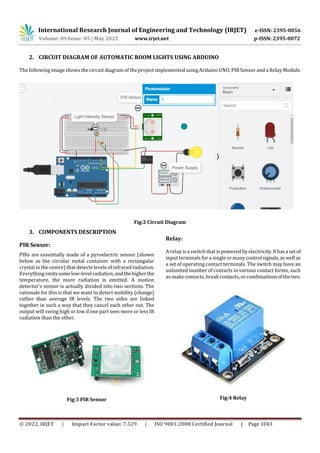
2. CIRCUIT DIAGRAM OF AUTOMATIC ROOM LIGHTS USING ARDUINO
The following image shows the circuit diagram of the project implemented using Arduino UNO, PIR Sensor and aRelayModule.
Fig:2 Circuit Diagram
3. COMPONENTS DESCRIPTION
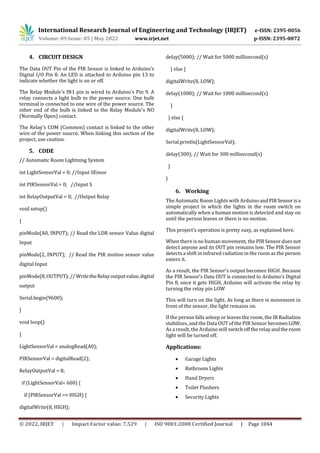
PIR Sensor:
PIRs are essentially made of a pyroelectric sensor (shown
below as the circular metal container with a rectangular
crystal in the centre) that detectslevels of infrared radiation.
Everything emitssomelow-levelradiation,andthehigherthe
temperature, the more radiation is emitted. A motion
detector's sensor is actually divided into two sections. The
rationale for this is that we want to detect mobility (change)
rather than average IR levels. The two sides are linked
together in such a way that they cancel each other out. The
output will swing high or low if one part sees more or less IR
radiation than the other.
Fig:3 PIR Sensor Fig:4 Relay
Relay:
A relay is a switch that is powered by electricity.Ithasasetof
input terminals for a single ormanycontrolsignals,aswellas
a set of operating contact terminals. The switch may have an
unlimited number of contacts in various contact forms, such
as make contacts, break contacts, or combinationsofthetwo.
International Research Journal of Engineering and Technology (IRJET) e-ISSN: 2395-0056
Volume: 09 Issue: 05 | May 2022 www.irjet.net p-ISSN: 2395-0072
© 2022, IRJET | Impact Factor value: 7.529 | ISO 9001:2008 Certified Journal | Page 1044
4. CIRCUIT DESIGN
The Data OUT Pin of the PIR Sensor is linked to Arduino's
Digital I/O Pin 8. An LED is attached to Arduino pin 13 to
indicate whether the light is on or off.
The Relay Module's IN1 pin is wired to Arduino's Pin 9. A
relay connects a light bulb to the power source. One bulb
terminal is connected to one wire of the power source. The
other end of the bulb is linked to the Relay Module's NO
(Normally Open) contact.
The Relay's COM (Common) contact is linked to the other
wire of the power source. When linking this section of the
project, use caution.
5. CODE
// Automatic Room Lightning System
int LightSensorVal = 0; //Input SEnsor
int PIRSensorVal = 0; //Input S
int RelayOutputVal = 0; //Output Relay
void setup()
{
pinMode(A0, INPUT); // Read the LDR sensor Value digital
Input
pinMode(2, INPUT); // Read the PIR motion sensor value
digital Input
pinMode(8, OUTPUT);//WritetheRelayoutputvalue,digital
output
Serial.begin(9600);
}
void loop()
{
LightSensorVal = analogRead(A0);
PIRSensorVal = digitalRead(2);
RelayOutputVal = 8;
if (LightSensorVal< 600) {
if (PIRSensorVal == HIGH) {
digitalWrite(8, HIGH);
delay(5000); // Wait for 5000 millisecond(s)
} else {
digitalWrite(8, LOW);
delay(1000); // Wait for 1000 millisecond(s)
}
} else {
digitalWrite(8, LOW);
Serial.println(LightSensorVal);
delay(300); // Wait for 300 millisecond(s)
}
}
6. Working
The Automatic Room Lights with Arduino andPIRSensorisa
simple project in which the lights in the room switch on
automatically when a human motion is detected and stay on
until the person leaves or there is no motion.
This project's operation is pretty easy, as explained here.
When there is no human movement, the PIR Sensor does not
detect anyone and its OUT pin remains low. The PIR Sensor
detects a shift in infrared radiation in the room as the person
enters it.
As a result, the PIR Sensor's output becomes HIGH. Because
the PIR Sensor's Data OUT is connected to Arduino's Digital
Pin 8, once it gets HIGH, Arduino will activate the relay by
turning the relay pin LOW
This will turn on the light. As long as there is movement in
front of the sensor, the light remains on.
If the person falls asleep or leaves the room, the IR Radiation
stabilizes, and the Data OUT of the PIR Sensor becomesLOW.
As a result, the Arduino will switch off the relay andtheroom
light will be turned off.
Applications:
 Garage Lights
 Bathroom Lights
 Hand Dryers
 Toilet Flushers
 Security Lights
International Research Journal of Engineering and Technology (IRJET) e-ISSN: 2395-0056
Volume: 09 Issue: 05 | May 2022 www.irjet.net p-ISSN: 2395-0072
© 2022, IRJET | Impact Factor value: 7.529 | ISO 9001:2008 Certified Journal | Page 1045
REFERENCES
[1]. TinkercadArduino Tutorials:Tutorials:AutomaticRoom
Lightning System
[2].http://education.rec.ri.cmu.edu/content/electronics/boe
/ir _sensor/1.html
[3] Automatic Room Light Controller with bidirectional
visitor counter | VOL-I Issue-4| ISSN: 2395-4841
.http://www.ijictrd.net/papers/IJICTRDV1I4005.pdf
[4].http://www.digchip.com/datasheets/parts/datasheet/1
05/ CL100-pdf.php
[5].http://www.datasheetarchive.com/dlmain/Datasheets3
12/174867.pdf
[6].https://www.fairchildsemi.com/datasheets/LM/LM7805
. pdf
[7] www.ijictrd.net
[8] www.slideshare.net
[9] lib.chipresistor.ru
BIOGRAPHIES
Mir Amjad Ali is a B.Tech Student,
Department of Electronics and
Computer Engineering, Sreenidhi
Institute of Science & Technology,
Hyderabad.
Mail id: rehan1136ali@gmail.com
Mohammad Abdul Nabeel Hasnain
is a B.E Student, Department of
Electrical and Instrumentation
Engineering, Muffakham Jah
College of Engineering and
Technology, Hyderabad.
Mail id: hasnainabeel@gmail.com

Automatic Room Lighting System

  • 1.
    International Research Journalof Engineering and Technology (IRJET) e-ISSN: 2395-0056 Volume: 09 Issue: 05 | May 2022 www.irjet.net p-ISSN: 2395-0072 © 2022, IRJET | Impact Factor value: 7.529 | ISO 9001:2008 Certified Journal | Page 1042 Automatic Room Lighting System Mir Amjad Ali1, Mohammad Abdul Nabeel Hasnain2 1B.Tech Student, Department of Electronics and Computer Engineering, SNIST, Hyderabad. 2 B.E Student, Department of Electrical and Instrumentation Engineering, MJCET, Hyderabad. ---------------------------------------------------------------------***--------------------------------------------------------------------- Abstract - In this project, the Automatic Room Lights using Arduino and PIR Sensor, where the lights in the room will switch on and off automatically when a human enters the room is made. Such Automatic Room Lights can be installed in garages, stairwells, restrooms, and other areas where we do not want continuous lighting but just when we are present. Also, with the help of an automatic room light control system, you won't have to worry about running out of electricity because the lights will turn off automatically whennoone isin the room. So, in this DIY project, we used Arduino and a PIR Sensor to construct Automatic Room Lights. Key Words: Automatic Room Lights, Arduino and a PIR Sensor. 1. OVERVIEW The Automatic Room Lights System with Arduino is a highly handy project since it eliminates the need to turn on and off switches every time you want to turn on the lights. The Arduino, PIR Sensor, and Relay Module are the primary components of the Automatic Room Lights project. The PIR Sensor is the focal point of the three components because it is the primary device for detecting humans and human motion. In reality, the Automatic Room Lights project is a key use of the PIR Sensor. A comparable principle is already in use in automatic toilet flush valves, hand dryers, and other products Components Used in this project :  Arduino UNO  PIR Sensor  Breadboard  Relay 5V  LDR – Light Dependent Resistor (photodiode )  Resistor  Bulb  Power Supply Fig:1 Construction and Output Image
  • 2.
    International Research Journalof Engineering and Technology (IRJET) e-ISSN: 2395-0056 Volume: 09 Issue: 05 | May 2022 www.irjet.net p-ISSN: 2395-0072 © 2022, IRJET | Impact Factor value: 7.529 | ISO 9001:2008 Certified Journal | Page 1043 2. CIRCUIT DIAGRAM OF AUTOMATIC ROOM LIGHTS USING ARDUINO The following image shows the circuit diagram of the project implemented using Arduino UNO, PIR Sensor and aRelayModule. Fig:2 Circuit Diagram 3. COMPONENTS DESCRIPTION PIR Sensor: PIRs are essentially made of a pyroelectric sensor (shown below as the circular metal container with a rectangular crystal in the centre) that detectslevels of infrared radiation. Everything emitssomelow-levelradiation,andthehigherthe temperature, the more radiation is emitted. A motion detector's sensor is actually divided into two sections. The rationale for this is that we want to detect mobility (change) rather than average IR levels. The two sides are linked together in such a way that they cancel each other out. The output will swing high or low if one part sees more or less IR radiation than the other. Fig:3 PIR Sensor Fig:4 Relay Relay: A relay is a switch that is powered by electricity.Ithasasetof input terminals for a single ormanycontrolsignals,aswellas a set of operating contact terminals. The switch may have an unlimited number of contacts in various contact forms, such as make contacts, break contacts, or combinationsofthetwo.
  • 3.
    International Research Journalof Engineering and Technology (IRJET) e-ISSN: 2395-0056 Volume: 09 Issue: 05 | May 2022 www.irjet.net p-ISSN: 2395-0072 © 2022, IRJET | Impact Factor value: 7.529 | ISO 9001:2008 Certified Journal | Page 1044 4. CIRCUIT DESIGN The Data OUT Pin of the PIR Sensor is linked to Arduino's Digital I/O Pin 8. An LED is attached to Arduino pin 13 to indicate whether the light is on or off. The Relay Module's IN1 pin is wired to Arduino's Pin 9. A relay connects a light bulb to the power source. One bulb terminal is connected to one wire of the power source. The other end of the bulb is linked to the Relay Module's NO (Normally Open) contact. The Relay's COM (Common) contact is linked to the other wire of the power source. When linking this section of the project, use caution. 5. CODE // Automatic Room Lightning System int LightSensorVal = 0; //Input SEnsor int PIRSensorVal = 0; //Input S int RelayOutputVal = 0; //Output Relay void setup() { pinMode(A0, INPUT); // Read the LDR sensor Value digital Input pinMode(2, INPUT); // Read the PIR motion sensor value digital Input pinMode(8, OUTPUT);//WritetheRelayoutputvalue,digital output Serial.begin(9600); } void loop() { LightSensorVal = analogRead(A0); PIRSensorVal = digitalRead(2); RelayOutputVal = 8; if (LightSensorVal< 600) { if (PIRSensorVal == HIGH) { digitalWrite(8, HIGH); delay(5000); // Wait for 5000 millisecond(s) } else { digitalWrite(8, LOW); delay(1000); // Wait for 1000 millisecond(s) } } else { digitalWrite(8, LOW); Serial.println(LightSensorVal); delay(300); // Wait for 300 millisecond(s) } } 6. Working The Automatic Room Lights with Arduino andPIRSensorisa simple project in which the lights in the room switch on automatically when a human motion is detected and stay on until the person leaves or there is no motion. This project's operation is pretty easy, as explained here. When there is no human movement, the PIR Sensor does not detect anyone and its OUT pin remains low. The PIR Sensor detects a shift in infrared radiation in the room as the person enters it. As a result, the PIR Sensor's output becomes HIGH. Because the PIR Sensor's Data OUT is connected to Arduino's Digital Pin 8, once it gets HIGH, Arduino will activate the relay by turning the relay pin LOW This will turn on the light. As long as there is movement in front of the sensor, the light remains on. If the person falls asleep or leaves the room, the IR Radiation stabilizes, and the Data OUT of the PIR Sensor becomesLOW. As a result, the Arduino will switch off the relay andtheroom light will be turned off. Applications:  Garage Lights  Bathroom Lights  Hand Dryers  Toilet Flushers  Security Lights
  • 4.
    International Research Journalof Engineering and Technology (IRJET) e-ISSN: 2395-0056 Volume: 09 Issue: 05 | May 2022 www.irjet.net p-ISSN: 2395-0072 © 2022, IRJET | Impact Factor value: 7.529 | ISO 9001:2008 Certified Journal | Page 1045 REFERENCES [1]. TinkercadArduino Tutorials:Tutorials:AutomaticRoom Lightning System [2].http://education.rec.ri.cmu.edu/content/electronics/boe /ir _sensor/1.html [3] Automatic Room Light Controller with bidirectional visitor counter | VOL-I Issue-4| ISSN: 2395-4841 .http://www.ijictrd.net/papers/IJICTRDV1I4005.pdf [4].http://www.digchip.com/datasheets/parts/datasheet/1 05/ CL100-pdf.php [5].http://www.datasheetarchive.com/dlmain/Datasheets3 12/174867.pdf [6].https://www.fairchildsemi.com/datasheets/LM/LM7805 . pdf [7] www.ijictrd.net [8] www.slideshare.net [9] lib.chipresistor.ru BIOGRAPHIES Mir Amjad Ali is a B.Tech Student, Department of Electronics and Computer Engineering, Sreenidhi Institute of Science & Technology, Hyderabad. Mail id: rehan1136ali@gmail.com Mohammad Abdul Nabeel Hasnain is a B.E Student, Department of Electrical and Instrumentation Engineering, Muffakham Jah College of Engineering and Technology, Hyderabad. Mail id: hasnainabeel@gmail.com