IPC PROJECT
AUTOMATIC ROOM
LIGHTENING SYSTEM
TEACHER-PROF. MADHURI KULKARNI
GROUP MEMBER- PRASAD SALUNKHE (119A4017)
SIDDHI BEDARKAR (220A4028)
RUCHA BORWADE (220A4031)
Tremendousadvancementintechnologyissucceededin
lastfewyears.Inrecentyearsthepeoplearelooking
forwardfortheautomationintheirdaytodaylife.Thenhow
thisautomationinroomlightingcanfarawayfromthat..??
Forsavingelectricalenergyandtowardsmorecomfortlife,
thisprojectwillhelpus.
1.Introduction
2.Components used
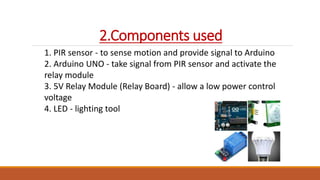
1. PIR sensor - to sense motion and provide signal to Arduino
2. Arduino UNO - take signal from PIR sensor and activate the
relay module
3. 5V Relay Module (Relay Board) - allow a low power control
voltage
4. LED - lighting tool
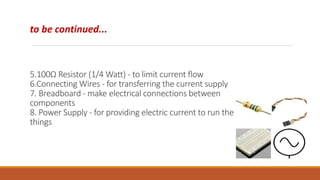
5.100Ω Resistor (1/4 Watt) - to limit current flow
6.Connecting Wires - for transferring the current supply
7. Breadboard - make electrical connections between
components
8. Power Supply - for providing electric current to run the
things
to be continued...
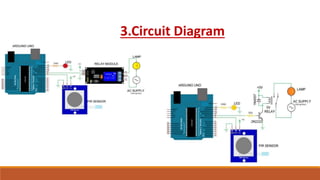
3.Circuit Diagram
4.Working Principle
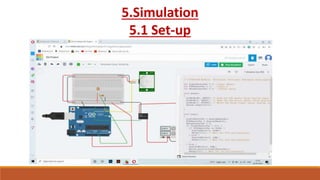
5.Simulation
5.1 Set-up
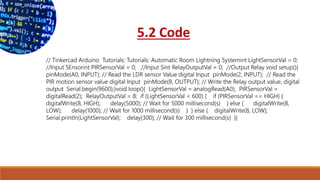
// Tinkercad Arduino Tutorials: Tutorials: Automatic Room Lightning Systemint LightSensorVal = 0;
//Input SEnsorint PIRSensorVal = 0; //Input Sint RelayOutputVal = 0; //Output Relay void setup(){
pinMode(A0, INPUT); // Read the LDR sensor Value digital Input pinMode(2, INPUT); // Read the
PIR motion sensor value digital Input pinMode(8, OUTPUT); // Write the Relay output value, digital
output Serial.begin(9600);}void loop(){ LightSensorVal = analogRead(A0); PIRSensorVal =
digitalRead(2); RelayOutputVal = 8; if (LightSensorVal < 600) { if (PIRSensorVal == HIGH) {
digitalWrite(8, HIGH); delay(5000); // Wait for 5000 millisecond(s) } else { digitalWrite(8,
LOW); delay(1000); // Wait for 1000 millisecond(s) } } else { digitalWrite(8, LOW);
Serial.println(LightSensorVal); delay(300); // Wait for 300 millisecond(s) }}
5.2 Code
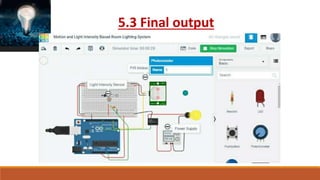
5.3 Final output
• Lamp will turn on if any moment detected by PIR sensor.
• Lamp will remain off if there is no any moment detected
by PIR sensor.
6. Results
A few applications of the
Automatic Room Lights
concept. Some of them are: 1.
Garage Lights
2. Bathroom Lights
3. Hand Dryers
4. Toilet Flushers
5. Security Lightsroom
7. Applications
8.Cost estimation
Components Cost
Arduino UNO ₹ 550/-
PIR sensor ₹55 - ₹65/-
Single-Channel Relay Module ₹45 - ₹50/-
Other expenses (cost of led, resistor,
connecting wire, power supply)
₹ 30/-
Total ₹₹ 690/-
• In this project, we saw the where the lights in the room will automatically
turn ON and OFF by detecting the presence of a human.
• Means when there is need only then and there light will be present.
• Hence minimise the wastage of electrical power, and saving the energy.
9.Conclusion
Thank you..!!

automatic room lightening system