Download free for 30 days
Sign in
Upload
Language (EN)
Support
Business
Mobile
Social Media
Marketing
Technology
Art & Photos
Career
Design
Education
Presentations & Public Speaking
Government & Nonprofit
Healthcare
Internet
Law
Leadership & Management
Automotive
Engineering
Software
Recruiting & HR
Retail
Sales
Services
Science
Small Business & Entrepreneurship
Food
Environment
Economy & Finance
Data & Analytics
Investor Relations
Sports
Spiritual
News & Politics
Travel
Self Improvement
Real Estate
Entertainment & Humor
Health & Medicine
Devices & Hardware
Lifestyle
Change Language
Language
English
Español
Português
Français
Deutsche
Cancel
Save
Submit search
EN
Uploaded by
foxel54542
PPTX, PDF
24 views
Project ECE Light Automation with Motion Sensor.pptx
Light Automation with Motion Sensor
Engineering
◦
Read more
0
Save
Share
Embed
Embed presentation
Download
Download to read offline
1
/ 7
2
/ 7
Most read
3
/ 7
4
/ 7
Most read
5
/ 7
6
/ 7
Most read
7
/ 7
More Related Content
PPTX
Lighting sensors and its importance
by
Zeel Shah
PDF
The science of light sensors
by
Jozhe Fonseca
PPTX
Iot proposal presentation base system an
by
imthathimran659
PDF
DESIGN OF AN INTELLIGENT AND EFFICIENT LIGHT CONTROL SYSTEM
by
Editor IJCATR
PPTX
Automatic room light controller using aurdino
by
AakashGupta889590
PDF
GU10 Motion Sensor Spotlights How They Work & Best Uses.pdf
by
Teco(Huizhou Henhui Electronics Technology Co., ltd.)
PPTX
Refined_Automatic_Room_Light_Controller.pptx
by
roshniyadav25122004j
PDF
IRJET- Intelligent Room Lighting System
by
IRJET Journal
Lighting sensors and its importance
by
Zeel Shah
The science of light sensors
by
Jozhe Fonseca
Iot proposal presentation base system an
by
imthathimran659
DESIGN OF AN INTELLIGENT AND EFFICIENT LIGHT CONTROL SYSTEM
by
Editor IJCATR
Automatic room light controller using aurdino
by
AakashGupta889590
GU10 Motion Sensor Spotlights How They Work & Best Uses.pdf
by
Teco(Huizhou Henhui Electronics Technology Co., ltd.)
Refined_Automatic_Room_Light_Controller.pptx
by
roshniyadav25122004j
IRJET- Intelligent Room Lighting System
by
IRJET Journal
Similar to Project ECE Light Automation with Motion Sensor.pptx
PPTX
automatic street light control using aurdino,PIR,LDR tinker cad circuit
by
anujabarge3
PPTX
motion sensor light using CD 4017 and IR sensor.pptx
by
SachinGoudar5
PPTX
ROOM LIGHT CONTROL SYSTEM PROJECT PRESENTATION BY BITAN DAS AND MADHURIMA BASU
by
Bitan Das
PPTX
CPR1 Title Defense Automatic Wash Room.pptx
by
RaquelGumpal2
PPTX
Natural light and artificial lighting
by
nitin boppanna
PPTX
AUTOMATIC ROOM LIGHTING SYSTEM.pptx
by
Aayush Sharma
PPT
Smart lighting solutions with motion sensors occupancy sensors pir sensors
by
Pammvi Group of Companies
PDF
PerfectSense Product Catalog
by
75F Building Intelligence
PPTX
automatic room lightening system
by
YashMatekar
PDF
Automatic Room Lighting System
by
IRJET Journal
PPT
Blaze Occupancy Sensors
by
automationsecurity
PDF
Energy-efficient Intelligent Street Lighting System
by
IRJET Journal
PDF
A REVIEW PAPER ON: IOT Based Library Light Management System
by
IRJET Journal
PDF
IRJET- Smart Light Intensity Management System
by
IRJET Journal
PDF
Msd office building design of intelligent lighting system
by
eSAT Journals
PPT
smartlightingsolutionswithmotionsensorsoccupancysensorspirsensors-10070701032...
by
KhadarAFarah
PDF
INNOVATIVE AND ENERGY EFFICIENT LIGHTING TECHNOLOGY
by
IRJET Journal
PDF
PerfectSenseCatalog
by
75F Building Intelligence
PPT
Blaze Occupancy Sensors
by
homeautomation
PDF
Discrete Solution.pdf
by
IbrahimPatehBah
automatic street light control using aurdino,PIR,LDR tinker cad circuit
by
anujabarge3
motion sensor light using CD 4017 and IR sensor.pptx
by
SachinGoudar5
ROOM LIGHT CONTROL SYSTEM PROJECT PRESENTATION BY BITAN DAS AND MADHURIMA BASU
by
Bitan Das
CPR1 Title Defense Automatic Wash Room.pptx
by
RaquelGumpal2
Natural light and artificial lighting
by
nitin boppanna
AUTOMATIC ROOM LIGHTING SYSTEM.pptx
by
Aayush Sharma
Smart lighting solutions with motion sensors occupancy sensors pir sensors
by
Pammvi Group of Companies
PerfectSense Product Catalog
by
75F Building Intelligence
automatic room lightening system
by
YashMatekar
Automatic Room Lighting System
by
IRJET Journal
Blaze Occupancy Sensors
by
automationsecurity
Energy-efficient Intelligent Street Lighting System
by
IRJET Journal
A REVIEW PAPER ON: IOT Based Library Light Management System
by
IRJET Journal
IRJET- Smart Light Intensity Management System
by
IRJET Journal
Msd office building design of intelligent lighting system
by
eSAT Journals
smartlightingsolutionswithmotionsensorsoccupancysensorspirsensors-10070701032...
by
KhadarAFarah
INNOVATIVE AND ENERGY EFFICIENT LIGHTING TECHNOLOGY
by
IRJET Journal
PerfectSenseCatalog
by
75F Building Intelligence
Blaze Occupancy Sensors
by
homeautomation
Discrete Solution.pdf
by
IbrahimPatehBah
Recently uploaded
PDF
Branches of AI – perception, reasoning, learning, and action.pdf
by
VyankateshBhaurkar1
PPTX
Power Circuit Breakers and Substations .pptx
by
JawadAmjad16
PDF
Finite Automata With Output - Moore and Mealy Machines definitions and Solved...
by
NileshPardeshi28
PDF
Deterministic Finite Automata to Regular Expression Conversion.pdf
by
NileshPardeshi28
PPTX
High Voltage Direct Current Circuit Breakers.pptx
by
JawadAmjad16
PPTX
Power Electronics_PE_lecture_10_presentation .pptx
by
kavitabani2
PPTX
HVAC_Design_Course_Mech_Engineering.pptx
by
sabermona665
PDF
BOE 2.1 Inch LCD 1600X1600 For VR AR Headset Smart Device
by
Syluxdisplay
PDF
Learn Linux in your Android Phone (Learn on the Go)
by
Narendran Solai Sridharan
PPTX
Hospital Management System Project- 220180107010.pptx
by
pravjo279
PDF
Foundations of AI and ML - Mechanical Engineering Perspectives.pdf
by
VyankateshBhaurkar1
PDF
EPC vs Reality: The Schedule That Was Never Possible
by
Ganesh Kumar
PDF
Java Programming core java and basics concepts
by
Harish Khodke
PPTX
CFP_Unit 5. Structure and Functions pptx
by
pawarbhaktiit
PPTX
analog communication part one lecture note
by
hirutfanta1212
PPTX
1.1 Structure of Materials_Material science.pptx
by
Dr. Sandip Thorat
PDF
graph graph graph theory Graph presentation .pdf
by
geekcooder2020
PPTX
review of transistor circuit and applications
by
sophieshuqinghuang
PPTX
Why Hydraulic Flushing Should Never Be Skipped Before Commissioning
by
Neometrix_Engineering_Pvt_Ltd
PPTX
Design and Development of Friction Stir Welding joints of Aluminium and Coppe...
by
NareshKumarSingh12
Branches of AI – perception, reasoning, learning, and action.pdf
by
VyankateshBhaurkar1
Power Circuit Breakers and Substations .pptx
by
JawadAmjad16
Finite Automata With Output - Moore and Mealy Machines definitions and Solved...
by
NileshPardeshi28
Deterministic Finite Automata to Regular Expression Conversion.pdf
by
NileshPardeshi28
High Voltage Direct Current Circuit Breakers.pptx
by
JawadAmjad16
Power Electronics_PE_lecture_10_presentation .pptx
by
kavitabani2
HVAC_Design_Course_Mech_Engineering.pptx
by
sabermona665
BOE 2.1 Inch LCD 1600X1600 For VR AR Headset Smart Device
by
Syluxdisplay
Learn Linux in your Android Phone (Learn on the Go)
by
Narendran Solai Sridharan
Hospital Management System Project- 220180107010.pptx
by
pravjo279
Foundations of AI and ML - Mechanical Engineering Perspectives.pdf
by
VyankateshBhaurkar1
EPC vs Reality: The Schedule That Was Never Possible
by
Ganesh Kumar
Java Programming core java and basics concepts
by
Harish Khodke
CFP_Unit 5. Structure and Functions pptx
by
pawarbhaktiit
analog communication part one lecture note
by
hirutfanta1212
1.1 Structure of Materials_Material science.pptx
by
Dr. Sandip Thorat
graph graph graph theory Graph presentation .pdf
by
geekcooder2020
review of transistor circuit and applications
by
sophieshuqinghuang
Why Hydraulic Flushing Should Never Be Skipped Before Commissioning
by
Neometrix_Engineering_Pvt_Ltd
Design and Development of Friction Stir Welding joints of Aluminium and Coppe...
by
NareshKumarSingh12
Project ECE Light Automation with Motion Sensor.pptx
1.
Futuristic Trends in
IOT e-ISBN: 978-93-6252-126-2 IIP Series, Volume 3, Book 9, Part 10, Chapter 5 LIGHT AUTOMATION USING MOTION SENSOR LIGHT AUTOMATION USING MOTION SENSOR Copyright © 2024 Authors Page | 267 Authors K K Akash Babu Students of ISE Information Science and Engineering Department of CSE M S Ramaiah University of applied sciences Bandayya Swamy Students of ISE Information Science and Engineering Department of CSE M S Ramaiah University of applied sciences Rakshith Rao P R Students of ISE Information Science and Engineering Department of CSE M S Ramaiah University of applied sciences Nagraj Y R Students of ISE Information Science and Engineering Department of CSE M S Ramaiah University of applied sciences Saniya Taj Students of ISE Information Science and Engineering Department of CSE M S Ramaiah University of applied sciences I. INTRODUCTION Motion detection using a PIR sensor circuit is widely used for security purposes in residential and commercial settings. The PIR sensor detects human motion by sensing the infrared radiation emitted by the human body. This system provides an effective solution for enhancing security and reducing energy consumption. By automating the lighting system based on motion detection, users can enjoy the convenience of having lights turn on and off automatically, eliminating the need for manual control. II. SYSTEM COMPONENTS The automated lighting system consists of the following components: 1. PIR Sensor: The Passive Infrared (PIR) sensor is the key component responsible for detecting motion. It detects changes in infrared radiation within its field of view, enabling the system to sense human movement accurately. the brain of the system, processing the signals received from the PIR sensor and controlling the relay module accordingly. It is programmed to interpret the motion signals and initiate the appropriate actions. 2. Relay Module: The relay module is used to control the electrical current flow to the lights. When activated by the microcontroller, the relay allows the current to pass through, turning on the lights. Conversely, when deactivated, the relay interrupts the current flow, turning off the lights.
2.
Copyright © 2024
Authors Page | 268 Futuristic Trends in IOT e-ISBN: 978-93-6252-126-2 IIP Series, Volume 3, Book 9, Part 10, Chapter 5 LIGHT AUTOMATION USING MOTION SENSOR 3. Lighting Circuit: The lighting circuit comprises the light bulbs or LED lights that are connected to the relay module. When the relay is activated, the electrical current flows through the circuit, illuminating the lights. 4. Power Supply: The system requires a stable power supply, typically +5V, to operate the microcontroller, PIR sensor, and relay module. III. WORKING PRINCIPLE The automated lighting system operates based on the following working principle: 5. Motion Detection: The PIR sensor continuously monitors its surroundings for any changes in infrared radiation. When a person or object moves within the sensor's detection range, the sensor detects the change in infrared radiation and triggers the system. 6. Signal Transmission: Upon detecting motion, the PIR sensor sends a signal to the microcontroller, indicating the presence of movement. The microcontroller processes this signal and initiates the necessary actions. 7. Light Activation: Once the microcontroller receives the motion signal, it activates the relay connected to the lighting circuit. The relay acts as a switch, allowing the electrical current to flow to the lights, thereby illuminating them. 8. Light Deactivation: After a predefined period of inactivity, the microcontroller deactivates the relay, cutting off the electrical current to the lights. This ensures that the lights are turned off when no motion is detected, conserving energy. IV. IMPLEMENTATION The implementation of the automated lighting system involves the following steps: 9. Sensor Placement: The PIR sensor should be strategically placed in an area where it can effectively detect motion. Consider factors such as the height, angle, and coverage area of the sensor to ensure optimal performance. 10. Circuit Design: Design the circuit layout, ensuring proper connections between the PIR sensor, microcontroller, relay module, and lighting circuit. Follow the datasheets and guidelines provided by the component manufacturers for accurate wiring. 11. Microcontroller Programming: Program the microcontroller to interpret the signals received from the PIR sensor and control the relay module accordingly. The programming logic should include instructions for activating the lights upon motion detection and setting a timer for automatic light deactivation. 12. Testing and Calibration: Test the system by simulating motion within the sensor's detection range. Verify that the lights turn on promptly upon motion detection and turn off after a predefined period of inactivity.
3.
Copyright © 2024
Authors Page | 269 Futuristic Trends in IOT e-ISBN: 978-93-6252-126-2 IIP Series, Volume 3, Book 9, Part 10, Chapter 5 LIGHT AUTOMATION USING MOTION SENSOR Calibrate the sensitivity and hold time settings of the PIR sensor to ensure accurate motion detection. 5. Integration and Expansion: The automated lighting system can be integrated with other smart home or building automation systems for enhanced functionality. For example, it can be connected to a central control hub or integrated with voice assistants for voice- activated control. V. USES 1. Energy Efficiency: The automated lighting system ensures that lights are only turned on when motion is detected, minimizing unnecessary energy consumption and reducing electricity bills. 2. Convenience: Users no longer need to manually control the lights, as the system automatically activates and deactivates them based on motion detection. 3. Enhanced Security: By integrating motion detection with the lighting system, the automated system acts as a deterrent to potential intruders, enhancing security in residential and commercial spaces. 4. Cost Savings: The energy-efficient operation of the system leads to cost savings in terms of reduced electricity consumption. VI. APPLICATIONS The automated lighting system using motion detection has various applications, including: 5. Residential Buildings: Implementing the system in homes provides convenience and energy savings by automatically controlling the lights based on occupancy. 6. Commercial Spaces: Offices, shopping malls, and other commercial buildings can benefit from the system by reducing energy waste and enhancing security. 7. Public Areas: Installing the system in public spaces such as parks, parking lots, and walkways improves safety and energy efficiency. 8. Industrial Facilities: The system can be utilized in warehouses, factories, and manufacturing plants to optimize lighting usage and reduce energy costs. VII. SYSTEM ENHANCEMENTS To further improve the automated lighting system, consider the following enhancements: 1. Multi-Zone Lighting: Implementing multiple PIR sensors and relay modules allows for zoning the lighting system. This enables independent control of lights in different areas based on motion detection, providing more granular control and energy savings.
4.
Copyright © 2024
Authors Page | 270 Futuristic Trends in IOT e-ISBN: 978-93-6252-126-2 IIP Series, Volume 3, Book 9, Part 10, Chapter 5 LIGHT AUTOMATION USING MOTION SENSOR 2. Dimming Functionality: Integrate dimmable LED lights or light bulbs with the system to enable adjustable brightness levels based on occupancy. This feature enhances energy efficiency by providing the right amount of light as per the user's needs. 3. Occupancy Sensing: Expand the system's capabilities by incorporating additional sensors, such as ultrasonic or microwave sensors, to detect occupancy in a more comprehensive manner. This can provide a more accurate representation of the occupancy status and enable more advanced automation features. 4. Data Logging and Analytics: Implement data logging capabilities to record motion detection events and lighting usage patterns. Analyzing this data can provide insights into occupancy trends, energy consumption patterns, and potential areas for further optimization. VIII. FUTURE DEVELOPMENTS To further enhance the automated lighting system, consider the following future developments: 5. Integration with Smart Home Systems: The automated lighting system can be integrated with smart home platforms, allowing users to control the lights remotely through mobile applications or voice commands. 6. Advanced Motion Detection Algorithms: Implementing advanced algorithms can enhance the accuracy of motion detection, reducing false triggers and improving system performance. 7. Energy Harvesting: Exploring energy harvesting techniques, such as solar power or kinetic energy, can further enhance the system's energy efficiency and sustainability. IX. SUMMARY This study explores the design and implementation of an automated lighting system using a Passive Infrared (PIR) sensor. The primary objective is to reduce electrical power consumption, addressing the prevalent issue of power shortage. The PIR sensor, an affordable device, detects infrared light radiating from objects within its field of view, thus sensing movement. This technology can be utilized in security systems and in areas where lights are unnecessarily left on, leading to power wastage. The sensor triggers the lights when motion is detected, controlled by a microcontroller. This cost-effective and power-saving project can significantly reduce electricity bills and contribute to power conservation. The automated lighting system using motion detection offers an efficient and convenient solution for controlling lighting based on occupancy. By integrating a PIR sensor, microcontroller, and relay module, the system effectively detects motion and activates the lights, providing energy savings, convenience, and enhanced security. The implementation and enhancements discussed open up possibilities for customization and expansion, allowing the system to adapt to specific requirements and provide even greater energy efficiency and automation capabilities.
5.
Futuristic Trends in
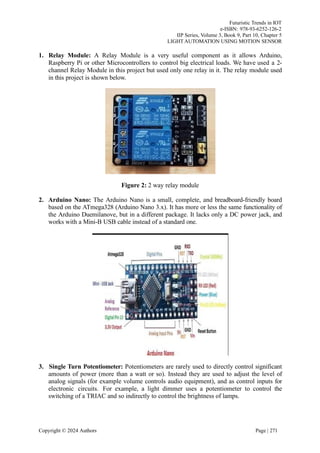
IOT e-ISBN: 978-93-6252-126-2 IIP Series, Volume 3, Book 9, Part 10, Chapter 5 LIGHT AUTOMATION USING MOTION SENSOR 1. Relay Module: A Relay Module is a very useful component as it allows Arduino, Raspberry Pi or other Microcontrollers to control big electrical loads. We have used a 2- channel Relay Module in this project but used only one relay in it. The relay module used in this project is shown below. Figure 2: 2 way relay module 2. Arduino Nano: The Arduino Nano is a small, complete, and breadboard-friendly board based on the ATmega328 (Arduino Nano 3.x). It has more or less the same functionality of the Arduino Duemilanove, but in a different package. It lacks only a DC power jack, and works with a Mini-B USB cable instead of a standard one. 3. Single Turn Potentiometer: Potentiometers are rarely used to directly control significant amounts of power (more than a watt or so). Instead they are used to adjust the level of analog signals (for example volume controls audio equipment), and as control inputs for electronic circuits. For example, a light dimmer uses a potentiometer to control the switching of a TRIAC and so indirectly to control the brightness of lamps. Copyright © 2024 Authors Page | 271
6.
Futuristic Trends in
IOT e-ISBN: 978-93-6252-126-2 IIP Series, Volume 3, Book 9, Part 10, Chapter 5 LIGHT AUTOMATION USING MOTION SENSOR X. PROPOSED MODEL The Arduino Nano is a small, complete and breadboard-friendly board based on the ATmega328 (Arduino Nano 3.x). It With refernce to the cmponents mentioned has more or less the same functionality of above,the model switches on the light as soon the Arduino Duemilanove, but in a as it detects some motion example:handwave different package. It lacks only a DC .This movement is detected by the PIR sensor power jack, and works with a Mini-B by mapping the surrounding where it is USB cable instead of a standard one. present. The led bulb glows when the sensor detects motion.After detection the signal is sent to the arduino nano3 which is programmed in the arduino ide to make the connection of the light as expected *code reference in implementation paper the light is connected to the relay module in order to handle the voltage diifernce in order to make the connection.The code shows us how the signal is generated and how implementation is done to achieve No need to search for the switch on the wall. the desired result. Rasberry pi is used as a The lighting system will automatically turn off software to connect all these devices to the lights when it does not sense any make them work in order,The movement for a certain period of time. potentiometer in the circuit enables us to Acts as a Deterent – This device also can be control for how long the light stays on used anywhere either at home or acts as a and also as an on off switch .The PIR deterent from intruders as it offices. This is also sensor can be used to detect human cost efficient. Thus by will be harder to do movement of vrious spedds and ist to give unlawful this attempt of ours circuit can be signal 1 to the arduino node to make used as activities. connection uptil the set time. This system can be scaled up to be used in places where not continous light is not required but required only for a short time .This project refers to all the other project papers referred to in the references section. XI. DEMERITS The sensors of the motion-sensored lighting system need to detect presence or movement in order to activate. If there are only a few occupants in an area, this device will require them to periodically activate the sensor (subject to the hold on time set) by moving within the detection zone. There is a possibility that the luminaires’ lifespan can be shortened due to the frequency of the switching. This will occur if the motion detectors are located in areas of high activity. Strategic placement of the sensor and appropriate selection of the model for the area can mitigate this problem. Copyright © 2024 Authors Page | 272
7.
Copyright © 2024
Authors Page | 273 Futuristic Trends in IOT e-ISBN: 978-93-6252-126-2 IIP Series, Volume 3, Book 9, Part 10, Chapter 5 LIGHT AUTOMATION USING MOTION SENSOR XII. MERITS Energy Savings – This system is very efficient as it automatically switches off the luminaires when there is no presence detected (for a predefine time). As a result, the end-user saves on electricity consumption. Convenience – Turning on the lights will be as easy as walking inside the room. No need to search for the switch on the wall. The lighting system will automatically turn off the lights when it does not sense any movement for a certain period of time. Acts as a Deterent – This device also can be used anywhere either at home or acts as a deterent from intruders as it offices. This is also cost efficient. Thus by will be harder to do unlawful this attempt of ours circuit can be used as activities. XIII. CONCLUSION Hereby we come to an end of or project “LIGHT AUTOMATION USING MOTION SENSOR”. This project gives us an idea to detect the motion. This project can be used anywhere either at home or offices. This is also cost efficient. Thus by this attempt of ours circuit can be used as protecting device and can be used for security also. It can be used as a kind of antitheft device. It is very much cost efficient and can be used easily and efficiently. XIV. ACKNOWLEDGEMENT This project is the output of the togetherness work of the team members. This project is outcome of the effort implemented by the group members under the guidance of Dr.Jyothi mam for which we are very thankfull for the support. The dedication of the group members gives out this fruitful worthy project, thankyou for the effots and support. REFERENCES 1 www.beprojectidea.blogspot.com 2 A great page on PIR sensors from GLOLAB (http://adafru.it/aKn) 3 NYU sensor report (http://adafru.it/aKo) 4 http://learn.adafruit.com/pir-passiveinfrared-proximity-motion-sensor 5 Lee W. Method and Apparatus for Detecting Direction and Speed Using PIRSensor. U.S. Patent 5291,020. 1994 Mar 1; 6 Hao Q., Hu F., Xiao Y. Multiple human tracking and idengification with wireless distributed pyroelectric sensor systems. IEEE Sens. J. 2009;3:428–439. [Google Scholar] 7 Tao S., Kudo M., Nonaka H., Toyama J. Constructing Ambient Intelligence. Springer Berlin Heidelberg; Berlin, Germany: 2012. Person authentication and activities analysis in an office environment using a sensor network; pp. 119–127. [Google Scholar] 8 Sun Q., Hu F., Hao Q. Mobile target scenario recognition via low-cost pyroelectric sensing system: Toward a context-enhanced accurate identification. IEEE Trans. Syst. Man Cybern. Syst. 2014;44:375–384. [Google Scholar] 9 Stauffer C., Grimson W.E.L. Learning patterns of activity using real-time tracking. IEEE Trans. Pattern Anal. Mach. Intell. 2000;22:747–757. [Google Scholar] 10 Whatmore R.W. Pyroelectric devices and materials. Rep. Prog. Phys. 1986;49:1335–1386. [Google Scholar] 11 Milde G., Häusler C., Gerlach G., Bahr H.-A., Balke H. 3-D modeling of pyroelectric sensor arrays part ii: Modulation transfer function. IEEE Sens.
Download


![Copyright © 2024 Authors Page | 273
Futuristic Trends in IOT
e-ISBN: 978-93-6252-126-2
IIP Series, Volume 3, Book 9, Part 10, Chapter 5
LIGHT AUTOMATION USING MOTION SENSOR
XII. MERITS
Energy Savings – This system is very efficient as it automatically switches off the
luminaires when there is no presence detected (for a predefine time). As a result, the end-user
saves on electricity consumption. Convenience – Turning on the lights will be as easy as
walking inside the room. No need to search for the switch on the wall. The lighting system
will automatically turn off the lights when it does not sense any movement for a certain
period of time. Acts as a Deterent – This device also can be used anywhere either at home or
acts as a deterent from intruders as it offices. This is also cost efficient. Thus by will be
harder to do unlawful this attempt of ours circuit can be used as activities.
XIII. CONCLUSION
Hereby we come to an end of or project “LIGHT AUTOMATION USING MOTION
SENSOR”. This project gives us an idea to detect the motion. This project can be used
anywhere either at home or offices. This is also cost efficient. Thus by this attempt of ours
circuit can be used as protecting device and can be used for security also. It can be used as a
kind of antitheft device. It is very much cost efficient and can be used easily and efficiently.
XIV. ACKNOWLEDGEMENT
This project is the output of the togetherness work of the team members. This project
is outcome of the effort implemented by the group members under the guidance of Dr.Jyothi
mam for which we are very thankfull for the support. The dedication of the group members
gives out this fruitful worthy project, thankyou for the effots and support.
REFERENCES
1 www.beprojectidea.blogspot.com
2 A great page on PIR sensors from GLOLAB (http://adafru.it/aKn)
3 NYU sensor report (http://adafru.it/aKo)
4 http://learn.adafruit.com/pir-passiveinfrared-proximity-motion-sensor
5 Lee W. Method and Apparatus for Detecting Direction and Speed Using PIRSensor. U.S. Patent 5291,020.
1994 Mar 1;
6 Hao Q., Hu F., Xiao Y. Multiple human tracking and idengification with wireless distributed pyroelectric
sensor systems. IEEE Sens. J. 2009;3:428–439. [Google Scholar]
7 Tao S., Kudo M., Nonaka H., Toyama J. Constructing Ambient Intelligence. Springer Berlin Heidelberg;
Berlin, Germany: 2012. Person authentication and activities analysis in an office environment using a sensor
network; pp. 119–127. [Google Scholar]
8 Sun Q., Hu F., Hao Q. Mobile target scenario recognition via low-cost pyroelectric sensing system: Toward a
context-enhanced accurate identification. IEEE Trans. Syst. Man Cybern. Syst. 2014;44:375–384. [Google
Scholar]
9 Stauffer C., Grimson W.E.L. Learning patterns of activity using real-time tracking. IEEE Trans. Pattern Anal.
Mach. Intell. 2000;22:747–757. [Google Scholar]
10 Whatmore R.W. Pyroelectric devices and materials. Rep. Prog. Phys. 1986;49:1335–1386. [Google Scholar]
11 Milde G., Häusler C., Gerlach G., Bahr H.-A., Balke H. 3-D modeling of pyroelectric sensor arrays part ii:
Modulation transfer function. IEEE Sens.](https://image.slidesharecdn.com/rsl2024ae0c6fa0aec6f1d-250218135040-71974098/85/Project-ECE-Light-Automation-with-Motion-Sensor-pptx-7-320.jpg)


