Heritage Institute of Technology
Dept. of Computer Science & Engg.
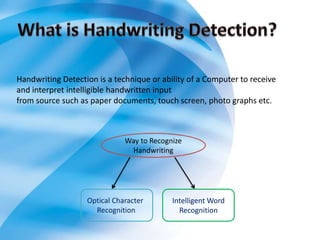
Handwriting Detection is a technique or ability of a Computer to receive
and interpret intelligible handwritten input
from source such as paper documents, touch screen, photo graphs etc.


                              Way to Recognize
                               Handwriting


                   Optical Character       Intelligent Word
                     Recognition             Recognition
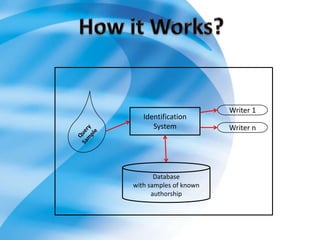
Writer 1
   Identification
      System            Writer n


       Database
with samples of known
      authorship
On-line handwriting recognition involves the automatic conversion of text
as it is written on a special digitizer or PDA, where a sensor picks up the
pen-tip movements as well as pen-up/pen-down switching. That kind of
data is known as digital ink and can be regarded as a dynamic
representation of handwriting. The obtained signal is converted into letter
codes which are usable within computer and text-processing applications.
The elements of an on-line handwriting recognition interface typically
include:
1) a pen or stylus for the user to write with.
2) a touch sensitive surface, which may be integrated with, or adjacent to,
an output display.
3) a software application which interprets the movements of the stylus
across the writing surface, translating the resulting strokes into digital text.
Off-line handwriting recognition involves the automatic
conversion of text in an image into letter codes which are
usable within computer and text-processing applications.
The data obtained by this form is regarded as a static
representation of handwriting. Off-line handwriting
recognition is comparatively difficult, as different people
have different handwriting styles. And, as of today, OCR
engines are primarily focused on machine printed text and
ICR for hand "printed" (written in capital letters) text.
There is no OCR/ICR engine that supports handwriting
recognition as of today.
• Recognition strategies heavily depends on the nature
  of the data to be recognized.
• In the cursive case, the problem is made complex by
  the fact that the writing is fundamentally ambiguous
  as the letters in the word are generally linked
  together, poorly written and may even be missing.
• On the contrary, hand printed word recognition is
  more related to printed word recognition, the
  individual letters composing the word being usually
  much easier to isolate and to identify.


                                                  Continue..
• Character Recognition techniques can be classified according
  to two criteria:
   – the way preprocessing is performed on the data
   – the type of the decision algorithm
• Preprocessing techniques include :
   – the use of global transforms (correlation, Fourier descriptors, etc.)
   – local comparison (local density, intersections with straight
     lines, variable masks, etc.)
   – geometrical or topological characteristics
     (strokes, loops, openings, diacritical marks, skeleton, etc.)
• Decision methods include:
   – various statistical methods,
   – neural networks, structural matching (on trees, chains, etc.)
   – stochastic processing (Markov chains, etc.).
• Two main types of strategies have been applied to this
  problem:
   – the holistic approach - recognition is globally performed on
     the whole representation of words and there is no attempt
     to identify characters individually.
      • The main advantage of holistic methods is that they avoid word
        segmentation
   – the analytical approach - deal with several levels of
     representation corresponding to increasing levels of
     abstraction (usually the feature level, the grapheme or
     pseudo-letter level and the word level). Words are not
     considered as a whole, but as sequences of smaller size
     units which must be easily related to characters in order to
     make recognition independent from a specific vocabulary
Feature extraction works in a similar fashion to neural network recognizers
however, programmers must manually determine the properties they feel
are important.
Some example properties might be:

Aspect Ratio
Percent of pixels above horizontal half point
Percent of pixels to right of vertical half point
Number of strokes
Average distance from image center
Is reflected y axis
Is reflected x axis
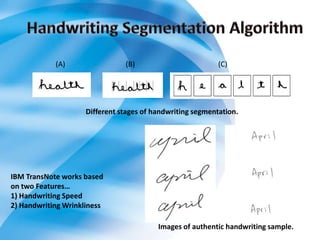
(A)                 (B)                         (C)


                     Different stages of handwriting segmentation.


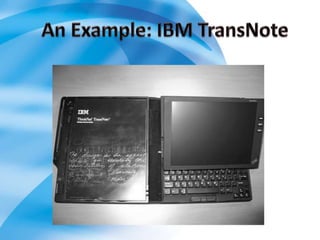
IBM TransNote works based
on two Features…
1) Handwriting Speed
2) Handwriting Wrinkliness

                                          Images of authentic handwriting sample.
Statistical Experiments
 A sample of the calculated measurements.
 Filename 300dpi 600dpi Wrinkliness Speed
 0101T1 14894 30583 1.03799867 0.11396973
 0101T2 8786        18638 1.084968652 0.107457204
 0101T3 9258        19764 1.094102493 0.118184103
 0202T1 6453         13765 1.092962679 0.093275242
 0202T2 6212         13319 1.100356033 0.094080635
 0202T3 5824         12722 1.127243231 0.087968122


      Wrinkliness calculation: a) handwriting
      sample, b) edge-detected sample, c) portion of edgedetected
      sample at 300 dpi, d) portion at 600 dpi.
• Handwriting Recognition aims to design systems
  which are able to recognize handwriting of natural
  language
• Methods and recognition rates depend on the level
  of constraints on handwriting.
• The constraints are mainly characterized by the:
   –   types of handwriting
   –   number of scriptors
   –   size of the vocabulary
   –   spatial layout.


                                                  Continue..
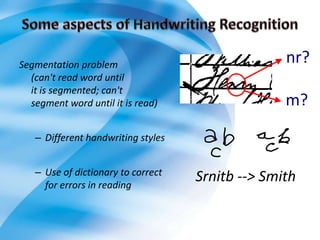
Segmentation problem                              nr?
  (can't read word until
  it is segmented; can't
  segment word until it is read)                  m?

   – Different handwriting styles


   – Use of dictionary to correct
     for errors in reading
                                    Srnitb --> Smith
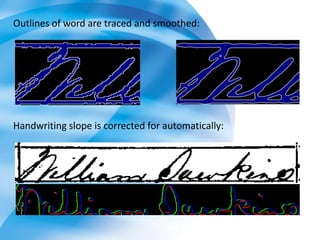
Outlines of word are traced and smoothed:


Handwriting slope is corrected for automatically:
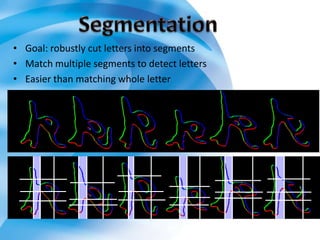
• Goal: robustly cut letters into segments
• Match multiple segments to detect letters
• Easier than matching whole letter
ADVANTAGES:
The most important advantage of speech
over handwriting is the speed of data entry. This is because it is much easier to
dictate the
machine than to write

DISADVANTAGES:
Has also drawbacks, such as it is noisy to hear
someone sitting next to us and talking to his machine. Moreover, anyone who
wants to input
confidential data to his/her computer is not willing to do it in public places. Most
importantly, it
is not possible to speak to a machine in a natural way due to constraints such as
out of vocabulary
wards, background noise, cross-talk, accented speech and so on.
So after all these stuff…
We have a brief Idea about Automatic Handwriting
Detection..
1) online and offline detection is available
2)Online procedure is easier then Offline procedure(difficult
one)
3)Today’s business world need some computerized
authentication for security purpose
   the (AHD) fulfill their need.
4)Handwriting recognition is important for genealogy...
...but it is hard
5)Current methods don't work very well...
...and they don't operate much like the human brain
Automatic handwriting recognition

Automatic handwriting recognition

  • 1.
    Heritage Institute ofTechnology Dept. of Computer Science & Engg.
  • 2.
    Handwriting Detection isa technique or ability of a Computer to receive and interpret intelligible handwritten input from source such as paper documents, touch screen, photo graphs etc. Way to Recognize Handwriting Optical Character Intelligent Word Recognition Recognition
  • 4.
    Writer 1 Identification System Writer n Database with samples of known authorship
  • 6.
    On-line handwriting recognitioninvolves the automatic conversion of text as it is written on a special digitizer or PDA, where a sensor picks up the pen-tip movements as well as pen-up/pen-down switching. That kind of data is known as digital ink and can be regarded as a dynamic representation of handwriting. The obtained signal is converted into letter codes which are usable within computer and text-processing applications. The elements of an on-line handwriting recognition interface typically include: 1) a pen or stylus for the user to write with. 2) a touch sensitive surface, which may be integrated with, or adjacent to, an output display. 3) a software application which interprets the movements of the stylus across the writing surface, translating the resulting strokes into digital text.
  • 7.
    Off-line handwriting recognitioninvolves the automatic conversion of text in an image into letter codes which are usable within computer and text-processing applications. The data obtained by this form is regarded as a static representation of handwriting. Off-line handwriting recognition is comparatively difficult, as different people have different handwriting styles. And, as of today, OCR engines are primarily focused on machine printed text and ICR for hand "printed" (written in capital letters) text. There is no OCR/ICR engine that supports handwriting recognition as of today.
  • 8.
    • Recognition strategiesheavily depends on the nature of the data to be recognized. • In the cursive case, the problem is made complex by the fact that the writing is fundamentally ambiguous as the letters in the word are generally linked together, poorly written and may even be missing. • On the contrary, hand printed word recognition is more related to printed word recognition, the individual letters composing the word being usually much easier to isolate and to identify. Continue..
  • 9.
    • Character Recognitiontechniques can be classified according to two criteria: – the way preprocessing is performed on the data – the type of the decision algorithm • Preprocessing techniques include : – the use of global transforms (correlation, Fourier descriptors, etc.) – local comparison (local density, intersections with straight lines, variable masks, etc.) – geometrical or topological characteristics (strokes, loops, openings, diacritical marks, skeleton, etc.) • Decision methods include: – various statistical methods, – neural networks, structural matching (on trees, chains, etc.) – stochastic processing (Markov chains, etc.).
  • 10.
    • Two maintypes of strategies have been applied to this problem: – the holistic approach - recognition is globally performed on the whole representation of words and there is no attempt to identify characters individually. • The main advantage of holistic methods is that they avoid word segmentation – the analytical approach - deal with several levels of representation corresponding to increasing levels of abstraction (usually the feature level, the grapheme or pseudo-letter level and the word level). Words are not considered as a whole, but as sequences of smaller size units which must be easily related to characters in order to make recognition independent from a specific vocabulary
  • 11.
    Feature extraction worksin a similar fashion to neural network recognizers however, programmers must manually determine the properties they feel are important. Some example properties might be: Aspect Ratio Percent of pixels above horizontal half point Percent of pixels to right of vertical half point Number of strokes Average distance from image center Is reflected y axis Is reflected x axis
  • 13.
    (A) (B) (C) Different stages of handwriting segmentation. IBM TransNote works based on two Features… 1) Handwriting Speed 2) Handwriting Wrinkliness Images of authentic handwriting sample.
  • 14.
    Statistical Experiments Asample of the calculated measurements. Filename 300dpi 600dpi Wrinkliness Speed 0101T1 14894 30583 1.03799867 0.11396973 0101T2 8786 18638 1.084968652 0.107457204 0101T3 9258 19764 1.094102493 0.118184103 0202T1 6453 13765 1.092962679 0.093275242 0202T2 6212 13319 1.100356033 0.094080635 0202T3 5824 12722 1.127243231 0.087968122 Wrinkliness calculation: a) handwriting sample, b) edge-detected sample, c) portion of edgedetected sample at 300 dpi, d) portion at 600 dpi.
  • 15.
    • Handwriting Recognitionaims to design systems which are able to recognize handwriting of natural language • Methods and recognition rates depend on the level of constraints on handwriting. • The constraints are mainly characterized by the: – types of handwriting – number of scriptors – size of the vocabulary – spatial layout. Continue..
  • 16.
    Segmentation problem nr? (can't read word until it is segmented; can't segment word until it is read) m? – Different handwriting styles – Use of dictionary to correct for errors in reading Srnitb --> Smith
  • 17.
    Outlines of wordare traced and smoothed: Handwriting slope is corrected for automatically:
  • 18.
    • Goal: robustlycut letters into segments • Match multiple segments to detect letters • Easier than matching whole letter
  • 19.
    ADVANTAGES: The most importantadvantage of speech over handwriting is the speed of data entry. This is because it is much easier to dictate the machine than to write DISADVANTAGES: Has also drawbacks, such as it is noisy to hear someone sitting next to us and talking to his machine. Moreover, anyone who wants to input confidential data to his/her computer is not willing to do it in public places. Most importantly, it is not possible to speak to a machine in a natural way due to constraints such as out of vocabulary wards, background noise, cross-talk, accented speech and so on.
  • 20.
    So after allthese stuff… We have a brief Idea about Automatic Handwriting Detection.. 1) online and offline detection is available 2)Online procedure is easier then Offline procedure(difficult one) 3)Today’s business world need some computerized authentication for security purpose the (AHD) fulfill their need. 4)Handwriting recognition is important for genealogy... ...but it is hard 5)Current methods don't work very well... ...and they don't operate much like the human brain

Editor's Notes

  • #20 On-line recognizers::CalliGrapherApple-Newton Print RecognizerThinkWriteGraffitiOff-line recognizers::W. SeniorCEDAR Penman