TP04PUB147
author(s)
J.C. CARSON
Guyson Corporation
Saratoga Springs, New York
abstract
conference
Deburring and Surface Finishing
March 16-18, 2004
Chicago, Illinois
terms
Blasting
Texture
Roughness
Finishing
Sandblasting
Beadblasting
TECHNICALPAPER
2004
Automated Blasting to Control
Surface Texture and Finish
Apart from many applications of blasting techniques that utilize nonabrasive
media to perform work such as deburring, deflashing and cleaning without
modification of component surfaces, impact treatment is also a fast and cost-
effective means of producing a desired texture or a specified roughness. This
review of blast finishing methods and equipment begins with a discussion of the
fundamentals of dry blast media and media delivery. Principal types of automatic
blast systems are described with an explanation of valuable capabilities of impact
treatment processes in surface preparation and finishing, including recent
advances in media reclamation and blast process control.
Society of Manufacturing Engineers • One SME Drive • P.O. Box 930
Dearborn, MI 48121 • Phone (313) 271-1500 • www.sme.org
SME TECHNICAL PAPERS
This Technical Paper may not be reproduced in whole or in
part in any form without the express written permission of
the Society of Manufacturing Engineers. By publishing this
paper, SME neither endorses any product, service or
information discussed herein, nor offers any technical
advice. SME specifically disclaims any warranty of
reliability or safety of any of the information contained
herein.
Automated Blasting to Control Surface Texture and Finish
J. C. Carson
Marketing Manager
Group Leader, Applications Team
Guyson Corporation
Summary
Apart from the many applications of blasting techniques that utilize non-abrasive media to
perform work such as deburring, deflashing and cleaning without modification of component
surfaces, impact treatment is also one of the most cost-effective means of producing a desired
texture or a specified roughness.
This review of blast finishing methods and equipment begins with a discussion of the
fundamentals of dry blast media and media delivery. The principal types of automatic blast
systems are described with an explanation of some important capabilities of impact treatment
processes in surface preparation and finishing, including some of the most recent advances in
media reclamation and blast process control.
The author attempts to emphasize that, when automated blasting can do the work, it is very often
the fastest and lowest cost alternative for production surface preparation and cosmetic finishing.
2
The specialized technology that is commonly referred to as “sandblasting” has evolved to
become one of the most widely used methods for cleaning, finishing and surface preparation of
metals and other materials.
Designers and builders of blast machinery for the manufacturing community are not fond of the
“sandblaster” designation. Because of the widespread use of the term, it is expeditious to accept
the label, however uncomfortable. One complaint is that most sand blasting is messy and
somewhat unpleasant work done outdoors with portable hand-held equipment, air-supplied
hoods and protective clothing. The abrasives used in such operations are usually the cheapest
available, since they are frequently considered expendable after a single pass through the blast
nozzle.
In contrast to the outdoor variety, blasting is generally “cabinet-ized” in modern manufacturing.
It is a contained process, the blasting particles or media are captured and recirculated, and the
dust is separated and collected. Increasingly, manual cabinet blasting operations are being
automated to upgrade their efficiency, reduce costs and ensure consistent and repeatable
processing.
Whether you call it beadblasting, abrasive blasting, shotblasting, gritblasting or another name,
the basis of all these techniques is impact energy. Millions of microscopic particles are projected
onto component surfaces, each capable of doing some work, according to its specific properties.
Fundamentals of Media Delivery
While blasting is commonly utilized in a variety of manufacturing and reconditioning operations,
it is not always a subject that is introduced in engineering and technical training programs. It is
sometimes understood only superficially and misused in practice. A brief look at basic operating
principles will provide the foundation for a discussion of specific surface treatment techniques.
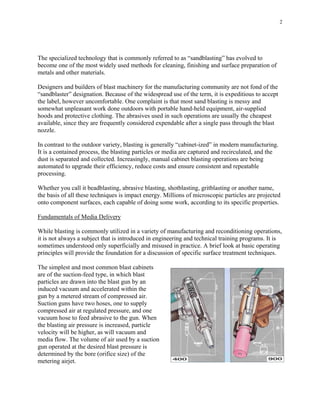
The simplest and most common blast cabinets
are of the suction-feed type, in which blast
particles are drawn into the blast gun by an
induced vacuum and accelerated within the
gun by a metered stream of compressed air.
Suction guns have two hoses, one to supply
compressed air at regulated pressure, and one
vacuum hose to feed abrasive to the gun. When
the blasting air pressure is increased, particle
velocity will be higher, as will vacuum and
media flow. The volume of air used by a suction
gun operated at the desired blast pressure is
determined by the bore (orifice size) of the
metering airjet.
3
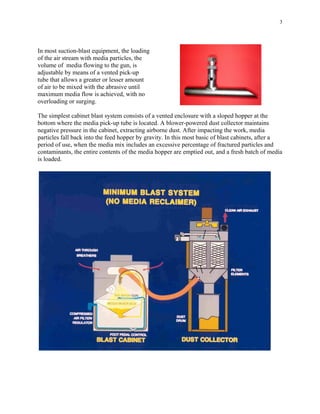
In most suction-blast equipment, the loading
of the air stream with media particles, the
volume of media flowing to the gun, is
adjustable by means of a vented pick-up
tube that allows a greater or lesser amount
of air to be mixed with the abrasive until
maximum media flow is achieved, with no
overloading or surging.
The simplest cabinet blast system consists of a vented enclosure with a sloped hopper at the
bottom where the media pick-up tube is located. A blower-powered dust collector maintains
negative pressure in the cabinet, extracting airborne dust. After impacting the work, media
particles fall back into the feed hopper by gravity. In this most basic of blast cabinets, after a
period of use, when the media mix includes an excessive percentage of fractured particles and
contaminants, the entire contents of the media hopper are emptied out, and a fresh batch of media
is loaded.
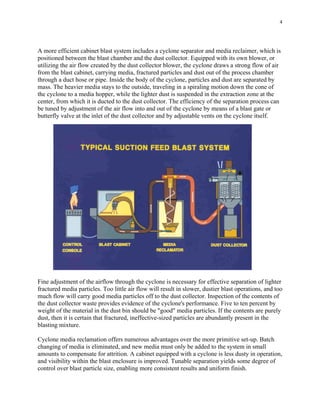
4
A more efficient cabinet blast system includes a cyclone separator and media reclaimer, which is
positioned between the blast chamber and the dust collector. Equipped with its own blower, or
utilizing the air flow created by the dust collector blower, the cyclone draws a strong flow of air
from the blast cabinet, carrying media, fractured particles and dust out of the process chamber
through a duct hose or pipe. Inside the body of the cyclone, particles and dust are separated by
mass. The heavier media stays to the outside, traveling in a spiraling motion down the cone of
the cyclone to a media hopper, while the lighter dust is suspended in the extraction zone at the
center, from which it is ducted to the dust collector. The efficiency of the separation process can
be tuned by adjustment of the air flow into and out of the cyclone by means of a blast gate or
butterfly valve at the inlet of the dust collector and by adjustable vents on the cyclone itself.
Fine adjustment of the airflow through the cyclone is necessary for effective separation of lighter
fractured media particles. Too little air flow will result in slower, dustier blast operations, and too
much flow will carry good media particles off to the dust collector. Inspection of the contents of
the dust collector waste provides evidence of the cyclone's performance. Five to ten percent by
weight of the material in the dust bin should be "good" media particles. If the contents are purely
dust, then it is certain that fractured, ineffective-sized particles are abundantly present in the
blasting mixture.
Cyclone media reclamation offers numerous advantages over the more primitive set-up. Batch
changing of media is eliminated, and new media must only be added to the system in small
amounts to compensate for attrition. A cabinet equipped with a cyclone is less dusty in operation,
and visibility within the blast enclosure is improved. Tunable separation yields some degree of
control over blast particle size, enabling more consistent results and uniform finish.
5
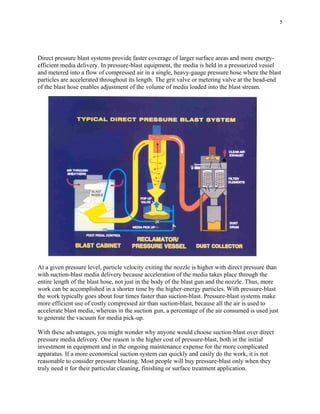
Direct pressure blast systems provide faster coverage of larger surface areas and more energy-
efficient media delivery. In pressure-blast equipment, the media is held in a pressurized vessel
and metered into a flow of compressed air in a single, heavy-gauge pressure hose where the blast
particles are accelerated throughout its length. The grit valve or metering valve at the head-end
of the blast hose enables adjustment of the volume of media loaded into the blast stream.
At a given pressure level, particle velocity exiting the nozzle is higher with direct pressure than
with suction-blast media delivery because acceleration of the media takes place through the
entire length of the blast hose, not just in the body of the blast gun and the nozzle. Thus, more
work can be accomplished in a shorter time by the higher-energy particles. With pressure-blast
the work typically goes about four times faster than suction-blast. Pressure-blast systems make
more efficient use of costly compressed air than suction-blast, because all the air is used to
accelerate blast media, whereas in the suction gun, a percentage of the air consumed is used just
to generate the vacuum for media pick-up.
With these advantages, you might wonder why anyone would choose suction-blast over direct
pressure media delivery. One reason is the higher cost of pressure-blast, both in the initial
investment in equipment and in the ongoing maintenance expense for the more complicated
apparatus. If a more economical suction system can quickly and easily do the work, it is not
reasonable to consider pressure blasting. Most people will buy pressure-blast only when they
truly need it for their particular cleaning, finishing or surface treatment application.
6
It should be noted that with manual blast equipment, whether suction- or pressure-feed, the
particle stream is directed by hand. Constant operator attention is required, and the quality of the
results can vary widely from user to user and part to part. Automated blasting equipment, while
operating on the same principles, removes issues related to technique and makes possible a
controlled and repeatable production process.
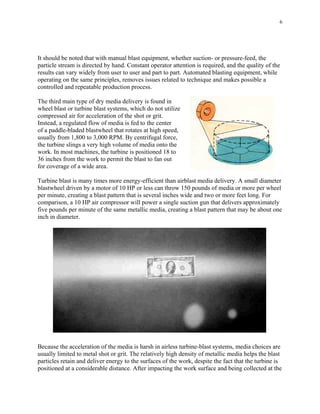
The third main type of dry media delivery is found in
wheel blast or turbine blast systems, which do not utilize
compressed air for acceleration of the shot or grit.
Instead, a regulated flow of media is fed to the center
of a paddle-bladed blastwheel that rotates at high speed,
usually from 1,800 to 3,000 RPM. By centrifugal force,
the turbine slings a very high volume of media onto the
work. In most machines, the turbine is positioned 18 to
36 inches from the work to permit the blast to fan out
for coverage of a wide area.
Turbine blast is many times more energy-efficient than airblast media delivery. A small diameter
blastwheel driven by a motor of 10 HP or less can throw 150 pounds of media or more per wheel
per minute, creating a blast pattern that is several inches wide and two or more feet long. For
comparison, a 10 HP air compressor will power a single suction gun that delivers approximately
five pounds per minute of the same metallic media, creating a blast pattern that may be about one
inch in diameter.
Because the acceleration of the media is harsh in airless turbine-blast systems, media choices are
usually limited to metal shot or grit. The relatively high density of metallic media helps the blast
particles retain and deliver energy to the surfaces of the work, despite the fact that the turbine is
positioned at a considerable distance. After impacting the work surface and being collected at the
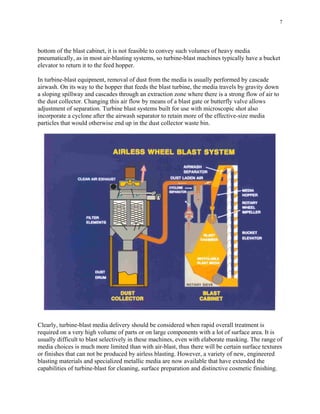
7
bottom of the blast cabinet, it is not feasible to convey such volumes of heavy media
pneumatically, as in most air-blasting systems, so turbine-blast machines typically have a bucket
elevator to return it to the feed hopper.
In turbine-blast equipment, removal of dust from the media is usually performed by cascade
airwash. On its way to the hopper that feeds the blast turbine, the media travels by gravity down
a sloping spillway and cascades through an extraction zone where there is a strong flow of air to
the dust collector. Changing this air flow by means of a blast gate or butterfly valve allows
adjustment of separation. Turbine blast systems built for use with microscopic shot also
incorporate a cyclone after the airwash separator to retain more of the effective-size media
particles that would otherwise end up in the dust collector waste bin.
Clearly, turbine-blast media delivery should be considered when rapid overall treatment is
required on a very high volume of parts or on large components with a lot of surface area. It is
usually difficult to blast selectively in these machines, even with elaborate masking. The range of
media choices is much more limited than with air-blast, thus there will be certain surface textures
or finishes that can not be produced by airless blasting. However, a variety of new, engineered
blasting materials and specialized metallic media are now available that have extended the
capabilities of turbine-blast for cleaning, surface preparation and distinctive cosmetic finishing.
8
Media Basics
To grasp the potential of automated blasting for cost reduction and quality improvement, it is
necessary to understand how the work is done and the mechanics of blast particles impacting
surfaces.
We should begin a discussion of media with some observations about sand blasting. Natural
silica sand or beach sand may be cheap, but this granular mineral material and the vitreous slag
by-products that are marketed as substitutes for sand in outdoor blasting are generally not
suitable for cabinet-type blast systems that recirculate media. All such materials have an
extremely high rate of fracture, leading to problems that will shortly be explained. More
importantly, you must understand that the use of silica sand for blasting may result in the release
into the air of free silica that can cause the respiratory ailment called silicosis. If you need the
surface finish generated by such mineral grit, you can choose from many other media that will do
the work that do not bring with them the liabilities and health hazards associated with sand
blasting.
The most important properties that should be considered in the selection of blast media for a
particular application are the material or chemical composition, hardness, density, particle shape,
screen or particle size and impact resistance. Both the technical performance of the media and
the cost of the process are at stake in the choice of blasting materials.
Commonly available blast media include agricultural materials such as ground nut shells or
starch grit, mineral substances like aluminum oxide or silicon carbide, ceramic shot and grit,
glass in the form of beads or granular crushed glass, various plastics formed into beads or ground
up into angular particles and metals such as steel shot and iron grit. Today, all or most of these
media are engineered materials, formulated or processed to emphasize useful characteristics for
impact treatment. It should be noted that some of the media in many of these categories of
materials are primarily marketed for outdoor or single-pass blasting operations versus use in
longer-cycle cabinet blast media delivery systems.
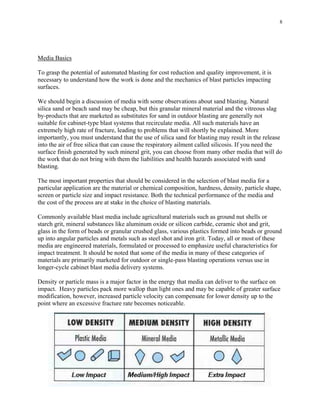
Density or particle mass is a major factor in the energy that media can deliver to the surface on
impact. Heavy particles pack more wallop than light ones and may be capable of greater surface
modification, however, increased particle velocity can compensate for lower density up to the
point where an excessive fracture rate becomes noticeable.
9
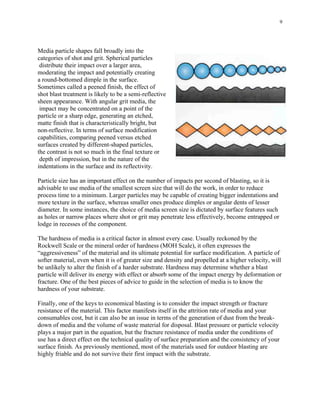
Media particle shapes fall broadly into the
categories of shot and grit. Spherical particles
distribute their impact over a larger area,
moderating the impact and potentially creating
a round-bottomed dimple in the surface.
Sometimes called a peened finish, the effect of
shot blast treatment is likely to be a semi-reflective
sheen appearance. With angular grit media, the
impact may be concentrated on a point of the
particle or a sharp edge, generating an etched,
matte finish that is characteristically bright, but
non-reflective. In terms of surface modification
capabilities, comparing peened versus etched
surfaces created by different-shaped particles,
the contrast is not so much in the final texture or
depth of impression, but in the nature of the
indentations in the surface and its reflectivity.
Particle size has an important effect on the number of impacts per second of blasting, so it is
advisable to use media of the smallest screen size that will do the work, in order to reduce
process time to a minimum. Larger particles may be capable of creating bigger indentations and
more texture in the surface, whereas smaller ones produce dimples or angular dents of lesser
diameter. In some instances, the choice of media screen size is dictated by surface features such
as holes or narrow places where shot or grit may penetrate less effectively, become entrapped or
lodge in recesses of the component.
The hardness of media is a critical factor in almost every case. Usually reckoned by the
Rockwell Scale or the mineral order of hardness (MOH Scale), it often expresses the
“aggressiveness” of the material and its ultimate potential for surface modification. A particle of
softer material, even when it is of greater size and density and propelled at a higher velocity, will
be unlikely to alter the finish of a harder substrate. Hardness may determine whether a blast
particle will deliver its energy with effect or absorb some of the impact energy by deformation or
fracture. One of the best pieces of advice to guide in the selection of media is to know the
hardness of your substrate.
Finally, one of the keys to economical blasting is to consider the impact strength or fracture
resistance of the material. This factor manifests itself in the attrition rate of media and your
consumables cost, but it can also be an issue in terms of the generation of dust from the break-
down of media and the volume of waste material for disposal. Blast pressure or particle velocity
plays a major part in the equation, but the fracture resistance of media under the conditions of
use has a direct effect on the technical quality of surface preparation and the consistency of your
surface finish. As previously mentioned, most of the materials used for outdoor blasting are
highly friable and do not survive their first impact with the substrate.
10
Obviously, all of the properties of media that we have outlined must be taken together to
determine the usefulness of any media for a given blasting application. Component material and
the type of blast equipment to be used dictate certain media choices. Media selection is usually
an educated process of elimination that should primarily be based on your technical surface
finish requirements. Cost considerations for a particular choice, both in terms of media
consumption and wear-and-tear on equipment, can be estimated to fill in the economic
dimensions in your evaluation of alternatives.
Some rules-of-thumb for media selection are the following:
1. Choose the least aggressive media that will do the work. This will result in less wear and
lower equipment maintenance expense.
2. Use the smallest media particle size that will do the work. More impacts per second will yield
a faster process.
3. Find the lowest blast pressure that will do the work. This offers the benefits of energy savings
in reduced compressed air requirements, as well as less wear and lower maintenance costs.
The best advice about media selection is to avoid making assumptions about what worked for
somebody else, take advantage of laboratory testing services offered by some equipment
manufacturers, insist that a potential supplier demonstrate acceptable results on your own
components and expect satisfactory answers to your questions about the testing and the
recommendations.
11
Blast Deburring
The fundamentals reviewed thus far can be applied in a discussion of burr removal. Impact
treatment can be an elegant solution for a variety of deburring and edge finishing problems, and
automated blast deburring is often the fastest and lowest cost approach to this secondary
operation.
Blasting deburrs by impact, so if a burr is very firmly attached to the parent material, it may not
be a good candidate for blast treatment. It is usually a mistake to try to use harsh abrasive blast
media to wear-down a burr or to abrade away the material of the component until the burr falls
off. In the most efficient blast deburring process, the work is done by a particle with sufficient
mass and velocity to knock the burr off and break it free from the edge.
Blast media have the ability to penetrate narrow openings, tight recesses and fine details that
might be difficult to access by other means. Blasting can be done selectively, so that impact
treatment is concentrated on specific areas of the component that are predictably the site of burrs
from automatic machining or metalworking processes. Nonabrasive media such as plastic beads
can effectively remove burrs without the slightest alteration of adjacent surfaces that may already
have the desired finish. If your purposes include cosmetic finishing, texturing or preparation of
component surfaces for another downstream process, in addition to removal of burrs, media
blasting can frequently accomplish both tasks in a single operation.
One other ability of blasting media that is worthy of mention in regard to deburring is rebound.
Certain materials, especially resilient plastic media such as cubical nylon beads, will bounce and
ricochet on impact, yet retain sufficient energy to do some work the second or third time they
strike a component surface. Rebound effects can be harnessed to get at problematic burrs on
internal features and components that may be convoluted in shape.
What happens to the burrs after they are removed from components is an important question for
evaluation of the blast system design. Sharp pieces of the same material as the part represent a
contaminant if they circulate with the media. One problem is that burrs could lodge or
accumulate in working parts of the blast system, causing clogs or other malfunctions. Another,
and sometimes more serious, problem is that burrs could be projected onto the component and
cause damage to critical surfaces.
A simple scalping screen placed in the reclaim system
is one approach to a solution, but its effectiveness is very
limited. If it catches burrs, the sieve will become blinded,
soon impeding the flow of media or stopping it.
When deburring ferrous components with nonferrous media,
Installation of a powerful magnetic separator in the reclaim
stack-up can pull burrs out of circulation and hold them.
Obviously, a different method is needed for deburring of
plastic or non-ferrous metal components.
12
Advanced Media Reclamation
Not only in blast deburring and deflashing, where significant quantities of media-contaminating
debris will be introduced into the blast system, but also in a variety of other applications, some of
which will shortly be discussed, there may be a need for more precise control over the blast
particle mix. Cyclone separator reclamation alone cannot be expected to perform satisfactorily in
such cases, especially in an automated system that must keep pace with production.
The introduction of a vibrating screen classifier in the cyclone reclaim stack-up to continuously
sieve 100% of the material extracted from the blast chamber before the media recirculates can
dramatically improve the performance of the system.
In addition to the separation of burrs, flash and other foreign matter, classification provides a
high degree of control over the size of the blast particles themselves. It maintains the consistency
of the media, optimizing its effectiveness and keeping the results of blasting within tight limits.
The top deck of the vibrating screen classifier captures material that is larger than the specified
size of the blast media particles and removes it to a scrap bin. The middle screen retains media
particles that are the correct size and delivers them to the blast machine. The lower deck collects
under-size media and finer debris.
13
Precision Roughening
Looking at the more aggressive aspects of blast treatment, there are applications of the
technology in production of a profiled surface with a specific roughness. Different from surface
preparation work that involves blast cleaning to remove deposits such as scale or oxidation, we
can call this category technical surface preparation, etching or precision roughening.
Many types of coatings benefit from a “toothed “ profile or anchor pattern for proper adhesion,
including thermal sprayed ceramic, metallic and polymer coatings, as well as organic coatings
applied by other means. Blast etching can function to increase surface area and promote stronger
mechanical bonding. On the other end of the roughness spectrum, microabrasive surface
preparation using exceedingly fine grit has proven beneficial for certain thin-film vacuum
coatings. Bonding and gluing of materials such as rubber, plastic, epoxy and metals may be
improved by controlled roughening of the substrate. In each case, good coating or bonding
depends, in large part, upon the uniformity of surface texture on key aspects of the component.
Requirements for surface texture, the degree of surface modification and the final surface
condition can vary extremely, but in most cases the media utilized will be sharp, angular grit that
is sufficient in hardness to affect the substrate. Two of the common air-blast media for precision
roughening applications are aluminum oxide and silicon carbide grit, while turbine-blast media
that may be good choices for certain etching requirements would be steel grit or chilled iron grit.
In addition to hardness, the most important media property for technical surface preparation
work is its screen size, since this determines the size of the minute indentations that create the
profile or texture. Larger particles of the same material will have greater mass and impact force.
The maximum depth of etch for any given grit size is achieved by increasing particle velocity, or
raising the blast pressure up, to a point near the threshold where the fracture resistance of the
media is exceeded.
When the highest degree of precision and consistency of texture is required for critical coating
work, a reclamation system enhanced by a screen classifier of suitable capacity can ensure that
media sizing is held within close tolerances. This upgrade yields a much more uniform surface
and significantly reduces media fines in the blast mix, a future source of dust.
It is necessary to quantify your surface texture requirements, both to guide in the initial
development of blast processing parameters and to verify the blasting results in your ongoing
quality control procedures. An average roughness value (Ra), or more commonly, a maximum
and minimum Ra value that can be measured on critical aspects of the component using a
profilometer is usually an adequate specification for surface texture.
If you have not determined the optimum surface texture you need, or you are in the process of
establishing a surface roughness specification for your coating, bonding or adhesive application,
the lab testing services of a blast system manufacturer can help by preparing samples with
several different degrees of profile for your own testing and evaluation.
14
Cosmetic Finishing
Some people in manufacturing think of finish only in terms of painting, plating or material
applied to the part. The appearance of many components can be greatly improved by the
elimination of superficial shortcomings, and the production of a “self-finish” that emphasizes the
inherent aesthetic qualities of its material by blast treatment.
Of course, the phrase “beauty is in the eyes of the beholder” applies to all products, and when it
comes to the looks of your components, Manufacturing Engineers usually take their cues from
senior management, the Marketing Department, or ultimately, your company’s customers. In the
matter of adding aesthetic value to your product, those responsible for production processes are
not consulted nearly enough in many organizations.
It is a mistake to consider impact treatment as a substitute for a buffing or polishing process, if
you are trying to generate highly reflective, shiny surfaces or mirror finishes. Blasting techniques
may be very useful to clean deposits from such surfaces without spoiling the shine, but not for
their production. Interestingly, self-finished components may be protected by durable, clear,
glossy coatings, combining the appearance of the substrate with that of its organic shell.
Impact finishing may be a viable method for generating a surface with a distinctive appearance
and “feel” on account of its texture. Blasting has unique abilities when you want to blend-in
minor surface imperfections. A blasted surface can be a bright, non-reflective matte finish; a
semi-reflective satin or sheen appearance that is nearly iridescent; or some attractive look that is
in-between. Such a blasted self-finish can be produced quickly and at very low cost, if it is
acceptable to your judges, the most important of which is the customer.
As mentioned in our review of media properties, grit blasting produces an etched surface with
angular indentations that tend to reflect light away from the eye, so it appears as a matte finish.
An example of a consumer product that exhibits this as a cosmetic finish would be the
circumference of some brands of circular saw blades.
Shot blasted surfaces, with their dimpled texture of rounded indentations, can reflect light in a
very subtle manner that is pleasing to the eye. Since this look has enjoyed broader acceptance
and popularity, you will recognize such blasted surface finishes on an enormous variety of
products, from aluminum alloy wheels, to wrist watches, to golf clubs. Structural materials such
as aluminum extrusions have also been enhanced in appearance by beadblasting methods.
Because shot and semi-spherical media are available in such a variety of materials and screen
sizes, there is almost no limit to the range of slightly different peened surfaces that can be
produced, each with unique qualities that might be distinctive and appealing in the eyes of the
beholder of your product.
Once again, when it is time to change your finish and come up with a new look for a product, the
laboratory testing services of some blast equipment manufacturers can help you evaluate textured
15
surfaces as an alternative finish. By providing you with a variety of examples for comparison, as
well as data about how they could be produced on a production basis, blasting lab work is
indispensable in this regard.
Types of Automated Blast Machinery
Understanding the basics of media delivery and some capabilities of the materials used in impact
treatment processes, the next question is how the component should be handled and presented to
the blast. It will be helpful to review some of the main types of production blast machinery and
consider some of the advantages and limitations associated with different types of automatic
blast systems.
When the volume of production is very low,
a manual blast process may be equal to the task.
It has already been pointed out that the results
of hand blasting rely heavily upon the technique
and close attention of the operator. Some sources
of variation in manual blasting may be reduced
by more user-friendly cabinet design and by
component handling conveniences such as
turntables, part-holding fixtures, roller supports and features that simplify loading and unloading.
But consistency and repeatability will never be strong points of hand blasting methods. Besides
the labor cost and slowness of tedious manual processing, you may also be concerned about the
possibility of worker injury due to repetitive motion in hand blasting operations.
Tumble-blasting can be an economical method of treating components in bulk by a batch
process. Available in many sizes, tumble-blast machines are utilized when all aspects of the parts
are to be equally covered by the blast. The main designs are barrel-type systems, those that have
a revolving basket and machines that tumble the batch of parts in an endless belt.
As components turn over and over in the batch, media
particles impact the exposed surfaces. Not all parts
lend themselves to blasting by this method. The speed
of tumbling can be slowed to reduce such part-on-part
damage, but some components that are made of fragile
materials or have protruding features that are especially
delicate may not fair well in tumble-blast processing.
Some machine designs produce more violent tumbling action than others. The circulation of
parts in the batch also varies, so some less effective tumble-blast machines will require much
longer processing cycles. Another point to consider is that there is an optimum batch size that
promotes fast, even finishing. Uniform coverage and cycle time will suffer if too many
components are loaded per batch.
16
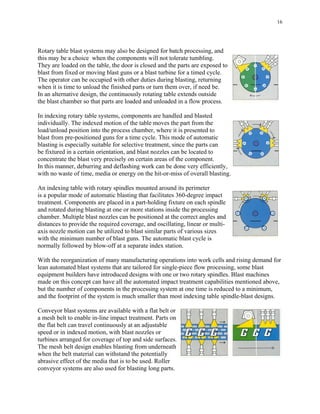
Rotary table blast systems may also be designed for batch processing, and
this may be a choice when the components will not tolerate tumbling.
They are loaded on the table, the door is closed and the parts are exposed to
blast from fixed or moving blast guns or a blast turbine for a timed cycle.
The operator can be occupied with other duties during blasting, returning
when it is time to unload the finished parts or turn them over, if need be.
In an alternative design, the continuously rotating table extends outside
the blast chamber so that parts are loaded and unloaded in a flow process.
In indexing rotary table systems, components are handled and blasted
individually. The indexed motion of the table moves the part from the
load/unload position into the process chamber, where it is presented to
blast from pre-positioned guns for a time cycle. This mode of automatic
blasting is especially suitable for selective treatment, since the parts can
be fixtured in a certain orientation, and blast nozzles can be located to
concentrate the blast very precisely on certain areas of the component.
In this manner, deburring and deflashing work can be done very efficiently,
with no waste of time, media or energy on the hit-or-miss of overall blasting.
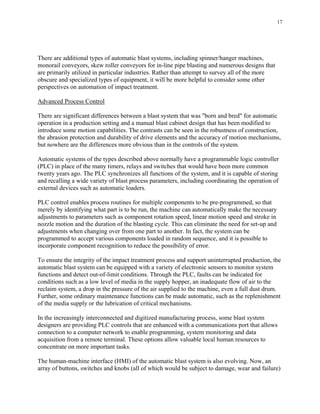
An indexing table with rotary spindles mounted around its perimeter
is a popular mode of automatic blasting that facilitates 360-degree impact
treatment. Components are placed in a part-holding fixture on each spindle
and rotated during blasting at one or more stations inside the processing
chamber. Multiple blast nozzles can be positioned at the correct angles and
distances to provide the required coverage, and oscillating, linear or multi-
axis nozzle motion can be utilized to blast similar parts of various sizes
with the minimum number of blast guns. The automatic blast cycle is
normally followed by blow-off at a separate index station.
With the reorganization of many manufacturing operations into work cells and rising demand for
lean automated blast systems that are tailored for single-piece flow processing, some blast
equipment builders have introduced designs with one or two rotary spindles. Blast machines
made on this concept can have all the automated impact treatment capabilities mentioned above,
but the number of components in the processing system at one time is reduced to a minimum,
and the footprint of the system is much smaller than most indexing table spindle-blast designs.
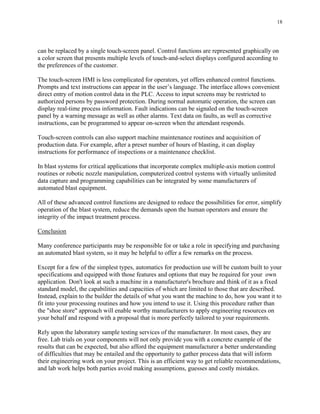
Conveyor blast systems are available with a flat belt or
a mesh belt to enable in-line impact treatment. Parts on
the flat belt can travel continuously at an adjustable
speed or in indexed motion, with blast nozzles or
turbines arranged for coverage of top and side surfaces.
The mesh belt design enables blasting from underneath
when the belt material can withstand the potentially
abrasive effect of the media that is to be used. Roller
conveyor systems are also used for blasting long parts.
17
There are additional types of automatic blast systems, including spinner/hanger machines,
monorail conveyors, skew roller conveyors for in-line pipe blasting and numerous designs that
are primarily utilized in particular industries. Rather than attempt to survey all of the more
obscure and specialized types of equipment, it will be more helpful to consider some other
perspectives on automation of impact treatment.
Advanced Process Control
There are significant differences between a blast system that was "born and bred" for automatic
operation in a production setting and a manual blast cabinet design that has been modified to
introduce some motion capabilities. The contrasts can be seen in the robustness of construction,
the abrasion protection and durability of drive elements and the accuracy of motion mechanisms,
but nowhere are the differences more obvious than in the controls of the system.
Automatic systems of the types described above normally have a programmable logic controller
(PLC) in place of the many timers, relays and switches that would have been more common
twenty years ago. The PLC synchronizes all functions of the system, and it is capable of storing
and recalling a wide variety of blast process parameters, including coordinating the operation of
external devices such as automatic loaders.
PLC control enables process routines for multiple components to be pre-programmed, so that
merely by identifying what part is to be run, the machine can automatically make the necessary
adjustments to parameters such as component rotation speed, linear motion speed and stroke in
nozzle motion and the duration of the blasting cycle. This can eliminate the need for set-up and
adjustments when changing over from one part to another. In fact, the system can be
programmed to accept various components loaded in random sequence, and it is possible to
incorporate component recognition to reduce the possibility of error.
To ensure the integrity of the impact treatment process and support uninterrupted production, the
automatic blast system can be equipped with a variety of electronic sensors to monitor system
functions and detect out-of-limit conditions. Through the PLC, faults can be indicated for
conditions such as a low level of media in the supply hopper, an inadequate flow of air to the
reclaim system, a drop in the pressure of the air supplied to the machine, even a full dust drum.
Further, some ordinary maintenance functions can be made automatic, such as the replenishment
of the media supply or the lubrication of critical mechanisms.
In the increasingly interconnected and digitized manufacturing process, some blast system
designers are providing PLC controls that are enhanced with a communications port that allows
connection to a computer network to enable programming, system monitoring and data
acquisition from a remote terminal. These options allow valuable local human resources to
concentrate on more important tasks.
The human-machine interface (HMI) of the automatic blast system is also evolving. Now, an
array of buttons, switches and knobs (all of which would be subject to damage, wear and failure)
18
can be replaced by a single touch-screen panel. Control functions are represented graphically on
a color screen that presents multiple levels of touch-and-select displays configured according to
the preferences of the customer.
The touch-screen HMI is less complicated for operators, yet offers enhanced control functions.
Prompts and text instructions can appear in the user’s language. The interface allows convenient
direct entry of motion control data in the PLC. Access to input screens may be restricted to
authorized persons by password protection. During normal automatic operation, the screen can
display real-time process information. Fault indications can be signaled on the touch-screen
panel by a warning message as well as other alarms. Text data on faults, as well as corrective
instructions, can be programmed to appear on-screen when the attendant responds.
Touch-screen controls can also support machine maintenance routines and acquisition of
production data. For example, after a preset number of hours of blasting, it can display
instructions for performance of inspections or a maintenance checklist.
In blast systems for critical applications that incorporate complex multiple-axis motion control
routines or robotic nozzle manipulation, computerized control systems with virtually unlimited
data capture and programming capabilities can be integrated by some manufacturers of
automated blast equipment.
All of these advanced control functions are designed to reduce the possibilities for error, simplify
operation of the blast system, reduce the demands upon the human operators and ensure the
integrity of the impact treatment process.
Conclusion
Many conference participants may be responsible for or take a role in specifying and purchasing
an automated blast system, so it may be helpful to offer a few remarks on the process.
Except for a few of the simplest types, automatics for production use will be custom built to your
specifications and equipped with those features and options that may be required for your own
application. Don't look at such a machine in a manufacturer's brochure and think of it as a fixed
standard model, the capabilities and capacities of which are limited to those that are described.
Instead, explain to the builder the details of what you want the machine to do, how you want it to
fit into your processing routines and how you intend to use it. Using this procedure rather than
the "shoe store" approach will enable worthy manufacturers to apply engineering resources on
your behalf and respond with a proposal that is more perfectly tailored to your requirements.
Rely upon the laboratory sample testing services of the manufacturer. In most cases, they are
free. Lab trials on your components will not only provide you with a concrete example of the
results that can be expected, but also afford the equipment manufacturer a better understanding
of difficulties that may be entailed and the opportunity to gather process data that will inform
their engineering work on your project. This is an efficient way to get reliable recommendations,
and lab work helps both parties avoid making assumptions, guesses and costly mistakes.
19
On turnkey system projects where automated impact treatment is but one part of a total process,
it is advisable that you or your system integrator consult a trusted blast system manufacturer and
get their technical resource people engaged as early as possible. It is especially important that
this consultation takes place before the budget for the project has been set and before crucial
decisions are made about material handling, general floor plan layout and the flow of work.
It is hoped that the reader understands that dryblast impact surface treatment is a dynamic
technology that is undergoing continued development and refinement in response to the
requirements of the manufacturing community. It is more precise, more controlled and more
versatile than ever.
It is vitally important for end-users to continue to challenge blast system designers and
manufacturers with new requirements, problems that need innovative solution, and desirable
process control improvements. You will find the best of these process equipment suppliers to be
responsive and dedicated problem-solvers, and this engagement and partnering is what will drive
the developments of the future.

Automated blasting

  • 1.
    TP04PUB147 author(s) J.C. CARSON Guyson Corporation SaratogaSprings, New York abstract conference Deburring and Surface Finishing March 16-18, 2004 Chicago, Illinois terms Blasting Texture Roughness Finishing Sandblasting Beadblasting TECHNICALPAPER 2004 Automated Blasting to Control Surface Texture and Finish Apart from many applications of blasting techniques that utilize nonabrasive media to perform work such as deburring, deflashing and cleaning without modification of component surfaces, impact treatment is also a fast and cost- effective means of producing a desired texture or a specified roughness. This review of blast finishing methods and equipment begins with a discussion of the fundamentals of dry blast media and media delivery. Principal types of automatic blast systems are described with an explanation of valuable capabilities of impact treatment processes in surface preparation and finishing, including recent advances in media reclamation and blast process control. Society of Manufacturing Engineers • One SME Drive • P.O. Box 930 Dearborn, MI 48121 • Phone (313) 271-1500 • www.sme.org
  • 2.
    SME TECHNICAL PAPERS ThisTechnical Paper may not be reproduced in whole or in part in any form without the express written permission of the Society of Manufacturing Engineers. By publishing this paper, SME neither endorses any product, service or information discussed herein, nor offers any technical advice. SME specifically disclaims any warranty of reliability or safety of any of the information contained herein.
  • 3.
    Automated Blasting toControl Surface Texture and Finish J. C. Carson Marketing Manager Group Leader, Applications Team Guyson Corporation Summary Apart from the many applications of blasting techniques that utilize non-abrasive media to perform work such as deburring, deflashing and cleaning without modification of component surfaces, impact treatment is also one of the most cost-effective means of producing a desired texture or a specified roughness. This review of blast finishing methods and equipment begins with a discussion of the fundamentals of dry blast media and media delivery. The principal types of automatic blast systems are described with an explanation of some important capabilities of impact treatment processes in surface preparation and finishing, including some of the most recent advances in media reclamation and blast process control. The author attempts to emphasize that, when automated blasting can do the work, it is very often the fastest and lowest cost alternative for production surface preparation and cosmetic finishing.
  • 4.
    2 The specialized technologythat is commonly referred to as “sandblasting” has evolved to become one of the most widely used methods for cleaning, finishing and surface preparation of metals and other materials. Designers and builders of blast machinery for the manufacturing community are not fond of the “sandblaster” designation. Because of the widespread use of the term, it is expeditious to accept the label, however uncomfortable. One complaint is that most sand blasting is messy and somewhat unpleasant work done outdoors with portable hand-held equipment, air-supplied hoods and protective clothing. The abrasives used in such operations are usually the cheapest available, since they are frequently considered expendable after a single pass through the blast nozzle. In contrast to the outdoor variety, blasting is generally “cabinet-ized” in modern manufacturing. It is a contained process, the blasting particles or media are captured and recirculated, and the dust is separated and collected. Increasingly, manual cabinet blasting operations are being automated to upgrade their efficiency, reduce costs and ensure consistent and repeatable processing. Whether you call it beadblasting, abrasive blasting, shotblasting, gritblasting or another name, the basis of all these techniques is impact energy. Millions of microscopic particles are projected onto component surfaces, each capable of doing some work, according to its specific properties. Fundamentals of Media Delivery While blasting is commonly utilized in a variety of manufacturing and reconditioning operations, it is not always a subject that is introduced in engineering and technical training programs. It is sometimes understood only superficially and misused in practice. A brief look at basic operating principles will provide the foundation for a discussion of specific surface treatment techniques. The simplest and most common blast cabinets are of the suction-feed type, in which blast particles are drawn into the blast gun by an induced vacuum and accelerated within the gun by a metered stream of compressed air. Suction guns have two hoses, one to supply compressed air at regulated pressure, and one vacuum hose to feed abrasive to the gun. When the blasting air pressure is increased, particle velocity will be higher, as will vacuum and media flow. The volume of air used by a suction gun operated at the desired blast pressure is determined by the bore (orifice size) of the metering airjet.
  • 5.
    3 In most suction-blastequipment, the loading of the air stream with media particles, the volume of media flowing to the gun, is adjustable by means of a vented pick-up tube that allows a greater or lesser amount of air to be mixed with the abrasive until maximum media flow is achieved, with no overloading or surging. The simplest cabinet blast system consists of a vented enclosure with a sloped hopper at the bottom where the media pick-up tube is located. A blower-powered dust collector maintains negative pressure in the cabinet, extracting airborne dust. After impacting the work, media particles fall back into the feed hopper by gravity. In this most basic of blast cabinets, after a period of use, when the media mix includes an excessive percentage of fractured particles and contaminants, the entire contents of the media hopper are emptied out, and a fresh batch of media is loaded.
  • 6.
    4 A more efficientcabinet blast system includes a cyclone separator and media reclaimer, which is positioned between the blast chamber and the dust collector. Equipped with its own blower, or utilizing the air flow created by the dust collector blower, the cyclone draws a strong flow of air from the blast cabinet, carrying media, fractured particles and dust out of the process chamber through a duct hose or pipe. Inside the body of the cyclone, particles and dust are separated by mass. The heavier media stays to the outside, traveling in a spiraling motion down the cone of the cyclone to a media hopper, while the lighter dust is suspended in the extraction zone at the center, from which it is ducted to the dust collector. The efficiency of the separation process can be tuned by adjustment of the air flow into and out of the cyclone by means of a blast gate or butterfly valve at the inlet of the dust collector and by adjustable vents on the cyclone itself. Fine adjustment of the airflow through the cyclone is necessary for effective separation of lighter fractured media particles. Too little air flow will result in slower, dustier blast operations, and too much flow will carry good media particles off to the dust collector. Inspection of the contents of the dust collector waste provides evidence of the cyclone's performance. Five to ten percent by weight of the material in the dust bin should be "good" media particles. If the contents are purely dust, then it is certain that fractured, ineffective-sized particles are abundantly present in the blasting mixture. Cyclone media reclamation offers numerous advantages over the more primitive set-up. Batch changing of media is eliminated, and new media must only be added to the system in small amounts to compensate for attrition. A cabinet equipped with a cyclone is less dusty in operation, and visibility within the blast enclosure is improved. Tunable separation yields some degree of control over blast particle size, enabling more consistent results and uniform finish.
  • 7.
    5 Direct pressure blastsystems provide faster coverage of larger surface areas and more energy- efficient media delivery. In pressure-blast equipment, the media is held in a pressurized vessel and metered into a flow of compressed air in a single, heavy-gauge pressure hose where the blast particles are accelerated throughout its length. The grit valve or metering valve at the head-end of the blast hose enables adjustment of the volume of media loaded into the blast stream. At a given pressure level, particle velocity exiting the nozzle is higher with direct pressure than with suction-blast media delivery because acceleration of the media takes place through the entire length of the blast hose, not just in the body of the blast gun and the nozzle. Thus, more work can be accomplished in a shorter time by the higher-energy particles. With pressure-blast the work typically goes about four times faster than suction-blast. Pressure-blast systems make more efficient use of costly compressed air than suction-blast, because all the air is used to accelerate blast media, whereas in the suction gun, a percentage of the air consumed is used just to generate the vacuum for media pick-up. With these advantages, you might wonder why anyone would choose suction-blast over direct pressure media delivery. One reason is the higher cost of pressure-blast, both in the initial investment in equipment and in the ongoing maintenance expense for the more complicated apparatus. If a more economical suction system can quickly and easily do the work, it is not reasonable to consider pressure blasting. Most people will buy pressure-blast only when they truly need it for their particular cleaning, finishing or surface treatment application.
  • 8.
    6 It should benoted that with manual blast equipment, whether suction- or pressure-feed, the particle stream is directed by hand. Constant operator attention is required, and the quality of the results can vary widely from user to user and part to part. Automated blasting equipment, while operating on the same principles, removes issues related to technique and makes possible a controlled and repeatable production process. The third main type of dry media delivery is found in wheel blast or turbine blast systems, which do not utilize compressed air for acceleration of the shot or grit. Instead, a regulated flow of media is fed to the center of a paddle-bladed blastwheel that rotates at high speed, usually from 1,800 to 3,000 RPM. By centrifugal force, the turbine slings a very high volume of media onto the work. In most machines, the turbine is positioned 18 to 36 inches from the work to permit the blast to fan out for coverage of a wide area. Turbine blast is many times more energy-efficient than airblast media delivery. A small diameter blastwheel driven by a motor of 10 HP or less can throw 150 pounds of media or more per wheel per minute, creating a blast pattern that is several inches wide and two or more feet long. For comparison, a 10 HP air compressor will power a single suction gun that delivers approximately five pounds per minute of the same metallic media, creating a blast pattern that may be about one inch in diameter. Because the acceleration of the media is harsh in airless turbine-blast systems, media choices are usually limited to metal shot or grit. The relatively high density of metallic media helps the blast particles retain and deliver energy to the surfaces of the work, despite the fact that the turbine is positioned at a considerable distance. After impacting the work surface and being collected at the
  • 9.
    7 bottom of theblast cabinet, it is not feasible to convey such volumes of heavy media pneumatically, as in most air-blasting systems, so turbine-blast machines typically have a bucket elevator to return it to the feed hopper. In turbine-blast equipment, removal of dust from the media is usually performed by cascade airwash. On its way to the hopper that feeds the blast turbine, the media travels by gravity down a sloping spillway and cascades through an extraction zone where there is a strong flow of air to the dust collector. Changing this air flow by means of a blast gate or butterfly valve allows adjustment of separation. Turbine blast systems built for use with microscopic shot also incorporate a cyclone after the airwash separator to retain more of the effective-size media particles that would otherwise end up in the dust collector waste bin. Clearly, turbine-blast media delivery should be considered when rapid overall treatment is required on a very high volume of parts or on large components with a lot of surface area. It is usually difficult to blast selectively in these machines, even with elaborate masking. The range of media choices is much more limited than with air-blast, thus there will be certain surface textures or finishes that can not be produced by airless blasting. However, a variety of new, engineered blasting materials and specialized metallic media are now available that have extended the capabilities of turbine-blast for cleaning, surface preparation and distinctive cosmetic finishing.
  • 10.
    8 Media Basics To graspthe potential of automated blasting for cost reduction and quality improvement, it is necessary to understand how the work is done and the mechanics of blast particles impacting surfaces. We should begin a discussion of media with some observations about sand blasting. Natural silica sand or beach sand may be cheap, but this granular mineral material and the vitreous slag by-products that are marketed as substitutes for sand in outdoor blasting are generally not suitable for cabinet-type blast systems that recirculate media. All such materials have an extremely high rate of fracture, leading to problems that will shortly be explained. More importantly, you must understand that the use of silica sand for blasting may result in the release into the air of free silica that can cause the respiratory ailment called silicosis. If you need the surface finish generated by such mineral grit, you can choose from many other media that will do the work that do not bring with them the liabilities and health hazards associated with sand blasting. The most important properties that should be considered in the selection of blast media for a particular application are the material or chemical composition, hardness, density, particle shape, screen or particle size and impact resistance. Both the technical performance of the media and the cost of the process are at stake in the choice of blasting materials. Commonly available blast media include agricultural materials such as ground nut shells or starch grit, mineral substances like aluminum oxide or silicon carbide, ceramic shot and grit, glass in the form of beads or granular crushed glass, various plastics formed into beads or ground up into angular particles and metals such as steel shot and iron grit. Today, all or most of these media are engineered materials, formulated or processed to emphasize useful characteristics for impact treatment. It should be noted that some of the media in many of these categories of materials are primarily marketed for outdoor or single-pass blasting operations versus use in longer-cycle cabinet blast media delivery systems. Density or particle mass is a major factor in the energy that media can deliver to the surface on impact. Heavy particles pack more wallop than light ones and may be capable of greater surface modification, however, increased particle velocity can compensate for lower density up to the point where an excessive fracture rate becomes noticeable.
  • 11.
    9 Media particle shapesfall broadly into the categories of shot and grit. Spherical particles distribute their impact over a larger area, moderating the impact and potentially creating a round-bottomed dimple in the surface. Sometimes called a peened finish, the effect of shot blast treatment is likely to be a semi-reflective sheen appearance. With angular grit media, the impact may be concentrated on a point of the particle or a sharp edge, generating an etched, matte finish that is characteristically bright, but non-reflective. In terms of surface modification capabilities, comparing peened versus etched surfaces created by different-shaped particles, the contrast is not so much in the final texture or depth of impression, but in the nature of the indentations in the surface and its reflectivity. Particle size has an important effect on the number of impacts per second of blasting, so it is advisable to use media of the smallest screen size that will do the work, in order to reduce process time to a minimum. Larger particles may be capable of creating bigger indentations and more texture in the surface, whereas smaller ones produce dimples or angular dents of lesser diameter. In some instances, the choice of media screen size is dictated by surface features such as holes or narrow places where shot or grit may penetrate less effectively, become entrapped or lodge in recesses of the component. The hardness of media is a critical factor in almost every case. Usually reckoned by the Rockwell Scale or the mineral order of hardness (MOH Scale), it often expresses the “aggressiveness” of the material and its ultimate potential for surface modification. A particle of softer material, even when it is of greater size and density and propelled at a higher velocity, will be unlikely to alter the finish of a harder substrate. Hardness may determine whether a blast particle will deliver its energy with effect or absorb some of the impact energy by deformation or fracture. One of the best pieces of advice to guide in the selection of media is to know the hardness of your substrate. Finally, one of the keys to economical blasting is to consider the impact strength or fracture resistance of the material. This factor manifests itself in the attrition rate of media and your consumables cost, but it can also be an issue in terms of the generation of dust from the break- down of media and the volume of waste material for disposal. Blast pressure or particle velocity plays a major part in the equation, but the fracture resistance of media under the conditions of use has a direct effect on the technical quality of surface preparation and the consistency of your surface finish. As previously mentioned, most of the materials used for outdoor blasting are highly friable and do not survive their first impact with the substrate.
  • 12.
    10 Obviously, all ofthe properties of media that we have outlined must be taken together to determine the usefulness of any media for a given blasting application. Component material and the type of blast equipment to be used dictate certain media choices. Media selection is usually an educated process of elimination that should primarily be based on your technical surface finish requirements. Cost considerations for a particular choice, both in terms of media consumption and wear-and-tear on equipment, can be estimated to fill in the economic dimensions in your evaluation of alternatives. Some rules-of-thumb for media selection are the following: 1. Choose the least aggressive media that will do the work. This will result in less wear and lower equipment maintenance expense. 2. Use the smallest media particle size that will do the work. More impacts per second will yield a faster process. 3. Find the lowest blast pressure that will do the work. This offers the benefits of energy savings in reduced compressed air requirements, as well as less wear and lower maintenance costs. The best advice about media selection is to avoid making assumptions about what worked for somebody else, take advantage of laboratory testing services offered by some equipment manufacturers, insist that a potential supplier demonstrate acceptable results on your own components and expect satisfactory answers to your questions about the testing and the recommendations.
  • 13.
    11 Blast Deburring The fundamentalsreviewed thus far can be applied in a discussion of burr removal. Impact treatment can be an elegant solution for a variety of deburring and edge finishing problems, and automated blast deburring is often the fastest and lowest cost approach to this secondary operation. Blasting deburrs by impact, so if a burr is very firmly attached to the parent material, it may not be a good candidate for blast treatment. It is usually a mistake to try to use harsh abrasive blast media to wear-down a burr or to abrade away the material of the component until the burr falls off. In the most efficient blast deburring process, the work is done by a particle with sufficient mass and velocity to knock the burr off and break it free from the edge. Blast media have the ability to penetrate narrow openings, tight recesses and fine details that might be difficult to access by other means. Blasting can be done selectively, so that impact treatment is concentrated on specific areas of the component that are predictably the site of burrs from automatic machining or metalworking processes. Nonabrasive media such as plastic beads can effectively remove burrs without the slightest alteration of adjacent surfaces that may already have the desired finish. If your purposes include cosmetic finishing, texturing or preparation of component surfaces for another downstream process, in addition to removal of burrs, media blasting can frequently accomplish both tasks in a single operation. One other ability of blasting media that is worthy of mention in regard to deburring is rebound. Certain materials, especially resilient plastic media such as cubical nylon beads, will bounce and ricochet on impact, yet retain sufficient energy to do some work the second or third time they strike a component surface. Rebound effects can be harnessed to get at problematic burrs on internal features and components that may be convoluted in shape. What happens to the burrs after they are removed from components is an important question for evaluation of the blast system design. Sharp pieces of the same material as the part represent a contaminant if they circulate with the media. One problem is that burrs could lodge or accumulate in working parts of the blast system, causing clogs or other malfunctions. Another, and sometimes more serious, problem is that burrs could be projected onto the component and cause damage to critical surfaces. A simple scalping screen placed in the reclaim system is one approach to a solution, but its effectiveness is very limited. If it catches burrs, the sieve will become blinded, soon impeding the flow of media or stopping it. When deburring ferrous components with nonferrous media, Installation of a powerful magnetic separator in the reclaim stack-up can pull burrs out of circulation and hold them. Obviously, a different method is needed for deburring of plastic or non-ferrous metal components.
  • 14.
    12 Advanced Media Reclamation Notonly in blast deburring and deflashing, where significant quantities of media-contaminating debris will be introduced into the blast system, but also in a variety of other applications, some of which will shortly be discussed, there may be a need for more precise control over the blast particle mix. Cyclone separator reclamation alone cannot be expected to perform satisfactorily in such cases, especially in an automated system that must keep pace with production. The introduction of a vibrating screen classifier in the cyclone reclaim stack-up to continuously sieve 100% of the material extracted from the blast chamber before the media recirculates can dramatically improve the performance of the system. In addition to the separation of burrs, flash and other foreign matter, classification provides a high degree of control over the size of the blast particles themselves. It maintains the consistency of the media, optimizing its effectiveness and keeping the results of blasting within tight limits. The top deck of the vibrating screen classifier captures material that is larger than the specified size of the blast media particles and removes it to a scrap bin. The middle screen retains media particles that are the correct size and delivers them to the blast machine. The lower deck collects under-size media and finer debris.
  • 15.
    13 Precision Roughening Looking atthe more aggressive aspects of blast treatment, there are applications of the technology in production of a profiled surface with a specific roughness. Different from surface preparation work that involves blast cleaning to remove deposits such as scale or oxidation, we can call this category technical surface preparation, etching or precision roughening. Many types of coatings benefit from a “toothed “ profile or anchor pattern for proper adhesion, including thermal sprayed ceramic, metallic and polymer coatings, as well as organic coatings applied by other means. Blast etching can function to increase surface area and promote stronger mechanical bonding. On the other end of the roughness spectrum, microabrasive surface preparation using exceedingly fine grit has proven beneficial for certain thin-film vacuum coatings. Bonding and gluing of materials such as rubber, plastic, epoxy and metals may be improved by controlled roughening of the substrate. In each case, good coating or bonding depends, in large part, upon the uniformity of surface texture on key aspects of the component. Requirements for surface texture, the degree of surface modification and the final surface condition can vary extremely, but in most cases the media utilized will be sharp, angular grit that is sufficient in hardness to affect the substrate. Two of the common air-blast media for precision roughening applications are aluminum oxide and silicon carbide grit, while turbine-blast media that may be good choices for certain etching requirements would be steel grit or chilled iron grit. In addition to hardness, the most important media property for technical surface preparation work is its screen size, since this determines the size of the minute indentations that create the profile or texture. Larger particles of the same material will have greater mass and impact force. The maximum depth of etch for any given grit size is achieved by increasing particle velocity, or raising the blast pressure up, to a point near the threshold where the fracture resistance of the media is exceeded. When the highest degree of precision and consistency of texture is required for critical coating work, a reclamation system enhanced by a screen classifier of suitable capacity can ensure that media sizing is held within close tolerances. This upgrade yields a much more uniform surface and significantly reduces media fines in the blast mix, a future source of dust. It is necessary to quantify your surface texture requirements, both to guide in the initial development of blast processing parameters and to verify the blasting results in your ongoing quality control procedures. An average roughness value (Ra), or more commonly, a maximum and minimum Ra value that can be measured on critical aspects of the component using a profilometer is usually an adequate specification for surface texture. If you have not determined the optimum surface texture you need, or you are in the process of establishing a surface roughness specification for your coating, bonding or adhesive application, the lab testing services of a blast system manufacturer can help by preparing samples with several different degrees of profile for your own testing and evaluation.
  • 16.
    14 Cosmetic Finishing Some peoplein manufacturing think of finish only in terms of painting, plating or material applied to the part. The appearance of many components can be greatly improved by the elimination of superficial shortcomings, and the production of a “self-finish” that emphasizes the inherent aesthetic qualities of its material by blast treatment. Of course, the phrase “beauty is in the eyes of the beholder” applies to all products, and when it comes to the looks of your components, Manufacturing Engineers usually take their cues from senior management, the Marketing Department, or ultimately, your company’s customers. In the matter of adding aesthetic value to your product, those responsible for production processes are not consulted nearly enough in many organizations. It is a mistake to consider impact treatment as a substitute for a buffing or polishing process, if you are trying to generate highly reflective, shiny surfaces or mirror finishes. Blasting techniques may be very useful to clean deposits from such surfaces without spoiling the shine, but not for their production. Interestingly, self-finished components may be protected by durable, clear, glossy coatings, combining the appearance of the substrate with that of its organic shell. Impact finishing may be a viable method for generating a surface with a distinctive appearance and “feel” on account of its texture. Blasting has unique abilities when you want to blend-in minor surface imperfections. A blasted surface can be a bright, non-reflective matte finish; a semi-reflective satin or sheen appearance that is nearly iridescent; or some attractive look that is in-between. Such a blasted self-finish can be produced quickly and at very low cost, if it is acceptable to your judges, the most important of which is the customer. As mentioned in our review of media properties, grit blasting produces an etched surface with angular indentations that tend to reflect light away from the eye, so it appears as a matte finish. An example of a consumer product that exhibits this as a cosmetic finish would be the circumference of some brands of circular saw blades. Shot blasted surfaces, with their dimpled texture of rounded indentations, can reflect light in a very subtle manner that is pleasing to the eye. Since this look has enjoyed broader acceptance and popularity, you will recognize such blasted surface finishes on an enormous variety of products, from aluminum alloy wheels, to wrist watches, to golf clubs. Structural materials such as aluminum extrusions have also been enhanced in appearance by beadblasting methods. Because shot and semi-spherical media are available in such a variety of materials and screen sizes, there is almost no limit to the range of slightly different peened surfaces that can be produced, each with unique qualities that might be distinctive and appealing in the eyes of the beholder of your product. Once again, when it is time to change your finish and come up with a new look for a product, the laboratory testing services of some blast equipment manufacturers can help you evaluate textured
  • 17.
    15 surfaces as analternative finish. By providing you with a variety of examples for comparison, as well as data about how they could be produced on a production basis, blasting lab work is indispensable in this regard. Types of Automated Blast Machinery Understanding the basics of media delivery and some capabilities of the materials used in impact treatment processes, the next question is how the component should be handled and presented to the blast. It will be helpful to review some of the main types of production blast machinery and consider some of the advantages and limitations associated with different types of automatic blast systems. When the volume of production is very low, a manual blast process may be equal to the task. It has already been pointed out that the results of hand blasting rely heavily upon the technique and close attention of the operator. Some sources of variation in manual blasting may be reduced by more user-friendly cabinet design and by component handling conveniences such as turntables, part-holding fixtures, roller supports and features that simplify loading and unloading. But consistency and repeatability will never be strong points of hand blasting methods. Besides the labor cost and slowness of tedious manual processing, you may also be concerned about the possibility of worker injury due to repetitive motion in hand blasting operations. Tumble-blasting can be an economical method of treating components in bulk by a batch process. Available in many sizes, tumble-blast machines are utilized when all aspects of the parts are to be equally covered by the blast. The main designs are barrel-type systems, those that have a revolving basket and machines that tumble the batch of parts in an endless belt. As components turn over and over in the batch, media particles impact the exposed surfaces. Not all parts lend themselves to blasting by this method. The speed of tumbling can be slowed to reduce such part-on-part damage, but some components that are made of fragile materials or have protruding features that are especially delicate may not fair well in tumble-blast processing. Some machine designs produce more violent tumbling action than others. The circulation of parts in the batch also varies, so some less effective tumble-blast machines will require much longer processing cycles. Another point to consider is that there is an optimum batch size that promotes fast, even finishing. Uniform coverage and cycle time will suffer if too many components are loaded per batch.
  • 18.
    16 Rotary table blastsystems may also be designed for batch processing, and this may be a choice when the components will not tolerate tumbling. They are loaded on the table, the door is closed and the parts are exposed to blast from fixed or moving blast guns or a blast turbine for a timed cycle. The operator can be occupied with other duties during blasting, returning when it is time to unload the finished parts or turn them over, if need be. In an alternative design, the continuously rotating table extends outside the blast chamber so that parts are loaded and unloaded in a flow process. In indexing rotary table systems, components are handled and blasted individually. The indexed motion of the table moves the part from the load/unload position into the process chamber, where it is presented to blast from pre-positioned guns for a time cycle. This mode of automatic blasting is especially suitable for selective treatment, since the parts can be fixtured in a certain orientation, and blast nozzles can be located to concentrate the blast very precisely on certain areas of the component. In this manner, deburring and deflashing work can be done very efficiently, with no waste of time, media or energy on the hit-or-miss of overall blasting. An indexing table with rotary spindles mounted around its perimeter is a popular mode of automatic blasting that facilitates 360-degree impact treatment. Components are placed in a part-holding fixture on each spindle and rotated during blasting at one or more stations inside the processing chamber. Multiple blast nozzles can be positioned at the correct angles and distances to provide the required coverage, and oscillating, linear or multi- axis nozzle motion can be utilized to blast similar parts of various sizes with the minimum number of blast guns. The automatic blast cycle is normally followed by blow-off at a separate index station. With the reorganization of many manufacturing operations into work cells and rising demand for lean automated blast systems that are tailored for single-piece flow processing, some blast equipment builders have introduced designs with one or two rotary spindles. Blast machines made on this concept can have all the automated impact treatment capabilities mentioned above, but the number of components in the processing system at one time is reduced to a minimum, and the footprint of the system is much smaller than most indexing table spindle-blast designs. Conveyor blast systems are available with a flat belt or a mesh belt to enable in-line impact treatment. Parts on the flat belt can travel continuously at an adjustable speed or in indexed motion, with blast nozzles or turbines arranged for coverage of top and side surfaces. The mesh belt design enables blasting from underneath when the belt material can withstand the potentially abrasive effect of the media that is to be used. Roller conveyor systems are also used for blasting long parts.
  • 19.
    17 There are additionaltypes of automatic blast systems, including spinner/hanger machines, monorail conveyors, skew roller conveyors for in-line pipe blasting and numerous designs that are primarily utilized in particular industries. Rather than attempt to survey all of the more obscure and specialized types of equipment, it will be more helpful to consider some other perspectives on automation of impact treatment. Advanced Process Control There are significant differences between a blast system that was "born and bred" for automatic operation in a production setting and a manual blast cabinet design that has been modified to introduce some motion capabilities. The contrasts can be seen in the robustness of construction, the abrasion protection and durability of drive elements and the accuracy of motion mechanisms, but nowhere are the differences more obvious than in the controls of the system. Automatic systems of the types described above normally have a programmable logic controller (PLC) in place of the many timers, relays and switches that would have been more common twenty years ago. The PLC synchronizes all functions of the system, and it is capable of storing and recalling a wide variety of blast process parameters, including coordinating the operation of external devices such as automatic loaders. PLC control enables process routines for multiple components to be pre-programmed, so that merely by identifying what part is to be run, the machine can automatically make the necessary adjustments to parameters such as component rotation speed, linear motion speed and stroke in nozzle motion and the duration of the blasting cycle. This can eliminate the need for set-up and adjustments when changing over from one part to another. In fact, the system can be programmed to accept various components loaded in random sequence, and it is possible to incorporate component recognition to reduce the possibility of error. To ensure the integrity of the impact treatment process and support uninterrupted production, the automatic blast system can be equipped with a variety of electronic sensors to monitor system functions and detect out-of-limit conditions. Through the PLC, faults can be indicated for conditions such as a low level of media in the supply hopper, an inadequate flow of air to the reclaim system, a drop in the pressure of the air supplied to the machine, even a full dust drum. Further, some ordinary maintenance functions can be made automatic, such as the replenishment of the media supply or the lubrication of critical mechanisms. In the increasingly interconnected and digitized manufacturing process, some blast system designers are providing PLC controls that are enhanced with a communications port that allows connection to a computer network to enable programming, system monitoring and data acquisition from a remote terminal. These options allow valuable local human resources to concentrate on more important tasks. The human-machine interface (HMI) of the automatic blast system is also evolving. Now, an array of buttons, switches and knobs (all of which would be subject to damage, wear and failure)
  • 20.
    18 can be replacedby a single touch-screen panel. Control functions are represented graphically on a color screen that presents multiple levels of touch-and-select displays configured according to the preferences of the customer. The touch-screen HMI is less complicated for operators, yet offers enhanced control functions. Prompts and text instructions can appear in the user’s language. The interface allows convenient direct entry of motion control data in the PLC. Access to input screens may be restricted to authorized persons by password protection. During normal automatic operation, the screen can display real-time process information. Fault indications can be signaled on the touch-screen panel by a warning message as well as other alarms. Text data on faults, as well as corrective instructions, can be programmed to appear on-screen when the attendant responds. Touch-screen controls can also support machine maintenance routines and acquisition of production data. For example, after a preset number of hours of blasting, it can display instructions for performance of inspections or a maintenance checklist. In blast systems for critical applications that incorporate complex multiple-axis motion control routines or robotic nozzle manipulation, computerized control systems with virtually unlimited data capture and programming capabilities can be integrated by some manufacturers of automated blast equipment. All of these advanced control functions are designed to reduce the possibilities for error, simplify operation of the blast system, reduce the demands upon the human operators and ensure the integrity of the impact treatment process. Conclusion Many conference participants may be responsible for or take a role in specifying and purchasing an automated blast system, so it may be helpful to offer a few remarks on the process. Except for a few of the simplest types, automatics for production use will be custom built to your specifications and equipped with those features and options that may be required for your own application. Don't look at such a machine in a manufacturer's brochure and think of it as a fixed standard model, the capabilities and capacities of which are limited to those that are described. Instead, explain to the builder the details of what you want the machine to do, how you want it to fit into your processing routines and how you intend to use it. Using this procedure rather than the "shoe store" approach will enable worthy manufacturers to apply engineering resources on your behalf and respond with a proposal that is more perfectly tailored to your requirements. Rely upon the laboratory sample testing services of the manufacturer. In most cases, they are free. Lab trials on your components will not only provide you with a concrete example of the results that can be expected, but also afford the equipment manufacturer a better understanding of difficulties that may be entailed and the opportunity to gather process data that will inform their engineering work on your project. This is an efficient way to get reliable recommendations, and lab work helps both parties avoid making assumptions, guesses and costly mistakes.
  • 21.
    19 On turnkey systemprojects where automated impact treatment is but one part of a total process, it is advisable that you or your system integrator consult a trusted blast system manufacturer and get their technical resource people engaged as early as possible. It is especially important that this consultation takes place before the budget for the project has been set and before crucial decisions are made about material handling, general floor plan layout and the flow of work. It is hoped that the reader understands that dryblast impact surface treatment is a dynamic technology that is undergoing continued development and refinement in response to the requirements of the manufacturing community. It is more precise, more controlled and more versatile than ever. It is vitally important for end-users to continue to challenge blast system designers and manufacturers with new requirements, problems that need innovative solution, and desirable process control improvements. You will find the best of these process equipment suppliers to be responsive and dedicated problem-solvers, and this engagement and partnering is what will drive the developments of the future.