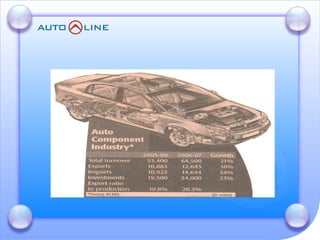
“ FUTURE OF AUTO COMPONENT INDUSTRY” BY MR. M. RADHAKRISHNAN JT.MANAGING  DIRECTOR PRESENTATION ON AUTOLINE INDUSTRIES LTD.
PRIMARY GROWTH DEMAND Dependant on OEMs OEM market drivers (for India) Growth in Economic Activity Increase in the Personal disposable incomes  Growth in Rural Economy Multiple & easy finance options  Decline in tax rates  Economic vehicles (Nano effect )
After market Drivers  Old vehicle population  Life span of components (frequency of replacement). Average value of parts replaced. Share of genuine-branded components in the total aftermarket.
DOMESTIC MARKET Growth opportunities in terms of volume The domestic market for four wheelers is projected to grow at a compounded annual growth rate of 9% during the next few years.  This will provide reasonably good growth opportunities in terms of volume to component manufacturers such as our company with facilities having latest technologies and mass manufacturing facilities.
 
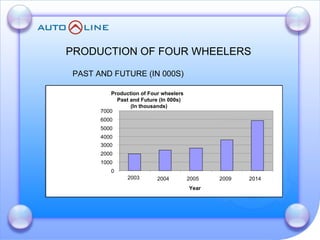
PRODUCTION OF FOUR WHEELERS  PAST AND  FUTURE  (IN 000S) Production of Four wheelers  Past and Future (In 000s) (In thousands) 0 1000 2000 3000 4000 5000 6000 7000 2003 2004 2005 2009 2014 Year
INDUSTRY OVERVIEW INDIAN AUTO COMPONENT INDUSTRY   The Indian automobile ancillary sector is transforming itself from a low-volume, highly fragmented one into a competitive industry, and backed by competitive strengths, technology and transition up the value chain.  Broadly the Indian automotive component industry can be divided into the organized and the unorganized segments. While the forte of the organized sector is the high valued added precision engineering products, the presence of a large unorganized sector is characteristic  especially of the lower value-added segments of the industry. In the organized segment, the component manufacturers supply components to at least one of the Original Equipment (Vehicle) Manufacturers (OEMs). Such component manufacturers usually have access to the required technology due to their tie-ups with some of the foreign collaborators or through their links with the automobile manufacturer.  There are presently 29 Vehicles Manufacturers (OEMs) in India located at Gurgaon, Pune and Chennai who together manufactured more than 5.2 million vehicles during 2005-06.
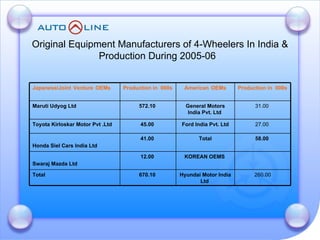
Original Equipment Manufacturers of 4-Wheelers In India & Production During 2005-06  American   OEMs Japanese/Joint   Venture   OEMs 260.00 Hyundai Motor India Ltd  670.10  Total  KOREAN OEMS  12.00  Swaraj Mazda Ltd   58.00   Total 41.00  Honda Siel Cars India Ltd   27.00  Ford India Pvt. Ltd 45.00  Toyota Kirloskar Motor Pvt .Ltd  31.00  General Motors India Pvt. Ltd  572.10  Maruti Udyog Ltd  Production in  000s  Production in  000s
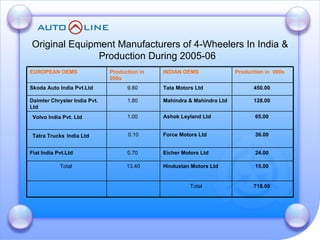
Original Equipment Manufacturers of 4-Wheelers In India & Production During 2005-06  Volvo India Pvt. Ltd   Tatra Trucks   India Ltd 718.00  Total 15.00  Hindustan Motors Ltd   13.40 Total  24.00  Eicher Motors Ltd   0.70   Fiat India Pvt.Ltd 36.00  Force Motors Ltd   0.10 65.00  Ashok Leyland Ltd 1.00   128.00  Mahindra & Mahindra Ltd 1.80   Daimler Chrysler India Pvt. Ltd 450.00  Tata Motors Ltd   9.80   Skoda Auto India Pvt.Ltd  Production in  000s   INDIAN OEMS   Production in  000s  EUROPEAN OEMS
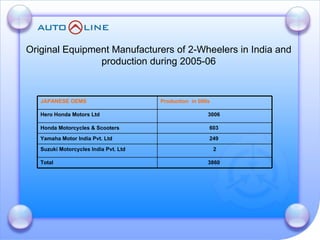
Original Equipment Manufacturers of 2-Wheelers in India and production during 2005-06 3860  Total   2 Suzuki Motorcycles India Pvt. Ltd   249  Yamaha Motor India Pvt. Ltd   603  Honda Motorcycles & Scooters   3006  Hero Honda Motors Ltd Production  in 000s   JAPANESE OEMS
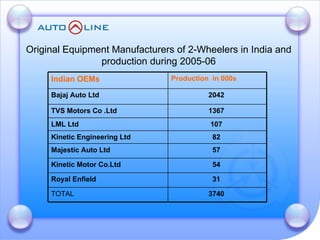
Original Equipment Manufacturers of 2-Wheelers in India and production during 2005-06 3740   TOTAL 31  Royal Enfield   54  Kinetic Motor Co.Ltd  57  Majestic Auto Ltd  82  Kinetic Engineering Ltd  107  LML Ltd  1367  TVS Motors Co . Ltd   2042  Bajaj Auto Ltd   Production  in 000s   Indian OEMs
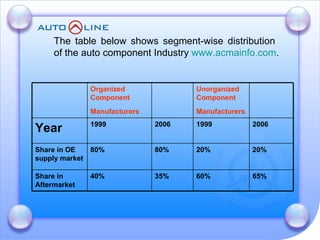
The table below shows segment-wise distribution  of the auto component Industry  www.acmainfo.com . 65%  60%  35%  40%  Share in Aftermarket  20%  20%  80%  80%  Share in OE supply market  2006  1999  2006  1999  Year   Unorganized Component Manufacturers   Organized Component Manufacturers
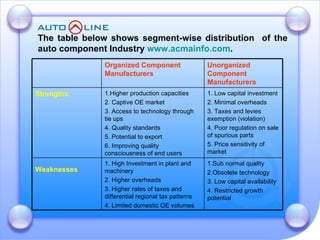
The table below shows segment-wise distribution  of the auto component Industry  www.acmainfo.com . 1.Sub normal quality 2.Obsolete technology 3. Low capital availability 4. Restricted growth potential  1. High Investment in plant and machinery 2. Higher overheads 3. Higher rates of taxes and differential regional tax patterns 4. Limited domestic OE volumes  Weaknesses   1. Low capital investment 2. Minimal overheads 3. Taxes and levies exemption (violation) 4. Poor regulation on sale of spurious parts 5. Price sensitivity of market  1.Higher production capacities 2. Captive OE market 3. Access to technology through tie ups 4. Quality standards 5. Potential to export 6. Improving quality consciousness of end users  Strengths Unorganized Component Manufacturers Organized Component Manufacturers
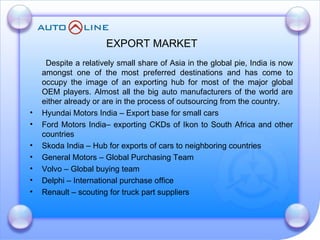
Despite a relatively small share of Asia in the global pie, India is now amongst one of the most preferred destinations and has come to occupy the image of an exporting hub for most of the major global OEM players. Almost all the big auto manufacturers of the world are either already or are in the process of outsourcing from the country. Hyundai Motors India – Export base for small cars  Ford Motors India– exporting CKDs of Ikon to South Africa and other countries  Skoda India – Hub for exports of cars to neighboring countries  General Motors – Global Purchasing Team  Volvo – Global buying team  Delphi – International purchase office  Renault – scouting for truck part suppliers  EXPORT MARKET
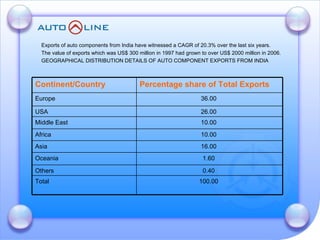
Exports of auto components from India have witnessed a CAGR of 20.3% over the last six years.  The value of exports which was US$ 300 million in 1997 had grown to over US$ 2000 million in 2006.  GEOGRAPHICAL DISTRIBUTION DETAILS OF AUTO COMPONENT EXPORTS FROM INDIA 100.00  Total  0.40  Others  1.60  Oceania  16.00  Asia  10.00  Africa  10.00  Middle East  26.00  USA  36.00  Europe  Percentage share of Total Exports  Continent/Country
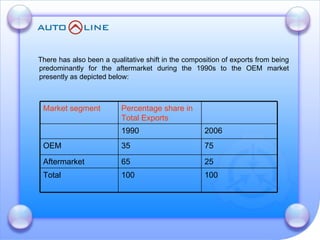
There has also been a qualitative shift in the composition of exports from being predominantly for the aftermarket during the 1990s to the OEM market presently as depicted below: 100  100  Total  25  65  Aftermarket  75  35  OEM  2006 1990 Percentage share in Total Exports  Market segment
 
Global Industry  - Major car makers in the world introducing car models simultaneously in different countries of the world  -  Ripple effect Under pressure to identify consumers preferences, national biases, Government regulations, new market segments - to gain market share, leading to impetus for Research, Design, innovations and changes in the manufacturing processes.  Result – Frugal Engineering (Renault – Nissan Chairman)   India emerging as a base of the entire world’s small car  production Global Trends that will impact the auto component industry in India
Pattern of demand for new cars.    -  In developed countries, Mature market with stagnant demand (1% growth over last 10 years)  -  Sales growth from China, India, South America, Eastern Europe (26% growth to go upto 40% by 2010)  Response to increasingly diverse set of customers - Large proliferation of segments & models ( challenges of cross over production from same line). - Plus myriad  of features like power steering, power windows, cruise control etc.   -  No. of vehicle models offered for sale in the US market alone doubled since 1980 to more than 1050 in 2004.
Adopt a global perspective in the operations  - Since 1990s, presence of all in virtually every corner of the world. - Especially in Emerging Markets, where all OEMs are fiercely competing for market shares  as the market grows. - Leading to simultaneous launch of models in different locations with similar standards. - Replicate Supply Chain structures. Strategies of Global Auto Majors impacting Component Manufacturers:
Reorganization of their vehicle portfolio around product platforms and car modules and systems. - Declining sales per vehicle model, short product life  cycle – preventing economies of scale in design &  manufacturing with adverse impact on cost. -  Focusing on common platforms and interchangeable  modules – leading to faster & lower cost deployment of  new solutions across the whole product range, while  tailoring vehicles to a multitude of tastes and  preferences of consumers in the world. - Design with a common underbody platform adapting  body, trim and ride to particular market conditions.
Wave of Consolidation  - Perspective of future platform sharing clearly acknowledged in deals such as Daimler acquiring Chrysler, GM – Mitsubishi, Nissan – Renault, Nissan – Renault – Mahindra, Nissan – Renault- Bajaj Auto (for Joint Manufacturing). - Estimated that within next 5 years, less than 10 independent automakers may survive.
Increased Vendor Responsibilities –reaching impressive levels - treated as partners - Passing the responsibility of developing, manufacturing and assembling important sections of the Car on to their Vendors. - Attempting innovative approaches in terms of assembly – suppliers assemble a number of modules in the final assembly plant and attach them directly to the vehicle themselves. (V/W & GM projects in Brazil) - ( Drivers Cabin for CV’s)
Role of technology in reshaping the industry   Extent to which a Design is economical, functional and easy to manufacture –impact new car’s revenues & costs. Cars are technically complex in that  a) fairly deep level of engineering expertise  b) a large number of parts must fit together in a precise way i.e. product architecture is integral , rather than modular.
Today most functions in the styling , design &engineering departments are done utilizing computers and math based engineering (as against paper based (draftsmen) ,clay models based processes). Various software tools and processes, such as FEA, CAE and product data management (PDM/PLM) practices are utilized to validate the components to validate the components for  -Form, Fit & Function.
Auto Component Industry in a state of Transition and Transformation  Indian auto component industry to take advantage of the transition that is taking place internationally and dominate the global supply chain in auto components due to  - reasonably priced skilled work force - large population of technology workers - established strengths in I.T. and electronics.
Transformation of global auto component industry structural change from 1,2,3 & 4th tiers to 0.5 tier structure. New direct suppliers are either specialised in complex systems OR integrators of several simpler systems. - Systems Integrators – Suppliers capable of designing and integrating components, subassemblies and systems into modules. - Global standardizers – Systems Manufacturers capable of setting the standard on a global basis for a component or system – through design, development and manufacturing of complex systems. - Component specialists - Suppliers capable of designing & manufacturing a specific component or subsystem, for a given car or platform – process specialists or product specialists.
INDIAN ADVANTAGE IN DESIGN & DEVELOPMENT  In the new paradigm, the design and development capability is a critical success factor. India has emerged as an offshore hub for software services outsourcing. - Design & development and supply of auto components provides a far greater opportunity as Automobile Industry is one of the largest industries in the world. - Leading OEMs have started outsourcing designing work to start- ups  such as Virtual E 3D and Ecad in India. - Have set up their own captive development centres in India
Worldwide market for design services pegged at USD 11 billion (Rs. 44,000 Crores) and presently India’s share is a mere 1 percent - Almost all major Auto and auto component companies in India are using 3D software engineering design tools to create designs . - India offers more than 20% cost reduction to any client and hence Global OEMs tempted to outsource to India.  - A typical CAD project in the USA will cost about USD 60 per man hour, as against about USD 25 in India. - India is known world over for its expertise in I.T., and has a long history in manufacturing , with strong domestic market. Outsourcing of engineering design services is a Big Opportunity for India.

Auto Industry Presentation

  • 1.
    “ FUTURE OFAUTO COMPONENT INDUSTRY” BY MR. M. RADHAKRISHNAN JT.MANAGING DIRECTOR PRESENTATION ON AUTOLINE INDUSTRIES LTD.
  • 2.
    PRIMARY GROWTH DEMANDDependant on OEMs OEM market drivers (for India) Growth in Economic Activity Increase in the Personal disposable incomes Growth in Rural Economy Multiple & easy finance options Decline in tax rates Economic vehicles (Nano effect )
  • 3.
    After market Drivers Old vehicle population Life span of components (frequency of replacement). Average value of parts replaced. Share of genuine-branded components in the total aftermarket.
  • 4.
    DOMESTIC MARKET Growthopportunities in terms of volume The domestic market for four wheelers is projected to grow at a compounded annual growth rate of 9% during the next few years. This will provide reasonably good growth opportunities in terms of volume to component manufacturers such as our company with facilities having latest technologies and mass manufacturing facilities.
  • 5.
  • 6.
    PRODUCTION OF FOURWHEELERS PAST AND FUTURE (IN 000S) Production of Four wheelers Past and Future (In 000s) (In thousands) 0 1000 2000 3000 4000 5000 6000 7000 2003 2004 2005 2009 2014 Year
  • 7.
    INDUSTRY OVERVIEW INDIANAUTO COMPONENT INDUSTRY The Indian automobile ancillary sector is transforming itself from a low-volume, highly fragmented one into a competitive industry, and backed by competitive strengths, technology and transition up the value chain. Broadly the Indian automotive component industry can be divided into the organized and the unorganized segments. While the forte of the organized sector is the high valued added precision engineering products, the presence of a large unorganized sector is characteristic especially of the lower value-added segments of the industry. In the organized segment, the component manufacturers supply components to at least one of the Original Equipment (Vehicle) Manufacturers (OEMs). Such component manufacturers usually have access to the required technology due to their tie-ups with some of the foreign collaborators or through their links with the automobile manufacturer. There are presently 29 Vehicles Manufacturers (OEMs) in India located at Gurgaon, Pune and Chennai who together manufactured more than 5.2 million vehicles during 2005-06.
  • 8.
    Original Equipment Manufacturersof 4-Wheelers In India & Production During 2005-06 American OEMs Japanese/Joint Venture OEMs 260.00 Hyundai Motor India Ltd 670.10 Total KOREAN OEMS 12.00 Swaraj Mazda Ltd 58.00 Total 41.00 Honda Siel Cars India Ltd 27.00 Ford India Pvt. Ltd 45.00 Toyota Kirloskar Motor Pvt .Ltd 31.00 General Motors India Pvt. Ltd 572.10 Maruti Udyog Ltd Production in 000s Production in 000s
  • 9.
    Original Equipment Manufacturersof 4-Wheelers In India & Production During 2005-06 Volvo India Pvt. Ltd Tatra Trucks India Ltd 718.00 Total 15.00 Hindustan Motors Ltd 13.40 Total 24.00 Eicher Motors Ltd 0.70 Fiat India Pvt.Ltd 36.00 Force Motors Ltd 0.10 65.00 Ashok Leyland Ltd 1.00 128.00 Mahindra & Mahindra Ltd 1.80 Daimler Chrysler India Pvt. Ltd 450.00 Tata Motors Ltd 9.80 Skoda Auto India Pvt.Ltd Production in 000s INDIAN OEMS Production in 000s EUROPEAN OEMS
  • 10.
    Original Equipment Manufacturersof 2-Wheelers in India and production during 2005-06 3860 Total 2 Suzuki Motorcycles India Pvt. Ltd 249 Yamaha Motor India Pvt. Ltd 603 Honda Motorcycles & Scooters 3006 Hero Honda Motors Ltd Production in 000s JAPANESE OEMS
  • 11.
    Original Equipment Manufacturersof 2-Wheelers in India and production during 2005-06 3740 TOTAL 31 Royal Enfield 54 Kinetic Motor Co.Ltd 57 Majestic Auto Ltd 82 Kinetic Engineering Ltd 107 LML Ltd 1367 TVS Motors Co . Ltd 2042 Bajaj Auto Ltd Production in 000s Indian OEMs
  • 12.
    The table belowshows segment-wise distribution of the auto component Industry www.acmainfo.com . 65% 60% 35% 40% Share in Aftermarket 20% 20% 80% 80% Share in OE supply market 2006 1999 2006 1999 Year Unorganized Component Manufacturers Organized Component Manufacturers
  • 13.
    The table belowshows segment-wise distribution of the auto component Industry www.acmainfo.com . 1.Sub normal quality 2.Obsolete technology 3. Low capital availability 4. Restricted growth potential 1. High Investment in plant and machinery 2. Higher overheads 3. Higher rates of taxes and differential regional tax patterns 4. Limited domestic OE volumes Weaknesses 1. Low capital investment 2. Minimal overheads 3. Taxes and levies exemption (violation) 4. Poor regulation on sale of spurious parts 5. Price sensitivity of market 1.Higher production capacities 2. Captive OE market 3. Access to technology through tie ups 4. Quality standards 5. Potential to export 6. Improving quality consciousness of end users Strengths Unorganized Component Manufacturers Organized Component Manufacturers
  • 14.
    Despite a relativelysmall share of Asia in the global pie, India is now amongst one of the most preferred destinations and has come to occupy the image of an exporting hub for most of the major global OEM players. Almost all the big auto manufacturers of the world are either already or are in the process of outsourcing from the country. Hyundai Motors India – Export base for small cars Ford Motors India– exporting CKDs of Ikon to South Africa and other countries Skoda India – Hub for exports of cars to neighboring countries General Motors – Global Purchasing Team Volvo – Global buying team Delphi – International purchase office Renault – scouting for truck part suppliers EXPORT MARKET
  • 15.
    Exports of autocomponents from India have witnessed a CAGR of 20.3% over the last six years. The value of exports which was US$ 300 million in 1997 had grown to over US$ 2000 million in 2006. GEOGRAPHICAL DISTRIBUTION DETAILS OF AUTO COMPONENT EXPORTS FROM INDIA 100.00 Total 0.40 Others 1.60 Oceania 16.00 Asia 10.00 Africa 10.00 Middle East 26.00 USA 36.00 Europe Percentage share of Total Exports Continent/Country
  • 16.
    There has alsobeen a qualitative shift in the composition of exports from being predominantly for the aftermarket during the 1990s to the OEM market presently as depicted below: 100 100 Total 25 65 Aftermarket 75 35 OEM 2006 1990 Percentage share in Total Exports Market segment
  • 17.
  • 18.
    Global Industry - Major car makers in the world introducing car models simultaneously in different countries of the world - Ripple effect Under pressure to identify consumers preferences, national biases, Government regulations, new market segments - to gain market share, leading to impetus for Research, Design, innovations and changes in the manufacturing processes. Result – Frugal Engineering (Renault – Nissan Chairman) India emerging as a base of the entire world’s small car production Global Trends that will impact the auto component industry in India
  • 19.
    Pattern of demandfor new cars. - In developed countries, Mature market with stagnant demand (1% growth over last 10 years) - Sales growth from China, India, South America, Eastern Europe (26% growth to go upto 40% by 2010) Response to increasingly diverse set of customers - Large proliferation of segments & models ( challenges of cross over production from same line). - Plus myriad of features like power steering, power windows, cruise control etc. - No. of vehicle models offered for sale in the US market alone doubled since 1980 to more than 1050 in 2004.
  • 20.
    Adopt a globalperspective in the operations - Since 1990s, presence of all in virtually every corner of the world. - Especially in Emerging Markets, where all OEMs are fiercely competing for market shares as the market grows. - Leading to simultaneous launch of models in different locations with similar standards. - Replicate Supply Chain structures. Strategies of Global Auto Majors impacting Component Manufacturers:
  • 21.
    Reorganization of theirvehicle portfolio around product platforms and car modules and systems. - Declining sales per vehicle model, short product life cycle – preventing economies of scale in design & manufacturing with adverse impact on cost. - Focusing on common platforms and interchangeable modules – leading to faster & lower cost deployment of new solutions across the whole product range, while tailoring vehicles to a multitude of tastes and preferences of consumers in the world. - Design with a common underbody platform adapting body, trim and ride to particular market conditions.
  • 22.
    Wave of Consolidation - Perspective of future platform sharing clearly acknowledged in deals such as Daimler acquiring Chrysler, GM – Mitsubishi, Nissan – Renault, Nissan – Renault – Mahindra, Nissan – Renault- Bajaj Auto (for Joint Manufacturing). - Estimated that within next 5 years, less than 10 independent automakers may survive.
  • 23.
    Increased Vendor Responsibilities–reaching impressive levels - treated as partners - Passing the responsibility of developing, manufacturing and assembling important sections of the Car on to their Vendors. - Attempting innovative approaches in terms of assembly – suppliers assemble a number of modules in the final assembly plant and attach them directly to the vehicle themselves. (V/W & GM projects in Brazil) - ( Drivers Cabin for CV’s)
  • 24.
    Role of technologyin reshaping the industry Extent to which a Design is economical, functional and easy to manufacture –impact new car’s revenues & costs. Cars are technically complex in that a) fairly deep level of engineering expertise b) a large number of parts must fit together in a precise way i.e. product architecture is integral , rather than modular.
  • 25.
    Today most functionsin the styling , design &engineering departments are done utilizing computers and math based engineering (as against paper based (draftsmen) ,clay models based processes). Various software tools and processes, such as FEA, CAE and product data management (PDM/PLM) practices are utilized to validate the components to validate the components for -Form, Fit & Function.
  • 26.
    Auto Component Industryin a state of Transition and Transformation Indian auto component industry to take advantage of the transition that is taking place internationally and dominate the global supply chain in auto components due to - reasonably priced skilled work force - large population of technology workers - established strengths in I.T. and electronics.
  • 27.
    Transformation of globalauto component industry structural change from 1,2,3 & 4th tiers to 0.5 tier structure. New direct suppliers are either specialised in complex systems OR integrators of several simpler systems. - Systems Integrators – Suppliers capable of designing and integrating components, subassemblies and systems into modules. - Global standardizers – Systems Manufacturers capable of setting the standard on a global basis for a component or system – through design, development and manufacturing of complex systems. - Component specialists - Suppliers capable of designing & manufacturing a specific component or subsystem, for a given car or platform – process specialists or product specialists.
  • 28.
    INDIAN ADVANTAGE INDESIGN & DEVELOPMENT In the new paradigm, the design and development capability is a critical success factor. India has emerged as an offshore hub for software services outsourcing. - Design & development and supply of auto components provides a far greater opportunity as Automobile Industry is one of the largest industries in the world. - Leading OEMs have started outsourcing designing work to start- ups such as Virtual E 3D and Ecad in India. - Have set up their own captive development centres in India
  • 29.
    Worldwide market fordesign services pegged at USD 11 billion (Rs. 44,000 Crores) and presently India’s share is a mere 1 percent - Almost all major Auto and auto component companies in India are using 3D software engineering design tools to create designs . - India offers more than 20% cost reduction to any client and hence Global OEMs tempted to outsource to India. - A typical CAD project in the USA will cost about USD 60 per man hour, as against about USD 25 in India. - India is known world over for its expertise in I.T., and has a long history in manufacturing , with strong domestic market. Outsourcing of engineering design services is a Big Opportunity for India.