MARKET ATTRACTIVENESS OF AUTO
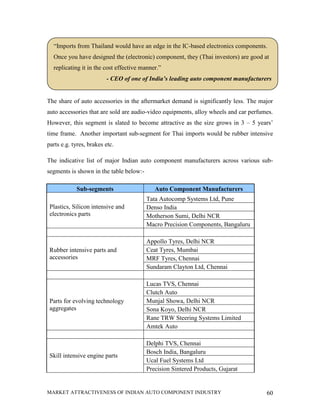
             COMPONENT BUSINESS IN INDIA


Prepared For:


Prepared By:                ,
                                                                  January 2009
               IMRB International
       INVESTMENT POTENTIAL IN AUTO COMPONENT INDUSTRY IN INDIA           1
Preface
Thai-Indian business relations have improved considerably over the past decade.
Thailand and India are close to concluding a Free Trade Agreement (FTA) covering trade
in goods by 2010. The Free Trade Agreement between Thailand and India is expected to
improve trade relations between the two countries further. The FTA covering trade in
goods would lead to long term mutual benefits in trade and investment and the
partnership would be expanded further to cover technology know-how and expertise.

India's primary imports from Thailand are machinery, electronic appliances, textiles,
plastic material, transport equipment, vegetable oil and latex. The major items of imports
under FTA are polycarbonate, cathode-ray tubes, color-TVs, air conditioners and
Aluminum products. Thailand’s main imports from India are jewelry, gemstones, steel,
pharmaceuticals and ferrous metal ores.

India's trade with Thailand could touch USD 7 billion by 2010-11 propelled by a
doubling in transaction under Free Trade Agreement (FTA). The EHS was implemented
on September 1, 2004, under which tariffs on 82 items were to be phased out by
September 1, 2006 by both the sides.

The trade between Thailand and India is estimated to be US $ 7 billion by 2010-11 from
US $ 2.2 billion in 2005-06.

The total trade of 82 items under Early Harvest Scheme (EHS) of the FTA was increased
by over 140 percent to about US $ 358.63 million in 2005-06 from US $ 149 million in
2003-04. The share of these 82 items in India-Thailand trade increased from 10.34
percent in 2003-04 to 15.68 percent in 2005-06.

Thailand’s export to India of the identified 82 EHS items was increased from US $ 84.64
million to US $ 275 million during the period from 2003 – 04 to 2005 – 06. During the
same time, India’s export to Thailand of these items increased from US $ 64.28 million to
US $ 83.03 million during the same period.


MARKET ATTRACTIVENESS OF INDIAN AUTO COMPONENT INDUSTRY                                 2
In 2007, Thailand’s export for these 82 items was US $ 406.31 million. Due the FTA
between two countries, Thailand is able to manage the trade surplus of US $ 598 in 2007
in bilateral trade between Thailand and India.

With significant potential for growth of business between the two countries, the Ministry
of Commerce, Thailand and Royal Thai Embassy would like to understand the
investment potential across the following identified product categories:-

       1. Home Utility and Furnishing: This would broadly include three product
           categories:-

               a. Furniture – Largely focusing on house hold furniture e.g. Sofa-set,
                   Dining table, Corner / corner table etc. Also covering office furniture
                   e.g. office chairs, cubicles, tables etc and open-air furniture i.e. the
                   furniture used in the garden, near pools etc.

               b. Interior Decoration items – This would include: Show pieces,
                   Wooden handicraft, photo frames, artificial flowers.

               c. Utensils – Household (kitchen), HoReCa (Hotel Restaurant Catering)
                   Segment, Institutional / Office.

               d. Plastic Products - Food containers, plastic storage boxes etc e.g.
                   Cello, Tupperware, Milton, Nyasa etc.

       2. Construction      Material:     This    would     include   Bathroom     Fittings,
           Tiles/Floorings (including wooden), Roof Tiles (used in the costal areas),
           Metal (Al, Tin etc) / Gypsum boards used for partition.

       3. Hospitality Services: This would be understood with the objective of tie-up
           with existing hotels – spas, specialty restaurant (e.g. Thai cuisine restaurant),
           health wellness services etc. The client would be interested in management
           control and running the property. The stand alone spas e.g. Kaya clinic is also
           covered in the purview of the study.


MARKET ATTRACTIVENESS OF INDIAN AUTO COMPONENT INDUSTRY                                   3
4. Auto parts and accessories: It would cover both types of auto parts:-

              a. Essential auto parts (low volume high value items e.g. gear box,
                  clutch plates etc and high volume low value items like break pads etc).
                  These parts would be for 2-wheelers (e.g. moulding etc) and 4-
                  wheelers – both cars and commercial vehicles.

              b. Accessories / decorative items e.g. music systems, alloy wheels etc

In order to understand the trade potential across the above categories, the Ministry of
Commerce, Thailand and Royal Thai Embassy has commissioned Business and Industrial
Research Division (BIRD) of IMRB International to avail its research based consultancy
services


MARKET ATTRACTIVENESS OF INDIAN AUTO COMPONENT INDUSTRY                                4
Table of Contents
1     EXECUTIVE SUMMARY ................................................................................................... 7
1.1   Automotive Component OEM and Replacement Markets .................................................... 10
1.2   Foreign Direct Investment and Government Policy .............................................................. 11
1.3   Attractiveness of Auto Component Sub-segments and Entry Strategy ................................. 11

2     GLOBAL AUTO COMPONENT INDUSTRY ................................................................ 13
2.1   Global Trends in the Automotive Industry............................................................................ 13
2.2   Major Auto and Auto Component Markets ........................................................................... 14
2.3   Major Auto Component Companies...................................................................................... 17

3     INDIAN AUTO COMPONENT INDUSTRY ................................................................... 18
3.1   Major Auto Component hubs in India ................................................................................... 19
3.2   Transition of Indian Auto Component Industry .................................................................... 20
3.3   Auto Component Industry Cost Buildup ............................................................................... 21
3.4   Classification of Auto Component Market ........................................................................... 22
3.5   Tier Structure of Auto Component Market ........................................................................... 23
3.6   Classification of Auto Components ...................................................................................... 24
3.7   Major Automobile Players .................................................................................................... 25
3.8   Major Automobile Component Players (Two, Three and Four Wheeler players) ................ 26
3.9   Foreign Collaboration in the Auto Component Industry....................................................... 27

4 INDUSTRY AND MARKET ANALYSIS ........................................................................ 29
4.1 Macro and Micro Environment Analysis: Indian Auto Component Market ......................... 30
4.2 SWOT Analysis: Indian Auto Component Market ............................................................... 31

5 MARKET SIZE AND GROWTH FORECASTS............................................................. 33
5.1 Global auto component market size and growth estimates ................................................... 33
5.2 Indian auto component market size and growth estimates .................................................... 34
    5.2.1    Production (in Number) and Growth rates of all vehicle categories
    including two wheelers .............................................................................................. 34
    5.2.2    Consolidated Production, Export and Investment in value terms ............... 35
    5.2.3    Value wise break up of sub-segments – two and four wheelers ................. 36
    5.2.4    Import estimates and trends (for 2 and 4 wheelers) .................................... 36
    5.2.5    Auto Component Export Destinations ........................................................ 38
    5.2.6    Trends in growth and margins – Two and Four wheelers .......................... 39

6     AUTO COMPONENT OEM AND REPLACEMENT MARKET ................................. 40
6.1   OEM Market in the Indian auto component industry............................................................ 40
6.2   OEM Component Sourcing ................................................................................................... 40
6.3   OEM Vendor Selection Process ............................................................................................ 41
6.4   Inventory in Supply Chain of OEM suppliers ....................................................................... 42
      6.4.1   Small and Medium OEM vendors .............................................................. 42
      6.4.2   Large OEM vendors / strategic Tier-1 suppliers......................................... 43


MARKET ATTRACTIVENESS OF INDIAN AUTO COMPONENT INDUSTRY                                                                   5
6.5   Break up of replacement parts market by type of vehicle ..................................................... 44
6.6   Automotive component replacement market: impact of structural changes ......................... 44
6.7   OEMs’ focus on replacement market .................................................................................... 45
6.8   Channel structure for auto component market ...................................................................... 46

7     GOVERNMENT INITIATIVES........................................................................................ 48
7.1   Foreign Direct Investment ..................................................................................................... 48
7.2   Auto Policy ............................................................................................................................ 48
7.3   Automotive Mission Plan 2016 ............................................................................................. 50

8     GROWTH DRIVERS AND CHALLENGES ................................................................... 51
8.1   Growth Drivers for Replacement Demand ............................................................................ 52
8.2   Issues and Challenges – Indian Auto Component Industry .................................................. 53
8.3   Indian Auto Component Industry amid changing global scenario ........................................ 54
8.4   Critical Success Factors......................................................................................................... 55

9     CONSUMER PREFERENCES FOR AUTO COMPONENTS ...................................... 56

10 ATTRACTIVENESS OF AUTO COMPONENT SEGMENTS FOR THAI
INVESTORS ............................................................................................................................... 58
10.1 Attractive segments within auto component market for Thai investors ................................ 58
10.2 Business Models for Collaboration ....................................................................................... 61

11 CONCLUSIONS AND RECOMMENDATIONS ............................................................ 63
11.1 Entry Strategy for Thai Investors in the Indian Auto Component Business ......................... 63
11.2 Recommended Distribution Channel for Thai investors ....................................................... 65

12 ANNEXURE: AUTO POLICY .......................................................................................... 67

13 LIST OF EXHIBITS ........................................................................................................... 77

14 REFERENCES .................................................................................................................... 79


MARKET ATTRACTIVENESS OF INDIAN AUTO COMPONENT INDUSTRY                                                                             6
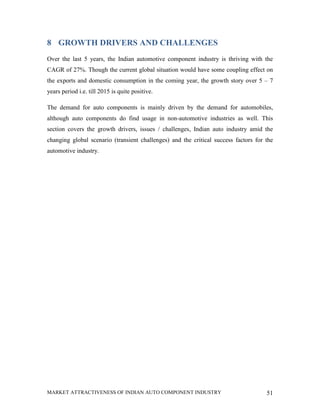
1 EXECUTIVE SUMMARY
The Indian automobile ancillary sector is transforming itself from a low-volume, highly
fragmented one into a competitive industry and backed by competitive strengths,
technology and evolving value chain. The Indian Auto component industry has
transitioned from a supplier for the global aftermarket to becoming a full-scale global
Tier 1 supplier.

The components in the Indian automotive component market are classified into Engine
parts, Drive transmission and steering parts, Body and chassis parts, Suspension and
braking parts, Electrical parts and Equipment and other parts.

The macro environment of the Indian auto component industry can be assessed by
understanding the social / consumer shifts, understanding its political and legal
environment, technological environment and economic shifts. This 9-forces analysis for
Indian auto component industry is done in the exhibit below:


MARKET ATTRACTIVENESS OF INDIAN AUTO COMPONENT INDUSTRY                              7
Market Analysis – Indian Auto Component Market

                                                                                                                                              Technological shifts
               Political / Legal Environment
                                                                                                                                  - Fast becoming global hub for R&D: GM, Daimler
  - FDI growing due to competitive advantage; witnessed
                                                                                   Entry Barriers                              Chrysler, Bosch, Suzuki, Johnson Controls etc. have set
 CAGR of 21.7% during 2002 – 07. The FDI was USD 7.2
                                                                      - OEMs’ “inclusive growth” ensuring long term                         up development centres in India.
                     Billion in 2007 – 08
                                                                    relationship especially for high value-adding items       - Casting and forging processes in India 25 to 30 % lower
  - Investment Commission of India facilitating FDI in all
                                                                 - Foreign suppliers supplying to global auto majors with                      than western counterparts.
                             forms
                                                                   local knowledge and expertise may have easy access           - 5 Indian auto component companies received coveted
          - No repatriation issues after paying taxes
                                                                                                                                      Deming Prize, largest number outside Japan.


              Supplier Power                                                  Industry Competitors                                                   Consumer Power
                                                                          - 450 – 500 mid to large players with
       - Tier structure supporting vendor                                                                                                    - Auto OEMs have average 2 suppliers
                                                                         around 6000 – 7000 units in addition to
                   relationship                                                                                                                     to ensure competitiveness
                                                                           around 10,000 units in unorganized
    - Most Tier – 3 suppliers are small units                                                                                                  - New auto clusters being developed
                                                                                         segment.
       largely from unorganized segment                                                                                                          with OEMs and major ancillaries
                                                                        - Technical tie ups and R&D ensuring at
                                                                                                                                                                -
                                                                          least 2 major players across segments


                                                                                                                                             Economic shifts
                  Social / Consumer shifts                                      Threat of Substitutes                       - Concentration of disposable income in top 6 – 8 cities
- Auto component industry – incubator to entrepreneurship            - Less threat to substitute for organized players        - Rising spending patterns on “pampering” therapies
  initiatives especially for less value adding components            working with OEMs and emphasizing on R&D                - International economic environment augurs cautious
- OEMs developing and launching “India centric” vehicles                              for future needs                                             approach
      after understanding Indian consumers’ demands                   - Unorganized units stand chances for greater
                                                                                            threat


                                                        Exhibit: 18-Force Market Analysis of Indian auto component market


MARKET ATTRACTIVENESS OF INDIAN AUTO COMPONENT INDUSTRY                                                                                                                                   8
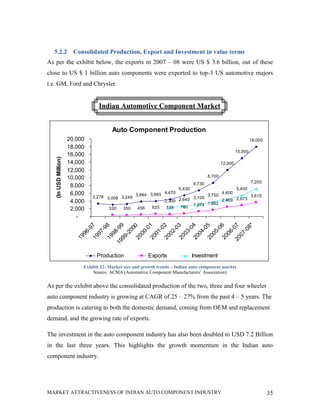
According to Automotive Component Manufacturers’ Association (ACMA), the
production of automotive component in India was US$ 18 billion. It is growing at CAGR
of 27% since 2002-03. The exhibit below shows that Indian auto component industry is
growing more than 25% since 2003 – 04. The exports in 2007 – 08 were US $ 3.6 billion,
out of these close to US $ 1 billion auto components were exported to top-3 US
automotive majors i.e. GM, Ford and Chrysler.


                                      Indian Automotive Component Market


                                              Auto Component Production
                      20,000                                                                                                       18,000
                      18,000
                                                                                                                          15,000
                      16,000
   (In USD Million)


                      14,000                                                                                     12,000
                      12,000
                      10,000                                                                            8,700
                                                                                                6,730                              7,200
                       8,000
                                                                      5,430                   5,400
                       6,000                        3,894 3,965 4,470             3,750
                                                                                        4,400
                                                                                                    3,615
                                  3,278 3,008 3,249                         3,100
                       4,000                                    2,300 2,645             2,469 2,873
                                                                            1,274 1,692
                                                     456   625   578   760
                       2,000             330   350

                         -
                                                                                                                                *
                                  7

                                          8

                                                   9


                                                                      1

                                                                              2

                                                                                       3

                                                                                               4

                                                                                                        5

                                                                                                                6

                                                                                                                         7
                                                         00


                                                                                                                                 8
                               -9

                                       -9

                                                -9


                                                                   -0

                                                                           -0

                                                                                    -0

                                                                                            -0

                                                                                                     -0

                                                                                                             -0

                                                                                                                      -0

                                                                                                                              -0
                                                          0
                          96

                                      97

                                              98


                                                               00

                                                                          01

                                                                                  02

                                                                                           03

                                                                                                   04

                                                                                                            05

                                                                                                                    06
                                                       -2


                                                                                                                           07
                         19

                                 19

                                           19


                                                              20

                                                                     20

                                                                               20

                                                                                       20

                                                                                                20

                                                                                                        20

                                                                                                                 20
                                                   99


                                                                                                                         20
                                                19


                                      Production                     Exports                    Investment
                           Exhibit 22: Market size and growth trends – Indian auto component market
                               Source: ACMA (Automotive Component Manufacturers Association)
                                                       * Estimated figures


The Indian auto industry and auto component industry in 2006 – 07 was US$ 34 billion
and US$ 15 billion. As per Government of India’s automotive mission plan 2016, the
Indian auto industry and auto component industry in 2015-16 is estimated to be US$ 105
billion and US$ 40 billion respectively. It signifies that auto component industry would


MARKET ATTRACTIVENESS OF INDIAN AUTO COMPONENT INDUSTRY                                                                                     9
grow more than two times in the next seven years. This high growth augurs the business
potential in the Indian automotive component industry in the long term.

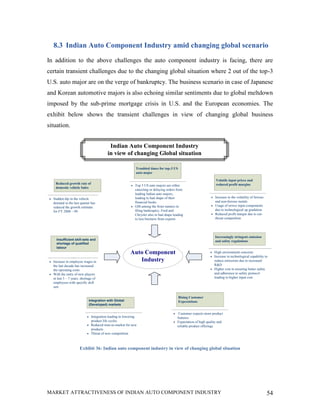
The auto component industry is facing transient challenges due to the changing global
situation where 2 out of the top-3 U.S. are on the verge of filing bankruptcy. Since Indian
automotive component industry is exporting to these auto majors, the reduction in the
pace of growth is expected this year. This reduction is coupled with reduced growth rate
of domestic vehicles sales in 2008-09. These rough times, however, are short timed in the
light of Government’s automotive mission plan 2016 whereby it aims to achieve the turn
over of US$ 145 billion by 2016. The growth factors i.e. lesser penetration of vehicles,
growing income levels portends health growth for Indian auto and auto component
industry in the long term.

  1.1 Automotive Component OEM and Replacement Markets

The OEM (Original Equipment Manufacturer) market is also known as the organized
market segment in the Indian auto component industry. All the Tier-1 suppliers/ vendor
to OEMs have their respective distribution channels in the aftermarket (or replacement
market) segment.

The inventory in the value chain of Indian automotive industry varies according to the
size of auto component suppliers. The large strategic Tier-1 suppliers who are better
connected with OEMs through ERP (Enterprise Resource Planning) system are able to
manage inventories better. On the other size, the small and medium sized Indian auto
component players not leveraging technology end up piling inventories due to “bull whip
effect”.

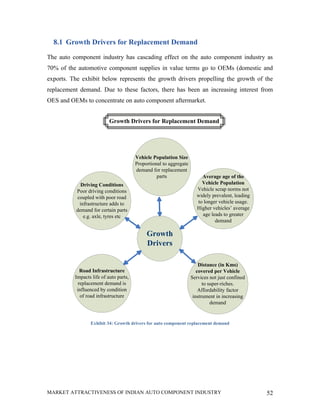
The Indian automotive component replacement market have various channels selling
genuine and spurious parts that makes it one of the most dynamic market segment (out of
the three market segments i.e. replacement demand, OEM demand and export market).
According to the study conducted by IMRB International for SIAM in 2006-07, the
counterfeit components constitute about 35% - 51% of private vehicle components
replacement market. Lately, OEMs have started showing increasing interest in the
replacement auto component.


MARKET ATTRACTIVENESS OF INDIAN AUTO COMPONENT INDUSTRY                                 10
1.2 Foreign Direct Investment and Government Policy

The automatic approval for foreign equity investment upto 100 per cent of manufacture
of automobiles and component is permitted for the auto and auto component industry.
The import of technology /technological up gradation on the royalty payment of 5%
without any duration limit and lump sum payment of USD 2 million is also allowed
under automatic route in this sector. The norms for Foreign Investment and import of
technology have also been progressively liberalized over the years for manufacture of
vehicles including passenger cars in order to make this sector globally competitive. With
the gradual liberalization of the automobile sector since 1991, the number of
manufacturing facilities in India has grown progressively.

  1.3 Attractiveness of Auto Component Sub-segments and Entry
         Strategy
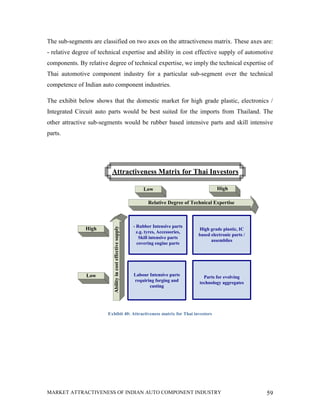
The exhibit below shows that the domestic market for high grade plastic, electronics /
Integrated Circuit auto parts would be best suited for the auto component imports from
Thailand. The other attractive sub-segments would be rubber based intensive parts and
skill intensive parts.


                         Attractiveness Matrix for Thai Investors

                                                                  Low                              High

                                                                    Relative Degree of Technical Expertise
                          Ability in cost effective supply


                High                                         - Rubber Intensive parts     High grade plastic, IC
                                                               e.g. tyres, Accessories    based electronic parts /
                                                               - Skill intensive parts          assemblies


                Low                                          High grade plastic, IC         Parts for evolving
                                                             based electronic parts /     technology aggregates
                                                                   assemblies


                         Exhibit 40: Attractiveness matrix for Thai investors


MARKET ATTRACTIVENESS OF INDIAN AUTO COMPONENT INDUSTRY                                                              11
For business collaboration, we suggest that Thai investors should initially export these
products for OEMs and aftermarket in India. Later on, when the product volumes would
increase, we suggest that it should set up the assembly base in one of the auto clusters, to
be selected based on initial experience. The exhibit below pictorially represents the
attractive areas and the timeframe for entering across various auto component market
sub-segments in India.


                                                                Entry strategy for Thai Investors
                                                                                      Degree of Attractiveness

                                                                            Low              Medium                High

                                             Plastic, silicon intensive
               Auto Component Sub-segments


                                                 electronic parts

                                             Rubber intensive parts
                                                and accessories
                                                 Parts for evolving
                                               technology aggregates

                                                Skill intensive parts
                                               covering engine parts

                                              Labour intensive parts –
                                                casting, forging etc

                                                     Legend

                                                                Immediate entry as OEM & aftermarket supplier

                                                                Enter in these sub-segments after 1 – 2 years of
                                                                immediate entry
                                                                Do not enter


                                                   Exhibit 42: Entry strategy for Thai investors


MARKET ATTRACTIVENESS OF INDIAN AUTO COMPONENT INDUSTRY                                                                   12
2 GLOBAL AUTO COMPONENT INDUSTRY
  2.1 Global Trends in the Automotive Industry

The world’s automotive manufacturing sector consists primarily of about 20 very
large multinational corporations. The automotive supply sector, however, comprises of
thousands of firms ranging in size from a few employees to more than 100,000.

According to industry estimates, the size of the global auto component industry in
the year 2008 was approximately US$1.4 trillion and is likely to grow to about
US$1.9 trillion by 2015. Out of this total auto component demand by 2015, about
40% (i.e. US$ 750 billion) is likely to be sourced from low cost countries (LCCs)
such as China, ASEAN countries and India. The trends that are shaping the global
automotive industry are shown in the exhibit below:-


                              Global Trends in the Automotive Industry


                                           Strategic “Tier-1" acting
                                        closely with OEMs for designs

                                                                                  Pressure to lower
   Level of profitability                                                         prices continues
          too low

                                            Global Trends –
                                          Automotive Industry

                                                                                    Continued
   Emerging markets are                                                            consolidation
  fastest growing markets
                                         Shared platforms & modules
                                           increasingly important


                            Exhibit 1: Global trends in the automotive industry


MARKET ATTRACTIVENESS OF INDIAN AUTO COMPONENT INDUSTRY                                               13
2.2 Major Auto and Auto Component Markets

The United States is far ahead of other countries when it comes to vehicle population per
1,000 vehicle driving age. It is home to the largest passenger vehicle market of any
country In 2007, there were about 250 million vehicles in the United States.

The exhibit below shows the penetration of LCVs across the major countries and the
emerging economies like Brazil, China and India.


              Cars for 1,000 inhabitants in different countries


                       Exhibit 2: Penetration of LCVs in different countries
                                     Source: Secondary Search


MARKET ATTRACTIVENESS OF INDIAN AUTO COMPONENT INDUSTRY                               14
The exhibit below maps vehicle penetration and nominal GDP per capita. In the long run,
the emerging economies like India hold immense potential as far as global automobile
industry future is concerned.


     GDP / Capita vs. Vehicle Density: India vis-à-vis Major Markets


               Exhibit 3: GDP / Capita vs. Vehicle Density: India vis-à-vis major markets


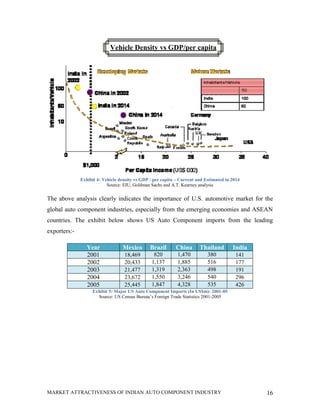
The exhibit below shows per capita income and the number of inhabitants per vehicle in
the year 2002 and expected ratio and per capita income in the year 2014. After comparing
the potential for future auto and auto component markets, it can be deduced that the
emerging economies like China and India would be at growth stage whereas the
developed economies like US and Japan are the saturated stage, expected to remain
stagnant or grow at less rate in the medium to long term.


MARKET ATTRACTIVENESS OF INDIAN AUTO COMPONENT INDUSTRY                                     15
Vehicle Density vs GDP/per capita


              Exhibit 4: Vehicle density vs GDP / per capita – Current and Estimated in 2014
                           Source: EIU, Goldman Sachs and A.T. Kearney analysis

The above analysis clearly indicates the importance of U.S. automotive market for the
global auto component industries, especially from the emerging economies and ASEAN
countries. The exhibit below shows US Auto Component imports from the leading
exporters:-

                 Year             Mexico        Brazil      China       Thailand        India
                 2001              18,469        820         1,470          380           141
                 2002              20,433       1,137        1,885          516           177
                 2003              21,477       1,319        2,363          498           191
                 2004              23,672       1,550        3,246          540           296
                 2005              25,445       1,847        4,328          535           426
                   Exhibit 5: Major US Auto Component Imports (In US$m): 2001-05
                     Source: US Census Bureau’s Foreign Trade Statistics 2001-2005


MARKET ATTRACTIVENESS OF INDIAN AUTO COMPONENT INDUSTRY                                         16
2.3 Major Auto Component Companies

The exhibit below shows top automotive component players and their sales figures
globally in 2004 and 2005. Robert Bosch Corporation (entered in India in collaboration
with MICO as MICO Bosch but now has standalone existence) and Delphi Automotive
Systems are the globally ranked number one and two respectively according to their sales
figures.


Company                                   Sales in 2004        Sales in 2005    Change%
                                           (USD Bn)             (USD Bn)
Robert Bosch Corporation                       35.4                 30.7         -13.28
Delphi Automotive Systems                      28.6                 26.9          -5.94
Denso Corporation                              23.2                  25            7.76
Magna International                            20.6                 22.8          10.68
Johnson Controls Inc.                          17.7                 19.2           8.47
Lear Corporation                               16.9                 17.1           1.18
Visteon Automotive Systems                     18.7                 16.9          -9.63
TRW International                               12                  12.6           5.00
Eaton Corporation                               9.8                 11.1          13.27
                  Exhibit 6: Top Ten Auto Component Manufacturers-2004 & 2005
                             Source: Various Auto reports, Database search


MARKET ATTRACTIVENESS OF INDIAN AUTO COMPONENT INDUSTRY                                   17
3 INDIAN AUTO COMPONENT INDUSTRY
The Indian automobile ancillary sector is transforming itself from a low-volume, highly
fragmented one into a competitive industry, and backed by competitive strengths,
technology and transition up the value chain. Broadly the Indian automotive component
industry can be divided into the organized and the unorganized segments. While the forte
of the organized sector is the high valued added precision engineering products, the
presence of a large unorganized sector is characteristic especially of the lower value-
added segments of the industry.

The ACMA-McKinsey Vision 2015 document forecasts the potential for the Indian auto
component industry to be US$ 40-45 billion by 2015. Investments and exports in this
segment are witnessing continuous growth. Global automobile manufactures see India as
a manufacturing hub for auto components and are rapidly ramping up the value of
components they source from India due to:

• The cost competitiveness in terms of labor and raw material

• Its established manufacturing base

• Fine quality of components manufactured in India (used as original components for
   vehicles made by General Motors, Mercedes, IVECO and Daewoo among others).


MARKET ATTRACTIVENESS OF INDIAN AUTO COMPONENT INDUSTRY                              18
3.1 Major Auto Component hubs in India

In India, there are four major clusters as far as auto and auto components are concerned.
The Chennai cluster has around 25 – 30% organized auto component manufacturers. The
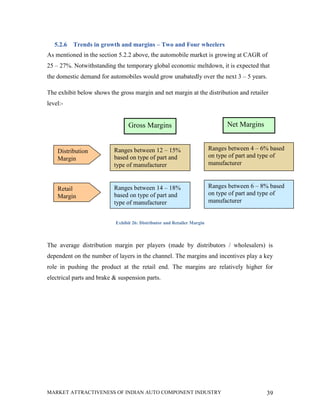
exhibit below maps major auto and auto component clusters in India:-


            Major Auto and Auto Component Cluster


  Delhi NCR and
  Pantnagar cluster


                            text


                text


 Pune cluster

                                          Chennai cluster
                          text


                                          Bengaluru cluster


                       Exhibit 7: Major auto and auto component clusters in India
                                        Source: Secondary search


MARKET ATTRACTIVENESS OF INDIAN AUTO COMPONENT INDUSTRY                               19
3.2 Transition of Indian Auto Component Industry

The Indian Auto component industry has transitioned from a supplier for the global
aftermarket to becoming a full-scale global Tier 1 supplier. The transition has been
brought upon by increased competition from foreign players that have helped Indian auto
component industry becoming auto component manufacturer and export of complex auto
spare parts. The exports from Indian auto components manufacturers to U.S. top 3
automotive majors have been in excess of US $ 900 Million last year. The exhibit below
shows the transition of Indian auto component industry.


                                    Transition of Indian Auto Component Industry

                               Rotating Auto                                        Heavy Forgings
                               Electricals                                          Wheel Rims
                               Tyres & Tubes
                      High
 Product Complexity


                                                        Small Castings &            Plastic Components
                                                        Forgings
                      Medium


                                                                        th
                                                                      Pa
                                                               iti on
                                                            ns
                                                        Tra
                               Hand Tools
                               Metal bonded &
                      Low


                               Moulded Rubber Parts


                                     Aftermarket              Tier 2-n supplier             Tier 1 supplier
                                                                                                         Customer complexity

                                               Exhibit 8: Transition of Indian auto component industry


MARKET ATTRACTIVENESS OF INDIAN AUTO COMPONENT INDUSTRY                                                                        20
3.3 Auto Component Industry Cost Buildup

    Across the auto component industry, material cost is almost the half of the total cost build
    up of the total expenditure. The exhibit below shows the percentage break up of total cost
    in the auto component industry.

    Auto component industry cost item                                                           %
    Material Costs                                                                            50.9%
    Power & Fuel                                                                               4.4%
    Employee Costs                                                                             5.9%
    Other Mfg Expenses                                                                         4.1%
    Selling expenses                                                                           2.1%
    Interest & Finance Costs                                                                   1.5%
    Depreciation                                                                               3.3%
    Tax                                                                                        2.3%
    OPBDIT Margins                                                                            16.9%
    NPM Margins                                                                                8.6%
                               TOTAL                                                          100%
                          Exhibit 9: Auto component industry Cost Structure FY06
                                Source: Primary interviews and database search


    Out of the 5 sub-segments i.e. equipment parts, braking parts, steering parts, electrical
    parts and engine parts, the percentage contribution of raw material out of the total cost at
    75% is highest in the braking parts sub-segment. The exhibit below provides the cost
    break up for the auto component by segments in the Indian auto component market:-

                                      Equipment           Braking        Steering       Electrical    Engine
                                       Parts-%            Parts-%        Parts-%        Parts-%       Parts-%
Raw Material Cost                        60%                74%            71%            68%           51%
Power and Fuel Cost                       5%                 5%             6%             4%            4%
Employee Cost                            15%                 7%            10%            10%           21%
Consumable Stores                         1%                 3%             4%             2%            6%
Selling Cost                              5%                 3%             3%             1%            5%
Others                                   14%                 8%             6%            15%           13%
                  Exhibit 10: Segment-wise cost structure in the auto-component Sector FY06
                                 Source: Primary interviews and database search


    MARKET ATTRACTIVENESS OF INDIAN AUTO COMPONENT INDUSTRY                                            21
3.4 Classification of Auto Component Market

The auto component industry can be classified into the 3 channels; as far as auto
component market is concerned. The classification of auto component market, as per the
market spread, is shown in the exhibit below:


            Classification of Auto Component Market


                            Auto Component Market


     OEM demand                  After market demand                 Exports demand


                   Auto Components                         Auto Accessories

                       Exhibit 11: Classification of auto component market


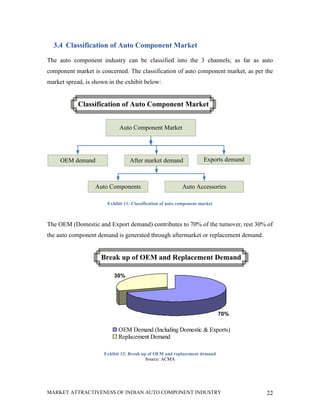
The OEM (Domestic and Export demand) contributes to 70% of the turnover, rest 30% of
the auto component demand is generated through aftermarket or replacement demand.


                     Break up of OEM and Replacement Demand

                          30%


                                                                             70%

                            OEM Demand (Including Domestic & Exports)
                            Replacement Demand

                      Exhibit 12: Break up of OEM and replacement demand
                                          Source: ACMA


MARKET ATTRACTIVENESS OF INDIAN AUTO COMPONENT INDUSTRY                               22
3.5 Tier Structure of Auto Component Market

The auto industry globally is structured based on vendor-supplier relationship with 3 to 5
nodes in the value chain ending at OEM (Original Equipment Manufacturer), that are also
the automotive major. In general, the OEMs in India typically have 100 to 500 Tier-1
equipment suppliers. These vendors are further classified as per the auto component sub-
segments that has been explained in the next section of this report. The tier structure in
the automotive industry is shown in the exhibit below:-


                      Tier Structure in the Auto Component Industry

                                                                                                       2nd
                                                                                                       Tier          2nd
                                                                                         2nd                         Tier
                                   2nd                                                   Tier
       2nd                         Tier
       Tier
                                                                                                        1st
                      1st                                                                              Tier
                     Tier
                                                     Tier
                                                      0.5                                   2nd
                                                                   OEM                      Tier                     2nd
       2nd
       Tier                                                                                                          Tier
                                   2nd
                                   Tier
3rd           3rd
                                                                                        2nd
Tier          Tier                                                                      Tier                  2nd
                            3rd        3rd                                                                    Tier
                            Tier       Tier

                                                                                                 1st             2nd
                                                                                                Tier             Tier
                     Tier-3 supplier to Tier-2 as well as
                                                                                     2nd
                           Tier-1 supplier to OEM                                    Tier                2nd
                                                                                                         Tier


                                   Exhibit 13: Tier structure in the auto component industry


MARKET ATTRACTIVENESS OF INDIAN AUTO COMPONENT INDUSTRY                                                                 23
3.6 Classification of Auto Components

The components in the Indian automotive component market are classified in the
following sub-segments:-


                             Segments within Auto Component Industry

                           Engine parts
                           - Requires high precision and high quality adherence
                           - These fall into three broad categories: Core engine parts, fuel delivery
                           system and others.
                           - Major parts include Pistons, piston rings, engine valves, fuel pumps etc

                           Drive transmission & steering parts
                           - Major sub-segments in this category include gears (tones), wheels/wheel
                           rims, steering gears and systems
                           - Major parts include starter motors, generators and spark plugs, gears, steering
                           gears and systems, wheel, clutch etc
                           - Technology intensive, top ten players account for about 80% of the total
                           segment size
                           - Size of replacement market for this segment is likely to increase esp. for
                           wheels


                           Body and chassis
                           - The chassis is the skeleton upon which all other components are positioned
  Auto Component
                           - The parts under this segment include underbody, closure, body side, doors,
      Industry
                           plastic-molded parts and exhaust systems etc

                           Suspension & braking parts
                           - Major sub-segments in this category are shock absorbers, leaf springs and
                           brake shoe assembly segments
                           - Gabriel India Ltd and Munjal Showa Ltd are the majors in
                           the shock absorber segment

                           Electrical parts
                           - New technology in cars and electric start two-wheelers are leading to the
                           growth of this segment
                           - Major parts include carburettors, starter motors, generators, bimetal bearings,
                           distributors, air conditioning unit etc

                           Equipment & Others
                           - Major equipment parts include headlights, dashboard instruments,
                           wiper motors and electric horns etc. Other components include sheet metal
                           components and plastic moulded parts

                      Exhibit 14: Segments within auto component industry


MARKET ATTRACTIVENESS OF INDIAN AUTO COMPONENT INDUSTRY                                                        24
3.7 Major Automobile Players
   The significant growth in the Indian automobile market as a result of growing income and
   purchase power has provided opportunities to all the global automobile players to set up
   their base in India in the last one decade. The setting up of new plants has provided
   cluster development of automobile and automotive component market in India.

   The exhibit below shows the major players in the Indian market who have manufacturing
   units in India:-

   Passenger Cars         Commercial Vehicles              Two-Wheelers               Three-Wheelers
Maruti Suzuki             Ashok Leyland                Hero Honda                  Bajaj Auto
Hyundai                   Tata Motors                  Bajaj Auto                  Piaggio
Tata Motors               Eicher Motors                TVS Motors                  Mahindra & Mahindra
Honda                     Swaraj Mazda                 Royal Enfield Motors        TVS Motors
Mahindra & Mahindra       Volvo                        Kinetic Motors              Tata Motors
Toyota                    MAN-Force                    Suzuki Motors               Force Motors
Fiat                                                   Yamaha Motors
Hindustan Motors                                       Honda
General Motors                                         LML India
Ford
Volkswagen
Renault
Mercedes Benz
Skoda
BMW
Volvo
                Exhibit 15: Auto Component Sub Segments and Major Players in Indian Markets


   MARKET ATTRACTIVENESS OF INDIAN AUTO COMPONENT INDUSTRY                                        25
3.8 Major Automobile Component Players (Two, Three and Four
        Wheeler players)
There is not any distinction between the two wheeler and four wheeler automobile
component players in the Indian automobile component industry. The major organized
players who are catering to two wheeler OEMs are also catering to four wheeler OEMs.
However, for some niche commercial vehicle components, due to specialized load
bearing and design requirements, some automobile component players are the vendors
only to commercial vehicles.

The exhibit below shows the major players operating in the key sub-segments in the
product segments of the auto components:-

    Product Segment                  Key Sub-Segments            Major Players
                               Gears & Drive                1. Rico Auto Inds
                               Clutches                     2. Automotive Axles
Transmission and Steering      Axles                        3. Wheels India Ltd.
                               Others                       Sona Koyo Steer.
                                                            GKN Driveline (India)
                               Starter Motors, Generator,   Denso
                               Distributor, Spark Plugs,    Motherson Sumi
                               Ignition Coil, Flywheel      MICO
Electrical Parts
                               Magnet, Voltage Regulator,   Minda Industries
                               Electrical Ignition          India Nippon
                                                            Lucas TVS
                                                            Escorts
                                                            India Pistons
                                                            Goetze (India)
                               Pistons
                                                            India Pistons
                               Piston Rings
                                                            Rane Engine Valves
Engine Parts                   Engine Valves
                                                            Shriram Pistons & Rings
                               Carburettors
                                                            Spaco Carburettors
                               Fuel Delivery System
                                                            Ucal Fuel
                                                            Lucas TVS
                                                            MICO Germany
                                                            Lumax, Autolite, Phoenix
                               Headlight
                                                            Lamps
                                                            Premiere Instruments &
Equipment                      Dashboard
                                                            Controls
                                                            Jay Bharat Maruti, Omax
                               Sheet Metal
                                                            Auto, JBM tools
                               Brake System                 Automotive Axles
Suspension and Braking
                               Brake Linings                Brakes India


MARKET ATTRACTIVENESS OF INDIAN AUTO COMPONENT INDUSTRY                            26
Shock Absorbers                         Kalyani Brakes
                                                                        Allied Nippon
                                                                        Rane Brake Lining
                                                                        Sundaram Brake
                                                                        Gabriel India
                                                                        Munjal Showa
                                Fan Belts                               Rico Auto
Others
                                Sheet Metal                             Rico Auto
             Exhibit 16: Auto Component Sub Segments and Major Players in Indian Markets
                                        Source: Database search


   “Top 50 auto component companies in India would have around 1000 auto
  component units across clusters. The vendors supplying to OEMs can be considered
  as organized segment players. These (organized players) would be around 5,000 –
  6,000. The total players including unorganized segment would be around 15,000.”
                     - Sr. Vice President, One of the leading Tier-1 component suppliers


Since components used in Commercial Vehicles and Tractors call for the properties of
high strength and load requirement, it was, therefore, observed that the operation of these
parts manufacturers are following in nature:

   a) The manufacturer is a niche player exclusively catering to the need of
         Commercial Vehicle or Tractor replacement market segment OR

  b)     A large organized player supplying to the traditional 2& 3 wheeler and passenger
         vehicles component markets has established a separate SBU (Strategic Business
         Unit) for servicing the need of Commercial Vehicles and Tractors segment

 3.9 Foreign Collaboration in the Auto Component Industry
The Indian automotive industry is characterized by a strong competition between
increasingly quality conscious manufacturers. The large, highly skilled but low cost
manufacturing base makes partnering linkages with overseas players attractive. These
strengths coupled with India’s well established strengths in IT/software combined
together to make India an emerging player in this sector. However, the industry needs to
continue to increase its quality standards and develop new products to compete globally.
Many domestic manufacturers have successfully entered into strategic alliances/


MARKET ATTRACTIVENESS OF INDIAN AUTO COMPONENT INDUSTRY                                     27
collaborations while others are actively chalking out their plans. Many of the world’s
       leading Tier-1 suppliers have set up manufacturing facilities in India including Bosch,
       Delphi, Visteon and Denso etc. Additionally, there is a well-developed domestic
       component and ancillary industry with some suppliers already meeting global technical
       and quality standards at the Tier-1 level. Some of India’s leading OES (Original
       Equipment Suppliers) include TACO, Bharat Forge, Sundaram Clayton, and Sundaram
       Brake Linings that have proven quality track record. However, many other suppliers lack
       such competence and are looking to upgrade their process/technologies to remain
       competitive. The exhibit below shows a part of Indian auto companies that have
       collaborated with the foreign partners in the Indian market:-

                                                            Name of Foreign
          Name of Indian Company                                                           Item of Manufacture
                                                             Collaborators
Amtek Auto Ltd., Gurgaon                              Bendo Kogyo, Japan                   Fly wheel ring gears
Jay Bharat Maruti Ltd., Gurgaon                       Allied Signal, USA                   Seat belts and Air bags
Subros Ltd., New Delhi                                Allied Signal, USA                   Catalytic converters
                                                                                           Exhaust Systems,
Mark Exhaust Systems Ltd., Gurgaon                    Sankei Giken, In.Co., Japan
                                                                                           Catalytic Converters
                                                      Saint Gobain Vitgrage,               Laminated Safety Glass
Atul Glass Industries Ltd., New Delhi                 France
                                                      Alcan Deutschland GmbH,              Pistons & Piston Rings
Menon Pistons Ltd., Kholapur                          Germany
                                                      Rockwell International Corp.,        Axle systems
Automotive Axles Ltd., Mysore                         USA
                                                      Blue Chip Products Inc.,             Water pumps
Autolec Industries, Madras                            USA
Spicer India Ltd., New Delhi                          Dana Corp., USA                      Engine bearings
                                                                                           Ball joints & Suspension
Sona Steering Systems Ltd., New Delhi                 Somic Ishikawa, Japan
                                                                                           joints
                                                                                           Asbestos free brake
Sona Steering Systems Ltd., New Delhi                 Fedoro, UK
                                                                                           linings
Sona Steering Systems Ltd., New Delhi                 Matsuda Industries, Japan            Cold forging
Haryana Sheet Glass Ltd., Haryana                     Pilkington Plc., UK                  Laminated sheet glass
                                                      Johnson Controls Inc., USA           Seating systems
                                                      Sommer Allibert, France              Interiors and Plastics
                                                      Yazaki, Japan                        Wiring harness
                                                                                           Transmission of steering
Tata Industries Ltd., Bombay                          ZF, Germany
                                                                                           systems
                                                      NIFCO, Japan                         Plastic Fasteners
                                                                                           Brake systems, Electrical
                                                      ITT, USA
                                                                                           & wiper systems
                         Exhibit 17: Indian Auto Component-Foreign Collaborations (2006)
                                              Source: Database search


       MARKET ATTRACTIVENESS OF INDIAN AUTO COMPONENT INDUSTRY                                            28
4 INDUSTRY AND MARKET ANALYSIS
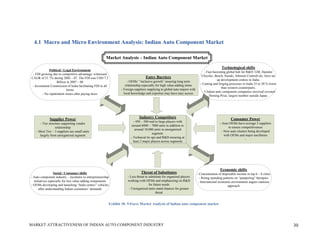
The macro environment of the Indian auto component industry can be assessed by
understanding the social / consumer shifts, understanding its political and legal
environment, technological environment and economic shifts. The micro environment of
the industry can be assessed under the Porter’s 5 forces framework by understanding the
entry barriers, threats and supplier / buyer power. Merging the two assessment
frameworks provides an indication of macros (at a broader level) and micro (at an
industry level) factors influencing the entry of new players in the market. This 9-forces
analysis on a framework (comprising macro and micro factors) for Indian auto
component industry is done in the exhibit below:-


MARKET ATTRACTIVENESS OF INDIAN AUTO COMPONENT INDUSTRY                               29
4.1 Macro and Micro Environment Analysis: Indian Auto Component Market

                                                        Market Analysis – Indian Auto Component Market

                                                                                                                                                 Technological shifts
               Political / Legal Environment
                                                                                                                                     - Fast becoming global hub for R&D: GM, Daimler
  - FDI growing due to competitive advantage; witnessed
                                                                                      Entry Barriers                              Chrysler, Bosch, Suzuki, Johnson Controls etc. have set
 CAGR of 21.7% during 2002 – 07. The FDI was USD 7.2
                                                                         - OEMs’ “inclusive growth” ensuring long term                         up development centres in India.
                     Billion in 2007 – 08
                                                                       relationship especially for high value-adding items       - Casting and forging processes in India 25 to 30 % lower
  - Investment Commission of India facilitating FDI in all
                                                                    - Foreign suppliers supplying to global auto majors with                      than western counterparts.
                             forms
                                                                      local knowledge and expertise may have easy access           - 5 Indian auto component companies received coveted
          - No repatriation issues after paying taxes
                                                                                                                                         Deming Prize, largest number outside Japan.


              Supplier Power                                                     Industry Competitors                                                   Consumer Power
                                                                             - 450 – 500 mid to large players with
       - Tier structure supporting vendor                                                                                                       - Auto OEMs have average 2 suppliers
                                                                            around 6000 – 7000 units in addition to
                   relationship                                                                                                                        to ensure competitiveness
                                                                              around 10,000 units in unorganized
    - Most Tier – 3 suppliers are small units                                                                                                     - New auto clusters being developed
                                                                                            segment.
       largely from unorganized segment                                                                                                             with OEMs and major ancillaries
                                                                           - Technical tie ups and R&D ensuring at
                                                                                                                                                                   -
                                                                             least 2 major players across segments


                                                                                                                                                Economic shifts
                  Social / Consumer shifts                                         Threat of Substitutes                       - Concentration of disposable income in top 6 – 8 cities
- Auto component industry – incubator to entrepreneurship               - Less threat to substitute for organized players        - Rising spending patterns on “pampering” therapies
  initiatives especially for less value adding components               working with OEMs and emphasizing on R&D                - International economic environment augurs cautious
- OEMs developing and launching “India centric” vehicles                                 for future needs                                             approach
      after understanding Indian consumers’ demands                      - Unorganized units stand chances for greater
                                                                                               threat


                                                             Exhibit 18: 9-Force Market Analysis of Indian auto component market


MARKET ATTRACTIVENESS OF INDIAN AUTO COMPONENT INDUSTRY                                                                                                                                      30
The macro and micro environment can be analyzed by looking at Porter’s five forces for
micro environment analysis and PEST analysis for analyzing macro environment of the
auto component industry.

In the exhibit above, while looking at competitors, there are 450 – 500 medium to large
players with around 6000 – 7000 units in addition to around 10,000 units in the
unorganized segment. This distribution highlight that auto component industry is
dominated by unorganized players. It provides opportunity for organized Thai investors
to provide the products identified as their core competence in the later part of the report.
Analyzing other aspects like entry barriers, threat of substitute and supplier and consumer
power also helps in understanding the Indian auto component market and devising the
entry strategy and positioning plank for the products supplied by the entrepreneurs from
Thailand to Indian auto component market.


  4.2 SWOT Analysis: Indian Auto Component Market

The classical tool to assess the industry environment is through SWOT analysis. The
exhibit below identifies Strengths, Weaknesses, Opportunities and Threats (SWOT
analysis) in the Indian Auto Component Industry:-


MARKET ATTRACTIVENESS OF INDIAN AUTO COMPONENT INDUSTRY                                  31
SWOT Analysis – Auto Component Industry


Strength                              KEY FEATURES                          Weakness
 ▪ Is globally cost competitive        ▪ Annual production turnover of      ▪ Industry has low level of research
 ▪ Adheres to strict quality          Rs. 210 billion (US $4.5 billion):    and development capability
                                      small by global standards
controls
                                       ▪ Around 5,000 players in the
                                                                             ▪ Industry is exposed to cyclical
 ▪ Has access to latest               unorganised sector and 400 in the     downturns in the automotive
technology                            organised sector.                     industry
 ▪ Provides support to critical        ▪ Share of unorganised sector at      ▪ Most component companies are
infrastructure and metal              23%: caters primarily to              dependent on global majors for
                                      replacement market
industries                                                                  technology
                                       ▪ Share of organised sector at
                                      77%: caters primarily to Original
                                      Equipment Manufacturers, exports
                                      and replacement market
                                       ▪ All prominent companies have
                                      technological tie-ups with global
                                      majors
                                       ▪ Manufactures products that may
                                      be classified into six categories:
                                      Engine Parts; Electrical Parts;
  Opportunities                       Drive, Transmission & Steering      Threats
  ▪ May serve as sourcing hub for
                                      Parts; Suspension & Braking Parts;  ▪ The presence of a large
                                      Equipment; and Others
  global automobile majors                                                counterfeit components market
                                       ▪ The fortunes of the industry are
   ▪ Significant export               largely driven by the automotive    poses a significant threat
  opportunities may be realised       industry                             ▪ Pressure on prices from
  through diversification of           ▪ Posted a decline in margins and  OEMs continues
  export basket
                                      returns in last five years till      ▪ Imports pose price based
                                      FY2002: working capital cycle
   ▪ Implementation of Value-                                             competition in the replacement
                                      increased during the same period
  Added-Tax (VAT) in FY2004                                               market
  will negate the cascading                                                ▪ Further marginalization of
  impact of prices                                                        smaller players likely
                          Exhibit 19: SWOT Analysis – Indian auto component industry


With the growing sales of automobiles, new global OEMs are entering in the Indian
automotive industry which in turn provides the auto component industry the opportunity
to register robust growth over next 5 – 8 years. The component industry has not more
than 50 players with turnover of more than US$ 500 million per annum. Around 70 –
80% of the total numbers of players, at the bottom of the pyramid, have revenues of less
than US$ 1 million per annum. The growing automobile demand and the increasing
awareness to purchase genuine spare parts in the aftermarket poses attractive market
opportunities for the two and four wheeler auto component manufacturers.


MARKET ATTRACTIVENESS OF INDIAN AUTO COMPONENT INDUSTRY                                                       32
5 MARKET SIZE AND GROWTH FORECASTS


  5.1 Global auto component market size and growth estimates

            Global Automotive Component Market (US$ billions)


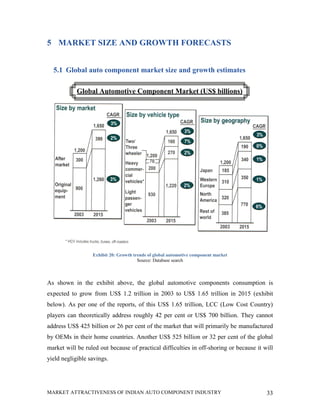
                  Exhibit 20: Growth trends of global automotive component market
                                       Source: Database search


As shown in the exhibit above, the global automotive components consumption is
expected to grow from US$ 1.2 trillion in 2003 to US$ 1.65 trillion in 2015 (exhibit
below). As per one of the reports, of this US$ 1.65 trillion, LCC (Low Cost Country)
players can theoretically address roughly 42 per cent or US$ 700 billion. They cannot
address US$ 425 billion or 26 per cent of the market that will primarily be manufactured
by OEMs in their home countries. Another US$ 525 billion or 32 per cent of the global
market will be ruled out because of practical difficulties in off-shoring or because it will
yield negligible savings.


MARKET ATTRACTIVENESS OF INDIAN AUTO COMPONENT INDUSTRY                                  33
5.2 Indian auto component market size and growth estimates

According to Automotive Component Manufacturers’ Association (ACMA), the
production of automotive component in India was US$ 18 billion. It is growing at CAGR
of 27% since 2002-03. The investment in the Indian auto component industry is also
gaining momentum with almost all major global automotive component manufacturers
are setting up their plants in India.

   5.2.1   Production (in Number) and Growth rates of all vehicle categories
           including two wheelers
The exhibit below indicates that in 2006-2007, out of the total automobiles market size of
around 1,10,65,000 vehicles, 94,42,000 or around 85% of the vehicles were two
wheelers. On an average, the overall annual growth rate of vehicles in the last 5 years has
been in excess of 15%.

        Category         2002-03      2003-04        2004-05                             2005-06   2006-07
 Passenger Car              609         843           1018                                1113       1323
 Utility Vehicle            114         146            192                                 197       222
 Commercial Vehicle         204         275            354                                 391       520
 Two-Wheeler               5076        5623           6530                                7609       9442
 Three-Wheeler              277         356            374                                 434       556
 Grand Total               6280        7244           8468                                9744      11065
 Growth Rate              18.13%      15.34%         16.90%                              15.06%    13.55%
 All Number in '000 units while Growth Rate is in percentage
 Source: Ministry of Heavy Industries, Government of India

                     Exhibit 21: Production and growth rates of all vehicle categories
                                             Source: ACMA
Above table also points out that the two-wheelers and passenger cars have been the most
significant product categories (combined share -97%) and growing steadily over the past
few years. The two wheeler replacement auto component market also holds significant
importance due to the sheer volumes. Therefore, the 2-wheeler automotive component
market cannot be ignored while gauging the attractiveness of automotive component
market of India. The synergies between the two-wheeler & four wheeler component
market also enable two-wheeler component manufacturers to service the four wheeler
segment easily.


MARKET ATTRACTIVENESS OF INDIAN AUTO COMPONENT INDUSTRY                                             34
5.2.2                 Consolidated Production, Export and Investment in value terms
As per the exhibit below, the exports in 2007 – 08 were US $ 3.6 billion, out of these
close to US $ 1 billion auto components were exported to top-3 US automotive majors
i.e. GM, Ford and Chrysler.


                                      Indian Automotive Component Market


                                               Auto Component Production
                      20,000                                                                                                       18,000
                      18,000
                                                                                                                          15,000
                      16,000
   (In USD Million)


                      14,000                                                                                     12,000
                      12,000
                      10,000                                                                            8,700
                                                                                                6,730                              7,200
                       8,000
                                                                                       5,430                              5,400
                       6,000                                  3,894 3,965 4,470             3,750
                                                                                                  4,400
                                                                                                              3,615
                                  3,278 3,008 3,249                                   3,100
                       4,000                                              2,300 2,645             2,469 2,873
                                                                                      1,274 1,692
                                                               456   625   578   760
                       2,000                  330      350

                         -


                                                                                                                                  *
                                  7

                                          8

                                                   9


                                                                      1

                                                                              2

                                                                                       3

                                                                                               4

                                                                                                        5

                                                                                                                6

                                                                                                                         7
                                                         00


                                                                                                                                 8
                               -9

                                       -9

                                                -9


                                                                   -0

                                                                           -0

                                                                                    -0

                                                                                            -0

                                                                                                     -0

                                                                                                             -0

                                                                                                                      -0

                                                                                                                              -0
                                                          0
                          96

                                      97

                                              98


                                                               00

                                                                          01

                                                                                  02

                                                                                           03

                                                                                                   04

                                                                                                            05

                                                                                                                    06
                                                       -2


                                                                                                                           07
                         19

                                 19

                                           19


                                                              20

                                                                     20

                                                                               20

                                                                                       20

                                                                                                20

                                                                                                        20

                                                                                                                 20
                                                    99


                                                                                                                         20
                                                19


                                      Production                     Exports                    Investment
                           Exhibit 22: Market size and growth trends – Indian auto component market
                               Source: ACMA (Automotive Component Manufacturers’ Association)

As per the exhibit above the consolidated production of the two, three and four wheeler
auto component industry is growing at CAGR of 25 – 27% from the past 4 – 5 years. The
production is catering to both the domestic demand, coming from OEM and replacement
demand, and the growing rate of exports.

The investment in the auto component industry has also been doubled to USD 7.2 Billion
in the last three years. This highlights the growth momentum in the Indian auto
component industry.


MARKET ATTRACTIVENESS OF INDIAN AUTO COMPONENT INDUSTRY                                                                                     35
5.2.3   Value wise break up of sub-segments – two and four wheelers

The two wheeler automotive component market like the four wheeler automotive
component market can be classified into the same sub-segments categories. Out of the
consolidated automotive component market, the engine parts have the major share among
the other auto components. It accounts for 31% of the total auto component market (in
value terms). The equipments, electrical and other parts account for 10%, 12% and 7%
respectively of the total auto component market size (in value terms). The break up of the
auto component industry (in value terms including 2 and 4 wheeler components) is
shown in the pie chart below:


               Beakup of Various Segments in Indian Auto Component Industry
                                     (In Value terms)

                                        31%
                                                                           19%


                                 7%                                           12%
                                       9%
                                                10%               12%
                      Engine parts                        Drive transmission & steering parts
                      Body & chassis                      Suspension & braking parts
                      Equipment                           Electrical parts
                      Others
          Exhibit 23: Percentage breakup of sub-segments in the Indian auto component industry
                 Source: ACMA (Automotive Component Manufacturers Association of India)


  5.2.4   Import estimates and trends (for 2 and 4 wheelers)
The imports for the auto components are ranging 2-4% for the total replacement market
(which is 30% of total auto component demand in India). In the OEM demand, import of
auto-components is negligible (less than 1%), as it can be identified from the comment
below:-


MARKET ATTRACTIVENESS OF INDIAN AUTO COMPONENT INDUSTRY                                          36
“All OEMs have their vendors located in India. However, some OEMs like us
     (Ashok Leyland) have set up their offices in China from where we are importing
     some components that are cost effective. These components would be less than 1% of
     the total auto component requirements
                    - Strategic Sourcing Official from one of leading Vehicle manufacturer


 Within imports of auto components, Engine and Suspension / Braking have relatively
 higher proportion in imports whereas Transmission and Equipments have lesser
 proportion.

 The table below highlights the items that are either high in import proportion (in value
 terms) or are growing at rapid rate i.e. 50% or more. India imported US$ 20 million auto
 components from China in 2004 – 05 whereas the imports from ASEAN countries were
 close to US$ 73 million during the same time. The estimated imports (based on the
 growth trends) from China and ASEAN countries in 2008 – 09 would be around US$ 120
 – 150 million and US$ 350 – 400 million respectively.

 Auto component import
                                Total Import – 2004-05 (US $ Million)             Growth Rate (2001-05)
 (OEM + Replacement)
                                          Imports     Imports     Share of               Imports    Imports from
                                 All                                           All
Components detail                          from        from       China &              from China     ASEAN
                               Imports                                       Imports
                                           China      ASEAN       ASEAN
Parts and accessory of motor
                                   543.38     3.98      61.16       12%      28%        28%           58%
vehicles
Engine parts                       203.19     8.99       3.09        6%      15%       113%           24%
Electrical parts and accessories    29.80     0.68       0.1         3%      26%        63%           -50%
Bumpers and parts                   23.09     0.23       1.59        8%      69%        74%           288%
Injection pumps, oil pumps,
                                    22.67     0.73       0.01        3%      39%       111%           -29%
water pumps
Drive axles with differential       18.63     0.01       0.87        5%      50%          -
Lighting equipment                  17.46      1.8       2.01       22%      24%        14%           107%
Other Brakes/Servo brakes           17.20      0.9       0.23        7%      46%        63%           -17%
Starter motors                      11.16      0.3       1.44       16%      33%       166%            5%
Clutches                             9.17      0.2       0.74       10%      25%        26%           147%
Wheels                               7.86     0.75       0.29       13%      80%       127%           14%
Steering wheels and columns          7.06     0.01       0.45        7%      45%        21%           208%
Rear view mirror                     4.23     0.74       0.6        32%      37%       104%           97%
Laminated safety glass               1.84     0.63       0.29       50%      87%       281%           313%
Total                               916.7     20.0       72.9                30%        55%           49%
                          Exhibit 24: Auto component imports (OEM + Replacement market)
   Source: ACMA (Automotive Component Manufacturers Association, DGFT (Directorate General of Foreign Trade)


 MARKET ATTRACTIVENESS OF INDIAN AUTO COMPONENT INDUSTRY                                                    37
The highlighted components above are the promising auto component products for both
two wheelers and four wheelers auto components that have are either high on value or the
rate of growth of import is significantly higher. These items could be looked as the
potential export items by Thai investors to export to India. The consumable items markets
like injection pumps, oil pumps, bumper and parts and wheels are growing at faster rate
in the replacement market due to increase vehicle population.
We expect the share of imported parts (especially from China and ASEAN countries
including Thailand) to grow in the future because of the two major reasons:-
    FTA’s that India has sign with a number of countries including Thailand would
       result in increase in imported parts
    Launch of similar products in India and China / ASEAN.


  5.2.5   Auto Component Export Destinations

The U.S. and European markets account for 28% each of the total exports from the Indian
auto component companies. The exhibit below shows the break up of the total auto
component export markets across the major auto importing markets.


                          Auto Component Export Destinations
                                  (In Value terms)
                                              28%


                                                                                27%
                           28%

                                             4% 2%              11%


                 U.S.       Europe         Asia        Africa       Australia         Others


                        Exhibit 25: Indian auto component export destinations
                                            Source: ACMA


MARKET ATTRACTIVENESS OF INDIAN AUTO COMPONENT INDUSTRY                                        38
5.2.6   Trends in growth and margins – Two and Four wheelers
As mentioned in the section 5.2.2 above, the automobile market is growing at CAGR of
25 – 27%. Notwithstanding the temporary global economic meltdown, it is expected that
the domestic demand for automobiles would grow unabatedly over the next 3 – 5 years.

The exhibit below shows the gross margin and net margin at the distribution and retailer
level:-


                                 Gross Margins                                 Net Margins


    Distribution           Ranges between 12 – 15%                       Ranges between 4 – 6% based
    Margin                 based on type of part and                     on type of part and type of
                           type of manufacturer                          manufacturer


    Retail                 Ranges between 14 – 18%                       Ranges between 6 – 8% based
    Margin                 based on type of part and                     on type of part and type of
                           type of manufacturer                          manufacturer


                           Exhibit 26: Distributor and Retailer Margin


The average distribution margin per players (made by distributors / wholesalers) is
dependent on the number of layers in the channel. The margins and incentives play a key
role in pushing the product at the retail end. The margins are relatively higher for
electrical parts and brake & suspension parts.


MARKET ATTRACTIVENESS OF INDIAN AUTO COMPONENT INDUSTRY                                      39
6 AUTO COMPONENT OEM AND REPLACEMENT
    MARKET
This section highlights OEM supply chain and inventory management aspects for small
and large auto component supplier. In the replacement market segment, changes in the
replacement market including the increasing focus of OEM on aftermarket in the recent
years and the channel structure have been highlighted in this chapter.

  6.1 OEM Market in the Indian auto component industry

The OEM market is also known as the organized market segment in the Indian auto
component industry. All the Tier-1 automotive component vendors have their respective
distribution channels in the aftermarket segment. Typically, an OEM works with around
100 – 200 Tier-1 suppliers and around 500 Tier-3 / Tier-2 suppliers (to Tier-2 / Tier 1
suppliers), depending upon the diversity of product line offerings.

  6.2 OEM Component Sourcing
The automotive manufacturing industry in India is on par with the globally competitive
markets. All the plants are typically connected with ERP systems with their strategic
vendors and distribution channels that enable them to control raw material, WIP (Work In
Process) and finished products (vehicles) inventory. The exhibit below shows typical
order-to-delivery process supply chain in the automotive industry.


MARKET ATTRACTIVENESS OF INDIAN AUTO COMPONENT INDUSTRY                              40
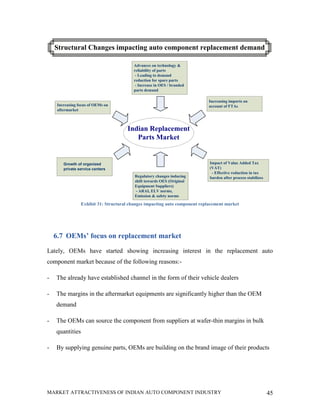
Typical Order-to-Delivery Process in the Auto Industry Supply Chain

                                     Purchasing   Programming     Marketing


                                                   Order Bank                           National
       Plan          Plan                                                               Sales Co.

                                                  Scheduling

     Schedule      Schedule

                                                   Sequencing


      Tier 2        Tier 1         Inbound         Body, paint,       Outbound                       Inv.
                                                                                         Dealer
     Supplier      Supplier        Logistics        assemble          Logistics

                                                                                                    Customer

                  Exhibit 27: Order-to-delivery process in auto industry supply chain


   “We have categorized the components in various buckets. For high value items, we
  follow JIT approach; we carry 1 day inventory for these items. For other categories
  we may carry 3 - 4 day inventory. For smaller and less value components we may
  have one week of inventory”
                - Strategic Sourcing Official from one of leading Vehicle manufacturer


  6.3 OEM Vendor Selection Process

The research team of IMRB International tried to understand the vendor selection process
of LCV and Commercial Vehicle manufacturers. The OEM vendor selection process was
found to be almost similar in all the OEMs visited during the course of this study. In
general, OEMs select vendors in the following steps:-

Step 1: First, the vendor contacts OEM’s sourcing or purchase department. Due to high
number of parts, the sourcing department is categorized into 4 – 5 vendor management
groups. After submitting the credential documents and filling the vendor application


MARKET ATTRACTIVENESS OF INDIAN AUTO COMPONENT INDUSTRY                                                     41
form, it is submitted with respective departments within the sourcing department of
OEM.

The party should be financially and technically sound. It should have prior experience as
supplier to other vehicle manufacturers. For some parts, specific commercial vehicle
technical expertise as vendor is required whereas for other components the vendor is
qualified if the party is supplying to LCVs.

Step 2: After initial qualification, a team of people from various departments (i.e.
Engineering, Sourcing etc) is formed that checks for quality aspects, the vendor’s
manufacturing set-up and technological capabilities etc. OEMs evaluate them whether
they would be able to meet OEM’s expectations with the economies of scales and quality
levels.

Step 3: After the party qualifies, OEMs involve in the commercial discussion about the
cost, inventory and other nitty-gritty. OEMs have long term association with vendors.
The process of vendor selection takes few weeks to few months.


  6.4 Inventory in Supply Chain of OEM suppliers

   6.4.1      Small and Medium OEM vendors
The small to medium auto component industry that are not leveraging the information
flow are the most vulnerable to the market volatility because of the “bullwhip effect”
leading to piling up of inventory all levels i.e. RM (Raw Material), WIP (Work In
Process) and FG (Finished Goods). The OEMs are well connected to their strategic
vendors either because of their physical proximity to the vendors or because of prompt
information exchange through ERP (Enterprise Resource Planning) software. It enables
these vendors to change the supplies as per the changing Master Production Scheduling at
OEMs’ end. The percolation of technology in India hasn’t seeped beyond Tier-1
suppliers, resulting in excess inventory at various levels. The exhibit below pictorially
represents the inventory buildup in a typical supply chain of Indian auto component
industries.


MARKET ATTRACTIVENESS OF INDIAN AUTO COMPONENT INDUSTRY                               42
Inventory in the Supply Chain of Small Indian Auto Component Industries

                                                     WIP
                                        RM                       FG
             Tier 2                                Tier 1                                       OEM
              Tier 2                                                                            OEM
                       Inventory                   Inventory                      Inventory
                                       Inventory
                                                               Inventory

           SMALL AUTO COMPANIES – LONG LEAD TIMES & SHIPMENT DELAYS


               Exhibit 28: Inventory in the supply chain of small auto component industries


   “The time is not ripe (for the auto component players like us). We have sudden
  export order cancellation from 2 out of top-3 US majors. We have inventory
  accumulation of around 50% of our annual turnover at various levels. It will take
  some time for us to come out of this situation.”
          - General Manager of one of mid sized Automotive Component Manufacturer


  6.4.2     Large OEM vendors / strategic Tier-1 suppliers
Though the supply chain of automotive industry in India is lagging behind in term of
technology adoption when compared with developed economies, the OEM and Tier-1
supplier relationship maintains some level of information flow that enables them to keep
a tab on the inventory levels. The exhibit below pictorially represents the ideal supply
chain situation that exists in the handful value chains in the Indian automotive industry.

  Inventory in the Supply Chain of Evolved Indian Auto Component Industries

              planning                SRM              planning             SRM               planning

               Tier 2
                Tier 2                                 Tier 1
                                                        Tier 1                                 OEM
                                                                                               OEM
                         Inventory                                         Delivery
          Manufacturing              Delivery      Manufacturing                              Assembly

      TOP 50 AUTO COMPONENT COMPANIES REPLACE INVENTORY WITH
   INFORMATION, HAVE ROBUST DELIVERY CAPABILITIES - LEAD TIMES ARE
                            VERY SHORT

                 Exhibit 29: Inventory in the evolved value chain of automotive industries


MARKET ATTRACTIVENESS OF INDIAN AUTO COMPONENT INDUSTRY                                                  43
6.5 Break up of replacement parts market by type of vehicle

The exhibit below shows the break up of the replacement market among various
categories of vehicles. 2/3 wheelers and cars replacement parts constitutes 66% of the
overall replacement market. In India, as far as major component suppliers are concerned,
most of the auto component players for 2/3 wheelers and cars are common..


                          Break up by type of vehicle (Year 2006-07)
                                         Tractors
                                           9%
                                                                         2/3 Wheelers
                      Commercial
                                                                             33%
                       Vehicles
                        25%


                                                     Cars
                                                     33%


             Exhibit 30: Break up of replacement auto component market by type of vehicle


  6.6 Automotive component replacement market: impact of structural
          changes
Though replacement market caters to 30% of the total (domestic and exports) auto
component market, several channels selling genuine and spurious parts make it the most
dynamic market segment out of the other two markets i.e. OEM demand and export
market.

Due to the squeezing margin for the OEM auto component segment, the replacement
market has relatively better margins for OES and additional stream of income for OEMs.
The replacement market has become increasingly competitive with the focus on OEMs,
imports and reducing price difference between OEM/OES products and spurious auto
components. The exhibit below details out the critical factors that have recently
transformed the aftermarket demand:


MARKET ATTRACTIVENESS OF INDIAN AUTO COMPONENT INDUSTRY                                     44
Structural Changes impacting auto component replacement demand

                                         Advances on technology &
                                         reliability of parts
                                          - Leading to demand
                                         reduction for spare parts
                                          - Increase in OES / branded
                                         parts demand

                                                                            Increasing imports on
     Increasing focus of OEMs on                                            account of FTAs
     aftermarket


                                      Indian Replacement
                                         Parts Market


        Growth of organized                                                  Impact of Value Added Tax
        private service centers                                              (VAT)
                                                                              - Effective reduction in tax
                                          Regulatory changes inducing        burden after process stabilizes
                                          shift towards OES (Original
                                          Equipment Suppliers)
                                           - ARAI, ELV norms,
                                          Emission & safety norms
                 Exhibit 31: Structural changes impacting auto component replacement market


    6.7 OEMs’ focus on replacement market
Lately, OEMs have started showing increasing interest in the replacement auto
component market because of the following reasons:-

-   The already have established channel in the form of their vehicle dealers

-   The margins in the aftermarket equipments are significantly higher than the OEM
    demand

-   The OEMs can source the component from suppliers at wafer-thin margins in bulk
    quantities

-   By supplying genuine parts, OEMs are building on the brand image of their products


MARKET ATTRACTIVENESS OF INDIAN AUTO COMPONENT INDUSTRY                                                        45
The marketing and supply initiatives taken by OEMs in the after market component
business is shown in the exhibit below:-


       OEMs’ initiatives in the after market (replacement) business


                        Exhibit 32: OEM initiatives to grab replacement market share


  6.8 Channel structure for auto component market

At a broader level, the channel structure for the replacement market can be classified into
3 categories: the OES / OEM channel, the spurious component channel and the import
channel where products are sold by importers.

According to the study conducted by IMRB International for SIAM in 2006-07, the
counterfeit components constitute about 35% - 51% of private vehicle components
replacement market. The exhibit below shows the product flow across different channels.
In the replacement market, it is estimated that spurious product market is bigger than the
market catered by genuine parts.


MARKET ATTRACTIVENESS OF INDIAN AUTO COMPONENT INDUSTRY                                 46
Prevailing Distribution Channels in the Auto Components Aftermarket


        OES
(Original Equipment
      Supplier)
                                                     Stockists / Big
                            Warehouse –                 Dealers
                           typically one at                                   Dealers – small dealers
        OEM                factory and the                                   generally in smaller cities


                                                                                                           CUSTOMER/END USER
(Original Equipment     others at zonal level
   Manufacturer)                                     Franchise e.g.
                                                    Leyparts, Maruti
                                                   Service Masters etc

     Unbranded            Warehouse –
(including spurious)     generally only at
 component market          factory level

                                                       Stockists / Big
                                                          Dealers
                           Importers esp. for
                         accessories – generally                             Dealers – small dealers
                          having warehouse at                               generally in smaller cities
                              import cities
      Imports


                           OES / OEMs –
                         further utilize their
                        spare parts channel


                       Exhibit 33: Channel structure in the auto component aftermarket


    “All the auto companies (out of a total of 25 to 30 companies) within our group,
   have separate distribution channels. We (our company) have OEM supplies, for
   aftermarket we supply to 1200 dealers directly, these dealers in turn send it to smaller
   shops. We have 1 warehouse in addition to warehouse at this (manufacturing)
   facility.”
         - General Manager, Marketing of one of the leading Tier-1 component suppliers


MARKET ATTRACTIVENESS OF INDIAN AUTO COMPONENT INDUSTRY                                                             47
7 GOVERNMENT INITIATIVES
  7.1 Foreign Direct Investment

The Indian automotive industry with a turnover of US$ 34 billion and the auto parts
industry with a turnover of US$15 billion offer excellent scope for FDI. The investment
figure for the past 5 years is shown in the exhibit 20 under chapter 5.2 of this report.

The automatic approval for foreign equity investment upto 100 per cent of manufacture
of automobiles and component is permitted. The import of components is freely allowed.
The import of technology/technological up gradation on the royalty payment of 5%
without any duration limit and lump sum payment of USD 2 million is also allowed
under automatic route in this sector.

The norms for Foreign Investment and import of technology have also been progressively
liberalized over the years for manufacture of vehicles including passenger cars in order to
make this sector globally competitive. With the gradual liberalization of the automobile
sector since 1991, the number of manufacturing facilities in India has grown
progressively. At present there are 15 manufacturers of passenger cars & multi utility
vehicles, 9 manufacturers of commercial vehicles, 16 of 2/3 wheelers and 14 of tractors
besides 5 manufacturers of engines.


  7.2 Auto Policy

The industry provides direct and indirect employment to 13.1 million people. The
contribution of the automotive industry to GDP has risen from 2.77% in 1992-93 to 5%
in 2006-07. The industry is also making a contribution of 17% to the kitty of indirect
taxes of the Government. In order to provide special attention to the auto industry, the
Government of India has drafted the Auto Policy whose vision and objectives are
mentioned below:


MARKET ATTRACTIVENESS OF INDIAN AUTO COMPONENT INDUSTRY                                    48
Vision

To establish a globally competitive Automotive Industry in India and to double its
contribution to the economy by 2010.

Objectives

This policy aims to promote integrated, phased, enduring and self-sustained growth of the
Indian automotive industry. The objectives are to:-

(i) Exalt the sector as a lever of industrial growth and employment and to achieve a high
degree of value addition in the country;

(ii) Promote a globally competitive automotive industry and emerge as a global source
for auto components;

(iii) Establish an international hub for manufacturing small, affordable passenger cars and
a key center for manufacturing Tractors and Two-wheelers in the world;

(iv) Ensure a balanced transition to open trade at a minimal risk to the Indian economy
and local industry;

(v) Conduce incessant modernization of the industry and facilitate indigenous design,
research and development;

(vi) Steer India's software industry into automotive technology;

(vii) Assist development of vehicles propelled by alternate energy sources;

(viii) Development of domestic safety and environmental standards at par with
international standards.

The full auto policy of Government of India is attached in the annexure of this report.


MARKET ATTRACTIVENESS OF INDIAN AUTO COMPONENT INDUSTRY                                   49
7.3 Automotive Mission Plan 2016

The Ministry of Commerce, with the help of SIAM (Society of Indian Automobile
Manufacturers) and ACMA (Automotive Component Manufacturers Association of
India) has devised automotive mission plan 2016 to emerge as the destination of choice in
the world for design and manufacture of automobiles and auto components with output
reaching a level of US$ 145 billion accounting for more than 10% of the GDP and
providing additional employment to 25 million people by 2016.

The Automotive Industry offers huge growth potential in terms of sales volume
(including exports) and also immense employment opportunities. The likely future
volumes of different vehicle categories were estimated on the basis of projections made
by iMaCS, NCAER and AT Kearney. The value of projected domestic output was
computed based on historical average vehicle prices. The export potential was estimated
on the basis of current trends and possible opportunities in major export destinations. The
demand for after-market auto components and export output was also included in
computing growth potential of the industry.

According to AMP, Government will encourage collaboration of Industry with research
and academic institutions like CSIR, IIT, and machine tool industry for the development
of appropriate technology and creation of IPR to meet more stringent regulations as well
as to develop relevant machine tools and equipment that improve manufacturing
processes and quality of the vehicles and components produced by the industry. The
interface with the Core Group on Automotive Research (CAR) would be strengthened.

The complete document of Automotive Mission Plan 2006 – 2016 describing the mission
for development of Indian Automotive Industry can be downloaded from the following
URL: http://www.siamindia.com/upload/AMP.pdf .


MARKET ATTRACTIVENESS OF INDIAN AUTO COMPONENT INDUSTRY                                 50
8 GROWTH DRIVERS AND CHALLENGES
Over the last 5 years, the Indian automotive component industry is thriving with the
CAGR of 27%. Though the current global situation would have some coupling effect on
the exports and domestic consumption in the coming year, the growth story over 5 – 7
years period i.e. till 2015 is quite positive.

The demand for auto components is mainly driven by the demand for automobiles,
although auto components do find usage in non-automotive industries as well. This
section covers the growth drivers, issues / challenges, Indian auto industry amid the
changing global scenario (transient challenges) and the critical success factors for the
automotive industry.


MARKET ATTRACTIVENESS OF INDIAN AUTO COMPONENT INDUSTRY                              51
8.1 Growth Drivers for Replacement Demand

The auto component industry has cascading effect on the auto component industry as
70% of the automotive component supplies in value terms go to OEMs (domestic and
exports. The exhibit below represents the growth drivers propelling the growth of the
replacement demand. Due to these factors, there has been an increasing interest from
OES and OEMs to concentrate on auto component aftermarket.


                           Growth Drivers for Replacement Demand


                                        Vehicle Population Size
                                        Proportional to aggregate
                                        demand for replacement
                                                  parts                 Average age of the
             Driving Conditions                                         Vehicle Population
           Poor driving conditions                                    Vehicle scrap norms not
           coupled with poor road                                     widely prevalent, leading
            infrastructure adds to                                    to longer vehicle usage.
           demand for certain parts                                   Higher vehicles’ average
              e.g. axle, tyres etc                                      age leads to greater
                                                                              demand

                                             Growth
                                             Drivers

                                                                        Distance (in Kms)
             Road Infrastructure                                       covered per Vehicle
          Impacts life of auto parts,                               Services not just confined
            replacement demand is                                         to super-riches.
           influenced by condition                                      Affordability factor
             of road infrastructure                                  instrument in increasing
                                                                              demand


                 Exhibit 34: Growth drivers for auto component replacement demand


MARKET ATTRACTIVENESS OF INDIAN AUTO COMPONENT INDUSTRY                                           52
8.2 Issues and Challenges – Indian Auto Component Industry

As is the case with many other young, aspirant and rapidly growing industries, Indian
auto component industry is also engulfed with certain challenges. These challenges can
be dissected into two categories – internal factors i.e. the challenges faced at
organizations’ level and external factors where the other entities, issues outside the
organization / industry influence the growth of the industry. The exhibit below highlights
the issues and challenges Indian auto component industry is facing today:-


                                  Indian Auto Component Industry –
                                        Issues and Challenges


       Internal factors                                                     External factors
   – At Organizations’ level                                         – Other than organizations’ level


                                                               Poor logistics & power
          Sustaining quality levels
                                                               infrastructure


          Shipment delays causing cascading               Tightening environmental & safety
          impact on aggregate planning of                 regulations leading to high capital
          supplier organizations                          investments


          Under-investment in ERP (Enterprise             Increasing cost of raw material and
          Resource Planning) infrastructure               labour wages
          leading to inefficient stock planning
          and high inventory levels                       Increasing competition and high lead
                                                          time for international contracts (from
                                                          OEMs)
          Rising attrition rate
                                                          Managing M&A / JV /
                                                          Collaborations

                     Exhibit 35: Indian auto component industry – Issues & Challenges


MARKET ATTRACTIVENESS OF INDIAN AUTO COMPONENT INDUSTRY                                                  53
8.3 Indian Auto Component Industry amid changing global scenario

In addition to the above challenges the auto component industry is facing, there are
certain transient challenges due to the changing global situation where 2 out of the top-3
U.S. auto major are on the verge of bankruptcy. The business scenario in case of Japanese
and Korean automotive majors is also echoing similar sentiments due to global meltdown
imposed by the sub-prime mortgage crisis in U.S. and the European economies. The
exhibit below shows the transient challenges in view of changing global business
situation.


                                           Indian Auto Component Industry
                                          in view of changing Global situation

                                                                Troubled times for top-3 US
                                                                auto major

                                                                                                                    Volatile input prices and
     Reduced growth rate of                                                                                         reduced profit margins
                                                          · Top 3 US auto majors are either
     domestic vehicle Sales
                                                            canceling or delaying orders from
                                                            leading Indian auto majors,
                                                            leading to bad shape of their                        · Increase in the volatility of ferrous
 · Sudden dip in the vehicle
   demand in the last quarter has                           financial books                                        and non-ferrous metals
                                                          · GM among the front runners in                        · Usage of newer input components
   reduced the growth estimate
   for FY 2008 – 09                                         filing bankruptcy, Ford and                            due to technological up gradation
                                                            Chrysler also in bad shape leading                   · Reduced profit margin due to cut-
                                                            to less business from exports                          throat competition


                                                                                                                   Increasingly stringent emission
      Insufficient skill-sets and                                                                                  and safety regulations
      shortage of qualified
      labour
                                                          Auto Component                                        · High environment concerns
                                                                                                                · Increase in technological capability to
 · Increase in employee wages in                             Industry                                             reduce emissions due to increased
   the last decade has increased                                                                                  R&D
   the operating costs                                                                                          · Higher cost in ensuring better safety
 · With the entry of new players                                                                                  and adherence to safety protocol
   in last 5 – 7 years, shortage of                                                                               leading to higher input cost
   employees with specific skill
   sets


                                                                                              Rising Customer
                              Integration with Global                                         Expectations
                              (Developed) markets

                                                                                        ·  Customer expects more product
                            · Integration leading to lowering                             features
                              product life cycles                                       · Expectation of high quality and
                            · Reduced time-to-market for new                              reliable product offerings
                              products
                            · Threat of new competition


                       Exhibit 36: Indian auto component industry in view of changing global situation


MARKET ATTRACTIVENESS OF INDIAN AUTO COMPONENT INDUSTRY                                                                                                    54
8.4 Critical Success Factors

The factors critical to the success of auto component industry in India have been
delineated in the exhibit below. Some of these factors are commonly important to the
supply chain and automotive component industry across the economies because of the
nature of the industry. However, some factors are based on observing the businesses in
the Indian automotive industry.


                      Critical Success Factors for Auto Component Industry
                                    m


                                                                                         c
                                                                           ma dom s of
                                  an g spe


                                                                             in mie g

                                                                                 et esti
                                   St


                                                                                     in
                                    ag lo ct
                                    a l
                                    a l
                                      ro en


                                                                        Sc Eco hiev
                                       o n
                                       on nt
                                       em ba ive
                                        pe
                                         e
                                         er


                                         g wi


                                                                          ale no
                                                                              Ac
                                           s
                                           s
                                            ba i
                                            ba i


                                                                              rk
                                              l e
                                               c
                                               c


                                                 th
                                                  h
                                                  h
                                                    e


              Forge right alliance                                                           Invest in technology
              with well defined exit                    Critical                                with long term
                                                                                                 perspective
                    strategy                            Success
                                                        Factors
                                       l
                                     na co-                                          Ma
                                 tio                                                su nag
                               ra e & n
                             e c                                                      pp in
                                         i
                           Op llen ion y                                                ly g t
                                                                                          ch he
                             e      t      g
                           xc rea nolo r
                          e c h
                                                                                            ai n
                                           e
                                   c nsf                  Building
                                te ra
                                     t                     credible
                                                         relationship
                                                          with key
                                                         customers


                     Exhibit 37: Critical success factors for auto component industry


MARKET ATTRACTIVENESS OF INDIAN AUTO COMPONENT INDUSTRY                                                             55
9 CONSUMER                                   PREFERENCES                              FOR             AUTO
     COMPONENTS
The understanding of consumer preference for the replacement market provides an
insight on the factors consumers consider important while purchasing the auto
components, be it for 2/ /3 wheelers, cars or commercial vehicles.

                                  Key Purchase Criteria (Replacement Market)


                    Individual Customer                                        Fleet Customer


     Quality                       4.5                          Quality                     4.4

       Price                 3.2                                  Price               3.4

 Availability           2.4                                 Availability        2

      Brand                 3.1                                  Brand                3.4

  Reliability               2.8                              Reliability            2.7

                0       1          2     3       4      5                  0    1           2     3   4   5

  1 = Least Important         5 = Most Important
                             Exhibit 38: Critical success factors for auto component industry
                                                      Source: ACMA

As per the exhibit above, quality, brand and price are three key criteria for both
individual customers and customers owning a fleet of vehicles, either for personal or
commercial use. However, price is a less important factor for crucial components like
engine and transmission parts. The same finding can be extended to high value, low
volume IC (Integrated Circuit) based components as well.

When it comes to the sources of purchase for the organized replacement market, majority
of the individual customers rely on OEM and branded parts. As per the exhibit below,
almost more than one-third of the individual customers purchase OEM parts i.e. the parts
available from OEM distribution channel. Around half of the customers, except for


MARKET ATTRACTIVENESS OF INDIAN AUTO COMPONENT INDUSTRY                                                   56
transmission parts, purchase branded components, available from dealers or auto
component shops.


              Source of Purchase (Replacement Parts)


               Engine Parts             42%                       47%              11%
             Electrical Parts         33%                     51%                 16%
        Transmission Parts             38%                    41%               21%
 Suspension / Braking Parts           34%                      51%                15%
           Equipment Parts            35%                       52%                13%

                             0%         20%         40%        60%         80%        100%

             OEM                          Branded                           Others


              Exhibit 39: Source of purchase for replacement parts by individual customers
                                            Source: ACMA


Recognizing the importance of OEMs in the component market, their criteria for vendor
selection and purchase process has been covered separately in “OEM’s Vendor Selection
Process” section of this report.


MARKET ATTRACTIVENESS OF INDIAN AUTO COMPONENT INDUSTRY                                      57
10 ATTRACTIVENESS                          OF          AUTO            COMPONENT
    SEGMENTS FOR THAI INVESTORS
This chapter takes the cues from the insights highlighted in previous chapters and
classifies the sub-segments in the automotive component industry in the attractiveness
matrix based on the opportunity for the Thai investors. It takes into account the import
trends for auto components - in total value terms, imports from China and ASEAN
countries, the subjective opinion of various stakeholders met through the automotive
value chain and maps the auto component sub-segments in the attractiveness matrix for
Thai investors.


  10.1 Attractive segments within auto component market for Thai
        investors
The attractiveness of domestic auto component market can be gauged by segmenting it
based on the type of raw materials, manufacturing/design process involved and the
technical expertise required to produce these auto parts. On the basis of these 3 factors,
the auto component market can be segmented into the following five broad categories:-

    1. Plastic, silicon intensive / electronics, integrated circuits parts

    2. Rubber intensive parts

    3. High labour intensive parts e.g. casting and forging parts

    4. Skill-intensive parts

    5. Parts for evolving technology aggregates


  “Thai auto component industry can supply tyres to Indian OEMs at cost effective
  price.”
                      - Sourcing Manager, one of leading passenger car manufacturers


MARKET ATTRACTIVENESS OF INDIAN AUTO COMPONENT INDUSTRY                                 58
The sub-segments are classified on two axes on the attractiveness matrix. These axes are:
- relative degree of technical expertise and ability in cost effective supply of automotive
components. By relative degree of technical expertise, we imply the technical expertise of
Thai automotive component industry for a particular sub-segment over the technical
competence of Indian auto component industries.

The exhibit below shows that the domestic market for high grade plastic, electronics /
Integrated Circuit auto parts would be best suited for the imports from Thailand. The
other attractive sub-segments would be rubber based intensive parts and skill intensive
parts.


                          Attractiveness Matrix for Thai Investors

                                                                   Low                              High

                                                                     Relative Degree of Technical Expertise


                                                              - Rubber Intensive parts
                           Ability in cost effective supply


               High                                                                        High grade plastic, IC
                                                                e.g. tyres, Accessories,
                                                                                           based electronic parts /
                                                                 Skill intensive parts
                                                                                                 assemblies
                                                                covering engine parts


               Low                                            Labour Intensive parts         Parts for evolving
                                                              requiring forging and        technology aggregates
                                                                     casting


                        Exhibit 40: Attractiveness matrix for Thai investors


MARKET ATTRACTIVENESS OF INDIAN AUTO COMPONENT INDUSTRY                                                               59
“Imports from Thailand would have an edge in the IC-based electronics components.
  Once you have designed the (electronic) component, they (Thai investors) are good at
  replicating it in the cost effective manner.”
                         - CEO of one of India’s leading auto component manufacturers


The share of auto accessories in the aftermarket demand is significantly less. The major
auto accessories that are sold are audio-video equipments, alloy wheels and car perfumes.
However, this segment is slated to become attractive as the size grows in 3 – 5 years’
time frame. Another important sub-segment for Thai imports would be rubber intensive
parts e.g. tyres, brakes etc.

The indicative list of major Indian auto component manufacturers across various sub-
segments is shown in the table below:-

            Sub-segments                    Auto Component Manufacturers
                                         Tata Autocomp Systems Ltd, Pune
 Plastics, Silicon intensive and         Denso India
 electronics parts                       Motherson Sumi, Delhi NCR
                                         Macro Precision Components, Bangaluru

                                         Appollo Tyres, Delhi NCR
 Rubber intensive parts and              Ceat Tyres, Mumbai
 accessories                             MRF Tyres, Chennai
                                         Sundaram Clayton Ltd, Chennai

                                         Lucas TVS, Chennai
                                         Clutch Auto
 Parts for evolving technology           Munjal Showa, Delhi NCR
 aggregates                              Sona Koyo, Delhi NCR
                                         Rane TRW Steering Systems Limited
                                         Amtek Auto

                                         Delphi TVS, Chennai
                                         Bosch India, Bangaluru
 Skill intensive engine parts
                                         Ucal Fuel Systems Ltd
                                         Precision Sintered Products, Gujarat


MARKET ATTRACTIVENESS OF INDIAN AUTO COMPONENT INDUSTRY                               60
Bharat Forge, Pune
                                           Automotive axles, Mysore
Labour intensive - casting, forging
parts                                      Unitech Texmech Pvt. Ltd., Pune
                                           Progressive Gears Industries (P) Ltd,
                                           Delhi

              Exhibit 41: Sub-segment wise list of Indian auto component manufacturers


  10.2 Business Models for Collaboration

There have been many success stories in the Indian auto component industry (as
mentioned in the section 3.8). The equity participation or technical tie up with foreign
collaborator depends upon the business plan and the attractiveness of various auto
component product categories.


   “3 types of business models exist in the (Indian) auto component industry: 1) Fully
  domestic or multinational 2) JV i.e. equal equity participation between Indian and
  foreign players 3) Indian company getting into technical tie up with foreign
  counterpart.”
      - General Manager, Marketing of one of the leading Tier-1 component suppliers


Based on the demand potential for the auto components from Thailand, it is suggested
that Thai investors should initially export these products for OEMs and aftermarket in
India. Later on, when the product volumes would increase, we suggest that it should set
up the assembly base in one of the auto clusters, to be selected based on initial
experience.

Over the last few years, we have seen the equity participation and technical tie up in
equal proportion from the foreign players in the auto component industry. However, due
to robust demand for the automotive component industry over the next 5 – 7 years, there
has been an increase in the business model involving the equity participation with the
domestic players. In general, the equity participation of 49% by the foreign player is
prevalent in the Indian automotive component industry. The Global automotive


MARKET ATTRACTIVENESS OF INDIAN AUTO COMPONENT INDUSTRY                                  61
component majors from Japan, US, Germany and France have formed a joined venture
based on equity participation with their Indian counterparts in the last 2 – 3 years.

It is suggested that Thai automotive component manufacturers should also set up
manufacturing or assembly plant in India by forming equity partnership with their Indian
counterparts.


MARKET ATTRACTIVENESS OF INDIAN AUTO COMPONENT INDUSTRY                                 62
11 CONCLUSIONS AND RECOMMENDATIONS
The domestic automotive component market holds promising potential for the domestic
industries and for the players from China and ASEAN countries. However, for the
imports from Thailand, the success would largely depend upon the attractiveness of
product segments. The attractiveness for sub-segments can be assessed by looking at
relative degree of technical expertise and ability in cost effective supply of automotive
components.

         11.1 Entry Strategy for Thai Investors in the Indian Auto Component
                                Business

The exhibit below pictorially highlights the attractive areas in the Indian auto component
market and the timeframe for entering through these sub-segments in the Indian markets.


                                                   Entry strategy for Thai Investors
                                                                          Degree of Attractiveness

                                                               Low              Medium                High

                                Plastic, silicon intensive
  Auto Component Sub-segments


                                    electronic parts

                                 Rubber intensive parts
                                    and accessories
                                     Parts for evolving
                                   technology aggregates

                                   Skill intensive parts
                                  covering engine parts

                                 Labour intensive parts –
                                   casting, forging etc

                                        Legend

                                                   Immediate entry as OEM & aftermarket supplier

                                                   Enter in these sub-segments after 1 – 2 years of
                                                   immediate entry
                                                   Do not enter


                                     Exhibit 42: Attractiveness of auto component sub-segments for Thai investors


MARKET ATTRACTIVENESS OF INDIAN AUTO COMPONENT INDUSTRY                                                             63
We suggest that Thai auto component manufacturers in the plastics, silicon intensive and
electronic parts would export their auto component products in India initially. Thai
investors would have technical edge over India auto component companies for silicon
intensive and electronics parts. Moreover, Thai investors can provide these parts cost
effectively because of the economies of scale of production.

Thai auto component manufacturers have attained high quality levels in the plastics,
silicon intensive and electronics parts by working with Japanese automobile
manufacturers. Also, since they are supplying auto components to Japanese automobile
manufacturers who have very high demand in comparison to Indian automobile
manufacturers, Thai auto component players have huge production capacities and thereby
lesser cost of manufacturing.

The other category of auto components would that would be attractive for Indian markets
would be rubber intensive parts and accessories. The rubber intensive parts would be
attractive for Thai investors due to cost effective availability of latex in Thailand.
Automobile tyres forms significant cost component among the automobile components.
Thailand can supply good quality tyres at better prices than the Indian counterparts.

As far as high labour intensive parts are concerned, India has the cost as well as skill
advantage. We, therefore, suggest Thai investors not to enter into these sub-segments in
the Indian automotive component industry.


MARKET ATTRACTIVENESS OF INDIAN AUTO COMPONENT INDUSTRY                                 64
The phase wise entry strategy for attractive auto component segments has been explained
pictorially in the exhibit below:-

 Phase I – Supply from                    Phase II – Bring                Phase III – Target
 plants located in                        manufacturing                    servicing
 Thailand or other                       closer to                         replacement
 countries                               marketplace                       market


 1. Form vendor
    relationship with Indian
    OEMs                              1. Set up assembly unit in               Focus on replacement
 2. Export parts from                    India                                 market for core
    Thailand / other                  2. Assembly unit to be set               components once the
    countries                            up at one of the auto                 products is established
 3. Set up warehouse at                  clusters, nearer to                   among OEMs
    port of entry for                    OEMs                                    · To be targeted after
    efficient distribution            3. Consolidate business                      establishing
    management                           with old OEMs and                         credibility among
 4. Target replacement                   target new OEMs and                       OEMs
    market for auto                      Tier – 1 suppliers                      · Acceptance by OEMs
    accessories like alloy            4. User raw material                         initially provide
    wheels, music systems,               procured from India or                    necessary push to
    car perfumes, decorative             from Thailand / other                     these components in
    stickers etc                         countries                                 replacement market


                               Exhibit 43: Entry strategy for Thai investors


  11.2 Recommended Distribution Channel for Thai investors

After examining the existing distribution channel for imports for the automotive
components market, it is suggested that Thai investors either should have a warehousing
arrangement at the port of entry. The port would most likely be either Mumbai or
Chennai. Goods are then supplied to OEMs and the replacement market from the
warehouse. Consequently, the following distribution channel is recommended.


MARKET ATTRACTIVENESS OF INDIAN AUTO COMPONENT INDUSTRY                                                   65
Recommended Distribution Channel for Thai Investors


                                                                                  Dealers – small


                                           t
                                    ke e n
                                                  Stockists / Big Dealers


                                 M ce m
                                                                                dealers generally in   End Customer


                                      t
                                                  (Usually at state level)
                                                                                   smaller cities


                                  pla
                                  ar
                                Re
                     Warehouse
   Imports      arrangement at port of
                       entry


                                               OE ket
                                               Ma
                                                 M
                                                  r
                                                    OES / OEMs – further
                                                    utilize their spare parts
                                                             channel


               Exhibit 44: Sub-segment wise list of Indian auto component manufacturers


Servicing replacement market calls for engaging stockists or big dealers at the zonal level
followed by the deployment of stockists at the state level. These stockists would supply
the auto components to dealers who in turn sell to end consumers.


                                                        *****


MARKET ATTRACTIVENESS OF INDIAN AUTO COMPONENT INDUSTRY                                                           66
12 ANNEXURE: AUTO POLICY
Vision: To establish a globally competitive automotive industry in India and to double
its contribution to the economy by 2010

1. POLICY OBJECTIVES

This policy aims to promote integrated, phased, enduring and self-sustained growth of the
Indian automotive industry. The objectives are to:-

(i) Exalt the sector as a lever of industrial growth and employment and to achieve a high
degree of value addition in the country;

(ii) Promote a globally competitive automotive industry and emerge as a global source
for auto components;

(iii) Establish an international hub for manufacturing small, affordable passenger cars and
a key center for manufacturing Tractors and Two-wheelers in the world;

(iv) Ensure a balanced transition to open trade at a minimal risk to the Indian economy
and local industry;

(v) Conduce incessant modernization of the industry and facilitate indigenous design,
research and development;

(vi) Steer India's software industry into automotive technology;

(vii) Assist development of vehicles propelled by alternate energy sources;

(viii) Development of domestic safety and environmental standards at par with
international standards.

2. BACKGROUND

2.1 Automotive industry has universal5ly emerged as an important driver in the economy.
Although the automotive industry in India is nearly six decades old, until 1982, only three
manufacturers - M/s. Hindustan Motors, M/s. Premier Automobiles and M/s. Standard


MARKET ATTRACTIVENESS OF INDIAN AUTO COMPONENT INDUSTRY                                 67
Motors tenanted the motor car sector. Owing to low volumes, it perpetuated obsolete
technologies and was out of sync with the world industry. In 1982, Maruti Udyog Ltd.
(MUL) came up as a government initiative in collaboration with Suzuki of Japan to
establish volume production of contemporary models. After the lifting of licensing in
1993, 17 new ventures have come up of which 16 are for manufacture of cars. This
industry currently accounts for nearly 4% of the GNP and 17% 0f the indirect tax
revenue.

3. EXTANT POLICY

3.1 Before the removal of QRs with effect from 01-04-2001, the policy placed import of
capital goods and automotive components under open general licence, but restricted
import of cars and automotive vehicles in Completely Built Unit (CBU) form or in
Completely Knocked Down (CKD) or in Semi Knocked Down (SKD) condition. Car
manufacturing units were issued licences to import components in CKD or SKD form
only on executing a Memorandum of Understanding (MOU) with the Director General
Foreign Trade (DGFT). 11 companies signed MOUs with DGFT under which they
agreed to:

             i.   Establish actual production of cars and not merely assemble vehicles;

           ii.    Bring in a minimum foreign equity of US $ 50 Million if a joint venture
                  involved majority foreign equity ownership;

           iii.   Indigenise components upto a minimum of 50% in the third and 70% in
                  the fifth year or earlier from the date of clearance of the first lot of
                  imports. Thereafter the MOU and import licensing will abate;

           iv.    Neutralise foreign exchange outgo on imports (CIF) by export of cars,
                  auto components etc. (FOB). This obligation was to commence from the
                  third year of start of production and to be fulfilled during the currency of
                  the MOU. From the fourth year imports were to be regulated in relation to
                  the exports made in the previous year.


MARKET ATTRACTIVENESS OF INDIAN AUTO COMPONENT INDUSTRY                                    68
4. CURRENT STATUS OF INDIAN AUTOMOTIVE INDUSTRY

4.1 The industry encompasses commercial vehicles, multi-utility vehicles, passenger cars,
two wheelers, three wheelers, tractors and auto components. There are in place 15
manufacturers of cars and multi utility vehicles, 9 of commercial vehicles, 14 of
Two/Three Wheelers and 10 of Tractors besides 5 of engines. With an investment of
Rs.50,000 crores, the turnover was Rs. 59,500 crores in Automotive Sector during 1999-
2000. It employs 4,50,000 people directly and 100,00,000 people indirectly and is now
inhabited by global majors in keen contention.

4.2 India manufactures about 38,00,000 2-wheelers, 5,70,000 passenger cars, 1,25,000
Multi Utility Vehicles, 1,70,000 Commercial Vehicles and 2,60,000 tractors annually.
India ranks second in the production of two wheelers and fifth in commercial vehicles.

4.3 India’s automotive component industry manufactures the entire range of parts
required by the domestic automobile industry and currently employs about 250,000
persons. Auto component manufacturers supply to two kinds of buyers – original
equipment manufacturers (OEM) and the replacement market. The replacement market is
characterised by the presence of several small-scale suppliers who score over the
organised players in terms of excise duty exemptions and lower overheads. The demand
from the OEM market, on the other hand, is dependent on the demand for new vehicles.

4.4 The auto sector (excluding Tractors) attained a steep cumulative annual growth of
22% between 1992 and 1997. The Tractors achieved a cumulative annual growth of 16%.
Component production grew by 28%. There has been a slowdown in the automobile
sector in the past two years. However, the component industry maintained a low but
positive growth rate mainly due to its export performance. Over the years, the component
industry has maintained a 10% - 12% share of exports in the total production.

4.5 Roads occupy an eminent position in transportation as they, as per the present
estimate, carry nearly 65% of freight and 87% of passenger traffic. Although, India has
3.3 million kilometers of road network, which is the second largest in the world, the
Indian highways are getting overpopulated. Traffic management and road sense also need
attention.


MARKET ATTRACTIVENESS OF INDIAN AUTO COMPONENT INDUSTRY                                  69
5. NEED FOR A COMPREHENSIVE AUTOMOTIVE POLICY

5.1 The extant policy has drawn many overseas companies into India but needs to be
more investor friendly, address emerging problems and be WTO compatible. World over,
the majors have consolidated to elevate technology, enlarge product range, access new
markets, cut costs and in-graft versatility. They have resorted to common platforms,
modular assemblies and systems integration by component suppliers and E-Commerce.

5.2 The automotive industry is in the midst of a major structural transformation in today's
globalised scenario. "System Supply" of integrated components and sub-systems is
becoming the order of the day, with individual small components being supplied to the
system integrators instead of the vehicle manufacturers. In this process, most of the SSI
units manufacturing smaller individual components are on their way to become tier 2 and
tier 3 suppliers, while the larger companies including most MNCs are being transformed
into tier 1 companies, which purchase from tier 2 & 3, and sell to the auto manufacturers.

5.3 Indian auto sector needs to grow collaterally and in harmony with world industry.
India has the potential to be a global automotive power. However, concerted efforts will
be required to take auto manufacturing to a self-sustaining level where they shall have
volumes, generate requisite technology and meet evolving emission requirements.

5.4 Volume is important for any manufacturing enterprise. However, it is more important
for automobile sector, both for the manufacture of vehicles as well as auto components.
Lack of volume will not only inhibit efficient manufacture but also R&D and
introduction of new models. The investment and fiscal policies should create an
environment for volume production and indigenous capability for innovation for small
cars and auto components.

5.5 Auto components manufacturers have been slowly gaining global recognition and
maintaining a certain level of exports despite the recent downturn. It should be possible
to achieve an export target of US $ 1 billion by 2005 and US $ 2.7 billion by 2010. This
would require three pronged marketing strategy: exports through OEMs for their global
sourcing requirements, export to tier I manufacturers as a part of their international
supply chain and direct exports to aftermarket. The main challenges are lower volume –


MARKET ATTRACTIVENESS OF INDIAN AUTO COMPONENT INDUSTRY                                 70
low scale, fragmentation, inadequate R&D/technology support, lower productivity levels,
limited resources for international marketing and establishment of an efficient supply
chain.

6. MEASURES TO REALIZE THE POLICY OBJECTIVES

6.1 Initiatives relating to investment, tariffs, duties and imposts will be the instruments to
achieve the Policy objectives. These path government’s economic reform and are in
harmony with the commitments made to WTO.

6.2 Increased resource allocation to the highways sector to ensure collateral upgradation
and development of road infrastructure in step with the increase in the population of
vehicles.

6.3 An appropriate regulatory framework for smooth movement of traffic, safety and
environmental aspects.

7. FOREIGN DIRECT INVESTMENT

7.1 Automatic approval for foreign equity investment up to 100% of manufacture of
automobiles and component is permitted.

8. IMPORT TARIFF

8.1 The incidence of import tariff will be fixed in a manner so as to facilitate
development of manufacturing capabilities as opposed to mere assembly without giving
undue protection; ensure balanced transition to open trade; promote increased
competition in the market and enlarge purchase options to the Indian customer.

8.2 The Government will review the automotive tariff structure periodically to encourage
demand, promote the growth of the industry and prevent India from becoming a dumping
ground for international rejects.

8.3 In respect of items with bound rates viz. Buses, Trucks, Tractors, CBUs and Auto
components, Government will give adequate accommodation to indigenous industry to
attain global standards.


MARKET ATTRACTIVENESS OF INDIAN AUTO COMPONENT INDUSTRY                                    71
8.4 In consonance with Auto Policy objectives, in respect of unbound items i.e., Motor
Cars, MUVs, Motorcycles, Mopeds, Scooters and Auto Rickshaws, the import tariff shall
be so designed as to give maximum fillip to manufacturing in the country without
extending undue protection to domestic industry.

8.5 The conditions for import of new Completely Built Units (CBUs), will be as per
Public Notice issued by the Director General Foreign Trade (DGFT) having regard to
environment and safety regulations.

8.6 Used vehicles imported into the country would have to meet CMVR, environmental
requirements as per Public Notice issued by DGFT laying down specific standards and
other criteria for such imports.

8.7 Appropriate measures including anti dumping duties will be put in place to check
dumping and unfair trade practices.

9. EXCISE DUTY

9.1 Motor Cars

               9.1.1 The ownership of cars in India is just 6 per thousand of population as
               against 500 in the developed economies. The contribution of the auto
               sector to the GDP and employment is likewise low. Expansion of local
               demand holds great potential and is vital to install scale volumes of
               production.


               9.1.2 Domestic demand mainly devolves around small cars not exceeding
               3.80 meters in length. Small cars occupy less of road space and save on
               fuel. These capture more than 85% of the market. India can build export
               capability and become an Asian hub for export of small cars. The growth
               of this segment needs to be spurred.


MARKET ATTRACTIVENESS OF INDIAN AUTO COMPONENT INDUSTRY                                 72
9.2 Multi Utility Vehicles

               9.2.1 MUVs are an important mode of economical mass transport in rural
               India due to poor road infrastructure and lack of good State transport
               system. They are the first vehicle purchased by a number of farmers,
               traders, small businessmen in rural and semi-urban markets. The
               Government will endeavour to provide fiscal incentives to this sector.

9.3 Commercial Vehicles

               9.3.1 Presently excise duty on commercial vehicles sold by a manufacturer
               whether as a chassis or with a complete body is 16%. However, no duty is
               levied on the body that is built by an independent body builder on chassis
               bought from a manufacturer. This dispensation inveigles production of the
               complete trucks and buses by the chassis manufacturer and is detrimental
               to safety standards. The duty imposed on the construction of bodies by an
               independent body builder, small or organised sector shall be equal to that
               of bodies built by a chassis manufacturer.

               9.3.2 The Government will encourage fabrication of bus body on bus
               chassis designed for better passenger comfort instead of truck chassis as is
               the current practice.

               9.3.3 The Government will promote the use of multi-axle vehicles for
               carriage of goods as they cause reduced environmental pollution and lesser
               wear and tear on road surface in comparison to the existing 2-axle trucks.

10. IMPROVING ROAD INFRASTRUCTURE

10.1 Traffic on roads is growing at a rate of 7 to 10% per annum while the vehicle
population growth for the past few years is of the order of 12% per annum. Poor road
infrastructure and traffic congestion can be a bottleneck in the growth of vehicle industry.
A balanced and coordinated approach will be undertaken for proper maintenance, up
gradation and development of roads by encouraging private sector participation besides


MARKET ATTRACTIVENESS OF INDIAN AUTO COMPONENT INDUSTRY                                  73
public investment and incorporating latest technologies and management practices to take
care of increase in vehicular traffic.

10.2 For the convenience of traveling public the Government shall also promote multi-
modal transportation and the implementation of mass rapid transport systems.

11. INCENTIVE FOR RESEARCH AND DEVELOPMENT

11.1 The Government shall promote Research & Development in automotive industry by
strengthening the efforts of industry in this direction by providing suitable fiscal and
financial incentives.

11.2 The current policy allows Weighted Tax Deduction under I.T. Act, 1961 for
sponsored research and in-house R&D expenditure. This will be improved further for
research and development activities of vehicle and component manufacturers from the
current level of 125%.

11.3 In addition, Vehicle manufacturers will also be considered for a rebate on the
applicable excise duty for every 1% of the gross turnover of the company expended
during the year on Research and Development carried either in-house under a distinct
dedicated entity, faculty or division within the company assessed as competent and
qualified for the purpose or in any other R&D institution in the country. This would
include R & D leading to adoption of low emission technologies and energy saving
devices.

11.4 Government will encourage setting up of independent auto design firms by
providing them tax breaks, concession duty on plant/equipment imports and granting
automatic approval.

11.5 Allocations to automotive “cess fund” created for R&D of automotive industry shall
be increased and the scope of activities covered under it enlarged.


MARKET ATTRACTIVENESS OF INDIAN AUTO COMPONENT INDUSTRY                              74
12. BUILDING BYE LAWS FOR RESIDENTIAL, COMMERCIAL AND OTHER
USES

12.1 With the growth of vehicles, smooth traffic movement has come under severe strain.
The problem has been aggravated because of inadequate provision of parking facilities
generally. Starting with metropolitan and important towns, the Government will pursue
with State Governments and Local bodies amendments to bye laws for upward revision
of the parking norms for new residential buildings, construction of common parking for
existing residential areas besides parking upgradation in all commercial areas. Multi-
storied parking shall also be encouraged.

13. ENVIRONMENTAL ASPECTS

13.1 The automotive and oil industry have to heave together to constantly fulfill
environment imperatives. The Government will continue to promote the use of low
emission fuel auto technology.

13.2 The Government after considering the recommendations of the Expert Committee
on Auto Fuel Policy headed by Dr. R.A. Mashelkar, have approved a road map for
implementation for the auto fuel quality consistent with the required levels of vehicular
emissions norms and environmental quality. The Government will formulate a
comprehensive auto fuel policy covering the other related aspects and ensure availability
of appropriate auto fuel/fuel mixes at minimum social costs across the country. Suitable
institutional mechanism will be put in place for certification, monitoring and enforcement
of different technologies/fuel mixes. Appropriate fiscal measures will be devised to
achieve milestones in the roadmap for implementation of auto fuel policy.

13.3 In the short run, the Government will encourage the use of short chain hydrocarbons
along with other auto fuels of the quality necessary to meet the vehicular emissions
norms.

13.4 There is prime need to support the development and introduction of vehicles
propelled by energy sources other than hydrocarbons by promoting appropriate
automotive technology. Hybrid vehicles and vehicles operating with batteries and fuel


MARKET ATTRACTIVENESS OF INDIAN AUTO COMPONENT INDUSTRY                                75
cells are alternatives to the conventional automobile, which in their early beginnings, lie
entreasured. As an impetus for the development of such vehicles, an appropriate long-
term fiscal structure shall be put in place to facilitate their acceptance vis-à-vis vehicles
based on conventional fuels.

13.5 Internationally, the practice is to levy higher road tax on older vehicles in order to
discourage their use. In India, the road tax on vehicles varies in nature and quantum
among the states. Lifetime road tax is also in vogue. The endeavour will be to move to
the international model.

13.6 In order to facilitate faster up-gradation of environmental quality, the Govt. will
consider having a terminal life policy for commercial vehicles along with incentives for
replacement for such vehicles.

14. SAFETY

14.1 Government will duly amend the Central Motor Vehicles Rules, Bureau of Indian
Standards (BIS) and other relevant provisions and introduce safety regulations that
conform to global standards.

14.2 Testing and certification facilities need to be revised and strengthened in accordance
with safety standards of global order. Government, in partnership with industry, will tend
to this requirement.

15. HARMONISATION OF STANDARDS:

15.1 Government recognises the need for harmonisation of standards in a global economy
and will work towards it.


MARKET ATTRACTIVENESS OF INDIAN AUTO COMPONENT INDUSTRY                                   76
13 LIST OF EXHIBITS
                                                                                                       Page No.

Exhibit 1: Global trends in the automotive industry ......................................................... 13
Exhibit 2: Penetration of LCVs in different countries ...................................................... 14
Exhibit 3: GDP / Capita vs. Vehicle Density: India vis-à-vis major markets.................. 15
Exhibit 4: Vehicle density vs GDP / per capita – Current and Estimated in 2014 ........... 16
Exhibit 5: Major US Auto Component Imports (In US$m): 2001-05 .............................. 16
Exhibit 6: Top Ten Auto Component Manufacturers-2004 & 2005................................. 17
Exhibit 7: Major auto and auto component clusters in India ............................................ 19
Exhibit 8: Transition of Indian auto component industry ................................................. 20
Exhibit 9: Auto component industry Cost Structure FY06 ............................................... 21
Exhibit 10: Segment-wise cost structure in the auto-component Sector FY06 ................ 21
Exhibit 11: Classification of auto component market....................................................... 22
Exhibit 12: Break up of OEM and replacement demand .................................................. 22
Exhibit 13: Tier structure in the auto component industry ............................................... 23
Exhibit 14: Segments within auto component industry .................................................... 24
Exhibit 15: Auto Component Sub Segments and Major Players in Indian Markets ........ 25
Exhibit 16: Auto Component Sub Segments and Major Players in Indian Markets ........ 27
Exhibit 17: Indian Auto Component-Foreign Collaborations (2006) ............................... 28
Exhibit 18: 9-Force Market Analysis of Indian auto component market ......................... 30
Exhibit 19: SWOT Analysis – Indian auto component industry ...................................... 32
Exhibit 20: Growth trends of global automotive component market ............................... 33
Exhibit 21: Production and growth rates of all vehicle categories ................................... 34
Exhibit 22: Market size and growth trends – Indian auto component market .................. 35
Exhibit 23: Percentage breakup of sub-segments in the Indian auto component industry 36
Exhibit 24: Auto component imports (OEM + Replacement market) .............................. 37
Exhibit 25: Indian auto component export destinations ................................................... 38
Exhibit 26: Distributor and Retailer Margin ..................................................................... 39
Exhibit 27: Order-to-delivery process in auto industry supply chain ............................... 41
Exhibit 28: Inventory in the supply chain of small auto component industries............... 43
Exhibit 29: Inventory in the evolved value chain of automotive industries ..................... 43
Exhibit 30: Break up of replacement auto component market by type of vehicle ............ 44
Exhibit 31: Structural changes impacting auto component replacement market .............. 45
Exhibit 32: OEM initiatives to grab replacement market share ........................................ 46
Exhibit 33: Channel structure in the auto component aftermarket ................................... 47
Exhibit 34: Growth drivers for auto component replacement demand ............................. 52
Exhibit 35: Indian auto component industry – Issues & Challenges ................................ 53
Exhibit 36: Indian auto component industry in view of changing global situation .......... 54
Exhibit 37: Critical success factors for auto component industry .................................... 55
Exhibit 38: Critical success factors for auto component industry .................................... 56
Exhibit 39: Source of purchase for replacement parts by individual customers............... 57
Exhibit 40: Attractiveness matrix for Thai investors ........................................................ 59
Exhibit 41: Sub-segment wise list of Indian auto component manufacturers .................. 61
Exhibit 42: Attractiveness of auto component sub-segments for Thai investors.............. 63


MARKET ATTRACTIVENESS OF INDIAN AUTO COMPONENT INDUSTRY                                                         77
Page No.

Exhibit 43: Entry strategy for Thai investors .................................................................... 65
Exhibit 44: Sub-segment wise list of Indian auto component manufacturers .................. 66


MARKET ATTRACTIVENESS OF INDIAN AUTO COMPONENT INDUSTRY                                                          78
14 REFERENCES

                        Primary Research – Expert Interviews

The expert interviews were conducted with the following organizations. More than one
interview per organization was conducted to gauge the holistic view of information
collectibles.

Government Departments and Industry Associations

        Automobile Component Manufacturers Association (ACMA), Delhi

        Society of India Automobile Manufacturers (SIAM), Delhi

        Department of Heavy Industries, Delhi

Automobile Companies

        Ashok Leyland, Chennai

        Hyundai Motors, Chennai

Automobile Component Manufacturers

        TVS Lucas, Chennai (and Delhi NCR)

        Brakes India Limied, Chennai

        Sundaram Fastners, Chennai,

        Bosch India, Bangalore

        Delhi TVS, Delhi NCR and Chennai

        Krishna Quinette Seats Pvt. Ltd, Delhi NCR


MARKET ATTRACTIVENESS OF INDIAN AUTO COMPONENT INDUSTRY                          79
Secondary Research Sources / Databases


ISI Emerging Markets Datatbase: Compilation of news articles, news snippets and
      various secondary data reports.

ACMA (Automobile Component Manufacturers Association) Database and Annual
    report: It details about latest market size and growth figures.

Internet Search for validation of various data points.


MARKET ATTRACTIVENESS OF INDIAN AUTO COMPONENT INDUSTRY                     80

Report auto component_market

  • 1.
    MARKET ATTRACTIVENESS OFAUTO COMPONENT BUSINESS IN INDIA Prepared For: Prepared By: , January 2009 IMRB International INVESTMENT POTENTIAL IN AUTO COMPONENT INDUSTRY IN INDIA 1
  • 2.
    Preface Thai-Indian business relationshave improved considerably over the past decade. Thailand and India are close to concluding a Free Trade Agreement (FTA) covering trade in goods by 2010. The Free Trade Agreement between Thailand and India is expected to improve trade relations between the two countries further. The FTA covering trade in goods would lead to long term mutual benefits in trade and investment and the partnership would be expanded further to cover technology know-how and expertise. India's primary imports from Thailand are machinery, electronic appliances, textiles, plastic material, transport equipment, vegetable oil and latex. The major items of imports under FTA are polycarbonate, cathode-ray tubes, color-TVs, air conditioners and Aluminum products. Thailand’s main imports from India are jewelry, gemstones, steel, pharmaceuticals and ferrous metal ores. India's trade with Thailand could touch USD 7 billion by 2010-11 propelled by a doubling in transaction under Free Trade Agreement (FTA). The EHS was implemented on September 1, 2004, under which tariffs on 82 items were to be phased out by September 1, 2006 by both the sides. The trade between Thailand and India is estimated to be US $ 7 billion by 2010-11 from US $ 2.2 billion in 2005-06. The total trade of 82 items under Early Harvest Scheme (EHS) of the FTA was increased by over 140 percent to about US $ 358.63 million in 2005-06 from US $ 149 million in 2003-04. The share of these 82 items in India-Thailand trade increased from 10.34 percent in 2003-04 to 15.68 percent in 2005-06. Thailand’s export to India of the identified 82 EHS items was increased from US $ 84.64 million to US $ 275 million during the period from 2003 – 04 to 2005 – 06. During the same time, India’s export to Thailand of these items increased from US $ 64.28 million to US $ 83.03 million during the same period. MARKET ATTRACTIVENESS OF INDIAN AUTO COMPONENT INDUSTRY 2
  • 3.
    In 2007, Thailand’sexport for these 82 items was US $ 406.31 million. Due the FTA between two countries, Thailand is able to manage the trade surplus of US $ 598 in 2007 in bilateral trade between Thailand and India. With significant potential for growth of business between the two countries, the Ministry of Commerce, Thailand and Royal Thai Embassy would like to understand the investment potential across the following identified product categories:- 1. Home Utility and Furnishing: This would broadly include three product categories:- a. Furniture – Largely focusing on house hold furniture e.g. Sofa-set, Dining table, Corner / corner table etc. Also covering office furniture e.g. office chairs, cubicles, tables etc and open-air furniture i.e. the furniture used in the garden, near pools etc. b. Interior Decoration items – This would include: Show pieces, Wooden handicraft, photo frames, artificial flowers. c. Utensils – Household (kitchen), HoReCa (Hotel Restaurant Catering) Segment, Institutional / Office. d. Plastic Products - Food containers, plastic storage boxes etc e.g. Cello, Tupperware, Milton, Nyasa etc. 2. Construction Material: This would include Bathroom Fittings, Tiles/Floorings (including wooden), Roof Tiles (used in the costal areas), Metal (Al, Tin etc) / Gypsum boards used for partition. 3. Hospitality Services: This would be understood with the objective of tie-up with existing hotels – spas, specialty restaurant (e.g. Thai cuisine restaurant), health wellness services etc. The client would be interested in management control and running the property. The stand alone spas e.g. Kaya clinic is also covered in the purview of the study. MARKET ATTRACTIVENESS OF INDIAN AUTO COMPONENT INDUSTRY 3
  • 4.
    4. Auto partsand accessories: It would cover both types of auto parts:- a. Essential auto parts (low volume high value items e.g. gear box, clutch plates etc and high volume low value items like break pads etc). These parts would be for 2-wheelers (e.g. moulding etc) and 4- wheelers – both cars and commercial vehicles. b. Accessories / decorative items e.g. music systems, alloy wheels etc In order to understand the trade potential across the above categories, the Ministry of Commerce, Thailand and Royal Thai Embassy has commissioned Business and Industrial Research Division (BIRD) of IMRB International to avail its research based consultancy services MARKET ATTRACTIVENESS OF INDIAN AUTO COMPONENT INDUSTRY 4
  • 5.
    Table of Contents 1 EXECUTIVE SUMMARY ................................................................................................... 7 1.1 Automotive Component OEM and Replacement Markets .................................................... 10 1.2 Foreign Direct Investment and Government Policy .............................................................. 11 1.3 Attractiveness of Auto Component Sub-segments and Entry Strategy ................................. 11 2 GLOBAL AUTO COMPONENT INDUSTRY ................................................................ 13 2.1 Global Trends in the Automotive Industry............................................................................ 13 2.2 Major Auto and Auto Component Markets ........................................................................... 14 2.3 Major Auto Component Companies...................................................................................... 17 3 INDIAN AUTO COMPONENT INDUSTRY ................................................................... 18 3.1 Major Auto Component hubs in India ................................................................................... 19 3.2 Transition of Indian Auto Component Industry .................................................................... 20 3.3 Auto Component Industry Cost Buildup ............................................................................... 21 3.4 Classification of Auto Component Market ........................................................................... 22 3.5 Tier Structure of Auto Component Market ........................................................................... 23 3.6 Classification of Auto Components ...................................................................................... 24 3.7 Major Automobile Players .................................................................................................... 25 3.8 Major Automobile Component Players (Two, Three and Four Wheeler players) ................ 26 3.9 Foreign Collaboration in the Auto Component Industry....................................................... 27 4 INDUSTRY AND MARKET ANALYSIS ........................................................................ 29 4.1 Macro and Micro Environment Analysis: Indian Auto Component Market ......................... 30 4.2 SWOT Analysis: Indian Auto Component Market ............................................................... 31 5 MARKET SIZE AND GROWTH FORECASTS............................................................. 33 5.1 Global auto component market size and growth estimates ................................................... 33 5.2 Indian auto component market size and growth estimates .................................................... 34 5.2.1 Production (in Number) and Growth rates of all vehicle categories including two wheelers .............................................................................................. 34 5.2.2 Consolidated Production, Export and Investment in value terms ............... 35 5.2.3 Value wise break up of sub-segments – two and four wheelers ................. 36 5.2.4 Import estimates and trends (for 2 and 4 wheelers) .................................... 36 5.2.5 Auto Component Export Destinations ........................................................ 38 5.2.6 Trends in growth and margins – Two and Four wheelers .......................... 39 6 AUTO COMPONENT OEM AND REPLACEMENT MARKET ................................. 40 6.1 OEM Market in the Indian auto component industry............................................................ 40 6.2 OEM Component Sourcing ................................................................................................... 40 6.3 OEM Vendor Selection Process ............................................................................................ 41 6.4 Inventory in Supply Chain of OEM suppliers ....................................................................... 42 6.4.1 Small and Medium OEM vendors .............................................................. 42 6.4.2 Large OEM vendors / strategic Tier-1 suppliers......................................... 43 MARKET ATTRACTIVENESS OF INDIAN AUTO COMPONENT INDUSTRY 5
  • 6.
    6.5 Break up of replacement parts market by type of vehicle ..................................................... 44 6.6 Automotive component replacement market: impact of structural changes ......................... 44 6.7 OEMs’ focus on replacement market .................................................................................... 45 6.8 Channel structure for auto component market ...................................................................... 46 7 GOVERNMENT INITIATIVES........................................................................................ 48 7.1 Foreign Direct Investment ..................................................................................................... 48 7.2 Auto Policy ............................................................................................................................ 48 7.3 Automotive Mission Plan 2016 ............................................................................................. 50 8 GROWTH DRIVERS AND CHALLENGES ................................................................... 51 8.1 Growth Drivers for Replacement Demand ............................................................................ 52 8.2 Issues and Challenges – Indian Auto Component Industry .................................................. 53 8.3 Indian Auto Component Industry amid changing global scenario ........................................ 54 8.4 Critical Success Factors......................................................................................................... 55 9 CONSUMER PREFERENCES FOR AUTO COMPONENTS ...................................... 56 10 ATTRACTIVENESS OF AUTO COMPONENT SEGMENTS FOR THAI INVESTORS ............................................................................................................................... 58 10.1 Attractive segments within auto component market for Thai investors ................................ 58 10.2 Business Models for Collaboration ....................................................................................... 61 11 CONCLUSIONS AND RECOMMENDATIONS ............................................................ 63 11.1 Entry Strategy for Thai Investors in the Indian Auto Component Business ......................... 63 11.2 Recommended Distribution Channel for Thai investors ....................................................... 65 12 ANNEXURE: AUTO POLICY .......................................................................................... 67 13 LIST OF EXHIBITS ........................................................................................................... 77 14 REFERENCES .................................................................................................................... 79 MARKET ATTRACTIVENESS OF INDIAN AUTO COMPONENT INDUSTRY 6
  • 7.
    1 EXECUTIVE SUMMARY TheIndian automobile ancillary sector is transforming itself from a low-volume, highly fragmented one into a competitive industry and backed by competitive strengths, technology and evolving value chain. The Indian Auto component industry has transitioned from a supplier for the global aftermarket to becoming a full-scale global Tier 1 supplier. The components in the Indian automotive component market are classified into Engine parts, Drive transmission and steering parts, Body and chassis parts, Suspension and braking parts, Electrical parts and Equipment and other parts. The macro environment of the Indian auto component industry can be assessed by understanding the social / consumer shifts, understanding its political and legal environment, technological environment and economic shifts. This 9-forces analysis for Indian auto component industry is done in the exhibit below: MARKET ATTRACTIVENESS OF INDIAN AUTO COMPONENT INDUSTRY 7
  • 8.
    Market Analysis –Indian Auto Component Market Technological shifts Political / Legal Environment - Fast becoming global hub for R&D: GM, Daimler - FDI growing due to competitive advantage; witnessed Entry Barriers Chrysler, Bosch, Suzuki, Johnson Controls etc. have set CAGR of 21.7% during 2002 – 07. The FDI was USD 7.2 - OEMs’ “inclusive growth” ensuring long term up development centres in India. Billion in 2007 – 08 relationship especially for high value-adding items - Casting and forging processes in India 25 to 30 % lower - Investment Commission of India facilitating FDI in all - Foreign suppliers supplying to global auto majors with than western counterparts. forms local knowledge and expertise may have easy access - 5 Indian auto component companies received coveted - No repatriation issues after paying taxes Deming Prize, largest number outside Japan. Supplier Power Industry Competitors Consumer Power - 450 – 500 mid to large players with - Tier structure supporting vendor - Auto OEMs have average 2 suppliers around 6000 – 7000 units in addition to relationship to ensure competitiveness around 10,000 units in unorganized - Most Tier – 3 suppliers are small units - New auto clusters being developed segment. largely from unorganized segment with OEMs and major ancillaries - Technical tie ups and R&D ensuring at - least 2 major players across segments Economic shifts Social / Consumer shifts Threat of Substitutes - Concentration of disposable income in top 6 – 8 cities - Auto component industry – incubator to entrepreneurship - Less threat to substitute for organized players - Rising spending patterns on “pampering” therapies initiatives especially for less value adding components working with OEMs and emphasizing on R&D - International economic environment augurs cautious - OEMs developing and launching “India centric” vehicles for future needs approach after understanding Indian consumers’ demands - Unorganized units stand chances for greater threat Exhibit: 18-Force Market Analysis of Indian auto component market MARKET ATTRACTIVENESS OF INDIAN AUTO COMPONENT INDUSTRY 8
  • 9.
    According to AutomotiveComponent Manufacturers’ Association (ACMA), the production of automotive component in India was US$ 18 billion. It is growing at CAGR of 27% since 2002-03. The exhibit below shows that Indian auto component industry is growing more than 25% since 2003 – 04. The exports in 2007 – 08 were US $ 3.6 billion, out of these close to US $ 1 billion auto components were exported to top-3 US automotive majors i.e. GM, Ford and Chrysler. Indian Automotive Component Market Auto Component Production 20,000 18,000 18,000 15,000 16,000 (In USD Million) 14,000 12,000 12,000 10,000 8,700 6,730 7,200 8,000 5,430 5,400 6,000 3,894 3,965 4,470 3,750 4,400 3,615 3,278 3,008 3,249 3,100 4,000 2,300 2,645 2,469 2,873 1,274 1,692 456 625 578 760 2,000 330 350 - * 7 8 9 1 2 3 4 5 6 7 00 8 -9 -9 -9 -0 -0 -0 -0 -0 -0 -0 -0 0 96 97 98 00 01 02 03 04 05 06 -2 07 19 19 19 20 20 20 20 20 20 20 99 20 19 Production Exports Investment Exhibit 22: Market size and growth trends – Indian auto component market Source: ACMA (Automotive Component Manufacturers Association) * Estimated figures The Indian auto industry and auto component industry in 2006 – 07 was US$ 34 billion and US$ 15 billion. As per Government of India’s automotive mission plan 2016, the Indian auto industry and auto component industry in 2015-16 is estimated to be US$ 105 billion and US$ 40 billion respectively. It signifies that auto component industry would MARKET ATTRACTIVENESS OF INDIAN AUTO COMPONENT INDUSTRY 9
  • 10.
    grow more thantwo times in the next seven years. This high growth augurs the business potential in the Indian automotive component industry in the long term. The auto component industry is facing transient challenges due to the changing global situation where 2 out of the top-3 U.S. are on the verge of filing bankruptcy. Since Indian automotive component industry is exporting to these auto majors, the reduction in the pace of growth is expected this year. This reduction is coupled with reduced growth rate of domestic vehicles sales in 2008-09. These rough times, however, are short timed in the light of Government’s automotive mission plan 2016 whereby it aims to achieve the turn over of US$ 145 billion by 2016. The growth factors i.e. lesser penetration of vehicles, growing income levels portends health growth for Indian auto and auto component industry in the long term. 1.1 Automotive Component OEM and Replacement Markets The OEM (Original Equipment Manufacturer) market is also known as the organized market segment in the Indian auto component industry. All the Tier-1 suppliers/ vendor to OEMs have their respective distribution channels in the aftermarket (or replacement market) segment. The inventory in the value chain of Indian automotive industry varies according to the size of auto component suppliers. The large strategic Tier-1 suppliers who are better connected with OEMs through ERP (Enterprise Resource Planning) system are able to manage inventories better. On the other size, the small and medium sized Indian auto component players not leveraging technology end up piling inventories due to “bull whip effect”. The Indian automotive component replacement market have various channels selling genuine and spurious parts that makes it one of the most dynamic market segment (out of the three market segments i.e. replacement demand, OEM demand and export market). According to the study conducted by IMRB International for SIAM in 2006-07, the counterfeit components constitute about 35% - 51% of private vehicle components replacement market. Lately, OEMs have started showing increasing interest in the replacement auto component. MARKET ATTRACTIVENESS OF INDIAN AUTO COMPONENT INDUSTRY 10
  • 11.
    1.2 Foreign DirectInvestment and Government Policy The automatic approval for foreign equity investment upto 100 per cent of manufacture of automobiles and component is permitted for the auto and auto component industry. The import of technology /technological up gradation on the royalty payment of 5% without any duration limit and lump sum payment of USD 2 million is also allowed under automatic route in this sector. The norms for Foreign Investment and import of technology have also been progressively liberalized over the years for manufacture of vehicles including passenger cars in order to make this sector globally competitive. With the gradual liberalization of the automobile sector since 1991, the number of manufacturing facilities in India has grown progressively. 1.3 Attractiveness of Auto Component Sub-segments and Entry Strategy The exhibit below shows that the domestic market for high grade plastic, electronics / Integrated Circuit auto parts would be best suited for the auto component imports from Thailand. The other attractive sub-segments would be rubber based intensive parts and skill intensive parts. Attractiveness Matrix for Thai Investors Low High Relative Degree of Technical Expertise Ability in cost effective supply High - Rubber Intensive parts High grade plastic, IC e.g. tyres, Accessories based electronic parts / - Skill intensive parts assemblies Low High grade plastic, IC Parts for evolving based electronic parts / technology aggregates assemblies Exhibit 40: Attractiveness matrix for Thai investors MARKET ATTRACTIVENESS OF INDIAN AUTO COMPONENT INDUSTRY 11
  • 12.
    For business collaboration,we suggest that Thai investors should initially export these products for OEMs and aftermarket in India. Later on, when the product volumes would increase, we suggest that it should set up the assembly base in one of the auto clusters, to be selected based on initial experience. The exhibit below pictorially represents the attractive areas and the timeframe for entering across various auto component market sub-segments in India. Entry strategy for Thai Investors Degree of Attractiveness Low Medium High Plastic, silicon intensive Auto Component Sub-segments electronic parts Rubber intensive parts and accessories Parts for evolving technology aggregates Skill intensive parts covering engine parts Labour intensive parts – casting, forging etc Legend Immediate entry as OEM & aftermarket supplier Enter in these sub-segments after 1 – 2 years of immediate entry Do not enter Exhibit 42: Entry strategy for Thai investors MARKET ATTRACTIVENESS OF INDIAN AUTO COMPONENT INDUSTRY 12
  • 13.
    2 GLOBAL AUTOCOMPONENT INDUSTRY 2.1 Global Trends in the Automotive Industry The world’s automotive manufacturing sector consists primarily of about 20 very large multinational corporations. The automotive supply sector, however, comprises of thousands of firms ranging in size from a few employees to more than 100,000. According to industry estimates, the size of the global auto component industry in the year 2008 was approximately US$1.4 trillion and is likely to grow to about US$1.9 trillion by 2015. Out of this total auto component demand by 2015, about 40% (i.e. US$ 750 billion) is likely to be sourced from low cost countries (LCCs) such as China, ASEAN countries and India. The trends that are shaping the global automotive industry are shown in the exhibit below:- Global Trends in the Automotive Industry Strategic “Tier-1" acting closely with OEMs for designs Pressure to lower Level of profitability prices continues too low Global Trends – Automotive Industry Continued Emerging markets are consolidation fastest growing markets Shared platforms & modules increasingly important Exhibit 1: Global trends in the automotive industry MARKET ATTRACTIVENESS OF INDIAN AUTO COMPONENT INDUSTRY 13
  • 14.
    2.2 Major Autoand Auto Component Markets The United States is far ahead of other countries when it comes to vehicle population per 1,000 vehicle driving age. It is home to the largest passenger vehicle market of any country In 2007, there were about 250 million vehicles in the United States. The exhibit below shows the penetration of LCVs across the major countries and the emerging economies like Brazil, China and India. Cars for 1,000 inhabitants in different countries Exhibit 2: Penetration of LCVs in different countries Source: Secondary Search MARKET ATTRACTIVENESS OF INDIAN AUTO COMPONENT INDUSTRY 14
  • 15.
    The exhibit belowmaps vehicle penetration and nominal GDP per capita. In the long run, the emerging economies like India hold immense potential as far as global automobile industry future is concerned. GDP / Capita vs. Vehicle Density: India vis-à-vis Major Markets Exhibit 3: GDP / Capita vs. Vehicle Density: India vis-à-vis major markets The exhibit below shows per capita income and the number of inhabitants per vehicle in the year 2002 and expected ratio and per capita income in the year 2014. After comparing the potential for future auto and auto component markets, it can be deduced that the emerging economies like China and India would be at growth stage whereas the developed economies like US and Japan are the saturated stage, expected to remain stagnant or grow at less rate in the medium to long term. MARKET ATTRACTIVENESS OF INDIAN AUTO COMPONENT INDUSTRY 15
  • 16.
    Vehicle Density vsGDP/per capita Exhibit 4: Vehicle density vs GDP / per capita – Current and Estimated in 2014 Source: EIU, Goldman Sachs and A.T. Kearney analysis The above analysis clearly indicates the importance of U.S. automotive market for the global auto component industries, especially from the emerging economies and ASEAN countries. The exhibit below shows US Auto Component imports from the leading exporters:- Year Mexico Brazil China Thailand India 2001 18,469 820 1,470 380 141 2002 20,433 1,137 1,885 516 177 2003 21,477 1,319 2,363 498 191 2004 23,672 1,550 3,246 540 296 2005 25,445 1,847 4,328 535 426 Exhibit 5: Major US Auto Component Imports (In US$m): 2001-05 Source: US Census Bureau’s Foreign Trade Statistics 2001-2005 MARKET ATTRACTIVENESS OF INDIAN AUTO COMPONENT INDUSTRY 16
  • 17.
    2.3 Major AutoComponent Companies The exhibit below shows top automotive component players and their sales figures globally in 2004 and 2005. Robert Bosch Corporation (entered in India in collaboration with MICO as MICO Bosch but now has standalone existence) and Delphi Automotive Systems are the globally ranked number one and two respectively according to their sales figures. Company Sales in 2004 Sales in 2005 Change% (USD Bn) (USD Bn) Robert Bosch Corporation 35.4 30.7 -13.28 Delphi Automotive Systems 28.6 26.9 -5.94 Denso Corporation 23.2 25 7.76 Magna International 20.6 22.8 10.68 Johnson Controls Inc. 17.7 19.2 8.47 Lear Corporation 16.9 17.1 1.18 Visteon Automotive Systems 18.7 16.9 -9.63 TRW International 12 12.6 5.00 Eaton Corporation 9.8 11.1 13.27 Exhibit 6: Top Ten Auto Component Manufacturers-2004 & 2005 Source: Various Auto reports, Database search MARKET ATTRACTIVENESS OF INDIAN AUTO COMPONENT INDUSTRY 17
  • 18.
    3 INDIAN AUTOCOMPONENT INDUSTRY The Indian automobile ancillary sector is transforming itself from a low-volume, highly fragmented one into a competitive industry, and backed by competitive strengths, technology and transition up the value chain. Broadly the Indian automotive component industry can be divided into the organized and the unorganized segments. While the forte of the organized sector is the high valued added precision engineering products, the presence of a large unorganized sector is characteristic especially of the lower value- added segments of the industry. The ACMA-McKinsey Vision 2015 document forecasts the potential for the Indian auto component industry to be US$ 40-45 billion by 2015. Investments and exports in this segment are witnessing continuous growth. Global automobile manufactures see India as a manufacturing hub for auto components and are rapidly ramping up the value of components they source from India due to: • The cost competitiveness in terms of labor and raw material • Its established manufacturing base • Fine quality of components manufactured in India (used as original components for vehicles made by General Motors, Mercedes, IVECO and Daewoo among others). MARKET ATTRACTIVENESS OF INDIAN AUTO COMPONENT INDUSTRY 18
  • 19.
    3.1 Major AutoComponent hubs in India In India, there are four major clusters as far as auto and auto components are concerned. The Chennai cluster has around 25 – 30% organized auto component manufacturers. The exhibit below maps major auto and auto component clusters in India:- Major Auto and Auto Component Cluster Delhi NCR and Pantnagar cluster text text Pune cluster Chennai cluster text Bengaluru cluster Exhibit 7: Major auto and auto component clusters in India Source: Secondary search MARKET ATTRACTIVENESS OF INDIAN AUTO COMPONENT INDUSTRY 19
  • 20.
    3.2 Transition ofIndian Auto Component Industry The Indian Auto component industry has transitioned from a supplier for the global aftermarket to becoming a full-scale global Tier 1 supplier. The transition has been brought upon by increased competition from foreign players that have helped Indian auto component industry becoming auto component manufacturer and export of complex auto spare parts. The exports from Indian auto components manufacturers to U.S. top 3 automotive majors have been in excess of US $ 900 Million last year. The exhibit below shows the transition of Indian auto component industry. Transition of Indian Auto Component Industry Rotating Auto Heavy Forgings Electricals Wheel Rims Tyres & Tubes High Product Complexity Small Castings & Plastic Components Forgings Medium th Pa iti on ns Tra Hand Tools Metal bonded & Low Moulded Rubber Parts Aftermarket Tier 2-n supplier Tier 1 supplier Customer complexity Exhibit 8: Transition of Indian auto component industry MARKET ATTRACTIVENESS OF INDIAN AUTO COMPONENT INDUSTRY 20
  • 21.
    3.3 Auto ComponentIndustry Cost Buildup Across the auto component industry, material cost is almost the half of the total cost build up of the total expenditure. The exhibit below shows the percentage break up of total cost in the auto component industry. Auto component industry cost item % Material Costs 50.9% Power & Fuel 4.4% Employee Costs 5.9% Other Mfg Expenses 4.1% Selling expenses 2.1% Interest & Finance Costs 1.5% Depreciation 3.3% Tax 2.3% OPBDIT Margins 16.9% NPM Margins 8.6% TOTAL 100% Exhibit 9: Auto component industry Cost Structure FY06 Source: Primary interviews and database search Out of the 5 sub-segments i.e. equipment parts, braking parts, steering parts, electrical parts and engine parts, the percentage contribution of raw material out of the total cost at 75% is highest in the braking parts sub-segment. The exhibit below provides the cost break up for the auto component by segments in the Indian auto component market:- Equipment Braking Steering Electrical Engine Parts-% Parts-% Parts-% Parts-% Parts-% Raw Material Cost 60% 74% 71% 68% 51% Power and Fuel Cost 5% 5% 6% 4% 4% Employee Cost 15% 7% 10% 10% 21% Consumable Stores 1% 3% 4% 2% 6% Selling Cost 5% 3% 3% 1% 5% Others 14% 8% 6% 15% 13% Exhibit 10: Segment-wise cost structure in the auto-component Sector FY06 Source: Primary interviews and database search MARKET ATTRACTIVENESS OF INDIAN AUTO COMPONENT INDUSTRY 21
  • 22.
    3.4 Classification ofAuto Component Market The auto component industry can be classified into the 3 channels; as far as auto component market is concerned. The classification of auto component market, as per the market spread, is shown in the exhibit below: Classification of Auto Component Market Auto Component Market OEM demand After market demand Exports demand Auto Components Auto Accessories Exhibit 11: Classification of auto component market The OEM (Domestic and Export demand) contributes to 70% of the turnover, rest 30% of the auto component demand is generated through aftermarket or replacement demand. Break up of OEM and Replacement Demand 30% 70% OEM Demand (Including Domestic & Exports) Replacement Demand Exhibit 12: Break up of OEM and replacement demand Source: ACMA MARKET ATTRACTIVENESS OF INDIAN AUTO COMPONENT INDUSTRY 22
  • 23.
    3.5 Tier Structureof Auto Component Market The auto industry globally is structured based on vendor-supplier relationship with 3 to 5 nodes in the value chain ending at OEM (Original Equipment Manufacturer), that are also the automotive major. In general, the OEMs in India typically have 100 to 500 Tier-1 equipment suppliers. These vendors are further classified as per the auto component sub- segments that has been explained in the next section of this report. The tier structure in the automotive industry is shown in the exhibit below:- Tier Structure in the Auto Component Industry 2nd Tier 2nd 2nd Tier 2nd Tier 2nd Tier Tier 1st 1st Tier Tier Tier 0.5 2nd OEM Tier 2nd 2nd Tier Tier 2nd Tier 3rd 3rd 2nd Tier Tier Tier 2nd 3rd 3rd Tier Tier Tier 1st 2nd Tier Tier Tier-3 supplier to Tier-2 as well as 2nd Tier-1 supplier to OEM Tier 2nd Tier Exhibit 13: Tier structure in the auto component industry MARKET ATTRACTIVENESS OF INDIAN AUTO COMPONENT INDUSTRY 23
  • 24.
    3.6 Classification ofAuto Components The components in the Indian automotive component market are classified in the following sub-segments:- Segments within Auto Component Industry Engine parts - Requires high precision and high quality adherence - These fall into three broad categories: Core engine parts, fuel delivery system and others. - Major parts include Pistons, piston rings, engine valves, fuel pumps etc Drive transmission & steering parts - Major sub-segments in this category include gears (tones), wheels/wheel rims, steering gears and systems - Major parts include starter motors, generators and spark plugs, gears, steering gears and systems, wheel, clutch etc - Technology intensive, top ten players account for about 80% of the total segment size - Size of replacement market for this segment is likely to increase esp. for wheels Body and chassis - The chassis is the skeleton upon which all other components are positioned Auto Component - The parts under this segment include underbody, closure, body side, doors, Industry plastic-molded parts and exhaust systems etc Suspension & braking parts - Major sub-segments in this category are shock absorbers, leaf springs and brake shoe assembly segments - Gabriel India Ltd and Munjal Showa Ltd are the majors in the shock absorber segment Electrical parts - New technology in cars and electric start two-wheelers are leading to the growth of this segment - Major parts include carburettors, starter motors, generators, bimetal bearings, distributors, air conditioning unit etc Equipment & Others - Major equipment parts include headlights, dashboard instruments, wiper motors and electric horns etc. Other components include sheet metal components and plastic moulded parts Exhibit 14: Segments within auto component industry MARKET ATTRACTIVENESS OF INDIAN AUTO COMPONENT INDUSTRY 24
  • 25.
    3.7 Major AutomobilePlayers The significant growth in the Indian automobile market as a result of growing income and purchase power has provided opportunities to all the global automobile players to set up their base in India in the last one decade. The setting up of new plants has provided cluster development of automobile and automotive component market in India. The exhibit below shows the major players in the Indian market who have manufacturing units in India:- Passenger Cars Commercial Vehicles Two-Wheelers Three-Wheelers Maruti Suzuki Ashok Leyland Hero Honda Bajaj Auto Hyundai Tata Motors Bajaj Auto Piaggio Tata Motors Eicher Motors TVS Motors Mahindra & Mahindra Honda Swaraj Mazda Royal Enfield Motors TVS Motors Mahindra & Mahindra Volvo Kinetic Motors Tata Motors Toyota MAN-Force Suzuki Motors Force Motors Fiat Yamaha Motors Hindustan Motors Honda General Motors LML India Ford Volkswagen Renault Mercedes Benz Skoda BMW Volvo Exhibit 15: Auto Component Sub Segments and Major Players in Indian Markets MARKET ATTRACTIVENESS OF INDIAN AUTO COMPONENT INDUSTRY 25
  • 26.
    3.8 Major AutomobileComponent Players (Two, Three and Four Wheeler players) There is not any distinction between the two wheeler and four wheeler automobile component players in the Indian automobile component industry. The major organized players who are catering to two wheeler OEMs are also catering to four wheeler OEMs. However, for some niche commercial vehicle components, due to specialized load bearing and design requirements, some automobile component players are the vendors only to commercial vehicles. The exhibit below shows the major players operating in the key sub-segments in the product segments of the auto components:- Product Segment Key Sub-Segments Major Players Gears & Drive 1. Rico Auto Inds Clutches 2. Automotive Axles Transmission and Steering Axles 3. Wheels India Ltd. Others Sona Koyo Steer. GKN Driveline (India) Starter Motors, Generator, Denso Distributor, Spark Plugs, Motherson Sumi Ignition Coil, Flywheel MICO Electrical Parts Magnet, Voltage Regulator, Minda Industries Electrical Ignition India Nippon Lucas TVS Escorts India Pistons Goetze (India) Pistons India Pistons Piston Rings Rane Engine Valves Engine Parts Engine Valves Shriram Pistons & Rings Carburettors Spaco Carburettors Fuel Delivery System Ucal Fuel Lucas TVS MICO Germany Lumax, Autolite, Phoenix Headlight Lamps Premiere Instruments & Equipment Dashboard Controls Jay Bharat Maruti, Omax Sheet Metal Auto, JBM tools Brake System Automotive Axles Suspension and Braking Brake Linings Brakes India MARKET ATTRACTIVENESS OF INDIAN AUTO COMPONENT INDUSTRY 26
  • 27.
    Shock Absorbers Kalyani Brakes Allied Nippon Rane Brake Lining Sundaram Brake Gabriel India Munjal Showa Fan Belts Rico Auto Others Sheet Metal Rico Auto Exhibit 16: Auto Component Sub Segments and Major Players in Indian Markets Source: Database search “Top 50 auto component companies in India would have around 1000 auto component units across clusters. The vendors supplying to OEMs can be considered as organized segment players. These (organized players) would be around 5,000 – 6,000. The total players including unorganized segment would be around 15,000.” - Sr. Vice President, One of the leading Tier-1 component suppliers Since components used in Commercial Vehicles and Tractors call for the properties of high strength and load requirement, it was, therefore, observed that the operation of these parts manufacturers are following in nature: a) The manufacturer is a niche player exclusively catering to the need of Commercial Vehicle or Tractor replacement market segment OR b) A large organized player supplying to the traditional 2& 3 wheeler and passenger vehicles component markets has established a separate SBU (Strategic Business Unit) for servicing the need of Commercial Vehicles and Tractors segment 3.9 Foreign Collaboration in the Auto Component Industry The Indian automotive industry is characterized by a strong competition between increasingly quality conscious manufacturers. The large, highly skilled but low cost manufacturing base makes partnering linkages with overseas players attractive. These strengths coupled with India’s well established strengths in IT/software combined together to make India an emerging player in this sector. However, the industry needs to continue to increase its quality standards and develop new products to compete globally. Many domestic manufacturers have successfully entered into strategic alliances/ MARKET ATTRACTIVENESS OF INDIAN AUTO COMPONENT INDUSTRY 27
  • 28.
    collaborations while othersare actively chalking out their plans. Many of the world’s leading Tier-1 suppliers have set up manufacturing facilities in India including Bosch, Delphi, Visteon and Denso etc. Additionally, there is a well-developed domestic component and ancillary industry with some suppliers already meeting global technical and quality standards at the Tier-1 level. Some of India’s leading OES (Original Equipment Suppliers) include TACO, Bharat Forge, Sundaram Clayton, and Sundaram Brake Linings that have proven quality track record. However, many other suppliers lack such competence and are looking to upgrade their process/technologies to remain competitive. The exhibit below shows a part of Indian auto companies that have collaborated with the foreign partners in the Indian market:- Name of Foreign Name of Indian Company Item of Manufacture Collaborators Amtek Auto Ltd., Gurgaon Bendo Kogyo, Japan Fly wheel ring gears Jay Bharat Maruti Ltd., Gurgaon Allied Signal, USA Seat belts and Air bags Subros Ltd., New Delhi Allied Signal, USA Catalytic converters Exhaust Systems, Mark Exhaust Systems Ltd., Gurgaon Sankei Giken, In.Co., Japan Catalytic Converters Saint Gobain Vitgrage, Laminated Safety Glass Atul Glass Industries Ltd., New Delhi France Alcan Deutschland GmbH, Pistons & Piston Rings Menon Pistons Ltd., Kholapur Germany Rockwell International Corp., Axle systems Automotive Axles Ltd., Mysore USA Blue Chip Products Inc., Water pumps Autolec Industries, Madras USA Spicer India Ltd., New Delhi Dana Corp., USA Engine bearings Ball joints & Suspension Sona Steering Systems Ltd., New Delhi Somic Ishikawa, Japan joints Asbestos free brake Sona Steering Systems Ltd., New Delhi Fedoro, UK linings Sona Steering Systems Ltd., New Delhi Matsuda Industries, Japan Cold forging Haryana Sheet Glass Ltd., Haryana Pilkington Plc., UK Laminated sheet glass Johnson Controls Inc., USA Seating systems Sommer Allibert, France Interiors and Plastics Yazaki, Japan Wiring harness Transmission of steering Tata Industries Ltd., Bombay ZF, Germany systems NIFCO, Japan Plastic Fasteners Brake systems, Electrical ITT, USA & wiper systems Exhibit 17: Indian Auto Component-Foreign Collaborations (2006) Source: Database search MARKET ATTRACTIVENESS OF INDIAN AUTO COMPONENT INDUSTRY 28
  • 29.
    4 INDUSTRY ANDMARKET ANALYSIS The macro environment of the Indian auto component industry can be assessed by understanding the social / consumer shifts, understanding its political and legal environment, technological environment and economic shifts. The micro environment of the industry can be assessed under the Porter’s 5 forces framework by understanding the entry barriers, threats and supplier / buyer power. Merging the two assessment frameworks provides an indication of macros (at a broader level) and micro (at an industry level) factors influencing the entry of new players in the market. This 9-forces analysis on a framework (comprising macro and micro factors) for Indian auto component industry is done in the exhibit below:- MARKET ATTRACTIVENESS OF INDIAN AUTO COMPONENT INDUSTRY 29
  • 30.
    4.1 Macro andMicro Environment Analysis: Indian Auto Component Market Market Analysis – Indian Auto Component Market Technological shifts Political / Legal Environment - Fast becoming global hub for R&D: GM, Daimler - FDI growing due to competitive advantage; witnessed Entry Barriers Chrysler, Bosch, Suzuki, Johnson Controls etc. have set CAGR of 21.7% during 2002 – 07. The FDI was USD 7.2 - OEMs’ “inclusive growth” ensuring long term up development centres in India. Billion in 2007 – 08 relationship especially for high value-adding items - Casting and forging processes in India 25 to 30 % lower - Investment Commission of India facilitating FDI in all - Foreign suppliers supplying to global auto majors with than western counterparts. forms local knowledge and expertise may have easy access - 5 Indian auto component companies received coveted - No repatriation issues after paying taxes Deming Prize, largest number outside Japan. Supplier Power Industry Competitors Consumer Power - 450 – 500 mid to large players with - Tier structure supporting vendor - Auto OEMs have average 2 suppliers around 6000 – 7000 units in addition to relationship to ensure competitiveness around 10,000 units in unorganized - Most Tier – 3 suppliers are small units - New auto clusters being developed segment. largely from unorganized segment with OEMs and major ancillaries - Technical tie ups and R&D ensuring at - least 2 major players across segments Economic shifts Social / Consumer shifts Threat of Substitutes - Concentration of disposable income in top 6 – 8 cities - Auto component industry – incubator to entrepreneurship - Less threat to substitute for organized players - Rising spending patterns on “pampering” therapies initiatives especially for less value adding components working with OEMs and emphasizing on R&D - International economic environment augurs cautious - OEMs developing and launching “India centric” vehicles for future needs approach after understanding Indian consumers’ demands - Unorganized units stand chances for greater threat Exhibit 18: 9-Force Market Analysis of Indian auto component market MARKET ATTRACTIVENESS OF INDIAN AUTO COMPONENT INDUSTRY 30
  • 31.
    The macro andmicro environment can be analyzed by looking at Porter’s five forces for micro environment analysis and PEST analysis for analyzing macro environment of the auto component industry. In the exhibit above, while looking at competitors, there are 450 – 500 medium to large players with around 6000 – 7000 units in addition to around 10,000 units in the unorganized segment. This distribution highlight that auto component industry is dominated by unorganized players. It provides opportunity for organized Thai investors to provide the products identified as their core competence in the later part of the report. Analyzing other aspects like entry barriers, threat of substitute and supplier and consumer power also helps in understanding the Indian auto component market and devising the entry strategy and positioning plank for the products supplied by the entrepreneurs from Thailand to Indian auto component market. 4.2 SWOT Analysis: Indian Auto Component Market The classical tool to assess the industry environment is through SWOT analysis. The exhibit below identifies Strengths, Weaknesses, Opportunities and Threats (SWOT analysis) in the Indian Auto Component Industry:- MARKET ATTRACTIVENESS OF INDIAN AUTO COMPONENT INDUSTRY 31
  • 32.
    SWOT Analysis –Auto Component Industry Strength KEY FEATURES Weakness ▪ Is globally cost competitive ▪ Annual production turnover of ▪ Industry has low level of research ▪ Adheres to strict quality Rs. 210 billion (US $4.5 billion): and development capability small by global standards controls ▪ Around 5,000 players in the ▪ Industry is exposed to cyclical ▪ Has access to latest unorganised sector and 400 in the downturns in the automotive technology organised sector. industry ▪ Provides support to critical ▪ Share of unorganised sector at ▪ Most component companies are infrastructure and metal 23%: caters primarily to dependent on global majors for replacement market industries technology ▪ Share of organised sector at 77%: caters primarily to Original Equipment Manufacturers, exports and replacement market ▪ All prominent companies have technological tie-ups with global majors ▪ Manufactures products that may be classified into six categories: Engine Parts; Electrical Parts; Opportunities Drive, Transmission & Steering Threats ▪ May serve as sourcing hub for Parts; Suspension & Braking Parts; ▪ The presence of a large Equipment; and Others global automobile majors counterfeit components market ▪ The fortunes of the industry are ▪ Significant export largely driven by the automotive poses a significant threat opportunities may be realised industry ▪ Pressure on prices from through diversification of ▪ Posted a decline in margins and OEMs continues export basket returns in last five years till ▪ Imports pose price based FY2002: working capital cycle ▪ Implementation of Value- competition in the replacement increased during the same period Added-Tax (VAT) in FY2004 market will negate the cascading ▪ Further marginalization of impact of prices smaller players likely Exhibit 19: SWOT Analysis – Indian auto component industry With the growing sales of automobiles, new global OEMs are entering in the Indian automotive industry which in turn provides the auto component industry the opportunity to register robust growth over next 5 – 8 years. The component industry has not more than 50 players with turnover of more than US$ 500 million per annum. Around 70 – 80% of the total numbers of players, at the bottom of the pyramid, have revenues of less than US$ 1 million per annum. The growing automobile demand and the increasing awareness to purchase genuine spare parts in the aftermarket poses attractive market opportunities for the two and four wheeler auto component manufacturers. MARKET ATTRACTIVENESS OF INDIAN AUTO COMPONENT INDUSTRY 32
  • 33.
    5 MARKET SIZEAND GROWTH FORECASTS 5.1 Global auto component market size and growth estimates Global Automotive Component Market (US$ billions) Exhibit 20: Growth trends of global automotive component market Source: Database search As shown in the exhibit above, the global automotive components consumption is expected to grow from US$ 1.2 trillion in 2003 to US$ 1.65 trillion in 2015 (exhibit below). As per one of the reports, of this US$ 1.65 trillion, LCC (Low Cost Country) players can theoretically address roughly 42 per cent or US$ 700 billion. They cannot address US$ 425 billion or 26 per cent of the market that will primarily be manufactured by OEMs in their home countries. Another US$ 525 billion or 32 per cent of the global market will be ruled out because of practical difficulties in off-shoring or because it will yield negligible savings. MARKET ATTRACTIVENESS OF INDIAN AUTO COMPONENT INDUSTRY 33
  • 34.
    5.2 Indian autocomponent market size and growth estimates According to Automotive Component Manufacturers’ Association (ACMA), the production of automotive component in India was US$ 18 billion. It is growing at CAGR of 27% since 2002-03. The investment in the Indian auto component industry is also gaining momentum with almost all major global automotive component manufacturers are setting up their plants in India. 5.2.1 Production (in Number) and Growth rates of all vehicle categories including two wheelers The exhibit below indicates that in 2006-2007, out of the total automobiles market size of around 1,10,65,000 vehicles, 94,42,000 or around 85% of the vehicles were two wheelers. On an average, the overall annual growth rate of vehicles in the last 5 years has been in excess of 15%. Category 2002-03 2003-04 2004-05 2005-06 2006-07 Passenger Car 609 843 1018 1113 1323 Utility Vehicle 114 146 192 197 222 Commercial Vehicle 204 275 354 391 520 Two-Wheeler 5076 5623 6530 7609 9442 Three-Wheeler 277 356 374 434 556 Grand Total 6280 7244 8468 9744 11065 Growth Rate 18.13% 15.34% 16.90% 15.06% 13.55% All Number in '000 units while Growth Rate is in percentage Source: Ministry of Heavy Industries, Government of India Exhibit 21: Production and growth rates of all vehicle categories Source: ACMA Above table also points out that the two-wheelers and passenger cars have been the most significant product categories (combined share -97%) and growing steadily over the past few years. The two wheeler replacement auto component market also holds significant importance due to the sheer volumes. Therefore, the 2-wheeler automotive component market cannot be ignored while gauging the attractiveness of automotive component market of India. The synergies between the two-wheeler & four wheeler component market also enable two-wheeler component manufacturers to service the four wheeler segment easily. MARKET ATTRACTIVENESS OF INDIAN AUTO COMPONENT INDUSTRY 34
  • 35.
    5.2.2 Consolidated Production, Export and Investment in value terms As per the exhibit below, the exports in 2007 – 08 were US $ 3.6 billion, out of these close to US $ 1 billion auto components were exported to top-3 US automotive majors i.e. GM, Ford and Chrysler. Indian Automotive Component Market Auto Component Production 20,000 18,000 18,000 15,000 16,000 (In USD Million) 14,000 12,000 12,000 10,000 8,700 6,730 7,200 8,000 5,430 5,400 6,000 3,894 3,965 4,470 3,750 4,400 3,615 3,278 3,008 3,249 3,100 4,000 2,300 2,645 2,469 2,873 1,274 1,692 456 625 578 760 2,000 330 350 - * 7 8 9 1 2 3 4 5 6 7 00 8 -9 -9 -9 -0 -0 -0 -0 -0 -0 -0 -0 0 96 97 98 00 01 02 03 04 05 06 -2 07 19 19 19 20 20 20 20 20 20 20 99 20 19 Production Exports Investment Exhibit 22: Market size and growth trends – Indian auto component market Source: ACMA (Automotive Component Manufacturers’ Association) As per the exhibit above the consolidated production of the two, three and four wheeler auto component industry is growing at CAGR of 25 – 27% from the past 4 – 5 years. The production is catering to both the domestic demand, coming from OEM and replacement demand, and the growing rate of exports. The investment in the auto component industry has also been doubled to USD 7.2 Billion in the last three years. This highlights the growth momentum in the Indian auto component industry. MARKET ATTRACTIVENESS OF INDIAN AUTO COMPONENT INDUSTRY 35
  • 36.
    5.2.3 Value wise break up of sub-segments – two and four wheelers The two wheeler automotive component market like the four wheeler automotive component market can be classified into the same sub-segments categories. Out of the consolidated automotive component market, the engine parts have the major share among the other auto components. It accounts for 31% of the total auto component market (in value terms). The equipments, electrical and other parts account for 10%, 12% and 7% respectively of the total auto component market size (in value terms). The break up of the auto component industry (in value terms including 2 and 4 wheeler components) is shown in the pie chart below: Beakup of Various Segments in Indian Auto Component Industry (In Value terms) 31% 19% 7% 12% 9% 10% 12% Engine parts Drive transmission & steering parts Body & chassis Suspension & braking parts Equipment Electrical parts Others Exhibit 23: Percentage breakup of sub-segments in the Indian auto component industry Source: ACMA (Automotive Component Manufacturers Association of India) 5.2.4 Import estimates and trends (for 2 and 4 wheelers) The imports for the auto components are ranging 2-4% for the total replacement market (which is 30% of total auto component demand in India). In the OEM demand, import of auto-components is negligible (less than 1%), as it can be identified from the comment below:- MARKET ATTRACTIVENESS OF INDIAN AUTO COMPONENT INDUSTRY 36
  • 37.
    “All OEMs havetheir vendors located in India. However, some OEMs like us (Ashok Leyland) have set up their offices in China from where we are importing some components that are cost effective. These components would be less than 1% of the total auto component requirements - Strategic Sourcing Official from one of leading Vehicle manufacturer Within imports of auto components, Engine and Suspension / Braking have relatively higher proportion in imports whereas Transmission and Equipments have lesser proportion. The table below highlights the items that are either high in import proportion (in value terms) or are growing at rapid rate i.e. 50% or more. India imported US$ 20 million auto components from China in 2004 – 05 whereas the imports from ASEAN countries were close to US$ 73 million during the same time. The estimated imports (based on the growth trends) from China and ASEAN countries in 2008 – 09 would be around US$ 120 – 150 million and US$ 350 – 400 million respectively. Auto component import Total Import – 2004-05 (US $ Million) Growth Rate (2001-05) (OEM + Replacement) Imports Imports Share of Imports Imports from All All Components detail from from China & from China ASEAN Imports Imports China ASEAN ASEAN Parts and accessory of motor 543.38 3.98 61.16 12% 28% 28% 58% vehicles Engine parts 203.19 8.99 3.09 6% 15% 113% 24% Electrical parts and accessories 29.80 0.68 0.1 3% 26% 63% -50% Bumpers and parts 23.09 0.23 1.59 8% 69% 74% 288% Injection pumps, oil pumps, 22.67 0.73 0.01 3% 39% 111% -29% water pumps Drive axles with differential 18.63 0.01 0.87 5% 50% - Lighting equipment 17.46 1.8 2.01 22% 24% 14% 107% Other Brakes/Servo brakes 17.20 0.9 0.23 7% 46% 63% -17% Starter motors 11.16 0.3 1.44 16% 33% 166% 5% Clutches 9.17 0.2 0.74 10% 25% 26% 147% Wheels 7.86 0.75 0.29 13% 80% 127% 14% Steering wheels and columns 7.06 0.01 0.45 7% 45% 21% 208% Rear view mirror 4.23 0.74 0.6 32% 37% 104% 97% Laminated safety glass 1.84 0.63 0.29 50% 87% 281% 313% Total 916.7 20.0 72.9 30% 55% 49% Exhibit 24: Auto component imports (OEM + Replacement market) Source: ACMA (Automotive Component Manufacturers Association, DGFT (Directorate General of Foreign Trade) MARKET ATTRACTIVENESS OF INDIAN AUTO COMPONENT INDUSTRY 37
  • 38.
    The highlighted componentsabove are the promising auto component products for both two wheelers and four wheelers auto components that have are either high on value or the rate of growth of import is significantly higher. These items could be looked as the potential export items by Thai investors to export to India. The consumable items markets like injection pumps, oil pumps, bumper and parts and wheels are growing at faster rate in the replacement market due to increase vehicle population. We expect the share of imported parts (especially from China and ASEAN countries including Thailand) to grow in the future because of the two major reasons:-  FTA’s that India has sign with a number of countries including Thailand would result in increase in imported parts  Launch of similar products in India and China / ASEAN. 5.2.5 Auto Component Export Destinations The U.S. and European markets account for 28% each of the total exports from the Indian auto component companies. The exhibit below shows the break up of the total auto component export markets across the major auto importing markets. Auto Component Export Destinations (In Value terms) 28% 27% 28% 4% 2% 11% U.S. Europe Asia Africa Australia Others Exhibit 25: Indian auto component export destinations Source: ACMA MARKET ATTRACTIVENESS OF INDIAN AUTO COMPONENT INDUSTRY 38
  • 39.
    5.2.6 Trends in growth and margins – Two and Four wheelers As mentioned in the section 5.2.2 above, the automobile market is growing at CAGR of 25 – 27%. Notwithstanding the temporary global economic meltdown, it is expected that the domestic demand for automobiles would grow unabatedly over the next 3 – 5 years. The exhibit below shows the gross margin and net margin at the distribution and retailer level:- Gross Margins Net Margins Distribution Ranges between 12 – 15% Ranges between 4 – 6% based Margin based on type of part and on type of part and type of type of manufacturer manufacturer Retail Ranges between 14 – 18% Ranges between 6 – 8% based Margin based on type of part and on type of part and type of type of manufacturer manufacturer Exhibit 26: Distributor and Retailer Margin The average distribution margin per players (made by distributors / wholesalers) is dependent on the number of layers in the channel. The margins and incentives play a key role in pushing the product at the retail end. The margins are relatively higher for electrical parts and brake & suspension parts. MARKET ATTRACTIVENESS OF INDIAN AUTO COMPONENT INDUSTRY 39
  • 40.
    6 AUTO COMPONENTOEM AND REPLACEMENT MARKET This section highlights OEM supply chain and inventory management aspects for small and large auto component supplier. In the replacement market segment, changes in the replacement market including the increasing focus of OEM on aftermarket in the recent years and the channel structure have been highlighted in this chapter. 6.1 OEM Market in the Indian auto component industry The OEM market is also known as the organized market segment in the Indian auto component industry. All the Tier-1 automotive component vendors have their respective distribution channels in the aftermarket segment. Typically, an OEM works with around 100 – 200 Tier-1 suppliers and around 500 Tier-3 / Tier-2 suppliers (to Tier-2 / Tier 1 suppliers), depending upon the diversity of product line offerings. 6.2 OEM Component Sourcing The automotive manufacturing industry in India is on par with the globally competitive markets. All the plants are typically connected with ERP systems with their strategic vendors and distribution channels that enable them to control raw material, WIP (Work In Process) and finished products (vehicles) inventory. The exhibit below shows typical order-to-delivery process supply chain in the automotive industry. MARKET ATTRACTIVENESS OF INDIAN AUTO COMPONENT INDUSTRY 40
  • 41.
    Typical Order-to-Delivery Processin the Auto Industry Supply Chain Purchasing Programming Marketing Order Bank National Plan Plan Sales Co. Scheduling Schedule Schedule Sequencing Tier 2 Tier 1 Inbound Body, paint, Outbound Inv. Dealer Supplier Supplier Logistics assemble Logistics Customer Exhibit 27: Order-to-delivery process in auto industry supply chain “We have categorized the components in various buckets. For high value items, we follow JIT approach; we carry 1 day inventory for these items. For other categories we may carry 3 - 4 day inventory. For smaller and less value components we may have one week of inventory” - Strategic Sourcing Official from one of leading Vehicle manufacturer 6.3 OEM Vendor Selection Process The research team of IMRB International tried to understand the vendor selection process of LCV and Commercial Vehicle manufacturers. The OEM vendor selection process was found to be almost similar in all the OEMs visited during the course of this study. In general, OEMs select vendors in the following steps:- Step 1: First, the vendor contacts OEM’s sourcing or purchase department. Due to high number of parts, the sourcing department is categorized into 4 – 5 vendor management groups. After submitting the credential documents and filling the vendor application MARKET ATTRACTIVENESS OF INDIAN AUTO COMPONENT INDUSTRY 41
  • 42.
    form, it issubmitted with respective departments within the sourcing department of OEM. The party should be financially and technically sound. It should have prior experience as supplier to other vehicle manufacturers. For some parts, specific commercial vehicle technical expertise as vendor is required whereas for other components the vendor is qualified if the party is supplying to LCVs. Step 2: After initial qualification, a team of people from various departments (i.e. Engineering, Sourcing etc) is formed that checks for quality aspects, the vendor’s manufacturing set-up and technological capabilities etc. OEMs evaluate them whether they would be able to meet OEM’s expectations with the economies of scales and quality levels. Step 3: After the party qualifies, OEMs involve in the commercial discussion about the cost, inventory and other nitty-gritty. OEMs have long term association with vendors. The process of vendor selection takes few weeks to few months. 6.4 Inventory in Supply Chain of OEM suppliers 6.4.1 Small and Medium OEM vendors The small to medium auto component industry that are not leveraging the information flow are the most vulnerable to the market volatility because of the “bullwhip effect” leading to piling up of inventory all levels i.e. RM (Raw Material), WIP (Work In Process) and FG (Finished Goods). The OEMs are well connected to their strategic vendors either because of their physical proximity to the vendors or because of prompt information exchange through ERP (Enterprise Resource Planning) software. It enables these vendors to change the supplies as per the changing Master Production Scheduling at OEMs’ end. The percolation of technology in India hasn’t seeped beyond Tier-1 suppliers, resulting in excess inventory at various levels. The exhibit below pictorially represents the inventory buildup in a typical supply chain of Indian auto component industries. MARKET ATTRACTIVENESS OF INDIAN AUTO COMPONENT INDUSTRY 42
  • 43.
    Inventory in theSupply Chain of Small Indian Auto Component Industries WIP RM FG Tier 2 Tier 1 OEM Tier 2 OEM Inventory Inventory Inventory Inventory Inventory SMALL AUTO COMPANIES – LONG LEAD TIMES & SHIPMENT DELAYS Exhibit 28: Inventory in the supply chain of small auto component industries “The time is not ripe (for the auto component players like us). We have sudden export order cancellation from 2 out of top-3 US majors. We have inventory accumulation of around 50% of our annual turnover at various levels. It will take some time for us to come out of this situation.” - General Manager of one of mid sized Automotive Component Manufacturer 6.4.2 Large OEM vendors / strategic Tier-1 suppliers Though the supply chain of automotive industry in India is lagging behind in term of technology adoption when compared with developed economies, the OEM and Tier-1 supplier relationship maintains some level of information flow that enables them to keep a tab on the inventory levels. The exhibit below pictorially represents the ideal supply chain situation that exists in the handful value chains in the Indian automotive industry. Inventory in the Supply Chain of Evolved Indian Auto Component Industries planning SRM planning SRM planning Tier 2 Tier 2 Tier 1 Tier 1 OEM OEM Inventory Delivery Manufacturing Delivery Manufacturing Assembly TOP 50 AUTO COMPONENT COMPANIES REPLACE INVENTORY WITH INFORMATION, HAVE ROBUST DELIVERY CAPABILITIES - LEAD TIMES ARE VERY SHORT Exhibit 29: Inventory in the evolved value chain of automotive industries MARKET ATTRACTIVENESS OF INDIAN AUTO COMPONENT INDUSTRY 43
  • 44.
    6.5 Break upof replacement parts market by type of vehicle The exhibit below shows the break up of the replacement market among various categories of vehicles. 2/3 wheelers and cars replacement parts constitutes 66% of the overall replacement market. In India, as far as major component suppliers are concerned, most of the auto component players for 2/3 wheelers and cars are common.. Break up by type of vehicle (Year 2006-07) Tractors 9% 2/3 Wheelers Commercial 33% Vehicles 25% Cars 33% Exhibit 30: Break up of replacement auto component market by type of vehicle 6.6 Automotive component replacement market: impact of structural changes Though replacement market caters to 30% of the total (domestic and exports) auto component market, several channels selling genuine and spurious parts make it the most dynamic market segment out of the other two markets i.e. OEM demand and export market. Due to the squeezing margin for the OEM auto component segment, the replacement market has relatively better margins for OES and additional stream of income for OEMs. The replacement market has become increasingly competitive with the focus on OEMs, imports and reducing price difference between OEM/OES products and spurious auto components. The exhibit below details out the critical factors that have recently transformed the aftermarket demand: MARKET ATTRACTIVENESS OF INDIAN AUTO COMPONENT INDUSTRY 44
  • 45.
    Structural Changes impactingauto component replacement demand Advances on technology & reliability of parts - Leading to demand reduction for spare parts - Increase in OES / branded parts demand Increasing imports on Increasing focus of OEMs on account of FTAs aftermarket Indian Replacement Parts Market Growth of organized Impact of Value Added Tax private service centers (VAT) - Effective reduction in tax Regulatory changes inducing burden after process stabilizes shift towards OES (Original Equipment Suppliers) - ARAI, ELV norms, Emission & safety norms Exhibit 31: Structural changes impacting auto component replacement market 6.7 OEMs’ focus on replacement market Lately, OEMs have started showing increasing interest in the replacement auto component market because of the following reasons:- - The already have established channel in the form of their vehicle dealers - The margins in the aftermarket equipments are significantly higher than the OEM demand - The OEMs can source the component from suppliers at wafer-thin margins in bulk quantities - By supplying genuine parts, OEMs are building on the brand image of their products MARKET ATTRACTIVENESS OF INDIAN AUTO COMPONENT INDUSTRY 45
  • 46.
    The marketing andsupply initiatives taken by OEMs in the after market component business is shown in the exhibit below:- OEMs’ initiatives in the after market (replacement) business Exhibit 32: OEM initiatives to grab replacement market share 6.8 Channel structure for auto component market At a broader level, the channel structure for the replacement market can be classified into 3 categories: the OES / OEM channel, the spurious component channel and the import channel where products are sold by importers. According to the study conducted by IMRB International for SIAM in 2006-07, the counterfeit components constitute about 35% - 51% of private vehicle components replacement market. The exhibit below shows the product flow across different channels. In the replacement market, it is estimated that spurious product market is bigger than the market catered by genuine parts. MARKET ATTRACTIVENESS OF INDIAN AUTO COMPONENT INDUSTRY 46
  • 47.
    Prevailing Distribution Channelsin the Auto Components Aftermarket OES (Original Equipment Supplier) Stockists / Big Warehouse – Dealers typically one at Dealers – small dealers OEM factory and the generally in smaller cities CUSTOMER/END USER (Original Equipment others at zonal level Manufacturer) Franchise e.g. Leyparts, Maruti Service Masters etc Unbranded Warehouse – (including spurious) generally only at component market factory level Stockists / Big Dealers Importers esp. for accessories – generally Dealers – small dealers having warehouse at generally in smaller cities import cities Imports OES / OEMs – further utilize their spare parts channel Exhibit 33: Channel structure in the auto component aftermarket “All the auto companies (out of a total of 25 to 30 companies) within our group, have separate distribution channels. We (our company) have OEM supplies, for aftermarket we supply to 1200 dealers directly, these dealers in turn send it to smaller shops. We have 1 warehouse in addition to warehouse at this (manufacturing) facility.” - General Manager, Marketing of one of the leading Tier-1 component suppliers MARKET ATTRACTIVENESS OF INDIAN AUTO COMPONENT INDUSTRY 47
  • 48.
    7 GOVERNMENT INITIATIVES 7.1 Foreign Direct Investment The Indian automotive industry with a turnover of US$ 34 billion and the auto parts industry with a turnover of US$15 billion offer excellent scope for FDI. The investment figure for the past 5 years is shown in the exhibit 20 under chapter 5.2 of this report. The automatic approval for foreign equity investment upto 100 per cent of manufacture of automobiles and component is permitted. The import of components is freely allowed. The import of technology/technological up gradation on the royalty payment of 5% without any duration limit and lump sum payment of USD 2 million is also allowed under automatic route in this sector. The norms for Foreign Investment and import of technology have also been progressively liberalized over the years for manufacture of vehicles including passenger cars in order to make this sector globally competitive. With the gradual liberalization of the automobile sector since 1991, the number of manufacturing facilities in India has grown progressively. At present there are 15 manufacturers of passenger cars & multi utility vehicles, 9 manufacturers of commercial vehicles, 16 of 2/3 wheelers and 14 of tractors besides 5 manufacturers of engines. 7.2 Auto Policy The industry provides direct and indirect employment to 13.1 million people. The contribution of the automotive industry to GDP has risen from 2.77% in 1992-93 to 5% in 2006-07. The industry is also making a contribution of 17% to the kitty of indirect taxes of the Government. In order to provide special attention to the auto industry, the Government of India has drafted the Auto Policy whose vision and objectives are mentioned below: MARKET ATTRACTIVENESS OF INDIAN AUTO COMPONENT INDUSTRY 48
  • 49.
    Vision To establish aglobally competitive Automotive Industry in India and to double its contribution to the economy by 2010. Objectives This policy aims to promote integrated, phased, enduring and self-sustained growth of the Indian automotive industry. The objectives are to:- (i) Exalt the sector as a lever of industrial growth and employment and to achieve a high degree of value addition in the country; (ii) Promote a globally competitive automotive industry and emerge as a global source for auto components; (iii) Establish an international hub for manufacturing small, affordable passenger cars and a key center for manufacturing Tractors and Two-wheelers in the world; (iv) Ensure a balanced transition to open trade at a minimal risk to the Indian economy and local industry; (v) Conduce incessant modernization of the industry and facilitate indigenous design, research and development; (vi) Steer India's software industry into automotive technology; (vii) Assist development of vehicles propelled by alternate energy sources; (viii) Development of domestic safety and environmental standards at par with international standards. The full auto policy of Government of India is attached in the annexure of this report. MARKET ATTRACTIVENESS OF INDIAN AUTO COMPONENT INDUSTRY 49
  • 50.
    7.3 Automotive MissionPlan 2016 The Ministry of Commerce, with the help of SIAM (Society of Indian Automobile Manufacturers) and ACMA (Automotive Component Manufacturers Association of India) has devised automotive mission plan 2016 to emerge as the destination of choice in the world for design and manufacture of automobiles and auto components with output reaching a level of US$ 145 billion accounting for more than 10% of the GDP and providing additional employment to 25 million people by 2016. The Automotive Industry offers huge growth potential in terms of sales volume (including exports) and also immense employment opportunities. The likely future volumes of different vehicle categories were estimated on the basis of projections made by iMaCS, NCAER and AT Kearney. The value of projected domestic output was computed based on historical average vehicle prices. The export potential was estimated on the basis of current trends and possible opportunities in major export destinations. The demand for after-market auto components and export output was also included in computing growth potential of the industry. According to AMP, Government will encourage collaboration of Industry with research and academic institutions like CSIR, IIT, and machine tool industry for the development of appropriate technology and creation of IPR to meet more stringent regulations as well as to develop relevant machine tools and equipment that improve manufacturing processes and quality of the vehicles and components produced by the industry. The interface with the Core Group on Automotive Research (CAR) would be strengthened. The complete document of Automotive Mission Plan 2006 – 2016 describing the mission for development of Indian Automotive Industry can be downloaded from the following URL: http://www.siamindia.com/upload/AMP.pdf . MARKET ATTRACTIVENESS OF INDIAN AUTO COMPONENT INDUSTRY 50
  • 51.
    8 GROWTH DRIVERSAND CHALLENGES Over the last 5 years, the Indian automotive component industry is thriving with the CAGR of 27%. Though the current global situation would have some coupling effect on the exports and domestic consumption in the coming year, the growth story over 5 – 7 years period i.e. till 2015 is quite positive. The demand for auto components is mainly driven by the demand for automobiles, although auto components do find usage in non-automotive industries as well. This section covers the growth drivers, issues / challenges, Indian auto industry amid the changing global scenario (transient challenges) and the critical success factors for the automotive industry. MARKET ATTRACTIVENESS OF INDIAN AUTO COMPONENT INDUSTRY 51
  • 52.
    8.1 Growth Driversfor Replacement Demand The auto component industry has cascading effect on the auto component industry as 70% of the automotive component supplies in value terms go to OEMs (domestic and exports. The exhibit below represents the growth drivers propelling the growth of the replacement demand. Due to these factors, there has been an increasing interest from OES and OEMs to concentrate on auto component aftermarket. Growth Drivers for Replacement Demand Vehicle Population Size Proportional to aggregate demand for replacement parts Average age of the Driving Conditions Vehicle Population Poor driving conditions Vehicle scrap norms not coupled with poor road widely prevalent, leading infrastructure adds to to longer vehicle usage. demand for certain parts Higher vehicles’ average e.g. axle, tyres etc age leads to greater demand Growth Drivers Distance (in Kms) Road Infrastructure covered per Vehicle Impacts life of auto parts, Services not just confined replacement demand is to super-riches. influenced by condition Affordability factor of road infrastructure instrument in increasing demand Exhibit 34: Growth drivers for auto component replacement demand MARKET ATTRACTIVENESS OF INDIAN AUTO COMPONENT INDUSTRY 52
  • 53.
    8.2 Issues andChallenges – Indian Auto Component Industry As is the case with many other young, aspirant and rapidly growing industries, Indian auto component industry is also engulfed with certain challenges. These challenges can be dissected into two categories – internal factors i.e. the challenges faced at organizations’ level and external factors where the other entities, issues outside the organization / industry influence the growth of the industry. The exhibit below highlights the issues and challenges Indian auto component industry is facing today:- Indian Auto Component Industry – Issues and Challenges Internal factors External factors – At Organizations’ level – Other than organizations’ level Poor logistics & power Sustaining quality levels infrastructure Shipment delays causing cascading Tightening environmental & safety impact on aggregate planning of regulations leading to high capital supplier organizations investments Under-investment in ERP (Enterprise Increasing cost of raw material and Resource Planning) infrastructure labour wages leading to inefficient stock planning and high inventory levels Increasing competition and high lead time for international contracts (from OEMs) Rising attrition rate Managing M&A / JV / Collaborations Exhibit 35: Indian auto component industry – Issues & Challenges MARKET ATTRACTIVENESS OF INDIAN AUTO COMPONENT INDUSTRY 53
  • 54.
    8.3 Indian AutoComponent Industry amid changing global scenario In addition to the above challenges the auto component industry is facing, there are certain transient challenges due to the changing global situation where 2 out of the top-3 U.S. auto major are on the verge of bankruptcy. The business scenario in case of Japanese and Korean automotive majors is also echoing similar sentiments due to global meltdown imposed by the sub-prime mortgage crisis in U.S. and the European economies. The exhibit below shows the transient challenges in view of changing global business situation. Indian Auto Component Industry in view of changing Global situation Troubled times for top-3 US auto major Volatile input prices and Reduced growth rate of reduced profit margins · Top 3 US auto majors are either domestic vehicle Sales canceling or delaying orders from leading Indian auto majors, leading to bad shape of their · Increase in the volatility of ferrous · Sudden dip in the vehicle demand in the last quarter has financial books and non-ferrous metals · GM among the front runners in · Usage of newer input components reduced the growth estimate for FY 2008 – 09 filing bankruptcy, Ford and due to technological up gradation Chrysler also in bad shape leading · Reduced profit margin due to cut- to less business from exports throat competition Increasingly stringent emission Insufficient skill-sets and and safety regulations shortage of qualified labour Auto Component · High environment concerns · Increase in technological capability to · Increase in employee wages in Industry reduce emissions due to increased the last decade has increased R&D the operating costs · Higher cost in ensuring better safety · With the entry of new players and adherence to safety protocol in last 5 – 7 years, shortage of leading to higher input cost employees with specific skill sets Rising Customer Integration with Global Expectations (Developed) markets · Customer expects more product · Integration leading to lowering features product life cycles · Expectation of high quality and · Reduced time-to-market for new reliable product offerings products · Threat of new competition Exhibit 36: Indian auto component industry in view of changing global situation MARKET ATTRACTIVENESS OF INDIAN AUTO COMPONENT INDUSTRY 54
  • 55.
    8.4 Critical SuccessFactors The factors critical to the success of auto component industry in India have been delineated in the exhibit below. Some of these factors are commonly important to the supply chain and automotive component industry across the economies because of the nature of the industry. However, some factors are based on observing the businesses in the Indian automotive industry. Critical Success Factors for Auto Component Industry m c ma dom s of an g spe in mie g et esti St in ag lo ct a l a l ro en Sc Eco hiev o n on nt em ba ive pe e er g wi ale no Ac s s ba i ba i rk l e c c th h h e Forge right alliance Invest in technology with well defined exit Critical with long term perspective strategy Success Factors l na co- Ma tio su nag ra e & n e c pp in i Op llen ion y ly g t ch he e t g xc rea nolo r e c h ai n e c nsf Building te ra t credible relationship with key customers Exhibit 37: Critical success factors for auto component industry MARKET ATTRACTIVENESS OF INDIAN AUTO COMPONENT INDUSTRY 55
  • 56.
    9 CONSUMER PREFERENCES FOR AUTO COMPONENTS The understanding of consumer preference for the replacement market provides an insight on the factors consumers consider important while purchasing the auto components, be it for 2/ /3 wheelers, cars or commercial vehicles. Key Purchase Criteria (Replacement Market) Individual Customer Fleet Customer Quality 4.5 Quality 4.4 Price 3.2 Price 3.4 Availability 2.4 Availability 2 Brand 3.1 Brand 3.4 Reliability 2.8 Reliability 2.7 0 1 2 3 4 5 0 1 2 3 4 5 1 = Least Important 5 = Most Important Exhibit 38: Critical success factors for auto component industry Source: ACMA As per the exhibit above, quality, brand and price are three key criteria for both individual customers and customers owning a fleet of vehicles, either for personal or commercial use. However, price is a less important factor for crucial components like engine and transmission parts. The same finding can be extended to high value, low volume IC (Integrated Circuit) based components as well. When it comes to the sources of purchase for the organized replacement market, majority of the individual customers rely on OEM and branded parts. As per the exhibit below, almost more than one-third of the individual customers purchase OEM parts i.e. the parts available from OEM distribution channel. Around half of the customers, except for MARKET ATTRACTIVENESS OF INDIAN AUTO COMPONENT INDUSTRY 56
  • 57.
    transmission parts, purchasebranded components, available from dealers or auto component shops. Source of Purchase (Replacement Parts) Engine Parts 42% 47% 11% Electrical Parts 33% 51% 16% Transmission Parts 38% 41% 21% Suspension / Braking Parts 34% 51% 15% Equipment Parts 35% 52% 13% 0% 20% 40% 60% 80% 100% OEM Branded Others Exhibit 39: Source of purchase for replacement parts by individual customers Source: ACMA Recognizing the importance of OEMs in the component market, their criteria for vendor selection and purchase process has been covered separately in “OEM’s Vendor Selection Process” section of this report. MARKET ATTRACTIVENESS OF INDIAN AUTO COMPONENT INDUSTRY 57
  • 58.
    10 ATTRACTIVENESS OF AUTO COMPONENT SEGMENTS FOR THAI INVESTORS This chapter takes the cues from the insights highlighted in previous chapters and classifies the sub-segments in the automotive component industry in the attractiveness matrix based on the opportunity for the Thai investors. It takes into account the import trends for auto components - in total value terms, imports from China and ASEAN countries, the subjective opinion of various stakeholders met through the automotive value chain and maps the auto component sub-segments in the attractiveness matrix for Thai investors. 10.1 Attractive segments within auto component market for Thai investors The attractiveness of domestic auto component market can be gauged by segmenting it based on the type of raw materials, manufacturing/design process involved and the technical expertise required to produce these auto parts. On the basis of these 3 factors, the auto component market can be segmented into the following five broad categories:- 1. Plastic, silicon intensive / electronics, integrated circuits parts 2. Rubber intensive parts 3. High labour intensive parts e.g. casting and forging parts 4. Skill-intensive parts 5. Parts for evolving technology aggregates “Thai auto component industry can supply tyres to Indian OEMs at cost effective price.” - Sourcing Manager, one of leading passenger car manufacturers MARKET ATTRACTIVENESS OF INDIAN AUTO COMPONENT INDUSTRY 58
  • 59.
    The sub-segments areclassified on two axes on the attractiveness matrix. These axes are: - relative degree of technical expertise and ability in cost effective supply of automotive components. By relative degree of technical expertise, we imply the technical expertise of Thai automotive component industry for a particular sub-segment over the technical competence of Indian auto component industries. The exhibit below shows that the domestic market for high grade plastic, electronics / Integrated Circuit auto parts would be best suited for the imports from Thailand. The other attractive sub-segments would be rubber based intensive parts and skill intensive parts. Attractiveness Matrix for Thai Investors Low High Relative Degree of Technical Expertise - Rubber Intensive parts Ability in cost effective supply High High grade plastic, IC e.g. tyres, Accessories, based electronic parts / Skill intensive parts assemblies covering engine parts Low Labour Intensive parts Parts for evolving requiring forging and technology aggregates casting Exhibit 40: Attractiveness matrix for Thai investors MARKET ATTRACTIVENESS OF INDIAN AUTO COMPONENT INDUSTRY 59
  • 60.
    “Imports from Thailandwould have an edge in the IC-based electronics components. Once you have designed the (electronic) component, they (Thai investors) are good at replicating it in the cost effective manner.” - CEO of one of India’s leading auto component manufacturers The share of auto accessories in the aftermarket demand is significantly less. The major auto accessories that are sold are audio-video equipments, alloy wheels and car perfumes. However, this segment is slated to become attractive as the size grows in 3 – 5 years’ time frame. Another important sub-segment for Thai imports would be rubber intensive parts e.g. tyres, brakes etc. The indicative list of major Indian auto component manufacturers across various sub- segments is shown in the table below:- Sub-segments Auto Component Manufacturers Tata Autocomp Systems Ltd, Pune Plastics, Silicon intensive and Denso India electronics parts Motherson Sumi, Delhi NCR Macro Precision Components, Bangaluru Appollo Tyres, Delhi NCR Rubber intensive parts and Ceat Tyres, Mumbai accessories MRF Tyres, Chennai Sundaram Clayton Ltd, Chennai Lucas TVS, Chennai Clutch Auto Parts for evolving technology Munjal Showa, Delhi NCR aggregates Sona Koyo, Delhi NCR Rane TRW Steering Systems Limited Amtek Auto Delphi TVS, Chennai Bosch India, Bangaluru Skill intensive engine parts Ucal Fuel Systems Ltd Precision Sintered Products, Gujarat MARKET ATTRACTIVENESS OF INDIAN AUTO COMPONENT INDUSTRY 60
  • 61.
    Bharat Forge, Pune Automotive axles, Mysore Labour intensive - casting, forging parts Unitech Texmech Pvt. Ltd., Pune Progressive Gears Industries (P) Ltd, Delhi Exhibit 41: Sub-segment wise list of Indian auto component manufacturers 10.2 Business Models for Collaboration There have been many success stories in the Indian auto component industry (as mentioned in the section 3.8). The equity participation or technical tie up with foreign collaborator depends upon the business plan and the attractiveness of various auto component product categories. “3 types of business models exist in the (Indian) auto component industry: 1) Fully domestic or multinational 2) JV i.e. equal equity participation between Indian and foreign players 3) Indian company getting into technical tie up with foreign counterpart.” - General Manager, Marketing of one of the leading Tier-1 component suppliers Based on the demand potential for the auto components from Thailand, it is suggested that Thai investors should initially export these products for OEMs and aftermarket in India. Later on, when the product volumes would increase, we suggest that it should set up the assembly base in one of the auto clusters, to be selected based on initial experience. Over the last few years, we have seen the equity participation and technical tie up in equal proportion from the foreign players in the auto component industry. However, due to robust demand for the automotive component industry over the next 5 – 7 years, there has been an increase in the business model involving the equity participation with the domestic players. In general, the equity participation of 49% by the foreign player is prevalent in the Indian automotive component industry. The Global automotive MARKET ATTRACTIVENESS OF INDIAN AUTO COMPONENT INDUSTRY 61
  • 62.
    component majors fromJapan, US, Germany and France have formed a joined venture based on equity participation with their Indian counterparts in the last 2 – 3 years. It is suggested that Thai automotive component manufacturers should also set up manufacturing or assembly plant in India by forming equity partnership with their Indian counterparts. MARKET ATTRACTIVENESS OF INDIAN AUTO COMPONENT INDUSTRY 62
  • 63.
    11 CONCLUSIONS ANDRECOMMENDATIONS The domestic automotive component market holds promising potential for the domestic industries and for the players from China and ASEAN countries. However, for the imports from Thailand, the success would largely depend upon the attractiveness of product segments. The attractiveness for sub-segments can be assessed by looking at relative degree of technical expertise and ability in cost effective supply of automotive components. 11.1 Entry Strategy for Thai Investors in the Indian Auto Component Business The exhibit below pictorially highlights the attractive areas in the Indian auto component market and the timeframe for entering through these sub-segments in the Indian markets. Entry strategy for Thai Investors Degree of Attractiveness Low Medium High Plastic, silicon intensive Auto Component Sub-segments electronic parts Rubber intensive parts and accessories Parts for evolving technology aggregates Skill intensive parts covering engine parts Labour intensive parts – casting, forging etc Legend Immediate entry as OEM & aftermarket supplier Enter in these sub-segments after 1 – 2 years of immediate entry Do not enter Exhibit 42: Attractiveness of auto component sub-segments for Thai investors MARKET ATTRACTIVENESS OF INDIAN AUTO COMPONENT INDUSTRY 63
  • 64.
    We suggest thatThai auto component manufacturers in the plastics, silicon intensive and electronic parts would export their auto component products in India initially. Thai investors would have technical edge over India auto component companies for silicon intensive and electronics parts. Moreover, Thai investors can provide these parts cost effectively because of the economies of scale of production. Thai auto component manufacturers have attained high quality levels in the plastics, silicon intensive and electronics parts by working with Japanese automobile manufacturers. Also, since they are supplying auto components to Japanese automobile manufacturers who have very high demand in comparison to Indian automobile manufacturers, Thai auto component players have huge production capacities and thereby lesser cost of manufacturing. The other category of auto components would that would be attractive for Indian markets would be rubber intensive parts and accessories. The rubber intensive parts would be attractive for Thai investors due to cost effective availability of latex in Thailand. Automobile tyres forms significant cost component among the automobile components. Thailand can supply good quality tyres at better prices than the Indian counterparts. As far as high labour intensive parts are concerned, India has the cost as well as skill advantage. We, therefore, suggest Thai investors not to enter into these sub-segments in the Indian automotive component industry. MARKET ATTRACTIVENESS OF INDIAN AUTO COMPONENT INDUSTRY 64
  • 65.
    The phase wiseentry strategy for attractive auto component segments has been explained pictorially in the exhibit below:- Phase I – Supply from Phase II – Bring Phase III – Target plants located in manufacturing servicing Thailand or other closer to replacement countries marketplace market 1. Form vendor relationship with Indian OEMs 1. Set up assembly unit in Focus on replacement 2. Export parts from India market for core Thailand / other 2. Assembly unit to be set components once the countries up at one of the auto products is established 3. Set up warehouse at clusters, nearer to among OEMs port of entry for OEMs · To be targeted after efficient distribution 3. Consolidate business establishing management with old OEMs and credibility among 4. Target replacement target new OEMs and OEMs market for auto Tier – 1 suppliers · Acceptance by OEMs accessories like alloy 4. User raw material initially provide wheels, music systems, procured from India or necessary push to car perfumes, decorative from Thailand / other these components in stickers etc countries replacement market Exhibit 43: Entry strategy for Thai investors 11.2 Recommended Distribution Channel for Thai investors After examining the existing distribution channel for imports for the automotive components market, it is suggested that Thai investors either should have a warehousing arrangement at the port of entry. The port would most likely be either Mumbai or Chennai. Goods are then supplied to OEMs and the replacement market from the warehouse. Consequently, the following distribution channel is recommended. MARKET ATTRACTIVENESS OF INDIAN AUTO COMPONENT INDUSTRY 65
  • 66.
    Recommended Distribution Channelfor Thai Investors Dealers – small t ke e n Stockists / Big Dealers M ce m dealers generally in End Customer t (Usually at state level) smaller cities pla ar Re Warehouse Imports arrangement at port of entry OE ket Ma M r OES / OEMs – further utilize their spare parts channel Exhibit 44: Sub-segment wise list of Indian auto component manufacturers Servicing replacement market calls for engaging stockists or big dealers at the zonal level followed by the deployment of stockists at the state level. These stockists would supply the auto components to dealers who in turn sell to end consumers. ***** MARKET ATTRACTIVENESS OF INDIAN AUTO COMPONENT INDUSTRY 66
  • 67.
    12 ANNEXURE: AUTOPOLICY Vision: To establish a globally competitive automotive industry in India and to double its contribution to the economy by 2010 1. POLICY OBJECTIVES This policy aims to promote integrated, phased, enduring and self-sustained growth of the Indian automotive industry. The objectives are to:- (i) Exalt the sector as a lever of industrial growth and employment and to achieve a high degree of value addition in the country; (ii) Promote a globally competitive automotive industry and emerge as a global source for auto components; (iii) Establish an international hub for manufacturing small, affordable passenger cars and a key center for manufacturing Tractors and Two-wheelers in the world; (iv) Ensure a balanced transition to open trade at a minimal risk to the Indian economy and local industry; (v) Conduce incessant modernization of the industry and facilitate indigenous design, research and development; (vi) Steer India's software industry into automotive technology; (vii) Assist development of vehicles propelled by alternate energy sources; (viii) Development of domestic safety and environmental standards at par with international standards. 2. BACKGROUND 2.1 Automotive industry has universal5ly emerged as an important driver in the economy. Although the automotive industry in India is nearly six decades old, until 1982, only three manufacturers - M/s. Hindustan Motors, M/s. Premier Automobiles and M/s. Standard MARKET ATTRACTIVENESS OF INDIAN AUTO COMPONENT INDUSTRY 67
  • 68.
    Motors tenanted themotor car sector. Owing to low volumes, it perpetuated obsolete technologies and was out of sync with the world industry. In 1982, Maruti Udyog Ltd. (MUL) came up as a government initiative in collaboration with Suzuki of Japan to establish volume production of contemporary models. After the lifting of licensing in 1993, 17 new ventures have come up of which 16 are for manufacture of cars. This industry currently accounts for nearly 4% of the GNP and 17% 0f the indirect tax revenue. 3. EXTANT POLICY 3.1 Before the removal of QRs with effect from 01-04-2001, the policy placed import of capital goods and automotive components under open general licence, but restricted import of cars and automotive vehicles in Completely Built Unit (CBU) form or in Completely Knocked Down (CKD) or in Semi Knocked Down (SKD) condition. Car manufacturing units were issued licences to import components in CKD or SKD form only on executing a Memorandum of Understanding (MOU) with the Director General Foreign Trade (DGFT). 11 companies signed MOUs with DGFT under which they agreed to: i. Establish actual production of cars and not merely assemble vehicles; ii. Bring in a minimum foreign equity of US $ 50 Million if a joint venture involved majority foreign equity ownership; iii. Indigenise components upto a minimum of 50% in the third and 70% in the fifth year or earlier from the date of clearance of the first lot of imports. Thereafter the MOU and import licensing will abate; iv. Neutralise foreign exchange outgo on imports (CIF) by export of cars, auto components etc. (FOB). This obligation was to commence from the third year of start of production and to be fulfilled during the currency of the MOU. From the fourth year imports were to be regulated in relation to the exports made in the previous year. MARKET ATTRACTIVENESS OF INDIAN AUTO COMPONENT INDUSTRY 68
  • 69.
    4. CURRENT STATUSOF INDIAN AUTOMOTIVE INDUSTRY 4.1 The industry encompasses commercial vehicles, multi-utility vehicles, passenger cars, two wheelers, three wheelers, tractors and auto components. There are in place 15 manufacturers of cars and multi utility vehicles, 9 of commercial vehicles, 14 of Two/Three Wheelers and 10 of Tractors besides 5 of engines. With an investment of Rs.50,000 crores, the turnover was Rs. 59,500 crores in Automotive Sector during 1999- 2000. It employs 4,50,000 people directly and 100,00,000 people indirectly and is now inhabited by global majors in keen contention. 4.2 India manufactures about 38,00,000 2-wheelers, 5,70,000 passenger cars, 1,25,000 Multi Utility Vehicles, 1,70,000 Commercial Vehicles and 2,60,000 tractors annually. India ranks second in the production of two wheelers and fifth in commercial vehicles. 4.3 India’s automotive component industry manufactures the entire range of parts required by the domestic automobile industry and currently employs about 250,000 persons. Auto component manufacturers supply to two kinds of buyers – original equipment manufacturers (OEM) and the replacement market. The replacement market is characterised by the presence of several small-scale suppliers who score over the organised players in terms of excise duty exemptions and lower overheads. The demand from the OEM market, on the other hand, is dependent on the demand for new vehicles. 4.4 The auto sector (excluding Tractors) attained a steep cumulative annual growth of 22% between 1992 and 1997. The Tractors achieved a cumulative annual growth of 16%. Component production grew by 28%. There has been a slowdown in the automobile sector in the past two years. However, the component industry maintained a low but positive growth rate mainly due to its export performance. Over the years, the component industry has maintained a 10% - 12% share of exports in the total production. 4.5 Roads occupy an eminent position in transportation as they, as per the present estimate, carry nearly 65% of freight and 87% of passenger traffic. Although, India has 3.3 million kilometers of road network, which is the second largest in the world, the Indian highways are getting overpopulated. Traffic management and road sense also need attention. MARKET ATTRACTIVENESS OF INDIAN AUTO COMPONENT INDUSTRY 69
  • 70.
    5. NEED FORA COMPREHENSIVE AUTOMOTIVE POLICY 5.1 The extant policy has drawn many overseas companies into India but needs to be more investor friendly, address emerging problems and be WTO compatible. World over, the majors have consolidated to elevate technology, enlarge product range, access new markets, cut costs and in-graft versatility. They have resorted to common platforms, modular assemblies and systems integration by component suppliers and E-Commerce. 5.2 The automotive industry is in the midst of a major structural transformation in today's globalised scenario. "System Supply" of integrated components and sub-systems is becoming the order of the day, with individual small components being supplied to the system integrators instead of the vehicle manufacturers. In this process, most of the SSI units manufacturing smaller individual components are on their way to become tier 2 and tier 3 suppliers, while the larger companies including most MNCs are being transformed into tier 1 companies, which purchase from tier 2 & 3, and sell to the auto manufacturers. 5.3 Indian auto sector needs to grow collaterally and in harmony with world industry. India has the potential to be a global automotive power. However, concerted efforts will be required to take auto manufacturing to a self-sustaining level where they shall have volumes, generate requisite technology and meet evolving emission requirements. 5.4 Volume is important for any manufacturing enterprise. However, it is more important for automobile sector, both for the manufacture of vehicles as well as auto components. Lack of volume will not only inhibit efficient manufacture but also R&D and introduction of new models. The investment and fiscal policies should create an environment for volume production and indigenous capability for innovation for small cars and auto components. 5.5 Auto components manufacturers have been slowly gaining global recognition and maintaining a certain level of exports despite the recent downturn. It should be possible to achieve an export target of US $ 1 billion by 2005 and US $ 2.7 billion by 2010. This would require three pronged marketing strategy: exports through OEMs for their global sourcing requirements, export to tier I manufacturers as a part of their international supply chain and direct exports to aftermarket. The main challenges are lower volume – MARKET ATTRACTIVENESS OF INDIAN AUTO COMPONENT INDUSTRY 70
  • 71.
    low scale, fragmentation,inadequate R&D/technology support, lower productivity levels, limited resources for international marketing and establishment of an efficient supply chain. 6. MEASURES TO REALIZE THE POLICY OBJECTIVES 6.1 Initiatives relating to investment, tariffs, duties and imposts will be the instruments to achieve the Policy objectives. These path government’s economic reform and are in harmony with the commitments made to WTO. 6.2 Increased resource allocation to the highways sector to ensure collateral upgradation and development of road infrastructure in step with the increase in the population of vehicles. 6.3 An appropriate regulatory framework for smooth movement of traffic, safety and environmental aspects. 7. FOREIGN DIRECT INVESTMENT 7.1 Automatic approval for foreign equity investment up to 100% of manufacture of automobiles and component is permitted. 8. IMPORT TARIFF 8.1 The incidence of import tariff will be fixed in a manner so as to facilitate development of manufacturing capabilities as opposed to mere assembly without giving undue protection; ensure balanced transition to open trade; promote increased competition in the market and enlarge purchase options to the Indian customer. 8.2 The Government will review the automotive tariff structure periodically to encourage demand, promote the growth of the industry and prevent India from becoming a dumping ground for international rejects. 8.3 In respect of items with bound rates viz. Buses, Trucks, Tractors, CBUs and Auto components, Government will give adequate accommodation to indigenous industry to attain global standards. MARKET ATTRACTIVENESS OF INDIAN AUTO COMPONENT INDUSTRY 71
  • 72.
    8.4 In consonancewith Auto Policy objectives, in respect of unbound items i.e., Motor Cars, MUVs, Motorcycles, Mopeds, Scooters and Auto Rickshaws, the import tariff shall be so designed as to give maximum fillip to manufacturing in the country without extending undue protection to domestic industry. 8.5 The conditions for import of new Completely Built Units (CBUs), will be as per Public Notice issued by the Director General Foreign Trade (DGFT) having regard to environment and safety regulations. 8.6 Used vehicles imported into the country would have to meet CMVR, environmental requirements as per Public Notice issued by DGFT laying down specific standards and other criteria for such imports. 8.7 Appropriate measures including anti dumping duties will be put in place to check dumping and unfair trade practices. 9. EXCISE DUTY 9.1 Motor Cars 9.1.1 The ownership of cars in India is just 6 per thousand of population as against 500 in the developed economies. The contribution of the auto sector to the GDP and employment is likewise low. Expansion of local demand holds great potential and is vital to install scale volumes of production. 9.1.2 Domestic demand mainly devolves around small cars not exceeding 3.80 meters in length. Small cars occupy less of road space and save on fuel. These capture more than 85% of the market. India can build export capability and become an Asian hub for export of small cars. The growth of this segment needs to be spurred. MARKET ATTRACTIVENESS OF INDIAN AUTO COMPONENT INDUSTRY 72
  • 73.
    9.2 Multi UtilityVehicles 9.2.1 MUVs are an important mode of economical mass transport in rural India due to poor road infrastructure and lack of good State transport system. They are the first vehicle purchased by a number of farmers, traders, small businessmen in rural and semi-urban markets. The Government will endeavour to provide fiscal incentives to this sector. 9.3 Commercial Vehicles 9.3.1 Presently excise duty on commercial vehicles sold by a manufacturer whether as a chassis or with a complete body is 16%. However, no duty is levied on the body that is built by an independent body builder on chassis bought from a manufacturer. This dispensation inveigles production of the complete trucks and buses by the chassis manufacturer and is detrimental to safety standards. The duty imposed on the construction of bodies by an independent body builder, small or organised sector shall be equal to that of bodies built by a chassis manufacturer. 9.3.2 The Government will encourage fabrication of bus body on bus chassis designed for better passenger comfort instead of truck chassis as is the current practice. 9.3.3 The Government will promote the use of multi-axle vehicles for carriage of goods as they cause reduced environmental pollution and lesser wear and tear on road surface in comparison to the existing 2-axle trucks. 10. IMPROVING ROAD INFRASTRUCTURE 10.1 Traffic on roads is growing at a rate of 7 to 10% per annum while the vehicle population growth for the past few years is of the order of 12% per annum. Poor road infrastructure and traffic congestion can be a bottleneck in the growth of vehicle industry. A balanced and coordinated approach will be undertaken for proper maintenance, up gradation and development of roads by encouraging private sector participation besides MARKET ATTRACTIVENESS OF INDIAN AUTO COMPONENT INDUSTRY 73
  • 74.
    public investment andincorporating latest technologies and management practices to take care of increase in vehicular traffic. 10.2 For the convenience of traveling public the Government shall also promote multi- modal transportation and the implementation of mass rapid transport systems. 11. INCENTIVE FOR RESEARCH AND DEVELOPMENT 11.1 The Government shall promote Research & Development in automotive industry by strengthening the efforts of industry in this direction by providing suitable fiscal and financial incentives. 11.2 The current policy allows Weighted Tax Deduction under I.T. Act, 1961 for sponsored research and in-house R&D expenditure. This will be improved further for research and development activities of vehicle and component manufacturers from the current level of 125%. 11.3 In addition, Vehicle manufacturers will also be considered for a rebate on the applicable excise duty for every 1% of the gross turnover of the company expended during the year on Research and Development carried either in-house under a distinct dedicated entity, faculty or division within the company assessed as competent and qualified for the purpose or in any other R&D institution in the country. This would include R & D leading to adoption of low emission technologies and energy saving devices. 11.4 Government will encourage setting up of independent auto design firms by providing them tax breaks, concession duty on plant/equipment imports and granting automatic approval. 11.5 Allocations to automotive “cess fund” created for R&D of automotive industry shall be increased and the scope of activities covered under it enlarged. MARKET ATTRACTIVENESS OF INDIAN AUTO COMPONENT INDUSTRY 74
  • 75.
    12. BUILDING BYELAWS FOR RESIDENTIAL, COMMERCIAL AND OTHER USES 12.1 With the growth of vehicles, smooth traffic movement has come under severe strain. The problem has been aggravated because of inadequate provision of parking facilities generally. Starting with metropolitan and important towns, the Government will pursue with State Governments and Local bodies amendments to bye laws for upward revision of the parking norms for new residential buildings, construction of common parking for existing residential areas besides parking upgradation in all commercial areas. Multi- storied parking shall also be encouraged. 13. ENVIRONMENTAL ASPECTS 13.1 The automotive and oil industry have to heave together to constantly fulfill environment imperatives. The Government will continue to promote the use of low emission fuel auto technology. 13.2 The Government after considering the recommendations of the Expert Committee on Auto Fuel Policy headed by Dr. R.A. Mashelkar, have approved a road map for implementation for the auto fuel quality consistent with the required levels of vehicular emissions norms and environmental quality. The Government will formulate a comprehensive auto fuel policy covering the other related aspects and ensure availability of appropriate auto fuel/fuel mixes at minimum social costs across the country. Suitable institutional mechanism will be put in place for certification, monitoring and enforcement of different technologies/fuel mixes. Appropriate fiscal measures will be devised to achieve milestones in the roadmap for implementation of auto fuel policy. 13.3 In the short run, the Government will encourage the use of short chain hydrocarbons along with other auto fuels of the quality necessary to meet the vehicular emissions norms. 13.4 There is prime need to support the development and introduction of vehicles propelled by energy sources other than hydrocarbons by promoting appropriate automotive technology. Hybrid vehicles and vehicles operating with batteries and fuel MARKET ATTRACTIVENESS OF INDIAN AUTO COMPONENT INDUSTRY 75
  • 76.
    cells are alternativesto the conventional automobile, which in their early beginnings, lie entreasured. As an impetus for the development of such vehicles, an appropriate long- term fiscal structure shall be put in place to facilitate their acceptance vis-à-vis vehicles based on conventional fuels. 13.5 Internationally, the practice is to levy higher road tax on older vehicles in order to discourage their use. In India, the road tax on vehicles varies in nature and quantum among the states. Lifetime road tax is also in vogue. The endeavour will be to move to the international model. 13.6 In order to facilitate faster up-gradation of environmental quality, the Govt. will consider having a terminal life policy for commercial vehicles along with incentives for replacement for such vehicles. 14. SAFETY 14.1 Government will duly amend the Central Motor Vehicles Rules, Bureau of Indian Standards (BIS) and other relevant provisions and introduce safety regulations that conform to global standards. 14.2 Testing and certification facilities need to be revised and strengthened in accordance with safety standards of global order. Government, in partnership with industry, will tend to this requirement. 15. HARMONISATION OF STANDARDS: 15.1 Government recognises the need for harmonisation of standards in a global economy and will work towards it. MARKET ATTRACTIVENESS OF INDIAN AUTO COMPONENT INDUSTRY 76
  • 77.
    13 LIST OFEXHIBITS Page No. Exhibit 1: Global trends in the automotive industry ......................................................... 13 Exhibit 2: Penetration of LCVs in different countries ...................................................... 14 Exhibit 3: GDP / Capita vs. Vehicle Density: India vis-à-vis major markets.................. 15 Exhibit 4: Vehicle density vs GDP / per capita – Current and Estimated in 2014 ........... 16 Exhibit 5: Major US Auto Component Imports (In US$m): 2001-05 .............................. 16 Exhibit 6: Top Ten Auto Component Manufacturers-2004 & 2005................................. 17 Exhibit 7: Major auto and auto component clusters in India ............................................ 19 Exhibit 8: Transition of Indian auto component industry ................................................. 20 Exhibit 9: Auto component industry Cost Structure FY06 ............................................... 21 Exhibit 10: Segment-wise cost structure in the auto-component Sector FY06 ................ 21 Exhibit 11: Classification of auto component market....................................................... 22 Exhibit 12: Break up of OEM and replacement demand .................................................. 22 Exhibit 13: Tier structure in the auto component industry ............................................... 23 Exhibit 14: Segments within auto component industry .................................................... 24 Exhibit 15: Auto Component Sub Segments and Major Players in Indian Markets ........ 25 Exhibit 16: Auto Component Sub Segments and Major Players in Indian Markets ........ 27 Exhibit 17: Indian Auto Component-Foreign Collaborations (2006) ............................... 28 Exhibit 18: 9-Force Market Analysis of Indian auto component market ......................... 30 Exhibit 19: SWOT Analysis – Indian auto component industry ...................................... 32 Exhibit 20: Growth trends of global automotive component market ............................... 33 Exhibit 21: Production and growth rates of all vehicle categories ................................... 34 Exhibit 22: Market size and growth trends – Indian auto component market .................. 35 Exhibit 23: Percentage breakup of sub-segments in the Indian auto component industry 36 Exhibit 24: Auto component imports (OEM + Replacement market) .............................. 37 Exhibit 25: Indian auto component export destinations ................................................... 38 Exhibit 26: Distributor and Retailer Margin ..................................................................... 39 Exhibit 27: Order-to-delivery process in auto industry supply chain ............................... 41 Exhibit 28: Inventory in the supply chain of small auto component industries............... 43 Exhibit 29: Inventory in the evolved value chain of automotive industries ..................... 43 Exhibit 30: Break up of replacement auto component market by type of vehicle ............ 44 Exhibit 31: Structural changes impacting auto component replacement market .............. 45 Exhibit 32: OEM initiatives to grab replacement market share ........................................ 46 Exhibit 33: Channel structure in the auto component aftermarket ................................... 47 Exhibit 34: Growth drivers for auto component replacement demand ............................. 52 Exhibit 35: Indian auto component industry – Issues & Challenges ................................ 53 Exhibit 36: Indian auto component industry in view of changing global situation .......... 54 Exhibit 37: Critical success factors for auto component industry .................................... 55 Exhibit 38: Critical success factors for auto component industry .................................... 56 Exhibit 39: Source of purchase for replacement parts by individual customers............... 57 Exhibit 40: Attractiveness matrix for Thai investors ........................................................ 59 Exhibit 41: Sub-segment wise list of Indian auto component manufacturers .................. 61 Exhibit 42: Attractiveness of auto component sub-segments for Thai investors.............. 63 MARKET ATTRACTIVENESS OF INDIAN AUTO COMPONENT INDUSTRY 77
  • 78.
    Page No. Exhibit 43:Entry strategy for Thai investors .................................................................... 65 Exhibit 44: Sub-segment wise list of Indian auto component manufacturers .................. 66 MARKET ATTRACTIVENESS OF INDIAN AUTO COMPONENT INDUSTRY 78
  • 79.
    14 REFERENCES Primary Research – Expert Interviews The expert interviews were conducted with the following organizations. More than one interview per organization was conducted to gauge the holistic view of information collectibles. Government Departments and Industry Associations Automobile Component Manufacturers Association (ACMA), Delhi Society of India Automobile Manufacturers (SIAM), Delhi Department of Heavy Industries, Delhi Automobile Companies Ashok Leyland, Chennai Hyundai Motors, Chennai Automobile Component Manufacturers TVS Lucas, Chennai (and Delhi NCR) Brakes India Limied, Chennai Sundaram Fastners, Chennai, Bosch India, Bangalore Delhi TVS, Delhi NCR and Chennai Krishna Quinette Seats Pvt. Ltd, Delhi NCR MARKET ATTRACTIVENESS OF INDIAN AUTO COMPONENT INDUSTRY 79
  • 80.
    Secondary Research Sources/ Databases ISI Emerging Markets Datatbase: Compilation of news articles, news snippets and various secondary data reports. ACMA (Automobile Component Manufacturers Association) Database and Annual report: It details about latest market size and growth figures. Internet Search for validation of various data points. MARKET ATTRACTIVENESS OF INDIAN AUTO COMPONENT INDUSTRY 80