2013


   Sector Report: Indian
   Automobile Industry
   Where is the Growth Going!


       Gaurav Dadhich, Bejoy Bernanrd, DVN Sukesh, Devesh Kushwaha
                     Department of Management Studies, IIT Roorkee
                                                           2/4/2013
1) Introduction:

Automotive industry in India is emerging as a 'sunrise sector' in the Indian economy and is now working
in terms of dynamics of an open market. Many joint ventures have been initiated in India in both
technical as well as financial aspects and the pace at which these activities are going to be increased in
the near future is high. The Government of India is also helping these initiatives to be successful. India is
also one of the world's fastest growing passenger car markets and second largest two wheeler
manufacturer. It is also the largest motor cycle manufacturer and stands fifth as commercial vehicle
manufacturer.

According to the Department of Industrial Policy and Promotion (DIPP), Ministry of Commerce, the
amount of FDI inflow into the automobile industry during 2000 and 2012 was worth US$ 6,992 million,
which is almost 4 per cent of the total FDI inflows.

In a report titled, 'Strategic Assessment of Small and Light Commercial Vehicles Market in India' by Frost
& Sullivan, it is mentioned that the Indian small and light commercial vehicle segment is expected to
grow at 18.5% compound annual growth rate (CAGR) in the next five years.

Automobile Industry in India is now making an annual turnover of $59 Million US dollars and also it is
providing employment to almost 13 million people in the Indian work class. This industry is considering
as one of the most competitive industries because the manufacturers in India have to face challenges
such as increasing fuel efficiency and reducing emissions apart from innovating.

    2) Evolution of Indian Automotive Sector

Indian automobile sector can be traced back to the British Raj days, when automobiles were for a rich
and wealthy few. Almost all of these vehicles were imported. To study the evolution of the industry in
India, let us have a look at the pre-liberalization and post-liberalization times together.

        a) Pre-Liberalization
           (data source :
           http://shodhganga.inflibnet.ac.in/bitstream/10603/3722/13/13_chapter%204.pdf)
1955-1970 : Moped
                       1898 : First Car Brought                           production begins.                                 1965 : Bajaj begins
                               to India                                 Other 2 wheelers came                               manufacturing Tempo
                                                                                  in


                                                                            Govt. notifies to
                        1928 : Trucks and Cars                          terminate assemblers in
                                                                                                                                 1972 : Kinetic
                        Assembled In India by                                3 years. Only
                                                                                                                            Engineering gets license
                          Hindustan Motors                                  manufacturers
                                                                           permitted then on


                                                                                                                             1980's : New Foreign
                                                                          1947 : Bajaj recieves
                       1931 : Auto Assembly by                                                                                Collaborations and
                                                                         Auto-Rickshaw license
                              Ford India                                                                                         beginning of
                                                                         from GoI and Piaggio
                                                                                                                                 deregulation


                                                                                                                             1983 : Maruti Udyog
                           1935 : Proposal to                                1944 : PAL
                                                                                                                               was setup. M&M
                          launch Automobile                            manufactured first car in
                                                                                                                            started manufacturing
                          Industry disallowed                                  India
                                                                                                                                    Jeeps


            b) Post-Liberalization
               (data source :
               http://shodhganga.inflibnet.ac.in/bitstream/10603/3722/13/13_chapter%204.pdf)


1991 : Mass Emission Norms introduced
              for Petrol                                                        1997 : National Highway Policy Introduced


                                        1992 : Mass Emission Norms introduced                                                     1997 : Many multinationals like
                                                      for Diesel                                                                     Daewoo, GM, Mercedes-
                                                                                                                             Benz, Honda, Hyundai, Toyota, Mitsubishi,
                                                                                                                              Suzuki, Volvo, Ford & Fiat entered the
                                                                                                                                              market.
3) Segmentation

India is fast developing nation with a middle-class that is ever-growing. The resultant growth in industry
and services and also the rising per-capita incomes have ensured a deep penetration of automobiles in
the lives of people and businesses alike. In order to guage the magnitude of this growth, we can
segment the sector into Commercial, Passenger and 2-3 Wheeler vehicles. Let us have a quick look at
how they are performing.

            a. Commercial Vehicles

Some of the commercial vehicles are Light commercial vehicles – Goods carrier, Multi Utility Vehicles,
Sports Utility and mini vans, Heavy commercial vehicles – Trucks, Tempo, Tractor and Tipper /
Dumper.

The market share of the various companies in the commercial vehicles segment is illustrated below.


                           Fig: Percentage Market Share of Commercial Vehicles


            b. Passenger Vehicles

The market share of the various companies in the passenger car segment is illustrated below.
Fig: Percentage Market Share of Passenger Vehicles


            c. 2-3 Wheeler Vehicles

This includes vehicles such as Scooters, Motorcycles and Mopeds. Two wheelers form the major
segment of Indian Industry with almost 75 percent market share with all other segments far behind.
Motor bikes in India were introduced in the year 1955. Initially bikes are introduced for defence and
police services but today the scenario is completely different. The entry of Japanese bike majors such as
Honda and Suzuki has completely changed the Indian two wheeler market. They introduced bikes with
fuel efficient engines and also with advanced features. Indian two wheeler markets consist of various
segments such as entry level bikes, medium level bikes, super bikes, scooters and recently electric bikes
were added to the list. At present, some of the major bike manufacturers across the world started their
business in India and introduced bikes starting from 100cc to 1200cc.

The market share of the various companies in the 2-3 wheeler vehicles segment is illustrated below.
Fig: Percentage Market Share of Two Wheeler


Fig: Percentage Market Share of Three Wheelers
4) Key Players

While studying the key players in the Indian Auto Sector, we shall concentrate mainly upon the
passenger car and 2-3 wheeler vehicles segment since they are the fastest growing segment and with
the largest impact on the economy.

   Key Indian players:

      Tata motors.
      Mahindra & Mahindra
      Ashok Leyland.
      Maruti Udyog Ltd.
      Bajaj Auto.

     Company name         Products             Manufacturing         Total group
                          manufactured         locations             turnover in USD $
     TATA MOTORS          Cars, commercial     Pune, Jamshedpur,     27.6 billion
                          vehicles.            Ahmedabad
     Mahindra &           Commercial           Nashik,               7.4 billion
     Mahindra             vehicles             Zahidarabad,
                                               Chennai
     Ashok Leyland        Commercial           Hosur, Pantnagar,     2.5 billion
                          vehicles             Alwar, Bhandara,
                                               Chennai
     Maruthi Udyog        Cars                 Gurgaon               7.5 billion
     Ltd.
     Bajaj auto           Motorcycles          Pune, Pantnagar,      3.39 billion
                                               Aurangabad


   Tata Motors: Tata Motors is India’s largest automobile company. It ranks among the top 3 in
   passenger vehicles in India. It has around 64% market share in commercial vehicles market and 16%
   market share in passenger vehicles market. Tata Motors also operates in United Kingdom, South
   Korea, Thailand and spain. It acquired the jaguar land rover in 2008. It has to its credit the
   development of the first indigenously developed light commercial vehicle, India’s first sports utility
   vehicle and the first indigenously developed light commercial vehicle. In January 2008 it unveiled
   the much awaited people’s car The Tata Nano. The standard version’s price was INR 1,00,000.
   Mahindra & Mahindra: Mahindra and Mahindra concentrate its production mainly in multi utility
   vehicles and 3 wheeler segments. It has two joint venture subsidiaries Mahindra Navistar
   automotives ltd. And Mahindra Renault in commercial vehicle and passenger car segments
   respectively. It has a market share of around 10 % in commercial vehicles and 7% in passenger
   vehicles. Mahindra and Mahindra is expanding into overseas market. It launches XYLO in South
   Africa in 2009.
   Ashok Leyland: It has a market share of around 16% in the commercial vehicles market. Ashok
   Leyland was formed in 1955 and is an wholly owned subsidiary of the Hinduja group. It
manufactures trucks, buses and diesel engines. It produces special utility vehicles such as fire
   fighters and modern army vehicles.
   Maruthi Udyog ltd: It has a market share of around 46% in passenger vehicles market. Maruthi
   Udyog ltd. Is India’s largest passenger car company and holds almost half of the passenger car
   market. Its range of cars include the entry level maruth-800 and Alto, hatchback Ritz, A-STAR,
   SWIFT,WAGON-R etc. and sedans Dzire, sx4 etc.
   Bajaj Auto: It has a market share of around 27% in two wheeler and 59% in 3 wheeler segments. It
   operates in several countries in Latin America, Africa, middle east, south and south east Asia. Bajaj
   auto is India’s largest exporter of 2 and 3 wheelers and is ranked 4th in the world.

Key International Companies in the Indian Automotive Sector:

       Skoda Auto
       Toyota
       BMW

    Company          products          manufacturing    Total group       Turnover in
    Name             Manufactured      Location         Turnover in       India in USD $
                                                        USD $
    Skoda auto       Cars              Pune             13.5 billion      767million
    Toyota           Cars              Gurgaon          192 billion       Na
    BMW              Cars              Mumbai,Pune      69 billion        Na


       Skoda Auto: Skoda started its operations in India from 2001 under SkodaAuto. It has a state of
       the art facility in Aurangabad. It has 4 models in India Skoda Superb, Skoda Octavia, Skoda Fabia,
       Skoda Laura. It has had a growth of 89% in June 2012.
       Toyota: It is one of the world’s top automobile manufacturers. Toyota has sold 9.75 million
       vehicles worldwide last year. Since its inception Toyota has been having a steady growth in
       India Toyota Kirloskar is a joint venture between Toyota Motor Corporation and the Kirloskar
       group.
        BMW: BMW is a German automobile company founded in 1917. It has 11 models available in
       India. The BMW group has invested more than 180 Cr. In India, BMW has production plants in
       Chennai.


   5) Market Scenario of Automobile Sector in India during 2011-12
Commercial
                                               Passenger
                                                                         Vehicles
                                                Vehicles
                                                                          4.66%
                                                15.07%
                                                                                Three
                                                                               Wheelers
                                                                                2.95%


               Two Wheelers
                 77.32%


                           Fig: Domestic Market Share for 2011-12

18000000

16000000

14000000

12000000

10000000                                                            Passenger Vehicles
                                                                    Commercial Vehicles
8000000
                                                                    Three Wheelers
6000000                                                             Two Wheelers

4000000

2000000

       0
           2005-062006-072007-082008-092009-10 2010-112011-12


                              Fig: Automobile Production Trends
16000000

14000000

12000000

10000000
                                                                        Passenger Vehicles
 8000000                                                                Commercial Vehicles
                                                                        Three Wheelers
 6000000
                                                                        Two Wheelers
 4000000

 2000000

          0
               2005-062006-07 2007-082008-092009-10 2010-112011-12


                               Fig: Automobile Domestic Sales Trends


2500000


2000000


1500000                                                                 Passenger Vehicles
                                                                        Commercial Vehicles
1000000                                                                 Three Wheelers
                                                                        Two Wheelers

 500000


      0
              2005-06 2006-07 2007-08 2008-09 2009-10 2010-11 2011-12


                                    Fig: Automobile Exports Trends
6) Auto Finance Industry

Auto finance for passenger and commercial vehicles in India has been an industry of solid and
continuous growth for the past 5 year (at roughly 16%) which is more than twice the rate of GDP
growth. Auto Finance penetration in the passenger cars section was whooping 72% in Dec, 2011 and
has been increasing since then. This rapid growth has been a significant driver of auto sales in India.

Both Banks and NBFCs have tapped the Auto Finance market and some of the players involved are SBI,
ICICI, HDFC, Bajaj Auto Finance, Kotak Mahindra Prime Ltd, Sundaram Auto Finance, etc.

    7) Few Important Facts and Statistics:

     Automobile sector’s contribution to Indian GDP is approximately : 7%
     Direct and Indirect Employment provided by the Auto Sector : 17 million
     4% of the total Foreign Direct Investment that reaches India is for the Automobile Sector
     22% of India’s Manufacturing GDP comes from the Automobile Sector

    8) Policies and regulation of Automobile Industry in India

The automobile industry was heavily regulated back in till the 1970’s. The government relaxed some
regulations during the 1980’s that encouraged foreign firms to participate in the Indian market. The
automobile industry was liberalized in the 1990’s. India’s automobile and the auto-component
industries is one of its biggest industries.

         Phase                 Period                    Major policies
     1                         1947-1965                 Related to protection,
                                                         indigenisation and
                                                         regulation of industry
     2                         1966-1979                 Related to protection,
                                                         indigenisation and
                                                         regulation of industry
     3                         1980-1990                 Relaxation on
                                                         technology acquisition

     4                         1991 onwards              Liberalizing foreign
                                                         investment.


Industry policy regulation (IPR) was passed in the year 1948. India’s automotive industry was recognized
under the category ‘ basic industries of importance’ whose” location must be governed by economic
factors of all-India importance, or which require a considerable investment of a high degree of technical
skill” were subject to regulation from the central government. The state played a controllers role. State
had the authority to prevent unfair foreign competition. Import of vehicles very virtually banned
because of high tariffs.
The industries (development and regulation) act(IDRA) was drafted in 1951.according to the act “an
industrial license was required for a unit with 50 or more workers (100 or more without power) in order
to establish a new unit, expand output by more than 5% annually, change location, manufacture a new
product, and to conduct business if a change was introduced in policies” starting from 1975 the
government introduced minor relaxations to the licensing requirements following which in 1978 the
government relaxed control on foreign equity collaborations. The industrial policy statement presented
in july 1980 encouraged limited liberalization and foreign collaborations. Poor performance of the public
sector undertakings led to the phase of liberalization and globalization starting from 1991. India’s
declining foreign reserves was also a reason for this shift.


    9) Why is India witnessing such growth in Automobile Sector?

India has a good market for automobiles because of several factors. Some of them are:

    Rapid Urbanization: Currently just 21 percent of population is present in urban areas. So by 2020
    and 2030 it is expected to grow to 35 percent and 40 percent respectively.
    Rising per capita GDP: The per capita of India in the year 2011 was $1200 USD and now it has
    become to $1330 USD in 2012. It is expected to touch $2000 USD by 2015. So, this increase in the
    per capita GDP signifies the purchasing power and hence the demand for automobiles increases in
    the successive years.
    Overall growth of other Industries: Industries are usually independent of each other but as the
    transportation is the basic need of every industry, demand for automobiles will rise with every
    positive change in industry.
    Car buyers getting younger: India is one of the youngest countries in the world with media age to be
    around 26 years, it resembles that work force mainly constitute the young individuals and hence the
    car buying age has become on a decline.
    Growing middle class: With the middle class of India growing annually, benefits of this sector are
    still untapped. It is the transition from the lower class to middle class which converts car into a need
    from luxury.


    10) Manufacturing Hubs

Ever since 1944, when PAL manufactured the first Indian Car, automobile manufacturing and
assembling, along with the manufacturing of automobile parts has been on the rise. Today, India is one
of the largest exporters of Automobiles and Automotive parts in the world. This has been due to solid
infrastructure provided by the national and state governments, as well as policy gifts such as tax-breaks,
the advent of the SEZs, etc. India now has major automobile manufacturing facilities all over the
country, with Chennai springing as a hub. Chennai is poised to live up to its name of the Detroit of India
due to its attraction to almost all major auto manufacturing companies of the world.

Some of the hubs of Indian Manufacturing can be seen as: (source: MapOfIndia.com)
Fig: Map of Indian Automobile Manufacturing Units
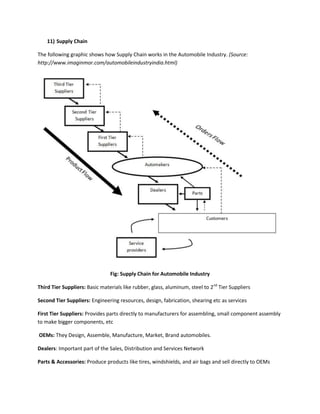
11) Supply Chain

The following graphic shows how Supply Chain works in the Automobile Industry. (Source:
http://www.imaginmor.com/automobileindustryindia.html)


                                Fig: Supply Chain for Automobile Industry

Third Tier Suppliers: Basic materials like rubber, glass, aluminum, steel to 2nd Tier Suppliers

Second Tier Suppliers: Engineering resources, design, fabrication, shearing etc as services

First Tier Suppliers: Provides parts directly to manufacturers for assembling, small component assembly
to make bigger components, etc

OEMs: They Design, Assemble, Manufacture, Market, Brand automobiles.

Dealers: Important part of the Sales, Distribution and Services Network

Parts & Accessories: Produce products like tires, windshields, and air bags and sell directly to OEMs
Service Providers: Servicing, Repairs, Financing, etc are provided by these players.


Note: Challenges in the Supply Chain of Automobile Sector in India (Source: KPMG)

        Integrating the end-to-end supply chain : Perceived as the biggest challenge in the coming years
        Managing Inbound Logistics/JIT Supplies
        Managing supply chain costs
        Managing Product/Parts Proliferation


    12) Key Bodies

    The Indian Automobile Industry has been able to scale such levels thanks to a well-organized
    structure and various bodies that ensure healthy competition and sustainability. Some of the
    important bodies that help reorient Indian Automobile Industry are:

            ACMA : Automotive Component Manufacturers Association of India
            SIAM : Society of Indian Automobile Manufacturers
            ARAI : Automotive Research Association of India
            SAFE : Society for Automotive Fitness & Environment

    13) Major Events:

Key Indian automobile players meet regularly to share ideas, vision and to exhibit the R&D, concepts,
new launches, etc. Some of the major events that facilitate these are:

        Indian Auto Expo : Largest Indian Auto show packed with new launches and concept cars
        India Automotive Summit
        SIAM Annual Convention

    14) Future Prospects & Forecasts

Except a few hiccups and little corrections, the growth in the Indian Automotive sector has been seeing
the green for the past 5 years. The rising incomes and the growth of the service sector will continue to
ensure this growth in the passenger vehicles segment. More fuel efficient and hybrid cars will be
demanded and made thanks to the new emission rules that are set to be applied on the lines of the
European standards.

In the 2 wheeler market, the growth prospects will depend if companies like Hero will be able to forge
newer partnerships like its previous partner Honda. A the same time, the 3-wheeler and light
commercial vehicle market is set to grow on the cue of improved last-mile delivery needs.
With the success of new entrants like Asia Motor Works (AMW) and with Mercedes’ India growth
targets for 2020, the commercial vehicles sector is going to expand widely; especially on the demand by
the Supply Chain restructuring thanks to the new prospects brought in by Retail FDI deregulation.

Forecasts:

Forecast for Financial Year 2013-14 (source: SIAM Report)

             Segment                              F13 Growth (Jan 13 Est.)
             Cars                                 0-1%
             UVs                                  56-64%
             Vans                                 3-6%
             PV TOTAL                             7-10%
             LCV                                  15-18%
             MHCV                                 21-23%
             Passenger Buses                      0-2%
             Total                                0-2%
             2W                                   3-5%
             3W Goods                             9-12%
             3W Passenger                         8-11%
             3W Total                             4-7%
             Auto Total                           3-5%


   15) References


       CMIE: http://www.cmie.com
       SIAM: http://siamindia.com
       Maps of India: http://www.mapsofindia.com
       INFLIBNET: http://www.inflibnet.ac.in
       Excerpts from assorted KPMG Reports
       Excerpts from assorted DIBD - OMI Reports
       Excerpts from assorted ACMA Reports

India automobile sector_report_feb_2013

  • 1.
    2013 Sector Report: Indian Automobile Industry Where is the Growth Going! Gaurav Dadhich, Bejoy Bernanrd, DVN Sukesh, Devesh Kushwaha Department of Management Studies, IIT Roorkee 2/4/2013
  • 2.
    1) Introduction: Automotive industryin India is emerging as a 'sunrise sector' in the Indian economy and is now working in terms of dynamics of an open market. Many joint ventures have been initiated in India in both technical as well as financial aspects and the pace at which these activities are going to be increased in the near future is high. The Government of India is also helping these initiatives to be successful. India is also one of the world's fastest growing passenger car markets and second largest two wheeler manufacturer. It is also the largest motor cycle manufacturer and stands fifth as commercial vehicle manufacturer. According to the Department of Industrial Policy and Promotion (DIPP), Ministry of Commerce, the amount of FDI inflow into the automobile industry during 2000 and 2012 was worth US$ 6,992 million, which is almost 4 per cent of the total FDI inflows. In a report titled, 'Strategic Assessment of Small and Light Commercial Vehicles Market in India' by Frost & Sullivan, it is mentioned that the Indian small and light commercial vehicle segment is expected to grow at 18.5% compound annual growth rate (CAGR) in the next five years. Automobile Industry in India is now making an annual turnover of $59 Million US dollars and also it is providing employment to almost 13 million people in the Indian work class. This industry is considering as one of the most competitive industries because the manufacturers in India have to face challenges such as increasing fuel efficiency and reducing emissions apart from innovating. 2) Evolution of Indian Automotive Sector Indian automobile sector can be traced back to the British Raj days, when automobiles were for a rich and wealthy few. Almost all of these vehicles were imported. To study the evolution of the industry in India, let us have a look at the pre-liberalization and post-liberalization times together. a) Pre-Liberalization (data source : http://shodhganga.inflibnet.ac.in/bitstream/10603/3722/13/13_chapter%204.pdf)
  • 3.
    1955-1970 : Moped 1898 : First Car Brought production begins. 1965 : Bajaj begins to India Other 2 wheelers came manufacturing Tempo in Govt. notifies to 1928 : Trucks and Cars terminate assemblers in 1972 : Kinetic Assembled In India by 3 years. Only Engineering gets license Hindustan Motors manufacturers permitted then on 1980's : New Foreign 1947 : Bajaj recieves 1931 : Auto Assembly by Collaborations and Auto-Rickshaw license Ford India beginning of from GoI and Piaggio deregulation 1983 : Maruti Udyog 1935 : Proposal to 1944 : PAL was setup. M&M launch Automobile manufactured first car in started manufacturing Industry disallowed India Jeeps b) Post-Liberalization (data source : http://shodhganga.inflibnet.ac.in/bitstream/10603/3722/13/13_chapter%204.pdf) 1991 : Mass Emission Norms introduced for Petrol 1997 : National Highway Policy Introduced 1992 : Mass Emission Norms introduced 1997 : Many multinationals like for Diesel Daewoo, GM, Mercedes- Benz, Honda, Hyundai, Toyota, Mitsubishi, Suzuki, Volvo, Ford & Fiat entered the market.
  • 4.
    3) Segmentation India isfast developing nation with a middle-class that is ever-growing. The resultant growth in industry and services and also the rising per-capita incomes have ensured a deep penetration of automobiles in the lives of people and businesses alike. In order to guage the magnitude of this growth, we can segment the sector into Commercial, Passenger and 2-3 Wheeler vehicles. Let us have a quick look at how they are performing. a. Commercial Vehicles Some of the commercial vehicles are Light commercial vehicles – Goods carrier, Multi Utility Vehicles, Sports Utility and mini vans, Heavy commercial vehicles – Trucks, Tempo, Tractor and Tipper / Dumper. The market share of the various companies in the commercial vehicles segment is illustrated below. Fig: Percentage Market Share of Commercial Vehicles b. Passenger Vehicles The market share of the various companies in the passenger car segment is illustrated below.
  • 5.
    Fig: Percentage MarketShare of Passenger Vehicles c. 2-3 Wheeler Vehicles This includes vehicles such as Scooters, Motorcycles and Mopeds. Two wheelers form the major segment of Indian Industry with almost 75 percent market share with all other segments far behind. Motor bikes in India were introduced in the year 1955. Initially bikes are introduced for defence and police services but today the scenario is completely different. The entry of Japanese bike majors such as Honda and Suzuki has completely changed the Indian two wheeler market. They introduced bikes with fuel efficient engines and also with advanced features. Indian two wheeler markets consist of various segments such as entry level bikes, medium level bikes, super bikes, scooters and recently electric bikes were added to the list. At present, some of the major bike manufacturers across the world started their business in India and introduced bikes starting from 100cc to 1200cc. The market share of the various companies in the 2-3 wheeler vehicles segment is illustrated below.
  • 6.
    Fig: Percentage MarketShare of Two Wheeler Fig: Percentage Market Share of Three Wheelers
  • 7.
    4) Key Players Whilestudying the key players in the Indian Auto Sector, we shall concentrate mainly upon the passenger car and 2-3 wheeler vehicles segment since they are the fastest growing segment and with the largest impact on the economy. Key Indian players: Tata motors. Mahindra & Mahindra Ashok Leyland. Maruti Udyog Ltd. Bajaj Auto. Company name Products Manufacturing Total group manufactured locations turnover in USD $ TATA MOTORS Cars, commercial Pune, Jamshedpur, 27.6 billion vehicles. Ahmedabad Mahindra & Commercial Nashik, 7.4 billion Mahindra vehicles Zahidarabad, Chennai Ashok Leyland Commercial Hosur, Pantnagar, 2.5 billion vehicles Alwar, Bhandara, Chennai Maruthi Udyog Cars Gurgaon 7.5 billion Ltd. Bajaj auto Motorcycles Pune, Pantnagar, 3.39 billion Aurangabad Tata Motors: Tata Motors is India’s largest automobile company. It ranks among the top 3 in passenger vehicles in India. It has around 64% market share in commercial vehicles market and 16% market share in passenger vehicles market. Tata Motors also operates in United Kingdom, South Korea, Thailand and spain. It acquired the jaguar land rover in 2008. It has to its credit the development of the first indigenously developed light commercial vehicle, India’s first sports utility vehicle and the first indigenously developed light commercial vehicle. In January 2008 it unveiled the much awaited people’s car The Tata Nano. The standard version’s price was INR 1,00,000. Mahindra & Mahindra: Mahindra and Mahindra concentrate its production mainly in multi utility vehicles and 3 wheeler segments. It has two joint venture subsidiaries Mahindra Navistar automotives ltd. And Mahindra Renault in commercial vehicle and passenger car segments respectively. It has a market share of around 10 % in commercial vehicles and 7% in passenger vehicles. Mahindra and Mahindra is expanding into overseas market. It launches XYLO in South Africa in 2009. Ashok Leyland: It has a market share of around 16% in the commercial vehicles market. Ashok Leyland was formed in 1955 and is an wholly owned subsidiary of the Hinduja group. It
  • 8.
    manufactures trucks, busesand diesel engines. It produces special utility vehicles such as fire fighters and modern army vehicles. Maruthi Udyog ltd: It has a market share of around 46% in passenger vehicles market. Maruthi Udyog ltd. Is India’s largest passenger car company and holds almost half of the passenger car market. Its range of cars include the entry level maruth-800 and Alto, hatchback Ritz, A-STAR, SWIFT,WAGON-R etc. and sedans Dzire, sx4 etc. Bajaj Auto: It has a market share of around 27% in two wheeler and 59% in 3 wheeler segments. It operates in several countries in Latin America, Africa, middle east, south and south east Asia. Bajaj auto is India’s largest exporter of 2 and 3 wheelers and is ranked 4th in the world. Key International Companies in the Indian Automotive Sector: Skoda Auto Toyota BMW Company products manufacturing Total group Turnover in Name Manufactured Location Turnover in India in USD $ USD $ Skoda auto Cars Pune 13.5 billion 767million Toyota Cars Gurgaon 192 billion Na BMW Cars Mumbai,Pune 69 billion Na Skoda Auto: Skoda started its operations in India from 2001 under SkodaAuto. It has a state of the art facility in Aurangabad. It has 4 models in India Skoda Superb, Skoda Octavia, Skoda Fabia, Skoda Laura. It has had a growth of 89% in June 2012. Toyota: It is one of the world’s top automobile manufacturers. Toyota has sold 9.75 million vehicles worldwide last year. Since its inception Toyota has been having a steady growth in India Toyota Kirloskar is a joint venture between Toyota Motor Corporation and the Kirloskar group. BMW: BMW is a German automobile company founded in 1917. It has 11 models available in India. The BMW group has invested more than 180 Cr. In India, BMW has production plants in Chennai. 5) Market Scenario of Automobile Sector in India during 2011-12
  • 9.
    Commercial Passenger Vehicles Vehicles 4.66% 15.07% Three Wheelers 2.95% Two Wheelers 77.32% Fig: Domestic Market Share for 2011-12 18000000 16000000 14000000 12000000 10000000 Passenger Vehicles Commercial Vehicles 8000000 Three Wheelers 6000000 Two Wheelers 4000000 2000000 0 2005-062006-072007-082008-092009-10 2010-112011-12 Fig: Automobile Production Trends
  • 10.
    16000000 14000000 12000000 10000000 Passenger Vehicles 8000000 Commercial Vehicles Three Wheelers 6000000 Two Wheelers 4000000 2000000 0 2005-062006-07 2007-082008-092009-10 2010-112011-12 Fig: Automobile Domestic Sales Trends 2500000 2000000 1500000 Passenger Vehicles Commercial Vehicles 1000000 Three Wheelers Two Wheelers 500000 0 2005-06 2006-07 2007-08 2008-09 2009-10 2010-11 2011-12 Fig: Automobile Exports Trends
  • 11.
    6) Auto FinanceIndustry Auto finance for passenger and commercial vehicles in India has been an industry of solid and continuous growth for the past 5 year (at roughly 16%) which is more than twice the rate of GDP growth. Auto Finance penetration in the passenger cars section was whooping 72% in Dec, 2011 and has been increasing since then. This rapid growth has been a significant driver of auto sales in India. Both Banks and NBFCs have tapped the Auto Finance market and some of the players involved are SBI, ICICI, HDFC, Bajaj Auto Finance, Kotak Mahindra Prime Ltd, Sundaram Auto Finance, etc. 7) Few Important Facts and Statistics: Automobile sector’s contribution to Indian GDP is approximately : 7% Direct and Indirect Employment provided by the Auto Sector : 17 million 4% of the total Foreign Direct Investment that reaches India is for the Automobile Sector 22% of India’s Manufacturing GDP comes from the Automobile Sector 8) Policies and regulation of Automobile Industry in India The automobile industry was heavily regulated back in till the 1970’s. The government relaxed some regulations during the 1980’s that encouraged foreign firms to participate in the Indian market. The automobile industry was liberalized in the 1990’s. India’s automobile and the auto-component industries is one of its biggest industries. Phase Period Major policies 1 1947-1965 Related to protection, indigenisation and regulation of industry 2 1966-1979 Related to protection, indigenisation and regulation of industry 3 1980-1990 Relaxation on technology acquisition 4 1991 onwards Liberalizing foreign investment. Industry policy regulation (IPR) was passed in the year 1948. India’s automotive industry was recognized under the category ‘ basic industries of importance’ whose” location must be governed by economic factors of all-India importance, or which require a considerable investment of a high degree of technical skill” were subject to regulation from the central government. The state played a controllers role. State had the authority to prevent unfair foreign competition. Import of vehicles very virtually banned because of high tariffs.
  • 12.
    The industries (developmentand regulation) act(IDRA) was drafted in 1951.according to the act “an industrial license was required for a unit with 50 or more workers (100 or more without power) in order to establish a new unit, expand output by more than 5% annually, change location, manufacture a new product, and to conduct business if a change was introduced in policies” starting from 1975 the government introduced minor relaxations to the licensing requirements following which in 1978 the government relaxed control on foreign equity collaborations. The industrial policy statement presented in july 1980 encouraged limited liberalization and foreign collaborations. Poor performance of the public sector undertakings led to the phase of liberalization and globalization starting from 1991. India’s declining foreign reserves was also a reason for this shift. 9) Why is India witnessing such growth in Automobile Sector? India has a good market for automobiles because of several factors. Some of them are: Rapid Urbanization: Currently just 21 percent of population is present in urban areas. So by 2020 and 2030 it is expected to grow to 35 percent and 40 percent respectively. Rising per capita GDP: The per capita of India in the year 2011 was $1200 USD and now it has become to $1330 USD in 2012. It is expected to touch $2000 USD by 2015. So, this increase in the per capita GDP signifies the purchasing power and hence the demand for automobiles increases in the successive years. Overall growth of other Industries: Industries are usually independent of each other but as the transportation is the basic need of every industry, demand for automobiles will rise with every positive change in industry. Car buyers getting younger: India is one of the youngest countries in the world with media age to be around 26 years, it resembles that work force mainly constitute the young individuals and hence the car buying age has become on a decline. Growing middle class: With the middle class of India growing annually, benefits of this sector are still untapped. It is the transition from the lower class to middle class which converts car into a need from luxury. 10) Manufacturing Hubs Ever since 1944, when PAL manufactured the first Indian Car, automobile manufacturing and assembling, along with the manufacturing of automobile parts has been on the rise. Today, India is one of the largest exporters of Automobiles and Automotive parts in the world. This has been due to solid infrastructure provided by the national and state governments, as well as policy gifts such as tax-breaks, the advent of the SEZs, etc. India now has major automobile manufacturing facilities all over the country, with Chennai springing as a hub. Chennai is poised to live up to its name of the Detroit of India due to its attraction to almost all major auto manufacturing companies of the world. Some of the hubs of Indian Manufacturing can be seen as: (source: MapOfIndia.com)
  • 13.
    Fig: Map ofIndian Automobile Manufacturing Units
  • 14.
    11) Supply Chain Thefollowing graphic shows how Supply Chain works in the Automobile Industry. (Source: http://www.imaginmor.com/automobileindustryindia.html) Fig: Supply Chain for Automobile Industry Third Tier Suppliers: Basic materials like rubber, glass, aluminum, steel to 2nd Tier Suppliers Second Tier Suppliers: Engineering resources, design, fabrication, shearing etc as services First Tier Suppliers: Provides parts directly to manufacturers for assembling, small component assembly to make bigger components, etc OEMs: They Design, Assemble, Manufacture, Market, Brand automobiles. Dealers: Important part of the Sales, Distribution and Services Network Parts & Accessories: Produce products like tires, windshields, and air bags and sell directly to OEMs
  • 15.
    Service Providers: Servicing,Repairs, Financing, etc are provided by these players. Note: Challenges in the Supply Chain of Automobile Sector in India (Source: KPMG) Integrating the end-to-end supply chain : Perceived as the biggest challenge in the coming years Managing Inbound Logistics/JIT Supplies Managing supply chain costs Managing Product/Parts Proliferation 12) Key Bodies The Indian Automobile Industry has been able to scale such levels thanks to a well-organized structure and various bodies that ensure healthy competition and sustainability. Some of the important bodies that help reorient Indian Automobile Industry are: ACMA : Automotive Component Manufacturers Association of India SIAM : Society of Indian Automobile Manufacturers ARAI : Automotive Research Association of India SAFE : Society for Automotive Fitness & Environment 13) Major Events: Key Indian automobile players meet regularly to share ideas, vision and to exhibit the R&D, concepts, new launches, etc. Some of the major events that facilitate these are: Indian Auto Expo : Largest Indian Auto show packed with new launches and concept cars India Automotive Summit SIAM Annual Convention 14) Future Prospects & Forecasts Except a few hiccups and little corrections, the growth in the Indian Automotive sector has been seeing the green for the past 5 years. The rising incomes and the growth of the service sector will continue to ensure this growth in the passenger vehicles segment. More fuel efficient and hybrid cars will be demanded and made thanks to the new emission rules that are set to be applied on the lines of the European standards. In the 2 wheeler market, the growth prospects will depend if companies like Hero will be able to forge newer partnerships like its previous partner Honda. A the same time, the 3-wheeler and light commercial vehicle market is set to grow on the cue of improved last-mile delivery needs.
  • 16.
    With the successof new entrants like Asia Motor Works (AMW) and with Mercedes’ India growth targets for 2020, the commercial vehicles sector is going to expand widely; especially on the demand by the Supply Chain restructuring thanks to the new prospects brought in by Retail FDI deregulation. Forecasts: Forecast for Financial Year 2013-14 (source: SIAM Report) Segment F13 Growth (Jan 13 Est.) Cars 0-1% UVs 56-64% Vans 3-6% PV TOTAL 7-10% LCV 15-18% MHCV 21-23% Passenger Buses 0-2% Total 0-2% 2W 3-5% 3W Goods 9-12% 3W Passenger 8-11% 3W Total 4-7% Auto Total 3-5% 15) References CMIE: http://www.cmie.com SIAM: http://siamindia.com Maps of India: http://www.mapsofindia.com INFLIBNET: http://www.inflibnet.ac.in Excerpts from assorted KPMG Reports Excerpts from assorted DIBD - OMI Reports Excerpts from assorted ACMA Reports