© 2013, Axiomatics AB
Authorization
The Missing Piece of the Puzzle
@srijith
@axiomatics
Srijith Nair
Director, Developer Relations
© 2013, Axiomatics AB
Show of Hands:
Authorization?
XACML?
© 2013, Axiomatics AB
Identity is key
Services need to know who you are
You need to prove who you are
Several protocols exist to support Authentication
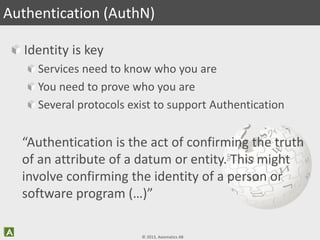
Authentication (AuthN)
“Authentication is the act of confirming the truth
of an attribute of a datum or entity. This might
involve confirming the identity of a person or
software program (…)”
© 2013, Axiomatics AB
Identity is key, but it is not everything
Authentication proves your identity
It does not decide what that identity entails
Enter Authorization
Authorization (AuthZ)
“The authorization function determines whether a
particular entity is authorized to perform a given
activity, typically inherited from authentication
when logging on to an application or service.”
© 2013, Axiomatics AB
Some frameworks, stds. confuse both phases
Often AuthN ≡ AuthZ
If you have authenticated then you are in…
AuthZ is part of a bigger process
Identify
Authenticate
Authorize
Think of the access to your APIs…
AuthN vs. AuthZ
© 2013, Axiomatics AB
Business-driven authorization
Let “Gold” customers access APIs 1,2 but not 3
Let “Platinum” customers access all APIs
Compliance-driven authorization
Do not let traders approve transactions they
requested
Privacy-driven authorization
Do not disclose medical data to non-employee users
AuthZ addresses various concerns
© 2013, Axiomatics AB
Mandatory Access Control (MAC)
Discretionary Access Control (DAC)
Role-Based Access Control (RBAC)
It’s widely adopted
It’s well understood and industry-standard
It’s simple
Most apps support some form of RBAC
Authorization Approaches
© 2013, Axiomatics AB
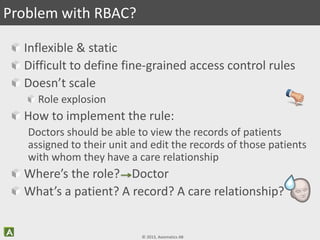
Inflexible & static
Difficult to define fine-grained access control rules
Doesn’t scale
Role explosion
How to implement the rule:
Doctors should be able to view the records of patients
assigned to their unit and edit the records of those patients
with whom they have a care relationship
Where’s the role? Doctor
What’s a patient? A record? A care relationship?
Problem with RBAC?
© 2013, Axiomatics AB
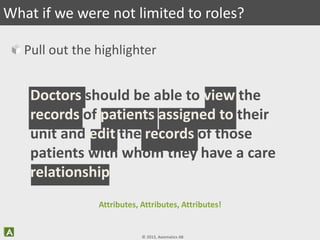
Pull out the highlighter
What if we were not limited to roles?
Doctors should be able to view the
records of patients assigned to their
unit and edit the records of those
patients with whom they have a care
relationship
Attributes, Attributes, Attributes!
© 2013, Axiomatics AB
Attribute-Based Access Control (ABAC)
uses attributes as building blocks
in a structured language used to define access control
rules and
to describe access requests
Attributes
Are sets of labels or properties
Describe all aspects of entities that must be considered
for authorization purposes
Each attribute consists of a key-value pair such as
“Class=Gold”, “OS=Windows”
Attribute-based access control
© 2013, Axiomatics AB
ABAC – beyond RBAC
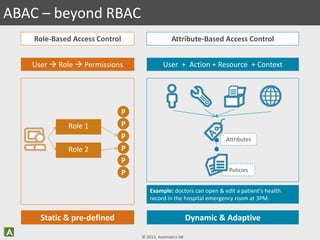
Role-Based Access Control Attribute-Based Access Control
User  Role  Permissions User + Action + Resource + Context
Attributes
Policies
Example: doctors can open & edit a patient’s health
record in the hospital emergency room at 3PM.
Static & pre-defined Dynamic & Adaptive
Role 1
Role 2
P
P
P
P
P
P
© 2013, Axiomatics AB
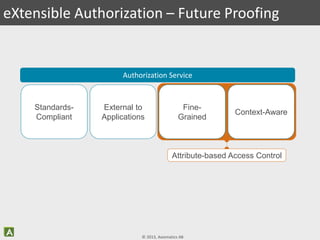
eXtensible Authorization – Future Proofing
External to
Applications
Standards-
Compliant
Authorization Service
Fine-
Grained
Context-Aware
Attribute-based Access Control
© 2013, Axiomatics AB
Enter XACML
© 2013, Axiomatics AB
Pronunciation
eXtensible Access Control Markup Language
OASIS standard
V 3.0 approved in January 2013
V 1.0 approved in 2003 (10 years ago!)
XACML is expressed as
A specification document and
An XML schema
REST profile for XACML exists (CSD)
http://www.oasis-open.org/committees/xacml/
14
What is XACML?
© 2013, Axiomatics AB
15
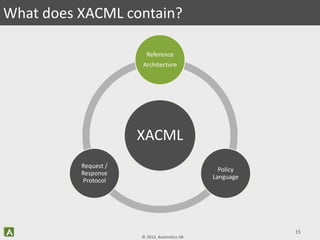
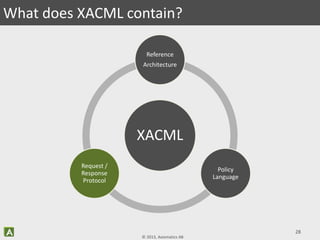
What does XACML contain?
XACML
Reference
Architecture
Policy
Language
Request /
Response
Protocol
© 2013, Axiomatics AB
16
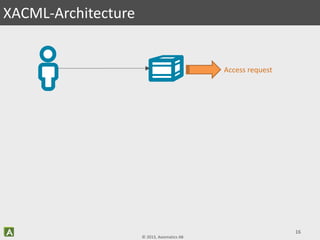
XACML-Architecture
Access request
© 2013, Axiomatics AB
17
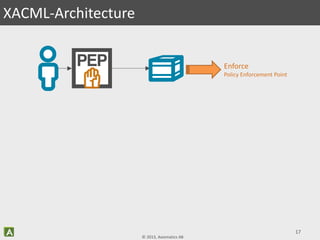
XACML-Architecture
Enforce
Policy Enforcement Point
© 2013, Axiomatics AB
18
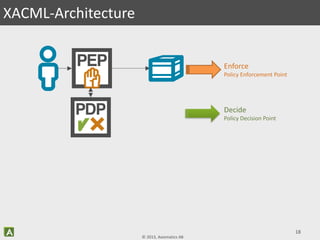
XACML-Architecture
Enforce
Policy Enforcement Point
Decide
Policy Decision Point
© 2013, Axiomatics AB
19
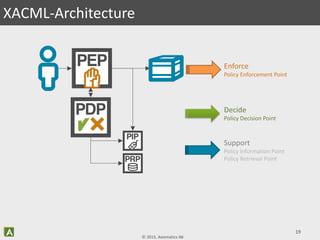
XACML-Architecture
Enforce
Policy Enforcement Point
Decide
Policy Decision Point
Support
Policy Information Point
Policy Retrieval Point
© 2013, Axiomatics AB
20
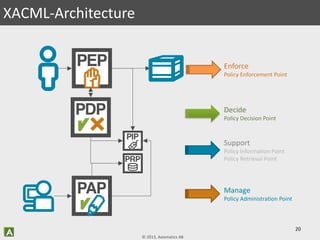
XACML-Architecture
Enforce
Policy Enforcement Point
Decide
Policy Decision Point
Manage
Policy Administration Point
Support
Policy Information Point
Policy Retrieval Point
© 2013, Axiomatics AB
21
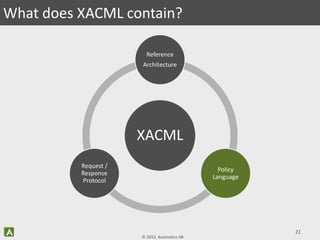
What does XACML contain?
XACML
Reference
Architecture
Policy
Language
Request /
Response
Protocol
© 2013, Axiomatics AB
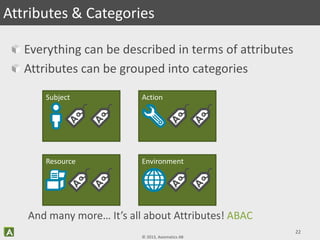
Everything can be described in terms of attributes
Attributes can be grouped into categories
And many more… It’s all about Attributes! ABAC
22
Attributes & Categories
Environment
Subject Action
Resource
© 2013, Axiomatics AB
23
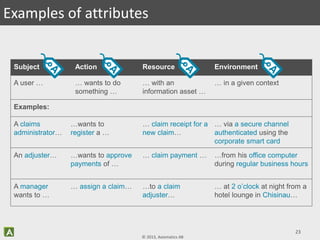
Examples of attributes
Subject Action Resource Environment
A user … … wants to do
something …
… with an
information asset …
… in a given context
Examples:
A claims
administrator…
…wants to
register a …
… claim receipt for a
new claim…
… via a secure channel
authenticated using the
corporate smart card
An adjuster… …wants to approve
payments of …
… claim payment … …from his office computer
during regular business hours
A manager
wants to …
… assign a claim… …to a claim
adjuster…
… at 2 o’clock at night from a
hotel lounge in Chisinau…
© 2013, Axiomatics AB
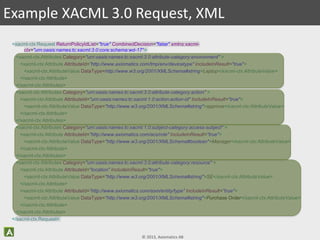
<xacml-ctx:Request ReturnPolicyIdList="true" CombinedDecision="false" xmlns:xacml-
ctx="urn:oasis:names:tc:xacml:3.0:core:schema:wd-17">
<xacml-ctx:Attributes Category="urn:oasis:names:tc:xacml:3.0:attribute-category:environment" >
<xacml-ctx:Attribute AttributeId=”http://www.axiomatics.com/tmp/env/devicetype" IncludeInResult="true">
<xacml-ctx:AttributeValue DataType=http://www.w3.org/2001/XMLSchema#string>Laptop</xacml-ctx:AttributeValue>
</xacml-ctx:Attribute>
</xacml-ctx:Attributes>
<xacml-ctx:Attributes Category="urn:oasis:names:tc:xacml:3.0:attribute-category:action" >
<xacml-ctx:Attribute AttributeId="urn:oasis:names:tc:xacml:1.0:action:action-id" IncludeInResult="true">
<xacml-ctx:AttributeValue DataType="http://www.w3.org/2001/XMLSchema#string">approve</xacml-ctx:AttributeValue>
</xacml-ctx:Attribute>
</xacml-ctx:Attributes>
<xacml-ctx:Attributes Category="urn:oasis:names:tc:xacml:1.0:subject-category:access-subject" >
<xacml-ctx:Attribute AttributeId=”http://www.axiomatics.com/acs/role" IncludeInResult="true">
<xacml-ctx:AttributeValue DataType="http://www.w3.org/2001/XMLSchema#boolean">Manager</xacml-ctx:AttributeValue>
</xacml-ctx:Attribute>
</xacml-ctx:Attributes>
<xacml-ctx:Attributes Category="urn:oasis:names:tc:xacml:3.0:attribute-category:resource" >
<xacml-ctx:Attribute AttributeId="location" IncludeInResult="true">
<xacml-ctx:AttributeValue DataType="http://www.w3.org/2001/XMLSchema#string">SE</xacml-ctx:AttributeValue>
</xacml-ctx:Attribute>
<xacml-ctx:Attribute AttributeId=”http://www.axiomatics.com/asm/entity/type" IncludeInResult="true">
<xacml-ctx:AttributeValue DataType="http://www.w3.org/2001/XMLSchema#string">Purchase Order</xacml-ctx:AttributeValue>
</xacml-ctx:Attribute>
</xacml-ctx:Attributes>
</xacml-ctx:Request>
Example XACML 3.0 Request, XML
© 2013, Axiomatics AB
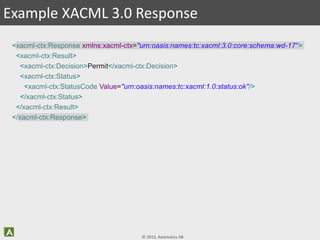
<xacml-ctx:Response xmlns:xacml-ctx="urn:oasis:names:tc:xacml:3.0:core:schema:wd-17">
<xacml-ctx:Result>
<xacml-ctx:Decision>Permit</xacml-ctx:Decision>
<xacml-ctx:Status>
<xacml-ctx:StatusCode Value="urn:oasis:names:tc:xacml:1.0:status:ok"/>
</xacml-ctx:Status>
</xacml-ctx:Result>
</xacml-ctx:Response>
Example XACML 3.0 Response
© 2013, Axiomatics AB
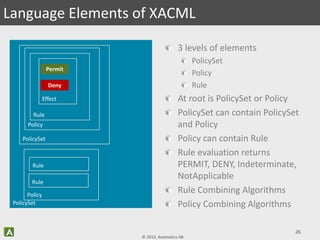
3 levels of elements
PolicySet
Policy
Rule
At root is PolicySet or Policy
PolicySet can contain PolicySet
and Policy
Policy can contain Rule
Rule evaluation returns
PERMIT, DENY, Indeterminate,
NotApplicable
Rule Combining Algorithms
Policy Combining Algorithms
26
Language Elements of XACML
PolicySet
PolicySet
Policy
Rule
Effect
Permit
Deny
Policy
Rule
Rule
© 2013, Axiomatics AB
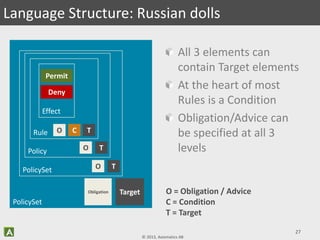
All 3 elements can
contain Target elements
At the heart of most
Rules is a Condition
Obligation/Advice can
be specified at all 3
levels
27
Language Structure: Russian dolls
PolicySet
PolicySet
Policy
Rule
Effect
Target
T
T
TC
Permit
Deny
O
Obligation
O
O
O = Obligation / Advice
C = Condition
T = Target
© 2013, Axiomatics AB
28
What does XACML contain?
XACML
Reference
Architecture
Policy
Language
Request /
Response
Protocol
© 2013, Axiomatics AB
Environment
Subject Action
Resource Environment
Action
Resource
Subject
29
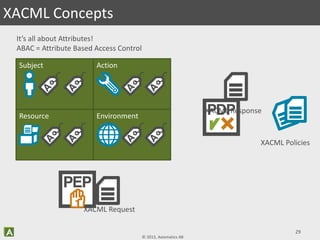
XACML Concepts
It’s all about Attributes!
ABAC = Attribute Based Access Control
XACML Policies
XACML Request
XACML Response
© 2013, Axiomatics AB
• Subject
User id = Alice
Role = Manager
• Action
Action id = approve
• Resource
Resource type = Purchase Order
PO #= 12367
• Environment
Device Type = Laptop
30
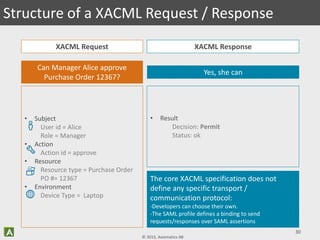
Structure of a XACML Request / Response
XACML Request XACML Response
Can Manager Alice approve
Purchase Order 12367?
Yes, she can
• Result
Decision: Permit
Status: ok
The core XACML specification does not
define any specific transport /
communication protocol:
-Developers can choose their own.
-The SAML profile defines a binding to send
requests/responses over SAML assertions
© 2013, Axiomatics AB
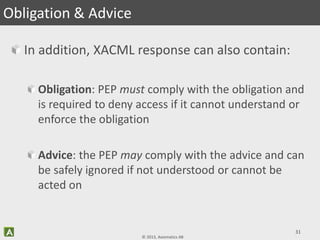
In addition, XACML response can also contain:
Obligation: PEP must comply with the obligation and
is required to deny access if it cannot understand or
enforce the obligation
Advice: the PEP may comply with the advice and can
be safely ignored if not understood or cannot be
acted on
31
Obligation & Advice
© 2013, Axiomatics AB
AuthN is not enough. AuthZ is needed.
RBAC is often not enough. ABAC is needed.
XACML is a prominent ABAC system.
XACML consists of:
Reference Architecture
Policy Language
Request Response Protocol
Summary
© 2013, Axiomatics AB
Axiomatics is world’s leading independent provider
of dynamic AuthZ solutions
Our products enable efficient XACML-based
authorization
APIs, SDKs for system integration
Java and .NET support
APS Developer Edition provides you with all the power
of our product in a read-to-use package
http://axiomatics.com/aps-developer-edition.html
Summary (Axiomatics)
© 2013, Axiomatics AB
http://developers.axiomatics.com
http://www.technicalprivacytraining.org/
https://www.oasis-open.org/committees/xacml/
http://docs.oasis-open.org/xacml/xacml-
rest/v1.0/xacml-rest-v1.0.pdf
http://www.webfarmr.eu/
http://analyzingidentity.com/
More Information
© 2013, Axiomatics AB
Questions?
Contact us at
info@axiomatics.com

Authorization The Missing Piece of the Puzzle

  • 1.
    © 2013, AxiomaticsAB Authorization The Missing Piece of the Puzzle @srijith @axiomatics Srijith Nair Director, Developer Relations
  • 2.
    © 2013, AxiomaticsAB Show of Hands: Authorization? XACML?
  • 3.
    © 2013, AxiomaticsAB Identity is key Services need to know who you are You need to prove who you are Several protocols exist to support Authentication Authentication (AuthN) “Authentication is the act of confirming the truth of an attribute of a datum or entity. This might involve confirming the identity of a person or software program (…)”
  • 4.
    © 2013, AxiomaticsAB Identity is key, but it is not everything Authentication proves your identity It does not decide what that identity entails Enter Authorization Authorization (AuthZ) “The authorization function determines whether a particular entity is authorized to perform a given activity, typically inherited from authentication when logging on to an application or service.”
  • 5.
    © 2013, AxiomaticsAB Some frameworks, stds. confuse both phases Often AuthN ≡ AuthZ If you have authenticated then you are in… AuthZ is part of a bigger process Identify Authenticate Authorize Think of the access to your APIs… AuthN vs. AuthZ
  • 6.
    © 2013, AxiomaticsAB Business-driven authorization Let “Gold” customers access APIs 1,2 but not 3 Let “Platinum” customers access all APIs Compliance-driven authorization Do not let traders approve transactions they requested Privacy-driven authorization Do not disclose medical data to non-employee users AuthZ addresses various concerns
  • 7.
    © 2013, AxiomaticsAB Mandatory Access Control (MAC) Discretionary Access Control (DAC) Role-Based Access Control (RBAC) It’s widely adopted It’s well understood and industry-standard It’s simple Most apps support some form of RBAC Authorization Approaches
  • 8.
    © 2013, AxiomaticsAB Inflexible & static Difficult to define fine-grained access control rules Doesn’t scale Role explosion How to implement the rule: Doctors should be able to view the records of patients assigned to their unit and edit the records of those patients with whom they have a care relationship Where’s the role? Doctor What’s a patient? A record? A care relationship? Problem with RBAC?
  • 9.
    © 2013, AxiomaticsAB Pull out the highlighter What if we were not limited to roles? Doctors should be able to view the records of patients assigned to their unit and edit the records of those patients with whom they have a care relationship Attributes, Attributes, Attributes!
  • 10.
    © 2013, AxiomaticsAB Attribute-Based Access Control (ABAC) uses attributes as building blocks in a structured language used to define access control rules and to describe access requests Attributes Are sets of labels or properties Describe all aspects of entities that must be considered for authorization purposes Each attribute consists of a key-value pair such as “Class=Gold”, “OS=Windows” Attribute-based access control
  • 11.
    © 2013, AxiomaticsAB ABAC – beyond RBAC Role-Based Access Control Attribute-Based Access Control User  Role  Permissions User + Action + Resource + Context Attributes Policies Example: doctors can open & edit a patient’s health record in the hospital emergency room at 3PM. Static & pre-defined Dynamic & Adaptive Role 1 Role 2 P P P P P P
  • 12.
    © 2013, AxiomaticsAB eXtensible Authorization – Future Proofing External to Applications Standards- Compliant Authorization Service Fine- Grained Context-Aware Attribute-based Access Control
  • 13.
    © 2013, AxiomaticsAB Enter XACML
  • 14.
    © 2013, AxiomaticsAB Pronunciation eXtensible Access Control Markup Language OASIS standard V 3.0 approved in January 2013 V 1.0 approved in 2003 (10 years ago!) XACML is expressed as A specification document and An XML schema REST profile for XACML exists (CSD) http://www.oasis-open.org/committees/xacml/ 14 What is XACML?
  • 15.
    © 2013, AxiomaticsAB 15 What does XACML contain? XACML Reference Architecture Policy Language Request / Response Protocol
  • 16.
    © 2013, AxiomaticsAB 16 XACML-Architecture Access request
  • 17.
    © 2013, AxiomaticsAB 17 XACML-Architecture Enforce Policy Enforcement Point
  • 18.
    © 2013, AxiomaticsAB 18 XACML-Architecture Enforce Policy Enforcement Point Decide Policy Decision Point
  • 19.
    © 2013, AxiomaticsAB 19 XACML-Architecture Enforce Policy Enforcement Point Decide Policy Decision Point Support Policy Information Point Policy Retrieval Point
  • 20.
    © 2013, AxiomaticsAB 20 XACML-Architecture Enforce Policy Enforcement Point Decide Policy Decision Point Manage Policy Administration Point Support Policy Information Point Policy Retrieval Point
  • 21.
    © 2013, AxiomaticsAB 21 What does XACML contain? XACML Reference Architecture Policy Language Request / Response Protocol
  • 22.
    © 2013, AxiomaticsAB Everything can be described in terms of attributes Attributes can be grouped into categories And many more… It’s all about Attributes! ABAC 22 Attributes & Categories Environment Subject Action Resource
  • 23.
    © 2013, AxiomaticsAB 23 Examples of attributes Subject Action Resource Environment A user … … wants to do something … … with an information asset … … in a given context Examples: A claims administrator… …wants to register a … … claim receipt for a new claim… … via a secure channel authenticated using the corporate smart card An adjuster… …wants to approve payments of … … claim payment … …from his office computer during regular business hours A manager wants to … … assign a claim… …to a claim adjuster… … at 2 o’clock at night from a hotel lounge in Chisinau…
  • 24.
    © 2013, AxiomaticsAB <xacml-ctx:Request ReturnPolicyIdList="true" CombinedDecision="false" xmlns:xacml- ctx="urn:oasis:names:tc:xacml:3.0:core:schema:wd-17"> <xacml-ctx:Attributes Category="urn:oasis:names:tc:xacml:3.0:attribute-category:environment" > <xacml-ctx:Attribute AttributeId=”http://www.axiomatics.com/tmp/env/devicetype" IncludeInResult="true"> <xacml-ctx:AttributeValue DataType=http://www.w3.org/2001/XMLSchema#string>Laptop</xacml-ctx:AttributeValue> </xacml-ctx:Attribute> </xacml-ctx:Attributes> <xacml-ctx:Attributes Category="urn:oasis:names:tc:xacml:3.0:attribute-category:action" > <xacml-ctx:Attribute AttributeId="urn:oasis:names:tc:xacml:1.0:action:action-id" IncludeInResult="true"> <xacml-ctx:AttributeValue DataType="http://www.w3.org/2001/XMLSchema#string">approve</xacml-ctx:AttributeValue> </xacml-ctx:Attribute> </xacml-ctx:Attributes> <xacml-ctx:Attributes Category="urn:oasis:names:tc:xacml:1.0:subject-category:access-subject" > <xacml-ctx:Attribute AttributeId=”http://www.axiomatics.com/acs/role" IncludeInResult="true"> <xacml-ctx:AttributeValue DataType="http://www.w3.org/2001/XMLSchema#boolean">Manager</xacml-ctx:AttributeValue> </xacml-ctx:Attribute> </xacml-ctx:Attributes> <xacml-ctx:Attributes Category="urn:oasis:names:tc:xacml:3.0:attribute-category:resource" > <xacml-ctx:Attribute AttributeId="location" IncludeInResult="true"> <xacml-ctx:AttributeValue DataType="http://www.w3.org/2001/XMLSchema#string">SE</xacml-ctx:AttributeValue> </xacml-ctx:Attribute> <xacml-ctx:Attribute AttributeId=”http://www.axiomatics.com/asm/entity/type" IncludeInResult="true"> <xacml-ctx:AttributeValue DataType="http://www.w3.org/2001/XMLSchema#string">Purchase Order</xacml-ctx:AttributeValue> </xacml-ctx:Attribute> </xacml-ctx:Attributes> </xacml-ctx:Request> Example XACML 3.0 Request, XML
  • 25.
    © 2013, AxiomaticsAB <xacml-ctx:Response xmlns:xacml-ctx="urn:oasis:names:tc:xacml:3.0:core:schema:wd-17"> <xacml-ctx:Result> <xacml-ctx:Decision>Permit</xacml-ctx:Decision> <xacml-ctx:Status> <xacml-ctx:StatusCode Value="urn:oasis:names:tc:xacml:1.0:status:ok"/> </xacml-ctx:Status> </xacml-ctx:Result> </xacml-ctx:Response> Example XACML 3.0 Response
  • 26.
    © 2013, AxiomaticsAB 3 levels of elements PolicySet Policy Rule At root is PolicySet or Policy PolicySet can contain PolicySet and Policy Policy can contain Rule Rule evaluation returns PERMIT, DENY, Indeterminate, NotApplicable Rule Combining Algorithms Policy Combining Algorithms 26 Language Elements of XACML PolicySet PolicySet Policy Rule Effect Permit Deny Policy Rule Rule
  • 27.
    © 2013, AxiomaticsAB All 3 elements can contain Target elements At the heart of most Rules is a Condition Obligation/Advice can be specified at all 3 levels 27 Language Structure: Russian dolls PolicySet PolicySet Policy Rule Effect Target T T TC Permit Deny O Obligation O O O = Obligation / Advice C = Condition T = Target
  • 28.
    © 2013, AxiomaticsAB 28 What does XACML contain? XACML Reference Architecture Policy Language Request / Response Protocol
  • 29.
    © 2013, AxiomaticsAB Environment Subject Action Resource Environment Action Resource Subject 29 XACML Concepts It’s all about Attributes! ABAC = Attribute Based Access Control XACML Policies XACML Request XACML Response
  • 30.
    © 2013, AxiomaticsAB • Subject User id = Alice Role = Manager • Action Action id = approve • Resource Resource type = Purchase Order PO #= 12367 • Environment Device Type = Laptop 30 Structure of a XACML Request / Response XACML Request XACML Response Can Manager Alice approve Purchase Order 12367? Yes, she can • Result Decision: Permit Status: ok The core XACML specification does not define any specific transport / communication protocol: -Developers can choose their own. -The SAML profile defines a binding to send requests/responses over SAML assertions
  • 31.
    © 2013, AxiomaticsAB In addition, XACML response can also contain: Obligation: PEP must comply with the obligation and is required to deny access if it cannot understand or enforce the obligation Advice: the PEP may comply with the advice and can be safely ignored if not understood or cannot be acted on 31 Obligation & Advice
  • 32.
    © 2013, AxiomaticsAB AuthN is not enough. AuthZ is needed. RBAC is often not enough. ABAC is needed. XACML is a prominent ABAC system. XACML consists of: Reference Architecture Policy Language Request Response Protocol Summary
  • 33.
    © 2013, AxiomaticsAB Axiomatics is world’s leading independent provider of dynamic AuthZ solutions Our products enable efficient XACML-based authorization APIs, SDKs for system integration Java and .NET support APS Developer Edition provides you with all the power of our product in a read-to-use package http://axiomatics.com/aps-developer-edition.html Summary (Axiomatics)
  • 34.
    © 2013, AxiomaticsAB http://developers.axiomatics.com http://www.technicalprivacytraining.org/ https://www.oasis-open.org/committees/xacml/ http://docs.oasis-open.org/xacml/xacml- rest/v1.0/xacml-rest-v1.0.pdf http://www.webfarmr.eu/ http://analyzingidentity.com/ More Information
  • 35.
    © 2013, AxiomaticsAB Questions? Contact us at info@axiomatics.com