
ATTRIBUTE BASED ACCESS CONTROL
Narendra Kumar
Agenda
• Introduction
• Architecture
• Attributes
• Policies
• Implementation
2
Introduction
• Access control paradigm whereby access rights are
granted to users through the use of policies which
combine attributes together.
• Policies can use any type of attributes e.g. user attributes,
resource attributes, object, environment attributes etc.
• Also referred to as policy based access control or claims
based access control.
3
Architecture
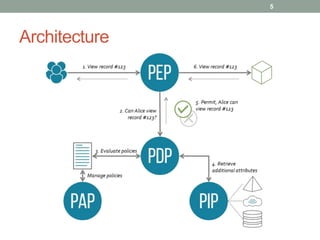
• The PEP or Policy Enforcement Point: it is responsible for
protecting the apps & data you want to apply ABAC to. The PEP
inspects the request and generates an authorization request from it
which it sends to the PDP.
• The PDP or Policy Decision Point: brain of the architecture.
This is the piece which evaluates incoming requests against policies it
has been configured with. The PDP returns a Permit / Deny decision.
The PDP may also use PIPs to retrieve missing metadata.
• The PIP or Policy Information Point: bridges the PDP to
external sources of attributes e.g. LDAP or databases.
4
Architecture
5
Attributes
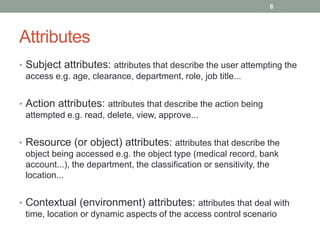
• Subject attributes: attributes that describe the user attempting the
access e.g. age, clearance, department, role, job title...
• Action attributes: attributes that describe the action being
attempted e.g. read, delete, view, approve...
• Resource (or object) attributes: attributes that describe the
object being accessed e.g. the object type (medical record, bank
account...), the department, the classification or sensitivity, the
location...
• Contextual (environment) attributes: attributes that deal with
time, location or dynamic aspects of the access control scenario
6
Policies
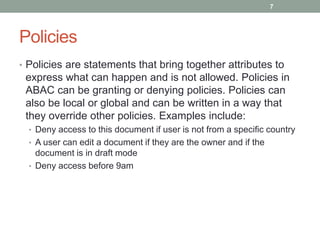
• Policies are statements that bring together attributes to
express what can happen and is not allowed. Policies in
ABAC can be granting or denying policies. Policies can
also be local or global and can be written in a way that
they override other policies. Examples include:
• Deny access to this document if user is not from a specific country
• A user can edit a document if they are the owner and if the
document is in draft mode
• Deny access before 9am
7
Implementation
• XACML standard
• Open source implementations available:
• AuthZForce(Java)
• Balana(Java)
• OpenAZ(Java)
8
Thanks/Merci
9

Attribute based access control

  • 1.
    ATTRIBUTE BASED ACCESSCONTROL Narendra Kumar
  • 2.
    Agenda • Introduction • Architecture •Attributes • Policies • Implementation 2
  • 3.
    Introduction • Access controlparadigm whereby access rights are granted to users through the use of policies which combine attributes together. • Policies can use any type of attributes e.g. user attributes, resource attributes, object, environment attributes etc. • Also referred to as policy based access control or claims based access control. 3
  • 4.
    Architecture • The PEPor Policy Enforcement Point: it is responsible for protecting the apps & data you want to apply ABAC to. The PEP inspects the request and generates an authorization request from it which it sends to the PDP. • The PDP or Policy Decision Point: brain of the architecture. This is the piece which evaluates incoming requests against policies it has been configured with. The PDP returns a Permit / Deny decision. The PDP may also use PIPs to retrieve missing metadata. • The PIP or Policy Information Point: bridges the PDP to external sources of attributes e.g. LDAP or databases. 4
  • 5.
  • 6.
    Attributes • Subject attributes:attributes that describe the user attempting the access e.g. age, clearance, department, role, job title... • Action attributes: attributes that describe the action being attempted e.g. read, delete, view, approve... • Resource (or object) attributes: attributes that describe the object being accessed e.g. the object type (medical record, bank account...), the department, the classification or sensitivity, the location... • Contextual (environment) attributes: attributes that deal with time, location or dynamic aspects of the access control scenario 6
  • 7.
    Policies • Policies arestatements that bring together attributes to express what can happen and is not allowed. Policies in ABAC can be granting or denying policies. Policies can also be local or global and can be written in a way that they override other policies. Examples include: • Deny access to this document if user is not from a specific country • A user can edit a document if they are the owner and if the document is in draft mode • Deny access before 9am 7
  • 8.
    Implementation • XACML standard •Open source implementations available: • AuthZForce(Java) • Balana(Java) • OpenAZ(Java) 8
  • 9.