Next Generation Access
Control
Urban Söderström
© Axiomatics 2016 2
Access Control is as easy as in the Middle Ages
Only 2 options:
•  Store data safely &
•  control access
•  Make data unusable
© Axiomatics 2016 3
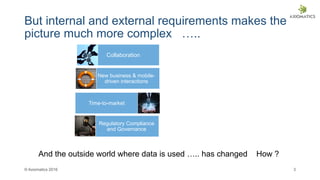
But internal and external requirements makes the
picture much more complex …..
And the outside world where data is used ….. has changed How ?
Collaboration
Regulatory Compliance
and Governance
New business & mobile-
driven interactions
Time-to-market
© Axiomatics 2016 4
1) Diligent 24 x 7 cyber crime professionals around
•  Ransome ware for bitcoins
•  Advanced Persistent Threat
•  Spearfishing
•  National surveillance breaches
Night and day working on their
Continuing Professional Education
© Axiomatics 2016 5
2) Population of computer users has changed
Expert engineers
But also
•  Your grandma
•  Your todler
•  Your malware
•  Your fridge
•  ………
Everyone is a user
With digital identity
© Axiomatics 2016 6
3) Identity ontology for every individual
My ID as a….
Customer
Supplier
Partner
Private user
Administrator
Anonymous user
Machine
Fraudster, mule
Identity Federation
E-ID
E-Citizenship
Mobil-ID
Bank-ID
…….
© Axiomatics 2016 7
4) Rapid evolving usability requirements – “seven
any”
Any one
Any time
Any where
Any device
Any networg
Any app
Across any value chain
Easy and fast
© Axiomatics 2016 8
5) Purpose of data use has changed
Internet of Things
E-Municipality
E-Government
Smart cities
Mobility
Environment
Commodities
Medical
Safety
Living
Drone delivery
Robot distribution
Physical surveillance
© Axiomatics 2016 9
6) Globalisation & data correlation Connectivity across
Datasets
Applications
“Things”
Value chains
Companies
Continents
Jurisdictions
Platforms
Devices
Clouds
API´s
interoperability
© Axiomatics 2016 10
7) Big data analytics Visual data discovery
Automated decision-making
70% of large organizations
Purchase external data
100% by 2019 (Forbes)
180.000 data analysts in US 2018
E.g. fraud detection
Well combined with physical
security tools
This requires Access Management
BaaS = Back-end of IoT
as a service
© Axiomatics 2016 11
8) Increased control, legislation & regulation
Data protection - GDPR
1)  Consistency across European Union
1)  One-stop-shop for citizens and business
2)  Scope: service providers outside Europe delivering EU services
3)  Right to be forgotten-Right to erasure:
1)  “Privacy by design” & “privacy by default”
2)  Right to be forgotten also applicable to third parties
4)  Notification of breach mandatory
1)  High fines
5)  Payment Services Directive II
1)  Mandatory to share customers profiles and data with 3rd parties
2)  On request (with customers consent & still adhering to the
3)  data protecting regulation)
© Axiomatics 2016 12
Responding to all trends with old school static IAM ?
Transaction
request
Authorisation
Entitlements
For the ID
Assets
+
data
authentication
Identity
+
properties
Password
Token
PIN
Biometric
Multifactor
Behaviour
©	
  Axioma)cs	
  2016	
   13	
  
By 2020, 70 percent of enterprises will use ABAC as
the dominant mechanism to protect critical assets
“ 	
  
70%	
   ”	
  
Gartner, 2013
NO ! - Dynamic and fine-grained IAM on data level
required
© Axiomatics 2016 14
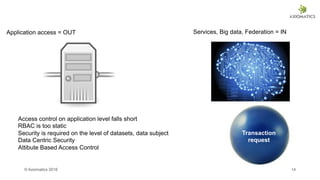
Application access = OUT Services, Big data, Federation = IN
Access control on application level falls short
RBAC is too static
Security is required on the level of datasets, data subject
Data Centric Security
Attibute Based Access Control
Transaction
request
© Axiomatics 2016 15
Every single transaction request…
The only thing persistent is
The request for a transaction
(with all its relevant properties)
© Axiomatics 2016 16
deserves an individual VIP treatment
Access decision
engine”
• real time
• context aware
• rule based
• customised
• flexible
• fine-grained
access decisions
©	
  Axioma)cs	
  2016	
   17	
  
⁃  Policies to protect assets / IP
⁃  Policies to prevent fraud
⁃  Policies to comply with external regulations
⁃  Policies to be more efficient
⁃  Policies to enable new business
⁃  CEOs, CIOs, CISOs, CDOs and other CXOs have responsibilities to define and
implement these policies
⁃  Security and compliance are board-level issues: requires key policies in place to
protect the Enterprise’s interests, IP and to safeguard their investments
Modern Enterprises need to be policy-driven
© Axiomatics 2016 18
⁃  Modern dynamic enterprises need modern dynamic
authorization models to meet requirements for ease of change
and centralization
⁃  Authorizations to…
⁃  Protect sensitive data
⁃  Protect critical assets
⁃  Protect critical transactions
Attribute Based Access Control is the new dynamic model
Access Policies
© Axiomatics 2016 19
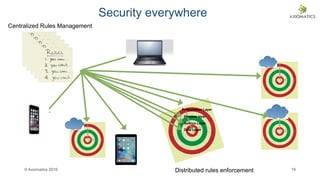
Security everywhere
Centralized Rules Management
Data Layer
Service Layer
Process layer
Presentation Layer
Distributed rules enforcement
© Axiomatics 2016 20
Finegrained context aware access mmnt - building blocks
user profile
database
identity federation trust level
framework
framework to manage
interaction of rule sets
e.g conflicting rules,
hierarchy, veto,
ownership
rulesets
in rule
engines
© Axiomatics 2016 21
Attribute Based Access Control
“Context Based”, or “Rule Based” Access Control:
• Fine-grained
• Additional authentication if reqiured (“step-up”)
• Flexible – Easy access if possible, complex when
required
• Configuration of rules in IAM: short time-to-market
(not programmed in applications)
• Risk level on dataset or transaction
• Trustlevel on authentication context
• Immediate intervention in case of compromise
(trustlevel attribute)
• From RBAC to ABAC or hybrid (role is also a rule!)
© Axiomatics 2016 22
Attribute-Based Access Control
A context-aware and dynamic authorization model
Who? What? When? Where? Why? How?
© Axiomatics 2016 23
GDPR or PSD-2 is a opportunity to start using
ABAC
⁃  DPR – GDPR requires changes in your rule and policy
governance
⁃  By using ABAC you don´t have to rework your rule and policy
governance in every application when changes are applied
⁃  You can include the Business in the process by using Business
processes when creating new policys
© Axiomatics 2016 24
Compared to legacy RBAC models…
⁃  Permissions assigned to roles
⁃  Roles assigned to users
⁃  Applications handle access
control intentionally
© Axiomatics 2016 25
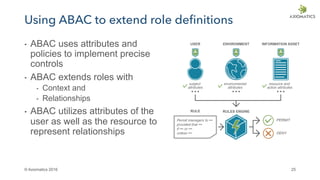
Using ABAC to extend role definitions
⁃  ABAC uses attributes and
policies to implement precise
controls
⁃  ABAC extends roles with
⁃  Context and
⁃  Relationships
⁃  ABAC utilizes attributes of the
user as well as the resource to
represent relationships
©	
  Axioma)cs	
  2016	
   26	
  
Axiomatics provides enterprise
software for access control
© Axiomatics 2016 27
Who we are…
About Axiomatics...
Offices in USA
and Sweden
Venture-backed
since 2013
90% growth
in 2015
© Axiomatics 2016 28
Our Customers
⁃  Fortune 500
⁃  Government Agencies
⁃  Vertical market expertise
⁃  Financial services (banking, insurance)
⁃  Highly-regulated industries (pharmaceuticals, aerospace, automotive…)
⁃  Media companies
Success stories
⁃  Securing online payments for 200 million users
⁃  Securing exchange of clinical trial data in
pharmaceutical research
⁃  Millions of transactions a day secured for one of the
world’s largest banks
⁃  Protecting privacy for insurance company’s clients
⁃  Compliance with Export Control regulations for aircraft
manufacturers
⁃  Copyright-protected streaming media for authorized users only
⁃  Improving speed and quality of health IT systems for
veterans nationwide
© Axiomatics 2016 30
Axiomatics Solutions
⁃  Authorization for Applications
⁃  Business logic and middleware
⁃  APIs and web services
⁃  On-premise and cloud applications
⁃  Authorization for Databases
⁃  Relational databases
⁃  Big Data
⁃  Access Review on policies
⁃  Prove regulatory compliance and
permissions of users or groups
⁃  Real-time review of dynamic authorization
⁃  Internal reporting and auditing needed at
various levels of user
⁃  Review what your employees can do
© Axiomatics 2016 31
Structuring the Policies
The Authorization Policy Lifecycle
© Axiomatics 2016 32
Deploy the architecture – Defence in Depth
© Axiomatics 2016 33
Questions?

Next generation access controls

  • 1.
  • 2.
    © Axiomatics 20162 Access Control is as easy as in the Middle Ages Only 2 options: •  Store data safely & •  control access •  Make data unusable
  • 3.
    © Axiomatics 20163 But internal and external requirements makes the picture much more complex ….. And the outside world where data is used ….. has changed How ? Collaboration Regulatory Compliance and Governance New business & mobile- driven interactions Time-to-market
  • 4.
    © Axiomatics 20164 1) Diligent 24 x 7 cyber crime professionals around •  Ransome ware for bitcoins •  Advanced Persistent Threat •  Spearfishing •  National surveillance breaches Night and day working on their Continuing Professional Education
  • 5.
    © Axiomatics 20165 2) Population of computer users has changed Expert engineers But also •  Your grandma •  Your todler •  Your malware •  Your fridge •  ……… Everyone is a user With digital identity
  • 6.
    © Axiomatics 20166 3) Identity ontology for every individual My ID as a…. Customer Supplier Partner Private user Administrator Anonymous user Machine Fraudster, mule Identity Federation E-ID E-Citizenship Mobil-ID Bank-ID …….
  • 7.
    © Axiomatics 20167 4) Rapid evolving usability requirements – “seven any” Any one Any time Any where Any device Any networg Any app Across any value chain Easy and fast
  • 8.
    © Axiomatics 20168 5) Purpose of data use has changed Internet of Things E-Municipality E-Government Smart cities Mobility Environment Commodities Medical Safety Living Drone delivery Robot distribution Physical surveillance
  • 9.
    © Axiomatics 20169 6) Globalisation & data correlation Connectivity across Datasets Applications “Things” Value chains Companies Continents Jurisdictions Platforms Devices Clouds API´s interoperability
  • 10.
    © Axiomatics 201610 7) Big data analytics Visual data discovery Automated decision-making 70% of large organizations Purchase external data 100% by 2019 (Forbes) 180.000 data analysts in US 2018 E.g. fraud detection Well combined with physical security tools This requires Access Management BaaS = Back-end of IoT as a service
  • 11.
    © Axiomatics 201611 8) Increased control, legislation & regulation Data protection - GDPR 1)  Consistency across European Union 1)  One-stop-shop for citizens and business 2)  Scope: service providers outside Europe delivering EU services 3)  Right to be forgotten-Right to erasure: 1)  “Privacy by design” & “privacy by default” 2)  Right to be forgotten also applicable to third parties 4)  Notification of breach mandatory 1)  High fines 5)  Payment Services Directive II 1)  Mandatory to share customers profiles and data with 3rd parties 2)  On request (with customers consent & still adhering to the 3)  data protecting regulation)
  • 12.
    © Axiomatics 201612 Responding to all trends with old school static IAM ? Transaction request Authorisation Entitlements For the ID Assets + data authentication Identity + properties Password Token PIN Biometric Multifactor Behaviour
  • 13.
    ©  Axioma)cs  2016   13   By 2020, 70 percent of enterprises will use ABAC as the dominant mechanism to protect critical assets “   70%   ”   Gartner, 2013 NO ! - Dynamic and fine-grained IAM on data level required
  • 14.
    © Axiomatics 201614 Application access = OUT Services, Big data, Federation = IN Access control on application level falls short RBAC is too static Security is required on the level of datasets, data subject Data Centric Security Attibute Based Access Control Transaction request
  • 15.
    © Axiomatics 201615 Every single transaction request… The only thing persistent is The request for a transaction (with all its relevant properties)
  • 16.
    © Axiomatics 201616 deserves an individual VIP treatment Access decision engine” • real time • context aware • rule based • customised • flexible • fine-grained access decisions
  • 17.
    ©  Axioma)cs  2016   17   ⁃  Policies to protect assets / IP ⁃  Policies to prevent fraud ⁃  Policies to comply with external regulations ⁃  Policies to be more efficient ⁃  Policies to enable new business ⁃  CEOs, CIOs, CISOs, CDOs and other CXOs have responsibilities to define and implement these policies ⁃  Security and compliance are board-level issues: requires key policies in place to protect the Enterprise’s interests, IP and to safeguard their investments Modern Enterprises need to be policy-driven
  • 18.
    © Axiomatics 201618 ⁃  Modern dynamic enterprises need modern dynamic authorization models to meet requirements for ease of change and centralization ⁃  Authorizations to… ⁃  Protect sensitive data ⁃  Protect critical assets ⁃  Protect critical transactions Attribute Based Access Control is the new dynamic model Access Policies
  • 19.
    © Axiomatics 201619 Security everywhere Centralized Rules Management Data Layer Service Layer Process layer Presentation Layer Distributed rules enforcement
  • 20.
    © Axiomatics 201620 Finegrained context aware access mmnt - building blocks user profile database identity federation trust level framework framework to manage interaction of rule sets e.g conflicting rules, hierarchy, veto, ownership rulesets in rule engines
  • 21.
    © Axiomatics 201621 Attribute Based Access Control “Context Based”, or “Rule Based” Access Control: • Fine-grained • Additional authentication if reqiured (“step-up”) • Flexible – Easy access if possible, complex when required • Configuration of rules in IAM: short time-to-market (not programmed in applications) • Risk level on dataset or transaction • Trustlevel on authentication context • Immediate intervention in case of compromise (trustlevel attribute) • From RBAC to ABAC or hybrid (role is also a rule!)
  • 22.
    © Axiomatics 201622 Attribute-Based Access Control A context-aware and dynamic authorization model Who? What? When? Where? Why? How?
  • 23.
    © Axiomatics 201623 GDPR or PSD-2 is a opportunity to start using ABAC ⁃  DPR – GDPR requires changes in your rule and policy governance ⁃  By using ABAC you don´t have to rework your rule and policy governance in every application when changes are applied ⁃  You can include the Business in the process by using Business processes when creating new policys
  • 24.
    © Axiomatics 201624 Compared to legacy RBAC models… ⁃  Permissions assigned to roles ⁃  Roles assigned to users ⁃  Applications handle access control intentionally
  • 25.
    © Axiomatics 201625 Using ABAC to extend role definitions ⁃  ABAC uses attributes and policies to implement precise controls ⁃  ABAC extends roles with ⁃  Context and ⁃  Relationships ⁃  ABAC utilizes attributes of the user as well as the resource to represent relationships
  • 26.
    ©  Axioma)cs  2016   26   Axiomatics provides enterprise software for access control
  • 27.
    © Axiomatics 201627 Who we are… About Axiomatics... Offices in USA and Sweden Venture-backed since 2013 90% growth in 2015
  • 28.
    © Axiomatics 201628 Our Customers ⁃  Fortune 500 ⁃  Government Agencies ⁃  Vertical market expertise ⁃  Financial services (banking, insurance) ⁃  Highly-regulated industries (pharmaceuticals, aerospace, automotive…) ⁃  Media companies
  • 29.
    Success stories ⁃  Securingonline payments for 200 million users ⁃  Securing exchange of clinical trial data in pharmaceutical research ⁃  Millions of transactions a day secured for one of the world’s largest banks ⁃  Protecting privacy for insurance company’s clients ⁃  Compliance with Export Control regulations for aircraft manufacturers ⁃  Copyright-protected streaming media for authorized users only ⁃  Improving speed and quality of health IT systems for veterans nationwide
  • 30.
    © Axiomatics 201630 Axiomatics Solutions ⁃  Authorization for Applications ⁃  Business logic and middleware ⁃  APIs and web services ⁃  On-premise and cloud applications ⁃  Authorization for Databases ⁃  Relational databases ⁃  Big Data ⁃  Access Review on policies ⁃  Prove regulatory compliance and permissions of users or groups ⁃  Real-time review of dynamic authorization ⁃  Internal reporting and auditing needed at various levels of user ⁃  Review what your employees can do
  • 31.
    © Axiomatics 201631 Structuring the Policies The Authorization Policy Lifecycle
  • 32.
    © Axiomatics 201632 Deploy the architecture – Defence in Depth
  • 33.
    © Axiomatics 201633 Questions?