1
1
Navigating the Post-
OpenAPI Era with
Innovative Design
Frameworks
2
3
Who I am
Daniel Kocot
Head of API Consulting @codecentric
daniel.kocot@codecentric.de
www.linkedin.com/in/danielkocot
4
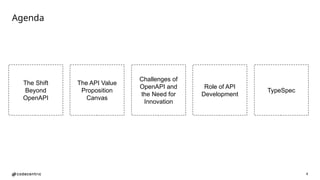
Agenda
The Shift
Beyond
OpenAPI
The API Value
Proposition
Canvas
Challenges of
OpenAPI and
the Need for
Innovation
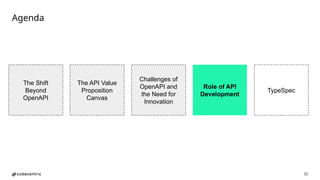
Role of API
Development
TypeSpec
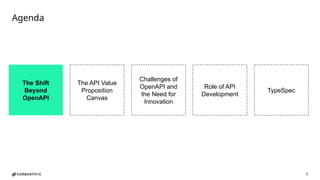
5
Agenda
The Shift
Beyond
OpenAPI
The API Value
Proposition
Canvas
Challenges of
OpenAPI and
the Need for
Innovation
Role of API
Development
TypeSpec
6
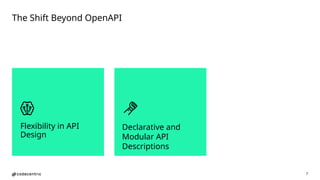
Flexibility in API
Design
The Shift Beyond OpenAPI
7
Flexibility in API
Design
Declarative and
Modular API
Descriptions
The Shift Beyond OpenAPI
8
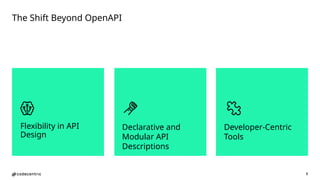
Flexibility in API
Design
Declarative and
Modular API
Descriptions
Developer-Centric
Tools
The Shift Beyond OpenAPI
9
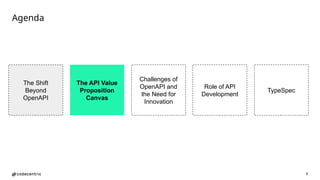
Agenda
The Shift
Beyond
OpenAPI
The API Value
Proposition
Canvas
Challenges of
OpenAPI and
the Need for
Innovation
Role of API
Development
TypeSpec
10
How do we ensure that the
APIs we build are truly
aligned with the business
goals while keeping
developer efficiency at the
core?
API Value Proposition Canvas
11
What?
12
13
APIs must solve business
problems, enable new revenue
streams, or support core
operations.
Developer Perspective
Business Perspective
APIs must be easy to understand,
implement, and maintain while
providing flexibility to adapt to
different interaction patterns and
technical requirements.
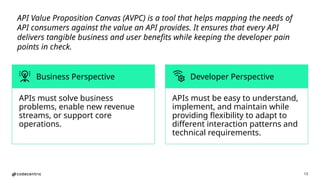
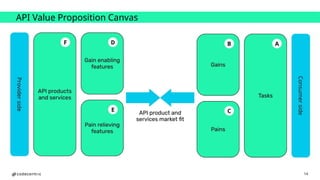
API Value Proposition Canvas (AVPC) is a tool that helps mapping the needs of
API consumers against the value an API provides. It ensures that every API
delivers tangible business and user benefits while keeping the developer pain
points in check.
API Value Proposition Canvas
14
15
Agenda
The Shift
Beyond
OpenAPI
The API Value
Proposition
Canvas
Challenges of
OpenAPI and
the Need for
Innovation
Role of API
Development
TypeSpec
16
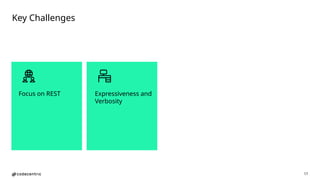
Key Challenges
Focus on REST
17
Key Challenges
Focus on REST Expressiveness and
Verbosity
18
Key Challenges
Focus on REST Expressiveness and
Verbosity
Limited
Collaboration and
Design-First
Flexibility
19
Key Challenges
Focus on REST Expressiveness and
Verbosity
Limited
Collaboration and
Design-First
Flexibility
Client Generation
and Documentation
Pitfalls
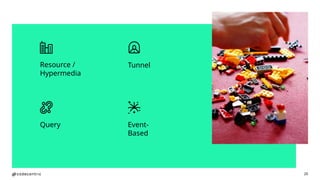
Resource /
Hypermedia
20
Tunnel
Query Event-
Based
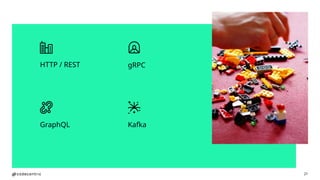
HTTP / REST
21
gRPC
GraphQL Kafka
22
Agenda
The Shift
Beyond
OpenAPI
The API Value
Proposition
Canvas
Challenges of
OpenAPI and
the Need for
Innovation
Role of API
Development
TypeSpec
23
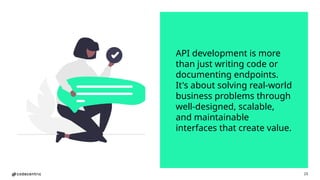
API development is more
than just writing code or
documenting endpoints.
It's about solving real-world
business problems through
well-designed, scalable,
and maintainable
interfaces that create value.
24
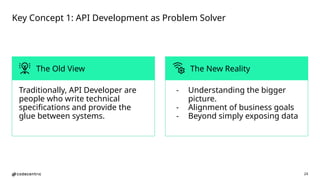
Traditionally, API Developer are
people who write technical
specifications and provide the
glue between systems.
The New Reality
Key Concept 1: API Development as Problem Solver
The Old View
- Understanding the bigger
picture.
- Alignment of business goals
- Beyond simply exposing data
25
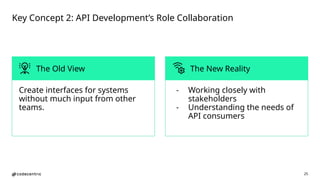
Create interfaces for systems
without much input from other
teams.
The New Reality
Key Concept 2: API Development’s Role Collaboration
The Old View
- Working closely with
stakeholders
- Understanding the needs of
API consumers
26
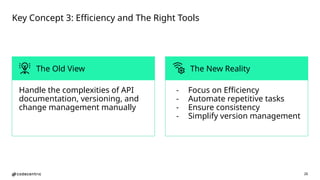
Handle the complexities of API
documentation, versioning, and
change management manually
The New Reality
Key Concept 3: Efficiency and The Right Tools
The Old View
- Focus on Efficiency
- Automate repetitive tasks
- Ensure consistency
- Simplify version management
27
Agenda
The Shift
Beyond
OpenAPI
The API Value
Proposition
Canvas
Challenges of
OpenAPI and
the Need for
Innovation
Role of an API
Developer
TypeSpec
28
We've all used OpenAPI, a
reliable standard for API
design. But as our needs
evolve, so do our tools.
Microsoft TypeSpec steps in
—not to replace standards,
but to extend and enhance
them.
29
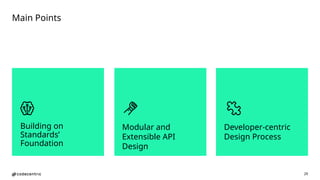
Building on
Standards’
Foundation
Modular and
Extensible API
Design
Developer-centric
Design Process
Main Points
From AVPC to API Design
with Typespec
30
31
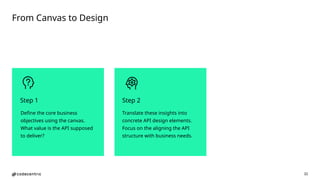
Define the core business
objectives using the canvas.
What value is the API supposed
to deliver?
Step 1
From Canvas to Design
32
Define the core business
objectives using the canvas.
What value is the API supposed
to deliver?
Translate these insights into
concrete API design elements.
Focus on the aligning the API
structure with business needs.
Step 1 Step 2
From Canvas to Design
33
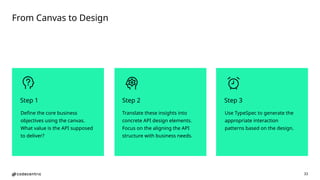
Define the core business
objectives using the canvas.
What value is the API supposed
to deliver?
Translate these insights into
concrete API design elements.
Focus on the aligning the API
structure with business needs.
Use TypeSpec to generate the
appropriate interaction
patterns based on the design.
Step 1 Step 2 Step 3
From Canvas to Design
34
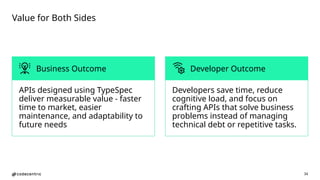
APIs designed using TypeSpec
deliver measurable value - faster
time to market, easier
maintenance, and adaptability to
future needs
Developer Outcome
Value for Both Sides
Business Outcome
Developers save time, reduce
cognitive load, and focus on
crafting APIs that solve business
problems instead of managing
technical debt or repetitive tasks.
API Design in the
Post-OpenAPI Era
35
36
Efficiency Through
Simplification
Flexibility in API
Interaction Patterns
Sustainable
Evolution and
Collaboration
3 Key Principles
37
Post-OpenAPI Era
● Efficiency First
● Business meets
Development
● Not every API needs to be
REST
"TypeSpec is the tool that brings
developer efficiency and business
value together."
Daniel Kocot
Head of API Consulting
daniel.kocot@codecentric.de
https://www.linkedin.com/in/danielkocot
Daniel (he / him)
codecentric AG | Hochstraße 11 | 42697 Solingen
Creating the digital future together.
39
codecentric AG | Hochstraße 11 | 42697 Solingen
Creating the digital future together.

Navigating the Post-OpenAPI Era with Innovative API Design Frameworks - Daniel Kocot, codecentric AG

  • 1.
  • 2.
    Navigating the Post- OpenAPIEra with Innovative Design Frameworks 2
  • 3.
    3 Who I am DanielKocot Head of API Consulting @codecentric daniel.kocot@codecentric.de www.linkedin.com/in/danielkocot
  • 4.
    4 Agenda The Shift Beyond OpenAPI The APIValue Proposition Canvas Challenges of OpenAPI and the Need for Innovation Role of API Development TypeSpec
  • 5.
    5 Agenda The Shift Beyond OpenAPI The APIValue Proposition Canvas Challenges of OpenAPI and the Need for Innovation Role of API Development TypeSpec
  • 6.
    6 Flexibility in API Design TheShift Beyond OpenAPI
  • 7.
    7 Flexibility in API Design Declarativeand Modular API Descriptions The Shift Beyond OpenAPI
  • 8.
    8 Flexibility in API Design Declarativeand Modular API Descriptions Developer-Centric Tools The Shift Beyond OpenAPI
  • 9.
    9 Agenda The Shift Beyond OpenAPI The APIValue Proposition Canvas Challenges of OpenAPI and the Need for Innovation Role of API Development TypeSpec
  • 10.
    10 How do weensure that the APIs we build are truly aligned with the business goals while keeping developer efficiency at the core?
  • 11.
  • 12.
  • 13.
    13 APIs must solvebusiness problems, enable new revenue streams, or support core operations. Developer Perspective Business Perspective APIs must be easy to understand, implement, and maintain while providing flexibility to adapt to different interaction patterns and technical requirements. API Value Proposition Canvas (AVPC) is a tool that helps mapping the needs of API consumers against the value an API provides. It ensures that every API delivers tangible business and user benefits while keeping the developer pain points in check.
  • 14.
  • 15.
    15 Agenda The Shift Beyond OpenAPI The APIValue Proposition Canvas Challenges of OpenAPI and the Need for Innovation Role of API Development TypeSpec
  • 16.
  • 17.
    17 Key Challenges Focus onREST Expressiveness and Verbosity
  • 18.
    18 Key Challenges Focus onREST Expressiveness and Verbosity Limited Collaboration and Design-First Flexibility
  • 19.
    19 Key Challenges Focus onREST Expressiveness and Verbosity Limited Collaboration and Design-First Flexibility Client Generation and Documentation Pitfalls
  • 20.
  • 21.
  • 22.
    22 Agenda The Shift Beyond OpenAPI The APIValue Proposition Canvas Challenges of OpenAPI and the Need for Innovation Role of API Development TypeSpec
  • 23.
    23 API development ismore than just writing code or documenting endpoints. It's about solving real-world business problems through well-designed, scalable, and maintainable interfaces that create value.
  • 24.
    24 Traditionally, API Developerare people who write technical specifications and provide the glue between systems. The New Reality Key Concept 1: API Development as Problem Solver The Old View - Understanding the bigger picture. - Alignment of business goals - Beyond simply exposing data
  • 25.
    25 Create interfaces forsystems without much input from other teams. The New Reality Key Concept 2: API Development’s Role Collaboration The Old View - Working closely with stakeholders - Understanding the needs of API consumers
  • 26.
    26 Handle the complexitiesof API documentation, versioning, and change management manually The New Reality Key Concept 3: Efficiency and The Right Tools The Old View - Focus on Efficiency - Automate repetitive tasks - Ensure consistency - Simplify version management
  • 27.
    27 Agenda The Shift Beyond OpenAPI The APIValue Proposition Canvas Challenges of OpenAPI and the Need for Innovation Role of an API Developer TypeSpec
  • 28.
    28 We've all usedOpenAPI, a reliable standard for API design. But as our needs evolve, so do our tools. Microsoft TypeSpec steps in —not to replace standards, but to extend and enhance them.
  • 29.
    29 Building on Standards’ Foundation Modular and ExtensibleAPI Design Developer-centric Design Process Main Points
  • 30.
    From AVPC toAPI Design with Typespec 30
  • 31.
    31 Define the corebusiness objectives using the canvas. What value is the API supposed to deliver? Step 1 From Canvas to Design
  • 32.
    32 Define the corebusiness objectives using the canvas. What value is the API supposed to deliver? Translate these insights into concrete API design elements. Focus on the aligning the API structure with business needs. Step 1 Step 2 From Canvas to Design
  • 33.
    33 Define the corebusiness objectives using the canvas. What value is the API supposed to deliver? Translate these insights into concrete API design elements. Focus on the aligning the API structure with business needs. Use TypeSpec to generate the appropriate interaction patterns based on the design. Step 1 Step 2 Step 3 From Canvas to Design
  • 34.
    34 APIs designed usingTypeSpec deliver measurable value - faster time to market, easier maintenance, and adaptability to future needs Developer Outcome Value for Both Sides Business Outcome Developers save time, reduce cognitive load, and focus on crafting APIs that solve business problems instead of managing technical debt or repetitive tasks.
  • 35.
    API Design inthe Post-OpenAPI Era 35
  • 36.
    36 Efficiency Through Simplification Flexibility inAPI Interaction Patterns Sustainable Evolution and Collaboration 3 Key Principles
  • 37.
    37 Post-OpenAPI Era ● EfficiencyFirst ● Business meets Development ● Not every API needs to be REST "TypeSpec is the tool that brings developer efficiency and business value together." Daniel Kocot Head of API Consulting daniel.kocot@codecentric.de https://www.linkedin.com/in/danielkocot Daniel (he / him)
  • 38.
    codecentric AG |Hochstraße 11 | 42697 Solingen Creating the digital future together. 39 codecentric AG | Hochstraße 11 | 42697 Solingen Creating the digital future together.

Editor's Notes

  • #4 Bild aus Azure DevOps?
  • #5 Bild aus Azure DevOps?
  • #6 1. Flexibility in API Design Principle: Moving beyond OpenAPI means embracing frameworks that offer flexibility in how APIs are designed, modeled, and documented. Explanation: OpenAPI tends to enforce a one-size-fits-all approach, often limited to RESTful APIs. In contrast, modern frameworks like Microsoft TypeSpec allow for diverse API interaction patterns (such as GraphQL, gRPC, or event-driven architectures). This flexibility means developers can design APIs that are best suited for their specific use case, ensuring higher adaptability and scalability. 2. Declarative and Modular API Specifications Principle: The future of API design is declarative and modular, reducing boilerplate and manual coding. Explanation: OpenAPI requires detailed, often repetitive manual specifications, which can be prone to errors and difficult to maintain. Frameworks like TypeSpec promote a declarative syntax where the API’s intent and behavior are specified at a high level. This modularity leads to reusable components, improved design clarity, and easier iteration, significantly enhancing developer efficiency. 3. Developer-Centric Tools for Enhanced Collaboration Principle: New API frameworks prioritize developer experience and collaboration, empowering teams to work more efficiently across the API lifecycle. Explanation: OpenAPI focuses heavily on API specification but doesn't offer as many tools for improving the development workflow or collaboration. Microsoft TypeSpec, on the other hand, integrates directly into developers’ workflows with enhanced tooling for automated client generation, validation, and documentation. This shift drives faster iterations, greater collaboration between teams, and ultimately, higher quality APIs.
  • #7 1. Flexibility in API Design Principle: Moving beyond OpenAPI means embracing frameworks that offer flexibility in how APIs are designed, modeled, and documented. Explanation: OpenAPI tends to enforce a one-size-fits-all approach, often limited to RESTful APIs. In contrast, modern frameworks like Microsoft TypeSpec allow for diverse API interaction patterns (such as GraphQL, gRPC, or event-driven architectures). This flexibility means developers can design APIs that are best suited for their specific use case, ensuring higher adaptability and scalability. 2. Declarative and Modular API Specifications Principle: The future of API design is declarative and modular, reducing boilerplate and manual coding. Explanation: OpenAPI requires detailed, often repetitive manual specifications, which can be prone to errors and difficult to maintain. Frameworks like TypeSpec promote a declarative syntax where the API’s intent and behavior are specified at a high level. This modularity leads to reusable components, improved design clarity, and easier iteration, significantly enhancing developer efficiency. 3. Developer-Centric Tools for Enhanced Collaboration Principle: New API frameworks prioritize developer experience and collaboration, empowering teams to work more efficiently across the API lifecycle. Explanation: OpenAPI focuses heavily on API specification but doesn't offer as many tools for improving the development workflow or collaboration. Microsoft TypeSpec, on the other hand, integrates directly into developers’ workflows with enhanced tooling for automated client generation, validation, and documentation. This shift drives faster iterations, greater collaboration between teams, and ultimately, higher quality APIs.
  • #8 1. Flexibility in API Design Principle: Moving beyond OpenAPI means embracing frameworks that offer flexibility in how APIs are designed, modeled, and documented. Explanation: OpenAPI tends to enforce a one-size-fits-all approach, often limited to RESTful APIs. In contrast, modern frameworks like Microsoft TypeSpec allow for diverse API interaction patterns (such as GraphQL, gRPC, or event-driven architectures). This flexibility means developers can design APIs that are best suited for their specific use case, ensuring higher adaptability and scalability. 2. Declarative and Modular API Specifications Principle: The future of API design is declarative and modular, reducing boilerplate and manual coding. Explanation: OpenAPI requires detailed, often repetitive manual specifications, which can be prone to errors and difficult to maintain. Frameworks like TypeSpec promote a declarative syntax where the API’s intent and behavior are specified at a high level. This modularity leads to reusable components, improved design clarity, and easier iteration, significantly enhancing developer efficiency. 3. Developer-Centric Tools for Enhanced Collaboration Principle: New API frameworks prioritize developer experience and collaboration, empowering teams to work more efficiently across the API lifecycle. Explanation: OpenAPI focuses heavily on API specification but doesn't offer as many tools for improving the development workflow or collaboration. Microsoft TypeSpec, on the other hand, integrates directly into developers’ workflows with enhanced tooling for automated client generation, validation, and documentation. This shift drives faster iterations, greater collaboration between teams, and ultimately, higher quality APIs.
  • #9 Bild aus Azure DevOps?
  • #15 Bild aus Azure DevOps?
  • #16 OpenAPI reinforces a REST-centric view of the world, which can lead to “REST-overload” in scenarios where other API patterns are more appropriate. Not all APIs are best served by REST, especially in the age of microservices, where event-driven and RPC-based communication models are gaining traction.
  • #17 OpenAPI’s specification can become overly verbose, making it challenging to maintain and extend, especially in large systems with many endpoints and complex data structures.
  • #18 While OpenAPI supports design-first approaches, it lacks the flexibility needed for iterative and collaborative API design processes.
  • #19 OpenAPI is often touted for its client code generation capabilities. However, the auto-generated client code is often not optimized for real-world use cases, requiring significant tweaking to fit specific project needs.
  • #20 Pattern hinterfragen
  • #21 Pattern hinterfragen
  • #22 Bild aus Azure DevOps?
  • #27 Bild aus Azure DevOps?
  • #36 Efficiency Through Simplification: TypeSpec streamlines API design by reducing complexity and automating repetitive tasks. This allows developers to focus on business logic and high-value work, accelerating the development cycle. Flexibility in API Interaction Patterns: TypeSpec supports multiple interaction models (REST, GraphQL, gRPC) from a single design source, giving developers the flexibility to choose the right API format for the job without additional overhead. Sustainable Evolution and Collaboration: TypeSpec’s modular structure ensures easy versioning and adaptability, reducing maintenance burdens. Its collaboration-friendly features enable clear communication between developers and stakeholders, aligning technical and business goals effectively.
  • #37 Efficiency First: TypeSpec reduces complexity and focuses on increasing development speed and quality. Business Meets Development: Using the API Value Proposition Canvas in combination with TypeSpec ensures that both business goals and technical needs are met. Not Every API Needs to be REST: Flexibility in API interaction patterns enables developers to create exactly what is needed for the use case at hand, avoiding unnecessary complexity.
  • #38 Bild aus Azure DevOps?