Customer Service
Level II
Advanced
What customers want
List a few points that you want as a customer.
The good news is that our customers don‟t want
anything besides what we want as a customer.
Hence:
Our prime focus should be at
“Customer Satisfaction”
Let‟s review the 10 Commandments...
Customer is always right
Even if they are wrong… yes the are. However,
we can‟t just tell them that.
Need now is to “Educate” the customer on
what's right and what's wrong.
Know who is boss
You are in business to service customer needs, and you
can only do that if you know what it is your customers
want. When you truly listen to your customers, they let
you know what they want and how you can provide good
service. Never forget that the customer pays our salary
and makes your job possible.
Be a good listener
Take the time to identify customer needs by asking
questions and concentrating on what the customer is
really saying. Listen to their words, tone of voice, body
language, and most importantly, how they feel. Beware
of making assumptions - thinking you intuitively know
what the customer wants. Effective listening and
undivided attention are particularly important on the
show floor where there is a great danger of
preoccupation.
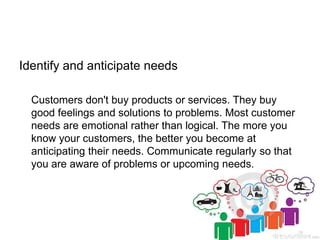
Identify and anticipate needs
Customers don't buy products or services. They buy
good feelings and solutions to problems. Most customer
needs are emotional rather than logical. The more you
know your customers, the better you become at
anticipating their needs. Communicate regularly so that
you are aware of problems or upcoming needs.
Make customers feel important and appreciated
Treat them as individuals. Always use their name and
find ways to compliment them, but be sincere. People
value sincerity. It creates good feeling and trust. Think
about ways to generate good feelings about doing
business with you. Customers are very sensitive and
know whether or not you really care about them. Thank
them every time you get a chance on the show floor be
sure that your body language conveys sincerity. Your
words and actions should be congruent.
Help customers understand your systems
Your organization may have the world's best systems for
getting things done, but if customers don't understand
them, they can get confused, impatient and angry. Take
time to explain how your systems work and how they
simplify transactions. Be careful that your systems don't
reduce the human element of your organization.
Appreciate the power of "Yes"
Always look for ways to help your customers. When they
have a request (as long as it is reasonable) tell them that
you can do it. Figure out how afterwards. Look for ways
to make doing business with you easy. Always do what
you say you are going to do.
Know how to apologize
When something goes wrong, apologize. It's easy and
customers like it. The customer may not always be right,
but the customer must always win. Deal with problems
immediately and let customers know what you have
done. Make it simple for customers to complain. Value
their complaints. As much as we dislike it, it gives us an
opportunity to improve. Even if customers are having a
bad day, go out of your way to make them feel
comfortable.
Give more than expected
Since the future of all companies lies in keeping
customers happy, think of ways to elevate yourself
above the competition. Consider the following:
• What can you give customers that they cannot get
elsewhere?
• What can you do to follow-up and thank people even when
they don't bother?
• What can you give a customer that is totally unexpected?
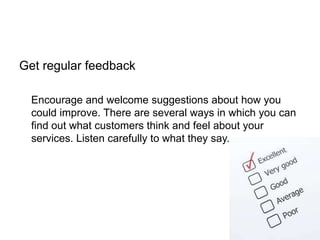
Get regular feedback
Encourage and welcome suggestions about how you
could improve. There are several ways in which you can
find out what customers think and feel about your
services. Listen carefully to what they say.
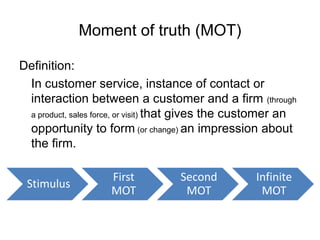
Moment of truth (MOT)
Definition:
In customer service, instance of contact or
interaction between a customer and a firm (through
a product, sales force, or visit) that gives the customer an
opportunity to form (or change) an impression about
the firm.
Stimulus
First
MOT
Second
MOT
Infinite
MOT
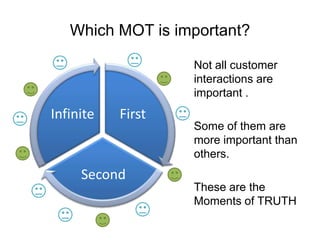
Which MOT is important?
First
Second
Infinite
Not all customer
interactions are
important .
Some of them are
more important than
others.
These are the
Moments of TRUTH
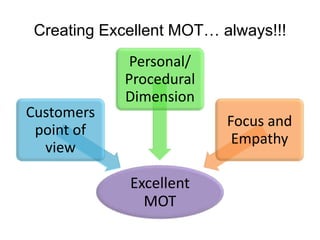
Creating Excellent MOT… always!!!
Excellent
MOT
Customers
point of
view
Personal/
Procedural
Dimension
Focus and
Empathy
Empathy
Understanding another person's feelings by
remembering or imagining being in a similar
situation.
Historically, empathy was known as "bedside manner," a quality considered
innate and impossible to acquire – either you were born with it or you
weren't.
More recently, greater emphasis has been placed on empathy as a
communication tool of substantial importance, and many experts now agree
that empathy and empathetic communication are teachable, learnable skills.
Practical Empathetic Communication
• Recognizing presence of strong feeling
(ie, fear, anger, grief, disappointment)
• Pausing to imagine how the customer might be
feeling
• Stating our perception of the customers feeling
(ie, "I can imagine that must be ..." or "It sounds like you're upset
about ...")
• Legitimizing that feeling
• Respecting the customers effort to cope with
the predicament
• Offering support and partnership (ie, "I'm committed to
work with you to ..." or "Let's see what we can do together to ...")
Let‟s play a game…
• Come to my desk with pen and notepad
• Pick up a chit from my desk
• Write it in your notepad
• Now you have 5 seconds to come up with an
empathetic response
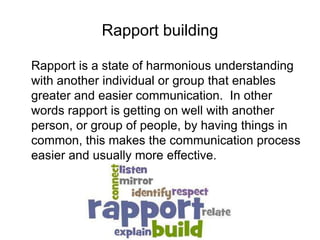
Rapport building
Rapport is a state of harmonious understanding
with another individual or group that enables
greater and easier communication. In other
words rapport is getting on well with another
person, or group of people, by having things in
common, this makes the communication process
easier and usually more effective.
Rapport building - Break the Ice
When meeting somebody for the first time some
simple tips will help you reduce the tension in the
situation enabling both parties to feel more relaxed
and thus communicate more effectively:
– Use non-threatening and „safe topics‟ for initial small talk
– Listen to what the other person is saying and look for
shared experiences or circumstances
– Try to inject an element of humor
– Positive body language
– Empathy
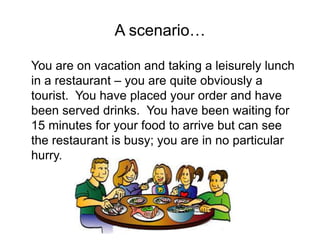
A scenario…
You are on vacation and taking a leisurely lunch
in a restaurant – you are quite obviously a
tourist. You have placed your order and have
been served drinks. You have been waiting for
15 minutes for your food to arrive but can see
the restaurant is busy; you are in no particular
hurry.
What happens next will change how you view your
experience of the restaurant:
• Nothing much happens; the waitress comes by to say she‟s sorry
that the food is taking a long time and how they are short-staffed in
the kitchen today. Eventually your food arrives and is good.
• You wait another 10 minutes before attracting the waitress‟s
attention to ask how much longer your lunch will be, she shrugs and
goes to the kitchen to find out. Eventually your food is served but
there is no apology for the wait.
• The waitress knows you‟ve been waiting and comes over to explain
that the restaurant is busier than expected and apologizes. She
offers you another round of drinks on the house and reassures you
that food will be served soon.
Dealing with Customer Dissatisfaction
• Negative personality traits of customers can
bring down your level of service.
• Three approaches to dealing with dissatisfaction
are:
a. dealing with complaints and anger
b. involving customer in problem resolution
c. handling an unreasonable request
Dealing with Customer Complaints/ Anger
• Acknowledge the customer‟s point of view.
• Avoid placing blame on the customer.
• Use magic words to defuse anger (“I understand,” “I
agree,” “I‟m sorry.”)
• Apologize for the problems created by you or your
company.
• Take responsibility, act fast, and be thorough.
• Tell the difficult customers how much you value
them.
• Follow up on the problem resolution.
• Do your best to make sure the problem does not
happen again.
Involving Customers in problem solving
It may be a good idea to involve customer in
working out a problem
• Mistakes and problems in serving customers are
inevitable.
• To minimize perception of poor
service, customer must be involved in deciding
what to do about the problem.
• Ideal condition is for customer service
representative and dissatisfied customers to be
partners in resolving the problem.
Handling an Unreasonable Request
• An unreasonable customer request is almost
inevitable at some point.
• Customer who makes unreasonable request is
usually aware of unreasonableness.
• Stand ground with dignity and reasonableness.
For example, be firm by repeating facts of
situation, but keep your temper under control.
Realistic Attitude
• Some unrealistic customers may not be worth
keeping.
• Realistic goal is to retain as many profitable
customers as possible.
• Set limits for unruly customers, and see if their
behavior changes.
• Frequent problem makers, and high-
maintenance customers might be dropped.
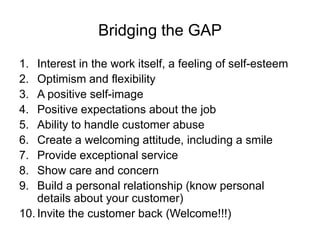
Bridging the GAP
1. Interest in the work itself, a feeling of self-esteem
2. Optimism and flexibility
3. A positive self-image
4. Positive expectations about the job
5. Ability to handle customer abuse
6. Create a welcoming attitude, including a smile
7. Provide exceptional service
8. Show care and concern
9. Build a personal relationship (know personal
details about your customer)
10. Invite the customer back (Welcome!!!)
So let’s go out and make our customers
“HAPPY” 

Customer service level two

  • 1.
  • 2.
    What customers want Lista few points that you want as a customer. The good news is that our customers don‟t want anything besides what we want as a customer. Hence: Our prime focus should be at “Customer Satisfaction”
  • 3.
    Let‟s review the10 Commandments... Customer is always right Even if they are wrong… yes the are. However, we can‟t just tell them that. Need now is to “Educate” the customer on what's right and what's wrong.
  • 4.
    Know who isboss You are in business to service customer needs, and you can only do that if you know what it is your customers want. When you truly listen to your customers, they let you know what they want and how you can provide good service. Never forget that the customer pays our salary and makes your job possible.
  • 5.
    Be a goodlistener Take the time to identify customer needs by asking questions and concentrating on what the customer is really saying. Listen to their words, tone of voice, body language, and most importantly, how they feel. Beware of making assumptions - thinking you intuitively know what the customer wants. Effective listening and undivided attention are particularly important on the show floor where there is a great danger of preoccupation.
  • 6.
    Identify and anticipateneeds Customers don't buy products or services. They buy good feelings and solutions to problems. Most customer needs are emotional rather than logical. The more you know your customers, the better you become at anticipating their needs. Communicate regularly so that you are aware of problems or upcoming needs.
  • 7.
    Make customers feelimportant and appreciated Treat them as individuals. Always use their name and find ways to compliment them, but be sincere. People value sincerity. It creates good feeling and trust. Think about ways to generate good feelings about doing business with you. Customers are very sensitive and know whether or not you really care about them. Thank them every time you get a chance on the show floor be sure that your body language conveys sincerity. Your words and actions should be congruent.
  • 8.
    Help customers understandyour systems Your organization may have the world's best systems for getting things done, but if customers don't understand them, they can get confused, impatient and angry. Take time to explain how your systems work and how they simplify transactions. Be careful that your systems don't reduce the human element of your organization.
  • 9.
    Appreciate the powerof "Yes" Always look for ways to help your customers. When they have a request (as long as it is reasonable) tell them that you can do it. Figure out how afterwards. Look for ways to make doing business with you easy. Always do what you say you are going to do.
  • 10.
    Know how toapologize When something goes wrong, apologize. It's easy and customers like it. The customer may not always be right, but the customer must always win. Deal with problems immediately and let customers know what you have done. Make it simple for customers to complain. Value their complaints. As much as we dislike it, it gives us an opportunity to improve. Even if customers are having a bad day, go out of your way to make them feel comfortable.
  • 11.
    Give more thanexpected Since the future of all companies lies in keeping customers happy, think of ways to elevate yourself above the competition. Consider the following: • What can you give customers that they cannot get elsewhere? • What can you do to follow-up and thank people even when they don't bother? • What can you give a customer that is totally unexpected?
  • 12.
    Get regular feedback Encourageand welcome suggestions about how you could improve. There are several ways in which you can find out what customers think and feel about your services. Listen carefully to what they say.
  • 13.
    Moment of truth(MOT) Definition: In customer service, instance of contact or interaction between a customer and a firm (through a product, sales force, or visit) that gives the customer an opportunity to form (or change) an impression about the firm. Stimulus First MOT Second MOT Infinite MOT
  • 14.
    Which MOT isimportant? First Second Infinite Not all customer interactions are important . Some of them are more important than others. These are the Moments of TRUTH
  • 15.
    Creating Excellent MOT…always!!! Excellent MOT Customers point of view Personal/ Procedural Dimension Focus and Empathy
  • 16.
    Empathy Understanding another person'sfeelings by remembering or imagining being in a similar situation. Historically, empathy was known as "bedside manner," a quality considered innate and impossible to acquire – either you were born with it or you weren't. More recently, greater emphasis has been placed on empathy as a communication tool of substantial importance, and many experts now agree that empathy and empathetic communication are teachable, learnable skills.
  • 17.
    Practical Empathetic Communication •Recognizing presence of strong feeling (ie, fear, anger, grief, disappointment) • Pausing to imagine how the customer might be feeling • Stating our perception of the customers feeling (ie, "I can imagine that must be ..." or "It sounds like you're upset about ...") • Legitimizing that feeling • Respecting the customers effort to cope with the predicament • Offering support and partnership (ie, "I'm committed to work with you to ..." or "Let's see what we can do together to ...")
  • 18.
    Let‟s play agame… • Come to my desk with pen and notepad • Pick up a chit from my desk • Write it in your notepad • Now you have 5 seconds to come up with an empathetic response
  • 19.
    Rapport building Rapport isa state of harmonious understanding with another individual or group that enables greater and easier communication. In other words rapport is getting on well with another person, or group of people, by having things in common, this makes the communication process easier and usually more effective.
  • 20.
    Rapport building -Break the Ice When meeting somebody for the first time some simple tips will help you reduce the tension in the situation enabling both parties to feel more relaxed and thus communicate more effectively: – Use non-threatening and „safe topics‟ for initial small talk – Listen to what the other person is saying and look for shared experiences or circumstances – Try to inject an element of humor – Positive body language – Empathy
  • 21.
    A scenario… You areon vacation and taking a leisurely lunch in a restaurant – you are quite obviously a tourist. You have placed your order and have been served drinks. You have been waiting for 15 minutes for your food to arrive but can see the restaurant is busy; you are in no particular hurry.
  • 22.
    What happens nextwill change how you view your experience of the restaurant: • Nothing much happens; the waitress comes by to say she‟s sorry that the food is taking a long time and how they are short-staffed in the kitchen today. Eventually your food arrives and is good. • You wait another 10 minutes before attracting the waitress‟s attention to ask how much longer your lunch will be, she shrugs and goes to the kitchen to find out. Eventually your food is served but there is no apology for the wait. • The waitress knows you‟ve been waiting and comes over to explain that the restaurant is busier than expected and apologizes. She offers you another round of drinks on the house and reassures you that food will be served soon.
  • 23.
    Dealing with CustomerDissatisfaction • Negative personality traits of customers can bring down your level of service. • Three approaches to dealing with dissatisfaction are: a. dealing with complaints and anger b. involving customer in problem resolution c. handling an unreasonable request
  • 24.
    Dealing with CustomerComplaints/ Anger • Acknowledge the customer‟s point of view. • Avoid placing blame on the customer. • Use magic words to defuse anger (“I understand,” “I agree,” “I‟m sorry.”) • Apologize for the problems created by you or your company. • Take responsibility, act fast, and be thorough. • Tell the difficult customers how much you value them. • Follow up on the problem resolution. • Do your best to make sure the problem does not happen again.
  • 25.
    Involving Customers inproblem solving It may be a good idea to involve customer in working out a problem • Mistakes and problems in serving customers are inevitable. • To minimize perception of poor service, customer must be involved in deciding what to do about the problem. • Ideal condition is for customer service representative and dissatisfied customers to be partners in resolving the problem.
  • 26.
    Handling an UnreasonableRequest • An unreasonable customer request is almost inevitable at some point. • Customer who makes unreasonable request is usually aware of unreasonableness. • Stand ground with dignity and reasonableness. For example, be firm by repeating facts of situation, but keep your temper under control.
  • 27.
    Realistic Attitude • Someunrealistic customers may not be worth keeping. • Realistic goal is to retain as many profitable customers as possible. • Set limits for unruly customers, and see if their behavior changes. • Frequent problem makers, and high- maintenance customers might be dropped.
  • 28.
    Bridging the GAP 1.Interest in the work itself, a feeling of self-esteem 2. Optimism and flexibility 3. A positive self-image 4. Positive expectations about the job 5. Ability to handle customer abuse 6. Create a welcoming attitude, including a smile 7. Provide exceptional service 8. Show care and concern 9. Build a personal relationship (know personal details about your customer) 10. Invite the customer back (Welcome!!!)
  • 29.
    So let’s goout and make our customers “HAPPY” 

Editor's Notes

  • #3 icebreaker
  • #4 Talk about the 10 commandment of great customer service
  • #19 I’m at the airport & there’s no one to talk to us…  I’ve lost my photo ID. My friend’s luggage was lost last week. I met with an accident yesterday and I missed my flight… I’m going to be a father of twins!  I don’t have a pen and I’m in a hospital right now. I need to get there, I’m getting married tomorrow (crying). I don’t have my confirmation number with me. I am worried about my connection flight. Arrrgh, I have a headache! Can I please get a window seat… (All window seats are sold) My kids had such a great time during this holiday!!! I am traveling with my grandparents and going on a world tour. I don’t like coffee I wish I could have stayed here more…