








Australian Digital Commerce:

A commentary on the Retail Sector
Authors
Kai Riemer, Jens Brunk, Uri Gal (The University of Sydney Business School)
Ben Gilchriest, Robert Ord (Capgemini Australia)
Contacts
A/Prof Kai Riemer,
kai.riemer@sydney.edu.au
Ben Gilchriest,
ben.gilchriest@capgemini.com
Study background
Data collection and analysis carried out between August and October 2013.
Download study
http://hdl.handle.net/2123/9540

This is a publication of the Australian Digital Transformation Lab, a joint venture
between The University of Sydney Business School and Capgemini Australia. The
information contained in this document is proprietary. All rights reserved. © 2013.
Table of Contents
What is Digital Commerce?
The Four Dimensions of Digital Commerce
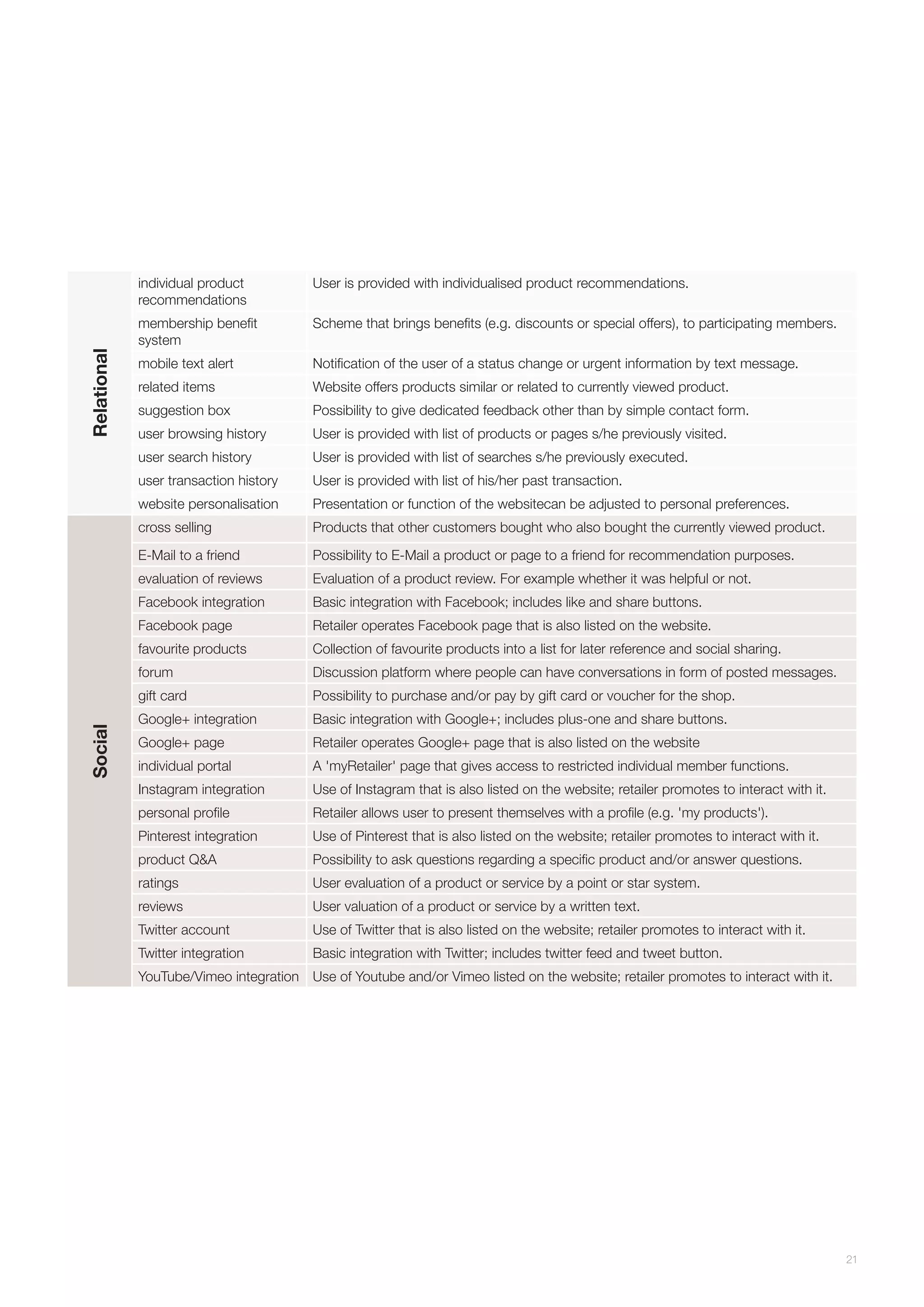
The Relational Gap
Bricks ‘n’ Mortar Vs Bricks ‘n’ Clicks

Key findings
1.	 Australian Retailers have achieved a reasonable level of maturity in providing customers with the ability to get information
and transact online (Informational and Transactional aspects of their Digital Commerce engagement).
2.	 However, Relational and Social features are under utilised. Australian retailers are missing opportunities to connect with
customers and create loyalty and drive repeat business.
3.	 Social features are mainly used for broadcasting messages through social platforms. There is a major development
opportunity for Australian retailers to engage a wider consumer base through social features.
4.	 Relationship building (Relational aspects) is the most under-utilised dimension. The potential for generating customer
intimacy and brand loyalty is currently unexploited by Australian retailers and has created a Relational Gap.
5.	 The key to a sustainable digital commerce presence for Australian retailers is to close the Relational Gap with investment
in Relational digital commerce features.
4

Australian Digital Commerce: A commentary on the Retail Sector
WHAT IS
DIGITAL
COMMERCE?

5
What is Digital Commerce?
Digital Commerce
“Digital Commerce is the Web 2.0 version of electronic
commerce comprising the full bandwidth of engagement with
customers through various digital channels, including social media
and mobile, in order to build lasting relationships, create meaningful
exchanges and generate repeat business.”
A new social dimension
to e-commerce

89

retail companies
were analysed as
part of the study,
with a mix of
“bricks & mortar”,
“bricks & clicks”
and “pure-play
virtual”. Each
company was
evaluated against 63
criteria to measure
their level of digital
commerce activity.

USD $1trillion and more than 50%
of Australians are ‘Digital Buyers’,
preferring to buy online where possible1.

Why being social is necessary to
survive in the digital economy
E-commerce has been around since
the late 1970s. We saw an acceleration
of web-based business, culminating in
the dot.com boom in the early 2000s
when new business models based on
Internet technology first took off, but
created an ultimately unsustainable
market environment. Despite the
many failures, this era gave rise to
new Internet giants that offer a wealth
of products and services worldwide;
competing with the biggest brands that
the world knows.
Most Australian consumers have, at
some point, bought (or sold) goods or
services through the Internet or other
electronic channels. Either through
basic online stores, marketplaces,
online auctions or email, the face-toface element of the transaction was
removed from the equation.
This First wave of Electronic Commerce
has marked a major shift in the way we
shop, with a focus on creating new and
convenient shopping experiences.
It has been estimated that the global
e-commerce market is worth over

However, after a decade or more
of e-commerce, it is becoming
increasingly difficult for companies to
stand out from the crowd and produce
a unique and compelling online
experience for their customers. At the
same time the advent of Web 2.0 has
brought about new opportunities for
businesses to differentiate and connect
with customers in unprecedented ways.
One of the biggest uses of the Internet
is for social purposes, whether this
be social websites, social blogging
platforms, social business interactions,
social forums and many more;
what is clear is that the Internet is
being used to connect like never
before. It is this power to connect
that digital commerce in the Web 2.0
era leverages to enhance the online
buying experience.
New technologies provide the ability
for companies to engage and connect
with their customers at a new level
of intimacy. This intimacy is thought
to increase loyalty, total spend and
generate repeat business. This Retail
market commentary will explore
these ideas.

1 	 eMarketer (2013), available at: http://www.emarketer.com/Article/ Ecommerce-Sales-Topped-1-TrillionFirst-Time-2012/1009649

6

Australian Digital Commerce: A commentary on the Retail Sector
Background

This market commentary is based on
a research project which has explored
the utilisation of digital commerce by 89
Australian Retailers. The retail market
in Australia is diverse and broad. To
ensure a balanced view, 19 sectors of
the retail market have been studied.

In the early days of electronic
commerce maturity was a matter of
whether a company had progressed
beyond offering a static web presence
with minimal form of interaction to
providing transaction services for
executing purchases (McKay and
Marshall 2004).

The online utilisation of all companies
in the sample was evaluated in detail
by examining the extent to which
certain digital commerce features were
available for the consumer. No quality
judgements were made.
Each type of digital utilisation was
assessed from the consumer point-ofview using a list of 63 criteria to record
whether certain tools, techniques or
features have been implemented.
Collectively these criteria form a good
indication of the extent to which
each company makes use of digital
commerce.

Today, consumers in many retail
sectors take information provision and
transaction capabilities for granted.
Maturity has become a matter of
providing higher levels of engagement
and relationship building.
For this study we built on and extended
a framework by Curty and Zhang
(2013). We distinguish among four
dimensions of digital commerce,
resembling increasing stages of
complexity and maturity: informational,
transactional, relational and social
dimensions of digital commerce.

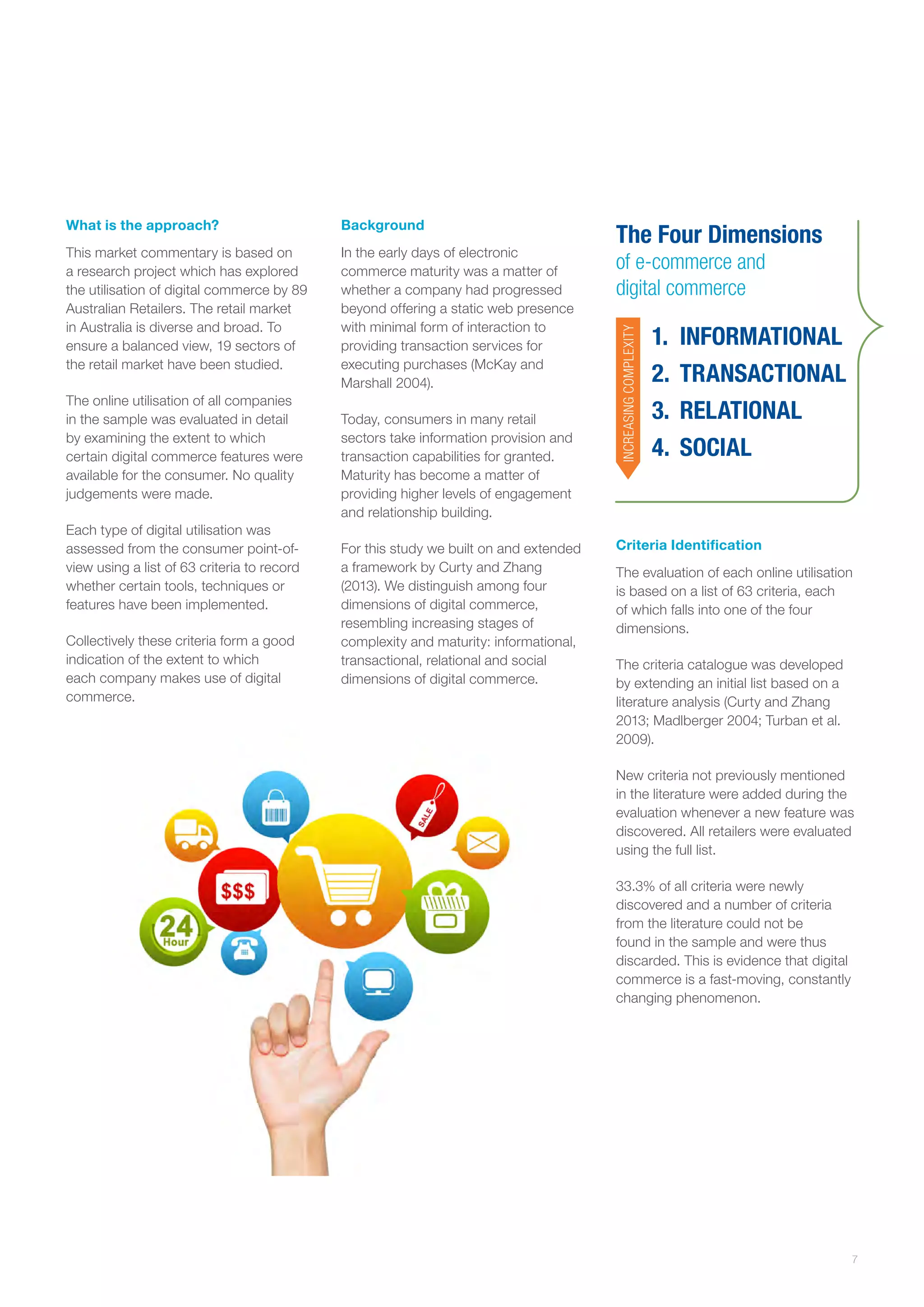
The Four Dimensions
of e-commerce and
digital commerce
INCREASING COMPLEXITY

What is the approach?

1.	 INFORMATIONAL
2.	 TRANSACTIONAL
3.	 RELATIONAL
4.	 SOCIAL

Criteria Identification
The evaluation of each online utilisation
is based on a list of 63 criteria, each
of which falls into one of the four
dimensions.
The criteria catalogue was developed
by extending an initial list based on a
literature analysis (Curty and Zhang
2013; Madlberger 2004; Turban et al.
2009).
New criteria not previously mentioned
in the literature were added during the
evaluation whenever a new feature was
discovered. All retailers were evaluated
using the full list.
33.3% of all criteria were newly
discovered and a number of criteria
from the literature could not be
found in the sample and were thus
discarded. This is evidence that digital
commerce is a fast-moving, constantly
changing phenomenon.

7
8

Australian Digital Commerce: A commentary on the Retail Sector
THE FOUR
DIMENSIONS
OF DIGITAL
COMMERCE

9
The Four Dimensions of
Digital Commerce
Informational
Informing customers about
product, service and business
offerings
The informational dimension represents
the most basic feature category in
digital commerce. It covers the ways
in which retailers provide information to
customers about product portfolio and
shopping experience. This dimension
should be equally important to all
Australian retail companies, whether
they choose to engage in online
transactions or not.
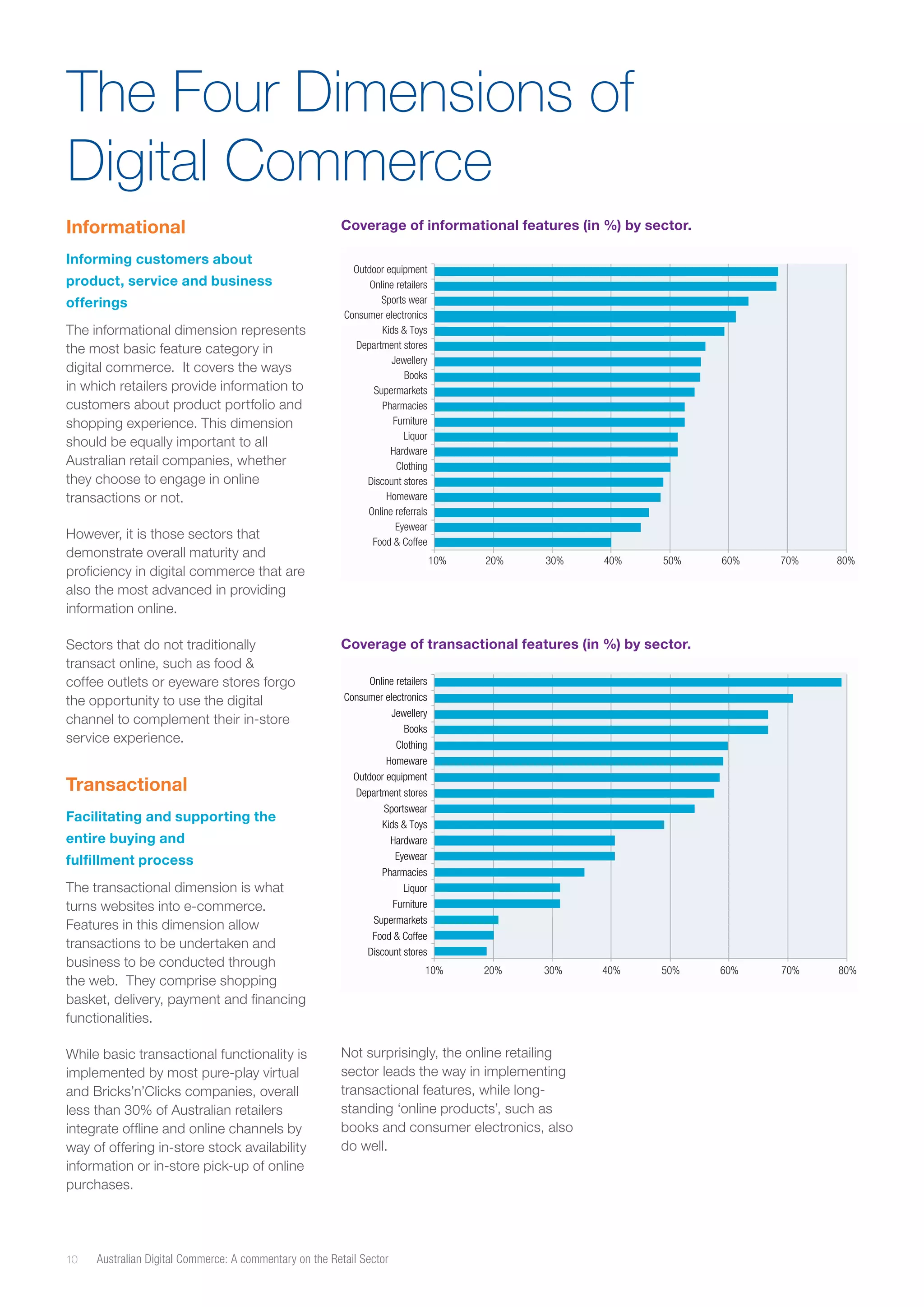
However, it is those sectors that
demonstrate overall maturity and
proficiency in digital commerce that are
also the most advanced in providing
information online.
Sectors that do not traditionally
transact online, such as food &
coffee outlets or eyeware stores forgo
the opportunity to use the digital
channel to complement their in-store
service experience.

Transactional
Facilitating and supporting the
entire buying and
fulfillment process
The transactional dimension is what
turns websites into e-commerce.
Features in this dimension allow
transactions to be undertaken and
business to be conducted through
the web. They comprise shopping
basket, delivery, payment and financing
functionalities.
While basic transactional functionality is
implemented by most pure-play virtual
and Bricks’n’Clicks companies, overall
less than 30% of Australian retailers
integrate offline and online channels by
way of offering in-store stock availability
information or in-store pick-up of online
purchases.

10

Coverage of informational features (in %) by sector.
Outdoor equipment
Online retailers
Sports wear
Consumer electronics
Kids & Toys
Department stores
Jewellery
Books
Supermarkets
Pharmacies
Furniture
Liquor
Hardware
Clothing
Discount stores
Homeware
Online referrals
Eyewear
Food & Coffee
10%

20%

30%

40%

50%

60%

70%

80%

60%

70%

80%

Coverage of transactional features (in %) by sector.
Online retailers
Consumer electronics
Jewellery
Books
Clothing
Homeware
Outdoor equipment
Department stores
Sportswear
Kids & Toys
Hardware
Eyewear
Pharmacies
Liquor
Furniture
Supermarkets
Food & Coffee
Discount stores
10%

20%

30%

Not surprisingly, the online retailing
sector leads the way in implementing
transactional features, while longstanding ‘online products’, such as
books and consumer electronics, also
do well.

Australian Digital Commerce: A commentary on the Retail Sector

40%

50%
Relational
Building 1-to-1 relationships with
customers, loyalty and repeat
purchases
The Relational dimension marks
the evolution from early-stage,
transaction-focused e-commerce to
engagement and relationship building
with customers. Example features are
website personalisation, recommender
systems, various user interaction
features, loyalty and benefits schemes
and other features that aim to build
relationships and retain customers for
repeat purchases.
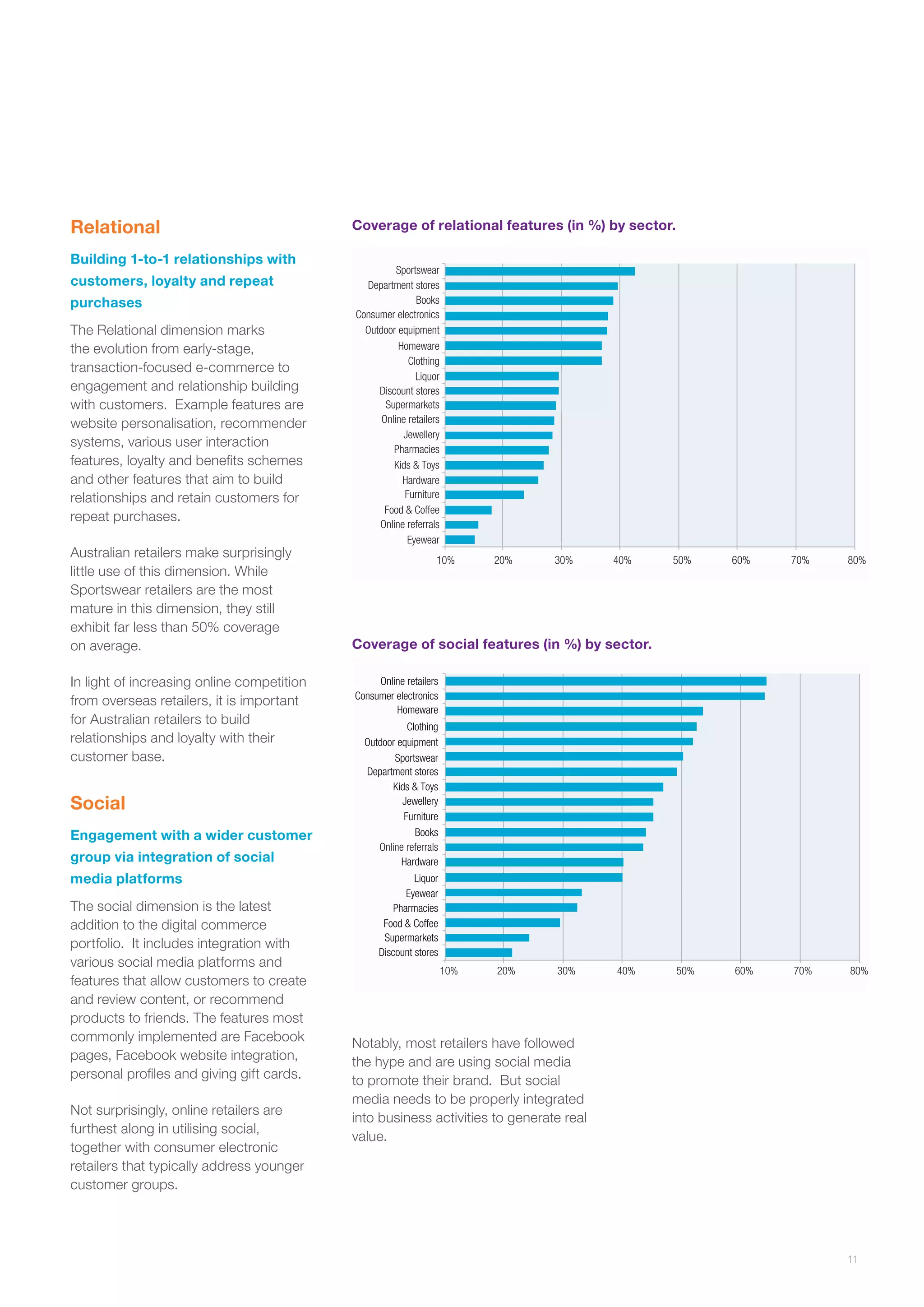
Australian retailers make surprisingly
little use of this dimension. While
Sportswear retailers are the most
mature in this dimension, they still
exhibit far less than 50% coverage
on average.
In light of increasing online competition
from overseas retailers, it is important
for Australian retailers to build
relationships and loyalty with their
customer base.

Social
Engagement with a wider customer
group via integration of social
media platforms
The social dimension is the latest
addition to the digital commerce
portfolio. It includes integration with
various social media platforms and
features that allow customers to create
and review content, or recommend
products to friends. The features most
commonly implemented are Facebook
pages, Facebook website integration,
personal profiles and giving gift cards.
Not surprisingly, online retailers are
furthest along in utilising social,
together with consumer electronic
retailers that typically address younger
customer groups.

Coverage of relational features (in %) by sector.
Sportswear
Department stores
Books
Consumer electronics
Outdoor equipment
Homeware
Clothing
Liquor
Discount stores
Supermarkets
Online retailers
Jewellery
Pharmacies
Kids & Toys
Hardware
Furniture
Food & Coffee
Online referrals
Eyewear
10%

20%

30%

40%

50%

60%

70%

80%

60%

70%

80%

Coverage of social features (in %) by sector.
Online retailers
Consumer electronics
Homeware
Clothing
Outdoor equipment
Sportswear
Department stores
Kids & Toys
Jewellery
Furniture
Books
Online referrals
Hardware
Liquor
Eyewear
Pharmacies
Food & Coffee
Supermarkets
Discount stores
10%

20%

30%

40%

50%

Notably, most retailers have followed
the hype and are using social media
to promote their brand. But social
media needs to be properly integrated
into business activities to generate real
value.

11
12

Australian Digital Commerce: A commentary on the Retail Sector
THE
RELATIONAL
GAP

13
The Relational Gap
What does it mean to
become relational?

engage with customers, build loyalty
and grow a sustainable customer base
in the digital channel.

A closer look at the results in the

While many
Australian retailers
have leaped into
social media, most
do not provide
an integrated
experience that
builds 1-to-1
relationships with
their customers as
the basis for a wider
social engagement.

relational dimension
Becoming relational means to move
beyond executing transactions with
customers. Converting banner hits
to visitors and visitors to paying
customers is costly. Effective digital
commerce aims to grow and harness a
loyal customer base.
Operationally, it means to single out
customers and provide services that
treat customers as individuals and
not as part of an anonymous mass.
This can be done by providing a
personalised digital experience and
enable product recommendations, and
by allowing customers to establish a
history with the company as the basis
for repeat purchases.
The Relational Gap
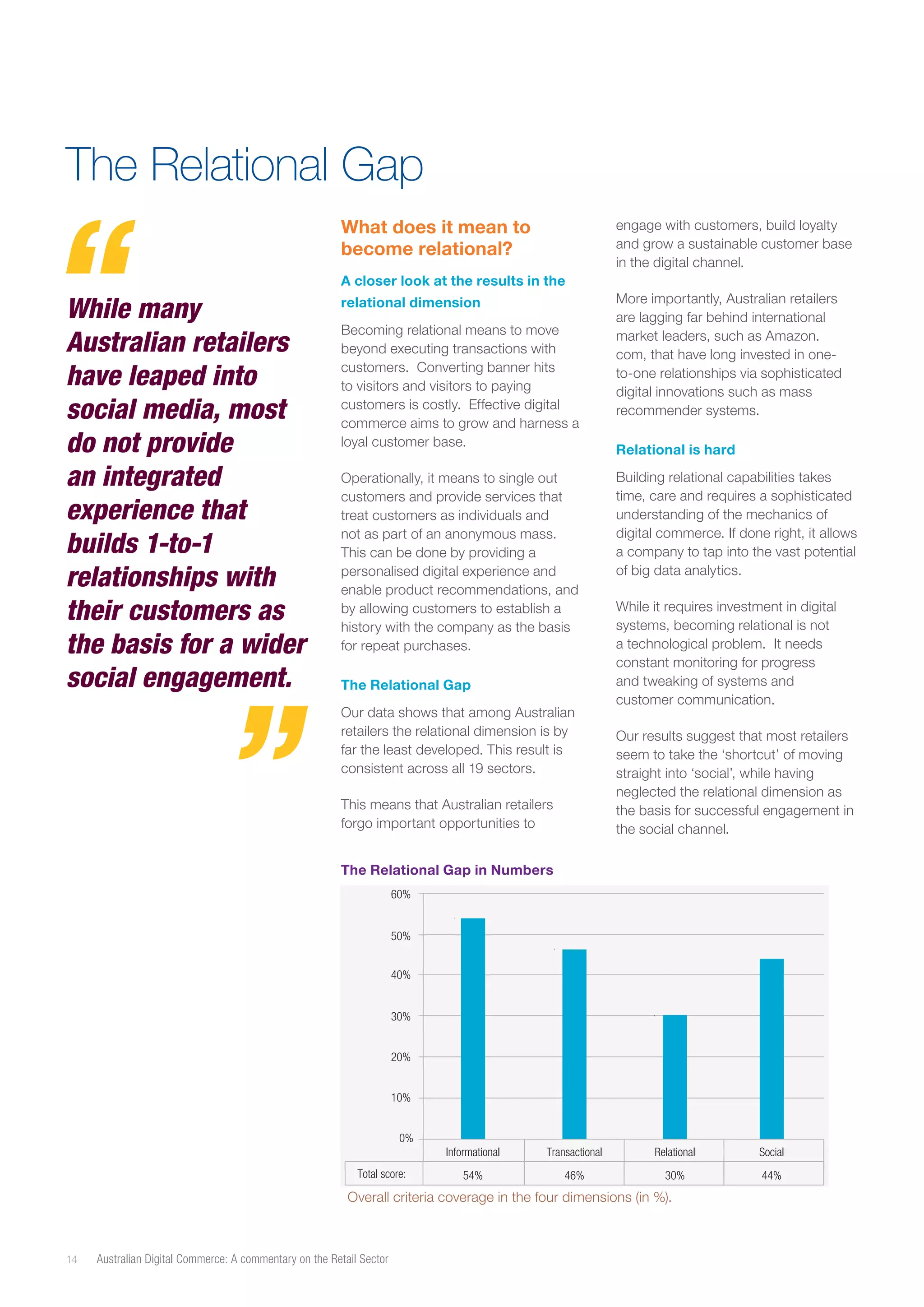
Our data shows that among Australian
retailers the relational dimension is by
far the least developed. This result is
consistent across all 19 sectors.
This means that Australian retailers
forgo important opportunities to

More importantly, Australian retailers
are lagging far behind international
market leaders, such as Amazon.
com, that have long invested in oneto-one relationships via sophisticated
digital innovations such as mass
recommender systems.
Relational is hard
Building relational capabilities takes
time, care and requires a sophisticated
understanding of the mechanics of
digital commerce. If done right, it allows
a company to tap into the vast potential
of big data analytics.
While it requires investment in digital
systems, becoming relational is not
a technological problem. It needs
constant monitoring for progress
and tweaking of systems and
customer communication.
Our results suggest that most retailers
seem to take the ‘shortcut’ of moving
straight into ‘social’, while having
neglected the relational dimension as
the basis for successful engagement in
the social channel.

The Relational Gap in Numbers
60%
50%
40%
30%
20%
10%
0%
Informational
Total score:

Transactional

Relational

Social

54%

46%

30%

44%

Overall criteria coverage in the four dimensions (in %).

14

Australian Digital Commerce: A commentary on the Retail Sector
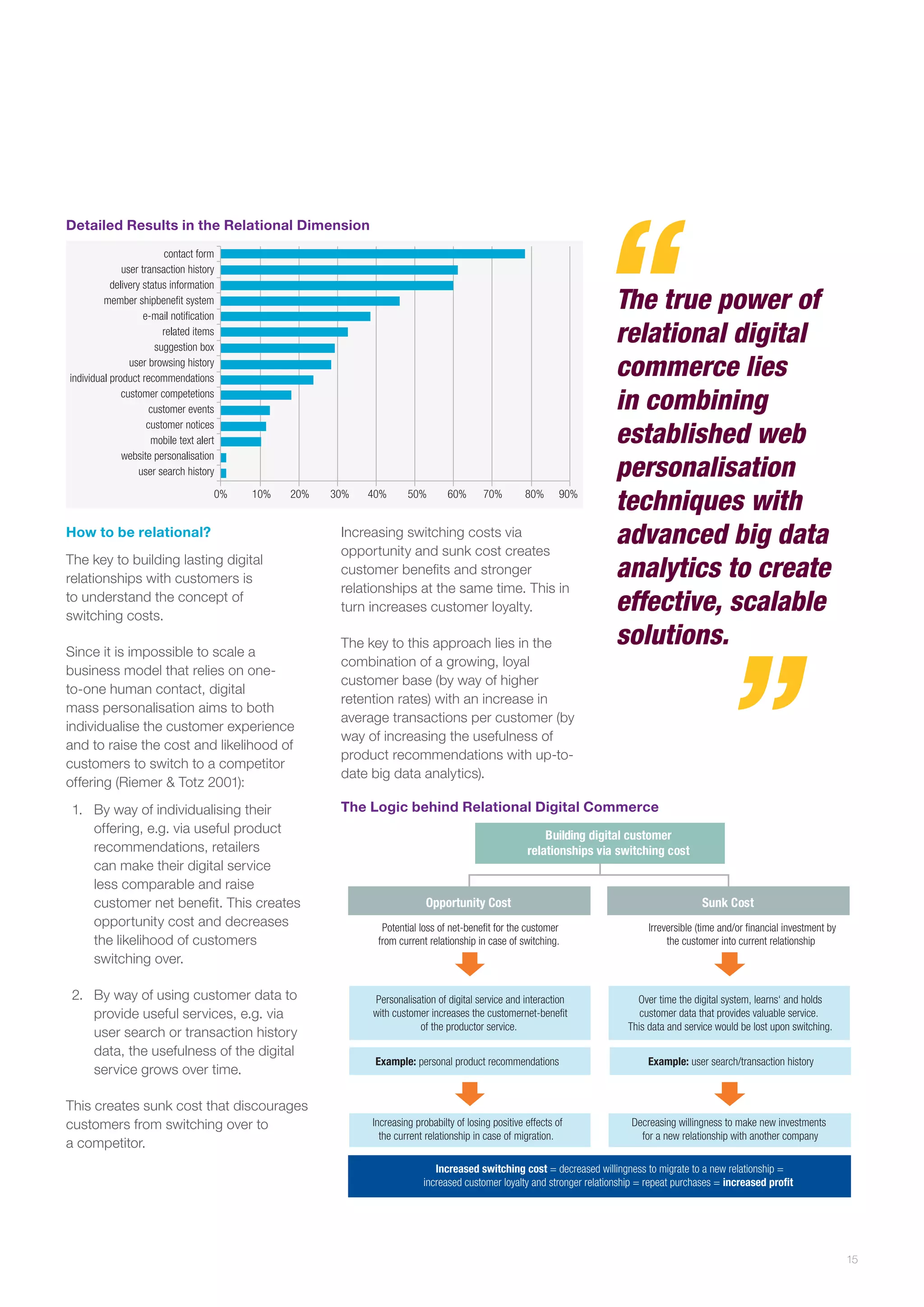
Detailed Results in the Relational Dimension
contact form
user transaction history
delivery status information
member shipbenefit system
e-mail notification
related items
suggestion box
user browsing history
individual product recommendations
customer competetions
customer events
customer notices
mobile text alert
website personalisation
user search history
0%

10%

20%

How to be relational?
The key to building lasting digital
relationships with customers is
to understand the concept of
switching costs.
Since it is impossible to scale a
business model that relies on oneto-one human contact, digital
mass personalisation aims to both
individualise the customer experience
and to raise the cost and likelihood of
customers to switch to a competitor
offering (Riemer & Totz 2001):
1.	 By way of individualising their
offering, e.g. via useful product
recommendations, retailers
can make their digital service
less comparable and raise
customer net benefit. This creates
opportunity cost and decreases
the likelihood of customers
switching over.
2.	 By way of using customer data to
provide useful services, e.g. via
user search or transaction history
data, the usefulness of the digital
service grows over time.
This creates sunk cost that discourages
customers from switching over to
a competitor.

30%

40%

50%

60%

70%

80%

90%

Increasing switching costs via
opportunity and sunk cost creates
customer benefits and stronger
relationships at the same time. This in
turn increases customer loyalty.
The key to this approach lies in the
combination of a growing, loyal
customer base (by way of higher
retention rates) with an increase in
average transactions per customer (by
way of increasing the usefulness of
product recommendations with up-todate big data analytics).

The true power of
relational digital
commerce lies
in combining
established web
personalisation
techniques with
advanced big data
analytics to create
effective, scalable
solutions.

The Logic behind Relational Digital Commerce
Building digital customer
relationships via switching cost

Opportunity Cost
Potential loss of net-benefit for the customer
from current relationship in case of switching.

Sunk Cost
Irreversible (time and/or financial investment by
the customer into current relationship

Personalisation of digital service and interaction
with customer increases the customernet-benefit
of the productor service.

Over time the digital system‚ learns‘ and holds
customer data that provides valuable service.
This data and service would be lost upon switching.

Example: personal product recommendations

Example: user search/transaction history

Increasing probabilty of losing positive effects of
the current relationship in case of migration.

Decreasing willingness to make new investments
for a new relationship with another company

Increased switching cost = decreased willingness to migrate to a new relationship =
increased customer loyalty and stronger relationship = repeat purchases = increased profit

15
16

Australian Digital Commerce: A commentary on the Retail Sector
BRICKS ‘n’
MORTAR
VS
BRICKS ‘n’
CLICKS

17
Bricks ‘n’ Mortar Vs
Bricks ‘n’ Clicks
Can online work with the
high-street?
With new players emerging and
incumbents rethinking or adding to
their business models, bridging the gap
between the traditional high-street and
the online world is arguably one of the
biggest challenges Australian Retailers
are facing. Quite often, these are seen
as competing groups that compete
for market share, sometimes within a
single brand. There are three types of
Retail companies covered in our study:
Bricks ‘n’ Mortar
In some sectors, transactional digital
commerce is harder to achieve or
does not make sense (e.g. selling
prescription-based eye-ware requires
in-store eye testing).
In other cases, transitional highstreet retailers are slow to engage in
digital transformation and build only

Pure-play Virtual

basic online ventures pushing mainly
informational content. Their overriding
aim is to generate footfall into their
stores. Afraid of ‘losing’ customers to
the internet they avoid going virtual.
Typically, they are quite good at offering
loyalty schemes with store cards
and building face-to-face customer
relationships through store assistance
and staff members.

These are the digital disruptors that
are capturing the loyalty of customers
through excellent online experiences.
These companies are able to generate
a regular flow of customers through
strong social media engagement,
superior transactional capabilities and
personalised online experiences.
Regardless of the model, Australian
retailers need to have an online
presence, but clearly link it to their
business model in order to maximise
the value and identify where it is they
want to push the customer to spend
on products and services. Social
commerce isn’t something to fear,
it should be embraced to connect
with larger than ever groups of
consumers online.

Bricks ‘n’ Clicks
Being a hybrid of transitional and pure
online, these organisations embrace
transactional use of the internet and
have the strength of both physical
and online relationship building.
They are best placed to develop
relationships because they can do so
both online and physically. This group
however faces unique challenges of
coordinating multi-channel logistics
and engagement with customers and
potentially conflicting price politics.

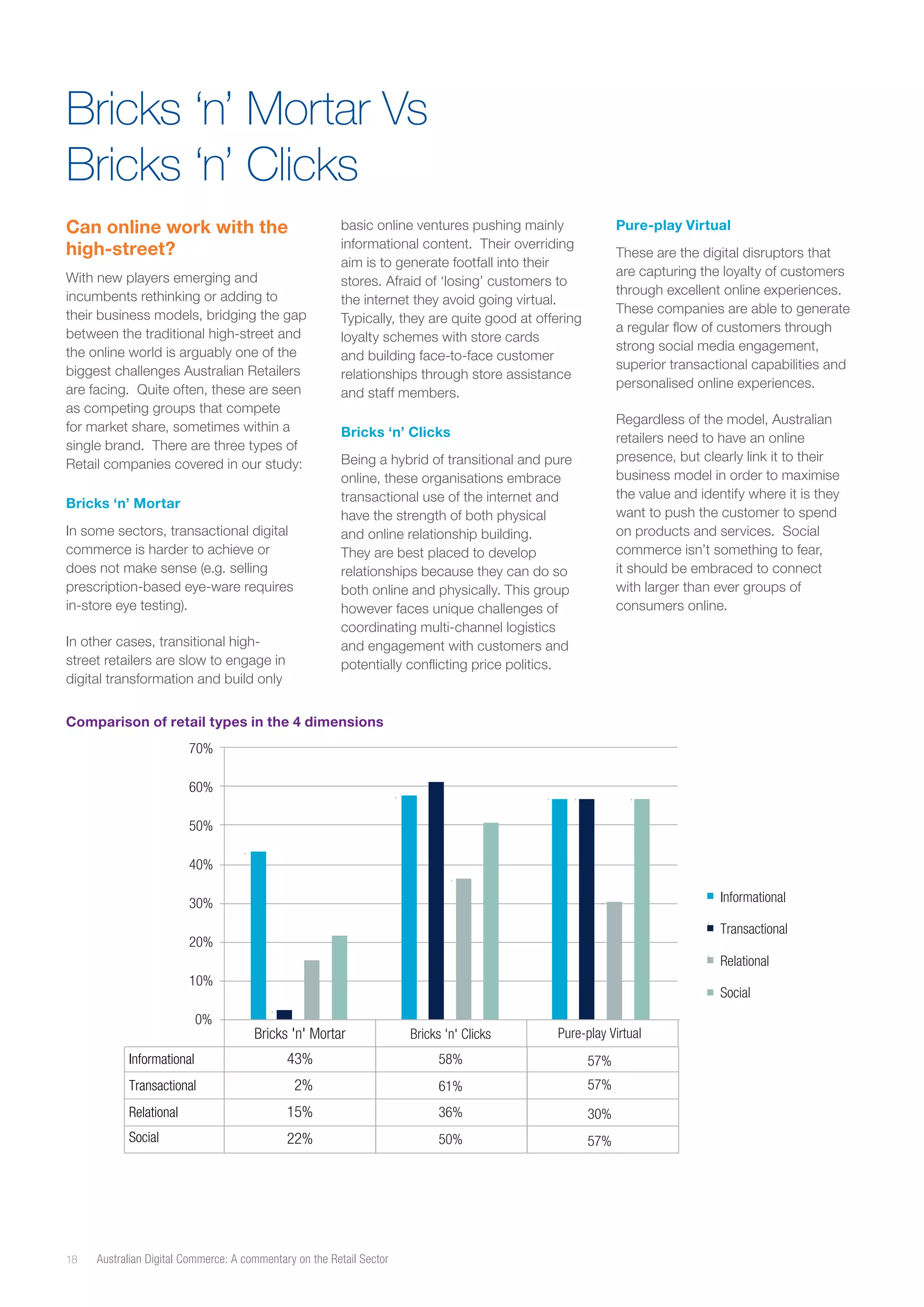
Comparison of retail types in the 4 dimensions

70%
60%
50%
40%
Informational

30%

Transactional

20%

Relational
10%
0%

Social
Bricks 'n' Clicks

Pure-play Virtual

Informational

43%

58%

57%

Transactional

2%

61%

57%

Relational

15%

36%

30%

Social

18

Bricks 'n' Mortar

22%

50%

57%

Australian Digital Commerce: A commentary on the Retail Sector
19
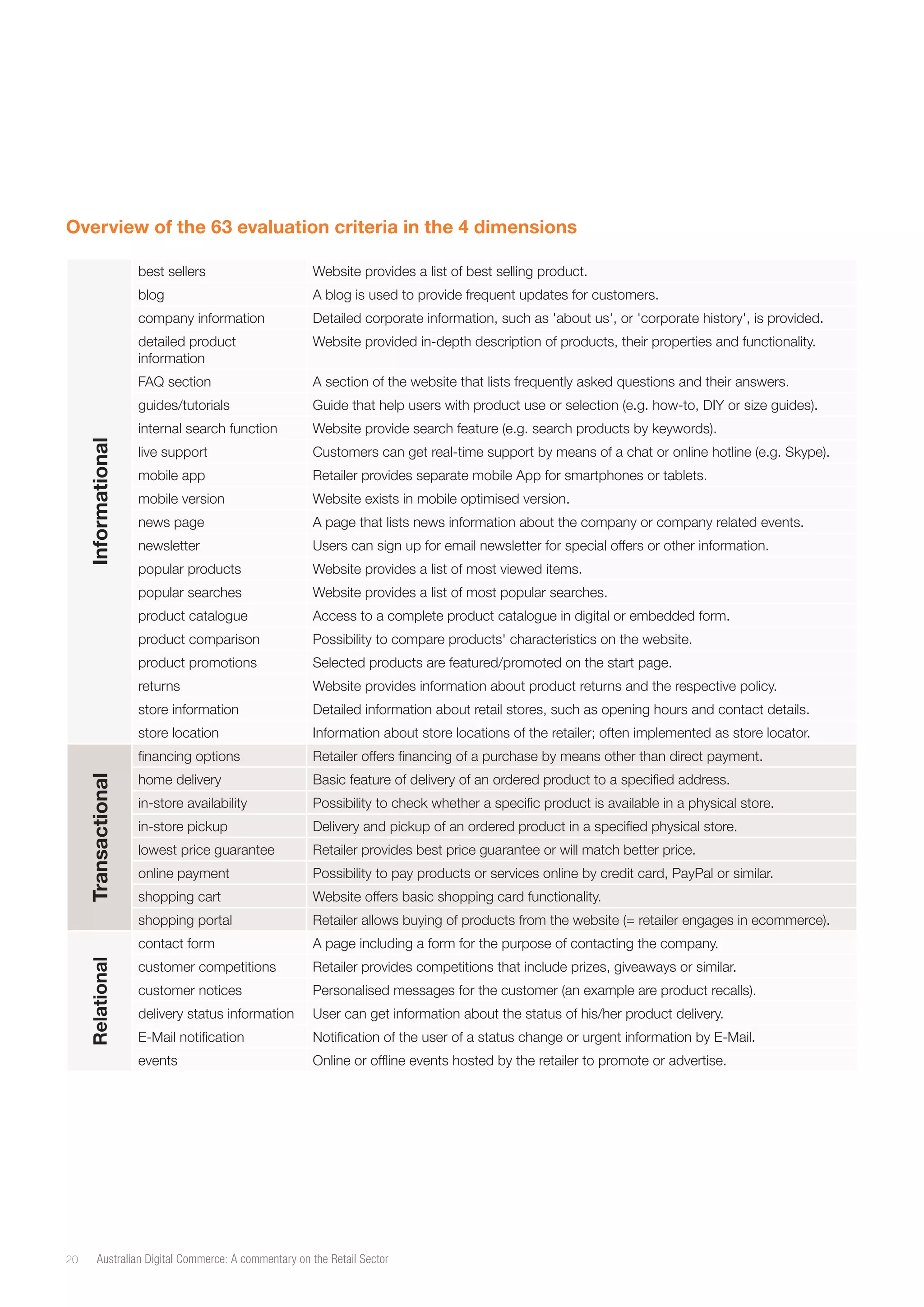
Overview of the 63 evaluation criteria in the 4 dimensions

Website provided in-depth description of products, their properties and functionality.

FAQ section

A section of the website that lists frequently asked questions and their answers.

guides/tutorials

Guide that help users with product use or selection (e.g. how-to, DIY or size guides).

internal search function

Website provide search feature (e.g. search products by keywords).

live support

Customers can get real-time support by means of a chat or online hotline (e.g. Skype).

mobile app

Retailer provides separate mobile App for smartphones or tablets.

mobile version

Website exists in mobile optimised version.

news page

A page that lists news information about the company or company related events.

newsletter

Users can sign up for email newsletter for special offers or other information.

popular products

Website provides a list of most viewed items.

popular searches

Website provides a list of most popular searches.

product catalogue

Access to a complete product catalogue in digital or embedded form.

product comparison

Possibility to compare products' characteristics on the website.

product promotions

Selected products are featured/promoted on the start page.

returns

Website provides information about product returns and the respective policy.

store information

Detailed information about retail stores, such as opening hours and contact details.

store location

Information about store locations of the retailer; often implemented as store locator.

financing options

Retailer offers financing of a purchase by means other than direct payment.

home delivery

Basic feature of delivery of an ordered product to a specified address.

in-store availability

Possibility to check whether a specific product is available in a physical store.

in-store pickup

Delivery and pickup of an ordered product in a specified physical store.

lowest price guarantee

Retailer provides best price guarantee or will match better price.

online payment

Possibility to pay products or services online by credit card, PayPal or similar.

shopping cart

Website offers basic shopping card functionality.

shopping portal

Retailer allows buying of products from the website (= retailer engages in ecommerce).

contact form

A page including a form for the purpose of contacting the company.

customer competitions

Retailer provides competitions that include prizes, giveaways or similar.

customer notices

Personalised messages for the customer (an example are product recalls).

delivery status information

User can get information about the status of his/her product delivery.

E-Mail notification

Notification of the user of a status change or urgent information by E-Mail.

events

Transactional

Detailed corporate information, such as 'about us', or 'corporate history', is provided.

detailed product
information

Relational

A blog is used to provide frequent updates for customers.

company information

20

Website provides a list of best selling product.

blog

Informational

best sellers

Online or offline events hosted by the retailer to promote or advertise.

Australian Digital Commerce: A commentary on the Retail Sector
Scheme that brings benefits (e.g. discounts or special offers), to participating members.

mobile text alert

Notification of the user of a status change or urgent information by text message.

related items

Website offers products similar or related to currently viewed product.

suggestion box

Possibility to give dedicated feedback other than by simple contact form.

user browsing history

User is provided with list of products or pages s/he previously visited.

user search history

User is provided with list of searches s/he previously executed.

user transaction history

User is provided with list of his/her past transaction.

website personalisation

Presentation or function of the websitecan be adjusted to personal preferences.

cross selling

Products that other customers bought who also bought the currently viewed product.

E-Mail to a friend

Possibility to E-Mail a product or page to a friend for recommendation purposes.

evaluation of reviews

Evaluation of a product review. For example whether it was helpful or not.

Facebook integration

Basic integration with Facebook; includes like and share buttons.

Facebook page

Retailer operates Facebook page that is also listed on the website.

favourite products

Collection of favourite products into a list for later reference and social sharing.

forum

Discussion platform where people can have conversations in form of posted messages.

gift card

Social

User is provided with individualised product recommendations.

membership benefit
system

Relational

individual product
recommendations

Possibility to purchase and/or pay by gift card or voucher for the shop.

Google+ integration

Basic integration with Google+; includes plus-one and share buttons.

Google+ page

Retailer operates Google+ page that is also listed on the website

individual portal

A 'myRetailer' page that gives access to restricted individual member functions.

Instagram integration

Use of Instagram that is also listed on the website; retailer promotes to interact with it.

personal profile

Retailer allows user to present themselves with a profile (e.g. 'my products').

Pinterest integration

Use of Pinterest that is also listed on the website; retailer promotes to interact with it.

product Q&A

Possibility to ask questions regarding a specific product and/or answer questions.

ratings

User evaluation of a product or service by a point or star system.

reviews

User valuation of a product or service by a written text.

Twitter account

Use of Twitter that is also listed on the website; retailer promotes to interact with it.

Twitter integration

Basic integration with Twitter; includes twitter feed and tweet button.

YouTube/Vimeo integration Use of Youtube and/or Vimeo listed on the website; retailer promotes to interact with it.

21
About the Authors
Kai Riemer is Associate Professor and Chair of Business Information Systems at the University of
Sydney Business School. Kai’s research is focused on Enterprise Social Networking, e-Collaboration,
inter-firm networking, virtual work, and E-Commerce. He has developed methods for team
communication, enterprise social network adoption and collaborative business practices.
kai.riemer@sydney.edu.au
twitter: karisyd
Jens Brunk is a student of Information Systems at the University of Münster (Germany) and a research
visitor with the Discipline of Business Information Systems at the University of Sydney Business School.
Jens’ research is in the field of digital commerce. Prior to coming to Sydney Jens spent a year in Spain,
where he worked for SEAT, S.A. and studied at the Universidad del País Vasco in Bilbao.
mail@jensbrunk.de

Uri Gal is a Senior Lecturer in the Discipline of Business Information Systems. Uri’s research takes a
social view of organisational processes in the context of the implementation and use of information
systems. He is focused on the relationships between people and technology in organisations, and
changes in work practices, organisational identities, and the introduction of new information systems.
uri.gal@sydney.edu.au

Ben Gilchriest is the venture lead for Capgemini Australia’s Digital Transformation practice. Ben has run
consulting businesses and supported large multi-nationals and government departments in their digital
strategy and transformation both in Europe and Asia-Pacific. Prior to joining Capgemini he ran a research
lab at the University of Bath and holds a Ph.d. in Neuroscience.
ben.gilchriest@capgemini.com
twitter: bengilchriest
Robert Ord is a Senior Consultant in Capgemini’s Marketing, Sales, and Service consulting practice.
Rob has worked in both the London and Sydney offices supporting clients across sectors. He is
specialised in customer strategy development, customer experience and multi-channel design.
robert.ord@capgemini.com
twitter: robertsord

Australian Digital Transformation Lab.
The Australian Digital Transformation Lab is a joint venture between The University of Sydney Business School and Capgemini Australia. It
combines the established academic research skills and knowledge of the Business School’s Discipline of Business Information Systems
with Capgemini’s expertise and leadership in business transformation and organisational change.
The Lab will engage in a range of research activities and produce studies in the following two key areas:
1.	 Digital transformation of business models: Digital technologies are disrupting established business models, but at the same
time open new opportunities for digital innovation and new business ideas. The Lab will investigate issues related to the digital
transformation of Australian businesses and industries.
2.	 Digital transformation of work and organisation: Digital technologies enable new forms of work, work place communication
and work organisation. The Lab will focus on the impact of new technologies with a focus on the successful management of digital
transformation utilising technologies such as Enterprise Social Networking.

22

Australian Digital Commerce: A commentary on the Retail Sector
REFERENCES:
Curty, R. G., and Zhang, P. 2013. “Website features that gave rise to social commerce: a historical analysis,” Electronic Commerce
Research and Applications (12:4), pp. 260–279.
Madlberger, M. 2004. “Strategies and Business Models in Electronic Retailing: Indications from the US and the UK,” in Proceedings of
the 6th international conference on Electronic commerce, pp. 296–303.
McKay, J., and Marshall, P. 2004. Strategic management of e-business, John Wiley & Sons Australia, Ltd.
Riemer, K., and Totz, C. 2001. “The many faces of personalization - an integrative overview of mass customization and
personalization”, Proceedings of the 1st World Congress on Mass Customization and Personalization, Hong Kong, (China),
Oct 1-2, 2001.
Turban, E., King, D., and Lang, J. 2009. Introduction to electronic commerce, (2nd ed.) Pearson Education.

23
The University of Sydney Business School is a world-class business
school at the forefront of global business and management education.
Relevant and focused on today’s business world, we are the only
Australian business school to achieve membership to CEMS - the
Global Alliance in Management Education in addition to international
accreditation from AACSB and EQUIS. 
Dedicated to the highest-quality teaching and to groundbreaking
research, our staff are industry leaders with a passion for creating
tomorrow’s world business leaders.

Driving Digital Transformation

Capgemini Australia’s Digital Transformation practice helps organisations
find digital opportunities within their business. Our team specialises
in identifying, designing, and developing new ventures, innovative
delivery models, and digital transformations to get real value from the
digital economy.
We offer a fresh approach based on collaborative and iterative design
with a focus on targeted outcomes. You bring your customer and
business experience. We bring perspectives from our understanding of
the Australian and global digital economy, and our leadership in business
and technology transformation.

Helping you
find, size, and
catalyse digital
opportunities.

Learn more about us at

www.capgemini.com.au
This is a publication of the Australian Digital Transformation Lab, a joint venture between The University of Sydney Business School and Capgemini Australia. The
information contained in this document is proprietary. All rights reserved. © 2013.

Australian Digital Commerce & "The Relational Gap"

  • 1.
    Australian Digital Commerce: Acommentary on the Retail Sector
  • 2.
    Authors Kai Riemer, JensBrunk, Uri Gal (The University of Sydney Business School) Ben Gilchriest, Robert Ord (Capgemini Australia) Contacts A/Prof Kai Riemer, kai.riemer@sydney.edu.au Ben Gilchriest, ben.gilchriest@capgemini.com Study background Data collection and analysis carried out between August and October 2013. Download study http://hdl.handle.net/2123/9540 This is a publication of the Australian Digital Transformation Lab, a joint venture between The University of Sydney Business School and Capgemini Australia. The information contained in this document is proprietary. All rights reserved. © 2013.
  • 3.
    Table of Contents Whatis Digital Commerce? The Four Dimensions of Digital Commerce The Relational Gap Bricks ‘n’ Mortar Vs Bricks ‘n’ Clicks Key findings 1. Australian Retailers have achieved a reasonable level of maturity in providing customers with the ability to get information and transact online (Informational and Transactional aspects of their Digital Commerce engagement). 2. However, Relational and Social features are under utilised. Australian retailers are missing opportunities to connect with customers and create loyalty and drive repeat business. 3. Social features are mainly used for broadcasting messages through social platforms. There is a major development opportunity for Australian retailers to engage a wider consumer base through social features. 4. Relationship building (Relational aspects) is the most under-utilised dimension. The potential for generating customer intimacy and brand loyalty is currently unexploited by Australian retailers and has created a Relational Gap. 5. The key to a sustainable digital commerce presence for Australian retailers is to close the Relational Gap with investment in Relational digital commerce features.
  • 4.
    4 Australian Digital Commerce:A commentary on the Retail Sector
  • 5.
  • 6.
    What is DigitalCommerce? Digital Commerce “Digital Commerce is the Web 2.0 version of electronic commerce comprising the full bandwidth of engagement with customers through various digital channels, including social media and mobile, in order to build lasting relationships, create meaningful exchanges and generate repeat business.” A new social dimension to e-commerce 89 retail companies were analysed as part of the study, with a mix of “bricks & mortar”, “bricks & clicks” and “pure-play virtual”. Each company was evaluated against 63 criteria to measure their level of digital commerce activity. USD $1trillion and more than 50% of Australians are ‘Digital Buyers’, preferring to buy online where possible1. Why being social is necessary to survive in the digital economy E-commerce has been around since the late 1970s. We saw an acceleration of web-based business, culminating in the dot.com boom in the early 2000s when new business models based on Internet technology first took off, but created an ultimately unsustainable market environment. Despite the many failures, this era gave rise to new Internet giants that offer a wealth of products and services worldwide; competing with the biggest brands that the world knows. Most Australian consumers have, at some point, bought (or sold) goods or services through the Internet or other electronic channels. Either through basic online stores, marketplaces, online auctions or email, the face-toface element of the transaction was removed from the equation. This First wave of Electronic Commerce has marked a major shift in the way we shop, with a focus on creating new and convenient shopping experiences. It has been estimated that the global e-commerce market is worth over However, after a decade or more of e-commerce, it is becoming increasingly difficult for companies to stand out from the crowd and produce a unique and compelling online experience for their customers. At the same time the advent of Web 2.0 has brought about new opportunities for businesses to differentiate and connect with customers in unprecedented ways. One of the biggest uses of the Internet is for social purposes, whether this be social websites, social blogging platforms, social business interactions, social forums and many more; what is clear is that the Internet is being used to connect like never before. It is this power to connect that digital commerce in the Web 2.0 era leverages to enhance the online buying experience. New technologies provide the ability for companies to engage and connect with their customers at a new level of intimacy. This intimacy is thought to increase loyalty, total spend and generate repeat business. This Retail market commentary will explore these ideas. 1 eMarketer (2013), available at: http://www.emarketer.com/Article/ Ecommerce-Sales-Topped-1-TrillionFirst-Time-2012/1009649 6 Australian Digital Commerce: A commentary on the Retail Sector
  • 7.
    Background This market commentaryis based on a research project which has explored the utilisation of digital commerce by 89 Australian Retailers. The retail market in Australia is diverse and broad. To ensure a balanced view, 19 sectors of the retail market have been studied. In the early days of electronic commerce maturity was a matter of whether a company had progressed beyond offering a static web presence with minimal form of interaction to providing transaction services for executing purchases (McKay and Marshall 2004). The online utilisation of all companies in the sample was evaluated in detail by examining the extent to which certain digital commerce features were available for the consumer. No quality judgements were made. Each type of digital utilisation was assessed from the consumer point-ofview using a list of 63 criteria to record whether certain tools, techniques or features have been implemented. Collectively these criteria form a good indication of the extent to which each company makes use of digital commerce. Today, consumers in many retail sectors take information provision and transaction capabilities for granted. Maturity has become a matter of providing higher levels of engagement and relationship building. For this study we built on and extended a framework by Curty and Zhang (2013). We distinguish among four dimensions of digital commerce, resembling increasing stages of complexity and maturity: informational, transactional, relational and social dimensions of digital commerce. The Four Dimensions of e-commerce and digital commerce INCREASING COMPLEXITY What is the approach? 1. INFORMATIONAL 2. TRANSACTIONAL 3. RELATIONAL 4. SOCIAL Criteria Identification The evaluation of each online utilisation is based on a list of 63 criteria, each of which falls into one of the four dimensions. The criteria catalogue was developed by extending an initial list based on a literature analysis (Curty and Zhang 2013; Madlberger 2004; Turban et al. 2009). New criteria not previously mentioned in the literature were added during the evaluation whenever a new feature was discovered. All retailers were evaluated using the full list. 33.3% of all criteria were newly discovered and a number of criteria from the literature could not be found in the sample and were thus discarded. This is evidence that digital commerce is a fast-moving, constantly changing phenomenon. 7
  • 8.
    8 Australian Digital Commerce:A commentary on the Retail Sector
  • 9.
  • 10.
    The Four Dimensionsof Digital Commerce Informational Informing customers about product, service and business offerings The informational dimension represents the most basic feature category in digital commerce. It covers the ways in which retailers provide information to customers about product portfolio and shopping experience. This dimension should be equally important to all Australian retail companies, whether they choose to engage in online transactions or not. However, it is those sectors that demonstrate overall maturity and proficiency in digital commerce that are also the most advanced in providing information online. Sectors that do not traditionally transact online, such as food & coffee outlets or eyeware stores forgo the opportunity to use the digital channel to complement their in-store service experience. Transactional Facilitating and supporting the entire buying and fulfillment process The transactional dimension is what turns websites into e-commerce. Features in this dimension allow transactions to be undertaken and business to be conducted through the web. They comprise shopping basket, delivery, payment and financing functionalities. While basic transactional functionality is implemented by most pure-play virtual and Bricks’n’Clicks companies, overall less than 30% of Australian retailers integrate offline and online channels by way of offering in-store stock availability information or in-store pick-up of online purchases. 10 Coverage of informational features (in %) by sector. Outdoor equipment Online retailers Sports wear Consumer electronics Kids & Toys Department stores Jewellery Books Supermarkets Pharmacies Furniture Liquor Hardware Clothing Discount stores Homeware Online referrals Eyewear Food & Coffee 10% 20% 30% 40% 50% 60% 70% 80% 60% 70% 80% Coverage of transactional features (in %) by sector. Online retailers Consumer electronics Jewellery Books Clothing Homeware Outdoor equipment Department stores Sportswear Kids & Toys Hardware Eyewear Pharmacies Liquor Furniture Supermarkets Food & Coffee Discount stores 10% 20% 30% Not surprisingly, the online retailing sector leads the way in implementing transactional features, while longstanding ‘online products’, such as books and consumer electronics, also do well. Australian Digital Commerce: A commentary on the Retail Sector 40% 50%
  • 11.
    Relational Building 1-to-1 relationshipswith customers, loyalty and repeat purchases The Relational dimension marks the evolution from early-stage, transaction-focused e-commerce to engagement and relationship building with customers. Example features are website personalisation, recommender systems, various user interaction features, loyalty and benefits schemes and other features that aim to build relationships and retain customers for repeat purchases. Australian retailers make surprisingly little use of this dimension. While Sportswear retailers are the most mature in this dimension, they still exhibit far less than 50% coverage on average. In light of increasing online competition from overseas retailers, it is important for Australian retailers to build relationships and loyalty with their customer base. Social Engagement with a wider customer group via integration of social media platforms The social dimension is the latest addition to the digital commerce portfolio. It includes integration with various social media platforms and features that allow customers to create and review content, or recommend products to friends. The features most commonly implemented are Facebook pages, Facebook website integration, personal profiles and giving gift cards. Not surprisingly, online retailers are furthest along in utilising social, together with consumer electronic retailers that typically address younger customer groups. Coverage of relational features (in %) by sector. Sportswear Department stores Books Consumer electronics Outdoor equipment Homeware Clothing Liquor Discount stores Supermarkets Online retailers Jewellery Pharmacies Kids & Toys Hardware Furniture Food & Coffee Online referrals Eyewear 10% 20% 30% 40% 50% 60% 70% 80% 60% 70% 80% Coverage of social features (in %) by sector. Online retailers Consumer electronics Homeware Clothing Outdoor equipment Sportswear Department stores Kids & Toys Jewellery Furniture Books Online referrals Hardware Liquor Eyewear Pharmacies Food & Coffee Supermarkets Discount stores 10% 20% 30% 40% 50% Notably, most retailers have followed the hype and are using social media to promote their brand. But social media needs to be properly integrated into business activities to generate real value. 11
  • 12.
    12 Australian Digital Commerce:A commentary on the Retail Sector
  • 13.
  • 14.
    The Relational Gap Whatdoes it mean to become relational? engage with customers, build loyalty and grow a sustainable customer base in the digital channel. A closer look at the results in the While many Australian retailers have leaped into social media, most do not provide an integrated experience that builds 1-to-1 relationships with their customers as the basis for a wider social engagement. relational dimension Becoming relational means to move beyond executing transactions with customers. Converting banner hits to visitors and visitors to paying customers is costly. Effective digital commerce aims to grow and harness a loyal customer base. Operationally, it means to single out customers and provide services that treat customers as individuals and not as part of an anonymous mass. This can be done by providing a personalised digital experience and enable product recommendations, and by allowing customers to establish a history with the company as the basis for repeat purchases. The Relational Gap Our data shows that among Australian retailers the relational dimension is by far the least developed. This result is consistent across all 19 sectors. This means that Australian retailers forgo important opportunities to More importantly, Australian retailers are lagging far behind international market leaders, such as Amazon. com, that have long invested in oneto-one relationships via sophisticated digital innovations such as mass recommender systems. Relational is hard Building relational capabilities takes time, care and requires a sophisticated understanding of the mechanics of digital commerce. If done right, it allows a company to tap into the vast potential of big data analytics. While it requires investment in digital systems, becoming relational is not a technological problem. It needs constant monitoring for progress and tweaking of systems and customer communication. Our results suggest that most retailers seem to take the ‘shortcut’ of moving straight into ‘social’, while having neglected the relational dimension as the basis for successful engagement in the social channel. The Relational Gap in Numbers 60% 50% 40% 30% 20% 10% 0% Informational Total score: Transactional Relational Social 54% 46% 30% 44% Overall criteria coverage in the four dimensions (in %). 14 Australian Digital Commerce: A commentary on the Retail Sector
  • 15.
    Detailed Results inthe Relational Dimension contact form user transaction history delivery status information member shipbenefit system e-mail notification related items suggestion box user browsing history individual product recommendations customer competetions customer events customer notices mobile text alert website personalisation user search history 0% 10% 20% How to be relational? The key to building lasting digital relationships with customers is to understand the concept of switching costs. Since it is impossible to scale a business model that relies on oneto-one human contact, digital mass personalisation aims to both individualise the customer experience and to raise the cost and likelihood of customers to switch to a competitor offering (Riemer & Totz 2001): 1. By way of individualising their offering, e.g. via useful product recommendations, retailers can make their digital service less comparable and raise customer net benefit. This creates opportunity cost and decreases the likelihood of customers switching over. 2. By way of using customer data to provide useful services, e.g. via user search or transaction history data, the usefulness of the digital service grows over time. This creates sunk cost that discourages customers from switching over to a competitor. 30% 40% 50% 60% 70% 80% 90% Increasing switching costs via opportunity and sunk cost creates customer benefits and stronger relationships at the same time. This in turn increases customer loyalty. The key to this approach lies in the combination of a growing, loyal customer base (by way of higher retention rates) with an increase in average transactions per customer (by way of increasing the usefulness of product recommendations with up-todate big data analytics). The true power of relational digital commerce lies in combining established web personalisation techniques with advanced big data analytics to create effective, scalable solutions. The Logic behind Relational Digital Commerce Building digital customer relationships via switching cost Opportunity Cost Potential loss of net-benefit for the customer from current relationship in case of switching. Sunk Cost Irreversible (time and/or financial investment by the customer into current relationship Personalisation of digital service and interaction with customer increases the customernet-benefit of the productor service. Over time the digital system‚ learns‘ and holds customer data that provides valuable service. This data and service would be lost upon switching. Example: personal product recommendations Example: user search/transaction history Increasing probabilty of losing positive effects of the current relationship in case of migration. Decreasing willingness to make new investments for a new relationship with another company Increased switching cost = decreased willingness to migrate to a new relationship = increased customer loyalty and stronger relationship = repeat purchases = increased profit 15
  • 16.
    16 Australian Digital Commerce:A commentary on the Retail Sector
  • 17.
  • 18.
    Bricks ‘n’ MortarVs Bricks ‘n’ Clicks Can online work with the high-street? With new players emerging and incumbents rethinking or adding to their business models, bridging the gap between the traditional high-street and the online world is arguably one of the biggest challenges Australian Retailers are facing. Quite often, these are seen as competing groups that compete for market share, sometimes within a single brand. There are three types of Retail companies covered in our study: Bricks ‘n’ Mortar In some sectors, transactional digital commerce is harder to achieve or does not make sense (e.g. selling prescription-based eye-ware requires in-store eye testing). In other cases, transitional highstreet retailers are slow to engage in digital transformation and build only Pure-play Virtual basic online ventures pushing mainly informational content. Their overriding aim is to generate footfall into their stores. Afraid of ‘losing’ customers to the internet they avoid going virtual. Typically, they are quite good at offering loyalty schemes with store cards and building face-to-face customer relationships through store assistance and staff members. These are the digital disruptors that are capturing the loyalty of customers through excellent online experiences. These companies are able to generate a regular flow of customers through strong social media engagement, superior transactional capabilities and personalised online experiences. Regardless of the model, Australian retailers need to have an online presence, but clearly link it to their business model in order to maximise the value and identify where it is they want to push the customer to spend on products and services. Social commerce isn’t something to fear, it should be embraced to connect with larger than ever groups of consumers online. Bricks ‘n’ Clicks Being a hybrid of transitional and pure online, these organisations embrace transactional use of the internet and have the strength of both physical and online relationship building. They are best placed to develop relationships because they can do so both online and physically. This group however faces unique challenges of coordinating multi-channel logistics and engagement with customers and potentially conflicting price politics. Comparison of retail types in the 4 dimensions 70% 60% 50% 40% Informational 30% Transactional 20% Relational 10% 0% Social Bricks 'n' Clicks Pure-play Virtual Informational 43% 58% 57% Transactional 2% 61% 57% Relational 15% 36% 30% Social 18 Bricks 'n' Mortar 22% 50% 57% Australian Digital Commerce: A commentary on the Retail Sector
  • 19.
  • 20.
    Overview of the63 evaluation criteria in the 4 dimensions Website provided in-depth description of products, their properties and functionality. FAQ section A section of the website that lists frequently asked questions and their answers. guides/tutorials Guide that help users with product use or selection (e.g. how-to, DIY or size guides). internal search function Website provide search feature (e.g. search products by keywords). live support Customers can get real-time support by means of a chat or online hotline (e.g. Skype). mobile app Retailer provides separate mobile App for smartphones or tablets. mobile version Website exists in mobile optimised version. news page A page that lists news information about the company or company related events. newsletter Users can sign up for email newsletter for special offers or other information. popular products Website provides a list of most viewed items. popular searches Website provides a list of most popular searches. product catalogue Access to a complete product catalogue in digital or embedded form. product comparison Possibility to compare products' characteristics on the website. product promotions Selected products are featured/promoted on the start page. returns Website provides information about product returns and the respective policy. store information Detailed information about retail stores, such as opening hours and contact details. store location Information about store locations of the retailer; often implemented as store locator. financing options Retailer offers financing of a purchase by means other than direct payment. home delivery Basic feature of delivery of an ordered product to a specified address. in-store availability Possibility to check whether a specific product is available in a physical store. in-store pickup Delivery and pickup of an ordered product in a specified physical store. lowest price guarantee Retailer provides best price guarantee or will match better price. online payment Possibility to pay products or services online by credit card, PayPal or similar. shopping cart Website offers basic shopping card functionality. shopping portal Retailer allows buying of products from the website (= retailer engages in ecommerce). contact form A page including a form for the purpose of contacting the company. customer competitions Retailer provides competitions that include prizes, giveaways or similar. customer notices Personalised messages for the customer (an example are product recalls). delivery status information User can get information about the status of his/her product delivery. E-Mail notification Notification of the user of a status change or urgent information by E-Mail. events Transactional Detailed corporate information, such as 'about us', or 'corporate history', is provided. detailed product information Relational A blog is used to provide frequent updates for customers. company information 20 Website provides a list of best selling product. blog Informational best sellers Online or offline events hosted by the retailer to promote or advertise. Australian Digital Commerce: A commentary on the Retail Sector
  • 21.
    Scheme that bringsbenefits (e.g. discounts or special offers), to participating members. mobile text alert Notification of the user of a status change or urgent information by text message. related items Website offers products similar or related to currently viewed product. suggestion box Possibility to give dedicated feedback other than by simple contact form. user browsing history User is provided with list of products or pages s/he previously visited. user search history User is provided with list of searches s/he previously executed. user transaction history User is provided with list of his/her past transaction. website personalisation Presentation or function of the websitecan be adjusted to personal preferences. cross selling Products that other customers bought who also bought the currently viewed product. E-Mail to a friend Possibility to E-Mail a product or page to a friend for recommendation purposes. evaluation of reviews Evaluation of a product review. For example whether it was helpful or not. Facebook integration Basic integration with Facebook; includes like and share buttons. Facebook page Retailer operates Facebook page that is also listed on the website. favourite products Collection of favourite products into a list for later reference and social sharing. forum Discussion platform where people can have conversations in form of posted messages. gift card Social User is provided with individualised product recommendations. membership benefit system Relational individual product recommendations Possibility to purchase and/or pay by gift card or voucher for the shop. Google+ integration Basic integration with Google+; includes plus-one and share buttons. Google+ page Retailer operates Google+ page that is also listed on the website individual portal A 'myRetailer' page that gives access to restricted individual member functions. Instagram integration Use of Instagram that is also listed on the website; retailer promotes to interact with it. personal profile Retailer allows user to present themselves with a profile (e.g. 'my products'). Pinterest integration Use of Pinterest that is also listed on the website; retailer promotes to interact with it. product Q&A Possibility to ask questions regarding a specific product and/or answer questions. ratings User evaluation of a product or service by a point or star system. reviews User valuation of a product or service by a written text. Twitter account Use of Twitter that is also listed on the website; retailer promotes to interact with it. Twitter integration Basic integration with Twitter; includes twitter feed and tweet button. YouTube/Vimeo integration Use of Youtube and/or Vimeo listed on the website; retailer promotes to interact with it. 21
  • 22.
    About the Authors KaiRiemer is Associate Professor and Chair of Business Information Systems at the University of Sydney Business School. Kai’s research is focused on Enterprise Social Networking, e-Collaboration, inter-firm networking, virtual work, and E-Commerce. He has developed methods for team communication, enterprise social network adoption and collaborative business practices. kai.riemer@sydney.edu.au twitter: karisyd Jens Brunk is a student of Information Systems at the University of Münster (Germany) and a research visitor with the Discipline of Business Information Systems at the University of Sydney Business School. Jens’ research is in the field of digital commerce. Prior to coming to Sydney Jens spent a year in Spain, where he worked for SEAT, S.A. and studied at the Universidad del País Vasco in Bilbao. mail@jensbrunk.de Uri Gal is a Senior Lecturer in the Discipline of Business Information Systems. Uri’s research takes a social view of organisational processes in the context of the implementation and use of information systems. He is focused on the relationships between people and technology in organisations, and changes in work practices, organisational identities, and the introduction of new information systems. uri.gal@sydney.edu.au Ben Gilchriest is the venture lead for Capgemini Australia’s Digital Transformation practice. Ben has run consulting businesses and supported large multi-nationals and government departments in their digital strategy and transformation both in Europe and Asia-Pacific. Prior to joining Capgemini he ran a research lab at the University of Bath and holds a Ph.d. in Neuroscience. ben.gilchriest@capgemini.com twitter: bengilchriest Robert Ord is a Senior Consultant in Capgemini’s Marketing, Sales, and Service consulting practice. Rob has worked in both the London and Sydney offices supporting clients across sectors. He is specialised in customer strategy development, customer experience and multi-channel design. robert.ord@capgemini.com twitter: robertsord Australian Digital Transformation Lab. The Australian Digital Transformation Lab is a joint venture between The University of Sydney Business School and Capgemini Australia. It combines the established academic research skills and knowledge of the Business School’s Discipline of Business Information Systems with Capgemini’s expertise and leadership in business transformation and organisational change. The Lab will engage in a range of research activities and produce studies in the following two key areas: 1. Digital transformation of business models: Digital technologies are disrupting established business models, but at the same time open new opportunities for digital innovation and new business ideas. The Lab will investigate issues related to the digital transformation of Australian businesses and industries. 2. Digital transformation of work and organisation: Digital technologies enable new forms of work, work place communication and work organisation. The Lab will focus on the impact of new technologies with a focus on the successful management of digital transformation utilising technologies such as Enterprise Social Networking. 22 Australian Digital Commerce: A commentary on the Retail Sector
  • 23.
    REFERENCES: Curty, R. G.,and Zhang, P. 2013. “Website features that gave rise to social commerce: a historical analysis,” Electronic Commerce Research and Applications (12:4), pp. 260–279. Madlberger, M. 2004. “Strategies and Business Models in Electronic Retailing: Indications from the US and the UK,” in Proceedings of the 6th international conference on Electronic commerce, pp. 296–303. McKay, J., and Marshall, P. 2004. Strategic management of e-business, John Wiley & Sons Australia, Ltd. Riemer, K., and Totz, C. 2001. “The many faces of personalization - an integrative overview of mass customization and personalization”, Proceedings of the 1st World Congress on Mass Customization and Personalization, Hong Kong, (China), Oct 1-2, 2001. Turban, E., King, D., and Lang, J. 2009. Introduction to electronic commerce, (2nd ed.) Pearson Education. 23
  • 24.
    The University ofSydney Business School is a world-class business school at the forefront of global business and management education. Relevant and focused on today’s business world, we are the only Australian business school to achieve membership to CEMS - the Global Alliance in Management Education in addition to international accreditation from AACSB and EQUIS.  Dedicated to the highest-quality teaching and to groundbreaking research, our staff are industry leaders with a passion for creating tomorrow’s world business leaders. Driving Digital Transformation Capgemini Australia’s Digital Transformation practice helps organisations find digital opportunities within their business. Our team specialises in identifying, designing, and developing new ventures, innovative delivery models, and digital transformations to get real value from the digital economy. We offer a fresh approach based on collaborative and iterative design with a focus on targeted outcomes. You bring your customer and business experience. We bring perspectives from our understanding of the Australian and global digital economy, and our leadership in business and technology transformation. Helping you find, size, and catalyse digital opportunities. Learn more about us at www.capgemini.com.au This is a publication of the Australian Digital Transformation Lab, a joint venture between The University of Sydney Business School and Capgemini Australia. The information contained in this document is proprietary. All rights reserved. © 2013.