Procurement	
  Essen.als:
A	
  blueprint	
  to	
  e-­‐commerce	
  success
         26th	
  September	
  2011


                                                  1
Agenda
•   Strategic developments in e-commerce and multi
    channel retail considerations for your business model

•   Planning

•   Challenges/issues

•   Requirements gathering

•   The RFP

•   Supplier selection

•   ROI
My deliverables today
•   Insight

•   Inspire
•   Provoke

•   Make more effective decisions
•   Improve your ROI

•   Reduce costs
•   Have a better chance of getting live on time

•   Mildly entertaining
My other involvement this week


•   Tuesday: ‘Mind the gap’: Recruitment, retention
    and skills issues

•   Wednesday: Technology panel, fashion panel, live
    site reviews

•   Thursday: Website optimisation masterclass
A poor man’s Billy Connolly
And like Ronnie, I’ll go off on a tangent
          from time to time
About us
• Practicology is about providing actionable insight delivered by people who have
  done the job
• We’ve all been at the coal face: I have previously been head of e-commerce for
  Ted Baker, Burberry, Harrods and Pentland brands
• We’re a full service global e-commerce and multi channel retail consultancy
• We have clients in Australia, UK, US, Malaysia, Scandinavia, Germany, Croatia,
  Switzerland and Belgium
• International judge of Australia’s Online Retail Awards and Judge of Draper’s
  etail awards 2011
• Run E-Commerce UK (LinkedIn.com)
• Listed in Retail Week’s top 50 ‘etail power list’
We don’t rely on our looks to earn a
    living...It’s a good thing too!
What’s it like to work with us?
Client engagement stages
Denial: I don’t need any help
A client who recognises they need
           some help
A relieved early engagement client
Success: A post engagement client
Nirvana: A long term client
We don’t take ourselves too seriously
but we take your success, very seriously
We’re setting up shop
You made a very good choice
    coming along today
Asides from having kids, or getting married, this
could be the most important thing you ever do!
Still too much smoke and mirrors
•   We took a global FMCG brand through supplier
    selection

•   The same brief saw us get responses from
    $200k to over $3m!
Everything I tell you today, I’ve been through myself
  more than 25 times as a client and a consultant
E-­‐Commerce:	
  Current	
  situa1on
Take figures with a pinch of salt
By 2019 online will deliver more
 growth than offline retail (UK)
Some Australian stats
•During 2010, shoppers have spent $10 to $12bn
 online, about 5% of total retail sales of $250bn.
 [Source: SMH.com, January 2011]

•It’s predicted that spending online will grow to
 $18bn by 2014
 [Source: Frost & Sullivan, via SMH.com, Jan 2011]

•I’ve also read that current sales online are more
 than $20bn!
94% of the Australian population access the internet,
                 79% do so every day.
[Source: AIMIA / Sensis Social Media Report, May 2011]
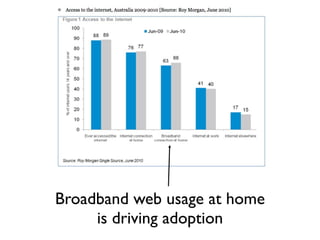
Broadband web usage at home
     is driving adoption
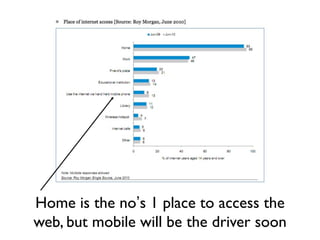
Home is the no’s 1 place to access the
web, but mobile will be the driver soon
Key online activities...with one
     obvious omission!
Fashion, followed by Electrical goods are the most
researched products or services on social networking sites
          [Source: AIMIA / Sensis Social Media Report, May 2011]
36% of Australians made a purchase after
 researching products via social media.
 [Source: AIMIA / Sensis Social Media Report, May 2011]
57% of Australians search the internet for
something to buy at least once a week and more
  than half buy something online every month
        [Source: Digital Futures 2010, CCi, May 2010]
44% of online purchases are
 made to overseas retailers
And...
The combination of no GST, and the high dollar
  are challenging and leading to a retail war
                  on 2 fronts

    With ever-increasing competition from
    International retailers on and offline...
Lulu Lemon’s first online localised proposition
      outside of North America will be in
Australia...and they’re opening more stores here
These guys want to eat your lunch!
So does Wiggle
And now they’ve opened an Australian site,
they also want the roof from over your head!
They’re taking £1m a week in online
        sales from Australia!
I’ve seen big changes in the last year
     in Australian online retailing
You’ve got a lot to be proud
 of...some great innovation
Augmented Reality:Virtual mirror
Customisation
(Shoes of Prey were there first)
See the camera in action
Demo of the camera’s
But some of your retailer’s are still
      well behind the curve
Keep your eye on the ball...
the pace of change is frightening!
The big changes (This month!)
 •   Retailers no longer hold the power
 •   Consumers choose the channel of engagement
 •   And they expect a seamless experience through all channels
 •   So retailers must make the move from ‘multiple channel’ to ‘cross
     channel’
 •   Consumers are influenced by their peers, not by the retailer
 •   FMCG and CPG players looking to have a direct to consumer play to
     drive insight and sales
 •   Mobile is THE game changer
 •   Social Media is a service and engagement driver
 •   Internationalisation is all the rage...but localisation is required
 •   The gap between buying offline and online continues to narrow
The web has evolved....largely driven by
broadband, wireless and more usable devices
Drivers of growth
•   The drivers for continued growth of sales online will be:
•   Increasing broadband penetration
•   Emerging International markets maturing
•   Ever – increasing media consumption online
•   Social networking and social commerce
•   Smartphone penetration fuelling mobile Internet adoption
•   The alignment of online and offline shopping experiences
•   The convergence of technology....TV/Web
•   Convenience of the shopping experience...driven by cross channel
•   Online propositions localised for the needs of the local market
Define	
  Requirements:
Strategic	
  Developments	
  
 You	
  Need	
  To	
  Plan	
  For
Because if you don’t, you’re going to
         lose market share
In any case, you need to plan for
    tomorrow, not just today
Mobile	
  Development
• 75%	
  of	
  Australians	
  using	
  GPS	
  devices	
  are	
  open	
  to	
  
  viewing	
  targeted	
  deals	
  when	
  visi.ng	
  bricks	
  and	
  
  mortar	
  outlets
• 41%	
  of	
  Australians	
  using	
  GPS	
  devices	
  are	
  open	
  to	
  
  viewing	
  targeted	
  deals	
  at	
  .mes	
  they	
  select
• 83%	
  of	
  18-­‐34	
  year	
  old	
  Australians	
  find	
  geo-­‐
  targeted	
  content	
  via	
  mobile	
  when	
  shopping	
  an	
  
  appealing	
  prospect	
  
• [Source:	
  Galaxy	
  Research,	
  via	
  DMI,	
  June	
  2011]


                                                                   61
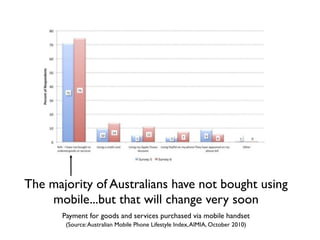
The majority of Australians have not bought using
    mobile...but that will change very soon
       Payment for goods and services purchased via mobile handset
        (Source: Australian Mobile Phone Lifestyle Index, AIMIA, October 2010)
The HIPPO says ‘let’s have an iphone
         or an ipad app
All too often mobile is still a
    very tactical scenario
But it is
driving ‘buyability’
Mobile	
  =	
  THE	
  game	
  changer!

             M-­‐commerce                                    In-­‐store	
  naviga.on
 Development	
  of	
  mobile	
  websites	
                     Mobile	
  ac*ng	
  as	
  in-­‐store	
  
  and	
  apps	
  which	
  make	
  shopping	
           ‘sat	
  nav’	
  for	
  shoppers	
  with	
  advice	
  
online	
  more	
  seamless	
  for	
  shoppers              on	
  where	
  to	
  find	
  par*cular	
  
                                                            products	
  or	
  offers	
  in-­‐store


 Barcode	
  scanning/Image	
                                 Proximity	
  marke.ng
       recogni.on                                        Retailers	
  can	
  leverage	
  loca*on-­‐
Tools	
  which	
  allow	
  shoppers	
  to	
  add	
       based	
  marke*ng	
  offers	
  through	
  
  items	
  to	
  their	
  online	
  basket	
  by	
                       mobile
 scanning	
  items	
  in	
  the	
  home	
  e.g.	
  
          Tesco’s	
  grocery	
  app
• 15% of Ocado’s sales during H1
  2011 came from its smartphone app
• Debenhams took £1m through their
  iPhone app in the first 6 months
• River Island will take over £2m this
 year through their app
Supermarkets in Asia leading
   the way with pop ups
Developments in Asia lead the way


-­‐	
  Over	
  500	
  of	
  its	
  most	
  popular	
  products,	
  complete	
  with	
  QR	
  codes	
  
which	
  can	
  be	
  scanned	
  using	
  the	
  Homeplus	
  app
-­‐	
  Products	
  range	
  from	
  daily	
  essen.als	
  such	
  as	
  milk	
  and	
  fresh	
  
produce,	
  to	
  pet	
  food	
  and	
  sta.onery	
  
-­‐	
  Orders	
  placed	
  before	
  13:00	
  will	
  be	
  delivered	
  to	
  customers'	
  homes	
  
on	
  the	
  same	
  day
The starting point for me...
How many retailers have a mobile
     compatible website?
Not many
Mobile can be the glue to bring customer engagement
     and the multi channel experience together
By 2015:
50%+ of web access through mobile

            By 2020:
 80% of web access will be through
             mobile
So you need to build mobile
into your requirements and
    your roadmap now
Mul1	
  Channel	
  Development
99% of retailers are
 ‘multiple channel’
Multi channel just means more than one
                 channel

‘Cross-channel’ is bringing together the
 strengths of each channel to create a
  better overall customer experience
Multi channel is not about managing
       customer expectations

   It’s about meeting customer
           expectations
The customer chooses the channel of engagement
Today’s consumer is a multi channel shopper
Today‘s consumer is a multi-channel shopper


                     “Almost everyone is a multi-
                     channel shopper, 86%
                     regularly use more than one
                     channel”
                     – Leo Burnett, 2010 Multichannel customer research
A multi channel proposition
Multi channel proposition on the PDP
The way we communicate has fundamentally
               changed
The purchase path is no longer linear
                       Presales Information    Product Availability   Assistance            Trans-action
Channels


Print


TV/Radio

Store

Internet


Letter

E-Mail

Telephone


Fax

SMS/MMS


            Usage of channel        Channel combination example of multichannel customers
•   63% research online before buying instore
•   89% who buy online also shop instore

•   20% of all online customers pick up their goods instore

•   29% researched offline before buying online
•   Multi channel customers spent 3.5 times as much as single channel customers

•   ‘Shop engagement is key’: Branch online orders grew by 130% in 2010

•   The store is credited with the sale

•   Click and collect growing at 2 x the rate of online sales
•   Mobile drives 5m visits to the website

•   A £3k bed was bought through mobile!
•   Multi Channel Shoppers visit stores three times more frequently

•   Multi Channel Customers are twice as loyal
Remember that the web is a
   sales driver for all of the
retailer’s channels, and not just
    a source of incremental
            revenue...
•Ted’s cameras know that their website only
represents around 5% of the company's total
sales but it influences 50-60% of all sales made
through all channels.
•And it is because of this, that they realize
integration across all channels is essential to
provide a complete user experience
•Dick Smith: 23% of online order revenue now
picked up in store
13% now being picked up in store
The web is a huge driver for offline
               sales
There’s too much talk about multi channel and
not enough focus on aligning the business with
           the customer’s journey
Let me tell you a story...
•   Casino customer journey:

•   Having breakfast I realise I’m out of milk and cornflakes so
    I order them on my iPad

•   Then at lunch I remember I’ve forgotten to order juice for
    dinner so I use my PC to do so

•   On the way to the store I then remember I need wine and
    I use my iPhone app to order

•   In store I’m pinged a coupon offering me 50% off a
    different cereal as I’m standing in the aisle looking at
    cereal

•   I also get a reminder on my phone that I haven’t bought
•   Opticians/Optometrist customer journey

•   Let’s imagine you were buying a new pair of glasses. What would be the
    optimum customer journey?

•   I went online using my iMac at home to make an appointment to have my
    eyes tested

•   I was also able to select a few brands of frames I might be interested in

•   When I went into the store, the staff and the optician new who I was and
    had the frames I was interested in ready

•   After my test and after I had selected a new frame, I was waiting for my
    glasses to be made up with the lenses when using an interactive in store
    mirror I tried on different sunglasses with different tints

•   I bought them and I went home

•   2 weeks later I sat on my glasses and broke them

•   I opened up the glasses case as I remembered there were contact details in
    there along with my customer reference

•   I called the store, or maybe I went online, either way they had my
    prescription to hand and they made me up a new pair of glasses in 24 hours
• So keep this in mind when you start to
  define your requirements for your
  e-commerce platform
• If you’re a multi channel business, what
  might the optimal customer journey
  be?
The number one driver for
customer’s is ‘convenience’ and the
    other driver is ‘immediacy’
The optimal customer
convenience proposition
•   Buy from the channel of choice: Online, in
    store, by phone

•   Return to the channel of choice…free

•   Have your order delivered to the place of
    choice: Work, home, your store for pick up

•   Have the order fulfilled at a time of their
    choosing

•   Have your order gift wrapped with a gift card
This is happening right now
Think ‘omni channel’
Interna1onalisa1on
• You	
  can’t	
  afford	
  to	
  only	
  look	
  inwardly
• You	
  need	
  to	
  extend	
  your	
  reach	
  and	
  take	
  market	
  
  share	
  from	
  new	
  markets


                                                                   103
What’s the size of the prize?
This will bring a tear to your eye
•B2C e-commerce worth €591bn in 2010
•Up 25% from 2009
•Between 2009 and 2013, global e-commerce
 sales will more than double!
•Source: IMR World
What’s happening now?
Top 10 Countries
    source: IMR World
The mature e-commerce markets in the
 US & UK will grow annually by 15% to
      20% over the coming years
         (Source: IMR World)
It’s a small world isn’t it?


“Yes, but a successful Internationalisation strategy is more
 than just language translation and currency conversion”
4 strategies in play
1. Do nothing: Don’t allow anyone to buy
   from overseas
2. Standardisation: Switch on the buy button
   only
3. Adaptation: Localise some aspects
4. Localisation: Fully localise the customer
   proposition
Some of us find it hard enough
    selling domestically
Yes lot’s of us aren’t doing it at all
In the UK, 42% of us haven’t even switched on
               the buy button!
            Source: Snow Valley delivery report
And most of us have only switched on the buy button
 and not localised the proposition = standardisation
Yet Debenhams are piloting multi
    lingual placards in store!
No sign of any International
        proposition
Hang on, here we go...
deeply hidden within delivery info
Adaptation = localise some aspects
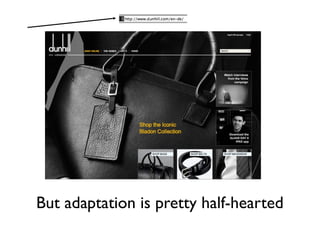
But adaptation is pretty half-hearted
Currency is the only thing to have
        visibly changed
Then there’s the full monty
Local language, payment, currency,
         customer service
A pretty compelling customer
         proposition
The results?
•   Since launch, traffic to clarks.de is 4 times higher
    than previous, this includes traffic generated by
    PPC
•   Conversion rate has grown from launch to
    become very similar to the UK site
•   Returns rate is much higher than the UK..again
    due to German catalogue heritage
•   Basket size and bounce rates are very similar on
    DE to UK
NET-A-PORTER/LIVE...
Internationalisation before your eyes
The American’s are coming!
You can now buy in the UK from
   many leading US retailers
But they haven’t got the model quite right!
  Would you pay an extra 50% to cover
            additional charges?
Hey, the World speak’s English!
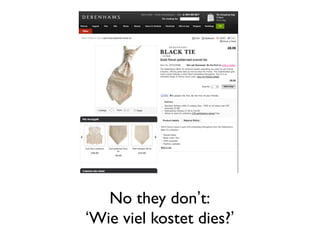
No they don’t:
‘Wie viel kostet dies?’
Why is it so important to give foreign
  nationals a local language site?
Cross border sales are growing...but
 localised propositions work best
Is it worth doing?
You better believe it!
Just ask ASOS...Free delivery worldwide!
  And International sales are up 161%
       43% of their sales = £140m
Cloggs take 15% of total sales through Cloggs.eu = £2.55m
   With France and Germany being the biggest markets
11Cs of Internationalisation
  •   Country
  •   Customers
  •   Communication
  •   Culture
  •   Customer Service
  •   Competitors
  •   Currency
  •   Conversion
  •   Categories
  •   Content
  •   Costs
•   Country
The United States of Europe...or is it?
If you want to know the difference
      just look at Eurovision!
•   Different currencies

•   Different payment methods

•   Different values

•   Different cultures

•   Different tastes

•   Different fears

•   Different motivations
If you haven’t localised yet....
Analyse existing web traffic patterns in order
to make some informed assumptions around
 the opportunity from international markets
• Traffic x conversion rate x AOV = Sales
  potential
Tip: Start with English
    language sites
Customers
You need to meet the needs of different user groups
who go about their journey in a slightly different way
Self service customers
Guess what the big drivers are?
Any tool that helps self service
customer’s get in and get out quickly
Mega menu’s can take one or two
clicks away from the path to purchase
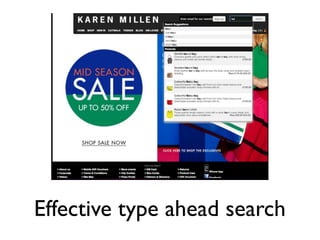
Effective type ahead search
Guess what the number one driver
   for German customer’s is?
34% of Germans want speed and efficiency:
(Source: atg e-commerce trends in Europe)
36% of Germans get annoyed by the
   checkout...they’re not alone
The things that annoy customers at
    the bag and the checkout...
Do you deliver abroad?
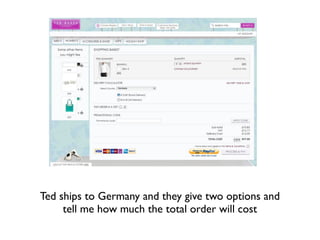
Ted ships to Germany and they give two options and
     tell me how much the total order will cost
If you are going to add on duty and other charges, make
   sure you show these on the bag, not in the checkout
At the bag I should know what the total cost of
the order is, whether or not you do gift wrap and
  gift message and what the delivery options are
Don’t force me to register
This is how to handle it
38% of French people want
  comparison shopping
But...size also matters
New or inexperienced web users
Reassure me, let me speak to a human if
 I need to! And....do you actually exist?
Difficulties reaching the organisation when they have
questions is the biggest frustration in France and Spain
                          (38%)
20% of Brits like to read peer
reviews and comments before buying
Ratings and reviews provide
    confidence and trust
Consumer trust in various sources of information
      and media: most trusted sources
  [Source: Nielsen Social Media Report, February 2010]
Key drivers for new customers and/or
     inexperienced web users =
            - Trust markers
          - Contact number
          - Your credentials
    - What other people bought
What’s the customer
       proposition?
•   Product/range the same?

•   Category hierarchy and naming the same?

•   Products, colours and styles the same name?

•   Americanise the English on the US site

•   Cross channel experience – Enable return to
    store in relevant markets?
What’s the customer
       proposition?
•   What currencies?

•   What languages? You can probably get away with an
    English language site for some EU markets such as the
    Netherlands and even Scandinavia
•   What payment methods? Local market debit and
    credit cards as well as other options such as pay on
    invoice or bill me later?

•   Enable customers to place orders over the phone?
•   Price positioning…same pricing?
Culture
• Cultural variances of local markets can
  impact upon a number of considerations
Not the optimum image for the
         middle east
Simplicity suits the Swedes
ooh la la...the French prefer a bit of
                theatre
In Japan, shopping represents a social activity, an
        opportunity to meet friends and socialise.
Due to this social function and reluctance to use credit
cards, online shopping has struggled to really take off in
            Japan whereas M-Commerce has
•   And of course, each country will observe its own
    public holidays and festivals:

•   Basic operational issues and requirements such as the
    fulfilment of customer orders and handling customer
    service at these important times of year
Currency/Payment
Germans want to know:
 ‘Can I pay using ELV?’
Europeans want to know:
    ‘Can I pay in €?’
Scandinavians want to know:
‘Can I pay cash on delivery?’
A growing number of customers also
     want to pay using PayPal
The $ is still the global currency
•   Can your PSP handle all of these
    requirements?
Most preferred payment methods
Top tip:
Think global - act local
Social	
  Media:	
  
What’s	
  it	
  all	
  about?
The	
  term	
  social	
  media	
  refers	
  to	
  the	
  use	
  of	
  web-­‐based	
  
and	
  mobile	
  technologies	
  to	
  turn	
  communica*on	
  into	
  
 interac*ve	
  dialogue	
  and	
  social	
  interac*on	
  that	
  allow	
  
the	
  crea*on	
  and	
  exchange	
  of	
  user-­‐generated	
  content


                                                                          11
The rise of customer democracy
Facebook is particularly good for
          democracy!
• An	
  integrated	
  online	
  experience	
  is	
  now	
  a	
  key	
  
  requirement	
  rather	
  than	
  a	
  nice-­‐to-­‐have
• Customers	
  expect	
  to	
  swap	
  effortlessly	
  between	
  
  online	
  shopping	
  (e-­‐commerce	
  pla^orms),	
  social	
  
  pla^orms	
  (such	
  as	
  Facebook)	
  and	
  related	
  online	
  
  touch	
  points


                                                              197
‘Social shopping’: ‘F-Commerce’
The jury is still out on that one in
     terms of F-Commerce
However as a marketing tool it can
           drive sales
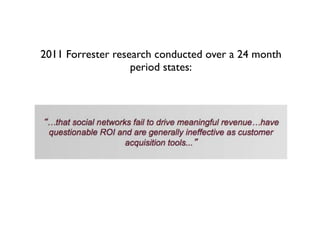
2011 Forrester research conducted over a 24 month
                   period states:
It’s now all about ‘word of web’ as
opposed to offline word of mouth
You already do
       it offline
•   Meeting prospects
•   Building relationships
•   Asking questions
•   Answering questions
•   Building trust
•   Building your reputation
Business investment in social media is extremely
  low suggesting the approach is very tactical
      [Source: AIMIA / Sensis Social Media Report, May 2011]
Percentage of marketing budget allocated to social media
average for medium and large businesses is less than 5%!
       [Source: AIMIA / Sensis Social Media Report, May 2011]
25% of Australian medium sized businesses have a social
  media presence, only 44% have a Twitter account =
That’s a lot of businesses with NO social media presence
            and a lot with no Twitter presence
       [Source: AIMIA / Sensis Social Media Report, May 2011]
Who is responsible for a business’ social media presence?
= A real lack of customer service engagement through social
          [Source: AIMIA / Sensis Social Media Report, May 2011]
The	
  customer	
  chooses	
  the	
  channel	
  
            of	
  engagement


                                         13
Tradi.onal	
  outbound	
  marke.ng


                               14
Marke.ng	
  today:	
  In	
  bound


                                    15
•It is our contention that it should penetrate the whole
organization

•Social Media shouldn’t :
•Be a ‘campaign’ or a ‘tactical’ sales tool  
•Nor should it only be customer facing
•Social media should :
•Embrace the internal business
•Harness the knowledge and insight available within those who
don’t always have a voice or a vehicle to impart their knowledge
through
Who has leveraged their employees
knowledge and engaged them with
  social media in their business?
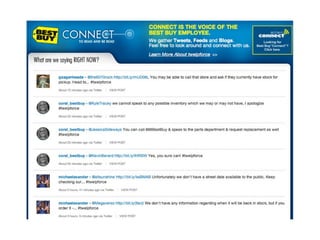
•Their Best Buy Connect social media platform has
the aim of showcasing their people, their culture and
with unedited perspectives, presents a transparent
picture of the business and its employees.

•It puts a truly human face on the brand, whilst
increasing accessibility and driving transparency.

•This in turn can have a tremendously positive effect
on current and future customer perceptions as well as
on current and future employees.
Social media is a service driver and
   key customer retention tool
Think ‘local social’:
Growing role of social interactions within customer
                 shopping missions
   Ability to drive footfall, advocacy and insight
Define	
  Requirements	
  For
Marrying	
  Brand	
  &	
  Transac1ons
It’s	
  a	
  thin	
  line	
  between	
  ‘futurology’	
  
                 and	
  hallucina.on


                                               218
Usability on its head
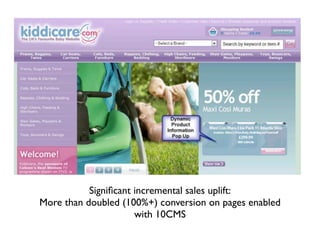
Case study: Kiddicare
Home page carousel
Significant incremental sales uplift:
More than doubled (100%+) conversion on pages enabled
                      with 10CMS
Fits.me: Bridging the gap between the
      on and offline fitting room
Augmented reality is driving online
        furniture sales
What are you waiting for?
Please don’t go for the ‘dip your toes approach’
     You can leapfrog the competition now
Before	
  you	
  begin
Do	
  you	
  have	
  a	
  roadmap	
  and	
  a	
  strategy	
  for	
  
                      e-­‐commerce?


                                                           228
If	
  you	
  don’t	
  have	
  a	
  plan,	
  
then	
  you	
  are	
  planning	
  to	
  fail


                                             229
A Commercial Plan & Roadmap


•   You need a plan for how you’re going to get
    from where you are, to where you want to be

•   High level will do for the key building blocks

•   Show how strategy, resource/people, marketing
    and technology will change over time
What	
  Are	
  The	
  Big	
  
Internal	
  Challenges?
• There	
  	
  are	
  	
  many	
  	
  challenges	
  	
  and	
  	
  issues	
  	
  to	
  	
  address	
  	
  
  in	
  	
  order	
  	
  to	
  	
  implement	
  	
  successful	
  	
  e-­‐commerce	


  projects	


• Projects	
  fail	
  typically	
  	
  due	
  to	
  	
  issues	
  	
  on	
  	
  both	
  	
  the	
  	
  
  client	
  and	
  	
  the	
  	
  supplier-­‐side.	
  	
  Rarely	
  	
  are	
  	
  they	
  	
  only	
  	
  
  caused	
  	
  by	
  	
  one	
  	
  of	
  	
  the	
  	
  par.es	
  	
  
• From	
  	
  a	
  	
  client-­‐side	
  	
  perspec.ve,	
  	
  the	
  organisa.ons	
  
  culture	
  and	
  	
  people	
  	
  significantly	
  	
  impact	
  	
  upon	
  	
  the	
  	
  
  success	
  	
  or	
  	
  	
  failure	
  	
  of	
  	
  an	
  	
  e-­‐commerce	
  	
  
  implementa.on	


                                                                                           234
• On	
  	
  top	
  	
  of	
  	
  that,	
  	
  many	
  	
  issues	
  	
  arise	
  	
  from	
  	
  the	
  	
  lack	
  	
  
  of	
  	
  there	
  being	
  a	
  	
  seasoned	
  	
  e-­‐commerce	
  	
  prac..oner	
  	
  
  on	
  	
  the	
  	
  	
  board	
  	
  
• We	
  	
  have	
  	
  seen	
  	
  many	
  	
  examples	
  	
  (too	
  	
  many)	
  	
  where	
  	
  
  projects	
  	
  fall	
  	
  short	
  	
  of	
  	
  expecta.ons,	
  	
  fail	
  	
  altogether,	


  or	
  	
  cost	
  	
  much	
  	
  more	
  	
  than	
  	
  an.cipated	


                                                                                                    235
Why	
  do	
  e-­‐commerce	
  projects	
  fail?
• When	
  there	
  isn’t	
  an	
  experienced	
  e-­‐commerce	
  	
  
  prac**oner	
  	
  on	
  	
  the	
  	
  board,	
  	
  this	
  	
  oEen	
  	
  leads	
  	
  to	
  	
  key	


  decisions	
  	
  being	
  	
  taken	
  	
  without	
  	
  the	
  	
  depth	
  	
  of	
  	
  insight	
  	
  
  required	
  	
  to	
  	
  support	
  	
  them.	
  	
  Issues	
  	
  can	
  	
  	
  include:	
  	
  
    – SeJng	
  	
  unrealis*c	
  	
  expecta*ons.	
  	
  Forecasts	
  	
  are	
  	
  too	
  	
  high	
  	
  and	
  	
  
      unsubstan*ated.	
  	
  Timescale	
  	
  	
  es*mates	
  	
  are	
  too	
  oEen	
  	
  
      incredibly	
  	
  op*mis*c	
  	
  
    – An	
  	
  insufficient	
  	
  level	
  	
  of	
  	
  investment	
  	
  in	
  	
  the	
  	
  development	
  	
  of	
  	
  
      the	
  	
  channel	
  	
  
    – The	
  	
  structure	
  	
  being	
  	
  ineffec*ve	
  	
  
    – The	
  	
  e-­‐commerce	
  	
  channel	
  	
  is	
  	
  developed	
  	
  as	
  	
  a	
  	
  silo	
  	
  and	
  	
  not	
  	
  
      integrated	
  	
  with	
  	
  key	
  	
  business	
  	
  	
  func*ons.	
  	
  The	
  	
  web	
  	
  drives	
  	
  
      visits	
  	
  to	
  	
  stores,	
  	
  and	
  	
  vice	
  	
  versa.	
  	
  This	
  	
  should	
  	
  be	
  	
  factored	
  	
  in	
  
                                                                                                                          236
Why	
  do	
  e-­‐commerce	
  projects	
  fail?
• A	
  	
  lack	
  	
  of	
  	
  cross-­‐func.onal	
  	
  teamwork	
  	
  (because	
  	
  it	
  	
  
  takes	
  	
  more	
  	
  than	
  	
  a	
  	
  head	
  	
  of	
  	
  e-­‐commerce	
  	
  to	


  deliver	
  	
  a	
  	
  successful	
  	
  web	
  	
  channel)
• For	
  	
  the	
  	
  best	
  	
  results	
  	
  collabora.on	
  	
  must	
  	
  take	
  	
  
  place	
  	
  between	
  	
  	
  the	
  	
  following	
  	
  opera.onal	
  	
  units:	
  	
  
        • Buying	
  	
  and	
  	
  Merchandising
        • Marke.ng
        • Supply	
  	
  chain
        • Fulfilment
        • Customer	
  	
  service
        • In-­‐store	
  	
  personnel
        • IT	
  and	
  development	
  	
  team
                                                                                          237
Why	
  do	
  e-­‐commerce	
  projects	
  fail?

• Involving	
  	
  team	
  	
  members	
  	
  who	
  	
  need	
  	
  to	
  	
  interact	
  	
  
  with	
  	
  and	
  	
  be	
  	
  involved	
  	
  with	
  	
  the	
  	
  e-­‐commerce	


  applica.on	
  	
  too	
  	
  late	


  (early	
  	
  stakeholder	
  	
  engagement	
  	
  is	
  	
  a	
  	
  necessity)	
  	
  
• Inadequate	
  	
  team	
  	
  skills	
  	
  (the	
  	
  speed	
  	
  and	
  	
  level	
  	
  of	
  	
  
  growth	
  	
  of	
  	
  e-­‐commerce	
  growth	
  has	
  meant	
  there’s	
  
  a	
  shortage	
  	
  of	
  	
  skills	
  	
  across	
  	
  various	
  	
  remits)	
  	
  
• Overall	
  	
  resistance	
  	
  to	
  	
  change...for	
  most	
  people,	
  
  change	
  comes	
  at	
  a	
  cost

                                                                                                                                                                                                                             238
What	
  can	
  you	
  do	
  about	
  it?
• Proac*ve	
  	
  and	
  	
  forward-­‐thinking	
  	
  businesses	
  	
  can	
  	
  prevent	
  	
  many	
  	
  of	
  	
  these	
  	
  piOalls	
  	
  
  and	
  	
  in	
  	
  doing	
  	
  so,	
  	
  save	
  	
  *me	
  	
  and	
  	
  money	
  	
  while	
  	
  crea*ng	
  	
  a	
  	
  smoother	
  	
  transi*on	
  	
  
  and	
  	
  implementa*on	
  	
  of	
  	
  e-­‐commerce.	


• Follow	
  	
  these	
  	
  steps	
  	
  for	
  	
  the	
  	
  best	
  	
  results:	
  	
  
      – Enrol	
  	
  key	
  	
  stakeholders	
  	
  in	
  	
  the	
  	
  planning	
  	
  phase,	
  	
  including	
  	
  execu*ves	
  	
  who	
  	
  will	
  	
  input	
  	
  into	


        the	
  	
  vision	
  	
  and	
  	
  opera*onal	
  	
  stakeholders	
  	
  who	
  	
  will	
  	
  be	
  	
  involved	
  	
  day-­‐to-­‐day	
  	
  with	
  	
  
        suppor*ng	
  	
  the	
  	
  	
  e-­‐commerce	
  	
  opera*on.	
  	
  As	
  	
  a	
  	
  minimum	
  	
  try	
  	
  to	
  	
  involve	
  	
  in-­‐store,	
  	
  e-­‐
        commerce,	
  	
  supply	
  	
  chain,	
  	
  IT	
  	
  	
  and	
  	
  marke*ng	
  	
  execu*ves	
  	
  from	
  	
  the	
  	
  outset.	
  	
  An	
  	
  experienced	
  	
  
        project	
  	
  manager	
  	
  /	
  	
  business	
  	
  analyst	
  	
  	
  can	
  	
  play	
  	
  a	
  	
  crucial	
  	
  role	
  	
  in	
  	
  making	
  	
  things	
  	
  happen.	
  	
  
      – Communicate	
  	
  the	
  	
  benefits	
  	
  of	
  	
  the	
  	
  channel	
  	
  to	
  	
  all	
  	
  affected	
  	
  opera*ng	
  	
  units	
  	
  ensuring	


        everyone	
  	
  sees	
  	
  the	
  	
  benefit	
  	
  to	
  	
  them	
  	
  and	
  	
  to	
  	
  the	
  	
  business.	
  	
  Given	
  	
  the	
  	
  growth	
  	
  poten*al,	
  	
  
        this	
  	
  should	
  	
  	
  be	
  	
  a	
  	
  simple	
  	
  task.	
  	
  Make	
  	
  everybody	
  	
  aware	
  	
  of	
  	
  the	
  	
  success	
  	
  stories	
  	
  in	
  	
  your	
  	
  
        industry,	
  	
  and	
  	
  what	
  	
  a	
  	
  	
  joined-­‐up	
  	
  approach	
  	
  can	
  	
  do	
  	
  for	
  	
  your	
  	
  business.	
  	
  
      – Run	
  	
  stakeholder	
  	
  workshops	
  	
  and	
  	
  interviews	
  	
  assessing	
  	
  the	
  	
  impact	
  	
  e-­‐commerce	
  	
  will	
  	
  have	


        on	
  	
  remits	
  	
  and	
  	
  job	
  	
  tasks,	
  	
  func*ons	
  	
  and	
  	
  processes,	
  	
  and	
  	
  employee	
  	
  roles	
  	
  in	
  	
  the	
  	
  execu*on	
  	
  
        phase.	
  	
  
      – Develop	
  	
  an	
  	
  opera*onal	
  	
  structure	
  	
  that	
  	
  maximises	
  	
  the	
  	
  opportunity	
  	
  and	
  	
  op*mised	


        processes	
  	
  that	
  	
  minimise	
  	
  the	
  	
  likely	
  	
  impact	
  	
  caused	
  	
  by	
  	
  the	
  	
  change	
  	
  e-­‐commerce	
  brings	
  to	
  
        people’s	
  roles	
  
                                                                                                                                                                         239
• To	
  	
  be	
  	
  successful,	
  	
  e-­‐commerce	
  	
  projects	
  	
  also	
  	
  
  require	
  	
  execu.ve-­‐level	
  	
  sponsorship	
  	
  or	
  	
  senior	
  	
  
  leader	
  consensus	
  	
  around	
  	
  the	
  	
  business	
  	
  need	
  	
  for	
  	
  
  the	
  	
  project	
  	
  
• Again	
  	
  the	
  	
  growth	
  	
  of	
  	
  e-­‐commerce	
  	
  should	
  	
  	
  make	
  	
  
  it	
  	
  a	
  	
  rela.vely	
  	
  easy	
  	
  task	
  	
  for	
  	
  project	
  	
  sponsors	
  	
  to	
  	
  
  again	
  	
  execu.ve	
  	
  level	
  	
  buy-­‐in	


                                                                                                   240
• You	
  	
  also	
  	
  need	
  	
  to	
  	
  ensure	
  	
  that	
  	
  the	
  	
  overall	
  	
  
  business	
  	
  strategy	
  	
  takes	
  	
  account	
  	
  of	
  	
  the	
  	
  impact	
  	
  
  that	
  	
  e-­‐commerce	
  	
  has	
  	
  on	
  	
  all	
  	
  other	
  	
  channels	
  	
  of	
  	
  
  the	
  	
  organisa.on	
  	
  
• By	
  	
  demonstra.ng	
  	
  the	
  	
  poten.al	
  	
  for	
  	
  	
  organisa.on-­‐
  wide	
  	
  benefits	
  	
  it	
  	
  will	
  	
  be	
  	
  easier	
  	
  to	
  	
  build	
  	
  a	
  business	
  	
  
  case,	
  	
  for	
  	
  budget	
  	
  and	
  	
  support
• Aher	
  	
  all,	
  	
  as	
  demonstrated	
  earlier,	
  e-­‐commerce	
  	
  is	
  	
  a	
  	
  
  driver	
  	
  of	
  	
  sales	
  	
  for	
  	
  all	
  	
  channels	
  	
  of	
  	
  the	
  	
  business	


                                                                                                     241
• So	
  don’t	
  think	
  of	
  e-­‐commerce	
  	
  as	
  	
  a	
  	
  silo,	
  	
  or	
  	
  an	
  	
  
  individual	
  	
  channel	
  	
  
• And	
  	
  if	
  	
  you	
  	
  can	
  	
  	
  communicate	
  	
  this	
  	
  successfully	
  	
  
  then	
  	
  the	
  	
  board	
  	
  will	
  	
  see	
  	
  that	
  	
  the	
  	
  value	
  	
  of	
  	
  e-­‐
  commerce	
  	
  and	
  	
  of	
  	
  the	
  	
  	
  web	
  	
  channel	
  	
  in	
  	
  general	
  	
  
  terms	
  	
  is	
  	
  business-­‐wide	
  	
  
• But	
  	
  consider	
  	
  that	
  	
  in-­‐store	
  	
  personnel	
  	
  should	
  	
  be	
  	
  
  rewarded	
  for	
  genera.ng	
  sales	
  online	
  otherwise	
  
  they’ll	
  stay	
  in	
  a	
  silo	
  mentality	
  and	
  will	
  fail	
  to	
  
  support	
  	
  the	
  	
  business	
  	
  as	
  	
  a	
  	
  whole	


                                                                                                  242
• If	
  you	
  don’t	
  focus	
  on	
  geing	
  stakeholder	
  
  commitment	
  and	
  a	
  clear	
  understanding	
  of	
  the	
  
  challenges	
  and	
  capabili.es	
  	
  required	
  	
  from	
  	
  the	
  	
  
  outset	
  	
  of	
  	
  your	
  	
  e-­‐commerce	
  	
  project,	
  	
  you	
  	
  run	
  	
  
  the	
  	
  risk	
  	
  of	
  	
  	
  spending	
  	
  too	
  	
  much	
  	
  .me	
  	
  and	
  	
  
  money	
  	
  at	
  	
  the	
  	
  back	
  	
  end	
  	
  of	
  	
  the	
  	
  project,	
  	
  trying	
  	
  
  to	
  	
  resolve	
  	
  internal	
  	
  	
  problems	
  	
  
• So	
  	
  ensure	
  	
  you	
  	
  engage	
  	
  all	
  	
  stakeholders	
  	
  in	
  	
  the	
  	
  
  planning	
  	
  phase	
  	
  for	
  	
  e-­‐commerce	
  

                                                                                                   243
• You	
  	
  can	
  	
  select	
  	
  the	
  	
  best	
  	
  technology,	
  	
  have	
  	
  a	
  	
  clear	
  	
  vision	
  	
  and	
  	
  roadmap	
  	
  
  with	
  	
  regards	
  	
  to	
  	
  where	
  	
  you	
  	
  	
  want	
  	
  to	
  	
  take	
  	
  the	
  	
  e-­‐commerce	
  channel,	
  but	
  
  if	
  you	
  don’t	
  have	
  an	
  experienced	
  and	
  highly	
  effec*ve	
  project	
  	
  manager,	
  	
  
  your	
  	
  project	
  	
  will	
  	
  fall	
  	
  down	
  	
  in	
  	
  one	
  	
  or	
  	
  more	
  	
  of	
  	
  the	
  	
  following	
  	
  ways:
• 	
  	
  
           •It	
  	
  will	
  	
  be	
  	
  late.	
  	
  This	
  	
  is	
  	
  preVy	
  	
  much	
  	
  guaranteed.	
  	
  We	
  	
  have	
  	
  seen	
  	
  a	
  	
  
           number	
  	
  of	
  	
  examples	
  	
  of	
  	
  poor	
  project	
  management	
  that	
  have	
  seen	
  sites	
  
           go	
  live	
  a	
  year	
  aEer	
  the	
  intended	
  go	
  live	
  date
           •	
  It	
  	
  will	
  	
  be	
  	
  lacking	
  	
  in	
  	
  scope	
  and	
  therefore	
  won’t	
  be	
  ‘fit	
  for	
  purpose’.	
  
           Long-­‐term	
  thinking	
  is	
  required	
  	
  here.	
  	
  
           •Invariably	
  	
  it	
  	
  will	
  	
  be	
  	
  over	
  	
  budget,	
  	
  as	
  	
  it	
  	
  will	
  	
  run	
  	
  late,	
  	
  and	
  	
  may	
  	
  also	
  	
  
           require	
  	
  various	
  	
  aspects	
  	
  of	
  	
  	
  code	
  	
  to	
  	
  be	
  	
  re-­‐wriVen.	
  	
  
           •Your	
  	
  internal	
  	
  stakeholders	
  	
  will	
  	
  be	
  	
  dissa*sfied	
  	
  and	
  	
  may	
  	
  lose	
  	
  faith	
  	
  
           altogether	
  	
  in	
  	
  the	
  	
  e-­‐commerce	
  	
  opportunity.	
  	
  
           •It	
  won’t	
  achieve	
  it’s	
  full	
  poten*al	
  in	
  terms	
  of	
  revenue	
  genera*on
           –(unfortunately,	
  	
  the	
  	
  	
  significant	
  	
  organic	
  	
  growth	
  	
  experienced	
  	
  by	
  	
  most	
  	
  
           online	
  	
  retailers	
  	
  oEen	
  	
  masks	
  	
  the	
  	
  	
  inefficiencies	
  	
  of	
  	
  their	
  	
  websites).	
  
                                                                                                                                                              244
Define	
  The	
  Opera1onal	
  Structure
The	
  different	
  models


                            246
• The	
  different	
  models:


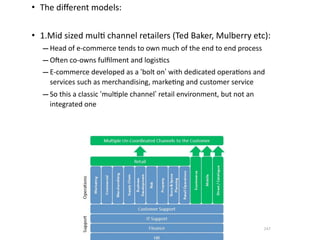
• 1.Mid	
  sized	
  mul.	
  channel	
  retailers	
  (Ted	
  Baker,	
  Mulberry	
  etc):
   – Head	
  of	
  e-­‐commerce	
  tends	
  to	
  own	
  much	
  of	
  the	
  end	
  to	
  end	
  process	
  
   – OEen	
  co-­‐owns	
  fulfilment	
  and	
  logis*cs
   – E-­‐commerce	
  developed	
  as	
  a	
  ‘bolt	
  on’	
  with	
  dedicated	
  opera*ons	
  and	
  
        services	
  such	
  as	
  merchandising,	
  marke*ng	
  and	
  customer	
  service	
  
     – So	
  this	
  a	
  classic	
  ‘mul*ple	
  channel’	
  retail	
  environment,	
  but	
  not	
  an	
  
        integrated	
  one


                                                                                                              247
• The	
  different	
  models:	
  Con.nued


• 2.Large	
  FTSE	
  retailers	
  (M&S,	
  John	
  Lewis	
  etc):
    – The	
  head	
  of	
  e-­‐commerce	
  is	
  ohen	
  responsible	
  for	
  everything	
  on	
  the	
  website
    – But	
  board	
  or	
  opera.onal	
  Director’s	
  own	
  different	
  parts	
  of	
  the	
  opera.on	
  such	
  as	
  
      supply	
  chain,	
  merchandising,	
  customer	
  service
    – It	
  tends	
  to	
  be	
  a	
  more	
  integrated	
  scenario,	
  but	
  with	
  some	
  businesses	
  such	
  as	
  M&S	
  
      or	
  John	
  Lewis,	
  home	
  shopping	
  or	
  their	
  ‘direct	
  business’	
  un.l	
  recently	
  was	
  a	
  
      completely	
  separate	
  business	
  unit
    – The	
  model	
  below	
  reflects	
  where	
  I	
  believe	
  most	
  mul.	
  channel	
  retailers	
  should	
  be	
  
      heading	
  structure	
  wise;


                                                                                                                  248
• The	
  different	
  models:	
  Con.nued


• 3.Groups/Mul.	
  brand	
  owners	
  (Pentland	
  brands,	
  Arcadia):
   – The	
  brands	
  have	
  their	
  own	
  management	
  team	
  ohen	
  including	
  a	
  head	
  of	
  e-­‐commerce
   – The	
  centre	
  of	
  the	
  business	
  provides	
  a	
  service	
  to	
  all	
  of	
  the	
  brands	
  across	
  marke.ng,	
  
      technology,	
  supply	
  chain	
  etc.	
  It’s	
  a	
  facilitator,	
  whereas	
  the	
  brands	
  own	
  management	
  
      teams	
  actually	
  trade	
  the	
  online	
  business


• 4.	
  Pureplays:
   – They	
  do	
  everything	
  in	
  the	
  business.	
  i.e.	
  The	
  full	
  end	
  to	
  end	
  process	
  including	
  the	
  
      coding	
  and	
  web	
  development	
  side


• 5.	
  The	
  outsourced	
  model:
   – This	
  is	
  where	
  there	
  is	
  a	
  small	
  e-­‐commerce	
  team	
  ohen	
  only	
  responsible	
  for	
  content	
  and	
  
      some	
  trading	
  aspects.	
  Customer	
  service,	
  marke.ng,	
  supply	
  chain,	
  fulfilment,	
  the	
  
      pla^orm	
  are	
  all	
  outsourced	
  to	
  a	
  supplier	
  such	
  as	
  GSI	
  commerce,	
  PFS	
  web	
  etc


                                                                                                                           249
The Four Pillars
Based on the 4 pillars model:
The optimal trading structure for
              B2C
Project	
  kick	
  off
• Schedule	
  a	
  kick	
  off	
  mee.ng	
  with	
  key	
  stakeholders
• (project	
  	
  sponsor,	
  	
  project	
  	
  	
  manager,	
  	
  project	
  	
  team	
  	
  
  etc)	
  	
  to	
  	
  develop	
  	
  the	
  	
  high	
  	
  level	
  	
  roadmap	
  	
  and	
  	
  
  strategy	
  	
  for	
  	
  e-­‐commerce	


                                                                                       253
Create	
  a	
  steering	
  group
• A	
  	
  recommended	
  	
  project	
  	
  team	
  	
  structure	
  	
  might	
  	
  look	
  	
  like	
  	
  
  this:	
  	
  
    – A	
  	
  project	
  	
  sponsor.	
  	
  Ideally	
  	
  someone	
  	
  at	
  	
  board	
  	
  level.	
  	
  
    – A	
  	
  project	
  	
  manager.	
  	
  Someone	
  	
  in	
  	
  the	
  	
  e-­‐commerce	
  	
  team.	
  	
  
    – A	
  	
  project	
  	
  team:	
  	
  the	
  	
  head	
  	
  of	
  	
  e-­‐commerce,	
  	
  the	
  	
  internal	
  	
  project	
  	
  
      manager	
  	
  (if	
  	
  you	
  	
  have	
  	
  one),	
  	
  	
  the	
  	
  IT	
  	
  manager,	
  	
  someone	
  	
  from	
  	
  
      finance,	
  	
  the	
  	
  project	
  	
  manager	
  	
  from	
  	
  the	
  	
  agency,	
  	
  etc.	
  	
  
    – A	
  	
  steering	
  	
  commigee	
  	
  comprising	
  	
  of	
  	
  key	
  	
  members	
  	
  from	
  	
  cross	
  	
  
      func.onal	
  	
  areas	
  	
  of	
  	
  the	
  	
  	
  business	
  	
  that	
  	
  will	
  	
  impact	
  	
  upon	
  	
  e-­‐
      commerce	
  	
  (finance,	
  	
  merchandising,	
  	
  opera.ons,	
  	
  fulfilment,	
  	
  	
  etc).	
  	
  
• Ensure	
  	
  that	
  	
  each	
  	
  of	
  	
  the	
  	
  project	
  	
  team	
  	
  members	
  	
  has	
  	
  the	
  	
  
  necessary	
  	
  level	
  	
  of	
  	
  skills	
  	
  and	
  	
  	
  experience	
  	
  and	
  	
  can	
  	
  
  commit	
  	
  the	
  	
  required	
  	
  level	
  	
  of	
  	
  .me	
  	
  to	
  	
  the	
  	
  project.	
                254
Documenta1on	
  required	
  pre	
  and	
  
    post	
  supplier	
  selec1on
• A	
  supplier	
  contract	
  with	
  appropriate	
  SLAs
• You’ll	
  need	
  a	
  high	
  	
  level	
  	
  roadmap	
  	
  and	
  	
  strategy	
  	
  for	
  	
  e-­‐
  commerce	
  	
  
• You	
  	
  will	
  	
  need	
  	
  a	
  	
  detailed	
  	
  financial	
  	
  plan	
  	
  
• Func.onal	
  specifica.on.	
  	
  This	
  will	
  cover	
  your	
  	
  e-­‐commerce	
  	
  
  system	
  	
  capabili.es,	
  	
  func.onality,	
  integra.on	
  	
  and	
  	
  
  interac.on	
  with	
  	
  users.	
  The	
  details	
  for	
  both	
  this	
  and	
  the	


  requirements	
  	
  document	
  will	
  have	
  been	
  captured	
  during	
  	
  
  stakeholder	
  workshops	
  	
  and	
  	
  one-­‐to-­‐one	
  interviews.	
  	
  
• Change	
  	
  request.	
  	
  This	
  	
  is	
  	
  usually	
  	
  a	
  	
  brief	
  	
  document	
  	
  
  outlining	
  	
  the	
  	
  objec.ve	
  	
  and	
  	
  	
  requirements	
  	
  of	
  	
  the	
  	
  change,	
  	
  
  which	
  	
  is	
  	
  then	
  	
  circulated	
  	
  to	
  	
  the	
  	
  project	
  	
  team	
  	
  to	
  	
  respond	
  	
  
  with	
  	
  	
  the	
  	
  proposed	
  	
  solu.on,	
  	
  cost,	
  	
  .mings	
  	
  and	
  	
  impacts.	
  
                                                                                                              256
• Risk	
  	
  log	
  	
  and	
  	
  impact	
  	
  assessment.	
  	
  This	
  	
  is	
  	
  normally	
  	
  done	
  	
  in	
  	
  response	
  	
  
  to	
  	
  a	
  	
  change	
  	
  	
  request.	
  	
  An	
  	
  impact	
  	
  assessment	
  	
  is	
  	
  where	
  	
  key	
  	
  opera*onal	
      	
  
  func*ons	
  	
  and	
  	
  departments	
  	
  review	
  	
  	
  the	
  	
  proposed	
  	
  change	
  	
  to	
  	
  evaluate	
  	
  
  whether	
  	
  there	
  	
  will	
  	
  be	
  	
  an	
  	
  impact	
  	
  on	
  	
  systems,	
  	
  people	
  	
  or	
  	
  	
  processes.	
  	
  
  Risks	
  	
  and	
  	
  issues	
  	
  are	
  	
  highlighted	
  	
  up	
  	
  front	
  	
  and	
  	
  managed	
  	
  appropriately.	
  	
  
• Resource	
  	
  plan.	
  	
  Create	
  	
  a	
  	
  GANTT	
  	
  chart	
  	
  and	
  	
  use	
  	
  it	
  	
  to	
  	
  ensure	
  	
  
  appropriate	
  	
  resource	
  	
  is	
  	
  	
  available	
  	
  for	
  	
  e-­‐commerce	
  	
  implementa*on.	
  	
  
• Cri*cal	
  	
  path	
  	
  and	
  	
  *ming	
  	
  plan.	
  	
  This	
  	
  covers	
  	
  the	
  	
  proposed	
  	
  *mescale	
  	
  for	
  	
  
  the	
  	
  project	
  	
  and	
  	
  	
  helps	
  	
  to	
  	
  iden*fy	
  	
  dependencies	
  	
  of	
  	
  all	
  	
  ac*vi*es.	
  	
  This	
  	
  
  will	
  	
  let	
  	
  you	
  	
  put	
  	
  together	
  	
  the	
  	
  resource	
  and	
  *ming	
  plan.	
  You	
  need	
  to	
  
  es*mate	
  how	
  long	
  each	
  element	
  of	
  the	
  project	
  will	
  take.	
  	
  	
  It’s	
  always	
  	
  best	
  	
  
  to	
  	
  build	
  	
  in	
  	
  some	
  	
  con*ngency	
  	
  to	
  	
  the	
  	
  *meline	
  	
  for	
  	
  each	
  	
  key	
  	
  milestone,	
  	
  
  and	
  	
  use	
  	
  the	
  	
  	
  cri*cal	
  	
  path	
  	
  as	
  	
  to	
  	
  con*nually	
  	
  measure	
  	
  your	
  	
  progress	
  	
  
  against	
  	
  the	
  	
  *meline.	
  	
  
• Tes*ng	
  	
  schedule.	
  	
  This	
  	
  will	
  	
  cover	
  	
  user	
  	
  acceptance	
  	
  tes*ng	
  	
  (UAT)	
  	
  as	
  	
  
  well	
  	
  as	
  	
  load	
  	
  and	
  	
  stress	
  	
  	
  tes*ng	
  	
  the	
  	
  system	
  	
  and	
  	
  should	


  cover	
  	
  tes*ng	
  	
  
  required	
  	
  as	
  	
  a	
  	
  result	
  	
  of	
  	
  change	
  	
  requests.	
  
                                                                                                                                              257
• Tes*ng	
  	
  schedule.	
  	
  This	
  	
  will	
  	
  cover	
  	
  user	
  	
  acceptance	
  	
  tes*ng	
  	
  (UAT)	
  	
  as	
  	
  well	
  	
  as	
  	
  
  load	
  	
  and	
  	
  stress	
  	
  	
  tes*ng	
  	
  the	
  	
  system	
  	
  and	
  	
  should	


  cover	
  	
  tes*ng	
  	
  required	
  	
  as	
  	
  a	
  
  result	
  	
  of	
  	
  change	
  	
  requests.	
  	
  
• Release	
  	
  schedule.	
  	
  A	
  	
  schedule	
  	
  of	
  	
  when	
  	
  changes	
  	
  are	
  	
  planned	
  	
  to	
  	
  be	
  	
  released	
  	
  
  to	
  	
  the	
  	
  website,	
  	
  	
  ensures	
  	
  priori*es	
  	
  are	
  	
  met	
  	
  and	
  	
  that	
  	
  the	
  	
  appropriate	
  	
  test	
  	
  
  environments	
  	
  are	
  	
  available	
  	
  at	
  	
  the	
  	
  	
  right	
  	
  *me.	
  	
  
• Project	
  	
  go/no	
  	
  traffic	
  	
  light.	
  	
  This	
  	
  highlights	
  	
  any	
  	
  outstanding	
  	
  requirements	
  	
  
  prior	
  	
  to	
  	
  go-­‐live	
  and	
  provides	
  a	
  view	
  of	
  the	
  status	
  of	
  these	
  elements	
  and	
  they’re	
  
  poten*al	
  impact	
  which	
  is	
  communicated	
  	
  by	
  	
  giving	
  	
  each	
  	
  item	
  	
  a	
  	
  red,	
  	
  green	
  	
  or	
  	
  
  amber	
  	
  status.	
  	
  
• Build	
  	
  a	
  	
  communica*ons	
  	
  plan.	
  	
  Review	
  	
  it	
  	
  regularly,	
  	
  and	
  	
  communicate	
  	
  
  frequently	
  	
  with	
  	
  all	
  	
  	
  the	
  	
  key	
  	
  stakeholders.	
  	
  This	
  	
  is	
  	
  a	
  	
  key	
  	
  aspect	
  	
  of	
  	
  successful	
  	
  
  project	
  	
  management,	
  	
  and	
  	
  it	
  	
  will	
  	
  also	
  	
  	
  help	
  	
  to	


  ensure	
  	
  that	
  	
  all	
  	
  stakeholders	
  	
  
  remain	
  	
  engaged	
  	
  throughout	
  	
  the	
  	
  lifecycle	
  	
  of	
  	
  the	
  	
  project.	
  	
  
• Conduct	
  	
  risk	
  	
  assessment.	
  	
  It	
  	
  is	
  	
  wise	
  	
  to	
  	
  carry	
  	
  out	
  	
  a	
  	
  full	
  	
  risk	
  	
  analysis	
  	
  and	
  	
  
  document	
  	
  all	
  	
  risks	
  	
  	
  in	
  	
  a	
  	
  risk	
  	
  register.	


  You	
  	
  need	
  	
  to	
  	
  regularly	
  	
  review	
  	
  each	
  	
  
  risk	
  	
  to	
  	
  ensure	
  	
  you	
  	
  are	
  	
  managing	
  	
  them.	
  	
  If	
  	
  	
  you	
  	
  have	
  	
  an	
  	
  internal	
  	
  audit	
  	
  
  department,	
  	
  then	
  	
  they	
  	
  are	
  	
  the	
  	
  ideal	
  	
  people	
  	
  to	
  	
  manage	
  	
  this	
  	
  aspect	
  	
  of	
  	
  	
  the	
  	
  
  project.	
                                                                                                                                                 258
Requirements	
  Gathering:
Front	
  End,	
  Back	
  End,	
  Integra1on
Timeline:	
  1	
  to	
  2	
  weeks

Process:	
  Workshops	
  &	
  stakeholder	
  interviews


                                                  260
Clientsite.com
Which stakeholders requirements
     should be captured?
•   IT and system development resources

•   Website design resources

•   Buying & Merchandising resources

•   Commercial planning and stock management
    resources

•   Pricing and promotions management resources

•   Content creation and content management
    resources, including photography and copy
Which stakeholders requirements
     should be captured?

•   Product photography and artworking resources

•   Online/digital marketing resources

•   Order management resources

•   Loss-prevention fraud-screening

•   Customer contact management resources

•   Warehousing facilities: Pick, pack and despatch resources,
    returns processing resources

•   Parcel carrier service

•   Reporting and control resources
What questions do you
    need to ask?
Brand/design

•   What are the brand values and ethos, existing
    visual collateral, guidelines we need to consier?

•   What aspirations, sites liked/disliked, etc?

•   What brand experience do we need to create?
Front end
•   Site wide functionality

      •      Discuss functionality that runs across whole site

      •      Newsletter sign-up, email-a-friend, social links, recently viewed,
             mini basket, login, etc.

•   Main Pages

      •      Discuss requirements for main site navigation, Home Page,
             Category & Brand landing pages, search and product listing pages

•   Search

      •      How ‘sophisticated’ does search need to be?

      •      Does content other that products need to be returned in search
             results
•   Guided (faceted) Navigation

      •    By which search facets should users be able to select/filter products?

      •    Single or multi-select facets?

•   Products

      •    Discuss product range, and any special requirements relating to display
           of products/Brands on the site

•   Personalisation

      •    What level of personalisation, if any, should the site support?

•   Merchandising Tools

      •    How are the products to be merchandised?: manually, rules based,
           algorithm based, mixture…
•   Promotions

      •    What promotions types, triggers, & targets does the platform need to
           support

•   Checkout Pages

      •    Discuss the checkout process – single or multi-page, guest checkout, do or
           don’t’ promote other products in checkout, etc.

•   General Site Pages

      •    ‘Static’ content pages: About us, contact us, Help/FAQ’s, etc.

•   Customer

          •      What features & functionality will be in the ‘My Account’ session of the
                 site

•   What integration requirements are there around customer for other systems
    (OMS, CRM, other?)
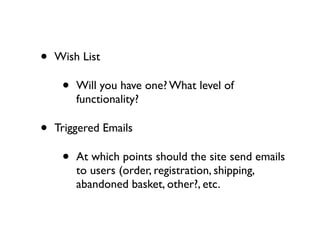
•   Wish List

     •   Will you have one? What level of
         functionality?

•   Triggered Emails

     •   At which points should the site send emails
         to users (order, registration, shipping,
         abandoned basket, other?, etc.
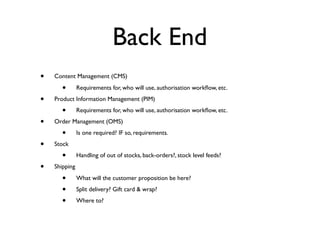
Back End
•   Content Management (CMS)

       •       Requirements for, who will use, authorisation workflow, etc.

•   Product Information Management (PIM)

       •       Requirements for, who will use, authorisation workflow, etc.

•   Order Management (OMS)

       •       Is one required? IF so, requirements.

•   Stock

       •       Handling of out of stocks, back-orders?, stock level feeds?

•   Shipping

       •       What will the customer proposition be here?

       •       Split delivery? Gift card & wrap?

       •       Where to?
•   Which payments will be accepted? Paypal?, loyalty?

•   Fraud?

•   PCI Security

•   Call Centre

      •      Outsourced or internal?

      •      Requirements for?

•   Email Marketing

•   Level of Integration with

•   Integration

•   To back-end systems (products, stock, orders, customer)

•   3rd party systems?
•   3rd Party Product Feeds

      •    Are these required, if so, details.

•   Analytics

      •    Requirements for

•   Reporting

      •    Requirements for

•   Hosting

      •    Requirements for

•   Account Management

      •    Requirements for
Products and content

•   Photography: Where and how will we do this?

•   Rich Content: A fundamental requirement to drive
    sales...however it needs to be created to drive sales

•   Exclusive Products: Could you offer some exclusive
    products online?

•   Head or long tail products?
Logistics

•   Outsource logistics?

•   Packaging: Fit for purpose for B2C?

•   Stockholding: Requirement to forecast

•   Returns handling: Processes required to handle this

•   Customer proposition to be determined: Matrix of existing
    delivery service levels to be produced

•   Australia only to begin with?
Customer Care: Call centre

  •   Managing B2C customer services

  •   Service provision only?

  •   Or, also as an additional sales driver: Card
      sales, live chat etc?

  •   Operating hours

  •   Managing International calls

  •   Language and time requirements
IT and Integration
•   ERP/legacy systems

•   Stock management

•   PIM

•   CRM

•   Other Data Services
•   Ensure that the platform you choose can be easily
    integrated with other parts of your business, such
    as your CRM and product information channels

•   Many companies are realising that sales and
    marketing functionality is increasingly important

•   Your e­commerce solution should be the engine
    room of your online sales and marketing efforts,
    helping with customer acquisition, customer
    retention, cross selling and upselling etc
Roll Out

•   Australia to begin?

•   Then English language countries?

•   EU when?

•   White label?
The	
  Supplier	
  Selec1on
          Process
Produce	
  The	
  RFP
Timeline:	
  5	
  days	
  with	
  itera*ons

Process:	
  Produced	
  by	
  head	
  of	
  e-­‐commerce	
  
    and	
  IT	
  director	
  or	
  by	
  a	
  consultant


                                                     282
Are	
  you	
  thinking	
  about	
  what	
  the	
  
                 customer	
  wants?
• Your	
  e-­‐commerce	
  strategy	
  needs	
  to	
  focus	
  on	
  the	
  customer	
  
  experience	
  to	
  ensure	
  success	
  and	
  in	
  order	
  to	
  make	
  sure	
  that	
  
  you	
  are	
  doing	
  jus.ce	
  to	
  your	
  brand	
  and	
  differen.a.ng	
  
  yourself	
  in	
  an	
  increasingly	
  compe..ve	
  marketplace
• Does	
  your	
  company	
  really	
  understand	
  what	
  your	
  customers	
  
  want?
• Are	
  all	
  the	
  necessary	
  stakeholders	
  within	
  your	
  company	
  
  feeding	
  in	
  to	
  your	
  e-­‐commerce	
  strategy	
  to	
  ensure	
  that	
  you	
  
  have	
  an	
  integrated	
  approach
• Is	
  the	
  supplier	
  on	
  the	
  ball	
  in	
  terms	
  of	
  usability	
  and	
  
  accessibility?
                                                                                  283
1. Introduction

•   State your objectives and provide clear guidance on expectations

•   The X Shop has ambitious plans for their growth online, and is
    considering a new platform to help them achieve this. They have a
    desire to be live by pre-Christmas 2011. This will require a new
    site design, and this requirements document is to be used as an
    RFP for both design and platform

•   However, any particular vendor may respond to either one or the
    other aspect, or both

•   Please make clear in your submission which aspect(s) you are
    tendering for, and how the cost is allocated between them
2. This Requirements Document
• This document sets out X Shop’s requirements for their new transactional websites. It uses
  the MoSCoW ratings approach for the level of requirement as follows:


       •    M – ‘Must Have’

       •    Clear requirement for first phase launch of site

       •    S – ‘Should Have’

       •    Ideally part of the 1st phase launch, but as long as the Functionality was confirmed
            deliverable shortly after launch, could form part of a 2nd phase launch

       •    C – ‘Could Have’

       •    Indicates Functionality X Shop might like to have, as long as the cost & complexity
            were reasonable. It would be helpful to know how your platform could deliver
            this Functionality, but could be phase 2 or even 3 releases.

       •    W – ‘Won’t Have’

       •    Indicates Functionality X Shop don’t need now, or in the medium term.
2. This Requirements Document
• Of course, it would be great if everything contained in
 this document were ready & available for immediate
 launch at modest cost
• However, since this might not be the case, the winning
 tender is likely to be the company that is able to deliver
 the largest portion of Functionality, at the earliest time,
 for the lowest cost
• Where the proposal is to phase the delivery of
 functionality, please quote separately for the Must Haves,
 the Should Haves, and the Could Haves
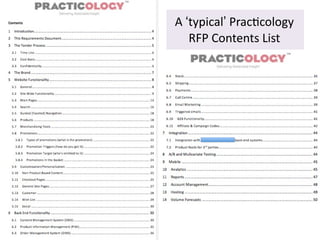
3. The Tender Process
•   We aim for this to be a very clear & transparent tender process, with each vendor
    ranked against the following key criteria:


    •   Your proposal

    •   Functional Fit ‘out of the box’

    •   Ability to deliver any outstanding Functionality

    •   Time frame for delivery of all agreed Functionality, over 1 or 2 phases

    •   Project Management approach

    •   Ability to service & support the site on an on-going basis

    •   Contract terms

    •   Client references

    •   Costs

    •   For the design element, the ability to translate X Shop’s brand values into a
        high-conversion transactional site with great usability and accessibility.
•   Please ensure your proposal responds explicitly to
    the requirements in this document – ideally in the
    same order (and with the same outline numbers)
    presented here, as well as directly addressing the
    key criteria listed above

•   Submissions that are just standard marketing
    about your platform, and don’t respond to the
    specifics will be judged poorly

•   Please demonstrate clearly how your proposal
    delivers these requirements, and back this up with
    screen-shots of back-end systems & live websites
    that demonstrate the Functionality purported.
•   In general, the tender process will have 3 phases:


•   	

    1 – Review received proposals and evaluate against criteria listed
    above, in order to reduce list of ‘possibles’ down to 2, or at most, 3
    options.


•   	

    2 – Full-day on-site visits with short-listed options, where full
    demonstrations of the systems (not just PowerPoint!) will be expected, as
    well as commercial discussions and ‘cultural fit’ can be gauged.


•   	

    3 – Due diligence and customer references for the best-fit options,
    in order to evaluate the winning tender.


•   All submissions should be in electronic form, and emailed to
3.1 Timeline
•   A somewhat more legible, landscape version of the
    above is on the last page of the document. However,
    the high-level plan is for:


•   1)	

   Discovery/Design to begin XXX 2011

•   2)	

   Build to begin XXX 2011

•   3)	

   UAT XXX 2011

•   4)	

   Go-live XXX 2011
3.2 Cost basis
•   Please note The X Company is looking for a fixed
    price quote for this project, not a T&M estimate

•   This quote will of course be dependant on a detailed
    discovery phase, but we would hope that the price
    after discover varies no more than 10-15% from your
    quote during the tender process
•   If your quote is on any other basis, please make this
    explicitly clear, as the assumption will be fixed price,
    and this will be the basis of all discussions going
    forward, unless agreed otherwise.
3.3 Confidentiality


•   The contents of this document should be
    considered commercial in confidence, and are
    not to be distributed outside of those in your
    organisation required to prepare a response

•   You’d want them to sign a NDA
4. The Brand
•   The X Company wants to grow their online their business to account for
    15-25% of their overall business within 3 years

•   The X Company wish to differentiate themselves online by listening to their
    customers and provide high quality customer service. They want to be seen as
    offering good value for money, bringing to market exclusives, first to offer
    products, whilst maintaining excitement and an element of surprise amongst
    their customer base.

•   They have identified 3 main reasons why customers come to their current site:

      •   For replenishment

      •   To browse

      •   To Indulge

•   X is seen as a very personal purchase; the X Company want to try and create
    some of this experience online via for e.g. personal customer stories so it is
    more than just about product and price.
5. Website Functionality
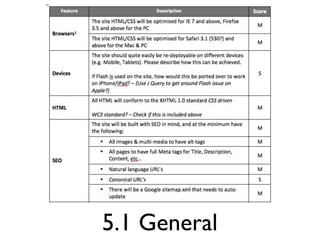
5.1 General
5.2 Site wide functionality
Newsletter/email sign up:
  How not to do it!
Social bookmarks/links
Recently viewed
Consider	
  adding	
  a	
  basket	
  lightbox	
  when	
  item	
  
                      added	
  to	
  basket


An	
  intui.ve	
  CTA	
  to:
1.add	
  to	
  cart	
  or	
  
•con.nue	
  shopping

Also	
  a	
  great	
  opportunity	
  
for	
  cross	
  selling


                                                                   307
How not to do a mini basket
This is how to do it
Dynamic FAQs
Live Chat
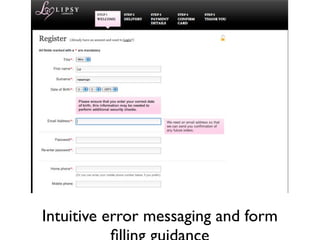
Intuitive error messaging and form
5.3 Main Pages
This is above the fold
Meets the needs of all user groups
      and all above the fold
Meets the needs of all user groups
Strong calls to action
- Where are the calls to action?
            - Bestsellers...new in...
- Only one product in clear view above the fold
A 3x2 grid increased conversion by 15% over a 4x3
    grid...again less is often more in this space!
Where are bestsellers, new in, customer favourites?
Look at the size of the images compared to Schuh
no filters....give me a hand please!
  Style, occasion, price, size etc
FC   AS   Theory   Tommy   CT   GANT
Persuasive	
  product	
  
descrip1on
Good	
  quality	
  product	
  
image	
  with	
  zoom
Mul1ple	
  views	
  of	
  
product	
  image	
  inc	
  
model
Product	
  price

Size	
  op1ons

Stock	
  and	
  availability

Delivery	
  price	
  and	
  
op1ons
Expected	
  delivery	
  date

Clear	
  ‘Add	
  to	
  Basket’

Wishlist	
  /	
  forward	
  to	
  a	
  
friend	
  /	
  social
Customer	
  ra1ngs	
  and	
  
reviews
Returns	
  Policy

Sizing	
  Chart

Email	
  me	
  when	
  back	
  in	
  
stock
Cross-­‐sells	
  /	
  up-­‐sells	
  /	
  
complete	
  the	
  look
SEO	
  H1	
  /	
  H2	
  Tags
332
How not to do it
5.4 Search
Site conversion from search:
           Retail average is 7.6%
(General retail average conversion is 4.23%)
A search for ‘delivery’
Sort by...
Effective type ahead search
5.5 Faceted Navigation
Search for ‘jeans’ with all relevant
         filters and facets
A search for gifts
My search for jeans
Look what happens when I search under
‘denim’....and how the heck do I narrow my
 choice down to make a purchase decision?
There should never be a
  ‘null search’ return
5.6 Products
Visual merchandising:
Has a massive impact on conversion
Myla	
  Model	
  choice


          She	
  is	
  way	
  too	
  skinny….	
  
          Almost	
  anorexic.	
  
          It’ll	
  be	
  a	
  put	
  off	
  for	
  a	
  lot	
  of	
  
          customers.
Model	
  Choice
Healthy,	
  curvy,	
  volump.ous	
  and	
  
olive/dark	
  skinned	
  models	
  sell	
  
lingerie.	
  AP,	
  Boux	
  and	
  M	
  &	
  S
Good visual merchandising
Image Size

• Each product displays only slight discernable differences to each other,
  fit, stripe, check, cuff, collar etc…
• Informing the customer of these style differences quickly is very
  important in the customer journey
• Online, the visual merchandising has to convey the product detail and
  brand values of quality to the customer. Image size is critical to this
Image Size


On product listing …difficult to discern product detail… check or strip?
Image Sizes


• TP image size on product listing and product detail page is the smallest of
  those reviewed. -40% to the average (of those reviewed) on both product listing
  and product detail page.
• Image size is too small to get across the quality and design details of the
  product and does not sit with brand core values.
• Net a Porter images on product listing nearly 3 x that of Thomas Pink.
• On the whole, retailers trading on quality/ designer have 3 images across on
  their product listing.
Easier to discern now
Image Size – Product detail


Only at zoom stage can you see that product is checked.
Image Size.


Only at zoom stage can you make out that the product is striped
and understand the quality of the garment… it also has piping
detail.
Now there’s no ambiguity
Image Size


•On tailoring with high selling prices … the small images do not
validate the product quality. It is difficult to get any sense of
quality
•The banner gives some quality assurance and reference
Nice consistent imagery!
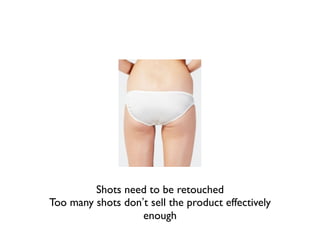
Shots need to be retouched
Too many shots don’t sell the product effectively
                   enough
5.7 Merchandising Tools
Cross selling increases conversion
           and the ATV
5.8 Promotions
5.8.1 Promotion type
5.8.2 Promotion Triggers:
     How you get it
5.8.3 Promotion target:
  Who’s entitled to it
5.8.4 Promotions in the basket
Only £25 away from free next day
delivery...question is, how much is delivery?
•   3 testing options for Remarketing with a classic abandoned
    shopping cart follow-up email, but with 3 alternative follow-
    ups which were tested with these results:
1. Generic branded follow-up email : +10% conversion rate
2. Personalised remarketing email with a promotional code for a
   5% discount time limited to 72 hours: +100% conversion rate
3. Personalised remarketing email with a promotional code  for
   a 5% discount time limited to 48 hours: +200% conversion
   rate
                       Source: Smart Insights
5.9 Customisation/Personalisation
5.11 Checkout
The Shopping bag and checkout are
where you lose most of your sales
Shopping	
  Bag	
  Page
46.4%	
  of	
  customer’s	
  don’t	
  even	
  make	
  it	
  from	
  
 the	
  bag	
  to	
  the	
  1st	
  stage	
  of	
  the	
  checkout...
                                  why?
Why do they abandon here?
•No delivery options
•No delivery info to total order value
•No idea whether or not I can add a
gift message?
•Gift wrap message is hidden/too
small
•They may not have a promotional
code but think they should have
•Data capture is just a distraction
•Difficult to see update basket or
continue shopping buttons
•Not everyone is ready to buy
5.12 General Site Pages
5.13 Customer Pages
5.15 Social
6. Back end functionality
6.1 CMS
6.2 Product Information
      Management
6.3 Order Management
6.4 Stock
6.5 Shipping
6.6 Payments
6.7 Call Centre
6.8 Email
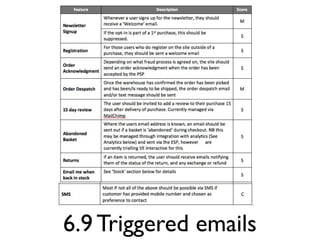
6.9 Triggered emails
The	
  system	
  should	
  enable	
  the	
  set-­‐up	
  of	
  affiliate	
  &	
  campaign	
  codes,	
  which	
  can	
  be	
  assigned	
  to	
  each	
  affiliate	
  or	
   PPC	
  
campaign,	
  and	
  tracked	
  by	
  the	
   system,	
  via	
  the	
  analy*cs	
  tags,	
   through	
  to	
   the	
  campaign	
  management	
  repor*ng	
  in	
  the	
  
analy*cs	
  applica*on.	


The	
  system	
  should	
  support	
  best-­‐prac*ce	
  affiliate	
  and	
  campaign	
  tracking	
   (the	
  repor*ng	
   and	
  analy*cs	
  of	
  this	
  will	
  be	
  
done	
  through	
   the	
  3rd	
  party	
  analy*cs	
  package,	
  but	
  the	
  site	
  database	
  &	
  HTML	
  should	
  be	
  coded	
  sufficiently,	
  and	
  with	
  
enough	
   granularity,	
   to	
   feed	
   the	
   analy*cs	
   package	
   appropriately,	
   and	
   the	
   affiliate/campaign	
   codes	
   wriVen	
   to	
   the	
  
customer	
  &	
  order	
  tables	
  so	
  they	
  can	
  be	
  reported	
  on	
  locally.


           6.11 Affiliate and Campaign codes
7. Integration with back end systems
8. A/B and multi variate testing
9. Mobile
•   The X Company is interested in incorporating a mobile approach into their
    overall Digital Strategy. Initially the main site should be built to be accessible via
    a mobile device. They would like to explore creating a device specific mobile
    app to provide for e.g.
      •     Stores near me using GPS

      •     Use of SMS to notify customer of order status

      •     Experimentation with QR codes
      •     Looking to implement PDAs/tablets for staff in-store as used in Apple
            Store.

      •     Need to be able to reskin main website
•   It should be device and browser compatible & integrated with mobile payment
    gateways

•   Overall requirements TBA
10. Analytics
11. Reports
12. Account Management
•   While this document has focused on platform functionality, we can’t stress enough the
    importance of on going account management as a selection criterion for this project. As part of
    your proposal, please describe and confirm the following key points:


    •    Who would be our named account management team, and what are their responsibilities?
    •    Is this person/are these people technical, commercial, or both?
    •    What do you offer, on an on-going basis, as far as best practice and innovation, for example?

    •    What is your development road-map for your platform and services?
    •    What direct access will we have to technical support staff, and during which days/hours?

    •    Please describe your process for handling bugs/issues, and change requests, and how the
         two are defined and delineated
    •    Do you have standard SLA’s around account management? If so, please describe these
13. Hosting
•   When explaining your hosting proposal, please, as a minimum, confirm the following:
•   Your recommended hosting architecture for a ‘minimum’ & ‘optimal’ solution

•   Bear in mind that even minimum hosting must reach the performance requirements mentioned below
•   The operating system, and any 3rd party software required to deliver your solution
•   What monitoring & alerting processes are available

•   What support options are available
•   Your experience with load balancing web servers (hardware and/or software – please confirm) and clustering
    databases
•   Please give specific examples and references for your claims here
•   Performance is expected to delivery page load times no greater than x seconds on a 512k broadband connection
•   Downtime is expected to be no greater than 0.5%
•   What business continuity and disaster recovery procedures do you have in place to support downtime SLA of
    0.5%?
•   24/7monitoring with helpdesk and alerts support
•   Cloud or dedicated hosting with scalability for peak traffic

•   SQL database(s)
•   Multiple redundant DNS and SMTP servers
•   Manage multiple B2C & B2B ecommerce storefronts, corporate sites, micro-
    sites, extranets, forums, and blogs from one central platform

•   Individual web stores can have different or same designs (or mixture of),
    same or different functionality, different or shared content

•   Host different domain and manage and share content across these; either
    shared or exclusive

•   New version rollouts on bi-annual basis

•   Supports sharing of customers across multiple web stores with a single
    registration, facilitating shared baskets across sit

•   Please describe the various SLA’s agreement offered, and the associated
    costs

•   Security
Select	
  Vendors:
Plaorm	
  providers,	
  System	
  Integrators,	
  
             Design	
  Agencies
Supplier	
  Selec1on
• Timeline:	
  4	
  weeks	
  in	
  total
• Process:	
  
   – Give	
  them	
  the	
  RFP	
  and	
  2	
  weeks	
  to	
  respond
   – Take	
  3	
  days	
  to	
  review	
  responses
   – Take	
  2	
  to	
  4	
  days	
  to	
  conduct	
  due	
  diligence	
  with	
  full	
  day	
  
     demos
   – Score	
  the	
  vendors	
  and	
  make	
  a	
  decision


                                                                                         425
Some	
  ques.ons	
  to	
  ask	
  at	
  the	
  
                    outset...
• How	
  ‘future-­‐proof’	
  are	
  the	
  vendor’s	
  technologies?
• Is	
  your	
  technology	
  easy	
  to	
  use	
  and	
  manage	
  (so	
  that	
  you	
  will	
  
  not	
  be	
  incurring	
  extra	
  costs	
  and	
  stretching	
  your	
  internal	
  
  resources	
  on	
  a	
  regular	
  basis)?
• Has	
  the	
  pla^orm	
  been	
  built	
  with	
  Search	
  Engine	
  Marke.ng	
  
  in	
  mind?
• Web	
  analy.cs	
  are	
  important	
  to	
  ensure	
  that	
  you	
  can	
  
  measure	
  what	
  is	
  happening	
  so	
  you	
  can	
  adapt	
  and	
  grow	
  
  accordingly.	
  What	
  kind	
  of	
  capabili.es	
  does	
  the	
  pla^orm	
  
  have	
  in	
  this	
  respect?
• –	
  Will	
  the	
  analy.cs	
  give	
  you	
  the	
  level	
  of	
  granularity	
  you	
  
  need?	
                                                                              426
• Find	
  out	
  what	
  kind	
  of	
  repor.ng	
  comes	
  as	
  
  standard	
  and	
  what	
  will	
  cost	
  you	
  extra
• Are	
  there	
  features	
  in	
  the	
  pla^orm	
  that	
  you	
  don’t	
  
  need	
  on	
  Day	
  1?	
  Understanding	
  how	
  much	
  these	
  
  will	
  cost	
  to	
  implement	
  once	
  the	
  site’s	
  live	
  will	
  
  help	
  you	
  plan	
  your	
  budget	
  and	
  your	
  approach	
  to	
  
  market
• Will	
  you	
  be	
  geing	
  the	
  level	
  of	
  strategic	
  
  consultancy	
  you	
  are	
  hoping	
  to	
  make	
  sure	
  that	
  the	
  
  technology	
  is	
  working	
  for	
  you	
  at	
  an	
  op.mal	
  
  level?                                                           427
• If	
  you	
  are	
  using	
  an	
  agency,	
  are	
  you	
  convinced	
  that	
  
  they	
  have	
  the	
  project	
  management	
  capabili*es	
  to	
  
  deliver	
  your	
  requirements	
  on	
  *me	
  and	
  within	
  
  budget?
• Are	
  you	
  prepared	
  to	
  pay	
  more	
  to	
  get	
  an	
  agency	
  
  with	
  a	
  proven	
  track	
  record	
  in	
  your	
  market	
  sector?
• Are	
  the	
  capabili*es	
  real	
  or	
  planned?	
  Make	
  your	
  
  assessment	
  evidence	
  based,	
  relying	
  on	
  what	
  they	
  
  agency	
  has	
  delivered,	
  rather	
  than	
  on	
  what	
  they	
  
  say	
  they	
  can	
  deliver.


                                                                        428
Main	
  Process	
  Steps
• Agree	
  the	
  scope	
  of	
  what	
  this	
  procurement	
  
  process	
  covers
• Define	
  your	
  requirements
• Priori.se	
  your	
  requirements
• Invite	
  proposals	
  specifically	
  against	
  these	
  
  requirements
• Objec.vely	
  manage	
  the	
  tender	
  process,	
  &	
  score	
  
  op.ons	
  against	
  your	
  requirements
• Ensure	
  non-­‐func.onal	
  requirements	
  are	
  
  evaluated	
  along	
  with	
  func.onal	
  ones
Agree	
  the	
  scope	
  of	
  what	
  this	
  
                      procurement	
  process	
  covers
• There	
  are	
  a	
  lot	
  of	
  different	
  elements	
  
  (and	
  possibly	
  3rd	
  party	
  tools)	
  that	
  can	
  
  form	
  part	
  of	
  an	
  eCom	
  pla^orm	
  (the	
  
   graphic	
  on	
  the	
  right	
  is	
  only	
  a	
  part	
  –	
  doesn’t	
  include	
  
   Order	
  or	
  Warehouse	
  Management,	
  for	
  example)
• So	
  be	
  clear	
  what	
  the	
  remit	
  for	
  this	
  
  project	
  is.	
  Does	
  it	
  cover	
  all	
  of	
  these	
  
  items,	
  or	
  just	
  a	
  subset?
• Can	
  some	
  of	
  them	
  be	
  evaluated	
  in	
  a	
  2nd	
  
  phase	
  aher	
  launch,	
  or	
  are	
  they	
  intrinsic	
  
  to	
  the	
  projects	
  success?
• Which	
  ones	
  are	
  ‘core’	
  to	
  the	
  pla^orm,	
  &	
  
  which	
  ones	
  possibly	
  ancillary	
  add-­‐ons
Define	
  your	
  requirements
• Once	
  the	
  scope	
  is	
  defined,	
  you	
  can	
  dig	
  down	
  into	
  
  the	
  detail	
  of	
  the	
  requirements	
  for	
  what	
  is	
  in	
  
  scope
• Remember,	
  if	
  you	
  ask	
  for	
  the	
  world,	
  expect	
  to	
  
  pay	
  for	
  it!	
  So	
  think	
  carefully	
  about	
  what	
  really	
  is	
  
  going	
  to	
  make	
  a	
  difference	
  to	
  how	
  you	
  run	
  your	
  
  business
• Watch	
  out	
  for	
  func.onality	
  that	
  sounds	
  great,	
  
  but	
  that	
  you’ll	
  never	
  get	
  ‘round	
  to	
  using
A	
  ‘typical’	
  Prac.cology	
  
      RFP	
  Contents	
  List
Priori.se	
  your	
  requirements
• Unless	
  your	
  check-­‐book	
  is	
  open-­‐ended,	
  
  priori.se!
• You	
  won’t	
  be	
  able	
  to	
  do	
  it	
  all,	
  so	
  make	
  sure	
  what	
  
  you	
  do	
  get	
  is	
  what	
  you	
  need,	
  and	
  will	
  deliver	
  an	
  
  acceptable	
  ROI
• Remember,	
  the	
  best	
  way	
  to	
  increase	
  the	
  risk	
  of	
  a	
  
  project	
  failing	
  is	
  to	
  try	
  to	
  do	
  too	
  much	
  in	
  one	
  go
   –I’m	
  not	
  sugges.ng	
  to	
  lower	
  your	
  ambi.ons,	
  but	
  if	
  you	
  
    can	
  phase	
  the	
  delivery,	
  you’ll	
  have	
  much	
  beger	
  chance	
  
    of	
  success
Invite	
  proposals	
  specifically	
  against	
  
               these	
  requirements
• Vendor’s	
  love	
  to	
  sell	
  you	
  what	
  they	
  think	
  their	
  
  good	
  points	
  are
• That’s	
  fine,	
  but	
  might	
  not	
  match	
  up	
  with	
  what	
  
  you	
  need
• Make	
  sure	
  they	
  respond	
  specifically	
  to	
  your	
  
  requirements,	
  and	
  if	
  they	
  make	
  it	
  to	
  the	
  demo	
  
  stage,	
  that	
  they	
  do	
  demonstrate	
  how	
  they	
  will	
  
  deliver	
  these	
  requirements
Objec*vely	
  manage	
  the	
  tender	
  process,	
  &	
  
 score	
  op*ons	
  against	
  your	
  requirements

• Each	
  qualifying	
  proposal	
  is	
  likely	
  to	
  have	
  its’	
  own	
  
  strengths	
  (and	
  weaknesses),	
  so	
  how	
  do	
  you	
  
  weigh	
  these	
  up	
  and	
  compare	
  them?
   –First	
  come	
  up	
  with	
  a	
  reasonably	
  granular	
  list	
  of	
  
    criteria,	
  and	
  then	
  priori.se	
  these	
  criteria
   –Score	
  each	
  op.on	
  against	
  each	
  criteria,	
  &	
  
    independently	
  of	
  whatever	
  score	
  they	
  get	
  on	
  other	
  
    criteria,	
  &	
  then	
  do	
  the	
  math!
• Ensure	
  the	
  whole	
  process	
  is	
  as	
  open	
  &	
  
  transparent	
  as	
  possible,	
  with	
  each	
  vendor	
  being	
  
  given	
  the	
  same	
  informa.on	
  as	
  everyone	
  else
Ensure	
  non-­‐func*onal	
  requirements	
  are	
  
    evaluated	
  along	
  with	
  func*onal	
  ones
• Cultural	
  fit
• Do	
  you	
  like	
  them?
• Contract	
  terms
• Payment	
  terms
• Total	
  cost	
  of	
  ownership
• Domain	
  experience
• Thought	
  leadership	
  
• These	
  are	
  all	
  valid	
  evalua.on	
  criteria,	
  and	
  should	
  
  be	
  included	
  along	
  with	
  the	
  func.onal	
  
Ensure	
  	
  you	
  are	
  comparing	
  like	
  for	
  like
Objec.ve	
  Scoring	
  Matrix
Discovery	
  Phase
• Timeline:	
  2	
  to	
  4	
  weeks
• Run	
  workshops	
  to	
  detail	
  and	
  capture	
  what	
  is	
  
  actually	
  going	
  to	
  be	
  built
   – Informa.on	
  architecture
   – Customer	
  journey
   – Customer	
  experience
   – Integra.on	
  etc


                                                                     440
Be	
  careful!
• NEVER	
  sign	
  a	
  contract	
  before	
  you	
  have	
  gone	
  
  through	
  a	
  detailed	
  discovery	
  phase
• Only	
  then	
  can	
  you	
  know	
  the	
  true	
  cost	
  of	
  what’s	
  
  going	
  to	
  be	
  delivered
• And	
  only	
  then	
  can	
  you	
  feel	
  fully	
  comfortable	
  
  with	
  their	
  ability	
  to	
  deliver


                                                                      441
Plaorm	
  choices
Some UK vendors
Your biggest challenge here is finding
              good SI’s
Build	
  Approaches
  • Waterfall
        –Spec	
  fully	
  up	
  front
        –Only	
  start	
  build	
  when	
  signed	
  off
        –Can	
  be	
  ‘fixed	
  price’	
  –	
  but	
  be	
  clear	
  on	
  this	
  with	
  vendor!

Pros                                                            Cons
•(should	
  be…)	
  very	
  clear	
  what	
  you	
  will	
      •Huge,	
  .me	
  consuming,	
  lengthy,	
  &	
  costly	
  effort	
  to	
  
be	
  geing                                                     document	
  in	
  enough	
  detail
•Vendor	
  should	
  be	
  able	
  to	
  give	
  accurate	
     •You	
  may	
  not	
  know	
  all	
  the	
  answers	
  you	
  need	
  to	
  
quote	
  based	
  on	
  detailed	
  spec                        complete	
  spec	
  at	
  the	
  .me
•Test	
  scripts	
  and	
  user	
  acceptance	
                 •Rigid	
  spec	
  that	
  needs	
  change	
  management	
  
criteria	
  can	
  be	
  based	
  on	
  same	
  document        control	
  to	
  amend
Build	
  Approaches
  • Agile
        –Build	
  the	
  essen.al	
  frame	
  work	
  first
        –Fill	
  in	
  details	
  as	
  you	
  go
        –By	
  defini.on	
  is	
  Time	
  &	
  Materials	
  priced

Pros                                                            Cons
•Much	
  quicker	
  path	
  to	
  prototyping	
  site,	
        •Client	
  doesn’t	
  have	
  clear,	
  documented	
  list	
  of	
  what	
  
where	
  you	
  can	
  see	
  what	
  you	
  will	
  get	
      they	
  will	
  get	
  for	
  what	
  price	
  ahead	
  of	
  .me
sooner                                                          •Risk	
  moves	
  to	
  client	
  (but	
  hence	
  lower	
  cost)
•Changes	
  much	
  more	
  easily	
  
accommodated
•Should	
  be	
  overall	
  lower	
  cost	
  &	
  quicker	
  
development
What	
  Pla^orm	
  Op.ons	
  are	
  there?
• ‘True’	
  Sohware	
  As	
  A	
  Service	
  (SaaS)
  –I	
  say	
  ‘true’,	
  as	
  several	
  claim	
  this,	
  but	
  almost	
  no-­‐one	
  is
  –‘Ideal’	
  is	
  single	
  version	
  of	
  pla^orm,	
  that	
  every	
  client	
  is	
  
   on
  –That	
  way	
  simpler	
  to	
  maintain
  –Everyone	
  gets	
  access	
  to	
  updates
  –But
     • Much	
  harder	
  to	
  customise
     • You	
  have	
  the	
  same	
  as	
  everyone	
  else.	
  Limited	
  compe..ve	
  
       differen.a.on
What	
  Pla^orm	
  Op.ons	
  are	
  there?
• Fully	
  Managed
  –Eg:	
  Venda,	
  BT	
  Fresca
  –Vendor	
  provides	
  hos.ng	
  as	
  well	
  as	
  pla^orm.
  –Typically	
  (almost)	
  all	
  clients	
  are	
  on	
  same	
  version	
  of	
  
   sohware	
  (or	
  at	
  least	
  that	
  is	
  the	
  inten.on)
  –There	
  is	
  usually	
  fixed	
  monthly	
  flat	
  fee,	
  plus	
  some	
  
   turnover/transac.on	
  charging/%
  –Is	
  simpler	
  for	
  budge.ng,	
  and	
  can	
  some.mes	
  get	
  
   launched	
  quicker
  –But	
  generally	
  limita.ons	
  in	
  flexibility,	
  as	
  vendor	
  tries	
  
   to	
  align	
  func.onality	
  across	
  all	
  clients
What	
  Pla^orm	
  Op.ons	
  are	
  there?
• Dedicated
 –Can	
  be	
  any	
  pla^orm	
  that	
  runs	
  independently	
  in	
  it’s	
  
  own	
  instance	
  (eg:	
  hybris,	
  Magento).	
  Essen.ally	
  
  anything	
  other	
  than	
  SaaS	
  or	
  Fully	
  Managed	
  pla^orms
 –Client	
  might	
  host	
  through	
  arrangement	
  with	
  pla^orm	
  
  vendor,	
  but	
  can	
  also	
  make	
  independent	
  hos.ng	
  
  arrangements
 –Client	
  fully	
  in	
  charge	
  of	
  own	
  des.ny,	
  as	
  far	
  as	
  
  bandwidth,	
  cpu,	
  integra.on	
  points	
  in	
  &	
  out	
  of	
  
  environment
 –But	
  also,	
  dependent	
  on	
  pla^orm	
  efficiency,	
  can	
  get	
  
  expensive	
  on	
  hos.ng	
  as	
  client	
  takes	
  all	
  responsibility	
  
  to	
  ensure	
  enough	
  horsepower	
  to	
  run	
  site	
  
What	
  Pla^orm	
  Op.ons	
  are	
  there?
• Shared
 –A	
  hybrid/lower	
  cost	
  version	
  of	
  fully	
  managed	
  &	
  
  dedicated
 –Vendor	
  manages	
  hos.ng,	
  and	
  splits	
  cost	
  of	
  hos.ng	
  
  across	
  a	
  number	
  of	
  clients
 –Obvious	
  cost	
  advantages,	
  and	
  for	
  low	
  volume	
  can	
  be	
  
  suitable
 –But	
  spikes	
  from	
  other	
  clients	
  can	
  affect	
  your	
  site’s	
  
  performance,	
  and	
  you	
  may	
  have	
  limita.ons	
  based	
  on	
  
  your	
  traffic	
  so	
  you	
  don’t	
  adversely	
  affect	
  others
ROI
• E-­‐commerce	
  pla^orms	
  can	
  help	
  organisa.ons	
  ...
• Drive	
  revenue	
  online	
  and	
  instore
• Boost	
  visitor	
  numbers/improve	
  customer	
  
  acquisi.on
     •–	
  Improve	
  search	
  engine	
  op.misa.on
     •–	
  Increase	
  conversion	
  rates
     •–	
  User	
  friendly	
  technology
     •–	
  Improved	
  informa.on	
  architecture
     •–	
  Less	
  drop-­‐outs/abandonments
     •–	
  Improved	
  site	
  search	
  capability

                                                        454
ROI
• Increase	
  basket	
  value
     •–	
  Upsell	
  and	
  cross-­‐sell	
  func.onality
     •–	
  Relevant	
  promo.ons
• Improve	
  customer	
  reten.on
     •–	
  Customisa.on	
  and	
  personalisa.on
     •–	
  Dynamic	
  pricing	
  and	
  merchandising
• More	
  accurate	
  and	
  granular	
  repor.ng	
  to	
  boost	
  
  understanding	
  of	
  most	
  profitable	
  product	
  lines/
  products
• Improve	
  processes	
  and	
  produc.vity...speeding	
  
                                                             455
ROI
• Reduce	
  costs
   – Increased	
  automa*on/streamlining	
  of	
  business	
  processes
   – Reduce	
  or	
  remove	
  need	
  for	
  internal	
  IT	
  resources	
  
   – Scalable	
  technology	
  without	
  need	
  for	
  major	
  investment	
  later	
  on
   – Pay	
  for	
  what	
  you	
  use	
  (on-­‐demand	
  solu*on)
   – Reduced	
  call	
  centre	
  costs	
  though	
  beVer	
  service	
  online	
  
• Improve	
  branding
   – BeVer	
  customer	
  experience
   – Faster	
  website	
  
   – Seamless	
  experience	
  across	
  channels	
  (e.g.	
  call	
  centre	
  synchronisa*on)
   – Tried	
  and	
  tested	
  technologies
• Improved	
  website	
  design
   – Less	
  cluVer
   – Economy	
  of	
  processes
                                                                                              456
Costs?
• 25k	
  to	
  over	
  $2m
• The	
  business	
  model	
  drives	
  the	
  cost
• Integra.on	
  is	
  ohen	
  the	
  key


                                                      457
• Build	
  the	
  site...
• Timeline	
  4	
  to	
  6	
  months


                                       458
 It’s	
  not	
  easy!	
  Get	
  some	
  qualified	
  
                    help	
  if	
  you	
  can


                                                459
• Download	
  the	
  workshop	
  here	
  from	
  7pm	
  this	
  
  evening:
• hgp://www.prac.cology.com/index.php/
  member/register
• Password	
  is:	
  prac.cology1


                                                            460
Thank You!


 www.Practicology.com
martin@Practicology.com
Twitter: @martinnewman

Procurement essentials 1 martin newman uk

  • 1.
    Procurement  Essen.als: A  blueprint  to  e-­‐commerce  success 26th  September  2011 1
  • 3.
    Agenda • Strategic developments in e-commerce and multi channel retail considerations for your business model • Planning • Challenges/issues • Requirements gathering • The RFP • Supplier selection • ROI
  • 4.
    My deliverables today • Insight • Inspire • Provoke • Make more effective decisions • Improve your ROI • Reduce costs • Have a better chance of getting live on time • Mildly entertaining
  • 5.
    My other involvementthis week • Tuesday: ‘Mind the gap’: Recruitment, retention and skills issues • Wednesday: Technology panel, fashion panel, live site reviews • Thursday: Website optimisation masterclass
  • 6.
    A poor man’sBilly Connolly
  • 7.
    And like Ronnie,I’ll go off on a tangent from time to time
  • 8.
    About us • Practicologyis about providing actionable insight delivered by people who have done the job • We’ve all been at the coal face: I have previously been head of e-commerce for Ted Baker, Burberry, Harrods and Pentland brands • We’re a full service global e-commerce and multi channel retail consultancy • We have clients in Australia, UK, US, Malaysia, Scandinavia, Germany, Croatia, Switzerland and Belgium • International judge of Australia’s Online Retail Awards and Judge of Draper’s etail awards 2011 • Run E-Commerce UK (LinkedIn.com) • Listed in Retail Week’s top 50 ‘etail power list’
  • 10.
    We don’t relyon our looks to earn a living...It’s a good thing too!
  • 11.
    What’s it liketo work with us?
  • 12.
  • 13.
    Denial: I don’tneed any help
  • 14.
    A client whorecognises they need some help
  • 15.
    A relieved earlyengagement client
  • 16.
    Success: A postengagement client
  • 17.
    Nirvana: A longterm client
  • 18.
    We don’t takeourselves too seriously but we take your success, very seriously
  • 19.
  • 20.
    You made avery good choice coming along today
  • 21.
    Asides from havingkids, or getting married, this could be the most important thing you ever do!
  • 22.
    Still too muchsmoke and mirrors
  • 23.
    We took a global FMCG brand through supplier selection • The same brief saw us get responses from $200k to over $3m!
  • 24.
    Everything I tellyou today, I’ve been through myself more than 25 times as a client and a consultant
  • 25.
  • 27.
    Take figures witha pinch of salt
  • 28.
    By 2019 onlinewill deliver more growth than offline retail (UK)
  • 29.
  • 30.
    •During 2010, shoppershave spent $10 to $12bn online, about 5% of total retail sales of $250bn. [Source: SMH.com, January 2011] •It’s predicted that spending online will grow to $18bn by 2014 [Source: Frost & Sullivan, via SMH.com, Jan 2011] •I’ve also read that current sales online are more than $20bn!
  • 31.
    94% of theAustralian population access the internet, 79% do so every day. [Source: AIMIA / Sensis Social Media Report, May 2011]
  • 32.
    Broadband web usageat home is driving adoption
  • 33.
    Home is theno’s 1 place to access the web, but mobile will be the driver soon
  • 34.
    Key online activities...withone obvious omission!
  • 35.
    Fashion, followed byElectrical goods are the most researched products or services on social networking sites [Source: AIMIA / Sensis Social Media Report, May 2011]
  • 36.
    36% of Australiansmade a purchase after researching products via social media. [Source: AIMIA / Sensis Social Media Report, May 2011]
  • 37.
    57% of Australianssearch the internet for something to buy at least once a week and more than half buy something online every month [Source: Digital Futures 2010, CCi, May 2010]
  • 38.
    44% of onlinepurchases are made to overseas retailers
  • 39.
  • 40.
    The combination ofno GST, and the high dollar are challenging and leading to a retail war on 2 fronts With ever-increasing competition from International retailers on and offline...
  • 41.
    Lulu Lemon’s firstonline localised proposition outside of North America will be in Australia...and they’re opening more stores here
  • 42.
    These guys wantto eat your lunch!
  • 43.
  • 44.
    And now they’veopened an Australian site, they also want the roof from over your head!
  • 45.
    They’re taking £1ma week in online sales from Australia!
  • 46.
    I’ve seen bigchanges in the last year in Australian online retailing
  • 47.
    You’ve got alot to be proud of...some great innovation
  • 48.
  • 49.
    Customisation (Shoes of Preywere there first)
  • 50.
    See the camerain action
  • 51.
    Demo of thecamera’s
  • 52.
    But some ofyour retailer’s are still well behind the curve
  • 53.
    Keep your eyeon the ball... the pace of change is frightening!
  • 54.
    The big changes(This month!) • Retailers no longer hold the power • Consumers choose the channel of engagement • And they expect a seamless experience through all channels • So retailers must make the move from ‘multiple channel’ to ‘cross channel’ • Consumers are influenced by their peers, not by the retailer • FMCG and CPG players looking to have a direct to consumer play to drive insight and sales • Mobile is THE game changer • Social Media is a service and engagement driver • Internationalisation is all the rage...but localisation is required • The gap between buying offline and online continues to narrow
  • 55.
    The web hasevolved....largely driven by broadband, wireless and more usable devices
  • 56.
    Drivers of growth • The drivers for continued growth of sales online will be: • Increasing broadband penetration • Emerging International markets maturing • Ever – increasing media consumption online • Social networking and social commerce • Smartphone penetration fuelling mobile Internet adoption • The alignment of online and offline shopping experiences • The convergence of technology....TV/Web • Convenience of the shopping experience...driven by cross channel • Online propositions localised for the needs of the local market
  • 57.
  • 58.
    Because if youdon’t, you’re going to lose market share
  • 59.
    In any case,you need to plan for tomorrow, not just today
  • 60.
  • 61.
    • 75%  of  Australians  using  GPS  devices  are  open  to   viewing  targeted  deals  when  visi.ng  bricks  and   mortar  outlets • 41%  of  Australians  using  GPS  devices  are  open  to   viewing  targeted  deals  at  .mes  they  select • 83%  of  18-­‐34  year  old  Australians  find  geo-­‐ targeted  content  via  mobile  when  shopping  an   appealing  prospect   • [Source:  Galaxy  Research,  via  DMI,  June  2011] 61
  • 62.
    The majority ofAustralians have not bought using mobile...but that will change very soon Payment for goods and services purchased via mobile handset (Source: Australian Mobile Phone Lifestyle Index, AIMIA, October 2010)
  • 64.
    The HIPPO says‘let’s have an iphone or an ipad app
  • 65.
    All too oftenmobile is still a very tactical scenario
  • 66.
    But it is driving‘buyability’
  • 67.
    Mobile  =  THE  game  changer! M-­‐commerce In-­‐store  naviga.on Development  of  mobile  websites   Mobile  ac*ng  as  in-­‐store   and  apps  which  make  shopping   ‘sat  nav’  for  shoppers  with  advice   online  more  seamless  for  shoppers on  where  to  find  par*cular   products  or  offers  in-­‐store Barcode  scanning/Image   Proximity  marke.ng recogni.on Retailers  can  leverage  loca*on-­‐ Tools  which  allow  shoppers  to  add   based  marke*ng  offers  through   items  to  their  online  basket  by   mobile scanning  items  in  the  home  e.g.   Tesco’s  grocery  app
  • 68.
    • 15% ofOcado’s sales during H1 2011 came from its smartphone app • Debenhams took £1m through their iPhone app in the first 6 months • River Island will take over £2m this year through their app
  • 69.
    Supermarkets in Asialeading the way with pop ups
  • 70.
    Developments in Asialead the way -­‐  Over  500  of  its  most  popular  products,  complete  with  QR  codes   which  can  be  scanned  using  the  Homeplus  app -­‐  Products  range  from  daily  essen.als  such  as  milk  and  fresh   produce,  to  pet  food  and  sta.onery   -­‐  Orders  placed  before  13:00  will  be  delivered  to  customers'  homes   on  the  same  day
  • 71.
  • 72.
    How many retailershave a mobile compatible website?
  • 73.
  • 74.
    Mobile can bethe glue to bring customer engagement and the multi channel experience together
  • 75.
    By 2015: 50%+ ofweb access through mobile By 2020: 80% of web access will be through mobile
  • 76.
    So you needto build mobile into your requirements and your roadmap now
  • 77.
  • 78.
    99% of retailersare ‘multiple channel’
  • 79.
    Multi channel justmeans more than one channel ‘Cross-channel’ is bringing together the strengths of each channel to create a better overall customer experience
  • 80.
    Multi channel isnot about managing customer expectations It’s about meeting customer expectations
  • 81.
    The customer choosesthe channel of engagement
  • 82.
    Today’s consumer isa multi channel shopper Today‘s consumer is a multi-channel shopper “Almost everyone is a multi- channel shopper, 86% regularly use more than one channel” – Leo Burnett, 2010 Multichannel customer research
  • 84.
    A multi channelproposition
  • 85.
  • 86.
    The way wecommunicate has fundamentally changed
  • 87.
    The purchase pathis no longer linear Presales Information Product Availability Assistance Trans-action Channels Print TV/Radio Store Internet Letter E-Mail Telephone Fax SMS/MMS Usage of channel Channel combination example of multichannel customers
  • 88.
    63% research online before buying instore • 89% who buy online also shop instore • 20% of all online customers pick up their goods instore • 29% researched offline before buying online • Multi channel customers spent 3.5 times as much as single channel customers • ‘Shop engagement is key’: Branch online orders grew by 130% in 2010 • The store is credited with the sale • Click and collect growing at 2 x the rate of online sales • Mobile drives 5m visits to the website • A £3k bed was bought through mobile! • Multi Channel Shoppers visit stores three times more frequently • Multi Channel Customers are twice as loyal
  • 90.
    Remember that theweb is a sales driver for all of the retailer’s channels, and not just a source of incremental revenue...
  • 91.
    •Ted’s cameras knowthat their website only represents around 5% of the company's total sales but it influences 50-60% of all sales made through all channels. •And it is because of this, that they realize integration across all channels is essential to provide a complete user experience •Dick Smith: 23% of online order revenue now picked up in store
  • 92.
    13% now beingpicked up in store
  • 93.
    The web isa huge driver for offline sales
  • 94.
    There’s too muchtalk about multi channel and not enough focus on aligning the business with the customer’s journey
  • 95.
    Let me tellyou a story... • Casino customer journey: • Having breakfast I realise I’m out of milk and cornflakes so I order them on my iPad • Then at lunch I remember I’ve forgotten to order juice for dinner so I use my PC to do so • On the way to the store I then remember I need wine and I use my iPhone app to order • In store I’m pinged a coupon offering me 50% off a different cereal as I’m standing in the aisle looking at cereal • I also get a reminder on my phone that I haven’t bought
  • 96.
    Opticians/Optometrist customer journey • Let’s imagine you were buying a new pair of glasses. What would be the optimum customer journey? • I went online using my iMac at home to make an appointment to have my eyes tested • I was also able to select a few brands of frames I might be interested in • When I went into the store, the staff and the optician new who I was and had the frames I was interested in ready • After my test and after I had selected a new frame, I was waiting for my glasses to be made up with the lenses when using an interactive in store mirror I tried on different sunglasses with different tints • I bought them and I went home • 2 weeks later I sat on my glasses and broke them • I opened up the glasses case as I remembered there were contact details in there along with my customer reference • I called the store, or maybe I went online, either way they had my prescription to hand and they made me up a new pair of glasses in 24 hours
  • 97.
    • So keepthis in mind when you start to define your requirements for your e-commerce platform • If you’re a multi channel business, what might the optimal customer journey be?
  • 98.
    The number onedriver for customer’s is ‘convenience’ and the other driver is ‘immediacy’
  • 99.
    The optimal customer convenienceproposition • Buy from the channel of choice: Online, in store, by phone • Return to the channel of choice…free • Have your order delivered to the place of choice: Work, home, your store for pick up • Have the order fulfilled at a time of their choosing • Have your order gift wrapped with a gift card
  • 100.
  • 101.
  • 102.
  • 103.
    • You  can’t  afford  to  only  look  inwardly • You  need  to  extend  your  reach  and  take  market   share  from  new  markets 103
  • 104.
    What’s the sizeof the prize?
  • 105.
    This will bringa tear to your eye
  • 106.
    •B2C e-commerce worth€591bn in 2010 •Up 25% from 2009 •Between 2009 and 2013, global e-commerce sales will more than double! •Source: IMR World
  • 107.
  • 108.
    Top 10 Countries source: IMR World
  • 109.
    The mature e-commercemarkets in the US & UK will grow annually by 15% to 20% over the coming years (Source: IMR World)
  • 110.
    It’s a smallworld isn’t it? “Yes, but a successful Internationalisation strategy is more than just language translation and currency conversion”
  • 111.
    4 strategies inplay 1. Do nothing: Don’t allow anyone to buy from overseas 2. Standardisation: Switch on the buy button only 3. Adaptation: Localise some aspects 4. Localisation: Fully localise the customer proposition
  • 112.
    Some of usfind it hard enough selling domestically
  • 113.
    Yes lot’s ofus aren’t doing it at all
  • 114.
    In the UK,42% of us haven’t even switched on the buy button! Source: Snow Valley delivery report
  • 115.
    And most ofus have only switched on the buy button and not localised the proposition = standardisation
  • 116.
    Yet Debenhams arepiloting multi lingual placards in store!
  • 117.
    No sign ofany International proposition
  • 118.
    Hang on, herewe go... deeply hidden within delivery info
  • 119.
  • 120.
    But adaptation ispretty half-hearted
  • 121.
    Currency is theonly thing to have visibly changed
  • 122.
  • 123.
    Local language, payment,currency, customer service
  • 125.
    A pretty compellingcustomer proposition
  • 126.
    The results? • Since launch, traffic to clarks.de is 4 times higher than previous, this includes traffic generated by PPC • Conversion rate has grown from launch to become very similar to the UK site • Returns rate is much higher than the UK..again due to German catalogue heritage • Basket size and bounce rates are very similar on DE to UK
  • 127.
  • 128.
  • 129.
    You can nowbuy in the UK from many leading US retailers
  • 130.
    But they haven’tgot the model quite right! Would you pay an extra 50% to cover additional charges?
  • 131.
    Hey, the Worldspeak’s English!
  • 132.
    No they don’t: ‘Wieviel kostet dies?’
  • 133.
    Why is itso important to give foreign nationals a local language site?
  • 135.
    Cross border salesare growing...but localised propositions work best
  • 136.
  • 137.
  • 138.
    Just ask ASOS...Freedelivery worldwide! And International sales are up 161% 43% of their sales = £140m
  • 139.
    Cloggs take 15%of total sales through Cloggs.eu = £2.55m With France and Germany being the biggest markets
  • 140.
    11Cs of Internationalisation • Country • Customers • Communication • Culture • Customer Service • Competitors • Currency • Conversion • Categories • Content • Costs
  • 141.
    Country
  • 142.
    The United Statesof Europe...or is it?
  • 143.
    If you wantto know the difference just look at Eurovision!
  • 144.
    Different currencies • Different payment methods • Different values • Different cultures • Different tastes • Different fears • Different motivations
  • 145.
    If you haven’tlocalised yet.... Analyse existing web traffic patterns in order to make some informed assumptions around the opportunity from international markets
  • 146.
    • Traffic xconversion rate x AOV = Sales potential
  • 147.
    Tip: Start withEnglish language sites
  • 148.
  • 149.
    You need tomeet the needs of different user groups who go about their journey in a slightly different way
  • 150.
  • 151.
    Guess what thebig drivers are?
  • 152.
    Any tool thathelps self service customer’s get in and get out quickly
  • 153.
    Mega menu’s cantake one or two clicks away from the path to purchase
  • 154.
  • 155.
    Guess what thenumber one driver for German customer’s is?
  • 156.
    34% of Germanswant speed and efficiency: (Source: atg e-commerce trends in Europe)
  • 157.
    36% of Germansget annoyed by the checkout...they’re not alone
  • 158.
    The things thatannoy customers at the bag and the checkout...
  • 159.
  • 160.
    Ted ships toGermany and they give two options and tell me how much the total order will cost
  • 161.
    If you aregoing to add on duty and other charges, make sure you show these on the bag, not in the checkout
  • 162.
    At the bagI should know what the total cost of the order is, whether or not you do gift wrap and gift message and what the delivery options are
  • 163.
    Don’t force meto register
  • 164.
    This is howto handle it
  • 165.
    38% of Frenchpeople want comparison shopping
  • 166.
  • 167.
  • 168.
    Reassure me, letme speak to a human if I need to! And....do you actually exist?
  • 169.
    Difficulties reaching theorganisation when they have questions is the biggest frustration in France and Spain (38%)
  • 170.
    20% of Britslike to read peer reviews and comments before buying
  • 171.
    Ratings and reviewsprovide confidence and trust
  • 172.
    Consumer trust invarious sources of information and media: most trusted sources [Source: Nielsen Social Media Report, February 2010]
  • 173.
    Key drivers fornew customers and/or inexperienced web users = - Trust markers - Contact number - Your credentials - What other people bought
  • 174.
    What’s the customer proposition? • Product/range the same? • Category hierarchy and naming the same? • Products, colours and styles the same name? • Americanise the English on the US site • Cross channel experience – Enable return to store in relevant markets?
  • 175.
    What’s the customer proposition? • What currencies? • What languages? You can probably get away with an English language site for some EU markets such as the Netherlands and even Scandinavia • What payment methods? Local market debit and credit cards as well as other options such as pay on invoice or bill me later? • Enable customers to place orders over the phone? • Price positioning…same pricing?
  • 176.
  • 177.
    • Cultural variancesof local markets can impact upon a number of considerations
  • 178.
    Not the optimumimage for the middle east
  • 179.
  • 180.
    ooh la la...theFrench prefer a bit of theatre
  • 181.
    In Japan, shoppingrepresents a social activity, an opportunity to meet friends and socialise. Due to this social function and reluctance to use credit cards, online shopping has struggled to really take off in Japan whereas M-Commerce has
  • 182.
    And of course, each country will observe its own public holidays and festivals: • Basic operational issues and requirements such as the fulfilment of customer orders and handling customer service at these important times of year
  • 183.
  • 185.
    Germans want toknow: ‘Can I pay using ELV?’
  • 186.
    Europeans want toknow: ‘Can I pay in €?’
  • 187.
    Scandinavians want toknow: ‘Can I pay cash on delivery?’
  • 188.
    A growing numberof customers also want to pay using PayPal
  • 189.
    The $ isstill the global currency
  • 190.
    Can your PSP handle all of these requirements?
  • 191.
  • 192.
  • 193.
    Social  Media:   What’s  it  all  about?
  • 194.
    The  term  social  media  refers  to  the  use  of  web-­‐based   and  mobile  technologies  to  turn  communica*on  into   interac*ve  dialogue  and  social  interac*on  that  allow   the  crea*on  and  exchange  of  user-­‐generated  content 11
  • 195.
    The rise ofcustomer democracy
  • 196.
    Facebook is particularlygood for democracy!
  • 197.
    • An  integrated  online  experience  is  now  a  key   requirement  rather  than  a  nice-­‐to-­‐have • Customers  expect  to  swap  effortlessly  between   online  shopping  (e-­‐commerce  pla^orms),  social   pla^orms  (such  as  Facebook)  and  related  online   touch  points 197
  • 198.
  • 199.
    The jury isstill out on that one in terms of F-Commerce
  • 200.
    However as amarketing tool it can drive sales
  • 201.
    2011 Forrester researchconducted over a 24 month period states:
  • 202.
    It’s now allabout ‘word of web’ as opposed to offline word of mouth
  • 203.
    You already do it offline • Meeting prospects • Building relationships • Asking questions • Answering questions • Building trust • Building your reputation
  • 204.
    Business investment insocial media is extremely low suggesting the approach is very tactical [Source: AIMIA / Sensis Social Media Report, May 2011]
  • 205.
    Percentage of marketingbudget allocated to social media average for medium and large businesses is less than 5%! [Source: AIMIA / Sensis Social Media Report, May 2011]
  • 206.
    25% of Australianmedium sized businesses have a social media presence, only 44% have a Twitter account = That’s a lot of businesses with NO social media presence and a lot with no Twitter presence [Source: AIMIA / Sensis Social Media Report, May 2011]
  • 207.
    Who is responsiblefor a business’ social media presence? = A real lack of customer service engagement through social [Source: AIMIA / Sensis Social Media Report, May 2011]
  • 208.
    The  customer  chooses  the  channel   of  engagement 13
  • 209.
  • 210.
  • 211.
    •It is ourcontention that it should penetrate the whole organization •Social Media shouldn’t : •Be a ‘campaign’ or a ‘tactical’ sales tool   •Nor should it only be customer facing •Social media should : •Embrace the internal business •Harness the knowledge and insight available within those who don’t always have a voice or a vehicle to impart their knowledge through
  • 212.
    Who has leveragedtheir employees knowledge and engaged them with social media in their business?
  • 213.
    •Their Best BuyConnect social media platform has the aim of showcasing their people, their culture and with unedited perspectives, presents a transparent picture of the business and its employees. •It puts a truly human face on the brand, whilst increasing accessibility and driving transparency. •This in turn can have a tremendously positive effect on current and future customer perceptions as well as on current and future employees.
  • 215.
    Social media isa service driver and key customer retention tool
  • 216.
    Think ‘local social’: Growingrole of social interactions within customer shopping missions Ability to drive footfall, advocacy and insight
  • 217.
    Define  Requirements  For Marrying  Brand  &  Transac1ons
  • 218.
    It’s  a  thin  line  between  ‘futurology’   and  hallucina.on 218
  • 219.
  • 220.
  • 221.
    Significant incremental salesuplift: More than doubled (100%+) conversion on pages enabled with 10CMS
  • 223.
    Fits.me: Bridging thegap between the on and offline fitting room
  • 225.
    Augmented reality isdriving online furniture sales
  • 226.
    What are youwaiting for? Please don’t go for the ‘dip your toes approach’ You can leapfrog the competition now
  • 227.
  • 228.
    Do  you  have  a  roadmap  and  a  strategy  for   e-­‐commerce? 228
  • 229.
    If  you  don’t  have  a  plan,   then  you  are  planning  to  fail 229
  • 230.
    A Commercial Plan& Roadmap • You need a plan for how you’re going to get from where you are, to where you want to be • High level will do for the key building blocks • Show how strategy, resource/people, marketing and technology will change over time
  • 233.
    What  Are  The  Big   Internal  Challenges?
  • 234.
    • There    are    many    challenges    and    issues    to    address     in    order    to    implement    successful    e-­‐commerce       projects         • Projects  fail  typically    due  to    issues    on    both    the     client  and    the    supplier-­‐side.    Rarely    are    they    only     caused    by    one    of    the    par.es     • From    a    client-­‐side    perspec.ve,    the  organisa.ons   culture  and    people    significantly    impact    upon    the     success    or      failure    of    an    e-­‐commerce     implementa.on         234
  • 235.
    • On    top    of    that,    many    issues    arise    from    the    lack     of    there  being  a    seasoned    e-­‐commerce    prac..oner     on    the      board     • We    have    seen    many    examples    (too    many)    where     projects    fall    short    of    expecta.ons,    fail    altogether,       or    cost    much    more    than    an.cipated       235
  • 236.
    Why  do  e-­‐commerce  projects  fail? • When  there  isn’t  an  experienced  e-­‐commerce     prac**oner    on    the    board,    this    oEen    leads    to    key       decisions    being    taken    without    the    depth    of    insight     required    to    support    them.    Issues    can      include:     – SeJng    unrealis*c    expecta*ons.    Forecasts    are    too    high    and     unsubstan*ated.    Timescale      es*mates    are  too  oEen     incredibly    op*mis*c     – An    insufficient    level    of    investment    in    the    development    of     the    channel     – The    structure    being    ineffec*ve     – The    e-­‐commerce    channel    is    developed    as    a    silo    and    not     integrated    with    key    business      func*ons.    The    web    drives     visits    to    stores,    and    vice    versa.    This    should    be    factored    in   236
  • 237.
    Why  do  e-­‐commerce  projects  fail? • A    lack    of    cross-­‐func.onal    teamwork    (because    it     takes    more    than    a    head    of    e-­‐commerce    to       deliver    a    successful    web    channel) • For    the    best    results    collabora.on    must    take     place    between      the    following    opera.onal    units:     • Buying    and    Merchandising • Marke.ng • Supply    chain • Fulfilment • Customer    service • In-­‐store    personnel • IT  and  development    team 237
  • 238.
    Why  do  e-­‐commerce  projects  fail? • Involving    team    members    who    need    to    interact     with    and    be    involved    with    the    e-­‐commerce       applica.on    too    late                                                                                                             (early    stakeholder    engagement    is    a    necessity)     • Inadequate    team    skills    (the    speed    and    level    of     growth    of    e-­‐commerce  growth  has  meant  there’s   a  shortage    of    skills    across    various    remits)     • Overall    resistance    to    change...for  most  people,   change  comes  at  a  cost 238
  • 239.
    What  can  you  do  about  it? • Proac*ve    and    forward-­‐thinking    businesses    can    prevent    many    of    these    piOalls     and    in    doing    so,    save    *me    and    money    while    crea*ng    a    smoother    transi*on     and    implementa*on    of    e-­‐commerce.         • Follow    these    steps    for    the    best    results:     – Enrol    key    stakeholders    in    the    planning    phase,    including    execu*ves    who    will    input    into       the    vision    and    opera*onal    stakeholders    who    will    be    involved    day-­‐to-­‐day    with     suppor*ng    the      e-­‐commerce    opera*on.    As    a    minimum    try    to    involve    in-­‐store,    e-­‐ commerce,    supply    chain,    IT      and    marke*ng    execu*ves    from    the    outset.    An    experienced     project    manager    /    business    analyst      can    play    a    crucial    role    in    making    things    happen.     – Communicate    the    benefits    of    the    channel    to    all    affected    opera*ng    units    ensuring       everyone    sees    the    benefit    to    them    and    to    the    business.    Given    the    growth    poten*al,     this    should      be    a    simple    task.    Make    everybody    aware    of    the    success    stories    in    your     industry,    and    what    a      joined-­‐up    approach    can    do    for    your    business.     – Run    stakeholder    workshops    and    interviews    assessing    the    impact    e-­‐commerce    will    have       on    remits    and    job    tasks,    func*ons    and    processes,    and    employee    roles    in    the    execu*on     phase.     – Develop    an    opera*onal    structure    that    maximises    the    opportunity    and    op*mised       processes    that    minimise    the    likely    impact    caused    by    the    change    e-­‐commerce  brings  to   people’s  roles   239
  • 240.
    • To    be    successful,    e-­‐commerce    projects    also     require    execu.ve-­‐level    sponsorship    or    senior     leader  consensus    around    the    business    need    for     the    project     • Again    the    growth    of    e-­‐commerce    should      make     it    a    rela.vely    easy    task    for    project    sponsors    to     again    execu.ve    level    buy-­‐in       240
  • 241.
    • You    also    need    to    ensure    that    the    overall     business    strategy    takes    account    of    the    impact     that    e-­‐commerce    has    on    all    other    channels    of     the    organisa.on     • By    demonstra.ng    the    poten.al    for      organisa.on-­‐ wide    benefits    it    will    be    easier    to    build    a  business     case,    for    budget    and    support • Aher    all,    as  demonstrated  earlier,  e-­‐commerce    is    a     driver    of    sales    for    all    channels    of    the    business     241
  • 242.
    • So  don’t  think  of  e-­‐commerce    as    a    silo,    or    an     individual    channel     • And    if    you    can      communicate    this    successfully     then    the    board    will    see    that    the    value    of    e-­‐ commerce    and    of    the      web    channel    in    general     terms    is    business-­‐wide     • But    consider    that    in-­‐store    personnel    should    be     rewarded  for  genera.ng  sales  online  otherwise   they’ll  stay  in  a  silo  mentality  and  will  fail  to   support    the    business    as    a    whole       242
  • 243.
    • If  you  don’t  focus  on  geing  stakeholder   commitment  and  a  clear  understanding  of  the   challenges  and  capabili.es    required    from    the     outset    of    your    e-­‐commerce    project,    you    run     the    risk    of      spending    too    much    .me    and     money    at    the    back    end    of    the    project,    trying     to    resolve    internal      problems     • So    ensure    you    engage    all    stakeholders    in    the     planning    phase    for    e-­‐commerce   243
  • 244.
    • You    can    select    the    best    technology,    have    a    clear    vision    and    roadmap     with    regards    to    where    you      want    to    take    the    e-­‐commerce  channel,  but   if  you  don’t  have  an  experienced  and  highly  effec*ve  project    manager,     your    project    will    fall    down    in    one    or    more    of    the    following    ways: •     •It    will    be    late.    This    is    preVy    much    guaranteed.    We    have    seen    a     number    of    examples    of    poor  project  management  that  have  seen  sites   go  live  a  year  aEer  the  intended  go  live  date •  It    will    be    lacking    in    scope  and  therefore  won’t  be  ‘fit  for  purpose’.   Long-­‐term  thinking  is  required    here.     •Invariably    it    will    be    over    budget,    as    it    will    run    late,    and    may    also     require    various    aspects    of      code    to    be    re-­‐wriVen.     •Your    internal    stakeholders    will    be    dissa*sfied    and    may    lose    faith     altogether    in    the    e-­‐commerce    opportunity.     •It  won’t  achieve  it’s  full  poten*al  in  terms  of  revenue  genera*on –(unfortunately,    the      significant    organic    growth    experienced    by    most     online    retailers    oEen    masks    the      inefficiencies    of    their    websites).   244
  • 245.
  • 246.
  • 247.
    • The  different  models: • 1.Mid  sized  mul.  channel  retailers  (Ted  Baker,  Mulberry  etc): – Head  of  e-­‐commerce  tends  to  own  much  of  the  end  to  end  process   – OEen  co-­‐owns  fulfilment  and  logis*cs – E-­‐commerce  developed  as  a  ‘bolt  on’  with  dedicated  opera*ons  and   services  such  as  merchandising,  marke*ng  and  customer  service   – So  this  a  classic  ‘mul*ple  channel’  retail  environment,  but  not  an   integrated  one 247
  • 248.
    • The  different  models:  Con.nued • 2.Large  FTSE  retailers  (M&S,  John  Lewis  etc): – The  head  of  e-­‐commerce  is  ohen  responsible  for  everything  on  the  website – But  board  or  opera.onal  Director’s  own  different  parts  of  the  opera.on  such  as   supply  chain,  merchandising,  customer  service – It  tends  to  be  a  more  integrated  scenario,  but  with  some  businesses  such  as  M&S   or  John  Lewis,  home  shopping  or  their  ‘direct  business’  un.l  recently  was  a   completely  separate  business  unit – The  model  below  reflects  where  I  believe  most  mul.  channel  retailers  should  be   heading  structure  wise; 248
  • 249.
    • The  different  models:  Con.nued • 3.Groups/Mul.  brand  owners  (Pentland  brands,  Arcadia): – The  brands  have  their  own  management  team  ohen  including  a  head  of  e-­‐commerce – The  centre  of  the  business  provides  a  service  to  all  of  the  brands  across  marke.ng,   technology,  supply  chain  etc.  It’s  a  facilitator,  whereas  the  brands  own  management   teams  actually  trade  the  online  business • 4.  Pureplays: – They  do  everything  in  the  business.  i.e.  The  full  end  to  end  process  including  the   coding  and  web  development  side • 5.  The  outsourced  model: – This  is  where  there  is  a  small  e-­‐commerce  team  ohen  only  responsible  for  content  and   some  trading  aspects.  Customer  service,  marke.ng,  supply  chain,  fulfilment,  the   pla^orm  are  all  outsourced  to  a  supplier  such  as  GSI  commerce,  PFS  web  etc 249
  • 250.
  • 251.
    Based on the4 pillars model: The optimal trading structure for B2C
  • 252.
  • 253.
    • Schedule  a  kick  off  mee.ng  with  key  stakeholders • (project    sponsor,    project      manager,    project    team     etc)    to    develop    the    high    level    roadmap    and     strategy    for    e-­‐commerce   253
  • 254.
    Create  a  steering  group • A    recommended    project    team    structure    might    look    like     this:     – A    project    sponsor.    Ideally    someone    at    board    level.     – A    project    manager.    Someone    in    the    e-­‐commerce    team.     – A    project    team:    the    head    of    e-­‐commerce,    the    internal    project     manager    (if    you    have    one),      the    IT    manager,    someone    from     finance,    the    project    manager    from    the    agency,    etc.     – A    steering    commigee    comprising    of    key    members    from    cross     func.onal    areas    of    the      business    that    will    impact    upon    e-­‐ commerce    (finance,    merchandising,    opera.ons,    fulfilment,      etc).     • Ensure    that    each    of    the    project    team    members    has    the     necessary    level    of    skills    and      experience    and    can     commit    the    required    level    of    .me    to    the    project.   254
  • 255.
    Documenta1on  required  pre  and   post  supplier  selec1on
  • 256.
    • A  supplier  contract  with  appropriate  SLAs • You’ll  need  a  high    level    roadmap    and    strategy    for    e-­‐ commerce     • You    will    need    a    detailed    financial    plan     • Func.onal  specifica.on.    This  will  cover  your    e-­‐commerce     system    capabili.es,    func.onality,  integra.on    and     interac.on  with    users.  The  details  for  both  this  and  the       requirements    document  will  have  been  captured  during     stakeholder  workshops    and    one-­‐to-­‐one  interviews.     • Change    request.    This    is    usually    a    brief    document     outlining    the    objec.ve    and      requirements    of    the    change,     which    is    then    circulated    to    the    project    team    to    respond     with      the    proposed    solu.on,    cost,    .mings    and    impacts.   256
  • 257.
    • Risk    log    and    impact    assessment.    This    is    normally    done    in    response     to    a    change      request.    An    impact    assessment    is    where    key    opera*onal     func*ons    and    departments    review      the    proposed    change    to    evaluate     whether    there    will    be    an    impact    on    systems,    people    or      processes.     Risks    and    issues    are    highlighted    up    front    and    managed    appropriately.     • Resource    plan.    Create    a    GANTT    chart    and    use    it    to    ensure     appropriate    resource    is      available    for    e-­‐commerce    implementa*on.     • Cri*cal    path    and    *ming    plan.    This    covers    the    proposed    *mescale    for     the    project    and      helps    to    iden*fy    dependencies    of    all    ac*vi*es.    This     will    let    you    put    together    the    resource  and  *ming  plan.  You  need  to   es*mate  how  long  each  element  of  the  project  will  take.      It’s  always    best     to    build    in    some    con*ngency    to    the    *meline    for    each    key    milestone,     and    use    the      cri*cal    path    as    to    con*nually    measure    your    progress     against    the    *meline.     • Tes*ng    schedule.    This    will    cover    user    acceptance    tes*ng    (UAT)    as     well    as    load    and    stress      tes*ng    the    system    and    should        cover    tes*ng     required    as    a    result    of    change    requests.   257
  • 258.
    • Tes*ng    schedule.    This    will    cover    user    acceptance    tes*ng    (UAT)    as    well    as     load    and    stress      tes*ng    the    system    and    should        cover    tes*ng    required    as    a   result    of    change    requests.     • Release    schedule.    A    schedule    of    when    changes    are    planned    to    be    released     to    the    website,      ensures    priori*es    are    met    and    that    the    appropriate    test     environments    are    available    at    the      right    *me.     • Project    go/no    traffic    light.    This    highlights    any    outstanding    requirements     prior    to    go-­‐live  and  provides  a  view  of  the  status  of  these  elements  and  they’re   poten*al  impact  which  is  communicated    by    giving    each    item    a    red,    green    or     amber    status.     • Build    a    communica*ons    plan.    Review    it    regularly,    and    communicate     frequently    with    all      the    key    stakeholders.    This    is    a    key    aspect    of    successful     project    management,    and    it    will    also      help    to        ensure    that    all    stakeholders     remain    engaged    throughout    the    lifecycle    of    the    project.     • Conduct    risk    assessment.    It    is    wise    to    carry    out    a    full    risk    analysis    and     document    all    risks      in    a    risk    register.        You    need    to    regularly    review    each     risk    to    ensure    you    are    managing    them.    If      you    have    an    internal    audit     department,    then    they    are    the    ideal    people    to    manage    this    aspect    of      the     project.   258
  • 259.
    Requirements  Gathering: Front  End,  Back  End,  Integra1on
  • 260.
    Timeline:  1  to  2  weeks Process:  Workshops  &  stakeholder  interviews 260
  • 261.
  • 263.
    Which stakeholders requirements should be captured? • IT and system development resources • Website design resources • Buying & Merchandising resources • Commercial planning and stock management resources • Pricing and promotions management resources • Content creation and content management resources, including photography and copy
  • 264.
    Which stakeholders requirements should be captured? • Product photography and artworking resources • Online/digital marketing resources • Order management resources • Loss-prevention fraud-screening • Customer contact management resources • Warehousing facilities: Pick, pack and despatch resources, returns processing resources • Parcel carrier service • Reporting and control resources
  • 265.
    What questions doyou need to ask?
  • 266.
    Brand/design • What are the brand values and ethos, existing visual collateral, guidelines we need to consier? • What aspirations, sites liked/disliked, etc? • What brand experience do we need to create?
  • 267.
    Front end • Site wide functionality • Discuss functionality that runs across whole site • Newsletter sign-up, email-a-friend, social links, recently viewed, mini basket, login, etc. • Main Pages • Discuss requirements for main site navigation, Home Page, Category & Brand landing pages, search and product listing pages • Search • How ‘sophisticated’ does search need to be? • Does content other that products need to be returned in search results
  • 268.
    Guided (faceted) Navigation • By which search facets should users be able to select/filter products? • Single or multi-select facets? • Products • Discuss product range, and any special requirements relating to display of products/Brands on the site • Personalisation • What level of personalisation, if any, should the site support? • Merchandising Tools • How are the products to be merchandised?: manually, rules based, algorithm based, mixture…
  • 269.
    Promotions • What promotions types, triggers, & targets does the platform need to support • Checkout Pages • Discuss the checkout process – single or multi-page, guest checkout, do or don’t’ promote other products in checkout, etc. • General Site Pages • ‘Static’ content pages: About us, contact us, Help/FAQ’s, etc. • Customer • What features & functionality will be in the ‘My Account’ session of the site • What integration requirements are there around customer for other systems (OMS, CRM, other?)
  • 270.
    Wish List • Will you have one? What level of functionality? • Triggered Emails • At which points should the site send emails to users (order, registration, shipping, abandoned basket, other?, etc.
  • 271.
    Back End • Content Management (CMS) • Requirements for, who will use, authorisation workflow, etc. • Product Information Management (PIM) • Requirements for, who will use, authorisation workflow, etc. • Order Management (OMS) • Is one required? IF so, requirements. • Stock • Handling of out of stocks, back-orders?, stock level feeds? • Shipping • What will the customer proposition be here? • Split delivery? Gift card & wrap? • Where to?
  • 272.
    Which payments will be accepted? Paypal?, loyalty? • Fraud? • PCI Security • Call Centre • Outsourced or internal? • Requirements for? • Email Marketing • Level of Integration with • Integration • To back-end systems (products, stock, orders, customer) • 3rd party systems?
  • 273.
    3rd Party Product Feeds • Are these required, if so, details. • Analytics • Requirements for • Reporting • Requirements for • Hosting • Requirements for • Account Management • Requirements for
  • 274.
    Products and content • Photography: Where and how will we do this? • Rich Content: A fundamental requirement to drive sales...however it needs to be created to drive sales • Exclusive Products: Could you offer some exclusive products online? • Head or long tail products?
  • 275.
    Logistics • Outsource logistics? • Packaging: Fit for purpose for B2C? • Stockholding: Requirement to forecast • Returns handling: Processes required to handle this • Customer proposition to be determined: Matrix of existing delivery service levels to be produced • Australia only to begin with?
  • 276.
    Customer Care: Callcentre • Managing B2C customer services • Service provision only? • Or, also as an additional sales driver: Card sales, live chat etc? • Operating hours • Managing International calls • Language and time requirements
  • 277.
    IT and Integration • ERP/legacy systems • Stock management • PIM • CRM • Other Data Services
  • 278.
    Ensure that the platform you choose can be easily integrated with other parts of your business, such as your CRM and product information channels • Many companies are realising that sales and marketing functionality is increasingly important • Your e­commerce solution should be the engine room of your online sales and marketing efforts, helping with customer acquisition, customer retention, cross selling and upselling etc
  • 279.
    Roll Out • Australia to begin? • Then English language countries? • EU when? • White label?
  • 280.
  • 281.
  • 282.
    Timeline:  5  days  with  itera*ons Process:  Produced  by  head  of  e-­‐commerce   and  IT  director  or  by  a  consultant 282
  • 283.
    Are  you  thinking  about  what  the   customer  wants? • Your  e-­‐commerce  strategy  needs  to  focus  on  the  customer   experience  to  ensure  success  and  in  order  to  make  sure  that   you  are  doing  jus.ce  to  your  brand  and  differen.a.ng   yourself  in  an  increasingly  compe..ve  marketplace • Does  your  company  really  understand  what  your  customers   want? • Are  all  the  necessary  stakeholders  within  your  company   feeding  in  to  your  e-­‐commerce  strategy  to  ensure  that  you   have  an  integrated  approach • Is  the  supplier  on  the  ball  in  terms  of  usability  and   accessibility? 283
  • 288.
    1. Introduction • State your objectives and provide clear guidance on expectations • The X Shop has ambitious plans for their growth online, and is considering a new platform to help them achieve this. They have a desire to be live by pre-Christmas 2011. This will require a new site design, and this requirements document is to be used as an RFP for both design and platform • However, any particular vendor may respond to either one or the other aspect, or both • Please make clear in your submission which aspect(s) you are tendering for, and how the cost is allocated between them
  • 289.
    2. This RequirementsDocument • This document sets out X Shop’s requirements for their new transactional websites. It uses the MoSCoW ratings approach for the level of requirement as follows: • M – ‘Must Have’ • Clear requirement for first phase launch of site • S – ‘Should Have’ • Ideally part of the 1st phase launch, but as long as the Functionality was confirmed deliverable shortly after launch, could form part of a 2nd phase launch • C – ‘Could Have’ • Indicates Functionality X Shop might like to have, as long as the cost & complexity were reasonable. It would be helpful to know how your platform could deliver this Functionality, but could be phase 2 or even 3 releases. • W – ‘Won’t Have’ • Indicates Functionality X Shop don’t need now, or in the medium term.
  • 290.
    2. This RequirementsDocument • Of course, it would be great if everything contained in this document were ready & available for immediate launch at modest cost • However, since this might not be the case, the winning tender is likely to be the company that is able to deliver the largest portion of Functionality, at the earliest time, for the lowest cost • Where the proposal is to phase the delivery of functionality, please quote separately for the Must Haves, the Should Haves, and the Could Haves
  • 291.
    3. The TenderProcess • We aim for this to be a very clear & transparent tender process, with each vendor ranked against the following key criteria: • Your proposal • Functional Fit ‘out of the box’ • Ability to deliver any outstanding Functionality • Time frame for delivery of all agreed Functionality, over 1 or 2 phases • Project Management approach • Ability to service & support the site on an on-going basis • Contract terms • Client references • Costs • For the design element, the ability to translate X Shop’s brand values into a high-conversion transactional site with great usability and accessibility.
  • 292.
    Please ensure your proposal responds explicitly to the requirements in this document – ideally in the same order (and with the same outline numbers) presented here, as well as directly addressing the key criteria listed above • Submissions that are just standard marketing about your platform, and don’t respond to the specifics will be judged poorly • Please demonstrate clearly how your proposal delivers these requirements, and back this up with screen-shots of back-end systems & live websites that demonstrate the Functionality purported.
  • 293.
    In general, the tender process will have 3 phases: • 1 – Review received proposals and evaluate against criteria listed above, in order to reduce list of ‘possibles’ down to 2, or at most, 3 options. • 2 – Full-day on-site visits with short-listed options, where full demonstrations of the systems (not just PowerPoint!) will be expected, as well as commercial discussions and ‘cultural fit’ can be gauged. • 3 – Due diligence and customer references for the best-fit options, in order to evaluate the winning tender. • All submissions should be in electronic form, and emailed to
  • 294.
    3.1 Timeline • A somewhat more legible, landscape version of the above is on the last page of the document. However, the high-level plan is for: • 1) Discovery/Design to begin XXX 2011 • 2) Build to begin XXX 2011 • 3) UAT XXX 2011 • 4) Go-live XXX 2011
  • 295.
    3.2 Cost basis • Please note The X Company is looking for a fixed price quote for this project, not a T&M estimate • This quote will of course be dependant on a detailed discovery phase, but we would hope that the price after discover varies no more than 10-15% from your quote during the tender process • If your quote is on any other basis, please make this explicitly clear, as the assumption will be fixed price, and this will be the basis of all discussions going forward, unless agreed otherwise.
  • 296.
    3.3 Confidentiality • The contents of this document should be considered commercial in confidence, and are not to be distributed outside of those in your organisation required to prepare a response • You’d want them to sign a NDA
  • 297.
    4. The Brand • The X Company wants to grow their online their business to account for 15-25% of their overall business within 3 years • The X Company wish to differentiate themselves online by listening to their customers and provide high quality customer service. They want to be seen as offering good value for money, bringing to market exclusives, first to offer products, whilst maintaining excitement and an element of surprise amongst their customer base. • They have identified 3 main reasons why customers come to their current site: • For replenishment • To browse • To Indulge • X is seen as a very personal purchase; the X Company want to try and create some of this experience online via for e.g. personal customer stories so it is more than just about product and price.
  • 298.
  • 299.
  • 301.
    5.2 Site widefunctionality
  • 302.
    Newsletter/email sign up: How not to do it!
  • 305.
  • 306.
  • 307.
    Consider  adding  a  basket  lightbox  when  item   added  to  basket An  intui.ve  CTA  to: 1.add  to  cart  or   •con.nue  shopping Also  a  great  opportunity   for  cross  selling 307
  • 309.
    How not todo a mini basket
  • 310.
    This is howto do it
  • 312.
  • 313.
  • 315.
  • 319.
  • 320.
    This is abovethe fold
  • 321.
    Meets the needsof all user groups and all above the fold
  • 323.
    Meets the needsof all user groups
  • 324.
  • 325.
    - Where arethe calls to action? - Bestsellers...new in... - Only one product in clear view above the fold
  • 327.
    A 3x2 gridincreased conversion by 15% over a 4x3 grid...again less is often more in this space!
  • 328.
    Where are bestsellers,new in, customer favourites? Look at the size of the images compared to Schuh
  • 329.
    no filters....give mea hand please! Style, occasion, price, size etc
  • 331.
    FC AS Theory Tommy CT GANT Persuasive  product   descrip1on Good  quality  product   image  with  zoom Mul1ple  views  of   product  image  inc   model Product  price Size  op1ons Stock  and  availability Delivery  price  and   op1ons Expected  delivery  date Clear  ‘Add  to  Basket’ Wishlist  /  forward  to  a   friend  /  social Customer  ra1ngs  and   reviews Returns  Policy Sizing  Chart Email  me  when  back  in   stock Cross-­‐sells  /  up-­‐sells  /   complete  the  look SEO  H1  /  H2  Tags
  • 332.
  • 333.
  • 334.
  • 335.
    Site conversion fromsearch: Retail average is 7.6% (General retail average conversion is 4.23%)
  • 336.
    A search for‘delivery’
  • 338.
  • 340.
  • 341.
  • 342.
    Search for ‘jeans’with all relevant filters and facets
  • 343.
  • 344.
  • 345.
    Look what happenswhen I search under ‘denim’....and how the heck do I narrow my choice down to make a purchase decision?
  • 346.
    There should neverbe a ‘null search’ return
  • 347.
  • 351.
    Visual merchandising: Has amassive impact on conversion
  • 352.
    Myla  Model  choice She  is  way  too  skinny….   Almost  anorexic.   It’ll  be  a  put  off  for  a  lot  of   customers.
  • 353.
    Model  Choice Healthy,  curvy,  volump.ous  and   olive/dark  skinned  models  sell   lingerie.  AP,  Boux  and  M  &  S
  • 354.
  • 355.
    Image Size • Eachproduct displays only slight discernable differences to each other, fit, stripe, check, cuff, collar etc… • Informing the customer of these style differences quickly is very important in the customer journey • Online, the visual merchandising has to convey the product detail and brand values of quality to the customer. Image size is critical to this
  • 356.
    Image Size On productlisting …difficult to discern product detail… check or strip?
  • 357.
    Image Sizes • TPimage size on product listing and product detail page is the smallest of those reviewed. -40% to the average (of those reviewed) on both product listing and product detail page. • Image size is too small to get across the quality and design details of the product and does not sit with brand core values. • Net a Porter images on product listing nearly 3 x that of Thomas Pink. • On the whole, retailers trading on quality/ designer have 3 images across on their product listing.
  • 358.
  • 359.
    Image Size –Product detail Only at zoom stage can you see that product is checked.
  • 360.
    Image Size. Only atzoom stage can you make out that the product is striped and understand the quality of the garment… it also has piping detail.
  • 361.
  • 362.
    Image Size •On tailoringwith high selling prices … the small images do not validate the product quality. It is difficult to get any sense of quality •The banner gives some quality assurance and reference
  • 363.
  • 364.
    Shots need tobe retouched Too many shots don’t sell the product effectively enough
  • 365.
  • 366.
    Cross selling increasesconversion and the ATV
  • 370.
  • 371.
  • 372.
  • 374.
    5.8.3 Promotion target: Who’s entitled to it
  • 375.
  • 376.
    Only £25 awayfrom free next day delivery...question is, how much is delivery?
  • 377.
    3 testing options for Remarketing with a classic abandoned shopping cart follow-up email, but with 3 alternative follow- ups which were tested with these results: 1. Generic branded follow-up email : +10% conversion rate 2. Personalised remarketing email with a promotional code for a 5% discount time limited to 72 hours: +100% conversion rate 3. Personalised remarketing email with a promotional code  for a 5% discount time limited to 48 hours: +200% conversion rate Source: Smart Insights
  • 378.
  • 379.
  • 382.
    The Shopping bagand checkout are where you lose most of your sales
  • 383.
  • 384.
    46.4%  of  customer’s  don’t  even  make  it  from   the  bag  to  the  1st  stage  of  the  checkout... why?
  • 385.
    Why do theyabandon here? •No delivery options •No delivery info to total order value •No idea whether or not I can add a gift message? •Gift wrap message is hidden/too small •They may not have a promotional code but think they should have •Data capture is just a distraction •Difficult to see update basket or continue shopping buttons •Not everyone is ready to buy
  • 386.
  • 387.
  • 391.
  • 392.
    6. Back endfunctionality
  • 393.
  • 399.
  • 401.
  • 402.
  • 403.
  • 405.
  • 407.
  • 408.
  • 410.
  • 412.
    The  system  should  enable  the  set-­‐up  of  affiliate  &  campaign  codes,  which  can  be  assigned  to  each  affiliate  or   PPC   campaign,  and  tracked  by  the   system,  via  the  analy*cs  tags,   through  to   the  campaign  management  repor*ng  in  the   analy*cs  applica*on.   The  system  should  support  best-­‐prac*ce  affiliate  and  campaign  tracking   (the  repor*ng   and  analy*cs  of  this  will  be   done  through   the  3rd  party  analy*cs  package,  but  the  site  database  &  HTML  should  be  coded  sufficiently,  and  with   enough   granularity,   to   feed   the   analy*cs   package   appropriately,   and   the   affiliate/campaign   codes   wriVen   to   the   customer  &  order  tables  so  they  can  be  reported  on  locally. 6.11 Affiliate and Campaign codes
  • 413.
    7. Integration withback end systems
  • 415.
    8. A/B andmulti variate testing
  • 416.
    9. Mobile • The X Company is interested in incorporating a mobile approach into their overall Digital Strategy. Initially the main site should be built to be accessible via a mobile device. They would like to explore creating a device specific mobile app to provide for e.g. • Stores near me using GPS • Use of SMS to notify customer of order status • Experimentation with QR codes • Looking to implement PDAs/tablets for staff in-store as used in Apple Store. • Need to be able to reskin main website • It should be device and browser compatible & integrated with mobile payment gateways • Overall requirements TBA
  • 417.
  • 418.
  • 420.
    12. Account Management • While this document has focused on platform functionality, we can’t stress enough the importance of on going account management as a selection criterion for this project. As part of your proposal, please describe and confirm the following key points: • Who would be our named account management team, and what are their responsibilities? • Is this person/are these people technical, commercial, or both? • What do you offer, on an on-going basis, as far as best practice and innovation, for example? • What is your development road-map for your platform and services? • What direct access will we have to technical support staff, and during which days/hours? • Please describe your process for handling bugs/issues, and change requests, and how the two are defined and delineated • Do you have standard SLA’s around account management? If so, please describe these
  • 421.
    13. Hosting • When explaining your hosting proposal, please, as a minimum, confirm the following: • Your recommended hosting architecture for a ‘minimum’ & ‘optimal’ solution • Bear in mind that even minimum hosting must reach the performance requirements mentioned below • The operating system, and any 3rd party software required to deliver your solution • What monitoring & alerting processes are available • What support options are available • Your experience with load balancing web servers (hardware and/or software – please confirm) and clustering databases • Please give specific examples and references for your claims here • Performance is expected to delivery page load times no greater than x seconds on a 512k broadband connection • Downtime is expected to be no greater than 0.5% • What business continuity and disaster recovery procedures do you have in place to support downtime SLA of 0.5%? • 24/7monitoring with helpdesk and alerts support • Cloud or dedicated hosting with scalability for peak traffic • SQL database(s) • Multiple redundant DNS and SMTP servers
  • 422.
    Manage multiple B2C & B2B ecommerce storefronts, corporate sites, micro- sites, extranets, forums, and blogs from one central platform • Individual web stores can have different or same designs (or mixture of), same or different functionality, different or shared content • Host different domain and manage and share content across these; either shared or exclusive • New version rollouts on bi-annual basis • Supports sharing of customers across multiple web stores with a single registration, facilitating shared baskets across sit • Please describe the various SLA’s agreement offered, and the associated costs • Security
  • 423.
    Select  Vendors: Plaorm  providers,  System  Integrators,   Design  Agencies
  • 424.
  • 425.
    • Timeline:  4  weeks  in  total • Process:   – Give  them  the  RFP  and  2  weeks  to  respond – Take  3  days  to  review  responses – Take  2  to  4  days  to  conduct  due  diligence  with  full  day   demos – Score  the  vendors  and  make  a  decision 425
  • 426.
    Some  ques.ons  to  ask  at  the   outset... • How  ‘future-­‐proof’  are  the  vendor’s  technologies? • Is  your  technology  easy  to  use  and  manage  (so  that  you  will   not  be  incurring  extra  costs  and  stretching  your  internal   resources  on  a  regular  basis)? • Has  the  pla^orm  been  built  with  Search  Engine  Marke.ng   in  mind? • Web  analy.cs  are  important  to  ensure  that  you  can   measure  what  is  happening  so  you  can  adapt  and  grow   accordingly.  What  kind  of  capabili.es  does  the  pla^orm   have  in  this  respect? • –  Will  the  analy.cs  give  you  the  level  of  granularity  you   need?   426
  • 427.
    • Find  out  what  kind  of  repor.ng  comes  as   standard  and  what  will  cost  you  extra • Are  there  features  in  the  pla^orm  that  you  don’t   need  on  Day  1?  Understanding  how  much  these   will  cost  to  implement  once  the  site’s  live  will   help  you  plan  your  budget  and  your  approach  to   market • Will  you  be  geing  the  level  of  strategic   consultancy  you  are  hoping  to  make  sure  that  the   technology  is  working  for  you  at  an  op.mal   level? 427
  • 428.
    • If  you  are  using  an  agency,  are  you  convinced  that   they  have  the  project  management  capabili*es  to   deliver  your  requirements  on  *me  and  within   budget? • Are  you  prepared  to  pay  more  to  get  an  agency   with  a  proven  track  record  in  your  market  sector? • Are  the  capabili*es  real  or  planned?  Make  your   assessment  evidence  based,  relying  on  what  they   agency  has  delivered,  rather  than  on  what  they   say  they  can  deliver. 428
  • 429.
    Main  Process  Steps •Agree  the  scope  of  what  this  procurement   process  covers • Define  your  requirements • Priori.se  your  requirements • Invite  proposals  specifically  against  these   requirements • Objec.vely  manage  the  tender  process,  &  score   op.ons  against  your  requirements • Ensure  non-­‐func.onal  requirements  are   evaluated  along  with  func.onal  ones
  • 430.
    Agree  the  scope  of  what  this   procurement  process  covers • There  are  a  lot  of  different  elements   (and  possibly  3rd  party  tools)  that  can   form  part  of  an  eCom  pla^orm  (the   graphic  on  the  right  is  only  a  part  –  doesn’t  include   Order  or  Warehouse  Management,  for  example) • So  be  clear  what  the  remit  for  this   project  is.  Does  it  cover  all  of  these   items,  or  just  a  subset? • Can  some  of  them  be  evaluated  in  a  2nd   phase  aher  launch,  or  are  they  intrinsic   to  the  projects  success? • Which  ones  are  ‘core’  to  the  pla^orm,  &   which  ones  possibly  ancillary  add-­‐ons
  • 431.
    Define  your  requirements •Once  the  scope  is  defined,  you  can  dig  down  into   the  detail  of  the  requirements  for  what  is  in   scope • Remember,  if  you  ask  for  the  world,  expect  to   pay  for  it!  So  think  carefully  about  what  really  is   going  to  make  a  difference  to  how  you  run  your   business • Watch  out  for  func.onality  that  sounds  great,   but  that  you’ll  never  get  ‘round  to  using
  • 432.
    A  ‘typical’  Prac.cology   RFP  Contents  List
  • 433.
    Priori.se  your  requirements •Unless  your  check-­‐book  is  open-­‐ended,   priori.se! • You  won’t  be  able  to  do  it  all,  so  make  sure  what   you  do  get  is  what  you  need,  and  will  deliver  an   acceptable  ROI • Remember,  the  best  way  to  increase  the  risk  of  a   project  failing  is  to  try  to  do  too  much  in  one  go –I’m  not  sugges.ng  to  lower  your  ambi.ons,  but  if  you   can  phase  the  delivery,  you’ll  have  much  beger  chance   of  success
  • 434.
    Invite  proposals  specifically  against   these  requirements • Vendor’s  love  to  sell  you  what  they  think  their   good  points  are • That’s  fine,  but  might  not  match  up  with  what   you  need • Make  sure  they  respond  specifically  to  your   requirements,  and  if  they  make  it  to  the  demo   stage,  that  they  do  demonstrate  how  they  will   deliver  these  requirements
  • 435.
    Objec*vely  manage  the  tender  process,  &   score  op*ons  against  your  requirements • Each  qualifying  proposal  is  likely  to  have  its’  own   strengths  (and  weaknesses),  so  how  do  you   weigh  these  up  and  compare  them? –First  come  up  with  a  reasonably  granular  list  of   criteria,  and  then  priori.se  these  criteria –Score  each  op.on  against  each  criteria,  &   independently  of  whatever  score  they  get  on  other   criteria,  &  then  do  the  math! • Ensure  the  whole  process  is  as  open  &   transparent  as  possible,  with  each  vendor  being   given  the  same  informa.on  as  everyone  else
  • 436.
    Ensure  non-­‐func*onal  requirements  are   evaluated  along  with  func*onal  ones • Cultural  fit • Do  you  like  them? • Contract  terms • Payment  terms • Total  cost  of  ownership • Domain  experience • Thought  leadership   • These  are  all  valid  evalua.on  criteria,  and  should   be  included  along  with  the  func.onal  
  • 437.
    Ensure    you  are  comparing  like  for  like
  • 438.
  • 439.
  • 440.
    • Timeline:  2  to  4  weeks • Run  workshops  to  detail  and  capture  what  is   actually  going  to  be  built – Informa.on  architecture – Customer  journey – Customer  experience – Integra.on  etc 440
  • 441.
    Be  careful! • NEVER  sign  a  contract  before  you  have  gone   through  a  detailed  discovery  phase • Only  then  can  you  know  the  true  cost  of  what’s   going  to  be  delivered • And  only  then  can  you  feel  fully  comfortable   with  their  ability  to  deliver 441
  • 442.
  • 444.
  • 445.
    Your biggest challengehere is finding good SI’s
  • 446.
    Build  Approaches • Waterfall –Spec  fully  up  front –Only  start  build  when  signed  off –Can  be  ‘fixed  price’  –  but  be  clear  on  this  with  vendor! Pros Cons •(should  be…)  very  clear  what  you  will   •Huge,  .me  consuming,  lengthy,  &  costly  effort  to   be  geing document  in  enough  detail •Vendor  should  be  able  to  give  accurate   •You  may  not  know  all  the  answers  you  need  to   quote  based  on  detailed  spec complete  spec  at  the  .me •Test  scripts  and  user  acceptance   •Rigid  spec  that  needs  change  management   criteria  can  be  based  on  same  document control  to  amend
  • 447.
    Build  Approaches • Agile –Build  the  essen.al  frame  work  first –Fill  in  details  as  you  go –By  defini.on  is  Time  &  Materials  priced Pros Cons •Much  quicker  path  to  prototyping  site,   •Client  doesn’t  have  clear,  documented  list  of  what   where  you  can  see  what  you  will  get   they  will  get  for  what  price  ahead  of  .me sooner •Risk  moves  to  client  (but  hence  lower  cost) •Changes  much  more  easily   accommodated •Should  be  overall  lower  cost  &  quicker   development
  • 450.
    What  Pla^orm  Op.ons  are  there? • ‘True’  Sohware  As  A  Service  (SaaS) –I  say  ‘true’,  as  several  claim  this,  but  almost  no-­‐one  is –‘Ideal’  is  single  version  of  pla^orm,  that  every  client  is   on –That  way  simpler  to  maintain –Everyone  gets  access  to  updates –But • Much  harder  to  customise • You  have  the  same  as  everyone  else.  Limited  compe..ve   differen.a.on
  • 451.
    What  Pla^orm  Op.ons  are  there? • Fully  Managed –Eg:  Venda,  BT  Fresca –Vendor  provides  hos.ng  as  well  as  pla^orm. –Typically  (almost)  all  clients  are  on  same  version  of   sohware  (or  at  least  that  is  the  inten.on) –There  is  usually  fixed  monthly  flat  fee,  plus  some   turnover/transac.on  charging/% –Is  simpler  for  budge.ng,  and  can  some.mes  get   launched  quicker –But  generally  limita.ons  in  flexibility,  as  vendor  tries   to  align  func.onality  across  all  clients
  • 452.
    What  Pla^orm  Op.ons  are  there? • Dedicated –Can  be  any  pla^orm  that  runs  independently  in  it’s   own  instance  (eg:  hybris,  Magento).  Essen.ally   anything  other  than  SaaS  or  Fully  Managed  pla^orms –Client  might  host  through  arrangement  with  pla^orm   vendor,  but  can  also  make  independent  hos.ng   arrangements –Client  fully  in  charge  of  own  des.ny,  as  far  as   bandwidth,  cpu,  integra.on  points  in  &  out  of   environment –But  also,  dependent  on  pla^orm  efficiency,  can  get   expensive  on  hos.ng  as  client  takes  all  responsibility   to  ensure  enough  horsepower  to  run  site  
  • 453.
    What  Pla^orm  Op.ons  are  there? • Shared –A  hybrid/lower  cost  version  of  fully  managed  &   dedicated –Vendor  manages  hos.ng,  and  splits  cost  of  hos.ng   across  a  number  of  clients –Obvious  cost  advantages,  and  for  low  volume  can  be   suitable –But  spikes  from  other  clients  can  affect  your  site’s   performance,  and  you  may  have  limita.ons  based  on   your  traffic  so  you  don’t  adversely  affect  others
  • 454.
    ROI • E-­‐commerce  pla^orms  can  help  organisa.ons  ... • Drive  revenue  online  and  instore • Boost  visitor  numbers/improve  customer   acquisi.on •–  Improve  search  engine  op.misa.on •–  Increase  conversion  rates •–  User  friendly  technology •–  Improved  informa.on  architecture •–  Less  drop-­‐outs/abandonments •–  Improved  site  search  capability 454
  • 455.
    ROI • Increase  basket  value •–  Upsell  and  cross-­‐sell  func.onality •–  Relevant  promo.ons • Improve  customer  reten.on •–  Customisa.on  and  personalisa.on •–  Dynamic  pricing  and  merchandising • More  accurate  and  granular  repor.ng  to  boost   understanding  of  most  profitable  product  lines/ products • Improve  processes  and  produc.vity...speeding   455
  • 456.
    ROI • Reduce  costs – Increased  automa*on/streamlining  of  business  processes – Reduce  or  remove  need  for  internal  IT  resources   – Scalable  technology  without  need  for  major  investment  later  on – Pay  for  what  you  use  (on-­‐demand  solu*on) – Reduced  call  centre  costs  though  beVer  service  online   • Improve  branding – BeVer  customer  experience – Faster  website   – Seamless  experience  across  channels  (e.g.  call  centre  synchronisa*on) – Tried  and  tested  technologies • Improved  website  design – Less  cluVer – Economy  of  processes 456
  • 457.
    Costs? • 25k  to  over  $2m • The  business  model  drives  the  cost • Integra.on  is  ohen  the  key 457
  • 458.
    • Build  the  site... • Timeline  4  to  6  months 458
  • 459.
     It’s  not  easy!  Get  some  qualified   help  if  you  can 459
  • 460.
    • Download  the  workshop  here  from  7pm  this   evening: • hgp://www.prac.cology.com/index.php/ member/register • Password  is:  prac.cology1 460
  • 461.