
AUNT
HELEN
T.S Eliot
Golosino, Sheena M.
Falgui, Lyka
THE AUTHOR
 Thomas Stearns Eliot
26 September 1888
St. Louis, Missouri, United
States
 American-born essayist,
publisher, playwright, literary and
social critic, and "one of the
twentieth century's major poets“
 At England in 1914 at age 25,
settling, working and marrying
there. He was
eventually naturalized as
a British subject in 1927 at age
39, renouncing his American
citizenship.
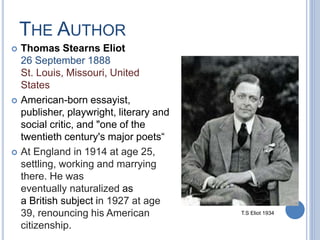
T.S Eliot 1934
 Died: 4 January
1965 (aged 76) at
Kensington, London,
England
 Occupation:
 Poet, dramatist
 Literary critic
 Editor
 Nationality: British
 Citizenship:
 American by birth;
 British from 1927
 Education: AB in
philosophy
 Alma mater:
 Merton College
 Oxford
 Harvard University
 Sorbonne(1905–
1965)
THINGS THAT INFLUENCED ELIOT WITH
LITERATURE
 He had to overcome physical limitations as a child:
 Congenital double inguinal hernia
 He could not participate in many physical
activities and was prevented from socializing
with his peers.
 Eliot states:
 "It is self-evident that St. Louis affected me more
deeply than any other environment has ever
done. I feel that there is something in having
passed one's childhood beside the big river,
which is incommunicable to those people who
have not. I consider myself fortunate to have
been born here, rather than in Boston, or New
York, or London."
MARRIAGE
 Married to Vivienne
Haigh-Wood at
Hampstead Register
Office on 26 June 1915.
 The marriage was
markedly unhappy, in
part because of
Vivienne's health
issues.
 When Harvard offered him
the Charles Eliot
Norton professorship for the
1932–1933 academic years,
he accepted and left Vivienne
in England
 Vivienne was committed to
the Northumberland House
mental hospital, Stoke
Newington, in 1938, and
remained there until she died.
Although Eliot was still legally
her husband, he never visited
her.
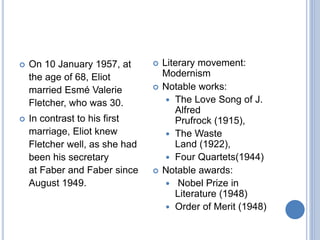
 On 10 January 1957, at
the age of 68, Eliot
married Esmé Valerie
Fletcher, who was 30.
 In contrast to his first
marriage, Eliot knew
Fletcher well, as she had
been his secretary
at Faber and Faber since
August 1949.
 Literary movement:
Modernism
 Notable works:
 The Love Song of J.
Alfred
Prufrock (1915),
 The Waste
Land (1922),
 Four Quartets(1944)
 Notable awards:
 Nobel Prize in
Literature (1948)
 Order of Merit (1948)
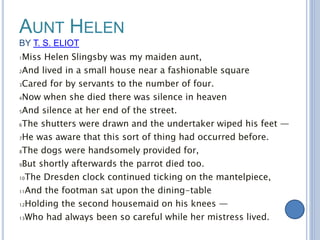
AUNT HELEN
BY T. S. ELIOT
1Miss Helen Slingsby was my maiden aunt,
2And lived in a small house near a fashionable square
3Cared for by servants to the number of four.
4Now when she died there was silence in heaven
5And silence at her end of the street.
6The shutters were drawn and the undertaker wiped his feet —
7He was aware that this sort of thing had occurred before.
8The dogs were handsomely provided for,
9But shortly afterwards the parrot died too.
10The Dresden clock continued ticking on the mantelpiece,
11And the footman sat upon the dining-table
12Holding the second housemaid on his knees —
13Who had always been so careful while her mistress lived.
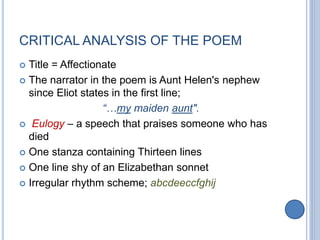
CRITICAL ANALYSIS OF THE POEM
 Title = Affectionate
 The narrator in the poem is Aunt Helen's nephew
since Eliot states in the first line;
“…my maiden aunt".
 Eulogy – a speech that praises someone who has
died
 One stanza containing Thirteen lines
 One line shy of an Elizabethan sonnet
 Irregular rhythm scheme; abcdeeccfghij
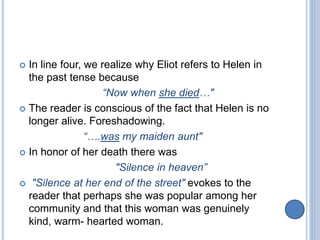
 In line four, we realize why Eliot refers to Helen in
the past tense because
“Now when she died…"
 The reader is conscious of the fact that Helen is no
longer alive. Foreshadowing.
“….was my maiden aunt"
 In honor of her death there was
"Silence in heaven”
 "Silence at her end of the street" evokes to the
reader that perhaps she was popular among her
community and that this woman was genuinely
kind, warm- hearted woman.
 In line six, Eliot writes, "The shutters were drawn"
which is symbolic of mourning, people would not let
light into the house.
 Eliot also states, "the undertaker wiped his feet“
 The undertaker seems to be "aware that this sort of
thing had occurred before“
 "sort of thing" is a euphemism for death and it is
regarded as a minor circumstance
 The Dresden clock
 And the footman sat upon the dining-table
Holding the second housemaid on his knees —
Who had always been so careful while her
mistress lived.
 Flirting; moving on with their lives; having fun in the process
 The death of Helen has established this so the footman and the
second housemaid are making the most of their lives while they
still can.
 “second housemaid" to perhaps convey that the first
housemaid is also dead.
SYMBOLS
 The clock
 The death of Helen
 The parrot
 indication that death is unexpected
REFLECTING MESSAGE
 Life is too short to live by other people's
expectations and requirements, no matter what one
achieves you will not be able to please everyone
 You should have fun with life while you still have the
time and to be able to die without any regrets.

Aunt Helen

  • 1.
  • 2.
    THE AUTHOR  ThomasStearns Eliot 26 September 1888 St. Louis, Missouri, United States  American-born essayist, publisher, playwright, literary and social critic, and "one of the twentieth century's major poets“  At England in 1914 at age 25, settling, working and marrying there. He was eventually naturalized as a British subject in 1927 at age 39, renouncing his American citizenship. T.S Eliot 1934
  • 3.
     Died: 4January 1965 (aged 76) at Kensington, London, England  Occupation:  Poet, dramatist  Literary critic  Editor  Nationality: British  Citizenship:  American by birth;  British from 1927  Education: AB in philosophy  Alma mater:  Merton College  Oxford  Harvard University  Sorbonne(1905– 1965)
  • 4.
    THINGS THAT INFLUENCEDELIOT WITH LITERATURE  He had to overcome physical limitations as a child:  Congenital double inguinal hernia  He could not participate in many physical activities and was prevented from socializing with his peers.  Eliot states:  "It is self-evident that St. Louis affected me more deeply than any other environment has ever done. I feel that there is something in having passed one's childhood beside the big river, which is incommunicable to those people who have not. I consider myself fortunate to have been born here, rather than in Boston, or New York, or London."
  • 5.
    MARRIAGE  Married toVivienne Haigh-Wood at Hampstead Register Office on 26 June 1915.  The marriage was markedly unhappy, in part because of Vivienne's health issues.  When Harvard offered him the Charles Eliot Norton professorship for the 1932–1933 academic years, he accepted and left Vivienne in England  Vivienne was committed to the Northumberland House mental hospital, Stoke Newington, in 1938, and remained there until she died. Although Eliot was still legally her husband, he never visited her.
  • 6.
     On 10January 1957, at the age of 68, Eliot married Esmé Valerie Fletcher, who was 30.  In contrast to his first marriage, Eliot knew Fletcher well, as she had been his secretary at Faber and Faber since August 1949.  Literary movement: Modernism  Notable works:  The Love Song of J. Alfred Prufrock (1915),  The Waste Land (1922),  Four Quartets(1944)  Notable awards:  Nobel Prize in Literature (1948)  Order of Merit (1948)
  • 7.
    AUNT HELEN BY T.S. ELIOT 1Miss Helen Slingsby was my maiden aunt, 2And lived in a small house near a fashionable square 3Cared for by servants to the number of four. 4Now when she died there was silence in heaven 5And silence at her end of the street. 6The shutters were drawn and the undertaker wiped his feet — 7He was aware that this sort of thing had occurred before. 8The dogs were handsomely provided for, 9But shortly afterwards the parrot died too. 10The Dresden clock continued ticking on the mantelpiece, 11And the footman sat upon the dining-table 12Holding the second housemaid on his knees — 13Who had always been so careful while her mistress lived.
  • 8.
    CRITICAL ANALYSIS OFTHE POEM  Title = Affectionate  The narrator in the poem is Aunt Helen's nephew since Eliot states in the first line; “…my maiden aunt".  Eulogy – a speech that praises someone who has died  One stanza containing Thirteen lines  One line shy of an Elizabethan sonnet  Irregular rhythm scheme; abcdeeccfghij
  • 9.
     In linefour, we realize why Eliot refers to Helen in the past tense because “Now when she died…"  The reader is conscious of the fact that Helen is no longer alive. Foreshadowing. “….was my maiden aunt"  In honor of her death there was "Silence in heaven”  "Silence at her end of the street" evokes to the reader that perhaps she was popular among her community and that this woman was genuinely kind, warm- hearted woman.
  • 10.
     In linesix, Eliot writes, "The shutters were drawn" which is symbolic of mourning, people would not let light into the house.  Eliot also states, "the undertaker wiped his feet“  The undertaker seems to be "aware that this sort of thing had occurred before“  "sort of thing" is a euphemism for death and it is regarded as a minor circumstance  The Dresden clock
  • 11.
     And thefootman sat upon the dining-table Holding the second housemaid on his knees — Who had always been so careful while her mistress lived.  Flirting; moving on with their lives; having fun in the process  The death of Helen has established this so the footman and the second housemaid are making the most of their lives while they still can.  “second housemaid" to perhaps convey that the first housemaid is also dead.
  • 12.
    SYMBOLS  The clock The death of Helen  The parrot  indication that death is unexpected
  • 13.
    REFLECTING MESSAGE  Lifeis too short to live by other people's expectations and requirements, no matter what one achieves you will not be able to please everyone  You should have fun with life while you still have the time and to be able to die without any regrets.