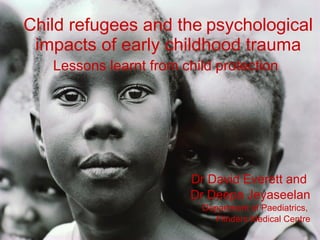
Child refugees and the   psychological impacts of early childhood trauma Lessons learnt from child protection   Dr David Everett and  Dr Deepa Jeyaseelan Department of Paediatrics,  Flinders Medical Centre
Outline The importance of the Early Years Lessons from the 1 st  World experience of child trauma from mal-treatment may apply to young refugee children from disadvantaged countries
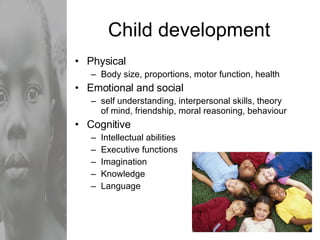
Child development Physical Body size, proportions, motor function, health Emotional and social self understanding, interpersonal skills, theory of mind, friendship, moral reasoning, behaviour Cognitive Intellectual abilities Executive functions Imagination Knowledge Language
Periods of development Prenatal Conception to birth - most rapid change Infancy to toddler (birth to 2 years) motor, perceptual, intellectual capacity Language begins Intimate ties to others and autonomy Early childhood (2-6 years) Refining of motor skills Self-sufficiency and self control Language - increased complexity Play and peers Morality
Periods of development Middle childhood (6-11 years) Master responsibilities Group participation, friendships Morality Logical thought Literacy, numeracy Adolescence (11-18 yrs) Autonomy Transition to adult world Adult size; sexual maturity Abstract thinking Define personal goals and values
Theories of child development ‘ Nature vs nurture’ Heredity Person is born with own set of characteristics e.g. verbal ability, sociability, anxiety Impact of environment Early experiences (-ve or +ve) shape and establish lifelong patterns of behaviour. Maturation  Genetically determined ‘unfolding course’ of growth. Stepwise; discontinuous
Theories of child development 20th century  Psychoanalytic models Freud psychosexual stages Erikson’s psychosocial stages of development Behaviourism and social learning theories Pavlov - classical conditioning Skinner - operant conditioning Cognitive developmental theory Piaget - children actively construct knowledge i.e. they ACTIVELY learn and ADAPT
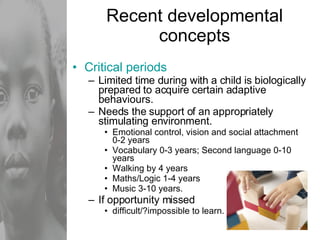
Recent developmental concepts Critical periods Limited time during with a child is biologically prepared to acquire certain adaptive behaviours. Needs the support of an appropriately stimulating environment. Emotional control, vision and social attachment 0-2 years Vocabulary 0-3 years; Second language 0-10 years Walking by 4 years Maths/Logic 1-4 years Music 3-10 years. If opportunity missed  difficult/?impossible to learn.
Ethological theory of attachment Bowlby 1969 Quality of attachment of child to caregiver has profound impact on child’s sense of security and capacity to form  trusting  relationships. Preattachment - birth to 6w ‘ Attachment in the making’ - 6-8w Clear-cut attachment - 6m-2yrs Formation of reciprocal relationship ->18m. Need sensitive caregiver Responsive, consistent, appropriate care.
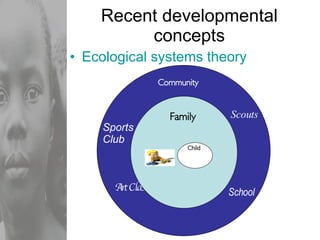
Recent developmental concepts Ecological systems theory Community Scouts School Sports Club Art Class Family Child
Outcomes of development All of a child’s early experiences are educational If these experiences are consistent, developmentally sound, emotionally supportive and attachment is secure positive effects on child and family. If children enter school ready to learn Better academic outcomes  Linked to improved social, economic and health outcomes in adulthood.
Outcomes of development Detection and amelioration of developmental problems in PRESCHOOL period increases likelihood of entering school ready to learn and succeed. If DD undetected and untreated Increased rates of school failure Behaviour problems Low self esteem Loss of potential Significant economic and social impact on society once child reaches adulthood.
Early deprivation and enrichment Eastern Europe orphanages Infants placed in adoptive families at various ages. The later the child was removed from deprived rearing condition --> less favourable developmental outcome. Unstimulating environment > 6 months - Cognitive impairments noted. > 2 years - Severe and persistent impairments in all domains of development.
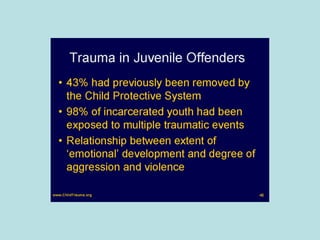
Outcomes of development Children exposed to significant neglect or maltreatment Fail to develop capacity to attach to others. Have poor emotional regulation. Seek control rather than closeness in relationships. Have higher rates of aggressive behaviours and conduct disorders in later life. Higher rates of DD and learning difficulties (30-40%).
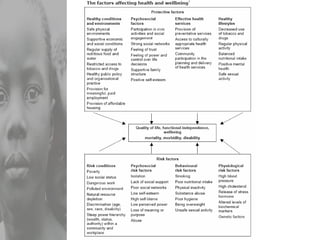
What factors impact on developmental outcomes? Social and behavioural determinants of health Environmental factors Psychosocial factors Behavioural / Lifestyle factors Physiological factors Global forces  Government policies/ health care system These factors interact with child’s genetic and temperamental predisposition Results in biological changes Determines coping, resilience and health outcomes for adult life.
 
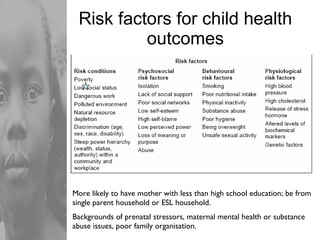
Risk factors for child health outcomes More likely to have mother with less than high school education; be from single parent household or ESL household. Backgrounds of prenatal stressors, maternal mental health or substance abuse issues, poor family organisation.
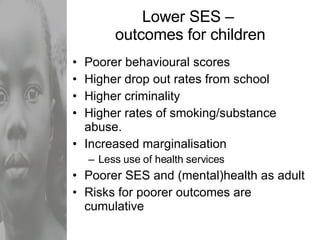
Lower SES –  outcomes for children Poorer behavioural scores Higher drop out rates from school Higher criminality Higher rates of smoking/substance abuse. Increased marginalisation Less use of health services Poorer SES and (mental)health as adult Risks for poorer outcomes are cumulative
 
JUST AS ….. Disease research leads to healthy-living knowledge and recommendations Vehicle accident research leads to improved road safety SO ….. Observation and research from early childhood adversity and trauma has led to ideas for advantaging children. And its all to do with the Brain.
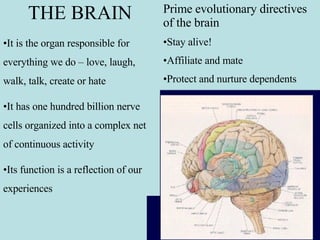
THE BRAIN It is the organ responsible for everything we do – love, laugh, walk, talk, create or hate It has one hundred billion nerve cells organized into a complex net of continuous activity Its function is a reflection of our experiences Prime evolutionary directives of the brain Stay alive! Affiliate and mate Protect and nurture dependents
 
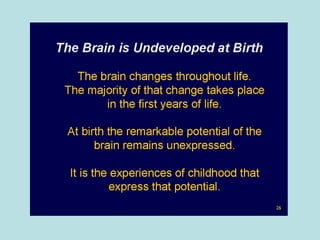
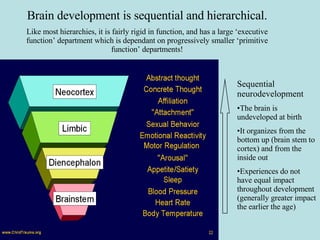
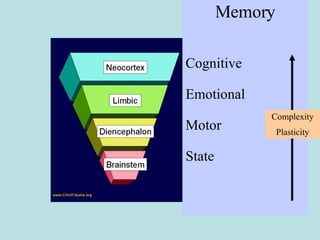
Brain development is sequential and hierarchical. Like most hierarchies, it is fairly rigid in function, and has a large ‘executive function’ department which is dependant on progressively smaller ‘primitive function’ departments! Sequential neurodevelopment The brain is undeveloped at birth It organizes from the bottom up (brain stem to cortex) and from the inside out Experiences do not have equal impact throughout development (generally greater impact the earlier the age)
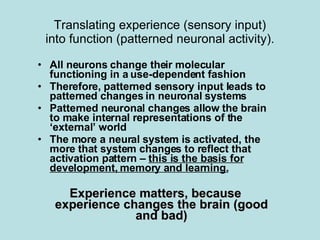
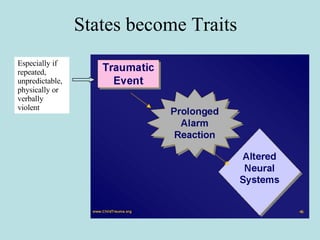
Translating experience (sensory input) into function (patterned neuronal activity). All neurons change their molecular functioning in a use-dependent fashion Therefore, patterned sensory input leads to patterned changes in neuronal systems Patterned neuronal changes allow the brain to make internal representations of the ‘external’ world The more a neural system is activated, the more that system changes to reflect that activation pattern –  this is the basis for development, memory and learning. Experience matters, because experience changes the brain (good and bad)
States become Traits Especially if repeated, unpredictable, physically or verbally violent
 
Memory Cognitive Emotional Motor State Complexity Plasticity
 
 
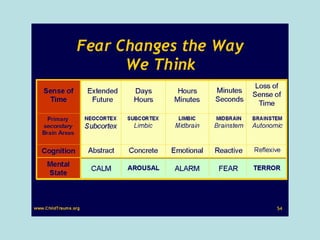
Mal-treatment, trauma and fear – impact on learning Traumatized children have a typical set of observable problems at school. Includes difficulties with attention, processing and storing information, and problems acting on their experiences in an age-appropriate manner
Physical and sexual mal-treatment of children is almost always accompanied by psychological and emotional mal-treatment Vast majority of mal-treatment is perpetrated by somebody in a carer role. That is, it is a breach of Healthy Attachment
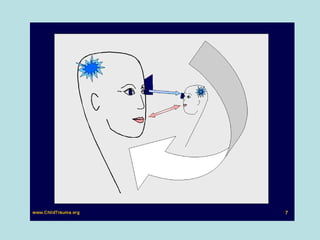
Healthy attachment “ Optimal” caregiving in the early years – is positive, harmonious, responsive and predictable  Involves the  Somatosensory Bath  (B. Perry) Touch, taste, sight, smell, sound and movement in the caregiver-infant interaction These primary sensations play a major role in providing the  patterned, repetitive  sensory stimulation and experiences that help  organise the child’s developing brain
 
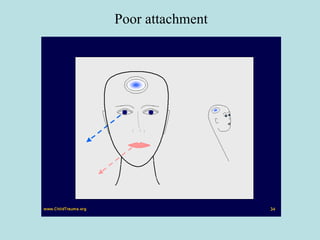
Poor attachment
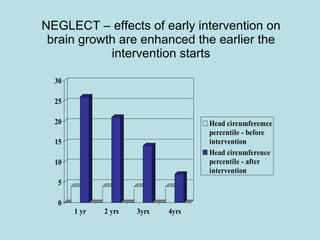
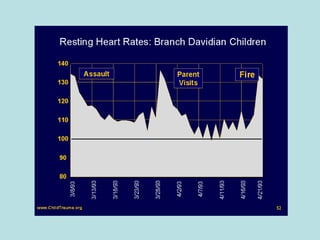
NEGLECT – effects of early intervention on brain growth are enhanced the earlier the intervention starts
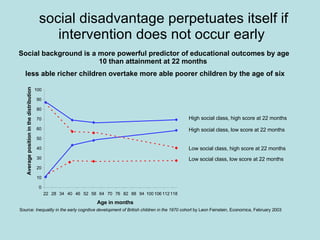
social disadvantage perpetuates itself if intervention does not occur early Source:  Inequality in the early cognitive development of British children in the 1970 cohort  by   Leon Feinstein, Economica, February 2003 High social class, high score at 22 months High social class, low score at 22 months Low social class, high score at 22 months Low social class, low score at 22 months Social background is a more powerful predictor of educational outcomes by age 10 than attainment at 22 months  less able richer children overtake more able poorer children by the age of six 0 10 20 30 40 50 60 70 80 90 100 22 28 34 40 46 52 58 64 70 76 82 88 94 100 106 112 118 Age in months Average position in the distribution
Suggested References http://www.rch.org.au/immigranthealth/index.cfm www.ChildTrauma.org  – large resource site Neuroarcheology of Childhood Maltreatment, B. Perry Long-term effects of nurse home visitation on children’s criminal and antisocial behaviour. D. Olds et al, JAMA, 1998 The economic cost of child abuse and neglect in SA, 1998, Office of Families and Children Childhood trauma, the neurobiology of adaptation, and “use-dependent” development of the brain: how states become traits. B. Perry et al, Infant Mental Health Journal, 1995 Early Years Study, McCain & Mustard.
 
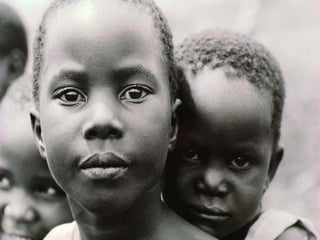
Experience of child refugees Approximately half of the world’s 20 million refugees are children. Majority are from central Africa (57%). Phases of experience Preflight Flight Resettlement 4 broad reactions Anticipation, devastating event, survival and adjustment.
Preflight Onset of political violence/war Witness or even engage in violence Social upheaval and increasing chaos in region Limited access to school Disruption of education and social development Anticipate/Cope with devastating event.
Flight Great uncertainty about future Displacement from home Transitional placement Risks of community violence, rape, abuse, DV exposure, disease, physical injuries. Dependence on others from basic needs Inadequate nutrition, hygiene, medical care  Separation from parents and caregivers. This has a greater impact on children than exposure to war atrocities.
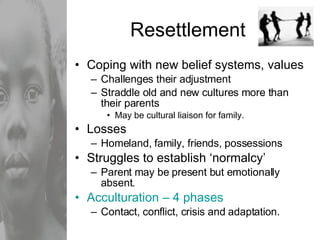
Resettlement Coping with new belief systems, values Challenges their adjustment Straddle old and new cultures more than their parents May be cultural liaison for family. Losses Homeland, family, friends, possessions Struggles to establish ‘normalcy’ Parent may be present but emotionally absent. Acculturation – 4 phases Contact, conflict, crisis and adaptation.
Outcomes for child refugees High risk for mental health problems Exposure to trauma Superimposed on complex acculturation and adjustment processes. More likely long term poor outcome Greater number of risk factors Younger the child <11 year old 3x more likely to develop PTSD Sx from experiences.
Protective factors Parents  Ability to cope, to maintain sense of calm and order, avoidance of dangerous situations Ideological commitment to cause Use of multiple coping strategies Emotion-inhibiting / focused, wishful thinking. Other social supports Connections to culture of origin Acculturation expands networks.
Increased vulnerability to psychological symptoms Exposure to war and political violence Individual vulnerability before trauma exposure Lower pre-migratory expectations Resettlement stress Father’s long term (>6 mths) unemployment in first year. Mother’s emotional well-being Family’s negativity Acute    chronic health issues
Child response to trauma Attention problems Anxiety Mood disorders Hyper/Hypovigilance Sleep disorders Behaviour/conduct disorder Suicidal ideation PTSD
Clinical presentation Withdrawal Extremes of aggression and negative emotion Fearfulness of benign items /people Disrupted sleep Somatic symptoms
 
Clinician’s role in the care of child refugees Prior to settlement Health care focuses on basic survival Resettlement Refugees contend with a myriad of agencies, organisations, schools, courts, medical facilities and social services. Hierarchy of needs and access may determine their agendas of use. Minimise ONGOING harm and risks health outcomes .
Clinician’s role in the care of child refugees Promote optimal nutrition, growth and physical health. Includes immunisations Developmental screening Refer to community based services as needed  Screen for and act on behavioural and mental health concerns raised Have awareness of interventions known to benefit young children and advocate for children’s access to services Home visiting; Incredible Years; CAMHS
Clinician’s role in the care of child refugees Provide info and surveillance with regards to injury prevention awareness of protection of children from injury and abuse. Screen for psychosocial risk DV, maternal depression, isolation. Support family Parental mental health, community supports Empower caregivers --> increase their independence Culturally appropriate practice.
Clinician’s role in the care of  child refugees Address social needs early Learn about culturally familiar people and supports and develop partnerships. Faciliate communication Culturally trained clinicians, interpreters. Account for developmental vulnerabilities and abilities To determine pace and nature of psychotherapeutic intervention. Be aware of stigma associated with seeking mental health support Talking about painful events may not be experienced as valuable by refugees. Take into account the role of ongoing traumatic triggers.
Discussion
Vitamin D/Rickets http://www.health.sa.gov.au/PPG/Default.aspx?tabid=202 SA Perinatal Guidelines, Chapter 5c “Vitamin D deficiency”    Introduction  |  Vitamin D deficiency in pregnancy  |  Antenatal screening and treatment  |  Neonatal management  |  References  |  Last reviewed
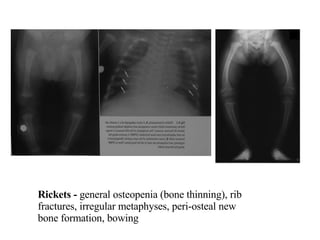
Rickets -  general osteopenia (bone thinning), rib fractures, irregular metaphyses, peri-osteal new bone formation, bowing
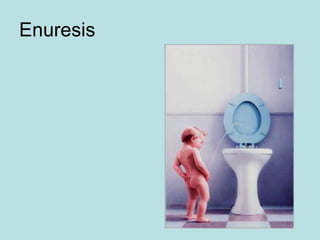
Enuresis
Definitions International Children’s Continence Society  (1997) Enuresis Normal voiding that occurs at an inappropriate or socially-unacceptable time or place nocturnal or diurnal diurnal enuresis vs dysfunctional voiding neuropathic & nonneuropathic Incontinence Involuntary loss of urine, objectively demonstrable, and constituting a social or hygienic problem
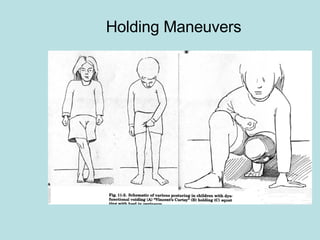
Evaluation - History Current symptoms and signs voiding pattern - stream/volume/frequency (diary) dysuria/frequency/urgency holding manoeuvres perineal hygiene - vulvovaginitis/balanitis UTI’s constipation Specific problems in infancy Age and pattern of toilet training primary vs secondary longest dry periods Family history of urological problems Social history  - think about CSA
Pathogenesis of Bladder Dysfunction “ Bad” bladder behaviours   Adoption of holding manoeuvres to suppress desire to void - leads to overactive detrusor with uninhibited bladder contractions   develop volitional control over contraction of the external  sphincter - external sphincter is used as ‘on-off’ switch for  bladder    - d ifficulty relaxing sphincter when attempting to void voluntarily  (detrusor sphincter discoordination)
Holding Maneuvers
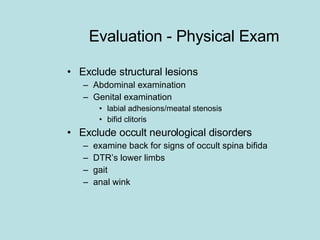
Evaluation - Physical Exam Exclude structural lesions Abdominal examination Genital examination labial adhesions/meatal stenosis bifid clitoris Exclude occult neurological disorders examine back for signs of occult spina bifida DTR’s lower limbs gait anal wink
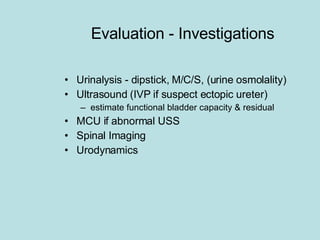
Evaluation - Investigations Urinalysis - dipstick, M/C/S, (urine osmolality) Ultrasound (IVP if suspect ectopic ureter) estimate functional bladder capacity & residual MCU if abnormal USS Spinal Imaging Urodynamics
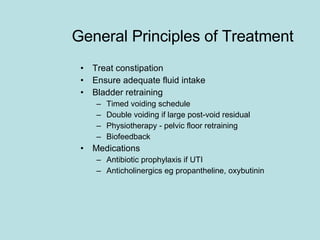
General Principles of Treatment Treat constipation Ensure adequate fluid intake Bladder retraining Timed voiding schedule Double voiding if large post-void residual Physiotherapy - pelvic floor retraining  Biofeedback Medications Antibiotic prophylaxis if UTI Anticholinergics eg propantheline, oxybutinin
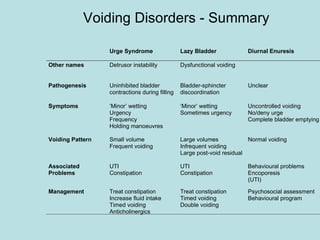
Voiding Disorders - Summary

Refugee Network Presentation

  • 1.
    Child refugees andthe psychological impacts of early childhood trauma Lessons learnt from child protection Dr David Everett and Dr Deepa Jeyaseelan Department of Paediatrics, Flinders Medical Centre
  • 2.
    Outline The importanceof the Early Years Lessons from the 1 st World experience of child trauma from mal-treatment may apply to young refugee children from disadvantaged countries
  • 3.
    Child development PhysicalBody size, proportions, motor function, health Emotional and social self understanding, interpersonal skills, theory of mind, friendship, moral reasoning, behaviour Cognitive Intellectual abilities Executive functions Imagination Knowledge Language
  • 4.
    Periods of developmentPrenatal Conception to birth - most rapid change Infancy to toddler (birth to 2 years) motor, perceptual, intellectual capacity Language begins Intimate ties to others and autonomy Early childhood (2-6 years) Refining of motor skills Self-sufficiency and self control Language - increased complexity Play and peers Morality
  • 5.
    Periods of developmentMiddle childhood (6-11 years) Master responsibilities Group participation, friendships Morality Logical thought Literacy, numeracy Adolescence (11-18 yrs) Autonomy Transition to adult world Adult size; sexual maturity Abstract thinking Define personal goals and values
  • 6.
    Theories of childdevelopment ‘ Nature vs nurture’ Heredity Person is born with own set of characteristics e.g. verbal ability, sociability, anxiety Impact of environment Early experiences (-ve or +ve) shape and establish lifelong patterns of behaviour. Maturation Genetically determined ‘unfolding course’ of growth. Stepwise; discontinuous
  • 7.
    Theories of childdevelopment 20th century Psychoanalytic models Freud psychosexual stages Erikson’s psychosocial stages of development Behaviourism and social learning theories Pavlov - classical conditioning Skinner - operant conditioning Cognitive developmental theory Piaget - children actively construct knowledge i.e. they ACTIVELY learn and ADAPT
  • 8.
    Recent developmental conceptsCritical periods Limited time during with a child is biologically prepared to acquire certain adaptive behaviours. Needs the support of an appropriately stimulating environment. Emotional control, vision and social attachment 0-2 years Vocabulary 0-3 years; Second language 0-10 years Walking by 4 years Maths/Logic 1-4 years Music 3-10 years. If opportunity missed difficult/?impossible to learn.
  • 9.
    Ethological theory ofattachment Bowlby 1969 Quality of attachment of child to caregiver has profound impact on child’s sense of security and capacity to form trusting relationships. Preattachment - birth to 6w ‘ Attachment in the making’ - 6-8w Clear-cut attachment - 6m-2yrs Formation of reciprocal relationship ->18m. Need sensitive caregiver Responsive, consistent, appropriate care.
  • 10.
    Recent developmental conceptsEcological systems theory Community Scouts School Sports Club Art Class Family Child
  • 11.
    Outcomes of developmentAll of a child’s early experiences are educational If these experiences are consistent, developmentally sound, emotionally supportive and attachment is secure positive effects on child and family. If children enter school ready to learn Better academic outcomes Linked to improved social, economic and health outcomes in adulthood.
  • 12.
    Outcomes of developmentDetection and amelioration of developmental problems in PRESCHOOL period increases likelihood of entering school ready to learn and succeed. If DD undetected and untreated Increased rates of school failure Behaviour problems Low self esteem Loss of potential Significant economic and social impact on society once child reaches adulthood.
  • 13.
    Early deprivation andenrichment Eastern Europe orphanages Infants placed in adoptive families at various ages. The later the child was removed from deprived rearing condition --> less favourable developmental outcome. Unstimulating environment > 6 months - Cognitive impairments noted. > 2 years - Severe and persistent impairments in all domains of development.
  • 14.
    Outcomes of developmentChildren exposed to significant neglect or maltreatment Fail to develop capacity to attach to others. Have poor emotional regulation. Seek control rather than closeness in relationships. Have higher rates of aggressive behaviours and conduct disorders in later life. Higher rates of DD and learning difficulties (30-40%).
  • 15.
    What factors impacton developmental outcomes? Social and behavioural determinants of health Environmental factors Psychosocial factors Behavioural / Lifestyle factors Physiological factors Global forces Government policies/ health care system These factors interact with child’s genetic and temperamental predisposition Results in biological changes Determines coping, resilience and health outcomes for adult life.
  • 16.
  • 17.
    Risk factors forchild health outcomes More likely to have mother with less than high school education; be from single parent household or ESL household. Backgrounds of prenatal stressors, maternal mental health or substance abuse issues, poor family organisation.
  • 18.
    Lower SES – outcomes for children Poorer behavioural scores Higher drop out rates from school Higher criminality Higher rates of smoking/substance abuse. Increased marginalisation Less use of health services Poorer SES and (mental)health as adult Risks for poorer outcomes are cumulative
  • 19.
  • 20.
    JUST AS …..Disease research leads to healthy-living knowledge and recommendations Vehicle accident research leads to improved road safety SO ….. Observation and research from early childhood adversity and trauma has led to ideas for advantaging children. And its all to do with the Brain.
  • 21.
    THE BRAIN Itis the organ responsible for everything we do – love, laugh, walk, talk, create or hate It has one hundred billion nerve cells organized into a complex net of continuous activity Its function is a reflection of our experiences Prime evolutionary directives of the brain Stay alive! Affiliate and mate Protect and nurture dependents
  • 22.
  • 23.
    Brain development issequential and hierarchical. Like most hierarchies, it is fairly rigid in function, and has a large ‘executive function’ department which is dependant on progressively smaller ‘primitive function’ departments! Sequential neurodevelopment The brain is undeveloped at birth It organizes from the bottom up (brain stem to cortex) and from the inside out Experiences do not have equal impact throughout development (generally greater impact the earlier the age)
  • 24.
    Translating experience (sensoryinput) into function (patterned neuronal activity). All neurons change their molecular functioning in a use-dependent fashion Therefore, patterned sensory input leads to patterned changes in neuronal systems Patterned neuronal changes allow the brain to make internal representations of the ‘external’ world The more a neural system is activated, the more that system changes to reflect that activation pattern – this is the basis for development, memory and learning. Experience matters, because experience changes the brain (good and bad)
  • 25.
    States become TraitsEspecially if repeated, unpredictable, physically or verbally violent
  • 26.
  • 27.
    Memory Cognitive EmotionalMotor State Complexity Plasticity
  • 28.
  • 29.
  • 30.
    Mal-treatment, trauma andfear – impact on learning Traumatized children have a typical set of observable problems at school. Includes difficulties with attention, processing and storing information, and problems acting on their experiences in an age-appropriate manner
  • 31.
    Physical and sexualmal-treatment of children is almost always accompanied by psychological and emotional mal-treatment Vast majority of mal-treatment is perpetrated by somebody in a carer role. That is, it is a breach of Healthy Attachment
  • 32.
    Healthy attachment “Optimal” caregiving in the early years – is positive, harmonious, responsive and predictable Involves the Somatosensory Bath (B. Perry) Touch, taste, sight, smell, sound and movement in the caregiver-infant interaction These primary sensations play a major role in providing the patterned, repetitive sensory stimulation and experiences that help organise the child’s developing brain
  • 33.
  • 34.
  • 35.
    NEGLECT – effectsof early intervention on brain growth are enhanced the earlier the intervention starts
  • 36.
    social disadvantage perpetuatesitself if intervention does not occur early Source: Inequality in the early cognitive development of British children in the 1970 cohort by Leon Feinstein, Economica, February 2003 High social class, high score at 22 months High social class, low score at 22 months Low social class, high score at 22 months Low social class, low score at 22 months Social background is a more powerful predictor of educational outcomes by age 10 than attainment at 22 months less able richer children overtake more able poorer children by the age of six 0 10 20 30 40 50 60 70 80 90 100 22 28 34 40 46 52 58 64 70 76 82 88 94 100 106 112 118 Age in months Average position in the distribution
  • 37.
    Suggested References http://www.rch.org.au/immigranthealth/index.cfmwww.ChildTrauma.org – large resource site Neuroarcheology of Childhood Maltreatment, B. Perry Long-term effects of nurse home visitation on children’s criminal and antisocial behaviour. D. Olds et al, JAMA, 1998 The economic cost of child abuse and neglect in SA, 1998, Office of Families and Children Childhood trauma, the neurobiology of adaptation, and “use-dependent” development of the brain: how states become traits. B. Perry et al, Infant Mental Health Journal, 1995 Early Years Study, McCain & Mustard.
  • 38.
  • 39.
    Experience of childrefugees Approximately half of the world’s 20 million refugees are children. Majority are from central Africa (57%). Phases of experience Preflight Flight Resettlement 4 broad reactions Anticipation, devastating event, survival and adjustment.
  • 40.
    Preflight Onset ofpolitical violence/war Witness or even engage in violence Social upheaval and increasing chaos in region Limited access to school Disruption of education and social development Anticipate/Cope with devastating event.
  • 41.
    Flight Great uncertaintyabout future Displacement from home Transitional placement Risks of community violence, rape, abuse, DV exposure, disease, physical injuries. Dependence on others from basic needs Inadequate nutrition, hygiene, medical care Separation from parents and caregivers. This has a greater impact on children than exposure to war atrocities.
  • 42.
    Resettlement Coping withnew belief systems, values Challenges their adjustment Straddle old and new cultures more than their parents May be cultural liaison for family. Losses Homeland, family, friends, possessions Struggles to establish ‘normalcy’ Parent may be present but emotionally absent. Acculturation – 4 phases Contact, conflict, crisis and adaptation.
  • 43.
    Outcomes for childrefugees High risk for mental health problems Exposure to trauma Superimposed on complex acculturation and adjustment processes. More likely long term poor outcome Greater number of risk factors Younger the child <11 year old 3x more likely to develop PTSD Sx from experiences.
  • 44.
    Protective factors Parents Ability to cope, to maintain sense of calm and order, avoidance of dangerous situations Ideological commitment to cause Use of multiple coping strategies Emotion-inhibiting / focused, wishful thinking. Other social supports Connections to culture of origin Acculturation expands networks.
  • 45.
    Increased vulnerability topsychological symptoms Exposure to war and political violence Individual vulnerability before trauma exposure Lower pre-migratory expectations Resettlement stress Father’s long term (>6 mths) unemployment in first year. Mother’s emotional well-being Family’s negativity Acute  chronic health issues
  • 46.
    Child response totrauma Attention problems Anxiety Mood disorders Hyper/Hypovigilance Sleep disorders Behaviour/conduct disorder Suicidal ideation PTSD
  • 47.
    Clinical presentation WithdrawalExtremes of aggression and negative emotion Fearfulness of benign items /people Disrupted sleep Somatic symptoms
  • 48.
  • 49.
    Clinician’s role inthe care of child refugees Prior to settlement Health care focuses on basic survival Resettlement Refugees contend with a myriad of agencies, organisations, schools, courts, medical facilities and social services. Hierarchy of needs and access may determine their agendas of use. Minimise ONGOING harm and risks health outcomes .
  • 50.
    Clinician’s role inthe care of child refugees Promote optimal nutrition, growth and physical health. Includes immunisations Developmental screening Refer to community based services as needed Screen for and act on behavioural and mental health concerns raised Have awareness of interventions known to benefit young children and advocate for children’s access to services Home visiting; Incredible Years; CAMHS
  • 51.
    Clinician’s role inthe care of child refugees Provide info and surveillance with regards to injury prevention awareness of protection of children from injury and abuse. Screen for psychosocial risk DV, maternal depression, isolation. Support family Parental mental health, community supports Empower caregivers --> increase their independence Culturally appropriate practice.
  • 52.
    Clinician’s role inthe care of child refugees Address social needs early Learn about culturally familiar people and supports and develop partnerships. Faciliate communication Culturally trained clinicians, interpreters. Account for developmental vulnerabilities and abilities To determine pace and nature of psychotherapeutic intervention. Be aware of stigma associated with seeking mental health support Talking about painful events may not be experienced as valuable by refugees. Take into account the role of ongoing traumatic triggers.
  • 53.
  • 54.
    Vitamin D/Rickets http://www.health.sa.gov.au/PPG/Default.aspx?tabid=202SA Perinatal Guidelines, Chapter 5c “Vitamin D deficiency”   Introduction  |  Vitamin D deficiency in pregnancy  |  Antenatal screening and treatment  |  Neonatal management  |  References  |  Last reviewed
  • 55.
    Rickets - general osteopenia (bone thinning), rib fractures, irregular metaphyses, peri-osteal new bone formation, bowing
  • 56.
  • 57.
    Definitions International Children’sContinence Society (1997) Enuresis Normal voiding that occurs at an inappropriate or socially-unacceptable time or place nocturnal or diurnal diurnal enuresis vs dysfunctional voiding neuropathic & nonneuropathic Incontinence Involuntary loss of urine, objectively demonstrable, and constituting a social or hygienic problem
  • 58.
    Evaluation - HistoryCurrent symptoms and signs voiding pattern - stream/volume/frequency (diary) dysuria/frequency/urgency holding manoeuvres perineal hygiene - vulvovaginitis/balanitis UTI’s constipation Specific problems in infancy Age and pattern of toilet training primary vs secondary longest dry periods Family history of urological problems Social history - think about CSA
  • 59.
    Pathogenesis of BladderDysfunction “ Bad” bladder behaviours Adoption of holding manoeuvres to suppress desire to void - leads to overactive detrusor with uninhibited bladder contractions develop volitional control over contraction of the external sphincter - external sphincter is used as ‘on-off’ switch for bladder - d ifficulty relaxing sphincter when attempting to void voluntarily (detrusor sphincter discoordination)
  • 60.
  • 61.
    Evaluation - PhysicalExam Exclude structural lesions Abdominal examination Genital examination labial adhesions/meatal stenosis bifid clitoris Exclude occult neurological disorders examine back for signs of occult spina bifida DTR’s lower limbs gait anal wink
  • 62.
    Evaluation - InvestigationsUrinalysis - dipstick, M/C/S, (urine osmolality) Ultrasound (IVP if suspect ectopic ureter) estimate functional bladder capacity & residual MCU if abnormal USS Spinal Imaging Urodynamics
  • 63.
    General Principles ofTreatment Treat constipation Ensure adequate fluid intake Bladder retraining Timed voiding schedule Double voiding if large post-void residual Physiotherapy - pelvic floor retraining Biofeedback Medications Antibiotic prophylaxis if UTI Anticholinergics eg propantheline, oxybutinin
  • 64.