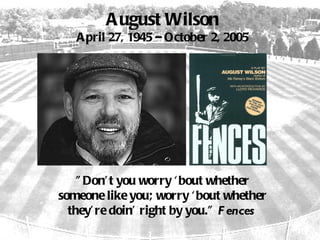
A ugust Wilson
   A pril 27, 1945 – October 2, 2005


    " Don’ t you worry ‘ bout whether
someone like you; worry ‘ bout whether
  they’ re doin’ right by you." F ences
A ugust Wilson’ s Plays
In 2005, A ugust Wilson completed a ten-play cycle, nine of which
are set in Pittsburgh, chronicling the A frican A merican experience
in the 20th century:
•1900s – Gem of the Ocean (2003)
•1910s – J oe Turner’s Come and Gone (1984)
•1920s – Ma Rainey’s Black Bottom (1982) – set in C hicago
•1930s – The Piano Lesson (1986) – won Pulitzer Prize
•1940s – Seven Guitars (1995)
•1950s – F ences (1985) – won Pulitzer Prize
•1960s – Two Trains Running (1990)
•1970s – J itney (1982)
•1980s – King Hedley II (2001)
•1990s – Radio Golf (2005)
Early L ife
• Born as August K ittel in Pittsburgh, later changed his nam e to August
  Wilson.
• Wilson was the fourth of seven child ren.
• H is father was a Germ an im m igrant baker, also nam ed Fred erick
  August K ittel, who seld om spent tim e with his fam ily, and his m other
  was an African Am erican cleaning wom an, D aisy Wilson, from N orth
  C arolina.
• Wilson's parents stayed together until he was five; his father raised their
  child ren in a two-room apartm ent behind a grocery store.
• This econom ically-d epressed neighborhood was inhabited by m any
  black Am ericans as well as others.
• D uring August's teenage years in the late 1 950s, his m other m arried
  D avid Bed ford , and the Bed ford fam ily m oved from the H ill to a then
  pred om inantly white working-class neighborhood , H azelwood .
• There, they encountered racial hostility; bricks were thrown through a
  wind ow at their new hom e.
Early L ife
• Wilson was the only black stud ent at C entral C atholic H igh School
  in 1 959; threats and abuse d rove him away.
• H e d ropped out of Glad stone H igh School in the 1 0th grad e in
  1 960 when a teacher accused him of plagiarizing a 20-page paper
  on N apoleon.
• Wilson m ad e such extensive use of the C arnegie L ibrary to
  ed ucate him self that they later award ed him a d egree (the only one
  they ever award ed ).
• Wilson, who had learned to read at age four, began read ing black
  writers there at age 1 2.
• Wilson knew that he wanted to be a writer, but this created tension
  with his m other, who wanted him to becom e a lawyer.
• She forced him to leave the fam ily hom e and he enlisted in the
  U nited States Arm y for a three-year stint in 1 962, but left after one
  year and went back to working od d jobs such as a porter, short-
  ord er cook, gard ener, and d ishwasher.
Ad ult L ife
• August K ittel changed his nam e to August Wilson to honor his
  m other when his father d ied in 1 965.

• In 1 968, Wilson co-found ed the Black H orizon Theater in the
  H ill D istrict of Pittsburgh along with fellow resid ent Rob
  Penny, who went on to becom e associate professor of African
  stud ies at the U niversity of Pittsburgh.

• Wilson served as a scriptwriter and d irector for the next ten
  years; d esperate for space, they staged m any of their plays in
  elem entary school aud itorium s and com m unity centers.
Death

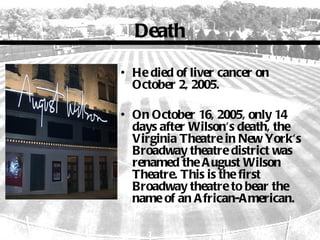
• He died of liver cancer on
  October 2, 2005.

• On October 16, 2005, only 14
  days after Wilson's death, the
  Virginia Theatre in New York's
  Broadway theatre district was
  renamed the A ugust Wilson
  Theatre. This is the first
  Broadway theatre to bear the
  name of an A frican-A merican.
F ences
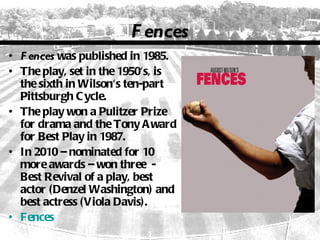
• F ences was published in 1985.
• The play, set in the 1950's, is
  the sixth in Wilson's ten-part
  Pittsburgh C ycle.
• The play won a Pulitzer Prize
  for drama and the Tony A ward
  for Best Play in 1987.
• In 2010 – nominated for 10
  more awards – won three -
  Best Revival of a play, best
  actor (Denzel Washington) and
  best actress (Viola Davis).
• Fences
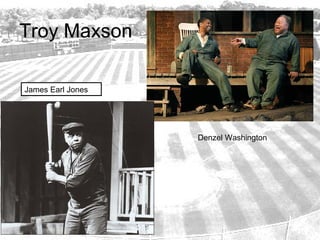
Troy Maxson

James Earl Jones


                   Denzel Washington
Focus
• Family relationships
  – Father/son
  – Husband/wife
• Generational conflicts
• Socio economic issues
• Racial issues
• Major symbol of the play & the title
  – Think of all the purposes of a fence
  – Why is the title plural?


• Baseball – how is it used and why
  appropriate?

August wilson2012

  • 1.
    A ugust Wilson A pril 27, 1945 – October 2, 2005 " Don’ t you worry ‘ bout whether someone like you; worry ‘ bout whether they’ re doin’ right by you." F ences
  • 2.
    A ugust Wilson’s Plays In 2005, A ugust Wilson completed a ten-play cycle, nine of which are set in Pittsburgh, chronicling the A frican A merican experience in the 20th century: •1900s – Gem of the Ocean (2003) •1910s – J oe Turner’s Come and Gone (1984) •1920s – Ma Rainey’s Black Bottom (1982) – set in C hicago •1930s – The Piano Lesson (1986) – won Pulitzer Prize •1940s – Seven Guitars (1995) •1950s – F ences (1985) – won Pulitzer Prize •1960s – Two Trains Running (1990) •1970s – J itney (1982) •1980s – King Hedley II (2001) •1990s – Radio Golf (2005)
  • 3.
    Early L ife •Born as August K ittel in Pittsburgh, later changed his nam e to August Wilson. • Wilson was the fourth of seven child ren. • H is father was a Germ an im m igrant baker, also nam ed Fred erick August K ittel, who seld om spent tim e with his fam ily, and his m other was an African Am erican cleaning wom an, D aisy Wilson, from N orth C arolina. • Wilson's parents stayed together until he was five; his father raised their child ren in a two-room apartm ent behind a grocery store. • This econom ically-d epressed neighborhood was inhabited by m any black Am ericans as well as others. • D uring August's teenage years in the late 1 950s, his m other m arried D avid Bed ford , and the Bed ford fam ily m oved from the H ill to a then pred om inantly white working-class neighborhood , H azelwood . • There, they encountered racial hostility; bricks were thrown through a wind ow at their new hom e.
  • 4.
    Early L ife •Wilson was the only black stud ent at C entral C atholic H igh School in 1 959; threats and abuse d rove him away. • H e d ropped out of Glad stone H igh School in the 1 0th grad e in 1 960 when a teacher accused him of plagiarizing a 20-page paper on N apoleon. • Wilson m ad e such extensive use of the C arnegie L ibrary to ed ucate him self that they later award ed him a d egree (the only one they ever award ed ). • Wilson, who had learned to read at age four, began read ing black writers there at age 1 2. • Wilson knew that he wanted to be a writer, but this created tension with his m other, who wanted him to becom e a lawyer. • She forced him to leave the fam ily hom e and he enlisted in the U nited States Arm y for a three-year stint in 1 962, but left after one year and went back to working od d jobs such as a porter, short- ord er cook, gard ener, and d ishwasher.
  • 5.
    Ad ult Life • August K ittel changed his nam e to August Wilson to honor his m other when his father d ied in 1 965. • In 1 968, Wilson co-found ed the Black H orizon Theater in the H ill D istrict of Pittsburgh along with fellow resid ent Rob Penny, who went on to becom e associate professor of African stud ies at the U niversity of Pittsburgh. • Wilson served as a scriptwriter and d irector for the next ten years; d esperate for space, they staged m any of their plays in elem entary school aud itorium s and com m unity centers.
  • 6.
    Death • He diedof liver cancer on October 2, 2005. • On October 16, 2005, only 14 days after Wilson's death, the Virginia Theatre in New York's Broadway theatre district was renamed the A ugust Wilson Theatre. This is the first Broadway theatre to bear the name of an A frican-A merican.
  • 7.
    F ences • Fences was published in 1985. • The play, set in the 1950's, is the sixth in Wilson's ten-part Pittsburgh C ycle. • The play won a Pulitzer Prize for drama and the Tony A ward for Best Play in 1987. • In 2010 – nominated for 10 more awards – won three - Best Revival of a play, best actor (Denzel Washington) and best actress (Viola Davis). • Fences
  • 8.
    Troy Maxson James EarlJones Denzel Washington
  • 9.
    Focus • Family relationships – Father/son – Husband/wife • Generational conflicts • Socio economic issues • Racial issues
  • 10.
    • Major symbolof the play & the title – Think of all the purposes of a fence – Why is the title plural? • Baseball – how is it used and why appropriate?