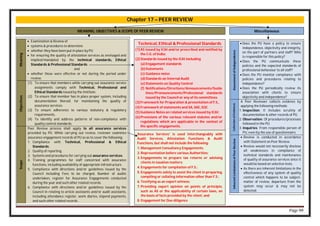
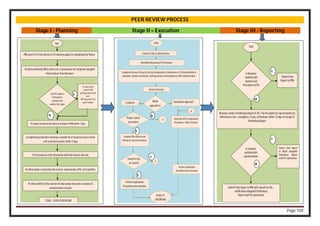
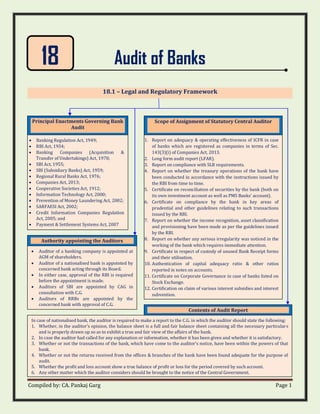
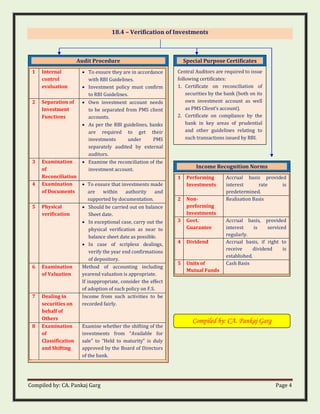
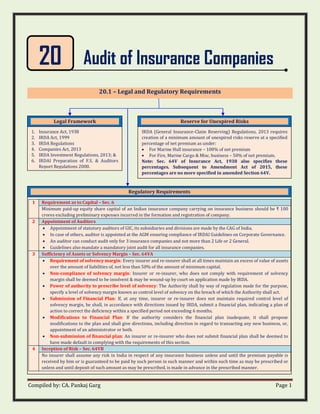
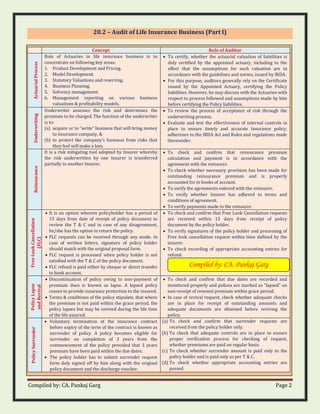
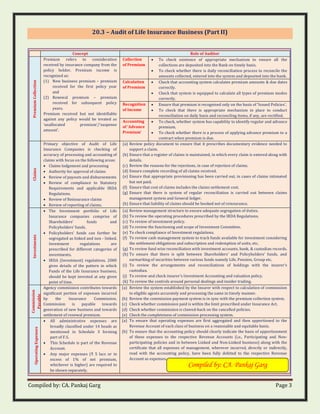
Compiled by: Pankaj Garg ©www.altclasses.in Page 1
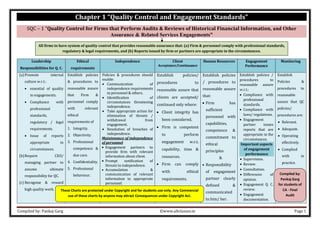
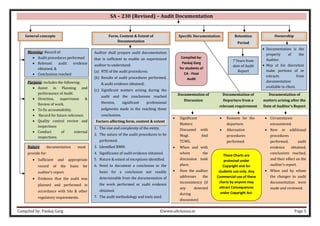
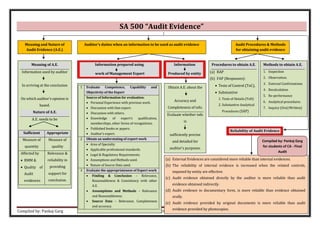
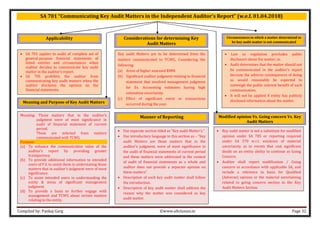
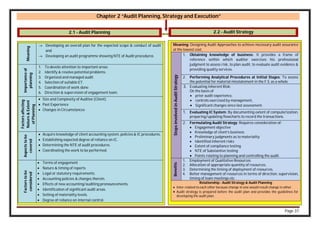
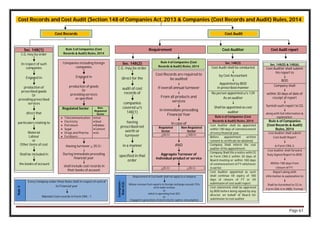
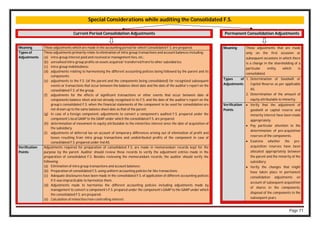
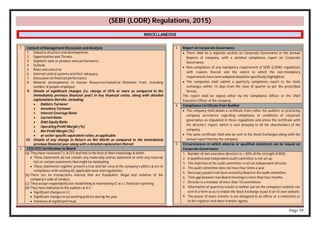
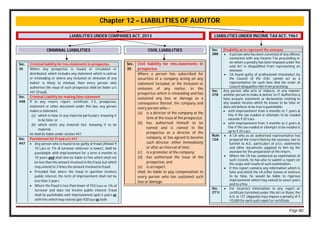
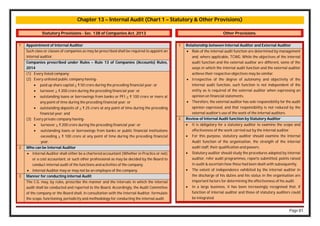
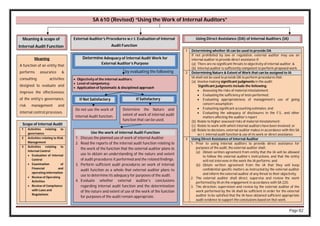
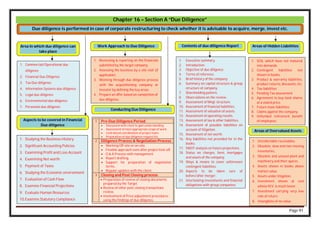
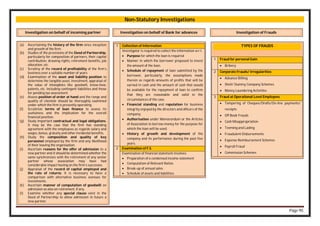
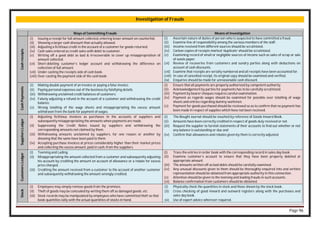
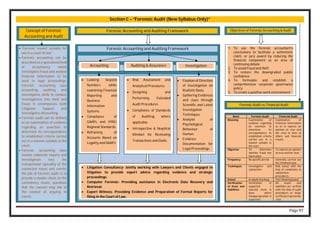
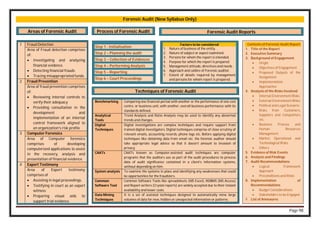
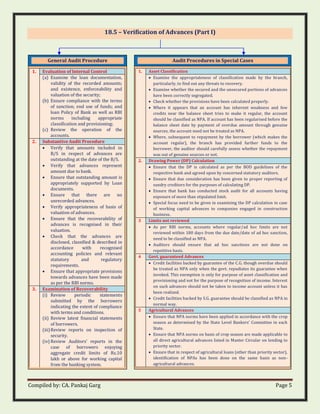
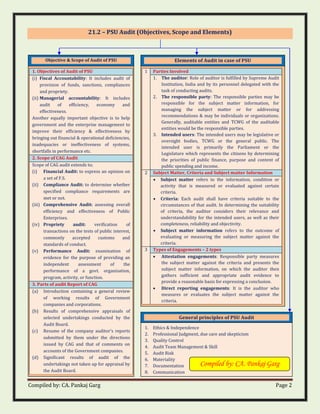
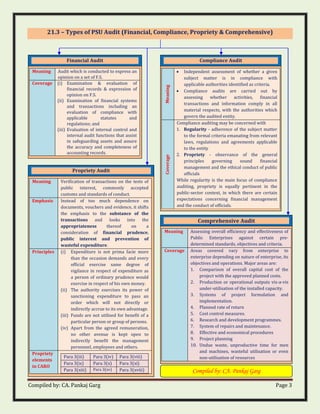
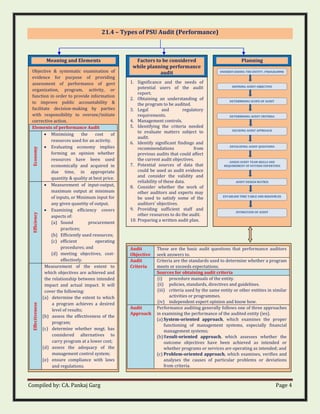
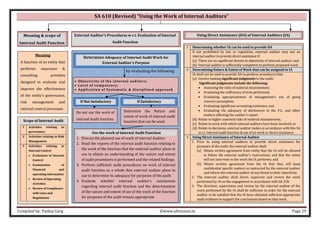
Chapter 1 “Quality Control and Engagement Standards”
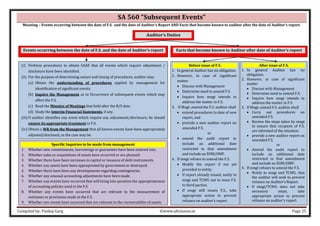
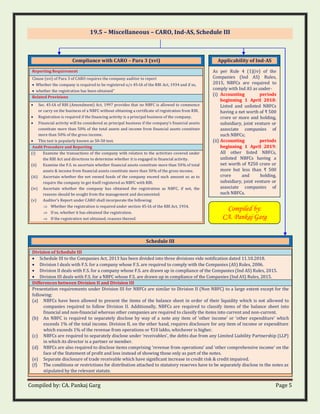
SQC – 1 “Quality Control for Firms that Perform Audits & Reviews of Historical Financial Information, and Other
Assurance & Related Services Engagements”
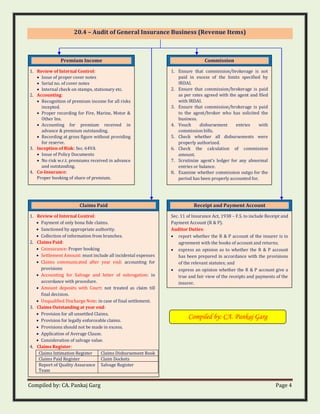
Leadership
Responsibilities for Q. C.
Ethical
requirements
Independence Client
Acceptance/Continuance
Human Resources Engagement
Performance
Monitoring
(a)Promote internal
culture w.r.t.:
• essential of quality
in engagements.
• Compliance with
professional
standards,
regulatory / legal
requirements.
• Issue of reports
appropriate in
circumstances.
(b)Require CEO/
managing partner to
assume ultimate
responsibility for QC.
(c) Recognise & reward
high quality work.
Establish policies
& procedures to
reasonable assure
that Firm &
personnel comply
with relevant
ethical
requirements of
1. Integrity.
2. Objectivity.
3. Professional
competence &
due care.
4. Confidentiality.
5. Professional
behaviour.
Policies & procedures should
enable:
• Communication of
independence requirements
to personnel & others.
• Identification of
circumstances threatening
independence.
• Take appropriate action for
elimination of threats /
withdrawal from
engagement.
• Resolution of breaches of
independence.
Maintenance of independence
of personnel
• Engagement partners to
provide firm with relevant
information about client.
• Prompt notification of
threats to independence.
• Accumulation &
communication of relevant
information to appropriate
personnel.
Establish policies/
procedures to
reasonable assure that
clients are accepted/
continued only where:
• Client integrity has
been considered.
• Firm is competent
to perform
engagement w.r.t.
capability, time &
resources.
• Firm can comply
with ethical
requirements.
Establish policies
/ procedures to
reasonable assure
that:
• Firm has
sufficient
personnel with
capabilities,
competence &
commitment to
ethical
principles
&
• Responsibility
of engagement
partner clearly
defined &
communicated
to him/ her.
Establish policies /
procedures to
reasonable assure
w.r.t.:
• Compliance with
professional
standards.
• Compliance with
laws/ regulations.
• Engagement
partner issues
reports that are
appropriate in the
circumstances.
Important aspects
of engagement
performance
• Supervision.
• Review.
• Consultation.
• Differences of
opinion.
• Engagement Q. C.
review.
• Engagement
documentation.
Establish
Policies &
procedures to
reasonable
assure that QC
policies/
procedures are:
• Relevant.
• Adequate.
• Operating
effectively.
• Complied
with in
practice.
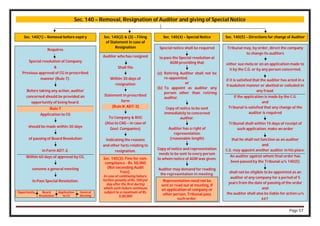
All firms to have system of quality control that provides reasonable assurance that: (a) Firm & personnel comply with professional standards,
regulatory & legal requirements, and (b) Reports issued by firm or partners are appropriate in the circumstances.
These Charts are protected under Copyright and for students use only. Any Commercial
use of these charts by anyone may attract Consequences under Copyright Act.
Compiled by:
Pankaj Garg
for students of
CA - Final
Audit
Downloaded from www.studyfromnotes.com
Compiled by: Pankaj Garg ©www.altclasses.in Page 2
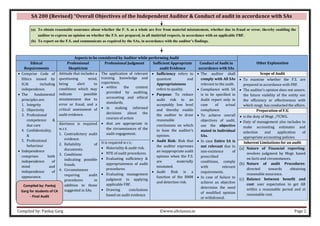
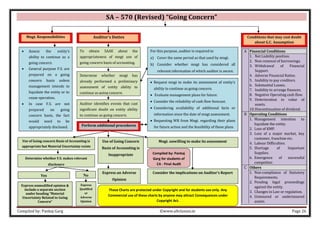
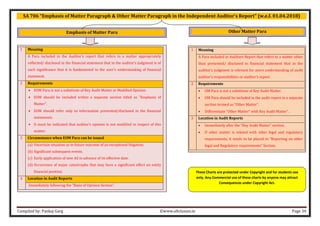
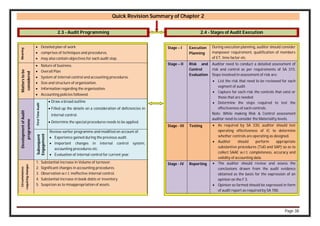
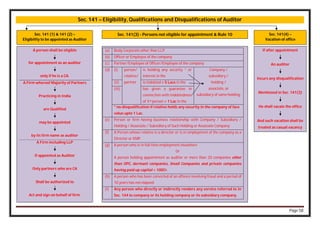
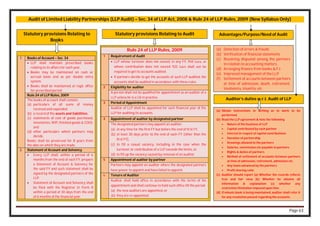
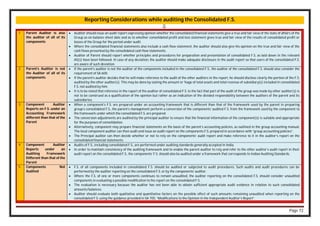
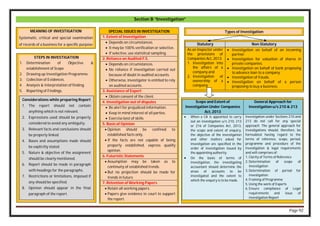
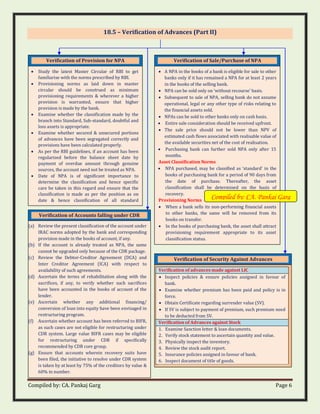
SA 200 (Revised) “Overall Objectives of the Independent Auditor & Conduct of audit in accordance with SAs
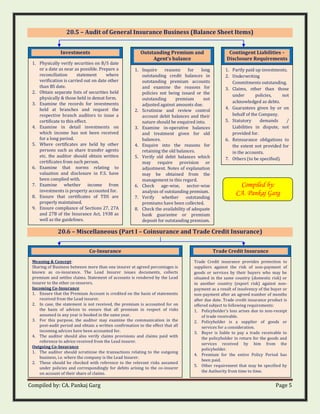
Aspects to be considered by Auditor while performing Audit
Other Explanation
Ethical
Requirements
Professional
Skepticism
Professional Judgment Sufficient Appropriate
audit Evidence
Conduct of Audit in
accordance with SAs
• Comprise Code of
Ethics issued by
ICAI including
independence.
• The fundamental
principles are:
1. Integrity
2. Objectivity
3. Professional
competence &
due care
4. Confidentiality,
&
5. Professional
behaviour
• Independence
comprises both
independence of
mind and
independence of
appearance.
Attitude that includes a
questioning mind,
being alert to
conditions which may
indicate possible
misstatement due to
error or fraud, and a
critical assessment of
audit evidence.
The application of relevant
training, knowledge and
experience,
• within the context
provided by auditing,
accounting and ethical
standards,
• in making informed
decisions about the
courses of action
• that are appropriate in
the circumstances of the
audit engagement.
• Sufficiency refers to
quantum and
Appropriateness
refers to quality.
• Purpose: To reduce
audit risk to an
acceptably low level
and thereby enable
the auditor to draw
reasonable
conclusions on which
to base the auditor’s
opinion.
• Audit Risk: Risk that
the auditor expresses
an inappropriate audit
opinion when the F.S.
are materially
misstated.
• Audit Risk is a
function of the RMM
and detection risk.
• The auditor shall
comply with All SAs
relevant to the audit.
• Compliance with SA
is to be specified in
Audit report only in
case of actual
compliance.
• To achieve overall
objectives of audit,
use the objective
stated in Individual
SAs.
• In case Entire SA is
not relevant due to
non-existence of
prescribed
conditions, comply
with relevant
requirements.
• In case of failure to
achieve an objective
determine the need
of modified opinion
or withdrawal.
Scope of Audit
• To examine whether the F.S. are
prepared in accordance with FRF.
• The auditor’s opinion does not assure,
the future viability of the entity nor
the efficiency or effectiveness with
which mngt. has conducted the affairs.
Preparation of F.S.
• is the duty of Mngt. /TCWG.
• Duty of management also includes to
make accounting estimates and
selection and application of
appropriate accounting policies.
Alertness is required
w.r.t.
1. Contradictory audit
evidence.
2. Reliability of
documents.
3. Conditions
indicating possible
frauds.
4. Circumstances
requiring audit
procedures in
addition to those
suggested in SAs.
It is required w.r.t.:
• Materiality & audit risk.
• NTE of audit procedures.
• Evaluating sufficiency &
appropriateness of audit
procedures.
• Evaluating management
judgment in applying
applicable FRF.
• Drawing conclusions
based on audit evidence.
Inherent Limitations for an audit
(a) Nature of Financial reporting:
involves judgment by Mngt. based
on facts and circumstances.
(b) Nature of audit Procedures:
directed towards obtaining
reasonable assurance.
(c) Balance between benefit and
cost: user expectation to get AR
within a reasonable period and at
reasonable cost.
(a) To obtain reasonable assurance about whether the F. S. as a whole are free from material misstatement, whether due to fraud or error, thereby enabling the
auditor to express an opinion on whether the F.S. are prepared, in all material respects, in accordance with an applicable FRF.
(b) To report on the F.S. and communicate as required by the SAs, in accordance with the auditor’s findings.
Compiled by: Pankaj
Garg for students of CA
- Final Audit
Compiled by: Pankaj Garg ©www.altclasses.in Page 3
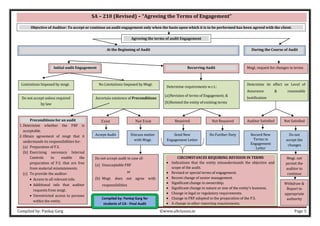
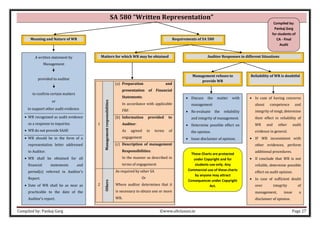
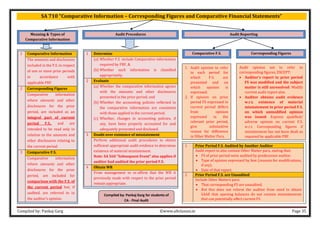
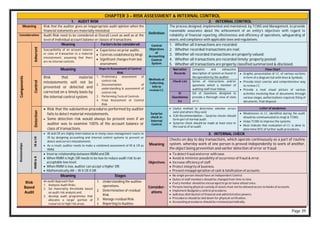
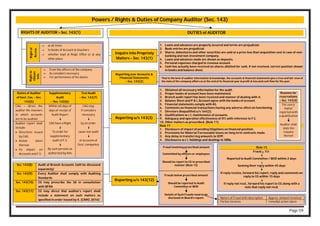
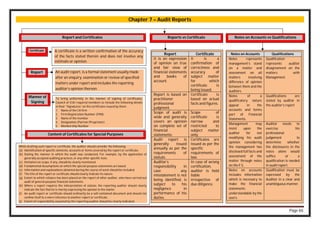
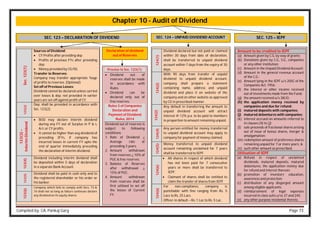
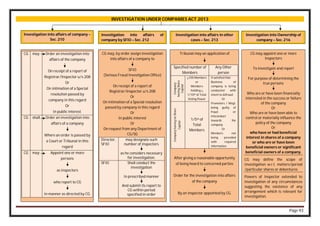
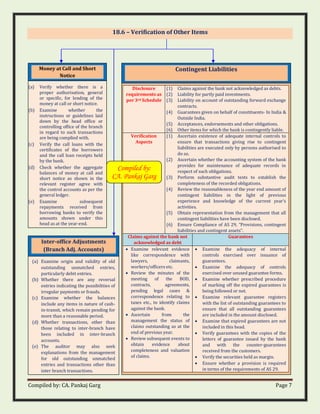
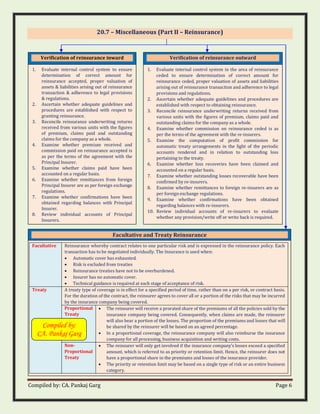
SA – 210 (Revised) – “Agreeing the Terms of Engagement”
Initial audit Engagement
No Further Duty
Recurring Audit
Ascertain existence of Preconditions
Determine requirements w.r.t.:
(a)Revision of terms of Engagement; &
(b)Remind the entity of existing terms
Mngt. not
permit the
auditor to
continue
Exist
Do not
accept the
changes
Not Exist Auditor Satisfied Not Satisfied
Send New
Engagement Letter
Accept Audit Discuss matter
with Mngt.
Record New
Terms in
Engagement
Letter
Determine its effect on Level of
Assurance & reasonable
Justification
Not Required
Withdraw &
Report to
appropriate
authority
At the Beginning of Audit During the Course of Audit
Limitations Imposed by mngt.
Do not accept unless required
by law
No Limitations Imposed by Mngt.
Do not accept audit in case of:
(a) Unacceptable FRF
or
(b) Mngt. does not agree with
responsibilities
Required
Mngt. request for changes in terms
Objective of Auditor: To accept or continue an audit engagement only when the basis upon which it is to be performed has been agreed with the client.
Agreeing the terms of audit Engagement
Preconditions for an audit
1. Determine whether the FRF is
acceptable.
2. Obtain agreement of mngt that it
understands its responsibilities for:
(a) Preparation of F.S.
(b) Exercising necessary Internal
Controls to enable the
preparation of F.S. that are free
from material misstatements.
(c) To provide the auditor:
• Access to all relevant info.
• Additional info that auditor
requests from mngt.
• Unrestricted access to persons
within the entity.
CIRCUMSTANCES REQUIRING REVISION IN TERMS
• Indications that the entity misunderstands the objective and
scope of the audit.
• Revised or special terms of engagement.
• Recent change of senior management.
• Significant change in ownership.
• Significant change in nature or size of the entity’s business.
• Change in legal or regulatory requirements.
• Change in FRF adopted in the preparation of the F.S.
• A change in other reporting requirements.
Compiled by: Pankaj Garg for
students of CA - Final Audit
Compiled by: Pankaj Garg ©www.altclasses.in Page 4
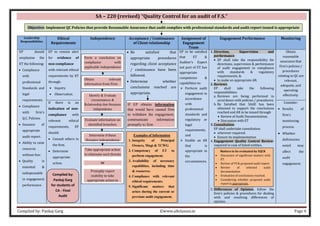
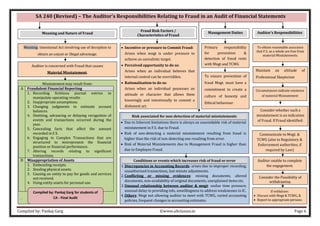
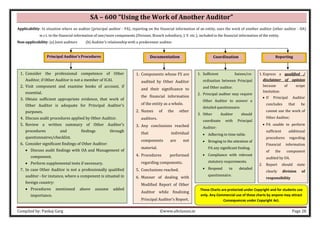
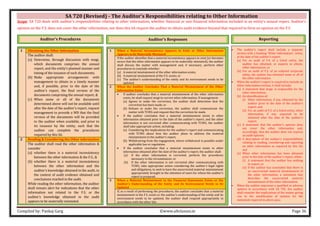
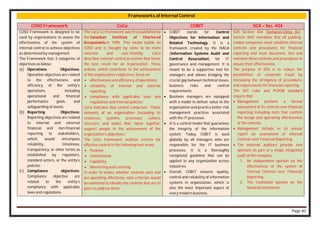
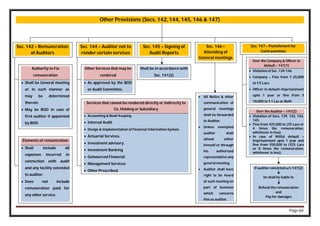
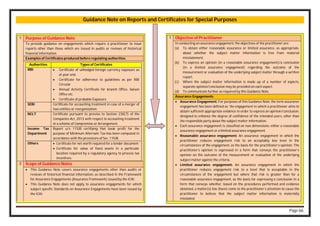
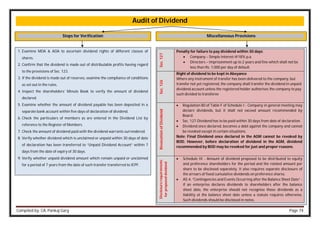
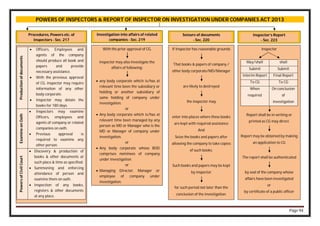
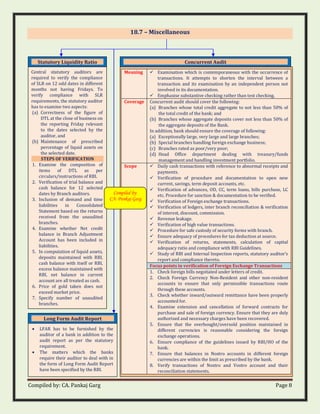
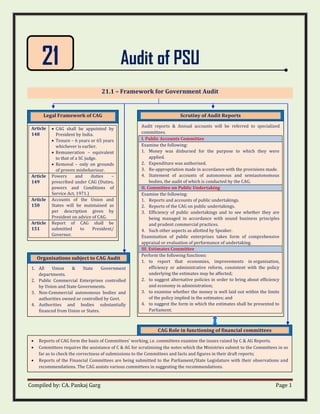
SA – 220 (revised) “Quality Control for an audit of F.S.”
Leadership
Responsibilities
Ethical
Requirements
Independence Acceptance / Continuance
of Client relationship
Assignment of
Engagement
Team
Engagement Performance Monitoring
EP should
emphasize the
ET the following:
• Compliance
with
professional
Standards and
legal
requirements.
• Compliance
with firm’s
Q.C. Policies.
• Issuance of
appropriate
audit report.
• Ability to raise
concerns
without fear.
• Quality is
essential &
indispensable
in engagement
performance.
EP to remain alert
for evidence of
non-compliance
with relevant ethical
requirements by ET
through:
• Inquiry.
• Observation.
• Be satisfied that
appropriate procedures
regarding client acceptance
/ continuance have been
followed.
• Determine whether
conclusions reached are
appropriate.
EP to be satisfied
that ET &
Auditor’s Expert
not part of ET has
appropriate
competence &
capabilities to:
➢ Perform audit
engagement in
accordance
with
professional
standards and
regulatory or
legal
requirements,
and
➢ Enable an AR
that is
appropriate in
the
circumstances.
1.Direction, Supervision and
performance:
• EP shall take the responsibility for
directions, supervision & performance
of audit engagement in compliance
with standards & regulatory
requirements, &.
• to make an appropriate AR.
2.Reviews:
EP shall take the following
responsibilities:
a. Reviews are being performed in
accordance with policies / procedures.
b. Be Satisfied that SAAE has been
obtained to support the conclusions
reached and AR to be issued through
• Review of Audit Documentation.
• Discussion with ET
3.Consultation:
EP shall undertake consultation
• wherever required.
• Ensure its implementation
4. Engagement Quality Control Review:
required in case of listed entities.
5. Differences of Opinion: follow the
firm’s policies & procedures for dealing
with and resolving differences of
opinion.
Obtain
reasonable
assurance that
firm’s policies /
procedures
relating to QC are
relevant,
adequate, and
operating
effectively.
If there is an
indication of non-
compliance with
relevant ethical
requirements, EP
should:
• Consult others in
the firm.
• Determine
appropriate
action.
Consider:
• Results of
firm’s
monitoring
process.
• Whether
deficiencies
noted may
affect the
audit
engagement.
Objective: Implement QC Policies that provide Reasonable Assurance that audit complies with professional standards and audit report issued is appropriate
Form a conclusion on
compliance with
applicable independence
requirements
Obtain relevant
information from Firm
Identify & Evaluate
circumstances &
Relationship that threatens
independence
Evaluate information on
identified breaches.
Determine if these
threaten independence
Take appropriate action
to eliminate such threats
or
Promptly report
inability to take
appropriate action to
firm.
Matters to be evaluated by EQCR
• Discussion of significant matters with
ET.
• Review of FS & proposed audit report.
• Review of selected audit
documentation
• Evaluation of conclusions reached.
• Considering whether proposed audit
report is appropriate.
If EP obtains information
that would have caused firm
to withdraw the engagement,
communicate information
promptly to firm
Examples of Information
1. Integrity of Principal
Owners, Mngt & TCWG
2. Competency of ET to
perform engagement.
3. Availability of necessary
capabilities, including time
& resources.
4. Compliance with relevant
ethical requirements.
5. Significant matters that
arises during the current or
previous audit engagement.
Compiled by:
Pankaj Garg
for students of
CA - Final
Audit
Compiled by: Pankaj Garg ©www.altclasses.in Page 5
SA – 230 (Revised) – Audit Documentation
Documentation of
Discussion
Documentation of
Departure from a
relevant requirement
Documentation of
matters arising after the
Date of Auditor’s Report
• Significant
Matters
Discussed with
Mngt. And
TCWG.
• When and with
whom the
discussion took
place.
• How the auditor
addresses the
inconsistency (if
any detected
during
discussion)
• Reasons for the
departure.
• Alternative
procedures
performed.
• Circumstance
encountered.
• New or additional
procedures
performed, audit
evidence obtained,
conclusions reached,
and their effect on the
auditor’s report.
• When and by whom
the changes to audit
documentation were
made and reviewed.
General concepts Specific Documentation
Meaning: Record of:
• Audit procedures performed
• Relevant audit evidence
obtained, &
• Conclusions reached
Purpose: includes the following:
• Assist in Planning and
performance of Audit.
• Direction, supervision &
Review of work.
• To fix accountability.
• Record for future reference.
• Quality control review and
inspections
• Conduct of external
inspections.
Nature documentation must
provide for:
• Sufficient and appropriate
record of the basis for
auditor’s report.
• Evidence that the audit was
planned and performed in
accordance with SAs & other
regulatory requirements.
Form, Content & Extent of
Documentation
Auditor shall prepare audit documentation
that is sufficient to enable an experienced
auditor to understand:
(a) NTE of the audit procedures;
(b) Results of audit procedures performed,
& audit evidence obtained;
(c) Significant matters arising during the
audit and the conclusions reached
thereon, significant professional
judgments made in the reaching those
conclusions.
Factors affecting form, content & extent
1. The size and complexity of the entity.
2. The nature of the audit procedures to be
performed.
3. Identified RMM.
4. Significance of audit evidence obtained.
5. Nature & extent of exceptions identified.
6. Need to document a conclusion or the
basis for a conclusion not readily
determinable from the documentation of
the work performed or audit evidence
obtained.
7. The audit methodology and tools used.
Retention
Period
7 Years from
date of Audit
Report
Ownership
• Documentation is the
property of the
Auditor.
• May at his discretion
make portions of or
extracts from
documentation
available to client.
These Charts are
protected under
Copyright and for
students use only. Any
Commercial use of these
charts by anyone may
attract Consequences
under Copyright Act.
Compiled by:
Pankaj Garg
for students of
CA - Final
Audit
Compiled by: Pankaj Garg ©www.altclasses.in Page 6
SA 240 (Revised) – The Auditor’s Responsibilities Relating to Fraud in an Audit of Financial Statements
Meaning and Nature of Fraud Auditor’s Responsibilities
Management Duties
Meaning: Intentional Act involving use of deception to
obtain an unjust or illegal advantage.
Auditor is concerned with Fraud that causes
Material Misstatement.
Misstatement may result from:
A Fraudulent Financial Reporting
1. Recording fictitious journal entries to
manipulate operating results.
2. Inappropriate assumptions.
3. Changing judgments to estimate account
balances.
4. Omitting, advancing or delaying recognition of
events and transactions occurred during the
year.
5. Concealing facts that affect the amount
recorded in F.S.
6. Engaging in Complex Transactions that are
structured to misrepresent the financial
position or financial performance.
7. Altering records relating to significant
transactions.
B Misappropriation of Assets
1. Embezzling receipts.
2. Stealing physical assets.
3. Causing an entity to pay for goods and services
not received.
4. Using entity assets for personal use.
.
To obtain reasonable assurance
that F.S. as a whole are free from
material Misstatements.
Maintain an attitude of
Professional Skepticism
Circumstances indicate existence
of material Misstatement
Primary responsibility
for prevention &
detection of fraud rests
with Mngt and TCWG
To ensure prevention of
fraud Mngt. must have a
commitment to create a
culture of honesty and
Ethical behaviour.
Fraud Risk Factors /
Characteristics of Fraud
• Incentive or pressure to Commit Fraud:
Arises when mngt is under pressure to
achieve an unrealistic target.
• Perceived opportunity to do so:
Arises when an individual believes that
internal control can be overridden.
• Rationalization to do so:
Arises when an individual possesses an
attitude or character that allows them
knowingly and intentionally to commit a
dishonest act.
Consider whether such a
misstatement is an indication
of Fraud. If Fraud identified:
Communicate to Mngt. &
TCWG (also to Regulatory &
Enforcement authorities, if
required by Law)
Auditor unable to complete
the engagement.
Consider the Possibility of
withdrawing.
If withdraw:
• Discuss with Mngt & TCWG, &
• Report to appropriate persons
Risk associated for non-detection of material misstatements
• Due to Inherent limitations there is always an unavoidable risk of material
misstatement in F.S. due to Fraud.
• Risk of non-detecting a material misstatement resulting from fraud is
higher than the risk of non-detecting one resulting from error.
• Risk of Material Misstatements due to Management Fraud is higher than
due to Employee Fraud.
Conditions or events which increases risk of fraud or error
1. Discrepancies in Accounting Records: arises due to improper recording,
unauthorised transactions, last minute adjustments.
2. Conflicting or missing evidences: missing documents, altered
documents, non-availability of original documents, unexplained items etc.
3. Unusual relationship between auditor & mngt: undue time pressure,
unusual delay in providing info, unwillingness to address weaknesses in IC.
4. Others: Mngt not allowing auditor to meet with TCWG, varied accounting
policies, frequent changes in accounting estimates.
Compiled by: Pankaj Garg for students of
CA - Final Audit
Compiled by: Pankaj Garg ©www.altclasses.in Page 7
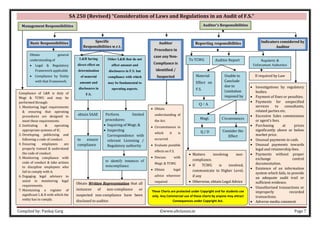
SA 250 (Revised) “Consideration of Laws and Regulations in an Audit of F.S.”
• Investigations by regulatory
bodies.
• Payment of fines or penalties.
• Payments for unspecified
services to consultants,
related parties etc.
• Excessive Sales commissions
or agent’s fees.
• Purchasing at prices
significantly above or below
market price.
• Unusual payments in cash.
• Unusual payments towards
legal and retainership fees.
• Payments without proper
exchange control
documentation.
• Existence of an information
system which fails, to provide
an adequate audit trail or
sufficient evidence.
• Unauthorised transactions or
improperly recorded
transactions.
• Adverse media comment.
obtain SAAE Perform limited
procedures:
• Inquiring of Mngt; &
• Inspecting
Correspondence with
relevant Licensing /
Regulatory authority
to ensure
compliance
to identify instances of
noncompliance.
Obtain Written Representation that all
instances of non-compliance or
suspected non-compliance have been
disclosed to auditor.
To TCWG Auditor Report Regularity &
Enforcement Authorities
Auditor’s Responsibilities
Basic Responsibilities
Obtain general
understanding of
• Legal & Regulatory
Framework applicable
• Compliance by Entity
with that Framework.
Auditor
Procedure in
case any Non-
Compliance is
identified /
Suspected
Reporting responsibilities
• Obtain
understanding of
the Act.
• Circumstances in
which it is
occurred.
• Evaluate possible
effects on F.S.
• Discuss with
Mngt. & TCWG
• Obtain legal
advice wherever
required
L&R having
direct effect on
determination
of material
amount and
disclosures in
F.S.
• Matters involving non-
compliance.
• If TCWG is involved,
communicate to Higher Level,
if any
• Otherwise, obtain Legal Advice
Specific
Responsibilities w.r.t.
Other L&R that do not
affect amount and
disclosures in F.S. but
compliance with which
may be fundamental to
operating aspects.
If required by Law
Material
Effect on
F.S.
Unable to
Conclude
due to
Limitation
imposed by
Q / A
Mngt.
Q / D
Circumstances
Consider the
Effect
Indicators considered by
Auditor
Management Responsibilities
Compliance of L&R is duty of
Mngt & TCWG and may be
performed through:
1. Monitoring legal requirements
& ensuring that operating
procedures are designed to
meet these requirements.
2. Instituting & operating
appropriate systems of IC.
3. Developing, publicising and
following a code of conduct.
4. Ensuring employees are
properly trained & understand
the code of conduct.
5. Monitoring compliance with
code of conduct & take actions
to discipline employees who
fail to comply with it.
6. Engaging legal advisors to
assist in monitoring legal
requirements.
7. Maintaining a register of
significant L & R with which the
entity has to comply.
These Charts are protected under Copyright and for students use
only. Any Commercial use of these charts by anyone may attract
Consequences under Copyright Act.
Compiled by: Pankaj Garg ©www.altclasses.in Page 8
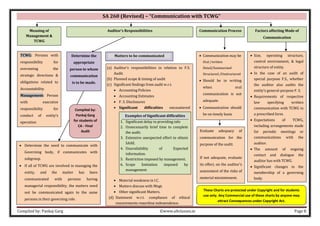
SA 260 (Revised) – “Communication with TCWG”
Meaning of
Management &
TCWG
Auditor’s Responsibilities Communication Process
TCWG: Persons with
responsibility for
overseeing the
strategic directions &
obligations related to
Accountability.
Management: Person
with executive
responsibility for
conduct of entity’s
operation
• Determine the need to communicate with
Governing body, if communicates with
subgroup.
• If all of TCWG are involved in managing the
entity, and the matter has been
communicated with persons having
managerial responsibility, the matters need
not be communicated again to the same
persons in their governing role.
• Communication may be
Oral /written
Detail/Summarised
Structured /Unstructured
• Should be in writing
when oral
communication is not
adequate.
• Communication should
be on timely basis
Matters to be communicated
(a) Auditor’s responsibilities in relation to F.S.
Audit.
(b) Planned scope & timing of audit
(c) Significant findings from audit w.r.t.
• Accounting Policies
• Accounting Estimates
• F. S. Disclosures
• Significant difficulties encountered
during the audit.
• Material weakness in I.C.
• Matters discuss with Mngt.
• Other significant Matters.
(d) Statement w.r.t. compliance of ethical
requirements regarding independence.
Evaluate adequacy of
communication for the
purpose of the audit.
If not adequate, evaluate
its effect, on the auditor’s
assessment of the risks of
material misstatement.
• Size, operating structure,
control environment, & legal
structure of entity.
• In the case of an audit of
special purpose F.S., whether
the auditor also audits the
entity’s general-purpose F. S.
• Requirements of respective
law specifying written
communication with TCWG in
a prescribed form.
• Expectations of TCWG,
including arrangements made
for periodic meetings or
communications with the
auditor.
• The amount of ongoing
contact and dialogue the
auditor has with TCWG.
• Significant changes in the
membership of a governing
body.
Factors affecting Mode of
Communication
Determine the
appropriate
person to whom
communication
is to be made.
Examples of Significant difficulties
1. Significant delay in providing info
2. Unnecessarily brief time to complete
the audit.
3. Extensive unexpected effort to obtain
SAAE.
4. Unavailability of Expected
information.
5. Restriction imposed by management.
6. Scope limitation imposed by
management
These Charts are protected under Copyright and for students
use only. Any Commercial use of these charts by anyone may
attract Consequences under Copyright Act.
Compiled by:
Pankaj Garg
for students of
CA - Final
Audit
Compiled by: Pankaj Garg ©www.altclasses.in Page 9
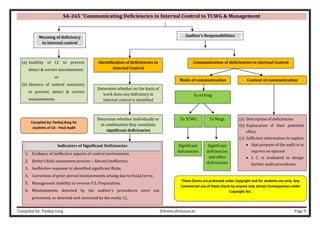
SA-265 “Communicating Deficiencies in Internal Control to TCWG & Management
Meaning of deficiency
in internal control
Auditor’s Responsibilities
(a) Inability of I.C to prevent
detect & correct misstatement;
or
(b) Absence of control necessary
to prevent, detect & correct
misstatements
Communication of deficiencies in Internal Control
Identification of deficiencies in
Internal Control
Determine whether individually or
in combination they constitute
significant deficiencies
Mode of communication Content of communication
To TCWG To Mngt. (a) Description of deficiencies
(b) Explanation of their potential
effect
(c) Sufficient information to explain
• that purpose of the audit is to
express an opinion
• I. C. is evaluated to design
further audit procedures
Significant
deficiencies
Significant
deficiencies
and other
deficiencies
In writing
Determine whether on the basis of
work done any deficiency in
internal control is identified
Indicators of Significant Deficiencies
1. Evidence of ineffective aspects of control environment.
2. Entity’s Risk assessment process – Absent/ineffective.
3. Ineffective response to identified significant Risks.
4. Correction of prior period misstatements arising due to fraud/error.
5. Management inability to oversee F.S. Preparation.
6. Misstatements detected by the auditor’s procedures were not
prevented, or detected and corrected by the entity I.C.
These Charts are protected under Copyright and for students use only. Any
Commercial use of these charts by anyone may attract Consequences under
Copyright Act.
Compiled by: Pankaj Garg for
students of CA - Final Audit
Compiled by: Pankaj Garg ©www.altclasses.in Page 10
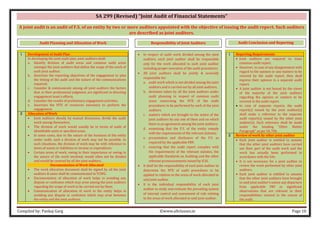
SA 299 (Revised) “Joint Audit of Financial Statements”
A joint audit is an audit of F.S. of an entity by two or more auditors appointed with the objective of issuing the audit report. Such auditors
are described as joint auditors.
Audit Planning and Allocation of Work Responsibility of Joint Auditors Audit Conclusion and Reporting
1 Development of Audit Plan
In developing the joint audit plan, joint auditors shall:
a. Identify division of audit areas and common audit areas
amongst the joint auditors that define the scope of the work of
each joint auditor;
b. Ascertain the reporting objectives of the engagement to plan
the timing of the audit and the nature of the communications
required;
c. Consider & communicate among all joint auditors the factors
that, in their professional judgment, are significant in directing
engagement team’s efforts;
d. Consider the results of preliminary engagement activities.
e. Ascertain the NTE of resources necessary to perform the
engagement.
2 Allocation of Work
• Joint auditors should, by mutual discussion, divide the audit
work among themselves.
• The division of work would usually be in terms of audit of
identifiable units or specified areas.
• In some cases, due to the nature of the business of the entity
under audit, such a division of work may not be possible. In
such situations, the division of work may be with reference to
items of assets or liabilities or income or expenditure.
• Certain areas of work, owing to their importance or owing to
the nature of the work involved, would often not be divided
and would be covered by all the joint auditors.
Documentation of Work Allocated
• The work allocation document shall be signed by all the joint
auditors & same shall be communicated to TCWG.
• Documentation of allocation of work helps in avoiding any
dispute or confusion which may arise among the joint auditors
regarding the scope of work to be carried out by them.
• Communication of allocation of work to the entity helps in
avoiding any dispute or confusion which may arise between
the entity and the joint auditors.
• In respect of audit work divided among the joint
auditors, each joint auditor shall be responsible
only for the work allocated to such joint auditor
including proper execution of the audit procedures.
• All joint auditors shall be jointly & severally
responsible for:
a. audit work which is not divided among the joint
auditors and is carried out by all joint auditors;
b. decisions taken by all the joint auditors under
audit planning in respect of common audit
areas concerning the NTE of the audit
procedures to be performed by each of the joint
auditors.
c. matters which are brought to the notice of the
joint auditors by any one of them and on which
there is an agreement among the joint auditors;
d. examining that the F.S. of the entity comply
with the requirements of the relevant statutes;
e. presentation and disclosure of the F.S. as
required by the applicable FRF;
f. ensuring that the audit report complies with
the requirements of the relevant statutes, the
applicable Standards on Auditing and the other
relevant pronouncements issued by ICAI.
• It shall be the responsibility of each joint auditor to
determine the NTE of audit procedures to be
applied in relation to the areas of work allocated to
said joint auditor.
• It is the individual responsibility of each joint
auditor to study and evaluate the prevailing system
of internal control and assessment of risk relating
to the areas of work allocated to said joint auditor.
1 Reporting Requirements
• Joint auditors are required to issue
common audit report.
• However, in case of any disagreement with
regard to the opinion or any matters to be
covered by the audit report, they shall
express their opinion in a separate audit
report.
• A joint auditor is not bound by the views
of the majority of the joint auditors
regarding the opinion or matters to be
covered in the audit report.
• In case of separate reports, the audit
report(s) issued by the joint auditor(s)
shall make a reference to the separate
audit report(s) issued by the other joint
auditor(s). Such reference shall be made
under the heading “Other Matter
Paragraph” as per SA 706.
2 Review of work by other joint auditor
• Each joint auditor is entitled to assume
that the other joint auditors have carried
out their part of the audit work and the
work has actually been performed in
accordance with the SAs.
• It is not necessary for a joint auditor to
review the work performed by other joint
auditors.
• Each joint auditor is entitled to assume
that the other joint auditors have brought
to said joint auditor’s notice any departure
from applicable FRF or significant
observations that are relevant to their
responsibilities noticed in the course of
the audit.
Compiled by: Pankaj Garg ©www.altclasses.in Page 11
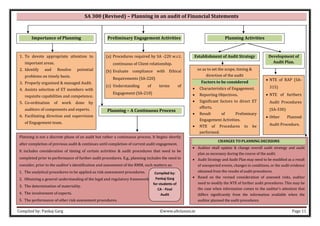
SA 300 (Revised) – Planning in an audit of Financial Statements
Establishment of Audit Strategy Development of
Audit Plan.
so as to set the scope, timing &
direction of the audit
Factors to be considered
• Characteristics of Engagement.
• Reporting Objectives.
• Significant factors to direct ET
efforts.
• Result of Preliminary
Engagement Activities.
• NTE of Procedures to be
performed.
• NTE of RAP (SA-
315)
• NTE of furthers
Audit Procedures
(SA-330)
• Other Planned
Audit Procedure.
Importance of Planning
CHANGES TO PLANNING DECISIONS
• Auditor shall update & change overall audit strategy and audit
plan as necessary during the course of the audit.
• Audit Strategy and Audit Plan may need to be modified as a result
of unexpected events, changes in conditions, or the audit evidence
obtained from the results of audit procedures.
• Based on the revised consideration of assessed risks, auditor
need to modify the NTE of further audit procedures. This may be
the case when information comes to the auditor’s attention that
differs significantly from the information available when the
auditor planned the audit procedures.
Preliminary Engagement Activities
(a) Procedures required by SA -220 w.r.t.
continuous of Client relationship.
(b) Evaluate compliance with Ethical
Requirements (SA-220)
(c) Understanding of terms of
Engagement (SA-210)
Planning Activities
Planning – A Continuous Process
1. To devote appropriate attention to
important areas.
2. Identify and Resolve potential
problems on timely basis.
3. Properly organized & managed Audit.
4. Assists selection of ET members with
requisite capabilities and competence.
5. Co-ordination of work done by
auditors of components and experts.
6. Facilitating direction and supervision
of Engagement team.
Planning is not a discrete phase of an audit but rather a continuous process. It begins shortly
after completion of previous audit & continues until completion of current audit engagement.
It includes consideration of timing of certain activities & audit procedures that need to be
completed prior to performance of further audit procedures. E.g., planning includes the need to
consider, prior to the auditor’s identification and assessment of the RMM, such matters as:
1. The analytical procedures to be applied as risk assessment procedures.
2. Obtaining a general understanding of the legal and regulatory framework.
3. The determination of materiality.
4. The involvement of experts.
5. The performance of other risk assessment procedures.
Compiled by:
Pankaj Garg
for students of
CA - Final
Audit
Compiled by: Pankaj Garg ©www.altclasses.in Page 12
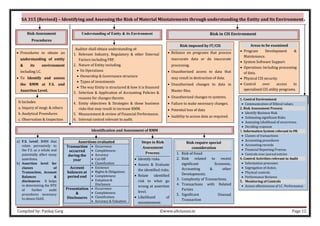
SA 315 (Revised) – Identifying and Assessing the Risk of Material Misstatements through understanding the Entity and Its Environment.
Risk Assessment
Procedures
Understanding of Entity & its Environment
Identification and Assessment of RMM
• Procedures to obtain an
understanding of entity
& its environment
including I.C.
• To Identify and assess
the RMM at F.S. and
Assertion Level.
It Includes
a. Inquiry of mngt. & others
b. Analytical Procedures
c. Observation & Inspection
Auditor shall obtain understanding of:
1. Relevant Industry, Regulatory & other External
Factors including FRF.
2. Nature of Entity including.
• Its Operations
• Ownership & Governance structure
• Types of investments
• The way Entity is structured & how it is financed
3. Selection & Application of Accounting Policies &
reasons for changes thereto.
4. Entity objectives & Strategies & those business
risks that may result in increase RMM.
5. Measurement & review of Financial Performance.
6. Internal control relevant to audit.
a) F.S. Level: RMM that
relate pervasively to
the F.S. as a whole and
potentially affect many
assertions.
b) Assertion level for
classes of
Transaction, Account
Balances &
disclosures: It helps
in determining the NTE
of further audit
procedures necessary
to obtain SAAE.
Steps in Risk
Assessment
Process:
• Identify risks
• Assess & Evaluate
the identified risks.
• Relate identified
risk to what go
wrong at assertion
level.
• Likelihood of
misstatement.
Risk require special
consideration
1. Risk of fraud
2. Risk related to recent
significant Economic,
Accounting & other
Developments.
3. Complexity of Transactions.
4. Transactions with Related
Parties
5. Significant Unusual
Transaction
Components of Internal Control
1. Control Environment
• Communication of Ethical values.
2. Risk Assessment Process
• Identify Business Risk
• Estimating significant Risks
• Assessing Likelihood of occurrence.
• Deciding response
3. Information System relevant to FR:
• Classes of transactions
• Accounting procedures
• Accounting records
• Financial Reporting Process.
• Controls over journal entries
4. Control Activities relevant to Audit
• Information processes
• Segregation of duties.
• Physical controls
• Performance Reviews
5. Monitoring of Controls
• Assess effectiveness of I.C. Performance.
Risk imposed by IT/CIS
• Reliance on programs that process
inaccurate data or do inaccurate
processing.
• Unauthorized access to data that
may result in destruction of data.
• Unauthorized changes to data in
Master files.
• Unauthorized changes to systems.
• Failure to make necessary changes.
• Potential loss of data
• Inability to access data as required.
Areas to be examined
• Program Development &
Maintenance.
• System Software Support.
• Operations Including processing
of data.
• Physical CIS security.
• Control over access to
specialized CIS utility programs.
Assertions evaluated
Transaction
occurred
during the
year
• Occurrence
• Completeness
• Accuracy
• Cut-Off
• Classification
Account
balances at
period end
• Existence
• Rights & Obligations
• Completeness
• Valuation &
Disclosure
Presentation
&
Disclosures
• Occurrence
• Completeness
• Classification
• Accuracy & Valuation
Risk in CIS Environment
Compiled by: Pankaj Garg ©www.altclasses.in Page 13
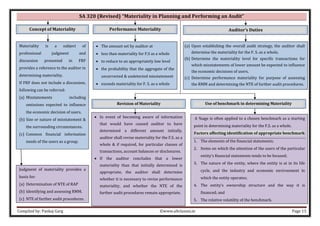
SA 320 (Revised) “Materiality in Planning and Performing an Audit”
Concept of Materiality
Materiality is a subject of
professional judgment and
discussion presented in FRF
provides a reference to the auditor in
determining materiality.
If FRF does not include a discussion,
following can be referred:
(a) Misstatements including
omissions expected to influence
the economic decision of users.
(b) Size or nature of misstatement &
the surrounding circumstances.
(c) Common financial information
needs of the users as a group.
Performance Materiality
• The amount set by auditor at
• less than materiality for F.S as a whole
• to reduce to an appropriately low level
• the probability that the aggregate of the
uncorrected & undetected misstatement
• exceeds materiality for F. S. as a whole
Auditor’s Duties
(a) Upon establishing the overall audit strategy, the auditor shall
determine the materiality for the F. S. as a whole.
(b) Determine the materiality level for specific transactions for
which misstatements of lower amount be expected to influence
the economic decisions of users.
(c) Determine performance materiality for purpose of assessing
the RMM and determining the NTE of further audit procedures.
Revision of Materiality Use of benchmark in determining Materiality
• In event of becoming aware of information
that would have caused auditor to have
determined a different amount initially,
auditor shall revise materiality for the F.S. as a
whole & if required, for particular classes of
transactions, account balances or disclosures.
• If the auditor concludes that a lower
materiality than that initially determined is
appropriate, the auditor shall determine
whether it is necessary to revise performance
materiality, and whether the NTE of the
further audit procedures remain appropriate.
A %age is often applied to a chosen benchmark as a starting
point in determining materiality for the F.S. as a whole.
Factors affecting identification of appropriate benchmark
1. The elements of the financial statements;
2. Items on which the attention of the users of the particular
entity’s financial statements tends to be focused;
3. The nature of the entity, where the entity is at in its life
cycle, and the industry and economic environment in
which the entity operates;
4. The entity’s ownership structure and the way it is
financed; and
5. The relative volatility of the benchmark.
Judgment of materiality provides a
basis for:
(a) Determination of NTE of RAP
(b) Identifying and assessing RMM.
(c) NTE of further audit procedures.
Compiled by: Pankaj Garg ©www.altclasses.in Page 14
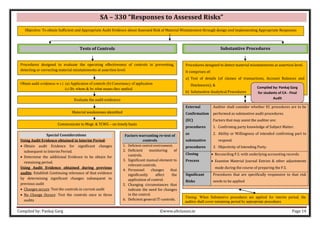
SA – 330 “Responses to Assessed Risks”
Tests of Controls
Procedures designed to evaluate the operating effectiveness of controls in preventing,
detecting or correcting material misstatements at assertion level.
Substantive Procedures
Obtain audit evidences w.r.t. (a) Application of controls (b) Consistency of application
(c) By whom & by what means they applied
Evaluate the audit evidences
Material weaknesses identified
Procedures designed to detect material misstatements at assertion level.
It comprises of:
a) Test of details (of classes of transactions, Account Balances and
Disclosures); &
b) Substantive Analytical Procedures
Communicate to Mngt. & TCWG – on timely basis
Objective: To obtain Sufficient and Appropriate Audit Evidence about Assessed Risk of Material Misstatement through design and implementing Appropriate Responses
Timing: When Substantive procedures are applied for interim period, the
auditor shall cover remaining period by appropriate procedures
Special Considerations
Using Audit Evidence obtained in Interim Period:
• Obtain audit Evidence for significant changes
subsequent to Interim Period.
• Determine the additional Evidence to be obtain for
remaining period.
Using Audit Evidence obtained during previous
audits: Establish Continuing relevance of that evidence
by determining significant changes subsequent to
previous audit
• Changes occurs: Test the controls in current audit
• No Change Occurs: Test the controls once in three
audits
Factors warranting re-test of
controls
1. Deficient control environment.
2. Deficient monitoring of
controls.
3. Significant manual element to
relevant controls.
4. Personnel changes that
significantly affect the
application of control.
5. Changing circumstances that
indicate the need for changes
in the control.
6. Deficient general IT-controls.
External
Confirmation
(EC)
procedures
as
substantive
procedures
Auditor shall consider whether EC procedures are to be
performed as substantive audit procedures.
Factors that may assist the auditor are:
1. Confirming party knowledge of Subject Matter.
2. Ability or Willingness of intended confirming part to
respond.
3. Objectivity of Intending Party.
Closing
Process
• Reconciling F.S. with underlying accounting records.
• Examine Material Journal Entries & other adjustments
made during the course of preparing the F.S.
Significant
Risks
Procedures that are specifically responsive to that risk
needs to be applied
Compiled by: Pankaj Garg
for students of CA - Final
Audit
Compiled by: Pankaj Garg ©www.altclasses.in Page 15
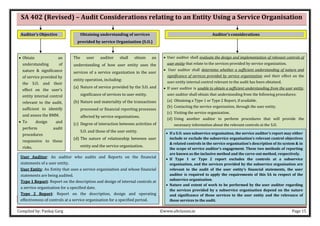
SA 402 (Revised) – Audit Considerations relating to an Entity Using a Service Organisation
Auditor’s Objective Obtaining understanding of services
provided by service Organisation (S.O.)
Auditor’s considerations
• Obtain an
understanding of
nature & significance
of service provided by
the S.O. and their
effect on the user’s
entity internal control
relevant to the audit,
sufficient to identify
and assess the RMM.
• To design and
perform audit
procedures
responsive to those
risks.
The user auditor shall obtain an
understanding of how user entity uses the
services of a service organization in the user
entity operation, including:
(a) Nature of service provided by the S.O. and
significance of services to user entity.
(b) Nature and materiality of the transactions
processed or financial reporting processes
affected by service organizations.
(c) Degree of interaction between activities of
S.O. and those of the user entity.
(d) The nature of relationship between user
entity and the service organization.
• User auditor shall evaluate the design and implementation of relevant controls of
user entity that relate to the services provided by service organization.
• User auditor shall determine whether a sufficient understanding of nature and
significance of services provided by service organization and their effect on the
user entity internal control relevant to the audit has been obtained.
• If user auditor is unable to obtain a sufficient understanding from the user entity,
user auditor shall obtain that understanding from the following procedures:
(a) Obtaining a Type 1 or Type 2 Report, if available.
(b) Contacting the service organization, through the user entity.
(c) Visiting the service organization.
(d) Using another auditor to perform procedures that will provide the
necessary information about the relevant controls at the S.O.
User Auditor: An auditor who audits and Reports on the financial
statements of a user entity.
User Entity: An Entity that uses a service organization and whose financial
statements are being audited.
Type 1 Report: Report on the description and design of internal controls at
a service organization for a specified date.
Type 2 Report: Report on the description, design and operating
effectiveness of controls at a service organisation for a specified period.
• If a S.O. uses subservice organisation, the service auditor’s report may either
include or exclude the subservice organisation’s relevant control objectives
& related controls in the service organisation’s description of its system & in
the scope of service auditor’s engagement. These two methods of reporting
are known as the inclusive method and the carve-out method, respectively.
• If Type 1 or Type 2 report excludes the controls at a subservice
organisation, and the services provided by the subservice organisation are
relevant to the audit of the user entity’s financial statements, the user
auditor is required to apply the requirements of this SA in respect of the
subservice organisation.
• Nature and extent of work to be performed by the user auditor regarding
the services provided by a subservice organisation depend on the nature
and significance of those services to the user entity and the relevance of
those services to the audit.
Compiled by: Pankaj Garg ©www.altclasses.in Page 16
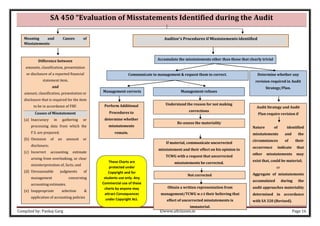
SA 450 “Evaluation of Misstatements Identified during the Audit
Meaning and Causes of
Misstatements
Accumulate the misstatements other than those that clearly trivial
Difference between
amounts, classification, presentation
or disclosure of a reported financial
statement item,
and
amount, classification, presentation or
disclosure that is required for the item
to be in accordance of FRF.
Causes of Misstatement
(a) Inaccuracy in gathering or
processing data from which the
F.S. are prepared;
(b) Omission of an amount or
disclosure;
(c) Incorrect accounting estimate
arising from overlooking, or clear
misinterpretation of, facts; and
(d) Unreasonable judgments of
management concerning
accounting estimates.
(e) Inappropriate selection &
application of accounting policies
Communicate to management & request them to correct. Determine whether any
revision required in Audit
Strategy/Plan.
Management corrects Management refuses
Perform Additional
Procedures to
determine whether
misstatements
remain.
Understand the reason for not making
corrections
If material, communicate uncorrected
misstatement and their effect on his opinion to
TCWG with a request that uncorrected
misstatements be corrected.
Not corrected
Obtain a written representation from
management/TCWG w.r.t their believing that
effect of uncorrected misstatements is
immaterial.
Re-assess the materiality
Auditor’s Procedures if Misstatements identified
Audit Strategy and Audit
Plan require revision if
Nature of identified
misstatements and the
circumstances of their
occurrence indicate that
other misstatements may
exist that, could be material;
or
Aggregate of misstatements
accumulated during the
audit approaches materiality
determined in accordance
with SA 320 (Revised).
These Charts are
protected under
Copyright and for
students use only. Any
Commercial use of these
charts by anyone may
attract Consequences
under Copyright Act.
Compiled by: Pankaj Garg ©www.altclasses.in Page 17
SA 500 “Audit Evidence”
Meaning and Nature of
Audit Evidence (A.E.)
Auditor’s duties when an information to be used as audit evidence Audit Procedures & Methods
for obtaining audit evidence
Reliability of Audit Evidence
Meaning of A.E.
Information used by auditor
In arriving at the conclusion
On which auditor’s opinion is
based.
Nature of A.E.
A.E. needs to be
Sufficient Appropriate
Measure of
quantity
Measure of
quality
Affected by
• RMM &
• Quality of
Audit
evidences
Relevance &
reliability in
providing
support for
conclusion.
Information prepared using
work of Management Expert
Information
Produced by entity
1 Evaluate Competence, Capability and
Objectivity of the Expert
Source of Information for evaluation:
• Personal Experience with previous work.
• Discussion with that expert.
• Discussion with others.
• Knowledge of expert’s qualification,
memberships, other forms of recognitions.
• Published books or papers.
• Auditor’s expert.
2 Obtain an understating of expert work
• Area of Specialty
• Applicable professional standards.
• Legal & Regulatory Requirements.
• Assumptions and Methods used.
• Nature of Source Data used.
3 Evaluate the appropriateness of Expert work
• Finding & Conclusion – Relevance,
Reasonableness & Consistency with other
A.E.
• Assumptions and Methods – Relevance
and Reasonableness.
• Source Data – Relevance, Completeness
and accuracy.
Obtain A.E. about the
Accuracy and
Completeness of info.
Evaluate whether info
is
sufficiently precise
and detailed for
auditor’s purposes.
Procedures to obtain A.E.
(a) RAP
(b) FAP (Responses):
• Tests of Control (ToC),
• Substantive
1. Tests of Details (ToD)
2. Substantive Analytical
Procedures (SAP)
Methods to obtain A.E.
1. Inspection
2. Observation.
3. External Confirmations
4. Recalculation
5. Re-performance
6. Analytical procedures
7. Inquiry (Oral/Written)
(a) External Evidences are considered more reliable than internal evidences.
(b) The reliability of internal evidence is increased when the related controls,
imposed by entity are effective.
(c) Audit evidence obtained directly by the auditor is more reliable than audit
evidence obtained indirectly.
(d) Audit evidence in documentary form, is more reliable than evidence obtained
orally.
(e) Audit evidence provided by original documents is more reliable than audit
evidence provided by photocopies.
Compiled by: Pankaj Garg
for students of CA - Final
Audit
Compiled by: Pankaj Garg ©www.altclasses.in Page 18
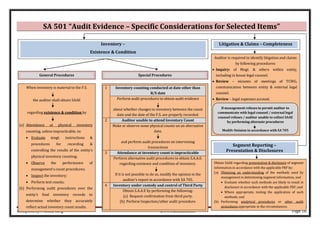
SA 501 “Audit Evidence – Specific Considerations for Selected Items”
Inventory –
Existence & Condition
Litigation & Claims – Completeness
Segment Reporting –
Presentation & Disclosures
General Procedures Special Procedures
When inventory is material to the F.S.
the auditor shall obtain SAAE
regarding existence & condition by
(a) Attendance at physical inventory
counting, unless impracticable, to:
• Evaluate mngt. instructions &
procedures for recording &
controlling the results of the entity’s
physical inventory counting;
• Observe the performance of
management’s count procedures;
• Inspect the inventory;
• Perform test counts;
(b) Performing audit procedures over the
entity’s final inventory records to
determine whether they accurately
reflect actual inventory count results.
1 Inventory counting conducted at date other than
B/S date
Perform audit procedures to obtain audit evidence
about whether changes in inventory between the count
date and the date of the F.S. are properly recorded.
2 Auditor unable to attend Inventory Count
Make or observe some physical counts on an alternative
date,
and perform audit procedures on intervening
transactions
3 Attendance at inventory count is impracticable
Perform alternative audit procedures to obtain S.A.A.E.
regarding existence and condition of inventory.
If it is not possible to do so, modify the opinion in the
auditor’s report in accordance with SA 705.
4 Inventory under custody and control of Third Party
Obtain S.A.A.E by performing the following:
(a) Request confirmation from third party.
(b) Perform Inspection/other audit procedure.
Auditor is required to identify litigation and claims
by following procedures:
• Inquiry: of Mngt. & others within entity,
including in house legal counsel.
• Review – minutes of meetings of TCWG,
communication between entity & external legal
counsel.
• Review – legal expenses account.
If management refuses to permit auditor to
communicate with legal counsel / external legal
counsel refuses / auditor unable to collect SAAE
by performing alternate procedures
Modify Opinion in accordance with SA 705
Obtain SAAE regarding presentation & disclosure of segment
information in accordance with the applicable FRF by:
(a) Obtaining an understanding of the methods used by
management in determining segment information, and
• Evaluate whether such methods are likely to result in
disclosure in accordance with the applicable FRF; and
• Where appropriate, testing the application of such
methods; and
(b) Performing analytical procedures or other audit
procedures appropriate in the circumstances.
Compiled by: Pankaj Garg ©www.altclasses.in Page 19
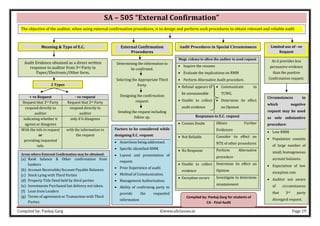
SA – 505 “External Confirmation”
+ ve Request - ve request
Request that 3rd Party Request that 3rd Party
respond directly to
auditor
respond directly to
auditor
indicating whether it
agrees or disagrees
only if it disagrees
With the info in request
or
providing requested
info.
with the information in
the request
The objective of the auditor, when using external confirmation procedures, is to design and perform such procedures to obtain relevant and reliable audit
evidence.
Audit Evidence obtained as a direct written
response to auditor from 3rd Party in
Paper/Electronic/Other form.
Meaning & Type of E.C.
2 Types
External Confirmation
Procedures
Determining the information to
be confirmed.
Selecting the Appropriate Third
Party.
Designing the confirmation
request.
Sending the request including
follow up.
Factors to be considered while
designing E.C. request:
• Assertions being addressed.
• Specific identified RMM.
• Layout and presentation of
request.
• Prior Experience of audit.
• Method of Communication.
• Management Authorization.
• Ability of confirming party to
provide the requested
information
Audit Procedures in Special Circumstances
Mngt. refuses to allow the auditor to send request
• Inquire the reasons
• Evaluate the implications on RMM
• Perform Alternative Audit procedure.
• Refusal appears to
be unreasonable
• Unable to collect
audit evidence
• Communicate to
TCWG.
• Determine its effect
on Opinion
Responses to E.C. request
• Creates Doubt Obtain Further
Evidences
• Not Reliable Consider its effect on
NTE of other procedures
• No Response Perform Alternative
procedure
• Unable to collect
evidence
Determine its effect on
Opinion
• Exception occurs Investigate to determine
misstatement
Limited use of –ve
Request
As it provides less
persuasive evidence
than the positive
Confirmation request.
Circumstances in
which negative
request may be used
as sole substantive
procedure:
• Low RMM.
• Population consists
of large number of
small, homogeneous
account balances.
• Expectation of low
exception rate.
• Auditor not aware
of circumstances
that 3rd party
disregard request.
Areas where External Confirmation may be obtained:
(a) Bank balance & Other confirmation from
bankers
(b) Account Receivable/Account Payable Balances
(c) Stock Lying with Third Parties
(d) Property Title Deed held by third parties
(e) Investments Purchased but delivery not taken.
(f) Loan from Lenders
(g) Terms of agreement or Transaction with Third
Parties
Compiled by: Pankaj Garg for students of
CA - Final Audit
Compiled by: Pankaj Garg ©www.altclasses.in Page 20
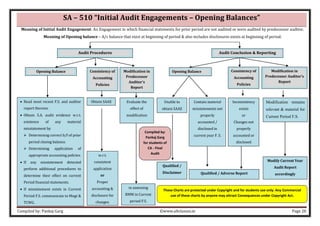
SA – 510 “Initial Audit Engagements – Opening Balances”
Meaning of Initial Audit Engagement: An Engagement in which financial statements for prior period are not audited or were audited by predecessor auditor.
Meaning of Opening balance – A/c balance that exist at beginning of period & also includes disclosures exists at beginning of period.
Audit Conclusion & Reporting
Audit Procedures
Opening Balance Consistency of
Accounting
Policies
Modification in
Predecessor Auditor’s
Report
Opening Balance Consistency of
Accounting
Policies
Balance
Unable to
obtain SAAE
Contain material
misstatements not
properly
accounted /
disclosed in
current year F. S.
Obtain SAAE
• Read most recent F.S. and auditor
report thereon.
• Obtain S.A. audit evidence w.r.t.
existence of any material
misstatement by
➢ Determining correct b/f of prior
period closing balance.
➢ Determining application of
appropriate accounting policies.
• If any misstatement detected
perform additional procedures to
determine their effect on current
Period financial statements.
• If misstatement exists in Current
Period F.S. communicate to Mngt &
TCWG.
w.r.t.
consistent
application
or
Proper
accounting &
disclosure for
changes.
Evaluate the
effect of
modification
Inconsistency
exists
or
Changes not
properly
accounted or
disclosed
Modify Current Year
Audit Report
accordingly
Modification remains
relevant & material for
Current Period F.S.
in assessing
RMM in Current
period F.S.
Qualified / Adverse Report
Qualified /
Disclaimer
Modification in
Predecessor
Auditor’s
Report
These Charts are protected under Copyright and for students use only. Any Commercial
use of these charts by anyone may attract Consequences under Copyright Act.
Compiled by:
Pankaj Garg
for students of
CA - Final
Audit
Compiled by: Pankaj Garg ©www.altclasses.in Page 21
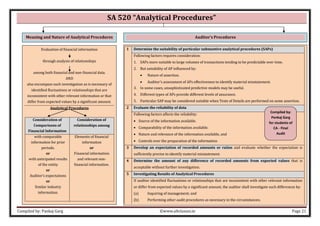
SA 520 “Analytical Procedures”
Meaning and Nature of Analytical Procedures Auditor’s Procedures
Evaluation of financial information
through analysis of relationships
among both financial and non-financial data.
AND
also encompass such investigation as is necessary of
identified fluctuations or relationships that are
inconsistent with other relevant information or that
differ from expected values by a significant amount.
Analytical Procedures
Consideration of
Comparisons of
Financial Information
Consideration of
relationships among
with comparable
information for prior
periods.
or
with anticipated results
of the entity
or
Auditor’s expectations
or
Similar industry
information.
Elements of financial
information
or
Financial information
and relevant non-
financial information.
1 Determine the suitability of particular substantive analytical procedures (SAPs)
Following factors requires consideration:
1. SAPs more suitable to large volumes of transactions tending to be predictable over time.
2. But suitability of AP influenced by:
• Nature of assertion.
• Auditor’s assessment of APs effectiveness to identify material misstatement.
3. In some cases, unsophisticated predictive models may be useful.
4. Different types of APs provide different levels of assurance.
5. Particular SAP may be considered suitable when Tests of Details are performed on same assertion.
2 Evaluate the reliability of data
Following factors affects the reliability:
• Source of the information available.
• Comparability of the information available.
• Nature and relevance of the information available, and
• Controls over the preparation of the information
3 Develop an expectation of recorded amounts or ratios and evaluate whether the expectation is
sufficiently precise to identify material misstatement.
4 Determine the amount of any difference of recorded amounts from expected values that is
acceptable without further investigation.
5 Investigating Results of Analytical Procedures
If auditor identified fluctuations or relationships that are inconsistent with other relevant information
or differ from expected values by a significant amount, the auditor shall investigate such differences by:
(a) Inquiring of management; and
(b) Performing other audit procedures as necessary in the circumstances.
Compiled by:
Pankaj Garg
for students of
CA - Final
Audit
Compiled by: Pankaj Garg ©www.altclasses.in Page 22
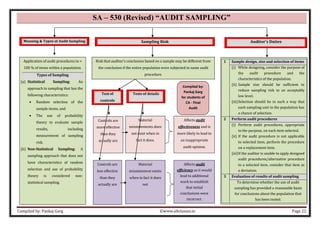
SA – 530 (Revised) “AUDIT SAMPLING”
Meaning & Types of Audit Sampling Sampling Risk Auditor’s Duties
Risk that auditor’s conclusion based on a sample may be different from
the conclusion if the entire population were subjected to same audit
procedure.
Application of audit procedures to <
100 % of items within a population.
Types of Sampling
(a) Statistical Sampling: An
approach to sampling that has the
following characteristics:
• Random selection of the
sample items; and
• The use of probability
theory to evaluate sample
results, including
measurement of sampling
risk.
(b) Non-Statistical Sampling: A
sampling approach that does not
have characteristics of random
selection and use of probability
theory is considered non-
statistical sampling.
Tests of details
Test of
controls
Controls are
less effective
than they
actually are
Controls are
more effective
than they
actually are
Material
misstatements does
not exist when in
fact it does.
Affects audit
efficiency as it would
lead to additional
work to establish
that initial
conclusions were
incorrect.
Affects audit
effectiveness and is
more likely to lead to
an inappropriate
audit opinion.
Material
misstatement exists
when in fact it does
not
1 Sample design, size and selection of items
(i) While designing, consider the purpose of
the audit procedure and the
characteristics of the population.
(ii) Sample size should be sufficient to
reduce sampling risk to an acceptably
low level.
(iii)Selection should be in such a way that
each sampling unit in the population has
a chance of selection.
2 Perform audit procedures
(i) Perform audit procedures, appropriate
to the purpose, on each item selected.
(ii) If the audit procedure is not applicable
to selected item, perform the procedure
on a replacement item.
(iii)If the auditor is unable to apply designed
audit procedures/alternative procedure
to a selected item, consider that item as
a deviation.
3 Evaluation of results of audit sampling
To determine whether the use of audit
sampling has provided a reasonable basis
for conclusions about the population that
has been tested.
Compiled by:
Pankaj Garg
for students of
CA - Final
Audit
Compiled by: Pankaj Garg ©www.altclasses.in Page 23
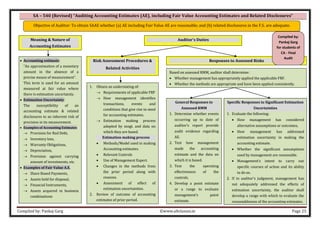
SA – 540 (Revised) “Auditing Accounting Estimates (AE), including Fair Value Accounting Estimates and Related Disclosures”
Objective of Auditor: To obtain SAAE whether (a) AE including Fair Value AE are reasonable; and (b) related disclosures in the F.S. are adequate.
Meaning & Nature of
Accounting Estimates
Risk Assessment Procedures &
Related Activities
Responses to Assessed Risks
Auditor’s Duties
• Accounting estimate:
“An approximation of a monetary
amount in the absence of a
precise means of measurement”.
This term is used for an amount
measured at fair value where
there is estimation uncertainty.
• Estimation Uncertainty:
The susceptibility of an
accounting estimate & related
disclosures to an inherent risk of
precision in its measurement.
• Examples of Accounting Estimates
→ Provision for Bad Debt,
→ Inventory loss,
→ Warranty Obligations,
→ Depreciation,
→ Provision against carrying
amount of investments, etc.
• Examples of Fair Value A.E.
→ Share Based Payments,
→ Assets held for disposal,
→ Financial Instruments,
→ Assets acquired in business
combinations
1. Obtain an understating of:
→ Requirements of applicable FRF
→ How management identifies
transactions, events and
conditions that give rise to need
for accounting estimates.
→ Estimation making process
adopted by mngt. and data on
which they are based.
Estimation making process
• Methods/Model used in making
Accounting estimates.
• Relevant Controls
• Use of Management Expert.
• Changes in the methods from
the prior period along with
reasons.
• Assessment of effect of
estimation uncertainties.
2. Review of outcome of accounting
estimates of prior period.
Specific Responses to Significant Estimation
Uncertainties
1. Evaluate the following:
• How management has considered
alternative assumptions or outcomes,
• How management has addressed
estimation uncertainty in making the
accounting estimate.
• Whether the significant assumptions
used by management are reasonable.
• Management’s intent to carry out
specific courses of action and its ability
to do so.
2. If in auditor’s judgment, management has
not adequately addressed the effects of
estimation uncertainty, the auditor shall
develop a range with which to evaluate the
reasonableness of the accounting estimates.
Based on assessed RMM, auditor shall determine:
• Whether management has appropriately applied the applicable FRF.
• Whether the methods are appropriate and have been applied consistently.
General Responses to
Assessed RMM
1. Determine whether events
occurring up to date of
auditor’s report provide
audit evidence regarding
AE.
2. Test how management
made the accounting
estimate and the data on
which it is based.
3. Test the operating
effectiveness of the
controls.
4. Develop a point estimate
or a range to evaluate
management’s point
estimate.
Compiled by:
Pankaj Garg
for students of
CA - Final
Audit
Compiled by: Pankaj Garg ©www.altclasses.in Page 24
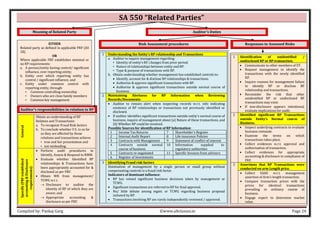
SA 550 “Related Parties”
Meaning of Related Party
EITHER
Related party as defined in applicable FRF (AS
18).
OR
Where applicable FRF establishes minimal or
no RP requirements:
a. A person/entity having control/ significant
influence, over reporting entity;
b. Entity over which reporting entity has
control / significant influence, and
c. Entity under common control with
reporting entity, through:
• Common controlling ownership
• Owners who are close family members
• Common key management
Auditor’s Duties
Risk Assessment procedures Responses to Assessed Risks
Auditor’s responsibilities in relation to RP
General
Obtain an understanding of RP
Relation and Transactions:
a. To recognize Fraud Risk factors
b. To conclude whether F.S. in so far
as they are affected by those
relations and transactions achieve
• true and fair presentation and
• not misleading.
Specific
(FRF
established
accounting
&
Disclosure
requirements)
• Perform audit procedures to
Identify, Assess & Respond to RMM.
• Evaluate whether Identified RP
relationships & Transactions have
been appropriately accounted for &
disclosed as per FRF.
• Obtain WR from management/
TCWG w.r.t.
→ Disclosure to auditor the
identity of RP of which they are
aware; and
→ Appropriate accounting &
disclosure as per FRF.
1 Understanding the Entity’s RP relationship and Transactions
a. Auditor to inquire management regarding:
• Identity of entity’s RP, changes from prior period.
• Nature of relationships between entity and RP.
• Type & purpose of transactions with RP.
b. Obtain understanding whether management has established controls to:
• Identify, account for & disclose RP relationships & transactions.
• Authorise & approve significant transactions with RP.
• Authorise & approve significant transactions outside normal course of
business.
2 Maintaining Alertness for RP Information when Reviewing
Records/Documents
• Auditor to remain alert when inspecting records w.r.t. info indicating
existence of RP relationships or transactions not previously identified or
disclosed.
• If auditor identifies significant transactions outside entity’s normal course of
business, inquire of management about (a) Nature of these transactions, and
(b) Whether RP could be involved.
Possible Sources for identification of RP Information:
1 Income Tax Returns 7 Shareholder’s Register
2 Internal Audit Report 8 Life insurance Policies
3 Contracts with Management 9 Statement of conflict of interest
4 Contracts outside normal
course of business
10 Information supplied to
regulatory authorities
5 Contracts re-negotiated 11 Specific Invoices from advisors
6 Register of Investments
3 Identifying Fraud risk factors
Domination of management by a single person or small group without
compensating controls is a fraud risk factor.
Indicators of dominant influence:
• RP has vetoed significant business decisions taken by management or
TCWG.
• Significant transactions are referred to RP for final approval.
• No/ little debate among mgmt. or TCWG regarding business proposal
initiated by RP.
• Transactions involving RP are rarely independently reviewed / approved.
1 Identification of unidentified /
undisclosed RP or RP transaction.
• Communicate to other members of ET.
• Request management to identify the
transactions with the newly identified
RP.
• Inquire reasons for management failure
to identify RP or disclose RP
relationship and transactions.
• Reconsider the risk that other
unidentified RP or undisclosed RP
transactions may exist.
• If non-disclosure appears intentional,
evaluate implications for audit.
2 Identified significant RP Transactions
outside Entity’s Normal course of
Business.
• Inspect underlying contracts to evaluate
business rationale.
• Examine the terms on which
transactions takes place.
• Collect evidences w.r.t. approval and
authorisation of transaction.
• Collect evidences for appropriate
accounting & disclosure in compliance of
FRF.
3 Assertions that RP Transactions were
conducted on arm Length price.
• Collect SAAE w.r.t. management
assertion of Arm’s length transaction.
• Compare transaction prices with the
prices for identical transactions
prevailing in ordinary course of
business.
• Engage expert to determine market
value.
Compiled by: Pankaj Garg ©www.altclasses.in Page 25
SA 560 “Subsequent Events”
Meaning – Events occurring between the date of F.S. and the date of Auditor’s Report AND Facts that become known to auditor after the date of Auditor’s report.
Auditor’s Duties
Events occurring between the date of F.S. and the date of Auditor’s report Facts that become known to Auditor after date of Auditor’s report
(i) Perform procedures to obtain SAAE that all events which require adjustment /
disclosure have been identified.
(ii) For the purpose of determining nature and timing of procedures, auditor may:
(a) Obtain the understanding of procedures applied by management for
identification of significant events.
(b) Inquire the Management as to Occurrence of subsequent events which may
affect the F.S.
(c) Read the Minutes of Meetings that held after the B/S date.
(d) Study the Interim Financial Statements, if any.
(iii) If auditor identifies any event which require any adjustment/disclosure, he should
ensure its appropriate treatment in F.S.
(iv) Obtain a WR from the Management that all known events have been appropriately
adjusted/disclosed, as the case may be.
Specific Inquiries to be made from management
1. Whether new commitments, borrowings or guarantees have been entered into.
2. Whether sales or acquisitions of assets have occurred or are planned.
3. Whether there have been increases in capital or issuance of debt instruments.
4. Whether any assets have been appropriated by government or destroyed.
5. Whether there have been any developments regarding contingencies.
6. Whether any unusual accounting adjustments have been made.
7. Whether any events have occurred that will bring into question the appropriateness
of accounting policies used in the F.S.
8. Whether any events have occurred that are relevant to the measurement of
estimates or provisions made in the F.S.
9. Whether any events have occurred that are relevant to the recoverability of assets.
Before issue of F.S.
1. In general Auditor has no obligation.
2. However, in case of significant
matter
• Discuss with Management
• Determine need to amend F.S.
• Inquire how mngt intends to
address the matter in F.S.
3. If Mngt. amend the F.S. auditor shall
• extend procedures to date of new
report, and
• provide a new auditor report on
amended F.S.
or
• amend the audit report to
include an additional date
restricted to that amendment
and include an EOM/OMP.
4. If mngt refuses to amend the F.S.
• Modify the report if not yet
provided to entity.
• If report already issued, notify to
mngt and TCWG not to issue F.S.
to third parties.
• If mngt still issues F.S., take
appropriate action to prevent
reliance on auditor’s report.
After issue of F.S.
1. In general Auditor has no
obligation.
2. However, in case of significant
matter
• Discuss with Management
• Determine need to amend F.S.
• Inquire how mngt intends to
address the matter in F.S.
3. If Mngt. amend F.S. auditor shall
• Carry out procedures on
amended F.S.
• Review the steps taken by mngt
to ensure that recipient of F.S.
are informed of the situation.
• provide a new auditor report on
amended F.S.
or
• Amend the audit report to
include an additional date
restricted to that amendment
and include an EOM/OMP.
4. If mngt refuses to amend the F.S.
• Notify to mngt and TCWG, that
the auditor will seek to prevent
reliance on Auditor’s Report.
• If mngt/TCWG does not take
necessary steps, take
appropriate action to prevent
reliance on auditor’s report.
Compiled by: Pankaj Garg ©www.altclasses.in Page 26
SA – 570 (Revised) “Going Concern”
• Assess the entity’s
ability to continue as a
going concern.
• General purpose F.S. are
prepared on a going
concern basis unless
management intends to
liquidate the entity or to
cease operation.
• In case F.S. are not
prepared on going
concern basis, the fact
would need to be
appropriately disclosed.
To obtain SAAE about the
appropriateness of mngt use of
going concern basis of accounting.
For this purpose, auditor is required to
a) Cover the same period as that used by mngt.
b) Consider whether mngt has considered all
relevant information of which auditor is aware.
Auditor identifies events that cast
significant doubt on entity ability
to continue as going concern.
• Request mngt to make its assessment of entity’s
ability to continue as going concern.
• Evaluate management plans for future.
• Consider the reliability of cash flow forecast.
• Considering availability of additional facts or
information since the date of mngt assessment.
• Requesting WR from Mngt. regarding their plans
for future action and the feasibility of these plans
Mngt. Responsibilities
Use of Going concern Basis of Accounting is
appropriate but Material Uncertainty exists
Use of Going Concern
Basis of Accounting is
Inappropriate
Mngt. unwilling to make its assessment
Consider the implications on Auditor’s Report
Express an Adverse
Opinion
Determine whether F.S. makes relevant
disclosure
Yes No
Express unmodified opinion &
include a separate section
under heading “Material
Uncertainty Related to Going
Concern”
Express
Qualified
or
Adverse
Opinion
Auditor’s Duties
Responsibilities
Perform additional procedures
Determine whether mngt has
already performed a preliminary
assessment of entity ability to
continue as going concern.
A Financial Conditions
1. Net Liability position.
2. Non-renewal of borrowings.
3. Withdrawal of Financial
Support.
4. Adverse Financial Ratios.
5. Inability to pay creditors.
6. Substantial Losses.
7. Inability to arrange finances.
8. Negative Operating cash flow.
9. Deterioration in value of
assets.
10.Discontinuation of dividend.
B Operating Conditions
1. Management intention to
liquidate the entity.
2. Loss of KMP.
3. Loss of a major market, key
customer, franchise etc.
4. Labour Difficulties.
5. Shortage of Important
Supplies.
6. Emergence of successful
competitor.
C Others
1. Non-compliance of Statutory
Requirements.
2. Pending legal proceedings
against the entity.
3. Changes in Law or regulation.
4. Uninsured or underinsured
assets.
Conditions that may cast doubt
about G.C. Assumption
These Charts are protected under Copyright and for students use only. Any
Commercial use of these charts by anyone may attract Consequences under
Copyright Act.
Compiled by: Pankaj
Garg for students of
CA - Final Audit
Compiled by: Pankaj Garg ©www.altclasses.in Page 27
SA 580 “Written Representation”
Meaning and Nature of WR
A written statement by
Management
provided to auditor
to confirm certain matters
or
to support other audit evidence.
• WR recognized as audit evidence
as a response to inquiries.
• WR do not provide SAAE
• WR should be in the form of a
representation letter addressed
to Auditor.
• WR shall be obtained for all
financial statements and
period(s) referred in Auditor’s
Report.
• Date of WR shall be as near as
practicable to the date of the
Auditor’s report.
Requirements of SA 580
Matters for which WR may be obtained Auditor Responses in different Situations
1
Management
responsibilities
(a) Preparation and
presentation of Financial
Statements:
In accordance with applicable
FRF.
(b) Information provided to
Auditor:
As agreed in terms of
engagement
(c) Description of management
Responsibilities:
In the manner as described in
terms of engagement
2
Others
As required by other SA
Or
Where auditor determines that it
is necessary to obtain one or more
WR.
Management refuses to
provide WR
• Discuss the matter with
management
• Re-evaluate the reliability
and integrity of management.
• Determine possible effect on
the opinion.
• Issue disclaimer of opinion.
Reliability of WR is doubtful
• In case of having concerns
about competence and
integrity of mngt, determine
their effect in reliability of
WR and other audit
evidence in general.
• IF WR inconsistent with
other evidences, perform
additional procedures.
• If conclude that WR is not
reliable, determine possible
effect on audit opinion.
• In case of sufficient doubt
over integrity of
management, issue a
disclaimer of opinion.
These Charts are protected
under Copyright and for
students use only. Any
Commercial use of these charts
by anyone may attract
Consequences under Copyright
Act.
Compiled by:
Pankaj Garg
for students of
CA - Final
Audit
Compiled by: Pankaj Garg ©www.altclasses.in Page 28
SA – 600 “Using the Work of Another Auditor”
Applicability: In situation where an auditor (principal auditor - PA), reporting on the financial information of an entity, uses the work of another auditor (other auditor - OA)
w.r.t. to the financial information of one/more components (Division, Branch subsidiary, J. V. etc.), included in the financial information of the entity.
Non-applicability: (a) Joint auditors (b) Auditor’s relationship with a predecessor auditor.
Principal Auditor’s Procedures
1. Consider the professional competence of Other
Auditor, if Other Auditor is not a member of ICAI.
2. Visit component and examine books of account, if
essential.
3. Obtain sufficient appropriate evidence, that work of
Other Auditor is adequate for Principal Auditor's
purposes.
4. Discuss audit procedures applied by Other Auditor.
5. Review a written summary of Other Auditor’s
procedures and findings through
questionnaires/checklist.
6. Consider significant findings of Other Auditor:
• Discuss audit findings with OA and Management of
component.
• Perform supplemental tests if necessary.
7. In case Other Auditor is not a professionally qualified
auditor - for instance, where a component is situated in
foreign country:
• Procedures mentioned above assume added
importance.
Documentation
1. Components whose FS are
audited by Other Auditor
and their significance to
the financial information
of the entity as a whole.
2. Names of the other
auditors.
3. Any conclusions reached
that individual
components are not
material.
4. Procedures performed
regarding components.
5. Conclusions reached.
6. Manner of dealing with
Modified Report of Other
Auditor while finalising
Principal Auditor’s Report.
1. Sufficient liaison/co-
ordination between Principal
and Other auditor.
2. Principal auditor may require
Other Auditor to answer a
detailed questionnaire.
3. Other Auditor should
coordinate with Principal
Auditor:
• Adhering to time-table.
• Bringing to the attention of
PA any significant finding.
• Compliance with relevant
statutory requirements.
• Respond to detailed
questionnaire.
Coordination Reporting
1. Express a qualified /
disclaimer of opinion
because of scope
limitation:
• If Principal Auditor
concludes that he
cannot use the work of
Other Auditor;
• PA unable to perform
sufficient additional
procedures regarding
Financial information
of the component
audited by OA.
2. Report should state
clearly division of
responsibility
between PA and OA.
These Charts are protected under Copyright and for students use
only. Any Commercial use of these charts by anyone may attract
Consequences under Copyright Act.
Compiled by: Pankaj Garg ©www.altclasses.in Page 29
SA 610 (Revised) “Using the Work of Internal Auditors”
Meaning & scope of
Internal Audit Function
External Auditor’s Procedures w.r.t. Evaluation of Internal
Audit Function
Meaning
A function of an entity that
performs assurance &
consulting activities
designed to evaluate and
improve the effectiveness
of the entity’s governance,
risk management and
internal control processes.
Scope of Internal Audit
1 Activities relating to
governance.
2 Activities relating to Risk
Management
3 Activities relating to
Internal Control
• Evaluation of Internal
Control
• Examination of
Financial and
operating information
• Review of Operating
Activities
• Review of Compliance
with Laws and
Regulations
by evaluating the following
• Objectivity of the internal auditors;
• Level of competency;
• Application of Systematic & disciplined approach
If Not Satisfactory
Determine Adequacy of Internal Audit Work for
External Auditor’s Purpose
Do not use the work of
internal Audit function.
If Satisfactory
Determine the Nature and
extent of work of internal audit
function that can be used.
Use the work of internal Audit Function
1. Discuss the planned use of work of internal Auditor.
2. Read the reports of the internal audit function relating to
the work of the function that the external auditor plans to
use to obtain an understanding of the nature and extent
of audit procedures it performed and the related findings.
3. Perform sufficient audit procedures on work of internal
audit function as a whole that external auditor plans to
use to determine its adequacy for purposes of the audit.
4. Evaluate whether external auditor’s conclusions
regarding internal audit function and the determination
of the nature and extent of use of the work of the function
for purposes of the audit remain appropriate.
Using Direct Assistance (DA) of Internal Auditors (IA)
1 Determining whether IA can be used to provide DA
If not prohibited by law or regulation, external auditor may use an
internal auditor to provide direct assistance if:
(a) There are no significant threats to objectivity of internal auditor; and
(b) Internal auditor is sufficiently competent to perform proposed work.
2 Determining Nature & Extent of Work that can be assigned to IA
IA shall not be used to provide DA to perform procedures that:
(a) Involve making significant judgments in the audit;
Significant judgments include the following:
• Assessing the risks of material misstatement;
• Evaluating the sufficiency of tests performed;
• Evaluating appropriateness of management’s use of going
concern assumption;
• Evaluating significant accounting estimates; and
• Evaluating the adequacy of disclosures in the F.S., and other
matters affecting the auditor’s report
(b) Relate to higher assessed risks of material misstatement;
(c) Relate to work with which internal auditors have been involved; or
(d) Relate to decisions, external auditor makes in accordance with this SA
w.r.t. internal audit function & use of its work or direct assistance.
3 Using Direct Assistance of Internal Auditor
1. Prior to using internal auditors to provide direct assistance for
purposes of the audit, the external auditor shall:
(a) Obtain written agreement from entity that the IA will be allowed
to follow the external auditor’s instructions, and that the entity
will not intervene in the work the IA performs; and
(b) Obtain written agreement from the IA that they will keep
confidential specific matters as instructed by the external auditor
and inform the external auditor of any threat to their objectivity.
2. The external auditor shall direct, supervise and review the work
performed by IA on the engagement in accordance with SA 220.
3. The direction, supervision and review by the external auditor of the
work performed by the IA shall be sufficient in order for the external
auditor to be satisfied that the IA have obtained sufficient appropriate
audit evidence to support the conclusions based on that work.
Compiled by: Pankaj Garg ©www.altclasses.in Page 30
SA 620 “Using the Work of Auditor’s Expert”
Meaning of Auditor’s Expert
• An individual or organisation
• possessing expertise in field
other than accounting/auditing,
• whose work is used by the
auditor
• to assist the auditor in obtaining
SAAE.
• Valuation of complex financial
instruments, L & B, P & M, jewellery,
works of art, antiques, intangible
assets, assets acquired and
liabilities assumed in business
combinations and assets that may
have been impaired.
• Actuarial calculation of liabilities
associated with insurance contracts
or employee benefit plans.
• Estimation of oil and gas reserves.
• Valuation of environmental
liabilities, and site clean-up costs.
• Interpretation of contracts, laws
and regulations.
• Analysis of complex or unusual tax
compliance issues.
Areas where work of AE can be
used
1 Determining need for an Auditor’s Expert 4 Agreement with Auditor’s Expert
An auditor’s expert may be needed to assist the auditor for the
followings:
• Obtaining an understanding of entity & its environment, including IC.
• Identifying and assessing the risks of material misstatement.
• Determining & implementing overall responses to assessed risks.
• Designing and performing further audit procedures to respond to
assessed risks.
• Evaluating the sufficiency and appropriateness of audit evidence
obtained.
Need to be in writing and cover the followings:
• Nature, scope and Objectives of Auditor’s Expert
work.
• Respective Role and Responsibilities of Auditor
and auditor’s Expert.
• NTE of Communication including form of report.
• Confidentiality requirements to be observed by
Auditor’s Expert.
2 Evaluate Competence, Capability and Objectivity of the Expert 5 Evaluate appropriateness of Expert work
Source of Information for evaluation:
• Personal Experience with previous work.
• Discussion with that expert.
• Discussion with other Auditors.
• Knowledge of expert’s qualification, memberships, other forms of
recognitions.
• Published books or papers.
• Auditor’s firm Q. C. Policies and Procedures.
• Finding & Conclusion – Relevance,
Reasonableness & Consistency with other A.E.
• Assumptions and Methods – Relevance and
Reasonableness.
• Source Data – Relevance, Completeness and
accuracy.
3 Obtain an understating of expert work 6 Expert work not adequate for audit purposes
• To enable the auditor to determine the nature, scope and
objectives of that expert’s work for auditor’s purposes.
• Evaluate the adequacy of that work for the auditor’s
purposes.
• If Auditor concludes that work of auditor’s expert is
not adequate for the auditor’s purposes and
• auditor cannot resolve the matter through the
additional audit procedures,
• it may be necessary to express a modified opinion.
Procedures to be followed while using the work of auditor’s expert
Reference to the Auditor’s Expert in the Auditor’s Report
• No reference required in case of unmodified Audit Report unless required by L & R.
• In case of modified reports, it may be appropriate to refer to the auditor’s expert, to explain the nature of the modification. In
such case, auditor may need the permission of the auditor’s expert before making such a reference.
Compiled by: Pankaj Garg ©www.altclasses.in Page 31
SA 700 (Revised) – Forming an Opinion and reporting on Financial Statements (w.e.f. 01.04.2018)
Meaning & Types of Audit Reports Elements of an Unmodified Audit Report
1 Title “Independent Auditor’s Report” – so as to distinguish from reports
issued by others.
2 Addressee Auditor’s Report shall be addressed as appropriate. Generally, it is
addressed to those for whom it is prepared.
3 Opinion Section Fair
Presentation
Framework
In our opinion, the F.S. present fairly in all material
respects in accordance with [applicable FRF]; Or
In our opinion, the F.S. gives a true and fair view of
______________ in accordance with [applicable FRF]
Compliance
Framework
In our opinion, the F.S. present, in all material
respect in accordance with [applicable FRF]
Opinion Para shall also cover the following:
• Identify the Entity.
• Identify the title of each financial statement.
• Specify the period/date covered by each F.S.
• State that F.S. have been audited.
4 Basis for
Opinion
• States that audit was conducted in accordance with SAs.
• Refer to Section of Auditor’s report that describes the auditor’s
responsibilities.
• Compliance of Ethical requirements including independence.
• Auditor’s believing that they had obtained sufficient and appropriate
audit evidence to provide a basis for the opinion.
5 Going Concern Where applicable, auditor shall report in accordance with SA 570.
6 Key Audit
Matter
In case of Listed Entity, auditor shall communicate Key Audit Matters in
Auditor’s Report in accordance with SA 701.
7 Management
Responsibilities
for the F.S.
• To prepare F.S. in accordance with applicable FRF.
• Maintenance of adequate records for safeguarding of assets and
prevention and detection of fraud.
• Making reasonable and prudent judgments and estimates.
• Design, Implementation and maintenance of Internal Control.
• Assessing the appropriateness of Going Concern basis of accounting.
• Overseeing the financial reporting process.
8 Auditor’s responsibilities for the Audit of F.S.
9 Other
Reporting
responsibilities
• Heading: “Reporting on Other Legal and Regulatory Requirements”.
• Will include reporting of CARO, 2016, reporting u/s 143(3) of
Companies Act, 2013, Rule 11 of CAAR, 2014.
10 Signature In personal name and name of firm, along with the membership number
and firm registration number.
11 Place The city where audit report is signed.
12 Date It should not be earlier than date on which audit evidences are collected.
1. State the objective of auditor to
obtain reasonable assurance that F.S.
as a whole are free from material
misstatements & issue the auditor’s
report that includes an auditor’s
opinion.
2. Explanation w.r.t. reasonable
assurance and application of concept
of materiality.
3. Statement that auditor exercises
professional judgment and maintain
professional skepticism throughout
audit.
4. State auditor’s responsibilities w.r.t.:
• Identifying & assessing the RMM.
• Design & perform audit
procedures responsive to assessed
risks.
• Obtain SAAE.
• Understanding of Internal Control.
• Expressing opinion on adequacy
and operating effectiveness of
Internal Financial Control.
• Evaluation of appropriateness of
Accounting policies &
reasonableness of accounting
estimates.
• Conclude on appropriateness of
management use of Going Concern
basis of accounting.
• Evaluate overall presentation,
structure & content of F.S.
5. State Auditor’s responsibilities w.r.t.:
• Matters communicated to TCWG.
• Providing statement to TCWG on
compliance of Ethical
requirements.
• Determining Key Audit matters out
of matters communicated to
TCWG.
Meaning
Reports in which auditor
expresses his opinion on financial
statements.
• For General purpose F.S. – SA
700, 701, 705 & 706 will
apply.
• For Special Purpose F.S. – SA
800 along with 700, 701, 705
& 706 will apply.
Types
A. Unmodified reports
Reports issued when auditor
concludes that F.S. are prepared
in all material respects in
accordance with applicable FRF.
B. Modified Reports
B.1 – Matters that affect Audit
Opinion.
B.1.1 – Qualified Opinion
B.1.2 – Adverse Opinion
B.1.3 – Disclaimer of Opinion
Details of B.1 is dealt by SA 705.
B.2 – Matters that do not affect
Audit opinion
B.2.1 – With EOM Para
B.2.1 – With OM Para
Details of B.2 is dealt by SA 706.
Compiled by:
Pankaj Garg
for students of
CA - Final
Audit
Compiled by: Pankaj Garg ©www.altclasses.in Page 32
SA 701 “Communicating Key Audit Matters in the Independent Auditor’s Report” (w.e.f. 01.04.2018)
Applicability
Meaning and Purpose of Key Audit Matters
Considerations for determining Key
Audit Matters
Manner of Reporting
• SA 701 applies to audit of complete set of
general-purpose financial statements of
listed entities and circumstances when
auditor decides to communicate key audit
matter in the auditor’s report.
• SA 705 prohibits the auditor from
communicating key audit matters when the
auditor disclaims the opinion on the
financial statements.
Meaning: Those matters that in the auditor’s
judgment were of most significance in
audit of financial statement of current
period.
These are selected from matters
communicated with TCWG.
Purpose:
(a) To enhance the communicative value of the
auditor’s report by providing greater
transparency.
(b) To provide additional information to intended
users of F.S. to assist them in understating those
matters that in auditor’s judgment were of most
significance.
(c) To assist intended users in understanding the
entity & areas of significant management
judgment.
(d) To provide a basis to further engage with
management and TCWG about certain matters
relating to the entity.
Key audit Matters are to be determined from the
matters communicated to TCWG, Considering the
following:
(a) Areas of higher assessed RMM.
(b) Significant auditor judgment relating to financial
statement that involved management judgment
for Ex. Accounting estimates having high
estimation uncertainty.
(c) Effect of significant event or transactions
occurred during the year.
• Use separate section titled as “Key audit Matter’s.”
• Use introductory language in this section as – “Key
audit Matters are those matters that in the
auditor’s judgment, were of most significance in
the audit of financial statements of current period
and these matters were addressed in the context
of audit of financial statements as a whole and
auditor does not provide a separate opinion on
these matters”.
• Description of each key audit matter shall follow
the introduction.
• Description of key audit matter shall address the
reason why the matter was considered as key
audit matter.
Circumstances in which a matter determined to
be key audit matter is not communicated
Modified opinion Vs. Going concern Vs. Key
Audit Matters
• Law or regulation precludes public
disclosure about the matter; or.
• Audit determines that the matter should not
be communicated in the auditor’s report
because the adverse consequences of doing
so would reasonably be expected to
outweigh the public interest benefit of such
communication.
• It will not be applied if entity has publicly
disclosed information about the matter.
• Key audit matter is not a substitute for modified
opinion under SA 705 or reporting required
under SA 570 w.r.t. existence of material
uncertainty as to events that cast significant
doubt on an entity ability to continue as Going
Concern.
• Auditor shall report modification / Going
concern in accordance with applicable SA, and
include a reference to basis for Qualified
(Adverse) opinion or the material ascertaining
related to going concern section in the Key
Audit Matters Section.
Compiled by: Pankaj Garg ©www.altclasses.in Page 33
SA 705 – Modifications to the Opinion in the Independent Auditor’s Report
Types of modified Opinion Considerations while issuing modified Opinion
Opinion Section Basis for Opinion Section Auditor’s Responsibility Section
Use the heading –
• Qualified Opinion
• Adverse Opinion
• Disclaimer of Opinion.
Wordings of Opinion:
Qualified
Except for the effects of
matters prescribed in “Basis
of Qualified Opinion”
section, the F.S. have been
prescribed fairly in all
material respects in
accordance with [applicable
FRF]
Adverse
In auditor’s opinion,
because of significance of
the matters described in
“Basis of Adverse Opinion”
section, the F.S. does not
give a true and fair view of
____________ in accordance
with [applicable FRF].
Disclaimer
Because of significance of
matters described in the
“Basis for Disclaimer of
Opinion” section, the
auditor has not been able to
obtain sufficient
appropriate audit evidence
to provide a basis for audit
opinion on F.S.
Amend the heading – Basis for Qualified Opinion
Basis for Adverse Opinion
Basis for Disclaimer of Opinion.
• Include a description of matter giving rise to
modification.
Cause of
Modification
Description
Material
Misstatement
in Amount
• Description of Misstatement.
• Quantification of financial
effect, if determinable.
• If not determinable, state the
fact.
Material
Misstatement in
Disclosure
Explanation how the
disclosures are misstated.
Material
Misstatement
due to non-
disclosure of
required
information
Describe nature of omitted
information.
And
Include the omitted disclosure
provided it is practicable.
Inability to
obtain SAAE
State the reason for inability.
• Amend the statement w.r.t. auditor believing that
audit evidences are sufficient and appropriate to
provide a basis for “Qualified Opinion” or “Adverse
Opinion”.
• In case of disclaimer, auditor’s report shall not
include the reference to section of auditor’s report
that describes the auditor’s responsibilities and
statement w.r.t. auditor’s believing that sufficient
appropriate audit evidence obtained.
When an auditor disclaims the
opinion, the auditor shall
amend the description of
auditor’s responsibilities to
include only the following:
• Statement that the auditor’s
responsibility is to conduct
an audit in accordance with
Standard on Auditing and to
issue Auditor’s Report.
• Statement that because of
significance of matters
described in basis for
disclaimer of opinion
section, auditor was not able
to obtain SAAE to provide a
basis for an audit opinion.
• Statement about auditor’s
independence and other
ethical requirements.
Qualified
Issued when:
F.S. are misstated having material
but not pervasive effect.
Or
Auditor not been able to collect
sufficient appropriate audit
evidence for transactions that are
having material but not pervasive
effect.
Adverse
Issued when F.S. are misstated
having material and pervasive
effect.
Disclaimer
Issued when auditor not been able
to collect sufficient appropriate
audit evidence for transactions
that are having material and
pervasive effect.
Pervasive Not
Pervasive
Material
Misstatement
ADVERSE QUALIFIED
SAAE not
obtained for
material
Transactions
DISCLAIMER QUALIFIED
Compiled by: Pankaj Garg for
students of CA - Final Audit
Compiled by: Pankaj Garg ©www.altclasses.in Page 34
SA 706 “Emphasis of Matter Paragraph & Other Matter Paragraph in the Independent Auditor’s Report” (w.e.f. 01.04.2018)
Emphasis of Matter Para Other Matter Para
1 Meaning
A Para included in the Auditor’s report that refers to a matter appropriately
reflected/ disclosed in the financial statement that in the auditor’s judgment is of
such significance that it is fundamental to the user’s understanding of financial
statement.
2 Requirements
• EOM Para is not a substitute of Key Audit Matter or Modified Opinion.
• EOM should be included within a separate section titled as “Emphasis of
Matter”.
• EOM should refer only to information presented/disclosed in the financial
statements.
• It must be indicated that auditor’s opinion is not modified in respect of this
matter.
3 Circumstance when EOM Para can be issued
(a) Uncertain situation as to future outcome of an exceptional litigation.
(b) Significant subsequent events.
(c) Early application of new AS in advance of its effective date.
(d) Occurrence of major catastrophe that may have a significant effect on entity
financial position.
4 Location in Audit Reports
Immediately following the “Basis of Opinion Section”.
1 Meaning
A Para included in Auditors Report that refers to a matter other
than presented/ disclosed in financial statement that in the
auditor’s judgment is relevant for users understanding of audit
auditor’s responsibilities or auditor’s report.
2 Requirements
• OM Para is not a substitute of Key Audit Matter.
• OM Para should be included in the audit report in a separate
section termed as “Other Matter”.
• Differentiate “Other Matter” with Key Audit Matter”.
3 Location in Audit Reports
• Immediately after the “Key Audit Matter” section.
• If other matter is related with other legal and regulatory
requirements, it needs to be placed in “Reporting on other
legal and Regulatory requirements” Section.
These Charts are protected under Copyright and for students use
only. Any Commercial use of these charts by anyone may attract
Consequences under Copyright Act.
Compiled by: Pankaj Garg ©www.altclasses.in Page 35
SA 710 “Comparative Information – Corresponding Figures and Comparative Financial Statements”
Meaning & Types of
Comparative Information
Audit Procedures Audit Reporting
1 Determine
(a) Whether F.S. include Comparative information
required by FRF, &
(b) Whether such information is classified
appropriately.
2 Evaluate
(a) Whether the comparative information agrees
with the amounts and other disclosures
presented in the prior period; and
(b) Whether the accounting policies reflected in
the comparative information are consistent
with those applied in the current period.
(c) Whether, changes in accounting policies, if
any, have been properly accounted for and
adequately presented and disclosed.
3 Doubt over existence of misstatement
Perform additional audit procedures to obtain
sufficient appropriate audit evidence to determine
existence of material misstatement.
Note: SA 560 “Subsequent Event” also applies if
auditor had audited the prior period F.S.
4 Obtain WR
From management to re-affirm that the WR it
previously made with respect to the prior period
remain appropriate.
Audit opinion not to refer to
corresponding figures, EXCEPT:
• Auditor’s report in prior period
FS was modified and the subject
matter is still unresolved: Modify
current audit report also.
• Auditor obtains audit evidence
w.r.t. existence of material
misstatement in prior period F.S.
on which unmodified opinion
was issued: Express qualified/
adverse opinion on current F.S.
w.r.t. Corresponding figures if
misstatement has not been dealt as
required by applicable FRF.
1. Audit opinion to refer
to each period for
which F.S. are
presented and on
which opinion is
expressed.
2. If opinion on prior
period FS expressed in
current period differs
from opinion
expressed in the
relevant prior period,
give substantive
reason for difference
in Other Matter Para.
Comparative F.S. Corresponding Figures
1 Comparative Information
The amounts and disclosures
included in the F.S. in respect
of one or more prior periods
in accordance with
applicable FRF.
2 Corresponding Figures
Comparative information
where amounts and other
disclosures for the prior
period, are included as an
integral part of current
period F.S., and are
intended to be read only in
relation to the amounts and
other disclosures relating to
the current period.
3 Comparative F.S.
Comparative information
where amounts and other
disclosures for the prior
period, are included for
comparison with the F.S. of
the current period but, if
audited, are referred to in
the auditor’s opinion.
1 Prior Period F.S. Audited by Another Auditor
Audit report to also contain Other Matter para, stating that:
• FS of prior period were audited by predecessor auditor.
• Type of opinion expressed by him (reasons for modifications,
if any).
• Date of that report.
2 Prior Period F.S. are Unaudited
Include Other Matters para:
• That corresponding FS are unaudited.
• But this does not relieve the auditor from need to obtain
SAAE that opening balances do not contain misstatements
that can potentially affect current FS
Compiled by: Pankaj Garg for students of
CA - Final Audit
Compiled by: Pankaj Garg ©www.altclasses.in Page 36
SA 720 (Revised) - The Auditor’s Responsibilities relating to Other Information
Scope: SA 720 deals with auditor’s responsibilities relating to other information, whether financial or non-financial information included in an entity’s annual report. Auditor’s
opinion on the F.S. does not cover the other information, nor does this SA require the auditor to obtain audit evidence beyond that required to form an opinion on the F.S.
Auditor’s Procedures Reporting
Auditor’s Responses
1 Obtaining the Other Information
The auditor shall:
(a) Determine, through discussion with mngt,
which documents comprises the annual
report, and the entity’s planned manner and
timing of the issuance of such documents;
(b) Make appropriate arrangements with
management to obtain in a timely manner
and, if possible, prior to the date of the
auditor’s report, the final version of the
documents comprising the annual report; &
(c) When some or all of the documents
determined above will not be available until
after the date of the auditor’s report, request
management to provide a WR that the final
version of the documents will be provided
to the auditor when available, and prior to
its issuance by the entity, such that the
auditor can complete the procedures
required by this SA.
2 Reading & Considering the Other information
The auditor shall read the other information &
consider
(a) whether there is a material inconsistency
between the other information & the F.S., &
(b) whether there is a material inconsistency
between the other information and the
auditor’s knowledge obtained in the audit, in
the context of audit evidence obtained and
conclusions reached in the audit.
While reading the other information, the auditor
shall remain alert for indications that the other
information not related to the F.S. or the
auditor’s knowledge obtained in the audit
appears to be materially misstated.
• The auditor’s report shall include a separate
section with a heading “Other Information”, when,
at the date of the auditor’s report:
(a) For an audit of F.S. of a listed entity, the
auditor has obtained, or expects to obtain,
other information; or
(b) For an audit of F.S. of an unlisted corporate
entity, the auditor has obtained some or all of
the other information.
• When the auditor’s report is required to include an
Other Information section, it shall include:
(a) A statement that mngt. is responsible for the
other information;
(b) An identification of:
(i) Other information, if any, obtained by the
auditor prior to the date of the auditor’s
report; and
(ii) For an audit of F.S. of a listed entity, other
information, if any, expected to be
obtained after the date of the auditor’s
report;
(c) A statement that the auditor’s opinion does
not cover the other information and,
accordingly, that the auditor does not express
an audit opinion;
(d) A description of the auditor’s responsibilities
relating to reading, considering and reporting
on other information as required by this SA;
and
(e) When other information has been obtained
prior to the date of the auditor’s report, either:
(i) A statement that the auditor has nothing
to report; or
(ii) If the auditor has concluded that there is
an uncorrected material misstatement of
the other information, a statement that
describes the uncorrected material
misstatement of the other information.
• When the auditor expresses a qualified or adverse
opinion in accordance with SA 705, the auditor
shall consider the implications of the matter giving
rise to the modification of opinion for the
statement required in above para.
1 When a Material Inconsistency Appears to Exist or Other Information
Appears to Be Materially Misstated
If the auditor identifies that a material inconsistency appears to exist (or becomes
aware that the other information appears to be materially misstated), the auditor
shall discuss the matter with management and, if necessary, perform other
procedures to conclude whether:
(a) A material misstatement of the other information exists;
(b) A material misstatement of the F.S. exists; or
(c) The auditor’s understanding of the entity and its environment needs to be
updated.
2 When the Auditor Concludes That a Material Misstatement of the Other
Information Exists
• If auditor concludes that a material misstatement of the other information
exists, he shall request mngt to correct other information. If management:
(a) Agrees to make the correction, the auditor shall determine that the
correction has been made; or
(b) Refuses to make the correction, the auditor shall communicate the
matter with TCWG and request that the correction be made.
• If the auditor concludes that a material misstatement exists in other
information obtained prior to the date of the auditor’s report, and the other
information is not corrected after communicating with TCWG, the auditor
shall take appropriate action, including:
(a) Considering the implications for the auditor’s report and communicating
with TCWG about how the auditor plans to address the material
misstatement in the auditor’s report,
(b) Withdrawing from the engagement, where withdrawal is possible under
applicable law or regulation.
• If the auditor concludes that a material misstatement exists in other
information obtained after the date of the auditor’s report, the auditor shall:
(a) If the other information is corrected, perform the procedures
necessary in the circumstances; or
(b) If the other information is not corrected after communicating with
TCWG, take appropriate action considering the auditor’s legal rights
and obligations, to seek to have the uncorrected material misstatement
appropriately brought to the attention of users for whom the auditor’s
report is prepared.
3 When a Material Misstatement in the Financial Statements Exists or the
Auditor’s Understanding of the Entity and Its Environment Needs to Be
Updated
If, as a result of performing the procedures, the auditor concludes that a material
misstatement in the F.S. exists or the auditor’s understanding of the entity and its
environment needs to be updated, the auditor shall respond appropriately in
accordance with the other SAs.
Page 37
Chapter 2 “Audit Planning, Strategy and Execution”
2.1 - Audit Planning
Meaning
 Developing an overall plan for the expected scope & conduct of audit
and
 Developing an audit programme showing NTE of Audit procedures
Importance
of
planning
1. To devote attention to important areas
2. Identify & resolve potential problems.
3. Organized and managed audit.
4. Selection of suitable ET.
5. Coordination of work done
6. Direction & supervision of engagement team.
Factors
affecting
Nature
&
Extent
of
Planning
 Size and Complexity of Auditee (Client).
 Past Experience
 Changes in Circumstances
Aspects
to
be
covered
 Acquire knowledge of client accounting system, policies & IC procedures.
 Establishing expected degree of reliance on IC.
 Determining the NTE of audit procedures.
 Coordinating the work to be performed.
Factors
to
be
considered
 Terms of engagement
 Nature & timing of reports
 Legal or statutory requirements.
 Accounting policies & changes therein.
 Effects of new accounting/auditing pronouncements.
 Identification of significant audit areas.
 Setting of materiality levels.
 Degree of reliance on internal control.
2.2 - Audit Strategy
Meaning: Designing Audit Approaches to achieve necessary audit assurance
at the lowest cost.
Steps
involved
in
Audit
Strategy
1. Obtaining knowledge of business: It provides a frame of
reference within which auditor exercises his professional
judgment to assess risk, to plan audit, to evaluate audit evidence &
providing quality services.
2. Performing Analytical Procedures at Initial Stages: To assess
the potential for material misstatement in the F.S. as a whole.
3. Evaluating Inherent Risk:
On the basis of
 prior audit experience,
 controls exercised by management,
 Significant changes since last assessment.
1. Evaluating IC System: By documenting extent of computerization,
preparing/updating flowcharts to record the transactions.
2. Formulating Audit Strategy: Requires consideration of:
 Engagement objective
 Knowledge of client’s business
 Preliminary judgments as to materiality
 Identified inherent risks
 Extent of compliance testing
 NTE of Substantive testing
 Points relating to planning and controlling the audit.
Benefits
1. Employment of Qualitative Resources.
2. Allocation of appropriate quantity of resources.
3. Determining the timing of deployment of resources.
4. Better management of resources in terms of direction, supervision,
timing of team meetings etc.
Relationship - Audit Strategy & Audit Planning
 Inter-related to each other because change in one would result change in other.
 Audit strategy is prepared before the audit plan and provides the guidelines for
developing the audit plan.
Page 38
Quick Revision Summary of Chapter 2
2.3 - Audit Programming 2.4 - Stages of Audit Execution
Meaning
 Detailed plan of work
 comprises of techniques and procedures,
 may also contain objectives for each audit step.
Matters
to
be
considered
 Nature of business.
 Overall Plan
 System of internal control and accounting procedures.
 Size and structure of organization.
 Information regarding the organization.
 Accounting policies followed.
Development
of
Audit
programme
First
Time
Audit
 Draw a broad outline
 Filled up the details on a consideration of deficiencies in
internal control.
 Determine the special procedures needs to be applied.
Subsequent
Engagement
Review earlier programme and modified on account of:
 Experience gained during the previous audit.
 Important changes in internal control system,
accounting procedures etc.
 Evaluation of internal control for current year.
Circumstances
requiring
changes
1. Substantial increase in Volume of turnover.
2. Significant changes in accounting procedures.
3. Observation w.r.t. ineffective internal control.
4. Substantial increase in book debts or inventory.
5. Suspicion as to misappropriation of assets.
Stage – I Execution
Planning
During execution planning, auditor should consider
manpower requirement, qualification of members
of ET, time factor etc.
Stage – II Risk and
Control
Evaluation
Auditor need to conduct a detailed assessment of
risk and control as per requirements of SA 315.
Steps involved in assessment of risk are:
 List the risk that need to be reviewed for each
segment of audit.
 Capture for each risk the controls that exist or
those that are needed
 Determine the steps required to test the
effectiveness of each controls.
Note: While making Risk & Control assessment
auditor need to consider the Materiality levels.
Stage - III Testing  As required by SA 330, auditor should test
operating effectiveness of IC to determine
whether controls are operating as designed.
 Auditor should perform appropriate
substantive procedures (ToD and SAP) so as to
collect SAAE w.r.t. completeness, accuracy and
validity of accounting data.
Stage - IV Reporting  The auditor should review and assess the
conclusions drawn from the audit evidence
obtained as the basis for the expression of an
opinion on the F.S.
 Opinion so farmed should be expressed in form
of audit report as required by SA 700.
Page 39
CHAPTER 3 – RISK ASSESSMENT & INTERNAL CONTROL
1. AUDIT RISK 2. INTERNAL CONTROL
Meaning Risk that the auditor gives an inappropriate audit opinion when the
financial statements are materially misstated.
Definition
The process designed, implemented and maintained, by TCWG and Management, to provide
reasonable assurance about the achievement of an entity’s objectives with regard to
reliability of financial reporting, effectiveness and efficiency of operations, safeguarding of
assets, and compliance with applicable laws and regulations.
Consideration Audit Risk need to be considered at Overall Level as well as at the
level of Individual account balance or classes of transactions
Components
Inherent
Meaning Factors to be considered Control
Objectives
of
Accounting
Control
System
1. Whether all transactions are recorded;
2. Whether recorded transactions are real;
3. Whether all recorded transactions are properly valued;
4. Whether all transactions are recorded timely; properly posted;
5. Whether all transactions are properly classified summarized & disclosed.
Susceptibility of an account balance
or class of transaction to a material
misstatement, assuming that there
are no internal controls.
 Experience on prior audits.
 Controls established by Mngt.
 Significant changes from last
assessment.
Control
Meaning Steps in Assessment of Control
Risk
Methods of
Collecting
info to
review I.C.
Narrative
Records
Complete and exhaustive
description of system as found in
the operation by the auditor
Flow Chart
 Graphic presentation of I.C. of various sections
in form of a diagram full with lines & Symbols.
 Provide most concise and comprehensive way
to review I.C.
 Provide a neat visual picture of various
activities involving flow of documents through
various stages, authorizations required, filing of
documents, final disposal .
Check List Series of instructions and/or
questions which a member of
auditing staff must follow.
IC
Questionna
ire
Set of Questions designed to
provide a thorough view of state
of I.C.
Risk that material
misstatements will not be
prevented or detected and
corrected on a timely basis by
the internal control system.
1. Preliminary assessment of
control risk.
2. Documentation of
understanding & assessment of
control risk.
3. Performing Tests of Controls
4. Final Assessment of Control
Risk.
Detection
 Risk that the substantive procedures performed by auditor
fails to detect material misstatements.
 Some detection risk would always be present even if an
auditor was to examine 100% of the account balance or
class of transactions.
Surprise
check in
Internal
Control
 Useful method to determine whether errors
exist and where they exist
 ICAI Recommendation – Surprise checks should
form part of normal audit.
 Surprise check should be made at least once in
the course of an audit.
Letter of weakness
 Weaknesses in I.C. identified during the audit
should be communicated to mngt & TCWG.
 Helps TCWG to improve the systems.
 Must indicate that evaluation of I.C. is done to
determine NTE of further audit procedures.
Relationships
IR
&
CR
 IR and CR are highly interrelated as in many cases management reacts to
IR by designing accounting and internal control systems to prevent or
detect and correct misstatements.
 As a result, auditor needs to make a combined assessment of IR & CR as
RMM.
3. INTERNAL CHECK
Meaning
Checks on day to day transactions, which operate continuously as a part of routine
system, whereby work of one person is proved independently to work of another,
the object being prevention and earlier detection of error or fraud.
RMM
&
R
 Inverse relationship between RMM and DR.
 When RMM is high, DR needs to be low to reduce audit risk to an
acceptable low level.
 When RMM is low, auditor can accept a higher DR.
 Mathematically AR = IR X CR X DR
Objectives
 To detect fraud and error with ease.
 Avoid & minimize possibility of occurrence of fraud & error.
 Increase efficiency of staff.
 Protect integrity of business.
 Prevent misappropriation of cash & falsification of accounts.
Risk
Based
Audit
Meaning Stages
Consider-
ations
 No single person should have an Independent Control.
 Duties of staff members should be changed from time to time.
 Every member should be encouraged to go on leave atleast once.
 Persons having physical custody of assets must not be allowed access to books of accounts.
 Implement Budgetary control procedures.
 Judicious distribution of financial and administrative powers.
 Procedures should be laid down for physical verification.
 Accounting procedures should be reviewed periodically.
An audit Approach that
1. Analyses Audit Risks,
2. Set materiality thresholds based
on audit risk analysis and
3. develop audit programmes that
allocates a larger portion of
resources to high risk areas.
1. Understanding the auditee
operations.
2. Determination of residual
Risk
3. Manage residual Risk.
4. Reporting to Auditee.
Page 40
Frameworks of Internal Control
COSO Framework CoCo COBIT SOX – Sec. 404
COSO Framework is designed to be
used by organizations to assess the
effectiveness of the system of
internal control to achieve objectives
as determined by management.
The Framework lists 3 categories of
objectives as below:
(a) Operations Objectives:
Operation objectives are related
to the effectiveness and
efficiency of the entity’s
operations, including
operational and financial
performance goals, and
safeguarding of assets.
(b) Reporting Objectives:
Reporting objectives are related
to internal and external
financial and non-financial
reporting to stakeholders,
which would encompass
reliability, timeliness,
transparency, or other terms as
established by regulators,
standard setters, or the entity’s
policies.
(c) Compliance objectives:
Compliance objective are
related to the entity’s
compliance with applicable
laws and regulations.
The CoCo (c) framework was first published by
the Canadian Institute of Chartered
Accountants in 1995. This model builds on
COSO and is thought by some to be more
concrete and user-friendly. CoCo
describes internal control as actions that foster
the best result for an organization. These
actions, which contribute to the achievement
of the organization’s objectives, focus on:
 effectiveness and efficiency of operations;
 reliability of internal and external
reporting;
 compliance with applicable laws and
regulations and internal policies.
CoCo indicates that control comprises: “Those
elements of an organization (including its
resources, systems, processes, culture,
structure, and tasks) that, taken together,
support people in the achievement of the
organization’s objectives.”
The CoCo framework outlines criteria for
effective control in the following four areas:
 Purpose
 Commitment
 Capability
 Monitoring and Learning
In order to assess whether controls exist and
are operating effectively, each criterion would
be examined to identify the controls that are in
place to address them.
 COBIT stands for Control
Objectives for Information and
Related Technology. It is a
framework created by the ISACA
(Information Systems Audit and
Control Association) for IT
governance and management. It is
meant to be a supportive tool for
managers and allows bridging the
crucial gap between technical issues,
business risks and control
requirements.
 Business managers are equipped
with a model to deliver value to the
organization and practice better risk
management practices associated
with the IT processes.
 It is a control model that guarantees
the integrity of the information
system. Today, COBIT is used
globally by all managers who are
responsible for the IT business
processes. It is a thoroughly
recognized guideline that can be
applied to any organization across
industries.
 Overall, COBIT ensures quality,
control and reliability of information
systems in organization, which is
also the most important aspect of
every modern business.
SOX Section 404 (Sarbanes-Oxley Act -
Section 404) mandates that all publicly-
traded companies must establish internal
controls and procedures for financial
reporting and must document, test and
maintain those controls and procedures to
ensure their effectiveness.
The purpose of SOX is to reduce the
possibilities of corporate fraud by
increasing the stringency of procedures
and requirements for financial reporting.
The SEC rules and PCAOB standard
require that:
 Management perform a formal
assessment of its controls over financial
reporting including tests that confirm
the design and operating effectiveness
of the controls.
 Management include in its annual
report an assessment of Internal
Controls over Financial Reporting.
 The external auditors provide two
opinions as part of a single integrated
audit of the company:
1. An independent opinion on the
effectiveness of the system of
Internal Controls over Financial
Reporting.
2. The traditional opinion on the
financial statements.
Page 41
Chapter 4 “Audit in an Automated Environment (New Syllabus)”
4.1 – Meaning and Components of Automated Environment
Meaning
Automated Environment may be defined as a system within an overall
business environment which comprise of people, processes and
technology.
Components
1. Business Applications like Tally, Tally ERP, SAR R/3, Business Suite.
2. Database like Oracle 12g, MS-SQL Server.
3. Operating Systems like Windows, UNIX.
4. Storage Devices like disks, tapes, NAS (Network attached Storage).
5. Network devices like switches, routers.
6. Networks like LAN, WAN, VPN etc.
7. Physical and Environmental Components like CCTVs, temperature
controls, firefighting equipment etc.
Real
Time
environment
 Real Time Environment is a type of automated environment in
which business operations and transactions are initiated, processed
and recorded on a real-time basis, i.e. immediately on their
occurrence.
 Examples of Such environments are Airlines and Railway
Reservations, CORE Banking, E-Commerce, ERP etc.
 Real Time Environment facilitates anytime, anywhere transactions
to take place. For this purpose, it is essential to have the systems,
networks and applications available during all times.
IT Components required in Real Time Environment
1. Applications like ERP, Core Banking Etc.
2. Middleware like web servers
3. Networks like WAN, Internet hosting.
4. Hardware like Data centers, storage devices, power supply etc.
4.2 – Auditing in an Automated Environment
1 Understanding of Automated Environment
As required by SA 315, auditor is required to obtain an understanding of the
entity and its environment as a part of Risk Assessment procedure to identify and
assess RMM. In an automated environment, auditor is required to obtain an
understating of the following:
1. Applications being used by the entity;
2. IT infrastructure components for each of the application;
3. Organisation structure and governance;
4. Policies, procedures and processes followed;
5. IT risks and controls.
2 Considerations of automated environment in different stages of Audit
Planning
Risk Assessment Process
 Consider risk arising from use of IT systems.
 Identify significant accounts and disclosures.
 Identify likely sources of misstatement.
Understanding of the Business
 Document understanding of business processes using Flowcharts /
Narratives.
 Prepare Risk and Control Matrices.
 Understand design of controls by performing walkthrough of end-to-
end process.
 Process wide considerations for Entity Level Controls, Segregation of
Duties.
Execution
Assessing Entity Level Controls
Consider aspects related to
 understanding and review of IT Governance.
 Segregation of duties,
 Review of General IT Controls and Application Controls.
Assessing Process Level Controls
Consider aspects relating to Risks and Controls with each process, sub-
process and activity.
Reporting
Testing of Reports & Information produced by the entity at completion
stage
Consider the evaluation of control deficiencies using Data Analytics.
Page 42
Chapter 4 “Audit in an Automated Environment (New Syllabus)”
4.3 – Enterprise Risk Management (ERM) 4.4 – Assessing IT Related Risks and Controls
Enterprise
Risk
management
 ERM is a formal program that is implemented across an
enterprise for enabling risk management.
 In many countries, companies are required to have a
formal ERM Program as a statutory requirement.
 In India, Sec. 134(3) of Companies Act, 2013 requires the
Board of Directors to include in their report a statement
indicating development and implementation of a risk
management policy for the company including
identification therein of elements of risk, if any, which in
the opinion of the Board may threaten the existence of the
company.
Risk
Assessment
Process
Steps
involved
in
Risk
Assessment
Process
Step 1 - Define Business Objectives and Goals.
Step 2 - Identify events that affect achievement of
business objectives.
Step 3 - Assess likelihood and impact.
Step 4 - Respond and mitigate risks.
Step 5 - Assess Residual Risks.
Considerations
of
Risk
Assessment
Process
1. Qualitative and Quantitative Factors;
2. Definition of Key Performance and Risk
Indicators;
3. Risk Appetite;
4. Risk Scores, Scales and Maps;
5. Use of Data & Metrics;
6. Benchmarking.
Commonly
used
framework
for
ERM
The most common framework that is suitable for
implementing an effective ERM is the COSO Enterprise Risk
Management – Integrated Framework developed by the
Committee of Sponsoring Organisations (COSO) in 2004 and
subsequently updated in 2016 to address the changes in
business environment.
Besides COSO framework, another widely available
framework is the ISO 31000 Risk Management standard
published by the International Organization for
Standardization.
Considerations in assessing IT Risks
Entity
Level
Risks
Entity Level Risks (Pervasive Risks) are
related to Governance, Organization and
Management of IT and requires
examination of following aspects:
(a) Whether management established an
IT Security Policy;
(b) Whether policy is being
communicated to all employees;
(c) Whether relevant training has been
provided to employees; and
(d) Whether management monitor the
adherence of the established policies.
Process
Level
Risks
Process Level Risks are related to Risks in
the IT Processes and Procedures being
followed and requires examination of
following aspects:
(a) Whether unauthorized changes to IT
Systems application being prevented
and detected in a timely manner; and
(b) Whether user access to systems
commensurate with roles and
responsibilities of the user.
Transaction
Level
Risks
Transaction Level Risks are related to IT
Risks at each layer of the automated
environment and requires examination of
following aspects:
(a) Whether direct data changes to
databases prevented; and
(b) Whether strong passwords used in the
operating system.
Controls required to mitigate IT Risks
General
IT
Controls
Policies & procedures that relate to many
applications & support the effective functioning
of application controls.
General IT-Controls that maintain integrity of
information & security of data commonly include
controls over the following:
1. Data center and network operations.
2. System software acquisition, change &
maintenance.
3. Program change.
4. Access security.
5. Application system acquisition, development,
and maintenance.
Application
Controls
 Manual or automated procedures that
typically operate at a business process level &
apply to processing of individual applications.
 They can be preventive or detective in nature.
 They relate to procedures used to initiate,
record, process and report transactions or
other financial data.
 Examples of Application controls are:
1. Edit checks and Validation of input data,
2. Sequence Number checks.
3. Limit Checks.
4. Reasonable Checks.
5. Mandatory Data Fields.
IT
Dependent
Controls
 Manual controls that make use of some form
of data or information or report produced
from IT systems and applications.
 Though the control is performed manually,
the design and effectiveness of such controls
depend on the reliability of source data.
Page 43
Chapter 4 “Audit in an Automated Environment (New Syllabus)”
4.5 – Evaluating Controls at Entity Level and Process Level
Entity Level Controls (ELCs)
Characteristics
 Entity Level controls also known as pervasive controls operate across an entity at all levels of
management, i.e. from top management to lower management.
 Entity Level Controls are considered to a part of a company’s internal control framework and
related to components of Internal Control other than control activities. It means that Entity Level
Controls are related to
(a) Control Environment
(b) Entity’s Risk Assessment Process.
(c) Information Systems and Communication.
(d) Monitoring.
 Entity level controls are subjective by nature and therefore require application of more professional
judgment in their evaluation and testing.
Types
Direct
ELCs
Direct ELCs operate at a level of business process to prevent, detect or correct a misstatement
in a timely manner. Examples of Direct ELCs are:
 Business performance reviews;
 Monitoring of effectiveness of control by Internal Audit function.
Indirect
ELCs
Indirect ELCs do not relate to any specific business process, transaction or account balance and
therefore, cannot prevent, detect or correct misstatements.
Indirect ELCs contribute indirectly to the effective operation of direct ELCs. Examples of
Indirect ELCs are:
 Company code of conduct;
 Human resource policies;
 Job roles & responsibilities.
Testing
of
ELCs
 As a part of audit engagement, auditors are required to understand, evaluate and validate the
entity level controls. Result of testing entity level controls could have an impact on the NTE of
other audit procedures including testing of controls.
 When the ELCs at a company are effective, the auditor may consider reducing the number of
samples in the TOCs and vice versa.
 In small organisations, the ELCs may not be formally documented and hence, auditor should
design audit procedures accordingly to obtain evidence of the existence and effectiveness of
entity level controls.
Process Level Controls
 Process Level Controls primarily
focus on control activities and the
monitoring of those activities at the
process level.
 Examples of Process Level Controls
are: approvals, authorizations,
verifications and reconciliations, etc.
Testing
of
Process
Level
Controls
 SA 315 require the auditor to
understand the business
process that makes up an
account balance or financial
statement line item.
 Understanding the business
process helps the auditor in
identification of risks and
controls within each process,
sub-process and activity.
 The auditor should document
this understanding of the
company’s business process
and flow of transactions in
the audit file in accordance
with SA 230.
Page 44
Chapter 4 “Audit in an Automated Environment (New Syllabus)”
4.6 – Data Analytics 4.7 – Standards, Guidelines and Procedures
Concept
of
Data
Analytics
 Data analytics is an analytical process by which meaning
information is generated and prepared from raw system data
using processes, tools, and techniques.
 In an automated environment, various insights can be extracted
from operational, financial, and other forms of electronic data
internal or external to the organization.
 The data so extracted is useful for preparation of management
information system (MIS) reports and electronic dashboards that
give a high-level snapshot of business performance.
 The data analytics methods used in an audit are known as
Computer Assisted Auditing Techniques or CAATs.
Application
of
Data
Analytics
In an automated environment, auditors can apply the concept of data
analytics for several aspects of an audit including the following:
1. Preliminary Analytics;
2. Risk Assessment;
3. Control Testing;
4. Non-Standard Journal Analysis;
5. Evaluation of Deficiencies;
6. Fraud Risk assessment.
Steps
involved
in
using
Data
Analytics
Step-1 Understand Business Environment including IT.
Step-2 Defines the Objectives and Criteria against which subject
matter will be evaluated.
Step-3 Identify Source and Format of Data.
Step-4 Extract Data.
Step-5 Verify, Completeness, accuracy and Validity of extracted
Data.
Step-6 Apply Criteria on data extracted.
Step-7 Validate and Confirm results.
Step-8 Document the results and Report the conclusions
.
Standards on
Auditing
AASB of ICAI issues various standards which are required to be followed while auditing
the financial statements of an entity.
Sec. 143(3)(i)
of Companies
Act, 2013
Section 143(3)(i) of Companies Act, 2013 requires statutory auditors to provide an
Independent Opinion on the Design and Operating Effectiveness of Internal Financial
Controls Over Financial Reporting (IFC-FR) of the company as at Balance Sheet date.
Section 404
of SOX Act,
2002
Section 404 of SOX Act 2002 requires public listed companies to implement, assess and
ensure effectiveness of internal controls over financial reporting.
Auditors of such companies are required to express an independent opinion on the design
and operating effectiveness of internal controls over financial reporting (ICFR).
ISO
27001:2013
ISO 27001:2013 is the Information Security Management System (ISMS) standard issued
by the International Organization for Standardization (ISO).
This standard provides the framework, guidelines and procedures for implementing
information security and related controls in a company.
ITIL and ISO
20000
ITIL (Information Technology Infrastructure Library) and ISO 20000 provide a set of best
practice processes and procedures for IT service management in a company. Some of the
areas that could be relevant to audit includes change management, incident management,
problem management, IT operations, IT asset management etc.
PCI-DSS  The Payment Card Industry – Data Security Standard, is the most widely adopted
information security standard for the payment cards industry.
 Any entity that is involved in the storage, retrieval, transmission or handling of credit
card/debit card information are required to implement the security controls in
accordance with this standard.
SSAE 18 Statements on Standards for Attest Engagements (SSAE) 18 is issued by AICPA and
effective from 01.05.2017 (Supersedes SSAE 16) requires the organizations to issue their
System and Organization Controls (SOC) Report under the SSAE-18 standard in SOC 1,
SOC 2 and SOC 3 reports.
 SOC 1 for reporting on controls at a service organization relevant to user entities’
internal control over financial reporting (ICFR).
 SOC 2 and SOC 3 for reporting on controls at a service organization relevant to security,
availability, processing integrity, confidentiality or privacy i.e., controls other than
ICFR.
CoBIT CoBIT is best practice IT Governance and Management framework published by
Information Systems Audit and Control Association.
It provides the required tools, resources and guidelines that are relevant to IT governance,
risk, compliance and information security.
Cyber
security
Framework
CSF published by the National Institute of Standards & Technology is one of the most
popular framework for improving critical infrastructure cyber security, which provides a
set of standards and best practices for companies to manage cyber security risks.
Page 45
Chapter 5 - Professional Ethics
5.1 - Important Sections of Chartered Accountant Act, 1949
Sec.
2(2)(iv)
A member of the Institute shall be deemed “to be in practice” when individually or in partnership with Chartered
Accountants in practice, he, in consideration of remuneration received or to be received renders such other
services as, in the opinion of the Council, are or may be rendered by a Chartered Accountant in practice.
Pursuant to Section 2(2)(iv), the Council has passed a resolution permitting a CA in practice to render entire range of
“Management Consultancy and other Services”.
Accordingly, “Management Consultancy and other Services” shall include the following:
 Personnel recruitment and selection.
 Acting as advisor or consultant to an issue, including such matters as Drafting of prospectus and listing
agreement and completing formalities with Stock Exchanges, ROC and SEBI, Preparation of publicity budget,
Advice regarding selection of various agencies connected with issue etc.
Explanation - For removal of doubts, it is hereby clarified that the activities of broking, underwriting and
portfolio management are not permitted.
Sec. 6  No member of the Institute shall be entitled to practice unless he has obtained from the Council a COP.
 Once a person becomes a member of ICAI, he is bound by the provisions of CA Act and its regulations.
 If he appears before the Income Tax Tribunal as an Income tax representative after becoming a member
he could appear so only in his capacity as a CA and a member of ICAI.
 A member of ICAI can have no other capacity in which he can take up such practice, separable from his
capacity to practice as a member of the Institute.
 A member not in practice cannot accept any engagement for services prescribed for a practicing CA. Therefore, if
a CA has surrendered his certificate of practice due to misconduct he cannot in any other capacity take up any
practice separable from his capacity to practice as a member of the institute.
Sec. 7  Every member of the Institute in practice shall use the designation of a chartered accountant.
 No member using such designation shall use any other description, whether in addition thereto or in
substitution.
 In case a member has more than one Certificate of practice, (subject to permission), for matters involving
practice as Chartered Accountant, they should use designation “Chartered Accountant”.
Sec. 21 “Professional or Other misconduct” shall be deemed to include any act or omission provided in any of the
Schedules, but nothing in this section shall be construed to limit or abridge in any way the power conferred
or duty cast on the Director (Discipline) u/s 21(1) to inquire into the conduct of any member of the Institute
under any other circumstances.
Sec. 25 No company, whether incorporated in India or elsewhere, shall practise as chartered accountants.
Sec. 26 No person other than a member of the Institute shall sign any document on behalf of a chartered accountant in
practice or a firm of such chartered accountants in his or its professional capacity.
Sec. 27 Office A Place where a name board is fixed or where such place is mentioned in the letterhead or any other
documents as a place of business.
Use of Name Board
at residence
Name board can be put in place of residence of member provided it is a name board of individual
member and not of firm.
Requirement
of Separate
In-charge
 If a CA in practice or a firm of CA has more than one office in India, each one of such offices
should be in the separate charge of a member of the institute, who may be either partner /
employee.
 The requirement of Section 27 in regard as to a member being in-charge of an office of a CA or a
firm of such CAs shall be satisfied only if the member is actively associated with such office.
 Such association shall be deemed to exist if the member resides in the place where the office is
situated for a period of not less than 182 days in a year or if he attends the said office for a
period of not less than 182 days in a year.
Exemption from Separate In-charge
Members
practicing in
Hilly area
subject to following conditions:
 Temporary office in plains may be opened for a period not exceeding 3 Months
in winter season.
 Name board of firm to be displayed at temporary office only during these 3
months.
 Temporary office should not be mentioned as place of Business on office
documents,
 Regular office need not be closed and all correspondence may continue at
permanent office,
 Before commencement of every winter and at the close of such temporary office,
it shall be obligatory on member to inform ICAI
Second office If it is situated in
 same premises in which first office is situated, or
 in the same city, or
 within 50 kms. from the municipal limits of city in which first office is
situated.
Page 46
5.2 - First Schedule to CA Act, 1949
Part – I
(Professional
Misconduct -
CA in Practice)
A CA in Practice is deemed to be guilty of professional Misconduct if he
Clause 1 Allows any person to practice in his name as a Chartered Accountant, unless such person is also a
Chartered Accountant in practice, and is in partnership with, or employed by himself.
Clause 2  Pays or allows or agrees to pay or allow, directly or indirectly,
 any share, commission or brokerage in fees or profits
 of his professional business to any person other than
 a member of the Institute, or
 partner / retired partner, or
 legal representative of deceased partner (If partnership deed provides), or
 member of any other professional bodies (ICSI, ICWAI, Bar Council of India, Indian
Institute of Architects, Institute of Actuaries of India) or
 with such other persons having prescribed qualifications (CS, CWA, Actuary, B.E.
Bachelor in Technology, Bachelor in Architecture, Bachelor in Law; MBA).
Sale of Goodwill: In case of sole proprietorship, the Council of ICAI has resolved that the
sale / transfer of goodwill shall be permitted in case of death of the proprietor provided:
 ICAI’s permission to practice in the deceased’s firm name is sought within a year of
death. (In such a case, name of firm is kept in abeyance till 1 year from date of death).
 In case there exist a dispute as to the legal heir, information as to the existence of the
dispute is received by the Institute within a year of the death. (In such a case, name of
the firm is kept in abeyance till one year from the date of settlement of dispute).
Clause 3 Accepts or agrees to accept any part of the profits of the professional work of a person who is not
a member of Institute. However, such restriction does not apply in respect of following persons:
 member of any other professional bodies (as specified in Clause 2), or
 with such other persons having prescribed qualifications (as specified in Clause 2).
Clause 4 Enters into partnership in or outside India, with any person other than the following:
1. C.A. in practice, or
2. Member of any other professional body having prescribed qualifications, or
3. a person who but for his residence abroad would be entitled to be registered as member, or
4. a person whose qualifications are recognized by CG or Council for the purpose of permitting
such partnerships.
Persons Qualified in India for purpose of Membership (Regulation 53A): CS, CWA, Actuary,
B.E., B. Tech, B. Arch, LLB or MBA (from recognised Universities or Institutes).
Permitted memberships for Partnership (Regulation 53B): Members of ICSI, ICWAI, Bar
Council of India, Institution of Engineers, Indian Institute of Architects, Institute of Actuaries of
India and professional Bodies outside India whose qualifications are recognised by the Council.
Clause 5 Secures any professional business through the services of a person who is not an employee or
not his partner or by means which are not open to a CA.
Clause 6  Solicits clients or professional work, either directly or indirectly,
 by circular, advertisement, personal communication or by any other means.
However, solicitation is relaxed in following cases:
 Securing professional work from another CA in practice.
 Responding to tenders issued by various users of professional services exclusively
reserved for CAs provided minimum fee is prescribed in the tender document or
Those tenders which are open to other professionals along with the Chartered
Accountants.
Council Guidelines w.r.t. Permitted and Prohibited forms of Solicitation
Empanelment
for allotment of
audit/
professional
work
 In respect of organisations, where a panel of CA’s exists, a member is free
to request to place his name on the panel.
 Roving enquiries for existence of such panel is not permitted.
 It is permissible to quote fees on enquiries being received from such
organisations, which maintains such panel.
Scope of
representation
u/s 140(4) of
Companies Act
2013
 Representation should not be used to secure needless publicity and
soliciting for his continuance as an auditor.
 May set out in a dignified manner how he has been acting independently
through his term of office and his willingness to continue as an auditor.
Public Interviews  Permitted subject to condition that it should not result in publicity.
Page 47
Guidelines for Posting the particulars on Website
 No standard format is prescribed and no restriction on use of colours.
 Website should run on ‘pull’ model not on ‘push’ model of technology.
 Mention of Website Address on professional stationery is permitted.
 Members are not allowed to use logo (other than prescribed by ICAI) on website.
 Photographs of any sort (other than passport size photo of member) is not permitted.
 Details should be so designed that it does not amount to soliciting client or advertisement of
professional attainments or services.
 Website may provide a link to the website of ICAI, its regional councils and branches and also
to the websites of Government/Government departments/Regulatory Authorities only.
 Address of the website may be different from the name of the firm.
 Name of clients and fees charged is not permitted to be given on website, except when
required by any regulator.
Clause 7  Advertises his professional attainments or services, or
 uses any designation or expressions other than CA
 on professional documents, visiting cards, letter heads or sign boards.
However, recognized degree of university or membership recognized institution may be used.
(a) Words like income-tax consultant, cost consultant or management consultant - not allowed.
(b) Persons eligible otherwise, subject to permission may practice as advocates but can’t use
designation “Chartered Accountant” and “Advocate” simultaneously.
(c) A member may appear on T.V. and films and etc. and describe themselves as CA, but no
reference, as to name/address/services of firm should be made.
(d) Name of CA acting as director in the company is permissible to appear in the prospectus of
the company, however descriptions regarding his expertise & knowledge is not permitted.
Clause 8  accept a position as Auditor, previously held by another chartered accountant,
 without first communicating with him, in writing.
(a) Professional reasons for not accepting Audit:
(i) Non-compliance of provisions of Sections. 139 & 140 of Companies Act, 2013.
(ii) Non-payment of undisputed audit fee (except sick unit).
(iii) Issuance of a qualified Report.
In first two, acceptance of audit amounts to professional misconduct. In (iii), member may
accept audit if he thinks that attitude of retiring auditor wasn’t proper and justified.
(b) Mode of communication: Registered post acknowledgement due or by hand against an
acknowledgement in writing. Mere posting of a letter under certificate of posting is not
sufficient to establish communication.
(c) The requirement for communicating would apply to all types of audit i.e. statutory audit,
tax audit, internal audit, concurrent audit or any other kind of audit.
Clause 9  accepts an appointment as auditor of a company, without ascertaining
 whether requirements of Sections 224 & 225 of Companies Act, 1956 (Sections 139 & 140 of
Companies Act 2013), in respect of such appointment have been duly complied with.
Clause 10  Charges or offers to charge, accepts or offers to accept,
 in respect of any professional employment,
 fee which is based on a %age of profits or which are contingent upon findings, or results of
such employment, except as permitted under regulations.
Regulation
192
(Restriction
on Fees)
In respect of below mentioned cases fees may be fixed as specified below:
 In the case of receiver or liquidator: on the basis of %age of realisation or
disbursement of assets.
 In the case of co-operative society: on the basis of %age of paid up capital
or working capital or gross/net income or profits.
 In the case of valuer for purposes of direct taxes and duties: on the basis
of %age of value of property valued.
 In the case of management consultancy services: on percentage basis
which may be contingent upon the findings, or results of such work.
 In case of fund raising services: on a percentage of the fund raised;
 In case of debt recovery services: on basis of percentage of the debt
recovered.
 In case of services related to cost optimization: on a percentage of the
benefit derived.
Clause 11  Engages in any Business or occupation, other than profession of C.A
 unless permitted by council so to engage.
Note: However, a member may become director (not being M.D. or Whole-time director) in a
company provided he or any of his partner is not interested in such company as an auditor.
Clause 12  Allows a person not being a member of Institute in practice or a member not being his
partner, to sign on his behalf or on behalf of his firm,
 any Balance Sheet, P&L A/c, Report or Financial Statements
Page 48
Part – II
(Professional
Misconduct -
CA in Service)
A CA in Service shall be deemed to be guilty of professional misconduct if he:
Clause 1 Pays or allows or agrees to pay directly or indirectly to any person any share in the emoluments
of the employment undertaken by him.
Clause 2 Accepts or agrees to accept any part of fees, profits or gains from a lawyer, a chartered
accountant or broker engaged by such company, firm or person or agent or customer of such
company, firm or person by way of commission or gratification.
Part – III
(Professional
Misconduct -
CA Generally)
A member of the Institute, whether in practice or not, shall be deemed to be guilty of other misconduct, if he
Clause 1 Not being a fellow of the Institute but acts as a fellow of the Institute.
Clause 2 Does not supply the information called for or does not comply with the requirements asked for
by the Institute, Council or any of its committees, Director (Discipline), Board of Discipline,
Disciplinary Committee, Quality Review Board or the appellate authority.
Clause 3 While inviting professional work from another chartered accountant or while responding to
tenders or enquiries or while advertising through a write up or anything as provided for in
clauses (6) and (7) of Part I of this schedule, gives information knowing it to be false.
Part – IV
(Other
Misconduct –
CA Generally)
A member of the Institute, whether in practice or not, shall be deemed to be guilty of other misconduct, if he
Clause 1 is held guilty of any civil or criminal court for an offence which is punishable with imprisonment
for a term not exceeding six months.
Clause 2 In the opinion of the Council brings disrepute to the profession or the Institute as a result of his
action whether or not related to his professional work.
Illustrative Cases of Other Misconduct:
1. Retaining of books of account and documents of the client without a reasonable cause.
2. Misappropriation by office-bearer of a Regional Council, of funds for his personal use.
3. Keeping assessment records of income tax department belonging to the client at home.
4. Adopting coercive methods on a bank for having a loan sanctioned to him.
5.3 - Second Schedule to CA Act, 1949
Part – I
(Professional
Misconduct -
CA in Practice)
A CA in Practice is deemed to be guilty of professional Misconduct if he
Clause 1  discloses the information, acquired in the course of his professional engagement
 to any person other than his client so engaging him
 without the consent of his client or otherwise than as required by any law.
Clause 2  Certifies or submits in his name or in the name of his firm
 a report of an examination of financial statements
 unless the examination of such statements and the related records has been made by him or
by a partner or an employee in his firm or by another CA in practice.
Clause 3  Permits his name or the name of his firm,
 to be used in connection with an estimate of earnings
 contingent upon future transactions
in manner which may lead to the belief that he vouches for the accuracy of the forecast.
Participation in preparation of forecasts & their review: SAE 3400 “The Examination of
Prospective Financial Information” allows to a member to participate in the preparation of profit
or financial forecasts and can review them subject to following conditions:
(a) He indicates the source of information.
(b) He indicates the basis of forecasts.
(c) He gives in his report the major assumptions made in arriving at the forecasts.
(d) He does not vouch for the accuracy of the forecasts.
Clause 4  expresses his opinion, on financial statements of any business or enterprise
 in which he, his firm or a partner in his firm has a substantial interest
(1) Sec. 141 of Companies Act, 2013 also prohibits a member from auditing the accounts of a
company in various situations.
(2) A member of the Institute cannot express the opinion in the following cases:
(a) Where the member himself is owner/partner of concerned business.
(b) Where the partner/relative (within the meaning of AS 18) of CA has substantial
interest in concerned business.
(c) Where the member himself or his partner or relative is a director.
(3) Members are not permitted to write books of account of their auditee clients.
Clause 5  fails to disclose a material fact, known to him, which is not disclosed in a financial statement,
 but disclosure of which is necessary, in making such financial statement not misleading
 where he is concerned with that financial statement in a professional capacity.
Page 49
Clause 6  fails to report a material misstatement. known to him, to appear in a financial statement
 with which he is concerned in a professional capacity.
Clause 7  Does not exercise due diligence, or is grossly negligent
 in the conduct of his professional duties.
Clause 8  Fails to obtain sufficient information, which is necessary for expression of an opinion or
 its exceptions are sufficiently material to negate the expression of an opinion.
Clause 9  Fails to invite attention to any material departure
 from the generally accepted procedure of audit applicable to the circumstances.
Clause 10  Fails to keep moneys of his client,
 other than fees or remuneration or money meant to be expended,
 in a separate banking account or
 to use such moneys for purposes for which they are intended within a reasonable time.
Part – II
(Professional
Misconduct -
CA Generally)
A member of the Institute will be held guilty of professional misconduct if he
Clause 1  Contravenes any of the provisions of this act or
 the regulations made there under or any guidelines issued by the council.
Clause 2  Being an employee of any company, firm or person,
 discloses confidential information acquired in the course of his employment
 except as and when required by any law or except as permitted by the employer.
Clause 3  Includes in any information, statement, return or form to be submitted to
 the Institute, Council or any of its committees, Director (Discipline), Board of Discipline,
Disciplinary Committee, Quality Review Board or the Appellate Authority,
 any particulars knowing them to be false.
Clause 4 Defalcates or embezzles money received in his professional capacity.
Part – III
(Other
Misconduct –
CA Generally)
Clause 1  A member of the Institute, whether in practice or not,
 shall be deemed to be guilty of other misconduct,
 if he is guilty by any civil or criminal court for an offence which is punishable for a term
exceeding 6 months.
5.4 - Council General Guidelines, 2008
Heading Provision
Opinion on
financial
statements
when there is
substantial
interest
 A member of the Institute shall not express his opinion on financial statements of any business or
enterprise in which one or more persons who are his “relatives” within the meaning of AS 18 has/have,
either by themselves or in conjunction with such member, a substantial interest in the said business or
enterprise.
 Explanation: For this purpose and for the purpose of compliance of Clause (4) of Part I of the Second
Schedule to the Chartered Accountants Act, 1949, the expression “substantial interest” shall have the
same meaning as is assigned thereto under Appendix (9) to the CA Regulations, 1988.
Points to remember
Relative as per AS 18, in relation to an individual, means the spouse, son, daughter, brother, sister,
father and mother who may be expected to influence, or be influenced by, that individual in his/her
dealings with the reporting enterprise.
Maintenance of
books of account
A member of the Institute in practice or the firm of CAs of which he is a partner, shall maintain and keep in
respect of his / its professional practice, proper books of account including the following: -
(i) a Cash Book;
(ii) a Ledger.
Tax Audit
assignments u/s
Section 44 AB of
the Income-tax
Act, 1961
 A member of the Institute in practice shall not accept, in a financial year, more than the “specified
number of tax audit assignments” u/s 44AB of the Income-tax Act, 1961.
 “The specified number of tax audit assignments” means -
(a) in the case of a CA in practice or a proprietary firm of CA, 60 tax audit assignments.
(b) in the case of firm of CAs in practice, 60 tax audit assignments per partner in the firm.
 It is clarified by the ICAI that any partner in the firm can sign tax audit report on behalf of firm.
Appointment of an
Auditor in case of
non-payment of
undisputed fees
 A member of the Institute in practice shall not accept the appointment as auditor of an entity in case the
undisputed audit fee of another Chartered Accountant for carrying out the statutory audit under the
Companies Act, 1956 or various other statutes has not been paid:
 In the case of sick unit (Negative net worth), the above prohibition of acceptance shall not apply.
Page 50
Specified
number of audit
assignments
 A member of the Institute in practice shall not hold at any time appointment of more than the “specified
number of audit assignments” of Companies u/s 141 of the Companies Act, 2013.
 A CA in practice as well as firm of Chartered Accountants in practice shall maintain a record of the audit
assignments accepted by him or by the firm of Chartered Accountants, or by any of the partners of the
firm in his individual name or as a partner of any other firm, as far as possible, in the following format:
S. No. Name of
the Co.
Registration
No.
Date of
Appointment
Date of
Acceptance
Date on which Form ADT-1
Filed with ROC
1 2 3 4 5 6
Appointment as
Statutory
auditor
 A member of the Institute in practice shall not accept the appointment as statutory auditor of PSU/ Govt.
Co/Listed Co & other Public Co having turnover of Rs. 50 Cr. or more in a year where he accepts any
other work or assignment or service in regard to the same Undertaking/Co on a remuneration which in
total exceeds the fee payable for carrying out the statutory audit of the same Undertaking/company.
 For the above purpose, the term “other work” or “service” or “assignment” shall include Management
Consultancy & other professional services permitted by Council pursuant to Sec. 2(2)(iv) of the CA Act.
Appointment of
an auditor when
he is indebted to
a concern
A member of the Institute in practice or a partner of a firm in practice or a firm shall not accept
appointment as auditor of a concern while indebted to the concern or given any guarantee or
provided any security in connection with the indebtedness of any third person to the concern, for
limits fixed in the statute and IN OTHER CASES FOR AMOUNT EXCEEDING RS. 10,000/-
5.5 - KYC (KNOW YOUR CLIENT) NORMS FOR A CA
Norms to be
observed by
Member in
Practice
Individual Client Corporate Entity Non-Corporate Entity
General
Information
 Name of Individual
 PAN No. or Aadhaar No.
 Business Description
 Copy of Last Audited
F.S.
 Name and Address
 Business description
 Name of Parent Company
 Copy of Last Audited F.S.
 Name and address
 PAN No.
 Business Description
 Partner’s Name & address
 Copy of Last Audited F.S.
Engagement
Information
Type of Engagement Type of Engagement Type of Engagement
Regulatory
Information
 Company PAN No.
 Company Identification No.
 Director’s Name and address
 Director’s identification No.
Importance of
KYC Norms
 The financial services industry globally is required to obtain information of their clients and comply with
KYC norms.
 Keeping in mind the highest standards of Chartered Accountancy profession in India, the Council of ICAI
recommended such norms to be observed by the members of the profession who are in practice.
 Considering the spirit underlying these measures, it is expected that every CA carrying out attest function
is encouraged to follow them and implementation of these measures would go a long way in ensuring
equitable flow of work among the members and would enhance prestige of the profession in the society.
 These Know Your Client (KYC) Norms are also important in order to ensure a healthy growth of the
profession and an equitable flow of professional work among the members.
5.6 - FUNDAMENTAL PRINCIPLES as per CODE OF ETHICS
Fundamental
Principles
Integrity A professional accountant should be straightforward and honest in all professional and
business relationships.
Objectivity A professional accountant should not allow bias, conflict of interest or undue influence of
others to override professional judgments.
Professional
Competence
A professional accountant should act diligently and in accordance with applicable
technical and professional standards.
Confidentiality A professional accountant should respect the confidentiality of information acquired as a
result of professional and employment relationships.
Professional
Behaviour
A professional accountant should comply with relevant laws and regulations and should
avoid any action that discredits the profession.
Threats involves
in compliance
Self-interest
Threats
It may occur as a result of the financial or other interests of a professional accountant or
of a relative.
Self-Review
Threats
It may occur when a previous judgment needs to be re-evaluated by the professional
accountant responsible for that judgment.
Advocacy
Threats
It may occur when a professional accountant promotes a position or opinion to the point
that subsequent objectivity may be compromised.
Familiarity
Threats
It may occur when, because of a relationship, a professional accountant becomes too
sympathetic to the interests of others.
Intimidation
Threats
It may occur when a professional accountant may be deterred from acting objectively by
threats, actual or perceived.
-------------------------------
Page 51
Chapter – 6 “Company Audit”
Section – Wise Index of Chapter X of Companies Act, 2013 along with Corresponding Rules
Chapter X of Companies Act, 2013 – Audit & Auditors
(Sec. 139 – 148)
Companies (Audit and Auditors) Rules, 2014
Sec. 139(1)
Appointment of Subsequent Auditor of Non-Government Company at
AGM
Rule 3 Manner and Procedure of Selection and Appointment of Auditors
Rule 4 Conditions for appointment and Notice to Registrar
Sec. 139(2) Rotation of Auditors Rule 5 Class of Companies
Sec. 139(3) Rotation of Auditing Partner and his team
Sec. 139(4) Power of C.G. to prescribe the manner of rotation. Rule 6 Manner of Rotation of Auditors by the companies on expiry of their
term.
Sec. 139(5) Appointment of Subsequent Auditor of Government Company
Sec. 139(6) Appointment of First Auditor of Non-Government Company
Sec. 139(7) Appointment of First Auditor of Government Company
Sec. 139(8) Filling of Casual Vacancies
Sec. 139(9) Re-appointment of Retiring Auditor
Sec. 139 (10) No Auditor is appointed or reappointed at AGM
Sec. 139 (11) Considerations of recommendations of Audit Committee
Sec. 140(1) Removal of Auditor before expiry of his term Rule 7 Removal of Auditor before expiry of his term
Sec. 140(2) Filing of statement in case of Resignation Rule 8 Resignation of Auditor
Sec. 140(3) Penalty for non-compliance of Sec. 140(2)
Sec. 140(4) Removal of Auditor on expiry of tenure / Giving of Special Notice
Sec. 140(5) Directions for Change of Auditors Rule 9 Liability to devolve on concerned partners only.
Sec. 141(1) Eligibility for appointment as Auditor
Sec. 141(2) Authorised Partner to act and sign in case of audit firm and LLP
Sec. 141(3) Disqualifications to be appointed as auditor Rule 10 Disqualifications of Auditor
Sec. 141(4) Vacation of Office in case of Subsequent disqualifications
Page 52
Sec. 142 Remuneration of Auditors
Sec. 143(1) Right of Access/Right to obtain Information/Inquiry into propriety
matters
Sec. 143(2) Reporting on Books and Account and Financial Statements
Sec. 143(3) Reporting on other Matters Rule 10A Internal Financial Controls
Rule 11 Other Matters to be included in Auditor’s Report
Sec. 143(4) Reasons for Adverse Remarks or Qualifications
Sec. 143(5) Directions by CAG to auditor of Government Company
Sec. 143(6) Order by CAG of Supplementary Audit of F.S. of Govt. Company
Sec. 143(7) Order by CAG of Test audit of Accounts of Government Company
Sec. 143(8) Audit of accounts of Branch Office Rule 12 Duties and Powers of the company auditor’s with reference to audit of
the branch and the branch auditor
Sec. 143(9) Compliance with Standards of Auditing
Sec. 143(10) Powers of C.G., to prescribe the Standards of Auditing
Sec. 143(11) Powers of C.G. to issue order for specified companies to report on
certain matters. (CARO, 2015)
Sec. 143(12) Reporting on Fraud Rule 13 Reporting of Frauds by auditor
Sec. 143(13) No Breach of duty if reporting u/s 143(12) is done in good faith.
Sec. 143(14) Application of Sec. 143 over Cost Accountant and Company Secretary.
Sec. 143(15) Penalty for non-compliance of Sec. 143(12)
Sec. 144 Auditor not to render certain services
Sec. 145 Auditor to sign audit reports, etc.
Sec. 146 Auditor to attend General Meetings
Sec. 147 Punishment for contravention
Sec. 148 Central Government to specify audit of certain items of cost in respect
of certain companies
Rule 14 Remuneration of Cost Auditor.
Page 53
Appointment of Auditor
 Appointment will be at First AGM
 till conclusion of 6th AGM; and
 hereafter till conclusion of every 6th AGM
 in prescribed manner (Rule 3).
 Subject to following conditions:
Condition Details of condition
1.Ratification Omitted by Companies
(Amendment) Act, 2017
2.Written
consent
Before appointment company
shall obtain
(a) Written consent from auditor
(b) Certificate from auditor.
(Rule 4)
3.Certificate  Certificate shall indicate
 Whether auditor has satisfied
the criteria as provided u/s
141.
4.Intimation to
ROC
 Company shall inform the
auditor and ROC about the
appointment of auditor within
15 days of appointment.
 Rule 4 – Intimation to ROC
will be in Form ADT-1
Non-Government Company – Sec. 139(1) Government, Govt. owned
/ controlled Companies –
Sec. 139(5)
Appointment of Auditor
In respect of a Financial
year
will be made by
CAG
Within a period of 180
Days
From the commencement
of financial year
Who shall hold the office
till the conclusion of next
AGM
Non-Government Company
– Sec. 139(6)
Government, Govt. owned /
controlled Companies – Sec.
139(7)
First auditor shall be
appointed by
Board of Directors
Within 30 days
of registration of company
If Board fails, Board shall
inform the members
Members shall within 90
days
at an EGM
appoint the first auditor
Who hold office till
conclusion of first AGM
First Auditor shall be
appointed
by CAG
Within 60 days of
registration of company
If CAG does not appoint the
auditor
BOD will appoint within next
30 days
If Board fails, Board shall
inform the members
Members shall within 60
days
at an EGM
appoint the first auditor
who hold office till
conclusion of first AGM
Appointment of Subsequent Auditor Appointment of First Auditor
Page 54
Rules 3 & 4 of Companies (Audit & Auditor’s) Rules, 2014
Rule 3 – Manner and procedure for selection and Appointment of Auditors Rule 4 – Conditions for Appointment and
Notice to Registrar
Company is required to constitute Audit Committee u/s 177
Yes No
Audit Committee shall consider the qualifications and
experience of the person considered for appointment
as auditor
BOD shall consider the
qualifications and experience
of the person considered for
appointment as auditor
Audit Committee shall recommend the name of person
to BOD for their consideration
BOD Agree
Place the matter for
considerations by members
in AGM.
BOD disagree
BOD shall refer back the matter to audit committee for
reconsideration
Audit Committee agree for
reconsideration
Audit committee decides
not to reconsider
BOD will record the
reasons for disagreement
BOD make its own
recommendations
Place the matter for considerations
by members in AGM.
Certificate obtained from the auditor shall
contain the following:
(a) That the individual or the audit form, as
the case may be, is eligible for
appointment as per the provisions of
this Act and Chartered Accountants Act,
1949.
(b) That proposed appointment is as per
the terms provided in the Act.
(c) That proposed appointment is within
the limits prescribed by the Act.
(d) That list of proceedings against the
auditor or the audit firm or any partner
of the firm w.r.t. disciplinary matters as
disclosed in the Certificate, is true and
correct.
Page 55
Rotation of Auditor
Sec. 139(2) Sec. 139(3) Sec. 139(4)
Listed companies and Other prescribed companies
Shall not appoint
An individual as an auditor for more than one term of
five consecutive years.
An audit Firm as an auditor for more than two terms of
five consecutive years.
Rule 5 Unlisted Public Companies having
paid up capital > 10 Cr.
Private Companies having paid up
capital > 50 Cr.
Companies not covered above if
public borrowings from banks and
FI/ public deposits > 50 Cr.
1st Proviso Individual Auditor Not eligible for reappointment
as auditor in same company
for 5 years after completing of
tenure
Audit Firm Not eligible for reappointment
as auditor in same company
for 5 years after completing of
tenure
2nd
Proviso
Audit Firm  Having a common partner with audit firm
 Whose tenure has just expired
 As on date of appointment
 Shall not be appointed as auditor of same company
 for a period of five years
3rd Proviso Every Company  Existing before commencement of this Act
 Shall comply with requirement of Sec. 139(2)
 Within a period which shall not be later than the date of First
AGM after 3 years from the date of commencement of this Act.
4th Proviso Sec. 139(2) shall not
prejudice the -
 Right of company to remove auditor
 Right of auditor to resign.
Members may resolve the
following:
(a) Rotation of auditing
partner & his team at
such interval as may be
prescribed.
(b) That audit shall be
conducted by more than
one auditor.
C.G. may by Rules
Prescribe the manner
of rotation for Sec.
139(2)
(Rule 6 prescribes
the manner of
rotation)
Rule 6 – Manner of Rotation
1. For calculating period of 5 years/10 years, period
served prior to commencement of this Act, shall also
be considered.
2. Individual auditor/Audit Firm shall not be eligible
for appointment as auditor for a period of 5 years if
it belongs to same network to whom retiring auditor
belong to.
3. Break in the term should be for a continuous period
of 5 years.
4. A partner in charge of audit firm who certifies the
financial statements of the company, if retires from
the said firm and join another firm, such other firm
shall also be ineligible to be appointed as auditor for
a period of 5 Years.
Page 56
Other Provisions of Sec. 139
Filling of Casual vacancies
– Sec. 139(8)
Reappointment of
Auditor
– Sec. 139(9)
No auditor Appointed
at AGM
– Sec. 139(10)
Recommendation of
Audit Committee
– Sec. 139(11)
Non-Govt. Co. – Sec. 139(8)(i) Govt. Co./Govt. Owned/
controlled Co. - Sec. 139(8)(ii)
Due to resignation Other
Reasons
Be filled by BOD
Within 30 days
Such appointment
shall be
Approved in
General meeting
Convened within 3
months
Of
recommendations
of BOD
Be filled by
BOD
Within 30
days
Be filled by
CAG
Within 30 days
If CAG does not fill the casual
vacancy
It will be filled by
Board of Directors
Within next 30 days
A retiring auditor may
be
Reappointed at AGM, if
he is
Not disqualified under
law
Not unwilling to
continue,
AND
No special resolution
has been passed w.r.t.
(a) Appointing someone
else as auditor
(b) providing expressly
that retiring auditor
shall not be
reappointed.
If no Auditor is
appointed
at AGM
Existing auditor will
continue
Where a company is
required to constitute
an audit committee u/s
177
All appointments
including filling of
casual vacancies
Shall be made only after
considering the
recommendations of
audit committee.
Page 57
Sec. 140 – Removal, Resignation of Auditor and giving of Special Notice
Sec. 140(1) – Removal before expiry Sec. 140(2) & (3) – Filing
of Statement in case of
Resignation
Sec. 140(4) – Special Notice
Requires
Special resolution of Company
&
Previous approval of CG in prescribed
manner (Rule 7).
Before taking any action, auditor
concerned should be provided an
opportunity of being heard.
Rule 7
Application to CG
should be made within 30 days
of passing of Board Resolution
in Form ADT-2.
Within 60 days of approval by CG,
convene a general meeting
to Pass Special Resolution.
Opportunity Board
Resolution
Application
to CG
General
Meeting
Auditor who has resigned
Shall file
Within 30 days of
resignation
Statement in prescribed
form
(Rule 8: ADT-3)
To Company & ROC
(Also to CAG – in case of
Govt. Companies)
Indicating the reasons
and other facts relating to
resignation.
Sec. 140(3): Fine for non-
compliance - Rs. 50,000
(Not exceeding Audit
Fees).
In case of continuing failure,
further penalty of Rs. 500 per
day after the first during
which such failure continues
subject to a maximum of Rs.
5,00,000
Special notice shall be required
to pass the Special resolution at
AGM providing that
(a) Retiring Auditor shall not be
re-appointed.
or
(b) To appoint as auditor any
person other than retiring
auditor.
Copy of notice to be sent
immediately to concerned
auditor.
Auditor has a right of
representation
(reasonable length)
Copy of notice and representation
needs to be sent to every person
to whom notice of AGM was given.
Auditor may demand for reading
the representation in meeting.
Representation need not be
sent or read out at meeting, if
on application of company or
other person, Tribunal pass
such order.
Sec. 140(5) – Directions for change of Auditor
Tribunal may, by order, direct the company
to change its auditors
either suo motu or on an application made to
it by the C.G. or by any person concerned,
if it is satisfied that the auditor has acted in a
fraudulent manner or abetted or colluded in
any fraud.
If the application is made by the C.G.
and
Tribunal is satisfied that any change of the
auditor is required
Tribunal shall within 15 days of receipt of
such application, make an order
that he shall not function as an auditor
and
C.G. may appoint another auditor in his place.
An auditor against whom final order has
been passed by the Tribunal u/s 140(5)
shall not be eligible to be appointed as an
auditor of any company for a period of 5
years from the date of passing of the order
and
the auditor shall also be liable for action u/s
447.
Page 58
Sec. 141 – Eligibility, Qualifications and Disqualifications of Auditor
(a) Body Corporate other than LLP
(b) Officer or Employee of the company
(c) Partner/Employee of Officer/Employee of the company
(d) (i) person/
relative/
partner
is holding any security * or
interest in the
Company /
subsidiary /
holding /
associate, or
subsidiary of same holding.
(ii) is indebted > 5 Lacs in the
(iii) has given a guarantee in
connection with indebtedness
of 3rd person > 1 Lac in the
* no disqualification if relative holds any security in the company of face
value upto 1 Lac.
(e) Person or firm having business relationship with Company / Subsidiary /
Holding / Associate / Subsidiary of Such Holding or Associate Company
(f) A Person whose relative is a director or is in employment of the company as a
Director or KMP.
(g) A person who is in full time employment elsewhere
Or
A person holding appointment as auditor or more than 20 companies other
than OPC, dormant companies, Small Companies and private companies
having paid up capital < 100Cr.
(h) A person who has been convicted of an offence involving fraud and a period of
10 years has not elapsed.
(i) Any person who directly or indirectly renders any service referred to in
Sec. 144 to company or its holding company or its subsidiary company.
Sec. 141 (1) & 141 (2) –
Eligibility to be appointed as Auditor
A person shall be eligible
for appointment as an auditor
only if he is a CA.
A Firm whereof Majority of Partners
Practicing in India
are Qualified
may be appointed
by its firm name as auditor
A Firm including LLP
If appointed as Auditor
Only partners who are CA
Shall be authorized to
Act and sign on behalf of firm.
Sec. 141(3) - Persons not eligible for appointment & Rule 10 Sec. 141(4) –
Vacation of office
If after appointment
An auditor
Incurs any disqualification
Mentioned in Sec. 141(3)
He shall vacate the office
And such vacation shall be
treated as casual vacancy
Page 59
Powers / Rights & Duties of Company Auditor (Sec. 143)
RIGHTS OF AUDITOR – Sec. 143(1)
Right
of
Access
 at all times
 to books of Account & Vouchers
 whether kept at Regd. Office or at any
other place.
Right
to
Obtain
Info.
 From the officers of the company
 As considers necessary
 For performance of his duties.
Duties of Auditor
of Govt. Cos. – Sec.
143(5)
Supplementary
Audit
– Sec. 143(6)
Test Audit
– Sec. 143(7)
CAG – direct the
auditor the manners
in which accounts
are to be audited.
Within 60 days of
days of receipt of
Audit Report
CAG have a Right
To order for
supplementary
audit of F.S.
By such persons as
authorized by him
CAG may
If considers
necessary
by an order
cause test audit
of accounts of
Govt. companies
Auditor report shall
include:
 Directions issued
by CAG.
 Action taken
thereon
 Its impact on
Accounts and F.S.
Sec. 143(8) Audit of Branch Accounts (will be discussed
separately)
Sec. 143(9) Every Auditor shall comply with Auditing
Standards
Sec. 143(10) CG may prescribe the SA in consultation
with NFRA
Sec. 143(11) CG may direct that auditor’s report shall
include a statement on such matters as
specified in order issued by it. (CARO, 2016)
DUTIES of AUDITOR
Inquire into Propriety
Matters – Sec. 143(1)
1. Loans and advances are properly secured and terms are prejudicial.
2. Book entries are prejudicial.
3. Shares, debentures and other securities are sold at a price less than acquisition cost in case of non-
banking and non-investment company.
4. Loans and advances made are shown as deposits.
5. Personal expenses charged to revenue account.
6. Cash has actually been received on shares allotted for cash, if not received, correct position shown
in books and balance sheet.
Reporting over Accounts &
Financial Statements
– Sec. 143(2)
Reporting u/s 143(3)
1. Obtained all necessary information for the audit.
2. Proper books of account have been maintained.
3. Branch audit report has been received and manner of dealing with it.
4. Balance Sheet and P & L Account agree with the books of account.
5. Financial statements comply with AS.
6. Comments on financial transactions having any adverse effect on functioning.
7. Directors disqualified u/s 164(2).
8. Qualifications w.r.t. maintenance of accounts.
9. Adequacy and operative effectiveness of IFC with reference to F.S.
10. Other matters as prescribed. (Rule 11)
Rule 11
1. Disclosure of impact of pending litigations on financial position.
2. Provisions for Material Foreseeable losses on long term contracts made.
3. Any delay in transferring amounts to IEPF.
4. Disclosures w.r.t. holdings and dealings in SBNs.
That to the best of auditor information & knowledge, the accounts & financial statements give a true and fair view of
the state of the company affairs as at the end of its financial year & profit & loss and cash flow for the year.
Reporting u/s 143(12)
Fraud involving prescribed amount
Committed by officers or employees
Should be report to CG in prescribed
manner (Rule 13)
Frauds below prescribed amount
Should be reported to Audit
Committee or BOD
Details of Such Frauds need to be
disclosed in Board’s report.
Rule 13
Fraud > 1Cr.
Reported to Audit Committee / BOD within 2 days
Seeking their reply within 45 days
If reply receive, forward his report, reply and comments on
reply to CG within 15 days
If reply not recd., forward his report to CG along with a
note that reply not recd.
Nature of Fraud with description Approx. amount involved
Parties involves remedial action taken
Reasons for
reservations
– Sec. 143(4)
For every
matter
reported with
a qualification
Auditor shall
state the
reasons
thereof
Page 60
Other Provisions (Secs. 142, 144, 145, 146 & 147)
Sec. 142 – Remuneration
of Auditors
Sec. 146 –
Attending of
General meetings
Sec. 144 – Auditor not to
render certain services
Sec. 145 – Signing of
Audit Reports
Sec. 147 – Punishment for
Contravention
Over the Company & Officer in
default – 147(1)
 Violation of Sec. 139-146
 Company – Fine from ₹ 25,000
to ₹ 5 Lacs.
 Officer in default–Imprisonment
upto 1 year or fine from ₹
10,000 to ₹ 1 Lac or Both
Over the Auditor – 147(2)
 Violation of Secs. 139, 143, 144,
145.
 Fine from ₹25,000 to (₹5 Lacs or
4 times the remuneration,
whichever is less).
 In case of Wilful default –
Imprisonment upto 1 year and
fine from ₹50,000 to (₹25 Lacs
or 8 times the remuneration,
whichever is less).
If auditor convicted u/s 147(2)
he shall be liable to
Refund the remuneration
and
Pay for damages
Authority to Fix
remuneration
 Shall be General meeting
or in such manner as
may be determined
therein.
 May be BOD in case of
first auditor if appointed
by BOD.
Elements of remuneration
 Shall include all
expenses incurred in
connection with audit
and any facility extended
to auditor.
 Does not include
remuneration paid for
any other service.
Other Services that may be
rendered
 As approved by the BOD
or Audit Committee.
Services that cannot be rendered directly or indirectly to
Co, Holding or Subsidiary
 Accounting & Book Keeping.
 Internal Audit
 Design & Implementation of Financial Information System.
 Actuarial Services.
 Investment advisory.
 Investment Banking
 Outsourced Financial
 Management Services
 Other Prescribed.
Shall be in accordance with
Sec. 141(2)
 All Notice & other
communication of
general meetings
shall be forwarded
to Auditor.
 Unless exempted
auditor shall
attend either
himself or through
his authorized
representative any
general meeting,
 Auditor shall have
right to be heard
at such meeting on
part of business
which concerns
him as auditor.
Page 61
Cost Records and Cost Audit (Section 148 of Companies Act, 2013 & Companies (Cost Records and Audit) Rules, 2014
Sec. 148(1)
C.G. may by order
In respect of such
companies
Engaged in
production of
prescribed goods
Or
providing prescribed
services
direct that
particulars relating to
Material
Labour
or
Other items of cost
Shall be included in
the books of account
Rule 3 of Companies (Cost
Records & Audit) Rules, 2014
Companies including foreign
companies
Engaged in
production of goods
Or
providing services
as specified
Regulated Sector Non-
Regulated
Sector
 Telecommunication
 Electricity
 Petroleum
 Sugar
 Drugs and Pharma
 Fertilisers
Iron
Steel
Rubber
Cement
etc.
Having turnover > 35 Cr.
During immediate preceding
financial year
shall include cost records in
their books of account
Requirement Cost Auditor Cost Audit report
Sec. 148(2)
C.G. may be order
direct for the
audit of cost
records of
companies
covered u/s
148(1)
having
prescribed net
worth or
turnover
in a manner
specified in that
order
Cost Records are required to
be audited
If overall annual turnover
From all products and
services
In immediate preceding
Financial Year
In case of
Regulated
Sector
Non-Regulated
Sector
>50 Cr. >100 Cr.
AND
Aggregate Turnover of
Individual product or service
>25 Cr. >35 Cr.
Rule 4 of Companies (Cost
Records & Audit) Rules, 2014
Exemption
–
Rule
4(3)
Requirement of Cost Audit shall not apply to a company
Whose revenue from exports in foreign exchange exceeds 75%
of its total revenue
or
which is operating from SEZ.
or
Engaged in generation of electricity for captive consumption
Rule
5
Every Company under these Rules shall In respect of each of
its Financial year
Maintain Cost records in Form CRA - 1
Sec. 148(3)
Cost Audit shall be conducted
by Cost Accountant
Appointed by BOD
in prescribed manner
No person appointed u/s 139
As an auditor
Shall be appointed as cost
auditor
Rule 6 of Companies (Cost
Records & Audit) Rules, 2014
Cost Auditor shall be appointed
within 180 days of commencement
of every financial year.
Before appointment written
consent & certificate be obtained.
Company Shall inform the cost
auditor of his appointment.
Company Shall file a notice with CG
in Form CRA-2 within 30 days of
Board meeting or within 180 days
of commencement of FY whichever
is earlier.
Cost Auditor appointed as such
shall continue till expiry of 180
days of closure of FY or till
submission of cost audit report.
Cost statements shall be approved
by BOD before being signed by any
director on behalf of Board for
submission to cost auditor.
Sec. 148(5) & 148(6)
Cost Auditor shall submit
his report to
BOD
Company shall
within 30 days of date of
receipt of report
furnish such report to CG
along with full information &
explanation.
Rule 6 of Companies
(Cost Records & Audit)
Rules, 2014
Cost Auditor shall submit
Cost Audit Report
in Form CRA-3.
Cost Auditor shall forward
Duly Signed Report to BOD
Within 180 days from
closure of FY.
Report along with
information & explanation to
Shall be furnished to CG in
Form CRA-4 in XBRL Format
Cost Records Cost Audit
Page 62
Branch Audit [Sec. 143(8) and Rule 12] and Payments controlled by Companies Act, 2013
Branch Audit Payments controlled by Companies Act, 2013
Branch Office –
Sec. 2(14)
Branch office, in relation to a company, means any
establishment described as such by the company.
Persons Eligible
to be appointed
as Branch
Auditor
– Sec. 143(8)
Indian
Branch
 Company Auditor
 Other person qualified for appointment
as auditor as per Sec. 141.
Foreign
Branch
 Company Auditor
 Other person qualified for appointment
as auditor as per Sec. 141.
 Other person qualified for appointment
as auditor in accordance with the Laws
of that country.
Duties of Branch
Auditor
– Sec. 143(8)
 Prepare a report on the accounts of the branch
examined by him
and
 send it to the auditor of the company who shall deal
with it in his report in such manner as he considers
necessary.
Duties & powers
of the company’s
auditor with
reference to the
audit of the
branch and the
branch auditor
– Rule 12
(1) The duties and powers of the company’s auditor
with reference to the audit of the branch and the
branch auditor, if any, shall be as contained in sub-
sections (1) to (4) of section 143.
(2) The branch auditor shall submit his report to the
company’s auditor.
(3) The provisions regarding reporting of fraud by the
auditor shall also extend to such branch auditor to
the extent it relates to the concerned branch.
Sec. 181 Contribution to Charitable Funds
 BOD can contribute to the bona fide charitable and other funds any
amount in any FY.
 If aggregate of such contribution exceeds 5% of average net profits of
3 immediately preceding FY, prior permission of company is required.
Sec. 182 Political Contribution
 Government company or any other company which has been in
existence for less than 3 FY cannot contribute any amount directly or
indirectly to any political party.
 In other cases, contribution in any FY can be made if a resolution
authorising the making of such contribution is passed at a Board
Meeting.
 Every company shall disclose in its P&L A/c total amount contributed
by it under this section during the FY to which the account relates.
 Contribution shall not be made except by an A/c payee cheque drawn
on a bank or an A/c payee bank draft or use of electronic clearing
system through a bank account.
Sec. 183 Contribution to National Defence Fund
 Section 183 permits the Board or any person or authority exercising
the powers of the Board or company to make contributions to the
National Defence Fund or any other Fund approved by the CG for the
purpose of National Defence to any extent as it thinks fit.
 Every company shall disclose in its profit and loss account the total
amount or amounts contributed by it to the National Defence Fund
during the financial year to which the amount relates.
Page 63
Audit of Limited Liability Partnerships (LLP Audit) – Sec. 34 of LLP Act, 2008 & Rule 24 of LLP Rules, 2009 (New Syllabus Only)
Statutory provisions Relating to
Books
Statutory provisions Relating to Audit Advantages/Purpose/Need of Audit
Auditor’s duties w.r.t. Audit of LLP
1. Books of Account – Sec. 34
 LLP shall maintain prescribed books
relating to its affairs for each year.
 Books may be maintained on cash or
accrual basis and as per double entry
system.
 Books shall be maintained at regd. office
for prescribed period.
Rule 24 of LLP Rules, 2009
The books of account shall contain:
(a) particulars of all sums of money
received and expended;
(b) a record of the assets and liabilities;
(c) statements of cost of goods purchased,
inventories, WIP, finished goods & COGS;
and
(d) other particulars which partners may
decide.
Books shall be preserved for 8 years from
the date on which they are made.
2. Statement of Account and Solvency
 Every LLP shall, within a period of 6
months from the end of each FY, prepare
a Statement of Account & Solvency for
the said FY and such statement shall be
signed by the designated partners of the
LLP.
 Statement of Account and Solvency shall
be filed with the Registrar in Form 8
within a period of 30 days from the end
of 6 months of the financial year.
Rule 24 of LLP Rules, 2009
1 Requirement of Audit
 LLP whose turnover does not exceed, in any FY, ₹40 Lacs, or
whose contribution does not exceed ₹25 Lacs shall not be
required to get its accounts audited.
 If partners decide to get the accounts of such LLP audited, the
accounts shall be audited in accordance with these rules.
2 Eligibility for auditor
A person shall not be qualified for appointment as an auditor of a
LLP unless he is a CA in practice.
3 Period of Appointment
Auditor of LLP shall be appointed for each financial year of the
LLP for auditing its accounts.
4 Appointment of auditor by designated partner
The designated partners may appoint an auditor:
(a) at any time for the first FY but before the end of first FY,
(b) at least 30 days prior to the end of each FY (other than the
first FY),
(c) to fill a casual vacancy, including in the case when the
turnover or contribution of a LLP exceeds the limits, or
(d) to fill up the vacancy caused by removal of an auditor.
5 Appointment of auditor by partner
Partners may appoint an auditor where the designated partners
have power to appoint and have failed to appoint.
6 Tenure of Auditor
Auditor shall hold office in accordance with the terms of his
appointment and shall continue to hold such office till the period
(a) the new auditors are appointed, or
(b) they are re-appointed.
(a) Detection of errors & frauds
(b) Verification of financial statements
(c) Resolving disputed among the partners
in relation to accounting matters.
(d) Arranging finance from banks & F.I.
(e) Improved management of the LLP
(f) Settlement of accounts between partners
at time of admission, death, retirement,
insolvency, insanity, etc
(a) Obtain instructions in writing as to work to be
performed.
(b) Read the LLP agreement & note the following
 Nature of the business of LLP
 Capital contributed by each partner
 Interest in respect of capital contributions
 Duration of partnership
 Drawings allowed to the partners
 Salaries, commission etc payable to partners
 Rights & duties of partners
 Method of settlement of accounts between partners
at time of admission, retirement, admission etc.
 Any loans advanced by the partners
 Profit sharing ratio
(c) Auditor should report (a) Whether the records reflects
true and fair view (b) Whether he obtains all
information & explanation (c) whether any
restriction/limitation imposed upon him.
(d) If minute book is being maintained, auditor shall refer it
for any resolution passed regarding the accounts.
Page 64
Guidance Note on IFC over Financial Reporting and Guidance Note on reporting of Fraud u/s 143(12)
Guidance Note on IFC over Financial Reporting Guidance Note on Reporting of Fraud u/s 143(12)
1 Meaning of Internal Financial Control – Sec. 134 of Companies Act, 2013
Policies and procedures adopted by the company for ensuring:
 Orderly & efficient conduct of its business, including adherence to Company policies,
 Safeguarding of its assets,
 Prevention and detection of frauds and errors,
 Accuracy and completeness of the accounting records, and
 Timely preparation of reliable financial information.
2 Meaning and concept of Internal Controls over Financial Reporting (ICFR)
 A Process designed to provide reasonable assurance regarding the reliability of financial reporting
and the preparation of F.S. for external purposes in accordance with GAAPs.
 Company’s IFC over financial reporting includes those policies & procedures which pertain to the
maintenance of the records that, in reasonable detail, accurately and fairly reflect the transactions
and dispositions of the assets.
 It provides reasonable assurance that transactions are recorded as necessary to permit
preparation of F.S. in accordance with GAAPs, and receipts and expenditures of the company are
being made only in accordance with authorizations of mngt and director of the company.
 It provides reasonable assurance regarding prevention or timely detection of unauthorized
acquisition, use or disposition of the company’s assets that could have a material effect on F.S.
3 Reporting Requirements
Sec. 134 In the case of a listed company, the Directors’ Responsibility states that directors,
have laid down IFC to be followed by the company and that such controls are
adequate and operating effectively.
Sec. 143 The auditor’s report should also state whether the company has adequate IFC
system in place and the operating effectiveness of such controls.
Sec. 177 Audit committee may call for comments of auditors about internal control systems
before their submission to the Board and may also discuss any related issues with
the internal and statutory auditors and the management company.
Sch. IV The independent directors should satisfy themselves on the integrity of financial
information and ensure that financial controls and systems of risk management are
robust and defensible.
Rule 8 of
Companies
(Accounts)
Rules, 2014
The director’s report should contain details in respect of adequacy of internal
financial controls with reference to the financial reporting.
1 Duty to report on frauds – Sec. 143(12)
If auditor in the course of the performance of his duties, has reason to
believe that an offence of fraud involving prescribed amount, is being or
has been committed in company, by its officers or employees, the auditor
shall report the matter to the C.G., within prescribed time and manner.
2 Manner of Reporting - Fraud amounting to ₹1 Cr. or more
If auditor has reason to believe that an offence of fraud, which involves or
is expected to involve individually an amount of ₹1 Cr. or above, is being
or has been committed against company by its officers or employees, the
auditor shall report the matter to the C.G. in following manner:
 Report the matter to Board/Audit Committee, immediately but not later
than 2 days of his knowledge of fraud, seeking their reply within 45 days;
 on receipt of such reply, the auditor shall forward his report and the reply
of Board/Audit Committee along with his comments to the C.G. within 15
days from date of receipt of such reply;
 In case reply not received, auditor shall forward his report to C.G. along
with a note containing details of his report that was forwarded to Board/
Audit Committee for which he has not received reply;
 Report shall be sent to the Secretary, MCA in a sealed cover by Regd. Post
with AD or by Speed Post followed by an e-mail in confirmation of the same;
 Report shall be on letter-head of the auditor containing postal address, e-
mail address, contact details and be signed by the auditor with his seal and
shall indicate his Membership Number; and
 Report shall be in the form of a statement as specified in Form ADT-4.
3 Manner of Reporting - Fraud amounting to less than ₹1 Cr.
 Section 143(12) prescribes that in case of a fraud involving lesser than the
specified amount [i.e. less than ₹1 Cr.], the auditor shall report the matter
to the audit committee constituted u/s 177 or to the Board in other cases
within such time and in such manner as may be prescribed.
 In this regard, Rule 13(3) of the CAAR, 2014 states that in case of a fraud
involving amount less than ₹1 Cr., the auditor shall report the matter to
Audit Committee constituted u/s 177 or to the Board immediately but not
later than 2 days of his knowledge of the fraud and he shall report the
matter specifying the following:
(a) Nature of Fraud with description;
(b) Approximate amount involved; and
(c) Parties involved.
Page 65
Chapter 7 – Audit Reports
Report and Certificates
Certificate A certificate is a written confirmation of the accuracy
of the facts stated therein and does not involve any
estimate or opinion.
Manner of
Signing
To bring uniformity in the manner of signing of certificates,
Council of ICAI required members to include the following details
in their “Signatures” on the certificates issued by them:
1. Name of the CA firm
2. Firm Registration Number (FRN)
3. Name of the member
4. Designation (Partner/Proprietor)
5. Membership Number
Content of Certificates for Special Purposes
While drafting such report or certificate, the auditor should consider the following:
(a) Identification of specific elements, accounts or items covered by the report or certificate.
(b) Stating the manner in which the audit was conducted. For example, by the application of
generally accepted auditing practices, or any other specific tests.
(c) limitation on scope, if any, should be clearly mentioned.
(d) Fundamental Assumptions on which the special purpose statements are based.
(e) Information and explanations obtained during the course of work should be included.
(f) The title of the report or certificate should clearly indicate its nature.
(g) Extent to which reliance has been placed on the report of other auditor, who have carried out
audit of general-purpose financial statements.
(h) Where a report requires the interpretation of statute, the reporting auditor should clearly
indicate the fact that he is merely expressing his opinion in the matter.
(i) An audit report or certificate should ordinarily be a self-contained document and should not
confine itself to a mere reference to another report or certificate.
(j) Extent of responsibility assumed by the reporting auditor should be clearly indicated.
Reports vs Certificate Notes on Accounts vs Qualifications
Report Certificate
It is an expression
of opinion on true
and fair view of
financial statements
and books of
account.
It is a
confirmation of
correctness and
accuracy of
subject matter
for which
certificate is
being issued.
Report is based on
practitioner
professional
judgment.
Certificate is
based on actual
facts and figures.
Scope of audit is
wide and generally
covers an opinion
on complete set of
financial
statements.
Scope of
certificate is
narrow and
restricted to
subject matter
only.
Audit report is
generally issued
annually as per the
requirements of
statute.
Certificates are
issued as per the
specific
requirements of
law.
Auditor’s
responsibility in
case any
misstatement is not
being identified, is
subject to his
negligence in
performance of his
duties.
In case of wrong
certification,
auditor is held
liable
irrespective of
due diligence.
Notes on Accounts Qualifications
Notes represents
management’s stand
on a matter and
assessment on all
matters involving
difference of opinion
between them and the
auditors.
Qualification
represents auditor
disagreement on the
matters with
Management.
Notes of a
qualificatory nature
appear in the
accounts and forms
part of Financial
Statements.
Qualifications are
stated by auditor in
the auditor’s report
Management may
insist upon the
auditor for not
modifying his audit
opinion considering
the management has
disclosed full facts and
assessment of the
matter through notes
on the F.S.
Auditor needs to
exercise his
professional
judgement to
determine whether
the disclosures in the
notes alone would
suffice or a
qualification is needed
in audit report.
Notes on accounts
includes information
which is necessary to
make the financial
statements
understandable by the
users.
Qualification must be
expressed by the
Auditor in a clear and
unambiguous manner.
Report An audit report, is a formal statement usually made
after an enquiry, examination or review of specified
matters under report and includes the reporting
auditor’s opinion thereon.
Page 66
Guidance Note on Reports and Certificates for Special Purposes
1 Purpose of Guidance Note
To provide guidance on engagements which require a practitioner to issue
reports other than those which are issued in audits or reviews of historical
financial information.
Examples of Certificates produced before regulating authorities
Authorities Types of Certificates
RBI  Certificate of unhedged foreign currency exposure as
at year end.
 Certificate for adherence to guidelines as per RBI
Circular
 Annual Activity Certificate for branch Office, liaison
Office etc.
 Certificate of probable Exposure.
SEBI Certificate for accounting treatment in case of a merger of
two entities or reorganization.
NCLT Certificate pursuant to proviso to Section 230(7) of the
Companies Act, 2013 with respect to accounting treatment
in a scheme of Compromise or Arrangement.
Income Tax
Department
Report u/s 115JB certifying that book profit for the
purpose of Minimum Alternate Tax has been computed in
accordance with the provisions of Sec. 115JB.
Others  Certificate for net worth required for a tender document
 Certificate for value of fixed assets in a particular
location required by a regulatory agency to process tax
incentives.
2 Scope of Guidance Notes
 This Guidance Note covers assurance engagements other than audits or
reviews of historical financial information, as described in the Framework
for Assurance Engagements (Assurance Framework) issued by the ICAI.
 This Guidance Note does not apply to assurance engagements for which
subject specific Standards on Assurance Engagements have been issued by
the ICAI.
3 Objective of Practitioner
In conducting an assurance engagement, the objectives of the practitioner are:
(a) To obtain either reasonable assurance or limited assurance, as appropriate,
about whether the subject matter information is free from material
misstatement;
(b) To express an opinion (in a reasonable assurance engagement)/a conclusion
(in a limited assurance engagement) regarding the outcome of the
measurement or evaluation of the underlying subject matter through a written
report.
(c) Where the subject matter information is made up of a number of aspects,
separate opinion/conclusion may be provided on each aspect.
(d) To communicate further as required by this Guidance Note.
Assurance Engagements
 Assurance Engagement: For purposes of this Guidance Note, the term assurance
engagement has been defined as “An engagement in which a practitioner aims to
obtain sufficient appropriate evidence in order to express an opinion/conclusion,
designed to enhance the degree of confidence of the intended users, other than
the responsible party about the subject matter information.
 Each assurance engagement is classified on two dimensions: either a reasonable
assurance engagement or a limited assurance engagement.
 Reasonable assurance engagement: An assurance engagement in which the
practitioner reduces engagement risk to an acceptably low level in the
circumstances of the engagement, as the basis for the practitioner’s opinion. The
practitioner’s opinion is expressed in a form that conveys the practitioner’s
opinion on the outcome of the measurement or evaluation of the underlying
subject matter against the criteria.
 Limited assurance engagement: An assurance engagement in which the
practitioner reduces engagement risk to a level that is acceptable in the
circumstances of the engagement but where that risk is greater than for a
reasonable assurance engagement, as the basis for expressing a conclusion in a
form that conveys whether, based on the procedures performed and evidence
obtained, a matter(s) has (have) come to the practitioner’s attention to cause the
practitioner to believe that the subject matter information is materially
misstated.
Page 67
Guidance Note on Reports and Certificates for Special Purposes
4 Requirements of Guidance Note
(i) Ethical and Quality Control
Requirements
(ii) Engagement Acceptance and
Continuance
(iii) Preconditions for the Assurance
Engagement
(iv) Planning
(v) Materiality
(vi) Understanding the Underlying
Subject Matter and Other
Engagement Circumstances
(vii) Work Performed by a
Practitioner’s Expert
(viii) Work Performed by Another
Practitioner
(ix) Work Performed by Responsible
Party’s or Evaluator Expert’s
(x) Work performed by Internal
Auditor
(xi) Written Representations
(xii) Subsequent Events
(xiii) Other Information
5 Forming the Assurance Opinion / Conclusion
 The practitioner should evaluate the sufficiency and appropriateness of the evidence obtained in the
context of the engagement and, if necessary, in the circumstances, attempt to obtain further evidence.
 The practitioner should consider all relevant evidence, regardless of whether it appears to
corroborate or to contradict the measurement or evaluation of the underlying subject matter against
the applicable criteria.
 If the practitioner is unable to obtain necessary further evidence, the practitioner should consider the
implications for the practitioner’s opinion/conclusion.
 The practitioner should form an opinion/a conclusion about whether the subject matter information
is free of material misstatement.
 If the practitioner is unable to obtain sufficient appropriate evidence, a scope limitation exists and the
practitioner should express a qualified opinion/conclusion or disclaim an opinion/conclusion, or
withdraw from the engagement, where withdrawal is possible under applicable law or regulation, as
appropriate.
6 Preparing the Assurance Report
The assurance report should be in writing and should contain a clear expression of the practitioner’s
opinion/conclusion about the subject matter information.
7 Contents of Assurance Report
(i) Title
(ii) Addressee
(iii) Statements
(iv) Informative Summary
(v) The practitioner’s opinion/ conclusion
(vi) The practitioner’s signature
(vii) The date of the assurance report
(viii) The Place of Signature
Page 68
Chapter 8 – Companies (Auditor’s Report) Order, 2016
CARO 2016 apply to all companies including foreign
companies except the following
(a)Banking Company
(b)Insurance Company
(c)Company licensed to operate u/s 8
(d)One Person Company
(e)Small Company
(f) Private limited Company (not being a subsidiary or
holding of public co.)
 Paid up capital + Reserves & Surplus < 1Cr.
(as on Balance Sheet Date)
+
 Total borrowings from Bank & F.I. < 1Cr.
(at any point of time during the FY)
+
 Total revenue as disclosed in Schedule III < 10 Cr.
(for the FY)
Applicability of CARO 2016
Important Notes
1.CARO not apply over audit report on Consolidated
F.S.
2.Provisions of CARO are equally applicable in case
of branches.
3.Paid up capital includes equity as well as
Preference.
4.Reserves include all types of reserves & P & L
Balance.
5.All Loans (secured/unsecured, long term/short
term, etc.) are to be considered and in aggregate.
6.F.I. includes NBFC.
7.Total Revenue comprises of Revenue from
Operations and Other Income.
Matters to be reported under CARO 2016 (Para 3)
Para
No.
Reporting Area Reporting Requirements
3(i) Fixed Assets  Whether proper records maintained.
 Whether physical verification has been conducted at reasonable intervals by mngt.
 Whether material discrepancies noticed and if so, whether dealt properly in books.
 Title deeds of immovable properties are held in name of Co., if not provide details.
3(ii) Inventories  Whether physical verification has been conducted at reasonable intervals by mngt.
 Whether material discrepancies noticed and if so, whether dealt properly in books.
3(iii) Loans and Advances Whether loans have been granted to companies, firms, LLP covered u/s 189. If so,
(a) T & C are not prejudicial to the company’s interest;
(b) Schedule of repayment of principal & payment of interest has been stipulated;
(c) State the total amount overdue for > 90 days.
3(iv) Compliance of Provisions
of Secs. 185 & 186
 In respect of loans, investments, guarantees, and security
 If not, provide the details thereof.
3(v) Public Deposits  Directives by RBI and Secs. 73 to 76 complied with. If not - nature of contravention.
 Order passed by CLB/RBI/Court/Tribunal–Whether complied with or not.
3(vi) Cost Records  Whether Specified u/s 148(1); whether accounts and records made and maintained.
3(vii) Statutory Dues  Whether undisputed PF, ESI, IT, ST, Custom, Excise, VAT, cess & Other – paid
regularly. If Not outstanding >6 months as on Balance Sheet Date.
 W.r.t. disputed IT, ST, ST, Custom, Excise, VAT – State Amount involved & forum
3(viii) Repayment of Dues  Whether co. default in repayment of dues – F.I., Bank, Govt., Debenture holders.
 If Yes – Nature and Amount of Default.
3(ix) Money raised by public
issue & term loans
 Whether money Raised by IPO/FPO/term Loans – applied for stated purpose.
 If Not – details along with delay and subsequent ratification be reported.
3(x) Fraud  Whether any fraud by company or on company by its officers/employees–noticed or reported.
 If Yes – Nature and amount to be stated.
3(xi) Managerial remuneration  Whether managerial remuneration has been paid with requisite approvals u/s 197.
 If Not, amount involved and steps taken for securing refund to be reported.
3(xii) Nidhi Companies  Whether the net owned funds to deposits ratio 1:20.
 Whether 10% unencumbered term deposits maintained.
3(xiii) Transaction with
Related Parties
 Whether transactions with related parties are in compliance with Secs. 177 & 188.
 Whether details disclosed in F.S. as required by applicable AS.
3(xiv) Preferential Allotment  Whether any preferential allotment of shares/FCD/PCD has been made.
 If so, whether Sec. 42 complied with and amount raised used for stated purpose.
 If Not – provide details of amount involved and nature of noncompliance.
3(xv) Non-cash transactions
with Directors
 Whether co. has entered into non-cash transactions with directors.
 If so. Whether Sec. 192 has been complied with.
3(xvi) Registration with RBI Whether regn. required u/s 45IA of RBI Act, 1934. If So- whether regn. obtained.
Page 69
Chapter 9 – Audit of Consolidated Financial Statements
Statutory Provisions - Sec. 129(3) of Companies Act, 2013
1 Requirement of Consolidation
 Where a company has one or more subsidiaries or associate companies, it shall, in
addition to financial statements, prepare a consolidated financial statement of the
company and of all the subsidiaries and associate companies in the same form and
manner as that of its own and in accordance with the applicable accounting standards.
 Company is also required to attach along with its financial statement, a separate
statement containing the salient features of the financial statement of its subsidiary or
subsidiaries and associate company or companies in prescribed Form (AOC-1).
 The Central Government may provide for the consolidation of accounts of companies in
such manner as may be prescribed.
Manner of Consolidation – Rule 6 of Companies (Accounts) Rules, 2014
The consolidation of financial statements of the company shall be made in accordance with
the provisions of Schedule III of the Act and the applicable AS.
First
Proviso
If a company covered u/s 129(3) which is not required to prepare
consolidated F.S. under the ASs, it shall be sufficient if the company complies
with provisions on consolidated F.S. provided in Schedule III of the Act.
Second
Proviso
Nothing in this rule shall apply in respect of preparation of consolidated F.S.
by a company if it meets the following conditions: -
(i) it is a wholly-owned or a partially-owned subsidiary of another
company and all its other members, including those not otherwise
entitled to vote, having been intimated in writing and for which the
proof of delivery of such intimation is available with the company, do
not object to the company not presenting consolidated F.S.;
(ii) it is a company whose securities are not listed or are not in the process
of listing on any stock exchange, whether in India or outside India; and
(iii) its ultimate or any intermediate holding company files consolidated F.S.
with the Registrar which are in compliance with the applicable ASs.”
.
Exception to Consolidations under Accounting Standrds
1 Para 11 of AS 21
A subsidiary should be excluded from consolidation when:
(a) control is intended to be temporary because the subsidiary is
acquired and held exclusively with a view to its subsequent
disposal in the near future; or
(b) it operates under severe long-term restrictions which significantly
impair its ability to transfer funds to the parent.
In consolidated financial statements, investments in such subsidiaries
should be accounted for in accordance with AS 13, Accounting for
Investments. The reasons for not consolidating a subsidiary should be
disclosed in the consolidated financial statements.
2 Para 31 of Ind AS 110
 An investment entity shall not consolidate its subsidiaries. Instead,
an investment entity shall measure an investment in a subsidiary
at fair value through profit or loss in accordance with Ind AS 109
(Financial Instruments).
 However as per Para 33, parent of an investment entity shall
consolidate all entities that it controls, including those controlled
through an investment entity subsidiary, unless the parent itself is
an investment entity
Meaning of Investment Company:
An entity that:
(a) obtains funds from one or more investors for the purpose of
providing those investor(s) with investment management
services;
(b) commits to its investor(s) that its business purpose is to invest
funds solely for returns from capital appreciation, investment
income, or both; and
(c) measures and evaluates the performance of substantially all of its
investments on a fair value basis.
Page 70
Responsibities w.r.t. Consolidated F.S.
Responsibility of Parent Responsibility of the auditor of the CFS
The responsibility for the preparation
and presentation of consolidated
financial statements, among other things,
is that of the management of the parent.
This includes:
(a) identifying components, and
including the financial information of
the components to be included in the
consolidated financial statements;
(b) where appropriate, identifying
reportable segments for segmental
reporting;
(c) identifying related parties and related
party transactions for reporting;
(d) obtaining accurate and complete
financial information from
components;
(e) making appropriate consolidation
adjustments;
(f) Harmonisation of accounting policies
and accounting framework; and
(g) GAAP conversion, where applicable.
Apart from the above, the parent
ordinarily issues instructions to the
management of the component specifying
the parent’s requirements relating to
financial information of the components
to be included in the consolidated
financial statements.
The auditor of the CFS is responsible for expressing an
opinion on whether the CFS are prepared, in all
material respects, in accordance with the FRF under
which the parent prepares the CFS.
Therefore, the auditor's objectives in an audit of CFS
are:
(a) to satisfy himself that the consolidated financial
statements have been prepared in accordance
with the requirements of applicable financial
reporting framework;
(b) to enable himself to express an opinion on the true
and fair view presented by the consolidated
financial statements.
(c) to enquire into the matters as specified in section
143(1) of the Companies Act, 2013; and.
(d) to report on the matters given in the clauses (a) to
(i) of section 143(3) of the Companies Act, 2013;
for other matters under section 143(3)(j) read
with rule 11 of the Companies (Audit and
Auditors) Rules, 2014.
(e) The auditor should also validate the requirement
of preparation of CFS for the company as per
applicable FRF.
Auditor’s Procedures in Auditing the Consolidated F.S.
(a) The auditor should obtain a list of subsidiaries, associates &
joint ventures included in CFS.
(b) The auditor should review the information provided by the
management of the parent identifying the subsidiaries,
associates and joint ventures.
(c) The auditor should verify that all the subsidiaries, associates
and joint venture have been included in the consolidated
financial statements.
(d) In respect of completeness of this information, the auditor
should perform the following procedures:
 review his working papers for the prior years for the
known subsidiaries, associates and joint ventures;
 review the parent’s procedures for identification of
subsidiaries and joint ventures;
 review the investments to determine the shareholding in
other entities;
 review the joint venture and other relevant agreements
entered into by the parent;
 review the statutory' records maintained by the parent,
for example register required under section 186 of the
Companies Act, 2013.
(e) The auditor should also identify the changes in the
shareholding that might have taken place since the last audit.
(f) The auditor should verify that the adjustments required by
the relevant AS have been made wherever required and have
been properly authorized by the management of the parent.
The preparation of CFS gives rise to Permanent Consolidation
Adjustments and Current Period Consolidation Adjustments.
Page 71
Special Considerations while auditing the Consolidated F.S.
Current Period Consolidation Adjustments Permanent Consolidation Adjustments
Meaning Those adjustments which are made in the accounting period for which Consolidated F.S. are prepared.
Types of
Adjustments
These adjustments primarily relate to elimination of intra-group transactions and account balances including:
(a) intra-group interest paid and received or management fees, etc.;
(b) unrealised intra-group profits on assets acquired/ transferred from/to other subsidiaries;
(c) intra-group indebtedness;
(d) adjustments relating to harmonising the different accounting policies being followed by the parent and its
components;
(e) adjustments to the F.S. (of the parent and the components being consolidated) for recognized subsequent
events or transactions that occur between the balance sheet date and the date of the auditor’s report on the
consolidated F.S. of the group.
(f) adjustments for the effects of significant transactions or other events that occur between date of
components balance sheet and not already recognised in its F.S. and the date of the auditor’s report on the
group’s consolidated F.S. when the financial statements of the component to be used for consolidation are
not drawn up to the same balance sheet date as that of the parent;
(g) In case of a foreign component, adjustments to convert a component’s audited F.S. prepared under the
component’s local GAAP to the GAAP under which the consolidated F.S. are prepared.
(h) determination of movement in equity attributable to the minorities interest since the date of acquisition of
the subsidiary.
(i) adjustments of deferred tax on account of temporary differences arising out of elimination of profit and
losses resulting from intra group transactions and undistributed profits of the component in case of
consolidated F.S. prepared under Ind AS.
Verification
Points
Adjustments required for preparation of consolidated F.S. are made in memorandum records kept for the
purpose by the parent. Auditor should review these records to verify the adjustment entries made in the
preparation of consolidated F.S. Besides reviewing the memorandum records, the auditor should verify the
following:
(a) Elimination of intra group transactions and account balances;
(b) Preparation of consolidated F.S. using uniform accounting policies for like transactions;
(c) Adequate disclosures have been made in the consolidated F.S. of application of different accounting policies
if it was impracticable to harmonize them.
(d) Adjustments made to harmonise the different accounting policies including adjustments made by
management to convert a component’s F.S. prepared under the component’s GAAP to the GAAP under which
the consolidated F.S. are prepared;
(e) Calculation of minorities/non-controlling interest;
(f) Adjustments relating to deferred tax on account of temporary differences arising out of elimination of profit
Meaning Those adjustments that are made
only on the first occasion or
subsequent occasions in which there
is a change in the shareholding of a
particular entity which is
consolidated.
Types of
Adjustments
1. Determination of Goodwill or
Capital Reserve as per applicable
AS.
2. Determination of the amount of
equity attributable to minority.
Verification
Points
 Verify that the adjustment of
goodwill or capital reserve and
minority interest have been made
appropriately.
 Pay particular attention to the
determination of pre-acquisition
reserves of the components.
 Examine whether the pre-
acquisition reserves have been
allocated appropriately between
the parent and the minority of the
subsidiary.
 Verify the changes that might
have taken place in permanent
consolidation adjustments on
account of subsequent acquisition
of shares in the components,
disposal of the components in the
subsequent years.
Page 72
Reporting Considerations while auditing the Consolidated F.S.
1 Parent Auditor is also
the auditor of all of its
components
 Auditor should issue an audit report expressing opinion whether the consolidated financial statements give a true and fair view of the state of affairs of the
Group as on balance sheet date and as to whether consolidated profit and loss statement gives true and fair view of the results of consolidated profit or
losses of the Group for the period under audit.
 Where the consolidated financial statements also include a cash flow statement, the auditor should also give his opinion on the true and fair view of the
cash flows presented by the consolidated cash flow statements.
 Auditor of Parent should report whether principles and procedures for preparation and presentation of consolidated F.S. as laid down in the relevant
AS(s) have been followed. In case of any deviation, the auditor should make adequate disclosure in the audit report so that users of the consolidated F.S.
are aware of such deviation.
2 Parent’s Auditor is not
the Auditor of all of its
components
 If the parent‘s auditor is not the auditor of the components included in the consolidated F.S., the auditor of the consolidated F.S. should also consider the
requirement of SA 600.
 If the parent‘s auditor decides that he will make reference to the audit of the other auditors in the report, he should disclose clearly the portion of the F.S.
audited by the other auditor(s). This may be done by stating the amount or %age of total assets and total revenue of subsidiary(s) included in consolidated
F.S. not audited by him.
 It is to be noted that reference in the report of the auditor of consolidated F.S. to the fact that part of the audit of the group was made by other auditor(s) is
not to be construed as a qualification of the opinion but rather as an indication of the divided responsibility between the auditors of the parent and its
subsidiaries.
3 Component Auditor
Reports on F.S. under an
Accounting Framework
different than that of the
Parent
 When a component’s F.S. are prepared under an accounting framework that is different than that of the framework used by the parent in preparing
group’s consolidated F.S., the parent’s management perform a conversion of the components’ audited F.S. from the framework used by the component to
the framework under which the consolidated F.S. are prepared.
 The conversion adjustments are audited by the principal auditor to ensure that the financial information of the component(s) is suitable and appropriate
for the purposes of consolidation.
 Alternatively, component may prepare financial statements on the basis of the parent’s accounting policies, as outlined in the group accounting manual.
The local component auditor can then audit and issue an audit report on the components F.S. prepared in accordance with “group accounting policies”.
 The Principal auditor can then decide whether or not to rely on the components’ audit report and make reference to it in the auditor’s report on the
consolidated financial statements.
4 Component Auditor
Reports under an
Auditing Framework
Different than that of the
Parent
 Audits of F.S., including consolidated F.S., are performed under auditing standards generally accepted in India.
 In order to maintain consistency of the auditing framework and to enable the parent auditor to rely and refer to the other auditor’s audit report in their
audit report on the consolidated F.S., the components’ F.S. should also be audited under a framework that corresponds to Indian Auditing Standards.
5 Components Not
Audited
 F.S. of all components included in consolidated F.S. should be audited or subjected to audit procedures. Such audits and audit procedures can be
performed by the auditor reporting on the consolidated F.S. or by the components’ auditor.
 Where the F.S. of one or more components continues to remain unaudited, the auditor reporting on the consolidated F.S. should consider unaudited
components in evaluating a possible modification to his report on the consolidated F.S.
 The evaluation is necessary because the auditor has not been able to obtain sufficient appropriate audit evidence in relation to such consolidated
amounts/balances.
 Auditor should evaluate both qualitative and quantitative factors on the possible effect of such amounts remaining unaudited when reporting on the
consolidated F.S. using the guidance provided in SA 705, “Modifications to the Opinion in the Independent Auditor’s Report”.
Compiled by: CA. Pankaj Garg Page 73
Chapter 10 - Audit of Dividend
Sec.
123(1)
Sources of Dividend:
 CY Profits after providing dep.
 Profits of previous FYs after providing
dep.
 Money provided by CG/SG.
Transfer to Reserves:
Company may transfer appropriate %age
of profits to reserves. (Optional)
Set off of Previous Losses:
Dividend cannot be declared unless carried
over losses & dep. not provided in earlier
years are set-off against profit of CY.
123(2)
Dep. shall be provided in accordance with
Sec. 123(2).
123(3)
–
Interim
Dividend
 BOD may declare Interim dividend
during any FY out of Surplus in P & L
A/c or CY profits.
 It cannot be higher than avg dividend of
preceding 3FYs, if company has
incurred losses in current FY upto the
end of quarter immediately preceding
the declaration of interim dividend.
123(4)
Dividend including interim dividend shall
be deposited within 5 days of declaration
in a separate Bank Account.
123(5)
Dividend shall be paid in cash only and to
the registered shareholder or his order or
his banker.
123(6)
Company which fails to comply with Secs. 73 &
74 shall not so long as failure continues declare
any dividend on its equity shares.
SEC. 123 – DECLARATION OF DIVIDEND SEC. 124 – UNPAID DIVIDEND ACCOUNT
Proviso to Sec. 123(1):
 Dividend out of
reserves shall be made
in accordance with
Rules.
 Dividend can be
declared only out of
free reserves.
Rules 3 of Companies
Declaration and
Payment of Dividend
Rules, 2014
Dividend out of reserves is
subject to following
conditions:
1. Rate of Dividend <
Average rate of
preceding 3 years.
2. Amount withdrawn
from reserves < 10% of
PUC & free reserves.
3. Balance of Reserves
after withdrawal >
15% of PUC.
4. Amount withdrawn
from reserves shall be
first utilised to set off
the losses of Current
FY.
Declaration of dividend
out of Reserves
124(1)
Dividend declared but not paid or claimed
within 30 days from date of declaration,
shall be transferred to unpaid dividend
account within 7 days from the expiry of 30
days.
124(2)
With 90 days from transfer of unpaid
dividend to unpaid dividend account,
company shall prepare a statement
containing name, address and unpaid
dividend and place it on website of the
company and on other website as approved
by CG in prescribed manner.
124(2)
Any default in transferring the amount to
unpaid dividend account will attract
interest @ 12% p.a. to be paid to members
in proportion to amount remaining unpaid.
124(4)
Any person entitled for money transferred
to unpaid dividend account may apply to
company for payment of money claimed.
124(5)
Money transferred to unpaid dividend
account remaining unclaimed for 7 years
shall be transferred to IEPF.
124(6)  All shares in respect of which dividend
has not been paid for 7 consecutive
years or more shall be transferred to
IEPF.
 Claimant of shares shall be entitled to
claim the transfer of shares from IEPF.
124(6)
For non-compliance, company is
punishable with fine ranging from Rs. 5
Lacs to Rs. 25 Lacs.
Officer in default – Rs. 1 Lac to Rs. 5 Lac.
SEC. 125 – IEPF
Amount to be credited to IEPF
(a) Amount given by C.G. by way of grants;
(b) Donations given by C.G., S.G., companies
or any other institution;
(c) Amount in the Unpaid Dividend Account;
(d) Amount in the general revenue account
of the C.G.;
(e) Amount lying in the IEPF u/s 205C of the
Companies Act, 1956;
(f) the interest or other income received
out of investments made from the Fund;
(g) the amount received u/s 38(4);
(h) the application money received by
companies and due for refund;
(i) matured deposits with companies;
(j) matured debentures with companies;
(k) interest accrued on amounts referred to
in clauses (h) to (j);
(l) sale proceeds of fractional shares arising
out of issue of bonus shares, merger &
amalgamation;
(m) redemption amount of preference shares
remaining unpaid for 7 or more years; &
(n) such other amount as prescribed.
Utilisation of IEPF
(a) Refund in respect of unclaimed
dividends, matured deposits, matured
debentures, the application money due
for refund and interest thereon;
(b) promotion of investors’ education,
awareness and protection;
(c) distribution of any disgorged amount
among eligible applicants;
(d) reimbursement of legal expenses
incurred in class suits u/ss 37 and 245;
(e) any other purpose incidental thereto.
Compiled by: CA. Pankaj Garg Page 74
Audit of Dividend
Steps for Verification
1. Examine MOA & AOA to ascertain dividend rights of different classes of
shares.
2. Confirm that the dividend is made out of distributable profits having regard
to the provisions of Sec. 123.
3. If the dividend is made out of reserves, examine the compliance of conditions
as set out in the rules.
4. Inspect the shareholders’ Minute Book to verify the amount of dividend
declared.
5. Examine whether the amount of dividend payable has been deposited in a
separate bank account within five days of declaration of dividend.
6. Check the particulars of members as are entered in the Dividend List by
reference to the Register of Members.
7. Check the amount of dividend paid with the dividend warrants surrendered.
8. Verify whether dividend which is unclaimed or unpaid within 30 days of date
of declaration has been transferred to “Unpaid Dividend Account” within 7
days from the date of expiry of 30 days.
9. Verify whether unpaid dividend amount which remain unpaid or unclaimed
for a period of 7 years from the date of such transfer transferred to IEPF.
Miscellaneous Provisions
Sec.
127
Penalty for failure to pay dividend within 30 days:
 Company – Simple Interest @18% p.a.
 Directors – Imprisonment up to 2 years and fine which shall not be
less than Rs. 1,000 per day of default.
Sec.
126
Right of dividend to be kept in Abeyance
Where any instrument of transfer has been delivered to the company, but
transfer not yet registered, the company shall transfer the dividend in unpaid
dividend account unless the registered holder authorises the company to pay
such divided to transferee
Revocation
of
Dividend
 Regulation 80 of Table F of Schedule I - Company in general meeting may
declare dividends, but it shall not exceed amount recommended by
Board.
 Sec. 127-Dividend has to be paid within 30 days from date of declaration.
 Dividend once declared, becomes a debt against the company and cannot
be revoked except in certain situations.
Note: Final Dividend once declared in the AGM cannot be revoked by
BOD. However, before declaration of dividend in the AGM, dividend
recommended by BOD may be revoked for just and proper reasons.
Disclosure
requirements
for
proposed
dividend
 Schedule III - Amount of dividend proposed to be distributed to equity
and preference shareholders for the period and the related amount per
share to be disclosed separately. It also requires separate disclosure of
the arrears of fixed cumulative dividends on preference shares.
 AS-4, “Contingencies and Events Occurring after the Balance Sheet Date” -
if an enterprise declares dividends to shareholders after the balance
sheet date, the enterprise should not recognise those dividends as a
liability at the balance sheet date unless a statute requires otherwise.
Such dividends should be disclosed in notes.
Page 75
Chapter 11 – CORPORATE GOVERNANCE
System by which companies are directed and governed by the management in the best interests of the stakeholders and others ensuring better
management, greater transparency and timely financial reporting.
Audit Committee (A.C.) u/s 177 of Companies Act, 2013 SEBI (LODR) Regulations, 2015
(a) Board of Director including its
composition, independent director, non-
executive director etc.;
(b) Provisions regarding composition and
functioning of Audit Committee
(Regulation 18).
(c) Provisions regarding setting up and role
of Nomination and Remuneration
Committee.
(d) Provisions regarding setting up and role
of Stakeholder Relationship Committee
(e) Provisions regarding setting up and role
of Risk Management Committee
(f) Vigil mechanism
(g) Related party Transaction
(h) Management of Subsidiaries
(i) Obligations w.r.t. Independent Directors
(j) Obligations w.r.t. directors and senior
management
(k) Others as specified in Part E of schedule II
(Discretionary).
Section Details
177(1) Companies required to constitute A.C.: Listed Public Companies & other prescribed (Public) companies:
(i) companies with a paid-up capital of > 10 Cr.;
(ii) companies having turnover > Rs. 100 Cr.;
(iii)companies, having in aggregate, outstanding loans or borrowings or debentures or deposits > 50 Cr.
177(2)  Composition - Minimum 3 directors; majority independent directors.
 Majority Members with Chairperson-ability to read & understand, F.S.
177(4) Functions of Audit Committee include:
1. Recommendation-Appointment, Remuneration
& terms of auditors;
2. Review & monitor auditor’s independence &
audit effectiveness;
3. Examination of F.S. & auditors’ report thereon;
4. Approval/Modification of transactions with
related parties;
5. Scrutiny of inter-corporate loans and
investments;
6. Valuation of undertakings/assets, wherever it is
necessary;
7. Evaluation of IFC and risk management systems;
8. Monitoring end use of funds raised through
public offers.
177(5) The Audit Committee may:
 call for the comments of the auditors about IC systems, the scope of audit, including the observations, and
 review of F.S. before their submission to the Board and
 may discuss any related issues-internal & statutory auditors.
177(6)  Investigate any matter specified u/s. 177(4) or referred to it by Board.
 Power-to obtain professional advice from external sources & full access to info contained in the records of
the company.
177(7) Auditors and KMP - Right to be heard in meetings of A.C. when it considers auditor’s report but shall not
have the right to vote.
177(8)  Board’s report shall disclose the composition of A.C. and
 Where the Board had not accepted recommendation of A.C., it shall be disclosed in report along with the
reasons therefor.
177(9) Vigil Mechanism
177(10)
Page 76
(SEBI (LODR) Regulations, 2015)
Requirements of Audit Committee
1. A.C. - Minimum 3 directors. 2/3 shall be independent
directors.
2. All members shall be financially literate & at least one
member shall have accounting/related financial management
expertise.
3. Chairman of the A.C. shall be an independent director.
4. Chairman of A.C. shall be present at AGM to answer
shareholder queries.
5. A.C. at its discretion shall invite finance director or head of
finance function, head of internal audit & representative of
statutory auditor & such other executives, to be present at
meetings of A.C.
6. Company Secretary shall act as the secretary to the
committee.
Meetings of Audit Committee:
 At least 4 & gap between 2 meetings - not more than 4 months.
 Quorum-Greater of 2 or 1/3 - minimum 2 independent
members.
Powers of audit Committee:
 To investigate any activity within its terms of reference.
 To seek information from any employee.
 To obtain outside legal or other professional advice.
 To secure attendance of outsiders with relevant expertise.
Mandatory review Area:
 Management discussion & analysis of financial conditions and
results of operations.
 Statement of significant related party transactions.
 Letters of IC weaknesses issued by the statutory auditors.
 Internal audit reports to internal control weaknesses; and
 Appointment, removal & remuneration of the Chief Internal
Auditor.
 Statement of deviations on (a) quarterly statement of
deviation including report of monitoring agencies submitted to
stock exchange (b) annual statement of funds utilized for
purposed other than those stated in offer document.
1 Auditor’s Role
 To ensure that auditor communicates frequently with the A.C. on key
accounting or auditing issues that, in his judgment, give rise to a greater risk
of material misstatement of the financial statements.
 To ensure that he addresses any questions or concerns voiced by A.C.
 To assist and advise the A.C. on improving corporate governance, oversight
of financial reporting process, implementation of accounting policies and
practices, compliance with ASs, strengthening of the internal control systems
in regard to financial reporting and reporting processes.
 To assist the management and A.C. to enable them to discharge their
functions effectively and in certification of the requirements of corporate
governance.
2 Auditor’s responsibilities
 Auditor’s responsibility in certifying compliance with the requirements of
corporate governance relates to the verification and certification of factual
implementation of requirements of corporate governance as stipulated in the
SEBI (LODR) Regulations, 2015.
 Such verification and certification is neither an audit nor an expression of
opinion.
 Certificate from the auditor as regards compliance with the requirements of
corporate governance is neither an assurance as to the future viability of the
company, nor the efficiency or effectiveness with which the management has
conducted the affairs of the company.
3 Auditor’s Procedures
 Auditor should conduct verification of compliance with the requirements of
corporate governance as stipulated in the SEBI (LODR) Regulations, in
accordance with the Guidance Note on Certification of Corporate Governance
issued by ICAI.
 The SAs would be applicable in the performance of certification with the
requirements of corporate governance by the auditor, to the extent relevant.
 The auditor should document matters, which are important in providing
evidence to support the certificate of factual findings, in accordance with SA
230 on “Audit Documentation”.
 The auditor should consider obtaining management representations in
accordance with SA 580, “Written Representations”.
AUDIT COMMITTEE (A.C.) – Requirements, Meetings, Powers and Role
Role of Audit Committee w.r.t.
review of financial statements
Audit committee is required to
review with management the
annual financial statements
before submission to the Board,
focusing primarily on:
(a) Matters required to be
included in the Director’s
Responsibility Statement to
be included in the Board’s
report in terms of Sec.
134(3)(c) of the Companies
Act, 2013.
(b) Changes, if any, in
accounting policies and
practices and reasons for
the same
(c) Major accounting entries
involving estimates based
on the exercise of judgment
by management
(d) Significant adjustments
made in the financial
statements arising out of
audit findings
(e) Compliance with listing and
other legal requirements
relating to F.S.
(f) Disclosure of any related
party transactions
(g) Qualifications in draft audit
report
Role of Auditor in Audit Committee
Page 77
(SEBI (LODR) Regulations, 2015)
Composition of Board of Directors (BOD)
 BOD shall have an optimum combination
of executive and non-executive directors
with at least one woman director and not
less than 50% of the BOD comprising non-
executive directors.
Provided that the BOD of the top 500
listed entities shall have at least one
independent woman director by April 1,
2019 and the BOD of the top 1000 listed
entities shall have at least one
independent woman director by April 1,
2020.
 Where the Chairperson of the Board is a
non-executive director, at least 1/3rd of
the Board should comprise independent
directors and in case the company does
not have a regular non-executive
Chairman, at least half of the Board should
comprise independent directors.
 The BOD of the top 1000 listed entities
(with effect from April 1, 2019) and the
top 2000 listed entities (with effect from
April 1, 2020) shall comprise of not less
than 6 directors.
 No listed entity shall appoint a person
or continue the directorship of any
person as a non-executive director who
has attained the age of 75 years unless a
special resolution is passed to that
effect, in which case the explanatory
statement annexed to the notice for such
motion shall indicate the justification
for appointing such a person.
1 Meetings of the BOD
 The Board shall meet at least 4 times a year, with a maximum time gap of
120 days between any two meetings.
 The quorum for every meeting of the BOD of the top 1000 listed entities
with effect from April 1, 2019 and of the top 2000 listed entities with
effect from April 1, 2020 shall be 1/3rd of its total strength or 3 directors,
whichever is higher, including at least one independent director.
2 Maximum Number of Directorships
(1) A person shall not be a director in more than 8 listed entities with effect
from April 1, 2019 and in not more than 7 listed entities with effect from
April 1, 2020:
Provided that a person shall not serve as an independent director in
more than 7 listed entities.
(2) Notwithstanding the above, any person who is serving as a whole time
director/managing director in any listed entity shall serve as an
independent director in not more than 3 listed entities.
For the purpose of this sub-regulation, the count for the number of listed
entities on which a person is a director/independent director shall be
only those whose equity shares are listed on a stock exchange.
3 Membership in Committees of BOD
A director shall not be a member in more than 10 committees or act as
chairperson of more than 5 committees across all listed entities in which he is a
director which shall be determined as follows:
(a) all public limited companies, whether listed or not, shall be included and all
other companies including private limited companies, foreign companies and
companies u/s 8 of the Companies Act, 2013 shall be excluded;
(b) for the purpose of determination of limit, chairpersonship and membership
of the audit committee and the Stakeholders' Relationship Committee alone
shall be considered.
Board of Directors – Composition and Remuneration
Remuneration of BOD
 BOD shall recommend all fees or
compensation, if any, paid to non-executive
directors, including independent directors
and shall require approval of shareholders
in general meeting.
 Requirement of obtaining approval of
shareholders shall not apply to payment of
sitting fees to non-executive directors, if
made within the limits prescribed.
 The approval of shareholders by special
resolution shall be obtained every year, in
which the annual remuneration payable
to a single non-executive director exceeds
50% of the total annual remuneration
payable to all non-executive directors,
giving details of the remuneration thereof.
 Independent directors shall not be entitled
to any stock option.
 Fees or compensation payable to executive
directors who are promoters or members
of the promoter group, shall be subject to
the approval of the shareholders by
special resolution in general meeting, if-
(i) the annual remuneration payable to
such executive director exceeds ₹ 5
crore or 2.5% of the net profits of the
listed entity, whichever is higher; or
(ii) where there is more than one such
director, the aggregate annual
remuneration to such directors
exceeds 5% of the net profits of the
listed entity:
Provided that the approval of the
shareholders under this provision shall be
valid only till the expiry of the term of such
director.
Obligations of Directors and Senior management
Page 78
(SEBI (LODR) Regulations, 2015)
Nomination and Remuneration Committee
(1) The board of directors shall constitute the nomination
and remuneration committee as follows:
(a) the committee shall comprise of at least three
directors;
(b) all directors of the committee shall be non-
executive directors; and
(c) at least 50% of the directors shall be independent
directors.
(2) The Chairperson of the nomination and remuneration
committee shall be an independent director.
Provided that the chairperson of the listed entity,
whether executive or non-executive, may be appointed
as a member of the Nomination and Remuneration
Committee and shall not chair such Committee.
(3) The quorum for a meeting of the nomination and
remuneration committee shall be either two
members or one third of the members of the
committee, whichever is greater, including at least
one independent director in attendance.
(4) The Chairperson of the nomination and remuneration
committee may be present at the AGM, to answer the
shareholders' queries; however, it shall be up to the
chairperson to decide who shall answer the queries.
(5) The nomination and remuneration committee shall
meet at least once in a year.
(6) The role of the nomination and remuneration
committee shall be as specified in Part D of the
Schedule II.
Committees of Board of Directors
Stakeholder Relationship Committee
 The listed entity shall constitute a Stakeholders
Relationship Committee to specifically look into
the mechanism of redressal of grievances of
shareholders, debenture holders and other
security holders.
 The chairperson of this committee shall be a
non-executive director.
 At least three directors, with at least one
being an independent director, shall be
members of the Committee.
 The Chairperson of the Stakeholders
Relationship Committee shall be present at
the AGM to answer queries of the security
holders.
 The stakeholder relationship committee shall
meet at least once in a year.
 The role of the Stakeholders Relationship
Committee shall be as specified in Part D of the
Schedule II.
Risk Management Committee
 The board of directors shall constitute a Risk
Management Committee.
 The majority of members of Risk Management
Committee shall consist of members of the
board of directors.
 The Chairperson of the Risk management
committee shall be a member of the board of
directors and senior executives of the listed
entity may be members of the committee.
 The risk management committee shall meet
at least once in a year.
 The board of directors shall define the role and
responsibility of the Risk Management
Committee and may delegate monitoring and
reviewing of the risk management plan to the
committee and such other functions as it may
deem fit, such function shall specifically cover
cyber security.
 The provisions of this regulation shall be
applicable to top 500 listed entities, determined
on the basis of market capitalisation, as at the
end of the immediate previous financial year.
Page 79
(SEBI (LODR) Regulations, 2015)
1 Content of Management Discussion and Analysis
1. Industry structure and developments.
2. Opportunities and Threats.
3. Segment–wise or product-wise performance.
4. Outlook
5. Risks and concerns.
6. Internal control systems and their adequacy.
7. Discussion on financial performance.
8. Material developments in Human Resources/Industrial Relations front, including
number of people employed.
9. Details of significant changes (i.e. change of 25% or more as compared to the
immediately previous financial year) in key financial ratios, along with detailed
explanations therefor, including:
 Debtors Turnover
 Inventory Turnover
 Interest Coverage Ratio
 Current Ratio
 Debt Equity Ratio
 Operating Profit Margin (%)
 Net Profit Margin (%)
 or sector-specific equivalent ratios, as applicable.
10. Details of any change in Return on Net Worth as compared to the immediately
previous financial year along with a detailed explanation thereof.
2 CEO/CFO Certification to Board
(a) They have reviewed F.S. & CFS and that to the best of their knowledge & belief:
 These statements do not contain any materially untrue statement or omit any material
fact or contain statements that might be misleading.
 These statements together present a true and fair view of the company’s affairs & are in
compliance with existing AS, applicable laws and regulations.
(b) There are no transactions entered that are fraudulent, illegal and violative of the
company’s code of conduct.
(c) They accept responsibility for establishing & maintaining IC w.r.t. financial reporting.
(d) They have indicated to the auditors & A.C.:
 Significant changes in I.C.
 Significant changes in accounting policies during the year.
 Instances of significant fraud.
MISCELLANEOUS
3 Report on Corporate Governance
 There shall be a separate section on Corporate Governance in the Annual
Reports of company, with a detailed compliance report on Corporate
Governance.
 Non-compliance of any mandatory requirement of SEBI (LODR) regulations
with reasons thereof and the extent to which the non-mandatory
requirements have been adopted should be specifically highlighted.
 The companies shall submit a quarterly compliance report to the stock
exchanges within 15 days from the close of quarter as per the prescribed
format.
The report shall be signed either by the Compliance Officer or the Chief
Executive Officer of the company.
4 Compliance Certificate from Auditor
 The company shall obtain a certificate from either the auditors or practicing
company secretaries regarding compliance of conditions of corporate
governance as stipulated in these regulations and annex the certificate with
the directors’ report, which is sent annually to all the shareholders of the
company.
 The same certificate shall also be sent to the Stock Exchanges along with the
annual report filed by the company.
5 Circumstances in which adverse or qualified statement can be issued on
Corporate Governance
1. Number of non-executive directors is < 50% of the strength of BOD.
2. A qualified and independent audit committee is not set up.
3. The chairman of the audit committee is not an independent director.
4. The audit committee does not meet four times a year.
5. Necessary powers not been vested by Board in the audit committee.
6. Time gap between two Board meetings is more than four months.
7. Director is a member of more than 10 committees.
8. Information of quarterly results is neither put on the company’s website nor
sent in a form so as to enable the Stock Exchange to put it on its own website.
9. The power of share transfer is not delegated to an officer or a committee or
to the registrar and share transfer agents.
Page 80
Chapter 12 – LIABILITIES OF AUDITOR
LIABILITIES UNDER COMPANIES ACT, 2013 LIABILITIES UNDER INCOME TAX ACT, 1961
CRIMINAL LIABILITIES CIVIL LIABILITIES
Sec.
34
Criminal liability for mis-statements in prospectus
Where any prospectus is issued or circulated or
distributed, which includes any statement which is untrue
or misleading or where any inclusion or omission of any
matter is likely to mislead, then every person who
authorises the issue of such prospectus shall be liable u/s
447 (fraud).
Sec.
448
Criminal Liability for making false statement
If in any return, report, certificate, F.S., prospectus,
statement or other document under this law, any person
makes a statement,
(a) which is false in any material particulars, knowing it
to be false; or
(b) which omits any material fact, knowing it to be
material,
he shall be liable under section 447.
Sec.
447
Punishment for Fraud u/s 447
 Any person who is found to be guilty of fraud (Atleast ₹
10 Lacs or 1% of turnover whicever is lower), shall be
punishable with imprisonment for a term 6 months to
10 years and shall also be liable to fine which shall not
be less than the amount involved in the fraud, but which
may extend to 3 times the amount involved in fraud.
 Provided that where the fraud in question involves
public interest, the term of imprisonment shall not be
less than 3 years.
 Where the fraud is less than lower of ₹10 Lacs or 1% of
turnover and does not involve public interest, fraud
shall be punishable with imprisonment upto 5 years or
with fine which may extend upto ₹20 lacs or both.
Sec.
35
Civil liability for mis-statements in
prospectus
Where a person has subscribed for
securities of a company acting on any
statement included, or the inclusion or
omission of any matter, in the
prospectus which is misleading and has
sustained any loss or damage as a
consequence thereof, the company and
every person who—
(a) is a director of the company at the
time of the issue of the prospectus;
(b) has authorised himself to be
named and is named in the
prospectus as a director of the
company, or has agreed to become
such director, either immediately
or after an interval of time;
(c) is a promoter of the company;
(d) has authorised the issue of the
prospectus; and
(e) is an expert,
shall, be liable to pay compensation to
every person who has sustained such
loss or damage.
Sec.
288
Disability as to represent the assessee
 A person who has been convicted of any offence
connected with any Income Tax proceeding or
on whom a penalty has been imposed under the
said Act is disqualified from representing an
assessee.
 CA found guilty of professional misconduct by
the Council of the ICAI, cannot act as a
representative for such time that the order of
Council disqualifies him from practising.
Sec.
278
Any person who acts or induces, in any manner
another person to make & deliver to IT Authorities a
false account, statement, or declaration, relating to
any taxable income which he knows to be false or
does not believe to be true is punishable:
 with imprisonment from 6 months to 7 years &
fine if the tax evaded or attempts to be evaded
exceeds ₹ 25 Lacs.
 with imprisonment from 3 months to 2 years &
fine if the tax evaded or attempts to be evaded is
up to ₹ 25 Lacs.
Rule
12A
 A CA who as an authorised representative has
prepared the return filed by the assessee, has to
furnish to A.O., particulars of a/cs, statements
and other documents supplied to him by the
assessee for the preparation of the return.
 Where the CA has conducted an examination of
such records, he has also to submit a report on
the scope and results of such examination.
 If this report contains any information which is
false and which the CA either knows or believes
to be false, he would be liable to rigorous
imprisonment which may extend to seven years
and to a fine.
Sec.
271J
 For incorrect information in any report or
certificate furnished under this Act or Rules, the
A.O. or CIT (Appeals) may impose a penalty of ₹
10,000 for each such report or certificate.
Page 81
Chapter 13 – Internal Audit (Chart 1 – Statutory & Other Provisions)
Statutory Provisions - Sec. 138 of Companies Act, 2013
1 Appointment of Internal Auditor
Such class or classes of companies as may be prescribed shall be required to appoint an
internal auditor.
Companies prescribed under Rules – Rule 13 of Companies (Accounts) Rules,
2014
(1) Every listed company;
(2) Every unlisted public company having-
 paid up share capital > ₹ 50 crore during the preceding financial year; or
 turnover > ₹ 200 crore during the preceding financial year; or
 outstanding loans or borrowings from banks or PFI > ₹ 100 crore or more at
any point of time during the preceding financial year; or
 outstanding deposits of > ₹ 25 crore at any point of time during the preceding
financial year; and
(3) Every private company having-
 turnover > ₹ 200 crore during the preceding financial year; or
 outstanding loans or borrowings from banks or public financial institutions
exceeding > ₹ 100 crore at any point of time during the preceding financial
year.
2 Who can be Internal Auditor
 Internal Auditor shall either be a chartered accountant (Whether in Practice or not)
or a cost accountant, or such other professional as may be decided by the Board to
conduct internal audit of the functions and activities of the company.
 Internal Auditor may or may not be an employee of the company.
3 Manner for conducting internal Audit
The C.G. may, by rules, prescribe the manner and the intervals in which the internal
audit shall be conducted and reported to the Board. Accordingly, the Audit Committee
of the company or the Board shall, in consultation with the Internal Auditor, formulate
the scope, functioning, periodicity and methodology for conducting the internal audit.
Other Provisions
1 Relationship between Internal Auditor and External Auditor
 Role of the internal audit function are determined by management
and, where applicable, TCWG. While the objectives of the internal
audit function and the external auditor are different, some of the
ways in which the internal audit function and the external auditor
achieve their respective objectives may be similar.
 Irrespective of the degree of autonomy and objectivity of the
internal audit function, such function is not independent of the
entity as is required of the external auditor when expressing an
opinion on financial statements.
 Therefore, the external auditor has sole responsibility for the audit
opinion expressed, and that responsibility is not reduced by the
external auditor’s use of the work of the internal auditors.
2 Review of Internal Audit function by Statutory Auditor
 It is obligatory for a statutory auditor to examine the scope and
effectiveness of the work carried out by the internal auditor.
 For this purpose, statutory auditor should examine the Internal
Audit function of the organisation, the strength of the internal
audit staff, their qualification and powers.
 Statutory auditor should study the procedures adopted by internal
auditor, refer audit programmes, reports submitted, points raised
in audit & ascertain how these had been dealt with subsequently.
 The extent of independence exhibited by the internal auditor in
the discharge of his duties and his status in the organisation are
important factors for determining the effectiveness of his audit.
 In a large business, it has been increasingly recognised that, if
function of internal auditor and those of statutory auditors could
be integrated.
Page 82
SA 610 (Revised) “Using the Work of Internal Auditors”
Meaning & scope of
Internal Audit Function
External Auditor’s Procedures w.r.t. Evaluation of Internal
Audit Function
Meaning
A function of an entity that
performs assurance &
consulting activities
designed to evaluate and
improve the effectiveness
of the entity’s governance,
risk management and
internal control processes.
Scope of Internal Audit
1 Activities relating to
governance.
2 Activities relating to Risk
Management
3 Activities relating to
Internal Control
 Evaluation of Internal
Control
 Examination of
Financial and
operating information
 Review of Operating
Activities
 Review of Compliance
with Laws and
Regulations
by evaluating the following
 Objectivity of the internal auditors;
 Level of competency;
 Application of Systematic & disciplined approach
If Not Satisfactory
Determine Adequacy of Internal Audit Work for
External Auditor’s Purpose
Do not use the work of
internal Audit function.
If Satisfactory
Determine the Nature and
extent of work of internal audit
function that can be used.
Use the work of internal Audit Function
1. Discuss the planned use of work of internal Auditor.
2. Read the reports of the internal audit function relating to
the work of the function that the external auditor plans to
use to obtain an understanding of the nature and extent
of audit procedures it performed and the related findings.
3. Perform sufficient audit procedures on work of internal
audit function as a whole that external auditor plans to
use to determine its adequacy for purposes of the audit.
4. Evaluate whether external auditor’s conclusions
regarding internal audit function and the determination
of the nature and extent of use of the work of the function
for purposes of the audit remain appropriate.
Using Direct Assistance (DA) of Internal Auditors (IA)
1 Determining whether IA can be used to provide DA
If not prohibited by law or regulation, external auditor may use an
internal auditor to provide direct assistance if:
(a) There are no significant threats to objectivity of internal auditor; &
(b) Internal auditor is sufficiently competent to perform proposed work.
2 Determining Nature & Extent of Work that can be assigned to IA
IA shall not be used to provide DA to perform procedures that:
(a) Involve making significant judgments in the audit;
Significant judgments include the following:
 Assessing the risks of material misstatement;
 Evaluating the sufficiency of tests performed;
 Evaluating appropriateness of management’s use of going
concern assumption;
 Evaluating significant accounting estimates; and
 Evaluating the adequacy of disclosures in the F.S., and other
matters affecting the auditor’s report
(b) Relate to higher assessed risks of material misstatement;
(c) Relate to work with which internal auditors have been involved; or
(d) Relate to decisions, external auditor makes in accordance with this SA
w.r.t. internal audit function & use of its work or direct assistance.
3 Using Direct Assistance of Internal Auditor
1. Prior to using internal auditors to provide direct assistance for
purposes of the audit, the external auditor shall:
(a) Obtain written agreement from entity that the IA will be allowed
to follow the external auditor’s instructions, and that the entity
will not intervene in the work the IA performs; and
(b) Obtain written agreement from the IA that they will keep
confidential specific matters as instructed by the external auditor
and inform the external auditor of any threat to their objectivity.
2. The external auditor shall direct, supervise and review the work
performed by IA on the engagement in accordance with SA 220.
3. The direction, supervision and review by the external auditor of the
work performed by the IA shall be sufficient in order for the external
auditor to be satisfied that the IA have obtained sufficient appropriate
audit evidence to support the conclusions based on that work.
Page 83
Standards on Internal Audit (SIA)
List of SIA Essential Features of Internal Audit Report of SIA
Elements of Internal Audit
Report (SIA 4 - Reporting)
SIA – 1 Planning an Internal Audit
SIA – 2 Basic Principles Governing Internal
Audit
SIA – 3 Documentation
SIA – 4 Reporting
SIA – 5 Sampling
SIA – 6 Analytical Procedures
SIA – 7 Quality Assurance in Internal Audit
SIA – 8 Terms of Internal Audit Engagement
SIA – 9 Communication with Management
SIA – 10 Internal Audit Evidence
SIA – 11 Consideration of Fraud in an Internal
Audit
SIA – 12 Internal Control Evaluation
SIA – 13 Enterprise Risk Management
SIA – 14 Internal Audit in an Information
Technology Environment
SIA – 15 Knowledge of the Entity and its
Environment
SIA – 16 Using the Work of an Expert
SIA – 17 Consideration of Laws and
Regulations in an Internal Audit
SIA – 18 Related Parties
1 Title
2 Addressee
3 Report Distribution List
4 Opening or Introductory
Paragraph
5 Scope Paragraph
6 Executive Summary
Paragraph
7 Observations (Main Report)
Paragraph
8 Comments from Local
Management
9 Action Taken Report
Paragraph
10 Date of the Report
11 Place of Signature
12 Internal Auditor’s Signature
Objectivity Comments and opinions expressed in the report should be as
objective and unbiased as possible.
Clarity The language used should be simple and straight-forward.
Accuracy The information contained in the report, whether quantified
or otherwise, should be accurate.
Conciseness Important information should not be omitted.
Constructiveness Destructive criticism should carefully be avoided in the
report.
Readability The reader’s interest should be captured and retained
throughout. For this, appropriate paragraph heading may be
used.
Timeliness The report should be submitted promptly otherwise
opportunity for taking action may be lost or a wrong decision
may be taken in the absence of the information.
Findings and
conclusions
These may be given either department-wise or in the order of
importance.
Recommendations An internal audit report usually includes recommendations
for potential improvements.
Auditee’s views The auditee’s views about audit conclusions or
recommendations may also be included in the audit report in
appropriate circumstances.
Summary A summary of conclusions and recommendations may be
given at the end. This is particularly useful in long reports.
Supporting
information
The internal auditor should supplement his report by such
documents and data which adequately and convincingly
support the conclusions.
Draft Report Before writing the final report, the internal auditor should
prepare a draft report. This would help him in finding out the
most effective manner of presenting his reports.
Writing and
issuing the Final
Report
The final report should be written only when the auditor is
completely satisfied with the draft report. Before issuing the
final report, the auditor should discuss conclusions and
recommendations at appropriate levels of management. The
report should be duly signed.
Page 84
Chapter 14 - Management Audit
Meaning, Scope etc. Steps in Management Audit
Step – 1 “Develop Management Audit Program”
1. Devising a Statement of Policy
2. Location of Audit Function
3. Allocation of personnel
4. Staff Training
5. Time and Other Aspects
6. Frequency of Audit
Step – 2 “Conduct of Audit”
Step – 3 “Conclusion and Reporting”
1. Pre Report Discussions
2. Preparing Draft report
3. Supporting Information
4. Writing & Issue Final Report
5. Follow Up of the Report
 Collection of fact through interview
 Measuring performance through
Management Audit Questionnaire
Types of Reports
Oral Required in case of emergency
Interim
Written
Required in case of matters
requiring early considerations
Regular
Written
Formal report after completion
of work
Summary
Written
Summarizes individual reports
on integrated approach
Behavioural Aspects
Causes Solutions
1. Staff/Line Conflict:
due to –
 Superiority complex
of management
auditor.
 Non-cooperation of
line with staff.
2. Control – Fear that
action may be taken
based on the
management audit
report.
1. Demonstrate audit
purpose as protective &
Constructive.
2. Demonstrate audit
objective as managerial
tool for better decisions
3. Ensure minimum
interference with regular
operations.
4. Ensure active
participation of
responsible persons.
5. Create atmosphere of
trust.
Meaning Systematic, independent
appraisal activity within an
organisation for a review of the
management efficiency in its
decision-making function.
Scope
Objective Evaluation of mngt.
functions as to laying
down objectives &
policies.
Effective-
ness
of decisions of
management
Efficiency of mngt. decision to
judge whether mngt. is
doing correct things &
doing these things
correctly.
Management
Audit vs.
Operational
Auditor
Mngt. Audit Op. Audit
Concerned
with quality of
managing
Concerned with
quality of
operations
Evaluation of
decisions taken
by top mngt.
Evaluation of EEE
of operations
Mngt. & Op. Audit are two
identifiable exercises but due to
overlapping areas, it will be
convenient to use the expression
Management & Operational Audit in
which management audit includes
within its scope all elements of
operational auditing.
Page 85
Operational Audit
Meaning, Types, Objectives & Need
Meaning Review and Appraisal of
Operations conducted by
competent independent person
Objectives
and Scope
1. Appraisal of Controls
2. Evaluation of Performance
3. Appraisal of Objectives & Plans
4. Appraisal of Organisational
Structure.
Need for Operational Audit
 Management requirement for the information in
respect of areas beyond their direct supervision.
 Inadequacy of traditional sources of information to
provide complete information to management.
 Operational Audit acts as an inexpensive, continuous
and objective appraisal of activities, operations and
controls to inform the management about
achievement of standards and the exceptions if any.
Operational Audit vs. Internal Audit Operational Audit vs. Financial Audit
Operational Auditing Internal Auditing
It is concerned with
the review and
appraisal of
operations.
Concerned with
determining whether
other controls are well
designed & in place
It is not a part of
internal control
It is a part of internal
control system
It is a constructive
function i.e. to provide
suggestions for
improvement
It is a protective
function i.e to
safeguard the assets of
the enterprise.
It analyses all aspects
of operations whether
they are in tune with
management policies,
objectives and Goals
It is primarily
concerned with
financial accounting
and internal control
It mainly deals with
qualitative aspects
It focuses more on
quantitative aspects
Financial
Auditing
Operational
Auditing
Purpose Concerned with
the opinion that
whether the
historical
information
recorded is
correct or not.
It emphasizes on
effectiveness and
efficiency of
operations for
future
performance.
Area Restricted to
matters directly
affecting the
appropriateness
of the presented
F.S.
It covers all the
activities that are
related to
efficiency and
effectiveness of
business
operations.
Reporting Financial audit
report is sent to
all stakeholders.
Operational audit
report is primarily
for the
management
End Task Financial audit
reports the
findings to the
persons as its
end objectives.
Operational audit
is not limited to
reporting but
includes
suggestions for
improvements
also.
Types
1. Functional Audit: deals with
one or more functions.
2. Organisational Audit: deals
with entire organizational unit.
3. Special Assignments: arises at
the request of management.
Page 86
Chapter 15 “Audit under Fiscal Laws” (Chart 1 – Audit under Income-tax Act, 1961)
Audit u/s 12A (Audit of Public Trust) Audit u/s 44AB
1 Requirement of Audit u/s 12A
If the total income of a trust without giving effect the exemptions
u/ss 11 & 12 exceeds the maximum exempted amount, the
accounts of the trust for that year need to be audited by an
accountant.
2 Audit Programme
Preliminary
Obtain the following from the trust:
 Copy of resolution specifying the appointment so as
to determine the scope of audit.
 List of accounting records maintained by the trust.
 Certified true copy of trust deed.
 Trial Balance as at end of accounting period.
 Balance Sheet and P & L account of the trust,
authenticated by the trustee.
Compliance
and
Substantive
testing
(i) Examine the system of accounting and internal
control.
(ii) Vouch the transactions of the trust so as to ensure
the following:
(a)transaction falls within the ambit;
(b)transaction is properly authorized;
(c) Proper accounting of all incomes and expenses;
(d)Amount applied are covered within the objects
of trust.
(iii) Check whether the financial statements agree with
the trial balance.
Issuing
Audit
Report
 Audit Report shall be furnished in Form No. 10B.
 Annexure to Form 10B requires certain information
to be provided by the auditor, which need to be
obtained from the trustees.
(a) Assessee carrying on business where total sales or turnover or gross receipts exceeds ₹100
lakhs in any PY; or
(b)Assessee carrying on profession where gross receipts exceed ₹ 50 Lakhs in any PY; or
(c) Assessee carrying on the business referred to under section 44AE/44BB/44BBB and declaring
lower income than prescribed under those sections in any PY; or
(d)Assessee carrying on profession covered u/s 44ADA and declaring lower income than deemed
u/s 44ADA and his income exceeds the maximum exempted amount.
(e) Assessee carrying on the business covered u/s 44AD and shall not be eligible to claim the
benefit of provisions of Sec. 44AD due to applicability of provisions of Sec. 44AD(4) and his
income exceeds the maximum exempted amount.
(i) Discount allowed in the sales invoice to be deducted from the turnover.
(ii) Cash discount otherwise than that allowed in a cash memo/sales invoice is in the nature of
a financing charge and should not be deducted from the figure of turnover.
(iii) Turnover discount is in the nature of trade discount and should be deducted from the
turnover.
(iv) Special rebate allowed to a customer need to be deducted from the sales if it is in the
nature of trade discount.
(v) Price of goods returned should be deducted from the turnover even if the returns are from
the sales made in the earlier year/s.
(vi) Sale proceeds of fixed assets would not form part of turnover.
(vii) Sale proceeds of property held as investment property will not form part of turnover.
(viii) Sale proceeds of any shares, securities, debentures, etc., held as investment will not form
part of turnover. However, if the shares, securities, debentures etc., are held as stock-in-
trade, the sale proceeds thereof will form part of turnover.
Page 87
Chapter 15 “Audit under Fiscal Laws” (Chart 2 – Tax Auditor and Sec. 145)
Auditor
 The audit shall be conducted by an
accountant as explained u/s 288.
 If accounts are audited under any
other law, it shall be sufficient
compliance, if the accounts get
audited under such other law
before the specified date and
furnishes by that date, the report of
the audit as required under such
other law and a further report by
an Accountant in the Form
prescribed u/s 44AB.
 In the case of assessee like co-
operative society where the
accounts are allowed to be audited
by a person other than a C.A., the
statutory auditor need not be a C.A.
However, tax audit can be carried
out by an “Accountant” only.
Forms of Audit Report
 Form 3CA and Form 3CD for person
carrying on Business or profession
who is required under any other law to
get his accounts audited; and
 Form 3CB and Form 3CD* for others.
* cover details from main book
Methods of Accounting and Accounting Standards (Sec. 145)
Sec. 145 (1) Income chargeable under the head ‘PGBP or ‘Other sources’ shall, be computed in accordance with either
cash or mercantile system of accounting regularly employed by the assessee.
Sec. 145 (2) The C.G. may notify in the Official Gazette from time to time Income Computation and Disclosure
Standards to be followed by any class of assessee or in respect of any class of income.
Sec. 145(3) Where the A.O. is not satisfied about the correctness or completeness of the accounts of the assessee, or
where method of accounting provided u/s 145(1) has not been regularly followed by the assessee or
income has not been computed in accordance with the Standards notified u/s 145(2), the A.O. may make an
assessment in a manner provided in Sec. 144 of Income-tax Act.
ICDS
notified by
Central
Government
The C.G. has prescribed the following Income Computation and Disclosure Standard:
I Accounting Policies
II Valuation of Inventories
III Construction Contracts
IV Revenue Recognition
V Tangible Fixed Assets
VI Effects of Changes in Foreign Exchange Rates
VII Government Grants
VIII Securities
IX Borrowing Costs
X Provisions, Contingent Liabilities and Contingent Assets
The above Standards are to be followed by all assessee following mercantile system of accounting for
computation of income under the head “PGBP’ and “Other Sources”. Therefore, it is clear that those
assessees who are following cash system of accounting need not follow the ICDSs notified above.
Page 88
Chapter 15 “Audit under Fiscal Laws” (Chart 3 – GST Audit)
Practices to be adopted for GST Audit
Audit means the
examination of records,
returns and other
documents maintained or
furnished by the registered
person under this Act or the
rules made thereunder or
under any other law for the
time being in force to verify
the correctness of
 turnover declared,
 taxes paid,
 refund claimed and
input tax credit availed,
and
 to assess his compliance
with the provisions of
this Act or the rules
made thereunder.
Definition of Audit – Sec.
2(13) of CGST Act, 2017
Auditor should evaluate internal control so as to identify the areas to be focused. For this purpose, following
practices may be adopted:
(1) Auditor may verify the following:
(a) Statutory Audit report which has specific disclosure w.r.t. to maintenance of record, stock and fixed assets.
(b) Information System Audit report and the Internal Audit Report.
(2) Internal Control questionnaire may be designed for GST compliance.
(3) Generalised audit software may be used for GST audit which would ensure adoption of modern practice of risk
based audit.
(4) Reconciliation of the books of account or reports from the ERP’s to the return is also useful.
(5) Trial balance should be reviewed for detecting any set off of expenses against incomes.
(6) Purchases/expenses are to be reviewed to examine applicability of reverse charge applicable to
goods/services.
(7) Reconciliation of foreign exchange outgo would also be necessary to identify the liability of import of services.
(8) Ratio analysis may also provide important information on areas of non-compliance.
Types of GST Audit
Audit Based on Turnover – Sec. 35(5) of CGST Act, 2017
Every registered person whose turnover during a financial year exceeds the
prescribed limit shall get his accounts audited by a Chartered Accountant or a
Cost Accountant and shall submit
 a copy of the audited annual accounts,
 the reconciliation statement u/s 44(2) and
 such other documents in such form and manner as may be prescribed.
 Rule 80(3) of CGST Rules, 2017: Every registered person whose aggregate
turnover during a financial year exceeds ₹ 2 Cr. shall get his accounts audited
and he shall furnish a copy of audited annual accounts and a reconciliation
statement, duly certified, in FORM GSTR-9C.
 Sec. 44(2) - Every registered person who is required to get his accounts
audited u/s 35(5) shall furnish, electronically, the annual return along with a
copy of the audited annual accounts & a reconciliation statement, reconciling
the value of supplies declared in the return furnished for the financial year
with the audited annual F.S., and such other particulars as may be prescribed.
Audit by Tax Authorities – Sec. 65
The Commissioner or any officer authorised by him, by way of
a general or a specific order, may undertake audit of any
registered person for such period, at such frequency and in
such manner as may be prescribed.
Special Audit – Sec. 66
1 Directions for Special Audit
If at any stage of scrutiny, inquiry or any other proceedings, any
officer not below rank of Assistant Commissioner, having regard
to the nature and complexity of the case and the interest of
revenue, is of the opinion that the value has not been correctly
declared or the credit availed is not within the normal limits, he
may, with the prior approval of the Commissioner, direct (in
Form GST ADT-03) such registered person by a communication
in writing to get his records including books of account examined
and audited by a chartered accountant or a cost accountant as
may be nominated by the Commissioner.
2 Time Limit for Completion of Audit
Audit shall be completed with the period of 90 days and audit
report shall be submitted, duly signed and certified, to the
Assistant Commissioner.
3 Extension of Time Limit
Assistant Commissioner may,
 on an application made to him in this behalf by the registered
person or the chartered accountant or cost accountant
or
 for any material and sufficient reason,
extend the said period by a further period of 90 days
4 Audit Expenses and Remuneration
Expenses of examination and audit, including the remuneration,
shall be determined and paid by the Commissioner and such
determination shall be final.
Page 89
Chapter 15 “Audit under Fiscal Laws” (Chart 4 – GST Audit)
GST Audit - Planning, Programming and Execution
3 GST Audit in Computerised Environment
 Compliances under the GST law are dependent upon technology because of large
numbers of transactions. In the GST regime, Information Systems have become an
integral part of a business entity day-to-day operation, such as return filing,
payment of taxes, rectification of returns filed, reconciliation of multiple returns
GSTR 1, GSTR 2A, GSTR 3B, e-Way Bill, GSTR 9 etc.
 The primary responsibility of the GST Auditor is to assess the entire CIS
environment and get macro perspective of data availability and systems
reliability.
 GST audit processes for big size entities is carried out by using Computer Systems
and Technology. For example, verification for the matching of Input Tax Credit
availed with the Outward Supply declared by the supplier being large in numbers,
cannot be done manually. Hence different computerized tools and methods have
to be used for the purpose.
 So, it may be concluded that computerized tools and methods have to be used for
conducting the GST audit. At the same time, it is important that the GST auditor is
aware of CIS Environment, and the audit risks involved therein.
4 Audit Planning
The auditors should obtain an understanding of the organization processes w.r.t.:
(i) accounting of Transactions
(ii) reporting to the GSTN Portal
(iii) reconciliation of filed data and
(iv) internal control systems implemented
In planning the portions of the audit which may be affected by the client's CIS
environment, the auditors should obtain an understanding of the significance and
complexity of the CIS activities and the availability of data for use in the audit.
Before starting his wok, the GST Auditor shall conduct a preliminary review to assess
the CIS controls and the risks that could impact his work by considering the following
points:
(i) Knowledge of the Business
(ii) Understanding the technology deployed
(iii) Understanding Internal Control System
(iv) Risk assessment and Materiality
1 Preparation for GST Audit
Steps auditor can take in connection with the GST audit may be listed as below:
1. Applicability of the GST audit to be informed to the concerned assessee.
2. Confirm the eligibility to be the GST auditor under the related legislation.
3. Understand the nature of business, the products or services, requirements of
records to be maintained, and advise the client to maintain accounts & records so
required.
4. Prepare a questionnaire to understand the operations/activities of the auditee.
5. Preparation of the detailed audit program and list of records to be verified.
6. Host of relevant reconciliations.
2 Audit approach under GST Audit
No specified approach is required for conducting GST audit. Audit may be conducted
on the basis of approach followed in Tax Audit u/s 44AB of the Income-tax Act and
audit under the Companies Act, 2013. GST Auditor is not required to express his
opinion on true and fair view of the financials when it is audited by others.
In any case, he is required to certify the correctness and completeness of certain
reconciled data.
1. Various methods that can be followed are listed below:
2. Obtaining knowledge of business & comparing them with similar businesses;
3. Preparing a master file of the clients (permanent master file);
4. Discussing on with the audit team on the methodology to proceed with the audit;
5. Studying and evaluating systems (including business systems) and internal
control of the business entity;
6. Assessing the audit risks and deploying of suitable personnel;
7. Assessing the risk appetite of the business entity;
8. Preparing of an audit plan/audit program and conducting the audit accordingly;
9. Reviewing meetings with the audit team;
10. Drawing conclusions on the basis of audit evidence;
11. Obtaining various management certificates;
12. Reporting the observations in the prescribed statutory format, if any, or evolving
a suitable format of reporting;
13. Maintaining Audit working papers file (Filing of documents either in permanent
file or working papers file);
14. Concluding the audit and intimating the management.
Page 90
Chapter 15 “Audit under Fiscal Laws” (Chart 5 – GST Audit)
Returns under GST Audit
Points of
comparison
GSTR-9
Annual Return
GSTR-9C
Reconciliation Statement
Nature Informational/a consolidation of
all GST Returns for FY 2017-18
Analytical statement on GST
returns certified by GST Auditor
Who must file GST Registered taxpayer GST registered taxpayer to whom
GST Audit is applicable
Not applicable to  Casual Taxable Person
 Non-Resident Taxable Person
 Input Service Distributor
 UIN Holders
 Online Information and Database
Access Retrieval Service providers
 Composition Dealers
 Persons subject to TCS or TDS
provisions
Those mentioned under GSTR-9
but also a registered person whose
aggregate turnover in an FY is less
than Rs. 2 Crores
Format of the
return
Consolidated summary details of the
turnover, ITC and tax paid, late fees as
per the GST returns filed between July
2017 and March 2018.
Further, declaration of demands/
refunds, supplies from composition
dealers, Job works, goods sent on an
approval basis, HSN wise summary of
outward and inward supplies, late fees
payable is required.
Part-A: Reporting of reconciliation
needed between turnover, tax paid
and ITC.
Part A also includes Report on
Auditor’s recommendation of any
additional tax liability.
Part B: Certificate by GST Auditor.
Who must
certify/ attest
No certification required by CA/CMA
but must be attested by the taxpayer
using a digital signature.
Certification of GST Auditor is
required who is either a CA/CMA
through digital signature and must
be attested by the taxpayer using a
digital signature.
Annexures No annexures to be attached Annexure of Audited financial
statement is required
1 Types of returns
GSTR 9 GSTR 9 should be filed by the regular taxpayers filing GSTR 1,
GSTR 2, GSTR 3.
GSTR 9A GSTR 9A should be filed by the persons registered under
composition scheme under GST.
GSTR 9B GSTR 9B should be filed by the e-commerce operators who
have filed GSTR 8 during the financial year.
GSTR 9C Should be filed by the taxpayers whose annual turnover exceed
₹ 2 Crores during the financial year. All such taxpayers are also
required to get their accounts audited and file a copy of audited
annual accounts and reconciliation statement of tax already
paid and tax payable as per audited accounts alongwith GSTR
9C.
2 GSTR 9
GSTR 9 form is an annual return to be filed once in a year by the registered
taxpayers under GST. It consists of details regarding the supplies made and
received during the year under different tax heads i.e. CGST, SGST and IGST. It
consolidates the information furnished in the monthly or quarterly returns
during the year.
3 GSTR 9C*
GSTR-9C is a statement of reconciliation between:
 the Annual returns in GSTR-9 filed for an FY, first being 2017-18 and
 the figures as per Audited Annual Financial statements of the taxpayer.
It is certified by the CA. It can be considered to be similar to that of a tax audit
report furnished under the Income-tax act.
It will consist of gross and taxable turnover as per the Books reconciled with the
respective figures as per the consolidation of all the GST returns for an FY. Hence,
any differences arising from this reconciliation exercise will be reported here
along with the reasons for the same.
The certified statement shall be issued for every GSTIN. Hence, for a PAN there
can be several reports of GSTR-9C.
* cover details from main book.
Page 91
Chapter 16 – Section A “Due Diligence”
Due diligence is performed in case of corporate restructuring to check whether it is advisable to acquire, merge, invest etc.
Area in which due diligence can
take place
Aspects to be covered in Financial
Due diligence
Contents of due diligence Report
1. Commercial/Operational due
diligence
2. Financial Due Diligence
3. Tax Due diligence
4. Information Systems due diligence
5. Legal due diligence
6. Environmental due diligence
7. Personnel due diligence
1. Executive summary.
2. Introduction.
3. Objective of due diligence.
4. Terms of reference.
5. Brief history of the company.
6. Summary on capital structure & group
structure of company.
7. Shareholding pattern.
8. Observations on the review.
9. Assessment of Mngt. structure.
10. Assessment of financial liabilities.
11. Assessment of valuation of assets.
12. Assessment of operating results.
13. Assessment of tax & other liabilities.
14. Assessment of possible liabilities on
account of litigation.
15. Assessment of net worth.
16. Any liabilities not provided for in the
books.
17. SWOT analysis on future projections.
18. Status on charges, liens, mortgages
and assets of the company.
19. Ways & means to cover unforeseen
contingent liabilities.
20. Aspects to be taken care of
before/after merger.
21. Interlocking investments and financial
obligations with group companies.
1. Studying the Business History
2. Significant Accounting Policies
3. Examining Profit and Loss Account
4. Examining Net worth
5. Payment of Taxes
6. Studying the Economic environment
7. Evaluation of Cash Flow
8. Examine Financial Projections
9. Evaluate Human Resources
10.Examine Statutory Compliance
Work Approach to Due Diligence
1. Reviewing & reporting on the financials
submitted by the target company.
2. Assessing the business by a site visit (if
applicable).
3. Working through due diligence process
with the acquisitioning company or
investor by defining the key areas.
4. Prepare an offer based on completion of
due diligence.
Conducting Due Diligence
1 Pre-Due Diligence Period
 Discussion with client to gain understanding.
 Assessment of most appropriate scope of work.
 Centralized coordination of project team.
 Preparation of due diligence request list.
2 Diligence Process & Negotiation Process
 Working Off-site or on-site.
 Flexible approach even after project kick-off.
 Q & A Process with management.
 Report drafting.
 Support for preparation of negotiation
terms.
 Regular updates with the client.
3 Closing and Post Closing process
 Preparation of review of closing documents
prepared by the Target.
 Review of other post-closing transactions
review.
 Involvement of Price adjustment procedures
using the findings of due diligence.
Areas of Hidden Liabilities
Areas of Overvalued Assets
1. SCN, which have not matured
into demands.
2. Contingent liabilities not
shown in books.
3. Product & warranty liabilities,
product returns, discounts, etc.
4. Tax liabilities
5. Pending Tax assessment.
6. Agreement to buy back shares
at a stated price.
7. Future lease liabilities.
8. Claims against the company.
9. Unfunded retirement benefit
of employees.
1. Uncollectable receivables.
2. Obsolete, slow and non-moving
inventories.
3. Obsolete and unused plant and
machinery and their spares.
4. Assets shown in books above
market value.
5. Assets under litigation.
6. Investment shown at cost
whose M.V. is much lower.
7. Investment carrying very low
rate of return.
8. Intangibles of no value.
Page 92
Section B “Investigation”
STEPS IN INVESTIGATION
1. Determination of Objective &
establishment of Scope
2. Drawing up Investigation Programme.
3. Collection of Evidences.
4. Analysis & Interpretation of finding.
5. Reporting of Findings.
MEANING OF INVESTIGATION
Systematic, critical and special examination
of records of a business for a specific purpose
Considerations while preparing Report
1. The report should not contain
anything which is not relevant.
2. Expressions used should be properly
considered to avoid any ambiguity.
3. Relevant facts and conclusions should
be properly linked.
4. Bases and assumptions made should
be explicitly stated.
5. Nature & objective of the assignment
should be clearly mentioned.
6. Report should be made in paragraph
with headings for the paragraphs.
7. Restrictions or limitations, imposed if
any should be specified.
8. Opinion should appear in the final
paragraph of the report.
SPECIAL ISSUES IN INVESTIGATION
1. Extent of Investigation
 Depends on circumstances.
 It may be 100% verification or selective.
 If selective, use statistical sampling.
2. Reliance on Audited F.S.
 Depends on circumstances.
 No reliance if investigation carried out
because of doubt in audited accounts.
 Otherwise, investigator is entitled to rely
on audited accounts.
3. Assistance of Expert
 Obtain consent of the client.
4. Investigation out of disputes
 Be alert for prejudiced information.
 Keep in mind interest of all parties.
 Exercise best of skills
5. Basis of Opinion
 Opinion should be confined to
established facts only.
 If the facts are not capable of being
properly established, express qualify
opinion.
6. Futuristic Statements
 Assumption may be taken as to
continuity of established trends.
 But no projection should be made for
trends in future
7. Retention of Working Papers
 Retain all working papers.
 Papers give evidence in court to support
the report.
Types of Investigation
Statutory Non-Statutory
As an inspector under
the provisions of
Companies Act, 2013.
1. Investigation into
the affairs of a
company and
2. Investigation of
ownership of a
company.
 Investigation on behalf of an incoming
partner.
 Investigation for valuation of shares in
private companies.
 Investigation on behalf of bank proposing
to advance loan to a company.
 Investigation of frauds.
 Investigation on behalf of a person
proposing to buy a business.
Scope and Extent of
Investigation Under Companies
Act, 2013
General Approach for
Investigation u/s 210 & 213
 When a CA is appointed to carry
out an investigation u/s 210, 213
or 216 of Companies Act, 2013,
the scope and extent of enquiry,
the objective of the investigation
and other matters asked for
investigation are specified in the
order of investigation issued by
the appointing authority.
 On the basis of terms of
investigation, the investigating
accountant should determine the
areas of accounts to be
investigated and the extent to
which the enquiry is to be made.
Investigation under Sections 210 and
213 do not call for any special
approach. The general approach for
investigations should, therefore, be
formulated having regard to the
terms of reference, scope, period,
programme and procedure of the
investigation & legal requirements
and will comprises of:
1. Clarity of Terms of Reference
2. Determination of scope of
Investigation
3. Determination of period for
investigation
4. Framing of Programme
5. Using the work of Experts
6. Ensure compliance of Legal
requirements and issue of
investigation Report
Page 93
INVESTIGATION UNDER COMPANIES ACT 2013
Investigation into affairs of company –
Sec. 210
Investigation into affairs of
company by SFIO – Sec. 212
Investigation into affairs in other
cases – Sec. 213
Investigation into Ownership of
company – Sec. 216
CG may Order an investigation into
affairs of the company
On receipt of a report of
Registrar/Inspector u/s 208
Or
On intimation of a Special
resolution passed by
company in this regard
Or
In public interest.
CG shall Order an investigation into
affairs of a company
Where an order is passed by
a Court or Tribunal in this
regard
CG may Appoint one or more
persons
as inspectors
who report to CG
in manner as directed by CG.
CG may, by order assign investigation
into affairs of a company to
SFIO
(Serious Fraud Investigation Office)
On receipt of a report of
Registrar/Inspector u/s 208
Or
On intimation of a Special resolution
passed by company in this regard
Or
In public interest
Or
On request from any Department of
CG/SG
Director,
SFIO
may designate such
number of inspectors
as he considers necessary
for investigation.
SFIO Shall conduct the
investigation
In prescribed manner
And submit its report to
CG within period
specified in order
Tribunal may on application of
Specified number of
Members
Any Other
person
Company
having
Share
Capital
>100 Members
or
Members
holding >
1/10th of Total
Voting Power
If satisfied that:
Business of
company is being
conducted with
intent to defraud
Or
Promoters / Mngt.
being guilty of
fraud or
misconduct
towards the
company
Or
Members not
being provided
with required
information
Company
having
no
Share
Capital
1/5th of
Total
Members
After giving a reasonable opportunity
of being heard to concerned parties
Order for the investigation into affairs
of the company
By an inspector appointed by CG.
CG may appoint one or more
Inspectors
To investigate and report
For purpose of determining the
true persons
Who are or have been financially
interested in the success or failure
of the company
Or
Who are or have been able to
control or materially influence the
policy of the company
Or
who have or had beneficial
interest in shares of a company
or who are or have been
beneficial owners or significant
beneficial owners of a company.
CG may define the scope of
investigation w.r.t. matters/period
/particular shares or debentures
Powers of Inspector extended to
investigation of any circumstances
suggesting the existence of any
arrangement which is relevant for
investigation.
Page 94
POWERS OF INSPECTORS & REPORT OF INSPECTOR ON INVESTIGATION UNDER COMPANIES ACT 2013
Procedures, Powers etc. of
Inspectors - Sec. 217
Investigation into affairs of related
companies - Sec. 219
Seizure of documents
- Sec. 220
Production
of
documents
 Officers, Employees and
agents of the company
should produce all book and
papers and provide
necessary assistance.
 With the previous approval
of CG, inspector may require
information of any other
body corporate.
 Inspector may detain the
books for 180 days.
Examine
on
Oath
 Inspectors may examine
Officers, employees and
agents of company or related
companies on oath.
 Previous approval is
required to examine any
other person.
Powers
of
Civil
Court
 Discovery & production of
books & other documents at
such place & time as specified.
 Summoning and enforcing
attendance of person and
examine them on oath.
 Inspection of any books,
registers & other documents
at any place.
With the prior approval of CG,
inspector may also investigate the
affairs of following:
 any body corporate which is/has at
relevant time been the subsidiary or
holding or another subsidiary of
same holding of company under
investigation.
or
 Any body corporate which is/has at
relevant time been managed by any
person as MD or Manager who is the
MD or Manager of company under
investigation.
or
 Any body corporate whose BOD
comprises nominees of company
under investigation.
or
 Managing Director, Manager or
employee of company under
investigation.
Inspector’s Report
- Sec. 223
If Inspector has reasonable grounds
That books & papers of company /
other body corporate/MD/Manager
are likely to destroyed
the inspector may
enter into places where these books
are kept with required assistance
And
Seize the books and papers after
allowing the company to take copies
of such books.
Such books and papers may be kept
by inspector
for such period not later than the
conclusion of the investigation.
Inspector
May/shall shall
Submit Submit
Interim Report Final Report
To CG To CG
When
required
On conclusion
of
investigation
Report shall be in writing or
printed as CG may direct.
Report may be obtained by making
an application to CG
The report shall be authenticated
by seal of the company whose
affairs have been investigated
or
by certificate of a public officer
Page 95
Non-Statutory Investigations
Investigation on behalf of incoming partner
(a) Ascertaining the history of the firm since inception
and growth of the firm.
(b) Studies of the provisions of the Deed of Partnership,
particularly for composition of partners, their capital
contribution, drawing rights, retirement benefits, job
allocation, etc.
(c) Scrutiny of the record of profitability of the firm’s
business over a suitable number of years
(d) Examination of the asset and liability position to
determine the tangible asset, investment, appraisal of
the value of intangibles like goodwill, know-how,
patents, etc. including contingent liabilities and those
for pending tax assessment.
(e) Assess position of order at hand and the range and
quality of clientele should be thoroughly examined
under which the firm is presently operating.
(f) Scrutinize terms of loan finance to assess its
usefulness and the implication for the overall
financial position.
(g) Study important contractual and legal obligations.
It may be the case that the firm has standing
agreement with the employees as regards salary and
wages, bonus, gratuity and other incidental benefits.
(h) Study the composition and quality of key
personnel employed by the firm and any likelihood
of their leaving the organisation.
(i) Ascertain reasons for the offer of admission to a
new partner and it should be determined whether the
same synchronizes with the retirement of any senior
partner whose association may have had
considerable impact having on the firm’s successes.
(j) Appraisal of the record of capital employed and
the rate of returns. It is necessary to have a
comparison with alternative business avenues for
investments.
(k) Ascertain manner of computation of goodwill on
admission as also on retirement, if any.
(l) Examine whether any special clause exist in the
Deed of Partnership to allow admission in future a
new partner.
Investigation on behalf of Bank for advances
1 Collection of Information
Investigator is required to collect the information w.r.t.
 Purpose for which the loan is required
 Manner in which the borrower proposed to invest
the amount of the loan.
 Schedule of repayment of loan submitted by the
borrower, particularly, the assumptions made
therein as regards amounts of profits that will be
earned in cash and the amount of cash that would
be available for the repayment of loan to confirm
that they are reasonable and valid in the
circumstances of the case.
 Financial standing and reputation for business
integrity enjoyed by the directors and officers of the
company.
 Authorisation under Memorandum or the Articles
of Association to borrow money for the purpose for
which the loan will be used.
 History of growth and development of the
company and its performance during the past five
years.
2 Examination of F.S.
Examination of financial statement involves:
 Preparation of a condensed income statement
 Computation of Relevant Ratios
 Break-up of annual sales
 Schedule of assets and liabilities
Investigation of Frauds
TYPES OF FRAUDS
1 Fraud for personal Gain
 Bribery
2 Corporate Frauds/ Irregularities
 Advance Billing
 Shell/ Dummy Company Schemes
 Money Laundering Activities
3 Fraud at Operational Level Employees
 Tampering of Cheques/Drafts/On-line payments/
receipts
 Off Book Frauds
 Cash Misappropriation
 Teeming and Lading
 Fraudulent Disbursements
 Expense Reimbursement Schemes
 Payroll Fraud
 Commission Schemes
Page 96
Investigation of Frauds
Ways of Committing Frauds Means of Investigation
Cash
receipts
(i) Issuing a receipt for full amount collected, entering lesser amount on counterfoil.
(ii) Showing a larger cash discount than actually allowed.
(iii) Adjusting a fictitious credit in the account of a customer for goods returned.
(iv) Cash sales entered as credit sales with debit to customer.
(v) Writing off a good debt as bad & irrecoverable to cover up misappropriation of
amount collected.
(vi) Short-debiting customer’s ledger account and withdrawing the difference on
collection of full amount.
(vii) Under-casting the receipts side of cash book.
(viii) Over-casting the payment side of the cash book.
(i) Ascertain nature of duties of person who is suspected to have committed a fraud.
(ii) Examine line of responsibility among the various members of the staff.
(iii) Income received from different sources should be scrutinized.
(iv) Carbon copies of receipts marked ‘duplicate’ should be scrutinized.
(v) Examining record of small or negligible sources of income such as sales of scrap or sale
of waste paper.
(vi) Review of recoveries from customers and sundry parties along with deductions on
account of cash discounts.
(vii) Examine that receipts are serially numbered and all receipts have been accounted for.
(viii) In case of cancelled receipt, its original copy should be examined and verified.
(ix) Enquiries should be made for unreasonable cash discount.
Cash
Payments
(i) Making double payment of an invoice or paying a false invoice.
(ii) Paying personal expenses out of the business by falsifying details.
(iii) Withdrawing unclaimed credit balances of customers.
(iv) Falsely adjusting a refund in the account of a customer and withdrawing the credit
balance.
(v) Wrong totalling of the wage sheets and misappropriating the excess amount
withdrawn from the bank for payment of wages.
(i) Ensure that all payments are properly authorized by competent authority.
(ii) Acknowledgement by parties for payments has to be carefully scrutinized.
(iii) Payment by bearer cheques requires careful examination.
(iv) Payment as regards wages should be examined for possible over totalling of wage
sheets and entries regarding dummy workmen.
(v) Payment for goods purchased should be reviewed so as to confirm that no payment has
been made in respect of supplies which have not been received.
Suppliers
Ledger
(i) Adjusting fictitious invoices as purchases in the accounts of suppliers and
subsequently misappropriating the amounts when payments are made.
(ii) Suppressing the Credit Notes issued by suppliers and withdrawing the
corresponding amounts not claimed by them.
(iii) Withdrawing amounts unclaimed by suppliers, for one reason or another by
showing that the same have been paid to them.
(iv) Accepting purchase invoices at prices considerably higher than their market prices
and collecting the excess amount, paid in cash, from the suppliers.
(i) The Bought Journal should be vouched by reference of Goods Inward Book.
(ii) Amounts have been correctly credited in respect of goods duly received or not.
(iii) Request the supplier to furnish statements of their accounts to find out whether or not
any balance is outstanding or due and
(iv) Confirm that allowances and rebates given by them is correctly adjusted.
Customers
Ledger
(i) Teeming and Lading.
(ii) Misappropriating the amount collected from a customer and subsequently adjusting
his account by crediting the amount on account of allowance or a rebate for excess
price charged.
(iii) Crediting the amount received from a customer to the account of another customer
and subsequently withdrawing the amount wrongly credited.
(i) Trace the entries in order book with the corresponding record in sales day book.
(ii) Examine customer’s account to ensure that they have been properly debited at
appropriate amount.
(iii) The amounts written off as bad debts should be carefully examined.
(iv) Any unusual discounts given to them should be thoroughly enquired into and written
representation should be obtained from appropriate authority in this connection.
(v) Attention should be given to the teeming and leading frauds in such accounts.
(vi) Balance confirmation from customers should be obtained.
Stock
(i) Employees may simply remove goods from the premises.
(ii) Theft of goods may be concealed by writing them off as damaged goods, etc.
(iii) Stock records may be manipulated by employees who have committed theft so that
book quantities tally with the actual quantities of stocks in hand.
(i) Physically check the quantities in stock and those shown by the stock book.
(ii) Cross checking of good inward and outward registers along with the purchases and
sales day book.
(iii) Use of expert advice wherever required.
Page 97
Section C – “Forensic Audit (New Syllabus Only)”
Forensic Accounting and Auditing Framework
Concept of Forensic
Accounting and Audit
 'Forensic' means' suitable for
use in a court of law'.
 Forensic accounting can be
described as a specialized field
of accountancy which
investigates fraud and analyse
financial information to be
used in legal proceedings.
Forensic accounting uses
accounting, auditing, and
investigative skills to conduct
investigations into theft and
fraud. It encompasses both
Litigation Support and
Investigative Accounting.
 Forensic audit can be defined
as an examination of evidence
regarding an assertion to
determine its correspondence
to established criteria carried
out in a manner suitable to the
court.
 Forensic accounting does
involve elaborate inquiry and
investigation into the
transactional typicality of the
connected issues and events,
the job of forensic audit is to
provide a double check on the
consistency issues, questions
that the counsel may ask in
the context of arguing in
courts.
Forensic Accounting and Auditing Framework
Accounting Auditing & Assurance Investigation
 Looking beyond
Numbers while
examining Financial
Reporting and
Business
Information
Systems.
 Compliance of
GAAPs and IFRS/
Regional Standards.
 Reframing of
Accounts Based on
Legality and GAAPs.
 Risk Assessment and
Analytical Procedures.
 Designing and
Performing Extended
Audit Procedures
 Compliance of Standards
of Auditing, where
applicable.
 Introspective & Skeptical
Mindset for Reviewing
Transactions and Deals.
 Fixation of Direction
of Investigation on
Realistic Basis.
 Gathering Evidences
and clues through
Scientific and Latest
Investigation
Techniques.
 Analysis of
Psychological
Behaviour of
Human.
 Evidence
Documentation for
Legal Proceedings.
 Litigation Consultancy- Jointly working with Lawyers and Clients engaged in
litigation to provide expert advice regarding evidence and strategic
proceedings.
 Computer Forensic- Providing assistance in Electronic Data Recovery and
Retrieval.
 Expert Witness- Providing Evidence and Preparation of Formal Reports for
filing in the Court of Law.
Objectives of Forensic Accounting & Audit
1. To use the forensic accountant’s
conclusions to facilitate a settlement,
claim, or jury award by reducing the
financial component as an area of
continuing debate
2. To avoid fraud and theft
3. To restore the downgraded public
confidence
4. To formulate and establish a
comprehensive corporate governance
policy
5. To create a positive work environment
Forensic Audit vs. Financial Audit
Basis Forensic Audit Financial Audit
Meaning Examination of
evidence regarding
an assertion to
determine its
correspondence to
established criteria
carried out in a
manner suitable to
the court.
Examination of
Financial Information
so as to express an
opinion on true and
fair view of state of
affairs and financial
results.
Objective To determine
whether fraud has
taken place.
To express an opinion
on true and fair view.
Frequency No specific period. Generally carried out
for a financial year.
Techniques Investigative and
substantive
Risk based with the
help of compliance &
substantive
procedures.
Extent In-depth checking. Test Checking based
Verification
of Asset and
liabilities
Verification of
suspected /
selected items is
done where
misappropriation is
suspected.
All assets and
liabilities are verified
with the help of audit
procedures or mngt.
certificate/representa
-tion.
Page 98
Forensic Audit (New Syllabus Only)
Areas of Forensic Audit
1 Fraud Detection
Area of Fraud detection comprises
of:
 Investigating and analyzing
financial evidence.
 Detecting financial frauds
 Tracing misappropriated funds.
2 Fraud Prevention
Area of fraud prevention comprises
of:
 Reviewing internal controls to
verify their adequacy
 Providing consultation in the
development and
implementation of an internal
control framework aligned to
an organization's risk profile
3 Computer Forensics
Area of Computer forensics
comprises of developing
computerized applications to assist
in the recovery, analysis and
presentation of financial evidence.
4 Expert Testimony
Area of Expert testimony
comprises of
 Assisting in legal proceedings,
 Testifying in court as an expert
witness
 Preparing visual aids to
support trial evidence.
Process of Forensic Audit
Step 1 - Initialisation
Step 2 – Planning the audit
Step 3 – Collection of Evidences
Step 4 – Performing Analysis
Step 5 – Reporting
Step 6 – Court Proceedings
Techniques of Forensic Audit
Benchmarking Comparing one financial period with another or the performance of one cost
centre, or business unit, with another, overall business performance with its
standards defined.
Analytical
Tools
Trend Analysis and Ratio Analysis may be used to identify any abnormal
trends and changes.
Digital
Techniques
Digital investigations are complex techniques and require support from
trained digital investigators. Digital techniques comprise of close scrutiny of
relevant emails, accounting records, phone logs etc. Before applying digital
techniques like obtaining data from email etc. the forensic auditor should
take appropriate legal advice so that it doesn’t amount to invasion of
privacy.
CAATs CAATs known as Computer-assisted audit techniques are computer
programs that the auditors use as part of the audit procedures to process
data of audit significance contained in a client’s information systems,
without depending on him.
System analysis To examine the systems in place and identifying any weaknesses that could
be opportunities for the fraudsters.
Common
Software Tool
Common Software Tools like spreadsheets (MS Excel), RDBMS (MS Access)
and Report writers (Crystal reports) are widely accepted due to their instant
availability and lower costs.
Data Mining
Techniques
It is a set of assisted techniques designed to automatically mine large
volumes of data for new, hidden or unexpected information or patterns.
Forensic Audit Reports
Factors to be considered
1. Nature of business of the entity.
2. Nature of subject or aspect examined.
3. Persons for whom the report is intended.
4. Purpose for which the report is prepared
5. Management attitude, directives and needs.
6. Approach and calibre of Forensic auditor.
7. Extent of details required by management
and persons for whom report is prepared.
Contents of Forensic Audit Report
1. Title of the Report
2. Executive Summary
3. Background of Engagement
 Origin
 Objectives of Engagement
 Proposed Outputs of the
Assignment
 Implementation
Approaches
4. Analysis of the Risks Involved
 Internal Environment Risks
 External Environment Risks
 Political and Legal Scenario
 Risks from Customers,
Suppliers and Competitors
etc.
 Business Process and
Human Resources
Management
 Market, Operational and
Technological Risks
 Others
5. Evidence of Risk Events
6. Analysis and Findings
7. Audit Recommendations
 Logical Framework
Approach
 Preconditions and Risks
8. Implementation of
Recommendations
 Budget Considerations
 Stakeholders to be Engaged
9. List of Annexures
Page 99
Chapter 17 – PEER REVIEW
MEANING, OBJECTIVES & SCOPE OF PEER REVIEW
Meaning
 Examination & Review of
 systems & procedures to determine
 whether they have been put in place by PU
 for ensuring the quality of attestation services as envisaged and
implied/mandated by the technical standards, Ethical
Standards & Professional Standards
and
 whether these were effective or not during the period under
review.
Objectives
(1) To ensure that members while carrying out assurance service
assignments comply with Technical, Professional and
Ethical Standards issued by the Institute;
(2) To ensure that member has in place proper system, including
documentation thereof, for maintaining the quality of
assurance services;
(3) To ensure adherence to various statutory & regulatory
requirements.
(4) To identify and address patterns of non-compliance with
quality control standards.
Scope
Peer Review process shall apply to all assurance services
provided by PU. While carrying out review, reviewer examines
assurance engagement records of PU so as to cover the following:
1. Compliance with Technical, Professional & Ethical
Standards:
2. Quality of reporting.
3. Systems and procedures for carrying out assurance services.
4. Training programmes for staff concerned with assurance
functions, including availability of appropriate infrastructure.
5. Compliance with directions and/or guidelines issued by the
Council including Fees to be charged, Number of audits
undertaken, register for Assurance Engagements conducted
during the year and such other related records.
6. Compliance with directions and/or guidelines issued by the
Council in relating to article assistants and/or audit assistants,
including attendance register, work diaries, stipend payments,
and such other related records.
Technical, Ethical & Professional Standards
(1)AS issued by ICAI and/or prescribed and notified by
the C.G. of India;
(2)Standards issued by the ICAI including
(a)Engagement standards
(b)Statements
(c) Guidance notes
(d)Standards on Internal Audit
(e)Statements on Quality Control
(f) Notifications/Directions/Announcements/Guide
lines/Pronouncements/Professional standards
issued by the Council or any of its committees.
(3)Framework for Preparation & presentation of F.S.,
(4)Framework of statements and SA, SAE, SQC
(5)Guidance Notes on related services issued by ICAI;
(6)Provisions of the various relevant statutes and/or
regulations which are applicable in the context of
the specific engagements.
Assurance Services' is used interchangeably with
Audit Services, Attestation Functions & Audit
Functions, but shall not include the following:
1. Management Consultancy Engagements;
2. Representation before various Authorities;
3. Engagements to prepare tax returns or advising
clients in taxation matters;
4. Engagements for compilation of F.S.;
5. Engagements solely to assist the client in preparing,
compiling or collating information other than F.S.;
6. Testifying as an expert witness;
7. Providing expert opinion on points of principle,
such as AS or the applicability of certain laws, on
the basis of facts provided by the client; and
8. Engagement for Due diligence
Miscellaneous
Assessment
of
Independence
 Does the PU have a policy to ensure
independence, objectivity and integrity,
on the part of partners and staff? Who
is responsible for this policy?
 Does the PU communicate these
policies and the expected standards of
professional behaviour to all staff?
 Does the PU monitor compliance with
policies and procedures relating to
independence?
 Does the PU periodically review its
association with clients to ensure
objectivity and independence?
Collection
of
Evidences
A Peer Reviewer collects evidence by
applying the following methods:
1. Inspection: It includes scrutiny of
documentation & other records of PU.
2. Observation: Of procedures/processes
followed in the PU.
3. Inquiries: From responsible person of
PU, even by the use of questionnaire.
Inherent
Limitations
of
Peer
Review
 Review is conducted in accordance
with Statement on Peer Review.
 Review would not necessarily disclose
all weaknesses in compliance of
technical standards and maintenance
of quality of assurance services since it
would be based on selective tests.
 As there are inherent limitations in the
effectiveness of any system of quality
control which happens to be subject-
matter of review, departure from the
system may occur & may not be
detected.
Page 100
PEER REVIEW PROCESS
Stage I - Planning Stage II – Execution Stage III - Reporting
Fixation of Date of Initial Meeting
ComplianceReview of General Controls (Independence, Maintenanceof Professional Skills &
Standards, OutsideConsultation, Staff Supervision & Development & OfficeAdministration
START
InitialMeeting between PU & Reviewer
Substantive Approach
Review of Records
Which
approach to
Compliance
Proper control
procedures
Determine NTE of Substantive
Procedures – MoreExtensive
A
A
Consider Effectiveness and
Efficacy of Control Procedures
Intend to rely
on Control
A
Perform Substantive
Procedures more extensive
Perform Substantive
Procedures less extensive
STAGE III -
REPORTING
Start
PRB selectsPU for Peer ReviewOrPU voluntary appliesforundergoing Peer Review
PU will benotifiedby PRB & willbesent aQuestionnairefor completionalongwith
Panelof atleast ThreeReviewers
DoesPUrequirea
fresh panel or
reviewerfrom
another city /region
PU makes special
request to PRB
specifying reason forthe
same.
PRBmayprovide fresh
panel if satisfied
PU selects & informs the nameof reviewer toPRBwithin 7days
A completedquestionnaire enclosing a complete list of assurance services clients
senttoselectedreviewer within 15 days
PU toprovideany other information which the reviewer may seek
Aninitialsampleis selectedby thereviewer, representativeofPU. client portfolio
PU willbe notifiedof the selectionof initial sampletwo weeks inadvance of
commencement of review
STAGE– II EXECUTION BEGINS
Start
Is Reviewer
satisfied with
Systems and
Procedures of PU
Submit Final
Report to PRB
Reviewersendsa Preliminary Report to PU. The PU submit its representation on
deficiencies/ non – compliance, if any, to Reviewerwithin 15 days of receipt of
Preliminary Report
Is reviewer
satisfied with
representation
Submit Final Report
to Board alongwith
Preliminary Report
and PU’s submissions
Submit Final report to PRB with reasons fordis –
satisfication alongwith Preliminary
Report and PU submissions
Y
N
Y
N
N
Y
Y
N
Y
N
Downloaded from www.studyfromnotes.com
Compiled by: CA. Pankaj Garg Page 1
Audit of Banks
18.1 – Legal and Regulatory Framework
18
Principal Enactments Governing Bank
Audit
• Banking Regulation Act, 1949;
• RBI Act, 1934;
• Banking Companies (Acquisition &
Transfer of Undertakings) Act, 1970;
• SBI Act, 1955;
• SBI (Subsidiary Banks) Act, 1959;
• Regional Rural Banks Act, 1976;
• Companies Act, 2013;
• Cooperative Societies Act, 1912;
• Information Technology Act, 2000;
• Prevention of Money Laundering Act, 2002;
• SARFAESI Act, 2002;
• Credit Information Companies Regulation
Act, 2005; and
• Payment & Settlement Systems Act, 2007
Authority appointing the Auditors
• Auditor of a banking company is appointed at
AGM of shareholders.
• Auditor of a nationalised bank is appointed by
concerned bank acting through its Board.
• In either case, approval of the RBI is required
before the appointment is made.
• Auditors of SBI are appointed by CAG in
consultation with C.G.
• Auditors of RRBs are appointed by the
concerned bank with approval of C.G.
Scope of Assignment of Statutory Central Auditor
1. Report on adequacy & operating effectiveness of ICFR in case
of banks which are registered as companies in terms of Sec.
143(3)(i) of Companies Act, 2013.
2. Long form audit report (LFAR).
3. Report on compliance with SLR requirements.
4. Report on whether the treasury operations of the bank have
been conducted in accordance with the instructions issued by
the RBI from time to time.
5. Certificate on reconciliation of securities by the bank (both on
its own investment account as well as PMS Banks' account).
6. Certificate on compliance by the bank in key areas of
prudential and other guidelines relating to such transactions
issued by the RBI.
7. Report on whether the income recognition, asset classification
and provisioning have been made as per the guidelines issued
by the RBI.
8. Report on whether any serious irregularity was noticed in the
working of the bank which requires immediate attention.
9. Certificate in respect of custody of unused Bank Receipt forms
and their utilisation.
10. Authentication of capital adequacy ratio & other ratios
reported in notes on accounts.
11. Certificate on Corporate Governance in case of banks listed on
Stock Exchange.
12. Certification on claim of various interest subsidies and interest
subvention.
In case of nationalised bank, the auditor is required to make a report to the C.G. in which the auditor should state the following:
1. Whether, in the auditor’s opinion, the balance sheet is a full and fair balance sheet containing all the necessary particulars
and is properly drawn up so as to exhibit a true and fair view of the affairs of the bank.
2. In case the auditor had called for any explanation or information, whether it has been given and whether it is satisfactory.
3. Whether or not the transactions of the bank, which have come to the auditor’s notice, have been within the powers of that
bank.
4. Whether or not the returns received from the offices & branches of the bank have been found adequate for the purpose of
audit.
5. Whether the profit and loss account show a true balance of profit or loss for the period covered by such account.
6. Any other matter which the auditor considers should be brought to the notice of the Central Government.
Contents of Audit Report
Compiled by: CA. Pankaj Garg Page 2
18.2 – Conducting Bank Audit
Stress Testing
• All commercial banks (excluding RRBs) shall
put in place a Board approved ‘Stress Testing
framework’ to suit their individual
requirements which would integrate into their
risk management systems.
• Stress tests are designed to understand
whether a bank has enough capital to survive
adverse economic conditions and to maintain
enough buffer to stay afloat under extreme
scenarios.
Requirements of Risk Management System
1 Involvement
of TCWG
Risk Management policies
should be approved by
TCWG having regard to
bank’s business
objectives & strategies,
capital strength, mngt
expertise, regulatory
requirements & types of
risks.
2 Identification,
Measurement
& Monitoring
of Risks
Risks that may
significantly affect the
achievement of bank’s
goals and objectives
should be identified,
measured and monitored.
3 Control
Activities
Banks must have controls
including the following:
• effective segregation
of duties,
• verification and
approval of
transactions,
• setting of limits,
• reporting and
approval of exception.
4 Monitoring
Activities
Risk mngt models,
methodologies and
assumptions used to
measure and manage risk
need to be evaluated by
Independent risk
management unit.
5 Reliable
Information
System
Must exist so as to
provide adequate
financial, operational and
compliance information
on a timely and
consistent basis to
management and TCWG.
Need for Special Audit Considerations
Special audit considerations arise in the audit of banks
because of:
1. particular nature of risks associated with financial
transactions undertaken by banks;
2. voluminous scale of banking operations and the
resultant significant exposures which can arise
within short period of time;
3. extensive dependence on IT for process of
transactions;
4. various statutory and regulatory requirements; and
5. the continuing development of new products and
services and banking practices which may not be
matched by the concurrent development of
accounting principles and auditing practices.
Special considerations in CIS Environment
1. Ensure that date available for processing is authorised, accurate
and complete.
2. Ensure that unauthorised amendments to the programmes are
being prevented.
3. Ensure that access & authorisation rights given to staff are
appropriate.
4. Ensure that bank charges calculated manually for accounts
when function is not regulated through parameters are
properly accounted for and authorised.
5. Verify whether exceptional transaction reports are being
authorised & verified on a daily basis by the concerned officials.
6. Verify that all the general ledger accounts codes authorised by
Head Office are in existence in the system.
7. Ensure that balance in general ledger tallies with the balance in
subsidiary book.
8. Ensure that the backup media is stored in fireproof cabinet
secured with lock and key and also that the off-site backups are
preserved for the emergency.
9. Check that the anti-virus software of latest version is installed
in servers/PCs of branches to prevent data corruption.
10. Ensure that access to computer room is restricted to authorised
persons only.
Basel III Framework
• Basel III norms relate to the Capital Adequacy requirement compliance
which the Bank has to achieve as contained in the BASEL III accord.
• It is global regulatory standard on capital adequacy of banks, stress
testing as well as market liquidity risk.
• Basel III accord strengthens the regulation, supervision and risk
management of the banking sector and aims at:
(a) improving the banking sector's ability to absorb shocks arising
from financial and economic stress, irrespective of reasons thereof;
(b) improving risk management and governance practices; and
(c) strengthening banks' transparency and disclosure standards.
Compiled by: CA. Pankaj Garg Page 3
18.3 – Internal Control Procedures
General Controls Demand Drafts
(1) The staff and officers of the bank should be
shifted from one position to another frequently
and without prior notice.
(2) The work of one person should be checked by
another person.
(3) A responsible officer should be given possession
of demand drafts, cheque books etc.
(4) The signature book should be kept with a
responsible officer.
(5) The bank should take insurance policies against
loss and employee's infidelity.
(6) The management structure should be clearly
drawn and rights and duties should be properly
understood.
(1) The signatures on a DD should be checked by an
officer with the Signature Book.
(2) All the D.Ds. issued by a branch should be
immediately confirmed by the advices to the
paying branch.
(3) If the paying branch does not receive proper
confirmation of any D.D. from the issuing branch
or does not receive credit in its account with that
branch, it should take immediate steps to
ascertain the reasons.
Bills for Collection Bills Purchased
(1) Documents accompanying bill should be received
& entered in the register by a proper officer.
(2) Account of principal should be credited only after
realisation of the bill.
(3) Ensure that bills sent by one branch to another
for collection are not included twice in balance
sheet.
(1) Verify that all documents of title are properly
assigned to the bank.
(2) Sufficient margin should be kept while purchasing
or discounting of a bill.
(3) Irregular outstanding accounts should be
periodically reported to the head office.
(4) Proportionate income should be recognised
between the periods.
Loans and Advances Credit Card Operations
(1) Evaluation of Customer creditworthiness.
(2) Sanctioning by proper authority.
(3) Execution of Necessary Documents.
(4) Keeping Sufficient Margin.
(5) Safe custody of securities held.
(6) Registration of charges in favour of bank.
(7) Inspection of securities on regular basis.
(8) Determination of market value of securities.
(9) Adjustment in drawing power with decrease in
value of assets.
(10) Reporting of Irregular accounts to Head office
(11) Review of accounts on timely basis.
(1) Effective screening of applications.
(2) Strict control over storage and issue of cards.
(3) Existence of a system to confirm status of
unutilised limit before accepting the settlement.
(4) Existence of system of prompt reporting by the
merchants of all settlements accepted.
(5) Reimbursement to merchants only after
verification of valid acceptance of cards.
(6) Reimbursements should be immediately charged
to the customer’s account.
(7) Existence of system to ensure that statements are
sent regularly and promptly to the customer.
(8) Existence of a system to monitor and follow-up of
customers’ payments.
(9) Identifying the items overdue beyond a
reasonable period.
(10) Existence of a system for periodic review of credit
card holders’ accounts.
Compiled by: CA. Pankaj Garg
Compiled by: CA. Pankaj Garg Page 4
18.4 – Verification of Investments
Audit Procedure
1 Internal
control
evaluation
• To ensure they are in accordance
with RBI Guidelines.
• Investment policy must confirm
to RBI Guidelines.
2 Separation of
Investment
Functions
• Own investment account needs
to be separated from PMS client
accounts.
• As per the RBI guidelines, banks
are required to get their
investments under PMS
separately audited by external
auditors.
3 Examination
of
Reconciliation
• Examine the reconciliation of the
investment account.
4 Examination
of Documents
• To ensure that investments made
are within authority and
supported by documentation.
5 Physical
verification
• Should be carried out on balance
Sheet date.
• In exceptional case, carry out the
physical verification as near to
balance sheet date as possible.
• In case of scripless dealings,
verify the year end confirmations
of depository.
6 Examination
of Valuation
Method of accounting including
yearend valuation is appropriate.
If inappropriate, consider the effect
of adoption of such policy on F.S.
7 Dealing in
securities on
behalf of
Others
Income from such activities to be
recorded fairly.
8 Examination
of
Classification
and Shifting
Examine whether the shifting of the
investments from “Available for
sale” to “Held to maturity” is duly
approved by the Board of Directors
of the bank.
Special Purpose Certificates
Central Auditors are required to issue
following certificates:
1. Certificate on reconciliation of
securities by the bank (both on its
own investment account as well
as PMS Client’s account).
2. Certificate on compliance by the
bank in key areas of prudential
and other guidelines relating to
such transactions issued by RBI.
Income Recognition Norms
1 Performing
Investments
Accrual basis provided
interest rate is
predetermined.
2 Non-
performing
Investments
Realisation Basis
3 Govt.
Guarantee
Accrual basis, provided
interest is serviced
regularly.
4 Dividend Accrual basis, if right to
receive dividend is
established.
5 Units of
Mutual Funds
Cash Basis
Compiled by: CA. Pankaj Garg
Compiled by: CA. Pankaj Garg Page 5
18.5 – Verification of Advances (Part I)
General Audit Procedure
1. Evaluation of Internal Control
(a) Examine the loan documentation,
validity of the recorded amounts;
and existence, enforceability and
valuation of the security;
(b) Ensure compliance with the terms
of sanction; end use of funds; and
loan Policy of Bank as well as RBI
norms including appropriate
classification and provisioning;
(c) Review the operation of the
accounts.
2. Substantive Audit Procedure
• Verify that amounts included in
B/S in respect of advances are
outstanding at the date of the B/S.
• Verify that advances represent
amount due to bank.
• Ensure that outstanding amount is
appropriately supported by Loan
documents.
• Ensure that there are no
unrecorded advances.
• Verify appropriateness of basis of
valuation of advances.
• Ensure that the recoverability of
advances is recognised in their
valuation.
• Check that the advances are
disclosed, classified & described in
accordance with recognised
accounting policies and relevant
statutory and regulatory
requirements.
• Ensure that appropriate provisions
towards advances have been made
as per the RBI norms.
3. Examination of Recoverability
(i) Review periodic statements
submitted by the borrowers
indicating the extent of compliance
with terms and conditions.
(ii) Review latest financial statements
of borrowers.
(iii)Review reports on inspection of
security.
(iv) Review Auditors’ reports in the
case of borrowers enjoying
aggregate credit limits of Rs.10
lakh or above for working capital
from the banking system.
Audit Procedures in Special Cases
1. Asset Classification
• Examine the appropriateness of classification made by the branch,
particularly, to find out any threats to recovery.
• Examine whether the secured and the unsecured portions of advances
have been correctly segregated.
• Check whether the provisions have been calculated properly.
• Where it appears that an account has inherent weakness and few
credits near the balance sheet tries to make it regular, the account
should be classified as NPA. If account has been regularised before the
balance sheet date by payment of overdue amount through genuine
sources, the account need not be treated as NPA.
• Where, subsequent to repayment by the borrower (which makes the
account regular), the branch has provided further funds to the
borrower, the auditor should carefully assess whether the repayment
was out of genuine sources or not.
2. Drawing Power (DP) Calculation
• Ensure that the DP is calculated as per the BOD guidelines of the
respective bank and agreed upon by concerned statutory auditors.
• Ensure that due consideration has been given to proper reporting of
sundry creditors for the purposes of calculating DP.
• Ensure that bank has conducted stock audit for all accounts having
exposure of more than stipulated limit.
• Special focus need to be given in examining the DP calculation in case
of working capital advances to companies engaged in construction
business.
3 Limits not reviewed
• As per RBI norms, accounts where regular/ad hoc limits are not
reviewed within 180 days from the due date/date of ad hoc sanction,
need to be classified as NPA.
• Auditors should ensure that ad hoc sanctions are not done on
repetitive basis.
4 Govt. guaranteed Advances
• Credit facilities backed by guarantee of the C.G. though overdue should
be treated as NPA only when the govt. repudiates its guarantee when
invoked. This exemption is only for purpose of asset classification and
provisioning and not for the purpose of recognition of income. Interest
on such advances should not be taken to income account unless it has
been realized.
• Credit facilities backed by S.G. guarantee should be classified as NPA in
normal way.
5 Agricultural Advances
• Ensure that NPA norms have been applied in accordance with the crop
season as determined by the State Level Bankers’ Committee in each
State.
• Ensure that NPA norms on basis of crop season are made applicable to
all direct agricultural advances listed in Master Circular on lending to
priority sector.
• Ensure that in respect of agricultural loans (other than priority sector),
identification of NPAs has been done on the same basis as non-
agricultural advances.
Compiled by: CA. Pankaj Garg Page 6
18.5 – Verification of Advances (Part II)
Verification of Accounts falling under CDR
(a) Review the present classification of the account under
IRAC norms adopted by the bank and corresponding
provision made in the books of account, if any.
(b) If the account is already treated as NPA, the same
cannot be upgraded only because of the CDR package.
(c) Review the Debtor-Creditor Agreement (DCA) and
Inter Creditor Agreement (ICA) with respect to
availability of such agreements.
(d) Ascertain the terms of rehabilitation along with the
sacrifices, if any, to verify whether such sacrifices
have been accounted in the books of account of the
lender.
(e) Ascertain whether any additional financing/
conversion of loan into equity have been envisaged in
restructuring program.
(f) Ascertain whether account has been referred to BIFR,
as such cases are not eligible for restructuring under
CDR system. Large value BIFR cases may be eligible
for restructuring under CDR if specifically
recommended by CDR core group.
(g) Ensure that accounts wherein recovery suits have
been filed, the initiative to resolve under CDR system
is taken by at least by 75% of the creditors by value &
60% in number.
Verification of Sale/Purchase of NPA
• A NPA in the books of a bank is eligible for sale to other
banks only if it has remained a NPA for at least 2 years
in the books of the selling bank.
• NPA can be sold only on ‘without recourse’ basis.
• Subsequent to sale of NPA, selling bank do not assume
operational, legal or any other type of risks relating to
the financial assets sold.
• NPAs can be sold to other banks only on cash basis.
• Entire sale consideration should be received upfront.
• The sale price should not be lower than NPV of
estimated cash flows associated with realisable value of
the available securities net of the cost of realisation.
• Purchasing bank can further sold NPA only after 15
months.
Asset Classification Norms
• NPA purchased, may be classified as ‘standard’ in the
books of purchasing bank for a period of 90 days from
the date of purchase. Thereafter, the asset
classification shall be determined on the basis of
recovery.
Provisioning Norms
• When a bank sells its non-performing financial assets
to other banks, the same will be removed from its
books on transfer.
• In the books of purchasing bank, the asset shall attract
provisioning requirement appropriate to its asset
classification status.
Verification of Provision for NPA
• Study the latest Master Circular of RBI to get
familiarise with the norms prescribed by RBI.
• Provisioning norms as laid down in master
circular should be construed as minimum
provisioning requirements & wherever a higher
provision is warranted, ensure that higher
provision is made by the bank.
• Examine whether the classification made by the
branch into Standard, Sub-standard, doubtful and
loss assets is appropriate.
• Examine whether secured & unsecured portions
of advances have been segregated correctly and
provisions have been calculated properly.
• As per the RBI guidelines, if an account has been
regularised before the balance sheet date by
payment of overdue amount through genuine
sources, the account need not be treated as NPA.
• Date of NPA is of significant importance to
determine the classification and hence specific
care be taken in this regard and ensure that the
classification is made as per the position as on
date & hence classification of all standard
accounts be reviewed as on balance sheet date.
Verification of Security Against Advances
Verification of advances made against LIC
• Inspect policies & ensure policies assigned in favour of
bank.
• Examine whether premium has been paid and policy is in
force.
• Obtain Certificate regarding surrender value (SV).
• If SV is subject to payment of premium, such premium need
to be deducted from SV.
Verification of Advances against Stock
1. Examine Sanction letter & loan documents.
2. Verify stock statement to ascertain quantity and value.
3. Physically inspect the inventory.
4. Review the stock audit report.
5. Insurance policies assigned in favour of bank.
6. Inspect document of title of goods.
Compiled by: CA. Pankaj Garg
Compiled by: CA. Pankaj Garg Page 7
18.6 – Verification of Other Items
Money at Call and Short
Notice
(a) Verify whether there is a
proper authorisation, general
or specific, for lending of the
money at call or short notice.
(b) Examine whether the
instructions or guidelines laid
down by the head office or
controlling office of the branch
in regard to such transactions
are being complied with.
(c) Verify the call loans with the
certificates of the borrowers
and the call loan receipts held
by the bank.
(d) Check whether the aggregate
balances of money at call and
short notice as shown in the
relevant register agree with
the control accounts as per the
general ledger.
(e) Examine subsequent
repayments received from
borrowing banks to verify the
amounts shown under this
head as at the year-end.
Inter-office Adjustments
(Branch Adj. Accounts)
(a) Examine origin and validity of old
outstanding unmatched entries,
particularly debit entries.
(b) Whether there are any reversal
entries indicating the possibilities of
irregular payments or frauds.
(c) Examine whether the balances
include any items in nature of cash-
in-transit, which remain pending for
more than a reasonable period.
(d) Whether transactions, other than
those relating to inter-branch have
been included in inter-branch
accounts.
(e) The auditor may also seek
explanations from the management
for old outstanding unmatched
entries and transactions other than
inter branch transactions.
Contingent Liabilities
Disclosure
requirements as
per 3rd Schedule
(1) Claims against the bank not acknowledged as debts.
(2) Liability for partly paid investments.
(3) Liability on account of outstanding forward exchange
contracts.
(4) Guarantees given on behalf of constituents- In India &
Outside India.
(5) Acceptances, endorsements and other obligations.
(6) Other items for which the bank is contingently liable.
Verification
Aspects
(1) Ascertain existence of adequate internal controls to
ensure that transactions giving rise to contingent
liabilities are executed only by persons authorised to
do so.
(2) Ascertain whether the accounting system of the bank
provides for maintenance of adequate records in
respect of such obligations.
(3) Perform substantive audit tests to establish the
completeness of the recorded obligations.
(4) Review the reasonableness of the year end amount of
contingent liabilities in the light of previous
experience and knowledge of the current year’s
activities.
(5) Obtain representation from the management that all
contingent liabilities have been disclosed.
(6) Ensure Compliance of AS 29, “Provisions, contingent
liabilities and contingent assets”.
Claims against the bank not
acknowledged as debt
Guarantees
• Examine relevant evidence
like correspondence with
lawyers, claimants,
workers/officers etc.
• Review the minutes of the
meeting of the BOD,
contracts, agreements,
pending legal cases &
correspondence relating to
taxes etc., to identify claims
against the bank.
• Ascertain from the
management the status of
claims outstanding as at the
end of previous year.
• Review subsequent events to
obtain evidence about
completeness and valuation
of claims.
• Examine the adequacy of internal
controls exercised over issuance of
guarantees.
• Examine the adequacy of controls
exercised over unused guarantee forms.
• Examine whether prescribed procedure
of marking off the expired guarantees is
being followed or not.
• Examine relevant guarantee registers
with the list of outstanding guarantees to
ensure that all outstanding guarantees
are included in the amount disclosed.
• Examine that expired guarantees are not
included in this head.
• Verify guarantees with the copies of the
letters of guarantee issued by the bank
and with the counter-guarantees
received from the customers.
• Verify the securities held as margin.
• Ensure whether a provision is required
in terms of the requirements of AS 29.
Compiled by:
CA. Pankaj Garg
Compiled by: CA. Pankaj Garg Page 8
18.7 – Miscellaneous
Statutory Liquidity Ratio
Central statutory auditors are
required to verify the compliance
of SLR on 12 odd dates in different
months not having Fridays. To
verify compliance with SLR
requirements, the statutory auditor
has to examine two aspects:
(a) Correctness of the figure of
DTL at the close of business on
the reporting Friday relevant
to the dates selected by the
auditor, and
(b) Maintenance of prescribed
percentage of liquid assets on
the selected date.
STEPS OF VERIFICATION
1. Examine the composition of
items of DTL as per
circulars/instructions of RBI.
2. Verification of trial balance and
cash balance for 12 selected
dates by Branch auditors.
3. Inclusion of demand and time
liabilities in Consolidated
Statement based on the returns
received from the unaudited
branches.
4. Examine whether Net credit
balance in Branch Adjustment
Account has been included in
liabilities.
5. In computation of liquid assets,
deposits maintained with RBI,
cash balance with itself or RBI,
excess balance maintained with
RBI, net balance in current
account are all treated as cash.
6. Price of gold taken does not
exceed market price.
7. Specify number of unaudited
branches.
Concurrent Audit
Meaning ✓ Examination which is contemporaneous with the occurrence of
transactions. It attempts to shorten the interval between a
transaction and its examination by an independent person not
involved in its documentation.
✓ Emphasise substantive checking rather than test checking.
Coverage Concurrent audit should cover the following:
(a) Branches whose total credit aggregate to not less than 50% of
the total credit of the bank; and
(b) Branches whose aggregate deposits cover not less than 50% of
the aggregate deposits of the Bank.
In addition, bank should ensure the coverage of following:
(a) Exceptionally large, very large and large branches;
(b) Special branches handling foreign exchange business;
(c) Branches rated as poor/very poor;
(d) Head Office department dealing with treasury/funds
management and handling investment portfolio.
Scope ✓ Daily cash transactions with reference to abnormal receipts and
payments.
✓ Verification of procedure and documentation to open new
current, savings, term deposit accounts, etc.
✓ Verification of advances, OD, CC, term loans, bills purchase, LC
etc. Procedure for sanction & documentation to be verified.
✓ Verification of Foreign exchange transactions.
✓ Verification of ledgers, inter branch reconciliation & verification
of interest, discount, commission.
✓ Revenue leakage.
✓ Verification of high value transactions.
✓ Procedure for safe custody of security forms with branch.
✓ Ensure adequacy of procedures for tax deduction at source.
✓ Verification of returns, statements, calculation of capital
adequacy ratio and compliance with RBI Guidelines.
✓ Study of RBI and Internal Inspection reports, statutory auditor’s
report and compliance thereto.
Focus points in verification of Foreign Exchange Transactions
1. Check foreign bills negotiated under letters of credit.
2. Check Foreign Currency Non-Resident and other non-resident
accounts to ensure that only permissible transactions route
through these accounts.
3. Check whether inward/outward remittance have been properly
accounted for.
4. Examine extension and cancellation of forward contracts for
purchase and sale of foreign currency. Ensure that they are duly
authorised and necessary charges have been recovered.
5. Ensure that the overbought/oversold position maintained in
different currencies is reasonable considering the foreign
exchange operations.
6. Ensure compliance of the guidelines issued by RBI/HO of the
bank.
7. Ensure that balances in Nostro accounts in different foreign
currencies are within the limit as prescribed by the bank.
8. Verify transactions of Nostro and Vostro account and their
reconciliation statements.
Long Form Audit Report
• LFAR has to be furnished by the
auditor of a bank in addition to the
audit report as per the statutory
requirement.
• The matters which the banks
require their auditor to deal with in
the form of Long Form Audit Report
have been specified by the RBI.
Compiled by:
CA. Pankaj Garg
Compiled by: CA. Pankaj Garg Page 1
Audit of NBFC
19.1 – Basics of NBFC
19
NBFC - Intro
• A company whose principal
business is of financial activity is
classified as NBFC.
• Financial activity will be
considered as principal business if
the company’s financial assets
constitute more than 50% of the
total assets (netted off by
intangible assets) and income from
financial assets constitute more
than 50% of the gross income.
Types of NBFC
(a) Investment and Credit Company (ICC).
(b) Infrastructure Finance Company.
(c) Systemically Important Core Investment
Company.
(d) Infrastructure debt Fund-NBFC.
(e) NBFC-Micro Finance Institution.
(f) Non-Banking Financial Company – Factors.
(g) Non-Operative Financial Holding Company.
Prudential Norms
Capital
Requirement
• Every NBFC shall maintain a capital ratio consisting of Tier I
& Tier II capital of its aggregate risk weighted assets on-
balance sheet and of risk adjusted value of off-balance sheet
items, which shall not be less than 15%.
• Tier I Capital shall not be less than 10%.
Income
Recognition
• It shall be based on recognised accounting principles.
• In case of NPA, income including interest/discount/hire
charges etc. shall be recognised only when actually realised.
• Any income recognised before the asset became NPA and
remaining unrealised shall be reversed.
Asset
Classification
Every NBFC shall, classify its loans and advances and any other
forms of credit into the following classes, namely:
(a) Standard assets;
(b) Sub-standard assets;
(c) Doubtful assets; and
(d) Loss assets.
Non-Performing
Assets
(a) Asset, in respect of which, interest remained overdue for >
6 months*;
(b) Term loan inclusive of unpaid interest, when instalment is
overdue for > 6 months* or on which interest amount
remained overdue for > 6 months*;
(c) demand or call loan, which remained overdue for > 6
months* from the date of demand or call or on which
interest amount remained overdue for > 6 months*;
(d) a bill which remains overdue > 6 months*;
(e) the interest in respect of a debt or the income on
receivables under head ‘other current assets’ in the nature
of short term advances, which facility remained overdue
for > 6 months*;
(f) any dues on account of sale of assets or services rendered
or reimbursement of expenses incurred, which remained
overdue for > 6 months*;
(g) the lease rental and hire purchase instalment, which has
become overdue for a period of > 12 months*.
*3 Months in case of NBFC-SI-Non deposit & deposit taking Co.
Provisioning
Requirement
• Standard Assets – 0.40%
• Sub-Standard Assets – 10%
• Doubtful Assets: Unsecured portion - 100%
• Doubtful Assets: Secured Portion – 20% (One year), 30%
(one to three years), 50% (>3 years).
• Loss Assets – 100%.
Registration & regulation of NBFC
• Sec. 45-IA of RBI (Amendment) Act,
1997 provides that no NBFC is allowed
to commence or carry on the business of
a NBFC without
(a) obtaining a certificate of registration
issued by the RBI; and
(b) having net owned fund of ₹ 25 lakh
or such other amount, not exceeding
₹ 100 crore, as notified by RBI.
Note: Net Owned funds as prescribed
for this purpose is ₹ 200 lakhs.
• Registration is required where the
financing activity is a principal business.
• To obviate dual regulation, certain
NBFC which are regulated by other
regulators are exempted from
requirement of registration.
Compiled by: CA. Pankaj Garg Page 2
19.2 – Audit Procedures and Classification of Fraud
Aspects of Audit Procedure
Ascertain the
business of
NBFC
Study the following: MOA & AOA
Business Policies
Minutes of Board/Committee meetings
Evaluation of
I.C. System
• Examine whether Internal Control exist, effective and continued.
• Review the effectiveness of system of recovery and periodical review of advances.
Registration Obtain a copy of certificate of registration granted by the RBI
Public
Deposit
Directions
1. Credit Rating: Obtain a copy of credit rating assigned to NBFC.
2. Interest and Brokerage payments: To ensure that it is not paid in excess.
3. Written application: Ensure that deposits has accepted with written application.
4. Deposit register: Examine that correct particulars entered in the register.
5. Repayment of deposits: Examine regularity of repayment of deposits on due date.
6. Custody of investments: Obtain certificate that investments are kept in safe custody.
7. Submission of accounts: Audited accounts, F.S. & Auditor’s report submitted on time.
8. Filing of annual return: Annual Return is filed in specified time.
9. Board Resolution in case of non-acceptance of deposits.
Change of credit rating
• In the event of downgrading of credit rating, NBFC will have to reduce its public deposits in accordance
with revised credit rating within specified time frame and informed the same to the RBI in writing.
• If credit rating in as of Investment Credit Company (ICC) is downgraded below the minimum specified
investment grade, ICC, shall regularise excess deposit as below:
(a) with immediate effect, stop accepting fresh public deposits and renewing existing deposits;
(b) all existing deposits shall run off to maturity; and
(c) report the position within 15 working days, to the Regional Office of RBI where the NBFC is
registered.
Prudential
Norms
1. Verification of compliance of prudential norms w.r.t.
• Income recognition
• Income from investments
• Asset classification
• Capital Adequacy norms
• Granting loan against own shares
• Norms for concentration of credit
2. Policy for granting Demand loans: has been framed by BOD.
3. Classification of advances: Has been made in accordance with the directions.
4. Income from NPA: Ensure that income from NPA has not been recognized.
5. Recovery from NPA: Check the recovery made in the NPAs account.
Classification of Frauds
In order to have uniformity in reporting, frauds have been classified as under based mainly on the provisions of IPC:
(a) Misappropriation and criminal breach of trust.
(b) Fraudulent encashment through forged instruments, manipulation of books of account or through fictitious accounts.
(c) Unauthorised credit facilities extended for reward or for illegal gratification.
(d) Negligence and cash shortages (Only if the intention to cheat/defraud is suspected/proved). If fraudulent intention is not
suspected/proved, at the time of detection, cases of negligence and cash shortage will be treated as fraud and reported, if:
• Cash shortages are more than Rs. 10,000/- and
• Cash shortages are more than Rs. 5000/- and detected by management/auditor/inspecting officer and not reported on
the occurrence by the persons handling cash.
(e) Cheating and forgery.
(f) Irregularities in foreign exchange transactions (only if the intention to cheat/ defraud is suspected/proved).
(g) Any other type of fraud not coming under the specific heads as above.
Compiled by: CA. Pankaj Garg Page 3
19.3 – Audit Check List in case of NBFC – Investment and Credit Company
Points related to investment Points related to Credit
• Physical Verification:
Auditor should physically verify the securities held by a
NBFC. Where any security is lodged with an institution or
a bank, a certificate from the bank/institution to that
effect must be verified.
• Income recognition:
Verify that dividend income wherever declared by a
company, has been duly received and accounted for. NBFC
Prudential Norms directions require dividend income on
shares of companies and units of mutual funds to be
recognised on cash basis. However, the NBFC has an
option to account for dividend income on accrual basis, if
the same has been declared by the body corporate in its
AGM and its right to receive the payment has been
established. Income from bonds/debentures of corporate
bodies is to be accounted on accrual basis only if the
interest rate on these instruments is predetermined and
interest is serviced regularly and not in arrears.
• Authorisation:
Verify the Board Minutes for purchase and sale of
investments.
• Classification:
Ascertain from the Board resolution or obtain a
management certificate to the effect that the investments
so acquired are current investments or Long Term
Investments.
• Valuation:
Check whether the investments have been valued in
accordance with the NBFC Prudential Norms Directions
and adequate provision for fall in the market value of
securities, wherever applicable, have been made there
against, as required by the Directions.
• Compliance of AS 13:
Ascertain whether the requirements of AS 13 “Accounting
for Investments” or other accounting standard, as
applicable, (to the extent they are not inconsistent with
the Directions) have been duly complied with by the
NBFC.
• External Confirmations:
In respect of shares/securities held through a depository,
obtain a confirmation from the depository regarding the
shares/securities held by it on behalf of the NBFC. Obtain
a confirmation from the approved intermediary regarding
securities deposited with/borrowed from it as at the year
end.
• Sanctioning:
Examine whether each loan or advance has been
properly sanctioned. Verify the conditions attached to the
sanction of each loan or advance i.e. limit on borrowings,
nature of security, interest, terms of repayment, etc.
• Security:
Verify the security obtained and the agreements entered
into, if any, with the concerned parties in respect of the
advances given. Ascertain the nature and value of
security and the net worth of the borrower/guarantor to
determine the extent to which an advance could be
considered realisable.
• Loan against own shares:
Verify whether the NBFC has not advanced any loans
against the security of its own shares.
• Compliance of prudential norms:
Check whether the NBFC has not lent/invested in excess
of the specified limits to any single borrower or group of
borrowers as per NBFC Prudential Norms Directions.
• Appraisal and follow up System:
Verify whether the NBFC has an adequate system of
proper appraisal and follow up of loans and advances. In
addition, analyse the trend of its recovery performance to
ascertain that the NBFC does not have an unduly high
level of NPAs.
• Classification:
Check the classification of loans and advances (including
bills purchased and discounted) made by a NBFC into
Standard Assets, Sub-Standard Assets, Doubtful Assets
and Loss Assets and the adequacy of provision for bad
and doubtful debts as required by NBFC Prudential
Norms Directions.
Compiled by: CA. Pankaj Garg
Compiled by: CA. Pankaj Garg Page 4
19.4 – NBFC Auditor’s Report (Reserve Bank) Directions, 2016
Para
3
All NBFC
1. Whether the company has obtained a Certificate of Registration (CoR) from the Bank (RBI).
2. In case the company holding CoR issued by the Bank, whether company is entitled to continue to
hold CoR in terms of its asset/income pattern.
3. Whether NBFC is meeting the required net owned funds requirement as laid down in directions
issued by RBI.
NBFC accepting
Public Deposits
1. Whether public deposits accepted by the company are within the limits as per NBFC Acceptance
of Public Deposits (Reserve Bank) Directions, 2016;
2. Whether the public deposits held in excess of permissible amount are regularised.
3. Whether the NBFC is accepting "public deposit” without minimum investment grade credit
rating from approved agency;
4. Whether the Capital Adequacy Ratio as disclosed in the return submitted to the Bank has been
correctly determined.
5. Whether the credit rating, for each of the fixed deposits schemes that has been assigned by
Credit Rating Agencies (a) is in force; and (b) whether the aggregate amount of deposits
outstanding as at any point during the year has exceeded the limit specified by Credit Rating
Agency;
6. Whether company has violated any restriction on acceptance of public deposit as provided in
NBFC Acceptance of Public Deposits (Reserve Bank) Directions, 2016.
7. Whether the company has defaulted in paying to its depositors the interest and /or principal
amount of the deposits after it became due;
8. Whether the company has complied with the prudential norms on income recognition, asset
classification, provisioning for bad and doubtful debts, and concentration of credit/investments.
9. Whether the company has complied with the liquid assets requirement as prescribed.
10. Whether the company has furnished to the Bank within the stipulated period the return on
deposits.
11. Whether the company has furnished to the Bank within the stipulated period the quarterly
return on prudential norms.
12. Whether, in the case of opening of new branches or offices to collect deposits or in the case of
closure of existing branches/offices or in the case of appointment of agent, the company has
complied with the requirements.
NBFC not
accepting
public deposits
1. Whether the BOD has passed a resolution for non-acceptance of any public deposits.
2. Whether the company has accepted any public deposits during the relevant period/year
3. Whether the company has complied with the prudential norms relating to income recognition,
asset classification and provisioning for bad and doubtful debts.
4. In respect of Systemically Important Non-deposit taking NBFCs:
(a) whether the capital adequacy ratio as disclosed in the return submitted to the Bank, has been
correctly arrived at; and
(b) whether the company has furnished to the Bank the annual statement of capital funds, risk
asset ratio within the stipulated period.
5. Whether the NBFC has been correctly classified as NBFC Micro Finance Institution.
Para
4
Reasons to be stated
for unfavourable or
qualified statements
• Where, in the auditor’s report, the statement regarding any of the items referred to in paragraph
3 above is unfavourable or qualified, the auditor’s report shall also state the reasons for such
unfavourable or qualified statement, as the case may be.
• Where the auditor is unable to express any opinion on any of the items referred to in paragraph
3 above, his report shall indicate such fact together with reasons therefore.
Para
5
Exception
Report
Where, in the case of a NBFC, the statement regarding any of the items referred to in Para 3, is
unfavorable or qualified, or in the opinion of the auditor the company has not complied with:
(a) the provisions of Chapter III B of Reserve Bank of India Act, 1934; or
(b) the NBFC Acceptance of Public Deposits (Reserve Bank) Directions, 2016; or
(c) NBFC–Non-Systemically Important Non-Deposit taking Company (Reserve Bank) Directions,
2016 and NBFC-Systemically Important Non-Deposit taking Company and Deposit taking
Company (Reserve Bank) Directions, 2016
it shall be the obligation of auditor to make a report containing details of such
unfavourable/qualified statements and non-compliance in respect of the company to the concerned
Regional Office of the Department of Non-Banking Supervision of the Bank under whose jurisdiction
the registered office of the company is located.
Compiled by:
CA. Pankaj Garg
Compiled by: CA. Pankaj Garg Page 5
19.5 – Miscellaneous – CARO, Ind-AS, Schedule III
Applicability of Ind-AS
As per Rule 4 (1)(iv) of the
Companies (Ind AS) Rules,
2015, NBFCs are required to
comply with Ind AS as under-
(i) Accounting periods
beginning 1 April 2018:
Listed and unlisted NBFCs
having a net worth of ₹ 500
crore or more and holding,
subsidiary, joint venture or
associate companies of
such NBFCs;
(ii) Accounting periods
beginning 1 April 2019:
All other listed NBFCs,
unlisted NBFCs having a
net worth of ₹250 crore or
more but less than ₹ 500
crore and holding,
subsidiary, joint venture or
associate companies of
such NBFCs.
Compliance with CARO – Para 3 (xvi)
Reporting Requirement
Clause (xvi) of Para 3 of CARO requires the company auditor to report
• Whether the company is required to be registered u/s 45-IA of the RBI Act, 1934 and if so,
• whether the registration has been obtained”
Related Provisions
• Sec. 45-IA of RBI (Amendment) Act, 1997 provides that no NBFC is allowed to commence
or carry on the business of a NBFC without obtaining a certificate of registration from RBI.
• Registration is required if the financing activity is a principal business of the company.
• Financial activity will be considered as principal business if the company’s financial assets
constitute more than 50% of the total assets and income from financial assets constitute
more than 50% of the gross income.
• This test is popularly known as 50-50 test.
Audit Procedure and Reporting
(i) Examine the transactions of the company with relation to the activities covered under
the RBI Act and directions to determine whether it is engaged in financial activity.
(ii) Examine the F.S. to ascertain whether financial assets constitute more than 50% of total
assets & income from financial assets constitute more than 50% of the gross income.
(iii) Ascertain whether the net owned funds of the company exceed such amount so as to
require the company to get itself registered as NBFC with RBI.
(iv) Ascertain whether the company has obtained the registration as NBFC, if not, the
reasons should be sought from the management and documented.
(v) Auditor’s Report under CARO shall incorporate the following:
 Whether the registration is required under section 45-IA of the RBI Act, 1934.
 If so, whether it has obtained the registration.
 If the registration not obtained, reasons thereof.
Schedule III
Division of Schedule III
• Schedule III to the Companies Act, 2013 has been divided into three divisions vide notification dated 11.10.2018.
• Division I deals with F.S. for a company whose F.S. are required to comply with the Companies (AS) Rules, 2006.
• Division II deals with F.S. for a company whose F.S. are drawn up in compliance of the Companies (Ind AS) Rules, 2015.
• Division III deals with F.S. for a NBFC whose F.S. are drawn up in compliance of the Companies (Ind AS) Rules, 2015.
Differences between Division II and Division III
Presentation requirements under Division III for NBFCs are similar to Division II (Non NBFC) to a large extent except for the
following:
(a) NBFCs have been allowed to present the items of the balance sheet in order of their liquidity which is not allowed to
companies required to follow Division II. Additionally, NBFCs are required to classify items of the balance sheet into
financial and non-financial whereas other companies are required to classify the items into current and non-current.
(b) An NBFC is required to separately disclose by way of a note any item of ‘other income’ or ‘other expenditure’ which
exceeds 1% of the total income. Division II, on the other hand, requires disclosure for any item of income or expenditure
which exceeds 1% of the revenue from operations or ₹10 lakhs, whichever is higher.
(c) NBFCs are required to separately disclose under ‘receivables’, the debts due from any Limited Liability Partnership (LLP)
in which its director is a partner or member.
(d) NBFCs are also required to disclose items comprising ‘revenue from operations’ and ‘other comprehensive income’ on the
face of the Statement of profit and loss instead of showing those only as part of the notes.
(e) Separate disclosure of trade receivable which have significant increase in credit risk & credit impaired.
(f) The conditions or restrictions for distribution attached to statutory reserves have to be separately disclose in the notes as
stipulated by the relevant statute.
Compiled by:
CA. Pankaj Garg
Compiled by: CA. Pankaj Garg Page 1
Audit of Insurance Companies
20.1 – Legal and Regulatory Requirements
20
Legal Framework
1. Insurance Act, 1938
2. IRDA Act, 1999
3. IRDA Regulations
4. Companies Act, 2013
5. IRDA Investment Regulations, 2013; &
6. IRDAI Preparation of F.S. & Auditors
Report Regulations 2000.
Regulatory Requirements
1 Requirement as to Capital – Sec. 6
Minimum paid-up equity share capital of an Indian insurance company carrying on insurance business should be ₹ 100
crores excluding preliminary expenses incurred in the formation and registration of company.
2 Appointment of Auditors
• Appointment of statutory auditors of GIC, its subsidiaries and divisions are made by the CAG of India.
• In case of others, auditor is appointed at the AGM ensuring compliance of IRDAI Guidelines on Corporate Governance.
• An auditor can conduct audit only for 3 insurance companies and not more than 2 Life or 2 General.
• Guidelines also mandate a mandatory joint audit for all insurance companies.
3 Sufficiency of Assets or Solvency Margin – Sec. 64VA
• Requirement of solvency margin: Every insurer and re-insurer shall at all times maintain an excess of value of assets
over the amount of liabilities of, not less than 50% of the amount of minimum capital.
• Non-compliance of solvency margin: Insurer or re-insurer, who does not comply with requirement of solvency
margin shall be deemed to be insolvent & may be wound-up by court on application made by IRDA.
• Power of authority to prescribe level of solvency: The Authority shall by way of regulation made for the purpose,
specify a level of solvency margin known as control level of solvency on the breach of which the Authority shall act.
• Submission of Financial Plan: If, at any time, insurer or re-insurer does not maintain required control level of
solvency margin, he shall, in accordance with directions issued by IRDA, submit a financial plan, indicating a plan of
action to correct the deficiency within a specified period not exceeding 6 months.
• Modifications to Financial Plan: If the authority considers the financial plan inadequate, it shall propose
modifications to the plan and shall give directions, including direction in regard to transacting any new business, or,
appointment of an administrator or both.
• Non-submission of financial plan: An insurer or re-insurer who does not submit financial plan shall be deemed to
have made default in complying with the requirements of this section.
4 Inception of Risk – Sec. 64VB
No insurer shall assume any risk in India in respect of any insurance business unless and until the premium payable is
received by him or is guaranteed to be paid by such person in such manner and within such time as may be prescribed or
unless and until deposit of such amount as may be prescribed, is made in advance in the prescribed manner.
Reserve for Unexpired Risks
IRDA (General Insurance-Claim Reserving) Regulations, 2013 requires
creation of a minimum amount of unexpired risks reserve at a specified
percentage of net premium as under:
• For Marine Hull insurance – 100% of net premium
• For Fire, Marine Cargo & Misc. business – 50% of net premium.
Note: Sec. 64V of Insurance Act, 1938 also specifies these
percentages. Subsequent to Amendment Act of 2015, these
percentages are no more specified in amended Section 64V.
Compiled by: CA. Pankaj Garg Page 2
20.2 – Audit of Life Insurance Business (Part I)
Concept Role of Auditor
Actuarial
Process
Role of Actuaries in life insurance business is to
concentrate on following key areas:
1. Product Development and Pricing.
2. Model Development.
3. Statutory Valuations and reserving.
4. Business Planning.
5. Solvency management.
6. Management reporting on various business
valuations & profitability models.
• To certify, whether the actuarial valuation of liabilities is
duly certified by the appointed actuary, including to the
effect that the assumptions for such valuation are in
accordance with the guidelines and norms, issued by IRDA.
• For this purpose, auditors generally rely on the Certificate
issued by the Appointed Actuary, certifying the Policy
liabilities. However, he may discuss with the Actuaries with
respect to process followed and assumptions made by him
before certifying the Policy liabilities.
Underwriting
Underwriter assesses the risk and determines the
premium to be charged. The function of the underwriter
is to:
(a) acquire or to “write” business that will bring money
to insurance company, &
(b) to protect the company’s business from risks that
they feel will make a loss.
• To review the process of acceptance of risk through the
underwriting process.
• Evaluate and test the effectiveness of internal controls in
place to ensure timely and accurate Insurance policy,
adherence to the IRDA Act and Rules and regulations made
thereunder.
Reinsurance
It is a risk mitigating tool adopted by Insurer whereby
the risk underwritten by one Insurer is transferred
partially to another Insurer.
• To check and confirm that reinsurance premium
calculation and payment is in accordance with the
agreement with the reinsurer.
• To check whether necessary provision has been made for
outstanding reinsurance premium and is properly
accounted for in books of account.
• To verify the agreements entered with the reinsurer.
• To verify whether Insurer has adhered to terms and
conditions of agreement.
• To verify payments made to the reinsurer.
Free
Look
Cancellation
(FLC)
• It is an option wherein policyholder has a period of
15 days from date of receipt of policy document to
review the T & C and in case of any disagreement,
he/she has the option to return the policy.
• FLC requests can be received through any mode. In
case of written letters, signature of policy holder
should match with the original proposal form.
• FLC request is processed when policy holder is not
satisfied with the T & C of the policy document.
• FLC refund is paid either by cheque or direct transfer
to bank account.
• To check and confirm that Free Look Cancellation requests
are received within 15 days from receipt of policy
document by the policy holder.
• To verify signatures of the policy holder and processing of
Free look cancellation request within time defined by the
insurer.
• To check recording of appropriate accounting entries for
refund.
Policy
Lapse
and
Revival
• Discontinuation of policy owing to non-payment of
premium dues is known as lapse. A lapsed policy
ceases to provide insurance protection to the insured.
• Terms & conditions of the policy stipulate, that where
the premium is not paid within the grace period, the
policy lapses but may be revived during the life time
of the life assured.
• To check and confirm that due dates are recorded and
monitored properly and polices are marked as “lapsed” on
non-receipt of renewal premium within grace period.
• In case of revival request, check whether adequate checks
are in place for receipt of outstanding amounts and
adequate documents are obtained before reviving the
policy.
Policy
Surrender
• Voluntary termination of the insurance contract
before expiry of the term of the contract is known as
surrender of policy. A policy becomes eligible for
surrender on completion of 3 years from the
commencement of the policy provided that 3 years
premium have been paid within the due dates.
• The policy holder has to submit surrender request
form duly signed off by him along with the original
policy document and the discharge voucher.
(a) To check and confirm that surrender requests are
received from the policy holder only.
(b) To check that adequate controls are in place to ensure
proper verification process for checking of request,
whether premiums are paid on regular basis.
(c) To check whether surrender amount is paid only to the
policy holder and is paid only as per T & C.
(d) To check whether appropriate accounting entries are
passed.
Compiled by: CA. Pankaj Garg
Compiled by: CA. Pankaj Garg Page 3
20.3 – Audit of Life Insurance Business (Part II)
Concept Role of Auditor
Premium
Collection
Premium refers to consideration
received by insurance company from the
policy holder. Premium income is
recognized as:
(1) New business premium – premium
received for the first policy year
and
(2) Renewal premium – premium
received for subsequent policy
years.
Premium received but not identifiable
against any policy would be treated as
‘unallocated premium’/‘suspense
amount’.
Collection
of Premium
• To check existence of appropriate mechanism to ensure all the
collections are deposited into the Bank on timely basis.
• To check whether there is daily reconciliation process to reconcile the
amounts collected, entered into the system and deposited into the bank.
Calculation
of Premium
• Check that accounting system calculates premium amounts & due dates
correctly.
• Check that system is equipped to calculate all types of premium modes
correctly.
Recognition
of Income
• Ensure that premium is recognised only on the basis of ‘Issued Policies’.
• To check that there is appropriate mechanism in place to conduct
reconciliation on daily basis and reconciling items, if any, are rectified.
Accounting
of ‘Advance
Premium’
• To check, whether system has capability to identify regular and advance
premium.
• To check whether there is a process of applying advance premium to a
contract when premium is due.
Claims
Primary objective of Audit of Life
Insurance Companies is checking of
accuracy of processing and accounting of
claims with focus on the following areas:
• Claims lodgement and processing
• Authority for approval of claims
• Review of payouts and disbursements
• Review of compliance to Statutory
Requirements and applicable IRDA
Regulations.
• Review of Reinsurance claims
• Review of reporting of claims.
(a) Review policy document to ensure that it prescribes documentary evidence needed to
support a claim.
(b) Ensure that a register of claims is maintained, in which every claim is entered along with
details.
(c) Review the reasons for the rejections, in case of rejection of claims.
(d) Ensure complete recording of all claims received.
(e) Ensure that appropriate provisioning has been carried out, in cases of claims intimated
but not paid.
(f) Ensure that cost of claims includes the claims settlement cost.
(g) Ensure that there is system of regular reconciliation is carried out between claims
management system and General ledger.
(h) Ensure that liability of claims should be booked net of reinsurance.
Investments
• The Investment portfolio of Life
Insurance companies comprise of
Shareholders’ funds and
Policyholders’ funds.
• Policyholders’ funds can further be
segregated as linked and non - linked.
Investment regulations are
prescribed for different categories of
investments.
• IRDA (Investment) regulations, 2000
gives details of the pattern in which
Funds of the Life Insurance business,
should be kept invested at any given
point of time.
(a) Review management structure to ensure adequate segregation of duties.
(b) To review the operating procedures prescribed by the IRDA Regulations.
(c) To review of investment policy.
(d) To review the functioning and scope of Investment Committee.
(e) To check compliance of Investment regulations.
(f) To review cash management system to track funds available for investment considering
the settlement obligations and subscription and redemption of units, etc.
(g) To review fund wise reconciliation with investment accounts, bank, & custodian records.
(h) To ensure that there is split between Shareholders’ and Policyholders’ funds, and
earmarking of securities between various funds namely Life, Pension, Group etc.
(i) To review the arrangements and reconciliations of holdings with the insurer’s
custodian.
(j) To review and check insurer’s Investment Accounting and valuation policy.
(k) To review the controls around personal dealings and insider trading.
Commission
Payable
Agency commission contributes towards
significant portion of expenses incurred
by the Insurance Commission.
Commission is payable towards
generation of new business and towards
settlement of renewal premium.
(a) Review the system established by the Insurer with respect to calculation of commission
to eligible agents accurately and processing the same in timely manner.
(b) Review the commission payment system is in sync with the premium collection system.
(c) Check whether commission paid is within the limit prescribed under Insurance Act.
(d) Check whether commission is clawed-back on the cancelled policies.
(e) Check the completeness of commission processing system.
Operating
Expenses
• All administrative expenses are
broadly classified under 14 heads as
mentioned in Schedule 3 forming
part of F.S.
• This Schedule is part of the Revenue
Account.
• Any major expenses (₹ 5 lacs or in
excess of 1% of net premium,
whichever is higher) are required to
be shown separately.
(a) To ensure that operating expenses are first aggregated and then apportioned to the
Revenue Account of each class of business on a reasonable and equitable basis.
(b) To ensure that the accounting policy should clearly indicate the basis of apportionment
of these expenses to the respective Revenue Accounts (i.e., Participating and Non-
participating policies and in between Linked and Non-Linked business) along with the
certificate that all expenses of management, wherever incurred, directly or indirectly,
read with the accounting policy, have been fully debited to the respective Revenue
Account as expenses.
Compiled by: CA. Pankaj Garg
Compiled by: CA. Pankaj Garg Page 4
20.4 – Audit of General Insurance Business (Revenue Items)
Premium Income
1. Review of Internal Control:
• Issue of proper cover notes
• Serial no. of cover notes
• Internal check on stamps, stationary etc.
2. Accounting:
• Recognition of premium income for all risks
incepted.
• Proper recording for Fire, Marine, Motor &
Other Ins.
• Accounting for premium received in
advance & premium outstanding.
• Recording at gross figure without providing
for reserve.
3. Inception of Risk: Sec. 64VA
• Issue of Policy Documents
• No risk w.r.t. premiums received in advance
and outstanding.
4. Co-Insurance:
Proper booking of share of premium.
Commission
1. Ensure that commission/brokerage is not
paid in excess of the limits specified by
IRDAI.
2. Ensure that commission/brokerage is paid
as per rates agreed with the agent and filed
with IRDAI.
3. Ensure that commission/brokerage is paid
to the agent/broker who has solicited the
business.
4. Vouch disbursement entries with
commission bills.
5. Check whether all disbursements were
properly authorized.
6. Check the calculation of commission
amount.
7. Scrutinize agent’s ledger for any abnormal
entries or balance.
8. Examine whether commission outgo for the
period has been properly accounted for.
Claims Paid
1. Review of Internal Control:
• Payment of only bona fide claims.
• Sanctioned by appropriate authority.
• Collection of information from branches.
2. Claims Paid:
• Coinsurance: Proper booking
• Settlement Amount: must include all incidental expenses
• Claims communicated after year end: accounting for
provisions
• Accounting for Salvage and letter of subrogation: in
accordance with procedure.
• Amount deposits with Court: not treated as claim till
final decision.
• Unqualified Discharge Note: in case of final settlement.
3. Claims Outstanding at year end:
• Provision for all unsettled Claims.
• Provision for legally enforceable claims.
• Provisions should not be made in excess.
• Application of Average Clause.
• Consideration of salvage value.
4. Claims Register:
Claims Intimation Register Claims Disbursement Book
Claims Paid Register Claim Dockets
Report of Quality Assurance
Team
Salvage Register
Compiled by: CA. Pankaj Garg
Receipt and Payment Account
Sec. 11 of Insurance Act, 1938 – F.S. to include Receipt and
Payment Account (R & P).
Auditor Duties:
• report whether the R & P account of the insurer is in
agreement with the books of account and returns;
• express an opinion as to whether the R & P account
has been prepared in accordance with the provisions
of the relevant statutes; and
• express an opinion whether the R & P account give a
true and fair view of the receipts and payments of the
insurer.
Compiled by: CA. Pankaj Garg Page 5
20.5 – Audit of General Insurance Business (Balance Sheet Items)
20.6 – Miscellaneous (Part I – Coinsurance and Trade Credit Insurance)
Investments
1. Physically verify securities on B/S date
or a date as near as possible. Prepare a
reconciliation statement where
verification is carried out on date other
than BS date.
2. Obtain separate lists of securities held
physically & those held in demat form.
3. Examine the records for investments
held at branches and request the
respective branch auditors to issue a
certificate to this effect.
4. Examine in detail investments on
which income has not been received
for a long period.
5. Where certificates are held by other
persons such as share transfer agents
etc. the auditor should obtain written
certificates from such person.
6. Examine that norms relating to
valuation and disclosure in F.S. have
been complied with.
7. Examine whether income from
investments is property accounted for.
8. Ensure that certificates of TDS are
properly maintained.
9. Ensure compliance of Sections 27, 27A
and 27B of the Insurance Act, 1938 as
well as the guidelines.
Outstanding Premium and
Agent’s balance
1. Inquire reasons for long
outstanding credit balances in
outstanding premium accounts
and examine the reasons for
policies not being issued or the
outstanding premium not
adjusted against amounts due.
2. Scrutinize and review control
account debit balances and their
nature should be enquired into.
3. Examine in-operative balances
and treatment given for old
balances.
4. Enquire into the reasons for
retaining the old balances.
5. Verify old debit balances which
may require provision or
adjustment. Notes of explanation
may be obtained from the
management in this regard.
6. Check age-wise, sector-wise
analysis of outstanding premium.
7. Verify whether outstanding
premiums have been collected.
8. Check the availability of adequate
bank guarantee or premium
deposit for outstanding premium.
Trade Credit Insurance
Trade Credit insurance provides protection to
suppliers against the risk of non-payment of
goods or services by their buyers who may be
situated in the same country (domestic risk) or
in another country (export risk) against non-
payment as a result of insolvency of the buyer or
non-payment after an agreed number of months
after due date. Trade credit insurance product is
offered subject to following requirements:
1. Policyholder's loss arises due to non-receipt
of trade receivable.
2. Policyholder is a supplier of goods or
services for a consideration.
3. Buyer is liable to pay a trade receivable to
the policyholder in return for the goods and
services received by him from the
policyholder.
4. Premium for the entire Policy Period has
been paid.
5. Other requirement that may be specified by
the Authority from time to time.
Co-Insurance
Meaning & Concept:
Sharing of Business between more than one insurer at agreed percentages is
known as co-insurance. The Lead Insurer issues documents, collects
premium and settles claims. Statement of accounts is rendered by the Lead
insurer to the other co-insurers.
Incoming Co-Insurance
1. Ensure that the Premium Account is credited on the basis of statements
received from the Lead insurer.
2. In case, the statement is not received, the premium is accounted for on
the basis of advices to ensure that all premium in respect of risks
assumed in any year is booked in the same year.
3. For this purpose, the auditor may examine the communication in the
post-audit period and obtain a written confirmation to the effect that all
incoming advices have been accounted for.
4. The auditor should also verify claims provisions and claims paid with
reference to advice received from the Lead insurer.
Outgoing Co-Insurance
1. The auditor should scrutinise the transactions relating to the outgoing
business, i.e. where the company is the Lead Insurer.
2. These should be checked with reference to the relevant risks assumed
under policies and correspondingly for debits arising to the co-insurer
on account of their share of claims.
Compiled by:
CA. Pankaj Garg
Contingent Liabilities –
Disclosure Requirements
1. Partly paid up investments.
2. Underwriting
Commitments outstanding.
3. Claims, other than those
under policies, not
acknowledged as debts.
4. Guarantees given by or on
behalf of the Company.
5. Statutory demands /
Liabilities in dispute, not
provided for.
6. Reinsurance obligations to
the extent not provided for
in the accounts.
7. Others (to be specified).
Compiled by: CA. Pankaj Garg Page 6
20.7 – Miscellaneous (Part II – Reinsurance)
Verification of reinsurance inward
1. Evaluate internal control system to ensure
determination of correct amount for
reinsurance accepted, proper valuation of
assets & liabilities arising out of reinsurance
transaction & adherence to legal provisions
& regulations.
2. Ascertain whether adequate guidelines and
procedures are established with respect to
granting reinsurance.
3. Reconcile reinsurance underwriting returns
received from various units with the figures
of premium, claims paid and outstanding
claims for the company as a whole.
4. Examine whether premium received and
commission paid on reinsurance accepted is
as per the terms of the agreement with the
Principal Insurer.
5. Examine whether claims paid have been
accounted on a regular basis.
6. Examine whether remittances from foreign
Principal Insurer are as per foreign exchange
regulations.
7. Examine whether confirmations have been
obtained regarding balances with Principal
Insurer.
8. Review individual accounts of Principal
Insurers.
Facultative and Treaty Reinsurance
Facultative Reinsurance whereby contract relates to one particular risk and is expressed in the reinsurance policy. Each
transaction has to be negotiated individually. The Insurance is used when:
• Automatic cover has exhausted.
• Risk is excluded from treaties
• Reinsurance treaties have not to be overburdened.
• Insurer has no automatic cover.
• Technical guidance is required at each stage of acceptance of risk.
Treaty A treaty type of coverage is in effect for a specified period of time, rather than on a per risk, or contract basis.
For the duration of the contract, the reinsurer agrees to cover all or a portion of the risks that may be incurred
by the insurance company being covered.
Proportional
Treaty
• The reinsurer will receive a prorated share of the premiums of all the policies sold by the
insurance company being covered. Consequently, when claims are made, the reinsurer
will also bear a portion of the losses. The proportion of the premiums and losses that will
be shared by the reinsurer will be based on an agreed percentage.
• In a proportional coverage, the reinsurance company will also reimburse the insurance
company for all processing, business acquisition and writing costs.
Non-
Proportional
Treaty
• The reinsurer will only get involved if the insurance company’s losses exceed a specified
amount, which is referred to as priority or retention limit. Hence, the reinsurer does not
have a proportional share in the premiums and losses of the insurance provider.
• The priority or retention limit may be based on a single type of risk or an entire business
category.
Verification of reinsurance outward
1. Evaluate internal control system in the area of reinsurance
ceded to ensure determination of correct amount for
reinsurance ceded, proper valuation of assets and liabilities
arising out of reinsurance transaction and adherence to legal
provisions and regulations.
2. Ascertain whether adequate guidelines and procedures are
established with respect to obtaining reinsurance.
3. Reconcile reinsurance underwriting returns received from
various units with the figures of premium, claims paid and
outstanding claims for the company as a whole.
4. Examine whether commission on reinsurance ceded is as
per the terms of the agreement with the re-insurers.
5. Examine the computation of profit commission for
automatic treaty arrangements in the light of the periodic
accounts rendered and in relation to outstanding loss
pertaining to the treaty.
6. Examine whether loss recoveries have been claimed and
accounted on a regular basis.
7. Examine whether outstanding losses recoverable have been
confirmed by re-insurers.
8. Examine whether remittances to foreign re-insurers are as
per foreign exchange regulations.
9. Examine whether confirmations have been obtained
regarding balances with re-insurers.
10. Review individual accounts of re-insurers to evaluate
whether any provision/write off or write back is required.
Compiled by:
CA. Pankaj Garg
Compiled by: CA. Pankaj Garg Page 1
Audit of PSU
21.1 – Framework for Government Audit
21
Legal Framework of CAG
Article
148
• CAG shall be appointed by
President by India.
• Tenure – 6 years or 65 years
whichever is earlier.
• Remuneration – equivalent
to that of a SC judge.
• Removal – only on grounds
of proven misbehaviour.
Article
149
Powers and duties –
prescribed under CAG (Duties,
powers and Conditions of
Service Act, 1971.)
Article
150
Accounts of the Union and
States will be maintained as
per description given by
President on advice of CAG.
Article
151
Report of CAG shall be
submitted to President/
Governor.
Organisations subject to CAG Audit
1. All Union & State Government
departments.
2. Public Commercial Enterprises controlled
by Union and State Governments.
3. Non-Commercial autonomous bodies and
authorities owned or controlled by Govt.
4. Authorities and bodies substantially
financed from Union or States.
Scrutiny of Audit Reports
Audit reports & Annual accounts will be referred to specialized
committees.
I. Public Accounts Committee
Examine the following:
1. Money was disbursed for the purpose to which they were
applied.
2. Expenditure was authorised.
3. Re-appropriation made in accordance with the provisions made.
4. Statement of accounts of autonomous and semiautonomous
bodies, the audit of which is conducted by the CAG.
II. Committee on Public Undertaking
Examine the following:
1. Reports and accounts of public undertakings.
2. Reports of the CAG on public undertakings.
3. Efficiency of public undertakings and to see whether they are
being managed in accordance with sound business principles
and prudent commercial practices.
4. Such other aspects as allotted by Speaker.
Examination of public enterprises takes form of comprehensive
appraisal or evaluation of performance of undertaking.
III. Estimates Committee
Perform the following functions:
1. to report that economies, improvements in organisation,
efficiency or administrative reform, consistent with the policy
underlying the estimates may be affected;
2. to suggest alternative policies in order to bring about efficiency
and economy in administration;
3. to examine whether the money is well laid out within the limits
of the policy implied in the estimates; and
4. to suggest the form in which the estimates shall be presented to
Parliament.
• Reports of CAG form the basis of Committees' working, i.e. committees examine the issues raised by C & AG Reports.
• Committees requires the assistance of C & AG for scrutinising the notes which the Ministries submit to the Committees in so
far as to check the correctness of submissions to the Committees and facts and figures in their draft reports;
• Reports of the Financial Committees are being submitted to the Parliament/State Legislature with their observations and
recommendations. The CAG assists various committees in suggesting the recommendations.
CAG Role in functioning of financial committees
Compiled by: CA. Pankaj Garg Page 2
21.2 – PSU Audit (Objectives, Scope and Elements)
Objective & Scope of Audit of PSU
1. Objectives of Audit of PSU
(i) Fiscal Accountability: It includes audit of
provision of funds, sanctions, compliances
and propriety.
(ii) Managerial accountability: It includes
audit of efficiency, economy and
effectiveness.
Another equally important objective is to help
government and the enterprise management to
improve their efficiency & effectiveness by
bringing out financial & operational deficiencies,
inadequacies or ineffectiveness of systems,
shortfalls in performance etc.
2. Scope of CAG Audit
Scope of CAG audit extends to;
(i) Financial Audit: to express an opinion on
a set of F.S.
(ii) Compliance Audit: to determine whether
specified compliance requirements are
met or not.
(iii) Comprehensive Audit: assessing overall
efficiency and effectiveness of Public
Enterprises.
(iv) Propriety audit: verification of
transactions on the tests of public interest,
commonly accepted customs and
standards of conduct.
(v) Performance Audit: examination of
evidence for the purpose of providing an
independent assessment of the
performance of a govt. organisation,
program, activity, or function.
3. Parts of audit Report of CAG
(a) Introduction containing a general review
of working results of Government
companies and corporations.
(b) Results of comprehensive appraisals of
selected undertakings conducted by the
Audit Board.
(c) Resume of the company auditor’s reports
submitted by them under the directions
issued by CAG and that of comments on
accounts of the Government companies.
(d) Significant results of audit of the
undertakings not taken up for appraisal by
the Audit Board.
Elements of Audit in case of PSU
1 Parties Involved
1. The auditor: Role of auditor is fulfilled by Supreme Audit
Institution, India and by its personnel delegated with the
task of conducting audits.
2. The responsible party: The responsible parties may be
responsible for the subject matter information, for
managing the subject matter or for addressing
recommendations & may be individuals or organizations.
Generally, auditable entities and TCWG of the auditable
entities would be the responsible parties.
3. Intended users: The intended users may be legislative or
oversight bodies, TCWG or the general public. The
intended user is primarily the Parliament or the
Legislature which represents the citizens by determining
the priorities of public finance, purpose and content of
public spending and income.
2 Subject Matter, Criteria and Subject matter Information
• Subject matter refers to the information, condition or
activity that is measured or evaluated against certain
criteria.
• Criteria: Each audit shall have criteria suitable to the
circumstances of that audit. In determining the suitability
of criteria, the auditor considers their relevance and
understandability for the intended users, as well as their
completeness, reliability and objectivity.
• Subject matter information refers to the outcome of
evaluating or measuring the subject matter against the
criteria.
3 Types of Engagements – 2 types
• Attestation engagements: Responsible party measures
the subject matter against the criteria and presents the
subject matter information, on which the auditor then
gathers sufficient and appropriate audit evidence to
provide a reasonable basis for expressing a conclusion.
• Direct reporting engagements: It is the auditor who
measures or evaluates the subject matter against the
criteria.
General principles of PSU Audit
1. Ethics & Independence
2. Professional Judgment, due care and skepticism
3. Quality Control
4. Audit Team Management & Skill
5. Audit Risk
6. Materiality
7. Documentation
8. Communication
Compiled by: CA. Pankaj Garg
Compiled by: CA. Pankaj Garg Page 3
21.3 – Types of PSU Audit (Financial, Compliance, Propriety & Comprehensive)
Financial Audit
Meaning Verification of transactions on the tests of
public interest, commonly accepted
customs and standards of conduct.
Emphasis Instead of too much dependence on
documents, vouchers and evidence, it shifts
the emphasis to the substance of the
transactions and looks into the
appropriateness thereof on a
consideration of financial prudence,
public interest and prevention of
wasteful expenditure.
Principles (i) Expenditure is not prima facie more
than the occasion demands and every
official exercise same degree of
vigilance in respect of expenditure as
a person of ordinary prudence would
exercise in respect of his own money.
(ii) The authority exercises its power of
sanctioning expenditure to pass an
order which will not directly or
indirectly accrue to its own advantage.
(iii) Funds are not utilised for benefit of a
particular person or group of persons.
(iv) Apart from the agreed remuneration,
no other avenue is kept open to
indirectly benefit the management
personnel, employees and others.
Propriety
elements
in CARO
Para 3(iii) Para 3(iv) Para 3(viii)
Para 3(ix) Para 3(x) Para 3(xi)
Para 3(xiii) Para 3(xv) Para 3(xviii)
Compliance Audit
Meaning
• Independent assessment of whether a given
subject matter is in compliance with
applicable authorities identified as criteria.
• Compliance audits are carried out by
assessing whether activities, financial
transactions and information comply in all
material respects, with the authorities which
govern the audited entity.
Coverage
Compliance auditing may be concerned with
1. Regularity - adherence of the subject matter
to the formal criteria emanating from relevant
laws, regulations and agreements applicable
to the entity
2. Propriety - observance of the general
principles governing sound financial
management and the ethical conduct of public
officials
While regularity is the main focus of compliance
auditing, propriety is equally pertinent in the
public-sector context, in which there are certain
expectations concerning financial management
and the conduct of officials.
Comprehensive Audit
Meaning Assessing overall efficiency and effectiveness of
Public Enterprises against certain pre-
determined standards, objectives and criteria.
Coverage Areas covered vary from enterprise to
enterprise depending on nature of enterprise, its
objectives and operations. Major areas are:
1. Comparison of overall capital cost of the
project with the approved planned costs.
2. Production or operational outputs vis-a-vis
under-utilisation of the installed capacity.
3. Systems of project formulation and
implementation.
4. Planned rate of return
5. Cost control measures.
6. Research and development programmes.
7. System of repairs and maintenance.
8. Effective and economical procedures
9. Project planning
10. Undue waste, unproductive time for men
and machines, wasteful utilisation or even
non-utilisation of resources
Compiled by: CA. Pankaj Garg
Propriety Audit
Meaning Audit which is conducted to express an
opinion on a set of F.S.
Coverage (i) Examination & evaluation of
financial records & expression of
opinion on F.S.
(ii) Examination of financial systems
and transactions including an
evaluation of compliance with
applicable statutes and
regulations; and
(iii) Evaluation of internal control and
internal audit functions that assist
in safeguarding assets and assure
the accuracy and completeness of
accounting records.
Compiled by: CA. Pankaj Garg Page 4
21.4 – Types of PSU Audit (Performance)
Meaning and Elements
Objective & systematic examination of
evidence for purpose of providing
assessment of performance of govt
organization, program, activity, or
function in order to provide information
to improve public accountability &
facilitate decision-making by parties
with responsibility to oversee/initiate
corrective action.
Elements of performance Audit
Economy
• Minimising the cost of
resources used for an activity.
• Evaluating economy implies
forming an opinion whether
resources have been used
economically and acquired in
due time, in appropriate
quantity & quality at best price.
Efficiency
• Measurement of input-output,
maximum output at minimum
of inputs, or Minimum input for
any given quantity of output.
• Examining efficiency covers
aspects of:
(a) Sound procurement
practices;
(b) Efficiently used resources;
(c) efficient operating
procedures; and
(d) meeting objectives, cost-
effectively.
Effectiveness
Measurement of the extent to
which objectives are achieved and
the relationship between intended
impact and actual impact. It will
cover the following:
(a) determine the extent to which
a program achieves a desired
level of results;
(b) assess the effectiveness of the
program;
(c) determine whether mngt. has
considered alternatives to
carry program at a lower cost;
(d) assess the adequacy of the
management control system;
(e) ensure compliance with laws
and regulations.
Planning
Factors to be considered
while planning performance
audit
Audit
Objective
These are the basic audit questions that performance auditors
seek answers to.
Audit
Criteria
Criteria are the standards used to determine whether a program
meets or exceeds expectations.
Sources for obtaining audit criteria
(i) procedure manuals of the entity.
(ii) policies, standards, directives and guidelines.
(iii) criteria used by the same entity or other entities in similar
activities or programmes.
(iv) independent expert opinion and know how.
Audit
Approach
Performance auditing generally follows one of three approaches
in examining the performance of the audited entity (ies).
(a) System-oriented approach, which examines the proper
functioning of management systems, especially financial
management systems;
(b)Result-oriented approach, which assesses whether the
outcome objectives have been achieved as intended or
whether programs or services are operating as intended; and
(c) Problem-oriented approach, which examines, verifies and
analyses the causes of particular problems or deviations
from criteria.
1. Significance and the needs of
potential users of the audit
report.
2. Obtaining an understanding of
the program to be audited.
3. Legal and regulatory
requirements.
4. Management controls.
5. Identifying the criteria needed
to evaluate matters subject to
audit.
6. Identify significant findings and
recommendations from
previous audits that could affect
the current audit objectives.
7. Potential sources of data that
could be used as audit evidence
and consider the validity and
reliability of these data.
8. Consider whether the work of
other auditors and experts may
be used to satisfy some of the
auditors' objectives.
9. Providing sufficient staff and
other resources to do the audit.
10. Preparing a written audit plan.
Downloaded from www.studyfromnotes.com

audit-charts-by-pankaj-garg.pdf

  • 1.
    Compiled by: PankajGarg ©www.altclasses.in Page 1 Chapter 1 “Quality Control and Engagement Standards” SQC – 1 “Quality Control for Firms that Perform Audits & Reviews of Historical Financial Information, and Other Assurance & Related Services Engagements” Leadership Responsibilities for Q. C. Ethical requirements Independence Client Acceptance/Continuance Human Resources Engagement Performance Monitoring (a)Promote internal culture w.r.t.: • essential of quality in engagements. • Compliance with professional standards, regulatory / legal requirements. • Issue of reports appropriate in circumstances. (b)Require CEO/ managing partner to assume ultimate responsibility for QC. (c) Recognise & reward high quality work. Establish policies & procedures to reasonable assure that Firm & personnel comply with relevant ethical requirements of 1. Integrity. 2. Objectivity. 3. Professional competence & due care. 4. Confidentiality. 5. Professional behaviour. Policies & procedures should enable: • Communication of independence requirements to personnel & others. • Identification of circumstances threatening independence. • Take appropriate action for elimination of threats / withdrawal from engagement. • Resolution of breaches of independence. Maintenance of independence of personnel • Engagement partners to provide firm with relevant information about client. • Prompt notification of threats to independence. • Accumulation & communication of relevant information to appropriate personnel. Establish policies/ procedures to reasonable assure that clients are accepted/ continued only where: • Client integrity has been considered. • Firm is competent to perform engagement w.r.t. capability, time & resources. • Firm can comply with ethical requirements. Establish policies / procedures to reasonable assure that: • Firm has sufficient personnel with capabilities, competence & commitment to ethical principles & • Responsibility of engagement partner clearly defined & communicated to him/ her. Establish policies / procedures to reasonable assure w.r.t.: • Compliance with professional standards. • Compliance with laws/ regulations. • Engagement partner issues reports that are appropriate in the circumstances. Important aspects of engagement performance • Supervision. • Review. • Consultation. • Differences of opinion. • Engagement Q. C. review. • Engagement documentation. Establish Policies & procedures to reasonable assure that QC policies/ procedures are: • Relevant. • Adequate. • Operating effectively. • Complied with in practice. All firms to have system of quality control that provides reasonable assurance that: (a) Firm & personnel comply with professional standards, regulatory & legal requirements, and (b) Reports issued by firm or partners are appropriate in the circumstances. These Charts are protected under Copyright and for students use only. Any Commercial use of these charts by anyone may attract Consequences under Copyright Act. Compiled by: Pankaj Garg for students of CA - Final Audit Downloaded from www.studyfromnotes.com
  • 2.
    Compiled by: PankajGarg ©www.altclasses.in Page 2 SA 200 (Revised) “Overall Objectives of the Independent Auditor & Conduct of audit in accordance with SAs Aspects to be considered by Auditor while performing Audit Other Explanation Ethical Requirements Professional Skepticism Professional Judgment Sufficient Appropriate audit Evidence Conduct of Audit in accordance with SAs • Comprise Code of Ethics issued by ICAI including independence. • The fundamental principles are: 1. Integrity 2. Objectivity 3. Professional competence & due care 4. Confidentiality, & 5. Professional behaviour • Independence comprises both independence of mind and independence of appearance. Attitude that includes a questioning mind, being alert to conditions which may indicate possible misstatement due to error or fraud, and a critical assessment of audit evidence. The application of relevant training, knowledge and experience, • within the context provided by auditing, accounting and ethical standards, • in making informed decisions about the courses of action • that are appropriate in the circumstances of the audit engagement. • Sufficiency refers to quantum and Appropriateness refers to quality. • Purpose: To reduce audit risk to an acceptably low level and thereby enable the auditor to draw reasonable conclusions on which to base the auditor’s opinion. • Audit Risk: Risk that the auditor expresses an inappropriate audit opinion when the F.S. are materially misstated. • Audit Risk is a function of the RMM and detection risk. • The auditor shall comply with All SAs relevant to the audit. • Compliance with SA is to be specified in Audit report only in case of actual compliance. • To achieve overall objectives of audit, use the objective stated in Individual SAs. • In case Entire SA is not relevant due to non-existence of prescribed conditions, comply with relevant requirements. • In case of failure to achieve an objective determine the need of modified opinion or withdrawal. Scope of Audit • To examine whether the F.S. are prepared in accordance with FRF. • The auditor’s opinion does not assure, the future viability of the entity nor the efficiency or effectiveness with which mngt. has conducted the affairs. Preparation of F.S. • is the duty of Mngt. /TCWG. • Duty of management also includes to make accounting estimates and selection and application of appropriate accounting policies. Alertness is required w.r.t. 1. Contradictory audit evidence. 2. Reliability of documents. 3. Conditions indicating possible frauds. 4. Circumstances requiring audit procedures in addition to those suggested in SAs. It is required w.r.t.: • Materiality & audit risk. • NTE of audit procedures. • Evaluating sufficiency & appropriateness of audit procedures. • Evaluating management judgment in applying applicable FRF. • Drawing conclusions based on audit evidence. Inherent Limitations for an audit (a) Nature of Financial reporting: involves judgment by Mngt. based on facts and circumstances. (b) Nature of audit Procedures: directed towards obtaining reasonable assurance. (c) Balance between benefit and cost: user expectation to get AR within a reasonable period and at reasonable cost. (a) To obtain reasonable assurance about whether the F. S. as a whole are free from material misstatement, whether due to fraud or error, thereby enabling the auditor to express an opinion on whether the F.S. are prepared, in all material respects, in accordance with an applicable FRF. (b) To report on the F.S. and communicate as required by the SAs, in accordance with the auditor’s findings. Compiled by: Pankaj Garg for students of CA - Final Audit
  • 3.
    Compiled by: PankajGarg ©www.altclasses.in Page 3 SA – 210 (Revised) – “Agreeing the Terms of Engagement” Initial audit Engagement No Further Duty Recurring Audit Ascertain existence of Preconditions Determine requirements w.r.t.: (a)Revision of terms of Engagement; & (b)Remind the entity of existing terms Mngt. not permit the auditor to continue Exist Do not accept the changes Not Exist Auditor Satisfied Not Satisfied Send New Engagement Letter Accept Audit Discuss matter with Mngt. Record New Terms in Engagement Letter Determine its effect on Level of Assurance & reasonable Justification Not Required Withdraw & Report to appropriate authority At the Beginning of Audit During the Course of Audit Limitations Imposed by mngt. Do not accept unless required by law No Limitations Imposed by Mngt. Do not accept audit in case of: (a) Unacceptable FRF or (b) Mngt. does not agree with responsibilities Required Mngt. request for changes in terms Objective of Auditor: To accept or continue an audit engagement only when the basis upon which it is to be performed has been agreed with the client. Agreeing the terms of audit Engagement Preconditions for an audit 1. Determine whether the FRF is acceptable. 2. Obtain agreement of mngt that it understands its responsibilities for: (a) Preparation of F.S. (b) Exercising necessary Internal Controls to enable the preparation of F.S. that are free from material misstatements. (c) To provide the auditor: • Access to all relevant info. • Additional info that auditor requests from mngt. • Unrestricted access to persons within the entity. CIRCUMSTANCES REQUIRING REVISION IN TERMS • Indications that the entity misunderstands the objective and scope of the audit. • Revised or special terms of engagement. • Recent change of senior management. • Significant change in ownership. • Significant change in nature or size of the entity’s business. • Change in legal or regulatory requirements. • Change in FRF adopted in the preparation of the F.S. • A change in other reporting requirements. Compiled by: Pankaj Garg for students of CA - Final Audit
  • 4.
    Compiled by: PankajGarg ©www.altclasses.in Page 4 SA – 220 (revised) “Quality Control for an audit of F.S.” Leadership Responsibilities Ethical Requirements Independence Acceptance / Continuance of Client relationship Assignment of Engagement Team Engagement Performance Monitoring EP should emphasize the ET the following: • Compliance with professional Standards and legal requirements. • Compliance with firm’s Q.C. Policies. • Issuance of appropriate audit report. • Ability to raise concerns without fear. • Quality is essential & indispensable in engagement performance. EP to remain alert for evidence of non-compliance with relevant ethical requirements by ET through: • Inquiry. • Observation. • Be satisfied that appropriate procedures regarding client acceptance / continuance have been followed. • Determine whether conclusions reached are appropriate. EP to be satisfied that ET & Auditor’s Expert not part of ET has appropriate competence & capabilities to: ➢ Perform audit engagement in accordance with professional standards and regulatory or legal requirements, and ➢ Enable an AR that is appropriate in the circumstances. 1.Direction, Supervision and performance: • EP shall take the responsibility for directions, supervision & performance of audit engagement in compliance with standards & regulatory requirements, &. • to make an appropriate AR. 2.Reviews: EP shall take the following responsibilities: a. Reviews are being performed in accordance with policies / procedures. b. Be Satisfied that SAAE has been obtained to support the conclusions reached and AR to be issued through • Review of Audit Documentation. • Discussion with ET 3.Consultation: EP shall undertake consultation • wherever required. • Ensure its implementation 4. Engagement Quality Control Review: required in case of listed entities. 5. Differences of Opinion: follow the firm’s policies & procedures for dealing with and resolving differences of opinion. Obtain reasonable assurance that firm’s policies / procedures relating to QC are relevant, adequate, and operating effectively. If there is an indication of non- compliance with relevant ethical requirements, EP should: • Consult others in the firm. • Determine appropriate action. Consider: • Results of firm’s monitoring process. • Whether deficiencies noted may affect the audit engagement. Objective: Implement QC Policies that provide Reasonable Assurance that audit complies with professional standards and audit report issued is appropriate Form a conclusion on compliance with applicable independence requirements Obtain relevant information from Firm Identify & Evaluate circumstances & Relationship that threatens independence Evaluate information on identified breaches. Determine if these threaten independence Take appropriate action to eliminate such threats or Promptly report inability to take appropriate action to firm. Matters to be evaluated by EQCR • Discussion of significant matters with ET. • Review of FS & proposed audit report. • Review of selected audit documentation • Evaluation of conclusions reached. • Considering whether proposed audit report is appropriate. If EP obtains information that would have caused firm to withdraw the engagement, communicate information promptly to firm Examples of Information 1. Integrity of Principal Owners, Mngt & TCWG 2. Competency of ET to perform engagement. 3. Availability of necessary capabilities, including time & resources. 4. Compliance with relevant ethical requirements. 5. Significant matters that arises during the current or previous audit engagement. Compiled by: Pankaj Garg for students of CA - Final Audit
  • 5.
    Compiled by: PankajGarg ©www.altclasses.in Page 5 SA – 230 (Revised) – Audit Documentation Documentation of Discussion Documentation of Departure from a relevant requirement Documentation of matters arising after the Date of Auditor’s Report • Significant Matters Discussed with Mngt. And TCWG. • When and with whom the discussion took place. • How the auditor addresses the inconsistency (if any detected during discussion) • Reasons for the departure. • Alternative procedures performed. • Circumstance encountered. • New or additional procedures performed, audit evidence obtained, conclusions reached, and their effect on the auditor’s report. • When and by whom the changes to audit documentation were made and reviewed. General concepts Specific Documentation Meaning: Record of: • Audit procedures performed • Relevant audit evidence obtained, & • Conclusions reached Purpose: includes the following: • Assist in Planning and performance of Audit. • Direction, supervision & Review of work. • To fix accountability. • Record for future reference. • Quality control review and inspections • Conduct of external inspections. Nature documentation must provide for: • Sufficient and appropriate record of the basis for auditor’s report. • Evidence that the audit was planned and performed in accordance with SAs & other regulatory requirements. Form, Content & Extent of Documentation Auditor shall prepare audit documentation that is sufficient to enable an experienced auditor to understand: (a) NTE of the audit procedures; (b) Results of audit procedures performed, & audit evidence obtained; (c) Significant matters arising during the audit and the conclusions reached thereon, significant professional judgments made in the reaching those conclusions. Factors affecting form, content & extent 1. The size and complexity of the entity. 2. The nature of the audit procedures to be performed. 3. Identified RMM. 4. Significance of audit evidence obtained. 5. Nature & extent of exceptions identified. 6. Need to document a conclusion or the basis for a conclusion not readily determinable from the documentation of the work performed or audit evidence obtained. 7. The audit methodology and tools used. Retention Period 7 Years from date of Audit Report Ownership • Documentation is the property of the Auditor. • May at his discretion make portions of or extracts from documentation available to client. These Charts are protected under Copyright and for students use only. Any Commercial use of these charts by anyone may attract Consequences under Copyright Act. Compiled by: Pankaj Garg for students of CA - Final Audit
  • 6.
    Compiled by: PankajGarg ©www.altclasses.in Page 6 SA 240 (Revised) – The Auditor’s Responsibilities Relating to Fraud in an Audit of Financial Statements Meaning and Nature of Fraud Auditor’s Responsibilities Management Duties Meaning: Intentional Act involving use of deception to obtain an unjust or illegal advantage. Auditor is concerned with Fraud that causes Material Misstatement. Misstatement may result from: A Fraudulent Financial Reporting 1. Recording fictitious journal entries to manipulate operating results. 2. Inappropriate assumptions. 3. Changing judgments to estimate account balances. 4. Omitting, advancing or delaying recognition of events and transactions occurred during the year. 5. Concealing facts that affect the amount recorded in F.S. 6. Engaging in Complex Transactions that are structured to misrepresent the financial position or financial performance. 7. Altering records relating to significant transactions. B Misappropriation of Assets 1. Embezzling receipts. 2. Stealing physical assets. 3. Causing an entity to pay for goods and services not received. 4. Using entity assets for personal use. . To obtain reasonable assurance that F.S. as a whole are free from material Misstatements. Maintain an attitude of Professional Skepticism Circumstances indicate existence of material Misstatement Primary responsibility for prevention & detection of fraud rests with Mngt and TCWG To ensure prevention of fraud Mngt. must have a commitment to create a culture of honesty and Ethical behaviour. Fraud Risk Factors / Characteristics of Fraud • Incentive or pressure to Commit Fraud: Arises when mngt is under pressure to achieve an unrealistic target. • Perceived opportunity to do so: Arises when an individual believes that internal control can be overridden. • Rationalization to do so: Arises when an individual possesses an attitude or character that allows them knowingly and intentionally to commit a dishonest act. Consider whether such a misstatement is an indication of Fraud. If Fraud identified: Communicate to Mngt. & TCWG (also to Regulatory & Enforcement authorities, if required by Law) Auditor unable to complete the engagement. Consider the Possibility of withdrawing. If withdraw: • Discuss with Mngt & TCWG, & • Report to appropriate persons Risk associated for non-detection of material misstatements • Due to Inherent limitations there is always an unavoidable risk of material misstatement in F.S. due to Fraud. • Risk of non-detecting a material misstatement resulting from fraud is higher than the risk of non-detecting one resulting from error. • Risk of Material Misstatements due to Management Fraud is higher than due to Employee Fraud. Conditions or events which increases risk of fraud or error 1. Discrepancies in Accounting Records: arises due to improper recording, unauthorised transactions, last minute adjustments. 2. Conflicting or missing evidences: missing documents, altered documents, non-availability of original documents, unexplained items etc. 3. Unusual relationship between auditor & mngt: undue time pressure, unusual delay in providing info, unwillingness to address weaknesses in IC. 4. Others: Mngt not allowing auditor to meet with TCWG, varied accounting policies, frequent changes in accounting estimates. Compiled by: Pankaj Garg for students of CA - Final Audit
  • 7.
    Compiled by: PankajGarg ©www.altclasses.in Page 7 SA 250 (Revised) “Consideration of Laws and Regulations in an Audit of F.S.” • Investigations by regulatory bodies. • Payment of fines or penalties. • Payments for unspecified services to consultants, related parties etc. • Excessive Sales commissions or agent’s fees. • Purchasing at prices significantly above or below market price. • Unusual payments in cash. • Unusual payments towards legal and retainership fees. • Payments without proper exchange control documentation. • Existence of an information system which fails, to provide an adequate audit trail or sufficient evidence. • Unauthorised transactions or improperly recorded transactions. • Adverse media comment. obtain SAAE Perform limited procedures: • Inquiring of Mngt; & • Inspecting Correspondence with relevant Licensing / Regulatory authority to ensure compliance to identify instances of noncompliance. Obtain Written Representation that all instances of non-compliance or suspected non-compliance have been disclosed to auditor. To TCWG Auditor Report Regularity & Enforcement Authorities Auditor’s Responsibilities Basic Responsibilities Obtain general understanding of • Legal & Regulatory Framework applicable • Compliance by Entity with that Framework. Auditor Procedure in case any Non- Compliance is identified / Suspected Reporting responsibilities • Obtain understanding of the Act. • Circumstances in which it is occurred. • Evaluate possible effects on F.S. • Discuss with Mngt. & TCWG • Obtain legal advice wherever required L&R having direct effect on determination of material amount and disclosures in F.S. • Matters involving non- compliance. • If TCWG is involved, communicate to Higher Level, if any • Otherwise, obtain Legal Advice Specific Responsibilities w.r.t. Other L&R that do not affect amount and disclosures in F.S. but compliance with which may be fundamental to operating aspects. If required by Law Material Effect on F.S. Unable to Conclude due to Limitation imposed by Q / A Mngt. Q / D Circumstances Consider the Effect Indicators considered by Auditor Management Responsibilities Compliance of L&R is duty of Mngt & TCWG and may be performed through: 1. Monitoring legal requirements & ensuring that operating procedures are designed to meet these requirements. 2. Instituting & operating appropriate systems of IC. 3. Developing, publicising and following a code of conduct. 4. Ensuring employees are properly trained & understand the code of conduct. 5. Monitoring compliance with code of conduct & take actions to discipline employees who fail to comply with it. 6. Engaging legal advisors to assist in monitoring legal requirements. 7. Maintaining a register of significant L & R with which the entity has to comply. These Charts are protected under Copyright and for students use only. Any Commercial use of these charts by anyone may attract Consequences under Copyright Act.
  • 8.
    Compiled by: PankajGarg ©www.altclasses.in Page 8 SA 260 (Revised) – “Communication with TCWG” Meaning of Management & TCWG Auditor’s Responsibilities Communication Process TCWG: Persons with responsibility for overseeing the strategic directions & obligations related to Accountability. Management: Person with executive responsibility for conduct of entity’s operation • Determine the need to communicate with Governing body, if communicates with subgroup. • If all of TCWG are involved in managing the entity, and the matter has been communicated with persons having managerial responsibility, the matters need not be communicated again to the same persons in their governing role. • Communication may be Oral /written Detail/Summarised Structured /Unstructured • Should be in writing when oral communication is not adequate. • Communication should be on timely basis Matters to be communicated (a) Auditor’s responsibilities in relation to F.S. Audit. (b) Planned scope & timing of audit (c) Significant findings from audit w.r.t. • Accounting Policies • Accounting Estimates • F. S. Disclosures • Significant difficulties encountered during the audit. • Material weakness in I.C. • Matters discuss with Mngt. • Other significant Matters. (d) Statement w.r.t. compliance of ethical requirements regarding independence. Evaluate adequacy of communication for the purpose of the audit. If not adequate, evaluate its effect, on the auditor’s assessment of the risks of material misstatement. • Size, operating structure, control environment, & legal structure of entity. • In the case of an audit of special purpose F.S., whether the auditor also audits the entity’s general-purpose F. S. • Requirements of respective law specifying written communication with TCWG in a prescribed form. • Expectations of TCWG, including arrangements made for periodic meetings or communications with the auditor. • The amount of ongoing contact and dialogue the auditor has with TCWG. • Significant changes in the membership of a governing body. Factors affecting Mode of Communication Determine the appropriate person to whom communication is to be made. Examples of Significant difficulties 1. Significant delay in providing info 2. Unnecessarily brief time to complete the audit. 3. Extensive unexpected effort to obtain SAAE. 4. Unavailability of Expected information. 5. Restriction imposed by management. 6. Scope limitation imposed by management These Charts are protected under Copyright and for students use only. Any Commercial use of these charts by anyone may attract Consequences under Copyright Act. Compiled by: Pankaj Garg for students of CA - Final Audit
  • 9.
    Compiled by: PankajGarg ©www.altclasses.in Page 9 SA-265 “Communicating Deficiencies in Internal Control to TCWG & Management Meaning of deficiency in internal control Auditor’s Responsibilities (a) Inability of I.C to prevent detect & correct misstatement; or (b) Absence of control necessary to prevent, detect & correct misstatements Communication of deficiencies in Internal Control Identification of deficiencies in Internal Control Determine whether individually or in combination they constitute significant deficiencies Mode of communication Content of communication To TCWG To Mngt. (a) Description of deficiencies (b) Explanation of their potential effect (c) Sufficient information to explain • that purpose of the audit is to express an opinion • I. C. is evaluated to design further audit procedures Significant deficiencies Significant deficiencies and other deficiencies In writing Determine whether on the basis of work done any deficiency in internal control is identified Indicators of Significant Deficiencies 1. Evidence of ineffective aspects of control environment. 2. Entity’s Risk assessment process – Absent/ineffective. 3. Ineffective response to identified significant Risks. 4. Correction of prior period misstatements arising due to fraud/error. 5. Management inability to oversee F.S. Preparation. 6. Misstatements detected by the auditor’s procedures were not prevented, or detected and corrected by the entity I.C. These Charts are protected under Copyright and for students use only. Any Commercial use of these charts by anyone may attract Consequences under Copyright Act. Compiled by: Pankaj Garg for students of CA - Final Audit
  • 10.
    Compiled by: PankajGarg ©www.altclasses.in Page 10 SA 299 (Revised) “Joint Audit of Financial Statements” A joint audit is an audit of F.S. of an entity by two or more auditors appointed with the objective of issuing the audit report. Such auditors are described as joint auditors. Audit Planning and Allocation of Work Responsibility of Joint Auditors Audit Conclusion and Reporting 1 Development of Audit Plan In developing the joint audit plan, joint auditors shall: a. Identify division of audit areas and common audit areas amongst the joint auditors that define the scope of the work of each joint auditor; b. Ascertain the reporting objectives of the engagement to plan the timing of the audit and the nature of the communications required; c. Consider & communicate among all joint auditors the factors that, in their professional judgment, are significant in directing engagement team’s efforts; d. Consider the results of preliminary engagement activities. e. Ascertain the NTE of resources necessary to perform the engagement. 2 Allocation of Work • Joint auditors should, by mutual discussion, divide the audit work among themselves. • The division of work would usually be in terms of audit of identifiable units or specified areas. • In some cases, due to the nature of the business of the entity under audit, such a division of work may not be possible. In such situations, the division of work may be with reference to items of assets or liabilities or income or expenditure. • Certain areas of work, owing to their importance or owing to the nature of the work involved, would often not be divided and would be covered by all the joint auditors. Documentation of Work Allocated • The work allocation document shall be signed by all the joint auditors & same shall be communicated to TCWG. • Documentation of allocation of work helps in avoiding any dispute or confusion which may arise among the joint auditors regarding the scope of work to be carried out by them. • Communication of allocation of work to the entity helps in avoiding any dispute or confusion which may arise between the entity and the joint auditors. • In respect of audit work divided among the joint auditors, each joint auditor shall be responsible only for the work allocated to such joint auditor including proper execution of the audit procedures. • All joint auditors shall be jointly & severally responsible for: a. audit work which is not divided among the joint auditors and is carried out by all joint auditors; b. decisions taken by all the joint auditors under audit planning in respect of common audit areas concerning the NTE of the audit procedures to be performed by each of the joint auditors. c. matters which are brought to the notice of the joint auditors by any one of them and on which there is an agreement among the joint auditors; d. examining that the F.S. of the entity comply with the requirements of the relevant statutes; e. presentation and disclosure of the F.S. as required by the applicable FRF; f. ensuring that the audit report complies with the requirements of the relevant statutes, the applicable Standards on Auditing and the other relevant pronouncements issued by ICAI. • It shall be the responsibility of each joint auditor to determine the NTE of audit procedures to be applied in relation to the areas of work allocated to said joint auditor. • It is the individual responsibility of each joint auditor to study and evaluate the prevailing system of internal control and assessment of risk relating to the areas of work allocated to said joint auditor. 1 Reporting Requirements • Joint auditors are required to issue common audit report. • However, in case of any disagreement with regard to the opinion or any matters to be covered by the audit report, they shall express their opinion in a separate audit report. • A joint auditor is not bound by the views of the majority of the joint auditors regarding the opinion or matters to be covered in the audit report. • In case of separate reports, the audit report(s) issued by the joint auditor(s) shall make a reference to the separate audit report(s) issued by the other joint auditor(s). Such reference shall be made under the heading “Other Matter Paragraph” as per SA 706. 2 Review of work by other joint auditor • Each joint auditor is entitled to assume that the other joint auditors have carried out their part of the audit work and the work has actually been performed in accordance with the SAs. • It is not necessary for a joint auditor to review the work performed by other joint auditors. • Each joint auditor is entitled to assume that the other joint auditors have brought to said joint auditor’s notice any departure from applicable FRF or significant observations that are relevant to their responsibilities noticed in the course of the audit.
  • 11.
    Compiled by: PankajGarg ©www.altclasses.in Page 11 SA 300 (Revised) – Planning in an audit of Financial Statements Establishment of Audit Strategy Development of Audit Plan. so as to set the scope, timing & direction of the audit Factors to be considered • Characteristics of Engagement. • Reporting Objectives. • Significant factors to direct ET efforts. • Result of Preliminary Engagement Activities. • NTE of Procedures to be performed. • NTE of RAP (SA- 315) • NTE of furthers Audit Procedures (SA-330) • Other Planned Audit Procedure. Importance of Planning CHANGES TO PLANNING DECISIONS • Auditor shall update & change overall audit strategy and audit plan as necessary during the course of the audit. • Audit Strategy and Audit Plan may need to be modified as a result of unexpected events, changes in conditions, or the audit evidence obtained from the results of audit procedures. • Based on the revised consideration of assessed risks, auditor need to modify the NTE of further audit procedures. This may be the case when information comes to the auditor’s attention that differs significantly from the information available when the auditor planned the audit procedures. Preliminary Engagement Activities (a) Procedures required by SA -220 w.r.t. continuous of Client relationship. (b) Evaluate compliance with Ethical Requirements (SA-220) (c) Understanding of terms of Engagement (SA-210) Planning Activities Planning – A Continuous Process 1. To devote appropriate attention to important areas. 2. Identify and Resolve potential problems on timely basis. 3. Properly organized & managed Audit. 4. Assists selection of ET members with requisite capabilities and competence. 5. Co-ordination of work done by auditors of components and experts. 6. Facilitating direction and supervision of Engagement team. Planning is not a discrete phase of an audit but rather a continuous process. It begins shortly after completion of previous audit & continues until completion of current audit engagement. It includes consideration of timing of certain activities & audit procedures that need to be completed prior to performance of further audit procedures. E.g., planning includes the need to consider, prior to the auditor’s identification and assessment of the RMM, such matters as: 1. The analytical procedures to be applied as risk assessment procedures. 2. Obtaining a general understanding of the legal and regulatory framework. 3. The determination of materiality. 4. The involvement of experts. 5. The performance of other risk assessment procedures. Compiled by: Pankaj Garg for students of CA - Final Audit
  • 12.
    Compiled by: PankajGarg ©www.altclasses.in Page 12 SA 315 (Revised) – Identifying and Assessing the Risk of Material Misstatements through understanding the Entity and Its Environment. Risk Assessment Procedures Understanding of Entity & its Environment Identification and Assessment of RMM • Procedures to obtain an understanding of entity & its environment including I.C. • To Identify and assess the RMM at F.S. and Assertion Level. It Includes a. Inquiry of mngt. & others b. Analytical Procedures c. Observation & Inspection Auditor shall obtain understanding of: 1. Relevant Industry, Regulatory & other External Factors including FRF. 2. Nature of Entity including. • Its Operations • Ownership & Governance structure • Types of investments • The way Entity is structured & how it is financed 3. Selection & Application of Accounting Policies & reasons for changes thereto. 4. Entity objectives & Strategies & those business risks that may result in increase RMM. 5. Measurement & review of Financial Performance. 6. Internal control relevant to audit. a) F.S. Level: RMM that relate pervasively to the F.S. as a whole and potentially affect many assertions. b) Assertion level for classes of Transaction, Account Balances & disclosures: It helps in determining the NTE of further audit procedures necessary to obtain SAAE. Steps in Risk Assessment Process: • Identify risks • Assess & Evaluate the identified risks. • Relate identified risk to what go wrong at assertion level. • Likelihood of misstatement. Risk require special consideration 1. Risk of fraud 2. Risk related to recent significant Economic, Accounting & other Developments. 3. Complexity of Transactions. 4. Transactions with Related Parties 5. Significant Unusual Transaction Components of Internal Control 1. Control Environment • Communication of Ethical values. 2. Risk Assessment Process • Identify Business Risk • Estimating significant Risks • Assessing Likelihood of occurrence. • Deciding response 3. Information System relevant to FR: • Classes of transactions • Accounting procedures • Accounting records • Financial Reporting Process. • Controls over journal entries 4. Control Activities relevant to Audit • Information processes • Segregation of duties. • Physical controls • Performance Reviews 5. Monitoring of Controls • Assess effectiveness of I.C. Performance. Risk imposed by IT/CIS • Reliance on programs that process inaccurate data or do inaccurate processing. • Unauthorized access to data that may result in destruction of data. • Unauthorized changes to data in Master files. • Unauthorized changes to systems. • Failure to make necessary changes. • Potential loss of data • Inability to access data as required. Areas to be examined • Program Development & Maintenance. • System Software Support. • Operations Including processing of data. • Physical CIS security. • Control over access to specialized CIS utility programs. Assertions evaluated Transaction occurred during the year • Occurrence • Completeness • Accuracy • Cut-Off • Classification Account balances at period end • Existence • Rights & Obligations • Completeness • Valuation & Disclosure Presentation & Disclosures • Occurrence • Completeness • Classification • Accuracy & Valuation Risk in CIS Environment
  • 13.
    Compiled by: PankajGarg ©www.altclasses.in Page 13 SA 320 (Revised) “Materiality in Planning and Performing an Audit” Concept of Materiality Materiality is a subject of professional judgment and discussion presented in FRF provides a reference to the auditor in determining materiality. If FRF does not include a discussion, following can be referred: (a) Misstatements including omissions expected to influence the economic decision of users. (b) Size or nature of misstatement & the surrounding circumstances. (c) Common financial information needs of the users as a group. Performance Materiality • The amount set by auditor at • less than materiality for F.S as a whole • to reduce to an appropriately low level • the probability that the aggregate of the uncorrected & undetected misstatement • exceeds materiality for F. S. as a whole Auditor’s Duties (a) Upon establishing the overall audit strategy, the auditor shall determine the materiality for the F. S. as a whole. (b) Determine the materiality level for specific transactions for which misstatements of lower amount be expected to influence the economic decisions of users. (c) Determine performance materiality for purpose of assessing the RMM and determining the NTE of further audit procedures. Revision of Materiality Use of benchmark in determining Materiality • In event of becoming aware of information that would have caused auditor to have determined a different amount initially, auditor shall revise materiality for the F.S. as a whole & if required, for particular classes of transactions, account balances or disclosures. • If the auditor concludes that a lower materiality than that initially determined is appropriate, the auditor shall determine whether it is necessary to revise performance materiality, and whether the NTE of the further audit procedures remain appropriate. A %age is often applied to a chosen benchmark as a starting point in determining materiality for the F.S. as a whole. Factors affecting identification of appropriate benchmark 1. The elements of the financial statements; 2. Items on which the attention of the users of the particular entity’s financial statements tends to be focused; 3. The nature of the entity, where the entity is at in its life cycle, and the industry and economic environment in which the entity operates; 4. The entity’s ownership structure and the way it is financed; and 5. The relative volatility of the benchmark. Judgment of materiality provides a basis for: (a) Determination of NTE of RAP (b) Identifying and assessing RMM. (c) NTE of further audit procedures.
  • 14.
    Compiled by: PankajGarg ©www.altclasses.in Page 14 SA – 330 “Responses to Assessed Risks” Tests of Controls Procedures designed to evaluate the operating effectiveness of controls in preventing, detecting or correcting material misstatements at assertion level. Substantive Procedures Obtain audit evidences w.r.t. (a) Application of controls (b) Consistency of application (c) By whom & by what means they applied Evaluate the audit evidences Material weaknesses identified Procedures designed to detect material misstatements at assertion level. It comprises of: a) Test of details (of classes of transactions, Account Balances and Disclosures); & b) Substantive Analytical Procedures Communicate to Mngt. & TCWG – on timely basis Objective: To obtain Sufficient and Appropriate Audit Evidence about Assessed Risk of Material Misstatement through design and implementing Appropriate Responses Timing: When Substantive procedures are applied for interim period, the auditor shall cover remaining period by appropriate procedures Special Considerations Using Audit Evidence obtained in Interim Period: • Obtain audit Evidence for significant changes subsequent to Interim Period. • Determine the additional Evidence to be obtain for remaining period. Using Audit Evidence obtained during previous audits: Establish Continuing relevance of that evidence by determining significant changes subsequent to previous audit • Changes occurs: Test the controls in current audit • No Change Occurs: Test the controls once in three audits Factors warranting re-test of controls 1. Deficient control environment. 2. Deficient monitoring of controls. 3. Significant manual element to relevant controls. 4. Personnel changes that significantly affect the application of control. 5. Changing circumstances that indicate the need for changes in the control. 6. Deficient general IT-controls. External Confirmation (EC) procedures as substantive procedures Auditor shall consider whether EC procedures are to be performed as substantive audit procedures. Factors that may assist the auditor are: 1. Confirming party knowledge of Subject Matter. 2. Ability or Willingness of intended confirming part to respond. 3. Objectivity of Intending Party. Closing Process • Reconciling F.S. with underlying accounting records. • Examine Material Journal Entries & other adjustments made during the course of preparing the F.S. Significant Risks Procedures that are specifically responsive to that risk needs to be applied Compiled by: Pankaj Garg for students of CA - Final Audit
  • 15.
    Compiled by: PankajGarg ©www.altclasses.in Page 15 SA 402 (Revised) – Audit Considerations relating to an Entity Using a Service Organisation Auditor’s Objective Obtaining understanding of services provided by service Organisation (S.O.) Auditor’s considerations • Obtain an understanding of nature & significance of service provided by the S.O. and their effect on the user’s entity internal control relevant to the audit, sufficient to identify and assess the RMM. • To design and perform audit procedures responsive to those risks. The user auditor shall obtain an understanding of how user entity uses the services of a service organization in the user entity operation, including: (a) Nature of service provided by the S.O. and significance of services to user entity. (b) Nature and materiality of the transactions processed or financial reporting processes affected by service organizations. (c) Degree of interaction between activities of S.O. and those of the user entity. (d) The nature of relationship between user entity and the service organization. • User auditor shall evaluate the design and implementation of relevant controls of user entity that relate to the services provided by service organization. • User auditor shall determine whether a sufficient understanding of nature and significance of services provided by service organization and their effect on the user entity internal control relevant to the audit has been obtained. • If user auditor is unable to obtain a sufficient understanding from the user entity, user auditor shall obtain that understanding from the following procedures: (a) Obtaining a Type 1 or Type 2 Report, if available. (b) Contacting the service organization, through the user entity. (c) Visiting the service organization. (d) Using another auditor to perform procedures that will provide the necessary information about the relevant controls at the S.O. User Auditor: An auditor who audits and Reports on the financial statements of a user entity. User Entity: An Entity that uses a service organization and whose financial statements are being audited. Type 1 Report: Report on the description and design of internal controls at a service organization for a specified date. Type 2 Report: Report on the description, design and operating effectiveness of controls at a service organisation for a specified period. • If a S.O. uses subservice organisation, the service auditor’s report may either include or exclude the subservice organisation’s relevant control objectives & related controls in the service organisation’s description of its system & in the scope of service auditor’s engagement. These two methods of reporting are known as the inclusive method and the carve-out method, respectively. • If Type 1 or Type 2 report excludes the controls at a subservice organisation, and the services provided by the subservice organisation are relevant to the audit of the user entity’s financial statements, the user auditor is required to apply the requirements of this SA in respect of the subservice organisation. • Nature and extent of work to be performed by the user auditor regarding the services provided by a subservice organisation depend on the nature and significance of those services to the user entity and the relevance of those services to the audit.
  • 16.
    Compiled by: PankajGarg ©www.altclasses.in Page 16 SA 450 “Evaluation of Misstatements Identified during the Audit Meaning and Causes of Misstatements Accumulate the misstatements other than those that clearly trivial Difference between amounts, classification, presentation or disclosure of a reported financial statement item, and amount, classification, presentation or disclosure that is required for the item to be in accordance of FRF. Causes of Misstatement (a) Inaccuracy in gathering or processing data from which the F.S. are prepared; (b) Omission of an amount or disclosure; (c) Incorrect accounting estimate arising from overlooking, or clear misinterpretation of, facts; and (d) Unreasonable judgments of management concerning accounting estimates. (e) Inappropriate selection & application of accounting policies Communicate to management & request them to correct. Determine whether any revision required in Audit Strategy/Plan. Management corrects Management refuses Perform Additional Procedures to determine whether misstatements remain. Understand the reason for not making corrections If material, communicate uncorrected misstatement and their effect on his opinion to TCWG with a request that uncorrected misstatements be corrected. Not corrected Obtain a written representation from management/TCWG w.r.t their believing that effect of uncorrected misstatements is immaterial. Re-assess the materiality Auditor’s Procedures if Misstatements identified Audit Strategy and Audit Plan require revision if Nature of identified misstatements and the circumstances of their occurrence indicate that other misstatements may exist that, could be material; or Aggregate of misstatements accumulated during the audit approaches materiality determined in accordance with SA 320 (Revised). These Charts are protected under Copyright and for students use only. Any Commercial use of these charts by anyone may attract Consequences under Copyright Act.
  • 17.
    Compiled by: PankajGarg ©www.altclasses.in Page 17 SA 500 “Audit Evidence” Meaning and Nature of Audit Evidence (A.E.) Auditor’s duties when an information to be used as audit evidence Audit Procedures & Methods for obtaining audit evidence Reliability of Audit Evidence Meaning of A.E. Information used by auditor In arriving at the conclusion On which auditor’s opinion is based. Nature of A.E. A.E. needs to be Sufficient Appropriate Measure of quantity Measure of quality Affected by • RMM & • Quality of Audit evidences Relevance & reliability in providing support for conclusion. Information prepared using work of Management Expert Information Produced by entity 1 Evaluate Competence, Capability and Objectivity of the Expert Source of Information for evaluation: • Personal Experience with previous work. • Discussion with that expert. • Discussion with others. • Knowledge of expert’s qualification, memberships, other forms of recognitions. • Published books or papers. • Auditor’s expert. 2 Obtain an understating of expert work • Area of Specialty • Applicable professional standards. • Legal & Regulatory Requirements. • Assumptions and Methods used. • Nature of Source Data used. 3 Evaluate the appropriateness of Expert work • Finding & Conclusion – Relevance, Reasonableness & Consistency with other A.E. • Assumptions and Methods – Relevance and Reasonableness. • Source Data – Relevance, Completeness and accuracy. Obtain A.E. about the Accuracy and Completeness of info. Evaluate whether info is sufficiently precise and detailed for auditor’s purposes. Procedures to obtain A.E. (a) RAP (b) FAP (Responses): • Tests of Control (ToC), • Substantive 1. Tests of Details (ToD) 2. Substantive Analytical Procedures (SAP) Methods to obtain A.E. 1. Inspection 2. Observation. 3. External Confirmations 4. Recalculation 5. Re-performance 6. Analytical procedures 7. Inquiry (Oral/Written) (a) External Evidences are considered more reliable than internal evidences. (b) The reliability of internal evidence is increased when the related controls, imposed by entity are effective. (c) Audit evidence obtained directly by the auditor is more reliable than audit evidence obtained indirectly. (d) Audit evidence in documentary form, is more reliable than evidence obtained orally. (e) Audit evidence provided by original documents is more reliable than audit evidence provided by photocopies. Compiled by: Pankaj Garg for students of CA - Final Audit
  • 18.
    Compiled by: PankajGarg ©www.altclasses.in Page 18 SA 501 “Audit Evidence – Specific Considerations for Selected Items” Inventory – Existence & Condition Litigation & Claims – Completeness Segment Reporting – Presentation & Disclosures General Procedures Special Procedures When inventory is material to the F.S. the auditor shall obtain SAAE regarding existence & condition by (a) Attendance at physical inventory counting, unless impracticable, to: • Evaluate mngt. instructions & procedures for recording & controlling the results of the entity’s physical inventory counting; • Observe the performance of management’s count procedures; • Inspect the inventory; • Perform test counts; (b) Performing audit procedures over the entity’s final inventory records to determine whether they accurately reflect actual inventory count results. 1 Inventory counting conducted at date other than B/S date Perform audit procedures to obtain audit evidence about whether changes in inventory between the count date and the date of the F.S. are properly recorded. 2 Auditor unable to attend Inventory Count Make or observe some physical counts on an alternative date, and perform audit procedures on intervening transactions 3 Attendance at inventory count is impracticable Perform alternative audit procedures to obtain S.A.A.E. regarding existence and condition of inventory. If it is not possible to do so, modify the opinion in the auditor’s report in accordance with SA 705. 4 Inventory under custody and control of Third Party Obtain S.A.A.E by performing the following: (a) Request confirmation from third party. (b) Perform Inspection/other audit procedure. Auditor is required to identify litigation and claims by following procedures: • Inquiry: of Mngt. & others within entity, including in house legal counsel. • Review – minutes of meetings of TCWG, communication between entity & external legal counsel. • Review – legal expenses account. If management refuses to permit auditor to communicate with legal counsel / external legal counsel refuses / auditor unable to collect SAAE by performing alternate procedures Modify Opinion in accordance with SA 705 Obtain SAAE regarding presentation & disclosure of segment information in accordance with the applicable FRF by: (a) Obtaining an understanding of the methods used by management in determining segment information, and • Evaluate whether such methods are likely to result in disclosure in accordance with the applicable FRF; and • Where appropriate, testing the application of such methods; and (b) Performing analytical procedures or other audit procedures appropriate in the circumstances.
  • 19.
    Compiled by: PankajGarg ©www.altclasses.in Page 19 SA – 505 “External Confirmation” + ve Request - ve request Request that 3rd Party Request that 3rd Party respond directly to auditor respond directly to auditor indicating whether it agrees or disagrees only if it disagrees With the info in request or providing requested info. with the information in the request The objective of the auditor, when using external confirmation procedures, is to design and perform such procedures to obtain relevant and reliable audit evidence. Audit Evidence obtained as a direct written response to auditor from 3rd Party in Paper/Electronic/Other form. Meaning & Type of E.C. 2 Types External Confirmation Procedures Determining the information to be confirmed. Selecting the Appropriate Third Party. Designing the confirmation request. Sending the request including follow up. Factors to be considered while designing E.C. request: • Assertions being addressed. • Specific identified RMM. • Layout and presentation of request. • Prior Experience of audit. • Method of Communication. • Management Authorization. • Ability of confirming party to provide the requested information Audit Procedures in Special Circumstances Mngt. refuses to allow the auditor to send request • Inquire the reasons • Evaluate the implications on RMM • Perform Alternative Audit procedure. • Refusal appears to be unreasonable • Unable to collect audit evidence • Communicate to TCWG. • Determine its effect on Opinion Responses to E.C. request • Creates Doubt Obtain Further Evidences • Not Reliable Consider its effect on NTE of other procedures • No Response Perform Alternative procedure • Unable to collect evidence Determine its effect on Opinion • Exception occurs Investigate to determine misstatement Limited use of –ve Request As it provides less persuasive evidence than the positive Confirmation request. Circumstances in which negative request may be used as sole substantive procedure: • Low RMM. • Population consists of large number of small, homogeneous account balances. • Expectation of low exception rate. • Auditor not aware of circumstances that 3rd party disregard request. Areas where External Confirmation may be obtained: (a) Bank balance & Other confirmation from bankers (b) Account Receivable/Account Payable Balances (c) Stock Lying with Third Parties (d) Property Title Deed held by third parties (e) Investments Purchased but delivery not taken. (f) Loan from Lenders (g) Terms of agreement or Transaction with Third Parties Compiled by: Pankaj Garg for students of CA - Final Audit
  • 20.
    Compiled by: PankajGarg ©www.altclasses.in Page 20 SA – 510 “Initial Audit Engagements – Opening Balances” Meaning of Initial Audit Engagement: An Engagement in which financial statements for prior period are not audited or were audited by predecessor auditor. Meaning of Opening balance – A/c balance that exist at beginning of period & also includes disclosures exists at beginning of period. Audit Conclusion & Reporting Audit Procedures Opening Balance Consistency of Accounting Policies Modification in Predecessor Auditor’s Report Opening Balance Consistency of Accounting Policies Balance Unable to obtain SAAE Contain material misstatements not properly accounted / disclosed in current year F. S. Obtain SAAE • Read most recent F.S. and auditor report thereon. • Obtain S.A. audit evidence w.r.t. existence of any material misstatement by ➢ Determining correct b/f of prior period closing balance. ➢ Determining application of appropriate accounting policies. • If any misstatement detected perform additional procedures to determine their effect on current Period financial statements. • If misstatement exists in Current Period F.S. communicate to Mngt & TCWG. w.r.t. consistent application or Proper accounting & disclosure for changes. Evaluate the effect of modification Inconsistency exists or Changes not properly accounted or disclosed Modify Current Year Audit Report accordingly Modification remains relevant & material for Current Period F.S. in assessing RMM in Current period F.S. Qualified / Adverse Report Qualified / Disclaimer Modification in Predecessor Auditor’s Report These Charts are protected under Copyright and for students use only. Any Commercial use of these charts by anyone may attract Consequences under Copyright Act. Compiled by: Pankaj Garg for students of CA - Final Audit
  • 21.
    Compiled by: PankajGarg ©www.altclasses.in Page 21 SA 520 “Analytical Procedures” Meaning and Nature of Analytical Procedures Auditor’s Procedures Evaluation of financial information through analysis of relationships among both financial and non-financial data. AND also encompass such investigation as is necessary of identified fluctuations or relationships that are inconsistent with other relevant information or that differ from expected values by a significant amount. Analytical Procedures Consideration of Comparisons of Financial Information Consideration of relationships among with comparable information for prior periods. or with anticipated results of the entity or Auditor’s expectations or Similar industry information. Elements of financial information or Financial information and relevant non- financial information. 1 Determine the suitability of particular substantive analytical procedures (SAPs) Following factors requires consideration: 1. SAPs more suitable to large volumes of transactions tending to be predictable over time. 2. But suitability of AP influenced by: • Nature of assertion. • Auditor’s assessment of APs effectiveness to identify material misstatement. 3. In some cases, unsophisticated predictive models may be useful. 4. Different types of APs provide different levels of assurance. 5. Particular SAP may be considered suitable when Tests of Details are performed on same assertion. 2 Evaluate the reliability of data Following factors affects the reliability: • Source of the information available. • Comparability of the information available. • Nature and relevance of the information available, and • Controls over the preparation of the information 3 Develop an expectation of recorded amounts or ratios and evaluate whether the expectation is sufficiently precise to identify material misstatement. 4 Determine the amount of any difference of recorded amounts from expected values that is acceptable without further investigation. 5 Investigating Results of Analytical Procedures If auditor identified fluctuations or relationships that are inconsistent with other relevant information or differ from expected values by a significant amount, the auditor shall investigate such differences by: (a) Inquiring of management; and (b) Performing other audit procedures as necessary in the circumstances. Compiled by: Pankaj Garg for students of CA - Final Audit
  • 22.
    Compiled by: PankajGarg ©www.altclasses.in Page 22 SA – 530 (Revised) “AUDIT SAMPLING” Meaning & Types of Audit Sampling Sampling Risk Auditor’s Duties Risk that auditor’s conclusion based on a sample may be different from the conclusion if the entire population were subjected to same audit procedure. Application of audit procedures to < 100 % of items within a population. Types of Sampling (a) Statistical Sampling: An approach to sampling that has the following characteristics: • Random selection of the sample items; and • The use of probability theory to evaluate sample results, including measurement of sampling risk. (b) Non-Statistical Sampling: A sampling approach that does not have characteristics of random selection and use of probability theory is considered non- statistical sampling. Tests of details Test of controls Controls are less effective than they actually are Controls are more effective than they actually are Material misstatements does not exist when in fact it does. Affects audit efficiency as it would lead to additional work to establish that initial conclusions were incorrect. Affects audit effectiveness and is more likely to lead to an inappropriate audit opinion. Material misstatement exists when in fact it does not 1 Sample design, size and selection of items (i) While designing, consider the purpose of the audit procedure and the characteristics of the population. (ii) Sample size should be sufficient to reduce sampling risk to an acceptably low level. (iii)Selection should be in such a way that each sampling unit in the population has a chance of selection. 2 Perform audit procedures (i) Perform audit procedures, appropriate to the purpose, on each item selected. (ii) If the audit procedure is not applicable to selected item, perform the procedure on a replacement item. (iii)If the auditor is unable to apply designed audit procedures/alternative procedure to a selected item, consider that item as a deviation. 3 Evaluation of results of audit sampling To determine whether the use of audit sampling has provided a reasonable basis for conclusions about the population that has been tested. Compiled by: Pankaj Garg for students of CA - Final Audit
  • 23.
    Compiled by: PankajGarg ©www.altclasses.in Page 23 SA – 540 (Revised) “Auditing Accounting Estimates (AE), including Fair Value Accounting Estimates and Related Disclosures” Objective of Auditor: To obtain SAAE whether (a) AE including Fair Value AE are reasonable; and (b) related disclosures in the F.S. are adequate. Meaning & Nature of Accounting Estimates Risk Assessment Procedures & Related Activities Responses to Assessed Risks Auditor’s Duties • Accounting estimate: “An approximation of a monetary amount in the absence of a precise means of measurement”. This term is used for an amount measured at fair value where there is estimation uncertainty. • Estimation Uncertainty: The susceptibility of an accounting estimate & related disclosures to an inherent risk of precision in its measurement. • Examples of Accounting Estimates → Provision for Bad Debt, → Inventory loss, → Warranty Obligations, → Depreciation, → Provision against carrying amount of investments, etc. • Examples of Fair Value A.E. → Share Based Payments, → Assets held for disposal, → Financial Instruments, → Assets acquired in business combinations 1. Obtain an understating of: → Requirements of applicable FRF → How management identifies transactions, events and conditions that give rise to need for accounting estimates. → Estimation making process adopted by mngt. and data on which they are based. Estimation making process • Methods/Model used in making Accounting estimates. • Relevant Controls • Use of Management Expert. • Changes in the methods from the prior period along with reasons. • Assessment of effect of estimation uncertainties. 2. Review of outcome of accounting estimates of prior period. Specific Responses to Significant Estimation Uncertainties 1. Evaluate the following: • How management has considered alternative assumptions or outcomes, • How management has addressed estimation uncertainty in making the accounting estimate. • Whether the significant assumptions used by management are reasonable. • Management’s intent to carry out specific courses of action and its ability to do so. 2. If in auditor’s judgment, management has not adequately addressed the effects of estimation uncertainty, the auditor shall develop a range with which to evaluate the reasonableness of the accounting estimates. Based on assessed RMM, auditor shall determine: • Whether management has appropriately applied the applicable FRF. • Whether the methods are appropriate and have been applied consistently. General Responses to Assessed RMM 1. Determine whether events occurring up to date of auditor’s report provide audit evidence regarding AE. 2. Test how management made the accounting estimate and the data on which it is based. 3. Test the operating effectiveness of the controls. 4. Develop a point estimate or a range to evaluate management’s point estimate. Compiled by: Pankaj Garg for students of CA - Final Audit
  • 24.
    Compiled by: PankajGarg ©www.altclasses.in Page 24 SA 550 “Related Parties” Meaning of Related Party EITHER Related party as defined in applicable FRF (AS 18). OR Where applicable FRF establishes minimal or no RP requirements: a. A person/entity having control/ significant influence, over reporting entity; b. Entity over which reporting entity has control / significant influence, and c. Entity under common control with reporting entity, through: • Common controlling ownership • Owners who are close family members • Common key management Auditor’s Duties Risk Assessment procedures Responses to Assessed Risks Auditor’s responsibilities in relation to RP General Obtain an understanding of RP Relation and Transactions: a. To recognize Fraud Risk factors b. To conclude whether F.S. in so far as they are affected by those relations and transactions achieve • true and fair presentation and • not misleading. Specific (FRF established accounting & Disclosure requirements) • Perform audit procedures to Identify, Assess & Respond to RMM. • Evaluate whether Identified RP relationships & Transactions have been appropriately accounted for & disclosed as per FRF. • Obtain WR from management/ TCWG w.r.t. → Disclosure to auditor the identity of RP of which they are aware; and → Appropriate accounting & disclosure as per FRF. 1 Understanding the Entity’s RP relationship and Transactions a. Auditor to inquire management regarding: • Identity of entity’s RP, changes from prior period. • Nature of relationships between entity and RP. • Type & purpose of transactions with RP. b. Obtain understanding whether management has established controls to: • Identify, account for & disclose RP relationships & transactions. • Authorise & approve significant transactions with RP. • Authorise & approve significant transactions outside normal course of business. 2 Maintaining Alertness for RP Information when Reviewing Records/Documents • Auditor to remain alert when inspecting records w.r.t. info indicating existence of RP relationships or transactions not previously identified or disclosed. • If auditor identifies significant transactions outside entity’s normal course of business, inquire of management about (a) Nature of these transactions, and (b) Whether RP could be involved. Possible Sources for identification of RP Information: 1 Income Tax Returns 7 Shareholder’s Register 2 Internal Audit Report 8 Life insurance Policies 3 Contracts with Management 9 Statement of conflict of interest 4 Contracts outside normal course of business 10 Information supplied to regulatory authorities 5 Contracts re-negotiated 11 Specific Invoices from advisors 6 Register of Investments 3 Identifying Fraud risk factors Domination of management by a single person or small group without compensating controls is a fraud risk factor. Indicators of dominant influence: • RP has vetoed significant business decisions taken by management or TCWG. • Significant transactions are referred to RP for final approval. • No/ little debate among mgmt. or TCWG regarding business proposal initiated by RP. • Transactions involving RP are rarely independently reviewed / approved. 1 Identification of unidentified / undisclosed RP or RP transaction. • Communicate to other members of ET. • Request management to identify the transactions with the newly identified RP. • Inquire reasons for management failure to identify RP or disclose RP relationship and transactions. • Reconsider the risk that other unidentified RP or undisclosed RP transactions may exist. • If non-disclosure appears intentional, evaluate implications for audit. 2 Identified significant RP Transactions outside Entity’s Normal course of Business. • Inspect underlying contracts to evaluate business rationale. • Examine the terms on which transactions takes place. • Collect evidences w.r.t. approval and authorisation of transaction. • Collect evidences for appropriate accounting & disclosure in compliance of FRF. 3 Assertions that RP Transactions were conducted on arm Length price. • Collect SAAE w.r.t. management assertion of Arm’s length transaction. • Compare transaction prices with the prices for identical transactions prevailing in ordinary course of business. • Engage expert to determine market value.
  • 25.
    Compiled by: PankajGarg ©www.altclasses.in Page 25 SA 560 “Subsequent Events” Meaning – Events occurring between the date of F.S. and the date of Auditor’s Report AND Facts that become known to auditor after the date of Auditor’s report. Auditor’s Duties Events occurring between the date of F.S. and the date of Auditor’s report Facts that become known to Auditor after date of Auditor’s report (i) Perform procedures to obtain SAAE that all events which require adjustment / disclosure have been identified. (ii) For the purpose of determining nature and timing of procedures, auditor may: (a) Obtain the understanding of procedures applied by management for identification of significant events. (b) Inquire the Management as to Occurrence of subsequent events which may affect the F.S. (c) Read the Minutes of Meetings that held after the B/S date. (d) Study the Interim Financial Statements, if any. (iii) If auditor identifies any event which require any adjustment/disclosure, he should ensure its appropriate treatment in F.S. (iv) Obtain a WR from the Management that all known events have been appropriately adjusted/disclosed, as the case may be. Specific Inquiries to be made from management 1. Whether new commitments, borrowings or guarantees have been entered into. 2. Whether sales or acquisitions of assets have occurred or are planned. 3. Whether there have been increases in capital or issuance of debt instruments. 4. Whether any assets have been appropriated by government or destroyed. 5. Whether there have been any developments regarding contingencies. 6. Whether any unusual accounting adjustments have been made. 7. Whether any events have occurred that will bring into question the appropriateness of accounting policies used in the F.S. 8. Whether any events have occurred that are relevant to the measurement of estimates or provisions made in the F.S. 9. Whether any events have occurred that are relevant to the recoverability of assets. Before issue of F.S. 1. In general Auditor has no obligation. 2. However, in case of significant matter • Discuss with Management • Determine need to amend F.S. • Inquire how mngt intends to address the matter in F.S. 3. If Mngt. amend the F.S. auditor shall • extend procedures to date of new report, and • provide a new auditor report on amended F.S. or • amend the audit report to include an additional date restricted to that amendment and include an EOM/OMP. 4. If mngt refuses to amend the F.S. • Modify the report if not yet provided to entity. • If report already issued, notify to mngt and TCWG not to issue F.S. to third parties. • If mngt still issues F.S., take appropriate action to prevent reliance on auditor’s report. After issue of F.S. 1. In general Auditor has no obligation. 2. However, in case of significant matter • Discuss with Management • Determine need to amend F.S. • Inquire how mngt intends to address the matter in F.S. 3. If Mngt. amend F.S. auditor shall • Carry out procedures on amended F.S. • Review the steps taken by mngt to ensure that recipient of F.S. are informed of the situation. • provide a new auditor report on amended F.S. or • Amend the audit report to include an additional date restricted to that amendment and include an EOM/OMP. 4. If mngt refuses to amend the F.S. • Notify to mngt and TCWG, that the auditor will seek to prevent reliance on Auditor’s Report. • If mngt/TCWG does not take necessary steps, take appropriate action to prevent reliance on auditor’s report.
  • 26.
    Compiled by: PankajGarg ©www.altclasses.in Page 26 SA – 570 (Revised) “Going Concern” • Assess the entity’s ability to continue as a going concern. • General purpose F.S. are prepared on a going concern basis unless management intends to liquidate the entity or to cease operation. • In case F.S. are not prepared on going concern basis, the fact would need to be appropriately disclosed. To obtain SAAE about the appropriateness of mngt use of going concern basis of accounting. For this purpose, auditor is required to a) Cover the same period as that used by mngt. b) Consider whether mngt has considered all relevant information of which auditor is aware. Auditor identifies events that cast significant doubt on entity ability to continue as going concern. • Request mngt to make its assessment of entity’s ability to continue as going concern. • Evaluate management plans for future. • Consider the reliability of cash flow forecast. • Considering availability of additional facts or information since the date of mngt assessment. • Requesting WR from Mngt. regarding their plans for future action and the feasibility of these plans Mngt. Responsibilities Use of Going concern Basis of Accounting is appropriate but Material Uncertainty exists Use of Going Concern Basis of Accounting is Inappropriate Mngt. unwilling to make its assessment Consider the implications on Auditor’s Report Express an Adverse Opinion Determine whether F.S. makes relevant disclosure Yes No Express unmodified opinion & include a separate section under heading “Material Uncertainty Related to Going Concern” Express Qualified or Adverse Opinion Auditor’s Duties Responsibilities Perform additional procedures Determine whether mngt has already performed a preliminary assessment of entity ability to continue as going concern. A Financial Conditions 1. Net Liability position. 2. Non-renewal of borrowings. 3. Withdrawal of Financial Support. 4. Adverse Financial Ratios. 5. Inability to pay creditors. 6. Substantial Losses. 7. Inability to arrange finances. 8. Negative Operating cash flow. 9. Deterioration in value of assets. 10.Discontinuation of dividend. B Operating Conditions 1. Management intention to liquidate the entity. 2. Loss of KMP. 3. Loss of a major market, key customer, franchise etc. 4. Labour Difficulties. 5. Shortage of Important Supplies. 6. Emergence of successful competitor. C Others 1. Non-compliance of Statutory Requirements. 2. Pending legal proceedings against the entity. 3. Changes in Law or regulation. 4. Uninsured or underinsured assets. Conditions that may cast doubt about G.C. Assumption These Charts are protected under Copyright and for students use only. Any Commercial use of these charts by anyone may attract Consequences under Copyright Act. Compiled by: Pankaj Garg for students of CA - Final Audit
  • 27.
    Compiled by: PankajGarg ©www.altclasses.in Page 27 SA 580 “Written Representation” Meaning and Nature of WR A written statement by Management provided to auditor to confirm certain matters or to support other audit evidence. • WR recognized as audit evidence as a response to inquiries. • WR do not provide SAAE • WR should be in the form of a representation letter addressed to Auditor. • WR shall be obtained for all financial statements and period(s) referred in Auditor’s Report. • Date of WR shall be as near as practicable to the date of the Auditor’s report. Requirements of SA 580 Matters for which WR may be obtained Auditor Responses in different Situations 1 Management responsibilities (a) Preparation and presentation of Financial Statements: In accordance with applicable FRF. (b) Information provided to Auditor: As agreed in terms of engagement (c) Description of management Responsibilities: In the manner as described in terms of engagement 2 Others As required by other SA Or Where auditor determines that it is necessary to obtain one or more WR. Management refuses to provide WR • Discuss the matter with management • Re-evaluate the reliability and integrity of management. • Determine possible effect on the opinion. • Issue disclaimer of opinion. Reliability of WR is doubtful • In case of having concerns about competence and integrity of mngt, determine their effect in reliability of WR and other audit evidence in general. • IF WR inconsistent with other evidences, perform additional procedures. • If conclude that WR is not reliable, determine possible effect on audit opinion. • In case of sufficient doubt over integrity of management, issue a disclaimer of opinion. These Charts are protected under Copyright and for students use only. Any Commercial use of these charts by anyone may attract Consequences under Copyright Act. Compiled by: Pankaj Garg for students of CA - Final Audit
  • 28.
    Compiled by: PankajGarg ©www.altclasses.in Page 28 SA – 600 “Using the Work of Another Auditor” Applicability: In situation where an auditor (principal auditor - PA), reporting on the financial information of an entity, uses the work of another auditor (other auditor - OA) w.r.t. to the financial information of one/more components (Division, Branch subsidiary, J. V. etc.), included in the financial information of the entity. Non-applicability: (a) Joint auditors (b) Auditor’s relationship with a predecessor auditor. Principal Auditor’s Procedures 1. Consider the professional competence of Other Auditor, if Other Auditor is not a member of ICAI. 2. Visit component and examine books of account, if essential. 3. Obtain sufficient appropriate evidence, that work of Other Auditor is adequate for Principal Auditor's purposes. 4. Discuss audit procedures applied by Other Auditor. 5. Review a written summary of Other Auditor’s procedures and findings through questionnaires/checklist. 6. Consider significant findings of Other Auditor: • Discuss audit findings with OA and Management of component. • Perform supplemental tests if necessary. 7. In case Other Auditor is not a professionally qualified auditor - for instance, where a component is situated in foreign country: • Procedures mentioned above assume added importance. Documentation 1. Components whose FS are audited by Other Auditor and their significance to the financial information of the entity as a whole. 2. Names of the other auditors. 3. Any conclusions reached that individual components are not material. 4. Procedures performed regarding components. 5. Conclusions reached. 6. Manner of dealing with Modified Report of Other Auditor while finalising Principal Auditor’s Report. 1. Sufficient liaison/co- ordination between Principal and Other auditor. 2. Principal auditor may require Other Auditor to answer a detailed questionnaire. 3. Other Auditor should coordinate with Principal Auditor: • Adhering to time-table. • Bringing to the attention of PA any significant finding. • Compliance with relevant statutory requirements. • Respond to detailed questionnaire. Coordination Reporting 1. Express a qualified / disclaimer of opinion because of scope limitation: • If Principal Auditor concludes that he cannot use the work of Other Auditor; • PA unable to perform sufficient additional procedures regarding Financial information of the component audited by OA. 2. Report should state clearly division of responsibility between PA and OA. These Charts are protected under Copyright and for students use only. Any Commercial use of these charts by anyone may attract Consequences under Copyright Act.
  • 29.
    Compiled by: PankajGarg ©www.altclasses.in Page 29 SA 610 (Revised) “Using the Work of Internal Auditors” Meaning & scope of Internal Audit Function External Auditor’s Procedures w.r.t. Evaluation of Internal Audit Function Meaning A function of an entity that performs assurance & consulting activities designed to evaluate and improve the effectiveness of the entity’s governance, risk management and internal control processes. Scope of Internal Audit 1 Activities relating to governance. 2 Activities relating to Risk Management 3 Activities relating to Internal Control • Evaluation of Internal Control • Examination of Financial and operating information • Review of Operating Activities • Review of Compliance with Laws and Regulations by evaluating the following • Objectivity of the internal auditors; • Level of competency; • Application of Systematic & disciplined approach If Not Satisfactory Determine Adequacy of Internal Audit Work for External Auditor’s Purpose Do not use the work of internal Audit function. If Satisfactory Determine the Nature and extent of work of internal audit function that can be used. Use the work of internal Audit Function 1. Discuss the planned use of work of internal Auditor. 2. Read the reports of the internal audit function relating to the work of the function that the external auditor plans to use to obtain an understanding of the nature and extent of audit procedures it performed and the related findings. 3. Perform sufficient audit procedures on work of internal audit function as a whole that external auditor plans to use to determine its adequacy for purposes of the audit. 4. Evaluate whether external auditor’s conclusions regarding internal audit function and the determination of the nature and extent of use of the work of the function for purposes of the audit remain appropriate. Using Direct Assistance (DA) of Internal Auditors (IA) 1 Determining whether IA can be used to provide DA If not prohibited by law or regulation, external auditor may use an internal auditor to provide direct assistance if: (a) There are no significant threats to objectivity of internal auditor; and (b) Internal auditor is sufficiently competent to perform proposed work. 2 Determining Nature & Extent of Work that can be assigned to IA IA shall not be used to provide DA to perform procedures that: (a) Involve making significant judgments in the audit; Significant judgments include the following: • Assessing the risks of material misstatement; • Evaluating the sufficiency of tests performed; • Evaluating appropriateness of management’s use of going concern assumption; • Evaluating significant accounting estimates; and • Evaluating the adequacy of disclosures in the F.S., and other matters affecting the auditor’s report (b) Relate to higher assessed risks of material misstatement; (c) Relate to work with which internal auditors have been involved; or (d) Relate to decisions, external auditor makes in accordance with this SA w.r.t. internal audit function & use of its work or direct assistance. 3 Using Direct Assistance of Internal Auditor 1. Prior to using internal auditors to provide direct assistance for purposes of the audit, the external auditor shall: (a) Obtain written agreement from entity that the IA will be allowed to follow the external auditor’s instructions, and that the entity will not intervene in the work the IA performs; and (b) Obtain written agreement from the IA that they will keep confidential specific matters as instructed by the external auditor and inform the external auditor of any threat to their objectivity. 2. The external auditor shall direct, supervise and review the work performed by IA on the engagement in accordance with SA 220. 3. The direction, supervision and review by the external auditor of the work performed by the IA shall be sufficient in order for the external auditor to be satisfied that the IA have obtained sufficient appropriate audit evidence to support the conclusions based on that work.
  • 30.
    Compiled by: PankajGarg ©www.altclasses.in Page 30 SA 620 “Using the Work of Auditor’s Expert” Meaning of Auditor’s Expert • An individual or organisation • possessing expertise in field other than accounting/auditing, • whose work is used by the auditor • to assist the auditor in obtaining SAAE. • Valuation of complex financial instruments, L & B, P & M, jewellery, works of art, antiques, intangible assets, assets acquired and liabilities assumed in business combinations and assets that may have been impaired. • Actuarial calculation of liabilities associated with insurance contracts or employee benefit plans. • Estimation of oil and gas reserves. • Valuation of environmental liabilities, and site clean-up costs. • Interpretation of contracts, laws and regulations. • Analysis of complex or unusual tax compliance issues. Areas where work of AE can be used 1 Determining need for an Auditor’s Expert 4 Agreement with Auditor’s Expert An auditor’s expert may be needed to assist the auditor for the followings: • Obtaining an understanding of entity & its environment, including IC. • Identifying and assessing the risks of material misstatement. • Determining & implementing overall responses to assessed risks. • Designing and performing further audit procedures to respond to assessed risks. • Evaluating the sufficiency and appropriateness of audit evidence obtained. Need to be in writing and cover the followings: • Nature, scope and Objectives of Auditor’s Expert work. • Respective Role and Responsibilities of Auditor and auditor’s Expert. • NTE of Communication including form of report. • Confidentiality requirements to be observed by Auditor’s Expert. 2 Evaluate Competence, Capability and Objectivity of the Expert 5 Evaluate appropriateness of Expert work Source of Information for evaluation: • Personal Experience with previous work. • Discussion with that expert. • Discussion with other Auditors. • Knowledge of expert’s qualification, memberships, other forms of recognitions. • Published books or papers. • Auditor’s firm Q. C. Policies and Procedures. • Finding & Conclusion – Relevance, Reasonableness & Consistency with other A.E. • Assumptions and Methods – Relevance and Reasonableness. • Source Data – Relevance, Completeness and accuracy. 3 Obtain an understating of expert work 6 Expert work not adequate for audit purposes • To enable the auditor to determine the nature, scope and objectives of that expert’s work for auditor’s purposes. • Evaluate the adequacy of that work for the auditor’s purposes. • If Auditor concludes that work of auditor’s expert is not adequate for the auditor’s purposes and • auditor cannot resolve the matter through the additional audit procedures, • it may be necessary to express a modified opinion. Procedures to be followed while using the work of auditor’s expert Reference to the Auditor’s Expert in the Auditor’s Report • No reference required in case of unmodified Audit Report unless required by L & R. • In case of modified reports, it may be appropriate to refer to the auditor’s expert, to explain the nature of the modification. In such case, auditor may need the permission of the auditor’s expert before making such a reference.
  • 31.
    Compiled by: PankajGarg ©www.altclasses.in Page 31 SA 700 (Revised) – Forming an Opinion and reporting on Financial Statements (w.e.f. 01.04.2018) Meaning & Types of Audit Reports Elements of an Unmodified Audit Report 1 Title “Independent Auditor’s Report” – so as to distinguish from reports issued by others. 2 Addressee Auditor’s Report shall be addressed as appropriate. Generally, it is addressed to those for whom it is prepared. 3 Opinion Section Fair Presentation Framework In our opinion, the F.S. present fairly in all material respects in accordance with [applicable FRF]; Or In our opinion, the F.S. gives a true and fair view of ______________ in accordance with [applicable FRF] Compliance Framework In our opinion, the F.S. present, in all material respect in accordance with [applicable FRF] Opinion Para shall also cover the following: • Identify the Entity. • Identify the title of each financial statement. • Specify the period/date covered by each F.S. • State that F.S. have been audited. 4 Basis for Opinion • States that audit was conducted in accordance with SAs. • Refer to Section of Auditor’s report that describes the auditor’s responsibilities. • Compliance of Ethical requirements including independence. • Auditor’s believing that they had obtained sufficient and appropriate audit evidence to provide a basis for the opinion. 5 Going Concern Where applicable, auditor shall report in accordance with SA 570. 6 Key Audit Matter In case of Listed Entity, auditor shall communicate Key Audit Matters in Auditor’s Report in accordance with SA 701. 7 Management Responsibilities for the F.S. • To prepare F.S. in accordance with applicable FRF. • Maintenance of adequate records for safeguarding of assets and prevention and detection of fraud. • Making reasonable and prudent judgments and estimates. • Design, Implementation and maintenance of Internal Control. • Assessing the appropriateness of Going Concern basis of accounting. • Overseeing the financial reporting process. 8 Auditor’s responsibilities for the Audit of F.S. 9 Other Reporting responsibilities • Heading: “Reporting on Other Legal and Regulatory Requirements”. • Will include reporting of CARO, 2016, reporting u/s 143(3) of Companies Act, 2013, Rule 11 of CAAR, 2014. 10 Signature In personal name and name of firm, along with the membership number and firm registration number. 11 Place The city where audit report is signed. 12 Date It should not be earlier than date on which audit evidences are collected. 1. State the objective of auditor to obtain reasonable assurance that F.S. as a whole are free from material misstatements & issue the auditor’s report that includes an auditor’s opinion. 2. Explanation w.r.t. reasonable assurance and application of concept of materiality. 3. Statement that auditor exercises professional judgment and maintain professional skepticism throughout audit. 4. State auditor’s responsibilities w.r.t.: • Identifying & assessing the RMM. • Design & perform audit procedures responsive to assessed risks. • Obtain SAAE. • Understanding of Internal Control. • Expressing opinion on adequacy and operating effectiveness of Internal Financial Control. • Evaluation of appropriateness of Accounting policies & reasonableness of accounting estimates. • Conclude on appropriateness of management use of Going Concern basis of accounting. • Evaluate overall presentation, structure & content of F.S. 5. State Auditor’s responsibilities w.r.t.: • Matters communicated to TCWG. • Providing statement to TCWG on compliance of Ethical requirements. • Determining Key Audit matters out of matters communicated to TCWG. Meaning Reports in which auditor expresses his opinion on financial statements. • For General purpose F.S. – SA 700, 701, 705 & 706 will apply. • For Special Purpose F.S. – SA 800 along with 700, 701, 705 & 706 will apply. Types A. Unmodified reports Reports issued when auditor concludes that F.S. are prepared in all material respects in accordance with applicable FRF. B. Modified Reports B.1 – Matters that affect Audit Opinion. B.1.1 – Qualified Opinion B.1.2 – Adverse Opinion B.1.3 – Disclaimer of Opinion Details of B.1 is dealt by SA 705. B.2 – Matters that do not affect Audit opinion B.2.1 – With EOM Para B.2.1 – With OM Para Details of B.2 is dealt by SA 706. Compiled by: Pankaj Garg for students of CA - Final Audit
  • 32.
    Compiled by: PankajGarg ©www.altclasses.in Page 32 SA 701 “Communicating Key Audit Matters in the Independent Auditor’s Report” (w.e.f. 01.04.2018) Applicability Meaning and Purpose of Key Audit Matters Considerations for determining Key Audit Matters Manner of Reporting • SA 701 applies to audit of complete set of general-purpose financial statements of listed entities and circumstances when auditor decides to communicate key audit matter in the auditor’s report. • SA 705 prohibits the auditor from communicating key audit matters when the auditor disclaims the opinion on the financial statements. Meaning: Those matters that in the auditor’s judgment were of most significance in audit of financial statement of current period. These are selected from matters communicated with TCWG. Purpose: (a) To enhance the communicative value of the auditor’s report by providing greater transparency. (b) To provide additional information to intended users of F.S. to assist them in understating those matters that in auditor’s judgment were of most significance. (c) To assist intended users in understanding the entity & areas of significant management judgment. (d) To provide a basis to further engage with management and TCWG about certain matters relating to the entity. Key audit Matters are to be determined from the matters communicated to TCWG, Considering the following: (a) Areas of higher assessed RMM. (b) Significant auditor judgment relating to financial statement that involved management judgment for Ex. Accounting estimates having high estimation uncertainty. (c) Effect of significant event or transactions occurred during the year. • Use separate section titled as “Key audit Matter’s.” • Use introductory language in this section as – “Key audit Matters are those matters that in the auditor’s judgment, were of most significance in the audit of financial statements of current period and these matters were addressed in the context of audit of financial statements as a whole and auditor does not provide a separate opinion on these matters”. • Description of each key audit matter shall follow the introduction. • Description of key audit matter shall address the reason why the matter was considered as key audit matter. Circumstances in which a matter determined to be key audit matter is not communicated Modified opinion Vs. Going concern Vs. Key Audit Matters • Law or regulation precludes public disclosure about the matter; or. • Audit determines that the matter should not be communicated in the auditor’s report because the adverse consequences of doing so would reasonably be expected to outweigh the public interest benefit of such communication. • It will not be applied if entity has publicly disclosed information about the matter. • Key audit matter is not a substitute for modified opinion under SA 705 or reporting required under SA 570 w.r.t. existence of material uncertainty as to events that cast significant doubt on an entity ability to continue as Going Concern. • Auditor shall report modification / Going concern in accordance with applicable SA, and include a reference to basis for Qualified (Adverse) opinion or the material ascertaining related to going concern section in the Key Audit Matters Section.
  • 33.
    Compiled by: PankajGarg ©www.altclasses.in Page 33 SA 705 – Modifications to the Opinion in the Independent Auditor’s Report Types of modified Opinion Considerations while issuing modified Opinion Opinion Section Basis for Opinion Section Auditor’s Responsibility Section Use the heading – • Qualified Opinion • Adverse Opinion • Disclaimer of Opinion. Wordings of Opinion: Qualified Except for the effects of matters prescribed in “Basis of Qualified Opinion” section, the F.S. have been prescribed fairly in all material respects in accordance with [applicable FRF] Adverse In auditor’s opinion, because of significance of the matters described in “Basis of Adverse Opinion” section, the F.S. does not give a true and fair view of ____________ in accordance with [applicable FRF]. Disclaimer Because of significance of matters described in the “Basis for Disclaimer of Opinion” section, the auditor has not been able to obtain sufficient appropriate audit evidence to provide a basis for audit opinion on F.S. Amend the heading – Basis for Qualified Opinion Basis for Adverse Opinion Basis for Disclaimer of Opinion. • Include a description of matter giving rise to modification. Cause of Modification Description Material Misstatement in Amount • Description of Misstatement. • Quantification of financial effect, if determinable. • If not determinable, state the fact. Material Misstatement in Disclosure Explanation how the disclosures are misstated. Material Misstatement due to non- disclosure of required information Describe nature of omitted information. And Include the omitted disclosure provided it is practicable. Inability to obtain SAAE State the reason for inability. • Amend the statement w.r.t. auditor believing that audit evidences are sufficient and appropriate to provide a basis for “Qualified Opinion” or “Adverse Opinion”. • In case of disclaimer, auditor’s report shall not include the reference to section of auditor’s report that describes the auditor’s responsibilities and statement w.r.t. auditor’s believing that sufficient appropriate audit evidence obtained. When an auditor disclaims the opinion, the auditor shall amend the description of auditor’s responsibilities to include only the following: • Statement that the auditor’s responsibility is to conduct an audit in accordance with Standard on Auditing and to issue Auditor’s Report. • Statement that because of significance of matters described in basis for disclaimer of opinion section, auditor was not able to obtain SAAE to provide a basis for an audit opinion. • Statement about auditor’s independence and other ethical requirements. Qualified Issued when: F.S. are misstated having material but not pervasive effect. Or Auditor not been able to collect sufficient appropriate audit evidence for transactions that are having material but not pervasive effect. Adverse Issued when F.S. are misstated having material and pervasive effect. Disclaimer Issued when auditor not been able to collect sufficient appropriate audit evidence for transactions that are having material and pervasive effect. Pervasive Not Pervasive Material Misstatement ADVERSE QUALIFIED SAAE not obtained for material Transactions DISCLAIMER QUALIFIED Compiled by: Pankaj Garg for students of CA - Final Audit
  • 34.
    Compiled by: PankajGarg ©www.altclasses.in Page 34 SA 706 “Emphasis of Matter Paragraph & Other Matter Paragraph in the Independent Auditor’s Report” (w.e.f. 01.04.2018) Emphasis of Matter Para Other Matter Para 1 Meaning A Para included in the Auditor’s report that refers to a matter appropriately reflected/ disclosed in the financial statement that in the auditor’s judgment is of such significance that it is fundamental to the user’s understanding of financial statement. 2 Requirements • EOM Para is not a substitute of Key Audit Matter or Modified Opinion. • EOM should be included within a separate section titled as “Emphasis of Matter”. • EOM should refer only to information presented/disclosed in the financial statements. • It must be indicated that auditor’s opinion is not modified in respect of this matter. 3 Circumstance when EOM Para can be issued (a) Uncertain situation as to future outcome of an exceptional litigation. (b) Significant subsequent events. (c) Early application of new AS in advance of its effective date. (d) Occurrence of major catastrophe that may have a significant effect on entity financial position. 4 Location in Audit Reports Immediately following the “Basis of Opinion Section”. 1 Meaning A Para included in Auditors Report that refers to a matter other than presented/ disclosed in financial statement that in the auditor’s judgment is relevant for users understanding of audit auditor’s responsibilities or auditor’s report. 2 Requirements • OM Para is not a substitute of Key Audit Matter. • OM Para should be included in the audit report in a separate section termed as “Other Matter”. • Differentiate “Other Matter” with Key Audit Matter”. 3 Location in Audit Reports • Immediately after the “Key Audit Matter” section. • If other matter is related with other legal and regulatory requirements, it needs to be placed in “Reporting on other legal and Regulatory requirements” Section. These Charts are protected under Copyright and for students use only. Any Commercial use of these charts by anyone may attract Consequences under Copyright Act.
  • 35.
    Compiled by: PankajGarg ©www.altclasses.in Page 35 SA 710 “Comparative Information – Corresponding Figures and Comparative Financial Statements” Meaning & Types of Comparative Information Audit Procedures Audit Reporting 1 Determine (a) Whether F.S. include Comparative information required by FRF, & (b) Whether such information is classified appropriately. 2 Evaluate (a) Whether the comparative information agrees with the amounts and other disclosures presented in the prior period; and (b) Whether the accounting policies reflected in the comparative information are consistent with those applied in the current period. (c) Whether, changes in accounting policies, if any, have been properly accounted for and adequately presented and disclosed. 3 Doubt over existence of misstatement Perform additional audit procedures to obtain sufficient appropriate audit evidence to determine existence of material misstatement. Note: SA 560 “Subsequent Event” also applies if auditor had audited the prior period F.S. 4 Obtain WR From management to re-affirm that the WR it previously made with respect to the prior period remain appropriate. Audit opinion not to refer to corresponding figures, EXCEPT: • Auditor’s report in prior period FS was modified and the subject matter is still unresolved: Modify current audit report also. • Auditor obtains audit evidence w.r.t. existence of material misstatement in prior period F.S. on which unmodified opinion was issued: Express qualified/ adverse opinion on current F.S. w.r.t. Corresponding figures if misstatement has not been dealt as required by applicable FRF. 1. Audit opinion to refer to each period for which F.S. are presented and on which opinion is expressed. 2. If opinion on prior period FS expressed in current period differs from opinion expressed in the relevant prior period, give substantive reason for difference in Other Matter Para. Comparative F.S. Corresponding Figures 1 Comparative Information The amounts and disclosures included in the F.S. in respect of one or more prior periods in accordance with applicable FRF. 2 Corresponding Figures Comparative information where amounts and other disclosures for the prior period, are included as an integral part of current period F.S., and are intended to be read only in relation to the amounts and other disclosures relating to the current period. 3 Comparative F.S. Comparative information where amounts and other disclosures for the prior period, are included for comparison with the F.S. of the current period but, if audited, are referred to in the auditor’s opinion. 1 Prior Period F.S. Audited by Another Auditor Audit report to also contain Other Matter para, stating that: • FS of prior period were audited by predecessor auditor. • Type of opinion expressed by him (reasons for modifications, if any). • Date of that report. 2 Prior Period F.S. are Unaudited Include Other Matters para: • That corresponding FS are unaudited. • But this does not relieve the auditor from need to obtain SAAE that opening balances do not contain misstatements that can potentially affect current FS Compiled by: Pankaj Garg for students of CA - Final Audit
  • 36.
    Compiled by: PankajGarg ©www.altclasses.in Page 36 SA 720 (Revised) - The Auditor’s Responsibilities relating to Other Information Scope: SA 720 deals with auditor’s responsibilities relating to other information, whether financial or non-financial information included in an entity’s annual report. Auditor’s opinion on the F.S. does not cover the other information, nor does this SA require the auditor to obtain audit evidence beyond that required to form an opinion on the F.S. Auditor’s Procedures Reporting Auditor’s Responses 1 Obtaining the Other Information The auditor shall: (a) Determine, through discussion with mngt, which documents comprises the annual report, and the entity’s planned manner and timing of the issuance of such documents; (b) Make appropriate arrangements with management to obtain in a timely manner and, if possible, prior to the date of the auditor’s report, the final version of the documents comprising the annual report; & (c) When some or all of the documents determined above will not be available until after the date of the auditor’s report, request management to provide a WR that the final version of the documents will be provided to the auditor when available, and prior to its issuance by the entity, such that the auditor can complete the procedures required by this SA. 2 Reading & Considering the Other information The auditor shall read the other information & consider (a) whether there is a material inconsistency between the other information & the F.S., & (b) whether there is a material inconsistency between the other information and the auditor’s knowledge obtained in the audit, in the context of audit evidence obtained and conclusions reached in the audit. While reading the other information, the auditor shall remain alert for indications that the other information not related to the F.S. or the auditor’s knowledge obtained in the audit appears to be materially misstated. • The auditor’s report shall include a separate section with a heading “Other Information”, when, at the date of the auditor’s report: (a) For an audit of F.S. of a listed entity, the auditor has obtained, or expects to obtain, other information; or (b) For an audit of F.S. of an unlisted corporate entity, the auditor has obtained some or all of the other information. • When the auditor’s report is required to include an Other Information section, it shall include: (a) A statement that mngt. is responsible for the other information; (b) An identification of: (i) Other information, if any, obtained by the auditor prior to the date of the auditor’s report; and (ii) For an audit of F.S. of a listed entity, other information, if any, expected to be obtained after the date of the auditor’s report; (c) A statement that the auditor’s opinion does not cover the other information and, accordingly, that the auditor does not express an audit opinion; (d) A description of the auditor’s responsibilities relating to reading, considering and reporting on other information as required by this SA; and (e) When other information has been obtained prior to the date of the auditor’s report, either: (i) A statement that the auditor has nothing to report; or (ii) If the auditor has concluded that there is an uncorrected material misstatement of the other information, a statement that describes the uncorrected material misstatement of the other information. • When the auditor expresses a qualified or adverse opinion in accordance with SA 705, the auditor shall consider the implications of the matter giving rise to the modification of opinion for the statement required in above para. 1 When a Material Inconsistency Appears to Exist or Other Information Appears to Be Materially Misstated If the auditor identifies that a material inconsistency appears to exist (or becomes aware that the other information appears to be materially misstated), the auditor shall discuss the matter with management and, if necessary, perform other procedures to conclude whether: (a) A material misstatement of the other information exists; (b) A material misstatement of the F.S. exists; or (c) The auditor’s understanding of the entity and its environment needs to be updated. 2 When the Auditor Concludes That a Material Misstatement of the Other Information Exists • If auditor concludes that a material misstatement of the other information exists, he shall request mngt to correct other information. If management: (a) Agrees to make the correction, the auditor shall determine that the correction has been made; or (b) Refuses to make the correction, the auditor shall communicate the matter with TCWG and request that the correction be made. • If the auditor concludes that a material misstatement exists in other information obtained prior to the date of the auditor’s report, and the other information is not corrected after communicating with TCWG, the auditor shall take appropriate action, including: (a) Considering the implications for the auditor’s report and communicating with TCWG about how the auditor plans to address the material misstatement in the auditor’s report, (b) Withdrawing from the engagement, where withdrawal is possible under applicable law or regulation. • If the auditor concludes that a material misstatement exists in other information obtained after the date of the auditor’s report, the auditor shall: (a) If the other information is corrected, perform the procedures necessary in the circumstances; or (b) If the other information is not corrected after communicating with TCWG, take appropriate action considering the auditor’s legal rights and obligations, to seek to have the uncorrected material misstatement appropriately brought to the attention of users for whom the auditor’s report is prepared. 3 When a Material Misstatement in the Financial Statements Exists or the Auditor’s Understanding of the Entity and Its Environment Needs to Be Updated If, as a result of performing the procedures, the auditor concludes that a material misstatement in the F.S. exists or the auditor’s understanding of the entity and its environment needs to be updated, the auditor shall respond appropriately in accordance with the other SAs.
  • 37.
    Page 37 Chapter 2“Audit Planning, Strategy and Execution” 2.1 - Audit Planning Meaning  Developing an overall plan for the expected scope & conduct of audit and  Developing an audit programme showing NTE of Audit procedures Importance of planning 1. To devote attention to important areas 2. Identify & resolve potential problems. 3. Organized and managed audit. 4. Selection of suitable ET. 5. Coordination of work done 6. Direction & supervision of engagement team. Factors affecting Nature & Extent of Planning  Size and Complexity of Auditee (Client).  Past Experience  Changes in Circumstances Aspects to be covered  Acquire knowledge of client accounting system, policies & IC procedures.  Establishing expected degree of reliance on IC.  Determining the NTE of audit procedures.  Coordinating the work to be performed. Factors to be considered  Terms of engagement  Nature & timing of reports  Legal or statutory requirements.  Accounting policies & changes therein.  Effects of new accounting/auditing pronouncements.  Identification of significant audit areas.  Setting of materiality levels.  Degree of reliance on internal control. 2.2 - Audit Strategy Meaning: Designing Audit Approaches to achieve necessary audit assurance at the lowest cost. Steps involved in Audit Strategy 1. Obtaining knowledge of business: It provides a frame of reference within which auditor exercises his professional judgment to assess risk, to plan audit, to evaluate audit evidence & providing quality services. 2. Performing Analytical Procedures at Initial Stages: To assess the potential for material misstatement in the F.S. as a whole. 3. Evaluating Inherent Risk: On the basis of  prior audit experience,  controls exercised by management,  Significant changes since last assessment. 1. Evaluating IC System: By documenting extent of computerization, preparing/updating flowcharts to record the transactions. 2. Formulating Audit Strategy: Requires consideration of:  Engagement objective  Knowledge of client’s business  Preliminary judgments as to materiality  Identified inherent risks  Extent of compliance testing  NTE of Substantive testing  Points relating to planning and controlling the audit. Benefits 1. Employment of Qualitative Resources. 2. Allocation of appropriate quantity of resources. 3. Determining the timing of deployment of resources. 4. Better management of resources in terms of direction, supervision, timing of team meetings etc. Relationship - Audit Strategy & Audit Planning  Inter-related to each other because change in one would result change in other.  Audit strategy is prepared before the audit plan and provides the guidelines for developing the audit plan.
  • 38.
    Page 38 Quick RevisionSummary of Chapter 2 2.3 - Audit Programming 2.4 - Stages of Audit Execution Meaning  Detailed plan of work  comprises of techniques and procedures,  may also contain objectives for each audit step. Matters to be considered  Nature of business.  Overall Plan  System of internal control and accounting procedures.  Size and structure of organization.  Information regarding the organization.  Accounting policies followed. Development of Audit programme First Time Audit  Draw a broad outline  Filled up the details on a consideration of deficiencies in internal control.  Determine the special procedures needs to be applied. Subsequent Engagement Review earlier programme and modified on account of:  Experience gained during the previous audit.  Important changes in internal control system, accounting procedures etc.  Evaluation of internal control for current year. Circumstances requiring changes 1. Substantial increase in Volume of turnover. 2. Significant changes in accounting procedures. 3. Observation w.r.t. ineffective internal control. 4. Substantial increase in book debts or inventory. 5. Suspicion as to misappropriation of assets. Stage – I Execution Planning During execution planning, auditor should consider manpower requirement, qualification of members of ET, time factor etc. Stage – II Risk and Control Evaluation Auditor need to conduct a detailed assessment of risk and control as per requirements of SA 315. Steps involved in assessment of risk are:  List the risk that need to be reviewed for each segment of audit.  Capture for each risk the controls that exist or those that are needed  Determine the steps required to test the effectiveness of each controls. Note: While making Risk & Control assessment auditor need to consider the Materiality levels. Stage - III Testing  As required by SA 330, auditor should test operating effectiveness of IC to determine whether controls are operating as designed.  Auditor should perform appropriate substantive procedures (ToD and SAP) so as to collect SAAE w.r.t. completeness, accuracy and validity of accounting data. Stage - IV Reporting  The auditor should review and assess the conclusions drawn from the audit evidence obtained as the basis for the expression of an opinion on the F.S.  Opinion so farmed should be expressed in form of audit report as required by SA 700.
  • 39.
    Page 39 CHAPTER 3– RISK ASSESSMENT & INTERNAL CONTROL 1. AUDIT RISK 2. INTERNAL CONTROL Meaning Risk that the auditor gives an inappropriate audit opinion when the financial statements are materially misstated. Definition The process designed, implemented and maintained, by TCWG and Management, to provide reasonable assurance about the achievement of an entity’s objectives with regard to reliability of financial reporting, effectiveness and efficiency of operations, safeguarding of assets, and compliance with applicable laws and regulations. Consideration Audit Risk need to be considered at Overall Level as well as at the level of Individual account balance or classes of transactions Components Inherent Meaning Factors to be considered Control Objectives of Accounting Control System 1. Whether all transactions are recorded; 2. Whether recorded transactions are real; 3. Whether all recorded transactions are properly valued; 4. Whether all transactions are recorded timely; properly posted; 5. Whether all transactions are properly classified summarized & disclosed. Susceptibility of an account balance or class of transaction to a material misstatement, assuming that there are no internal controls.  Experience on prior audits.  Controls established by Mngt.  Significant changes from last assessment. Control Meaning Steps in Assessment of Control Risk Methods of Collecting info to review I.C. Narrative Records Complete and exhaustive description of system as found in the operation by the auditor Flow Chart  Graphic presentation of I.C. of various sections in form of a diagram full with lines & Symbols.  Provide most concise and comprehensive way to review I.C.  Provide a neat visual picture of various activities involving flow of documents through various stages, authorizations required, filing of documents, final disposal . Check List Series of instructions and/or questions which a member of auditing staff must follow. IC Questionna ire Set of Questions designed to provide a thorough view of state of I.C. Risk that material misstatements will not be prevented or detected and corrected on a timely basis by the internal control system. 1. Preliminary assessment of control risk. 2. Documentation of understanding & assessment of control risk. 3. Performing Tests of Controls 4. Final Assessment of Control Risk. Detection  Risk that the substantive procedures performed by auditor fails to detect material misstatements.  Some detection risk would always be present even if an auditor was to examine 100% of the account balance or class of transactions. Surprise check in Internal Control  Useful method to determine whether errors exist and where they exist  ICAI Recommendation – Surprise checks should form part of normal audit.  Surprise check should be made at least once in the course of an audit. Letter of weakness  Weaknesses in I.C. identified during the audit should be communicated to mngt & TCWG.  Helps TCWG to improve the systems.  Must indicate that evaluation of I.C. is done to determine NTE of further audit procedures. Relationships IR & CR  IR and CR are highly interrelated as in many cases management reacts to IR by designing accounting and internal control systems to prevent or detect and correct misstatements.  As a result, auditor needs to make a combined assessment of IR & CR as RMM. 3. INTERNAL CHECK Meaning Checks on day to day transactions, which operate continuously as a part of routine system, whereby work of one person is proved independently to work of another, the object being prevention and earlier detection of error or fraud. RMM & R  Inverse relationship between RMM and DR.  When RMM is high, DR needs to be low to reduce audit risk to an acceptable low level.  When RMM is low, auditor can accept a higher DR.  Mathematically AR = IR X CR X DR Objectives  To detect fraud and error with ease.  Avoid & minimize possibility of occurrence of fraud & error.  Increase efficiency of staff.  Protect integrity of business.  Prevent misappropriation of cash & falsification of accounts. Risk Based Audit Meaning Stages Consider- ations  No single person should have an Independent Control.  Duties of staff members should be changed from time to time.  Every member should be encouraged to go on leave atleast once.  Persons having physical custody of assets must not be allowed access to books of accounts.  Implement Budgetary control procedures.  Judicious distribution of financial and administrative powers.  Procedures should be laid down for physical verification.  Accounting procedures should be reviewed periodically. An audit Approach that 1. Analyses Audit Risks, 2. Set materiality thresholds based on audit risk analysis and 3. develop audit programmes that allocates a larger portion of resources to high risk areas. 1. Understanding the auditee operations. 2. Determination of residual Risk 3. Manage residual Risk. 4. Reporting to Auditee.
  • 40.
    Page 40 Frameworks ofInternal Control COSO Framework CoCo COBIT SOX – Sec. 404 COSO Framework is designed to be used by organizations to assess the effectiveness of the system of internal control to achieve objectives as determined by management. The Framework lists 3 categories of objectives as below: (a) Operations Objectives: Operation objectives are related to the effectiveness and efficiency of the entity’s operations, including operational and financial performance goals, and safeguarding of assets. (b) Reporting Objectives: Reporting objectives are related to internal and external financial and non-financial reporting to stakeholders, which would encompass reliability, timeliness, transparency, or other terms as established by regulators, standard setters, or the entity’s policies. (c) Compliance objectives: Compliance objective are related to the entity’s compliance with applicable laws and regulations. The CoCo (c) framework was first published by the Canadian Institute of Chartered Accountants in 1995. This model builds on COSO and is thought by some to be more concrete and user-friendly. CoCo describes internal control as actions that foster the best result for an organization. These actions, which contribute to the achievement of the organization’s objectives, focus on:  effectiveness and efficiency of operations;  reliability of internal and external reporting;  compliance with applicable laws and regulations and internal policies. CoCo indicates that control comprises: “Those elements of an organization (including its resources, systems, processes, culture, structure, and tasks) that, taken together, support people in the achievement of the organization’s objectives.” The CoCo framework outlines criteria for effective control in the following four areas:  Purpose  Commitment  Capability  Monitoring and Learning In order to assess whether controls exist and are operating effectively, each criterion would be examined to identify the controls that are in place to address them.  COBIT stands for Control Objectives for Information and Related Technology. It is a framework created by the ISACA (Information Systems Audit and Control Association) for IT governance and management. It is meant to be a supportive tool for managers and allows bridging the crucial gap between technical issues, business risks and control requirements.  Business managers are equipped with a model to deliver value to the organization and practice better risk management practices associated with the IT processes.  It is a control model that guarantees the integrity of the information system. Today, COBIT is used globally by all managers who are responsible for the IT business processes. It is a thoroughly recognized guideline that can be applied to any organization across industries.  Overall, COBIT ensures quality, control and reliability of information systems in organization, which is also the most important aspect of every modern business. SOX Section 404 (Sarbanes-Oxley Act - Section 404) mandates that all publicly- traded companies must establish internal controls and procedures for financial reporting and must document, test and maintain those controls and procedures to ensure their effectiveness. The purpose of SOX is to reduce the possibilities of corporate fraud by increasing the stringency of procedures and requirements for financial reporting. The SEC rules and PCAOB standard require that:  Management perform a formal assessment of its controls over financial reporting including tests that confirm the design and operating effectiveness of the controls.  Management include in its annual report an assessment of Internal Controls over Financial Reporting.  The external auditors provide two opinions as part of a single integrated audit of the company: 1. An independent opinion on the effectiveness of the system of Internal Controls over Financial Reporting. 2. The traditional opinion on the financial statements.
  • 41.
    Page 41 Chapter 4“Audit in an Automated Environment (New Syllabus)” 4.1 – Meaning and Components of Automated Environment Meaning Automated Environment may be defined as a system within an overall business environment which comprise of people, processes and technology. Components 1. Business Applications like Tally, Tally ERP, SAR R/3, Business Suite. 2. Database like Oracle 12g, MS-SQL Server. 3. Operating Systems like Windows, UNIX. 4. Storage Devices like disks, tapes, NAS (Network attached Storage). 5. Network devices like switches, routers. 6. Networks like LAN, WAN, VPN etc. 7. Physical and Environmental Components like CCTVs, temperature controls, firefighting equipment etc. Real Time environment  Real Time Environment is a type of automated environment in which business operations and transactions are initiated, processed and recorded on a real-time basis, i.e. immediately on their occurrence.  Examples of Such environments are Airlines and Railway Reservations, CORE Banking, E-Commerce, ERP etc.  Real Time Environment facilitates anytime, anywhere transactions to take place. For this purpose, it is essential to have the systems, networks and applications available during all times. IT Components required in Real Time Environment 1. Applications like ERP, Core Banking Etc. 2. Middleware like web servers 3. Networks like WAN, Internet hosting. 4. Hardware like Data centers, storage devices, power supply etc. 4.2 – Auditing in an Automated Environment 1 Understanding of Automated Environment As required by SA 315, auditor is required to obtain an understanding of the entity and its environment as a part of Risk Assessment procedure to identify and assess RMM. In an automated environment, auditor is required to obtain an understating of the following: 1. Applications being used by the entity; 2. IT infrastructure components for each of the application; 3. Organisation structure and governance; 4. Policies, procedures and processes followed; 5. IT risks and controls. 2 Considerations of automated environment in different stages of Audit Planning Risk Assessment Process  Consider risk arising from use of IT systems.  Identify significant accounts and disclosures.  Identify likely sources of misstatement. Understanding of the Business  Document understanding of business processes using Flowcharts / Narratives.  Prepare Risk and Control Matrices.  Understand design of controls by performing walkthrough of end-to- end process.  Process wide considerations for Entity Level Controls, Segregation of Duties. Execution Assessing Entity Level Controls Consider aspects related to  understanding and review of IT Governance.  Segregation of duties,  Review of General IT Controls and Application Controls. Assessing Process Level Controls Consider aspects relating to Risks and Controls with each process, sub- process and activity. Reporting Testing of Reports & Information produced by the entity at completion stage Consider the evaluation of control deficiencies using Data Analytics.
  • 42.
    Page 42 Chapter 4“Audit in an Automated Environment (New Syllabus)” 4.3 – Enterprise Risk Management (ERM) 4.4 – Assessing IT Related Risks and Controls Enterprise Risk management  ERM is a formal program that is implemented across an enterprise for enabling risk management.  In many countries, companies are required to have a formal ERM Program as a statutory requirement.  In India, Sec. 134(3) of Companies Act, 2013 requires the Board of Directors to include in their report a statement indicating development and implementation of a risk management policy for the company including identification therein of elements of risk, if any, which in the opinion of the Board may threaten the existence of the company. Risk Assessment Process Steps involved in Risk Assessment Process Step 1 - Define Business Objectives and Goals. Step 2 - Identify events that affect achievement of business objectives. Step 3 - Assess likelihood and impact. Step 4 - Respond and mitigate risks. Step 5 - Assess Residual Risks. Considerations of Risk Assessment Process 1. Qualitative and Quantitative Factors; 2. Definition of Key Performance and Risk Indicators; 3. Risk Appetite; 4. Risk Scores, Scales and Maps; 5. Use of Data & Metrics; 6. Benchmarking. Commonly used framework for ERM The most common framework that is suitable for implementing an effective ERM is the COSO Enterprise Risk Management – Integrated Framework developed by the Committee of Sponsoring Organisations (COSO) in 2004 and subsequently updated in 2016 to address the changes in business environment. Besides COSO framework, another widely available framework is the ISO 31000 Risk Management standard published by the International Organization for Standardization. Considerations in assessing IT Risks Entity Level Risks Entity Level Risks (Pervasive Risks) are related to Governance, Organization and Management of IT and requires examination of following aspects: (a) Whether management established an IT Security Policy; (b) Whether policy is being communicated to all employees; (c) Whether relevant training has been provided to employees; and (d) Whether management monitor the adherence of the established policies. Process Level Risks Process Level Risks are related to Risks in the IT Processes and Procedures being followed and requires examination of following aspects: (a) Whether unauthorized changes to IT Systems application being prevented and detected in a timely manner; and (b) Whether user access to systems commensurate with roles and responsibilities of the user. Transaction Level Risks Transaction Level Risks are related to IT Risks at each layer of the automated environment and requires examination of following aspects: (a) Whether direct data changes to databases prevented; and (b) Whether strong passwords used in the operating system. Controls required to mitigate IT Risks General IT Controls Policies & procedures that relate to many applications & support the effective functioning of application controls. General IT-Controls that maintain integrity of information & security of data commonly include controls over the following: 1. Data center and network operations. 2. System software acquisition, change & maintenance. 3. Program change. 4. Access security. 5. Application system acquisition, development, and maintenance. Application Controls  Manual or automated procedures that typically operate at a business process level & apply to processing of individual applications.  They can be preventive or detective in nature.  They relate to procedures used to initiate, record, process and report transactions or other financial data.  Examples of Application controls are: 1. Edit checks and Validation of input data, 2. Sequence Number checks. 3. Limit Checks. 4. Reasonable Checks. 5. Mandatory Data Fields. IT Dependent Controls  Manual controls that make use of some form of data or information or report produced from IT systems and applications.  Though the control is performed manually, the design and effectiveness of such controls depend on the reliability of source data.
  • 43.
    Page 43 Chapter 4“Audit in an Automated Environment (New Syllabus)” 4.5 – Evaluating Controls at Entity Level and Process Level Entity Level Controls (ELCs) Characteristics  Entity Level controls also known as pervasive controls operate across an entity at all levels of management, i.e. from top management to lower management.  Entity Level Controls are considered to a part of a company’s internal control framework and related to components of Internal Control other than control activities. It means that Entity Level Controls are related to (a) Control Environment (b) Entity’s Risk Assessment Process. (c) Information Systems and Communication. (d) Monitoring.  Entity level controls are subjective by nature and therefore require application of more professional judgment in their evaluation and testing. Types Direct ELCs Direct ELCs operate at a level of business process to prevent, detect or correct a misstatement in a timely manner. Examples of Direct ELCs are:  Business performance reviews;  Monitoring of effectiveness of control by Internal Audit function. Indirect ELCs Indirect ELCs do not relate to any specific business process, transaction or account balance and therefore, cannot prevent, detect or correct misstatements. Indirect ELCs contribute indirectly to the effective operation of direct ELCs. Examples of Indirect ELCs are:  Company code of conduct;  Human resource policies;  Job roles & responsibilities. Testing of ELCs  As a part of audit engagement, auditors are required to understand, evaluate and validate the entity level controls. Result of testing entity level controls could have an impact on the NTE of other audit procedures including testing of controls.  When the ELCs at a company are effective, the auditor may consider reducing the number of samples in the TOCs and vice versa.  In small organisations, the ELCs may not be formally documented and hence, auditor should design audit procedures accordingly to obtain evidence of the existence and effectiveness of entity level controls. Process Level Controls  Process Level Controls primarily focus on control activities and the monitoring of those activities at the process level.  Examples of Process Level Controls are: approvals, authorizations, verifications and reconciliations, etc. Testing of Process Level Controls  SA 315 require the auditor to understand the business process that makes up an account balance or financial statement line item.  Understanding the business process helps the auditor in identification of risks and controls within each process, sub-process and activity.  The auditor should document this understanding of the company’s business process and flow of transactions in the audit file in accordance with SA 230.
  • 44.
    Page 44 Chapter 4“Audit in an Automated Environment (New Syllabus)” 4.6 – Data Analytics 4.7 – Standards, Guidelines and Procedures Concept of Data Analytics  Data analytics is an analytical process by which meaning information is generated and prepared from raw system data using processes, tools, and techniques.  In an automated environment, various insights can be extracted from operational, financial, and other forms of electronic data internal or external to the organization.  The data so extracted is useful for preparation of management information system (MIS) reports and electronic dashboards that give a high-level snapshot of business performance.  The data analytics methods used in an audit are known as Computer Assisted Auditing Techniques or CAATs. Application of Data Analytics In an automated environment, auditors can apply the concept of data analytics for several aspects of an audit including the following: 1. Preliminary Analytics; 2. Risk Assessment; 3. Control Testing; 4. Non-Standard Journal Analysis; 5. Evaluation of Deficiencies; 6. Fraud Risk assessment. Steps involved in using Data Analytics Step-1 Understand Business Environment including IT. Step-2 Defines the Objectives and Criteria against which subject matter will be evaluated. Step-3 Identify Source and Format of Data. Step-4 Extract Data. Step-5 Verify, Completeness, accuracy and Validity of extracted Data. Step-6 Apply Criteria on data extracted. Step-7 Validate and Confirm results. Step-8 Document the results and Report the conclusions . Standards on Auditing AASB of ICAI issues various standards which are required to be followed while auditing the financial statements of an entity. Sec. 143(3)(i) of Companies Act, 2013 Section 143(3)(i) of Companies Act, 2013 requires statutory auditors to provide an Independent Opinion on the Design and Operating Effectiveness of Internal Financial Controls Over Financial Reporting (IFC-FR) of the company as at Balance Sheet date. Section 404 of SOX Act, 2002 Section 404 of SOX Act 2002 requires public listed companies to implement, assess and ensure effectiveness of internal controls over financial reporting. Auditors of such companies are required to express an independent opinion on the design and operating effectiveness of internal controls over financial reporting (ICFR). ISO 27001:2013 ISO 27001:2013 is the Information Security Management System (ISMS) standard issued by the International Organization for Standardization (ISO). This standard provides the framework, guidelines and procedures for implementing information security and related controls in a company. ITIL and ISO 20000 ITIL (Information Technology Infrastructure Library) and ISO 20000 provide a set of best practice processes and procedures for IT service management in a company. Some of the areas that could be relevant to audit includes change management, incident management, problem management, IT operations, IT asset management etc. PCI-DSS  The Payment Card Industry – Data Security Standard, is the most widely adopted information security standard for the payment cards industry.  Any entity that is involved in the storage, retrieval, transmission or handling of credit card/debit card information are required to implement the security controls in accordance with this standard. SSAE 18 Statements on Standards for Attest Engagements (SSAE) 18 is issued by AICPA and effective from 01.05.2017 (Supersedes SSAE 16) requires the organizations to issue their System and Organization Controls (SOC) Report under the SSAE-18 standard in SOC 1, SOC 2 and SOC 3 reports.  SOC 1 for reporting on controls at a service organization relevant to user entities’ internal control over financial reporting (ICFR).  SOC 2 and SOC 3 for reporting on controls at a service organization relevant to security, availability, processing integrity, confidentiality or privacy i.e., controls other than ICFR. CoBIT CoBIT is best practice IT Governance and Management framework published by Information Systems Audit and Control Association. It provides the required tools, resources and guidelines that are relevant to IT governance, risk, compliance and information security. Cyber security Framework CSF published by the National Institute of Standards & Technology is one of the most popular framework for improving critical infrastructure cyber security, which provides a set of standards and best practices for companies to manage cyber security risks.
  • 45.
    Page 45 Chapter 5- Professional Ethics 5.1 - Important Sections of Chartered Accountant Act, 1949 Sec. 2(2)(iv) A member of the Institute shall be deemed “to be in practice” when individually or in partnership with Chartered Accountants in practice, he, in consideration of remuneration received or to be received renders such other services as, in the opinion of the Council, are or may be rendered by a Chartered Accountant in practice. Pursuant to Section 2(2)(iv), the Council has passed a resolution permitting a CA in practice to render entire range of “Management Consultancy and other Services”. Accordingly, “Management Consultancy and other Services” shall include the following:  Personnel recruitment and selection.  Acting as advisor or consultant to an issue, including such matters as Drafting of prospectus and listing agreement and completing formalities with Stock Exchanges, ROC and SEBI, Preparation of publicity budget, Advice regarding selection of various agencies connected with issue etc. Explanation - For removal of doubts, it is hereby clarified that the activities of broking, underwriting and portfolio management are not permitted. Sec. 6  No member of the Institute shall be entitled to practice unless he has obtained from the Council a COP.  Once a person becomes a member of ICAI, he is bound by the provisions of CA Act and its regulations.  If he appears before the Income Tax Tribunal as an Income tax representative after becoming a member he could appear so only in his capacity as a CA and a member of ICAI.  A member of ICAI can have no other capacity in which he can take up such practice, separable from his capacity to practice as a member of the Institute.  A member not in practice cannot accept any engagement for services prescribed for a practicing CA. Therefore, if a CA has surrendered his certificate of practice due to misconduct he cannot in any other capacity take up any practice separable from his capacity to practice as a member of the institute. Sec. 7  Every member of the Institute in practice shall use the designation of a chartered accountant.  No member using such designation shall use any other description, whether in addition thereto or in substitution.  In case a member has more than one Certificate of practice, (subject to permission), for matters involving practice as Chartered Accountant, they should use designation “Chartered Accountant”. Sec. 21 “Professional or Other misconduct” shall be deemed to include any act or omission provided in any of the Schedules, but nothing in this section shall be construed to limit or abridge in any way the power conferred or duty cast on the Director (Discipline) u/s 21(1) to inquire into the conduct of any member of the Institute under any other circumstances. Sec. 25 No company, whether incorporated in India or elsewhere, shall practise as chartered accountants. Sec. 26 No person other than a member of the Institute shall sign any document on behalf of a chartered accountant in practice or a firm of such chartered accountants in his or its professional capacity. Sec. 27 Office A Place where a name board is fixed or where such place is mentioned in the letterhead or any other documents as a place of business. Use of Name Board at residence Name board can be put in place of residence of member provided it is a name board of individual member and not of firm. Requirement of Separate In-charge  If a CA in practice or a firm of CA has more than one office in India, each one of such offices should be in the separate charge of a member of the institute, who may be either partner / employee.  The requirement of Section 27 in regard as to a member being in-charge of an office of a CA or a firm of such CAs shall be satisfied only if the member is actively associated with such office.  Such association shall be deemed to exist if the member resides in the place where the office is situated for a period of not less than 182 days in a year or if he attends the said office for a period of not less than 182 days in a year. Exemption from Separate In-charge Members practicing in Hilly area subject to following conditions:  Temporary office in plains may be opened for a period not exceeding 3 Months in winter season.  Name board of firm to be displayed at temporary office only during these 3 months.  Temporary office should not be mentioned as place of Business on office documents,  Regular office need not be closed and all correspondence may continue at permanent office,  Before commencement of every winter and at the close of such temporary office, it shall be obligatory on member to inform ICAI Second office If it is situated in  same premises in which first office is situated, or  in the same city, or  within 50 kms. from the municipal limits of city in which first office is situated.
  • 46.
    Page 46 5.2 -First Schedule to CA Act, 1949 Part – I (Professional Misconduct - CA in Practice) A CA in Practice is deemed to be guilty of professional Misconduct if he Clause 1 Allows any person to practice in his name as a Chartered Accountant, unless such person is also a Chartered Accountant in practice, and is in partnership with, or employed by himself. Clause 2  Pays or allows or agrees to pay or allow, directly or indirectly,  any share, commission or brokerage in fees or profits  of his professional business to any person other than  a member of the Institute, or  partner / retired partner, or  legal representative of deceased partner (If partnership deed provides), or  member of any other professional bodies (ICSI, ICWAI, Bar Council of India, Indian Institute of Architects, Institute of Actuaries of India) or  with such other persons having prescribed qualifications (CS, CWA, Actuary, B.E. Bachelor in Technology, Bachelor in Architecture, Bachelor in Law; MBA). Sale of Goodwill: In case of sole proprietorship, the Council of ICAI has resolved that the sale / transfer of goodwill shall be permitted in case of death of the proprietor provided:  ICAI’s permission to practice in the deceased’s firm name is sought within a year of death. (In such a case, name of firm is kept in abeyance till 1 year from date of death).  In case there exist a dispute as to the legal heir, information as to the existence of the dispute is received by the Institute within a year of the death. (In such a case, name of the firm is kept in abeyance till one year from the date of settlement of dispute). Clause 3 Accepts or agrees to accept any part of the profits of the professional work of a person who is not a member of Institute. However, such restriction does not apply in respect of following persons:  member of any other professional bodies (as specified in Clause 2), or  with such other persons having prescribed qualifications (as specified in Clause 2). Clause 4 Enters into partnership in or outside India, with any person other than the following: 1. C.A. in practice, or 2. Member of any other professional body having prescribed qualifications, or 3. a person who but for his residence abroad would be entitled to be registered as member, or 4. a person whose qualifications are recognized by CG or Council for the purpose of permitting such partnerships. Persons Qualified in India for purpose of Membership (Regulation 53A): CS, CWA, Actuary, B.E., B. Tech, B. Arch, LLB or MBA (from recognised Universities or Institutes). Permitted memberships for Partnership (Regulation 53B): Members of ICSI, ICWAI, Bar Council of India, Institution of Engineers, Indian Institute of Architects, Institute of Actuaries of India and professional Bodies outside India whose qualifications are recognised by the Council. Clause 5 Secures any professional business through the services of a person who is not an employee or not his partner or by means which are not open to a CA. Clause 6  Solicits clients or professional work, either directly or indirectly,  by circular, advertisement, personal communication or by any other means. However, solicitation is relaxed in following cases:  Securing professional work from another CA in practice.  Responding to tenders issued by various users of professional services exclusively reserved for CAs provided minimum fee is prescribed in the tender document or Those tenders which are open to other professionals along with the Chartered Accountants. Council Guidelines w.r.t. Permitted and Prohibited forms of Solicitation Empanelment for allotment of audit/ professional work  In respect of organisations, where a panel of CA’s exists, a member is free to request to place his name on the panel.  Roving enquiries for existence of such panel is not permitted.  It is permissible to quote fees on enquiries being received from such organisations, which maintains such panel. Scope of representation u/s 140(4) of Companies Act 2013  Representation should not be used to secure needless publicity and soliciting for his continuance as an auditor.  May set out in a dignified manner how he has been acting independently through his term of office and his willingness to continue as an auditor. Public Interviews  Permitted subject to condition that it should not result in publicity.
  • 47.
    Page 47 Guidelines forPosting the particulars on Website  No standard format is prescribed and no restriction on use of colours.  Website should run on ‘pull’ model not on ‘push’ model of technology.  Mention of Website Address on professional stationery is permitted.  Members are not allowed to use logo (other than prescribed by ICAI) on website.  Photographs of any sort (other than passport size photo of member) is not permitted.  Details should be so designed that it does not amount to soliciting client or advertisement of professional attainments or services.  Website may provide a link to the website of ICAI, its regional councils and branches and also to the websites of Government/Government departments/Regulatory Authorities only.  Address of the website may be different from the name of the firm.  Name of clients and fees charged is not permitted to be given on website, except when required by any regulator. Clause 7  Advertises his professional attainments or services, or  uses any designation or expressions other than CA  on professional documents, visiting cards, letter heads or sign boards. However, recognized degree of university or membership recognized institution may be used. (a) Words like income-tax consultant, cost consultant or management consultant - not allowed. (b) Persons eligible otherwise, subject to permission may practice as advocates but can’t use designation “Chartered Accountant” and “Advocate” simultaneously. (c) A member may appear on T.V. and films and etc. and describe themselves as CA, but no reference, as to name/address/services of firm should be made. (d) Name of CA acting as director in the company is permissible to appear in the prospectus of the company, however descriptions regarding his expertise & knowledge is not permitted. Clause 8  accept a position as Auditor, previously held by another chartered accountant,  without first communicating with him, in writing. (a) Professional reasons for not accepting Audit: (i) Non-compliance of provisions of Sections. 139 & 140 of Companies Act, 2013. (ii) Non-payment of undisputed audit fee (except sick unit). (iii) Issuance of a qualified Report. In first two, acceptance of audit amounts to professional misconduct. In (iii), member may accept audit if he thinks that attitude of retiring auditor wasn’t proper and justified. (b) Mode of communication: Registered post acknowledgement due or by hand against an acknowledgement in writing. Mere posting of a letter under certificate of posting is not sufficient to establish communication. (c) The requirement for communicating would apply to all types of audit i.e. statutory audit, tax audit, internal audit, concurrent audit or any other kind of audit. Clause 9  accepts an appointment as auditor of a company, without ascertaining  whether requirements of Sections 224 & 225 of Companies Act, 1956 (Sections 139 & 140 of Companies Act 2013), in respect of such appointment have been duly complied with. Clause 10  Charges or offers to charge, accepts or offers to accept,  in respect of any professional employment,  fee which is based on a %age of profits or which are contingent upon findings, or results of such employment, except as permitted under regulations. Regulation 192 (Restriction on Fees) In respect of below mentioned cases fees may be fixed as specified below:  In the case of receiver or liquidator: on the basis of %age of realisation or disbursement of assets.  In the case of co-operative society: on the basis of %age of paid up capital or working capital or gross/net income or profits.  In the case of valuer for purposes of direct taxes and duties: on the basis of %age of value of property valued.  In the case of management consultancy services: on percentage basis which may be contingent upon the findings, or results of such work.  In case of fund raising services: on a percentage of the fund raised;  In case of debt recovery services: on basis of percentage of the debt recovered.  In case of services related to cost optimization: on a percentage of the benefit derived. Clause 11  Engages in any Business or occupation, other than profession of C.A  unless permitted by council so to engage. Note: However, a member may become director (not being M.D. or Whole-time director) in a company provided he or any of his partner is not interested in such company as an auditor. Clause 12  Allows a person not being a member of Institute in practice or a member not being his partner, to sign on his behalf or on behalf of his firm,  any Balance Sheet, P&L A/c, Report or Financial Statements
  • 48.
    Page 48 Part –II (Professional Misconduct - CA in Service) A CA in Service shall be deemed to be guilty of professional misconduct if he: Clause 1 Pays or allows or agrees to pay directly or indirectly to any person any share in the emoluments of the employment undertaken by him. Clause 2 Accepts or agrees to accept any part of fees, profits or gains from a lawyer, a chartered accountant or broker engaged by such company, firm or person or agent or customer of such company, firm or person by way of commission or gratification. Part – III (Professional Misconduct - CA Generally) A member of the Institute, whether in practice or not, shall be deemed to be guilty of other misconduct, if he Clause 1 Not being a fellow of the Institute but acts as a fellow of the Institute. Clause 2 Does not supply the information called for or does not comply with the requirements asked for by the Institute, Council or any of its committees, Director (Discipline), Board of Discipline, Disciplinary Committee, Quality Review Board or the appellate authority. Clause 3 While inviting professional work from another chartered accountant or while responding to tenders or enquiries or while advertising through a write up or anything as provided for in clauses (6) and (7) of Part I of this schedule, gives information knowing it to be false. Part – IV (Other Misconduct – CA Generally) A member of the Institute, whether in practice or not, shall be deemed to be guilty of other misconduct, if he Clause 1 is held guilty of any civil or criminal court for an offence which is punishable with imprisonment for a term not exceeding six months. Clause 2 In the opinion of the Council brings disrepute to the profession or the Institute as a result of his action whether or not related to his professional work. Illustrative Cases of Other Misconduct: 1. Retaining of books of account and documents of the client without a reasonable cause. 2. Misappropriation by office-bearer of a Regional Council, of funds for his personal use. 3. Keeping assessment records of income tax department belonging to the client at home. 4. Adopting coercive methods on a bank for having a loan sanctioned to him. 5.3 - Second Schedule to CA Act, 1949 Part – I (Professional Misconduct - CA in Practice) A CA in Practice is deemed to be guilty of professional Misconduct if he Clause 1  discloses the information, acquired in the course of his professional engagement  to any person other than his client so engaging him  without the consent of his client or otherwise than as required by any law. Clause 2  Certifies or submits in his name or in the name of his firm  a report of an examination of financial statements  unless the examination of such statements and the related records has been made by him or by a partner or an employee in his firm or by another CA in practice. Clause 3  Permits his name or the name of his firm,  to be used in connection with an estimate of earnings  contingent upon future transactions in manner which may lead to the belief that he vouches for the accuracy of the forecast. Participation in preparation of forecasts & their review: SAE 3400 “The Examination of Prospective Financial Information” allows to a member to participate in the preparation of profit or financial forecasts and can review them subject to following conditions: (a) He indicates the source of information. (b) He indicates the basis of forecasts. (c) He gives in his report the major assumptions made in arriving at the forecasts. (d) He does not vouch for the accuracy of the forecasts. Clause 4  expresses his opinion, on financial statements of any business or enterprise  in which he, his firm or a partner in his firm has a substantial interest (1) Sec. 141 of Companies Act, 2013 also prohibits a member from auditing the accounts of a company in various situations. (2) A member of the Institute cannot express the opinion in the following cases: (a) Where the member himself is owner/partner of concerned business. (b) Where the partner/relative (within the meaning of AS 18) of CA has substantial interest in concerned business. (c) Where the member himself or his partner or relative is a director. (3) Members are not permitted to write books of account of their auditee clients. Clause 5  fails to disclose a material fact, known to him, which is not disclosed in a financial statement,  but disclosure of which is necessary, in making such financial statement not misleading  where he is concerned with that financial statement in a professional capacity.
  • 49.
    Page 49 Clause 6 fails to report a material misstatement. known to him, to appear in a financial statement  with which he is concerned in a professional capacity. Clause 7  Does not exercise due diligence, or is grossly negligent  in the conduct of his professional duties. Clause 8  Fails to obtain sufficient information, which is necessary for expression of an opinion or  its exceptions are sufficiently material to negate the expression of an opinion. Clause 9  Fails to invite attention to any material departure  from the generally accepted procedure of audit applicable to the circumstances. Clause 10  Fails to keep moneys of his client,  other than fees or remuneration or money meant to be expended,  in a separate banking account or  to use such moneys for purposes for which they are intended within a reasonable time. Part – II (Professional Misconduct - CA Generally) A member of the Institute will be held guilty of professional misconduct if he Clause 1  Contravenes any of the provisions of this act or  the regulations made there under or any guidelines issued by the council. Clause 2  Being an employee of any company, firm or person,  discloses confidential information acquired in the course of his employment  except as and when required by any law or except as permitted by the employer. Clause 3  Includes in any information, statement, return or form to be submitted to  the Institute, Council or any of its committees, Director (Discipline), Board of Discipline, Disciplinary Committee, Quality Review Board or the Appellate Authority,  any particulars knowing them to be false. Clause 4 Defalcates or embezzles money received in his professional capacity. Part – III (Other Misconduct – CA Generally) Clause 1  A member of the Institute, whether in practice or not,  shall be deemed to be guilty of other misconduct,  if he is guilty by any civil or criminal court for an offence which is punishable for a term exceeding 6 months. 5.4 - Council General Guidelines, 2008 Heading Provision Opinion on financial statements when there is substantial interest  A member of the Institute shall not express his opinion on financial statements of any business or enterprise in which one or more persons who are his “relatives” within the meaning of AS 18 has/have, either by themselves or in conjunction with such member, a substantial interest in the said business or enterprise.  Explanation: For this purpose and for the purpose of compliance of Clause (4) of Part I of the Second Schedule to the Chartered Accountants Act, 1949, the expression “substantial interest” shall have the same meaning as is assigned thereto under Appendix (9) to the CA Regulations, 1988. Points to remember Relative as per AS 18, in relation to an individual, means the spouse, son, daughter, brother, sister, father and mother who may be expected to influence, or be influenced by, that individual in his/her dealings with the reporting enterprise. Maintenance of books of account A member of the Institute in practice or the firm of CAs of which he is a partner, shall maintain and keep in respect of his / its professional practice, proper books of account including the following: - (i) a Cash Book; (ii) a Ledger. Tax Audit assignments u/s Section 44 AB of the Income-tax Act, 1961  A member of the Institute in practice shall not accept, in a financial year, more than the “specified number of tax audit assignments” u/s 44AB of the Income-tax Act, 1961.  “The specified number of tax audit assignments” means - (a) in the case of a CA in practice or a proprietary firm of CA, 60 tax audit assignments. (b) in the case of firm of CAs in practice, 60 tax audit assignments per partner in the firm.  It is clarified by the ICAI that any partner in the firm can sign tax audit report on behalf of firm. Appointment of an Auditor in case of non-payment of undisputed fees  A member of the Institute in practice shall not accept the appointment as auditor of an entity in case the undisputed audit fee of another Chartered Accountant for carrying out the statutory audit under the Companies Act, 1956 or various other statutes has not been paid:  In the case of sick unit (Negative net worth), the above prohibition of acceptance shall not apply.
  • 50.
    Page 50 Specified number ofaudit assignments  A member of the Institute in practice shall not hold at any time appointment of more than the “specified number of audit assignments” of Companies u/s 141 of the Companies Act, 2013.  A CA in practice as well as firm of Chartered Accountants in practice shall maintain a record of the audit assignments accepted by him or by the firm of Chartered Accountants, or by any of the partners of the firm in his individual name or as a partner of any other firm, as far as possible, in the following format: S. No. Name of the Co. Registration No. Date of Appointment Date of Acceptance Date on which Form ADT-1 Filed with ROC 1 2 3 4 5 6 Appointment as Statutory auditor  A member of the Institute in practice shall not accept the appointment as statutory auditor of PSU/ Govt. Co/Listed Co & other Public Co having turnover of Rs. 50 Cr. or more in a year where he accepts any other work or assignment or service in regard to the same Undertaking/Co on a remuneration which in total exceeds the fee payable for carrying out the statutory audit of the same Undertaking/company.  For the above purpose, the term “other work” or “service” or “assignment” shall include Management Consultancy & other professional services permitted by Council pursuant to Sec. 2(2)(iv) of the CA Act. Appointment of an auditor when he is indebted to a concern A member of the Institute in practice or a partner of a firm in practice or a firm shall not accept appointment as auditor of a concern while indebted to the concern or given any guarantee or provided any security in connection with the indebtedness of any third person to the concern, for limits fixed in the statute and IN OTHER CASES FOR AMOUNT EXCEEDING RS. 10,000/- 5.5 - KYC (KNOW YOUR CLIENT) NORMS FOR A CA Norms to be observed by Member in Practice Individual Client Corporate Entity Non-Corporate Entity General Information  Name of Individual  PAN No. or Aadhaar No.  Business Description  Copy of Last Audited F.S.  Name and Address  Business description  Name of Parent Company  Copy of Last Audited F.S.  Name and address  PAN No.  Business Description  Partner’s Name & address  Copy of Last Audited F.S. Engagement Information Type of Engagement Type of Engagement Type of Engagement Regulatory Information  Company PAN No.  Company Identification No.  Director’s Name and address  Director’s identification No. Importance of KYC Norms  The financial services industry globally is required to obtain information of their clients and comply with KYC norms.  Keeping in mind the highest standards of Chartered Accountancy profession in India, the Council of ICAI recommended such norms to be observed by the members of the profession who are in practice.  Considering the spirit underlying these measures, it is expected that every CA carrying out attest function is encouraged to follow them and implementation of these measures would go a long way in ensuring equitable flow of work among the members and would enhance prestige of the profession in the society.  These Know Your Client (KYC) Norms are also important in order to ensure a healthy growth of the profession and an equitable flow of professional work among the members. 5.6 - FUNDAMENTAL PRINCIPLES as per CODE OF ETHICS Fundamental Principles Integrity A professional accountant should be straightforward and honest in all professional and business relationships. Objectivity A professional accountant should not allow bias, conflict of interest or undue influence of others to override professional judgments. Professional Competence A professional accountant should act diligently and in accordance with applicable technical and professional standards. Confidentiality A professional accountant should respect the confidentiality of information acquired as a result of professional and employment relationships. Professional Behaviour A professional accountant should comply with relevant laws and regulations and should avoid any action that discredits the profession. Threats involves in compliance Self-interest Threats It may occur as a result of the financial or other interests of a professional accountant or of a relative. Self-Review Threats It may occur when a previous judgment needs to be re-evaluated by the professional accountant responsible for that judgment. Advocacy Threats It may occur when a professional accountant promotes a position or opinion to the point that subsequent objectivity may be compromised. Familiarity Threats It may occur when, because of a relationship, a professional accountant becomes too sympathetic to the interests of others. Intimidation Threats It may occur when a professional accountant may be deterred from acting objectively by threats, actual or perceived. -------------------------------
  • 51.
    Page 51 Chapter –6 “Company Audit” Section – Wise Index of Chapter X of Companies Act, 2013 along with Corresponding Rules Chapter X of Companies Act, 2013 – Audit & Auditors (Sec. 139 – 148) Companies (Audit and Auditors) Rules, 2014 Sec. 139(1) Appointment of Subsequent Auditor of Non-Government Company at AGM Rule 3 Manner and Procedure of Selection and Appointment of Auditors Rule 4 Conditions for appointment and Notice to Registrar Sec. 139(2) Rotation of Auditors Rule 5 Class of Companies Sec. 139(3) Rotation of Auditing Partner and his team Sec. 139(4) Power of C.G. to prescribe the manner of rotation. Rule 6 Manner of Rotation of Auditors by the companies on expiry of their term. Sec. 139(5) Appointment of Subsequent Auditor of Government Company Sec. 139(6) Appointment of First Auditor of Non-Government Company Sec. 139(7) Appointment of First Auditor of Government Company Sec. 139(8) Filling of Casual Vacancies Sec. 139(9) Re-appointment of Retiring Auditor Sec. 139 (10) No Auditor is appointed or reappointed at AGM Sec. 139 (11) Considerations of recommendations of Audit Committee Sec. 140(1) Removal of Auditor before expiry of his term Rule 7 Removal of Auditor before expiry of his term Sec. 140(2) Filing of statement in case of Resignation Rule 8 Resignation of Auditor Sec. 140(3) Penalty for non-compliance of Sec. 140(2) Sec. 140(4) Removal of Auditor on expiry of tenure / Giving of Special Notice Sec. 140(5) Directions for Change of Auditors Rule 9 Liability to devolve on concerned partners only. Sec. 141(1) Eligibility for appointment as Auditor Sec. 141(2) Authorised Partner to act and sign in case of audit firm and LLP Sec. 141(3) Disqualifications to be appointed as auditor Rule 10 Disqualifications of Auditor Sec. 141(4) Vacation of Office in case of Subsequent disqualifications
  • 52.
    Page 52 Sec. 142Remuneration of Auditors Sec. 143(1) Right of Access/Right to obtain Information/Inquiry into propriety matters Sec. 143(2) Reporting on Books and Account and Financial Statements Sec. 143(3) Reporting on other Matters Rule 10A Internal Financial Controls Rule 11 Other Matters to be included in Auditor’s Report Sec. 143(4) Reasons for Adverse Remarks or Qualifications Sec. 143(5) Directions by CAG to auditor of Government Company Sec. 143(6) Order by CAG of Supplementary Audit of F.S. of Govt. Company Sec. 143(7) Order by CAG of Test audit of Accounts of Government Company Sec. 143(8) Audit of accounts of Branch Office Rule 12 Duties and Powers of the company auditor’s with reference to audit of the branch and the branch auditor Sec. 143(9) Compliance with Standards of Auditing Sec. 143(10) Powers of C.G., to prescribe the Standards of Auditing Sec. 143(11) Powers of C.G. to issue order for specified companies to report on certain matters. (CARO, 2015) Sec. 143(12) Reporting on Fraud Rule 13 Reporting of Frauds by auditor Sec. 143(13) No Breach of duty if reporting u/s 143(12) is done in good faith. Sec. 143(14) Application of Sec. 143 over Cost Accountant and Company Secretary. Sec. 143(15) Penalty for non-compliance of Sec. 143(12) Sec. 144 Auditor not to render certain services Sec. 145 Auditor to sign audit reports, etc. Sec. 146 Auditor to attend General Meetings Sec. 147 Punishment for contravention Sec. 148 Central Government to specify audit of certain items of cost in respect of certain companies Rule 14 Remuneration of Cost Auditor.
  • 53.
    Page 53 Appointment ofAuditor  Appointment will be at First AGM  till conclusion of 6th AGM; and  hereafter till conclusion of every 6th AGM  in prescribed manner (Rule 3).  Subject to following conditions: Condition Details of condition 1.Ratification Omitted by Companies (Amendment) Act, 2017 2.Written consent Before appointment company shall obtain (a) Written consent from auditor (b) Certificate from auditor. (Rule 4) 3.Certificate  Certificate shall indicate  Whether auditor has satisfied the criteria as provided u/s 141. 4.Intimation to ROC  Company shall inform the auditor and ROC about the appointment of auditor within 15 days of appointment.  Rule 4 – Intimation to ROC will be in Form ADT-1 Non-Government Company – Sec. 139(1) Government, Govt. owned / controlled Companies – Sec. 139(5) Appointment of Auditor In respect of a Financial year will be made by CAG Within a period of 180 Days From the commencement of financial year Who shall hold the office till the conclusion of next AGM Non-Government Company – Sec. 139(6) Government, Govt. owned / controlled Companies – Sec. 139(7) First auditor shall be appointed by Board of Directors Within 30 days of registration of company If Board fails, Board shall inform the members Members shall within 90 days at an EGM appoint the first auditor Who hold office till conclusion of first AGM First Auditor shall be appointed by CAG Within 60 days of registration of company If CAG does not appoint the auditor BOD will appoint within next 30 days If Board fails, Board shall inform the members Members shall within 60 days at an EGM appoint the first auditor who hold office till conclusion of first AGM Appointment of Subsequent Auditor Appointment of First Auditor
  • 54.
    Page 54 Rules 3& 4 of Companies (Audit & Auditor’s) Rules, 2014 Rule 3 – Manner and procedure for selection and Appointment of Auditors Rule 4 – Conditions for Appointment and Notice to Registrar Company is required to constitute Audit Committee u/s 177 Yes No Audit Committee shall consider the qualifications and experience of the person considered for appointment as auditor BOD shall consider the qualifications and experience of the person considered for appointment as auditor Audit Committee shall recommend the name of person to BOD for their consideration BOD Agree Place the matter for considerations by members in AGM. BOD disagree BOD shall refer back the matter to audit committee for reconsideration Audit Committee agree for reconsideration Audit committee decides not to reconsider BOD will record the reasons for disagreement BOD make its own recommendations Place the matter for considerations by members in AGM. Certificate obtained from the auditor shall contain the following: (a) That the individual or the audit form, as the case may be, is eligible for appointment as per the provisions of this Act and Chartered Accountants Act, 1949. (b) That proposed appointment is as per the terms provided in the Act. (c) That proposed appointment is within the limits prescribed by the Act. (d) That list of proceedings against the auditor or the audit firm or any partner of the firm w.r.t. disciplinary matters as disclosed in the Certificate, is true and correct.
  • 55.
    Page 55 Rotation ofAuditor Sec. 139(2) Sec. 139(3) Sec. 139(4) Listed companies and Other prescribed companies Shall not appoint An individual as an auditor for more than one term of five consecutive years. An audit Firm as an auditor for more than two terms of five consecutive years. Rule 5 Unlisted Public Companies having paid up capital > 10 Cr. Private Companies having paid up capital > 50 Cr. Companies not covered above if public borrowings from banks and FI/ public deposits > 50 Cr. 1st Proviso Individual Auditor Not eligible for reappointment as auditor in same company for 5 years after completing of tenure Audit Firm Not eligible for reappointment as auditor in same company for 5 years after completing of tenure 2nd Proviso Audit Firm  Having a common partner with audit firm  Whose tenure has just expired  As on date of appointment  Shall not be appointed as auditor of same company  for a period of five years 3rd Proviso Every Company  Existing before commencement of this Act  Shall comply with requirement of Sec. 139(2)  Within a period which shall not be later than the date of First AGM after 3 years from the date of commencement of this Act. 4th Proviso Sec. 139(2) shall not prejudice the -  Right of company to remove auditor  Right of auditor to resign. Members may resolve the following: (a) Rotation of auditing partner & his team at such interval as may be prescribed. (b) That audit shall be conducted by more than one auditor. C.G. may by Rules Prescribe the manner of rotation for Sec. 139(2) (Rule 6 prescribes the manner of rotation) Rule 6 – Manner of Rotation 1. For calculating period of 5 years/10 years, period served prior to commencement of this Act, shall also be considered. 2. Individual auditor/Audit Firm shall not be eligible for appointment as auditor for a period of 5 years if it belongs to same network to whom retiring auditor belong to. 3. Break in the term should be for a continuous period of 5 years. 4. A partner in charge of audit firm who certifies the financial statements of the company, if retires from the said firm and join another firm, such other firm shall also be ineligible to be appointed as auditor for a period of 5 Years.
  • 56.
    Page 56 Other Provisionsof Sec. 139 Filling of Casual vacancies – Sec. 139(8) Reappointment of Auditor – Sec. 139(9) No auditor Appointed at AGM – Sec. 139(10) Recommendation of Audit Committee – Sec. 139(11) Non-Govt. Co. – Sec. 139(8)(i) Govt. Co./Govt. Owned/ controlled Co. - Sec. 139(8)(ii) Due to resignation Other Reasons Be filled by BOD Within 30 days Such appointment shall be Approved in General meeting Convened within 3 months Of recommendations of BOD Be filled by BOD Within 30 days Be filled by CAG Within 30 days If CAG does not fill the casual vacancy It will be filled by Board of Directors Within next 30 days A retiring auditor may be Reappointed at AGM, if he is Not disqualified under law Not unwilling to continue, AND No special resolution has been passed w.r.t. (a) Appointing someone else as auditor (b) providing expressly that retiring auditor shall not be reappointed. If no Auditor is appointed at AGM Existing auditor will continue Where a company is required to constitute an audit committee u/s 177 All appointments including filling of casual vacancies Shall be made only after considering the recommendations of audit committee.
  • 57.
    Page 57 Sec. 140– Removal, Resignation of Auditor and giving of Special Notice Sec. 140(1) – Removal before expiry Sec. 140(2) & (3) – Filing of Statement in case of Resignation Sec. 140(4) – Special Notice Requires Special resolution of Company & Previous approval of CG in prescribed manner (Rule 7). Before taking any action, auditor concerned should be provided an opportunity of being heard. Rule 7 Application to CG should be made within 30 days of passing of Board Resolution in Form ADT-2. Within 60 days of approval by CG, convene a general meeting to Pass Special Resolution. Opportunity Board Resolution Application to CG General Meeting Auditor who has resigned Shall file Within 30 days of resignation Statement in prescribed form (Rule 8: ADT-3) To Company & ROC (Also to CAG – in case of Govt. Companies) Indicating the reasons and other facts relating to resignation. Sec. 140(3): Fine for non- compliance - Rs. 50,000 (Not exceeding Audit Fees). In case of continuing failure, further penalty of Rs. 500 per day after the first during which such failure continues subject to a maximum of Rs. 5,00,000 Special notice shall be required to pass the Special resolution at AGM providing that (a) Retiring Auditor shall not be re-appointed. or (b) To appoint as auditor any person other than retiring auditor. Copy of notice to be sent immediately to concerned auditor. Auditor has a right of representation (reasonable length) Copy of notice and representation needs to be sent to every person to whom notice of AGM was given. Auditor may demand for reading the representation in meeting. Representation need not be sent or read out at meeting, if on application of company or other person, Tribunal pass such order. Sec. 140(5) – Directions for change of Auditor Tribunal may, by order, direct the company to change its auditors either suo motu or on an application made to it by the C.G. or by any person concerned, if it is satisfied that the auditor has acted in a fraudulent manner or abetted or colluded in any fraud. If the application is made by the C.G. and Tribunal is satisfied that any change of the auditor is required Tribunal shall within 15 days of receipt of such application, make an order that he shall not function as an auditor and C.G. may appoint another auditor in his place. An auditor against whom final order has been passed by the Tribunal u/s 140(5) shall not be eligible to be appointed as an auditor of any company for a period of 5 years from the date of passing of the order and the auditor shall also be liable for action u/s 447.
  • 58.
    Page 58 Sec. 141– Eligibility, Qualifications and Disqualifications of Auditor (a) Body Corporate other than LLP (b) Officer or Employee of the company (c) Partner/Employee of Officer/Employee of the company (d) (i) person/ relative/ partner is holding any security * or interest in the Company / subsidiary / holding / associate, or subsidiary of same holding. (ii) is indebted > 5 Lacs in the (iii) has given a guarantee in connection with indebtedness of 3rd person > 1 Lac in the * no disqualification if relative holds any security in the company of face value upto 1 Lac. (e) Person or firm having business relationship with Company / Subsidiary / Holding / Associate / Subsidiary of Such Holding or Associate Company (f) A Person whose relative is a director or is in employment of the company as a Director or KMP. (g) A person who is in full time employment elsewhere Or A person holding appointment as auditor or more than 20 companies other than OPC, dormant companies, Small Companies and private companies having paid up capital < 100Cr. (h) A person who has been convicted of an offence involving fraud and a period of 10 years has not elapsed. (i) Any person who directly or indirectly renders any service referred to in Sec. 144 to company or its holding company or its subsidiary company. Sec. 141 (1) & 141 (2) – Eligibility to be appointed as Auditor A person shall be eligible for appointment as an auditor only if he is a CA. A Firm whereof Majority of Partners Practicing in India are Qualified may be appointed by its firm name as auditor A Firm including LLP If appointed as Auditor Only partners who are CA Shall be authorized to Act and sign on behalf of firm. Sec. 141(3) - Persons not eligible for appointment & Rule 10 Sec. 141(4) – Vacation of office If after appointment An auditor Incurs any disqualification Mentioned in Sec. 141(3) He shall vacate the office And such vacation shall be treated as casual vacancy
  • 59.
    Page 59 Powers /Rights & Duties of Company Auditor (Sec. 143) RIGHTS OF AUDITOR – Sec. 143(1) Right of Access  at all times  to books of Account & Vouchers  whether kept at Regd. Office or at any other place. Right to Obtain Info.  From the officers of the company  As considers necessary  For performance of his duties. Duties of Auditor of Govt. Cos. – Sec. 143(5) Supplementary Audit – Sec. 143(6) Test Audit – Sec. 143(7) CAG – direct the auditor the manners in which accounts are to be audited. Within 60 days of days of receipt of Audit Report CAG have a Right To order for supplementary audit of F.S. By such persons as authorized by him CAG may If considers necessary by an order cause test audit of accounts of Govt. companies Auditor report shall include:  Directions issued by CAG.  Action taken thereon  Its impact on Accounts and F.S. Sec. 143(8) Audit of Branch Accounts (will be discussed separately) Sec. 143(9) Every Auditor shall comply with Auditing Standards Sec. 143(10) CG may prescribe the SA in consultation with NFRA Sec. 143(11) CG may direct that auditor’s report shall include a statement on such matters as specified in order issued by it. (CARO, 2016) DUTIES of AUDITOR Inquire into Propriety Matters – Sec. 143(1) 1. Loans and advances are properly secured and terms are prejudicial. 2. Book entries are prejudicial. 3. Shares, debentures and other securities are sold at a price less than acquisition cost in case of non- banking and non-investment company. 4. Loans and advances made are shown as deposits. 5. Personal expenses charged to revenue account. 6. Cash has actually been received on shares allotted for cash, if not received, correct position shown in books and balance sheet. Reporting over Accounts & Financial Statements – Sec. 143(2) Reporting u/s 143(3) 1. Obtained all necessary information for the audit. 2. Proper books of account have been maintained. 3. Branch audit report has been received and manner of dealing with it. 4. Balance Sheet and P & L Account agree with the books of account. 5. Financial statements comply with AS. 6. Comments on financial transactions having any adverse effect on functioning. 7. Directors disqualified u/s 164(2). 8. Qualifications w.r.t. maintenance of accounts. 9. Adequacy and operative effectiveness of IFC with reference to F.S. 10. Other matters as prescribed. (Rule 11) Rule 11 1. Disclosure of impact of pending litigations on financial position. 2. Provisions for Material Foreseeable losses on long term contracts made. 3. Any delay in transferring amounts to IEPF. 4. Disclosures w.r.t. holdings and dealings in SBNs. That to the best of auditor information & knowledge, the accounts & financial statements give a true and fair view of the state of the company affairs as at the end of its financial year & profit & loss and cash flow for the year. Reporting u/s 143(12) Fraud involving prescribed amount Committed by officers or employees Should be report to CG in prescribed manner (Rule 13) Frauds below prescribed amount Should be reported to Audit Committee or BOD Details of Such Frauds need to be disclosed in Board’s report. Rule 13 Fraud > 1Cr. Reported to Audit Committee / BOD within 2 days Seeking their reply within 45 days If reply receive, forward his report, reply and comments on reply to CG within 15 days If reply not recd., forward his report to CG along with a note that reply not recd. Nature of Fraud with description Approx. amount involved Parties involves remedial action taken Reasons for reservations – Sec. 143(4) For every matter reported with a qualification Auditor shall state the reasons thereof
  • 60.
    Page 60 Other Provisions(Secs. 142, 144, 145, 146 & 147) Sec. 142 – Remuneration of Auditors Sec. 146 – Attending of General meetings Sec. 144 – Auditor not to render certain services Sec. 145 – Signing of Audit Reports Sec. 147 – Punishment for Contravention Over the Company & Officer in default – 147(1)  Violation of Sec. 139-146  Company – Fine from ₹ 25,000 to ₹ 5 Lacs.  Officer in default–Imprisonment upto 1 year or fine from ₹ 10,000 to ₹ 1 Lac or Both Over the Auditor – 147(2)  Violation of Secs. 139, 143, 144, 145.  Fine from ₹25,000 to (₹5 Lacs or 4 times the remuneration, whichever is less).  In case of Wilful default – Imprisonment upto 1 year and fine from ₹50,000 to (₹25 Lacs or 8 times the remuneration, whichever is less). If auditor convicted u/s 147(2) he shall be liable to Refund the remuneration and Pay for damages Authority to Fix remuneration  Shall be General meeting or in such manner as may be determined therein.  May be BOD in case of first auditor if appointed by BOD. Elements of remuneration  Shall include all expenses incurred in connection with audit and any facility extended to auditor.  Does not include remuneration paid for any other service. Other Services that may be rendered  As approved by the BOD or Audit Committee. Services that cannot be rendered directly or indirectly to Co, Holding or Subsidiary  Accounting & Book Keeping.  Internal Audit  Design & Implementation of Financial Information System.  Actuarial Services.  Investment advisory.  Investment Banking  Outsourced Financial  Management Services  Other Prescribed. Shall be in accordance with Sec. 141(2)  All Notice & other communication of general meetings shall be forwarded to Auditor.  Unless exempted auditor shall attend either himself or through his authorized representative any general meeting,  Auditor shall have right to be heard at such meeting on part of business which concerns him as auditor.
  • 61.
    Page 61 Cost Recordsand Cost Audit (Section 148 of Companies Act, 2013 & Companies (Cost Records and Audit) Rules, 2014 Sec. 148(1) C.G. may by order In respect of such companies Engaged in production of prescribed goods Or providing prescribed services direct that particulars relating to Material Labour or Other items of cost Shall be included in the books of account Rule 3 of Companies (Cost Records & Audit) Rules, 2014 Companies including foreign companies Engaged in production of goods Or providing services as specified Regulated Sector Non- Regulated Sector  Telecommunication  Electricity  Petroleum  Sugar  Drugs and Pharma  Fertilisers Iron Steel Rubber Cement etc. Having turnover > 35 Cr. During immediate preceding financial year shall include cost records in their books of account Requirement Cost Auditor Cost Audit report Sec. 148(2) C.G. may be order direct for the audit of cost records of companies covered u/s 148(1) having prescribed net worth or turnover in a manner specified in that order Cost Records are required to be audited If overall annual turnover From all products and services In immediate preceding Financial Year In case of Regulated Sector Non-Regulated Sector >50 Cr. >100 Cr. AND Aggregate Turnover of Individual product or service >25 Cr. >35 Cr. Rule 4 of Companies (Cost Records & Audit) Rules, 2014 Exemption – Rule 4(3) Requirement of Cost Audit shall not apply to a company Whose revenue from exports in foreign exchange exceeds 75% of its total revenue or which is operating from SEZ. or Engaged in generation of electricity for captive consumption Rule 5 Every Company under these Rules shall In respect of each of its Financial year Maintain Cost records in Form CRA - 1 Sec. 148(3) Cost Audit shall be conducted by Cost Accountant Appointed by BOD in prescribed manner No person appointed u/s 139 As an auditor Shall be appointed as cost auditor Rule 6 of Companies (Cost Records & Audit) Rules, 2014 Cost Auditor shall be appointed within 180 days of commencement of every financial year. Before appointment written consent & certificate be obtained. Company Shall inform the cost auditor of his appointment. Company Shall file a notice with CG in Form CRA-2 within 30 days of Board meeting or within 180 days of commencement of FY whichever is earlier. Cost Auditor appointed as such shall continue till expiry of 180 days of closure of FY or till submission of cost audit report. Cost statements shall be approved by BOD before being signed by any director on behalf of Board for submission to cost auditor. Sec. 148(5) & 148(6) Cost Auditor shall submit his report to BOD Company shall within 30 days of date of receipt of report furnish such report to CG along with full information & explanation. Rule 6 of Companies (Cost Records & Audit) Rules, 2014 Cost Auditor shall submit Cost Audit Report in Form CRA-3. Cost Auditor shall forward Duly Signed Report to BOD Within 180 days from closure of FY. Report along with information & explanation to Shall be furnished to CG in Form CRA-4 in XBRL Format Cost Records Cost Audit
  • 62.
    Page 62 Branch Audit[Sec. 143(8) and Rule 12] and Payments controlled by Companies Act, 2013 Branch Audit Payments controlled by Companies Act, 2013 Branch Office – Sec. 2(14) Branch office, in relation to a company, means any establishment described as such by the company. Persons Eligible to be appointed as Branch Auditor – Sec. 143(8) Indian Branch  Company Auditor  Other person qualified for appointment as auditor as per Sec. 141. Foreign Branch  Company Auditor  Other person qualified for appointment as auditor as per Sec. 141.  Other person qualified for appointment as auditor in accordance with the Laws of that country. Duties of Branch Auditor – Sec. 143(8)  Prepare a report on the accounts of the branch examined by him and  send it to the auditor of the company who shall deal with it in his report in such manner as he considers necessary. Duties & powers of the company’s auditor with reference to the audit of the branch and the branch auditor – Rule 12 (1) The duties and powers of the company’s auditor with reference to the audit of the branch and the branch auditor, if any, shall be as contained in sub- sections (1) to (4) of section 143. (2) The branch auditor shall submit his report to the company’s auditor. (3) The provisions regarding reporting of fraud by the auditor shall also extend to such branch auditor to the extent it relates to the concerned branch. Sec. 181 Contribution to Charitable Funds  BOD can contribute to the bona fide charitable and other funds any amount in any FY.  If aggregate of such contribution exceeds 5% of average net profits of 3 immediately preceding FY, prior permission of company is required. Sec. 182 Political Contribution  Government company or any other company which has been in existence for less than 3 FY cannot contribute any amount directly or indirectly to any political party.  In other cases, contribution in any FY can be made if a resolution authorising the making of such contribution is passed at a Board Meeting.  Every company shall disclose in its P&L A/c total amount contributed by it under this section during the FY to which the account relates.  Contribution shall not be made except by an A/c payee cheque drawn on a bank or an A/c payee bank draft or use of electronic clearing system through a bank account. Sec. 183 Contribution to National Defence Fund  Section 183 permits the Board or any person or authority exercising the powers of the Board or company to make contributions to the National Defence Fund or any other Fund approved by the CG for the purpose of National Defence to any extent as it thinks fit.  Every company shall disclose in its profit and loss account the total amount or amounts contributed by it to the National Defence Fund during the financial year to which the amount relates.
  • 63.
    Page 63 Audit ofLimited Liability Partnerships (LLP Audit) – Sec. 34 of LLP Act, 2008 & Rule 24 of LLP Rules, 2009 (New Syllabus Only) Statutory provisions Relating to Books Statutory provisions Relating to Audit Advantages/Purpose/Need of Audit Auditor’s duties w.r.t. Audit of LLP 1. Books of Account – Sec. 34  LLP shall maintain prescribed books relating to its affairs for each year.  Books may be maintained on cash or accrual basis and as per double entry system.  Books shall be maintained at regd. office for prescribed period. Rule 24 of LLP Rules, 2009 The books of account shall contain: (a) particulars of all sums of money received and expended; (b) a record of the assets and liabilities; (c) statements of cost of goods purchased, inventories, WIP, finished goods & COGS; and (d) other particulars which partners may decide. Books shall be preserved for 8 years from the date on which they are made. 2. Statement of Account and Solvency  Every LLP shall, within a period of 6 months from the end of each FY, prepare a Statement of Account & Solvency for the said FY and such statement shall be signed by the designated partners of the LLP.  Statement of Account and Solvency shall be filed with the Registrar in Form 8 within a period of 30 days from the end of 6 months of the financial year. Rule 24 of LLP Rules, 2009 1 Requirement of Audit  LLP whose turnover does not exceed, in any FY, ₹40 Lacs, or whose contribution does not exceed ₹25 Lacs shall not be required to get its accounts audited.  If partners decide to get the accounts of such LLP audited, the accounts shall be audited in accordance with these rules. 2 Eligibility for auditor A person shall not be qualified for appointment as an auditor of a LLP unless he is a CA in practice. 3 Period of Appointment Auditor of LLP shall be appointed for each financial year of the LLP for auditing its accounts. 4 Appointment of auditor by designated partner The designated partners may appoint an auditor: (a) at any time for the first FY but before the end of first FY, (b) at least 30 days prior to the end of each FY (other than the first FY), (c) to fill a casual vacancy, including in the case when the turnover or contribution of a LLP exceeds the limits, or (d) to fill up the vacancy caused by removal of an auditor. 5 Appointment of auditor by partner Partners may appoint an auditor where the designated partners have power to appoint and have failed to appoint. 6 Tenure of Auditor Auditor shall hold office in accordance with the terms of his appointment and shall continue to hold such office till the period (a) the new auditors are appointed, or (b) they are re-appointed. (a) Detection of errors & frauds (b) Verification of financial statements (c) Resolving disputed among the partners in relation to accounting matters. (d) Arranging finance from banks & F.I. (e) Improved management of the LLP (f) Settlement of accounts between partners at time of admission, death, retirement, insolvency, insanity, etc (a) Obtain instructions in writing as to work to be performed. (b) Read the LLP agreement & note the following  Nature of the business of LLP  Capital contributed by each partner  Interest in respect of capital contributions  Duration of partnership  Drawings allowed to the partners  Salaries, commission etc payable to partners  Rights & duties of partners  Method of settlement of accounts between partners at time of admission, retirement, admission etc.  Any loans advanced by the partners  Profit sharing ratio (c) Auditor should report (a) Whether the records reflects true and fair view (b) Whether he obtains all information & explanation (c) whether any restriction/limitation imposed upon him. (d) If minute book is being maintained, auditor shall refer it for any resolution passed regarding the accounts.
  • 64.
    Page 64 Guidance Noteon IFC over Financial Reporting and Guidance Note on reporting of Fraud u/s 143(12) Guidance Note on IFC over Financial Reporting Guidance Note on Reporting of Fraud u/s 143(12) 1 Meaning of Internal Financial Control – Sec. 134 of Companies Act, 2013 Policies and procedures adopted by the company for ensuring:  Orderly & efficient conduct of its business, including adherence to Company policies,  Safeguarding of its assets,  Prevention and detection of frauds and errors,  Accuracy and completeness of the accounting records, and  Timely preparation of reliable financial information. 2 Meaning and concept of Internal Controls over Financial Reporting (ICFR)  A Process designed to provide reasonable assurance regarding the reliability of financial reporting and the preparation of F.S. for external purposes in accordance with GAAPs.  Company’s IFC over financial reporting includes those policies & procedures which pertain to the maintenance of the records that, in reasonable detail, accurately and fairly reflect the transactions and dispositions of the assets.  It provides reasonable assurance that transactions are recorded as necessary to permit preparation of F.S. in accordance with GAAPs, and receipts and expenditures of the company are being made only in accordance with authorizations of mngt and director of the company.  It provides reasonable assurance regarding prevention or timely detection of unauthorized acquisition, use or disposition of the company’s assets that could have a material effect on F.S. 3 Reporting Requirements Sec. 134 In the case of a listed company, the Directors’ Responsibility states that directors, have laid down IFC to be followed by the company and that such controls are adequate and operating effectively. Sec. 143 The auditor’s report should also state whether the company has adequate IFC system in place and the operating effectiveness of such controls. Sec. 177 Audit committee may call for comments of auditors about internal control systems before their submission to the Board and may also discuss any related issues with the internal and statutory auditors and the management company. Sch. IV The independent directors should satisfy themselves on the integrity of financial information and ensure that financial controls and systems of risk management are robust and defensible. Rule 8 of Companies (Accounts) Rules, 2014 The director’s report should contain details in respect of adequacy of internal financial controls with reference to the financial reporting. 1 Duty to report on frauds – Sec. 143(12) If auditor in the course of the performance of his duties, has reason to believe that an offence of fraud involving prescribed amount, is being or has been committed in company, by its officers or employees, the auditor shall report the matter to the C.G., within prescribed time and manner. 2 Manner of Reporting - Fraud amounting to ₹1 Cr. or more If auditor has reason to believe that an offence of fraud, which involves or is expected to involve individually an amount of ₹1 Cr. or above, is being or has been committed against company by its officers or employees, the auditor shall report the matter to the C.G. in following manner:  Report the matter to Board/Audit Committee, immediately but not later than 2 days of his knowledge of fraud, seeking their reply within 45 days;  on receipt of such reply, the auditor shall forward his report and the reply of Board/Audit Committee along with his comments to the C.G. within 15 days from date of receipt of such reply;  In case reply not received, auditor shall forward his report to C.G. along with a note containing details of his report that was forwarded to Board/ Audit Committee for which he has not received reply;  Report shall be sent to the Secretary, MCA in a sealed cover by Regd. Post with AD or by Speed Post followed by an e-mail in confirmation of the same;  Report shall be on letter-head of the auditor containing postal address, e- mail address, contact details and be signed by the auditor with his seal and shall indicate his Membership Number; and  Report shall be in the form of a statement as specified in Form ADT-4. 3 Manner of Reporting - Fraud amounting to less than ₹1 Cr.  Section 143(12) prescribes that in case of a fraud involving lesser than the specified amount [i.e. less than ₹1 Cr.], the auditor shall report the matter to the audit committee constituted u/s 177 or to the Board in other cases within such time and in such manner as may be prescribed.  In this regard, Rule 13(3) of the CAAR, 2014 states that in case of a fraud involving amount less than ₹1 Cr., the auditor shall report the matter to Audit Committee constituted u/s 177 or to the Board immediately but not later than 2 days of his knowledge of the fraud and he shall report the matter specifying the following: (a) Nature of Fraud with description; (b) Approximate amount involved; and (c) Parties involved.
  • 65.
    Page 65 Chapter 7– Audit Reports Report and Certificates Certificate A certificate is a written confirmation of the accuracy of the facts stated therein and does not involve any estimate or opinion. Manner of Signing To bring uniformity in the manner of signing of certificates, Council of ICAI required members to include the following details in their “Signatures” on the certificates issued by them: 1. Name of the CA firm 2. Firm Registration Number (FRN) 3. Name of the member 4. Designation (Partner/Proprietor) 5. Membership Number Content of Certificates for Special Purposes While drafting such report or certificate, the auditor should consider the following: (a) Identification of specific elements, accounts or items covered by the report or certificate. (b) Stating the manner in which the audit was conducted. For example, by the application of generally accepted auditing practices, or any other specific tests. (c) limitation on scope, if any, should be clearly mentioned. (d) Fundamental Assumptions on which the special purpose statements are based. (e) Information and explanations obtained during the course of work should be included. (f) The title of the report or certificate should clearly indicate its nature. (g) Extent to which reliance has been placed on the report of other auditor, who have carried out audit of general-purpose financial statements. (h) Where a report requires the interpretation of statute, the reporting auditor should clearly indicate the fact that he is merely expressing his opinion in the matter. (i) An audit report or certificate should ordinarily be a self-contained document and should not confine itself to a mere reference to another report or certificate. (j) Extent of responsibility assumed by the reporting auditor should be clearly indicated. Reports vs Certificate Notes on Accounts vs Qualifications Report Certificate It is an expression of opinion on true and fair view of financial statements and books of account. It is a confirmation of correctness and accuracy of subject matter for which certificate is being issued. Report is based on practitioner professional judgment. Certificate is based on actual facts and figures. Scope of audit is wide and generally covers an opinion on complete set of financial statements. Scope of certificate is narrow and restricted to subject matter only. Audit report is generally issued annually as per the requirements of statute. Certificates are issued as per the specific requirements of law. Auditor’s responsibility in case any misstatement is not being identified, is subject to his negligence in performance of his duties. In case of wrong certification, auditor is held liable irrespective of due diligence. Notes on Accounts Qualifications Notes represents management’s stand on a matter and assessment on all matters involving difference of opinion between them and the auditors. Qualification represents auditor disagreement on the matters with Management. Notes of a qualificatory nature appear in the accounts and forms part of Financial Statements. Qualifications are stated by auditor in the auditor’s report Management may insist upon the auditor for not modifying his audit opinion considering the management has disclosed full facts and assessment of the matter through notes on the F.S. Auditor needs to exercise his professional judgement to determine whether the disclosures in the notes alone would suffice or a qualification is needed in audit report. Notes on accounts includes information which is necessary to make the financial statements understandable by the users. Qualification must be expressed by the Auditor in a clear and unambiguous manner. Report An audit report, is a formal statement usually made after an enquiry, examination or review of specified matters under report and includes the reporting auditor’s opinion thereon.
  • 66.
    Page 66 Guidance Noteon Reports and Certificates for Special Purposes 1 Purpose of Guidance Note To provide guidance on engagements which require a practitioner to issue reports other than those which are issued in audits or reviews of historical financial information. Examples of Certificates produced before regulating authorities Authorities Types of Certificates RBI  Certificate of unhedged foreign currency exposure as at year end.  Certificate for adherence to guidelines as per RBI Circular  Annual Activity Certificate for branch Office, liaison Office etc.  Certificate of probable Exposure. SEBI Certificate for accounting treatment in case of a merger of two entities or reorganization. NCLT Certificate pursuant to proviso to Section 230(7) of the Companies Act, 2013 with respect to accounting treatment in a scheme of Compromise or Arrangement. Income Tax Department Report u/s 115JB certifying that book profit for the purpose of Minimum Alternate Tax has been computed in accordance with the provisions of Sec. 115JB. Others  Certificate for net worth required for a tender document  Certificate for value of fixed assets in a particular location required by a regulatory agency to process tax incentives. 2 Scope of Guidance Notes  This Guidance Note covers assurance engagements other than audits or reviews of historical financial information, as described in the Framework for Assurance Engagements (Assurance Framework) issued by the ICAI.  This Guidance Note does not apply to assurance engagements for which subject specific Standards on Assurance Engagements have been issued by the ICAI. 3 Objective of Practitioner In conducting an assurance engagement, the objectives of the practitioner are: (a) To obtain either reasonable assurance or limited assurance, as appropriate, about whether the subject matter information is free from material misstatement; (b) To express an opinion (in a reasonable assurance engagement)/a conclusion (in a limited assurance engagement) regarding the outcome of the measurement or evaluation of the underlying subject matter through a written report. (c) Where the subject matter information is made up of a number of aspects, separate opinion/conclusion may be provided on each aspect. (d) To communicate further as required by this Guidance Note. Assurance Engagements  Assurance Engagement: For purposes of this Guidance Note, the term assurance engagement has been defined as “An engagement in which a practitioner aims to obtain sufficient appropriate evidence in order to express an opinion/conclusion, designed to enhance the degree of confidence of the intended users, other than the responsible party about the subject matter information.  Each assurance engagement is classified on two dimensions: either a reasonable assurance engagement or a limited assurance engagement.  Reasonable assurance engagement: An assurance engagement in which the practitioner reduces engagement risk to an acceptably low level in the circumstances of the engagement, as the basis for the practitioner’s opinion. The practitioner’s opinion is expressed in a form that conveys the practitioner’s opinion on the outcome of the measurement or evaluation of the underlying subject matter against the criteria.  Limited assurance engagement: An assurance engagement in which the practitioner reduces engagement risk to a level that is acceptable in the circumstances of the engagement but where that risk is greater than for a reasonable assurance engagement, as the basis for expressing a conclusion in a form that conveys whether, based on the procedures performed and evidence obtained, a matter(s) has (have) come to the practitioner’s attention to cause the practitioner to believe that the subject matter information is materially misstated.
  • 67.
    Page 67 Guidance Noteon Reports and Certificates for Special Purposes 4 Requirements of Guidance Note (i) Ethical and Quality Control Requirements (ii) Engagement Acceptance and Continuance (iii) Preconditions for the Assurance Engagement (iv) Planning (v) Materiality (vi) Understanding the Underlying Subject Matter and Other Engagement Circumstances (vii) Work Performed by a Practitioner’s Expert (viii) Work Performed by Another Practitioner (ix) Work Performed by Responsible Party’s or Evaluator Expert’s (x) Work performed by Internal Auditor (xi) Written Representations (xii) Subsequent Events (xiii) Other Information 5 Forming the Assurance Opinion / Conclusion  The practitioner should evaluate the sufficiency and appropriateness of the evidence obtained in the context of the engagement and, if necessary, in the circumstances, attempt to obtain further evidence.  The practitioner should consider all relevant evidence, regardless of whether it appears to corroborate or to contradict the measurement or evaluation of the underlying subject matter against the applicable criteria.  If the practitioner is unable to obtain necessary further evidence, the practitioner should consider the implications for the practitioner’s opinion/conclusion.  The practitioner should form an opinion/a conclusion about whether the subject matter information is free of material misstatement.  If the practitioner is unable to obtain sufficient appropriate evidence, a scope limitation exists and the practitioner should express a qualified opinion/conclusion or disclaim an opinion/conclusion, or withdraw from the engagement, where withdrawal is possible under applicable law or regulation, as appropriate. 6 Preparing the Assurance Report The assurance report should be in writing and should contain a clear expression of the practitioner’s opinion/conclusion about the subject matter information. 7 Contents of Assurance Report (i) Title (ii) Addressee (iii) Statements (iv) Informative Summary (v) The practitioner’s opinion/ conclusion (vi) The practitioner’s signature (vii) The date of the assurance report (viii) The Place of Signature
  • 68.
    Page 68 Chapter 8– Companies (Auditor’s Report) Order, 2016 CARO 2016 apply to all companies including foreign companies except the following (a)Banking Company (b)Insurance Company (c)Company licensed to operate u/s 8 (d)One Person Company (e)Small Company (f) Private limited Company (not being a subsidiary or holding of public co.)  Paid up capital + Reserves & Surplus < 1Cr. (as on Balance Sheet Date) +  Total borrowings from Bank & F.I. < 1Cr. (at any point of time during the FY) +  Total revenue as disclosed in Schedule III < 10 Cr. (for the FY) Applicability of CARO 2016 Important Notes 1.CARO not apply over audit report on Consolidated F.S. 2.Provisions of CARO are equally applicable in case of branches. 3.Paid up capital includes equity as well as Preference. 4.Reserves include all types of reserves & P & L Balance. 5.All Loans (secured/unsecured, long term/short term, etc.) are to be considered and in aggregate. 6.F.I. includes NBFC. 7.Total Revenue comprises of Revenue from Operations and Other Income. Matters to be reported under CARO 2016 (Para 3) Para No. Reporting Area Reporting Requirements 3(i) Fixed Assets  Whether proper records maintained.  Whether physical verification has been conducted at reasonable intervals by mngt.  Whether material discrepancies noticed and if so, whether dealt properly in books.  Title deeds of immovable properties are held in name of Co., if not provide details. 3(ii) Inventories  Whether physical verification has been conducted at reasonable intervals by mngt.  Whether material discrepancies noticed and if so, whether dealt properly in books. 3(iii) Loans and Advances Whether loans have been granted to companies, firms, LLP covered u/s 189. If so, (a) T & C are not prejudicial to the company’s interest; (b) Schedule of repayment of principal & payment of interest has been stipulated; (c) State the total amount overdue for > 90 days. 3(iv) Compliance of Provisions of Secs. 185 & 186  In respect of loans, investments, guarantees, and security  If not, provide the details thereof. 3(v) Public Deposits  Directives by RBI and Secs. 73 to 76 complied with. If not - nature of contravention.  Order passed by CLB/RBI/Court/Tribunal–Whether complied with or not. 3(vi) Cost Records  Whether Specified u/s 148(1); whether accounts and records made and maintained. 3(vii) Statutory Dues  Whether undisputed PF, ESI, IT, ST, Custom, Excise, VAT, cess & Other – paid regularly. If Not outstanding >6 months as on Balance Sheet Date.  W.r.t. disputed IT, ST, ST, Custom, Excise, VAT – State Amount involved & forum 3(viii) Repayment of Dues  Whether co. default in repayment of dues – F.I., Bank, Govt., Debenture holders.  If Yes – Nature and Amount of Default. 3(ix) Money raised by public issue & term loans  Whether money Raised by IPO/FPO/term Loans – applied for stated purpose.  If Not – details along with delay and subsequent ratification be reported. 3(x) Fraud  Whether any fraud by company or on company by its officers/employees–noticed or reported.  If Yes – Nature and amount to be stated. 3(xi) Managerial remuneration  Whether managerial remuneration has been paid with requisite approvals u/s 197.  If Not, amount involved and steps taken for securing refund to be reported. 3(xii) Nidhi Companies  Whether the net owned funds to deposits ratio 1:20.  Whether 10% unencumbered term deposits maintained. 3(xiii) Transaction with Related Parties  Whether transactions with related parties are in compliance with Secs. 177 & 188.  Whether details disclosed in F.S. as required by applicable AS. 3(xiv) Preferential Allotment  Whether any preferential allotment of shares/FCD/PCD has been made.  If so, whether Sec. 42 complied with and amount raised used for stated purpose.  If Not – provide details of amount involved and nature of noncompliance. 3(xv) Non-cash transactions with Directors  Whether co. has entered into non-cash transactions with directors.  If so. Whether Sec. 192 has been complied with. 3(xvi) Registration with RBI Whether regn. required u/s 45IA of RBI Act, 1934. If So- whether regn. obtained.
  • 69.
    Page 69 Chapter 9– Audit of Consolidated Financial Statements Statutory Provisions - Sec. 129(3) of Companies Act, 2013 1 Requirement of Consolidation  Where a company has one or more subsidiaries or associate companies, it shall, in addition to financial statements, prepare a consolidated financial statement of the company and of all the subsidiaries and associate companies in the same form and manner as that of its own and in accordance with the applicable accounting standards.  Company is also required to attach along with its financial statement, a separate statement containing the salient features of the financial statement of its subsidiary or subsidiaries and associate company or companies in prescribed Form (AOC-1).  The Central Government may provide for the consolidation of accounts of companies in such manner as may be prescribed. Manner of Consolidation – Rule 6 of Companies (Accounts) Rules, 2014 The consolidation of financial statements of the company shall be made in accordance with the provisions of Schedule III of the Act and the applicable AS. First Proviso If a company covered u/s 129(3) which is not required to prepare consolidated F.S. under the ASs, it shall be sufficient if the company complies with provisions on consolidated F.S. provided in Schedule III of the Act. Second Proviso Nothing in this rule shall apply in respect of preparation of consolidated F.S. by a company if it meets the following conditions: - (i) it is a wholly-owned or a partially-owned subsidiary of another company and all its other members, including those not otherwise entitled to vote, having been intimated in writing and for which the proof of delivery of such intimation is available with the company, do not object to the company not presenting consolidated F.S.; (ii) it is a company whose securities are not listed or are not in the process of listing on any stock exchange, whether in India or outside India; and (iii) its ultimate or any intermediate holding company files consolidated F.S. with the Registrar which are in compliance with the applicable ASs.” . Exception to Consolidations under Accounting Standrds 1 Para 11 of AS 21 A subsidiary should be excluded from consolidation when: (a) control is intended to be temporary because the subsidiary is acquired and held exclusively with a view to its subsequent disposal in the near future; or (b) it operates under severe long-term restrictions which significantly impair its ability to transfer funds to the parent. In consolidated financial statements, investments in such subsidiaries should be accounted for in accordance with AS 13, Accounting for Investments. The reasons for not consolidating a subsidiary should be disclosed in the consolidated financial statements. 2 Para 31 of Ind AS 110  An investment entity shall not consolidate its subsidiaries. Instead, an investment entity shall measure an investment in a subsidiary at fair value through profit or loss in accordance with Ind AS 109 (Financial Instruments).  However as per Para 33, parent of an investment entity shall consolidate all entities that it controls, including those controlled through an investment entity subsidiary, unless the parent itself is an investment entity Meaning of Investment Company: An entity that: (a) obtains funds from one or more investors for the purpose of providing those investor(s) with investment management services; (b) commits to its investor(s) that its business purpose is to invest funds solely for returns from capital appreciation, investment income, or both; and (c) measures and evaluates the performance of substantially all of its investments on a fair value basis.
  • 70.
    Page 70 Responsibities w.r.t.Consolidated F.S. Responsibility of Parent Responsibility of the auditor of the CFS The responsibility for the preparation and presentation of consolidated financial statements, among other things, is that of the management of the parent. This includes: (a) identifying components, and including the financial information of the components to be included in the consolidated financial statements; (b) where appropriate, identifying reportable segments for segmental reporting; (c) identifying related parties and related party transactions for reporting; (d) obtaining accurate and complete financial information from components; (e) making appropriate consolidation adjustments; (f) Harmonisation of accounting policies and accounting framework; and (g) GAAP conversion, where applicable. Apart from the above, the parent ordinarily issues instructions to the management of the component specifying the parent’s requirements relating to financial information of the components to be included in the consolidated financial statements. The auditor of the CFS is responsible for expressing an opinion on whether the CFS are prepared, in all material respects, in accordance with the FRF under which the parent prepares the CFS. Therefore, the auditor's objectives in an audit of CFS are: (a) to satisfy himself that the consolidated financial statements have been prepared in accordance with the requirements of applicable financial reporting framework; (b) to enable himself to express an opinion on the true and fair view presented by the consolidated financial statements. (c) to enquire into the matters as specified in section 143(1) of the Companies Act, 2013; and. (d) to report on the matters given in the clauses (a) to (i) of section 143(3) of the Companies Act, 2013; for other matters under section 143(3)(j) read with rule 11 of the Companies (Audit and Auditors) Rules, 2014. (e) The auditor should also validate the requirement of preparation of CFS for the company as per applicable FRF. Auditor’s Procedures in Auditing the Consolidated F.S. (a) The auditor should obtain a list of subsidiaries, associates & joint ventures included in CFS. (b) The auditor should review the information provided by the management of the parent identifying the subsidiaries, associates and joint ventures. (c) The auditor should verify that all the subsidiaries, associates and joint venture have been included in the consolidated financial statements. (d) In respect of completeness of this information, the auditor should perform the following procedures:  review his working papers for the prior years for the known subsidiaries, associates and joint ventures;  review the parent’s procedures for identification of subsidiaries and joint ventures;  review the investments to determine the shareholding in other entities;  review the joint venture and other relevant agreements entered into by the parent;  review the statutory' records maintained by the parent, for example register required under section 186 of the Companies Act, 2013. (e) The auditor should also identify the changes in the shareholding that might have taken place since the last audit. (f) The auditor should verify that the adjustments required by the relevant AS have been made wherever required and have been properly authorized by the management of the parent. The preparation of CFS gives rise to Permanent Consolidation Adjustments and Current Period Consolidation Adjustments.
  • 71.
    Page 71 Special Considerationswhile auditing the Consolidated F.S. Current Period Consolidation Adjustments Permanent Consolidation Adjustments Meaning Those adjustments which are made in the accounting period for which Consolidated F.S. are prepared. Types of Adjustments These adjustments primarily relate to elimination of intra-group transactions and account balances including: (a) intra-group interest paid and received or management fees, etc.; (b) unrealised intra-group profits on assets acquired/ transferred from/to other subsidiaries; (c) intra-group indebtedness; (d) adjustments relating to harmonising the different accounting policies being followed by the parent and its components; (e) adjustments to the F.S. (of the parent and the components being consolidated) for recognized subsequent events or transactions that occur between the balance sheet date and the date of the auditor’s report on the consolidated F.S. of the group. (f) adjustments for the effects of significant transactions or other events that occur between date of components balance sheet and not already recognised in its F.S. and the date of the auditor’s report on the group’s consolidated F.S. when the financial statements of the component to be used for consolidation are not drawn up to the same balance sheet date as that of the parent; (g) In case of a foreign component, adjustments to convert a component’s audited F.S. prepared under the component’s local GAAP to the GAAP under which the consolidated F.S. are prepared. (h) determination of movement in equity attributable to the minorities interest since the date of acquisition of the subsidiary. (i) adjustments of deferred tax on account of temporary differences arising out of elimination of profit and losses resulting from intra group transactions and undistributed profits of the component in case of consolidated F.S. prepared under Ind AS. Verification Points Adjustments required for preparation of consolidated F.S. are made in memorandum records kept for the purpose by the parent. Auditor should review these records to verify the adjustment entries made in the preparation of consolidated F.S. Besides reviewing the memorandum records, the auditor should verify the following: (a) Elimination of intra group transactions and account balances; (b) Preparation of consolidated F.S. using uniform accounting policies for like transactions; (c) Adequate disclosures have been made in the consolidated F.S. of application of different accounting policies if it was impracticable to harmonize them. (d) Adjustments made to harmonise the different accounting policies including adjustments made by management to convert a component’s F.S. prepared under the component’s GAAP to the GAAP under which the consolidated F.S. are prepared; (e) Calculation of minorities/non-controlling interest; (f) Adjustments relating to deferred tax on account of temporary differences arising out of elimination of profit Meaning Those adjustments that are made only on the first occasion or subsequent occasions in which there is a change in the shareholding of a particular entity which is consolidated. Types of Adjustments 1. Determination of Goodwill or Capital Reserve as per applicable AS. 2. Determination of the amount of equity attributable to minority. Verification Points  Verify that the adjustment of goodwill or capital reserve and minority interest have been made appropriately.  Pay particular attention to the determination of pre-acquisition reserves of the components.  Examine whether the pre- acquisition reserves have been allocated appropriately between the parent and the minority of the subsidiary.  Verify the changes that might have taken place in permanent consolidation adjustments on account of subsequent acquisition of shares in the components, disposal of the components in the subsequent years.
  • 72.
    Page 72 Reporting Considerationswhile auditing the Consolidated F.S. 1 Parent Auditor is also the auditor of all of its components  Auditor should issue an audit report expressing opinion whether the consolidated financial statements give a true and fair view of the state of affairs of the Group as on balance sheet date and as to whether consolidated profit and loss statement gives true and fair view of the results of consolidated profit or losses of the Group for the period under audit.  Where the consolidated financial statements also include a cash flow statement, the auditor should also give his opinion on the true and fair view of the cash flows presented by the consolidated cash flow statements.  Auditor of Parent should report whether principles and procedures for preparation and presentation of consolidated F.S. as laid down in the relevant AS(s) have been followed. In case of any deviation, the auditor should make adequate disclosure in the audit report so that users of the consolidated F.S. are aware of such deviation. 2 Parent’s Auditor is not the Auditor of all of its components  If the parent‘s auditor is not the auditor of the components included in the consolidated F.S., the auditor of the consolidated F.S. should also consider the requirement of SA 600.  If the parent‘s auditor decides that he will make reference to the audit of the other auditors in the report, he should disclose clearly the portion of the F.S. audited by the other auditor(s). This may be done by stating the amount or %age of total assets and total revenue of subsidiary(s) included in consolidated F.S. not audited by him.  It is to be noted that reference in the report of the auditor of consolidated F.S. to the fact that part of the audit of the group was made by other auditor(s) is not to be construed as a qualification of the opinion but rather as an indication of the divided responsibility between the auditors of the parent and its subsidiaries. 3 Component Auditor Reports on F.S. under an Accounting Framework different than that of the Parent  When a component’s F.S. are prepared under an accounting framework that is different than that of the framework used by the parent in preparing group’s consolidated F.S., the parent’s management perform a conversion of the components’ audited F.S. from the framework used by the component to the framework under which the consolidated F.S. are prepared.  The conversion adjustments are audited by the principal auditor to ensure that the financial information of the component(s) is suitable and appropriate for the purposes of consolidation.  Alternatively, component may prepare financial statements on the basis of the parent’s accounting policies, as outlined in the group accounting manual. The local component auditor can then audit and issue an audit report on the components F.S. prepared in accordance with “group accounting policies”.  The Principal auditor can then decide whether or not to rely on the components’ audit report and make reference to it in the auditor’s report on the consolidated financial statements. 4 Component Auditor Reports under an Auditing Framework Different than that of the Parent  Audits of F.S., including consolidated F.S., are performed under auditing standards generally accepted in India.  In order to maintain consistency of the auditing framework and to enable the parent auditor to rely and refer to the other auditor’s audit report in their audit report on the consolidated F.S., the components’ F.S. should also be audited under a framework that corresponds to Indian Auditing Standards. 5 Components Not Audited  F.S. of all components included in consolidated F.S. should be audited or subjected to audit procedures. Such audits and audit procedures can be performed by the auditor reporting on the consolidated F.S. or by the components’ auditor.  Where the F.S. of one or more components continues to remain unaudited, the auditor reporting on the consolidated F.S. should consider unaudited components in evaluating a possible modification to his report on the consolidated F.S.  The evaluation is necessary because the auditor has not been able to obtain sufficient appropriate audit evidence in relation to such consolidated amounts/balances.  Auditor should evaluate both qualitative and quantitative factors on the possible effect of such amounts remaining unaudited when reporting on the consolidated F.S. using the guidance provided in SA 705, “Modifications to the Opinion in the Independent Auditor’s Report”.
  • 73.
    Compiled by: CA.Pankaj Garg Page 73 Chapter 10 - Audit of Dividend Sec. 123(1) Sources of Dividend:  CY Profits after providing dep.  Profits of previous FYs after providing dep.  Money provided by CG/SG. Transfer to Reserves: Company may transfer appropriate %age of profits to reserves. (Optional) Set off of Previous Losses: Dividend cannot be declared unless carried over losses & dep. not provided in earlier years are set-off against profit of CY. 123(2) Dep. shall be provided in accordance with Sec. 123(2). 123(3) – Interim Dividend  BOD may declare Interim dividend during any FY out of Surplus in P & L A/c or CY profits.  It cannot be higher than avg dividend of preceding 3FYs, if company has incurred losses in current FY upto the end of quarter immediately preceding the declaration of interim dividend. 123(4) Dividend including interim dividend shall be deposited within 5 days of declaration in a separate Bank Account. 123(5) Dividend shall be paid in cash only and to the registered shareholder or his order or his banker. 123(6) Company which fails to comply with Secs. 73 & 74 shall not so long as failure continues declare any dividend on its equity shares. SEC. 123 – DECLARATION OF DIVIDEND SEC. 124 – UNPAID DIVIDEND ACCOUNT Proviso to Sec. 123(1):  Dividend out of reserves shall be made in accordance with Rules.  Dividend can be declared only out of free reserves. Rules 3 of Companies Declaration and Payment of Dividend Rules, 2014 Dividend out of reserves is subject to following conditions: 1. Rate of Dividend < Average rate of preceding 3 years. 2. Amount withdrawn from reserves < 10% of PUC & free reserves. 3. Balance of Reserves after withdrawal > 15% of PUC. 4. Amount withdrawn from reserves shall be first utilised to set off the losses of Current FY. Declaration of dividend out of Reserves 124(1) Dividend declared but not paid or claimed within 30 days from date of declaration, shall be transferred to unpaid dividend account within 7 days from the expiry of 30 days. 124(2) With 90 days from transfer of unpaid dividend to unpaid dividend account, company shall prepare a statement containing name, address and unpaid dividend and place it on website of the company and on other website as approved by CG in prescribed manner. 124(2) Any default in transferring the amount to unpaid dividend account will attract interest @ 12% p.a. to be paid to members in proportion to amount remaining unpaid. 124(4) Any person entitled for money transferred to unpaid dividend account may apply to company for payment of money claimed. 124(5) Money transferred to unpaid dividend account remaining unclaimed for 7 years shall be transferred to IEPF. 124(6)  All shares in respect of which dividend has not been paid for 7 consecutive years or more shall be transferred to IEPF.  Claimant of shares shall be entitled to claim the transfer of shares from IEPF. 124(6) For non-compliance, company is punishable with fine ranging from Rs. 5 Lacs to Rs. 25 Lacs. Officer in default – Rs. 1 Lac to Rs. 5 Lac. SEC. 125 – IEPF Amount to be credited to IEPF (a) Amount given by C.G. by way of grants; (b) Donations given by C.G., S.G., companies or any other institution; (c) Amount in the Unpaid Dividend Account; (d) Amount in the general revenue account of the C.G.; (e) Amount lying in the IEPF u/s 205C of the Companies Act, 1956; (f) the interest or other income received out of investments made from the Fund; (g) the amount received u/s 38(4); (h) the application money received by companies and due for refund; (i) matured deposits with companies; (j) matured debentures with companies; (k) interest accrued on amounts referred to in clauses (h) to (j); (l) sale proceeds of fractional shares arising out of issue of bonus shares, merger & amalgamation; (m) redemption amount of preference shares remaining unpaid for 7 or more years; & (n) such other amount as prescribed. Utilisation of IEPF (a) Refund in respect of unclaimed dividends, matured deposits, matured debentures, the application money due for refund and interest thereon; (b) promotion of investors’ education, awareness and protection; (c) distribution of any disgorged amount among eligible applicants; (d) reimbursement of legal expenses incurred in class suits u/ss 37 and 245; (e) any other purpose incidental thereto.
  • 74.
    Compiled by: CA.Pankaj Garg Page 74 Audit of Dividend Steps for Verification 1. Examine MOA & AOA to ascertain dividend rights of different classes of shares. 2. Confirm that the dividend is made out of distributable profits having regard to the provisions of Sec. 123. 3. If the dividend is made out of reserves, examine the compliance of conditions as set out in the rules. 4. Inspect the shareholders’ Minute Book to verify the amount of dividend declared. 5. Examine whether the amount of dividend payable has been deposited in a separate bank account within five days of declaration of dividend. 6. Check the particulars of members as are entered in the Dividend List by reference to the Register of Members. 7. Check the amount of dividend paid with the dividend warrants surrendered. 8. Verify whether dividend which is unclaimed or unpaid within 30 days of date of declaration has been transferred to “Unpaid Dividend Account” within 7 days from the date of expiry of 30 days. 9. Verify whether unpaid dividend amount which remain unpaid or unclaimed for a period of 7 years from the date of such transfer transferred to IEPF. Miscellaneous Provisions Sec. 127 Penalty for failure to pay dividend within 30 days:  Company – Simple Interest @18% p.a.  Directors – Imprisonment up to 2 years and fine which shall not be less than Rs. 1,000 per day of default. Sec. 126 Right of dividend to be kept in Abeyance Where any instrument of transfer has been delivered to the company, but transfer not yet registered, the company shall transfer the dividend in unpaid dividend account unless the registered holder authorises the company to pay such divided to transferee Revocation of Dividend  Regulation 80 of Table F of Schedule I - Company in general meeting may declare dividends, but it shall not exceed amount recommended by Board.  Sec. 127-Dividend has to be paid within 30 days from date of declaration.  Dividend once declared, becomes a debt against the company and cannot be revoked except in certain situations. Note: Final Dividend once declared in the AGM cannot be revoked by BOD. However, before declaration of dividend in the AGM, dividend recommended by BOD may be revoked for just and proper reasons. Disclosure requirements for proposed dividend  Schedule III - Amount of dividend proposed to be distributed to equity and preference shareholders for the period and the related amount per share to be disclosed separately. It also requires separate disclosure of the arrears of fixed cumulative dividends on preference shares.  AS-4, “Contingencies and Events Occurring after the Balance Sheet Date” - if an enterprise declares dividends to shareholders after the balance sheet date, the enterprise should not recognise those dividends as a liability at the balance sheet date unless a statute requires otherwise. Such dividends should be disclosed in notes.
  • 75.
    Page 75 Chapter 11– CORPORATE GOVERNANCE System by which companies are directed and governed by the management in the best interests of the stakeholders and others ensuring better management, greater transparency and timely financial reporting. Audit Committee (A.C.) u/s 177 of Companies Act, 2013 SEBI (LODR) Regulations, 2015 (a) Board of Director including its composition, independent director, non- executive director etc.; (b) Provisions regarding composition and functioning of Audit Committee (Regulation 18). (c) Provisions regarding setting up and role of Nomination and Remuneration Committee. (d) Provisions regarding setting up and role of Stakeholder Relationship Committee (e) Provisions regarding setting up and role of Risk Management Committee (f) Vigil mechanism (g) Related party Transaction (h) Management of Subsidiaries (i) Obligations w.r.t. Independent Directors (j) Obligations w.r.t. directors and senior management (k) Others as specified in Part E of schedule II (Discretionary). Section Details 177(1) Companies required to constitute A.C.: Listed Public Companies & other prescribed (Public) companies: (i) companies with a paid-up capital of > 10 Cr.; (ii) companies having turnover > Rs. 100 Cr.; (iii)companies, having in aggregate, outstanding loans or borrowings or debentures or deposits > 50 Cr. 177(2)  Composition - Minimum 3 directors; majority independent directors.  Majority Members with Chairperson-ability to read & understand, F.S. 177(4) Functions of Audit Committee include: 1. Recommendation-Appointment, Remuneration & terms of auditors; 2. Review & monitor auditor’s independence & audit effectiveness; 3. Examination of F.S. & auditors’ report thereon; 4. Approval/Modification of transactions with related parties; 5. Scrutiny of inter-corporate loans and investments; 6. Valuation of undertakings/assets, wherever it is necessary; 7. Evaluation of IFC and risk management systems; 8. Monitoring end use of funds raised through public offers. 177(5) The Audit Committee may:  call for the comments of the auditors about IC systems, the scope of audit, including the observations, and  review of F.S. before their submission to the Board and  may discuss any related issues-internal & statutory auditors. 177(6)  Investigate any matter specified u/s. 177(4) or referred to it by Board.  Power-to obtain professional advice from external sources & full access to info contained in the records of the company. 177(7) Auditors and KMP - Right to be heard in meetings of A.C. when it considers auditor’s report but shall not have the right to vote. 177(8)  Board’s report shall disclose the composition of A.C. and  Where the Board had not accepted recommendation of A.C., it shall be disclosed in report along with the reasons therefor. 177(9) Vigil Mechanism 177(10)
  • 76.
    Page 76 (SEBI (LODR)Regulations, 2015) Requirements of Audit Committee 1. A.C. - Minimum 3 directors. 2/3 shall be independent directors. 2. All members shall be financially literate & at least one member shall have accounting/related financial management expertise. 3. Chairman of the A.C. shall be an independent director. 4. Chairman of A.C. shall be present at AGM to answer shareholder queries. 5. A.C. at its discretion shall invite finance director or head of finance function, head of internal audit & representative of statutory auditor & such other executives, to be present at meetings of A.C. 6. Company Secretary shall act as the secretary to the committee. Meetings of Audit Committee:  At least 4 & gap between 2 meetings - not more than 4 months.  Quorum-Greater of 2 or 1/3 - minimum 2 independent members. Powers of audit Committee:  To investigate any activity within its terms of reference.  To seek information from any employee.  To obtain outside legal or other professional advice.  To secure attendance of outsiders with relevant expertise. Mandatory review Area:  Management discussion & analysis of financial conditions and results of operations.  Statement of significant related party transactions.  Letters of IC weaknesses issued by the statutory auditors.  Internal audit reports to internal control weaknesses; and  Appointment, removal & remuneration of the Chief Internal Auditor.  Statement of deviations on (a) quarterly statement of deviation including report of monitoring agencies submitted to stock exchange (b) annual statement of funds utilized for purposed other than those stated in offer document. 1 Auditor’s Role  To ensure that auditor communicates frequently with the A.C. on key accounting or auditing issues that, in his judgment, give rise to a greater risk of material misstatement of the financial statements.  To ensure that he addresses any questions or concerns voiced by A.C.  To assist and advise the A.C. on improving corporate governance, oversight of financial reporting process, implementation of accounting policies and practices, compliance with ASs, strengthening of the internal control systems in regard to financial reporting and reporting processes.  To assist the management and A.C. to enable them to discharge their functions effectively and in certification of the requirements of corporate governance. 2 Auditor’s responsibilities  Auditor’s responsibility in certifying compliance with the requirements of corporate governance relates to the verification and certification of factual implementation of requirements of corporate governance as stipulated in the SEBI (LODR) Regulations, 2015.  Such verification and certification is neither an audit nor an expression of opinion.  Certificate from the auditor as regards compliance with the requirements of corporate governance is neither an assurance as to the future viability of the company, nor the efficiency or effectiveness with which the management has conducted the affairs of the company. 3 Auditor’s Procedures  Auditor should conduct verification of compliance with the requirements of corporate governance as stipulated in the SEBI (LODR) Regulations, in accordance with the Guidance Note on Certification of Corporate Governance issued by ICAI.  The SAs would be applicable in the performance of certification with the requirements of corporate governance by the auditor, to the extent relevant.  The auditor should document matters, which are important in providing evidence to support the certificate of factual findings, in accordance with SA 230 on “Audit Documentation”.  The auditor should consider obtaining management representations in accordance with SA 580, “Written Representations”. AUDIT COMMITTEE (A.C.) – Requirements, Meetings, Powers and Role Role of Audit Committee w.r.t. review of financial statements Audit committee is required to review with management the annual financial statements before submission to the Board, focusing primarily on: (a) Matters required to be included in the Director’s Responsibility Statement to be included in the Board’s report in terms of Sec. 134(3)(c) of the Companies Act, 2013. (b) Changes, if any, in accounting policies and practices and reasons for the same (c) Major accounting entries involving estimates based on the exercise of judgment by management (d) Significant adjustments made in the financial statements arising out of audit findings (e) Compliance with listing and other legal requirements relating to F.S. (f) Disclosure of any related party transactions (g) Qualifications in draft audit report Role of Auditor in Audit Committee
  • 77.
    Page 77 (SEBI (LODR)Regulations, 2015) Composition of Board of Directors (BOD)  BOD shall have an optimum combination of executive and non-executive directors with at least one woman director and not less than 50% of the BOD comprising non- executive directors. Provided that the BOD of the top 500 listed entities shall have at least one independent woman director by April 1, 2019 and the BOD of the top 1000 listed entities shall have at least one independent woman director by April 1, 2020.  Where the Chairperson of the Board is a non-executive director, at least 1/3rd of the Board should comprise independent directors and in case the company does not have a regular non-executive Chairman, at least half of the Board should comprise independent directors.  The BOD of the top 1000 listed entities (with effect from April 1, 2019) and the top 2000 listed entities (with effect from April 1, 2020) shall comprise of not less than 6 directors.  No listed entity shall appoint a person or continue the directorship of any person as a non-executive director who has attained the age of 75 years unless a special resolution is passed to that effect, in which case the explanatory statement annexed to the notice for such motion shall indicate the justification for appointing such a person. 1 Meetings of the BOD  The Board shall meet at least 4 times a year, with a maximum time gap of 120 days between any two meetings.  The quorum for every meeting of the BOD of the top 1000 listed entities with effect from April 1, 2019 and of the top 2000 listed entities with effect from April 1, 2020 shall be 1/3rd of its total strength or 3 directors, whichever is higher, including at least one independent director. 2 Maximum Number of Directorships (1) A person shall not be a director in more than 8 listed entities with effect from April 1, 2019 and in not more than 7 listed entities with effect from April 1, 2020: Provided that a person shall not serve as an independent director in more than 7 listed entities. (2) Notwithstanding the above, any person who is serving as a whole time director/managing director in any listed entity shall serve as an independent director in not more than 3 listed entities. For the purpose of this sub-regulation, the count for the number of listed entities on which a person is a director/independent director shall be only those whose equity shares are listed on a stock exchange. 3 Membership in Committees of BOD A director shall not be a member in more than 10 committees or act as chairperson of more than 5 committees across all listed entities in which he is a director which shall be determined as follows: (a) all public limited companies, whether listed or not, shall be included and all other companies including private limited companies, foreign companies and companies u/s 8 of the Companies Act, 2013 shall be excluded; (b) for the purpose of determination of limit, chairpersonship and membership of the audit committee and the Stakeholders' Relationship Committee alone shall be considered. Board of Directors – Composition and Remuneration Remuneration of BOD  BOD shall recommend all fees or compensation, if any, paid to non-executive directors, including independent directors and shall require approval of shareholders in general meeting.  Requirement of obtaining approval of shareholders shall not apply to payment of sitting fees to non-executive directors, if made within the limits prescribed.  The approval of shareholders by special resolution shall be obtained every year, in which the annual remuneration payable to a single non-executive director exceeds 50% of the total annual remuneration payable to all non-executive directors, giving details of the remuneration thereof.  Independent directors shall not be entitled to any stock option.  Fees or compensation payable to executive directors who are promoters or members of the promoter group, shall be subject to the approval of the shareholders by special resolution in general meeting, if- (i) the annual remuneration payable to such executive director exceeds ₹ 5 crore or 2.5% of the net profits of the listed entity, whichever is higher; or (ii) where there is more than one such director, the aggregate annual remuneration to such directors exceeds 5% of the net profits of the listed entity: Provided that the approval of the shareholders under this provision shall be valid only till the expiry of the term of such director. Obligations of Directors and Senior management
  • 78.
    Page 78 (SEBI (LODR)Regulations, 2015) Nomination and Remuneration Committee (1) The board of directors shall constitute the nomination and remuneration committee as follows: (a) the committee shall comprise of at least three directors; (b) all directors of the committee shall be non- executive directors; and (c) at least 50% of the directors shall be independent directors. (2) The Chairperson of the nomination and remuneration committee shall be an independent director. Provided that the chairperson of the listed entity, whether executive or non-executive, may be appointed as a member of the Nomination and Remuneration Committee and shall not chair such Committee. (3) The quorum for a meeting of the nomination and remuneration committee shall be either two members or one third of the members of the committee, whichever is greater, including at least one independent director in attendance. (4) The Chairperson of the nomination and remuneration committee may be present at the AGM, to answer the shareholders' queries; however, it shall be up to the chairperson to decide who shall answer the queries. (5) The nomination and remuneration committee shall meet at least once in a year. (6) The role of the nomination and remuneration committee shall be as specified in Part D of the Schedule II. Committees of Board of Directors Stakeholder Relationship Committee  The listed entity shall constitute a Stakeholders Relationship Committee to specifically look into the mechanism of redressal of grievances of shareholders, debenture holders and other security holders.  The chairperson of this committee shall be a non-executive director.  At least three directors, with at least one being an independent director, shall be members of the Committee.  The Chairperson of the Stakeholders Relationship Committee shall be present at the AGM to answer queries of the security holders.  The stakeholder relationship committee shall meet at least once in a year.  The role of the Stakeholders Relationship Committee shall be as specified in Part D of the Schedule II. Risk Management Committee  The board of directors shall constitute a Risk Management Committee.  The majority of members of Risk Management Committee shall consist of members of the board of directors.  The Chairperson of the Risk management committee shall be a member of the board of directors and senior executives of the listed entity may be members of the committee.  The risk management committee shall meet at least once in a year.  The board of directors shall define the role and responsibility of the Risk Management Committee and may delegate monitoring and reviewing of the risk management plan to the committee and such other functions as it may deem fit, such function shall specifically cover cyber security.  The provisions of this regulation shall be applicable to top 500 listed entities, determined on the basis of market capitalisation, as at the end of the immediate previous financial year.
  • 79.
    Page 79 (SEBI (LODR)Regulations, 2015) 1 Content of Management Discussion and Analysis 1. Industry structure and developments. 2. Opportunities and Threats. 3. Segment–wise or product-wise performance. 4. Outlook 5. Risks and concerns. 6. Internal control systems and their adequacy. 7. Discussion on financial performance. 8. Material developments in Human Resources/Industrial Relations front, including number of people employed. 9. Details of significant changes (i.e. change of 25% or more as compared to the immediately previous financial year) in key financial ratios, along with detailed explanations therefor, including:  Debtors Turnover  Inventory Turnover  Interest Coverage Ratio  Current Ratio  Debt Equity Ratio  Operating Profit Margin (%)  Net Profit Margin (%)  or sector-specific equivalent ratios, as applicable. 10. Details of any change in Return on Net Worth as compared to the immediately previous financial year along with a detailed explanation thereof. 2 CEO/CFO Certification to Board (a) They have reviewed F.S. & CFS and that to the best of their knowledge & belief:  These statements do not contain any materially untrue statement or omit any material fact or contain statements that might be misleading.  These statements together present a true and fair view of the company’s affairs & are in compliance with existing AS, applicable laws and regulations. (b) There are no transactions entered that are fraudulent, illegal and violative of the company’s code of conduct. (c) They accept responsibility for establishing & maintaining IC w.r.t. financial reporting. (d) They have indicated to the auditors & A.C.:  Significant changes in I.C.  Significant changes in accounting policies during the year.  Instances of significant fraud. MISCELLANEOUS 3 Report on Corporate Governance  There shall be a separate section on Corporate Governance in the Annual Reports of company, with a detailed compliance report on Corporate Governance.  Non-compliance of any mandatory requirement of SEBI (LODR) regulations with reasons thereof and the extent to which the non-mandatory requirements have been adopted should be specifically highlighted.  The companies shall submit a quarterly compliance report to the stock exchanges within 15 days from the close of quarter as per the prescribed format. The report shall be signed either by the Compliance Officer or the Chief Executive Officer of the company. 4 Compliance Certificate from Auditor  The company shall obtain a certificate from either the auditors or practicing company secretaries regarding compliance of conditions of corporate governance as stipulated in these regulations and annex the certificate with the directors’ report, which is sent annually to all the shareholders of the company.  The same certificate shall also be sent to the Stock Exchanges along with the annual report filed by the company. 5 Circumstances in which adverse or qualified statement can be issued on Corporate Governance 1. Number of non-executive directors is < 50% of the strength of BOD. 2. A qualified and independent audit committee is not set up. 3. The chairman of the audit committee is not an independent director. 4. The audit committee does not meet four times a year. 5. Necessary powers not been vested by Board in the audit committee. 6. Time gap between two Board meetings is more than four months. 7. Director is a member of more than 10 committees. 8. Information of quarterly results is neither put on the company’s website nor sent in a form so as to enable the Stock Exchange to put it on its own website. 9. The power of share transfer is not delegated to an officer or a committee or to the registrar and share transfer agents.
  • 80.
    Page 80 Chapter 12– LIABILITIES OF AUDITOR LIABILITIES UNDER COMPANIES ACT, 2013 LIABILITIES UNDER INCOME TAX ACT, 1961 CRIMINAL LIABILITIES CIVIL LIABILITIES Sec. 34 Criminal liability for mis-statements in prospectus Where any prospectus is issued or circulated or distributed, which includes any statement which is untrue or misleading or where any inclusion or omission of any matter is likely to mislead, then every person who authorises the issue of such prospectus shall be liable u/s 447 (fraud). Sec. 448 Criminal Liability for making false statement If in any return, report, certificate, F.S., prospectus, statement or other document under this law, any person makes a statement, (a) which is false in any material particulars, knowing it to be false; or (b) which omits any material fact, knowing it to be material, he shall be liable under section 447. Sec. 447 Punishment for Fraud u/s 447  Any person who is found to be guilty of fraud (Atleast ₹ 10 Lacs or 1% of turnover whicever is lower), shall be punishable with imprisonment for a term 6 months to 10 years and shall also be liable to fine which shall not be less than the amount involved in the fraud, but which may extend to 3 times the amount involved in fraud.  Provided that where the fraud in question involves public interest, the term of imprisonment shall not be less than 3 years.  Where the fraud is less than lower of ₹10 Lacs or 1% of turnover and does not involve public interest, fraud shall be punishable with imprisonment upto 5 years or with fine which may extend upto ₹20 lacs or both. Sec. 35 Civil liability for mis-statements in prospectus Where a person has subscribed for securities of a company acting on any statement included, or the inclusion or omission of any matter, in the prospectus which is misleading and has sustained any loss or damage as a consequence thereof, the company and every person who— (a) is a director of the company at the time of the issue of the prospectus; (b) has authorised himself to be named and is named in the prospectus as a director of the company, or has agreed to become such director, either immediately or after an interval of time; (c) is a promoter of the company; (d) has authorised the issue of the prospectus; and (e) is an expert, shall, be liable to pay compensation to every person who has sustained such loss or damage. Sec. 288 Disability as to represent the assessee  A person who has been convicted of any offence connected with any Income Tax proceeding or on whom a penalty has been imposed under the said Act is disqualified from representing an assessee.  CA found guilty of professional misconduct by the Council of the ICAI, cannot act as a representative for such time that the order of Council disqualifies him from practising. Sec. 278 Any person who acts or induces, in any manner another person to make & deliver to IT Authorities a false account, statement, or declaration, relating to any taxable income which he knows to be false or does not believe to be true is punishable:  with imprisonment from 6 months to 7 years & fine if the tax evaded or attempts to be evaded exceeds ₹ 25 Lacs.  with imprisonment from 3 months to 2 years & fine if the tax evaded or attempts to be evaded is up to ₹ 25 Lacs. Rule 12A  A CA who as an authorised representative has prepared the return filed by the assessee, has to furnish to A.O., particulars of a/cs, statements and other documents supplied to him by the assessee for the preparation of the return.  Where the CA has conducted an examination of such records, he has also to submit a report on the scope and results of such examination.  If this report contains any information which is false and which the CA either knows or believes to be false, he would be liable to rigorous imprisonment which may extend to seven years and to a fine. Sec. 271J  For incorrect information in any report or certificate furnished under this Act or Rules, the A.O. or CIT (Appeals) may impose a penalty of ₹ 10,000 for each such report or certificate.
  • 81.
    Page 81 Chapter 13– Internal Audit (Chart 1 – Statutory & Other Provisions) Statutory Provisions - Sec. 138 of Companies Act, 2013 1 Appointment of Internal Auditor Such class or classes of companies as may be prescribed shall be required to appoint an internal auditor. Companies prescribed under Rules – Rule 13 of Companies (Accounts) Rules, 2014 (1) Every listed company; (2) Every unlisted public company having-  paid up share capital > ₹ 50 crore during the preceding financial year; or  turnover > ₹ 200 crore during the preceding financial year; or  outstanding loans or borrowings from banks or PFI > ₹ 100 crore or more at any point of time during the preceding financial year; or  outstanding deposits of > ₹ 25 crore at any point of time during the preceding financial year; and (3) Every private company having-  turnover > ₹ 200 crore during the preceding financial year; or  outstanding loans or borrowings from banks or public financial institutions exceeding > ₹ 100 crore at any point of time during the preceding financial year. 2 Who can be Internal Auditor  Internal Auditor shall either be a chartered accountant (Whether in Practice or not) or a cost accountant, or such other professional as may be decided by the Board to conduct internal audit of the functions and activities of the company.  Internal Auditor may or may not be an employee of the company. 3 Manner for conducting internal Audit The C.G. may, by rules, prescribe the manner and the intervals in which the internal audit shall be conducted and reported to the Board. Accordingly, the Audit Committee of the company or the Board shall, in consultation with the Internal Auditor, formulate the scope, functioning, periodicity and methodology for conducting the internal audit. Other Provisions 1 Relationship between Internal Auditor and External Auditor  Role of the internal audit function are determined by management and, where applicable, TCWG. While the objectives of the internal audit function and the external auditor are different, some of the ways in which the internal audit function and the external auditor achieve their respective objectives may be similar.  Irrespective of the degree of autonomy and objectivity of the internal audit function, such function is not independent of the entity as is required of the external auditor when expressing an opinion on financial statements.  Therefore, the external auditor has sole responsibility for the audit opinion expressed, and that responsibility is not reduced by the external auditor’s use of the work of the internal auditors. 2 Review of Internal Audit function by Statutory Auditor  It is obligatory for a statutory auditor to examine the scope and effectiveness of the work carried out by the internal auditor.  For this purpose, statutory auditor should examine the Internal Audit function of the organisation, the strength of the internal audit staff, their qualification and powers.  Statutory auditor should study the procedures adopted by internal auditor, refer audit programmes, reports submitted, points raised in audit & ascertain how these had been dealt with subsequently.  The extent of independence exhibited by the internal auditor in the discharge of his duties and his status in the organisation are important factors for determining the effectiveness of his audit.  In a large business, it has been increasingly recognised that, if function of internal auditor and those of statutory auditors could be integrated.
  • 82.
    Page 82 SA 610(Revised) “Using the Work of Internal Auditors” Meaning & scope of Internal Audit Function External Auditor’s Procedures w.r.t. Evaluation of Internal Audit Function Meaning A function of an entity that performs assurance & consulting activities designed to evaluate and improve the effectiveness of the entity’s governance, risk management and internal control processes. Scope of Internal Audit 1 Activities relating to governance. 2 Activities relating to Risk Management 3 Activities relating to Internal Control  Evaluation of Internal Control  Examination of Financial and operating information  Review of Operating Activities  Review of Compliance with Laws and Regulations by evaluating the following  Objectivity of the internal auditors;  Level of competency;  Application of Systematic & disciplined approach If Not Satisfactory Determine Adequacy of Internal Audit Work for External Auditor’s Purpose Do not use the work of internal Audit function. If Satisfactory Determine the Nature and extent of work of internal audit function that can be used. Use the work of internal Audit Function 1. Discuss the planned use of work of internal Auditor. 2. Read the reports of the internal audit function relating to the work of the function that the external auditor plans to use to obtain an understanding of the nature and extent of audit procedures it performed and the related findings. 3. Perform sufficient audit procedures on work of internal audit function as a whole that external auditor plans to use to determine its adequacy for purposes of the audit. 4. Evaluate whether external auditor’s conclusions regarding internal audit function and the determination of the nature and extent of use of the work of the function for purposes of the audit remain appropriate. Using Direct Assistance (DA) of Internal Auditors (IA) 1 Determining whether IA can be used to provide DA If not prohibited by law or regulation, external auditor may use an internal auditor to provide direct assistance if: (a) There are no significant threats to objectivity of internal auditor; & (b) Internal auditor is sufficiently competent to perform proposed work. 2 Determining Nature & Extent of Work that can be assigned to IA IA shall not be used to provide DA to perform procedures that: (a) Involve making significant judgments in the audit; Significant judgments include the following:  Assessing the risks of material misstatement;  Evaluating the sufficiency of tests performed;  Evaluating appropriateness of management’s use of going concern assumption;  Evaluating significant accounting estimates; and  Evaluating the adequacy of disclosures in the F.S., and other matters affecting the auditor’s report (b) Relate to higher assessed risks of material misstatement; (c) Relate to work with which internal auditors have been involved; or (d) Relate to decisions, external auditor makes in accordance with this SA w.r.t. internal audit function & use of its work or direct assistance. 3 Using Direct Assistance of Internal Auditor 1. Prior to using internal auditors to provide direct assistance for purposes of the audit, the external auditor shall: (a) Obtain written agreement from entity that the IA will be allowed to follow the external auditor’s instructions, and that the entity will not intervene in the work the IA performs; and (b) Obtain written agreement from the IA that they will keep confidential specific matters as instructed by the external auditor and inform the external auditor of any threat to their objectivity. 2. The external auditor shall direct, supervise and review the work performed by IA on the engagement in accordance with SA 220. 3. The direction, supervision and review by the external auditor of the work performed by the IA shall be sufficient in order for the external auditor to be satisfied that the IA have obtained sufficient appropriate audit evidence to support the conclusions based on that work.
  • 83.
    Page 83 Standards onInternal Audit (SIA) List of SIA Essential Features of Internal Audit Report of SIA Elements of Internal Audit Report (SIA 4 - Reporting) SIA – 1 Planning an Internal Audit SIA – 2 Basic Principles Governing Internal Audit SIA – 3 Documentation SIA – 4 Reporting SIA – 5 Sampling SIA – 6 Analytical Procedures SIA – 7 Quality Assurance in Internal Audit SIA – 8 Terms of Internal Audit Engagement SIA – 9 Communication with Management SIA – 10 Internal Audit Evidence SIA – 11 Consideration of Fraud in an Internal Audit SIA – 12 Internal Control Evaluation SIA – 13 Enterprise Risk Management SIA – 14 Internal Audit in an Information Technology Environment SIA – 15 Knowledge of the Entity and its Environment SIA – 16 Using the Work of an Expert SIA – 17 Consideration of Laws and Regulations in an Internal Audit SIA – 18 Related Parties 1 Title 2 Addressee 3 Report Distribution List 4 Opening or Introductory Paragraph 5 Scope Paragraph 6 Executive Summary Paragraph 7 Observations (Main Report) Paragraph 8 Comments from Local Management 9 Action Taken Report Paragraph 10 Date of the Report 11 Place of Signature 12 Internal Auditor’s Signature Objectivity Comments and opinions expressed in the report should be as objective and unbiased as possible. Clarity The language used should be simple and straight-forward. Accuracy The information contained in the report, whether quantified or otherwise, should be accurate. Conciseness Important information should not be omitted. Constructiveness Destructive criticism should carefully be avoided in the report. Readability The reader’s interest should be captured and retained throughout. For this, appropriate paragraph heading may be used. Timeliness The report should be submitted promptly otherwise opportunity for taking action may be lost or a wrong decision may be taken in the absence of the information. Findings and conclusions These may be given either department-wise or in the order of importance. Recommendations An internal audit report usually includes recommendations for potential improvements. Auditee’s views The auditee’s views about audit conclusions or recommendations may also be included in the audit report in appropriate circumstances. Summary A summary of conclusions and recommendations may be given at the end. This is particularly useful in long reports. Supporting information The internal auditor should supplement his report by such documents and data which adequately and convincingly support the conclusions. Draft Report Before writing the final report, the internal auditor should prepare a draft report. This would help him in finding out the most effective manner of presenting his reports. Writing and issuing the Final Report The final report should be written only when the auditor is completely satisfied with the draft report. Before issuing the final report, the auditor should discuss conclusions and recommendations at appropriate levels of management. The report should be duly signed.
  • 84.
    Page 84 Chapter 14- Management Audit Meaning, Scope etc. Steps in Management Audit Step – 1 “Develop Management Audit Program” 1. Devising a Statement of Policy 2. Location of Audit Function 3. Allocation of personnel 4. Staff Training 5. Time and Other Aspects 6. Frequency of Audit Step – 2 “Conduct of Audit” Step – 3 “Conclusion and Reporting” 1. Pre Report Discussions 2. Preparing Draft report 3. Supporting Information 4. Writing & Issue Final Report 5. Follow Up of the Report  Collection of fact through interview  Measuring performance through Management Audit Questionnaire Types of Reports Oral Required in case of emergency Interim Written Required in case of matters requiring early considerations Regular Written Formal report after completion of work Summary Written Summarizes individual reports on integrated approach Behavioural Aspects Causes Solutions 1. Staff/Line Conflict: due to –  Superiority complex of management auditor.  Non-cooperation of line with staff. 2. Control – Fear that action may be taken based on the management audit report. 1. Demonstrate audit purpose as protective & Constructive. 2. Demonstrate audit objective as managerial tool for better decisions 3. Ensure minimum interference with regular operations. 4. Ensure active participation of responsible persons. 5. Create atmosphere of trust. Meaning Systematic, independent appraisal activity within an organisation for a review of the management efficiency in its decision-making function. Scope Objective Evaluation of mngt. functions as to laying down objectives & policies. Effective- ness of decisions of management Efficiency of mngt. decision to judge whether mngt. is doing correct things & doing these things correctly. Management Audit vs. Operational Auditor Mngt. Audit Op. Audit Concerned with quality of managing Concerned with quality of operations Evaluation of decisions taken by top mngt. Evaluation of EEE of operations Mngt. & Op. Audit are two identifiable exercises but due to overlapping areas, it will be convenient to use the expression Management & Operational Audit in which management audit includes within its scope all elements of operational auditing.
  • 85.
    Page 85 Operational Audit Meaning,Types, Objectives & Need Meaning Review and Appraisal of Operations conducted by competent independent person Objectives and Scope 1. Appraisal of Controls 2. Evaluation of Performance 3. Appraisal of Objectives & Plans 4. Appraisal of Organisational Structure. Need for Operational Audit  Management requirement for the information in respect of areas beyond their direct supervision.  Inadequacy of traditional sources of information to provide complete information to management.  Operational Audit acts as an inexpensive, continuous and objective appraisal of activities, operations and controls to inform the management about achievement of standards and the exceptions if any. Operational Audit vs. Internal Audit Operational Audit vs. Financial Audit Operational Auditing Internal Auditing It is concerned with the review and appraisal of operations. Concerned with determining whether other controls are well designed & in place It is not a part of internal control It is a part of internal control system It is a constructive function i.e. to provide suggestions for improvement It is a protective function i.e to safeguard the assets of the enterprise. It analyses all aspects of operations whether they are in tune with management policies, objectives and Goals It is primarily concerned with financial accounting and internal control It mainly deals with qualitative aspects It focuses more on quantitative aspects Financial Auditing Operational Auditing Purpose Concerned with the opinion that whether the historical information recorded is correct or not. It emphasizes on effectiveness and efficiency of operations for future performance. Area Restricted to matters directly affecting the appropriateness of the presented F.S. It covers all the activities that are related to efficiency and effectiveness of business operations. Reporting Financial audit report is sent to all stakeholders. Operational audit report is primarily for the management End Task Financial audit reports the findings to the persons as its end objectives. Operational audit is not limited to reporting but includes suggestions for improvements also. Types 1. Functional Audit: deals with one or more functions. 2. Organisational Audit: deals with entire organizational unit. 3. Special Assignments: arises at the request of management.
  • 86.
    Page 86 Chapter 15“Audit under Fiscal Laws” (Chart 1 – Audit under Income-tax Act, 1961) Audit u/s 12A (Audit of Public Trust) Audit u/s 44AB 1 Requirement of Audit u/s 12A If the total income of a trust without giving effect the exemptions u/ss 11 & 12 exceeds the maximum exempted amount, the accounts of the trust for that year need to be audited by an accountant. 2 Audit Programme Preliminary Obtain the following from the trust:  Copy of resolution specifying the appointment so as to determine the scope of audit.  List of accounting records maintained by the trust.  Certified true copy of trust deed.  Trial Balance as at end of accounting period.  Balance Sheet and P & L account of the trust, authenticated by the trustee. Compliance and Substantive testing (i) Examine the system of accounting and internal control. (ii) Vouch the transactions of the trust so as to ensure the following: (a)transaction falls within the ambit; (b)transaction is properly authorized; (c) Proper accounting of all incomes and expenses; (d)Amount applied are covered within the objects of trust. (iii) Check whether the financial statements agree with the trial balance. Issuing Audit Report  Audit Report shall be furnished in Form No. 10B.  Annexure to Form 10B requires certain information to be provided by the auditor, which need to be obtained from the trustees. (a) Assessee carrying on business where total sales or turnover or gross receipts exceeds ₹100 lakhs in any PY; or (b)Assessee carrying on profession where gross receipts exceed ₹ 50 Lakhs in any PY; or (c) Assessee carrying on the business referred to under section 44AE/44BB/44BBB and declaring lower income than prescribed under those sections in any PY; or (d)Assessee carrying on profession covered u/s 44ADA and declaring lower income than deemed u/s 44ADA and his income exceeds the maximum exempted amount. (e) Assessee carrying on the business covered u/s 44AD and shall not be eligible to claim the benefit of provisions of Sec. 44AD due to applicability of provisions of Sec. 44AD(4) and his income exceeds the maximum exempted amount. (i) Discount allowed in the sales invoice to be deducted from the turnover. (ii) Cash discount otherwise than that allowed in a cash memo/sales invoice is in the nature of a financing charge and should not be deducted from the figure of turnover. (iii) Turnover discount is in the nature of trade discount and should be deducted from the turnover. (iv) Special rebate allowed to a customer need to be deducted from the sales if it is in the nature of trade discount. (v) Price of goods returned should be deducted from the turnover even if the returns are from the sales made in the earlier year/s. (vi) Sale proceeds of fixed assets would not form part of turnover. (vii) Sale proceeds of property held as investment property will not form part of turnover. (viii) Sale proceeds of any shares, securities, debentures, etc., held as investment will not form part of turnover. However, if the shares, securities, debentures etc., are held as stock-in- trade, the sale proceeds thereof will form part of turnover.
  • 87.
    Page 87 Chapter 15“Audit under Fiscal Laws” (Chart 2 – Tax Auditor and Sec. 145) Auditor  The audit shall be conducted by an accountant as explained u/s 288.  If accounts are audited under any other law, it shall be sufficient compliance, if the accounts get audited under such other law before the specified date and furnishes by that date, the report of the audit as required under such other law and a further report by an Accountant in the Form prescribed u/s 44AB.  In the case of assessee like co- operative society where the accounts are allowed to be audited by a person other than a C.A., the statutory auditor need not be a C.A. However, tax audit can be carried out by an “Accountant” only. Forms of Audit Report  Form 3CA and Form 3CD for person carrying on Business or profession who is required under any other law to get his accounts audited; and  Form 3CB and Form 3CD* for others. * cover details from main book Methods of Accounting and Accounting Standards (Sec. 145) Sec. 145 (1) Income chargeable under the head ‘PGBP or ‘Other sources’ shall, be computed in accordance with either cash or mercantile system of accounting regularly employed by the assessee. Sec. 145 (2) The C.G. may notify in the Official Gazette from time to time Income Computation and Disclosure Standards to be followed by any class of assessee or in respect of any class of income. Sec. 145(3) Where the A.O. is not satisfied about the correctness or completeness of the accounts of the assessee, or where method of accounting provided u/s 145(1) has not been regularly followed by the assessee or income has not been computed in accordance with the Standards notified u/s 145(2), the A.O. may make an assessment in a manner provided in Sec. 144 of Income-tax Act. ICDS notified by Central Government The C.G. has prescribed the following Income Computation and Disclosure Standard: I Accounting Policies II Valuation of Inventories III Construction Contracts IV Revenue Recognition V Tangible Fixed Assets VI Effects of Changes in Foreign Exchange Rates VII Government Grants VIII Securities IX Borrowing Costs X Provisions, Contingent Liabilities and Contingent Assets The above Standards are to be followed by all assessee following mercantile system of accounting for computation of income under the head “PGBP’ and “Other Sources”. Therefore, it is clear that those assessees who are following cash system of accounting need not follow the ICDSs notified above.
  • 88.
    Page 88 Chapter 15“Audit under Fiscal Laws” (Chart 3 – GST Audit) Practices to be adopted for GST Audit Audit means the examination of records, returns and other documents maintained or furnished by the registered person under this Act or the rules made thereunder or under any other law for the time being in force to verify the correctness of  turnover declared,  taxes paid,  refund claimed and input tax credit availed, and  to assess his compliance with the provisions of this Act or the rules made thereunder. Definition of Audit – Sec. 2(13) of CGST Act, 2017 Auditor should evaluate internal control so as to identify the areas to be focused. For this purpose, following practices may be adopted: (1) Auditor may verify the following: (a) Statutory Audit report which has specific disclosure w.r.t. to maintenance of record, stock and fixed assets. (b) Information System Audit report and the Internal Audit Report. (2) Internal Control questionnaire may be designed for GST compliance. (3) Generalised audit software may be used for GST audit which would ensure adoption of modern practice of risk based audit. (4) Reconciliation of the books of account or reports from the ERP’s to the return is also useful. (5) Trial balance should be reviewed for detecting any set off of expenses against incomes. (6) Purchases/expenses are to be reviewed to examine applicability of reverse charge applicable to goods/services. (7) Reconciliation of foreign exchange outgo would also be necessary to identify the liability of import of services. (8) Ratio analysis may also provide important information on areas of non-compliance. Types of GST Audit Audit Based on Turnover – Sec. 35(5) of CGST Act, 2017 Every registered person whose turnover during a financial year exceeds the prescribed limit shall get his accounts audited by a Chartered Accountant or a Cost Accountant and shall submit  a copy of the audited annual accounts,  the reconciliation statement u/s 44(2) and  such other documents in such form and manner as may be prescribed.  Rule 80(3) of CGST Rules, 2017: Every registered person whose aggregate turnover during a financial year exceeds ₹ 2 Cr. shall get his accounts audited and he shall furnish a copy of audited annual accounts and a reconciliation statement, duly certified, in FORM GSTR-9C.  Sec. 44(2) - Every registered person who is required to get his accounts audited u/s 35(5) shall furnish, electronically, the annual return along with a copy of the audited annual accounts & a reconciliation statement, reconciling the value of supplies declared in the return furnished for the financial year with the audited annual F.S., and such other particulars as may be prescribed. Audit by Tax Authorities – Sec. 65 The Commissioner or any officer authorised by him, by way of a general or a specific order, may undertake audit of any registered person for such period, at such frequency and in such manner as may be prescribed. Special Audit – Sec. 66 1 Directions for Special Audit If at any stage of scrutiny, inquiry or any other proceedings, any officer not below rank of Assistant Commissioner, having regard to the nature and complexity of the case and the interest of revenue, is of the opinion that the value has not been correctly declared or the credit availed is not within the normal limits, he may, with the prior approval of the Commissioner, direct (in Form GST ADT-03) such registered person by a communication in writing to get his records including books of account examined and audited by a chartered accountant or a cost accountant as may be nominated by the Commissioner. 2 Time Limit for Completion of Audit Audit shall be completed with the period of 90 days and audit report shall be submitted, duly signed and certified, to the Assistant Commissioner. 3 Extension of Time Limit Assistant Commissioner may,  on an application made to him in this behalf by the registered person or the chartered accountant or cost accountant or  for any material and sufficient reason, extend the said period by a further period of 90 days 4 Audit Expenses and Remuneration Expenses of examination and audit, including the remuneration, shall be determined and paid by the Commissioner and such determination shall be final.
  • 89.
    Page 89 Chapter 15“Audit under Fiscal Laws” (Chart 4 – GST Audit) GST Audit - Planning, Programming and Execution 3 GST Audit in Computerised Environment  Compliances under the GST law are dependent upon technology because of large numbers of transactions. In the GST regime, Information Systems have become an integral part of a business entity day-to-day operation, such as return filing, payment of taxes, rectification of returns filed, reconciliation of multiple returns GSTR 1, GSTR 2A, GSTR 3B, e-Way Bill, GSTR 9 etc.  The primary responsibility of the GST Auditor is to assess the entire CIS environment and get macro perspective of data availability and systems reliability.  GST audit processes for big size entities is carried out by using Computer Systems and Technology. For example, verification for the matching of Input Tax Credit availed with the Outward Supply declared by the supplier being large in numbers, cannot be done manually. Hence different computerized tools and methods have to be used for the purpose.  So, it may be concluded that computerized tools and methods have to be used for conducting the GST audit. At the same time, it is important that the GST auditor is aware of CIS Environment, and the audit risks involved therein. 4 Audit Planning The auditors should obtain an understanding of the organization processes w.r.t.: (i) accounting of Transactions (ii) reporting to the GSTN Portal (iii) reconciliation of filed data and (iv) internal control systems implemented In planning the portions of the audit which may be affected by the client's CIS environment, the auditors should obtain an understanding of the significance and complexity of the CIS activities and the availability of data for use in the audit. Before starting his wok, the GST Auditor shall conduct a preliminary review to assess the CIS controls and the risks that could impact his work by considering the following points: (i) Knowledge of the Business (ii) Understanding the technology deployed (iii) Understanding Internal Control System (iv) Risk assessment and Materiality 1 Preparation for GST Audit Steps auditor can take in connection with the GST audit may be listed as below: 1. Applicability of the GST audit to be informed to the concerned assessee. 2. Confirm the eligibility to be the GST auditor under the related legislation. 3. Understand the nature of business, the products or services, requirements of records to be maintained, and advise the client to maintain accounts & records so required. 4. Prepare a questionnaire to understand the operations/activities of the auditee. 5. Preparation of the detailed audit program and list of records to be verified. 6. Host of relevant reconciliations. 2 Audit approach under GST Audit No specified approach is required for conducting GST audit. Audit may be conducted on the basis of approach followed in Tax Audit u/s 44AB of the Income-tax Act and audit under the Companies Act, 2013. GST Auditor is not required to express his opinion on true and fair view of the financials when it is audited by others. In any case, he is required to certify the correctness and completeness of certain reconciled data. 1. Various methods that can be followed are listed below: 2. Obtaining knowledge of business & comparing them with similar businesses; 3. Preparing a master file of the clients (permanent master file); 4. Discussing on with the audit team on the methodology to proceed with the audit; 5. Studying and evaluating systems (including business systems) and internal control of the business entity; 6. Assessing the audit risks and deploying of suitable personnel; 7. Assessing the risk appetite of the business entity; 8. Preparing of an audit plan/audit program and conducting the audit accordingly; 9. Reviewing meetings with the audit team; 10. Drawing conclusions on the basis of audit evidence; 11. Obtaining various management certificates; 12. Reporting the observations in the prescribed statutory format, if any, or evolving a suitable format of reporting; 13. Maintaining Audit working papers file (Filing of documents either in permanent file or working papers file); 14. Concluding the audit and intimating the management.
  • 90.
    Page 90 Chapter 15“Audit under Fiscal Laws” (Chart 5 – GST Audit) Returns under GST Audit Points of comparison GSTR-9 Annual Return GSTR-9C Reconciliation Statement Nature Informational/a consolidation of all GST Returns for FY 2017-18 Analytical statement on GST returns certified by GST Auditor Who must file GST Registered taxpayer GST registered taxpayer to whom GST Audit is applicable Not applicable to  Casual Taxable Person  Non-Resident Taxable Person  Input Service Distributor  UIN Holders  Online Information and Database Access Retrieval Service providers  Composition Dealers  Persons subject to TCS or TDS provisions Those mentioned under GSTR-9 but also a registered person whose aggregate turnover in an FY is less than Rs. 2 Crores Format of the return Consolidated summary details of the turnover, ITC and tax paid, late fees as per the GST returns filed between July 2017 and March 2018. Further, declaration of demands/ refunds, supplies from composition dealers, Job works, goods sent on an approval basis, HSN wise summary of outward and inward supplies, late fees payable is required. Part-A: Reporting of reconciliation needed between turnover, tax paid and ITC. Part A also includes Report on Auditor’s recommendation of any additional tax liability. Part B: Certificate by GST Auditor. Who must certify/ attest No certification required by CA/CMA but must be attested by the taxpayer using a digital signature. Certification of GST Auditor is required who is either a CA/CMA through digital signature and must be attested by the taxpayer using a digital signature. Annexures No annexures to be attached Annexure of Audited financial statement is required 1 Types of returns GSTR 9 GSTR 9 should be filed by the regular taxpayers filing GSTR 1, GSTR 2, GSTR 3. GSTR 9A GSTR 9A should be filed by the persons registered under composition scheme under GST. GSTR 9B GSTR 9B should be filed by the e-commerce operators who have filed GSTR 8 during the financial year. GSTR 9C Should be filed by the taxpayers whose annual turnover exceed ₹ 2 Crores during the financial year. All such taxpayers are also required to get their accounts audited and file a copy of audited annual accounts and reconciliation statement of tax already paid and tax payable as per audited accounts alongwith GSTR 9C. 2 GSTR 9 GSTR 9 form is an annual return to be filed once in a year by the registered taxpayers under GST. It consists of details regarding the supplies made and received during the year under different tax heads i.e. CGST, SGST and IGST. It consolidates the information furnished in the monthly or quarterly returns during the year. 3 GSTR 9C* GSTR-9C is a statement of reconciliation between:  the Annual returns in GSTR-9 filed for an FY, first being 2017-18 and  the figures as per Audited Annual Financial statements of the taxpayer. It is certified by the CA. It can be considered to be similar to that of a tax audit report furnished under the Income-tax act. It will consist of gross and taxable turnover as per the Books reconciled with the respective figures as per the consolidation of all the GST returns for an FY. Hence, any differences arising from this reconciliation exercise will be reported here along with the reasons for the same. The certified statement shall be issued for every GSTIN. Hence, for a PAN there can be several reports of GSTR-9C. * cover details from main book.
  • 91.
    Page 91 Chapter 16– Section A “Due Diligence” Due diligence is performed in case of corporate restructuring to check whether it is advisable to acquire, merge, invest etc. Area in which due diligence can take place Aspects to be covered in Financial Due diligence Contents of due diligence Report 1. Commercial/Operational due diligence 2. Financial Due Diligence 3. Tax Due diligence 4. Information Systems due diligence 5. Legal due diligence 6. Environmental due diligence 7. Personnel due diligence 1. Executive summary. 2. Introduction. 3. Objective of due diligence. 4. Terms of reference. 5. Brief history of the company. 6. Summary on capital structure & group structure of company. 7. Shareholding pattern. 8. Observations on the review. 9. Assessment of Mngt. structure. 10. Assessment of financial liabilities. 11. Assessment of valuation of assets. 12. Assessment of operating results. 13. Assessment of tax & other liabilities. 14. Assessment of possible liabilities on account of litigation. 15. Assessment of net worth. 16. Any liabilities not provided for in the books. 17. SWOT analysis on future projections. 18. Status on charges, liens, mortgages and assets of the company. 19. Ways & means to cover unforeseen contingent liabilities. 20. Aspects to be taken care of before/after merger. 21. Interlocking investments and financial obligations with group companies. 1. Studying the Business History 2. Significant Accounting Policies 3. Examining Profit and Loss Account 4. Examining Net worth 5. Payment of Taxes 6. Studying the Economic environment 7. Evaluation of Cash Flow 8. Examine Financial Projections 9. Evaluate Human Resources 10.Examine Statutory Compliance Work Approach to Due Diligence 1. Reviewing & reporting on the financials submitted by the target company. 2. Assessing the business by a site visit (if applicable). 3. Working through due diligence process with the acquisitioning company or investor by defining the key areas. 4. Prepare an offer based on completion of due diligence. Conducting Due Diligence 1 Pre-Due Diligence Period  Discussion with client to gain understanding.  Assessment of most appropriate scope of work.  Centralized coordination of project team.  Preparation of due diligence request list. 2 Diligence Process & Negotiation Process  Working Off-site or on-site.  Flexible approach even after project kick-off.  Q & A Process with management.  Report drafting.  Support for preparation of negotiation terms.  Regular updates with the client. 3 Closing and Post Closing process  Preparation of review of closing documents prepared by the Target.  Review of other post-closing transactions review.  Involvement of Price adjustment procedures using the findings of due diligence. Areas of Hidden Liabilities Areas of Overvalued Assets 1. SCN, which have not matured into demands. 2. Contingent liabilities not shown in books. 3. Product & warranty liabilities, product returns, discounts, etc. 4. Tax liabilities 5. Pending Tax assessment. 6. Agreement to buy back shares at a stated price. 7. Future lease liabilities. 8. Claims against the company. 9. Unfunded retirement benefit of employees. 1. Uncollectable receivables. 2. Obsolete, slow and non-moving inventories. 3. Obsolete and unused plant and machinery and their spares. 4. Assets shown in books above market value. 5. Assets under litigation. 6. Investment shown at cost whose M.V. is much lower. 7. Investment carrying very low rate of return. 8. Intangibles of no value.
  • 92.
    Page 92 Section B“Investigation” STEPS IN INVESTIGATION 1. Determination of Objective & establishment of Scope 2. Drawing up Investigation Programme. 3. Collection of Evidences. 4. Analysis & Interpretation of finding. 5. Reporting of Findings. MEANING OF INVESTIGATION Systematic, critical and special examination of records of a business for a specific purpose Considerations while preparing Report 1. The report should not contain anything which is not relevant. 2. Expressions used should be properly considered to avoid any ambiguity. 3. Relevant facts and conclusions should be properly linked. 4. Bases and assumptions made should be explicitly stated. 5. Nature & objective of the assignment should be clearly mentioned. 6. Report should be made in paragraph with headings for the paragraphs. 7. Restrictions or limitations, imposed if any should be specified. 8. Opinion should appear in the final paragraph of the report. SPECIAL ISSUES IN INVESTIGATION 1. Extent of Investigation  Depends on circumstances.  It may be 100% verification or selective.  If selective, use statistical sampling. 2. Reliance on Audited F.S.  Depends on circumstances.  No reliance if investigation carried out because of doubt in audited accounts.  Otherwise, investigator is entitled to rely on audited accounts. 3. Assistance of Expert  Obtain consent of the client. 4. Investigation out of disputes  Be alert for prejudiced information.  Keep in mind interest of all parties.  Exercise best of skills 5. Basis of Opinion  Opinion should be confined to established facts only.  If the facts are not capable of being properly established, express qualify opinion. 6. Futuristic Statements  Assumption may be taken as to continuity of established trends.  But no projection should be made for trends in future 7. Retention of Working Papers  Retain all working papers.  Papers give evidence in court to support the report. Types of Investigation Statutory Non-Statutory As an inspector under the provisions of Companies Act, 2013. 1. Investigation into the affairs of a company and 2. Investigation of ownership of a company.  Investigation on behalf of an incoming partner.  Investigation for valuation of shares in private companies.  Investigation on behalf of bank proposing to advance loan to a company.  Investigation of frauds.  Investigation on behalf of a person proposing to buy a business. Scope and Extent of Investigation Under Companies Act, 2013 General Approach for Investigation u/s 210 & 213  When a CA is appointed to carry out an investigation u/s 210, 213 or 216 of Companies Act, 2013, the scope and extent of enquiry, the objective of the investigation and other matters asked for investigation are specified in the order of investigation issued by the appointing authority.  On the basis of terms of investigation, the investigating accountant should determine the areas of accounts to be investigated and the extent to which the enquiry is to be made. Investigation under Sections 210 and 213 do not call for any special approach. The general approach for investigations should, therefore, be formulated having regard to the terms of reference, scope, period, programme and procedure of the investigation & legal requirements and will comprises of: 1. Clarity of Terms of Reference 2. Determination of scope of Investigation 3. Determination of period for investigation 4. Framing of Programme 5. Using the work of Experts 6. Ensure compliance of Legal requirements and issue of investigation Report
  • 93.
    Page 93 INVESTIGATION UNDERCOMPANIES ACT 2013 Investigation into affairs of company – Sec. 210 Investigation into affairs of company by SFIO – Sec. 212 Investigation into affairs in other cases – Sec. 213 Investigation into Ownership of company – Sec. 216 CG may Order an investigation into affairs of the company On receipt of a report of Registrar/Inspector u/s 208 Or On intimation of a Special resolution passed by company in this regard Or In public interest. CG shall Order an investigation into affairs of a company Where an order is passed by a Court or Tribunal in this regard CG may Appoint one or more persons as inspectors who report to CG in manner as directed by CG. CG may, by order assign investigation into affairs of a company to SFIO (Serious Fraud Investigation Office) On receipt of a report of Registrar/Inspector u/s 208 Or On intimation of a Special resolution passed by company in this regard Or In public interest Or On request from any Department of CG/SG Director, SFIO may designate such number of inspectors as he considers necessary for investigation. SFIO Shall conduct the investigation In prescribed manner And submit its report to CG within period specified in order Tribunal may on application of Specified number of Members Any Other person Company having Share Capital >100 Members or Members holding > 1/10th of Total Voting Power If satisfied that: Business of company is being conducted with intent to defraud Or Promoters / Mngt. being guilty of fraud or misconduct towards the company Or Members not being provided with required information Company having no Share Capital 1/5th of Total Members After giving a reasonable opportunity of being heard to concerned parties Order for the investigation into affairs of the company By an inspector appointed by CG. CG may appoint one or more Inspectors To investigate and report For purpose of determining the true persons Who are or have been financially interested in the success or failure of the company Or Who are or have been able to control or materially influence the policy of the company Or who have or had beneficial interest in shares of a company or who are or have been beneficial owners or significant beneficial owners of a company. CG may define the scope of investigation w.r.t. matters/period /particular shares or debentures Powers of Inspector extended to investigation of any circumstances suggesting the existence of any arrangement which is relevant for investigation.
  • 94.
    Page 94 POWERS OFINSPECTORS & REPORT OF INSPECTOR ON INVESTIGATION UNDER COMPANIES ACT 2013 Procedures, Powers etc. of Inspectors - Sec. 217 Investigation into affairs of related companies - Sec. 219 Seizure of documents - Sec. 220 Production of documents  Officers, Employees and agents of the company should produce all book and papers and provide necessary assistance.  With the previous approval of CG, inspector may require information of any other body corporate.  Inspector may detain the books for 180 days. Examine on Oath  Inspectors may examine Officers, employees and agents of company or related companies on oath.  Previous approval is required to examine any other person. Powers of Civil Court  Discovery & production of books & other documents at such place & time as specified.  Summoning and enforcing attendance of person and examine them on oath.  Inspection of any books, registers & other documents at any place. With the prior approval of CG, inspector may also investigate the affairs of following:  any body corporate which is/has at relevant time been the subsidiary or holding or another subsidiary of same holding of company under investigation. or  Any body corporate which is/has at relevant time been managed by any person as MD or Manager who is the MD or Manager of company under investigation. or  Any body corporate whose BOD comprises nominees of company under investigation. or  Managing Director, Manager or employee of company under investigation. Inspector’s Report - Sec. 223 If Inspector has reasonable grounds That books & papers of company / other body corporate/MD/Manager are likely to destroyed the inspector may enter into places where these books are kept with required assistance And Seize the books and papers after allowing the company to take copies of such books. Such books and papers may be kept by inspector for such period not later than the conclusion of the investigation. Inspector May/shall shall Submit Submit Interim Report Final Report To CG To CG When required On conclusion of investigation Report shall be in writing or printed as CG may direct. Report may be obtained by making an application to CG The report shall be authenticated by seal of the company whose affairs have been investigated or by certificate of a public officer
  • 95.
    Page 95 Non-Statutory Investigations Investigationon behalf of incoming partner (a) Ascertaining the history of the firm since inception and growth of the firm. (b) Studies of the provisions of the Deed of Partnership, particularly for composition of partners, their capital contribution, drawing rights, retirement benefits, job allocation, etc. (c) Scrutiny of the record of profitability of the firm’s business over a suitable number of years (d) Examination of the asset and liability position to determine the tangible asset, investment, appraisal of the value of intangibles like goodwill, know-how, patents, etc. including contingent liabilities and those for pending tax assessment. (e) Assess position of order at hand and the range and quality of clientele should be thoroughly examined under which the firm is presently operating. (f) Scrutinize terms of loan finance to assess its usefulness and the implication for the overall financial position. (g) Study important contractual and legal obligations. It may be the case that the firm has standing agreement with the employees as regards salary and wages, bonus, gratuity and other incidental benefits. (h) Study the composition and quality of key personnel employed by the firm and any likelihood of their leaving the organisation. (i) Ascertain reasons for the offer of admission to a new partner and it should be determined whether the same synchronizes with the retirement of any senior partner whose association may have had considerable impact having on the firm’s successes. (j) Appraisal of the record of capital employed and the rate of returns. It is necessary to have a comparison with alternative business avenues for investments. (k) Ascertain manner of computation of goodwill on admission as also on retirement, if any. (l) Examine whether any special clause exist in the Deed of Partnership to allow admission in future a new partner. Investigation on behalf of Bank for advances 1 Collection of Information Investigator is required to collect the information w.r.t.  Purpose for which the loan is required  Manner in which the borrower proposed to invest the amount of the loan.  Schedule of repayment of loan submitted by the borrower, particularly, the assumptions made therein as regards amounts of profits that will be earned in cash and the amount of cash that would be available for the repayment of loan to confirm that they are reasonable and valid in the circumstances of the case.  Financial standing and reputation for business integrity enjoyed by the directors and officers of the company.  Authorisation under Memorandum or the Articles of Association to borrow money for the purpose for which the loan will be used.  History of growth and development of the company and its performance during the past five years. 2 Examination of F.S. Examination of financial statement involves:  Preparation of a condensed income statement  Computation of Relevant Ratios  Break-up of annual sales  Schedule of assets and liabilities Investigation of Frauds TYPES OF FRAUDS 1 Fraud for personal Gain  Bribery 2 Corporate Frauds/ Irregularities  Advance Billing  Shell/ Dummy Company Schemes  Money Laundering Activities 3 Fraud at Operational Level Employees  Tampering of Cheques/Drafts/On-line payments/ receipts  Off Book Frauds  Cash Misappropriation  Teeming and Lading  Fraudulent Disbursements  Expense Reimbursement Schemes  Payroll Fraud  Commission Schemes
  • 96.
    Page 96 Investigation ofFrauds Ways of Committing Frauds Means of Investigation Cash receipts (i) Issuing a receipt for full amount collected, entering lesser amount on counterfoil. (ii) Showing a larger cash discount than actually allowed. (iii) Adjusting a fictitious credit in the account of a customer for goods returned. (iv) Cash sales entered as credit sales with debit to customer. (v) Writing off a good debt as bad & irrecoverable to cover up misappropriation of amount collected. (vi) Short-debiting customer’s ledger account and withdrawing the difference on collection of full amount. (vii) Under-casting the receipts side of cash book. (viii) Over-casting the payment side of the cash book. (i) Ascertain nature of duties of person who is suspected to have committed a fraud. (ii) Examine line of responsibility among the various members of the staff. (iii) Income received from different sources should be scrutinized. (iv) Carbon copies of receipts marked ‘duplicate’ should be scrutinized. (v) Examining record of small or negligible sources of income such as sales of scrap or sale of waste paper. (vi) Review of recoveries from customers and sundry parties along with deductions on account of cash discounts. (vii) Examine that receipts are serially numbered and all receipts have been accounted for. (viii) In case of cancelled receipt, its original copy should be examined and verified. (ix) Enquiries should be made for unreasonable cash discount. Cash Payments (i) Making double payment of an invoice or paying a false invoice. (ii) Paying personal expenses out of the business by falsifying details. (iii) Withdrawing unclaimed credit balances of customers. (iv) Falsely adjusting a refund in the account of a customer and withdrawing the credit balance. (v) Wrong totalling of the wage sheets and misappropriating the excess amount withdrawn from the bank for payment of wages. (i) Ensure that all payments are properly authorized by competent authority. (ii) Acknowledgement by parties for payments has to be carefully scrutinized. (iii) Payment by bearer cheques requires careful examination. (iv) Payment as regards wages should be examined for possible over totalling of wage sheets and entries regarding dummy workmen. (v) Payment for goods purchased should be reviewed so as to confirm that no payment has been made in respect of supplies which have not been received. Suppliers Ledger (i) Adjusting fictitious invoices as purchases in the accounts of suppliers and subsequently misappropriating the amounts when payments are made. (ii) Suppressing the Credit Notes issued by suppliers and withdrawing the corresponding amounts not claimed by them. (iii) Withdrawing amounts unclaimed by suppliers, for one reason or another by showing that the same have been paid to them. (iv) Accepting purchase invoices at prices considerably higher than their market prices and collecting the excess amount, paid in cash, from the suppliers. (i) The Bought Journal should be vouched by reference of Goods Inward Book. (ii) Amounts have been correctly credited in respect of goods duly received or not. (iii) Request the supplier to furnish statements of their accounts to find out whether or not any balance is outstanding or due and (iv) Confirm that allowances and rebates given by them is correctly adjusted. Customers Ledger (i) Teeming and Lading. (ii) Misappropriating the amount collected from a customer and subsequently adjusting his account by crediting the amount on account of allowance or a rebate for excess price charged. (iii) Crediting the amount received from a customer to the account of another customer and subsequently withdrawing the amount wrongly credited. (i) Trace the entries in order book with the corresponding record in sales day book. (ii) Examine customer’s account to ensure that they have been properly debited at appropriate amount. (iii) The amounts written off as bad debts should be carefully examined. (iv) Any unusual discounts given to them should be thoroughly enquired into and written representation should be obtained from appropriate authority in this connection. (v) Attention should be given to the teeming and leading frauds in such accounts. (vi) Balance confirmation from customers should be obtained. Stock (i) Employees may simply remove goods from the premises. (ii) Theft of goods may be concealed by writing them off as damaged goods, etc. (iii) Stock records may be manipulated by employees who have committed theft so that book quantities tally with the actual quantities of stocks in hand. (i) Physically check the quantities in stock and those shown by the stock book. (ii) Cross checking of good inward and outward registers along with the purchases and sales day book. (iii) Use of expert advice wherever required.
  • 97.
    Page 97 Section C– “Forensic Audit (New Syllabus Only)” Forensic Accounting and Auditing Framework Concept of Forensic Accounting and Audit  'Forensic' means' suitable for use in a court of law'.  Forensic accounting can be described as a specialized field of accountancy which investigates fraud and analyse financial information to be used in legal proceedings. Forensic accounting uses accounting, auditing, and investigative skills to conduct investigations into theft and fraud. It encompasses both Litigation Support and Investigative Accounting.  Forensic audit can be defined as an examination of evidence regarding an assertion to determine its correspondence to established criteria carried out in a manner suitable to the court.  Forensic accounting does involve elaborate inquiry and investigation into the transactional typicality of the connected issues and events, the job of forensic audit is to provide a double check on the consistency issues, questions that the counsel may ask in the context of arguing in courts. Forensic Accounting and Auditing Framework Accounting Auditing & Assurance Investigation  Looking beyond Numbers while examining Financial Reporting and Business Information Systems.  Compliance of GAAPs and IFRS/ Regional Standards.  Reframing of Accounts Based on Legality and GAAPs.  Risk Assessment and Analytical Procedures.  Designing and Performing Extended Audit Procedures  Compliance of Standards of Auditing, where applicable.  Introspective & Skeptical Mindset for Reviewing Transactions and Deals.  Fixation of Direction of Investigation on Realistic Basis.  Gathering Evidences and clues through Scientific and Latest Investigation Techniques.  Analysis of Psychological Behaviour of Human.  Evidence Documentation for Legal Proceedings.  Litigation Consultancy- Jointly working with Lawyers and Clients engaged in litigation to provide expert advice regarding evidence and strategic proceedings.  Computer Forensic- Providing assistance in Electronic Data Recovery and Retrieval.  Expert Witness- Providing Evidence and Preparation of Formal Reports for filing in the Court of Law. Objectives of Forensic Accounting & Audit 1. To use the forensic accountant’s conclusions to facilitate a settlement, claim, or jury award by reducing the financial component as an area of continuing debate 2. To avoid fraud and theft 3. To restore the downgraded public confidence 4. To formulate and establish a comprehensive corporate governance policy 5. To create a positive work environment Forensic Audit vs. Financial Audit Basis Forensic Audit Financial Audit Meaning Examination of evidence regarding an assertion to determine its correspondence to established criteria carried out in a manner suitable to the court. Examination of Financial Information so as to express an opinion on true and fair view of state of affairs and financial results. Objective To determine whether fraud has taken place. To express an opinion on true and fair view. Frequency No specific period. Generally carried out for a financial year. Techniques Investigative and substantive Risk based with the help of compliance & substantive procedures. Extent In-depth checking. Test Checking based Verification of Asset and liabilities Verification of suspected / selected items is done where misappropriation is suspected. All assets and liabilities are verified with the help of audit procedures or mngt. certificate/representa -tion.
  • 98.
    Page 98 Forensic Audit(New Syllabus Only) Areas of Forensic Audit 1 Fraud Detection Area of Fraud detection comprises of:  Investigating and analyzing financial evidence.  Detecting financial frauds  Tracing misappropriated funds. 2 Fraud Prevention Area of fraud prevention comprises of:  Reviewing internal controls to verify their adequacy  Providing consultation in the development and implementation of an internal control framework aligned to an organization's risk profile 3 Computer Forensics Area of Computer forensics comprises of developing computerized applications to assist in the recovery, analysis and presentation of financial evidence. 4 Expert Testimony Area of Expert testimony comprises of  Assisting in legal proceedings,  Testifying in court as an expert witness  Preparing visual aids to support trial evidence. Process of Forensic Audit Step 1 - Initialisation Step 2 – Planning the audit Step 3 – Collection of Evidences Step 4 – Performing Analysis Step 5 – Reporting Step 6 – Court Proceedings Techniques of Forensic Audit Benchmarking Comparing one financial period with another or the performance of one cost centre, or business unit, with another, overall business performance with its standards defined. Analytical Tools Trend Analysis and Ratio Analysis may be used to identify any abnormal trends and changes. Digital Techniques Digital investigations are complex techniques and require support from trained digital investigators. Digital techniques comprise of close scrutiny of relevant emails, accounting records, phone logs etc. Before applying digital techniques like obtaining data from email etc. the forensic auditor should take appropriate legal advice so that it doesn’t amount to invasion of privacy. CAATs CAATs known as Computer-assisted audit techniques are computer programs that the auditors use as part of the audit procedures to process data of audit significance contained in a client’s information systems, without depending on him. System analysis To examine the systems in place and identifying any weaknesses that could be opportunities for the fraudsters. Common Software Tool Common Software Tools like spreadsheets (MS Excel), RDBMS (MS Access) and Report writers (Crystal reports) are widely accepted due to their instant availability and lower costs. Data Mining Techniques It is a set of assisted techniques designed to automatically mine large volumes of data for new, hidden or unexpected information or patterns. Forensic Audit Reports Factors to be considered 1. Nature of business of the entity. 2. Nature of subject or aspect examined. 3. Persons for whom the report is intended. 4. Purpose for which the report is prepared 5. Management attitude, directives and needs. 6. Approach and calibre of Forensic auditor. 7. Extent of details required by management and persons for whom report is prepared. Contents of Forensic Audit Report 1. Title of the Report 2. Executive Summary 3. Background of Engagement  Origin  Objectives of Engagement  Proposed Outputs of the Assignment  Implementation Approaches 4. Analysis of the Risks Involved  Internal Environment Risks  External Environment Risks  Political and Legal Scenario  Risks from Customers, Suppliers and Competitors etc.  Business Process and Human Resources Management  Market, Operational and Technological Risks  Others 5. Evidence of Risk Events 6. Analysis and Findings 7. Audit Recommendations  Logical Framework Approach  Preconditions and Risks 8. Implementation of Recommendations  Budget Considerations  Stakeholders to be Engaged 9. List of Annexures
  • 99.
    Page 99 Chapter 17– PEER REVIEW MEANING, OBJECTIVES & SCOPE OF PEER REVIEW Meaning  Examination & Review of  systems & procedures to determine  whether they have been put in place by PU  for ensuring the quality of attestation services as envisaged and implied/mandated by the technical standards, Ethical Standards & Professional Standards and  whether these were effective or not during the period under review. Objectives (1) To ensure that members while carrying out assurance service assignments comply with Technical, Professional and Ethical Standards issued by the Institute; (2) To ensure that member has in place proper system, including documentation thereof, for maintaining the quality of assurance services; (3) To ensure adherence to various statutory & regulatory requirements. (4) To identify and address patterns of non-compliance with quality control standards. Scope Peer Review process shall apply to all assurance services provided by PU. While carrying out review, reviewer examines assurance engagement records of PU so as to cover the following: 1. Compliance with Technical, Professional & Ethical Standards: 2. Quality of reporting. 3. Systems and procedures for carrying out assurance services. 4. Training programmes for staff concerned with assurance functions, including availability of appropriate infrastructure. 5. Compliance with directions and/or guidelines issued by the Council including Fees to be charged, Number of audits undertaken, register for Assurance Engagements conducted during the year and such other related records. 6. Compliance with directions and/or guidelines issued by the Council in relating to article assistants and/or audit assistants, including attendance register, work diaries, stipend payments, and such other related records. Technical, Ethical & Professional Standards (1)AS issued by ICAI and/or prescribed and notified by the C.G. of India; (2)Standards issued by the ICAI including (a)Engagement standards (b)Statements (c) Guidance notes (d)Standards on Internal Audit (e)Statements on Quality Control (f) Notifications/Directions/Announcements/Guide lines/Pronouncements/Professional standards issued by the Council or any of its committees. (3)Framework for Preparation & presentation of F.S., (4)Framework of statements and SA, SAE, SQC (5)Guidance Notes on related services issued by ICAI; (6)Provisions of the various relevant statutes and/or regulations which are applicable in the context of the specific engagements. Assurance Services' is used interchangeably with Audit Services, Attestation Functions & Audit Functions, but shall not include the following: 1. Management Consultancy Engagements; 2. Representation before various Authorities; 3. Engagements to prepare tax returns or advising clients in taxation matters; 4. Engagements for compilation of F.S.; 5. Engagements solely to assist the client in preparing, compiling or collating information other than F.S.; 6. Testifying as an expert witness; 7. Providing expert opinion on points of principle, such as AS or the applicability of certain laws, on the basis of facts provided by the client; and 8. Engagement for Due diligence Miscellaneous Assessment of Independence  Does the PU have a policy to ensure independence, objectivity and integrity, on the part of partners and staff? Who is responsible for this policy?  Does the PU communicate these policies and the expected standards of professional behaviour to all staff?  Does the PU monitor compliance with policies and procedures relating to independence?  Does the PU periodically review its association with clients to ensure objectivity and independence? Collection of Evidences A Peer Reviewer collects evidence by applying the following methods: 1. Inspection: It includes scrutiny of documentation & other records of PU. 2. Observation: Of procedures/processes followed in the PU. 3. Inquiries: From responsible person of PU, even by the use of questionnaire. Inherent Limitations of Peer Review  Review is conducted in accordance with Statement on Peer Review.  Review would not necessarily disclose all weaknesses in compliance of technical standards and maintenance of quality of assurance services since it would be based on selective tests.  As there are inherent limitations in the effectiveness of any system of quality control which happens to be subject- matter of review, departure from the system may occur & may not be detected.
  • 100.
    Page 100 PEER REVIEWPROCESS Stage I - Planning Stage II – Execution Stage III - Reporting Fixation of Date of Initial Meeting ComplianceReview of General Controls (Independence, Maintenanceof Professional Skills & Standards, OutsideConsultation, Staff Supervision & Development & OfficeAdministration START InitialMeeting between PU & Reviewer Substantive Approach Review of Records Which approach to Compliance Proper control procedures Determine NTE of Substantive Procedures – MoreExtensive A A Consider Effectiveness and Efficacy of Control Procedures Intend to rely on Control A Perform Substantive Procedures more extensive Perform Substantive Procedures less extensive STAGE III - REPORTING Start PRB selectsPU for Peer ReviewOrPU voluntary appliesforundergoing Peer Review PU will benotifiedby PRB & willbesent aQuestionnairefor completionalongwith Panelof atleast ThreeReviewers DoesPUrequirea fresh panel or reviewerfrom another city /region PU makes special request to PRB specifying reason forthe same. PRBmayprovide fresh panel if satisfied PU selects & informs the nameof reviewer toPRBwithin 7days A completedquestionnaire enclosing a complete list of assurance services clients senttoselectedreviewer within 15 days PU toprovideany other information which the reviewer may seek Aninitialsampleis selectedby thereviewer, representativeofPU. client portfolio PU willbe notifiedof the selectionof initial sampletwo weeks inadvance of commencement of review STAGE– II EXECUTION BEGINS Start Is Reviewer satisfied with Systems and Procedures of PU Submit Final Report to PRB Reviewersendsa Preliminary Report to PU. The PU submit its representation on deficiencies/ non – compliance, if any, to Reviewerwithin 15 days of receipt of Preliminary Report Is reviewer satisfied with representation Submit Final Report to Board alongwith Preliminary Report and PU’s submissions Submit Final report to PRB with reasons fordis – satisfication alongwith Preliminary Report and PU submissions Y N Y N N Y Y N Y N Downloaded from www.studyfromnotes.com
  • 101.
    Compiled by: CA.Pankaj Garg Page 1 Audit of Banks 18.1 – Legal and Regulatory Framework 18 Principal Enactments Governing Bank Audit • Banking Regulation Act, 1949; • RBI Act, 1934; • Banking Companies (Acquisition & Transfer of Undertakings) Act, 1970; • SBI Act, 1955; • SBI (Subsidiary Banks) Act, 1959; • Regional Rural Banks Act, 1976; • Companies Act, 2013; • Cooperative Societies Act, 1912; • Information Technology Act, 2000; • Prevention of Money Laundering Act, 2002; • SARFAESI Act, 2002; • Credit Information Companies Regulation Act, 2005; and • Payment & Settlement Systems Act, 2007 Authority appointing the Auditors • Auditor of a banking company is appointed at AGM of shareholders. • Auditor of a nationalised bank is appointed by concerned bank acting through its Board. • In either case, approval of the RBI is required before the appointment is made. • Auditors of SBI are appointed by CAG in consultation with C.G. • Auditors of RRBs are appointed by the concerned bank with approval of C.G. Scope of Assignment of Statutory Central Auditor 1. Report on adequacy & operating effectiveness of ICFR in case of banks which are registered as companies in terms of Sec. 143(3)(i) of Companies Act, 2013. 2. Long form audit report (LFAR). 3. Report on compliance with SLR requirements. 4. Report on whether the treasury operations of the bank have been conducted in accordance with the instructions issued by the RBI from time to time. 5. Certificate on reconciliation of securities by the bank (both on its own investment account as well as PMS Banks' account). 6. Certificate on compliance by the bank in key areas of prudential and other guidelines relating to such transactions issued by the RBI. 7. Report on whether the income recognition, asset classification and provisioning have been made as per the guidelines issued by the RBI. 8. Report on whether any serious irregularity was noticed in the working of the bank which requires immediate attention. 9. Certificate in respect of custody of unused Bank Receipt forms and their utilisation. 10. Authentication of capital adequacy ratio & other ratios reported in notes on accounts. 11. Certificate on Corporate Governance in case of banks listed on Stock Exchange. 12. Certification on claim of various interest subsidies and interest subvention. In case of nationalised bank, the auditor is required to make a report to the C.G. in which the auditor should state the following: 1. Whether, in the auditor’s opinion, the balance sheet is a full and fair balance sheet containing all the necessary particulars and is properly drawn up so as to exhibit a true and fair view of the affairs of the bank. 2. In case the auditor had called for any explanation or information, whether it has been given and whether it is satisfactory. 3. Whether or not the transactions of the bank, which have come to the auditor’s notice, have been within the powers of that bank. 4. Whether or not the returns received from the offices & branches of the bank have been found adequate for the purpose of audit. 5. Whether the profit and loss account show a true balance of profit or loss for the period covered by such account. 6. Any other matter which the auditor considers should be brought to the notice of the Central Government. Contents of Audit Report
  • 102.
    Compiled by: CA.Pankaj Garg Page 2 18.2 – Conducting Bank Audit Stress Testing • All commercial banks (excluding RRBs) shall put in place a Board approved ‘Stress Testing framework’ to suit their individual requirements which would integrate into their risk management systems. • Stress tests are designed to understand whether a bank has enough capital to survive adverse economic conditions and to maintain enough buffer to stay afloat under extreme scenarios. Requirements of Risk Management System 1 Involvement of TCWG Risk Management policies should be approved by TCWG having regard to bank’s business objectives & strategies, capital strength, mngt expertise, regulatory requirements & types of risks. 2 Identification, Measurement & Monitoring of Risks Risks that may significantly affect the achievement of bank’s goals and objectives should be identified, measured and monitored. 3 Control Activities Banks must have controls including the following: • effective segregation of duties, • verification and approval of transactions, • setting of limits, • reporting and approval of exception. 4 Monitoring Activities Risk mngt models, methodologies and assumptions used to measure and manage risk need to be evaluated by Independent risk management unit. 5 Reliable Information System Must exist so as to provide adequate financial, operational and compliance information on a timely and consistent basis to management and TCWG. Need for Special Audit Considerations Special audit considerations arise in the audit of banks because of: 1. particular nature of risks associated with financial transactions undertaken by banks; 2. voluminous scale of banking operations and the resultant significant exposures which can arise within short period of time; 3. extensive dependence on IT for process of transactions; 4. various statutory and regulatory requirements; and 5. the continuing development of new products and services and banking practices which may not be matched by the concurrent development of accounting principles and auditing practices. Special considerations in CIS Environment 1. Ensure that date available for processing is authorised, accurate and complete. 2. Ensure that unauthorised amendments to the programmes are being prevented. 3. Ensure that access & authorisation rights given to staff are appropriate. 4. Ensure that bank charges calculated manually for accounts when function is not regulated through parameters are properly accounted for and authorised. 5. Verify whether exceptional transaction reports are being authorised & verified on a daily basis by the concerned officials. 6. Verify that all the general ledger accounts codes authorised by Head Office are in existence in the system. 7. Ensure that balance in general ledger tallies with the balance in subsidiary book. 8. Ensure that the backup media is stored in fireproof cabinet secured with lock and key and also that the off-site backups are preserved for the emergency. 9. Check that the anti-virus software of latest version is installed in servers/PCs of branches to prevent data corruption. 10. Ensure that access to computer room is restricted to authorised persons only. Basel III Framework • Basel III norms relate to the Capital Adequacy requirement compliance which the Bank has to achieve as contained in the BASEL III accord. • It is global regulatory standard on capital adequacy of banks, stress testing as well as market liquidity risk. • Basel III accord strengthens the regulation, supervision and risk management of the banking sector and aims at: (a) improving the banking sector's ability to absorb shocks arising from financial and economic stress, irrespective of reasons thereof; (b) improving risk management and governance practices; and (c) strengthening banks' transparency and disclosure standards.
  • 103.
    Compiled by: CA.Pankaj Garg Page 3 18.3 – Internal Control Procedures General Controls Demand Drafts (1) The staff and officers of the bank should be shifted from one position to another frequently and without prior notice. (2) The work of one person should be checked by another person. (3) A responsible officer should be given possession of demand drafts, cheque books etc. (4) The signature book should be kept with a responsible officer. (5) The bank should take insurance policies against loss and employee's infidelity. (6) The management structure should be clearly drawn and rights and duties should be properly understood. (1) The signatures on a DD should be checked by an officer with the Signature Book. (2) All the D.Ds. issued by a branch should be immediately confirmed by the advices to the paying branch. (3) If the paying branch does not receive proper confirmation of any D.D. from the issuing branch or does not receive credit in its account with that branch, it should take immediate steps to ascertain the reasons. Bills for Collection Bills Purchased (1) Documents accompanying bill should be received & entered in the register by a proper officer. (2) Account of principal should be credited only after realisation of the bill. (3) Ensure that bills sent by one branch to another for collection are not included twice in balance sheet. (1) Verify that all documents of title are properly assigned to the bank. (2) Sufficient margin should be kept while purchasing or discounting of a bill. (3) Irregular outstanding accounts should be periodically reported to the head office. (4) Proportionate income should be recognised between the periods. Loans and Advances Credit Card Operations (1) Evaluation of Customer creditworthiness. (2) Sanctioning by proper authority. (3) Execution of Necessary Documents. (4) Keeping Sufficient Margin. (5) Safe custody of securities held. (6) Registration of charges in favour of bank. (7) Inspection of securities on regular basis. (8) Determination of market value of securities. (9) Adjustment in drawing power with decrease in value of assets. (10) Reporting of Irregular accounts to Head office (11) Review of accounts on timely basis. (1) Effective screening of applications. (2) Strict control over storage and issue of cards. (3) Existence of a system to confirm status of unutilised limit before accepting the settlement. (4) Existence of system of prompt reporting by the merchants of all settlements accepted. (5) Reimbursement to merchants only after verification of valid acceptance of cards. (6) Reimbursements should be immediately charged to the customer’s account. (7) Existence of system to ensure that statements are sent regularly and promptly to the customer. (8) Existence of a system to monitor and follow-up of customers’ payments. (9) Identifying the items overdue beyond a reasonable period. (10) Existence of a system for periodic review of credit card holders’ accounts. Compiled by: CA. Pankaj Garg
  • 104.
    Compiled by: CA.Pankaj Garg Page 4 18.4 – Verification of Investments Audit Procedure 1 Internal control evaluation • To ensure they are in accordance with RBI Guidelines. • Investment policy must confirm to RBI Guidelines. 2 Separation of Investment Functions • Own investment account needs to be separated from PMS client accounts. • As per the RBI guidelines, banks are required to get their investments under PMS separately audited by external auditors. 3 Examination of Reconciliation • Examine the reconciliation of the investment account. 4 Examination of Documents • To ensure that investments made are within authority and supported by documentation. 5 Physical verification • Should be carried out on balance Sheet date. • In exceptional case, carry out the physical verification as near to balance sheet date as possible. • In case of scripless dealings, verify the year end confirmations of depository. 6 Examination of Valuation Method of accounting including yearend valuation is appropriate. If inappropriate, consider the effect of adoption of such policy on F.S. 7 Dealing in securities on behalf of Others Income from such activities to be recorded fairly. 8 Examination of Classification and Shifting Examine whether the shifting of the investments from “Available for sale” to “Held to maturity” is duly approved by the Board of Directors of the bank. Special Purpose Certificates Central Auditors are required to issue following certificates: 1. Certificate on reconciliation of securities by the bank (both on its own investment account as well as PMS Client’s account). 2. Certificate on compliance by the bank in key areas of prudential and other guidelines relating to such transactions issued by RBI. Income Recognition Norms 1 Performing Investments Accrual basis provided interest rate is predetermined. 2 Non- performing Investments Realisation Basis 3 Govt. Guarantee Accrual basis, provided interest is serviced regularly. 4 Dividend Accrual basis, if right to receive dividend is established. 5 Units of Mutual Funds Cash Basis Compiled by: CA. Pankaj Garg
  • 105.
    Compiled by: CA.Pankaj Garg Page 5 18.5 – Verification of Advances (Part I) General Audit Procedure 1. Evaluation of Internal Control (a) Examine the loan documentation, validity of the recorded amounts; and existence, enforceability and valuation of the security; (b) Ensure compliance with the terms of sanction; end use of funds; and loan Policy of Bank as well as RBI norms including appropriate classification and provisioning; (c) Review the operation of the accounts. 2. Substantive Audit Procedure • Verify that amounts included in B/S in respect of advances are outstanding at the date of the B/S. • Verify that advances represent amount due to bank. • Ensure that outstanding amount is appropriately supported by Loan documents. • Ensure that there are no unrecorded advances. • Verify appropriateness of basis of valuation of advances. • Ensure that the recoverability of advances is recognised in their valuation. • Check that the advances are disclosed, classified & described in accordance with recognised accounting policies and relevant statutory and regulatory requirements. • Ensure that appropriate provisions towards advances have been made as per the RBI norms. 3. Examination of Recoverability (i) Review periodic statements submitted by the borrowers indicating the extent of compliance with terms and conditions. (ii) Review latest financial statements of borrowers. (iii)Review reports on inspection of security. (iv) Review Auditors’ reports in the case of borrowers enjoying aggregate credit limits of Rs.10 lakh or above for working capital from the banking system. Audit Procedures in Special Cases 1. Asset Classification • Examine the appropriateness of classification made by the branch, particularly, to find out any threats to recovery. • Examine whether the secured and the unsecured portions of advances have been correctly segregated. • Check whether the provisions have been calculated properly. • Where it appears that an account has inherent weakness and few credits near the balance sheet tries to make it regular, the account should be classified as NPA. If account has been regularised before the balance sheet date by payment of overdue amount through genuine sources, the account need not be treated as NPA. • Where, subsequent to repayment by the borrower (which makes the account regular), the branch has provided further funds to the borrower, the auditor should carefully assess whether the repayment was out of genuine sources or not. 2. Drawing Power (DP) Calculation • Ensure that the DP is calculated as per the BOD guidelines of the respective bank and agreed upon by concerned statutory auditors. • Ensure that due consideration has been given to proper reporting of sundry creditors for the purposes of calculating DP. • Ensure that bank has conducted stock audit for all accounts having exposure of more than stipulated limit. • Special focus need to be given in examining the DP calculation in case of working capital advances to companies engaged in construction business. 3 Limits not reviewed • As per RBI norms, accounts where regular/ad hoc limits are not reviewed within 180 days from the due date/date of ad hoc sanction, need to be classified as NPA. • Auditors should ensure that ad hoc sanctions are not done on repetitive basis. 4 Govt. guaranteed Advances • Credit facilities backed by guarantee of the C.G. though overdue should be treated as NPA only when the govt. repudiates its guarantee when invoked. This exemption is only for purpose of asset classification and provisioning and not for the purpose of recognition of income. Interest on such advances should not be taken to income account unless it has been realized. • Credit facilities backed by S.G. guarantee should be classified as NPA in normal way. 5 Agricultural Advances • Ensure that NPA norms have been applied in accordance with the crop season as determined by the State Level Bankers’ Committee in each State. • Ensure that NPA norms on basis of crop season are made applicable to all direct agricultural advances listed in Master Circular on lending to priority sector. • Ensure that in respect of agricultural loans (other than priority sector), identification of NPAs has been done on the same basis as non- agricultural advances.
  • 106.
    Compiled by: CA.Pankaj Garg Page 6 18.5 – Verification of Advances (Part II) Verification of Accounts falling under CDR (a) Review the present classification of the account under IRAC norms adopted by the bank and corresponding provision made in the books of account, if any. (b) If the account is already treated as NPA, the same cannot be upgraded only because of the CDR package. (c) Review the Debtor-Creditor Agreement (DCA) and Inter Creditor Agreement (ICA) with respect to availability of such agreements. (d) Ascertain the terms of rehabilitation along with the sacrifices, if any, to verify whether such sacrifices have been accounted in the books of account of the lender. (e) Ascertain whether any additional financing/ conversion of loan into equity have been envisaged in restructuring program. (f) Ascertain whether account has been referred to BIFR, as such cases are not eligible for restructuring under CDR system. Large value BIFR cases may be eligible for restructuring under CDR if specifically recommended by CDR core group. (g) Ensure that accounts wherein recovery suits have been filed, the initiative to resolve under CDR system is taken by at least by 75% of the creditors by value & 60% in number. Verification of Sale/Purchase of NPA • A NPA in the books of a bank is eligible for sale to other banks only if it has remained a NPA for at least 2 years in the books of the selling bank. • NPA can be sold only on ‘without recourse’ basis. • Subsequent to sale of NPA, selling bank do not assume operational, legal or any other type of risks relating to the financial assets sold. • NPAs can be sold to other banks only on cash basis. • Entire sale consideration should be received upfront. • The sale price should not be lower than NPV of estimated cash flows associated with realisable value of the available securities net of the cost of realisation. • Purchasing bank can further sold NPA only after 15 months. Asset Classification Norms • NPA purchased, may be classified as ‘standard’ in the books of purchasing bank for a period of 90 days from the date of purchase. Thereafter, the asset classification shall be determined on the basis of recovery. Provisioning Norms • When a bank sells its non-performing financial assets to other banks, the same will be removed from its books on transfer. • In the books of purchasing bank, the asset shall attract provisioning requirement appropriate to its asset classification status. Verification of Provision for NPA • Study the latest Master Circular of RBI to get familiarise with the norms prescribed by RBI. • Provisioning norms as laid down in master circular should be construed as minimum provisioning requirements & wherever a higher provision is warranted, ensure that higher provision is made by the bank. • Examine whether the classification made by the branch into Standard, Sub-standard, doubtful and loss assets is appropriate. • Examine whether secured & unsecured portions of advances have been segregated correctly and provisions have been calculated properly. • As per the RBI guidelines, if an account has been regularised before the balance sheet date by payment of overdue amount through genuine sources, the account need not be treated as NPA. • Date of NPA is of significant importance to determine the classification and hence specific care be taken in this regard and ensure that the classification is made as per the position as on date & hence classification of all standard accounts be reviewed as on balance sheet date. Verification of Security Against Advances Verification of advances made against LIC • Inspect policies & ensure policies assigned in favour of bank. • Examine whether premium has been paid and policy is in force. • Obtain Certificate regarding surrender value (SV). • If SV is subject to payment of premium, such premium need to be deducted from SV. Verification of Advances against Stock 1. Examine Sanction letter & loan documents. 2. Verify stock statement to ascertain quantity and value. 3. Physically inspect the inventory. 4. Review the stock audit report. 5. Insurance policies assigned in favour of bank. 6. Inspect document of title of goods. Compiled by: CA. Pankaj Garg
  • 107.
    Compiled by: CA.Pankaj Garg Page 7 18.6 – Verification of Other Items Money at Call and Short Notice (a) Verify whether there is a proper authorisation, general or specific, for lending of the money at call or short notice. (b) Examine whether the instructions or guidelines laid down by the head office or controlling office of the branch in regard to such transactions are being complied with. (c) Verify the call loans with the certificates of the borrowers and the call loan receipts held by the bank. (d) Check whether the aggregate balances of money at call and short notice as shown in the relevant register agree with the control accounts as per the general ledger. (e) Examine subsequent repayments received from borrowing banks to verify the amounts shown under this head as at the year-end. Inter-office Adjustments (Branch Adj. Accounts) (a) Examine origin and validity of old outstanding unmatched entries, particularly debit entries. (b) Whether there are any reversal entries indicating the possibilities of irregular payments or frauds. (c) Examine whether the balances include any items in nature of cash- in-transit, which remain pending for more than a reasonable period. (d) Whether transactions, other than those relating to inter-branch have been included in inter-branch accounts. (e) The auditor may also seek explanations from the management for old outstanding unmatched entries and transactions other than inter branch transactions. Contingent Liabilities Disclosure requirements as per 3rd Schedule (1) Claims against the bank not acknowledged as debts. (2) Liability for partly paid investments. (3) Liability on account of outstanding forward exchange contracts. (4) Guarantees given on behalf of constituents- In India & Outside India. (5) Acceptances, endorsements and other obligations. (6) Other items for which the bank is contingently liable. Verification Aspects (1) Ascertain existence of adequate internal controls to ensure that transactions giving rise to contingent liabilities are executed only by persons authorised to do so. (2) Ascertain whether the accounting system of the bank provides for maintenance of adequate records in respect of such obligations. (3) Perform substantive audit tests to establish the completeness of the recorded obligations. (4) Review the reasonableness of the year end amount of contingent liabilities in the light of previous experience and knowledge of the current year’s activities. (5) Obtain representation from the management that all contingent liabilities have been disclosed. (6) Ensure Compliance of AS 29, “Provisions, contingent liabilities and contingent assets”. Claims against the bank not acknowledged as debt Guarantees • Examine relevant evidence like correspondence with lawyers, claimants, workers/officers etc. • Review the minutes of the meeting of the BOD, contracts, agreements, pending legal cases & correspondence relating to taxes etc., to identify claims against the bank. • Ascertain from the management the status of claims outstanding as at the end of previous year. • Review subsequent events to obtain evidence about completeness and valuation of claims. • Examine the adequacy of internal controls exercised over issuance of guarantees. • Examine the adequacy of controls exercised over unused guarantee forms. • Examine whether prescribed procedure of marking off the expired guarantees is being followed or not. • Examine relevant guarantee registers with the list of outstanding guarantees to ensure that all outstanding guarantees are included in the amount disclosed. • Examine that expired guarantees are not included in this head. • Verify guarantees with the copies of the letters of guarantee issued by the bank and with the counter-guarantees received from the customers. • Verify the securities held as margin. • Ensure whether a provision is required in terms of the requirements of AS 29. Compiled by: CA. Pankaj Garg
  • 108.
    Compiled by: CA.Pankaj Garg Page 8 18.7 – Miscellaneous Statutory Liquidity Ratio Central statutory auditors are required to verify the compliance of SLR on 12 odd dates in different months not having Fridays. To verify compliance with SLR requirements, the statutory auditor has to examine two aspects: (a) Correctness of the figure of DTL at the close of business on the reporting Friday relevant to the dates selected by the auditor, and (b) Maintenance of prescribed percentage of liquid assets on the selected date. STEPS OF VERIFICATION 1. Examine the composition of items of DTL as per circulars/instructions of RBI. 2. Verification of trial balance and cash balance for 12 selected dates by Branch auditors. 3. Inclusion of demand and time liabilities in Consolidated Statement based on the returns received from the unaudited branches. 4. Examine whether Net credit balance in Branch Adjustment Account has been included in liabilities. 5. In computation of liquid assets, deposits maintained with RBI, cash balance with itself or RBI, excess balance maintained with RBI, net balance in current account are all treated as cash. 6. Price of gold taken does not exceed market price. 7. Specify number of unaudited branches. Concurrent Audit Meaning ✓ Examination which is contemporaneous with the occurrence of transactions. It attempts to shorten the interval between a transaction and its examination by an independent person not involved in its documentation. ✓ Emphasise substantive checking rather than test checking. Coverage Concurrent audit should cover the following: (a) Branches whose total credit aggregate to not less than 50% of the total credit of the bank; and (b) Branches whose aggregate deposits cover not less than 50% of the aggregate deposits of the Bank. In addition, bank should ensure the coverage of following: (a) Exceptionally large, very large and large branches; (b) Special branches handling foreign exchange business; (c) Branches rated as poor/very poor; (d) Head Office department dealing with treasury/funds management and handling investment portfolio. Scope ✓ Daily cash transactions with reference to abnormal receipts and payments. ✓ Verification of procedure and documentation to open new current, savings, term deposit accounts, etc. ✓ Verification of advances, OD, CC, term loans, bills purchase, LC etc. Procedure for sanction & documentation to be verified. ✓ Verification of Foreign exchange transactions. ✓ Verification of ledgers, inter branch reconciliation & verification of interest, discount, commission. ✓ Revenue leakage. ✓ Verification of high value transactions. ✓ Procedure for safe custody of security forms with branch. ✓ Ensure adequacy of procedures for tax deduction at source. ✓ Verification of returns, statements, calculation of capital adequacy ratio and compliance with RBI Guidelines. ✓ Study of RBI and Internal Inspection reports, statutory auditor’s report and compliance thereto. Focus points in verification of Foreign Exchange Transactions 1. Check foreign bills negotiated under letters of credit. 2. Check Foreign Currency Non-Resident and other non-resident accounts to ensure that only permissible transactions route through these accounts. 3. Check whether inward/outward remittance have been properly accounted for. 4. Examine extension and cancellation of forward contracts for purchase and sale of foreign currency. Ensure that they are duly authorised and necessary charges have been recovered. 5. Ensure that the overbought/oversold position maintained in different currencies is reasonable considering the foreign exchange operations. 6. Ensure compliance of the guidelines issued by RBI/HO of the bank. 7. Ensure that balances in Nostro accounts in different foreign currencies are within the limit as prescribed by the bank. 8. Verify transactions of Nostro and Vostro account and their reconciliation statements. Long Form Audit Report • LFAR has to be furnished by the auditor of a bank in addition to the audit report as per the statutory requirement. • The matters which the banks require their auditor to deal with in the form of Long Form Audit Report have been specified by the RBI. Compiled by: CA. Pankaj Garg
  • 109.
    Compiled by: CA.Pankaj Garg Page 1 Audit of NBFC 19.1 – Basics of NBFC 19 NBFC - Intro • A company whose principal business is of financial activity is classified as NBFC. • Financial activity will be considered as principal business if the company’s financial assets constitute more than 50% of the total assets (netted off by intangible assets) and income from financial assets constitute more than 50% of the gross income. Types of NBFC (a) Investment and Credit Company (ICC). (b) Infrastructure Finance Company. (c) Systemically Important Core Investment Company. (d) Infrastructure debt Fund-NBFC. (e) NBFC-Micro Finance Institution. (f) Non-Banking Financial Company – Factors. (g) Non-Operative Financial Holding Company. Prudential Norms Capital Requirement • Every NBFC shall maintain a capital ratio consisting of Tier I & Tier II capital of its aggregate risk weighted assets on- balance sheet and of risk adjusted value of off-balance sheet items, which shall not be less than 15%. • Tier I Capital shall not be less than 10%. Income Recognition • It shall be based on recognised accounting principles. • In case of NPA, income including interest/discount/hire charges etc. shall be recognised only when actually realised. • Any income recognised before the asset became NPA and remaining unrealised shall be reversed. Asset Classification Every NBFC shall, classify its loans and advances and any other forms of credit into the following classes, namely: (a) Standard assets; (b) Sub-standard assets; (c) Doubtful assets; and (d) Loss assets. Non-Performing Assets (a) Asset, in respect of which, interest remained overdue for > 6 months*; (b) Term loan inclusive of unpaid interest, when instalment is overdue for > 6 months* or on which interest amount remained overdue for > 6 months*; (c) demand or call loan, which remained overdue for > 6 months* from the date of demand or call or on which interest amount remained overdue for > 6 months*; (d) a bill which remains overdue > 6 months*; (e) the interest in respect of a debt or the income on receivables under head ‘other current assets’ in the nature of short term advances, which facility remained overdue for > 6 months*; (f) any dues on account of sale of assets or services rendered or reimbursement of expenses incurred, which remained overdue for > 6 months*; (g) the lease rental and hire purchase instalment, which has become overdue for a period of > 12 months*. *3 Months in case of NBFC-SI-Non deposit & deposit taking Co. Provisioning Requirement • Standard Assets – 0.40% • Sub-Standard Assets – 10% • Doubtful Assets: Unsecured portion - 100% • Doubtful Assets: Secured Portion – 20% (One year), 30% (one to three years), 50% (>3 years). • Loss Assets – 100%. Registration & regulation of NBFC • Sec. 45-IA of RBI (Amendment) Act, 1997 provides that no NBFC is allowed to commence or carry on the business of a NBFC without (a) obtaining a certificate of registration issued by the RBI; and (b) having net owned fund of ₹ 25 lakh or such other amount, not exceeding ₹ 100 crore, as notified by RBI. Note: Net Owned funds as prescribed for this purpose is ₹ 200 lakhs. • Registration is required where the financing activity is a principal business. • To obviate dual regulation, certain NBFC which are regulated by other regulators are exempted from requirement of registration.
  • 110.
    Compiled by: CA.Pankaj Garg Page 2 19.2 – Audit Procedures and Classification of Fraud Aspects of Audit Procedure Ascertain the business of NBFC Study the following: MOA & AOA Business Policies Minutes of Board/Committee meetings Evaluation of I.C. System • Examine whether Internal Control exist, effective and continued. • Review the effectiveness of system of recovery and periodical review of advances. Registration Obtain a copy of certificate of registration granted by the RBI Public Deposit Directions 1. Credit Rating: Obtain a copy of credit rating assigned to NBFC. 2. Interest and Brokerage payments: To ensure that it is not paid in excess. 3. Written application: Ensure that deposits has accepted with written application. 4. Deposit register: Examine that correct particulars entered in the register. 5. Repayment of deposits: Examine regularity of repayment of deposits on due date. 6. Custody of investments: Obtain certificate that investments are kept in safe custody. 7. Submission of accounts: Audited accounts, F.S. & Auditor’s report submitted on time. 8. Filing of annual return: Annual Return is filed in specified time. 9. Board Resolution in case of non-acceptance of deposits. Change of credit rating • In the event of downgrading of credit rating, NBFC will have to reduce its public deposits in accordance with revised credit rating within specified time frame and informed the same to the RBI in writing. • If credit rating in as of Investment Credit Company (ICC) is downgraded below the minimum specified investment grade, ICC, shall regularise excess deposit as below: (a) with immediate effect, stop accepting fresh public deposits and renewing existing deposits; (b) all existing deposits shall run off to maturity; and (c) report the position within 15 working days, to the Regional Office of RBI where the NBFC is registered. Prudential Norms 1. Verification of compliance of prudential norms w.r.t. • Income recognition • Income from investments • Asset classification • Capital Adequacy norms • Granting loan against own shares • Norms for concentration of credit 2. Policy for granting Demand loans: has been framed by BOD. 3. Classification of advances: Has been made in accordance with the directions. 4. Income from NPA: Ensure that income from NPA has not been recognized. 5. Recovery from NPA: Check the recovery made in the NPAs account. Classification of Frauds In order to have uniformity in reporting, frauds have been classified as under based mainly on the provisions of IPC: (a) Misappropriation and criminal breach of trust. (b) Fraudulent encashment through forged instruments, manipulation of books of account or through fictitious accounts. (c) Unauthorised credit facilities extended for reward or for illegal gratification. (d) Negligence and cash shortages (Only if the intention to cheat/defraud is suspected/proved). If fraudulent intention is not suspected/proved, at the time of detection, cases of negligence and cash shortage will be treated as fraud and reported, if: • Cash shortages are more than Rs. 10,000/- and • Cash shortages are more than Rs. 5000/- and detected by management/auditor/inspecting officer and not reported on the occurrence by the persons handling cash. (e) Cheating and forgery. (f) Irregularities in foreign exchange transactions (only if the intention to cheat/ defraud is suspected/proved). (g) Any other type of fraud not coming under the specific heads as above.
  • 111.
    Compiled by: CA.Pankaj Garg Page 3 19.3 – Audit Check List in case of NBFC – Investment and Credit Company Points related to investment Points related to Credit • Physical Verification: Auditor should physically verify the securities held by a NBFC. Where any security is lodged with an institution or a bank, a certificate from the bank/institution to that effect must be verified. • Income recognition: Verify that dividend income wherever declared by a company, has been duly received and accounted for. NBFC Prudential Norms directions require dividend income on shares of companies and units of mutual funds to be recognised on cash basis. However, the NBFC has an option to account for dividend income on accrual basis, if the same has been declared by the body corporate in its AGM and its right to receive the payment has been established. Income from bonds/debentures of corporate bodies is to be accounted on accrual basis only if the interest rate on these instruments is predetermined and interest is serviced regularly and not in arrears. • Authorisation: Verify the Board Minutes for purchase and sale of investments. • Classification: Ascertain from the Board resolution or obtain a management certificate to the effect that the investments so acquired are current investments or Long Term Investments. • Valuation: Check whether the investments have been valued in accordance with the NBFC Prudential Norms Directions and adequate provision for fall in the market value of securities, wherever applicable, have been made there against, as required by the Directions. • Compliance of AS 13: Ascertain whether the requirements of AS 13 “Accounting for Investments” or other accounting standard, as applicable, (to the extent they are not inconsistent with the Directions) have been duly complied with by the NBFC. • External Confirmations: In respect of shares/securities held through a depository, obtain a confirmation from the depository regarding the shares/securities held by it on behalf of the NBFC. Obtain a confirmation from the approved intermediary regarding securities deposited with/borrowed from it as at the year end. • Sanctioning: Examine whether each loan or advance has been properly sanctioned. Verify the conditions attached to the sanction of each loan or advance i.e. limit on borrowings, nature of security, interest, terms of repayment, etc. • Security: Verify the security obtained and the agreements entered into, if any, with the concerned parties in respect of the advances given. Ascertain the nature and value of security and the net worth of the borrower/guarantor to determine the extent to which an advance could be considered realisable. • Loan against own shares: Verify whether the NBFC has not advanced any loans against the security of its own shares. • Compliance of prudential norms: Check whether the NBFC has not lent/invested in excess of the specified limits to any single borrower or group of borrowers as per NBFC Prudential Norms Directions. • Appraisal and follow up System: Verify whether the NBFC has an adequate system of proper appraisal and follow up of loans and advances. In addition, analyse the trend of its recovery performance to ascertain that the NBFC does not have an unduly high level of NPAs. • Classification: Check the classification of loans and advances (including bills purchased and discounted) made by a NBFC into Standard Assets, Sub-Standard Assets, Doubtful Assets and Loss Assets and the adequacy of provision for bad and doubtful debts as required by NBFC Prudential Norms Directions. Compiled by: CA. Pankaj Garg
  • 112.
    Compiled by: CA.Pankaj Garg Page 4 19.4 – NBFC Auditor’s Report (Reserve Bank) Directions, 2016 Para 3 All NBFC 1. Whether the company has obtained a Certificate of Registration (CoR) from the Bank (RBI). 2. In case the company holding CoR issued by the Bank, whether company is entitled to continue to hold CoR in terms of its asset/income pattern. 3. Whether NBFC is meeting the required net owned funds requirement as laid down in directions issued by RBI. NBFC accepting Public Deposits 1. Whether public deposits accepted by the company are within the limits as per NBFC Acceptance of Public Deposits (Reserve Bank) Directions, 2016; 2. Whether the public deposits held in excess of permissible amount are regularised. 3. Whether the NBFC is accepting "public deposit” without minimum investment grade credit rating from approved agency; 4. Whether the Capital Adequacy Ratio as disclosed in the return submitted to the Bank has been correctly determined. 5. Whether the credit rating, for each of the fixed deposits schemes that has been assigned by Credit Rating Agencies (a) is in force; and (b) whether the aggregate amount of deposits outstanding as at any point during the year has exceeded the limit specified by Credit Rating Agency; 6. Whether company has violated any restriction on acceptance of public deposit as provided in NBFC Acceptance of Public Deposits (Reserve Bank) Directions, 2016. 7. Whether the company has defaulted in paying to its depositors the interest and /or principal amount of the deposits after it became due; 8. Whether the company has complied with the prudential norms on income recognition, asset classification, provisioning for bad and doubtful debts, and concentration of credit/investments. 9. Whether the company has complied with the liquid assets requirement as prescribed. 10. Whether the company has furnished to the Bank within the stipulated period the return on deposits. 11. Whether the company has furnished to the Bank within the stipulated period the quarterly return on prudential norms. 12. Whether, in the case of opening of new branches or offices to collect deposits or in the case of closure of existing branches/offices or in the case of appointment of agent, the company has complied with the requirements. NBFC not accepting public deposits 1. Whether the BOD has passed a resolution for non-acceptance of any public deposits. 2. Whether the company has accepted any public deposits during the relevant period/year 3. Whether the company has complied with the prudential norms relating to income recognition, asset classification and provisioning for bad and doubtful debts. 4. In respect of Systemically Important Non-deposit taking NBFCs: (a) whether the capital adequacy ratio as disclosed in the return submitted to the Bank, has been correctly arrived at; and (b) whether the company has furnished to the Bank the annual statement of capital funds, risk asset ratio within the stipulated period. 5. Whether the NBFC has been correctly classified as NBFC Micro Finance Institution. Para 4 Reasons to be stated for unfavourable or qualified statements • Where, in the auditor’s report, the statement regarding any of the items referred to in paragraph 3 above is unfavourable or qualified, the auditor’s report shall also state the reasons for such unfavourable or qualified statement, as the case may be. • Where the auditor is unable to express any opinion on any of the items referred to in paragraph 3 above, his report shall indicate such fact together with reasons therefore. Para 5 Exception Report Where, in the case of a NBFC, the statement regarding any of the items referred to in Para 3, is unfavorable or qualified, or in the opinion of the auditor the company has not complied with: (a) the provisions of Chapter III B of Reserve Bank of India Act, 1934; or (b) the NBFC Acceptance of Public Deposits (Reserve Bank) Directions, 2016; or (c) NBFC–Non-Systemically Important Non-Deposit taking Company (Reserve Bank) Directions, 2016 and NBFC-Systemically Important Non-Deposit taking Company and Deposit taking Company (Reserve Bank) Directions, 2016 it shall be the obligation of auditor to make a report containing details of such unfavourable/qualified statements and non-compliance in respect of the company to the concerned Regional Office of the Department of Non-Banking Supervision of the Bank under whose jurisdiction the registered office of the company is located. Compiled by: CA. Pankaj Garg
  • 113.
    Compiled by: CA.Pankaj Garg Page 5 19.5 – Miscellaneous – CARO, Ind-AS, Schedule III Applicability of Ind-AS As per Rule 4 (1)(iv) of the Companies (Ind AS) Rules, 2015, NBFCs are required to comply with Ind AS as under- (i) Accounting periods beginning 1 April 2018: Listed and unlisted NBFCs having a net worth of ₹ 500 crore or more and holding, subsidiary, joint venture or associate companies of such NBFCs; (ii) Accounting periods beginning 1 April 2019: All other listed NBFCs, unlisted NBFCs having a net worth of ₹250 crore or more but less than ₹ 500 crore and holding, subsidiary, joint venture or associate companies of such NBFCs. Compliance with CARO – Para 3 (xvi) Reporting Requirement Clause (xvi) of Para 3 of CARO requires the company auditor to report • Whether the company is required to be registered u/s 45-IA of the RBI Act, 1934 and if so, • whether the registration has been obtained” Related Provisions • Sec. 45-IA of RBI (Amendment) Act, 1997 provides that no NBFC is allowed to commence or carry on the business of a NBFC without obtaining a certificate of registration from RBI. • Registration is required if the financing activity is a principal business of the company. • Financial activity will be considered as principal business if the company’s financial assets constitute more than 50% of the total assets and income from financial assets constitute more than 50% of the gross income. • This test is popularly known as 50-50 test. Audit Procedure and Reporting (i) Examine the transactions of the company with relation to the activities covered under the RBI Act and directions to determine whether it is engaged in financial activity. (ii) Examine the F.S. to ascertain whether financial assets constitute more than 50% of total assets & income from financial assets constitute more than 50% of the gross income. (iii) Ascertain whether the net owned funds of the company exceed such amount so as to require the company to get itself registered as NBFC with RBI. (iv) Ascertain whether the company has obtained the registration as NBFC, if not, the reasons should be sought from the management and documented. (v) Auditor’s Report under CARO shall incorporate the following:  Whether the registration is required under section 45-IA of the RBI Act, 1934.  If so, whether it has obtained the registration.  If the registration not obtained, reasons thereof. Schedule III Division of Schedule III • Schedule III to the Companies Act, 2013 has been divided into three divisions vide notification dated 11.10.2018. • Division I deals with F.S. for a company whose F.S. are required to comply with the Companies (AS) Rules, 2006. • Division II deals with F.S. for a company whose F.S. are drawn up in compliance of the Companies (Ind AS) Rules, 2015. • Division III deals with F.S. for a NBFC whose F.S. are drawn up in compliance of the Companies (Ind AS) Rules, 2015. Differences between Division II and Division III Presentation requirements under Division III for NBFCs are similar to Division II (Non NBFC) to a large extent except for the following: (a) NBFCs have been allowed to present the items of the balance sheet in order of their liquidity which is not allowed to companies required to follow Division II. Additionally, NBFCs are required to classify items of the balance sheet into financial and non-financial whereas other companies are required to classify the items into current and non-current. (b) An NBFC is required to separately disclose by way of a note any item of ‘other income’ or ‘other expenditure’ which exceeds 1% of the total income. Division II, on the other hand, requires disclosure for any item of income or expenditure which exceeds 1% of the revenue from operations or ₹10 lakhs, whichever is higher. (c) NBFCs are required to separately disclose under ‘receivables’, the debts due from any Limited Liability Partnership (LLP) in which its director is a partner or member. (d) NBFCs are also required to disclose items comprising ‘revenue from operations’ and ‘other comprehensive income’ on the face of the Statement of profit and loss instead of showing those only as part of the notes. (e) Separate disclosure of trade receivable which have significant increase in credit risk & credit impaired. (f) The conditions or restrictions for distribution attached to statutory reserves have to be separately disclose in the notes as stipulated by the relevant statute. Compiled by: CA. Pankaj Garg
  • 114.
    Compiled by: CA.Pankaj Garg Page 1 Audit of Insurance Companies 20.1 – Legal and Regulatory Requirements 20 Legal Framework 1. Insurance Act, 1938 2. IRDA Act, 1999 3. IRDA Regulations 4. Companies Act, 2013 5. IRDA Investment Regulations, 2013; & 6. IRDAI Preparation of F.S. & Auditors Report Regulations 2000. Regulatory Requirements 1 Requirement as to Capital – Sec. 6 Minimum paid-up equity share capital of an Indian insurance company carrying on insurance business should be ₹ 100 crores excluding preliminary expenses incurred in the formation and registration of company. 2 Appointment of Auditors • Appointment of statutory auditors of GIC, its subsidiaries and divisions are made by the CAG of India. • In case of others, auditor is appointed at the AGM ensuring compliance of IRDAI Guidelines on Corporate Governance. • An auditor can conduct audit only for 3 insurance companies and not more than 2 Life or 2 General. • Guidelines also mandate a mandatory joint audit for all insurance companies. 3 Sufficiency of Assets or Solvency Margin – Sec. 64VA • Requirement of solvency margin: Every insurer and re-insurer shall at all times maintain an excess of value of assets over the amount of liabilities of, not less than 50% of the amount of minimum capital. • Non-compliance of solvency margin: Insurer or re-insurer, who does not comply with requirement of solvency margin shall be deemed to be insolvent & may be wound-up by court on application made by IRDA. • Power of authority to prescribe level of solvency: The Authority shall by way of regulation made for the purpose, specify a level of solvency margin known as control level of solvency on the breach of which the Authority shall act. • Submission of Financial Plan: If, at any time, insurer or re-insurer does not maintain required control level of solvency margin, he shall, in accordance with directions issued by IRDA, submit a financial plan, indicating a plan of action to correct the deficiency within a specified period not exceeding 6 months. • Modifications to Financial Plan: If the authority considers the financial plan inadequate, it shall propose modifications to the plan and shall give directions, including direction in regard to transacting any new business, or, appointment of an administrator or both. • Non-submission of financial plan: An insurer or re-insurer who does not submit financial plan shall be deemed to have made default in complying with the requirements of this section. 4 Inception of Risk – Sec. 64VB No insurer shall assume any risk in India in respect of any insurance business unless and until the premium payable is received by him or is guaranteed to be paid by such person in such manner and within such time as may be prescribed or unless and until deposit of such amount as may be prescribed, is made in advance in the prescribed manner. Reserve for Unexpired Risks IRDA (General Insurance-Claim Reserving) Regulations, 2013 requires creation of a minimum amount of unexpired risks reserve at a specified percentage of net premium as under: • For Marine Hull insurance – 100% of net premium • For Fire, Marine Cargo & Misc. business – 50% of net premium. Note: Sec. 64V of Insurance Act, 1938 also specifies these percentages. Subsequent to Amendment Act of 2015, these percentages are no more specified in amended Section 64V.
  • 115.
    Compiled by: CA.Pankaj Garg Page 2 20.2 – Audit of Life Insurance Business (Part I) Concept Role of Auditor Actuarial Process Role of Actuaries in life insurance business is to concentrate on following key areas: 1. Product Development and Pricing. 2. Model Development. 3. Statutory Valuations and reserving. 4. Business Planning. 5. Solvency management. 6. Management reporting on various business valuations & profitability models. • To certify, whether the actuarial valuation of liabilities is duly certified by the appointed actuary, including to the effect that the assumptions for such valuation are in accordance with the guidelines and norms, issued by IRDA. • For this purpose, auditors generally rely on the Certificate issued by the Appointed Actuary, certifying the Policy liabilities. However, he may discuss with the Actuaries with respect to process followed and assumptions made by him before certifying the Policy liabilities. Underwriting Underwriter assesses the risk and determines the premium to be charged. The function of the underwriter is to: (a) acquire or to “write” business that will bring money to insurance company, & (b) to protect the company’s business from risks that they feel will make a loss. • To review the process of acceptance of risk through the underwriting process. • Evaluate and test the effectiveness of internal controls in place to ensure timely and accurate Insurance policy, adherence to the IRDA Act and Rules and regulations made thereunder. Reinsurance It is a risk mitigating tool adopted by Insurer whereby the risk underwritten by one Insurer is transferred partially to another Insurer. • To check and confirm that reinsurance premium calculation and payment is in accordance with the agreement with the reinsurer. • To check whether necessary provision has been made for outstanding reinsurance premium and is properly accounted for in books of account. • To verify the agreements entered with the reinsurer. • To verify whether Insurer has adhered to terms and conditions of agreement. • To verify payments made to the reinsurer. Free Look Cancellation (FLC) • It is an option wherein policyholder has a period of 15 days from date of receipt of policy document to review the T & C and in case of any disagreement, he/she has the option to return the policy. • FLC requests can be received through any mode. In case of written letters, signature of policy holder should match with the original proposal form. • FLC request is processed when policy holder is not satisfied with the T & C of the policy document. • FLC refund is paid either by cheque or direct transfer to bank account. • To check and confirm that Free Look Cancellation requests are received within 15 days from receipt of policy document by the policy holder. • To verify signatures of the policy holder and processing of Free look cancellation request within time defined by the insurer. • To check recording of appropriate accounting entries for refund. Policy Lapse and Revival • Discontinuation of policy owing to non-payment of premium dues is known as lapse. A lapsed policy ceases to provide insurance protection to the insured. • Terms & conditions of the policy stipulate, that where the premium is not paid within the grace period, the policy lapses but may be revived during the life time of the life assured. • To check and confirm that due dates are recorded and monitored properly and polices are marked as “lapsed” on non-receipt of renewal premium within grace period. • In case of revival request, check whether adequate checks are in place for receipt of outstanding amounts and adequate documents are obtained before reviving the policy. Policy Surrender • Voluntary termination of the insurance contract before expiry of the term of the contract is known as surrender of policy. A policy becomes eligible for surrender on completion of 3 years from the commencement of the policy provided that 3 years premium have been paid within the due dates. • The policy holder has to submit surrender request form duly signed off by him along with the original policy document and the discharge voucher. (a) To check and confirm that surrender requests are received from the policy holder only. (b) To check that adequate controls are in place to ensure proper verification process for checking of request, whether premiums are paid on regular basis. (c) To check whether surrender amount is paid only to the policy holder and is paid only as per T & C. (d) To check whether appropriate accounting entries are passed. Compiled by: CA. Pankaj Garg
  • 116.
    Compiled by: CA.Pankaj Garg Page 3 20.3 – Audit of Life Insurance Business (Part II) Concept Role of Auditor Premium Collection Premium refers to consideration received by insurance company from the policy holder. Premium income is recognized as: (1) New business premium – premium received for the first policy year and (2) Renewal premium – premium received for subsequent policy years. Premium received but not identifiable against any policy would be treated as ‘unallocated premium’/‘suspense amount’. Collection of Premium • To check existence of appropriate mechanism to ensure all the collections are deposited into the Bank on timely basis. • To check whether there is daily reconciliation process to reconcile the amounts collected, entered into the system and deposited into the bank. Calculation of Premium • Check that accounting system calculates premium amounts & due dates correctly. • Check that system is equipped to calculate all types of premium modes correctly. Recognition of Income • Ensure that premium is recognised only on the basis of ‘Issued Policies’. • To check that there is appropriate mechanism in place to conduct reconciliation on daily basis and reconciling items, if any, are rectified. Accounting of ‘Advance Premium’ • To check, whether system has capability to identify regular and advance premium. • To check whether there is a process of applying advance premium to a contract when premium is due. Claims Primary objective of Audit of Life Insurance Companies is checking of accuracy of processing and accounting of claims with focus on the following areas: • Claims lodgement and processing • Authority for approval of claims • Review of payouts and disbursements • Review of compliance to Statutory Requirements and applicable IRDA Regulations. • Review of Reinsurance claims • Review of reporting of claims. (a) Review policy document to ensure that it prescribes documentary evidence needed to support a claim. (b) Ensure that a register of claims is maintained, in which every claim is entered along with details. (c) Review the reasons for the rejections, in case of rejection of claims. (d) Ensure complete recording of all claims received. (e) Ensure that appropriate provisioning has been carried out, in cases of claims intimated but not paid. (f) Ensure that cost of claims includes the claims settlement cost. (g) Ensure that there is system of regular reconciliation is carried out between claims management system and General ledger. (h) Ensure that liability of claims should be booked net of reinsurance. Investments • The Investment portfolio of Life Insurance companies comprise of Shareholders’ funds and Policyholders’ funds. • Policyholders’ funds can further be segregated as linked and non - linked. Investment regulations are prescribed for different categories of investments. • IRDA (Investment) regulations, 2000 gives details of the pattern in which Funds of the Life Insurance business, should be kept invested at any given point of time. (a) Review management structure to ensure adequate segregation of duties. (b) To review the operating procedures prescribed by the IRDA Regulations. (c) To review of investment policy. (d) To review the functioning and scope of Investment Committee. (e) To check compliance of Investment regulations. (f) To review cash management system to track funds available for investment considering the settlement obligations and subscription and redemption of units, etc. (g) To review fund wise reconciliation with investment accounts, bank, & custodian records. (h) To ensure that there is split between Shareholders’ and Policyholders’ funds, and earmarking of securities between various funds namely Life, Pension, Group etc. (i) To review the arrangements and reconciliations of holdings with the insurer’s custodian. (j) To review and check insurer’s Investment Accounting and valuation policy. (k) To review the controls around personal dealings and insider trading. Commission Payable Agency commission contributes towards significant portion of expenses incurred by the Insurance Commission. Commission is payable towards generation of new business and towards settlement of renewal premium. (a) Review the system established by the Insurer with respect to calculation of commission to eligible agents accurately and processing the same in timely manner. (b) Review the commission payment system is in sync with the premium collection system. (c) Check whether commission paid is within the limit prescribed under Insurance Act. (d) Check whether commission is clawed-back on the cancelled policies. (e) Check the completeness of commission processing system. Operating Expenses • All administrative expenses are broadly classified under 14 heads as mentioned in Schedule 3 forming part of F.S. • This Schedule is part of the Revenue Account. • Any major expenses (₹ 5 lacs or in excess of 1% of net premium, whichever is higher) are required to be shown separately. (a) To ensure that operating expenses are first aggregated and then apportioned to the Revenue Account of each class of business on a reasonable and equitable basis. (b) To ensure that the accounting policy should clearly indicate the basis of apportionment of these expenses to the respective Revenue Accounts (i.e., Participating and Non- participating policies and in between Linked and Non-Linked business) along with the certificate that all expenses of management, wherever incurred, directly or indirectly, read with the accounting policy, have been fully debited to the respective Revenue Account as expenses. Compiled by: CA. Pankaj Garg
  • 117.
    Compiled by: CA.Pankaj Garg Page 4 20.4 – Audit of General Insurance Business (Revenue Items) Premium Income 1. Review of Internal Control: • Issue of proper cover notes • Serial no. of cover notes • Internal check on stamps, stationary etc. 2. Accounting: • Recognition of premium income for all risks incepted. • Proper recording for Fire, Marine, Motor & Other Ins. • Accounting for premium received in advance & premium outstanding. • Recording at gross figure without providing for reserve. 3. Inception of Risk: Sec. 64VA • Issue of Policy Documents • No risk w.r.t. premiums received in advance and outstanding. 4. Co-Insurance: Proper booking of share of premium. Commission 1. Ensure that commission/brokerage is not paid in excess of the limits specified by IRDAI. 2. Ensure that commission/brokerage is paid as per rates agreed with the agent and filed with IRDAI. 3. Ensure that commission/brokerage is paid to the agent/broker who has solicited the business. 4. Vouch disbursement entries with commission bills. 5. Check whether all disbursements were properly authorized. 6. Check the calculation of commission amount. 7. Scrutinize agent’s ledger for any abnormal entries or balance. 8. Examine whether commission outgo for the period has been properly accounted for. Claims Paid 1. Review of Internal Control: • Payment of only bona fide claims. • Sanctioned by appropriate authority. • Collection of information from branches. 2. Claims Paid: • Coinsurance: Proper booking • Settlement Amount: must include all incidental expenses • Claims communicated after year end: accounting for provisions • Accounting for Salvage and letter of subrogation: in accordance with procedure. • Amount deposits with Court: not treated as claim till final decision. • Unqualified Discharge Note: in case of final settlement. 3. Claims Outstanding at year end: • Provision for all unsettled Claims. • Provision for legally enforceable claims. • Provisions should not be made in excess. • Application of Average Clause. • Consideration of salvage value. 4. Claims Register: Claims Intimation Register Claims Disbursement Book Claims Paid Register Claim Dockets Report of Quality Assurance Team Salvage Register Compiled by: CA. Pankaj Garg Receipt and Payment Account Sec. 11 of Insurance Act, 1938 – F.S. to include Receipt and Payment Account (R & P). Auditor Duties: • report whether the R & P account of the insurer is in agreement with the books of account and returns; • express an opinion as to whether the R & P account has been prepared in accordance with the provisions of the relevant statutes; and • express an opinion whether the R & P account give a true and fair view of the receipts and payments of the insurer.
  • 118.
    Compiled by: CA.Pankaj Garg Page 5 20.5 – Audit of General Insurance Business (Balance Sheet Items) 20.6 – Miscellaneous (Part I – Coinsurance and Trade Credit Insurance) Investments 1. Physically verify securities on B/S date or a date as near as possible. Prepare a reconciliation statement where verification is carried out on date other than BS date. 2. Obtain separate lists of securities held physically & those held in demat form. 3. Examine the records for investments held at branches and request the respective branch auditors to issue a certificate to this effect. 4. Examine in detail investments on which income has not been received for a long period. 5. Where certificates are held by other persons such as share transfer agents etc. the auditor should obtain written certificates from such person. 6. Examine that norms relating to valuation and disclosure in F.S. have been complied with. 7. Examine whether income from investments is property accounted for. 8. Ensure that certificates of TDS are properly maintained. 9. Ensure compliance of Sections 27, 27A and 27B of the Insurance Act, 1938 as well as the guidelines. Outstanding Premium and Agent’s balance 1. Inquire reasons for long outstanding credit balances in outstanding premium accounts and examine the reasons for policies not being issued or the outstanding premium not adjusted against amounts due. 2. Scrutinize and review control account debit balances and their nature should be enquired into. 3. Examine in-operative balances and treatment given for old balances. 4. Enquire into the reasons for retaining the old balances. 5. Verify old debit balances which may require provision or adjustment. Notes of explanation may be obtained from the management in this regard. 6. Check age-wise, sector-wise analysis of outstanding premium. 7. Verify whether outstanding premiums have been collected. 8. Check the availability of adequate bank guarantee or premium deposit for outstanding premium. Trade Credit Insurance Trade Credit insurance provides protection to suppliers against the risk of non-payment of goods or services by their buyers who may be situated in the same country (domestic risk) or in another country (export risk) against non- payment as a result of insolvency of the buyer or non-payment after an agreed number of months after due date. Trade credit insurance product is offered subject to following requirements: 1. Policyholder's loss arises due to non-receipt of trade receivable. 2. Policyholder is a supplier of goods or services for a consideration. 3. Buyer is liable to pay a trade receivable to the policyholder in return for the goods and services received by him from the policyholder. 4. Premium for the entire Policy Period has been paid. 5. Other requirement that may be specified by the Authority from time to time. Co-Insurance Meaning & Concept: Sharing of Business between more than one insurer at agreed percentages is known as co-insurance. The Lead Insurer issues documents, collects premium and settles claims. Statement of accounts is rendered by the Lead insurer to the other co-insurers. Incoming Co-Insurance 1. Ensure that the Premium Account is credited on the basis of statements received from the Lead insurer. 2. In case, the statement is not received, the premium is accounted for on the basis of advices to ensure that all premium in respect of risks assumed in any year is booked in the same year. 3. For this purpose, the auditor may examine the communication in the post-audit period and obtain a written confirmation to the effect that all incoming advices have been accounted for. 4. The auditor should also verify claims provisions and claims paid with reference to advice received from the Lead insurer. Outgoing Co-Insurance 1. The auditor should scrutinise the transactions relating to the outgoing business, i.e. where the company is the Lead Insurer. 2. These should be checked with reference to the relevant risks assumed under policies and correspondingly for debits arising to the co-insurer on account of their share of claims. Compiled by: CA. Pankaj Garg Contingent Liabilities – Disclosure Requirements 1. Partly paid up investments. 2. Underwriting Commitments outstanding. 3. Claims, other than those under policies, not acknowledged as debts. 4. Guarantees given by or on behalf of the Company. 5. Statutory demands / Liabilities in dispute, not provided for. 6. Reinsurance obligations to the extent not provided for in the accounts. 7. Others (to be specified).
  • 119.
    Compiled by: CA.Pankaj Garg Page 6 20.7 – Miscellaneous (Part II – Reinsurance) Verification of reinsurance inward 1. Evaluate internal control system to ensure determination of correct amount for reinsurance accepted, proper valuation of assets & liabilities arising out of reinsurance transaction & adherence to legal provisions & regulations. 2. Ascertain whether adequate guidelines and procedures are established with respect to granting reinsurance. 3. Reconcile reinsurance underwriting returns received from various units with the figures of premium, claims paid and outstanding claims for the company as a whole. 4. Examine whether premium received and commission paid on reinsurance accepted is as per the terms of the agreement with the Principal Insurer. 5. Examine whether claims paid have been accounted on a regular basis. 6. Examine whether remittances from foreign Principal Insurer are as per foreign exchange regulations. 7. Examine whether confirmations have been obtained regarding balances with Principal Insurer. 8. Review individual accounts of Principal Insurers. Facultative and Treaty Reinsurance Facultative Reinsurance whereby contract relates to one particular risk and is expressed in the reinsurance policy. Each transaction has to be negotiated individually. The Insurance is used when: • Automatic cover has exhausted. • Risk is excluded from treaties • Reinsurance treaties have not to be overburdened. • Insurer has no automatic cover. • Technical guidance is required at each stage of acceptance of risk. Treaty A treaty type of coverage is in effect for a specified period of time, rather than on a per risk, or contract basis. For the duration of the contract, the reinsurer agrees to cover all or a portion of the risks that may be incurred by the insurance company being covered. Proportional Treaty • The reinsurer will receive a prorated share of the premiums of all the policies sold by the insurance company being covered. Consequently, when claims are made, the reinsurer will also bear a portion of the losses. The proportion of the premiums and losses that will be shared by the reinsurer will be based on an agreed percentage. • In a proportional coverage, the reinsurance company will also reimburse the insurance company for all processing, business acquisition and writing costs. Non- Proportional Treaty • The reinsurer will only get involved if the insurance company’s losses exceed a specified amount, which is referred to as priority or retention limit. Hence, the reinsurer does not have a proportional share in the premiums and losses of the insurance provider. • The priority or retention limit may be based on a single type of risk or an entire business category. Verification of reinsurance outward 1. Evaluate internal control system in the area of reinsurance ceded to ensure determination of correct amount for reinsurance ceded, proper valuation of assets and liabilities arising out of reinsurance transaction and adherence to legal provisions and regulations. 2. Ascertain whether adequate guidelines and procedures are established with respect to obtaining reinsurance. 3. Reconcile reinsurance underwriting returns received from various units with the figures of premium, claims paid and outstanding claims for the company as a whole. 4. Examine whether commission on reinsurance ceded is as per the terms of the agreement with the re-insurers. 5. Examine the computation of profit commission for automatic treaty arrangements in the light of the periodic accounts rendered and in relation to outstanding loss pertaining to the treaty. 6. Examine whether loss recoveries have been claimed and accounted on a regular basis. 7. Examine whether outstanding losses recoverable have been confirmed by re-insurers. 8. Examine whether remittances to foreign re-insurers are as per foreign exchange regulations. 9. Examine whether confirmations have been obtained regarding balances with re-insurers. 10. Review individual accounts of re-insurers to evaluate whether any provision/write off or write back is required. Compiled by: CA. Pankaj Garg
  • 120.
    Compiled by: CA.Pankaj Garg Page 1 Audit of PSU 21.1 – Framework for Government Audit 21 Legal Framework of CAG Article 148 • CAG shall be appointed by President by India. • Tenure – 6 years or 65 years whichever is earlier. • Remuneration – equivalent to that of a SC judge. • Removal – only on grounds of proven misbehaviour. Article 149 Powers and duties – prescribed under CAG (Duties, powers and Conditions of Service Act, 1971.) Article 150 Accounts of the Union and States will be maintained as per description given by President on advice of CAG. Article 151 Report of CAG shall be submitted to President/ Governor. Organisations subject to CAG Audit 1. All Union & State Government departments. 2. Public Commercial Enterprises controlled by Union and State Governments. 3. Non-Commercial autonomous bodies and authorities owned or controlled by Govt. 4. Authorities and bodies substantially financed from Union or States. Scrutiny of Audit Reports Audit reports & Annual accounts will be referred to specialized committees. I. Public Accounts Committee Examine the following: 1. Money was disbursed for the purpose to which they were applied. 2. Expenditure was authorised. 3. Re-appropriation made in accordance with the provisions made. 4. Statement of accounts of autonomous and semiautonomous bodies, the audit of which is conducted by the CAG. II. Committee on Public Undertaking Examine the following: 1. Reports and accounts of public undertakings. 2. Reports of the CAG on public undertakings. 3. Efficiency of public undertakings and to see whether they are being managed in accordance with sound business principles and prudent commercial practices. 4. Such other aspects as allotted by Speaker. Examination of public enterprises takes form of comprehensive appraisal or evaluation of performance of undertaking. III. Estimates Committee Perform the following functions: 1. to report that economies, improvements in organisation, efficiency or administrative reform, consistent with the policy underlying the estimates may be affected; 2. to suggest alternative policies in order to bring about efficiency and economy in administration; 3. to examine whether the money is well laid out within the limits of the policy implied in the estimates; and 4. to suggest the form in which the estimates shall be presented to Parliament. • Reports of CAG form the basis of Committees' working, i.e. committees examine the issues raised by C & AG Reports. • Committees requires the assistance of C & AG for scrutinising the notes which the Ministries submit to the Committees in so far as to check the correctness of submissions to the Committees and facts and figures in their draft reports; • Reports of the Financial Committees are being submitted to the Parliament/State Legislature with their observations and recommendations. The CAG assists various committees in suggesting the recommendations. CAG Role in functioning of financial committees
  • 121.
    Compiled by: CA.Pankaj Garg Page 2 21.2 – PSU Audit (Objectives, Scope and Elements) Objective & Scope of Audit of PSU 1. Objectives of Audit of PSU (i) Fiscal Accountability: It includes audit of provision of funds, sanctions, compliances and propriety. (ii) Managerial accountability: It includes audit of efficiency, economy and effectiveness. Another equally important objective is to help government and the enterprise management to improve their efficiency & effectiveness by bringing out financial & operational deficiencies, inadequacies or ineffectiveness of systems, shortfalls in performance etc. 2. Scope of CAG Audit Scope of CAG audit extends to; (i) Financial Audit: to express an opinion on a set of F.S. (ii) Compliance Audit: to determine whether specified compliance requirements are met or not. (iii) Comprehensive Audit: assessing overall efficiency and effectiveness of Public Enterprises. (iv) Propriety audit: verification of transactions on the tests of public interest, commonly accepted customs and standards of conduct. (v) Performance Audit: examination of evidence for the purpose of providing an independent assessment of the performance of a govt. organisation, program, activity, or function. 3. Parts of audit Report of CAG (a) Introduction containing a general review of working results of Government companies and corporations. (b) Results of comprehensive appraisals of selected undertakings conducted by the Audit Board. (c) Resume of the company auditor’s reports submitted by them under the directions issued by CAG and that of comments on accounts of the Government companies. (d) Significant results of audit of the undertakings not taken up for appraisal by the Audit Board. Elements of Audit in case of PSU 1 Parties Involved 1. The auditor: Role of auditor is fulfilled by Supreme Audit Institution, India and by its personnel delegated with the task of conducting audits. 2. The responsible party: The responsible parties may be responsible for the subject matter information, for managing the subject matter or for addressing recommendations & may be individuals or organizations. Generally, auditable entities and TCWG of the auditable entities would be the responsible parties. 3. Intended users: The intended users may be legislative or oversight bodies, TCWG or the general public. The intended user is primarily the Parliament or the Legislature which represents the citizens by determining the priorities of public finance, purpose and content of public spending and income. 2 Subject Matter, Criteria and Subject matter Information • Subject matter refers to the information, condition or activity that is measured or evaluated against certain criteria. • Criteria: Each audit shall have criteria suitable to the circumstances of that audit. In determining the suitability of criteria, the auditor considers their relevance and understandability for the intended users, as well as their completeness, reliability and objectivity. • Subject matter information refers to the outcome of evaluating or measuring the subject matter against the criteria. 3 Types of Engagements – 2 types • Attestation engagements: Responsible party measures the subject matter against the criteria and presents the subject matter information, on which the auditor then gathers sufficient and appropriate audit evidence to provide a reasonable basis for expressing a conclusion. • Direct reporting engagements: It is the auditor who measures or evaluates the subject matter against the criteria. General principles of PSU Audit 1. Ethics & Independence 2. Professional Judgment, due care and skepticism 3. Quality Control 4. Audit Team Management & Skill 5. Audit Risk 6. Materiality 7. Documentation 8. Communication Compiled by: CA. Pankaj Garg
  • 122.
    Compiled by: CA.Pankaj Garg Page 3 21.3 – Types of PSU Audit (Financial, Compliance, Propriety & Comprehensive) Financial Audit Meaning Verification of transactions on the tests of public interest, commonly accepted customs and standards of conduct. Emphasis Instead of too much dependence on documents, vouchers and evidence, it shifts the emphasis to the substance of the transactions and looks into the appropriateness thereof on a consideration of financial prudence, public interest and prevention of wasteful expenditure. Principles (i) Expenditure is not prima facie more than the occasion demands and every official exercise same degree of vigilance in respect of expenditure as a person of ordinary prudence would exercise in respect of his own money. (ii) The authority exercises its power of sanctioning expenditure to pass an order which will not directly or indirectly accrue to its own advantage. (iii) Funds are not utilised for benefit of a particular person or group of persons. (iv) Apart from the agreed remuneration, no other avenue is kept open to indirectly benefit the management personnel, employees and others. Propriety elements in CARO Para 3(iii) Para 3(iv) Para 3(viii) Para 3(ix) Para 3(x) Para 3(xi) Para 3(xiii) Para 3(xv) Para 3(xviii) Compliance Audit Meaning • Independent assessment of whether a given subject matter is in compliance with applicable authorities identified as criteria. • Compliance audits are carried out by assessing whether activities, financial transactions and information comply in all material respects, with the authorities which govern the audited entity. Coverage Compliance auditing may be concerned with 1. Regularity - adherence of the subject matter to the formal criteria emanating from relevant laws, regulations and agreements applicable to the entity 2. Propriety - observance of the general principles governing sound financial management and the ethical conduct of public officials While regularity is the main focus of compliance auditing, propriety is equally pertinent in the public-sector context, in which there are certain expectations concerning financial management and the conduct of officials. Comprehensive Audit Meaning Assessing overall efficiency and effectiveness of Public Enterprises against certain pre- determined standards, objectives and criteria. Coverage Areas covered vary from enterprise to enterprise depending on nature of enterprise, its objectives and operations. Major areas are: 1. Comparison of overall capital cost of the project with the approved planned costs. 2. Production or operational outputs vis-a-vis under-utilisation of the installed capacity. 3. Systems of project formulation and implementation. 4. Planned rate of return 5. Cost control measures. 6. Research and development programmes. 7. System of repairs and maintenance. 8. Effective and economical procedures 9. Project planning 10. Undue waste, unproductive time for men and machines, wasteful utilisation or even non-utilisation of resources Compiled by: CA. Pankaj Garg Propriety Audit Meaning Audit which is conducted to express an opinion on a set of F.S. Coverage (i) Examination & evaluation of financial records & expression of opinion on F.S. (ii) Examination of financial systems and transactions including an evaluation of compliance with applicable statutes and regulations; and (iii) Evaluation of internal control and internal audit functions that assist in safeguarding assets and assure the accuracy and completeness of accounting records.
  • 123.
    Compiled by: CA.Pankaj Garg Page 4 21.4 – Types of PSU Audit (Performance) Meaning and Elements Objective & systematic examination of evidence for purpose of providing assessment of performance of govt organization, program, activity, or function in order to provide information to improve public accountability & facilitate decision-making by parties with responsibility to oversee/initiate corrective action. Elements of performance Audit Economy • Minimising the cost of resources used for an activity. • Evaluating economy implies forming an opinion whether resources have been used economically and acquired in due time, in appropriate quantity & quality at best price. Efficiency • Measurement of input-output, maximum output at minimum of inputs, or Minimum input for any given quantity of output. • Examining efficiency covers aspects of: (a) Sound procurement practices; (b) Efficiently used resources; (c) efficient operating procedures; and (d) meeting objectives, cost- effectively. Effectiveness Measurement of the extent to which objectives are achieved and the relationship between intended impact and actual impact. It will cover the following: (a) determine the extent to which a program achieves a desired level of results; (b) assess the effectiveness of the program; (c) determine whether mngt. has considered alternatives to carry program at a lower cost; (d) assess the adequacy of the management control system; (e) ensure compliance with laws and regulations. Planning Factors to be considered while planning performance audit Audit Objective These are the basic audit questions that performance auditors seek answers to. Audit Criteria Criteria are the standards used to determine whether a program meets or exceeds expectations. Sources for obtaining audit criteria (i) procedure manuals of the entity. (ii) policies, standards, directives and guidelines. (iii) criteria used by the same entity or other entities in similar activities or programmes. (iv) independent expert opinion and know how. Audit Approach Performance auditing generally follows one of three approaches in examining the performance of the audited entity (ies). (a) System-oriented approach, which examines the proper functioning of management systems, especially financial management systems; (b)Result-oriented approach, which assesses whether the outcome objectives have been achieved as intended or whether programs or services are operating as intended; and (c) Problem-oriented approach, which examines, verifies and analyses the causes of particular problems or deviations from criteria. 1. Significance and the needs of potential users of the audit report. 2. Obtaining an understanding of the program to be audited. 3. Legal and regulatory requirements. 4. Management controls. 5. Identifying the criteria needed to evaluate matters subject to audit. 6. Identify significant findings and recommendations from previous audits that could affect the current audit objectives. 7. Potential sources of data that could be used as audit evidence and consider the validity and reliability of these data. 8. Consider whether the work of other auditors and experts may be used to satisfy some of the auditors' objectives. 9. Providing sufficient staff and other resources to do the audit. 10. Preparing a written audit plan. Downloaded from www.studyfromnotes.com