Historical
Development of
Art
Module 4
Prehistoric Art
(Cave Art)
Prehistoric Art (Cave Art)
Prehistoric refers to all artworks produce by
ancient men before any preconceived culture and
known methods of writing and record keeping
ever existed.
01
02 Art before history.
Cave Paintings / Petrograph
 Refers to any parietal art, which involves the application of color pigments
on the walls, floors or ceilings or ancient rock dwellings inhabited by
prehistoric man.
Cave Drawing/
Petroglyps
 Refers to an engraved drawing that is etched or done by
cutting lines on the rock surface with a sharp object
probably a flint or stone tool, rather than one made by
drawing lines with charcoal or manganese.
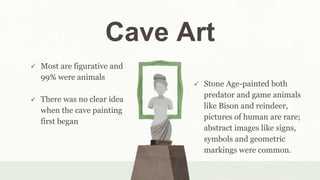
Cave Art
 Stone Age-painted both
predator and game animals
like Bison and reindeer,
pictures of human are rare;
abstract images like signs,
symbols and geometric
markings were common.
 Most are figurative and
99% were animals
 There was no clear idea
when the cave painting
first began
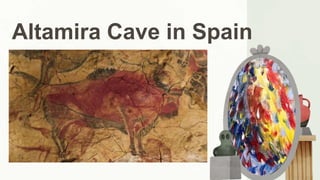
Altamira Cave in Spain
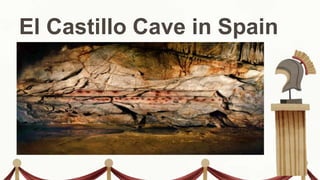
El Castillo Cave in Spain
Mercury Venus
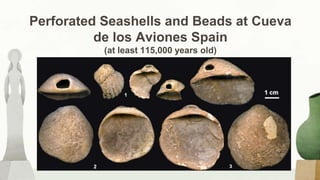
Perforated Seashells and Beads at Cueva
de los Aviones Spain
(at least 115,000 years old)
Mercury is the closest
planet to the Sun and the
smallest of them all
Venus has a beautiful
name and is the second
planet from the Sun
Despite being red, Mars
is actually a cold place.
It’s full of iron oxide dust
Mercury Venus Mars
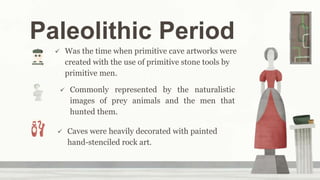
Paleolithic Period
 Was the time when primitive cave artworks were
created with the use of primitive stone tools by
primitive men.
 Commonly represented by the naturalistic
images of prey animals and the men that
hunted them.
 Caves were heavily decorated with painted
hand-stenciled rock art.
Venus has extremely
high temperatures
Neptune is the fourth
largest planet
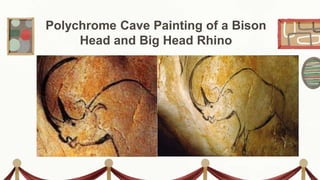
Polychrome Cave Painting of a Bison
Head and Big Head Rhino
Mars is actually a very
cold place
Mercury is the closest
planet to the Sun
Saturn is a gas giant
and has several rings
Jupiter is the biggest
planet of them all
Mars Venus Neptune
Mercury Saturn Jupiter
Neolithic
Period
The shift from Old Stone Age (Paleolithic) to New Stone
Age (Neolithic)
 Happened when man began to develop the culture and
change his lifestyle.
Neolithic farmers started the civilization
 Man became civilized when he stopped being nomadic
and settled down and created communities that grew crops
and tamed the animals.
Designs used on clay pots were commonly derived from
plants and animal forms.
Philippine
Primitive Art:
Cave Paintings
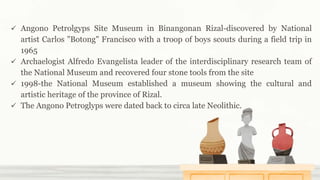
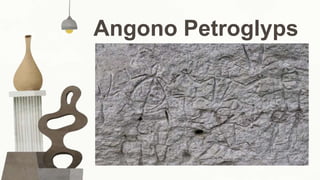
 Angono Petrolgyps Site Museum in Binangonan Rizal-discovered by National
artist Carlos "Botong" Francisco with a troop of boys scouts during a field trip in
1965
 Archaelogist Alfredo Evangelista leader of the interdisciplinary research team of
the National Museum and recovered four stone tools from the site
 1998-the National Museum established a museum showing the cultural and
artistic heritage of the province of Rizal.
 The Angono Petroglyps were dated back to circa late Neolithic.
 Presidential Decree No. 260-declared the Angono
Petroglyps a National Cultural Treasure.
 Other sites: Alab, Mountain Province carved on
boulders on top of cliffs dated not earlier than
1500 B.C or even later.
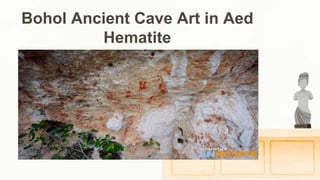
 Two kinds of petrographs: 1. charcoal
drawings on cave walls in Penablanca,
Cagayan Province and Singnapan Caves in
Southern Palawan; 2. red hematite prints in
Anda Peninsula, Bohol Province (dates are
still undetermined)
Angono Petroglyps
Venus has a beautiful
name and is the second
planet from the Sun
Venus
Despite being red, Mars
is actually a cold place.
It’s full of iron oxide dust
Mars
50% 75%
Bohol Ancient Cave Art in Aed
Hematite
You can replace the image on the
screen with your own work. Just
right-click on it and select “Replace
image”
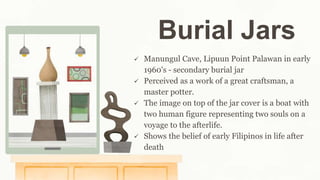
Burial Jars
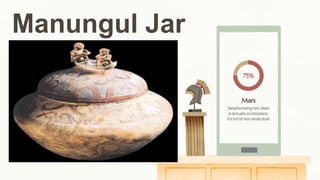
 Manungul Cave, Lipuun Point Palawan in early
1960's - secondary burial jar
 Perceived as a work of a great craftsman, a
master potter.
 The image on top of the jar cover is a boat with
two human figure representing two souls on a
voyage to the afterlife.
 Shows the belief of early Filipinos in life after
death
Manungul Jar
You can replace the image on the
screen with your own work. Just
right-click on it and select “Replace
image”
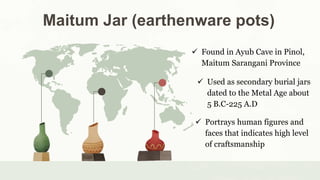
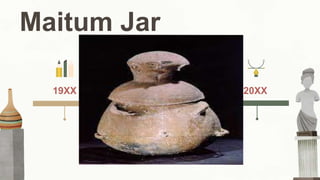
Maitum Jar (earthenware pots)
 Found in Ayub Cave in Pinol,
Maitum Sarangani Province
 Portrays human figures and
faces that indicates high level
of craftsmanship
 Used as secondary burial jars
dated to the Metal Age about
5 B.C-225 A.D
Maitum Jar
19XX
Venus
Venus has a toxic
atmosphere
Mars
Mars is full of iron
oxide dust
19XX 20XX
20XX
Mars
Mars was named
after a god
Mercury
Mercury is a very
small planet
Venus
Venus has a toxic
atmosphere
Jupiter
Jupiter is a huge
gas giant
Classical
Period
 Classical art refers to the art from Greece and Rome
 General term describing the long period of time in the cultural
history when the Mediterranean Sea was the center
 Started with the earliest-recorded Greek poetry of Homer
and continued through the rise of Rome and Christianity, up
to the fall of the Western Roman Empire and the start of the
Early Middle Ages.
Classical Period: Greek
Arts
Greek Golden Age-Greeks
achieved new heights in art,
architecture, theater and
philosophy.
Greek Arts-held as the
standard or measure by which
all later art will be judged;
shaped our minds of what
perfection should look like.
 Evident is statues and stone
figures called Kouroi.
 Began after the Greek victory
over the Persians-democracy
was improved under the
leadership of Pericles
Classical Period: Greek Arts
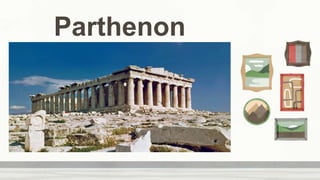
 Most wonderful accomplishment-rebuilding of the Parthenon
(temple devoted to Athena on the Acropolis)
 Phythagoras famous mathematician
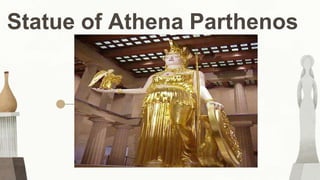
 Pheidias-created a statue for Athena, sculpted in ivory and gold.
 Socrates-Father of Philosophy
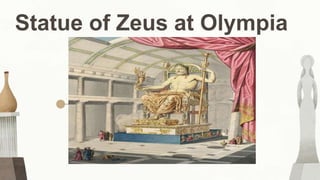
 Greatest known works - Massive Statue of Zeus at Olympia and
the Statue of Athena Pathernos in Parthenon (made of gold and
ivory, chrysus, elephantine)
Parthenon
Venus has a beautiful
name, but also high
temperatures
Expressionism
Earth is the third planet
from the Sun and
harbors life
Art Nouveau
Statue of Zeus at Olympia
Exhibition
B
● Artist name
● Time & date
● Venue
Exhibition
C
● Artist name
● Time & date
● Venue
02
03
Statue of Athena Parthenos
Exhibition
B
● Artist name
● Time & date
● Venue
Exhibition
C
● Artist name
● Time & date
● Venue
02
03
Classical Period: Greek Arts
● Greek art influenced Roman artNumber of works
produced
● Greeks-idealistic, imaginative and spiritual while Romans
are bounded to what they saw to the world.
● Subjects-snake-haired Medusas, centaurs, dancing girls,
Olympic athletes and Gods.
● Master sculptors and more highly skilled than the
Egyptians
● Adorned their warships with pigments mixed with hot
wax
● Made use of paints made from precious stones, earth and
plants
● No Greek paintings survived the ages until 20 century
Classical Period:
Roman Arts
Classical Period: Roman Arts
● Most powerful nation on earth defeating all others at military organization and
warfare, engineering and architecture.
● Invention of dome and the groin vault, the development of concrete and
European-wide network of roads and bridges
● Emperor Trajan (98-117 C.E) and Emperor Hadrian (117-138 C.E)-Rome
reached the peak of its architectural glory, attained numerous building
programs of monuments, baths, aqueducts, palaces, temples and mausoleums.
● Practical people, art forms were influenced by the ancient Greeks and
Etruscans
Romans as Practical
People:
 Wanted their art and architecture to be useful
 Planned their cities and built bridges, aqueducts, public baths and
market places, apartment houses and harbors
 Every ordered sculpture for public square was meant to tell the future
generations of how great of Rome
Romans: 1st Century
 Improved the use of concrete
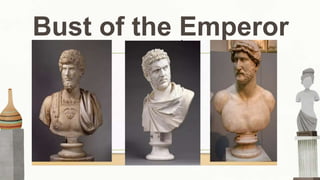
 Showed the skill and originality by portraying their generals, emperors
and senators with a degree of realism unknown to Greeks
 Achieved a high degree of naturalism in painting through the artist's
understanding of perspective and the use of light and shade.
 Subjects: nature, portrait of children and beautiful young men and
women, religion
 Most popular colors were red, black and cream-white
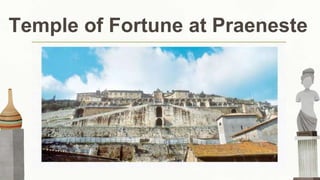
Temple of Fortune at Praeneste
Wanted their art and architecture to be useful
Planned their cities and built bridges, aqueducts, public baths and market places, apartment houses and
harbors
Every ordered sculpture for public square was meant to tell the future generations of how great of Rome
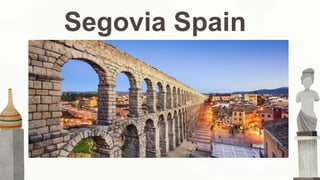
Segovia Spain
Wanted their art and architecture to be useful
Planned their cities and built bridges, aqueducts, public baths and market places, apartment houses and
harbors
Every ordered sculpture for public square was meant to tell the future generations of how great of Rome
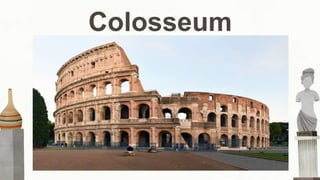
Colosseum
Wanted their art and architecture to be useful
Planned their cities and built bridges, aqueducts, public baths and market places, apartment houses and
harbors
Every ordered sculpture for public square was meant to tell the future generations of how great of Rome
Bust of the Emperor
Wanted their art and architecture to be useful
Planned their cities and built bridges, aqueducts, public baths and market places, apartment houses and
harbors
Every ordered sculpture for public square was meant to tell the future generations of how great of Rome
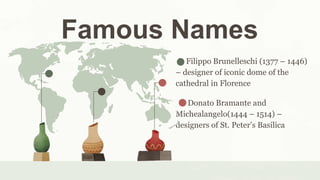
Famous Names
Filippo Brunelleschi (1377 – 1446)
– designer of iconic dome of the
cathedral in Florence
Donato Bramante and
Michealangelo(1444 – 1514) –
designers of St. Peter’s Basilica

Historical-Development-of-Art.pptx art appreciation

  • 1.
  • 2.
  • 3.
    Prehistoric Art (CaveArt) Prehistoric refers to all artworks produce by ancient men before any preconceived culture and known methods of writing and record keeping ever existed. 01 02 Art before history.
  • 4.
    Cave Paintings /Petrograph  Refers to any parietal art, which involves the application of color pigments on the walls, floors or ceilings or ancient rock dwellings inhabited by prehistoric man.
  • 5.
    Cave Drawing/ Petroglyps  Refersto an engraved drawing that is etched or done by cutting lines on the rock surface with a sharp object probably a flint or stone tool, rather than one made by drawing lines with charcoal or manganese.
  • 6.
    Cave Art  StoneAge-painted both predator and game animals like Bison and reindeer, pictures of human are rare; abstract images like signs, symbols and geometric markings were common.  Most are figurative and 99% were animals  There was no clear idea when the cave painting first began
  • 7.
  • 8.
    El Castillo Cavein Spain Mercury Venus
  • 9.
    Perforated Seashells andBeads at Cueva de los Aviones Spain (at least 115,000 years old) Mercury is the closest planet to the Sun and the smallest of them all Venus has a beautiful name and is the second planet from the Sun Despite being red, Mars is actually a cold place. It’s full of iron oxide dust Mercury Venus Mars
  • 10.
    Paleolithic Period  Wasthe time when primitive cave artworks were created with the use of primitive stone tools by primitive men.  Commonly represented by the naturalistic images of prey animals and the men that hunted them.  Caves were heavily decorated with painted hand-stenciled rock art.
  • 11.
    Venus has extremely hightemperatures Neptune is the fourth largest planet Polychrome Cave Painting of a Bison Head and Big Head Rhino Mars is actually a very cold place Mercury is the closest planet to the Sun Saturn is a gas giant and has several rings Jupiter is the biggest planet of them all Mars Venus Neptune Mercury Saturn Jupiter
  • 12.
  • 13.
    The shift fromOld Stone Age (Paleolithic) to New Stone Age (Neolithic)  Happened when man began to develop the culture and change his lifestyle. Neolithic farmers started the civilization  Man became civilized when he stopped being nomadic and settled down and created communities that grew crops and tamed the animals. Designs used on clay pots were commonly derived from plants and animal forms.
  • 14.
  • 15.
     Angono PetrolgypsSite Museum in Binangonan Rizal-discovered by National artist Carlos "Botong" Francisco with a troop of boys scouts during a field trip in 1965  Archaelogist Alfredo Evangelista leader of the interdisciplinary research team of the National Museum and recovered four stone tools from the site  1998-the National Museum established a museum showing the cultural and artistic heritage of the province of Rizal.  The Angono Petroglyps were dated back to circa late Neolithic.
  • 16.
     Presidential DecreeNo. 260-declared the Angono Petroglyps a National Cultural Treasure.  Other sites: Alab, Mountain Province carved on boulders on top of cliffs dated not earlier than 1500 B.C or even later.  Two kinds of petrographs: 1. charcoal drawings on cave walls in Penablanca, Cagayan Province and Singnapan Caves in Southern Palawan; 2. red hematite prints in Anda Peninsula, Bohol Province (dates are still undetermined)
  • 17.
    Angono Petroglyps Venus hasa beautiful name and is the second planet from the Sun Venus Despite being red, Mars is actually a cold place. It’s full of iron oxide dust Mars 50% 75%
  • 18.
    Bohol Ancient CaveArt in Aed Hematite You can replace the image on the screen with your own work. Just right-click on it and select “Replace image”
  • 19.
    Burial Jars  ManungulCave, Lipuun Point Palawan in early 1960's - secondary burial jar  Perceived as a work of a great craftsman, a master potter.  The image on top of the jar cover is a boat with two human figure representing two souls on a voyage to the afterlife.  Shows the belief of early Filipinos in life after death
  • 20.
    Manungul Jar You canreplace the image on the screen with your own work. Just right-click on it and select “Replace image”
  • 21.
    Maitum Jar (earthenwarepots)  Found in Ayub Cave in Pinol, Maitum Sarangani Province  Portrays human figures and faces that indicates high level of craftsmanship  Used as secondary burial jars dated to the Metal Age about 5 B.C-225 A.D
  • 22.
    Maitum Jar 19XX Venus Venus hasa toxic atmosphere Mars Mars is full of iron oxide dust 19XX 20XX 20XX
  • 23.
    Mars Mars was named aftera god Mercury Mercury is a very small planet Venus Venus has a toxic atmosphere Jupiter Jupiter is a huge gas giant Classical Period
  • 24.
     Classical artrefers to the art from Greece and Rome  General term describing the long period of time in the cultural history when the Mediterranean Sea was the center  Started with the earliest-recorded Greek poetry of Homer and continued through the rise of Rome and Christianity, up to the fall of the Western Roman Empire and the start of the Early Middle Ages.
  • 25.
    Classical Period: Greek Arts GreekGolden Age-Greeks achieved new heights in art, architecture, theater and philosophy. Greek Arts-held as the standard or measure by which all later art will be judged; shaped our minds of what perfection should look like.
  • 26.
     Evident isstatues and stone figures called Kouroi.  Began after the Greek victory over the Persians-democracy was improved under the leadership of Pericles
  • 27.
    Classical Period: GreekArts  Most wonderful accomplishment-rebuilding of the Parthenon (temple devoted to Athena on the Acropolis)  Phythagoras famous mathematician  Pheidias-created a statue for Athena, sculpted in ivory and gold.  Socrates-Father of Philosophy  Greatest known works - Massive Statue of Zeus at Olympia and the Statue of Athena Pathernos in Parthenon (made of gold and ivory, chrysus, elephantine)
  • 28.
    Parthenon Venus has abeautiful name, but also high temperatures Expressionism Earth is the third planet from the Sun and harbors life Art Nouveau
  • 29.
    Statue of Zeusat Olympia Exhibition B ● Artist name ● Time & date ● Venue Exhibition C ● Artist name ● Time & date ● Venue 02 03
  • 30.
    Statue of AthenaParthenos Exhibition B ● Artist name ● Time & date ● Venue Exhibition C ● Artist name ● Time & date ● Venue 02 03
  • 31.
    Classical Period: GreekArts ● Greek art influenced Roman artNumber of works produced ● Greeks-idealistic, imaginative and spiritual while Romans are bounded to what they saw to the world. ● Subjects-snake-haired Medusas, centaurs, dancing girls, Olympic athletes and Gods. ● Master sculptors and more highly skilled than the Egyptians ● Adorned their warships with pigments mixed with hot wax ● Made use of paints made from precious stones, earth and plants ● No Greek paintings survived the ages until 20 century
  • 32.
  • 33.
    Classical Period: RomanArts ● Most powerful nation on earth defeating all others at military organization and warfare, engineering and architecture. ● Invention of dome and the groin vault, the development of concrete and European-wide network of roads and bridges ● Emperor Trajan (98-117 C.E) and Emperor Hadrian (117-138 C.E)-Rome reached the peak of its architectural glory, attained numerous building programs of monuments, baths, aqueducts, palaces, temples and mausoleums. ● Practical people, art forms were influenced by the ancient Greeks and Etruscans
  • 34.
    Romans as Practical People: Wanted their art and architecture to be useful  Planned their cities and built bridges, aqueducts, public baths and market places, apartment houses and harbors  Every ordered sculpture for public square was meant to tell the future generations of how great of Rome
  • 35.
    Romans: 1st Century Improved the use of concrete  Showed the skill and originality by portraying their generals, emperors and senators with a degree of realism unknown to Greeks  Achieved a high degree of naturalism in painting through the artist's understanding of perspective and the use of light and shade.  Subjects: nature, portrait of children and beautiful young men and women, religion  Most popular colors were red, black and cream-white
  • 36.
    Temple of Fortuneat Praeneste Wanted their art and architecture to be useful Planned their cities and built bridges, aqueducts, public baths and market places, apartment houses and harbors Every ordered sculpture for public square was meant to tell the future generations of how great of Rome
  • 37.
    Segovia Spain Wanted theirart and architecture to be useful Planned their cities and built bridges, aqueducts, public baths and market places, apartment houses and harbors Every ordered sculpture for public square was meant to tell the future generations of how great of Rome
  • 38.
    Colosseum Wanted their artand architecture to be useful Planned their cities and built bridges, aqueducts, public baths and market places, apartment houses and harbors Every ordered sculpture for public square was meant to tell the future generations of how great of Rome
  • 39.
    Bust of theEmperor Wanted their art and architecture to be useful Planned their cities and built bridges, aqueducts, public baths and market places, apartment houses and harbors Every ordered sculpture for public square was meant to tell the future generations of how great of Rome
  • 40.
    Famous Names Filippo Brunelleschi(1377 – 1446) – designer of iconic dome of the cathedral in Florence Donato Bramante and Michealangelo(1444 – 1514) – designers of St. Peter’s Basilica