Study Guide
EMC / JOUR 3000
 Edward Bowen
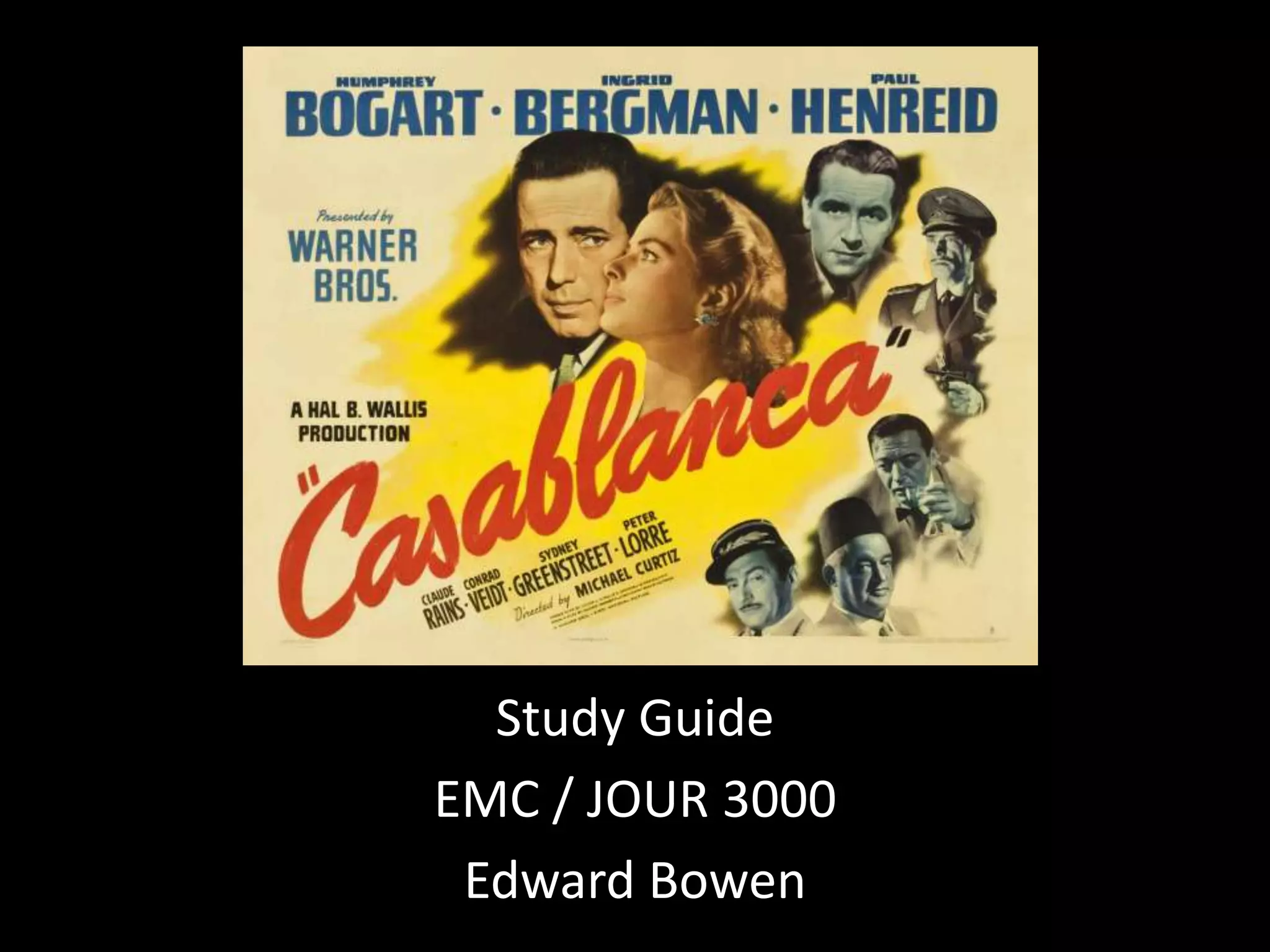
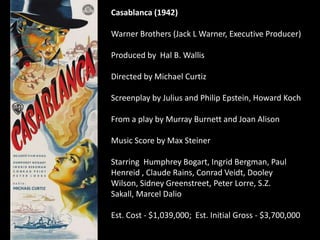
Casablanca (1942)

Warner Brothers (Jack L Warner, Executive Producer)

Produced by Hal B. Wallis

Directed by Michael Curtiz

Screenplay by Julius and Philip Epstein, Howard Koch

From a play by Murray Burnett and Joan Alison

Music Score by Max Steiner

Starring Humphrey Bogart, Ingrid Bergman, Paul
Henreid , Claude Rains, Conrad Veidt, Dooley
Wilson, Sidney Greenstreet, Peter Lorre, S.Z.
Sakall, Marcel Dalio

Est. Cost - $1,039,000; Est. Initial Gross - $3,700,000
Casablanca (1942)

Thus Casablanca is not just one film. It is many films, an anthology.
[...] When all the archetypes burst in shamelessly, we reach Homeric
depths. Two clichés make us laugh. A hundred clichés move us. For
we sense dimly that the clichés are talking among themselves, and
celebrating a reunion.
Umberto Eco
http://www.themodernword.com/eco/eco_casablanca.html
The Technical Dimension
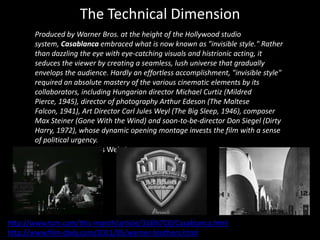
       Produced by Warner Bros. at the height of the Hollywood studio
       system, Casablanca embraced what is now known as "invisible style." Rather
       than dazzling the eye with eye-catching visuals and histrionic acting, it
       seduces the viewer by creating a seamless, lush universe that gradually
       envelops the audience. Hardly an effortless accomplishment, "invisible style"
       required an absolute mastery of the various cinematic elements by its
       collaborators, including Hungarian director Michael Curtiz (Mildred
       Pierce, 1945), director of photography Arthur Edeson (The Maltese
       Falcon, 1941), Art Director Carl Jules Weyl (The Big Sleep, 1946), composer
       Max Steiner (Gone With the Wind) and soon-to-be-director Don Siegel (Dirty
       Harry, 1972), whose dynamic opening montage invests the film with a sense
       of political urgency.
       Turner Classic Movies Website


http://www.tcm.com/this-month/article/316%7C0/Casablanca.html
http://www.film-daily.com/2011/05/warner-brothers.html
The Technical Dimension
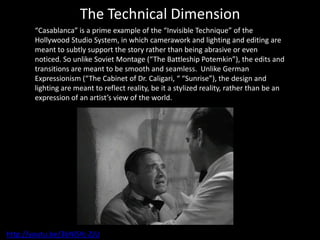
        “Casablanca” is a prime example of the “Invisible Technique” of the
        Hollywood Studio System, in which camerawork and lighting and editing are
        meant to subtly support the story rather than being abrasive or even
        noticed. So unlike Soviet Montage (“The Battleship Potemkin”), the edits and
        transitions are meant to be smooth and seamless. Unlike German
        Expressionism (“The Cabinet of Dr. Caligari, “ “Sunrise”), the design and
        lighting are meant to reflect reality, be it a stylized reality, rather than be an
        expression of an artist’s view of the world.


http://youtu.be/3bNlSYc-ZJU
The Technical Dimension
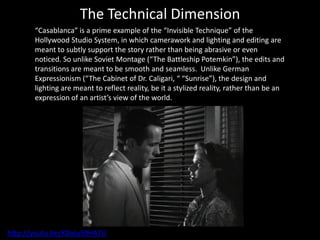
       “Casablanca” is a prime example of the “Invisible Technique” of the
       Hollywood Studio System, in which camerawork and lighting and editing are
       meant to subtly support the story rather than being abrasive or even
       noticed. So unlike Soviet Montage (“The Battleship Potemkin”), the edits and
       transitions are meant to be smooth and seamless. Unlike German
       Expressionism (“The Cabinet of Dr. Caligari, “ “Sunrise”), the design and
       lighting are meant to reflect reality, be it a stylized reality, rather than be an
       expression of an artist’s view of the world.


http://youtu.be/KDxLyS9H47U
The Technical Dimension
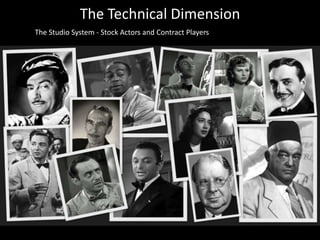
The Studio System - Stock Actors and Contract Players
The Technical Dimension
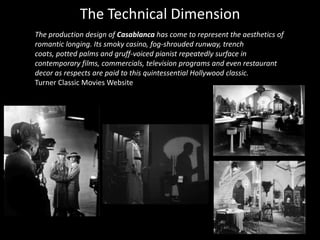
The production design of Casablanca has come to represent the aesthetics of
romantic longing. Its smoky casino, fog-shrouded runway, trench
coats, potted palms and gruff-voiced pianist repeatedly surface in
contemporary films, commercials, television programs and even restaurant
decor as respects are paid to this quintessential Hollywood classic.
Turner Classic Movies Website
The Technical Dimension
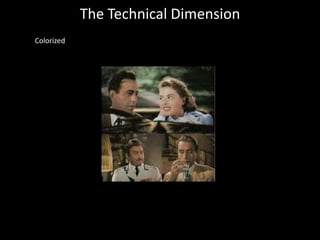
Colorized


The Technical Dimension
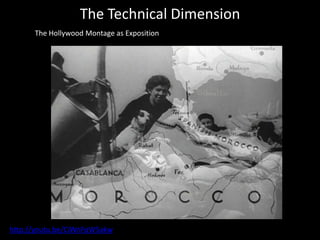
      The Hollywood Montage as Exposition


http://youtu.be/CiWnFqW5akw
The Technical Dimension
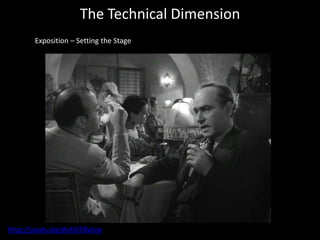
       Exposition – Setting the Stage


http://youtu.be/ActId7BvIcw
The Technical Dimension
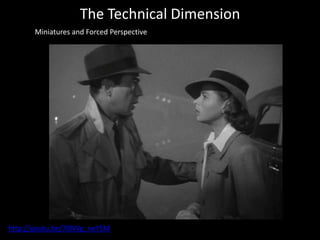
       Miniatures and Forced Perspective


http://youtu.be/70NVg_neYSM
The Technical Dimension
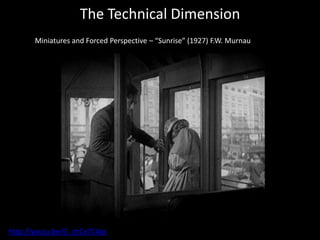
       Miniatures and Forced Perspective – “Sunrise” (1927) F.W. Murnau


http://youtu.be/G_zhCx7C4qs
The Technical Dimension
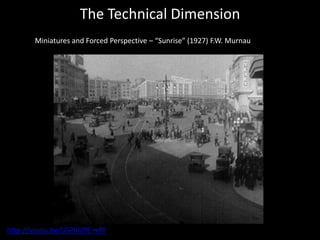
       Miniatures and Forced Perspective – “Sunrise” (1927) F.W. Murnau


http://youtu.be/LGPnUPE-mfY
The Technical Dimension
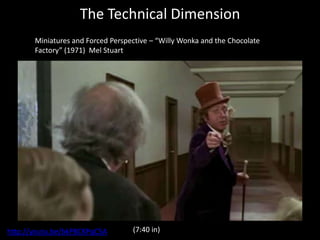
       Miniatures and Forced Perspective – “Willy Wonka and the Chocolate
       Factory” (1971) Mel Stuart


http://youtu.be/bkPBCKPqC5A        (7:40 in)
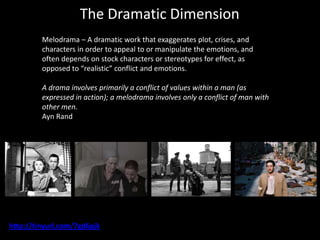
The Dramatic Dimension
         Melodrama – A dramatic work that exaggerates plot, crises, and
         characters in order to appeal to or manipulate the emotions, and
         often depends on stock characters or stereotypes for effect, as
         opposed to “realistic” conflict and emotions.

         A drama involves primarily a conflict of values within a man (as
         expressed in action); a melodrama involves only a conflict of man with
         other men.
         Ayn Rand


http://tinyurl.com/7gd6pjk
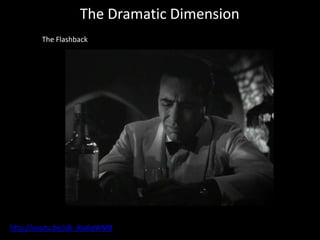
The Dramatic Dimension
        The Flashback


http://youtu.be/xB_jKu6qWM8
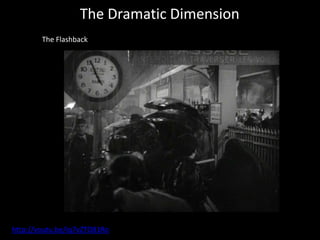
The Dramatic Dimension
        The Flashback


http://youtu.be/iq7vZTO81Ro
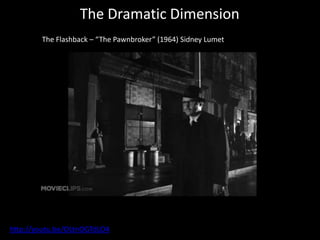
The Dramatic Dimension
        The Flashback – “The Pawnbroker” (1964) Sidney Lumet


http://youtu.be/OLtnOGTdLO4
The Dramatic Dimension
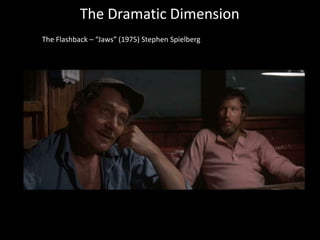
The Flashback – “Jaws” (1975) Stephen Spielberg
The Dramatic Dimension
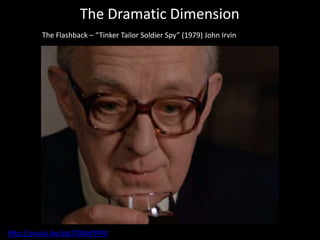
         The Flashback – “Tinker Tailor Soldier Spy” (1979) John Irvin


http://youtu.be/ezLTOK6dYPM
The Dramatic Dimension
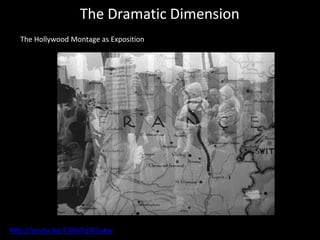
  The Hollywood Montage as Exposition


http://youtu.be/CiWnFqW5akw
The Dramatic Dimension
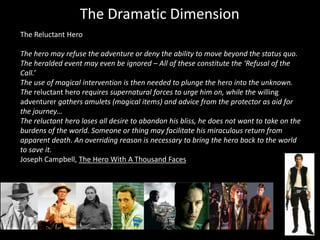
The Reluctant Hero

The hero may refuse the adventure or deny the ability to move beyond the status quo.
The heralded event may even be ignored – All of these constitute the ‘Refusal of the
Call.’
The use of magical intervention is then needed to plunge the hero into the unknown.
The reluctant hero requires supernatural forces to urge him on, while the willing
adventurer gathers amulets (magical items) and advice from the protector as aid for
the journey…
The reluctant hero loses all desire to abandon his bliss, he does not want to take on the
burdens of the world. Someone or thing may facilitate his miraculous return from
apparent death. An overriding reason is necessary to bring the hero back to the world
to save it.
Joseph Campbell, The Hero With A Thousand Faces
The Dramatic Dimension
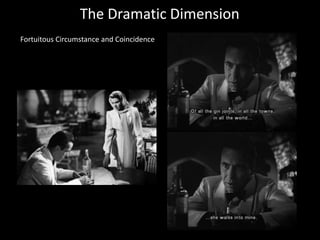
Fortuitous Circumstance and Coincidence
The Dramatic Dimension
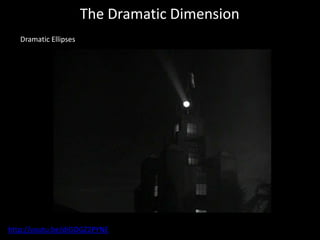
   Dramatic Ellipses


http://youtu.be/diGOGZ2PYNE
The Dramatic Dimension
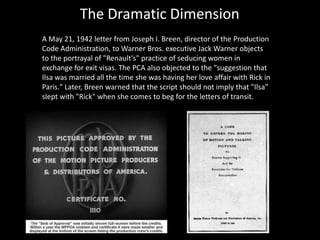
A May 21, 1942 letter from Joseph I. Breen, director of the Production
Code Administration, to Warner Bros. executive Jack Warner objects
to the portrayal of "Renault's" practice of seducing women in
exchange for exit visas. The PCA also objected to the "suggestion that
Ilsa was married all the time she was having her love affair with Rick in
Paris." Later, Breen warned that the script should not imply that "Ilsa"
slept with "Rick" when she comes to beg for the letters of transit.
The Socio/Historical Dimension
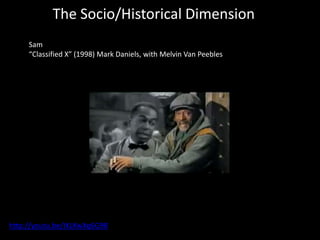
     Sam
     “Classified X” (1998) Mark Daniels, with Melvin Van Peebles


http://youtu.be/IXLKwXq6G98
The Historical Dimension
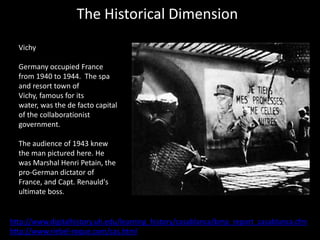
  Vichy

  Germany occupied France
  from 1940 to 1944. The spa
  and resort town of
  Vichy, famous for its
  water, was the de facto capital
  of the collaborationist
  government.

  The audience of 1943 knew
  the man pictured here. He
  was Marshal Henri Petain, the
  pro-German dictator of
  France, and Capt. Renauld's
  ultimate boss.


http://www.digitalhistory.uh.edu/learning_history/casablanca/bmp_report_casablanca.cfm
http://www.riebel-roque.com/cas.html
The Historical Dimension
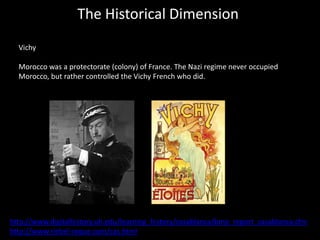
  Vichy

  Morocco was a protectorate (colony) of France. The Nazi regime never occupied
  Morocco, but rather controlled the Vichy French who did.


http://www.digitalhistory.uh.edu/learning_history/casablanca/bmp_report_casablanca.cfm
http://www.riebel-roque.com/cas.html
The Historical Dimension
      Propaganda

      Irene Lee, Warner Brothers’ West Coast Story Editor, submitted the script to
      producer Hal Wallis four days after the attack on Pearl Harbor.

      Warner Brothers ordered a hasty rewrite of "Across the Pacific" which
      involved a Japanese plot to blow up Pearl Harbor, changing the setting to
      the Panama Canal.

      Hollywood had a history of supporting and being supported by Roosevelt
      and his administration.

      The Warner Brothers had bucked the other studios, hesitant to alienate
      foreign markets, by releasing “Confessions of a Nazi Spy” in 1939.

      In September of 1941, isolationist members of the U.S. Senate, calling
      Hollywood “a raging volcano of war fever,” launched an investigation into
      whether studio executives, many of whom were Jewish, were inserting
      interventionist messages into popular movies.
http://www.digitalhistory.uh.edu/learning_history/casablanca/bmp_report_casablanca.cfm
http://www.riebel-roque.com/cas.html
The Historical Dimension
      Propaganda

      How does “Casablanca” act as propaganda during the U.S. involvement
      during World War II?

      Is Rick Blaine, at first hesitant to get involved, eventually pushed to take
      action, a metaphor for the U.S. and its hesitation at the outset of World War
      !!?

      Made in 1942 and released not long after the United States had seriously
      committed itself to fighting in World War II, the classic film Casablanca
      provides insight into popular attitudes early in the war. In addition, it lays
      out some of the arguments for U.S. involvement, tracing the transformation
      of U.S. policy from neutrality to non-belligerency to involvement. The
      character of Richard "Rick" Blaine, played by Humphrey Bogart, provided a
      heroic analogy for the historical process of U.S. involvement in the war


http://www.digitalhistory.uh.edu/learning_history/casablanca/bmp_report_casablanca.cfm
http://www.riebel-roque.com/cas.html
The Historical Dimension
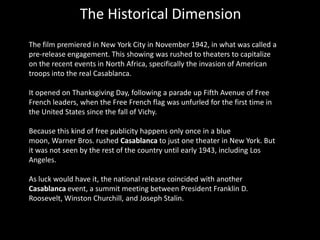
The film premiered in New York City in November 1942, in what was called a
pre-release engagement. This showing was rushed to theaters to capitalize
on the recent events in North Africa, specifically the invasion of American
troops into the real Casablanca.

It opened on Thanksgiving Day, following a parade up Fifth Avenue of Free
French leaders, when the Free French flag was unfurled for the first time in
the United States since the fall of Vichy.

Because this kind of free publicity happens only once in a blue
moon, Warner Bros. rushed Casablanca to just one theater in New York. But
it was not seen by the rest of the country until early 1943, including Los
Angeles.

As luck would have it, the national release coincided with another
Casablanca event, a summit meeting between President Franklin D.
Roosevelt, Winston Churchill, and Joseph Stalin.
The Historical Dimension
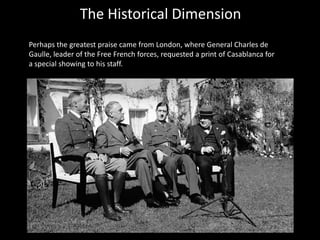
Perhaps the greatest praise came from London, where General Charles de
Gaulle, leader of the Free French forces, requested a print of Casablanca for
a special showing to his staff.
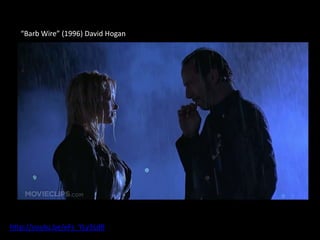
“Barb Wire” (1996) David Hogan


http://youtu.be/eFs_YLy3Ld8
EMC/JOUR 3000 Casablanca Study Guide

EMC/JOUR 3000 Casablanca Study Guide

  • 1.
    Study Guide EMC /JOUR 3000 Edward Bowen
  • 2.
    Casablanca (1942) Warner Brothers(Jack L Warner, Executive Producer) Produced by Hal B. Wallis Directed by Michael Curtiz Screenplay by Julius and Philip Epstein, Howard Koch From a play by Murray Burnett and Joan Alison Music Score by Max Steiner Starring Humphrey Bogart, Ingrid Bergman, Paul Henreid , Claude Rains, Conrad Veidt, Dooley Wilson, Sidney Greenstreet, Peter Lorre, S.Z. Sakall, Marcel Dalio Est. Cost - $1,039,000; Est. Initial Gross - $3,700,000
  • 3.
    Casablanca (1942) Thus Casablancais not just one film. It is many films, an anthology. [...] When all the archetypes burst in shamelessly, we reach Homeric depths. Two clichés make us laugh. A hundred clichés move us. For we sense dimly that the clichés are talking among themselves, and celebrating a reunion. Umberto Eco http://www.themodernword.com/eco/eco_casablanca.html
  • 4.
    The Technical Dimension Produced by Warner Bros. at the height of the Hollywood studio system, Casablanca embraced what is now known as "invisible style." Rather than dazzling the eye with eye-catching visuals and histrionic acting, it seduces the viewer by creating a seamless, lush universe that gradually envelops the audience. Hardly an effortless accomplishment, "invisible style" required an absolute mastery of the various cinematic elements by its collaborators, including Hungarian director Michael Curtiz (Mildred Pierce, 1945), director of photography Arthur Edeson (The Maltese Falcon, 1941), Art Director Carl Jules Weyl (The Big Sleep, 1946), composer Max Steiner (Gone With the Wind) and soon-to-be-director Don Siegel (Dirty Harry, 1972), whose dynamic opening montage invests the film with a sense of political urgency. Turner Classic Movies Website 
 http://www.tcm.com/this-month/article/316%7C0/Casablanca.html http://www.film-daily.com/2011/05/warner-brothers.html
  • 5.
    The Technical Dimension “Casablanca” is a prime example of the “Invisible Technique” of the Hollywood Studio System, in which camerawork and lighting and editing are meant to subtly support the story rather than being abrasive or even noticed. So unlike Soviet Montage (“The Battleship Potemkin”), the edits and transitions are meant to be smooth and seamless. Unlike German Expressionism (“The Cabinet of Dr. Caligari, “ “Sunrise”), the design and lighting are meant to reflect reality, be it a stylized reality, rather than be an expression of an artist’s view of the world. http://youtu.be/3bNlSYc-ZJU
  • 6.
    The Technical Dimension “Casablanca” is a prime example of the “Invisible Technique” of the Hollywood Studio System, in which camerawork and lighting and editing are meant to subtly support the story rather than being abrasive or even noticed. So unlike Soviet Montage (“The Battleship Potemkin”), the edits and transitions are meant to be smooth and seamless. Unlike German Expressionism (“The Cabinet of Dr. Caligari, “ “Sunrise”), the design and lighting are meant to reflect reality, be it a stylized reality, rather than be an expression of an artist’s view of the world. http://youtu.be/KDxLyS9H47U
  • 7.
    The Technical Dimension TheStudio System - Stock Actors and Contract Players
  • 8.
    The Technical Dimension Theproduction design of Casablanca has come to represent the aesthetics of romantic longing. Its smoky casino, fog-shrouded runway, trench coats, potted palms and gruff-voiced pianist repeatedly surface in contemporary films, commercials, television programs and even restaurant decor as respects are paid to this quintessential Hollywood classic. Turner Classic Movies Website
  • 9.
  • 10.
    The Technical Dimension The Hollywood Montage as Exposition 
 http://youtu.be/CiWnFqW5akw
  • 11.
    The Technical Dimension Exposition – Setting the Stage 
 http://youtu.be/ActId7BvIcw
  • 12.
    The Technical Dimension Miniatures and Forced Perspective 
 http://youtu.be/70NVg_neYSM
  • 13.
    The Technical Dimension Miniatures and Forced Perspective – “Sunrise” (1927) F.W. Murnau 
 http://youtu.be/G_zhCx7C4qs
  • 14.
    The Technical Dimension Miniatures and Forced Perspective – “Sunrise” (1927) F.W. Murnau 
 http://youtu.be/LGPnUPE-mfY
  • 15.
    The Technical Dimension Miniatures and Forced Perspective – “Willy Wonka and the Chocolate Factory” (1971) Mel Stuart 
 http://youtu.be/bkPBCKPqC5A (7:40 in)
  • 22.
    The Dramatic Dimension Melodrama – A dramatic work that exaggerates plot, crises, and characters in order to appeal to or manipulate the emotions, and often depends on stock characters or stereotypes for effect, as opposed to “realistic” conflict and emotions. A drama involves primarily a conflict of values within a man (as expressed in action); a melodrama involves only a conflict of man with other men. Ayn Rand http://tinyurl.com/7gd6pjk
  • 23.
    The Dramatic Dimension The Flashback http://youtu.be/xB_jKu6qWM8
  • 24.
    The Dramatic Dimension The Flashback http://youtu.be/iq7vZTO81Ro
  • 25.
    The Dramatic Dimension The Flashback – “The Pawnbroker” (1964) Sidney Lumet http://youtu.be/OLtnOGTdLO4
  • 26.
    The Dramatic Dimension TheFlashback – “Jaws” (1975) Stephen Spielberg
  • 27.
    The Dramatic Dimension The Flashback – “Tinker Tailor Soldier Spy” (1979) John Irvin http://youtu.be/ezLTOK6dYPM
  • 30.
    The Dramatic Dimension The Hollywood Montage as Exposition http://youtu.be/CiWnFqW5akw
  • 31.
    The Dramatic Dimension TheReluctant Hero The hero may refuse the adventure or deny the ability to move beyond the status quo. The heralded event may even be ignored – All of these constitute the ‘Refusal of the Call.’ The use of magical intervention is then needed to plunge the hero into the unknown. The reluctant hero requires supernatural forces to urge him on, while the willing adventurer gathers amulets (magical items) and advice from the protector as aid for the journey… The reluctant hero loses all desire to abandon his bliss, he does not want to take on the burdens of the world. Someone or thing may facilitate his miraculous return from apparent death. An overriding reason is necessary to bring the hero back to the world to save it. Joseph Campbell, The Hero With A Thousand Faces
  • 32.
    The Dramatic Dimension FortuitousCircumstance and Coincidence
  • 33.
    The Dramatic Dimension Dramatic Ellipses http://youtu.be/diGOGZ2PYNE
  • 34.
    The Dramatic Dimension AMay 21, 1942 letter from Joseph I. Breen, director of the Production Code Administration, to Warner Bros. executive Jack Warner objects to the portrayal of "Renault's" practice of seducing women in exchange for exit visas. The PCA also objected to the "suggestion that Ilsa was married all the time she was having her love affair with Rick in Paris." Later, Breen warned that the script should not imply that "Ilsa" slept with "Rick" when she comes to beg for the letters of transit.
  • 35.
    The Socio/Historical Dimension Sam “Classified X” (1998) Mark Daniels, with Melvin Van Peebles http://youtu.be/IXLKwXq6G98
  • 36.
    The Historical Dimension Vichy Germany occupied France from 1940 to 1944. The spa and resort town of Vichy, famous for its water, was the de facto capital of the collaborationist government. The audience of 1943 knew the man pictured here. He was Marshal Henri Petain, the pro-German dictator of France, and Capt. Renauld's ultimate boss. http://www.digitalhistory.uh.edu/learning_history/casablanca/bmp_report_casablanca.cfm http://www.riebel-roque.com/cas.html
  • 37.
    The Historical Dimension Vichy Morocco was a protectorate (colony) of France. The Nazi regime never occupied Morocco, but rather controlled the Vichy French who did. http://www.digitalhistory.uh.edu/learning_history/casablanca/bmp_report_casablanca.cfm http://www.riebel-roque.com/cas.html
  • 38.
    The Historical Dimension Propaganda Irene Lee, Warner Brothers’ West Coast Story Editor, submitted the script to producer Hal Wallis four days after the attack on Pearl Harbor. Warner Brothers ordered a hasty rewrite of "Across the Pacific" which involved a Japanese plot to blow up Pearl Harbor, changing the setting to the Panama Canal. Hollywood had a history of supporting and being supported by Roosevelt and his administration. The Warner Brothers had bucked the other studios, hesitant to alienate foreign markets, by releasing “Confessions of a Nazi Spy” in 1939. In September of 1941, isolationist members of the U.S. Senate, calling Hollywood “a raging volcano of war fever,” launched an investigation into whether studio executives, many of whom were Jewish, were inserting interventionist messages into popular movies. http://www.digitalhistory.uh.edu/learning_history/casablanca/bmp_report_casablanca.cfm http://www.riebel-roque.com/cas.html
  • 39.
    The Historical Dimension Propaganda How does “Casablanca” act as propaganda during the U.S. involvement during World War II? Is Rick Blaine, at first hesitant to get involved, eventually pushed to take action, a metaphor for the U.S. and its hesitation at the outset of World War !!? Made in 1942 and released not long after the United States had seriously committed itself to fighting in World War II, the classic film Casablanca provides insight into popular attitudes early in the war. In addition, it lays out some of the arguments for U.S. involvement, tracing the transformation of U.S. policy from neutrality to non-belligerency to involvement. The character of Richard "Rick" Blaine, played by Humphrey Bogart, provided a heroic analogy for the historical process of U.S. involvement in the war http://www.digitalhistory.uh.edu/learning_history/casablanca/bmp_report_casablanca.cfm http://www.riebel-roque.com/cas.html
  • 40.
    The Historical Dimension Thefilm premiered in New York City in November 1942, in what was called a pre-release engagement. This showing was rushed to theaters to capitalize on the recent events in North Africa, specifically the invasion of American troops into the real Casablanca. It opened on Thanksgiving Day, following a parade up Fifth Avenue of Free French leaders, when the Free French flag was unfurled for the first time in the United States since the fall of Vichy. Because this kind of free publicity happens only once in a blue moon, Warner Bros. rushed Casablanca to just one theater in New York. But it was not seen by the rest of the country until early 1943, including Los Angeles. As luck would have it, the national release coincided with another Casablanca event, a summit meeting between President Franklin D. Roosevelt, Winston Churchill, and Joseph Stalin.
  • 41.
    The Historical Dimension Perhapsthe greatest praise came from London, where General Charles de Gaulle, leader of the Free French forces, requested a print of Casablanca for a special showing to his staff.
  • 44.
    “Barb Wire” (1996)David Hogan http://youtu.be/eFs_YLy3Ld8