AUDIENCE
RECOGNITION AND
INVOLVEMENT
AUDIENCE
RECOGNITION
TYPES OF AUDIENCE
AUDIENCE RECOGNITION
• Determine whether your audience is
1. High tech
2. Low tech
3. Lay
4. Multiple
3
1. HIGH TECH AUDIENCE
• Work in your field of expertise
• Same department or similar capacity in other
company
• Can be termed as colleagues because they
have
– Same educational background
– Same work experience
– Same level of understanding
• Writing to high tech audience is easy.
4
CHARACTERISTICS OF HIGH TECH
AUDIENCE
1. Are experts in the your field.
2. High tech jargon, acronyms and abbreviations
can be used.
3. Minimal details about standard procedures or
technical theories
4. Little background information about a
project’s history.
5
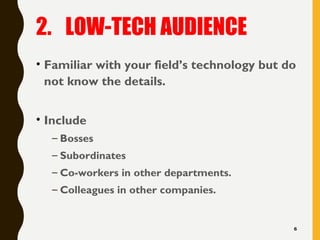
2. LOW-TECH AUDIENCE
• Familiar with your field’s technology but do
not know the details.
• Include
– Bosses
– Subordinates
– Co-workers in other departments.
– Colleagues in other companies.
6
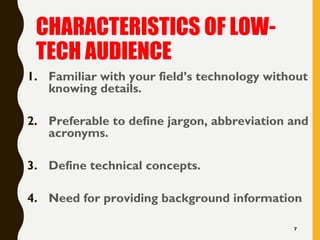
CHARACTERISTICS OF LOW-
TECH AUDIENCE
1. Familiar with your field’s technology without
knowing details.
2. Preferable to define jargon, abbreviation and
acronyms.
3. Define technical concepts.
4. Need for providing background information
7
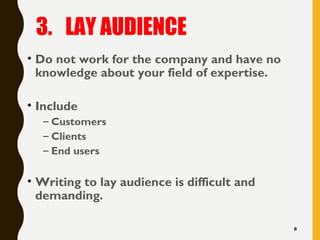
3. LAY AUDIENCE
• Do not work for the company and have no
knowledge about your field of expertise.
• Include
– Customers
– Clients
– End users
• Writing to lay audience is difficult and
demanding.
8
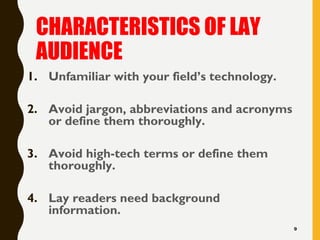
CHARACTERISTICS OF LAY
AUDIENCE
1. Unfamiliar with your field’s technology.
2. Avoid jargon, abbreviations and acronyms
or define them thoroughly.
3. Avoid high-tech terms or define them
thoroughly.
4. Lay readers need background
information.
9
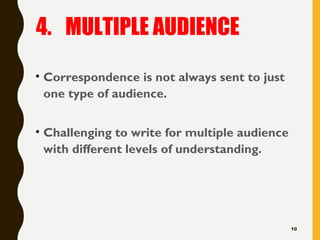
4. MULTIPLE AUDIENCE
• Correspondence is not always sent to just
one type of audience.
• Challenging to write for multiple audience
with different levels of understanding.
10
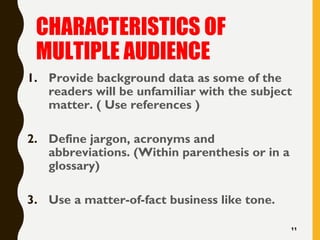
CHARACTERISTICS OF
MULTIPLE AUDIENCE
1. Provide background data as some of the
readers will be unfamiliar with the subject
matter. ( Use references )
2. Define jargon, acronyms and
abbreviations. (Within parenthesis or in a
glossary)
3. Use a matter-of-fact business like tone.
11
DEFINING TERMS FOR
DIFFERENT AUDIENCE
LEVELS
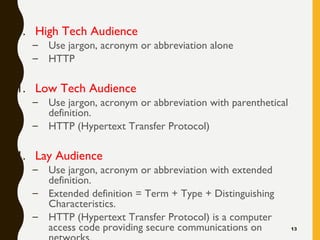
1. High Tech Audience
– Use jargon, acronym or abbreviation alone
– HTTP
1. Low Tech Audience
– Use jargon, acronym or abbreviation with parenthetical
definition.
– HTTP (Hypertext Transfer Protocol)
1. Lay Audience
– Use jargon, acronym or abbreviation with extended
definition.
– Extended definition = Term + Type + Distinguishing
Characteristics.
– HTTP (Hypertext Transfer Protocol) is a computer
access code providing secure communications on 13
BIASED LANGUAGE
ISSUES OF DIVERSITY
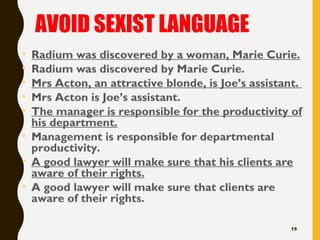
AVOID SEXIST LANGUAGE
• Radium was discovered by a woman, Marie Curie.
• Radium was discovered by Marie Curie.
• Mrs Acton, an attractive blonde, is Joe’s assistant.
• Mrs Acton is Joe’s assistant.
• The manager is responsible for the productivity of
his department.
• Management is responsible for departmental
productivity.
• A good lawyer will make sure that his clients are
aware of their rights.
• A good lawyer will make sure that clients are
aware of their rights.
15
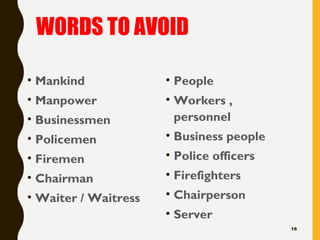
WORDS TO AVOID
• Mankind
• Manpower
• Businessmen
• Policemen
• Firemen
• Chairman
• Waiter / Waitress
• People
• Workers ,
personnel
• Business people
• Police officers
• Firefighters
• Chairperson
• Server
16
AUDIENCE
INVOLVEMENT
KEEPYOUR READER INTERESTED !!
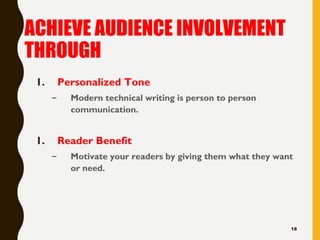
ACHIEVE AUDIENCE INVOLVEMENT
THROUGH
1. Personalized Tone
– Modern technical writing is person to person
communication.
1. Reader Benefit
– Motivate your readers by giving them what they want
or need.
18
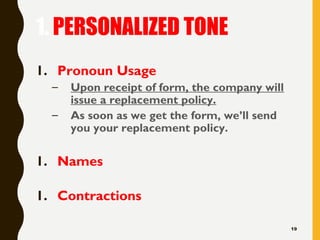
1. PERSONALIZED TONE
1. Pronoun Usage
– Upon receipt of form, the company will
issue a replacement policy.
– As soon as we get the form, we’ll send
you your replacement policy.
1. Names
1. Contractions
19
2. READER BENEFIT
1. Explain the Benefit
– State benefit early or late in the technical
document.
1. Use Positive Verbs and Words
– We’ve received your letter complaining about
our services.
– Thank you for writing to us about our services.
– We can not process your request. You failed to
follow the printed instructions.
– So that we may process your request rapidly,
please fill in line 6 on the printed form.
20
THANK YOU

Audience

  • 1.
  • 2.
  • 3.
    AUDIENCE RECOGNITION • Determinewhether your audience is 1. High tech 2. Low tech 3. Lay 4. Multiple 3
  • 4.
    1. HIGH TECHAUDIENCE • Work in your field of expertise • Same department or similar capacity in other company • Can be termed as colleagues because they have – Same educational background – Same work experience – Same level of understanding • Writing to high tech audience is easy. 4
  • 5.
    CHARACTERISTICS OF HIGHTECH AUDIENCE 1. Are experts in the your field. 2. High tech jargon, acronyms and abbreviations can be used. 3. Minimal details about standard procedures or technical theories 4. Little background information about a project’s history. 5
  • 6.
    2. LOW-TECH AUDIENCE •Familiar with your field’s technology but do not know the details. • Include – Bosses – Subordinates – Co-workers in other departments. – Colleagues in other companies. 6
  • 7.
    CHARACTERISTICS OF LOW- TECHAUDIENCE 1. Familiar with your field’s technology without knowing details. 2. Preferable to define jargon, abbreviation and acronyms. 3. Define technical concepts. 4. Need for providing background information 7
  • 8.
    3. LAY AUDIENCE •Do not work for the company and have no knowledge about your field of expertise. • Include – Customers – Clients – End users • Writing to lay audience is difficult and demanding. 8
  • 9.
    CHARACTERISTICS OF LAY AUDIENCE 1.Unfamiliar with your field’s technology. 2. Avoid jargon, abbreviations and acronyms or define them thoroughly. 3. Avoid high-tech terms or define them thoroughly. 4. Lay readers need background information. 9
  • 10.
    4. MULTIPLE AUDIENCE •Correspondence is not always sent to just one type of audience. • Challenging to write for multiple audience with different levels of understanding. 10
  • 11.
    CHARACTERISTICS OF MULTIPLE AUDIENCE 1.Provide background data as some of the readers will be unfamiliar with the subject matter. ( Use references ) 2. Define jargon, acronyms and abbreviations. (Within parenthesis or in a glossary) 3. Use a matter-of-fact business like tone. 11
  • 12.
  • 13.
    1. High TechAudience – Use jargon, acronym or abbreviation alone – HTTP 1. Low Tech Audience – Use jargon, acronym or abbreviation with parenthetical definition. – HTTP (Hypertext Transfer Protocol) 1. Lay Audience – Use jargon, acronym or abbreviation with extended definition. – Extended definition = Term + Type + Distinguishing Characteristics. – HTTP (Hypertext Transfer Protocol) is a computer access code providing secure communications on 13
  • 14.
  • 15.
    AVOID SEXIST LANGUAGE •Radium was discovered by a woman, Marie Curie. • Radium was discovered by Marie Curie. • Mrs Acton, an attractive blonde, is Joe’s assistant. • Mrs Acton is Joe’s assistant. • The manager is responsible for the productivity of his department. • Management is responsible for departmental productivity. • A good lawyer will make sure that his clients are aware of their rights. • A good lawyer will make sure that clients are aware of their rights. 15
  • 16.
    WORDS TO AVOID •Mankind • Manpower • Businessmen • Policemen • Firemen • Chairman • Waiter / Waitress • People • Workers , personnel • Business people • Police officers • Firefighters • Chairperson • Server 16
  • 17.
  • 18.
    ACHIEVE AUDIENCE INVOLVEMENT THROUGH 1.Personalized Tone – Modern technical writing is person to person communication. 1. Reader Benefit – Motivate your readers by giving them what they want or need. 18
  • 19.
    1. PERSONALIZED TONE 1.Pronoun Usage – Upon receipt of form, the company will issue a replacement policy. – As soon as we get the form, we’ll send you your replacement policy. 1. Names 1. Contractions 19
  • 20.
    2. READER BENEFIT 1.Explain the Benefit – State benefit early or late in the technical document. 1. Use Positive Verbs and Words – We’ve received your letter complaining about our services. – Thank you for writing to us about our services. – We can not process your request. You failed to follow the printed instructions. – So that we may process your request rapidly, please fill in line 6 on the printed form. 20
  • 21.