AUTISM SPECTRUM
DISORDER
By - Ms. Aradhana
Masih
M.Sc. Nursing
INTRODUCTION
• The word autism derived from Greek word “Autos” which means
“Self”
• It is also known as MIND BLINDNESS describe by LEO KANNER.
• It is a developmental disorder that is characterized by impaired
development in communication, social interaction and behavior.
DEFINITION
Autism is the disorder of neural development charecterized by impaired
social interactions and communications and by ristricted and repetitive
behavior.
- By American Psychiatric Association
According to the world health organization (WHO), autism spectrum
disorder (ASD) is a group of conditions that affect brain
development. It's characterized by difficulties with social
communication and interaction, as well as repetitive behaviors and
interests.
• The diagnostic criteria require that symptoms become apprant before a
child is 3 years old.
PREVALENCE/INCIDENCE
• Estimated prevalence of 1-2 per 1000.
• It is a long-term illness.
• Boys are higher risk than girls.
• Sex ratio is 4:1.
• Risk of autism is associated with advanced age in either parents with
diabetes, bleeding and use of psychiatric drugs by mothers.
ETIOLOGY
• Neurological theories – Structural or functional damage od cns.
• Infections – some antenatal infections such as meningitis,
cytomegalovirus etc.
• Biochemical theory – increase serotonin level lead to autism.
• Genetics theory – higher incidence seen in monozygotic twins.
• Psychodynamic theories – parents of autistic children are highly
intellectual, socially reserved, cold and emotionally detached.
• Family theory – poor parenting(emotionally cold parents) , family
breakup etc.
CLASSIFICATION
• ATYPICAL AUTISM – abnormal and impaired development
manifested after age of three years or there is imparement in in
communication and stereotyped behavior.
• Asperger's syndrome – impairment of social activities and
stereotyped features but no delay in speech and cognitive
development, male – female ratio is 8:1
• Rett syndrome – found mainly in girls. Normal early development is
followed by partial or complete loss of speech and acquired hand
skills.
• Heller’s syndrome(childhood disintegrate disorder) – characterized
by late onset of developmental delay or severe and sudden reversals
in language, social function,behavioral and motor skills.
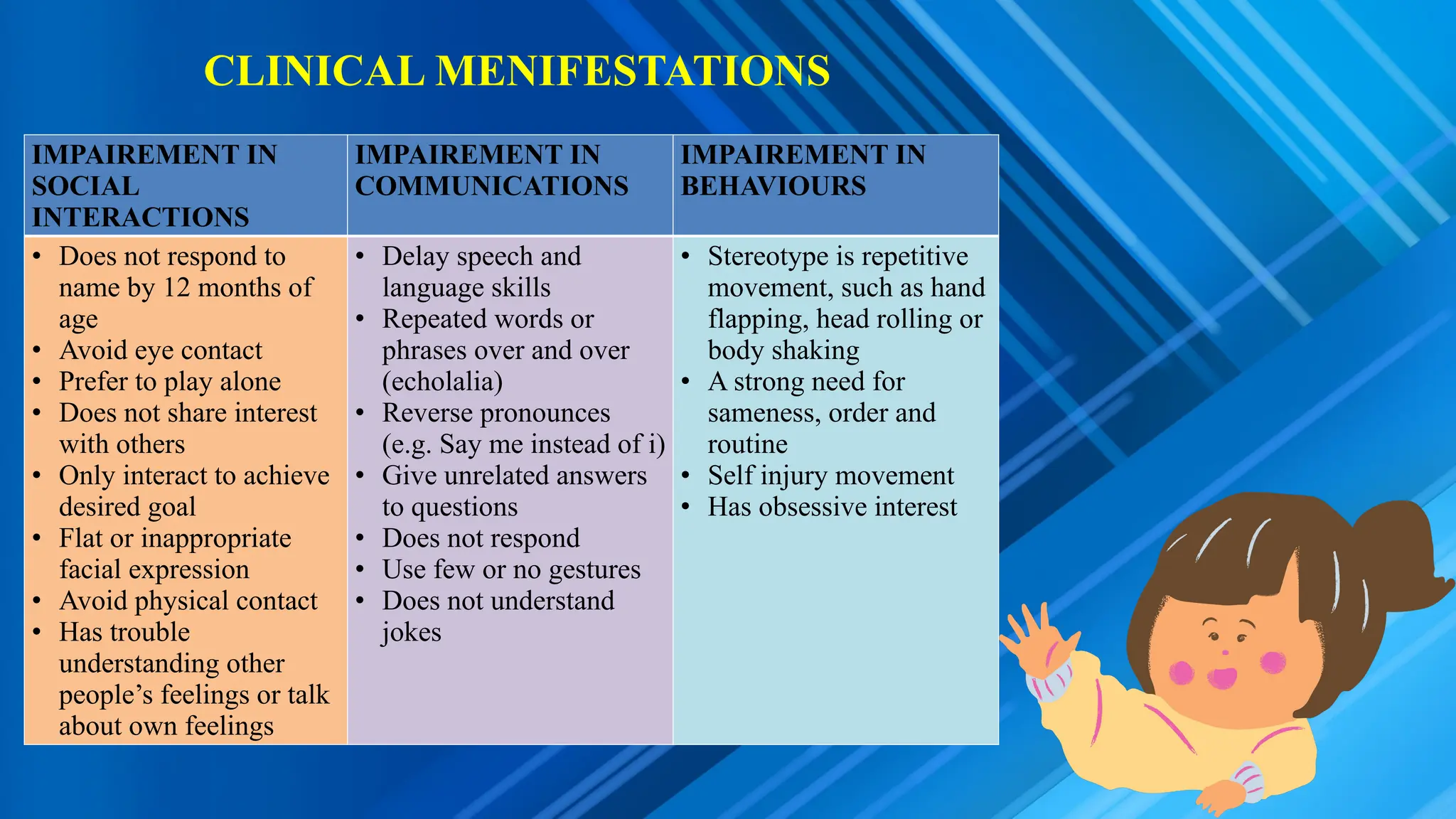
CLINICAL MENIFESTATIONS
IMPAIREMENT IN
SOCIAL
INTERACTIONS
IMPAIREMENT IN
COMMUNICATIONS
IMPAIREMENT IN
BEHAVIOURS
• Does not respond to
name by 12 months of
age
• Avoid eye contact
• Prefer to play alone
• Does not share interest
with others
• Only interact to achieve
desired goal
• Flat or inappropriate
facial expression
• Avoid physical contact
• Has trouble
understanding other
people’s feelings or talk
about own feelings
• Delay speech and
language skills
• Repeated words or
phrases over and over
(echolalia)
• Reverse pronounces
(e.g. Say me instead of i)
• Give unrelated answers
to questions
• Does not respond
• Use few or no gestures
• Does not understand
jokes
• Stereotype is repetitive
movement, such as hand
flapping, head rolling or
body shaking
• A strong need for
sameness, order and
routine
• Self injury movement
• Has obsessive interest
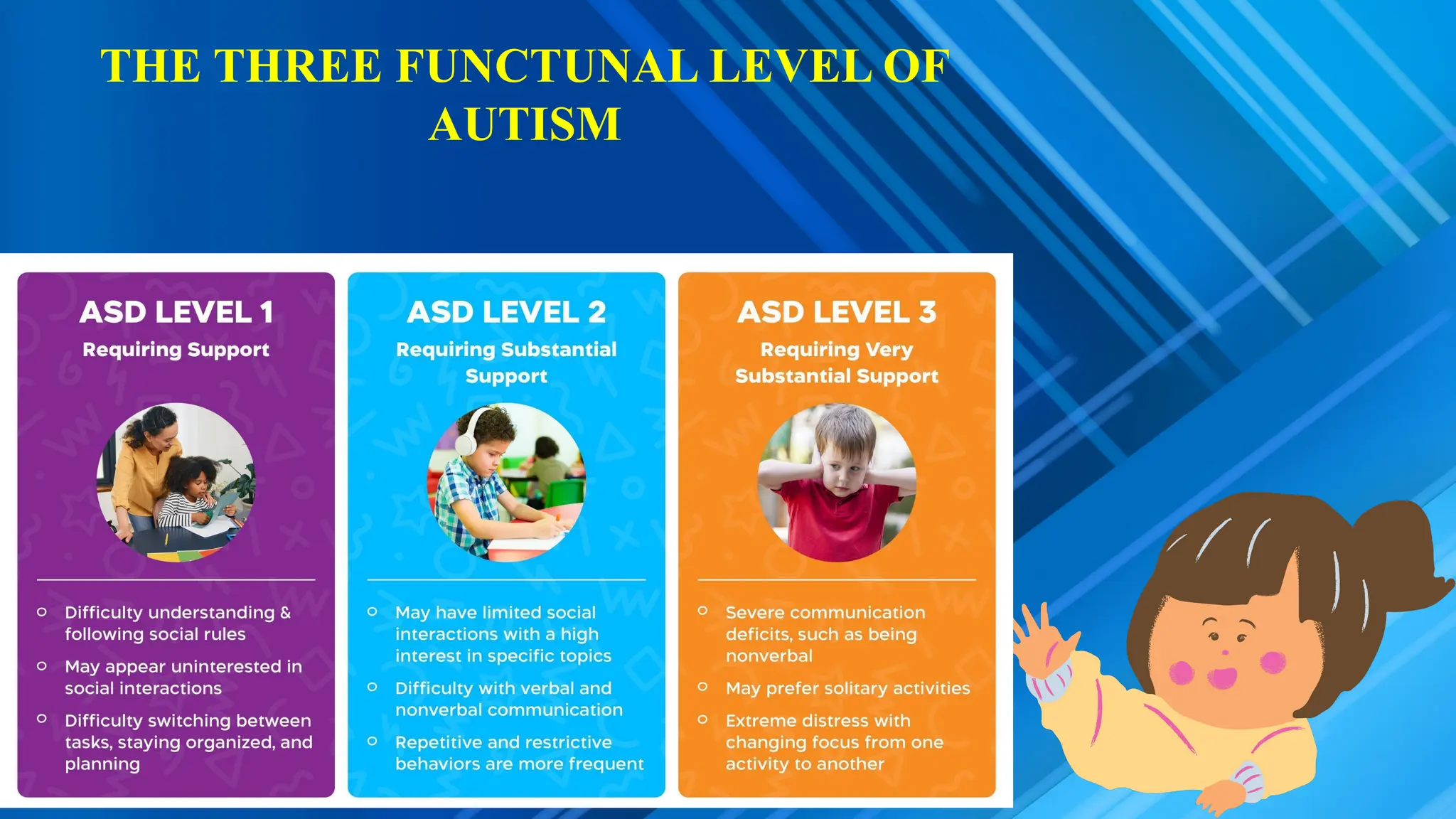
THE THREE FUNCTUNAL LEVEL OF
AUTISM
WARNING SIGNS OD ASD
• Not responding to child’s name.
• Lack of back or forth babbling.
• Smiling late.
• Failure to make eye contact.
• No sign of words by 16 months.
• No two words phrases by 24 months.
DIAGNOSTIC EVALUATIONS
• History collections
• Physical examination
• Screening to be performed during first 2 year of life
• More in depth diagnosis and evaluations should be performed
if a child had more development delay
MANAGEMENT
• Special educations: Focus on developing social skills, speech,
language, self care and job skills of child.
• Behavioural management: Use to teach social skills,motor skills
and cognitive skills.
• Family therapy: Parents and other family members can interact
with their children in way to promote social interaction skills
manage problem behaviour.
• Medications: Medications such as antidepressant, stimulants,
clonidine help to controlling and treatment of autism
• Biomedical and complementary therapies. Minerals, vitamins
and dietary interventions.
autism spectrum disorder.pptxSD is a spectrum disorder characterized by impairement in development in communication, social interaction and behaviour

autism spectrum disorder.pptxSD is a spectrum disorder characterized by impairement in development in communication, social interaction and behaviour

  • 1.
    AUTISM SPECTRUM DISORDER By -Ms. Aradhana Masih M.Sc. Nursing
  • 2.
    INTRODUCTION • The wordautism derived from Greek word “Autos” which means “Self” • It is also known as MIND BLINDNESS describe by LEO KANNER. • It is a developmental disorder that is characterized by impaired development in communication, social interaction and behavior.
  • 3.
    DEFINITION Autism is thedisorder of neural development charecterized by impaired social interactions and communications and by ristricted and repetitive behavior. - By American Psychiatric Association According to the world health organization (WHO), autism spectrum disorder (ASD) is a group of conditions that affect brain development. It's characterized by difficulties with social communication and interaction, as well as repetitive behaviors and interests. • The diagnostic criteria require that symptoms become apprant before a child is 3 years old.
  • 4.
    PREVALENCE/INCIDENCE • Estimated prevalenceof 1-2 per 1000. • It is a long-term illness. • Boys are higher risk than girls. • Sex ratio is 4:1. • Risk of autism is associated with advanced age in either parents with diabetes, bleeding and use of psychiatric drugs by mothers.
  • 5.
    ETIOLOGY • Neurological theories– Structural or functional damage od cns. • Infections – some antenatal infections such as meningitis, cytomegalovirus etc. • Biochemical theory – increase serotonin level lead to autism. • Genetics theory – higher incidence seen in monozygotic twins. • Psychodynamic theories – parents of autistic children are highly intellectual, socially reserved, cold and emotionally detached. • Family theory – poor parenting(emotionally cold parents) , family breakup etc.
  • 6.
    CLASSIFICATION • ATYPICAL AUTISM– abnormal and impaired development manifested after age of three years or there is imparement in in communication and stereotyped behavior. • Asperger's syndrome – impairment of social activities and stereotyped features but no delay in speech and cognitive development, male – female ratio is 8:1 • Rett syndrome – found mainly in girls. Normal early development is followed by partial or complete loss of speech and acquired hand skills. • Heller’s syndrome(childhood disintegrate disorder) – characterized by late onset of developmental delay or severe and sudden reversals in language, social function,behavioral and motor skills.
  • 7.
    CLINICAL MENIFESTATIONS IMPAIREMENT IN SOCIAL INTERACTIONS IMPAIREMENTIN COMMUNICATIONS IMPAIREMENT IN BEHAVIOURS • Does not respond to name by 12 months of age • Avoid eye contact • Prefer to play alone • Does not share interest with others • Only interact to achieve desired goal • Flat or inappropriate facial expression • Avoid physical contact • Has trouble understanding other people’s feelings or talk about own feelings • Delay speech and language skills • Repeated words or phrases over and over (echolalia) • Reverse pronounces (e.g. Say me instead of i) • Give unrelated answers to questions • Does not respond • Use few or no gestures • Does not understand jokes • Stereotype is repetitive movement, such as hand flapping, head rolling or body shaking • A strong need for sameness, order and routine • Self injury movement • Has obsessive interest
  • 8.
    THE THREE FUNCTUNALLEVEL OF AUTISM
  • 9.
    WARNING SIGNS ODASD • Not responding to child’s name. • Lack of back or forth babbling. • Smiling late. • Failure to make eye contact. • No sign of words by 16 months. • No two words phrases by 24 months.
  • 10.
    DIAGNOSTIC EVALUATIONS • Historycollections • Physical examination • Screening to be performed during first 2 year of life • More in depth diagnosis and evaluations should be performed if a child had more development delay
  • 11.
    MANAGEMENT • Special educations:Focus on developing social skills, speech, language, self care and job skills of child. • Behavioural management: Use to teach social skills,motor skills and cognitive skills. • Family therapy: Parents and other family members can interact with their children in way to promote social interaction skills manage problem behaviour. • Medications: Medications such as antidepressant, stimulants, clonidine help to controlling and treatment of autism • Biomedical and complementary therapies. Minerals, vitamins and dietary interventions.