A"ack	
  and	
  Defense	
  in	
  	
  
the	
  Public	
  Cloud	
  
Robert	
  Wood	
  |	
  @robertwood50	
  
Agenda	
  
•  Introduc@ons	
  
•  Shared	
  responsibility	
  considera@ons	
  
•  A"ack	
  and	
  defend	
  scenarios	
  
– Denial	
  of	
  service	
  
– Host	
  takeover	
  and	
  pivo@ng	
  
– Data	
  exfiltra@on	
  
– Creden@al	
  theH	
  
•  Concluding	
  remarks	
  
Whoami	
  
•  Technical	
  Manager	
  @Cigital	
  
•  Background	
  in	
  red	
  teaming,	
  forensics,	
  
pentes@ng,	
  code	
  reviews,	
  and	
  design	
  reviews	
  
•  Heavily	
  involved	
  in	
  assessing	
  and	
  helping	
  
design	
  applica@ons	
  built	
  on	
  public	
  and	
  private	
  
clouds	
  
SHARED	
  RESPONSIBILITY	
  
Considera@ons	
  for	
  a"ackers	
  and	
  defenders	
  
Public	
  Cloud	
  Service	
  Models	
  
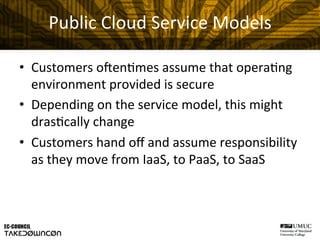
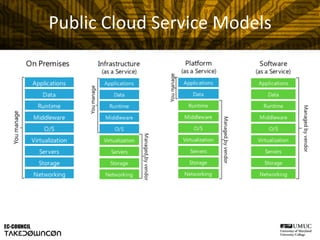
•  Customers	
  oHen@mes	
  assume	
  that	
  opera@ng	
  
environment	
  provided	
  is	
  secure	
  
•  Depending	
  on	
  the	
  service	
  model,	
  this	
  might	
  
dras@cally	
  change	
  	
  
•  Customers	
  hand	
  off	
  and	
  assume	
  responsibility	
  
as	
  they	
  move	
  from	
  IaaS,	
  to	
  PaaS,	
  to	
  SaaS	
  
Public	
  Cloud	
  Service	
  Models	
  
What	
  Does	
  This	
  Mean?	
  
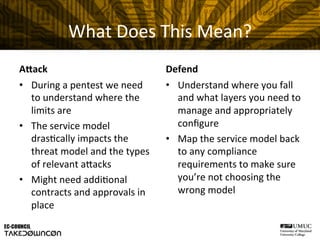
A0ack	
  
•  During	
  a	
  pentest	
  we	
  need	
  
to	
  understand	
  where	
  the	
  
limits	
  are	
  
•  The	
  service	
  model	
  
dras@cally	
  impacts	
  the	
  
threat	
  model	
  and	
  the	
  types	
  
of	
  relevant	
  a"acks	
  
•  Might	
  need	
  addi@onal	
  
contracts	
  and	
  approvals	
  in	
  
place	
  
Defend	
  
•  Understand	
  where	
  you	
  fall	
  
and	
  what	
  layers	
  you	
  need	
  to	
  
manage	
  and	
  appropriately	
  
configure	
  
•  Map	
  the	
  service	
  model	
  back	
  
to	
  any	
  compliance	
  
requirements	
  to	
  make	
  sure	
  
you’re	
  not	
  choosing	
  the	
  
wrong	
  model	
  
DENIAL	
  OF	
  SERVICE	
  
A"ack	
  Descrip@on	
  
•  Tradi@onal	
  a"ack	
  leveraging	
  system	
  or	
  
network	
  resource	
  exhaus@on	
  
•  Bugs	
  in	
  underlying	
  soHware	
  or	
  un-­‐scalable	
  
architectures	
  
Defender’s	
  Perspec@ve	
  
•  Place	
  controls	
  at	
  the	
  DNS	
  level	
  and	
  protect	
  IP	
  
addresses	
  –	
  rotate	
  if	
  exposed	
  (e.g.	
  Cloudflare)	
  
•  Leverage	
  the	
  scalable	
  features	
  of	
  the	
  cloud	
  
– But	
  configure	
  appropriately	
  to	
  avoid	
  unnecessary	
  
scaling	
  causing	
  addi@onal	
  issues	
  
– Layer	
  scale	
  detec@on	
  
•  Make	
  sure	
  that	
  other	
  controls	
  don’t	
  add	
  to	
  
the	
  DoS	
  problem	
  (like	
  ModSecurity	
  WAF)	
  
HOST	
  TAKEOVER	
  AND	
  PIVOTING	
  
A"ack	
  Pa"ern	
  
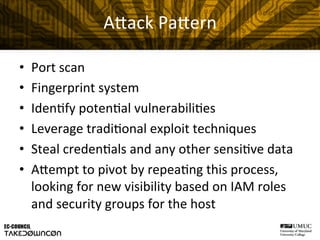
•  Port	
  scan	
  
•  Fingerprint	
  system	
  
•  Iden@fy	
  poten@al	
  vulnerabili@es	
  
•  Leverage	
  tradi@onal	
  exploit	
  techniques	
  
•  Steal	
  creden@als	
  and	
  any	
  other	
  sensi@ve	
  data	
  
•  A"empt	
  to	
  pivot	
  by	
  repea@ng	
  this	
  process,	
  
looking	
  for	
  new	
  visibility	
  based	
  on	
  IAM	
  roles	
  
and	
  security	
  groups	
  for	
  the	
  host	
  
A"acker’s	
  Perspec@ve	
  
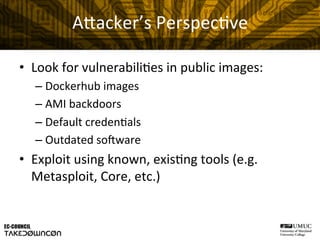
•  Look	
  for	
  vulnerabili@es	
  in	
  public	
  images:	
  
– Dockerhub	
  images	
  
– AMI	
  backdoors	
  
– Default	
  creden@als	
  
– Outdated	
  soHware	
  
•  Exploit	
  using	
  known,	
  exis@ng	
  tools	
  (e.g.	
  
Metasploit,	
  Core,	
  etc.)	
  
Defender’s	
  Perspec@ve	
  
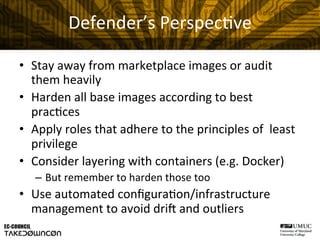
•  Stay	
  away	
  from	
  marketplace	
  images	
  or	
  audit	
  
them	
  heavily	
  
•  Harden	
  all	
  base	
  images	
  according	
  to	
  best	
  
prac@ces	
  
•  Apply	
  roles	
  that	
  adhere	
  to	
  the	
  principles	
  of	
  	
  least	
  
privilege	
  
•  Consider	
  layering	
  with	
  containers	
  (e.g.	
  Docker)	
  
–  But	
  remember	
  to	
  harden	
  those	
  too	
  
•  Use	
  automated	
  configura@on/infrastructure	
  
management	
  to	
  avoid	
  driH	
  and	
  outliers	
  
DATA	
  EXFILTRATION	
  
A"ack	
  Pa"ern	
  
•  Iden@fy	
  data	
  stores	
  
– World	
  accessible	
  S3	
  buckets,	
  Internet	
  exposed	
  
database	
  servers,	
  etc.	
  
•  Compromise	
  applica@on	
  or	
  host	
  that	
  has	
  
access	
  to	
  data	
  store	
  
•  Connect	
  to	
  data	
  store	
  
•  Exfiltrate	
  for	
  the	
  win	
  
Defender’s	
  Perspec@ve	
  
•  Restrict	
  access	
  to	
  data	
  stores	
  via	
  security	
  
groups	
  and	
  IAM	
  
•  Completely	
  isolate	
  data	
  stores	
  based	
  on	
  
customers	
  (e.g.	
  different	
  RDS	
  or	
  database	
  
servers)	
  
– Go	
  further	
  and	
  segregate	
  hosts	
  from	
  data	
  storage	
  
zones	
  
•  Log	
  all	
  access	
  and	
  set	
  up	
  alerts	
  
CREDENTIAL	
  THEFT	
  
A"ack	
  Pa"ern	
  
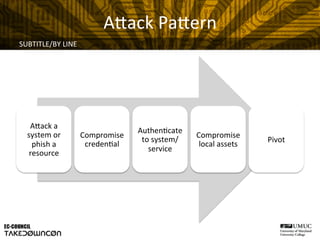
A"ack	
  a	
  
system	
  or	
  
phish	
  a	
  
resource	
  
Compromise	
  
creden@al	
  
Authen@cate	
  
to	
  system/
service	
  
Compromise	
  
local	
  assets	
  
Pivot	
  
SUBTITLE/BY	
  LINE	
  
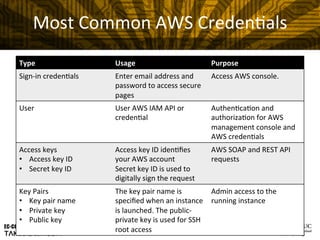
Most	
  Common	
  AWS	
  Creden@als	
  
Type	
   Usage	
   Purpose	
  
Sign-­‐in	
  creden@als	
   Enter	
  email	
  address	
  and	
  
password	
  to	
  access	
  secure	
  
pages	
  
Access	
  AWS	
  console.	
  
User	
   User	
  AWS	
  IAM	
  API	
  or	
  
creden@al	
  
Authen@ca@on	
  and	
  
authoriza@on	
  for	
  AWS	
  
management	
  console	
  and	
  
AWS	
  creden@als	
  
Access	
  keys	
  
•  Access	
  key	
  ID	
  
•  Secret	
  key	
  ID	
  
Access	
  key	
  ID	
  iden@fies	
  
your	
  AWS	
  account	
  
Secret	
  key	
  ID	
  is	
  used	
  to	
  
digitally	
  sign	
  the	
  request	
  
AWS	
  SOAP	
  and	
  REST	
  API	
  
requests	
  
Key	
  Pairs	
  
•  Key	
  pair	
  name	
  
•  Private	
  key	
  
•  Public	
  key	
  
The	
  key	
  pair	
  name	
  is	
  
specified	
  when	
  an	
  instance	
  
is	
  launched.	
  The	
  public-­‐
private	
  key	
  is	
  used	
  for	
  SSH	
  
root	
  access	
  
Admin	
  access	
  to	
  the	
  
running	
  instance	
  
What’s	
  a	
  Creden@al	
  Here?	
  
•  What	
  is	
  a	
  creden@al	
  in	
  the	
  cloud?	
  
–  API	
  keys	
  	
  
–  Username	
  and	
  password	
  
–  MFA	
  tokens	
  
–  SSH	
  keys	
  
–  Oauth/SSO	
  tokens	
  
•  What	
  do	
  they	
  protect?	
  
–  Infrastructure	
  management	
  accounts	
  
–  Systems	
  and	
  services	
  
–  User	
  accounts	
  
–  Deployment	
  processes	
  
A"acker’s	
  Perspec@ve	
  
•  Creden@als	
  can	
  be	
  stolen	
  in	
  the	
  old	
  fashioned	
  
ways	
  (some@mes…):	
  
– Phishing	
  
– Client-­‐side	
  takeover	
  to	
  get	
  keys	
  
– Cross-­‐site	
  scrip@ng	
  
Defender’s	
  Perspec@ve	
  
•  Leverage	
  two-­‐factor	
  authen@ca@on	
  wherever	
  
possible	
  
•  Use	
  layered	
  accounts	
  that	
  follow	
  the	
  principles	
  of	
  
least	
  privilege	
  (e.g.	
  IAM)	
  
•  Refrain	
  from	
  using	
  administra@ve	
  accounts	
  
•  Apply	
  these	
  principles	
  to	
  both	
  cloud	
  
infrastructure	
  management	
  and	
  applica@on	
  
components	
  
•  Log	
  and	
  alert	
  on	
  suspicious	
  ac@vity	
  (e.g.	
  logging	
  
in	
  from	
  different	
  countries)	
  
CONCLUDING	
  REMARKS	
  
As	
  an	
  A"acker	
  
•  Many	
  tradi@onal	
  a"acks	
  will	
  s@ll	
  work	
  given	
  
the	
  underlying	
  infrastructure	
  
•  New	
  a"ack	
  surface	
  creates	
  new	
  spins	
  on	
  old	
  
a"acks	
  or	
  some	
  new	
  a"acks	
  en@rely	
  
•  Can	
  leverage	
  cloud	
  services	
  yourself	
  for	
  
scalable,	
  distributed	
  a"acks	
  
As	
  a	
  Defender	
  
•  Threat	
  model	
  early	
  and	
  oHen	
  to	
  understand	
  your	
  
system’s	
  design	
  and	
  applicable	
  a"ack	
  surface	
  
•  Embrace	
  plaform	
  provided	
  security	
  controls	
  (e.g.	
  
IAM,	
  S3	
  SSE,	
  KMS,	
  etc.)	
  
•  There	
  are	
  many	
  third	
  party	
  services	
  that	
  provide	
  
seamless	
  integra@on,	
  evaluate	
  the	
  threat	
  model	
  
and	
  consider	
  them	
  
–  Controls	
  in	
  as	
  many	
  different	
  loca@ons	
  as	
  possible	
  
•  Integra@on	
  will	
  depend	
  on	
  whether	
  your	
  app/
infrastructure	
  is	
  grass	
  fields	
  or	
  a	
  migra@on	
  
Understand	
  Your	
  Doomsday	
  
•  Repriori@zed	
  by	
  cloud	
  
–  Malicious	
  insider	
  
–  Data	
  in	
  transit	
  
protec@on	
  
–  Management	
  interface	
  
compromise	
  
–  Creden@al	
  compromise	
  
–  Infrastructure	
  supply	
  
chain	
  stability	
  
–  DDoS	
  –	
  against	
  you	
  or	
  
related	
  clients	
  
•  Unique	
  to	
  cloud	
  
–  Service	
  provider	
  
termina@on	
  
–  Changes	
  in	
  jurisdic@on	
  
–  Subpoena	
  and	
  e-­‐
discovery	
  of	
  another	
  
tenant	
  
–  Mul@-­‐tenant	
  isola@on	
  of	
  
isola@on	
  
Ques@ons?	
  
Robert	
  Wood	
  |	
  @robertwood50	
  
rwood@cigital.com	
  

Attack and defense in the public cloud by Robert Wood

  • 1.
    A"ack  and  Defense  in     the  Public  Cloud   Robert  Wood  |  @robertwood50  
  • 2.
    Agenda   •  Introduc@ons   •  Shared  responsibility  considera@ons   •  A"ack  and  defend  scenarios   – Denial  of  service   – Host  takeover  and  pivo@ng   – Data  exfiltra@on   – Creden@al  theH   •  Concluding  remarks  
  • 3.
    Whoami   •  Technical  Manager  @Cigital   •  Background  in  red  teaming,  forensics,   pentes@ng,  code  reviews,  and  design  reviews   •  Heavily  involved  in  assessing  and  helping   design  applica@ons  built  on  public  and  private   clouds  
  • 5.
    SHARED  RESPONSIBILITY   Considera@ons  for  a"ackers  and  defenders  
  • 6.
    Public  Cloud  Service  Models   •  Customers  oHen@mes  assume  that  opera@ng   environment  provided  is  secure   •  Depending  on  the  service  model,  this  might   dras@cally  change     •  Customers  hand  off  and  assume  responsibility   as  they  move  from  IaaS,  to  PaaS,  to  SaaS  
  • 7.
  • 8.
    What  Does  This  Mean?   A0ack   •  During  a  pentest  we  need   to  understand  where  the   limits  are   •  The  service  model   dras@cally  impacts  the   threat  model  and  the  types   of  relevant  a"acks   •  Might  need  addi@onal   contracts  and  approvals  in   place   Defend   •  Understand  where  you  fall   and  what  layers  you  need  to   manage  and  appropriately   configure   •  Map  the  service  model  back   to  any  compliance   requirements  to  make  sure   you’re  not  choosing  the   wrong  model  
  • 9.
  • 10.
    A"ack  Descrip@on   • Tradi@onal  a"ack  leveraging  system  or   network  resource  exhaus@on   •  Bugs  in  underlying  soHware  or  un-­‐scalable   architectures  
  • 11.
    Defender’s  Perspec@ve   • Place  controls  at  the  DNS  level  and  protect  IP   addresses  –  rotate  if  exposed  (e.g.  Cloudflare)   •  Leverage  the  scalable  features  of  the  cloud   – But  configure  appropriately  to  avoid  unnecessary   scaling  causing  addi@onal  issues   – Layer  scale  detec@on   •  Make  sure  that  other  controls  don’t  add  to   the  DoS  problem  (like  ModSecurity  WAF)  
  • 12.
  • 13.
    A"ack  Pa"ern   • Port  scan   •  Fingerprint  system   •  Iden@fy  poten@al  vulnerabili@es   •  Leverage  tradi@onal  exploit  techniques   •  Steal  creden@als  and  any  other  sensi@ve  data   •  A"empt  to  pivot  by  repea@ng  this  process,   looking  for  new  visibility  based  on  IAM  roles   and  security  groups  for  the  host  
  • 14.
    A"acker’s  Perspec@ve   • Look  for  vulnerabili@es  in  public  images:   – Dockerhub  images   – AMI  backdoors   – Default  creden@als   – Outdated  soHware   •  Exploit  using  known,  exis@ng  tools  (e.g.   Metasploit,  Core,  etc.)  
  • 15.
    Defender’s  Perspec@ve   • Stay  away  from  marketplace  images  or  audit   them  heavily   •  Harden  all  base  images  according  to  best   prac@ces   •  Apply  roles  that  adhere  to  the  principles  of    least   privilege   •  Consider  layering  with  containers  (e.g.  Docker)   –  But  remember  to  harden  those  too   •  Use  automated  configura@on/infrastructure   management  to  avoid  driH  and  outliers  
  • 16.
  • 17.
    A"ack  Pa"ern   • Iden@fy  data  stores   – World  accessible  S3  buckets,  Internet  exposed   database  servers,  etc.   •  Compromise  applica@on  or  host  that  has   access  to  data  store   •  Connect  to  data  store   •  Exfiltrate  for  the  win  
  • 18.
    Defender’s  Perspec@ve   • Restrict  access  to  data  stores  via  security   groups  and  IAM   •  Completely  isolate  data  stores  based  on   customers  (e.g.  different  RDS  or  database   servers)   – Go  further  and  segregate  hosts  from  data  storage   zones   •  Log  all  access  and  set  up  alerts  
  • 19.
  • 20.
    A"ack  Pa"ern   A"ack  a   system  or   phish  a   resource   Compromise   creden@al   Authen@cate   to  system/ service   Compromise   local  assets   Pivot   SUBTITLE/BY  LINE  
  • 21.
    Most  Common  AWS  Creden@als   Type   Usage   Purpose   Sign-­‐in  creden@als   Enter  email  address  and   password  to  access  secure   pages   Access  AWS  console.   User   User  AWS  IAM  API  or   creden@al   Authen@ca@on  and   authoriza@on  for  AWS   management  console  and   AWS  creden@als   Access  keys   •  Access  key  ID   •  Secret  key  ID   Access  key  ID  iden@fies   your  AWS  account   Secret  key  ID  is  used  to   digitally  sign  the  request   AWS  SOAP  and  REST  API   requests   Key  Pairs   •  Key  pair  name   •  Private  key   •  Public  key   The  key  pair  name  is   specified  when  an  instance   is  launched.  The  public-­‐ private  key  is  used  for  SSH   root  access   Admin  access  to  the   running  instance  
  • 22.
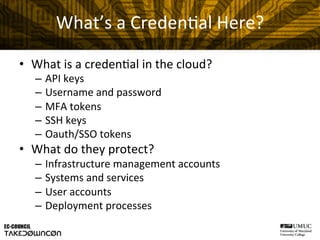
    What’s  a  Creden@al  Here?   •  What  is  a  creden@al  in  the  cloud?   –  API  keys     –  Username  and  password   –  MFA  tokens   –  SSH  keys   –  Oauth/SSO  tokens   •  What  do  they  protect?   –  Infrastructure  management  accounts   –  Systems  and  services   –  User  accounts   –  Deployment  processes  
  • 23.
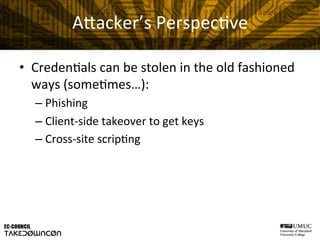
    A"acker’s  Perspec@ve   • Creden@als  can  be  stolen  in  the  old  fashioned   ways  (some@mes…):   – Phishing   – Client-­‐side  takeover  to  get  keys   – Cross-­‐site  scrip@ng  
  • 24.
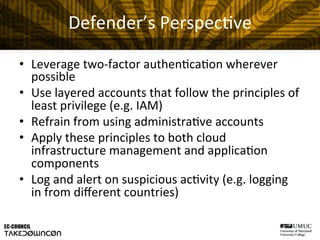
    Defender’s  Perspec@ve   • Leverage  two-­‐factor  authen@ca@on  wherever   possible   •  Use  layered  accounts  that  follow  the  principles  of   least  privilege  (e.g.  IAM)   •  Refrain  from  using  administra@ve  accounts   •  Apply  these  principles  to  both  cloud   infrastructure  management  and  applica@on   components   •  Log  and  alert  on  suspicious  ac@vity  (e.g.  logging   in  from  different  countries)  
  • 25.
  • 26.
    As  an  A"acker   •  Many  tradi@onal  a"acks  will  s@ll  work  given   the  underlying  infrastructure   •  New  a"ack  surface  creates  new  spins  on  old   a"acks  or  some  new  a"acks  en@rely   •  Can  leverage  cloud  services  yourself  for   scalable,  distributed  a"acks  
  • 27.
    As  a  Defender   •  Threat  model  early  and  oHen  to  understand  your   system’s  design  and  applicable  a"ack  surface   •  Embrace  plaform  provided  security  controls  (e.g.   IAM,  S3  SSE,  KMS,  etc.)   •  There  are  many  third  party  services  that  provide   seamless  integra@on,  evaluate  the  threat  model   and  consider  them   –  Controls  in  as  many  different  loca@ons  as  possible   •  Integra@on  will  depend  on  whether  your  app/ infrastructure  is  grass  fields  or  a  migra@on  
  • 28.
    Understand  Your  Doomsday   •  Repriori@zed  by  cloud   –  Malicious  insider   –  Data  in  transit   protec@on   –  Management  interface   compromise   –  Creden@al  compromise   –  Infrastructure  supply   chain  stability   –  DDoS  –  against  you  or   related  clients   •  Unique  to  cloud   –  Service  provider   termina@on   –  Changes  in  jurisdic@on   –  Subpoena  and  e-­‐ discovery  of  another   tenant   –  Mul@-­‐tenant  isola@on  of   isola@on  
  • 29.
    Ques@ons?   Robert  Wood  |  @robertwood50   rwood@cigital.com