Breaking Smart [Bank] Statements
How to read a Bank Statement without a password
SECURITY RESEARCHER @
TRUSTWAVE SPIDERLABS RESEARCH –VAT
OCTOBER 10, 2019
Manuel Nader
Agenda
Context
Analysis of the file
Analysis of JavaScript
RC4
Demo
Analysis after fix
Conclusions
Q & A
01
02
03
04
05
06
07
08
Whoami
• Work
• Security Researcher at Trustwave SpiderLabs.
• Previously worked in the offensive side of security (Ethical Hacking).
• Before that he worked on the defensive side of security.
• Extra
• Web attacks, DDoS
• Dogs, tacos
• Twitter: @AgoraSecurity
Context
Disclosure Timeline
• Disclosure to SLR Intelligence: March 21, 2018
• SLR Intelligence contacted the vendor: March 22, 2018
• Vendor responded: April 30, 2018
• Vendor (responsible.disclosure@citi.com) confirms fix: July 19,
2018
Context – Who?
• CitiBanamex
• One of the largest Banks in Mexico (3rd biggest bank1 in Mexico).
• Part of Citigroup (one of the biggest groups in the world).
1. https://www.forbes.com.mx/los-10-bancos-mas-grandes-de-mexico/
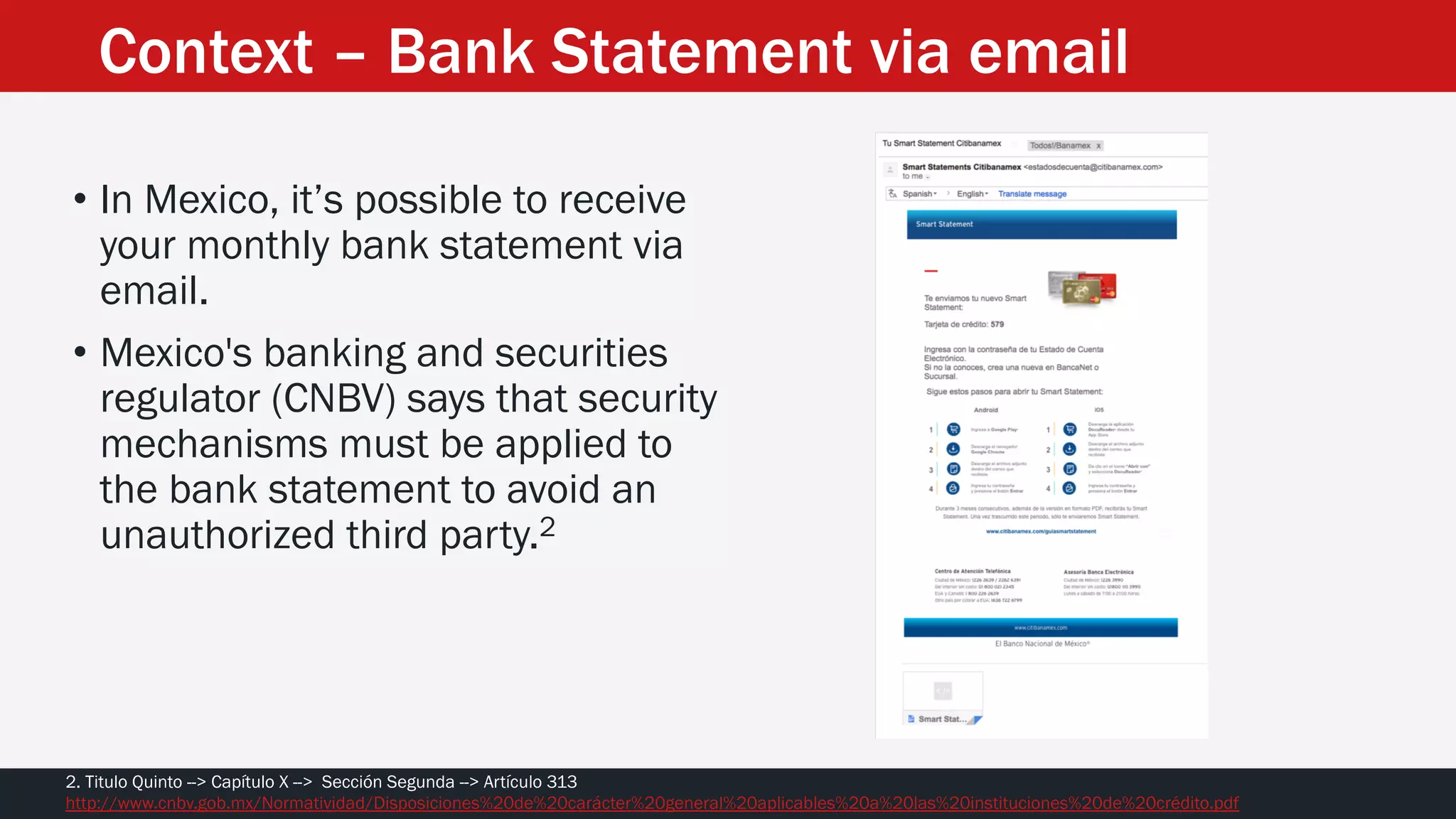
• In Mexico, it’s possible to receive
your monthly bank statement via
email.
• Mexico's banking and securities
regulator (CNBV) says that security
mechanisms must be applied to
the bank statement to avoid an
unauthorized third party.2
2. Titulo Quinto --> Capítulo X --> Sección Segunda --> Artículo 313
http://www.cnbv.gob.mx/Normatividad/Disposiciones%20de%20carácter%20general%20aplicables%20a%20las%20instituciones%20de%20crédito.pdf
Context – Bank Statement via email
• CitiBanamex send two types of Bank Statements:
1. Encrypted PDF. Used for most accounts.
2. Smart Statements. Send only3 to Credit Cards of the type “Tarjetas Oro,
Prestige y Beyond Citibanamex”.
• Fun Fact: They have a FAQ page4 for the Smart Statement.
• Question 3 (translated):
• 3. Is my Smart Statement safe?
• The Smart Statement has the highest security protocols worldwide, which is
why it is just as safe as your PDF Account Statement.
3. Information from 2018
4. https://www.banamex.com/citialert/smartstatement/resources/faqs.pdf?lid=MX%7Ces%7Cpersonas%7Cbanca-digital%7Cestado-de-cuenta-TextoBottom-04102017-
Information-irFAQsSmartStatement-ES-ES
Context – CitiBanamex Bank Statement via email
Analysis of the file
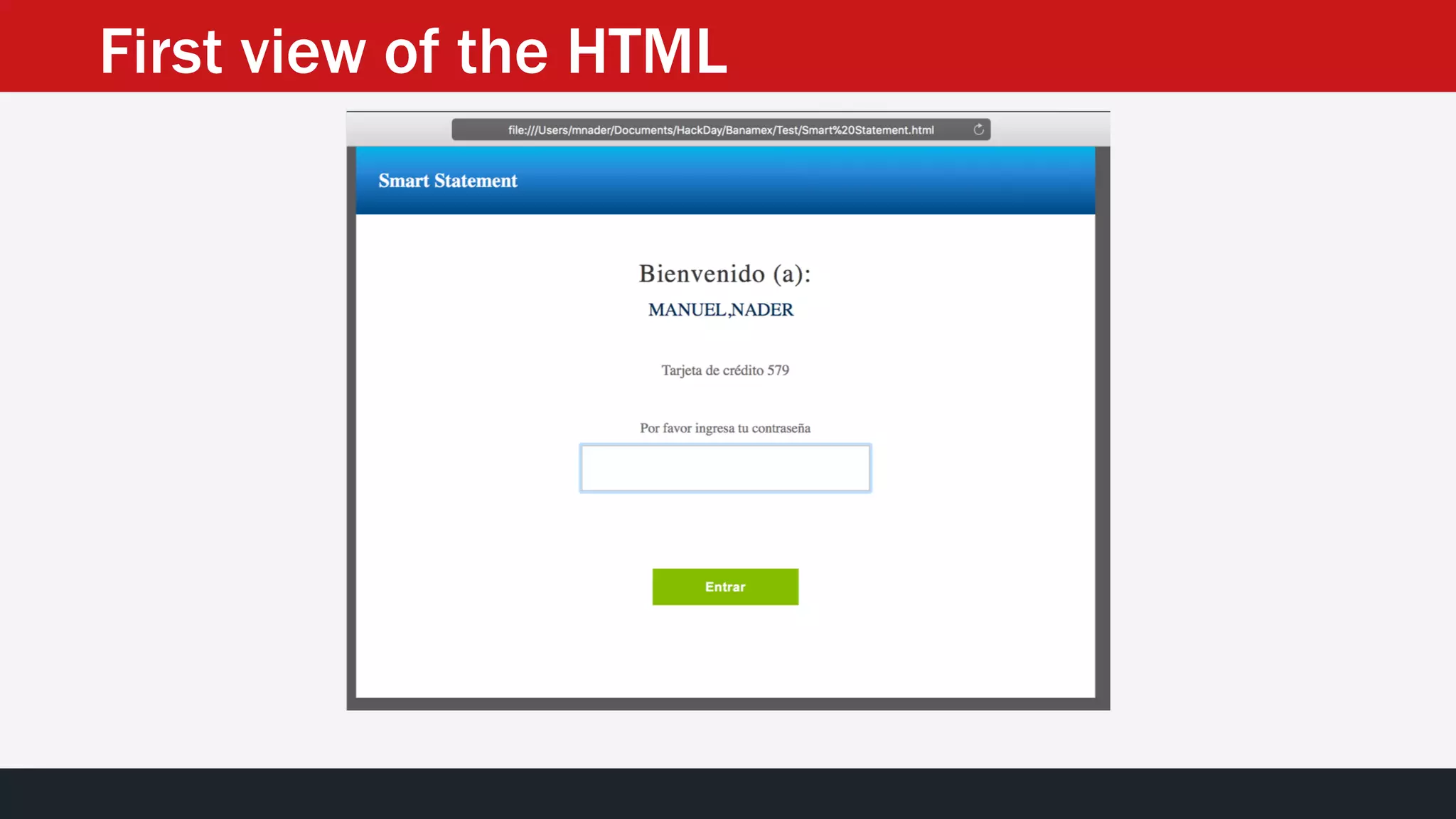
First view of the HTML
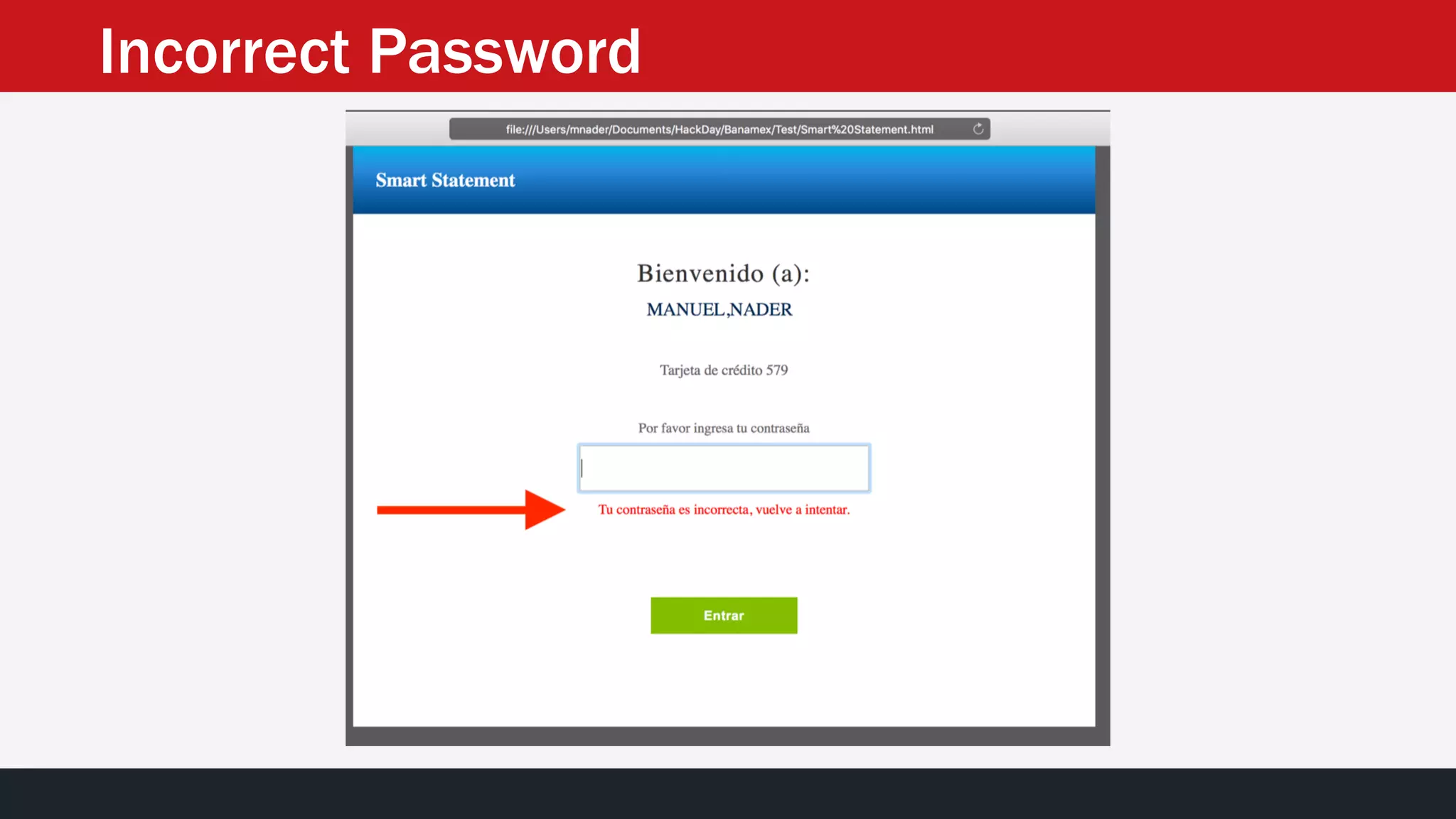
Incorrect Password
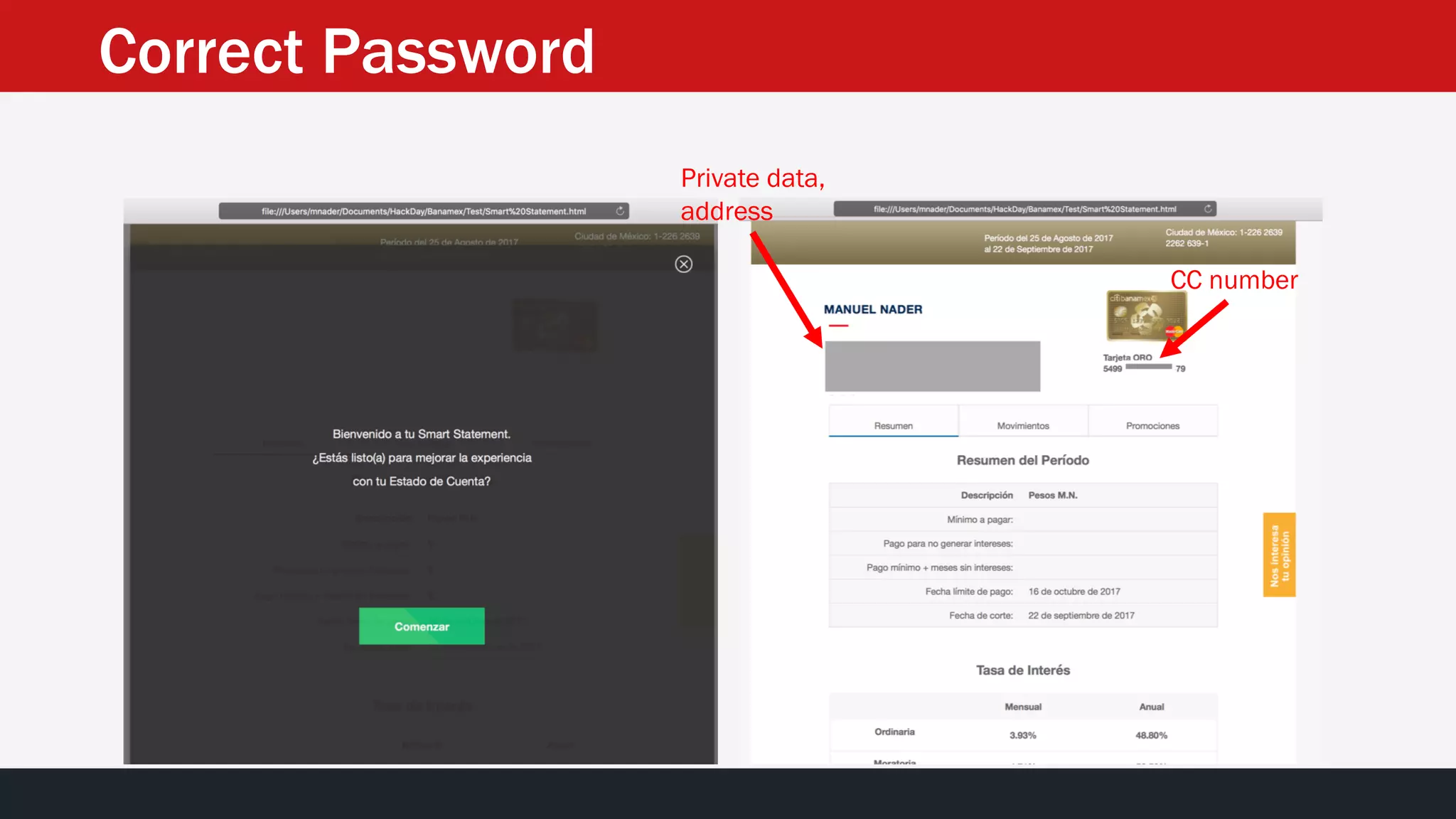
Correct Password
Private data,
address
CC number
What does the HTML contain?
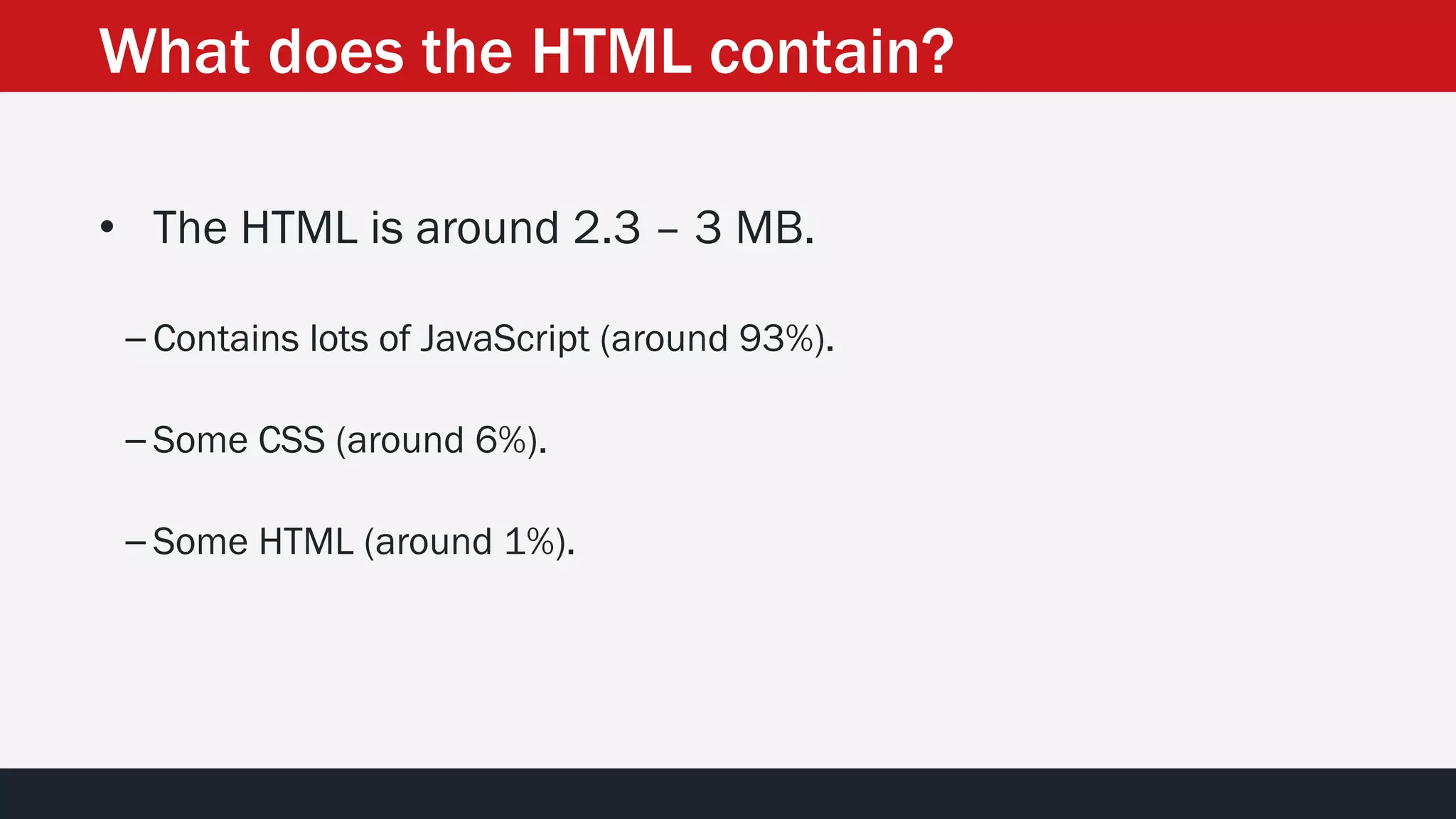
• The HTML is around 2.3 – 3 MB.
– Contains lots of JavaScript (around 93%).
– Some CSS (around 6%).
– Some HTML (around 1%).
What is happening?
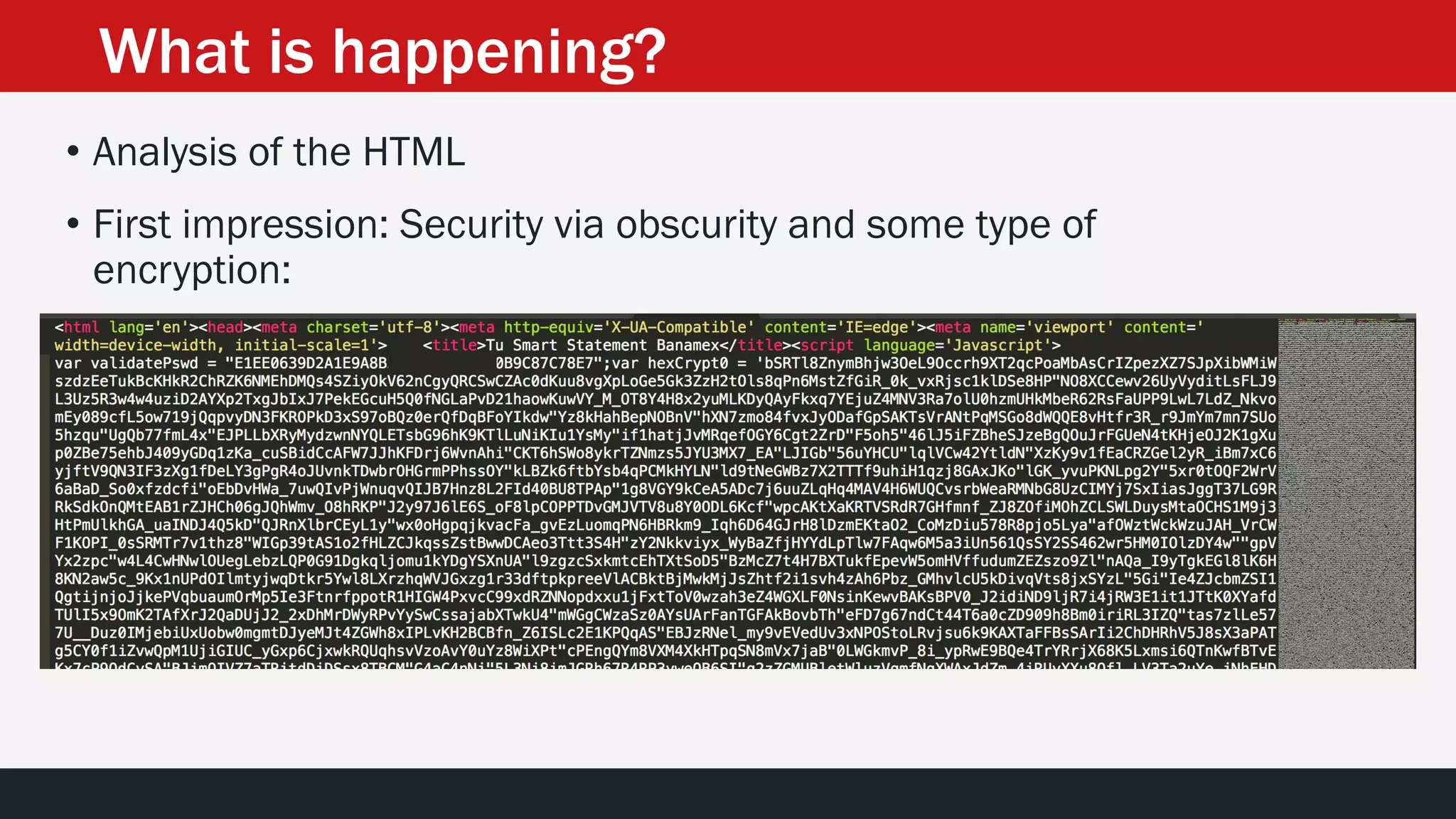
• First impression: Security via obscurity and some type of
encryption:
• Analysis of the HTML
Analysis of the JavaScript
JS Analysis #1
• It has 31 JavaScript functions and a lot of variables.
– Some are very similar: hexCrypt0, hexCrypt1, hexCrypt2, etc.
– One is particularly interesting: validatePswd
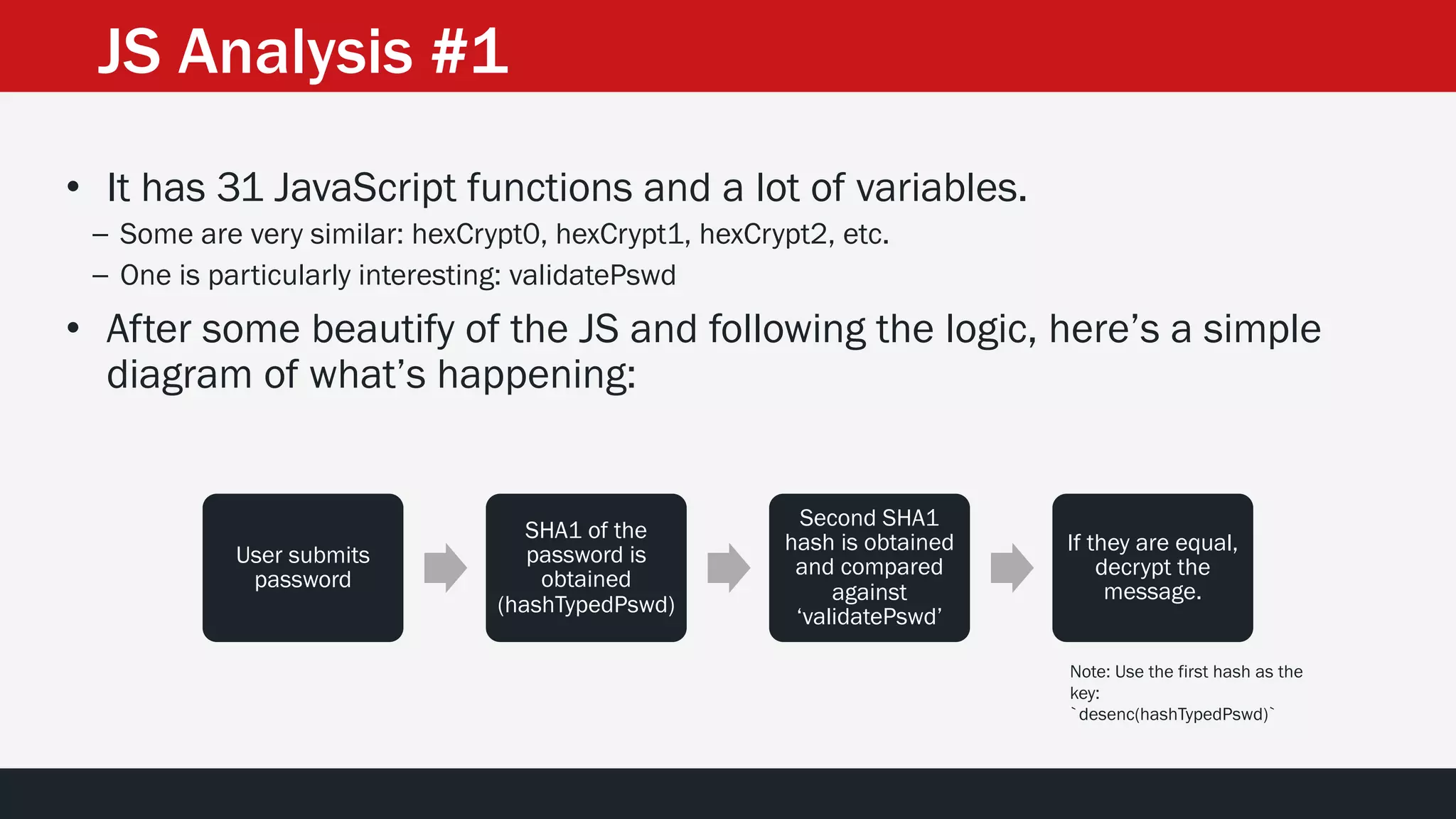
• After some beautify of the JS and following the logic, here’s a simple
diagram of what’s happening:
User submits
password
SHA1 of the
password is
obtained
(hashTypedPswd)
Second SHA1
hash is obtained
and compared
against
‘validatePswd’
If they are equal,
decrypt the
message.
Note: Use the first hash as the
key:
`desenc(hashTypedPswd)`
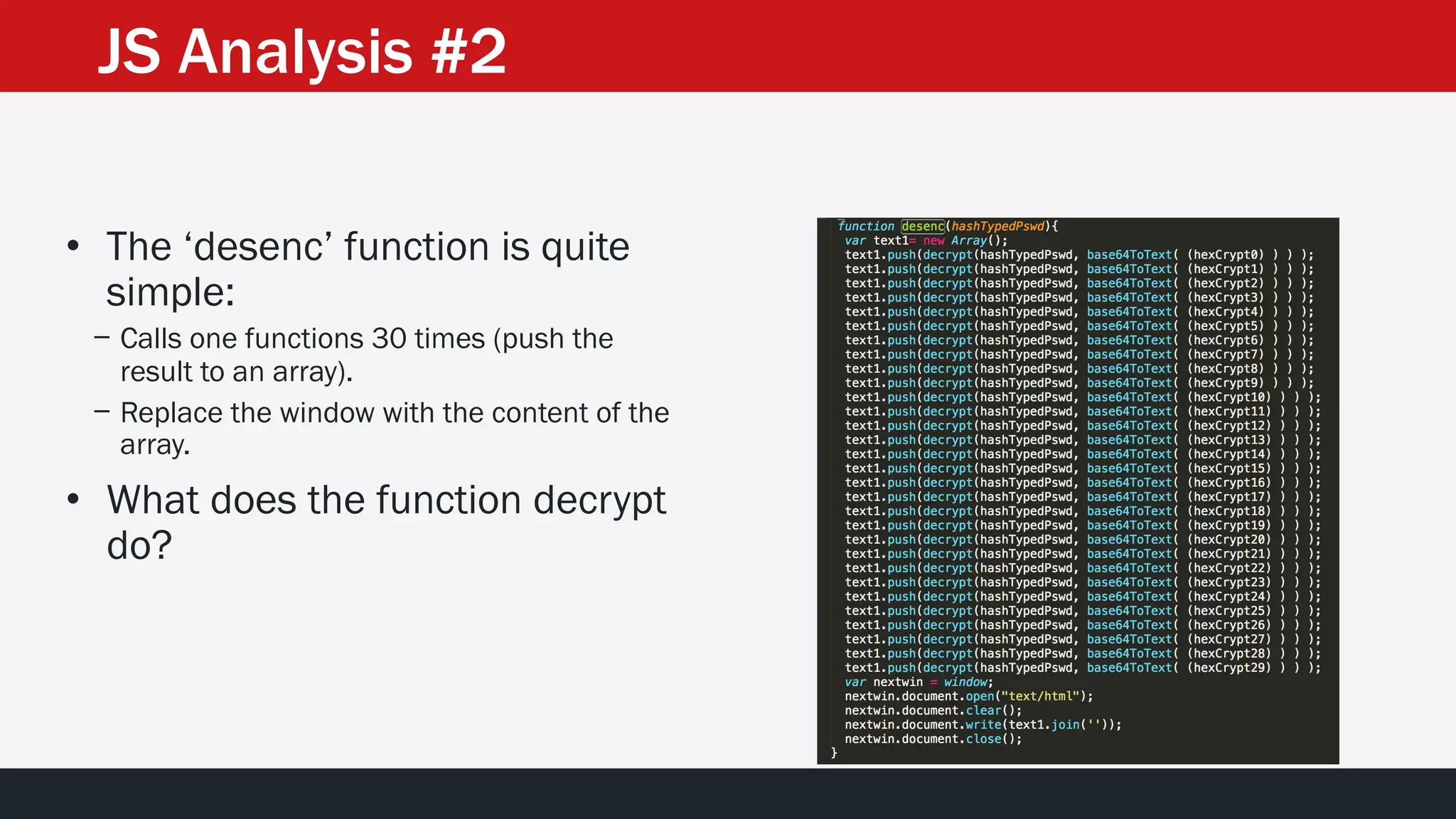
• The ‘desenc’ function is quite
simple:
− Calls one functions 30 times (push the
result to an array).
− Replace the window with the content of the
array.
• What does the function decrypt
do?
JS Analysis #2
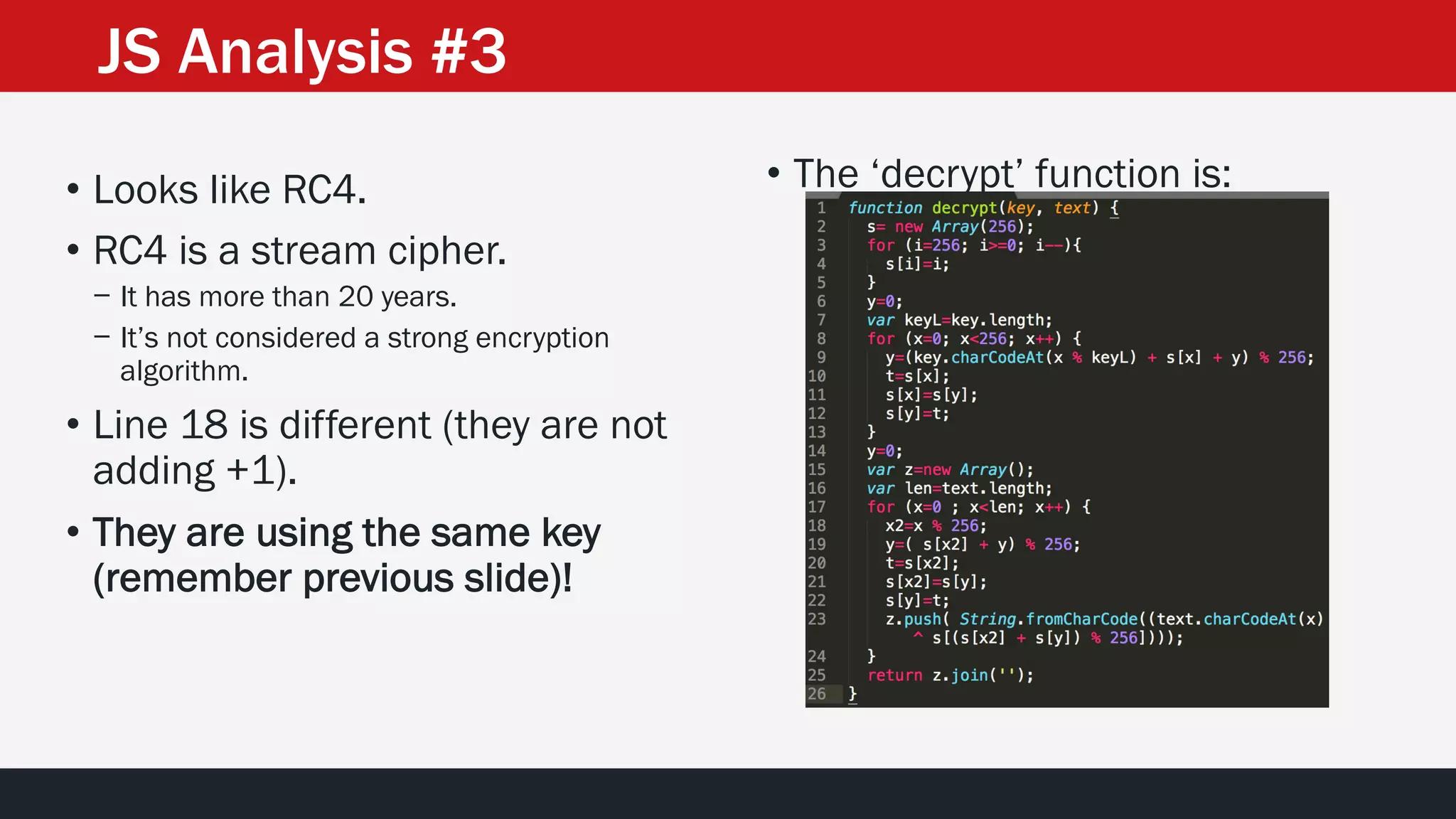
• The ‘decrypt’ function is:• Looks like RC4.
• RC4 is a stream cipher.
− It has more than 20 years.
− It’s not considered a strong encryption
algorithm.
• Line 18 is different (they are not
adding +1).
• They are using the same key
(remember previous slide)!
JS Analysis #3
RC4
RC4 – What is it?
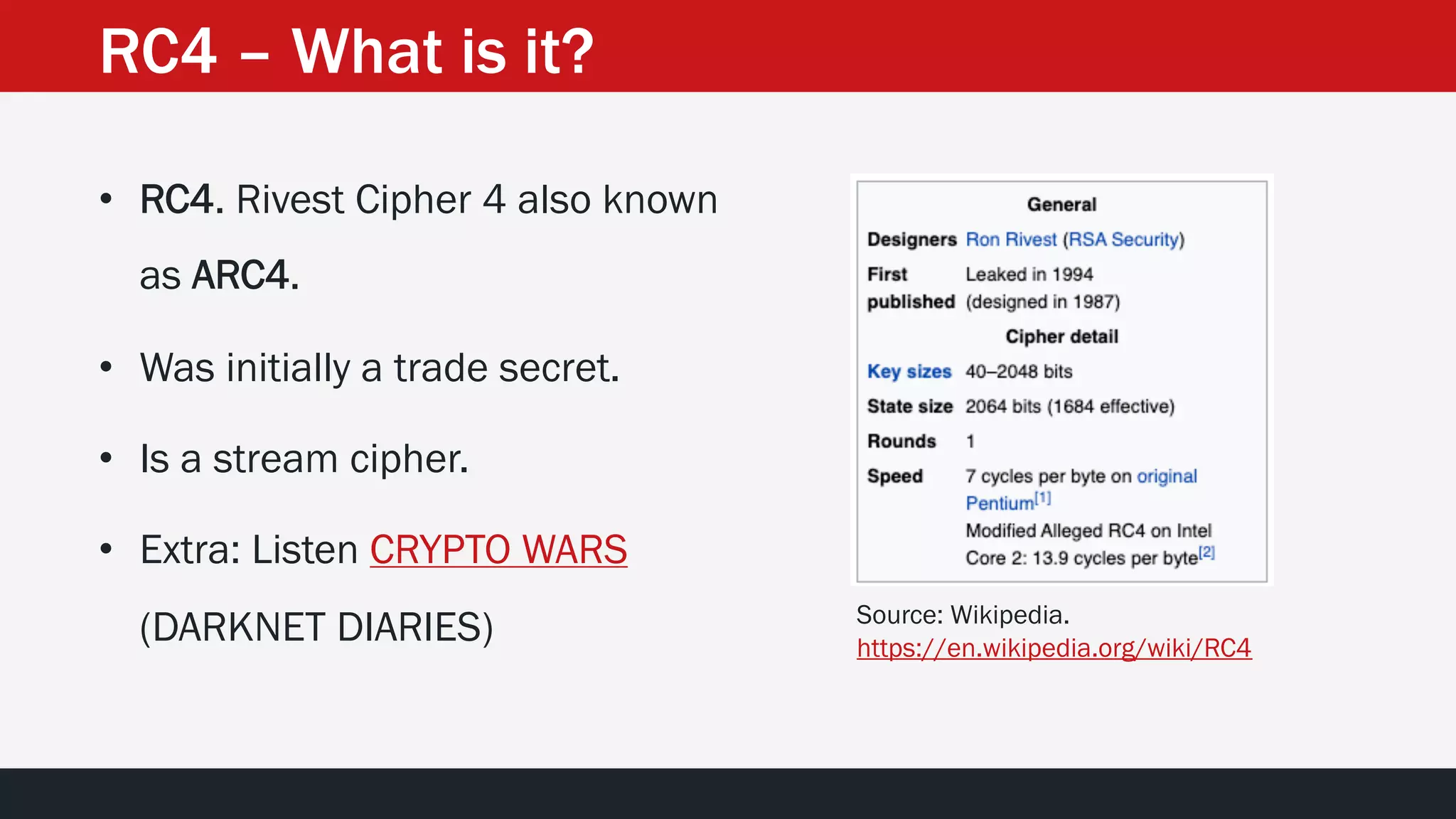
• RC4. Rivest Cipher 4 also known
as ARC4.
• Was initially a trade secret.
• Is a stream cipher.
• Extra: Listen CRYPTO WARS
(DARKNET DIARIES) Source: Wikipedia.
https://en.wikipedia.org/wiki/RC4
RC4 – Overview #1
• A stream cipher is a symmetric key cipher where plaintext digits
are combined with a pseudorandom cipher digit stream
(keystream), RC4 is a stream cipher.
• For RC4, the keystream is independent of the plaintext
(Synchronous stream cipher).
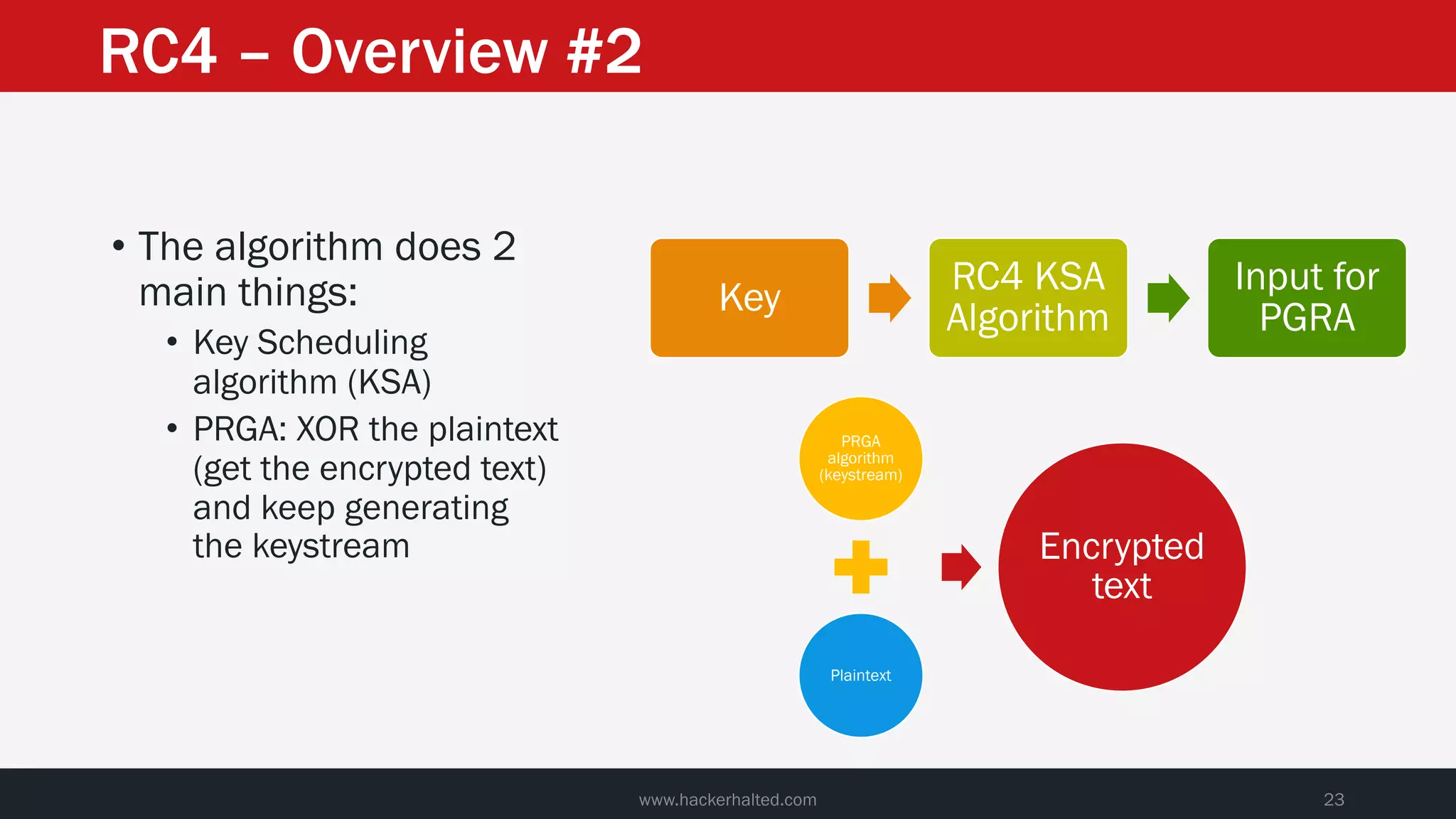
• The algorithm does 2
main things:
• Key Scheduling
algorithm (KSA)
• PRGA: XOR the plaintext
(get the encrypted text)
and keep generating
the keystream
www.hackerhalted.com 23
RC4 – Overview #2
PRGA
algorithm
(keystream)
Plaintext
Encrypted
text
Key
RC4 KSA
Algorithm
Input for
PGRA
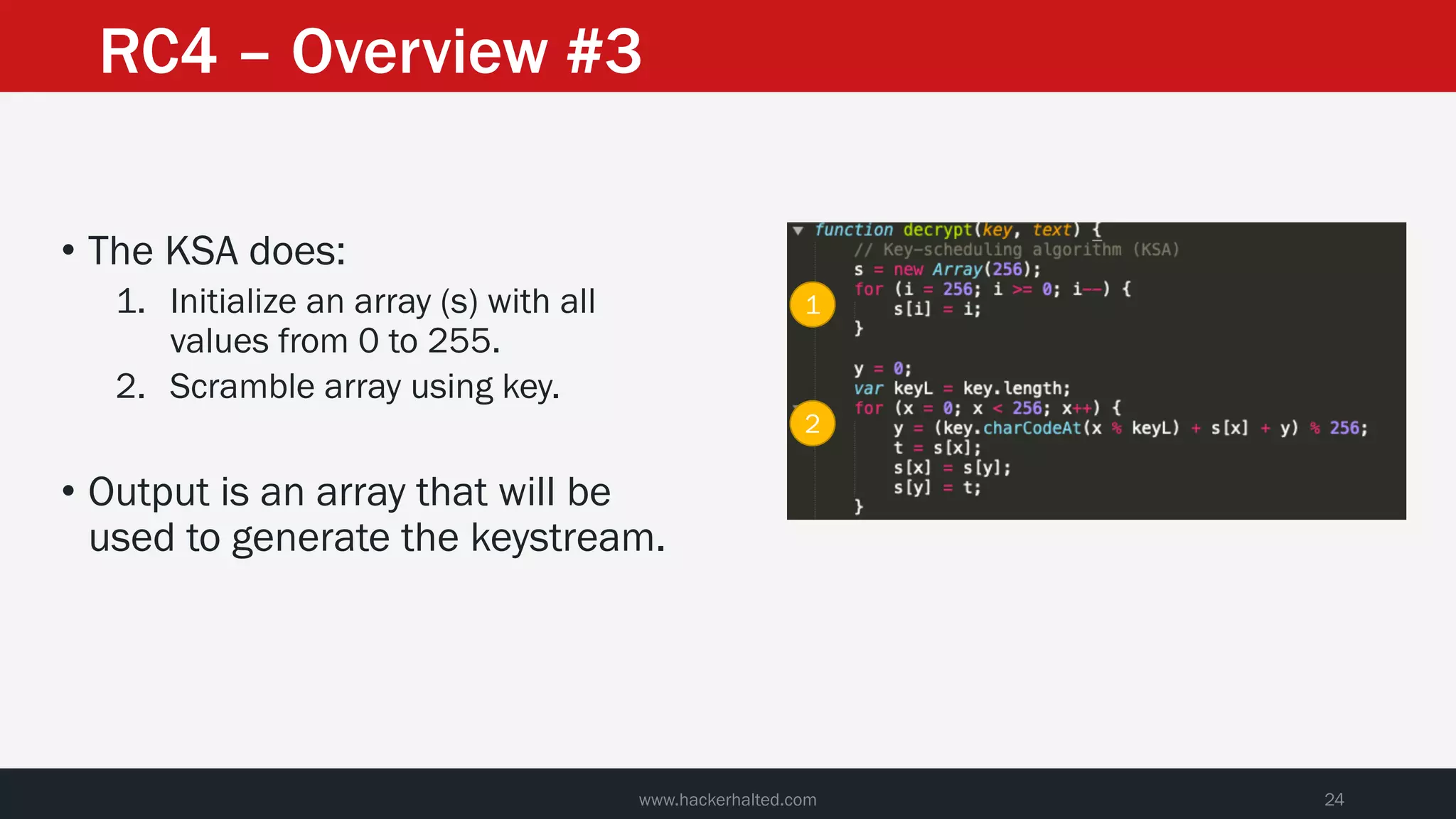
• The KSA does:
1. Initialize an array (s) with all
values from 0 to 255.
2. Scramble array using key.
• Output is an array that will be
used to generate the keystream.
www.hackerhalted.com 24
RC4 – Overview #3
1
2
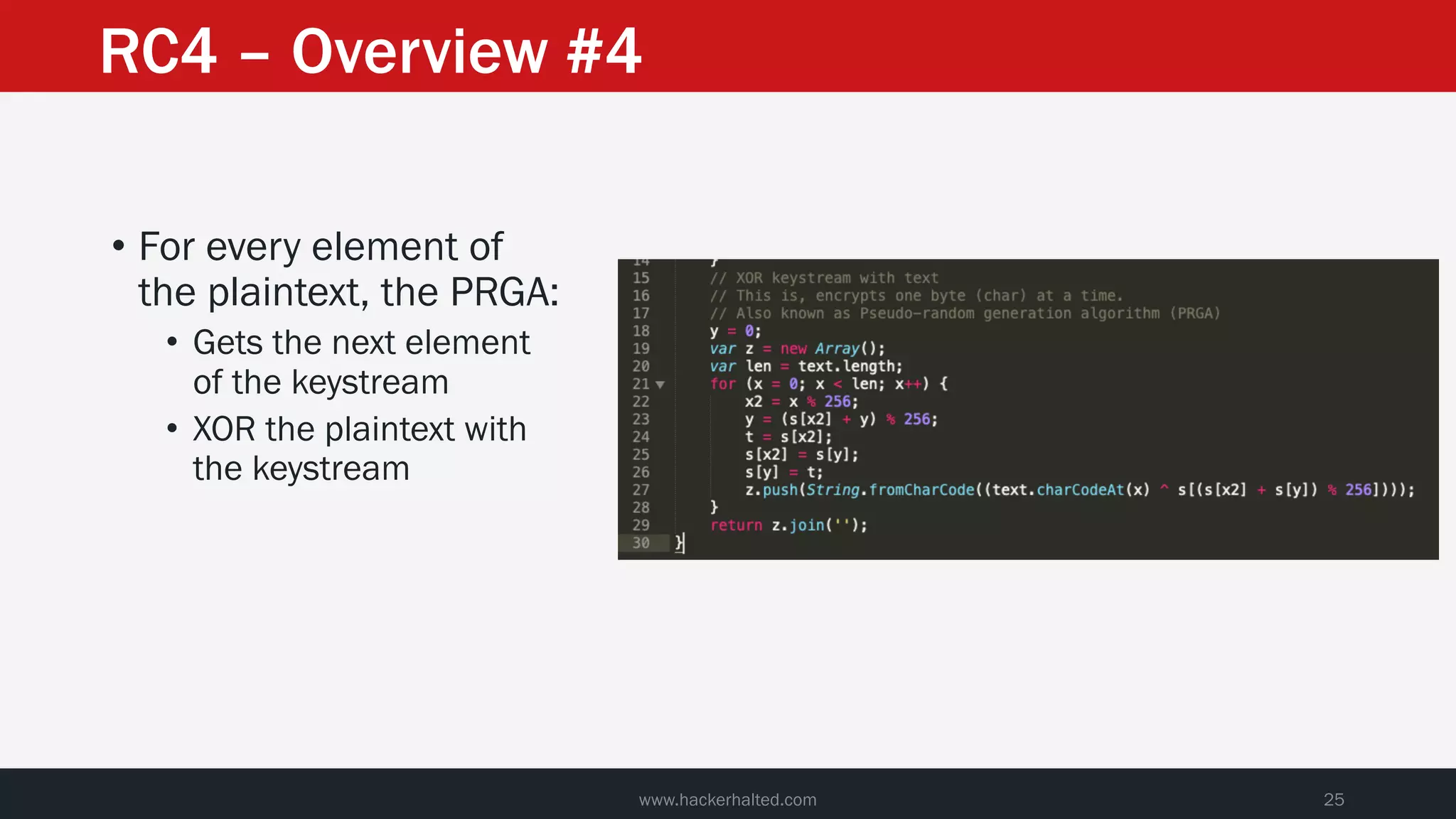
• For every element of
the plaintext, the PRGA:
• Gets the next element
of the keystream
• XOR the plaintext with
the keystream
www.hackerhalted.com 25
RC4 – Overview #4
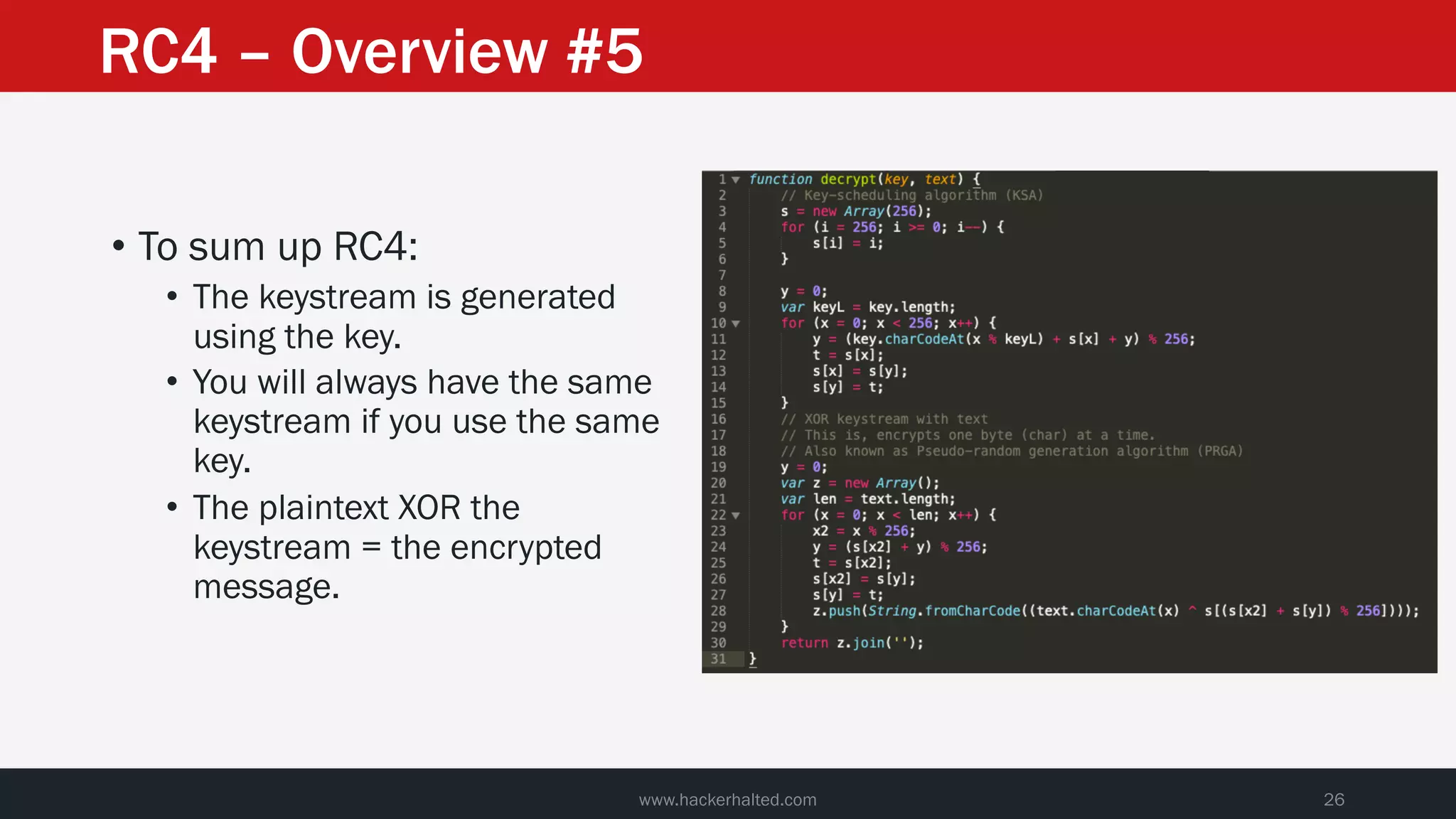
• To sum up RC4:
• The keystream is generated
using the key.
• You will always have the same
keystream if you use the same
key.
• The plaintext XOR the
keystream = the encrypted
message.
www.hackerhalted.com 26
RC4 – Overview #5
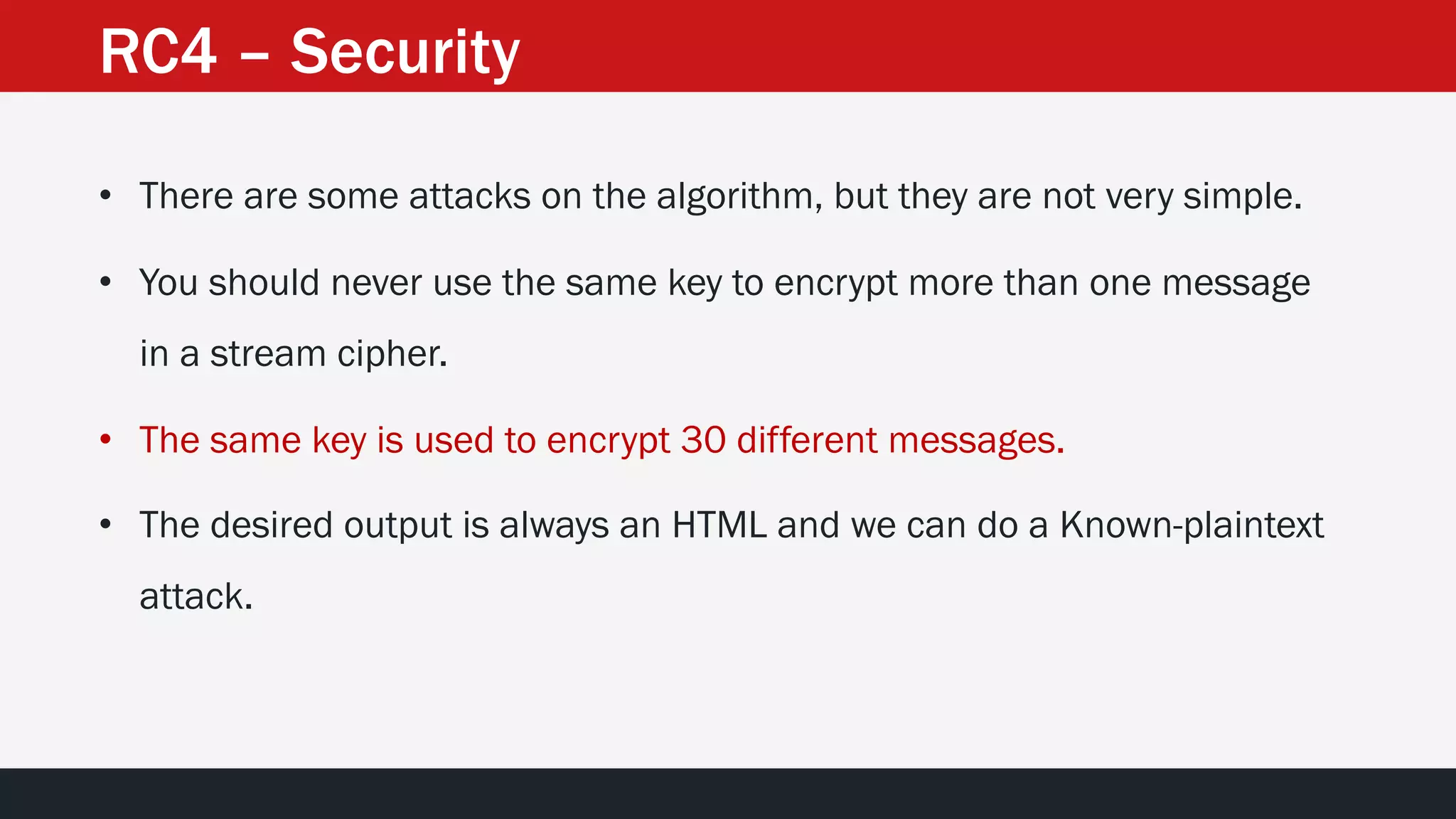
RC4 – Security
• There are some attacks on the algorithm, but they are not very simple.
• You should never use the same key to encrypt more than one message
in a stream cipher.
• The same key is used to encrypt 30 different messages.
• The desired output is always an HTML and we can do a Known-plaintext
attack.
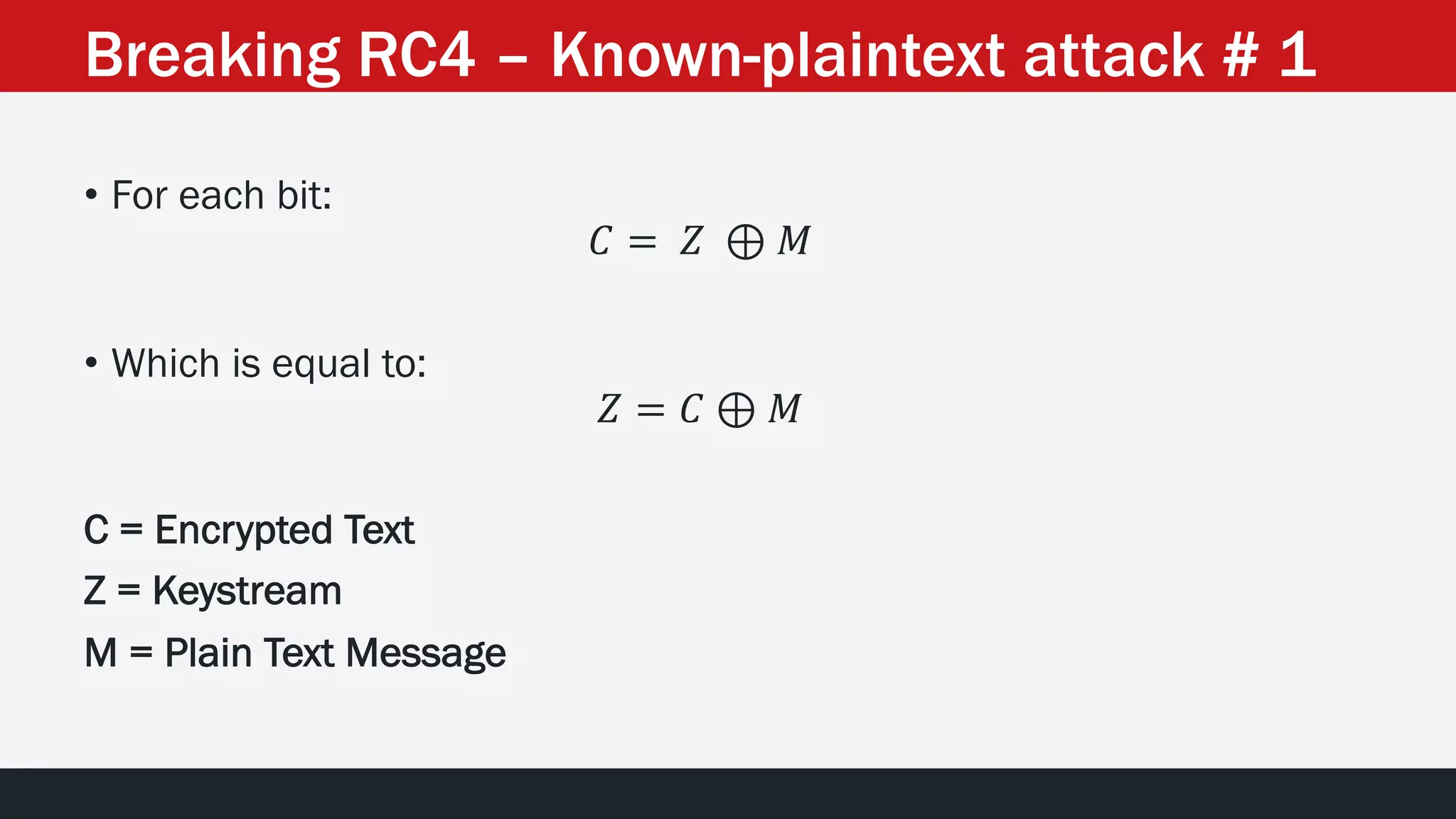
Breaking RC4 – Known-plaintext attack # 1
• For each bit:
𝐶 = 𝑍 ⊕ 𝑀
• Which is equal to:
𝑍 = 𝐶 ⊕ 𝑀
C = Encrypted Text
Z = Keystream
M = Plain Text Message
• We have the Encrypted Message and it is split in ~30 variables [for
our convenience].
• Could we obtain the Keystream?
• Could we obtain the complete plain text?
Breaking RC4 – Known-plaintext attack # 2
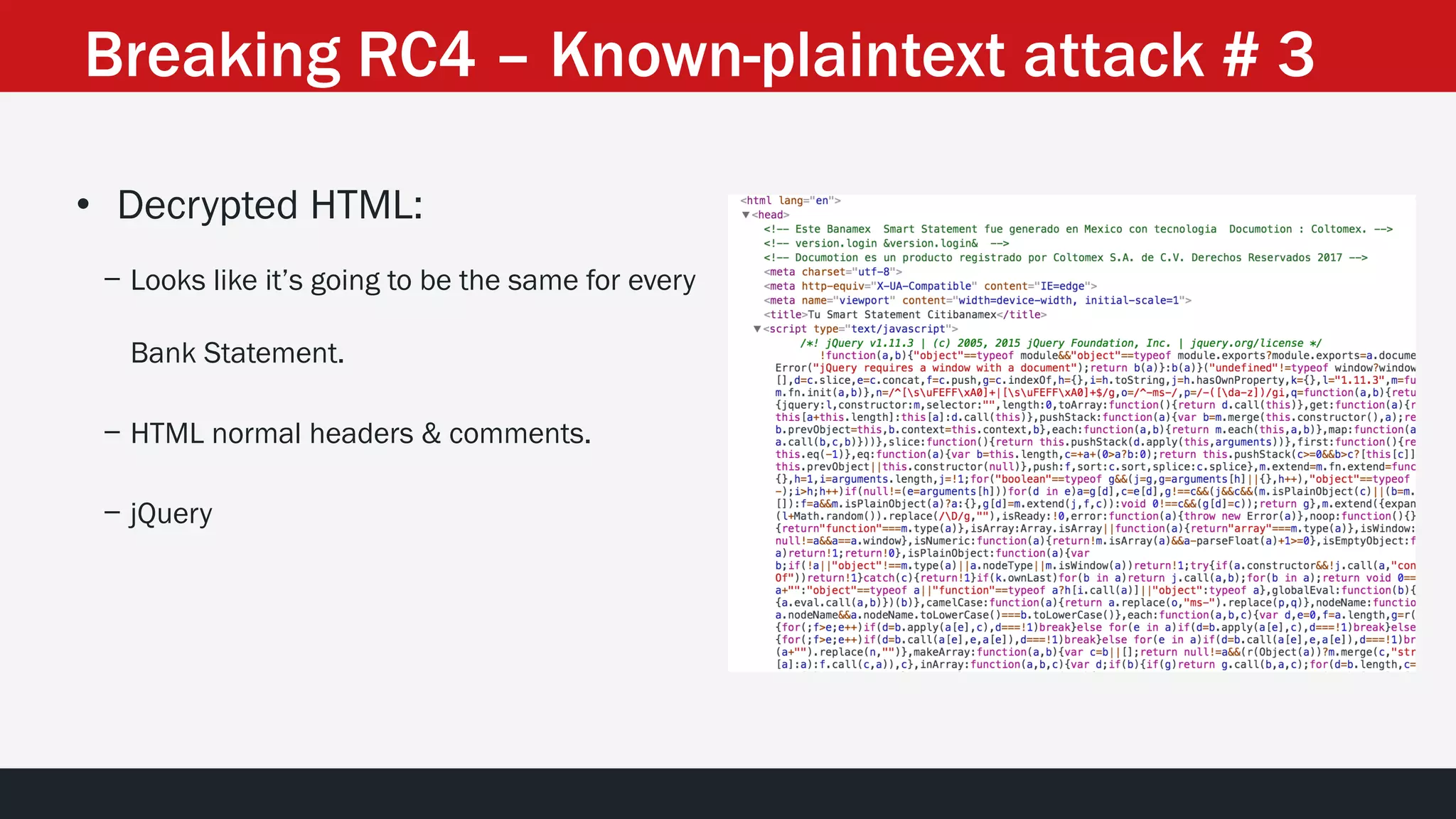
• Decrypted HTML:
− Looks like it’s going to be the same for every
Bank Statement.
− HTML normal headers & comments.
− jQuery
Breaking RC4 – Known-plaintext attack # 3
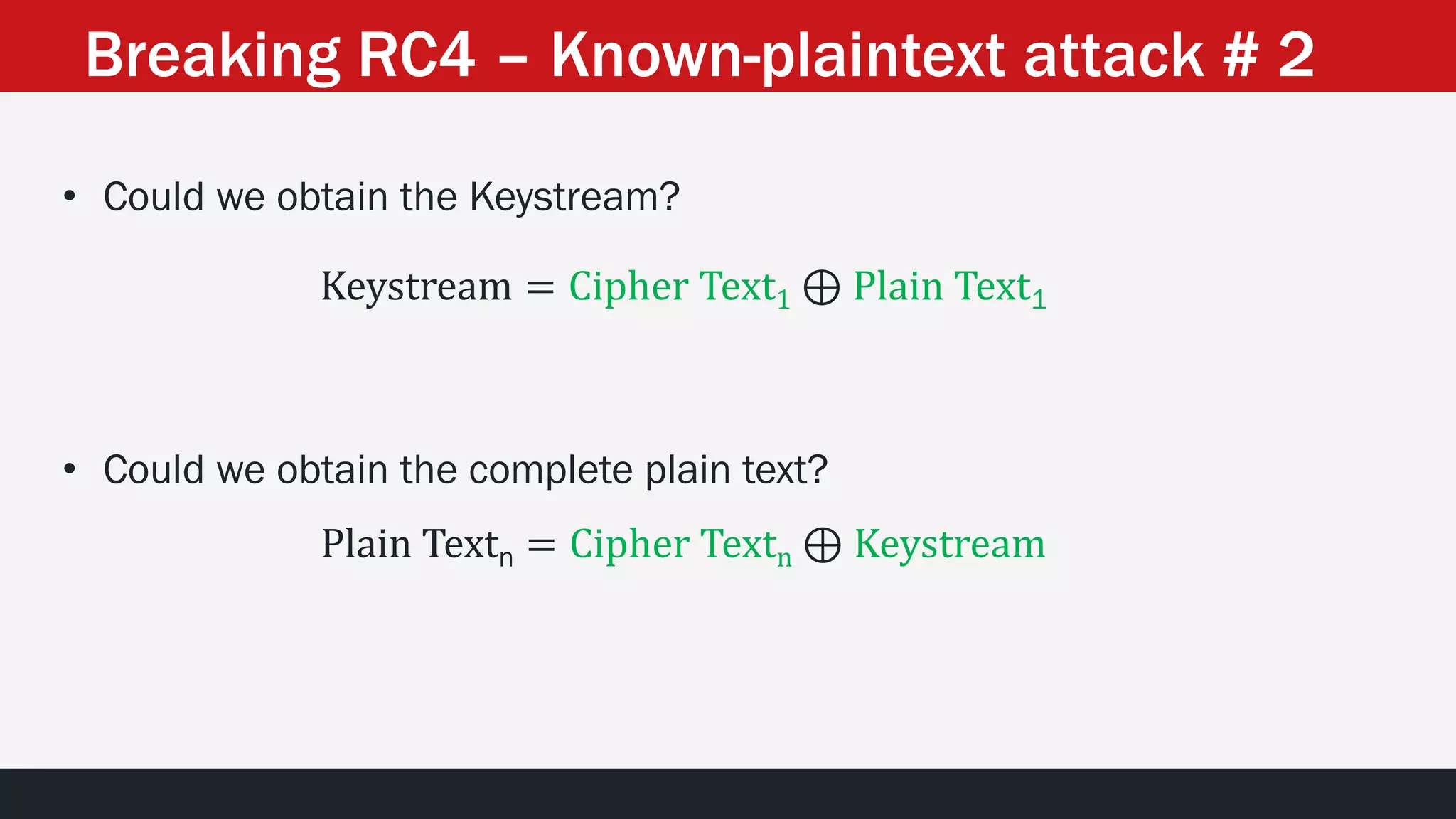
• Could we obtain the Keystream?
Keystream = Cipher Text1 ⊕ Plain Text1
• Could we obtain the complete plain text?
Plain Textn = Cipher Textn ⊕ Keystream
Breaking RC4 – Known-plaintext attack # 2
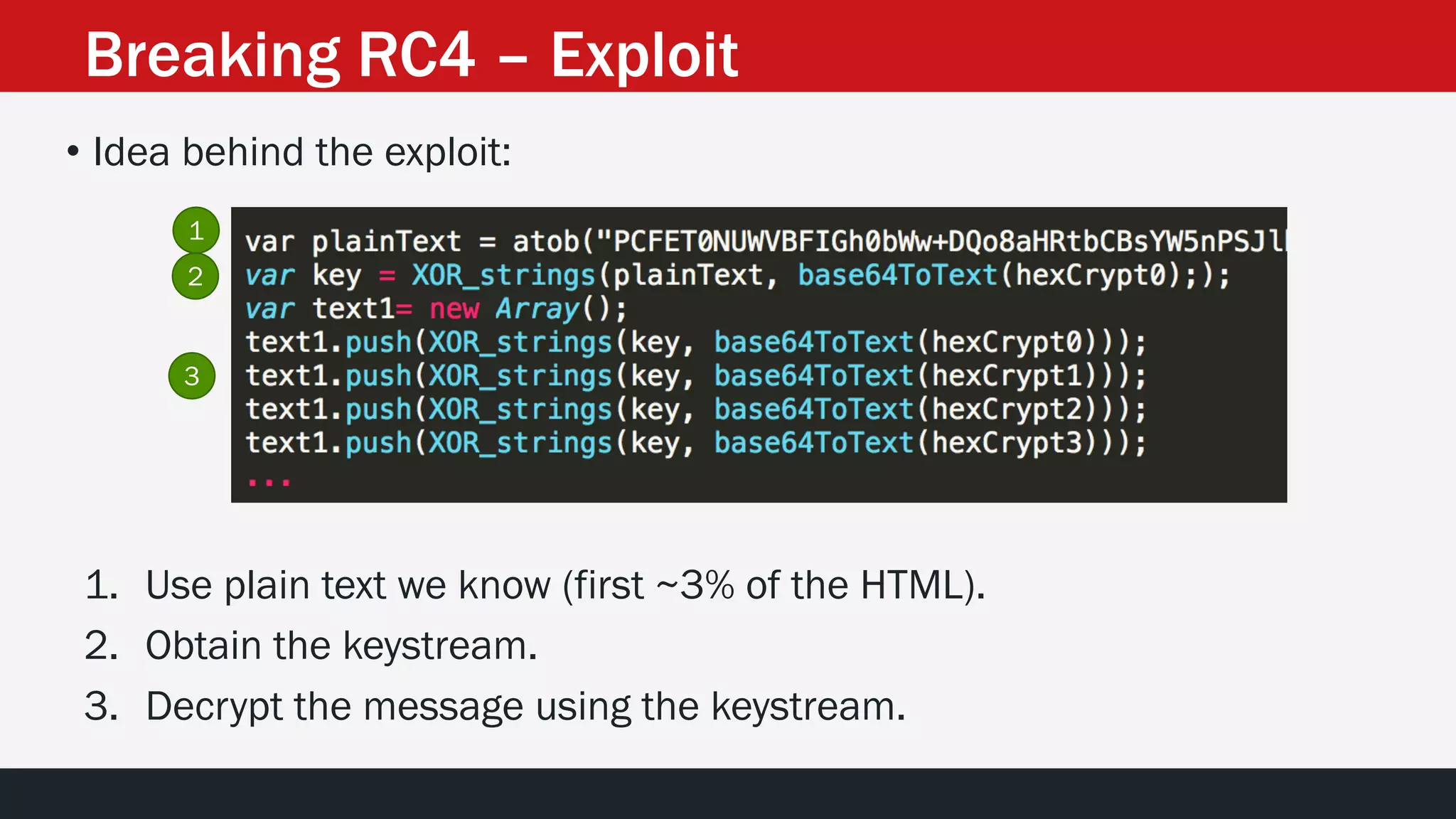
• Idea behind the exploit:
1
2
3
Breaking RC4 – Exploit
1. Use plain text we know (first ~3% of the HTML).
2. Obtain the keystream.
3. Decrypt the message using the keystream.
Demo
Possible Fixes
Possible Fixes
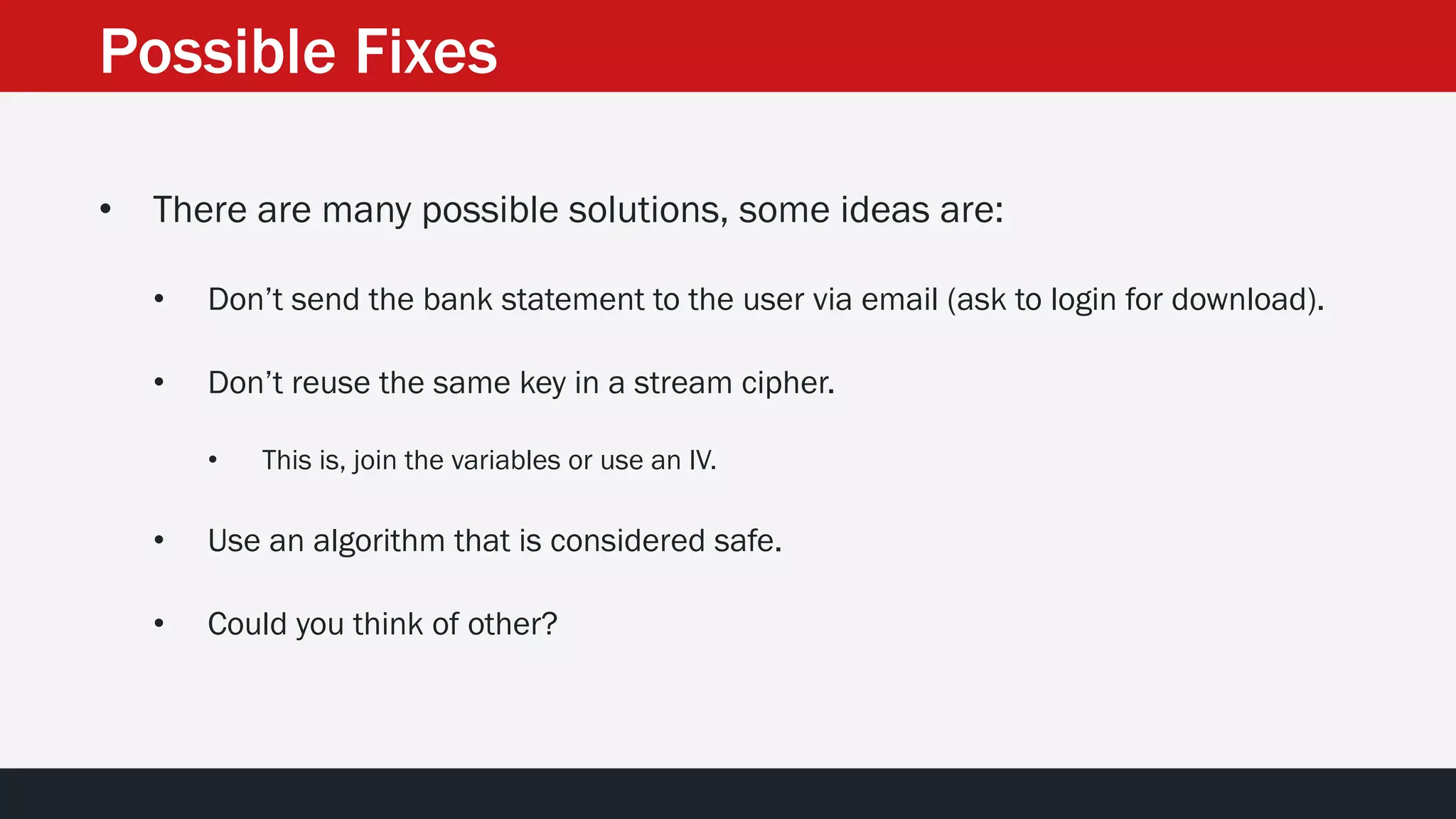
• There are many possible solutions, some ideas are:
• Don’t send the bank statement to the user via email (ask to login for download).
• Don’t reuse the same key in a stream cipher.
• This is, join the variables or use an IV.
• Use an algorithm that is considered safe.
• Could you think of other?
Analysis After the Fix
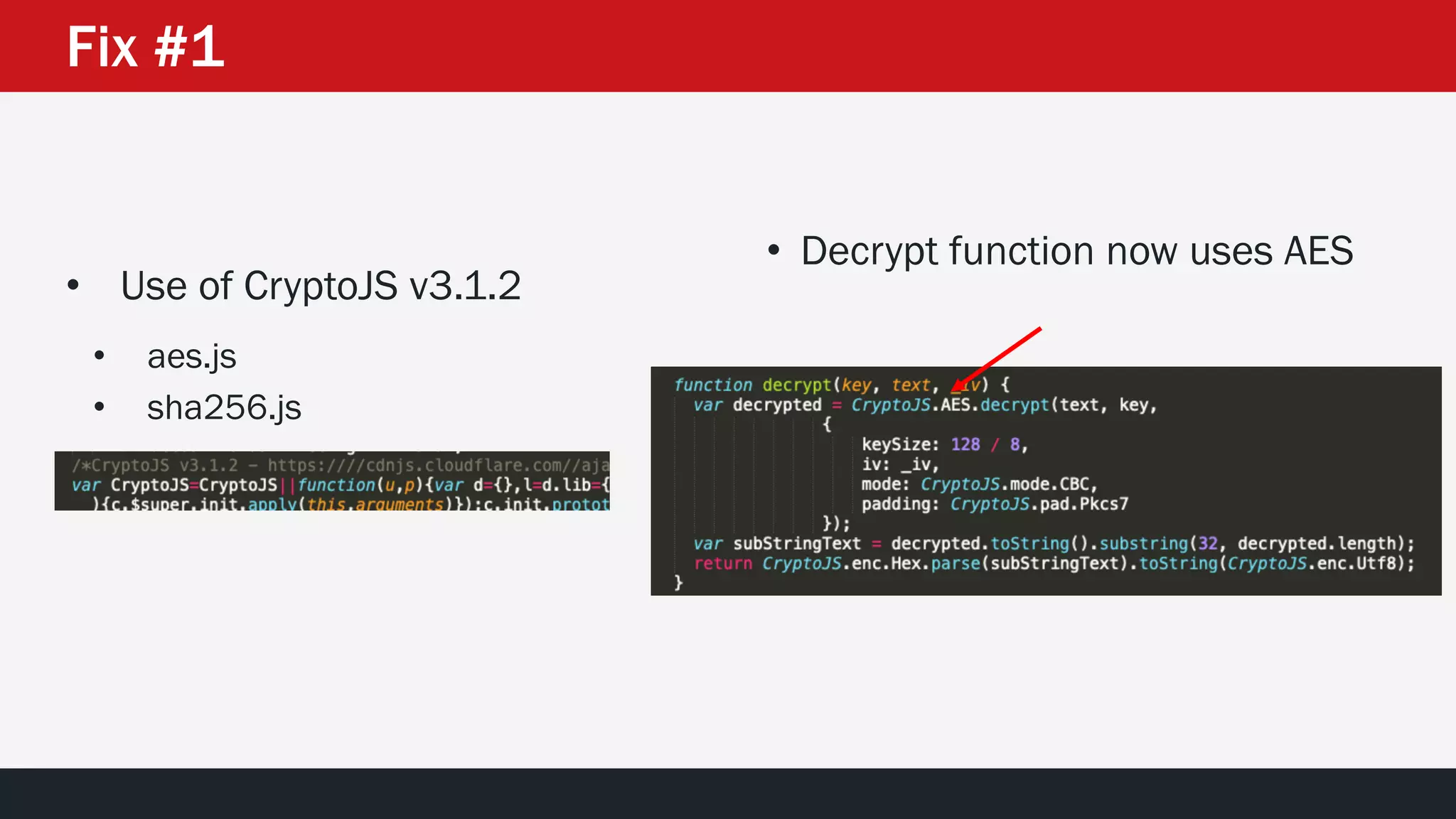
Fix #1
• Decrypt function now uses AES
• Use of CryptoJS v3.1.2
• aes.js
• sha256.js
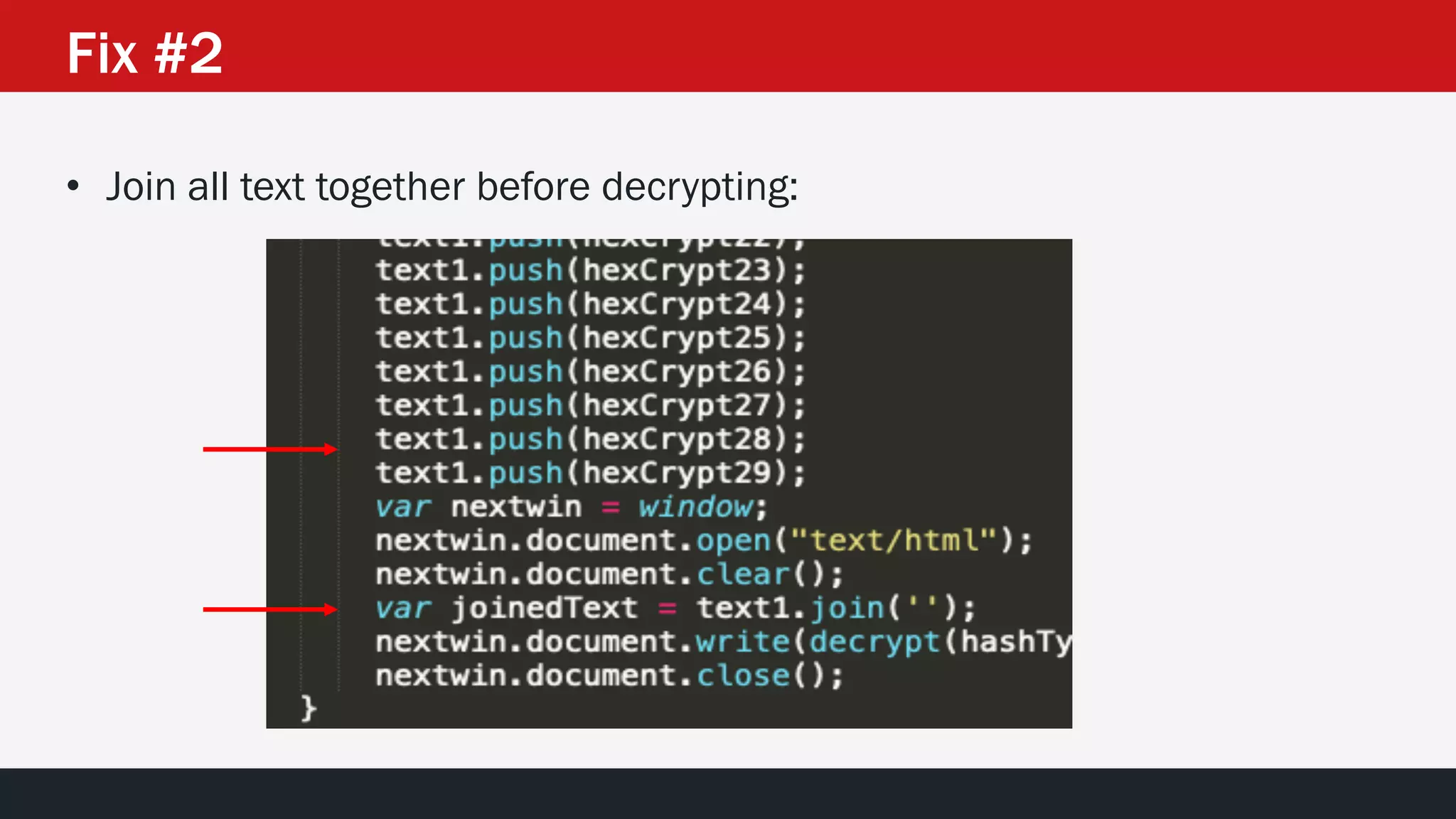
Fix #2
• Join all text together before decrypting:
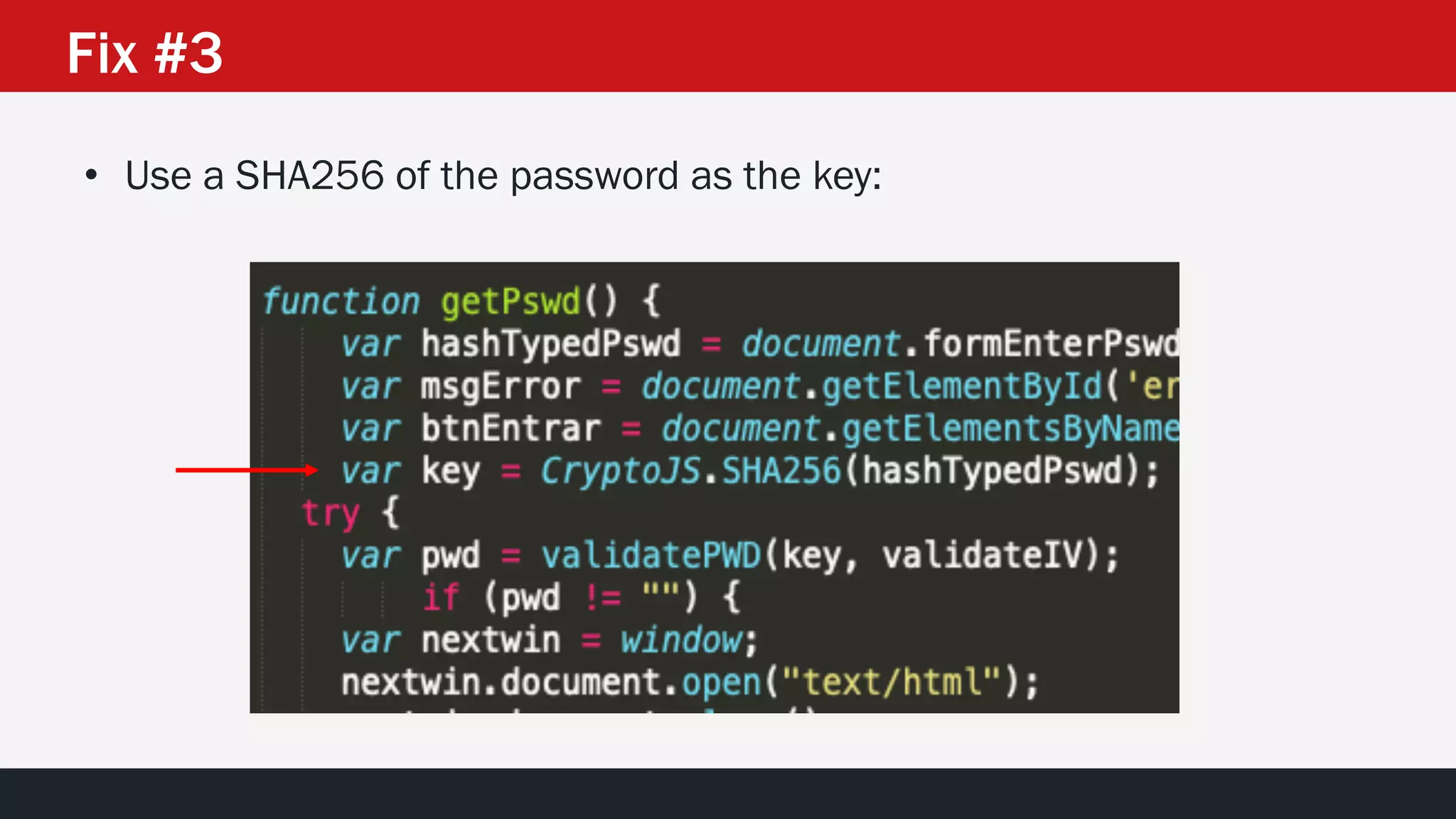
Fix #3
• Use a SHA256 of the password as the key:
Conclusion
Conclusion
• It’s a good idea to have a security review before rolling out a new product.
• Hire specialists if needed.
• Always use cryptography algorithms that are considered safe.
• Never roll your own cryptography algorithms (nor implement them differently).
• Never use the same key more than once in a stream cipher.
• If possible, have a simple, safe & clear way of communicating security issues to your organization.
• Blog: https://www.trustwave.com/en-us/resources/blogs/spiderlabs-blog/breaking-smart-bank-
statements/
Questions and Next Steps
Breaking Smart [Bank] Statements – Hacker Halted 2019 – Manuel Nader

Breaking Smart [Bank] Statements – Hacker Halted 2019 – Manuel Nader

  • 1.
    Breaking Smart [Bank]Statements How to read a Bank Statement without a password
  • 2.
    SECURITY RESEARCHER @ TRUSTWAVESPIDERLABS RESEARCH –VAT OCTOBER 10, 2019 Manuel Nader
  • 3.
    Agenda Context Analysis of thefile Analysis of JavaScript RC4 Demo Analysis after fix Conclusions Q & A 01 02 03 04 05 06 07 08
  • 4.
    Whoami • Work • SecurityResearcher at Trustwave SpiderLabs. • Previously worked in the offensive side of security (Ethical Hacking). • Before that he worked on the defensive side of security. • Extra • Web attacks, DDoS • Dogs, tacos • Twitter: @AgoraSecurity
  • 5.
  • 6.
    Disclosure Timeline • Disclosureto SLR Intelligence: March 21, 2018 • SLR Intelligence contacted the vendor: March 22, 2018 • Vendor responded: April 30, 2018 • Vendor (responsible.disclosure@citi.com) confirms fix: July 19, 2018
  • 7.
    Context – Who? •CitiBanamex • One of the largest Banks in Mexico (3rd biggest bank1 in Mexico). • Part of Citigroup (one of the biggest groups in the world). 1. https://www.forbes.com.mx/los-10-bancos-mas-grandes-de-mexico/
  • 8.
    • In Mexico,it’s possible to receive your monthly bank statement via email. • Mexico's banking and securities regulator (CNBV) says that security mechanisms must be applied to the bank statement to avoid an unauthorized third party.2 2. Titulo Quinto --> Capítulo X --> Sección Segunda --> Artículo 313 http://www.cnbv.gob.mx/Normatividad/Disposiciones%20de%20carácter%20general%20aplicables%20a%20las%20instituciones%20de%20crédito.pdf Context – Bank Statement via email
  • 9.
    • CitiBanamex sendtwo types of Bank Statements: 1. Encrypted PDF. Used for most accounts. 2. Smart Statements. Send only3 to Credit Cards of the type “Tarjetas Oro, Prestige y Beyond Citibanamex”. • Fun Fact: They have a FAQ page4 for the Smart Statement. • Question 3 (translated): • 3. Is my Smart Statement safe? • The Smart Statement has the highest security protocols worldwide, which is why it is just as safe as your PDF Account Statement. 3. Information from 2018 4. https://www.banamex.com/citialert/smartstatement/resources/faqs.pdf?lid=MX%7Ces%7Cpersonas%7Cbanca-digital%7Cestado-de-cuenta-TextoBottom-04102017- Information-irFAQsSmartStatement-ES-ES Context – CitiBanamex Bank Statement via email
  • 10.
  • 11.
    First view ofthe HTML
  • 12.
  • 13.
  • 14.
    What does theHTML contain? • The HTML is around 2.3 – 3 MB. – Contains lots of JavaScript (around 93%). – Some CSS (around 6%). – Some HTML (around 1%).
  • 15.
    What is happening? •First impression: Security via obscurity and some type of encryption: • Analysis of the HTML
  • 16.
    Analysis of theJavaScript
  • 17.
    JS Analysis #1 •It has 31 JavaScript functions and a lot of variables. – Some are very similar: hexCrypt0, hexCrypt1, hexCrypt2, etc. – One is particularly interesting: validatePswd • After some beautify of the JS and following the logic, here’s a simple diagram of what’s happening: User submits password SHA1 of the password is obtained (hashTypedPswd) Second SHA1 hash is obtained and compared against ‘validatePswd’ If they are equal, decrypt the message. Note: Use the first hash as the key: `desenc(hashTypedPswd)`
  • 18.
    • The ‘desenc’function is quite simple: − Calls one functions 30 times (push the result to an array). − Replace the window with the content of the array. • What does the function decrypt do? JS Analysis #2
  • 19.
    • The ‘decrypt’function is:• Looks like RC4. • RC4 is a stream cipher. − It has more than 20 years. − It’s not considered a strong encryption algorithm. • Line 18 is different (they are not adding +1). • They are using the same key (remember previous slide)! JS Analysis #3
  • 20.
  • 21.
    RC4 – Whatis it? • RC4. Rivest Cipher 4 also known as ARC4. • Was initially a trade secret. • Is a stream cipher. • Extra: Listen CRYPTO WARS (DARKNET DIARIES) Source: Wikipedia. https://en.wikipedia.org/wiki/RC4
  • 22.
    RC4 – Overview#1 • A stream cipher is a symmetric key cipher where plaintext digits are combined with a pseudorandom cipher digit stream (keystream), RC4 is a stream cipher. • For RC4, the keystream is independent of the plaintext (Synchronous stream cipher).
  • 23.
    • The algorithmdoes 2 main things: • Key Scheduling algorithm (KSA) • PRGA: XOR the plaintext (get the encrypted text) and keep generating the keystream www.hackerhalted.com 23 RC4 – Overview #2 PRGA algorithm (keystream) Plaintext Encrypted text Key RC4 KSA Algorithm Input for PGRA
  • 24.
    • The KSAdoes: 1. Initialize an array (s) with all values from 0 to 255. 2. Scramble array using key. • Output is an array that will be used to generate the keystream. www.hackerhalted.com 24 RC4 – Overview #3 1 2
  • 25.
    • For everyelement of the plaintext, the PRGA: • Gets the next element of the keystream • XOR the plaintext with the keystream www.hackerhalted.com 25 RC4 – Overview #4
  • 26.
    • To sumup RC4: • The keystream is generated using the key. • You will always have the same keystream if you use the same key. • The plaintext XOR the keystream = the encrypted message. www.hackerhalted.com 26 RC4 – Overview #5
  • 27.
    RC4 – Security •There are some attacks on the algorithm, but they are not very simple. • You should never use the same key to encrypt more than one message in a stream cipher. • The same key is used to encrypt 30 different messages. • The desired output is always an HTML and we can do a Known-plaintext attack.
  • 28.
    Breaking RC4 –Known-plaintext attack # 1 • For each bit: 𝐶 = 𝑍 ⊕ 𝑀 • Which is equal to: 𝑍 = 𝐶 ⊕ 𝑀 C = Encrypted Text Z = Keystream M = Plain Text Message
  • 29.
    • We havethe Encrypted Message and it is split in ~30 variables [for our convenience]. • Could we obtain the Keystream? • Could we obtain the complete plain text? Breaking RC4 – Known-plaintext attack # 2
  • 30.
    • Decrypted HTML: −Looks like it’s going to be the same for every Bank Statement. − HTML normal headers & comments. − jQuery Breaking RC4 – Known-plaintext attack # 3
  • 31.
    • Could weobtain the Keystream? Keystream = Cipher Text1 ⊕ Plain Text1 • Could we obtain the complete plain text? Plain Textn = Cipher Textn ⊕ Keystream Breaking RC4 – Known-plaintext attack # 2
  • 32.
    • Idea behindthe exploit: 1 2 3 Breaking RC4 – Exploit 1. Use plain text we know (first ~3% of the HTML). 2. Obtain the keystream. 3. Decrypt the message using the keystream.
  • 33.
  • 34.
  • 35.
    Possible Fixes • Thereare many possible solutions, some ideas are: • Don’t send the bank statement to the user via email (ask to login for download). • Don’t reuse the same key in a stream cipher. • This is, join the variables or use an IV. • Use an algorithm that is considered safe. • Could you think of other?
  • 36.
  • 37.
    Fix #1 • Decryptfunction now uses AES • Use of CryptoJS v3.1.2 • aes.js • sha256.js
  • 38.
    Fix #2 • Joinall text together before decrypting:
  • 39.
    Fix #3 • Usea SHA256 of the password as the key:
  • 40.
  • 41.
    Conclusion • It’s agood idea to have a security review before rolling out a new product. • Hire specialists if needed. • Always use cryptography algorithms that are considered safe. • Never roll your own cryptography algorithms (nor implement them differently). • Never use the same key more than once in a stream cipher. • If possible, have a simple, safe & clear way of communicating security issues to your organization. • Blog: https://www.trustwave.com/en-us/resources/blogs/spiderlabs-blog/breaking-smart-bank- statements/
  • 42.