Created with lots of love by the
Building stronger Brickies…
    One family at a time
                              School City of Hobart
                                Parents as Teachers
So why did we invite you here?
   LEARN something new today

   TALK things over with some old friends
    and some new ones

   REFLECT on how new research fits into the
    way you parent your children

   CREATE a tool for yourself and others to
    use based on your knowledge and
    experience
Okay, and maybe a little bit to drink your coffee in peace!
•   TEACH you something which
                                                               I hope you will find valuable
                                                               as a parent

                                                           •   LISTEN to your ideas and
                                                               feedback

                                                           •   UNDERSTAND that we all
                                                               have different backgrounds
                                                               and experiences that form
                                                               our beliefs and make us the
                                                               way we are

                                                           •   VALUE what each of you has
                                                               to contribute to our time
                                                               together and to our
And, yes, a small part of me wanted to show off my sweet       community
                    little guy, Andrew!
What is                          What is NOT
      attachment?                        attachment?

   The relationship that           The fact that your child
    develops between a child         cries/falls-to-the floor/melts-
    and his or her main              down/you-name-it when you
    caregivers                       leave


   Window of opportunity is        The way your child talks
    from birth to age 2              to his or her
                                     pacifier/blanket/Elmo-doll/toy-
                                     dinosaur/whatever-it-is-at-your-
   Affects social, emotional,       house like a long lost friend
    and intellectual                 and can’t possibly live life
    development later in life        without it
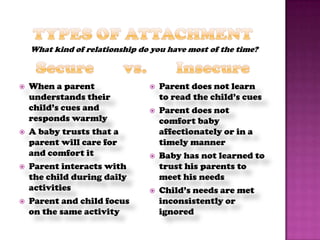
What kind of relationship do you have most of the time?


   When a parent                  Parent does not learn
    understands their               to read the child’s cues
    child’s cues and               Parent does not
    responds warmly                 comfort baby
   A baby trusts that a            affectionately or in a
    parent will care for            timely manner
    and comfort it                 Baby has not learned to
   Parent interacts with           trust his parents to
    the child during daily          meet his needs
    activities                     Child’s needs are met
   Parent and child focus          inconsistently or
    on the same activity            ignored
Use the reflection sheet provided for you to identify
behaviors you see as they interact. Also consider…

•   How they communicate with each other verbally?

•   What kind of body language and gestures do they
    make to each other?

•   What are each of them paying attention to?

•   Has been a time when you’ve felt or acted similarly?
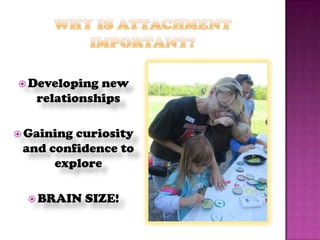
 Developing new
   relationships

 Gainingcuriosity
 and confidence to
      explore

   BRAIN   SIZE!
“New research by neuroscientists and child
   psychiatrists show that children whose
  mothers nurtured them early in life have
brains with a larger hippocampus. This is the
  first research of its kind to show the link
between a mother’s nurturing and changes in
    the hippocampus, which is a key brain
structure important to learning, memory and
               stress response.”
   Source: Jim Dryden, Washington University School of Medicine
Source: http://scitechdaily.com/mothers-nurturing-results-in-larger-
                     hippocampus-in-children/
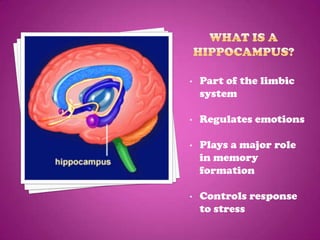
•   Part of the limbic
    system

•   Regulates emotions

•   Plays a major role
    in memory
    formation

•   Controls response
    to stress
Use the reflection sheet provided for you to identify
behaviors you see as they interact. Also consider…

•   How they communicate differently than the first
    pair we observed?

•   What kind of body language and gestures do they
    make to each other?

•   What are each of them paying attention to?

•   Has there been a time when you’ve felt like your
    relationship with you child was at its very best?
 Children who are nurtured in their
  early years have a brain that is
  physiologically different than children
  who are not nurtured (Luby, 2011)
 A larger hippocampus is linked to
    Improved memory
    Improved ability to cope with stress
    Improved overall school performance

  “This study validates something that seems to be intuitive, which is just how important
                nurturing parents are to creating adaptive human beings.”

                                   -Joan L. Luby, MD,
                  Professor of Child Psychiatry, Washington University
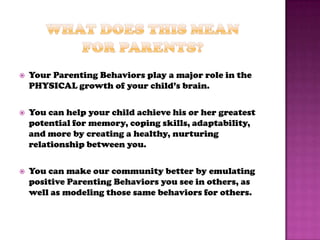
   Your Parenting Behaviors play a major role in the
    PHYSICAL growth of your child’s brain.

   You can help your child achieve his or her greatest
    potential for memory, coping skills, adaptability,
    and more by creating a healthy, nurturing
    relationship between you.

   You can make our community better by emulating
    positive Parenting Behaviors you see in others, as
    well as modeling those same behaviors for others.
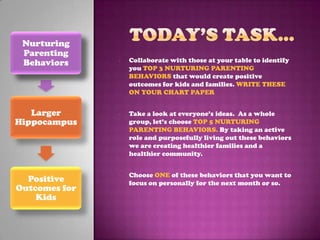
Nurturing
 Parenting
 Behaviors     •   Collaborate with those at your table to identify
                   you TOP 3 NURTURING PARENTING
                   BEHAVIORS that would create positive
                   outcomes for kids and families. WRITE THESE
                   ON YOUR CHART PAPER


   Larger      •   Take a look at everyone’s ideas. As a whole
Hippocampus        group, let’s choose TOP 5 NURTURING
                   PARENTING BEHAVIORS. By taking an active
                   role and purposefully living out these behaviors
                   we are creating healthier families and a
                   healthier community.


               •   Choose ONE of these behaviors that you want to
  Positive         focus on personally for the next month or so.
Outcomes for
    Kids
Thank you so much for coming to our first Parent Café and
 making it a success. Please turn your pink paper into the
           basket by the door as you are leaving.

           Hope you enjoyed our time together!

Attachment and brain_development

  • 1.
    Created with lotsof love by the Building stronger Brickies… One family at a time School City of Hobart Parents as Teachers
  • 2.
    So why didwe invite you here?  LEARN something new today  TALK things over with some old friends and some new ones  REFLECT on how new research fits into the way you parent your children  CREATE a tool for yourself and others to use based on your knowledge and experience Okay, and maybe a little bit to drink your coffee in peace!
  • 3.
    TEACH you something which I hope you will find valuable as a parent • LISTEN to your ideas and feedback • UNDERSTAND that we all have different backgrounds and experiences that form our beliefs and make us the way we are • VALUE what each of you has to contribute to our time together and to our And, yes, a small part of me wanted to show off my sweet community little guy, Andrew!
  • 4.
    What is What is NOT attachment? attachment?  The relationship that  The fact that your child develops between a child cries/falls-to-the floor/melts- and his or her main down/you-name-it when you caregivers leave  Window of opportunity is  The way your child talks from birth to age 2 to his or her pacifier/blanket/Elmo-doll/toy- dinosaur/whatever-it-is-at-your-  Affects social, emotional, house like a long lost friend and intellectual and can’t possibly live life development later in life without it
  • 5.
    What kind ofrelationship do you have most of the time?  When a parent  Parent does not learn understands their to read the child’s cues child’s cues and  Parent does not responds warmly comfort baby  A baby trusts that a affectionately or in a parent will care for timely manner and comfort it  Baby has not learned to  Parent interacts with trust his parents to the child during daily meet his needs activities  Child’s needs are met  Parent and child focus inconsistently or on the same activity ignored
  • 6.
    Use the reflectionsheet provided for you to identify behaviors you see as they interact. Also consider… • How they communicate with each other verbally? • What kind of body language and gestures do they make to each other? • What are each of them paying attention to? • Has been a time when you’ve felt or acted similarly?
  • 7.
     Developing new relationships  Gainingcuriosity and confidence to explore  BRAIN SIZE!
  • 8.
    “New research byneuroscientists and child psychiatrists show that children whose mothers nurtured them early in life have brains with a larger hippocampus. This is the first research of its kind to show the link between a mother’s nurturing and changes in the hippocampus, which is a key brain structure important to learning, memory and stress response.” Source: Jim Dryden, Washington University School of Medicine Source: http://scitechdaily.com/mothers-nurturing-results-in-larger- hippocampus-in-children/
  • 9.
    Part of the limbic system • Regulates emotions • Plays a major role in memory formation • Controls response to stress
  • 10.
    Use the reflectionsheet provided for you to identify behaviors you see as they interact. Also consider… • How they communicate differently than the first pair we observed? • What kind of body language and gestures do they make to each other? • What are each of them paying attention to? • Has there been a time when you’ve felt like your relationship with you child was at its very best?
  • 11.
     Children whoare nurtured in their early years have a brain that is physiologically different than children who are not nurtured (Luby, 2011)  A larger hippocampus is linked to  Improved memory  Improved ability to cope with stress  Improved overall school performance “This study validates something that seems to be intuitive, which is just how important nurturing parents are to creating adaptive human beings.” -Joan L. Luby, MD, Professor of Child Psychiatry, Washington University
  • 13.
    Your Parenting Behaviors play a major role in the PHYSICAL growth of your child’s brain.  You can help your child achieve his or her greatest potential for memory, coping skills, adaptability, and more by creating a healthy, nurturing relationship between you.  You can make our community better by emulating positive Parenting Behaviors you see in others, as well as modeling those same behaviors for others.
  • 14.
    Nurturing Parenting Behaviors • Collaborate with those at your table to identify you TOP 3 NURTURING PARENTING BEHAVIORS that would create positive outcomes for kids and families. WRITE THESE ON YOUR CHART PAPER Larger • Take a look at everyone’s ideas. As a whole Hippocampus group, let’s choose TOP 5 NURTURING PARENTING BEHAVIORS. By taking an active role and purposefully living out these behaviors we are creating healthier families and a healthier community. • Choose ONE of these behaviors that you want to Positive focus on personally for the next month or so. Outcomes for Kids
  • 15.
    Thank you somuch for coming to our first Parent Café and making it a success. Please turn your pink paper into the basket by the door as you are leaving. Hope you enjoyed our time together!