The Spiritual Science
  of Everyday Life

                 www.spiritualscience.co.uk
To „become‟ through
                                  experience someone
 Our inspirational body –
                                  beyond the person we were
 brings awareness of what we
                                  and to intuitively recall
 sense as „happening‟ and a
                                  those experiences –
 stream of desires that inspire
 human feelings. It radiates as
 soul.
                                               our own
                                               enduring “I”


                          Our formative body –
                          moulds and permeates
                          our physical body.
The physical body –
incapable of keeping
itself intact.
                          The Four-Fold Human Being
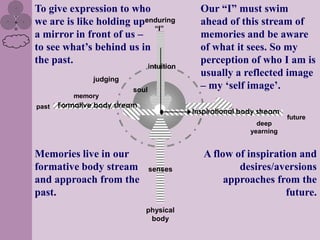
To give expression to who                      Our “I” must swim
we are is like holding upenduring              ahead of this stream of
                           “I”
a mirror in front of us –                      memories and be aware
to see what‟s behind us in                     of what it sees. So my
the past.                                      perception of who I am is
                                 intuition
                                               usually a reflected image
                judging
                          soul
                                  soul         – my „self image‟.
           memory
past   Formative body stream
                                             Inspirational body stream
                                                                         future
                                                               deep
                                                             yearning


Memories live in our                            A flow of inspiration and
formative body stream            senses                 desires/aversions
and approach from the                                approaches from the
past.                                                              future.
                               physical
                                body
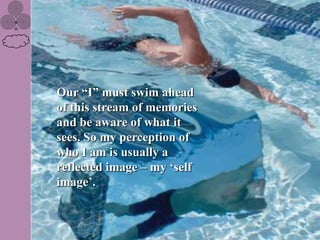
Our “I” must swim ahead
of this stream of memories
and be aware of what it
sees. So my perception of
who I am is usually a
reflected image – my „self
image‟.
Our “I” must swim ahead
of this stream of memories
and be aware of what it
sees. So my perception of
who I am is usually a
reflected image – my „self
image‟.
s oul
s oul
s oul
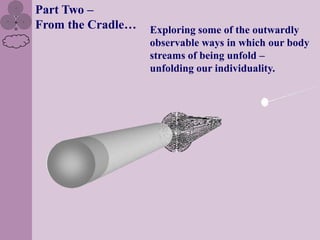
Part Two –
From the Cradle…   Exploring some of the outwardly
                   observable ways in which our body
                   streams of being unfold –
                   unfolding our individuality.
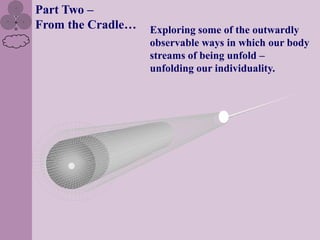
Part Two –
From the Cradle…   Exploring some of the outwardly
                   observable ways in which our body
                   streams of being unfold –
                   unfolding our individuality.
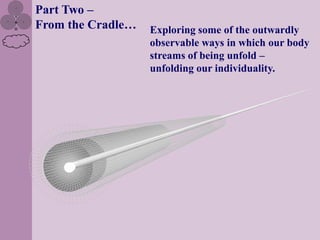
Part Two –
From the Cradle…   Exploring some of the outwardly
                   observable ways in which our body
                   streams of being unfold –
                   unfolding our individuality.
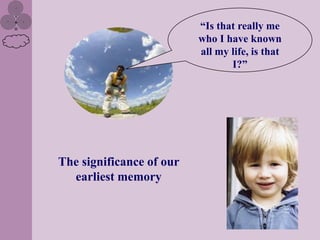
“Is that really me
                          who I have known
                          all my life, is that
                                 I?”


The significance of our
  earliest memory
The You are I Game
  Object: To find your earliest memory
                       Relax – calm and awake
   Probably somewhere between ages 2 & 4 (or earlier/later)
       If you‟re already familiar with this memory, let it
       rest and orientate yourself
    Some triggers….                An accident or illness?
 Being in bed, a blanket, pyjamas? An item of clothing? A food or cup, plate?
    The bathroom or other room, furniture, a view from a window/doorway?
   Parents, siblings?      A visiting relative/family friend or their house/garden?
A celebration or festive occasion?      A journey, a vehicle?          A Game, a toy?
                  Play group, nursery, infant school room/play area, playmate?

     Does a particular sense trigger the memory?
 Is the memory confused with a photograph/family story?
  Having difficulty? Pause „somewhere near’ the memory.
        What most „stands out‟ in the memory?
HAPPY BIRTHDAY!!!
                   YOU ARE I

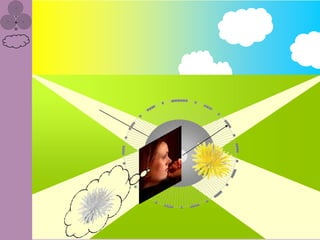
    When your enduring “I” was first able to “hold up a
    mirror”, look back into the past and recognise itself
     “in reflection” as our self image or everyday ego.

Leading up to this
point we begin to feel
some awareness of this.
It remains for a while
as a feeling – a child‟s
feeling, but the
behavioural effects of
which can be observed
by parents/carers.
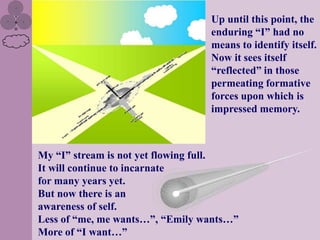
Up until this point, the
                                 enduring “I” had no
                                 means to identify itself.
                                 Now it sees itself
                                 “reflected” in those
                                 permeating formative
                                 forces upon which is
                                 impressed memory.


My “I” stream is not yet flowing full.
It will continue to incarnate
for many years yet.
But now there is an
awareness of self.
Less of “me, me wants…”, “Emily wants…”
More of “I want…”
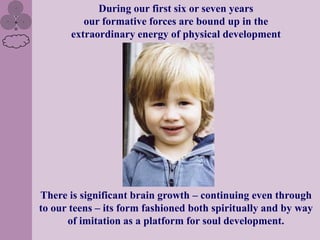
During our first six or seven years
          our formative forces are bound up in the
       extraordinary energy of physical development


There is significant brain growth – continuing even through
to our teens – its form fashioned both spiritually and by way
      of imitation as a platform for soul development.
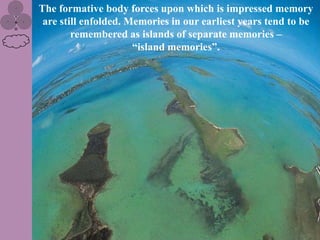
The formative body forces upon which is impressed memory
 are still enfolded. Memories in our earliest years tend to be
        remembered as islands of separate memories –
                      “island memories”.
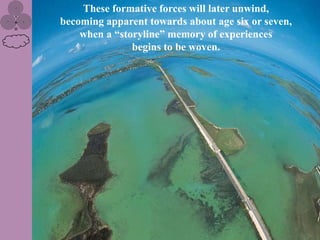
These formative forces will later unwind,
becoming apparent towards about age six or seven,
    when a “storyline” memory of experiences
               begins to be woven.
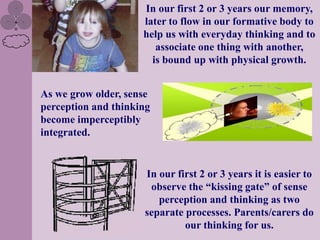
In our first 2 or 3 years our memory,
                     later to flow in our formative body to
                     help us with everyday thinking and to
                        associate one thing with another,
                       is bound up with physical growth.


As we grow older, sense
perception and thinking
become imperceptibly
integrated.


                     In our first 2 or 3 years it is easier to
                      observe the “kissing gate” of sense
                        perception and thinking as two
                     separate processes. Parents/carers do
                              our thinking for us.
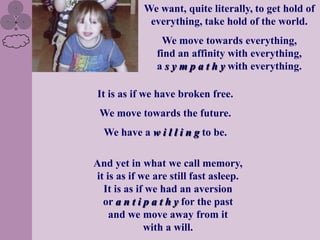
We want, quite literally, to get hold of
             everything, take hold of the world.
                We move towards everything,
               find an affinity with everything,
               a s y m p a t h y with everything.
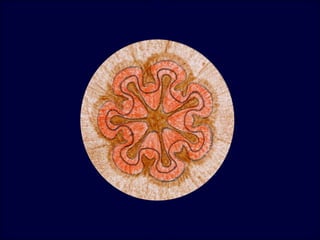
It is as if we have broken free.
 We move towards the future.
  We have a w i l l i n g to be.

And yet in what we call memory,
it is as if we are still fast asleep.
  It is as if we had an aversion
  or a n t i p a t h y for the past
    and we move away from it
             with a will.
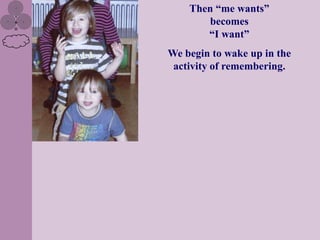
Then “me wants”
       becomes
       “I want”
We begin to wake up in the
 activity of remembering.
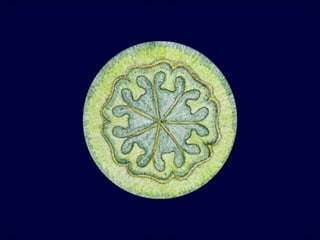
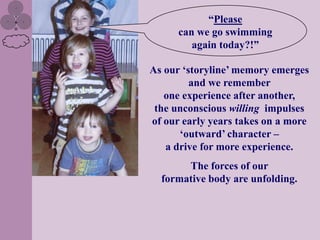
“Please
      can we go swimming
         again today?!”

As our „storyline‟ memory emerges
         and we remember
   one experience after another,
 the unconscious willing impulses
of our early years takes on a more
      „outward‟ character –
   a drive for more experience.
       The forces of our
  formative body are unfolding.
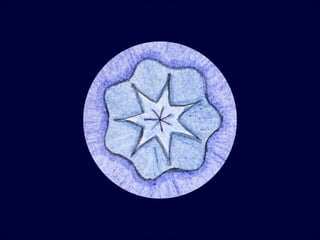
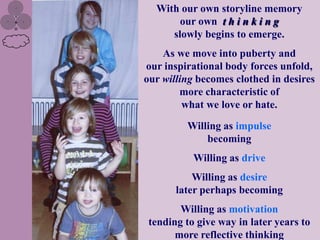
With our own storyline memory
       our own t h i n k i n g
     slowly begins to emerge.
    As we move into puberty and
our inspirational body forces unfold,
our willing becomes clothed in desires
        more characteristic of
         what we love or hate.

         Willing as impulse
             becoming
           Willing as drive
           Willing as desire
       later perhaps becoming
        Willing as motivation
 tending to give way in later years to
       more reflective thinking
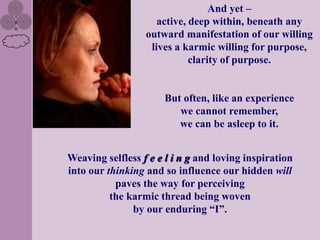
And yet –
                     active, deep within, beneath any
                  outward manifestation of our willing
                   lives a karmic willing for purpose,
                             clarity of purpose.


                      But often, like an experience
                         we cannot remember,
                         we can be asleep to it.


Weaving selfless f e e l i n g and loving inspiration
into our thinking and so influence our hidden will
           paves the way for perceiving
          the karmic thread being woven
               by our enduring “I”.
Unit4
Unit4
Unit4
Unit4
Unit4
Unit4
Unit4

Unit4

  • 8.
    The Spiritual Science of Everyday Life www.spiritualscience.co.uk
  • 9.
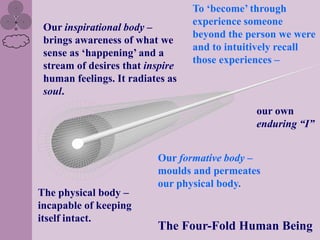
    To „become‟ through experience someone Our inspirational body – beyond the person we were brings awareness of what we and to intuitively recall sense as „happening‟ and a those experiences – stream of desires that inspire human feelings. It radiates as soul. our own enduring “I” Our formative body – moulds and permeates our physical body. The physical body – incapable of keeping itself intact. The Four-Fold Human Being
  • 10.
    To give expressionto who Our “I” must swim we are is like holding upenduring ahead of this stream of “I” a mirror in front of us – memories and be aware to see what‟s behind us in of what it sees. So my the past. perception of who I am is intuition usually a reflected image judging soul soul – my „self image‟. memory past Formative body stream Inspirational body stream future deep yearning Memories live in our A flow of inspiration and formative body stream senses desires/aversions and approach from the approaches from the past. future. physical body
  • 11.
    Our “I” mustswim ahead of this stream of memories and be aware of what it sees. So my perception of who I am is usually a reflected image – my „self image‟.
  • 12.
    Our “I” mustswim ahead of this stream of memories and be aware of what it sees. So my perception of who I am is usually a reflected image – my „self image‟.
  • 13.
  • 14.
  • 15.
  • 16.
    Part Two – Fromthe Cradle… Exploring some of the outwardly observable ways in which our body streams of being unfold – unfolding our individuality.
  • 17.
    Part Two – Fromthe Cradle… Exploring some of the outwardly observable ways in which our body streams of being unfold – unfolding our individuality.
  • 18.
    Part Two – Fromthe Cradle… Exploring some of the outwardly observable ways in which our body streams of being unfold – unfolding our individuality.
  • 19.
    “Is that reallyme who I have known all my life, is that I?” The significance of our earliest memory
  • 20.
    The You areI Game Object: To find your earliest memory Relax – calm and awake Probably somewhere between ages 2 & 4 (or earlier/later) If you‟re already familiar with this memory, let it rest and orientate yourself Some triggers…. An accident or illness? Being in bed, a blanket, pyjamas? An item of clothing? A food or cup, plate? The bathroom or other room, furniture, a view from a window/doorway? Parents, siblings? A visiting relative/family friend or their house/garden? A celebration or festive occasion? A journey, a vehicle? A Game, a toy? Play group, nursery, infant school room/play area, playmate? Does a particular sense trigger the memory? Is the memory confused with a photograph/family story? Having difficulty? Pause „somewhere near’ the memory. What most „stands out‟ in the memory?
  • 21.
    HAPPY BIRTHDAY!!! YOU ARE I When your enduring “I” was first able to “hold up a mirror”, look back into the past and recognise itself “in reflection” as our self image or everyday ego. Leading up to this point we begin to feel some awareness of this. It remains for a while as a feeling – a child‟s feeling, but the behavioural effects of which can be observed by parents/carers.
  • 22.
    Up until thispoint, the enduring “I” had no means to identify itself. Now it sees itself “reflected” in those permeating formative forces upon which is impressed memory. My “I” stream is not yet flowing full. It will continue to incarnate for many years yet. But now there is an awareness of self. Less of “me, me wants…”, “Emily wants…” More of “I want…”
  • 23.
    During our firstsix or seven years our formative forces are bound up in the extraordinary energy of physical development There is significant brain growth – continuing even through to our teens – its form fashioned both spiritually and by way of imitation as a platform for soul development.
  • 24.
    The formative bodyforces upon which is impressed memory are still enfolded. Memories in our earliest years tend to be remembered as islands of separate memories – “island memories”.
  • 25.
    These formative forceswill later unwind, becoming apparent towards about age six or seven, when a “storyline” memory of experiences begins to be woven.
  • 26.
    In our first2 or 3 years our memory, later to flow in our formative body to help us with everyday thinking and to associate one thing with another, is bound up with physical growth. As we grow older, sense perception and thinking become imperceptibly integrated. In our first 2 or 3 years it is easier to observe the “kissing gate” of sense perception and thinking as two separate processes. Parents/carers do our thinking for us.
  • 27.
    We want, quiteliterally, to get hold of everything, take hold of the world. We move towards everything, find an affinity with everything, a s y m p a t h y with everything. It is as if we have broken free. We move towards the future. We have a w i l l i n g to be. And yet in what we call memory, it is as if we are still fast asleep. It is as if we had an aversion or a n t i p a t h y for the past and we move away from it with a will.
  • 28.
    Then “me wants” becomes “I want” We begin to wake up in the activity of remembering.
  • 29.
    “Please can we go swimming again today?!” As our „storyline‟ memory emerges and we remember one experience after another, the unconscious willing impulses of our early years takes on a more „outward‟ character – a drive for more experience. The forces of our formative body are unfolding.
  • 30.
    With our ownstoryline memory our own t h i n k i n g slowly begins to emerge. As we move into puberty and our inspirational body forces unfold, our willing becomes clothed in desires more characteristic of what we love or hate. Willing as impulse becoming Willing as drive Willing as desire later perhaps becoming Willing as motivation tending to give way in later years to more reflective thinking
  • 31.
    And yet – active, deep within, beneath any outward manifestation of our willing lives a karmic willing for purpose, clarity of purpose. But often, like an experience we cannot remember, we can be asleep to it. Weaving selfless f e e l i n g and loving inspiration into our thinking and so influence our hidden will paves the way for perceiving the karmic thread being woven by our enduring “I”.