Social Emotional Development in the
Early Years: Promoting Positive
Relationships
https://learn.extension.org/events/2097
1	
  
Sign up for webinar email notifications
www.extension.org/62831
Provide feedback and earn CE credit with one link:
We will provide this link at the end of the webinar
2	
  
Research and evidenced-based
professional development
through engaged online communities.
www.extension.org/militaryfamilies
3	
  
https://www.facebook.com/MFLNfamilydevelopment
https://twitter.com/MFLNFD
Talk About It Tuesday: #MFLNchat
https://www.youtube.com/user/MILFamLN
https://www.linkedin.com/groups/Military-Families-Learning-Network-6617392
To subscribe to our MFLN Family Development newsletter send an email to
MFLNfamilydevelopment@gmail.com
Subject: Subscribe
4	
  
Available resources
https://learn.extension.org/events/2097
Find slides and additional resources under ‘event materials’
5	
  
•  Through the Early Intervention Training Program at the University of Illinois,
providers in Illinois can receive 1.5 hours of Early Intervention credit.
•  Several states other than Illinois have already agreed to recognize CE units from
this webinar. They are: Kansas, Kentucky, Ohio, North Carolina, Tennessee,
and Virginia.
•  A certificate of completion is available from this webinar after completing an
evaluation and post-test for all participants. This certificate can sometimes be
used to apply for CE credits with your credentialing body if you are not an Illinois
provider.
•  Links and further information will be available at the end of today’s presentation
	
  
6	
  
Evaluation and CE Credit	
  
Today’s Presenters:
7	
  
Rosa Milagros Santos, PhD
•  Research focus: young children with disabilities and their families within the context of
early intervention and early childhood special education services
•  Collaborated to create numerous professional development tools and materials that are
widely disseminated and used nationwide
•  Designed and conducted over 200 workshops and trainings for a variety of early
childhood providers and family members
•  Editor of the Young Exceptional Children Journal
Kimberly Hile, EdM
•  Currently completing her doctoral degree in early childhood special education at
University of Illinois as a Project Blend Trainee.
•  Research interests: exploring how early intervention service providers are
trained to support families of infants and toddlers with special needs.
•  Active participant with the Early Intervention Training Program at the University
of Illinois and member of the Division of Early Childhood of the Council for
Exceptional Children
PROMOTING POSITIVE
RELATIONSHIPS TO ENHANCE
SOCIAL EMOTIONAL DEVELOPMENT
Kimberly Hile, Ed.M.
Rosa Milagros Santos, PhD
8	
  
The following presentation is not endorsed by the Department of Defense and the information, as well as, any opinions or views, contained
herein are solely that of the presenter.
TODAY’S OBJECTIVES
¢  Highlight research on the importance of healthy and
positive relationships between children and their
caregivers.
¢  Describe factors that impact parent/child relationships
¢  Discuss relationship-based practices
¢  Describe parent coaching strategies
9	
  
IMPORTANCE OF RELATIONSHIPS
“All children grow and thrive in the context of close
and dependable relationships that provide love and
nurturance, security, and responsive interactions.”
(Center on the Social and Emotional Foundations for Early Learning, 2010).
10	
  
MYTHS
11	
  
“Young children can benefit
significantly from secure relationships
with multiple caregivers (within or
outside the family), while their
attachments to their parents remain
primary and central.”
12	
  
“The influence of relationships on
development lasts for the first five
years of a child’s life.”
13	
  
“Although young children certainly can
establish healthy relationships with
more than one or two adults, prolonged
separations from familiar caregivers and
repeated “detaching” and “re-attaching”
to people who matter are emotionally
distressing and can lead to enduring
problems.”
14	
  
GOODNESS OF FIT THEORY
(THOMAS & CHESS, 1977)
15	
  
16	
  
ANY
QUESTIONS?
FACTORS IMPACTING PARENT/CHILD
RELATIONSHIPS
17	
  
CULTURAL AND LINGUISTIC INFLUENCES ON
PARENT-CHILD RELATIONSHIPS
18	
  
We carry in our
journey, experiences
and beliefs developed
and shaped by
“messages” and
“recordings” from and
of our families,
friends, and
communities.
How we view the
world – how we
behave, react,
interact, etc. are
greatly influenced by
our culture and
language.
Culture and language are inseparable components of any
individual and therefore must be taken into consideration
simultaneously beginning when the child joins the human
community.
Cultural and Linguistic Influences on
Parent-Child Relationships
19	
  
HOW DOES CULTURE AND LANGUAGE MANIFEST
IN OUR WORK WITH CHILDREN AND FAMILIES?
20	
  
•  Time
•  Space
•  Interaction Style
•  Childrearing Practices: feeding, play, toileting, sleeping,
independence, etc.
Thorp (2010)
MEAN AGE EXPECTATION IN MONTHS FOR
MILESTONE ATTAINMENT
21
Caucasian Puerto Rican Filipino
Eat Solid Food 8.2 10.1 6.7*
Training Cup 12.0 17.1 21.9*
Utensils 17.7 26.5 32.4*
Finger Food 8.9 9.4 9.5
Wean 16.8 18.2 36.2*
Sleep by Self 13.8 14.6 38.8*
Sleep all Night 11.4 14.5 32.4*
Choose Clothes 31.1 44.2 33.1*
Dress Self 38.2 44.2 39.2
Play Alone 25.0 24.8 12.3*
Toilet Trained-Day 31.6 29.0 20.4*
Toilet Trained-Night 33.2 31.8 34.2
Carlson&Harwood(2000)
21	
  
Korean-American
Mothers
European-
American Mothers
Believe parents and
children should play
together
54% 96%
Prefer children play with
sex-typed toys (e.g., boys
play with trucks)
71% 43%
Provide children with many
chances to decide (e.g., give
child choices)
11% 66%
22	
  
Expectations of Two Groups
(Farver and Lee-Shin, 2000)
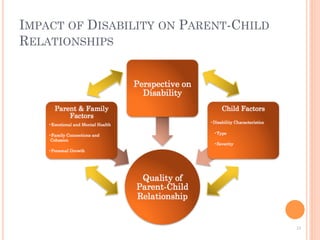
IMPACT OF DISABILITY ON PARENT-CHILD
RELATIONSHIPS
23	
  
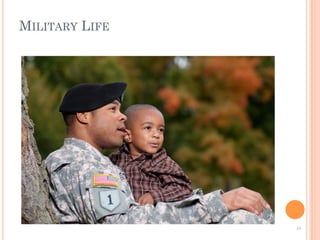
MILITARY LIFE
24	
  
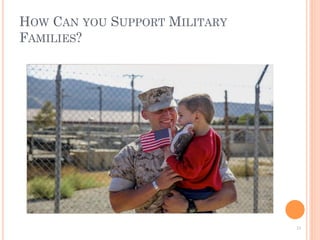
HOW CAN YOU SUPPORT MILITARY
FAMILIES?
25	
  
26	
  
ANY
QUESTIONS?
“It is not what the service provider
does during the home visit that will
make the difference in the child’s
development; it is what the family
learns during the visits and uses
during their activities and routines
throughout the week that facilitates
the child’s learning and development.”
(McWilliam, 2000)
27	
  
RELATIONSHIP-BASED PRACTICES
¢  Respect for the person
¢  Sensitivity to context
¢  Commitment to evolving growth & change
28	
  
RELATIONSHIP-BASED PRACTICES
¢  Mutuality of shared goals
¢  Open communication
¢  Commitment to reflecting on the work
¢  Setting standards for staff
29	
  
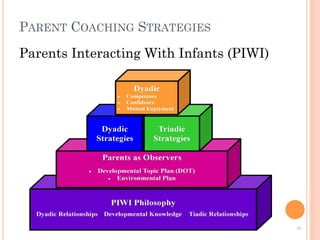
PARENT COACHING STRATEGIES
Parents Interacting With Infants (PIWI)
30	
  
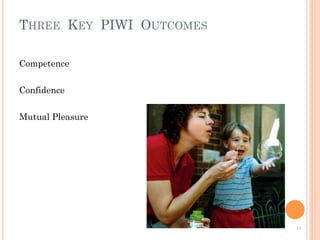
THREE KEY PIWI OUTCOMES
Competence
Confidence
Mutual Pleasure
31	
  
PARENT-CHILD INTERACTION:
DYADIC STRATEGIES
“Any alterations or additions that the adult
consciously uses during adult-child
interactions to facilitate a better match
with the baby and to foster his/her
development.”
[PIWI Projects, Children’s Research Center, University of Illinois at Urbana-Champaign]
32	
  
PARENT-CHILD INTERACTION:
TRIADIC STRATEGIES
“…used by the interventionist
during the course of parent-child interaction
to expand & build interactions that are
pleasurable for both partners and
supportive of children’s development,
while also recognizing and strengthening
the natural competence of parents
as they interact with their children.”
[PIWI Projects, Children’s Research Center, University of Illinois at Urbana-Champaign]33	
  
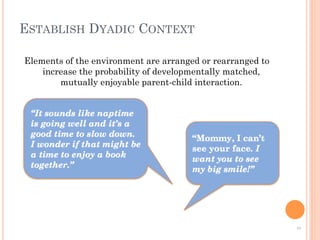
ESTABLISH DYADIC CONTEXT
Elements of the environment are arranged or rearranged to
increase the probability of developmentally matched,
mutually enjoyable parent-child interaction.
34	
  
35	
  
36	
  
AFFIRM PARENT COMPETENCE
Developmentally supportive interactions are warmly recognized and
expanded upon as are characteristics of child competence.
37	
  
38	
  
39	
  
FOCUS ATTENTION
Aspects of the interaction are commented upon, expanded, or
questioned in order to draw the parent’s attention to
particular competencies or actions in self or child.
40	
  
41	
  
42	
  
43	
  
ANY
QUESTIONS?
PROVIDE DEVELOPMENTAL INFORMATION
Information about the child’s developmental agenda is given by
verbally labeling or interpreting the child’s social-emotional,
cognitive, language, and motor abilities within the context of play
and interaction.
44	
  
45	
  
46	
  
MODEL
Dyadic interaction roles are momentarily taken on by the
interventionist.
47	
  
48	
  
49	
  
50	
  
SUGGEST
Interventionist provides parent with a specific suggestion for
something to try with the child.
51	
  
52	
  
USING TRIADIC STRATEGIES:
MOST TO LEAST FREQUENT
53	
  
Establish Dyadic Context
Affirm Competence
Focus Attention
Provide Information
Model
Suggest
54	
  
DECIDING ON A STRATEGY
¢  Provide supportive environment
¢  Wait & observe
¢  Choose strategy (“balanced support”):
—  Most to least frequency
55	
  
DECIDING ON A STRATEGY
¢  Choose strategy (“balanced support”):
—  Direct or Indirect
¢  Wait & observe
¢  Re-adjust
OUR INFLUENCE AS PROVIDERS
ON FAMILIES
56	
  
57	
  
GUIDELINES
ü  Put yourself in the parent’s shoes
ü  Think about the dyad’s strengths
58	
  
GUIDELINES
ü  Think about the key outcomes:
—  competence
—  confidence
—  mutual enjoyment
ü  Be wary of over-using “model” and “suggest”
—  most directive strategies
—  can have some negative consequences.
59	
  
ANY
QUESTIONS?
ANY QUESTIONS?
FEEL FREE TO CONTACT US!
¢  Kimberly Hile EdM
—  khile@illinois.edu
¢  Rosa Milagros Santos PhD
—  rsantos@illinois.edu
60	
  
Key Take-Away Points
61	
  
The influence of positive relationships on
development lasts a lifetime.
Factors such as culture, presence of a
disability, and military life can impact
parent-child relationships.
A key premise of relationship-based
practices is the focus on the partnership
between parents and providers.
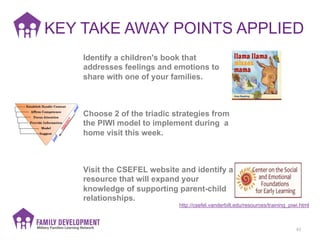
KEY TAKE AWAY POINTS APPLIED	
  
62	
  
http://csefel.vanderbilt.edu/resources/training_piwi.html
Visit the CSEFEL website and identify a
resource that will expand your
knowledge of supporting parent-child
relationships.
Choose 2 of the triadic strategies from
the PIWI model to implement during a
home visit this week.
Identify a children's book that
addresses feelings and emotions to
share with one of your families.
• Webinar participants who want to receive a certificate of continuing
education (or just want proof of participation in the training) need to take this
post-test AND evaluation:
https://vte.co1.qualtrics.com/jfe/form/SV_bk1PpLx6iS0K8wB
• CE certificates of completion will be automatically emailed to participants
upon completion of the post-test & evaluation.
§ Questions/concerns surrounding CE credit certificates can be emailed
to this address: MFLNFDEarlyIntervention@gmail.com
§ Sometimes state/professional licensure boards recognize CE credits
from other states. However, it is necessary to check with your state
and/or professional boards if you need CE credits for your field.
63	
  
CE Credit Information
Upcoming Events:	


64	
  
This material is based upon work supported by the National Institute of Food and Agriculture, U.S. Department of Agriculture, and the Office of Family
Readiness Policy, Children and Youth, U.S. Department of Defense under Award Numbers 2010-48869-20685, 2012-48755-20306, and
2014-48770-22587.
Personal Finance
Military Caregiving
Family Development
Family Transitions
Network Literacy
Nutrition & Wellness
Community Capacity Building
Find all upcoming and recorded webinars
covering:
www.extension.org/62581

FDEI Promoting Postive Relationships

  • 1.
    Social Emotional Developmentin the Early Years: Promoting Positive Relationships https://learn.extension.org/events/2097 1  
  • 2.
    Sign up forwebinar email notifications www.extension.org/62831 Provide feedback and earn CE credit with one link: We will provide this link at the end of the webinar 2  
  • 3.
    Research and evidenced-based professionaldevelopment through engaged online communities. www.extension.org/militaryfamilies 3  
  • 4.
    https://www.facebook.com/MFLNfamilydevelopment https://twitter.com/MFLNFD Talk About ItTuesday: #MFLNchat https://www.youtube.com/user/MILFamLN https://www.linkedin.com/groups/Military-Families-Learning-Network-6617392 To subscribe to our MFLN Family Development newsletter send an email to MFLNfamilydevelopment@gmail.com Subject: Subscribe 4  
  • 5.
    Available resources https://learn.extension.org/events/2097 Find slidesand additional resources under ‘event materials’ 5  
  • 6.
    •  Through theEarly Intervention Training Program at the University of Illinois, providers in Illinois can receive 1.5 hours of Early Intervention credit. •  Several states other than Illinois have already agreed to recognize CE units from this webinar. They are: Kansas, Kentucky, Ohio, North Carolina, Tennessee, and Virginia. •  A certificate of completion is available from this webinar after completing an evaluation and post-test for all participants. This certificate can sometimes be used to apply for CE credits with your credentialing body if you are not an Illinois provider. •  Links and further information will be available at the end of today’s presentation   6   Evaluation and CE Credit  
  • 7.
    Today’s Presenters: 7   RosaMilagros Santos, PhD •  Research focus: young children with disabilities and their families within the context of early intervention and early childhood special education services •  Collaborated to create numerous professional development tools and materials that are widely disseminated and used nationwide •  Designed and conducted over 200 workshops and trainings for a variety of early childhood providers and family members •  Editor of the Young Exceptional Children Journal Kimberly Hile, EdM •  Currently completing her doctoral degree in early childhood special education at University of Illinois as a Project Blend Trainee. •  Research interests: exploring how early intervention service providers are trained to support families of infants and toddlers with special needs. •  Active participant with the Early Intervention Training Program at the University of Illinois and member of the Division of Early Childhood of the Council for Exceptional Children
  • 8.
    PROMOTING POSITIVE RELATIONSHIPS TOENHANCE SOCIAL EMOTIONAL DEVELOPMENT Kimberly Hile, Ed.M. Rosa Milagros Santos, PhD 8   The following presentation is not endorsed by the Department of Defense and the information, as well as, any opinions or views, contained herein are solely that of the presenter.
  • 9.
    TODAY’S OBJECTIVES ¢  Highlightresearch on the importance of healthy and positive relationships between children and their caregivers. ¢  Describe factors that impact parent/child relationships ¢  Discuss relationship-based practices ¢  Describe parent coaching strategies 9  
  • 10.
    IMPORTANCE OF RELATIONSHIPS “Allchildren grow and thrive in the context of close and dependable relationships that provide love and nurturance, security, and responsive interactions.” (Center on the Social and Emotional Foundations for Early Learning, 2010). 10  
  • 11.
  • 12.
    “Young children canbenefit significantly from secure relationships with multiple caregivers (within or outside the family), while their attachments to their parents remain primary and central.” 12  
  • 13.
    “The influence ofrelationships on development lasts for the first five years of a child’s life.” 13  
  • 14.
    “Although young childrencertainly can establish healthy relationships with more than one or two adults, prolonged separations from familiar caregivers and repeated “detaching” and “re-attaching” to people who matter are emotionally distressing and can lead to enduring problems.” 14  
  • 15.
    GOODNESS OF FITTHEORY (THOMAS & CHESS, 1977) 15  
  • 16.
  • 17.
  • 18.
    CULTURAL AND LINGUISTICINFLUENCES ON PARENT-CHILD RELATIONSHIPS 18   We carry in our journey, experiences and beliefs developed and shaped by “messages” and “recordings” from and of our families, friends, and communities. How we view the world – how we behave, react, interact, etc. are greatly influenced by our culture and language.
  • 19.
    Culture and languageare inseparable components of any individual and therefore must be taken into consideration simultaneously beginning when the child joins the human community. Cultural and Linguistic Influences on Parent-Child Relationships 19  
  • 20.
    HOW DOES CULTUREAND LANGUAGE MANIFEST IN OUR WORK WITH CHILDREN AND FAMILIES? 20   •  Time •  Space •  Interaction Style •  Childrearing Practices: feeding, play, toileting, sleeping, independence, etc. Thorp (2010)
  • 21.
    MEAN AGE EXPECTATIONIN MONTHS FOR MILESTONE ATTAINMENT 21 Caucasian Puerto Rican Filipino Eat Solid Food 8.2 10.1 6.7* Training Cup 12.0 17.1 21.9* Utensils 17.7 26.5 32.4* Finger Food 8.9 9.4 9.5 Wean 16.8 18.2 36.2* Sleep by Self 13.8 14.6 38.8* Sleep all Night 11.4 14.5 32.4* Choose Clothes 31.1 44.2 33.1* Dress Self 38.2 44.2 39.2 Play Alone 25.0 24.8 12.3* Toilet Trained-Day 31.6 29.0 20.4* Toilet Trained-Night 33.2 31.8 34.2 Carlson&Harwood(2000) 21  
  • 22.
    Korean-American Mothers European- American Mothers Believe parentsand children should play together 54% 96% Prefer children play with sex-typed toys (e.g., boys play with trucks) 71% 43% Provide children with many chances to decide (e.g., give child choices) 11% 66% 22   Expectations of Two Groups (Farver and Lee-Shin, 2000)
  • 23.
    IMPACT OF DISABILITYON PARENT-CHILD RELATIONSHIPS 23  
  • 24.
  • 25.
    HOW CAN YOUSUPPORT MILITARY FAMILIES? 25  
  • 26.
  • 27.
    “It is notwhat the service provider does during the home visit that will make the difference in the child’s development; it is what the family learns during the visits and uses during their activities and routines throughout the week that facilitates the child’s learning and development.” (McWilliam, 2000) 27  
  • 28.
    RELATIONSHIP-BASED PRACTICES ¢  Respectfor the person ¢  Sensitivity to context ¢  Commitment to evolving growth & change 28  
  • 29.
    RELATIONSHIP-BASED PRACTICES ¢  Mutualityof shared goals ¢  Open communication ¢  Commitment to reflecting on the work ¢  Setting standards for staff 29  
  • 30.
    PARENT COACHING STRATEGIES ParentsInteracting With Infants (PIWI) 30  
  • 31.
    THREE KEY PIWIOUTCOMES Competence Confidence Mutual Pleasure 31  
  • 32.
    PARENT-CHILD INTERACTION: DYADIC STRATEGIES “Anyalterations or additions that the adult consciously uses during adult-child interactions to facilitate a better match with the baby and to foster his/her development.” [PIWI Projects, Children’s Research Center, University of Illinois at Urbana-Champaign] 32  
  • 33.
    PARENT-CHILD INTERACTION: TRIADIC STRATEGIES “…usedby the interventionist during the course of parent-child interaction to expand & build interactions that are pleasurable for both partners and supportive of children’s development, while also recognizing and strengthening the natural competence of parents as they interact with their children.” [PIWI Projects, Children’s Research Center, University of Illinois at Urbana-Champaign]33  
  • 34.
    ESTABLISH DYADIC CONTEXT Elementsof the environment are arranged or rearranged to increase the probability of developmentally matched, mutually enjoyable parent-child interaction. 34  
  • 35.
  • 36.
  • 37.
    AFFIRM PARENT COMPETENCE Developmentallysupportive interactions are warmly recognized and expanded upon as are characteristics of child competence. 37  
  • 38.
  • 39.
  • 40.
    FOCUS ATTENTION Aspects ofthe interaction are commented upon, expanded, or questioned in order to draw the parent’s attention to particular competencies or actions in self or child. 40  
  • 41.
  • 42.
  • 43.
  • 44.
    PROVIDE DEVELOPMENTAL INFORMATION Informationabout the child’s developmental agenda is given by verbally labeling or interpreting the child’s social-emotional, cognitive, language, and motor abilities within the context of play and interaction. 44  
  • 45.
  • 46.
  • 47.
    MODEL Dyadic interaction rolesare momentarily taken on by the interventionist. 47  
  • 48.
  • 49.
  • 50.
    50   SUGGEST Interventionist providesparent with a specific suggestion for something to try with the child.
  • 51.
  • 52.
  • 53.
    USING TRIADIC STRATEGIES: MOSTTO LEAST FREQUENT 53   Establish Dyadic Context Affirm Competence Focus Attention Provide Information Model Suggest
  • 54.
    54   DECIDING ONA STRATEGY ¢  Provide supportive environment ¢  Wait & observe ¢  Choose strategy (“balanced support”): —  Most to least frequency
  • 55.
    55   DECIDING ONA STRATEGY ¢  Choose strategy (“balanced support”): —  Direct or Indirect ¢  Wait & observe ¢  Re-adjust
  • 56.
    OUR INFLUENCE ASPROVIDERS ON FAMILIES 56  
  • 57.
    57   GUIDELINES ü  Putyourself in the parent’s shoes ü  Think about the dyad’s strengths
  • 58.
    58   GUIDELINES ü  Thinkabout the key outcomes: —  competence —  confidence —  mutual enjoyment ü  Be wary of over-using “model” and “suggest” —  most directive strategies —  can have some negative consequences.
  • 59.
  • 60.
    ANY QUESTIONS? FEEL FREETO CONTACT US! ¢  Kimberly Hile EdM —  khile@illinois.edu ¢  Rosa Milagros Santos PhD —  rsantos@illinois.edu 60  
  • 61.
    Key Take-Away Points 61   The influence of positive relationships on development lasts a lifetime. Factors such as culture, presence of a disability, and military life can impact parent-child relationships. A key premise of relationship-based practices is the focus on the partnership between parents and providers.
  • 62.
    KEY TAKE AWAYPOINTS APPLIED   62   http://csefel.vanderbilt.edu/resources/training_piwi.html Visit the CSEFEL website and identify a resource that will expand your knowledge of supporting parent-child relationships. Choose 2 of the triadic strategies from the PIWI model to implement during a home visit this week. Identify a children's book that addresses feelings and emotions to share with one of your families.
  • 63.
    • Webinar participants whowant to receive a certificate of continuing education (or just want proof of participation in the training) need to take this post-test AND evaluation: https://vte.co1.qualtrics.com/jfe/form/SV_bk1PpLx6iS0K8wB • CE certificates of completion will be automatically emailed to participants upon completion of the post-test & evaluation. § Questions/concerns surrounding CE credit certificates can be emailed to this address: MFLNFDEarlyIntervention@gmail.com § Sometimes state/professional licensure boards recognize CE credits from other states. However, it is necessary to check with your state and/or professional boards if you need CE credits for your field. 63   CE Credit Information
  • 64.
  • 65.
    This material isbased upon work supported by the National Institute of Food and Agriculture, U.S. Department of Agriculture, and the Office of Family Readiness Policy, Children and Youth, U.S. Department of Defense under Award Numbers 2010-48869-20685, 2012-48755-20306, and 2014-48770-22587. Personal Finance Military Caregiving Family Development Family Transitions Network Literacy Nutrition & Wellness Community Capacity Building Find all upcoming and recorded webinars covering: www.extension.org/62581