The Spiritual Science
  of Everyday Life

                 www.spiritualscience.co.uk
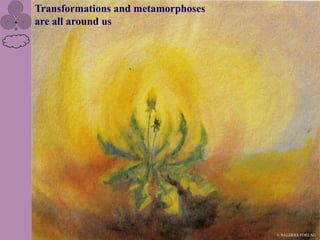
Transformations and metamorphoses
are all around us


                                    © BALDERS FORLAG
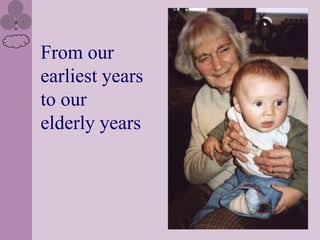
From our
earliest years
to our
elderly years
A Child of our Times

The connection between our senses and our activities of
           Thinking, Feeling and Willing.


        The connection between memory and
             our different body systems.


     Observing a special relationship between the
     physical body, memory and idea formation.


       Developing our „Gift of Remembrance‟.
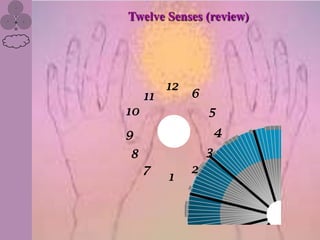
Twelve Senses (review)


          12
     11        6
10                 5
9                      4
8                  3
     7         2           s oul
          1
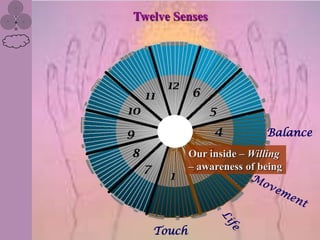
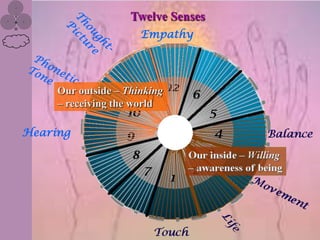
Twelve Senses


                           Balance
           Our inside – Willing
           – awareness of being


   Touch
Twelve Senses
                      Empathy


     Our outside – Thinking
     – receiving the world

Hearing
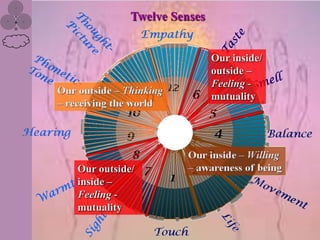
Twelve Senses


                           Our inside/
                           outside –
                           Feeling -
                           mutuality


Our outside/
inside –
Feeling -
mutuality
(review)
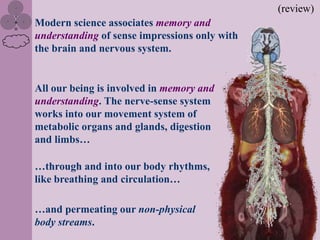
Modern science associates memory and
understanding of sense impressions only with
the brain and nervous system.


All our being is involved in memory and
understanding. The nerve-sense system
works into our movement system of
metabolic organs and glands, digestion
and limbs…

…through and into our body rhythms,
like breathing and circulation…

…and permeating our non-physical
body streams.
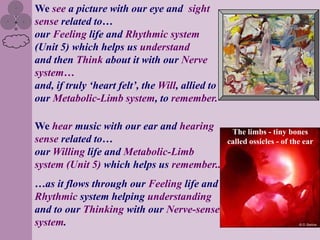
We see a picture with our eye and sight
sense related to…
our Feeling life and Rhythmic system
(Unit 5) which helps us understand
and then Think about it with our Nerve
system…
and, if truly „heart felt‟, the Will, allied to
our Metabolic-Limb system, to remember.

We hear music with our ear and hearing             The limbs - tiny bones
sense related to…                                 called ossicles - of the ear
our Willing life and Metabolic-Limb
system (Unit 5) which helps us remember..
…as it flows through our Feeling life and
Rhythmic system helping understanding
and to our Thinking with our Nerve-sense
system.
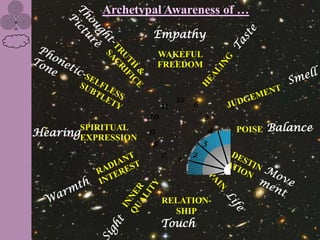
Archetypal Awareness of …
                    Empathy
                        WAKEFUL
                        FREEDOM


                              12
                         11        6
                    10                 5
       SPIRITUAL
HearingEXPRESSION   9                      4           POISE Balance
                    8                  3
                                               s oul
                         7         2
                              1


                         RELATION-
                           SHIP
                         Touch
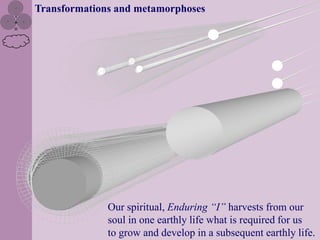
Transformations and metamorphoses


              Our spiritual, Enduring “I” harvests from our
              soul in one earthly life what is required for us
              to grow and develop in a subsequent earthly life.
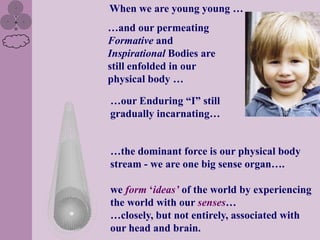
When we are young young …
…and our permeating
Formative and
Inspirational Bodies are
still enfolded in our
physical body …

…our Enduring “I” still
gradually incarnating…


…the dominant force is our physical body
stream - we are one big sense organ….

we form „ideas‟ of the world by experiencing
the world with our senses…
…closely, but not entirely, associated with
our head and brain.
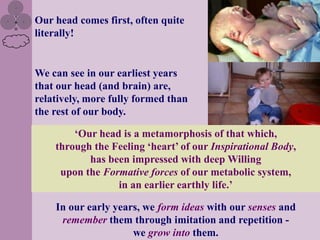
Our head comes first, often quite
literally!


We can see in our earliest years
that our head (and brain) are,
relatively, more fully formed than
the rest of our body.

        „Our head is a metamorphosis of that which,
    through the Feeling „heart‟ of our Inspirational Body,
           has been impressed with deep Willing
     upon the Formative forces of our metabolic system,
                 in an earlier earthly life.‟

    In our early years, we form ideas with our senses and
     remember them through imitation and repetition -
                     we grow into them.
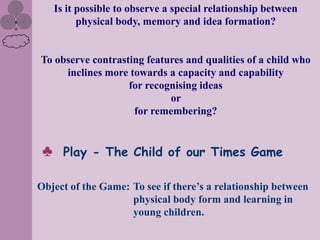
Is it possible to observe a special relationship between
           physical body, memory and idea formation?


To observe contrasting features and qualities of a child who
     inclines more towards a capacity and capability
                   for recognising ideas
                            or
                    for remembering?


 ♣     Play - The Child of our Times Game

Object of the Game: To see if there‟s a relationship between
                    physical body form and learning in
                    young children.
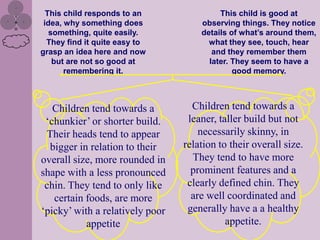
This child responds to an               This child is good at
 idea, why something does            observing things. They notice
   something, quite easily.          details of what’s around them,
  They find it quite easy to           what they see, touch, hear
grasp an idea here and now              and they remember them
    but are not so good at             later. They seem to have a
       remembering it.                        good memory.


   Children tend towards a         Children tend towards a
 ‘chunkier’ or shorter build.     leaner, taller build but not
 Their heads tend to appear          necessarily skinny, in
  bigger in relation to their    relation to their overall size.
overall size, more rounded in      They tend to have more
shape with a less pronounced       prominent features and a
 chin. They tend to only like     clearly defined chin. They
   certain foods, are more         are well coordinated and
‘picky’ with a relatively poor    generally have a a healthy
           appetite                         appetite.
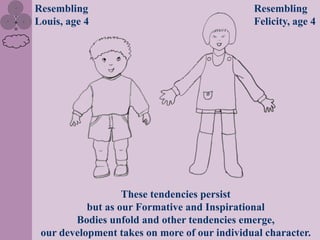
Resembling                                    Resembling
Louis, age 4                                  Felicity, age 4


                   These tendencies persist
           but as our Formative and Inspirational
        Bodies unfold and other tendencies emerge,
 our development takes on more of our individual character.
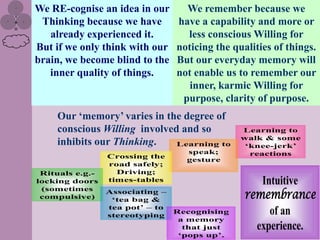
We RE-cognise an idea in our       We remember because we
 Thinking because we have        have a capability and more or
   already experienced it.         less conscious Willing for
But if we only think with our    noticing the qualities of things.
brain, we become blind to the    But our everyday memory will
   inner quality of things.      not enable us to remember our
                                    inner, karmic Willing for
                                  purpose, clarity of purpose.
    Our „memory‟ varies in the degree of
    conscious Willing involved and so           Learning to
                                                walk & some
    inhibits our Thinking.    Learning to        „knee-jerk‟
                                   speak;         reactions
                 Crossing the
                                   gesture
                 road safely;
 Rituals e.g.-     Driving;
locking doors    times-tables                       Intuitive
                                                 remembrance
 (sometimes      Associating –
 compulsive)      „tea bag &
                 tea pot‟ – to
                 stereotyping
                                 Recognising          of an
                                  a memory
                                   that just       experience.
                                  „pops up‟.
Intuitive                             …is a capability
remembrance                              that flows in with
     of an                               the stream of our
                                         “Enduring “I”
  experience.


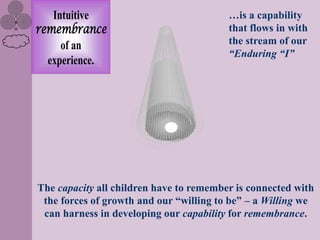
The capacity all children have to remember is connected with
 the forces of growth and our “willing to be” – a Willing we
 can harness in developing our capability for remembrance.
Intuitive                                          …is a capability
remembrance                     enduring              that flows in with
                                  “I”                 the stream of our
     of an
                                                      “Enduring “I”
  experience.
                                  intuition

                 judging
                                  soul
                           soul
            memory
 past   Formative body stream
                                              Inspirational body stream
                                                                          future
                                                                deep
                                                              yearning


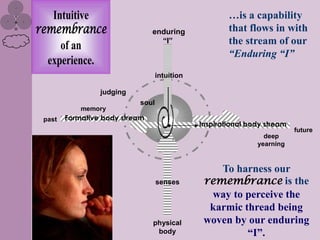
                                                  To harness our
                                  senses       remembrance is the
                                                way to perceive the
                                                karmic thread being
                                physical       woven by our enduring
                                 body                   “I”.
To ponder on…
      If the head is a physical metamorphosis of what
    our soul and organism experienced in an earlier life,
                 where does our “I” fit in?


 What are the implications if we only think with our head?


  Are we free to „think with our heart‟, why should we and
                    what does that mean?


What resonance of the two tendencies in early childhood can
                be observed in adult life?


      Why should we foster imagination in childhood?
Unit7
Unit7
Unit7
Unit7
Unit7
Unit7
Unit7

Unit7

  • 8.
    The Spiritual Science of Everyday Life www.spiritualscience.co.uk
  • 9.
    Transformations and metamorphoses areall around us © BALDERS FORLAG
  • 10.
    From our earliest years toour elderly years
  • 11.
    A Child ofour Times The connection between our senses and our activities of Thinking, Feeling and Willing. The connection between memory and our different body systems. Observing a special relationship between the physical body, memory and idea formation. Developing our „Gift of Remembrance‟.
  • 12.
    Twelve Senses (review) 12 11 6 10 5 9 4 8 3 7 2 s oul 1
  • 13.
    Twelve Senses Balance Our inside – Willing – awareness of being Touch
  • 14.
    Twelve Senses Empathy Our outside – Thinking – receiving the world Hearing
  • 15.
    Twelve Senses Our inside/ outside – Feeling - mutuality Our outside/ inside – Feeling - mutuality
  • 16.
    (review) Modern science associatesmemory and understanding of sense impressions only with the brain and nervous system. All our being is involved in memory and understanding. The nerve-sense system works into our movement system of metabolic organs and glands, digestion and limbs… …through and into our body rhythms, like breathing and circulation… …and permeating our non-physical body streams.
  • 17.
    We see apicture with our eye and sight sense related to… our Feeling life and Rhythmic system (Unit 5) which helps us understand and then Think about it with our Nerve system… and, if truly „heart felt‟, the Will, allied to our Metabolic-Limb system, to remember. We hear music with our ear and hearing The limbs - tiny bones sense related to… called ossicles - of the ear our Willing life and Metabolic-Limb system (Unit 5) which helps us remember.. …as it flows through our Feeling life and Rhythmic system helping understanding and to our Thinking with our Nerve-sense system.
  • 18.
    Archetypal Awareness of… Empathy WAKEFUL FREEDOM 12 11 6 10 5 SPIRITUAL HearingEXPRESSION 9 4 POISE Balance 8 3 s oul 7 2 1 RELATION- SHIP Touch
  • 19.
    Transformations and metamorphoses Our spiritual, Enduring “I” harvests from our soul in one earthly life what is required for us to grow and develop in a subsequent earthly life.
  • 20.
    When we areyoung young … …and our permeating Formative and Inspirational Bodies are still enfolded in our physical body … …our Enduring “I” still gradually incarnating… …the dominant force is our physical body stream - we are one big sense organ…. we form „ideas‟ of the world by experiencing the world with our senses… …closely, but not entirely, associated with our head and brain.
  • 21.
    Our head comesfirst, often quite literally! We can see in our earliest years that our head (and brain) are, relatively, more fully formed than the rest of our body. „Our head is a metamorphosis of that which, through the Feeling „heart‟ of our Inspirational Body, has been impressed with deep Willing upon the Formative forces of our metabolic system, in an earlier earthly life.‟ In our early years, we form ideas with our senses and remember them through imitation and repetition - we grow into them.
  • 22.
    Is it possibleto observe a special relationship between physical body, memory and idea formation? To observe contrasting features and qualities of a child who inclines more towards a capacity and capability for recognising ideas or for remembering? ♣ Play - The Child of our Times Game Object of the Game: To see if there‟s a relationship between physical body form and learning in young children.
  • 23.
    This child respondsto an This child is good at idea, why something does observing things. They notice something, quite easily. details of what’s around them, They find it quite easy to what they see, touch, hear grasp an idea here and now and they remember them but are not so good at later. They seem to have a remembering it. good memory. Children tend towards a Children tend towards a ‘chunkier’ or shorter build. leaner, taller build but not Their heads tend to appear necessarily skinny, in bigger in relation to their relation to their overall size. overall size, more rounded in They tend to have more shape with a less pronounced prominent features and a chin. They tend to only like clearly defined chin. They certain foods, are more are well coordinated and ‘picky’ with a relatively poor generally have a a healthy appetite appetite.
  • 24.
    Resembling Resembling Louis, age 4 Felicity, age 4 These tendencies persist but as our Formative and Inspirational Bodies unfold and other tendencies emerge, our development takes on more of our individual character.
  • 25.
    We RE-cognise anidea in our We remember because we Thinking because we have have a capability and more or already experienced it. less conscious Willing for But if we only think with our noticing the qualities of things. brain, we become blind to the But our everyday memory will inner quality of things. not enable us to remember our inner, karmic Willing for purpose, clarity of purpose. Our „memory‟ varies in the degree of conscious Willing involved and so Learning to walk & some inhibits our Thinking. Learning to „knee-jerk‟ speak; reactions Crossing the gesture road safely; Rituals e.g.- Driving; locking doors times-tables Intuitive remembrance (sometimes Associating – compulsive) „tea bag & tea pot‟ – to stereotyping Recognising of an a memory that just experience. „pops up‟.
  • 26.
    Intuitive …is a capability remembrance that flows in with of an the stream of our “Enduring “I” experience. The capacity all children have to remember is connected with the forces of growth and our “willing to be” – a Willing we can harness in developing our capability for remembrance.
  • 27.
    Intuitive …is a capability remembrance enduring that flows in with “I” the stream of our of an “Enduring “I” experience. intuition judging soul soul memory past Formative body stream Inspirational body stream future deep yearning To harness our senses remembrance is the way to perceive the karmic thread being physical woven by our enduring body “I”.
  • 28.
    To ponder on… If the head is a physical metamorphosis of what our soul and organism experienced in an earlier life, where does our “I” fit in? What are the implications if we only think with our head? Are we free to „think with our heart‟, why should we and what does that mean? What resonance of the two tendencies in early childhood can be observed in adult life? Why should we foster imagination in childhood?