Science and Ethics
FSTE 3022
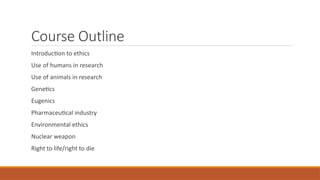
Course Outline
Introduction to ethics
Use of humans in research
Use of animals in research
Genetics
Eugenics
Pharmaceutical industry
Environmental ethics
Nuclear weapon
Right to life/right to die
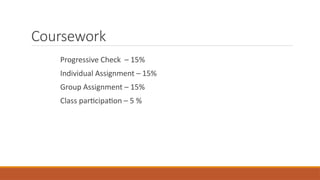
Coursework
Progressive Check – 15%
Individual Assignment – 15%
Group Assignment – 15%
Class participation – 5 %
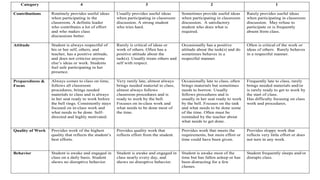
Rubrics: Class Participation
Category 4 3 2 1
Contributions Routinely provides useful ideas
when participating in the
classroom. A definite leader
who contributes a lot of effort
and who makes class
discussions better.
Usually provides useful ideas
when participating in classroom
discussion. A strong student
who tries hard.
Sometimes provide useful ideas
when participating in classroom
discussion. A satisfactory
student who does what is
required.
Rarely provides useful ideas
when participating in classroom
discussion. May refuse to
participate or is frequently
absent from class.
Attitude Student is always respectful of
his or her self, others, and
teacher, has a positive attitude,
and does not criticize anyone
else’s ideas or work. Students
feel safe participating in her
presence.
Rarely is critical of ideas or
work of others. Often has a
positive attitude about the
task(s). Usually treats others and
self with respect.
Occasionally has a positive
attitude about the task(s) and do
sometimes behaves in a
respectful manner.
Often is critical of the work or
ideas of others. Rarely behaves
in a respectful manner.
Preparedness &
Focus
Always comes to class on time,
follows all classroom
procedures, brings needed
materials to class and is always
in her seat ready to work before
the bell rings. Consistently stays
focused on in-class work and
what needs to be done. Self-
directed and highly motivated.
Very rarely late, almost always
brings needed material to class,
almost always follows
classroom procedures and is
ready to work by the bell.
Focuses on in-class work and
what needs to be done most of
the time.
Occasionally late to class, often
brings materials but sometimes
needs to borrow. Usually
follows procedures and is
usually in her seat ready to work
by the bell. Focuses on the task
and what needs to be done some
of the time. Often must be
reminded by the teacher about
what needs to get done.
Frequently late to class, rarely
brings needed materials and/or
is rarely ready to get to work by
the start of class.
Has difficulty focusing on class
work and procedures.
Quality of Work Provides work of the highest
quality that reflects the student’s
best efforts.
Provides quality work that
reflects effort from the student.
Provides work that meets the
requirements, but more effort or
time could have been given.
Provides sloppy work that
reflects very little effort or does
not turn in any work.
Behavior Student is awake and engaged in
class on a daily basis. Student
shows no disruptive behavior.
Student is awake and engaged in
class nearly every day, and
shows no disruptive behavior.
Student is awake most of the
time but has fallen asleep or has
been distracting for a few
classes.
Student frequently sleeps and/or
disrupts class.
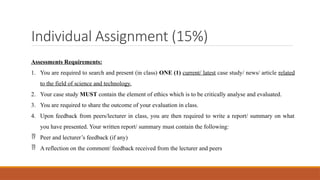
Assessments Requirements:
1. You are required to search and present (in class) ONE (1) current/ latest case study/ news/ article related
to the field of science and technology.
2. Your case study MUST contain the element of ethics which is to be critically analyse and evaluated.
3. You are required to share the outcome of your evaluation in class.
4. Upon feedback from peers/lecturer in class, you are then required to write a report/ summary on what
you have presented. Your written report/ summary must contain the following:
 Peer and lecturer’s feedback (if any)
 A reflection on the comment/ feedback received from the lecturer and peers
Individual Assignment (15%)
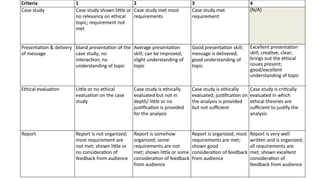
Criteria 1 2 3 4
Case study Case study shown little or
no relevancy on ethical
topic; requirement not
met
Case study met most
requirements
Case study met
requirement
(N/A)
Presentation & delivery
of message
bland presentation of the
case study; no
interaction; no
understanding of topic
Average presentation
skill; can be improved;
slight understanding of
topic
Good presentation skill;
message is delivered;
good understanding of
topic
Excellent presentation
skill; creative; clear;
brings out the ethical
issues present;
good/excellent
understanding of topic
Ethical evaluation Little or no ethical
evaluation on the case
study
Case study is ethically
evaluated but not in
depth/ little or no
justification is provided
for the analysis
Case study is ethically
evaluated; justification on
the analysis is provided
but not sufficient
Case study is critically
evaluated in which
ethical theories are
sufficient to justify the
analysis
Report Report is not organized;
most requirement are
not met; shown little or
no consideration of
feedback from audience
Report is somehow
organized; some
requirements are not
met; shown little or some
consideration of feedback
from audience
Report is organized; most
requirements are met;
shown good
consideration of feedback
from audience
Report is very well
written and is organized;
all requirements are
met; shown excellent
consideration of
feedback from audience
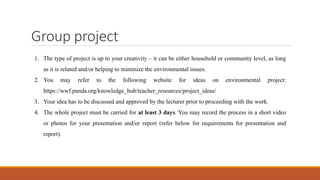
Group project
1. The type of project is up to your creativity – it can be either household or community level, as long
as it is related and/or helping to minimize the environmental issues.
2. You may refer to the following website for ideas on environmental project:
https://wwf.panda.org/knowledge_hub/teacher_resources/project_ideas/
3. Your idea has to be discussed and approved by the lecturer prior to proceeding with the work.
4. The whole project must be carried for at least 3 days. You may record the process in a short video
or photos for your presentation and/or report (refer below for requirements for presentation and
report).
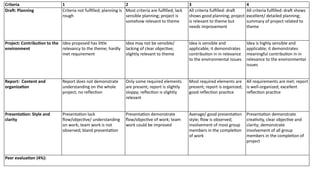
Criteria 1 2 3 4
Draft: Planning Criteria not fulfilled; planning is
rough
Most criteria are fulfilled; lack
sensible planning; project is
somehow relevant to theme
All criteria fulfilled: draft
shows good planning; project
is relevant to theme but
needs improvement
All criteria fulfilled: draft shows
excellent/ detailed planning;
summary of project related to
theme
Project: Contribution to the
environment
Idea proposed has little
relevancy to the theme; hardly
met requirement
Idea may not be sensible/
lacking of clear objective;
slightly relevant to theme
Idea is sensible and
applicable; it demonstrates
contribution in in relevance
to the environmental issues
Idea is highly sensible and
applicable; it demonstrates
meaningful contribution in in
relevance to the environmental
issues
Report: Content and
organization
Report does not demonstrate
understanding on the whole
project; no reflection
Only some required elements
are present; report is slightly
sloppy; reflection is slightly
relevant
Most required elements are
present; report is organized;
good reflection practice
All requirements are met; report
is well-organized; excellent
reflection practice
Presentation: Style and
clarity
Presentation lack
flow/objective/ understanding
on work; team work is not
observed; bland presentation
Presentation demonstrate
flow/objective of work; team
work could be improved
Average/ good presentation
style; flow is observed;
involvement of most group
members in the completion
of work
Presentation demonstrate
creativity, clear objective and
clarity; demonstrate
involvement of all group
members in the completion of
project
Peer evaluation (4%):
References
C. Neal Steward Jr. (2011). Research Ethics for Scientists. Wiley-Blackwell; John Wiley
& Sons, Ltd.
Adam Briggle, Carl Mitcham (2012). Ethics and Science: An Introduction. Cambridge
University Press
Speight, James G.; Foote, Russell (2011). Ethics in Science and Engineering. Wiley
Monroe, Kristen Renwick (2012). Science, Ethics, and Politics: Conversations and
Investigations. Paradigm Pub
Chapter 1
Introduction to Ethics
Learning outcome
Ethical perspective from the western and eastern tradition
Ethics and the scientist
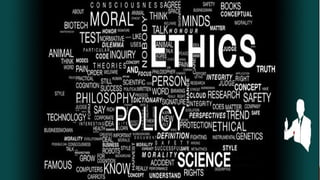
Pick 1 word from the
following slide, and
relate the word to ethics
Discussion
Discuss in pair whether you think the following are right or wrong:
a) Having to exhibit a red ‘P’ for 3 years after passing a driving test
b) Banning smoking in restaurants
c) Spending money on fertility programs (such as IVF)
d) Taking organs for transplant from accident victims unless their license is
endorsed to say ‘no’
Examples of ethical dilemmas in science
 You were asked to create a human-animal hybrid using a 16-day
old embryo, what would you do?
 You were asked to invent a bomb which is 100 times more
powerful than atomic bomb, what would you do?
 Your final year drug development project requires you to select
human as participant, how could you do it?
How would you know what to do?
Group activity
Discuss what is/ are the current ethical issues arise in the field of
science and technology.
15 minutes
Present your ideas in class
Ethics
An area of study that deals with ideas about what is good or bad behavior
Greek word “ethos” – custom; habit
Denotes the theory of the right action
Reading: ‘Why study ethics’, manual page 3
Ethics vs Morality
Morality : set of values or world views
Ethics : practice of reflecting on those values and their
foundations and applications
- Burton, E., Goldsmith. J., Matteri, N. (2018)
https://www.youtube.com/watch?v=fAkqh9pfVkc
Ethics – The Western Perspective
Concerned with the following questions:
How people ought to act
What is consider the ‘right conduct’
Normative ethics
Is a branch of ethics that concerns how things should and
ought to be
2 ethical theories emerged:
◦ Consequentialism / Teleological ethics
◦ Deontology
Consequentialism
= Teleological Theory
An approach to ethics that focuses on rightness or wrongness of the consequences of the action
Example: Utilitarianism
◦ Acknowledged the fact that many acts are having both bad and good consequences
◦ Accessing the net outcome justifies the morality of the act
◦ An action is right if it leads to the most happiness for the greatest number of people ("happiness" here
is defined as the maximization of pleasure and the minimization of pain)
Utilitarianism – The Critics
Burdensome to employ
Almost impossible to predict all the consequences
◦ E.g. Is it ethical that we sacrifice the life of an HIV patient for
research of drugs and save many lives?
Delayed in getting things done and delay
accomplishment
Deontology
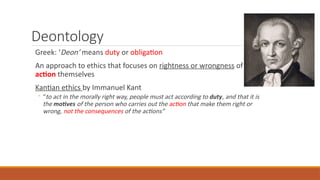
Greek: ‘Deon’ means duty or obligation
An approach to ethics that focuses on rightness or wrongness of the
action themselves
Kantian ethics by Immanuel Kant
◦ “to act in the morally right way, people must act according to duty, and that it is
the motives of the person who carries out the action that make them right or
wrong, not the consequences of the actions”
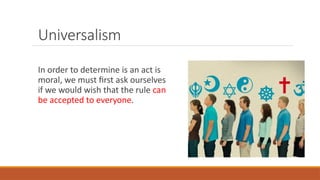
Universalism
In order to determine is an act is
moral, we must first ask ourselves
if we would wish that the rule can
be accepted to everyone.
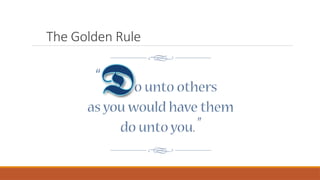
The Golden Rule
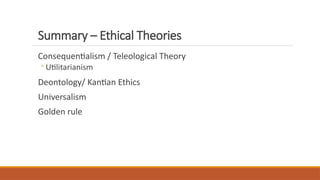
Summary – Ethical Theories
Consequentialism / Teleological Theory
◦ Utilitarianism
Deontology/ Kantian Ethics
Universalism
Golden rule
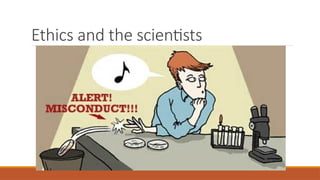
Ethics and the scientists
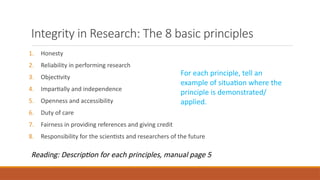
Integrity in Research: The 8 basic principles
1. Honesty
2. Reliability in performing research
3. Objectivity
4. Impartially and independence
5. Openness and accessibility
6. Duty of care
7. Fairness in providing references and giving credit
8. Responsibility for the scientists and researchers of the future
For each principle, tell an
example of situation where the
principle is demonstrated/
applied.
Reading: Description for each principles, manual page 5
WHY IS SCIENTIST INTEGRITY SO
IMPORTANT?
https://www.youtube.com/watch?v=4wIBCoxuOJ0 (10 min)
Common misconducts
in scientists
Gregor Mendel, The Father of Genetic
-Results and data are too true/smooth to believe
-Decades of statisticians have argued that he may have falsified and exaggerated
his data to match his theory more perfectly
1960s: ‘Poly-Water’
- Myth: Discovery of polymerized water
- Fact: Presence of unclean glassware in water
1970s: Genetic modified mice
- Myth: Black and white mice got successfully transplanted
- Truth: Mice were coloured in black using permanent marker
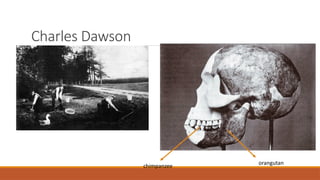
Charles Dawson
orangutan
chimpanzee
Sharing session:
Scientific fraud you’ve found
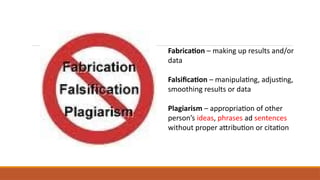
Fabrication – making up results and/or
data
Falsification – manipulating, adjusting,
smoothing results or data
Plagiarism – appropriation of other
person’s ideas, phrases ad sentences
without proper attribution or citation
Sample case
The research protocol for a study of a drug on hypertension requires the administration of the
drug at different doses to 50 laboratory mice, with chemical and behavioural tests to determine
toxic effects. Tom has almost finished the experiment for Dr Q. He has only 5 mice left to test.
However, he really wants to finish his work in time to go to the Universal Studio in Singapore on
semester break with his friends, who are leaving tonight. He has injected the drug in all 50 mice
but has not completed all of the tests. He therefore decides to extrapolate from the 45
completed results to produce the 5 additional results.
Reflection
Did Tom’s action violate any principles of scientific ethics?
If you were Tom, what would you do?
How do you think the incident/ dilemma can be avoided?
Case Study #1 (manual pg. 6)
Jay is a young chemical engineer who specializes in catalysts to be used in chemical processes in
his company. In preliminary research on catalysts, Jay has gathered some data suggesting that
catalyst B might be best for a special chemical process. However, based on their experience, the
senior chemical engineers in Jay's unit are still convinced catalyst A is best for that sort of process.
Jay agrees that his data is inconclusive and that more research is needed. Meanwhile, the head of
Jay's division tells the engineers that it is now time to recommend a catalyst for the company to
use. Since there is no time for further research on catalyst B, the engineers recommend A.
The division head tells Jay to write up the recommendation with supporting data. However, he
tells him to "make the numbers look good" by doing the math backwards and leaving out Jay's
data concerning catalyst B.
What should Jay do?
What other ethical issue is present in this case study?
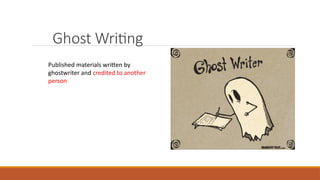
Ghost Writing
Published materials written by
ghostwriter and credited to another
person
Activity: Case study 2
(manual pg.7)
READ AND DISCUSS THE QUESTIONS IN PAIRS OR GROUP
TIME: 20 MINUTES
Questions to answer:
1. What is the best solution for Smyth to continue his current research and graduate?
2. “Ghost-writing” is defined as writing in the name of another. There are many commercially
operated “ghost-writing” websites. Is it ethically acceptable to publish ghost-written papers?
Why?
3. There are some science fields that acquiesce to “ghost-writing”. Some people argue that
writing is not a part of sciences, thus ghost-writing is acceptable, unlike data fabrication or
stealing intellectual property. Also they say that you can be more productive if you are
working in the lab instead of spending a lot of time to write a paper. What do you think about
this opinion?
4. Are there any other ethical problems in this case study?

Chapter 1 Introduction to Science and Ethics

  • 1.
  • 2.
    Course Outline Introduction toethics Use of humans in research Use of animals in research Genetics Eugenics Pharmaceutical industry Environmental ethics Nuclear weapon Right to life/right to die
  • 3.
    Coursework Progressive Check –15% Individual Assignment – 15% Group Assignment – 15% Class participation – 5 %
  • 4.
  • 5.
    Category 4 32 1 Contributions Routinely provides useful ideas when participating in the classroom. A definite leader who contributes a lot of effort and who makes class discussions better. Usually provides useful ideas when participating in classroom discussion. A strong student who tries hard. Sometimes provide useful ideas when participating in classroom discussion. A satisfactory student who does what is required. Rarely provides useful ideas when participating in classroom discussion. May refuse to participate or is frequently absent from class. Attitude Student is always respectful of his or her self, others, and teacher, has a positive attitude, and does not criticize anyone else’s ideas or work. Students feel safe participating in her presence. Rarely is critical of ideas or work of others. Often has a positive attitude about the task(s). Usually treats others and self with respect. Occasionally has a positive attitude about the task(s) and do sometimes behaves in a respectful manner. Often is critical of the work or ideas of others. Rarely behaves in a respectful manner. Preparedness & Focus Always comes to class on time, follows all classroom procedures, brings needed materials to class and is always in her seat ready to work before the bell rings. Consistently stays focused on in-class work and what needs to be done. Self- directed and highly motivated. Very rarely late, almost always brings needed material to class, almost always follows classroom procedures and is ready to work by the bell. Focuses on in-class work and what needs to be done most of the time. Occasionally late to class, often brings materials but sometimes needs to borrow. Usually follows procedures and is usually in her seat ready to work by the bell. Focuses on the task and what needs to be done some of the time. Often must be reminded by the teacher about what needs to get done. Frequently late to class, rarely brings needed materials and/or is rarely ready to get to work by the start of class. Has difficulty focusing on class work and procedures. Quality of Work Provides work of the highest quality that reflects the student’s best efforts. Provides quality work that reflects effort from the student. Provides work that meets the requirements, but more effort or time could have been given. Provides sloppy work that reflects very little effort or does not turn in any work. Behavior Student is awake and engaged in class on a daily basis. Student shows no disruptive behavior. Student is awake and engaged in class nearly every day, and shows no disruptive behavior. Student is awake most of the time but has fallen asleep or has been distracting for a few classes. Student frequently sleeps and/or disrupts class.
  • 6.
    Assessments Requirements: 1. Youare required to search and present (in class) ONE (1) current/ latest case study/ news/ article related to the field of science and technology. 2. Your case study MUST contain the element of ethics which is to be critically analyse and evaluated. 3. You are required to share the outcome of your evaluation in class. 4. Upon feedback from peers/lecturer in class, you are then required to write a report/ summary on what you have presented. Your written report/ summary must contain the following:  Peer and lecturer’s feedback (if any)  A reflection on the comment/ feedback received from the lecturer and peers Individual Assignment (15%)
  • 7.
    Criteria 1 23 4 Case study Case study shown little or no relevancy on ethical topic; requirement not met Case study met most requirements Case study met requirement (N/A) Presentation & delivery of message bland presentation of the case study; no interaction; no understanding of topic Average presentation skill; can be improved; slight understanding of topic Good presentation skill; message is delivered; good understanding of topic Excellent presentation skill; creative; clear; brings out the ethical issues present; good/excellent understanding of topic Ethical evaluation Little or no ethical evaluation on the case study Case study is ethically evaluated but not in depth/ little or no justification is provided for the analysis Case study is ethically evaluated; justification on the analysis is provided but not sufficient Case study is critically evaluated in which ethical theories are sufficient to justify the analysis Report Report is not organized; most requirement are not met; shown little or no consideration of feedback from audience Report is somehow organized; some requirements are not met; shown little or some consideration of feedback from audience Report is organized; most requirements are met; shown good consideration of feedback from audience Report is very well written and is organized; all requirements are met; shown excellent consideration of feedback from audience
  • 8.
    Group project 1. Thetype of project is up to your creativity – it can be either household or community level, as long as it is related and/or helping to minimize the environmental issues. 2. You may refer to the following website for ideas on environmental project: https://wwf.panda.org/knowledge_hub/teacher_resources/project_ideas/ 3. Your idea has to be discussed and approved by the lecturer prior to proceeding with the work. 4. The whole project must be carried for at least 3 days. You may record the process in a short video or photos for your presentation and/or report (refer below for requirements for presentation and report).
  • 9.
    Criteria 1 23 4 Draft: Planning Criteria not fulfilled; planning is rough Most criteria are fulfilled; lack sensible planning; project is somehow relevant to theme All criteria fulfilled: draft shows good planning; project is relevant to theme but needs improvement All criteria fulfilled: draft shows excellent/ detailed planning; summary of project related to theme Project: Contribution to the environment Idea proposed has little relevancy to the theme; hardly met requirement Idea may not be sensible/ lacking of clear objective; slightly relevant to theme Idea is sensible and applicable; it demonstrates contribution in in relevance to the environmental issues Idea is highly sensible and applicable; it demonstrates meaningful contribution in in relevance to the environmental issues Report: Content and organization Report does not demonstrate understanding on the whole project; no reflection Only some required elements are present; report is slightly sloppy; reflection is slightly relevant Most required elements are present; report is organized; good reflection practice All requirements are met; report is well-organized; excellent reflection practice Presentation: Style and clarity Presentation lack flow/objective/ understanding on work; team work is not observed; bland presentation Presentation demonstrate flow/objective of work; team work could be improved Average/ good presentation style; flow is observed; involvement of most group members in the completion of work Presentation demonstrate creativity, clear objective and clarity; demonstrate involvement of all group members in the completion of project Peer evaluation (4%):
  • 10.
    References C. Neal StewardJr. (2011). Research Ethics for Scientists. Wiley-Blackwell; John Wiley & Sons, Ltd. Adam Briggle, Carl Mitcham (2012). Ethics and Science: An Introduction. Cambridge University Press Speight, James G.; Foote, Russell (2011). Ethics in Science and Engineering. Wiley Monroe, Kristen Renwick (2012). Science, Ethics, and Politics: Conversations and Investigations. Paradigm Pub
  • 12.
  • 13.
    Learning outcome Ethical perspectivefrom the western and eastern tradition Ethics and the scientist
  • 14.
    Pick 1 wordfrom the following slide, and relate the word to ethics
  • 16.
    Discussion Discuss in pairwhether you think the following are right or wrong: a) Having to exhibit a red ‘P’ for 3 years after passing a driving test b) Banning smoking in restaurants c) Spending money on fertility programs (such as IVF) d) Taking organs for transplant from accident victims unless their license is endorsed to say ‘no’
  • 17.
    Examples of ethicaldilemmas in science  You were asked to create a human-animal hybrid using a 16-day old embryo, what would you do?  You were asked to invent a bomb which is 100 times more powerful than atomic bomb, what would you do?  Your final year drug development project requires you to select human as participant, how could you do it? How would you know what to do?
  • 18.
    Group activity Discuss whatis/ are the current ethical issues arise in the field of science and technology. 15 minutes Present your ideas in class
  • 19.
    Ethics An area ofstudy that deals with ideas about what is good or bad behavior Greek word “ethos” – custom; habit Denotes the theory of the right action Reading: ‘Why study ethics’, manual page 3
  • 20.
    Ethics vs Morality Morality: set of values or world views Ethics : practice of reflecting on those values and their foundations and applications - Burton, E., Goldsmith. J., Matteri, N. (2018) https://www.youtube.com/watch?v=fAkqh9pfVkc
  • 21.
    Ethics – TheWestern Perspective Concerned with the following questions: How people ought to act What is consider the ‘right conduct’
  • 22.
    Normative ethics Is abranch of ethics that concerns how things should and ought to be 2 ethical theories emerged: ◦ Consequentialism / Teleological ethics ◦ Deontology
  • 23.
    Consequentialism = Teleological Theory Anapproach to ethics that focuses on rightness or wrongness of the consequences of the action Example: Utilitarianism ◦ Acknowledged the fact that many acts are having both bad and good consequences ◦ Accessing the net outcome justifies the morality of the act ◦ An action is right if it leads to the most happiness for the greatest number of people ("happiness" here is defined as the maximization of pleasure and the minimization of pain)
  • 24.
    Utilitarianism – TheCritics Burdensome to employ Almost impossible to predict all the consequences ◦ E.g. Is it ethical that we sacrifice the life of an HIV patient for research of drugs and save many lives? Delayed in getting things done and delay accomplishment
  • 25.
    Deontology Greek: ‘Deon’ meansduty or obligation An approach to ethics that focuses on rightness or wrongness of the action themselves Kantian ethics by Immanuel Kant ◦ “to act in the morally right way, people must act according to duty, and that it is the motives of the person who carries out the action that make them right or wrong, not the consequences of the actions”
  • 26.
    Universalism In order todetermine is an act is moral, we must first ask ourselves if we would wish that the rule can be accepted to everyone.
  • 27.
  • 28.
    Summary – EthicalTheories Consequentialism / Teleological Theory ◦ Utilitarianism Deontology/ Kantian Ethics Universalism Golden rule
  • 29.
    Ethics and thescientists
  • 30.
    Integrity in Research:The 8 basic principles 1. Honesty 2. Reliability in performing research 3. Objectivity 4. Impartially and independence 5. Openness and accessibility 6. Duty of care 7. Fairness in providing references and giving credit 8. Responsibility for the scientists and researchers of the future For each principle, tell an example of situation where the principle is demonstrated/ applied. Reading: Description for each principles, manual page 5
  • 31.
    WHY IS SCIENTISTINTEGRITY SO IMPORTANT? https://www.youtube.com/watch?v=4wIBCoxuOJ0 (10 min)
  • 32.
  • 33.
    Gregor Mendel, TheFather of Genetic -Results and data are too true/smooth to believe -Decades of statisticians have argued that he may have falsified and exaggerated his data to match his theory more perfectly 1960s: ‘Poly-Water’ - Myth: Discovery of polymerized water - Fact: Presence of unclean glassware in water 1970s: Genetic modified mice - Myth: Black and white mice got successfully transplanted - Truth: Mice were coloured in black using permanent marker
  • 34.
  • 35.
  • 36.
    Fabrication – makingup results and/or data Falsification – manipulating, adjusting, smoothing results or data Plagiarism – appropriation of other person’s ideas, phrases ad sentences without proper attribution or citation
  • 37.
    Sample case The researchprotocol for a study of a drug on hypertension requires the administration of the drug at different doses to 50 laboratory mice, with chemical and behavioural tests to determine toxic effects. Tom has almost finished the experiment for Dr Q. He has only 5 mice left to test. However, he really wants to finish his work in time to go to the Universal Studio in Singapore on semester break with his friends, who are leaving tonight. He has injected the drug in all 50 mice but has not completed all of the tests. He therefore decides to extrapolate from the 45 completed results to produce the 5 additional results.
  • 38.
    Reflection Did Tom’s actionviolate any principles of scientific ethics? If you were Tom, what would you do? How do you think the incident/ dilemma can be avoided?
  • 39.
    Case Study #1(manual pg. 6) Jay is a young chemical engineer who specializes in catalysts to be used in chemical processes in his company. In preliminary research on catalysts, Jay has gathered some data suggesting that catalyst B might be best for a special chemical process. However, based on their experience, the senior chemical engineers in Jay's unit are still convinced catalyst A is best for that sort of process. Jay agrees that his data is inconclusive and that more research is needed. Meanwhile, the head of Jay's division tells the engineers that it is now time to recommend a catalyst for the company to use. Since there is no time for further research on catalyst B, the engineers recommend A. The division head tells Jay to write up the recommendation with supporting data. However, he tells him to "make the numbers look good" by doing the math backwards and leaving out Jay's data concerning catalyst B. What should Jay do? What other ethical issue is present in this case study?
  • 40.
    Ghost Writing Published materialswritten by ghostwriter and credited to another person
  • 41.
    Activity: Case study2 (manual pg.7) READ AND DISCUSS THE QUESTIONS IN PAIRS OR GROUP TIME: 20 MINUTES
  • 42.
    Questions to answer: 1.What is the best solution for Smyth to continue his current research and graduate? 2. “Ghost-writing” is defined as writing in the name of another. There are many commercially operated “ghost-writing” websites. Is it ethically acceptable to publish ghost-written papers? Why? 3. There are some science fields that acquiesce to “ghost-writing”. Some people argue that writing is not a part of sciences, thus ghost-writing is acceptable, unlike data fabrication or stealing intellectual property. Also they say that you can be more productive if you are working in the lab instead of spending a lot of time to write a paper. What do you think about this opinion? 4. Are there any other ethical problems in this case study?