Unit - II
Space vs Earth Environment
Presented by
Mr. G. Madhan Kumar, AP/Aero
SATHYABAMA
INSTITUTE OF SCIENCE AND TECHNOLOGY
SAEA3017 MANNED SPACE MISSION
Outline
 Atmosphere: Structure and Composition,
 Atmosphere: Air Pressure, Temperature, and Density,
 Atmosphere: Meteoroid,
 Orbital Debris & Radiation Protection,
 Human Factors of Crewed Spaceflight,
 Safety of Crewed Spaceflight,
 Magnetosphere,
 Radiation Environment: Galactic Cosmic Radiation (GCR),
 Solar Particle Events (SPE),
 Radiation and the Human Body,
 Impact of microgravity and g forces on humans,
 space adaptation syndrome.
Overview of the Earth’s
Atmosphere
• The atmosphere, when scaled to the size of an
apple, is no thicker than the skin on an apple.
• The atmosphere is a gas.
• The atmosphere is a fluid.
• There is a surface but no “top” – the atmosphere
gradually thins out with increasing altitude
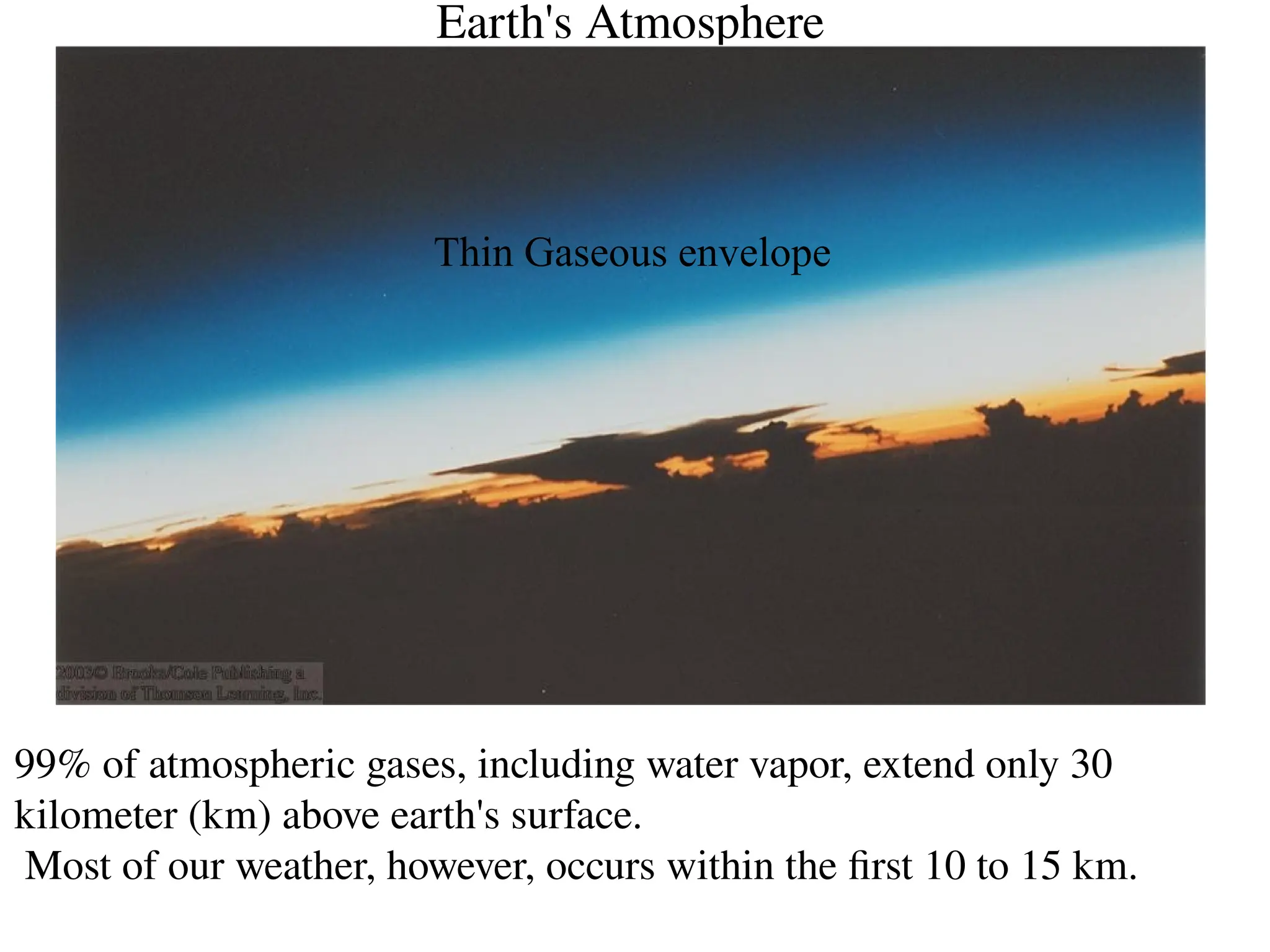
Earth's Atmosphere
99% of atmospheric gases, including water vapor, extend only 30
kilometer (km) above earth's surface.
Most of our weather, however, occurs within the first 10 to 15 km.
Thin Gaseous envelope
Composition of the
Atmosphere
permanent gases
variable gases
trace gases
aerosols
• roles of nitrogen, oxygen and argon
• role of water vapor
• carbon dioxide, methane, ozone, CFCs, et al.
Composition of the
Atmosphere
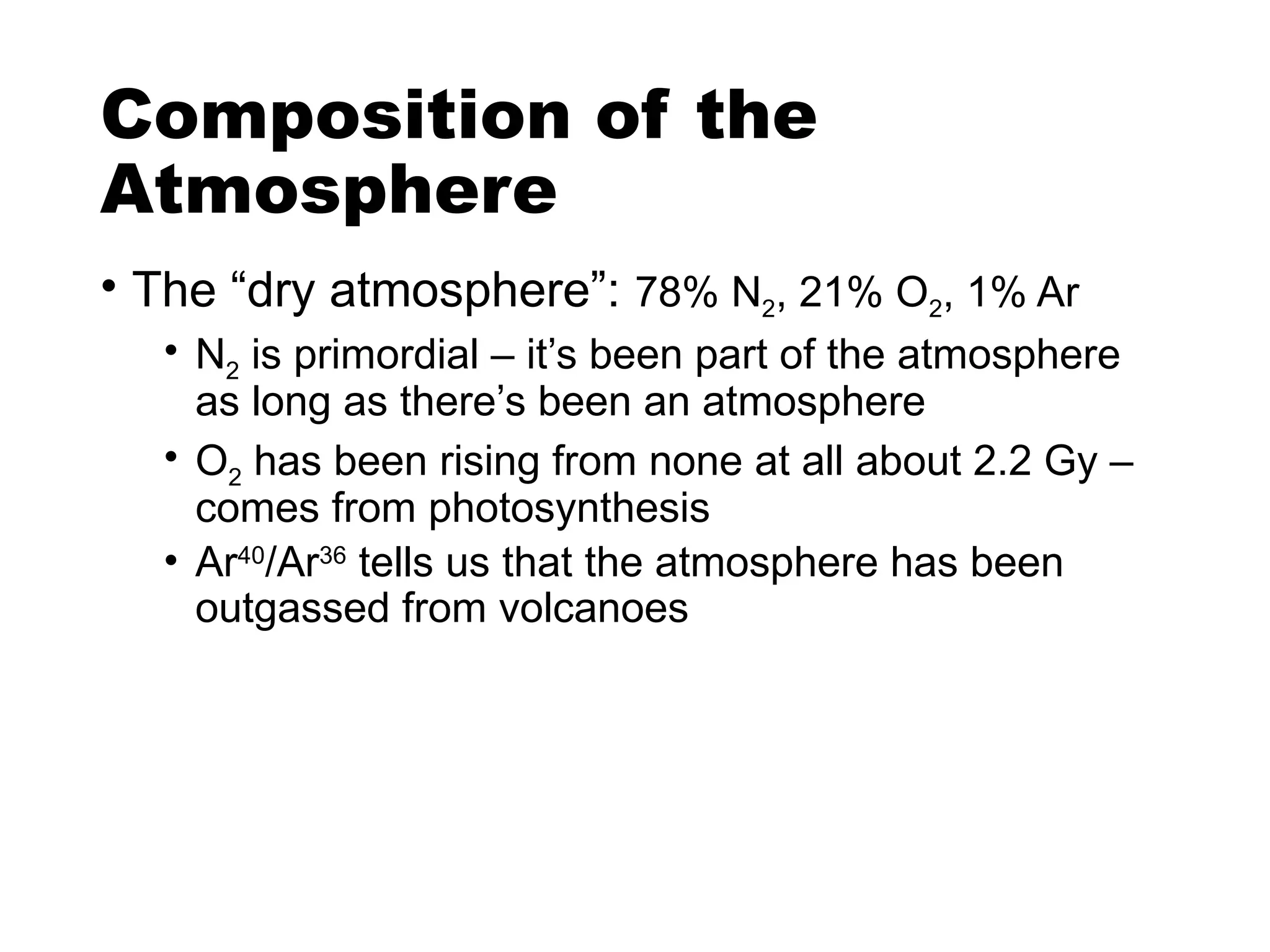
• The “dry atmosphere”: 78% N2, 21% O2, 1% Ar
• N2 is primordial – it’s been part of the atmosphere
as long as there’s been an atmosphere
• O2 has been rising from none at all about 2.2 Gy –
comes from photosynthesis
• Ar40
/Ar36
tells us that the atmosphere has been
outgassed from volcanoes
Composition of the
Atmosphere
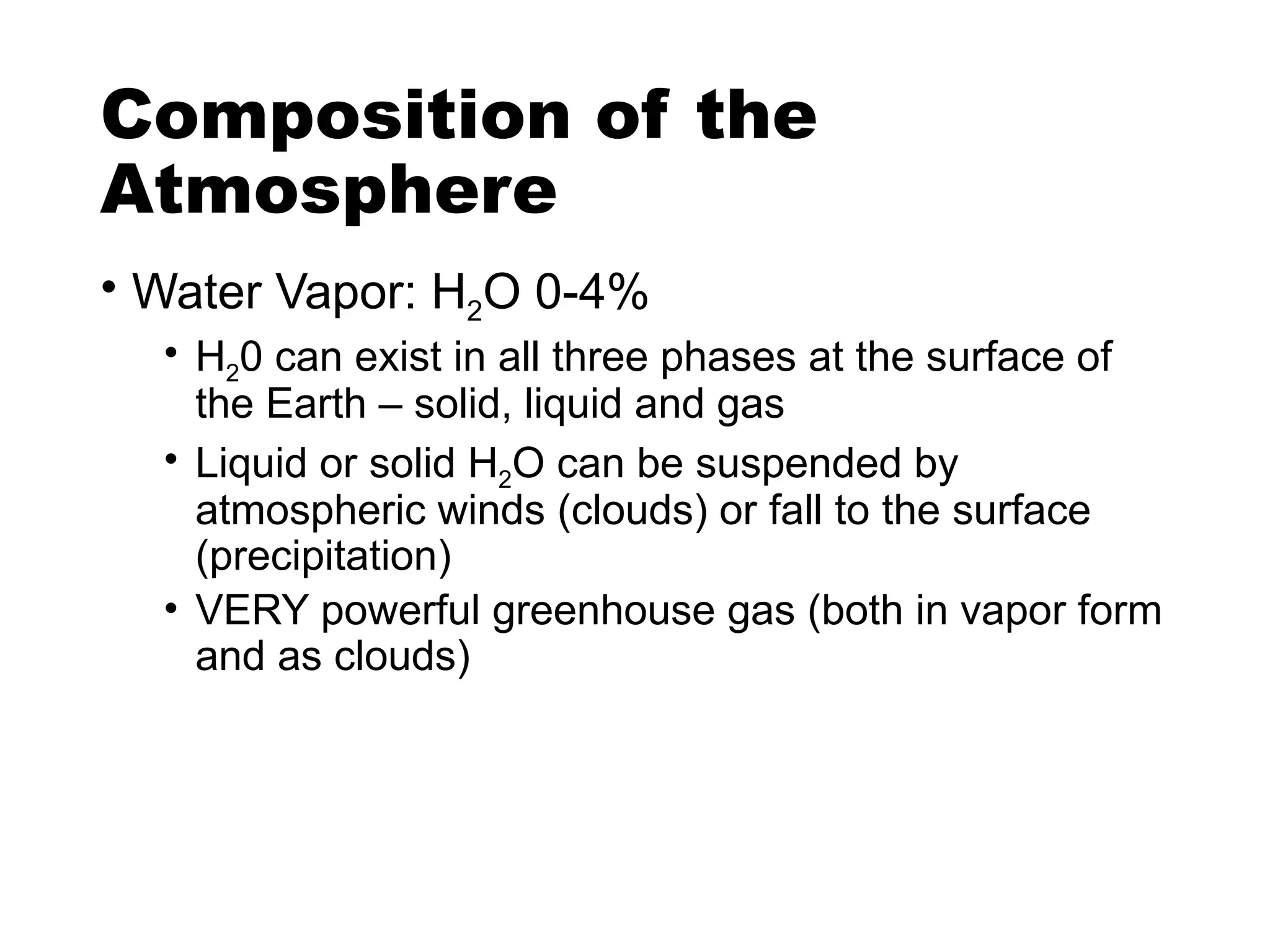
• Water Vapor: H2O 0-4%
• H20 can exist in all three phases at the surface of
the Earth – solid, liquid and gas
• Liquid or solid H2O can be suspended by
atmospheric winds (clouds) or fall to the surface
(precipitation)
• VERY powerful greenhouse gas (both in vapor form
and as clouds)
Composition of the
Atmosphere
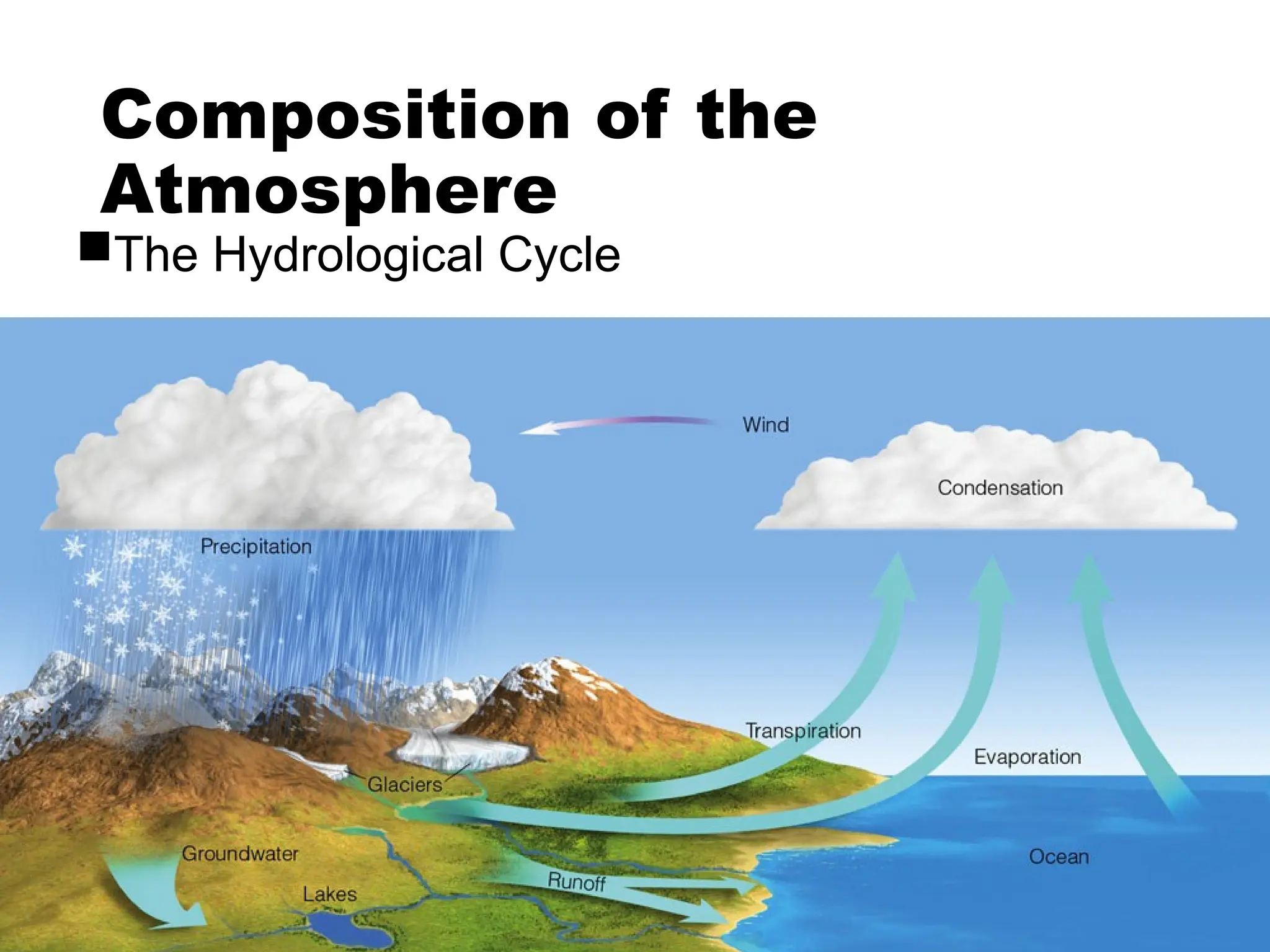
The Hydrological Cycle
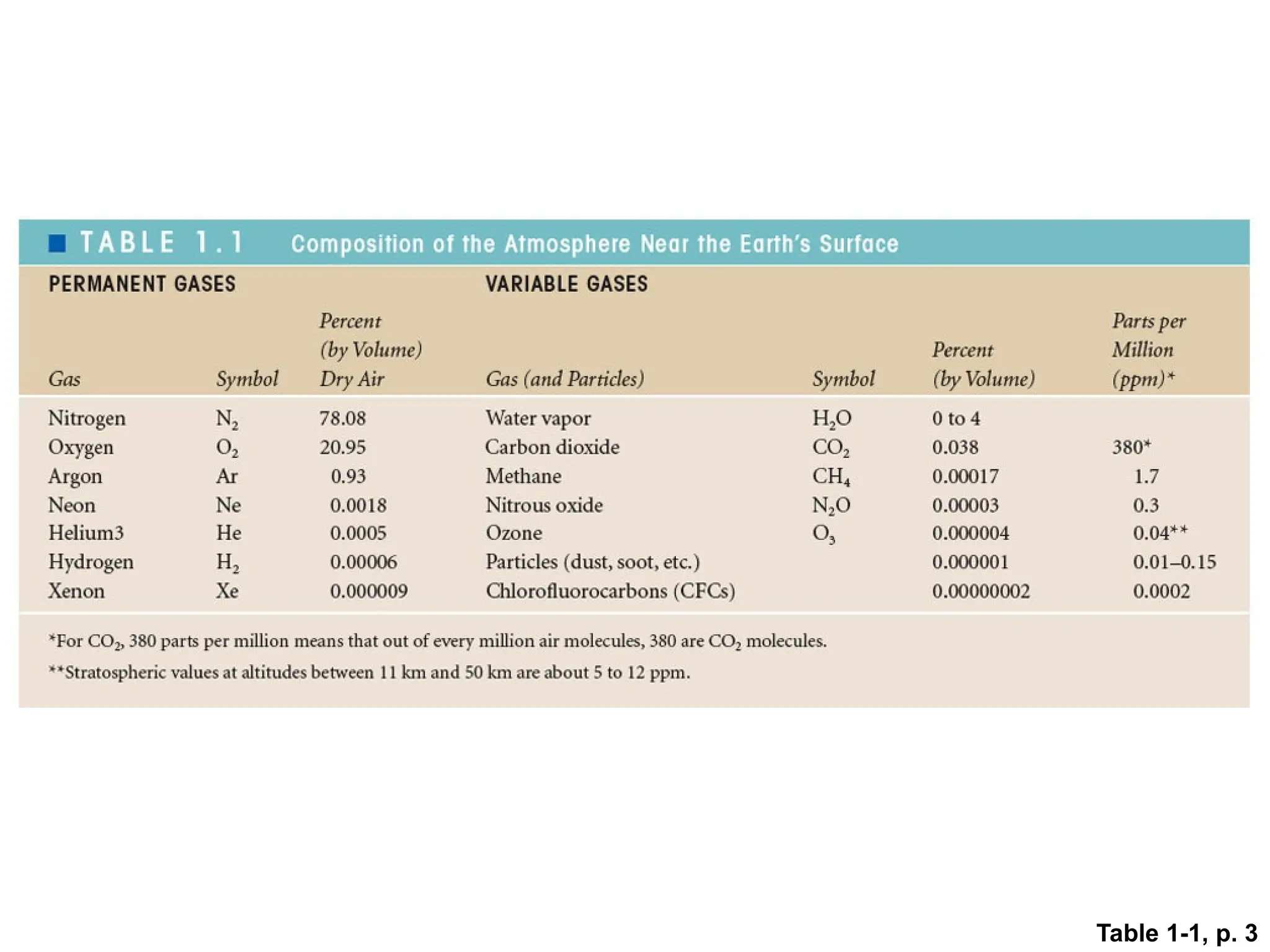
Table 1-1, p. 3
Composition of the
Atmosphere
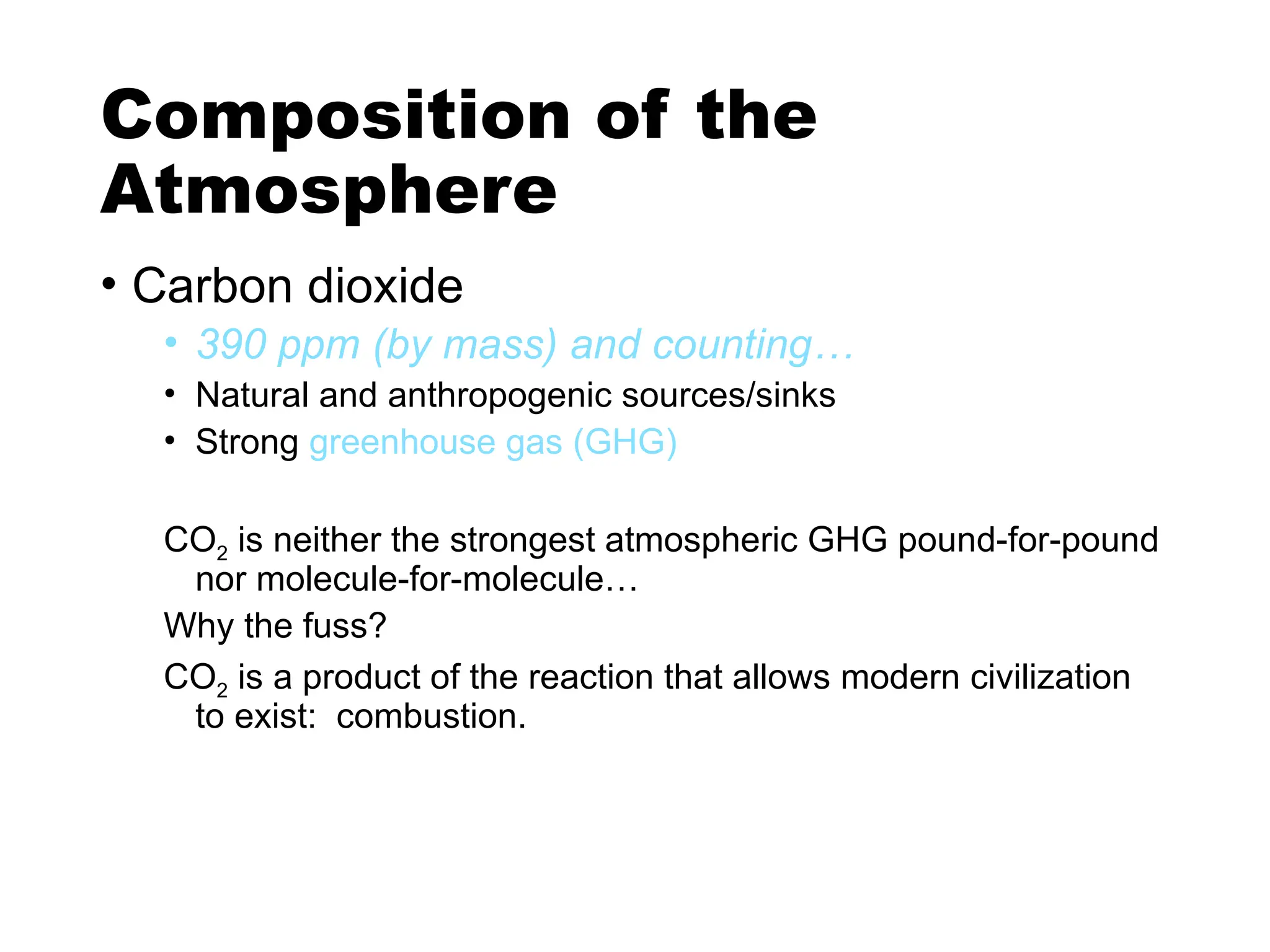
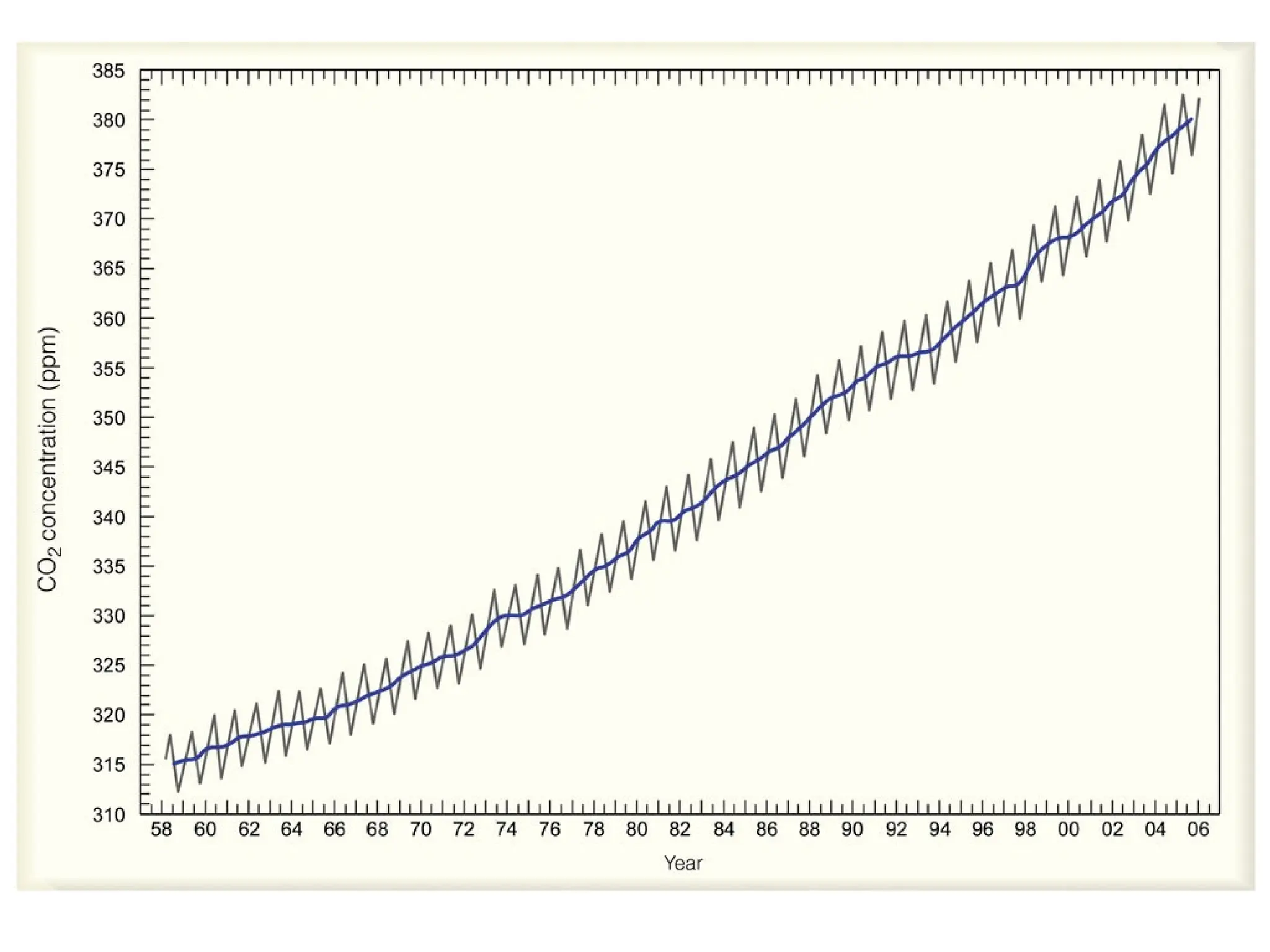
• Carbon dioxide
• 390 ppm (by mass) and counting…
• Natural and anthropogenic sources/sinks
• Strong greenhouse gas (GHG)
CO2 is neither the strongest atmospheric GHG pound-for-pound
nor molecule-for-molecule…
Why the fuss?
CO2 is a product of the reaction that allows modern civilization
to exist: combustion.
Composition of the
Atmosphere
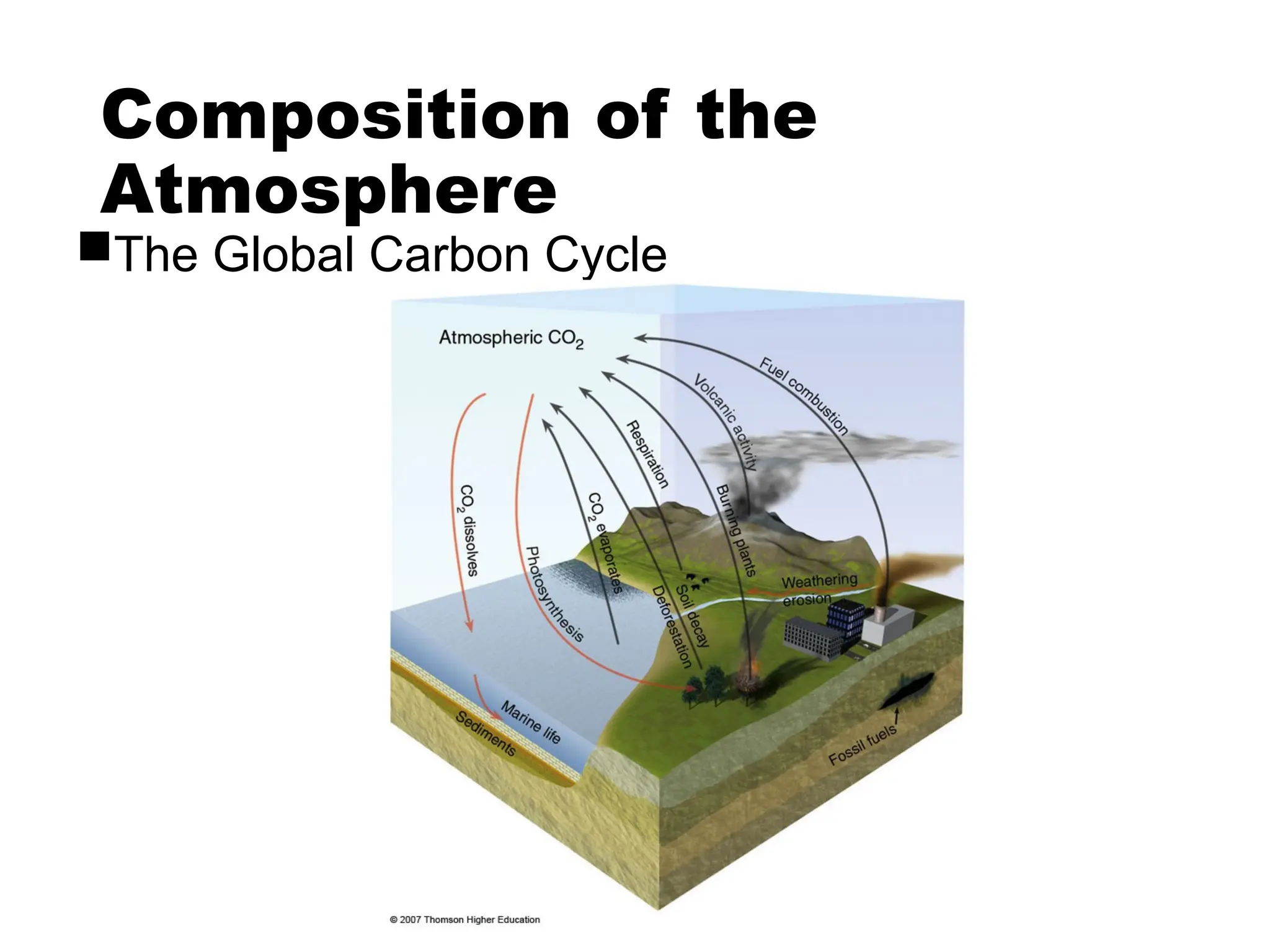
The Global Carbon Cycle
Composition of the
Atmosphere
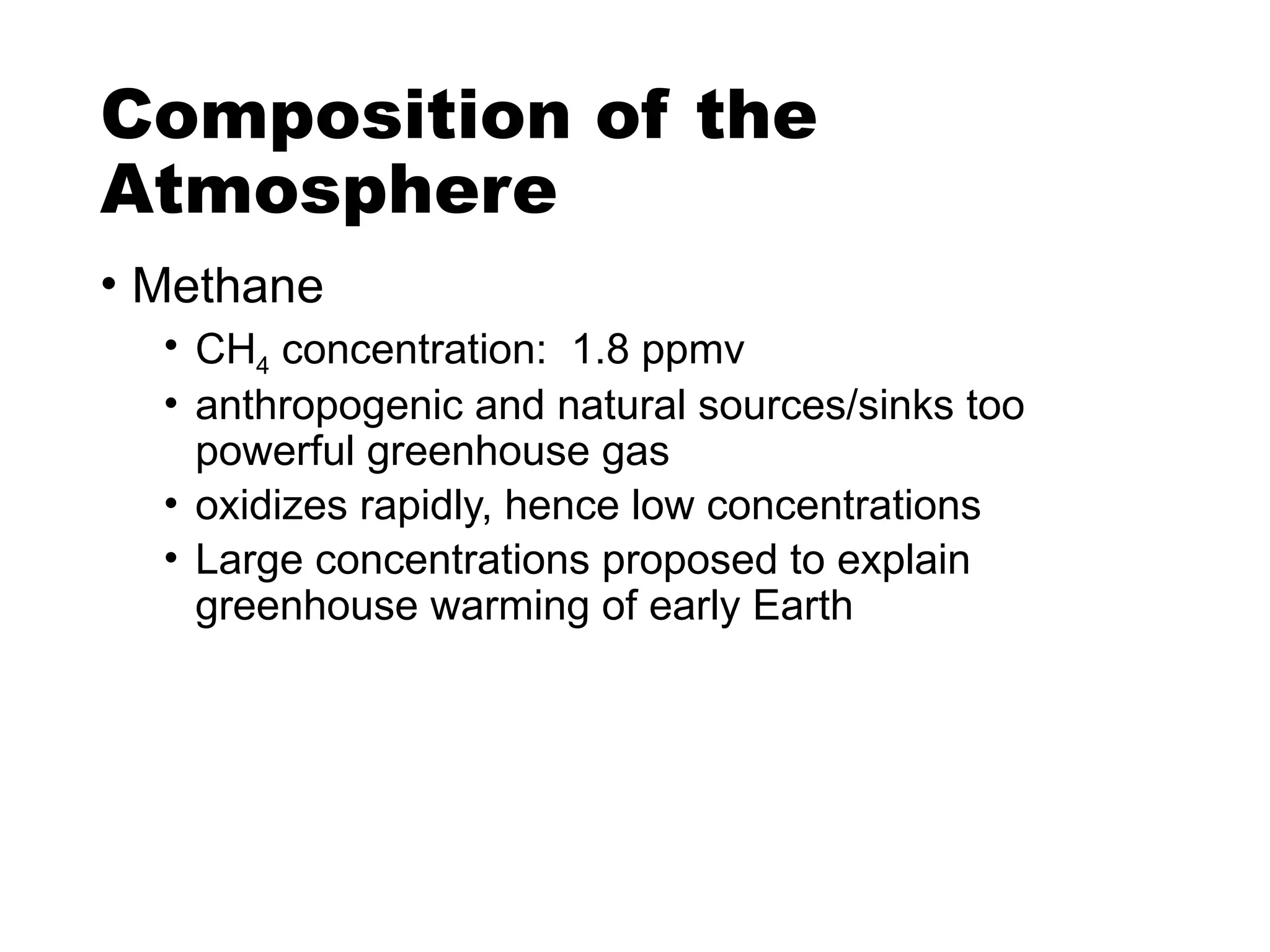
• Methane
• CH4 concentration: 1.8 ppmv
• anthropogenic and natural sources/sinks too
powerful greenhouse gas
• oxidizes rapidly, hence low concentrations
• Large concentrations proposed to explain
greenhouse warming of early Earth
Composition of the
Atmosphere
• Ozone, CFCs and NOx
• Ozone (O3)
• shields the surface from UV rays
• produced by reaction with NOx and sunlight near the
surface
• CFC’s (Chlorofluorocarbons)
• destroy stratospheric ozone
• chlorine is a catalyst: it destroys one O3 molecule and
then is free to find another
• Ozone at high altitudes (stratosphere) is “good”;
ozone at low altitudes (troposphere) is “bad.”
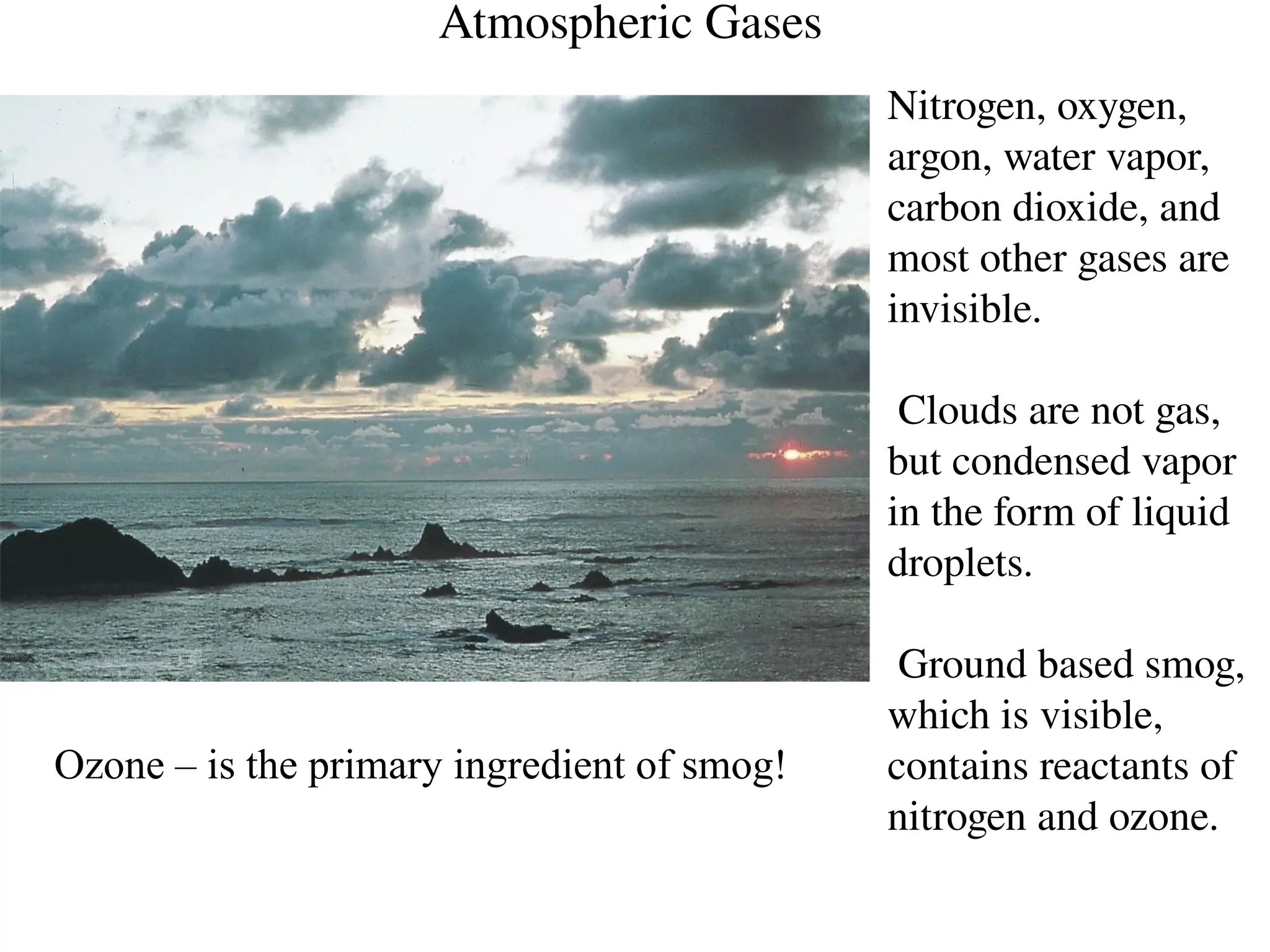
Atmospheric Gases
Nitrogen, oxygen,
argon, water vapor,
carbon dioxide, and
most other gases are
invisible.
Clouds are not gas,
but condensed vapor
in the form of liquid
droplets.
Ground based smog,
which is visible,
contains reactants of
nitrogen and ozone.
Ozone – is the primary ingredient of smog!
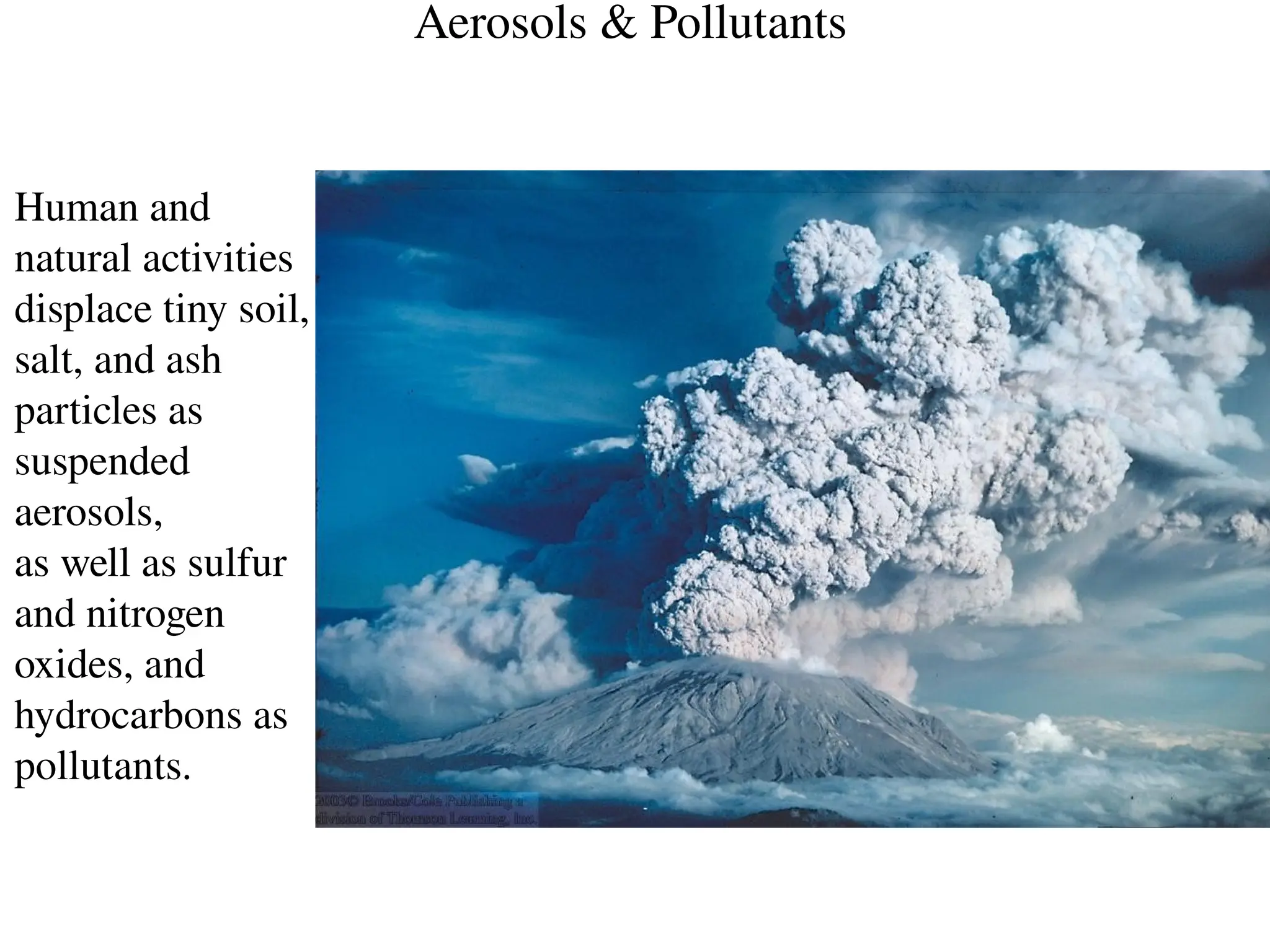
Aerosols & Pollutants
Human and
natural activities
displace tiny soil,
salt, and ash
particles as
suspended
aerosols,
as well as sulfur
and nitrogen
oxides, and
hydrocarbons as
pollutants.
Composition of the
Atmosphere
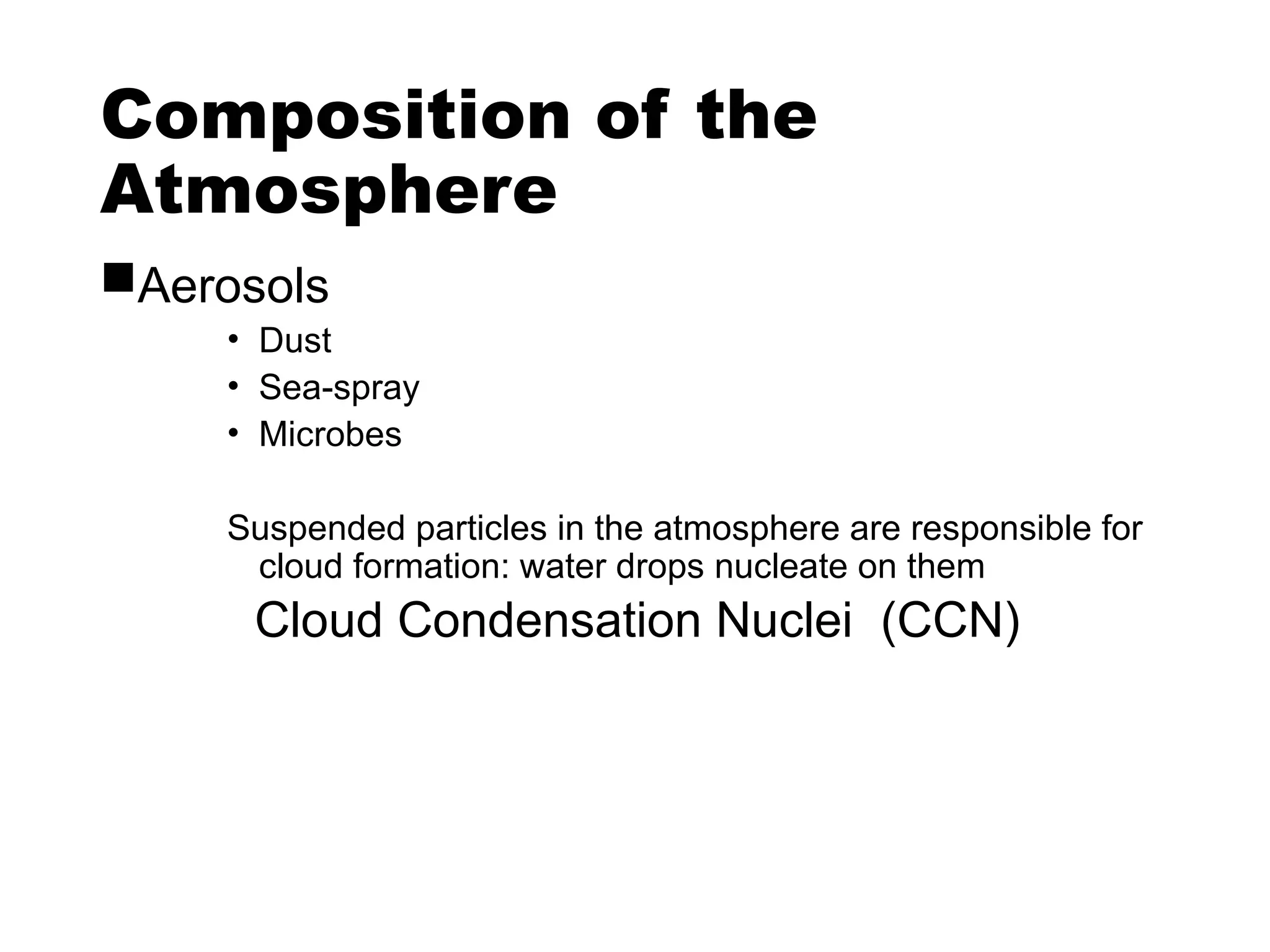
Aerosols
• Dust
• Sea-spray
• Microbes
Suspended particles in the atmosphere are responsible for
cloud formation: water drops nucleate on them
Cloud Condensation Nuclei (CCN)
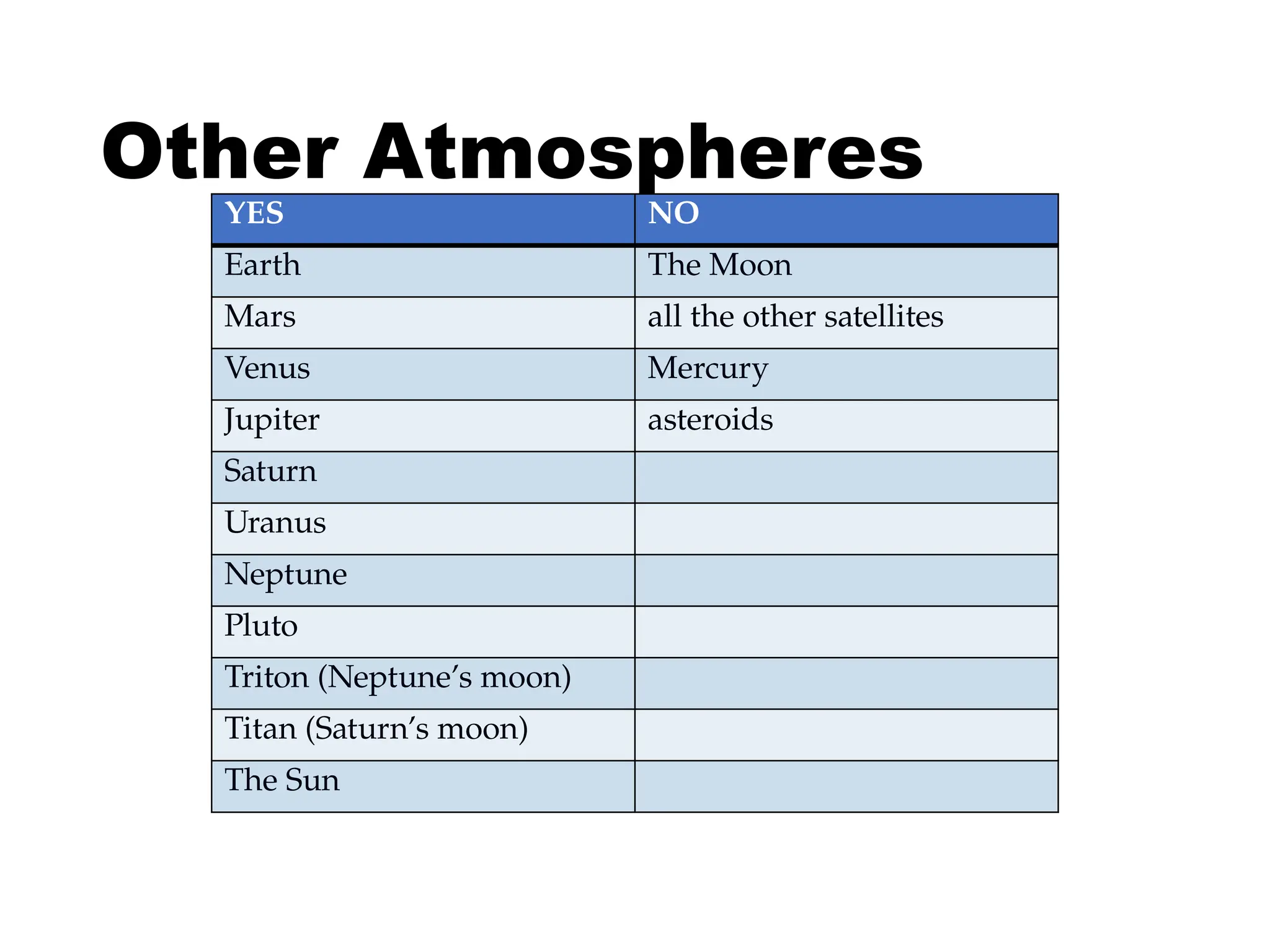
Other Atmospheres
YES NO
Earth The Moon
Mars all the other satellites
Venus Mercury
Jupiter asteroids
Saturn
Uranus
Neptune
Pluto
Triton (Neptune’s moon)
Titan (Saturn’s moon)
The Sun
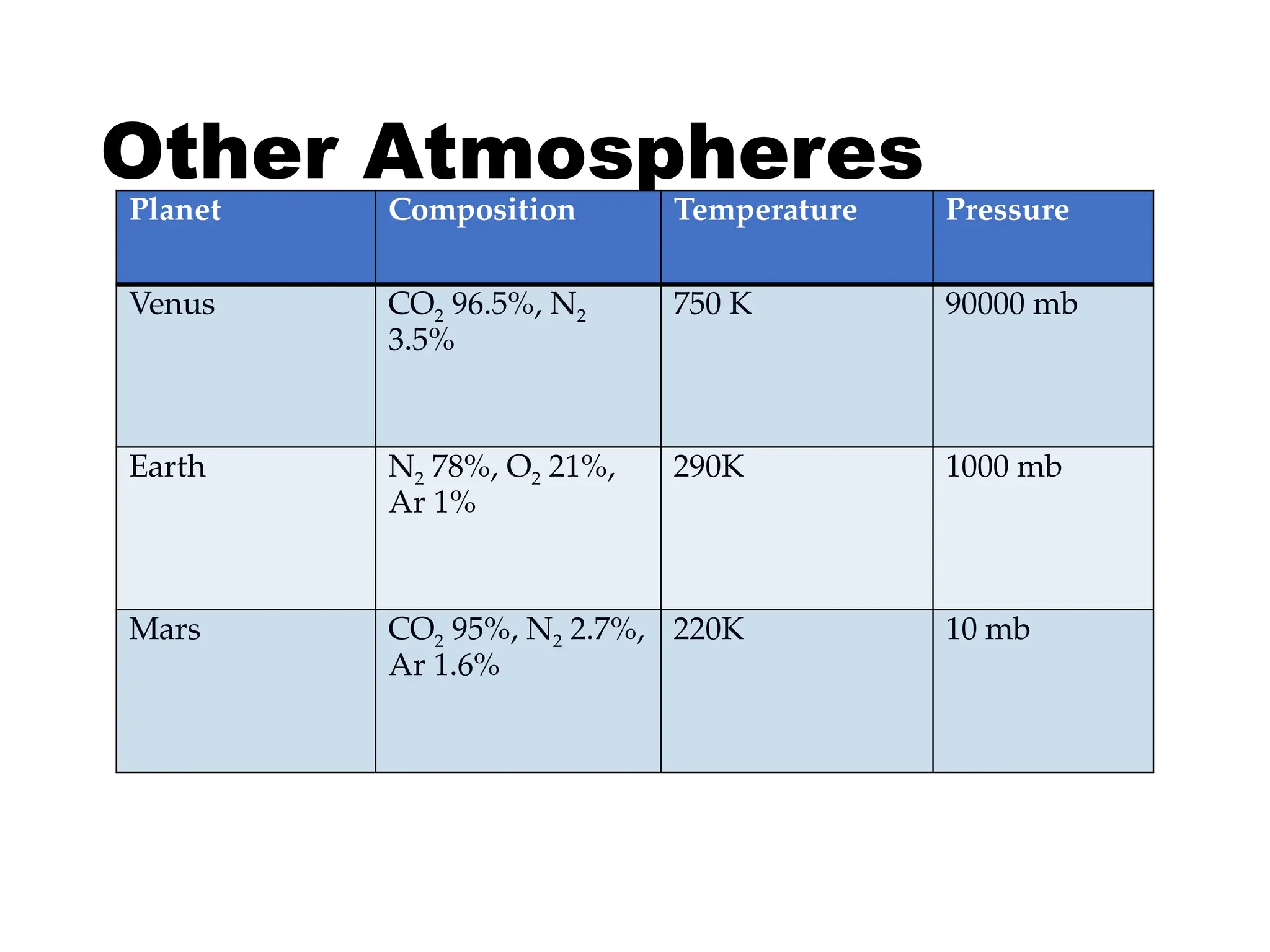
Other Atmospheres
Planet Composition Temperature Pressure
Venus CO2 96.5%, N2
3.5%
750 K 90000 mb
Earth N2 78%, O2 21%,
Ar 1%
290K 1000 mb
Mars CO2 95%, N2 2.7%,
Ar 1.6%
220K 10 mb
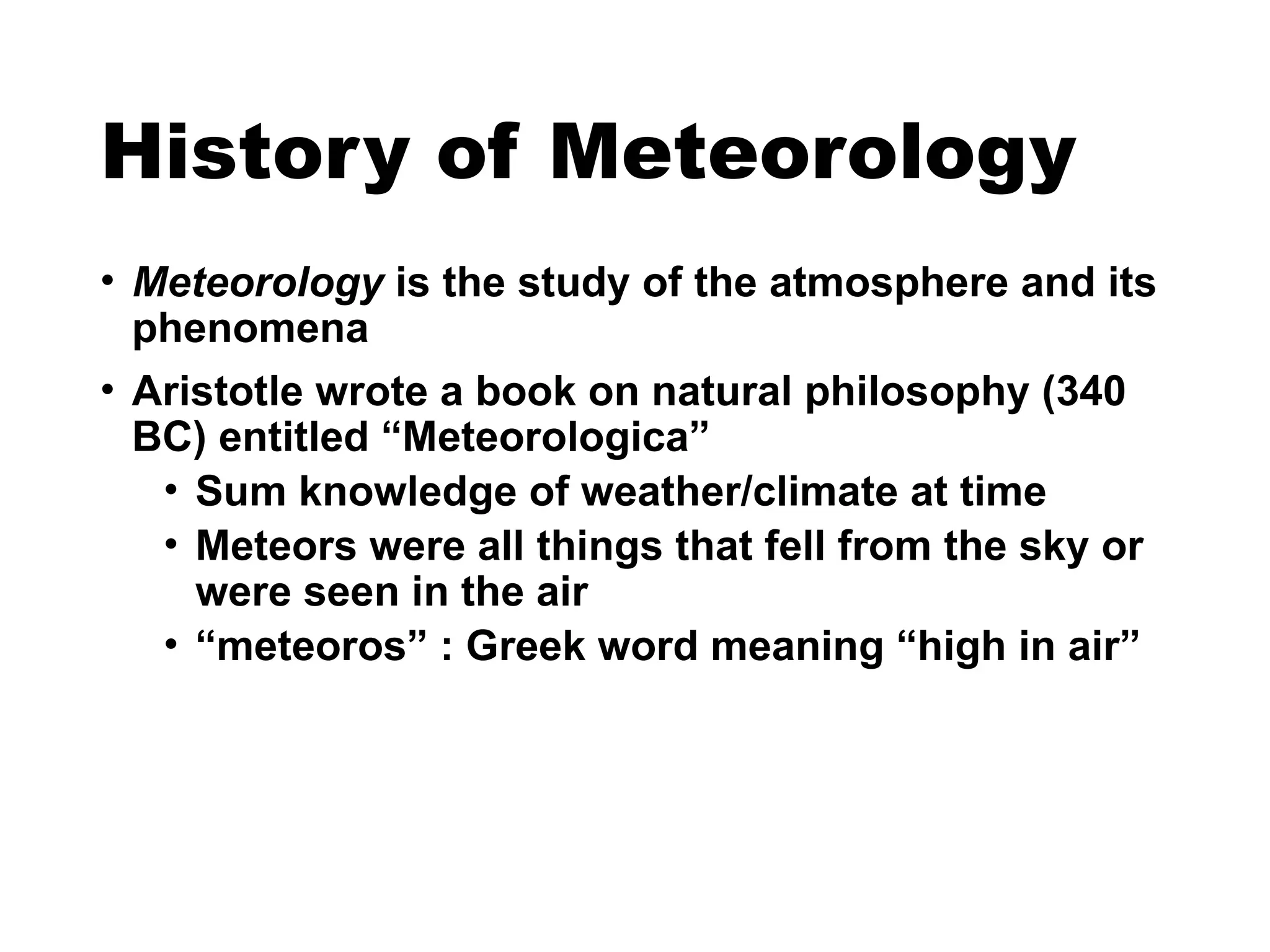
History of Meteorology
• Meteorology is the study of the atmosphere and its
phenomena
• Aristotle wrote a book on natural philosophy (340
BC) entitled “Meteorologica”
• Sum knowledge of weather/climate at time
• Meteors were all things that fell from the sky or
were seen in the air
• “meteoros” : Greek word meaning “high in air”
History of Meteorology
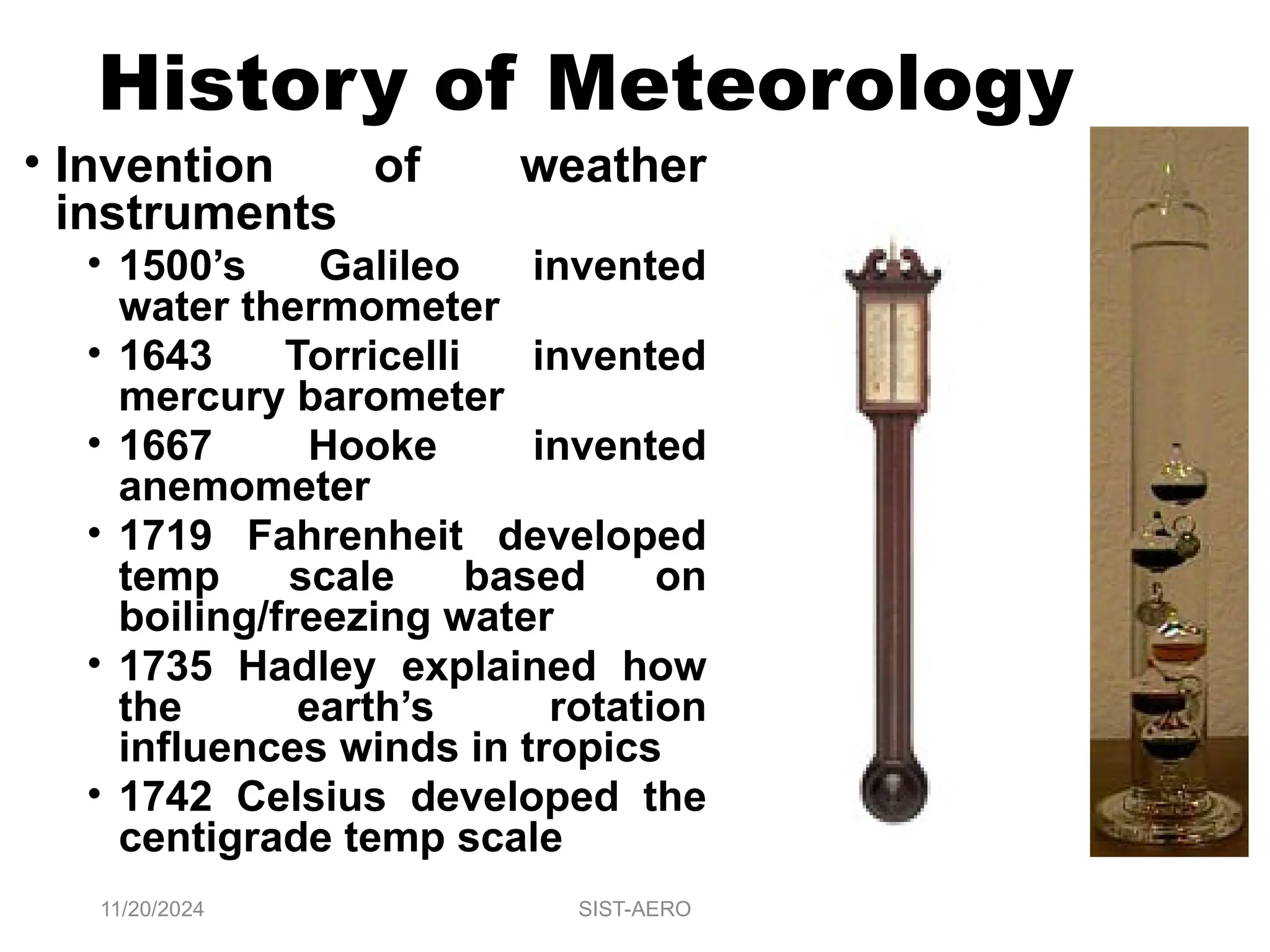
• Invention of weather
instruments
• 1500’s Galileo invented
water thermometer
• 1643 Torricelli invented
mercury barometer
• 1667 Hooke invented
anemometer
• 1719 Fahrenheit developed
temp scale based on
boiling/freezing water
• 1735 Hadley explained how
the earth’s rotation
influences winds in tropics
• 1742 Celsius developed the
centigrade temp scale
11/20/2024 SIST-AERO
History of Meteorology
• 1787 Charles discovered
relationship between temp and
a volume of air
• 1835 Coriolis used math to
demonstrate the effect that the
earth’s rotation has on atmos.
Motions
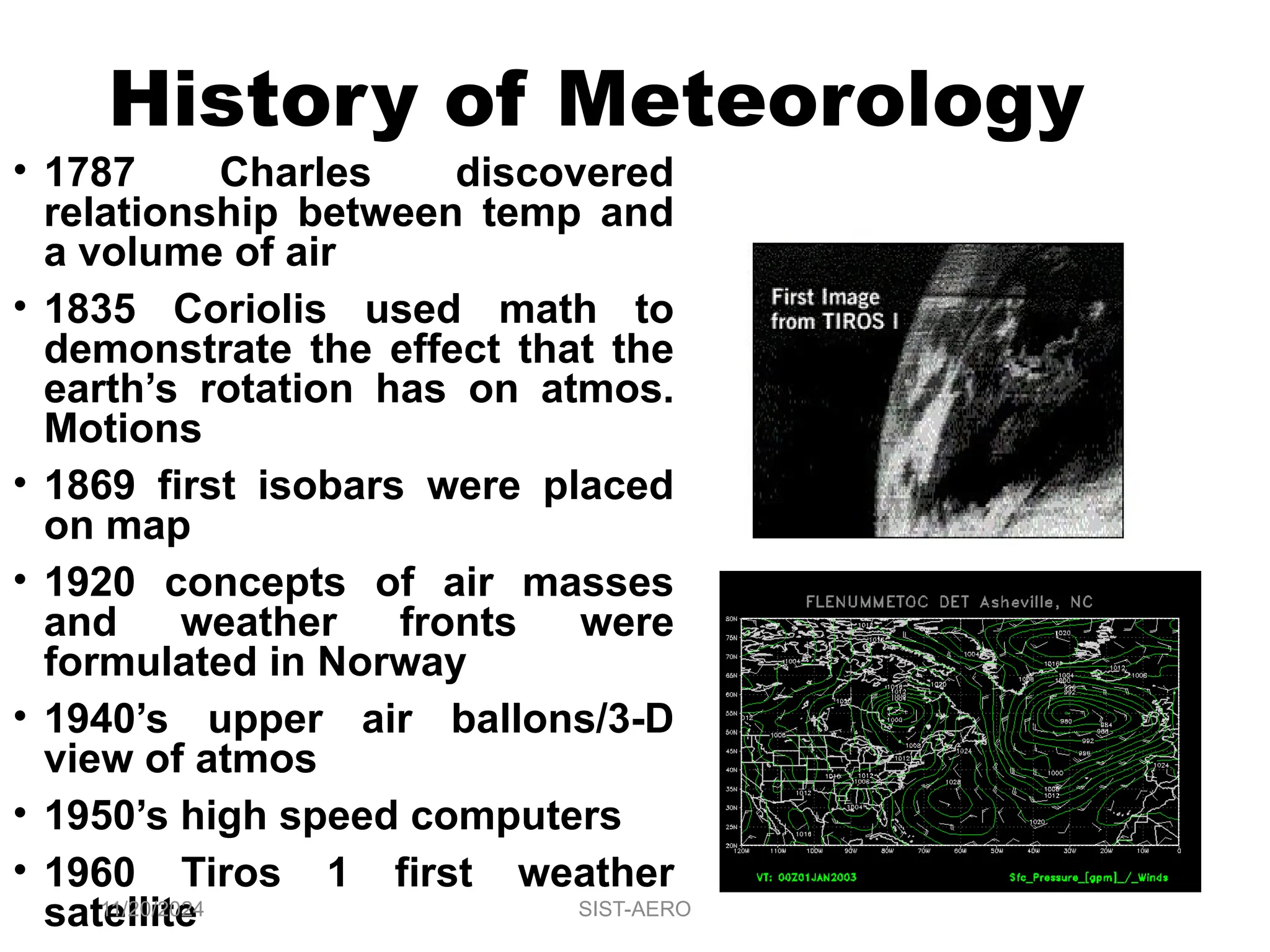
• 1869 first isobars were placed
on map
• 1920 concepts of air masses
and weather fronts were
formulated in Norway
• 1940’s upper air ballons/3-D
view of atmos
• 1950’s high speed computers
• 1960 Tiros 1 first weather
satellite
11/20/2024 SIST-AERO
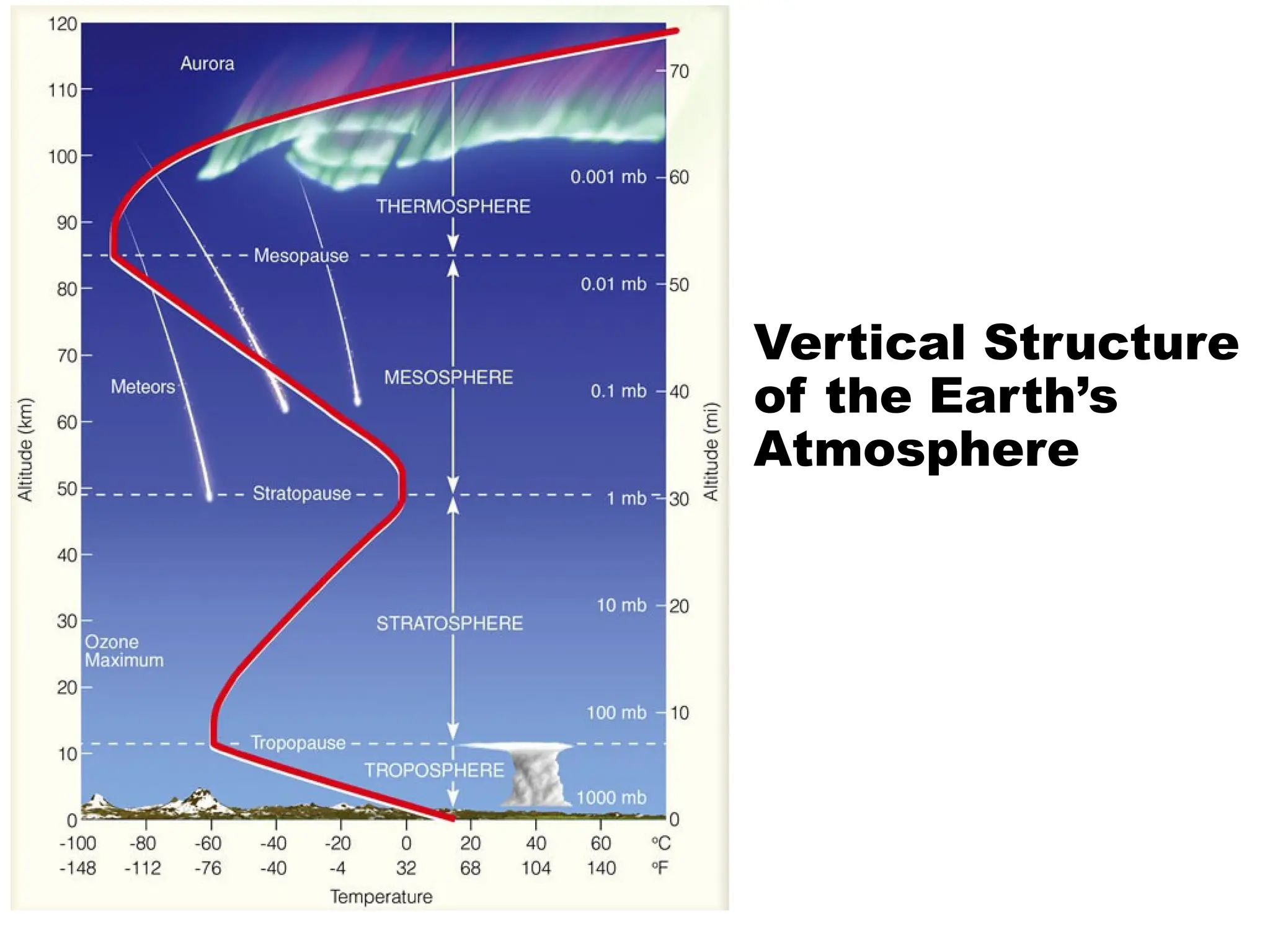
Vertical Structure
of the Earth’s
Atmosphere
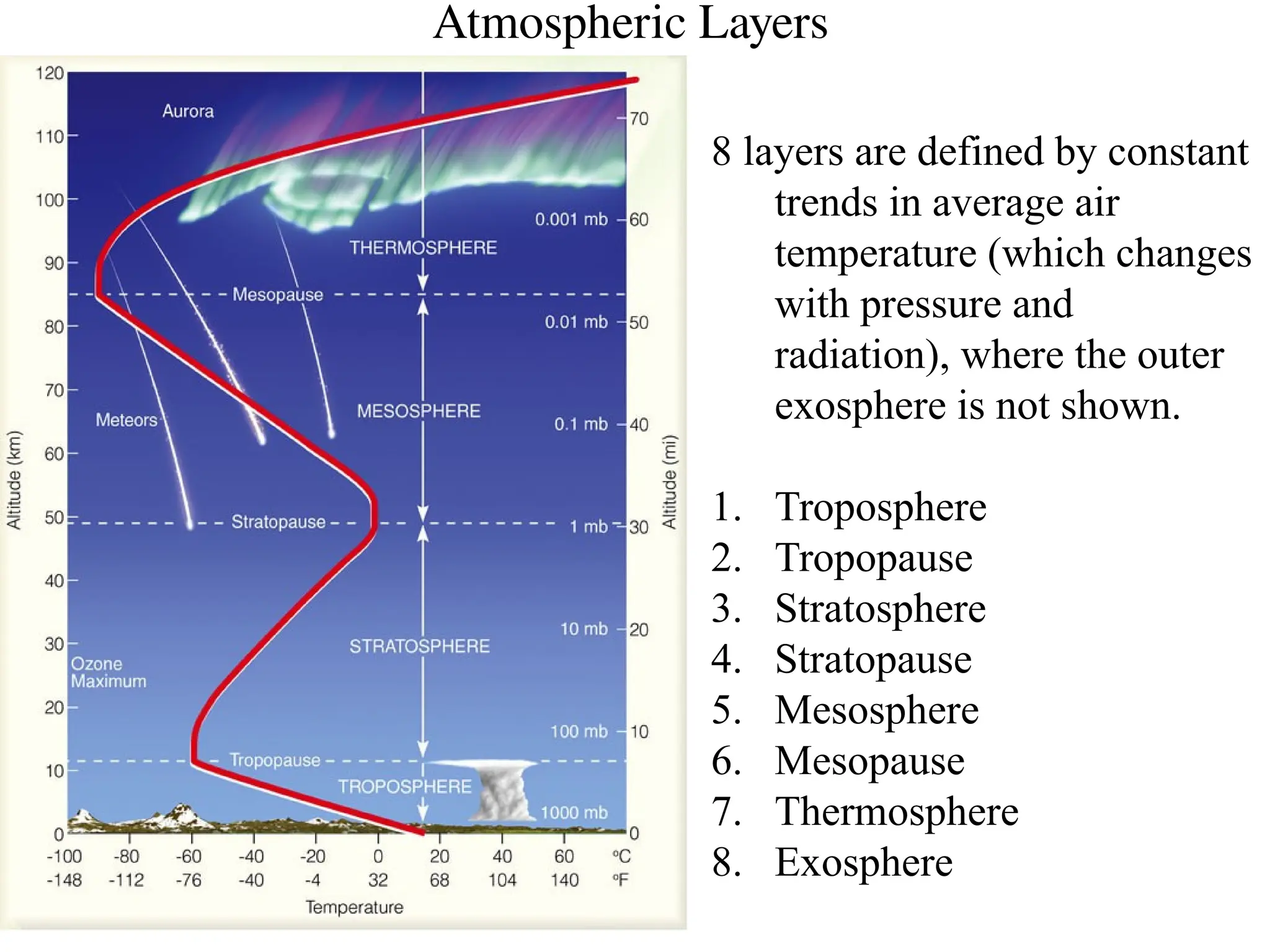
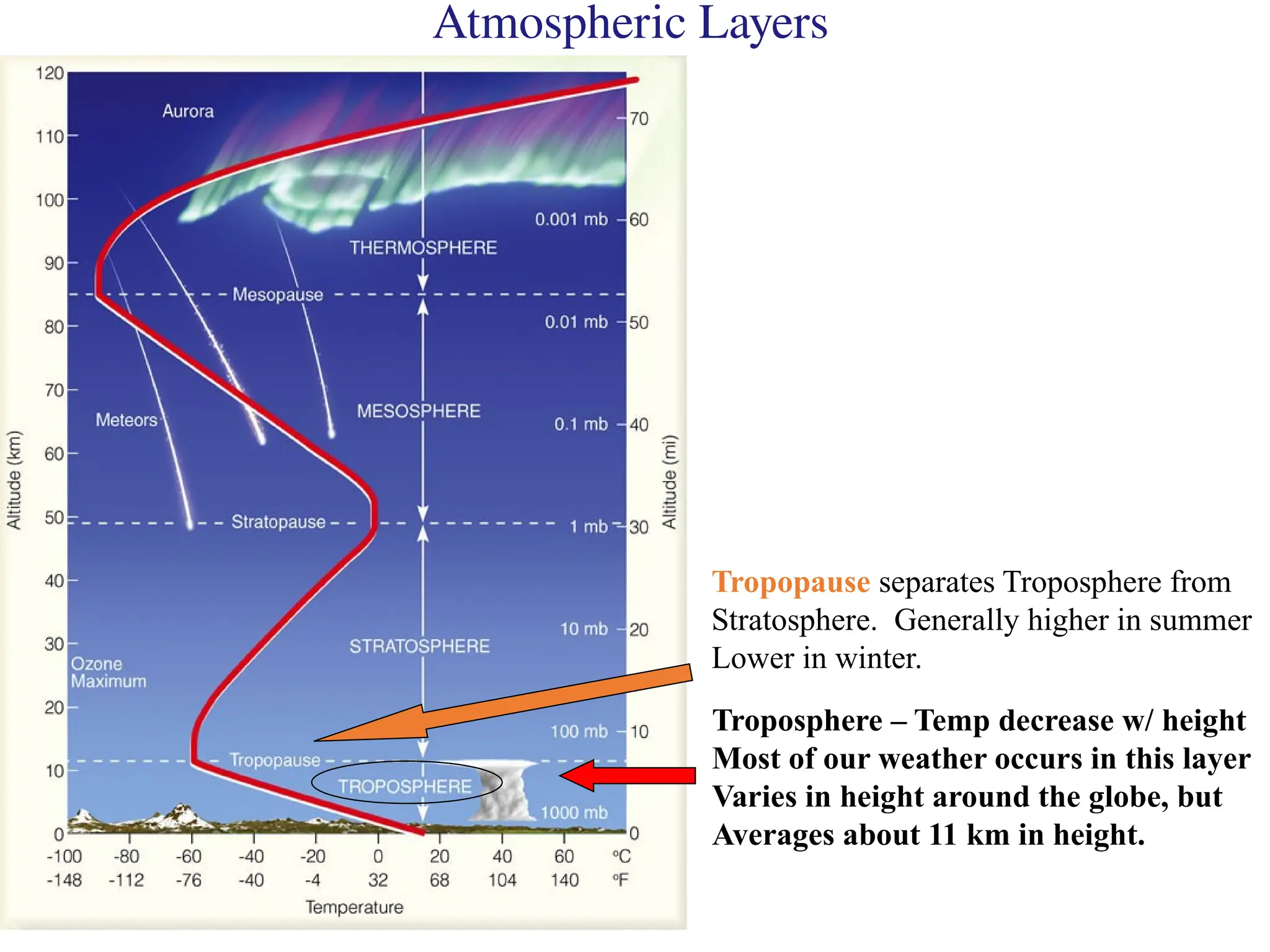
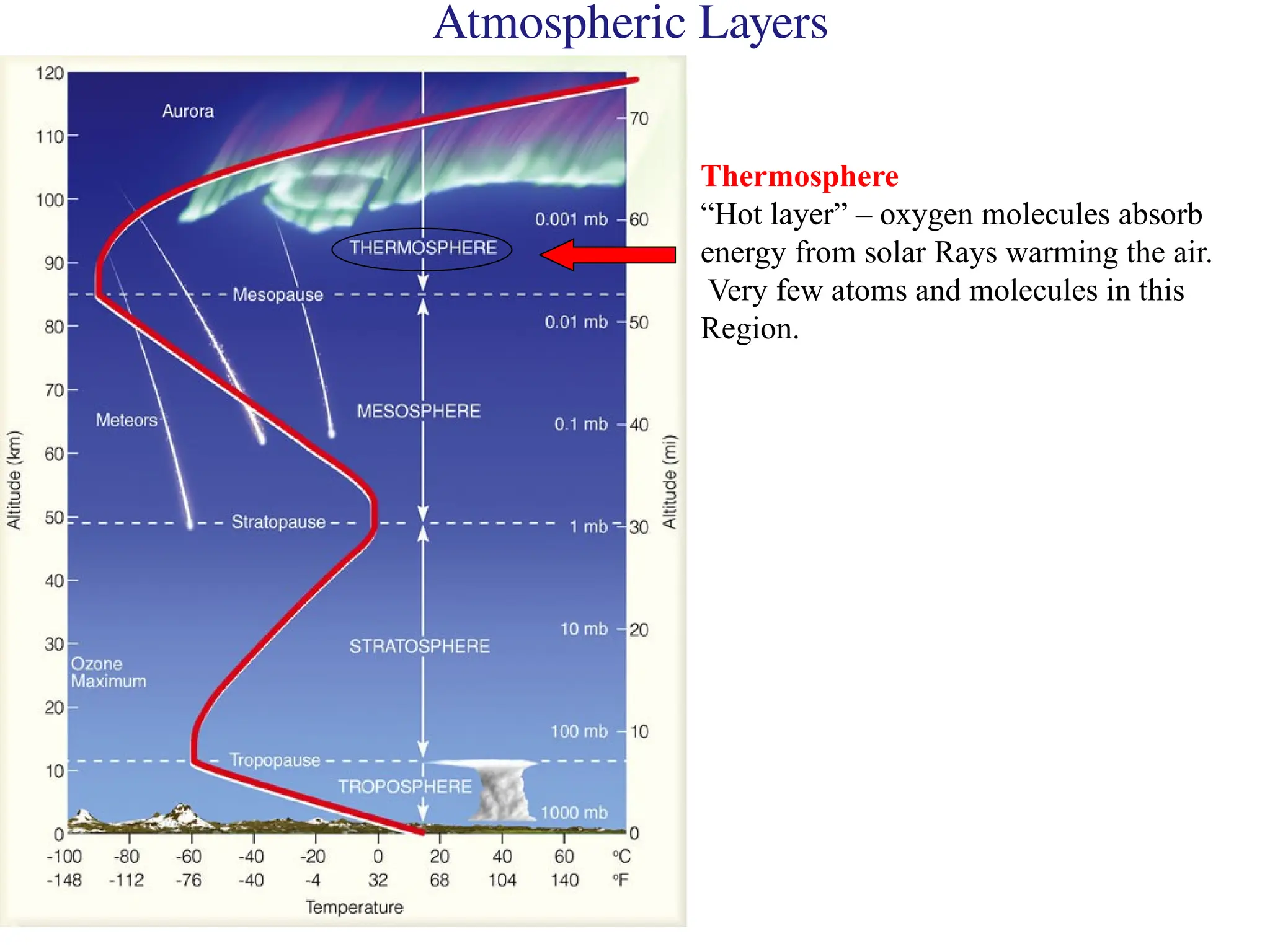
Atmospheric Layers
8 layers are defined by constant
trends in average air
temperature (which changes
with pressure and
radiation), where the outer
exosphere is not shown.
1. Troposphere
2. Tropopause
3. Stratosphere
4. Stratopause
5. Mesosphere
6. Mesopause
7. Thermosphere
8. Exosphere
Atmospheric Layers
Troposphere – Temp decrease w/ height
Most of our weather occurs in this layer
Varies in height around the globe, but
Averages about 11 km in height.
Tropopause separates Troposphere from
Stratosphere. Generally higher in summer
Lower in winter.
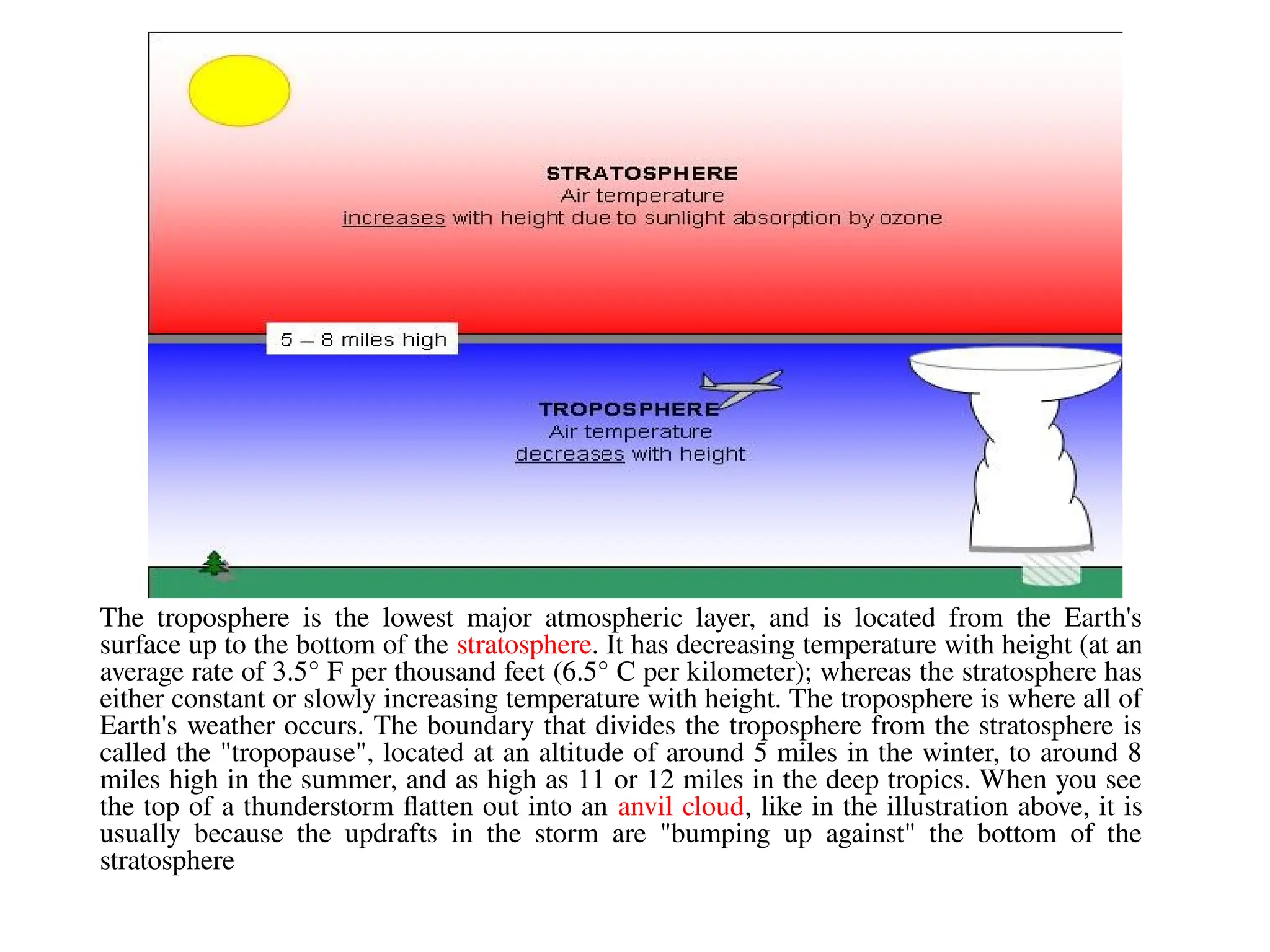
The troposphere is the lowest major atmospheric layer, and is located from the Earth's
surface up to the bottom of the stratosphere. It has decreasing temperature with height (at an
average rate of 3.5° F per thousand feet (6.5° C per kilometer); whereas the stratosphere has
either constant or slowly increasing temperature with height. The troposphere is where all of
Earth's weather occurs. The boundary that divides the troposphere from the stratosphere is
called the "tropopause", located at an altitude of around 5 miles in the winter, to around 8
miles high in the summer, and as high as 11 or 12 miles in the deep tropics. When you see
the top of a thunderstorm flatten out into an anvil cloud, like in the illustration above, it is
usually because the updrafts in the storm are "bumping up against" the bottom of the
stratosphere
Atmospheric Layers
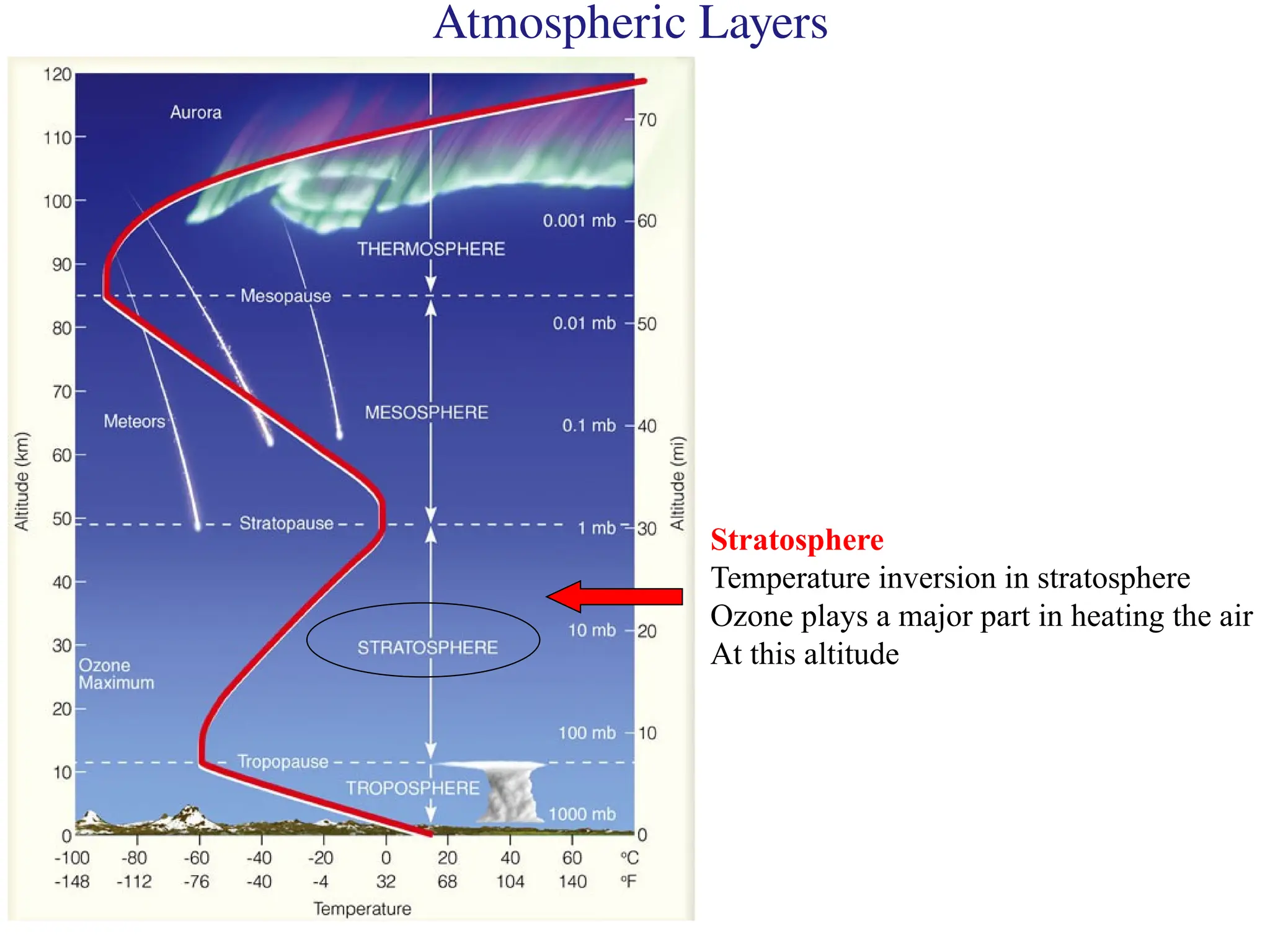
Stratosphere
Temperature inversion in stratosphere
Ozone plays a major part in heating the air
At this altitude
Atmospheric Layers
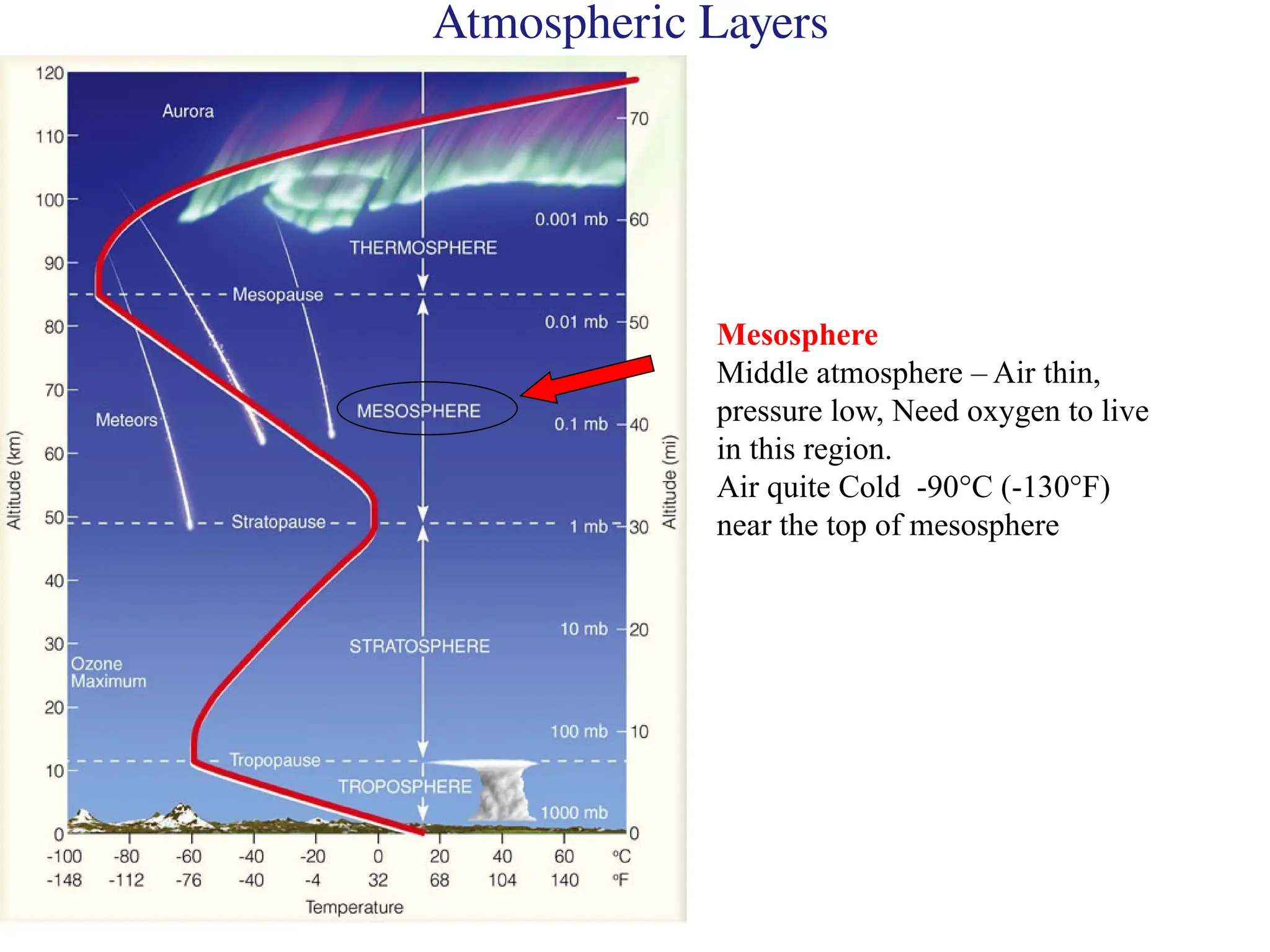
Mesosphere
Middle atmosphere – Air thin,
pressure low, Need oxygen to live
in this region.
Air quite Cold -90°C (-130°F)
near the top of mesosphere
Atmospheric Layers
Thermosphere
“Hot layer” – oxygen molecules absorb
energy from solar Rays warming the air.
Very few atoms and molecules in this
Region.
The Stratosphere and Ozone Layer
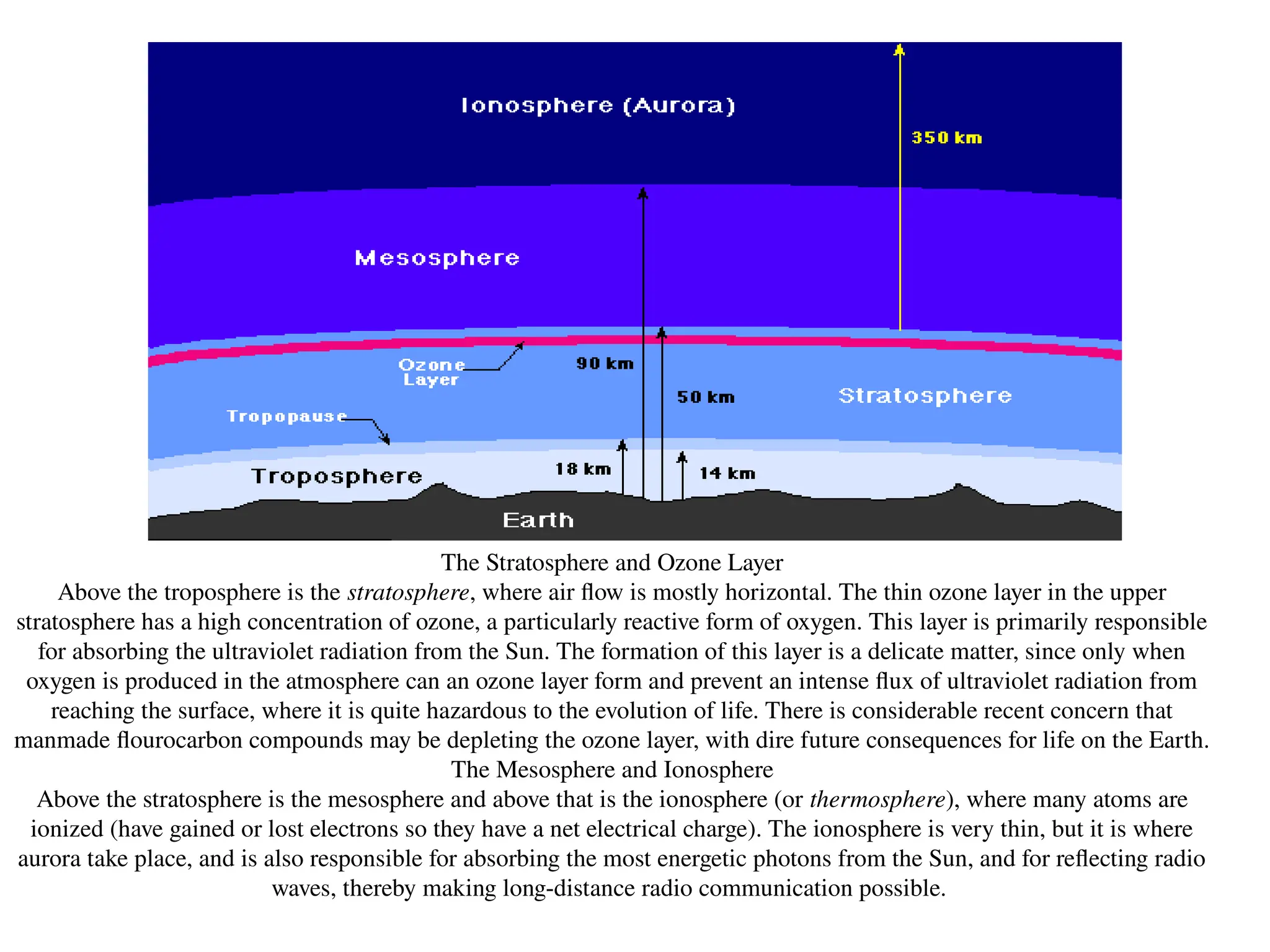
Above the troposphere is the stratosphere, where air flow is mostly horizontal. The thin ozone layer in the upper
stratosphere has a high concentration of ozone, a particularly reactive form of oxygen. This layer is primarily responsible
for absorbing the ultraviolet radiation from the Sun. The formation of this layer is a delicate matter, since only when
oxygen is produced in the atmosphere can an ozone layer form and prevent an intense flux of ultraviolet radiation from
reaching the surface, where it is quite hazardous to the evolution of life. There is considerable recent concern that
manmade flourocarbon compounds may be depleting the ozone layer, with dire future consequences for life on the Earth.
The Mesosphere and Ionosphere
Above the stratosphere is the mesosphere and above that is the ionosphere (or thermosphere), where many atoms are
ionized (have gained or lost electrons so they have a net electrical charge). The ionosphere is very thin, but it is where
aurora take place, and is also responsible for absorbing the most energetic photons from the Sun, and for reflecting radio
waves, thereby making long-distance radio communication possible.
A Brief Look at Air Pressure
and Air Density
• air density (ρ pronounced “row”)
• air pressure (p)
• sea-level pressure (ps)
• Baseballs travel farther in higher-altitude air (Denver)
than they do in lower-altitude air.
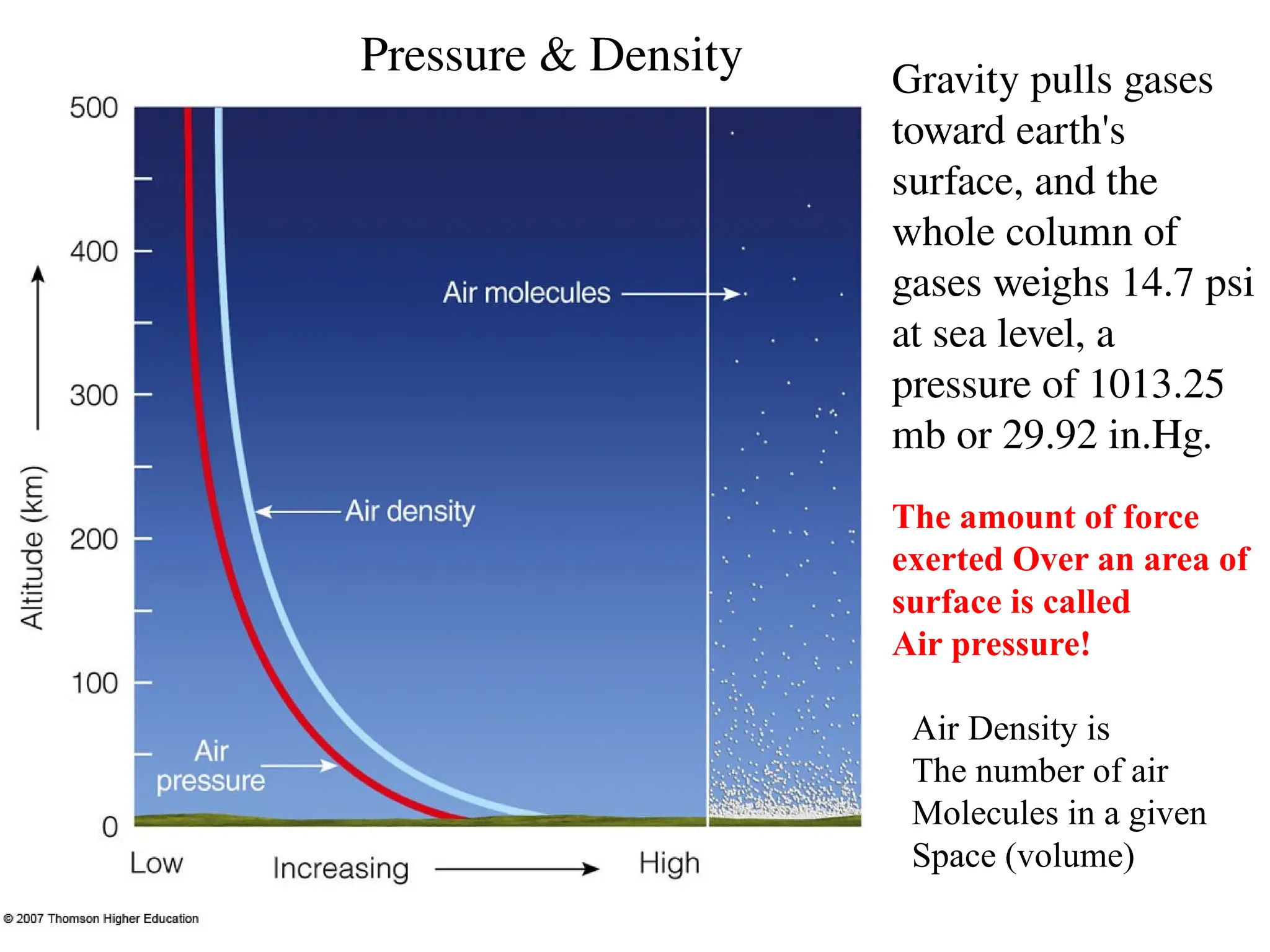
Pressure & Density Gravity pulls gases
toward earth's
surface, and the
whole column of
gases weighs 14.7 psi
at sea level, a
pressure of 1013.25
mb or 29.92 in.Hg.
Air Density is
The number of air
Molecules in a given
Space (volume)
The amount of force
exerted Over an area of
surface is called
Air pressure!
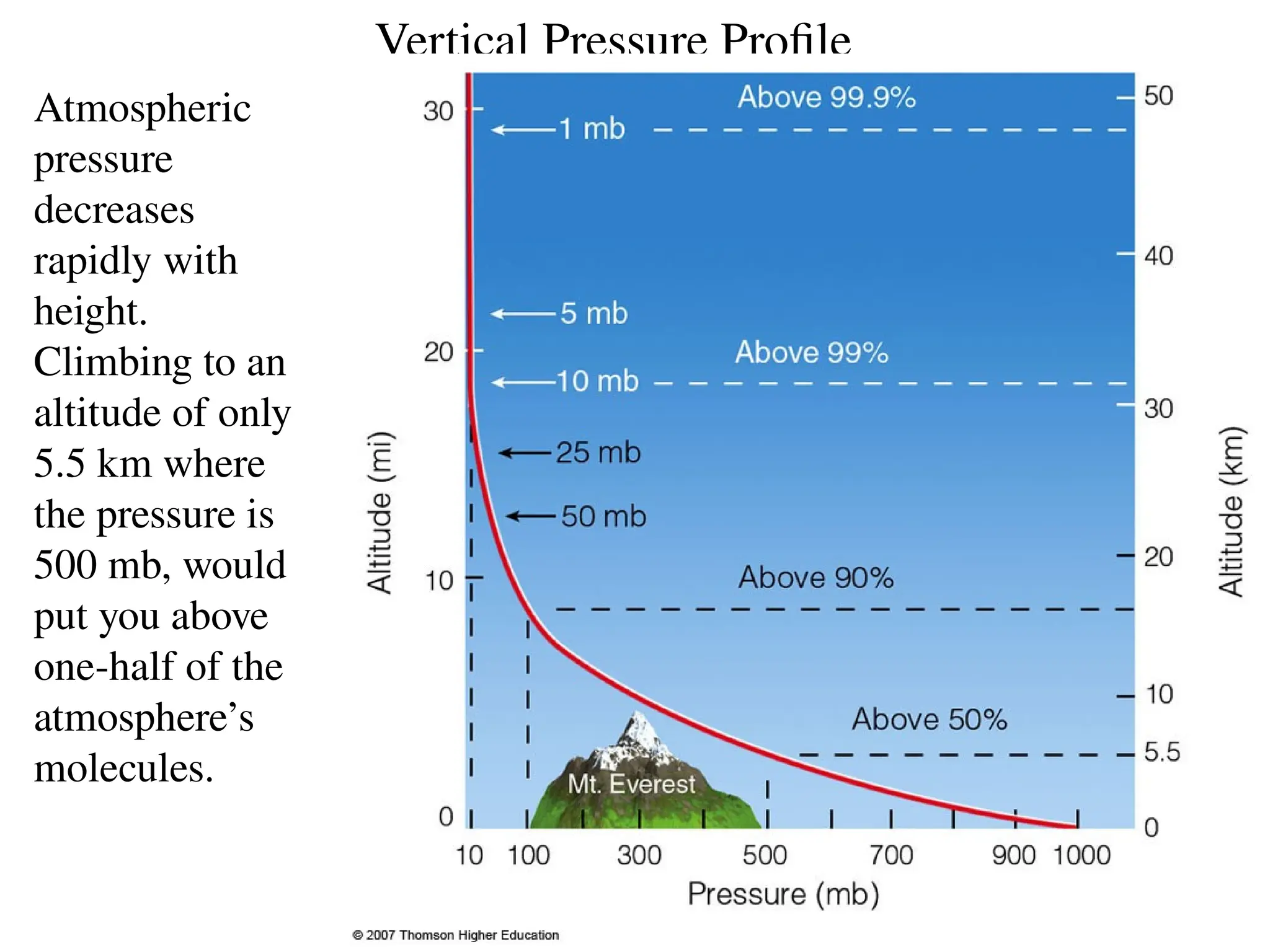
Vertical Pressure Profile
Atmospheric
pressure
decreases
rapidly with
height.
Climbing to an
altitude of only
5.5 km where
the pressure is
500 mb, would
put you above
one-half of the
atmosphere’s
molecules.
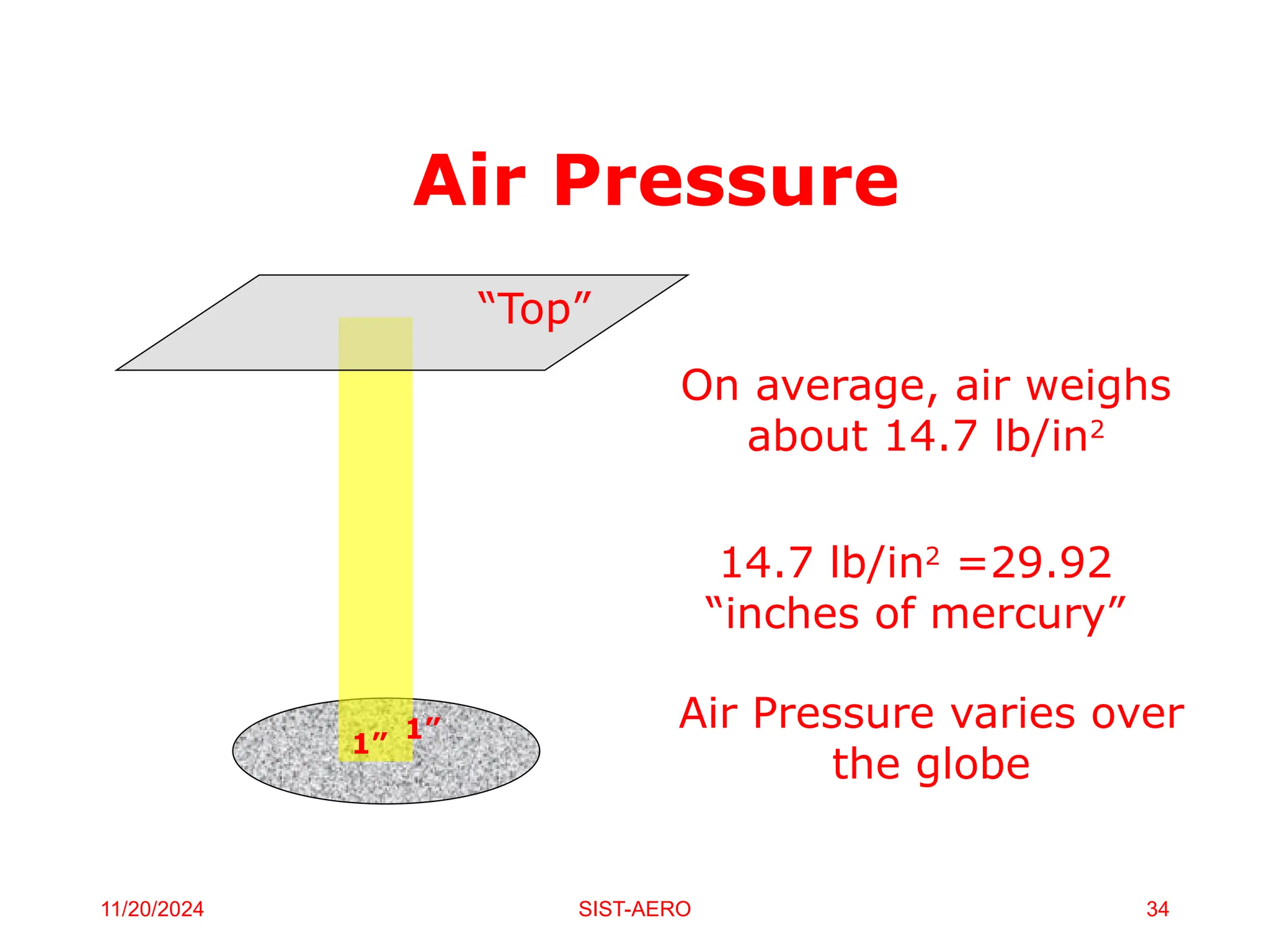
Air Pressure
On average, air weighs
about 14.7 lb/in2
14.7 lb/in2
=29.92
“inches of mercury”
Air Pressure varies over
the globe
1”
1”
“Top”
11/20/2024 SIST-AERO 34
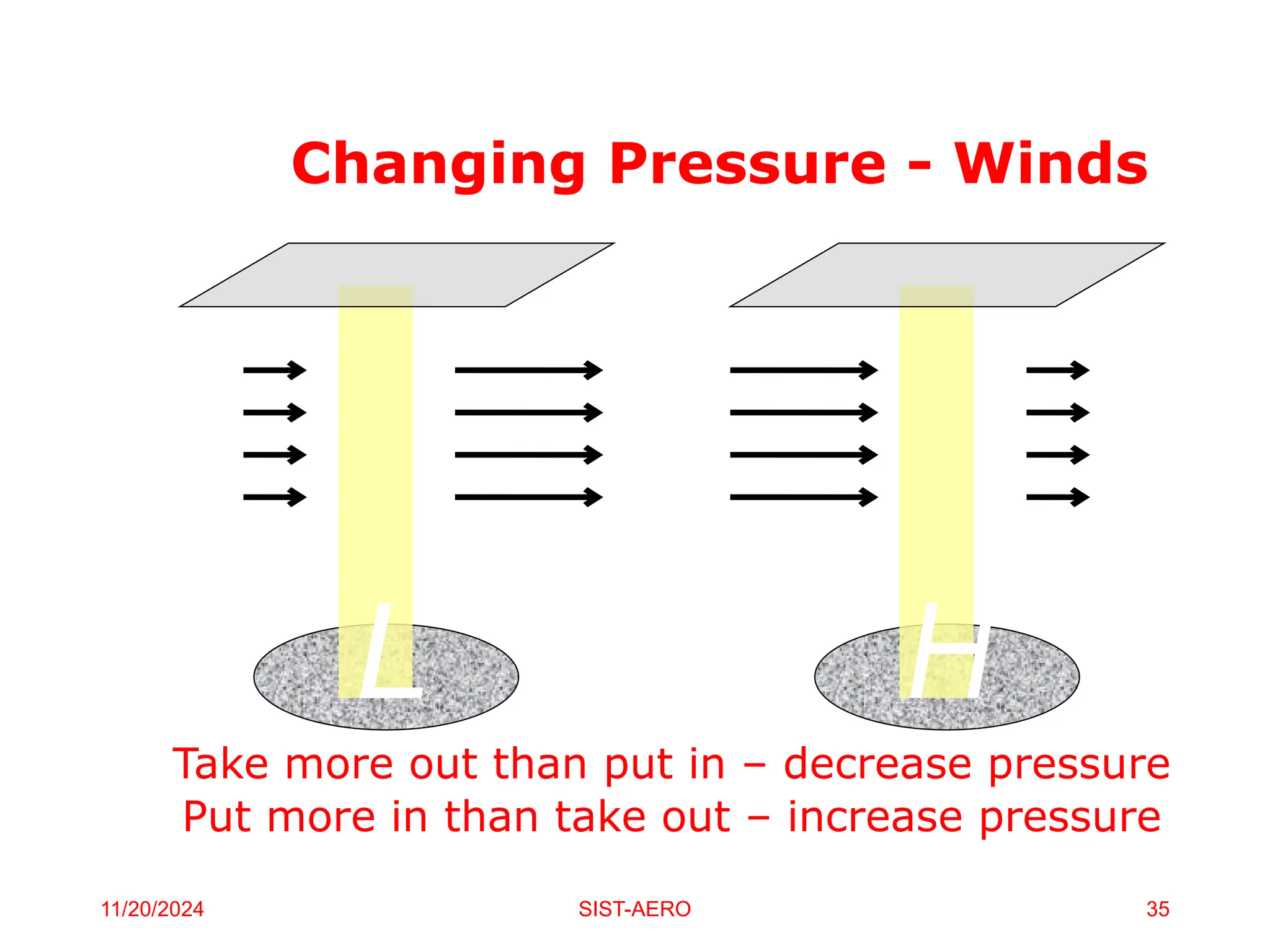
Changing Pressure - Winds
Take more out than put in – decrease pressure
Put more in than take out – increase pressure
11/20/2024 SIST-AERO 35
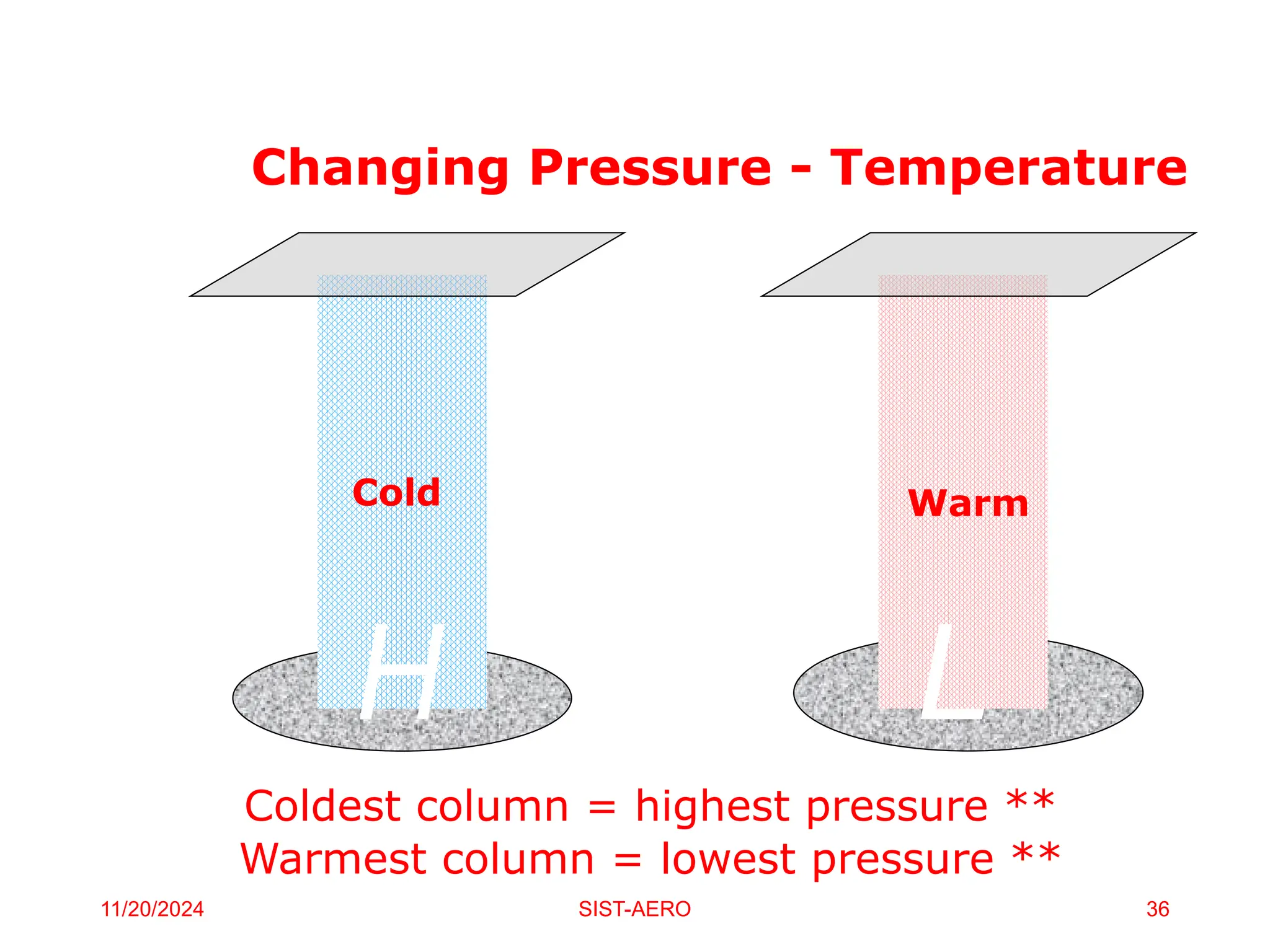
Changing Pressure - Temperature
Cold Warm
Coldest column = highest pressure **
Warmest column = lowest pressure **
11/20/2024 SIST-AERO 36
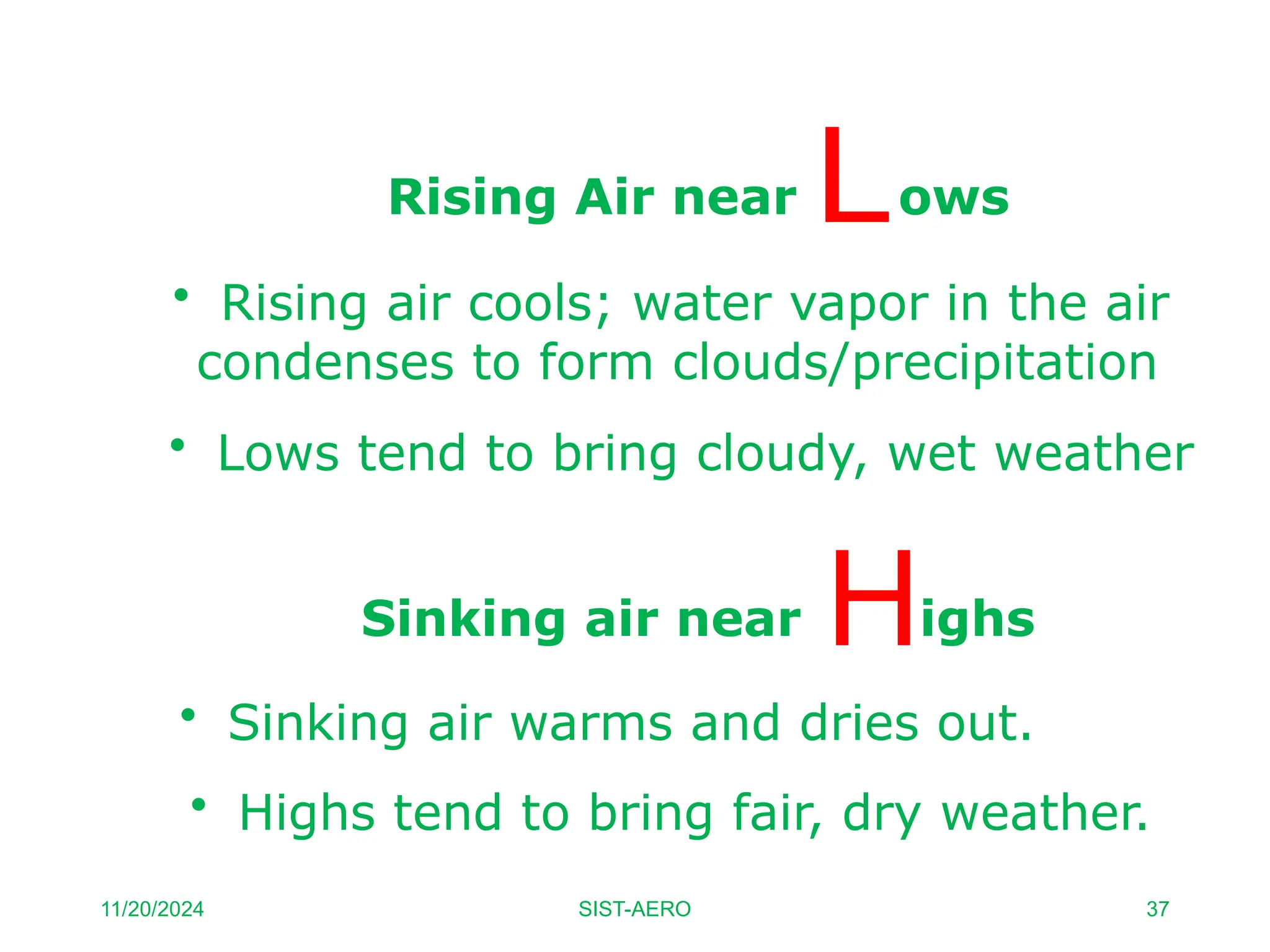
• Lows tend to bring cloudy, wet weather
• Highs tend to bring fair, dry weather.
Rising Air near ows
• Rising air cools; water vapor in the air
condenses to form clouds/precipitation
Sinking air near ighs
• Sinking air warms and dries out.
11/20/2024 SIST-AERO 37
Some Fundamentals
• Earth is heated unevenly: Tropics are
warmer than the Polar Regions.
• Nature tries to try to even out
temperature differences.
• Uneven heating sets atmosphere in
motion and is the fundamental cause
of all weather.
11/20/2024 SIST-AERO 38
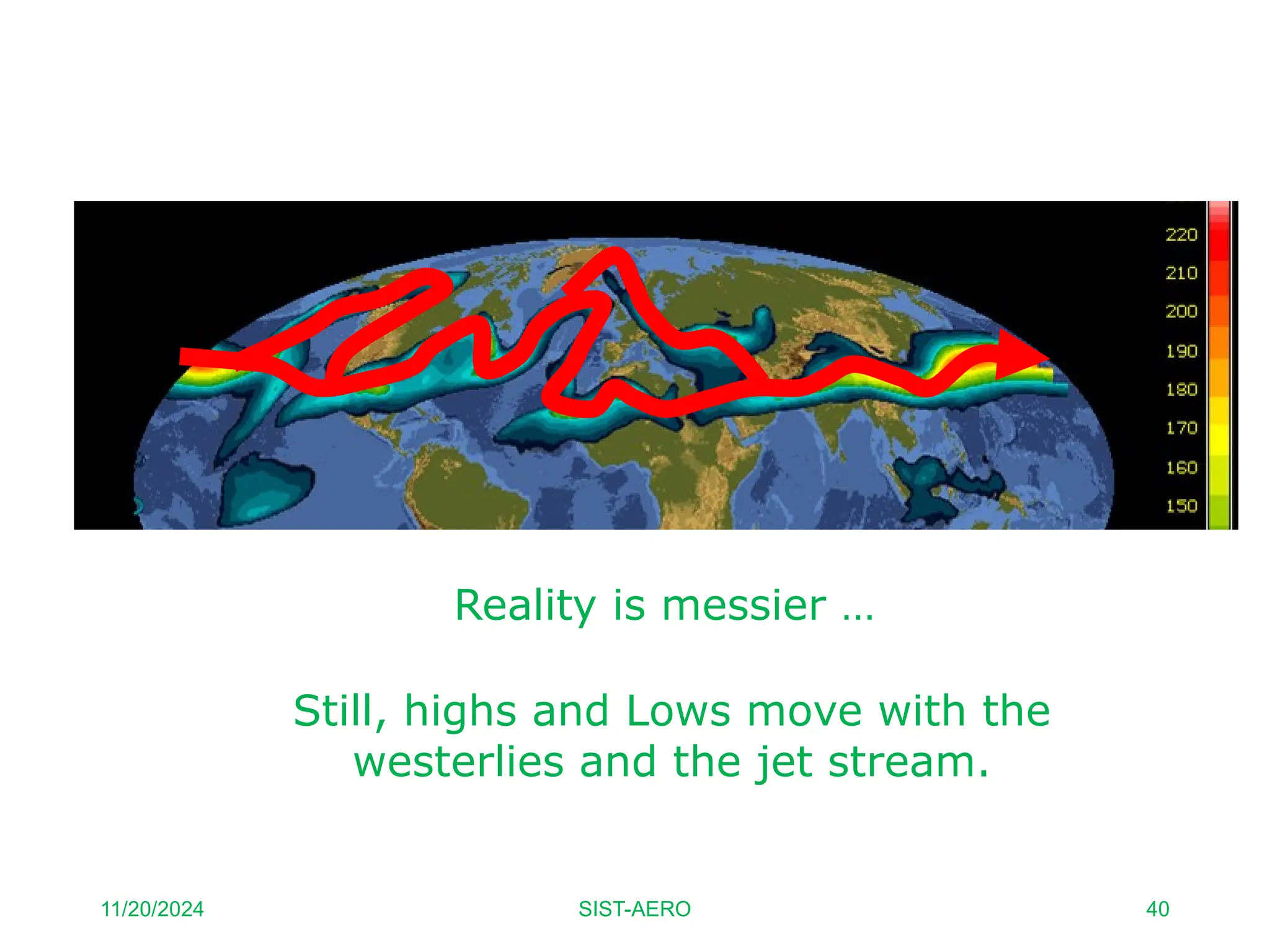
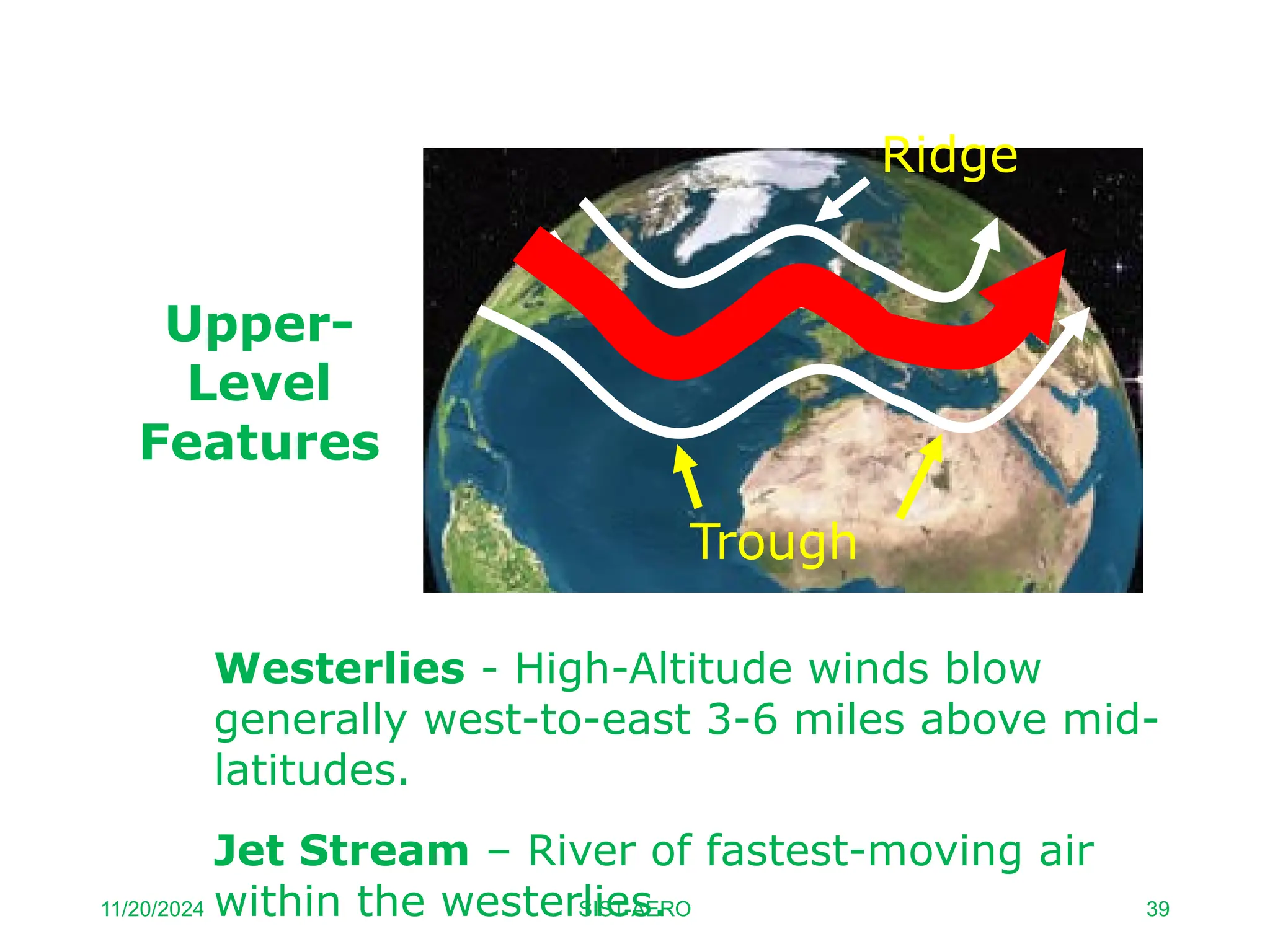
Westerlies - High-Altitude winds blow
generally west-to-east 3-6 miles above mid-
latitudes.
Jet Stream – River of fastest-moving air
within the westerlies.
Ridge
Trough
Upper-
Level
Features
11/20/2024 SIST-AERO 39
Reality is messier …
Still, highs and Lows move with the
westerlies and the jet stream.
11/20/2024 SIST-AERO 40
Weather vs. Climate
Weather is the dynamical
way in which the
atmosphere maintains the
equilibrium climate.
Elements of Weather
air temperature
air pressure
humidity
clouds
precipitation
visibility
wind
• Certain weather elements, like
clouds, visibility and wind, are
of particular interest to pilots.
Climate
Average weather
• time-average
• regional (spatial) average
Extremes
Trends
• Climate represents long-term
(e.g. 30 yr) averages of weather.
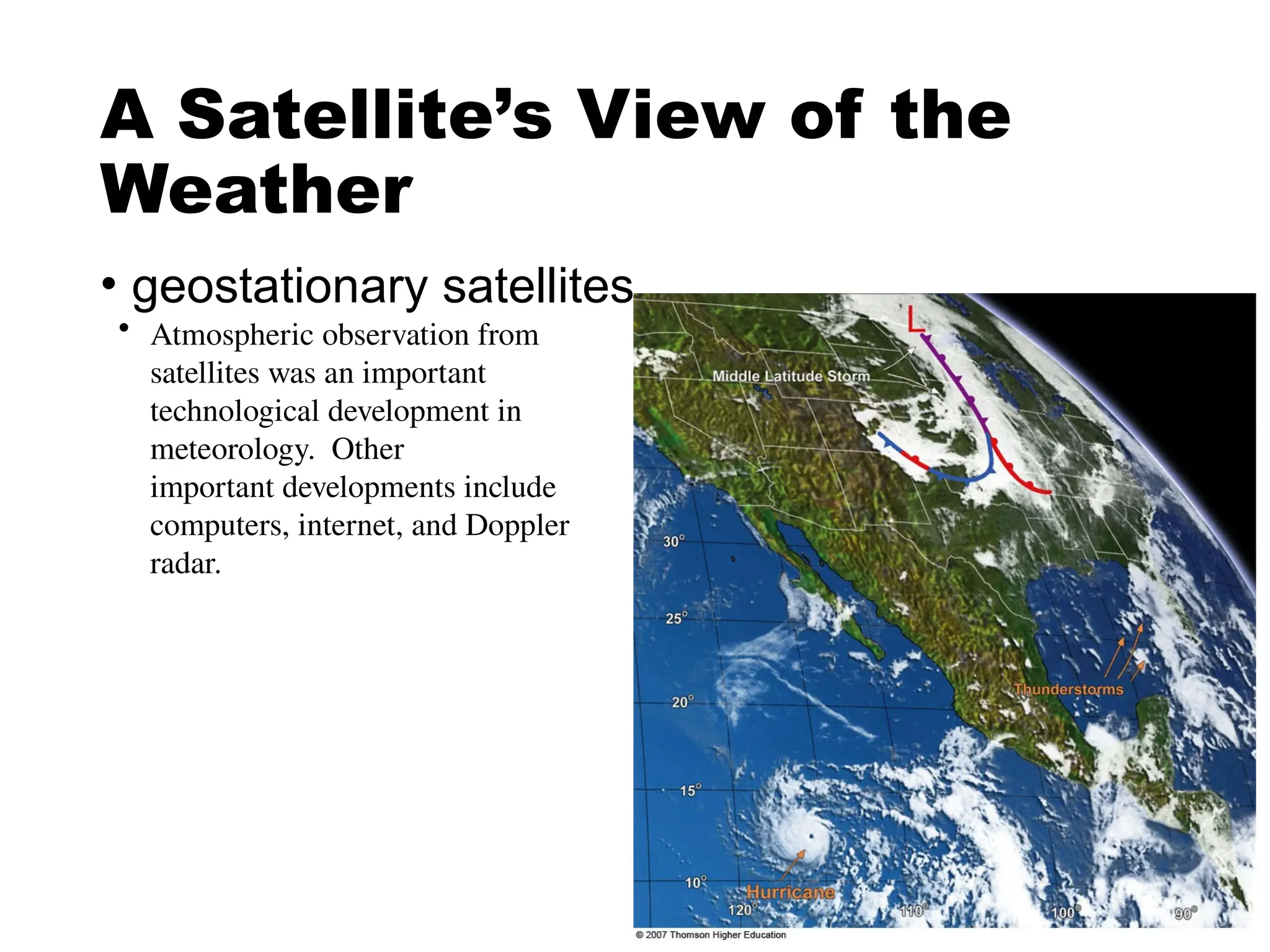
A Satellite’s View of the
Weather
• geostationary satellites
• Atmospheric observation from
satellites was an important
technological development in
meteorology. Other
important developments include
computers, internet, and Doppler
radar.
Storms of all Sizes
midlatitude cyclonic storms
hurricanes and tropical storms
thunderstorms
tornadoes
• Storms are very exciting, but they also play an important role in
moving heat and moisture around throughout the atmosphere.
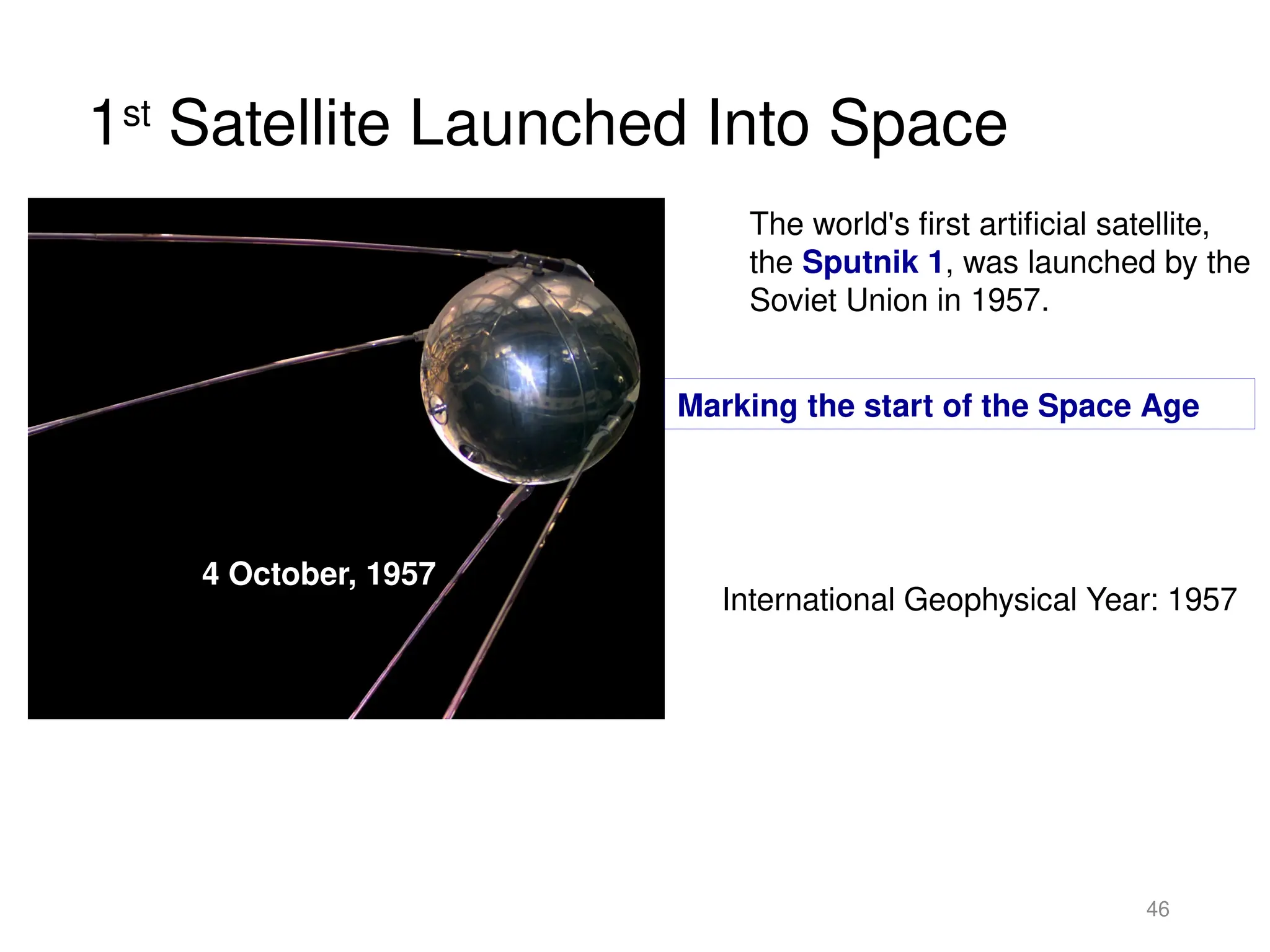
1st
Satellite Launched Into Space
46
The world's first artificial satellite,
the Sputnik 1, was launched by the
Soviet Union in 1957.
4 October, 1957
Marking the start of the Space Age
International Geophysical Year: 1957
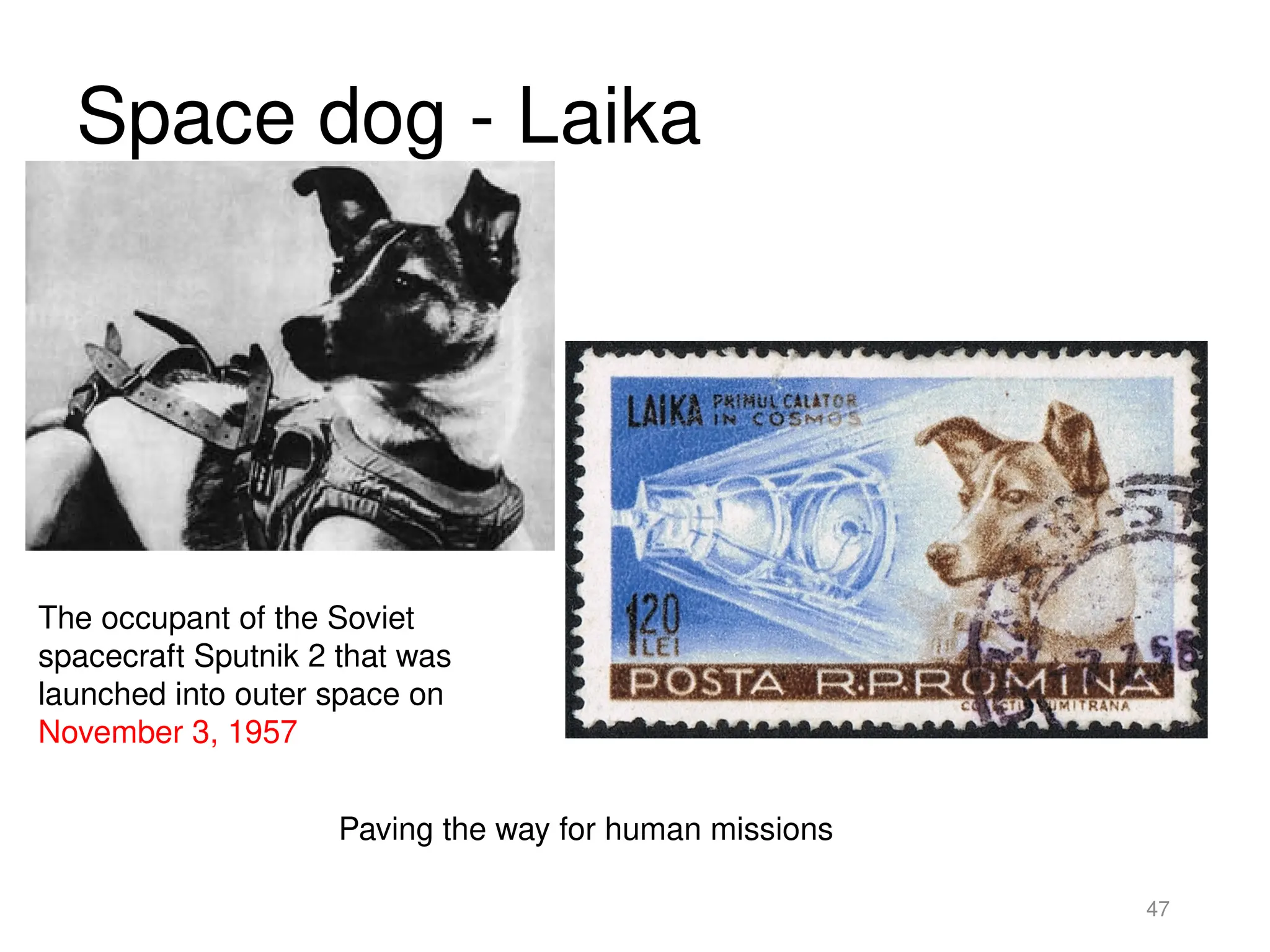
Space dog - Laika
47
The occupant of the Soviet
spacecraft Sputnik 2 that was
launched into outer space on
November 3, 1957
Paving the way for human missions
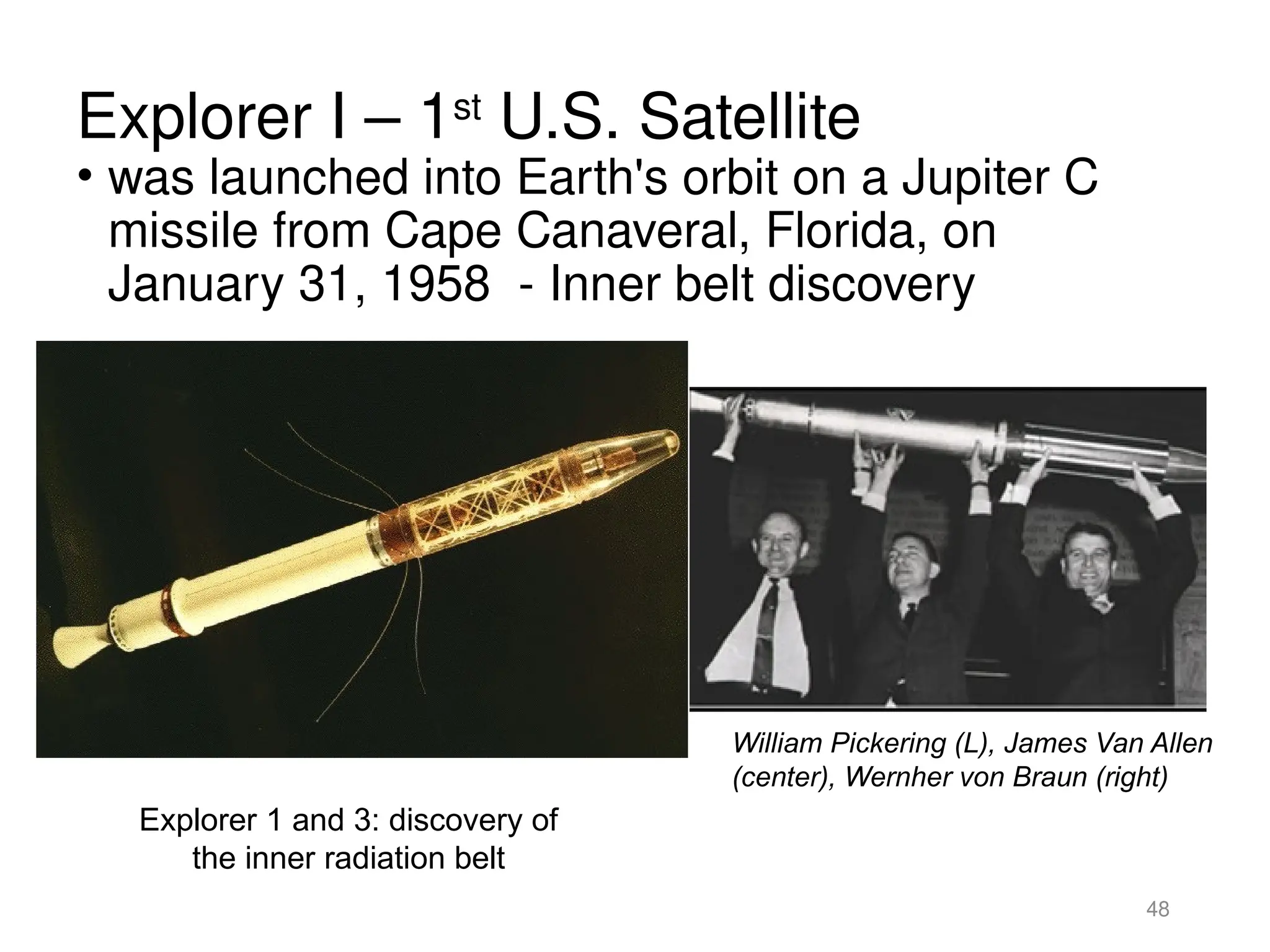
Explorer I – 1st
U.S. Satellite
• was launched into Earth's orbit on a Jupiter C
missile from Cape Canaveral, Florida, on
January 31, 1958 - Inner belt discovery
48
Explorer 1 and 3: discovery of
the inner radiation belt
William Pickering (L), James Van Allen
(center), Wernher von Braun (right)
11/20/2024 SIST-AERO 49
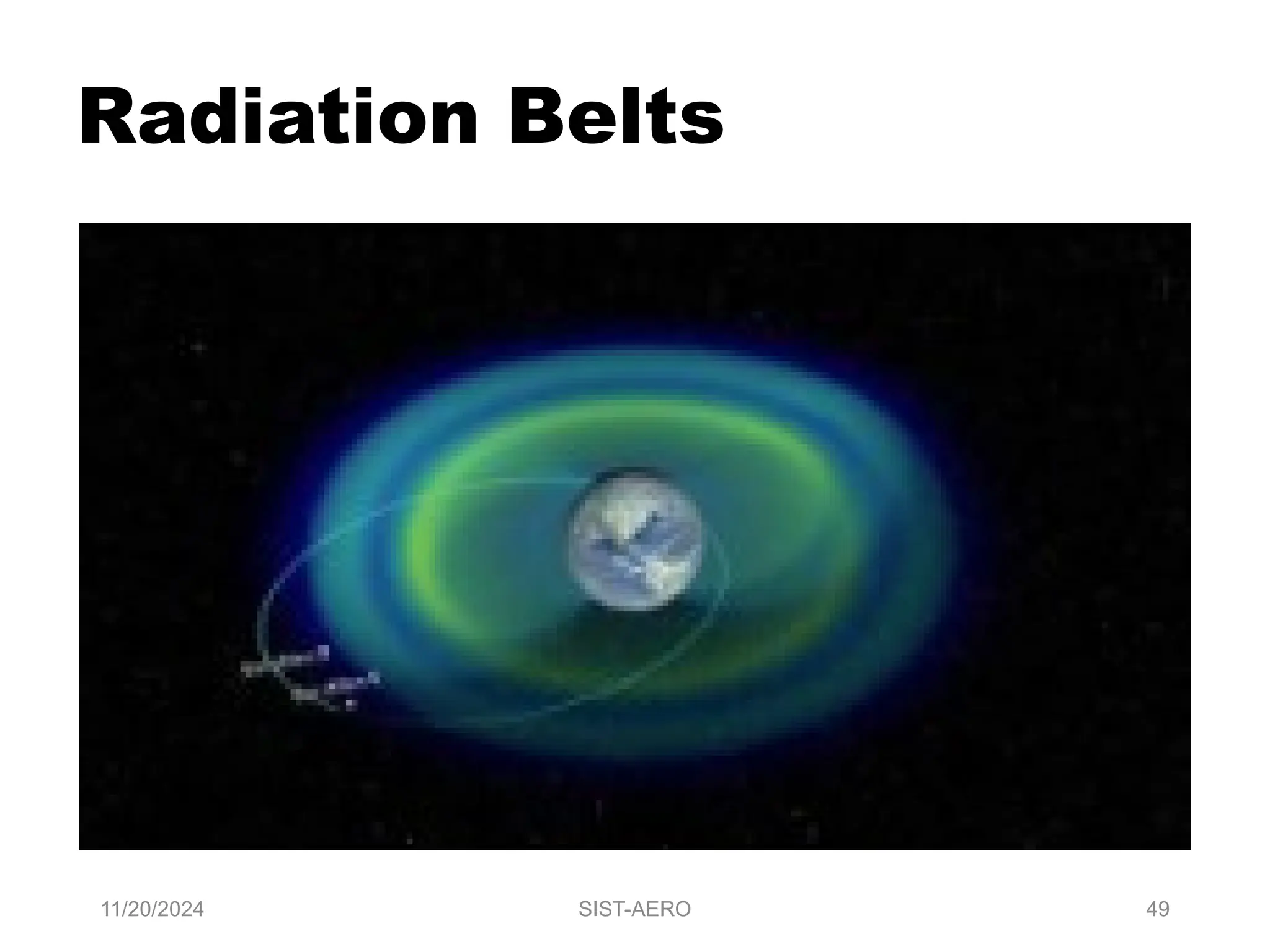
Radiation Belts
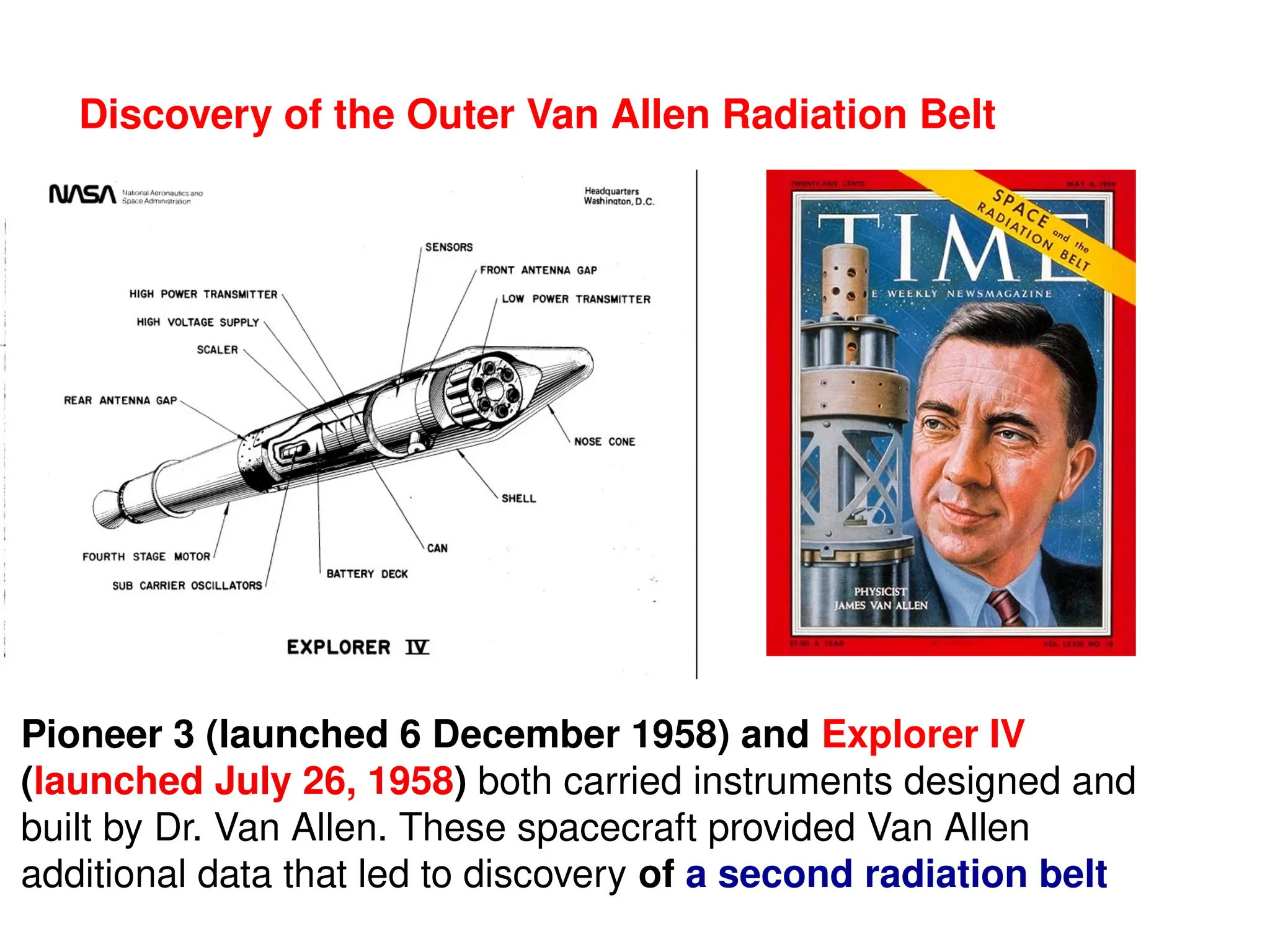
Discovery of the Outer Van Allen Radiation Belt
Pioneer 3 (launched 6 December 1958) and Explorer IV
(launched July 26, 1958) both carried instruments designed and
built by Dr. Van Allen. These spacecraft provided Van Allen
additional data that led to discovery of a second radiation belt
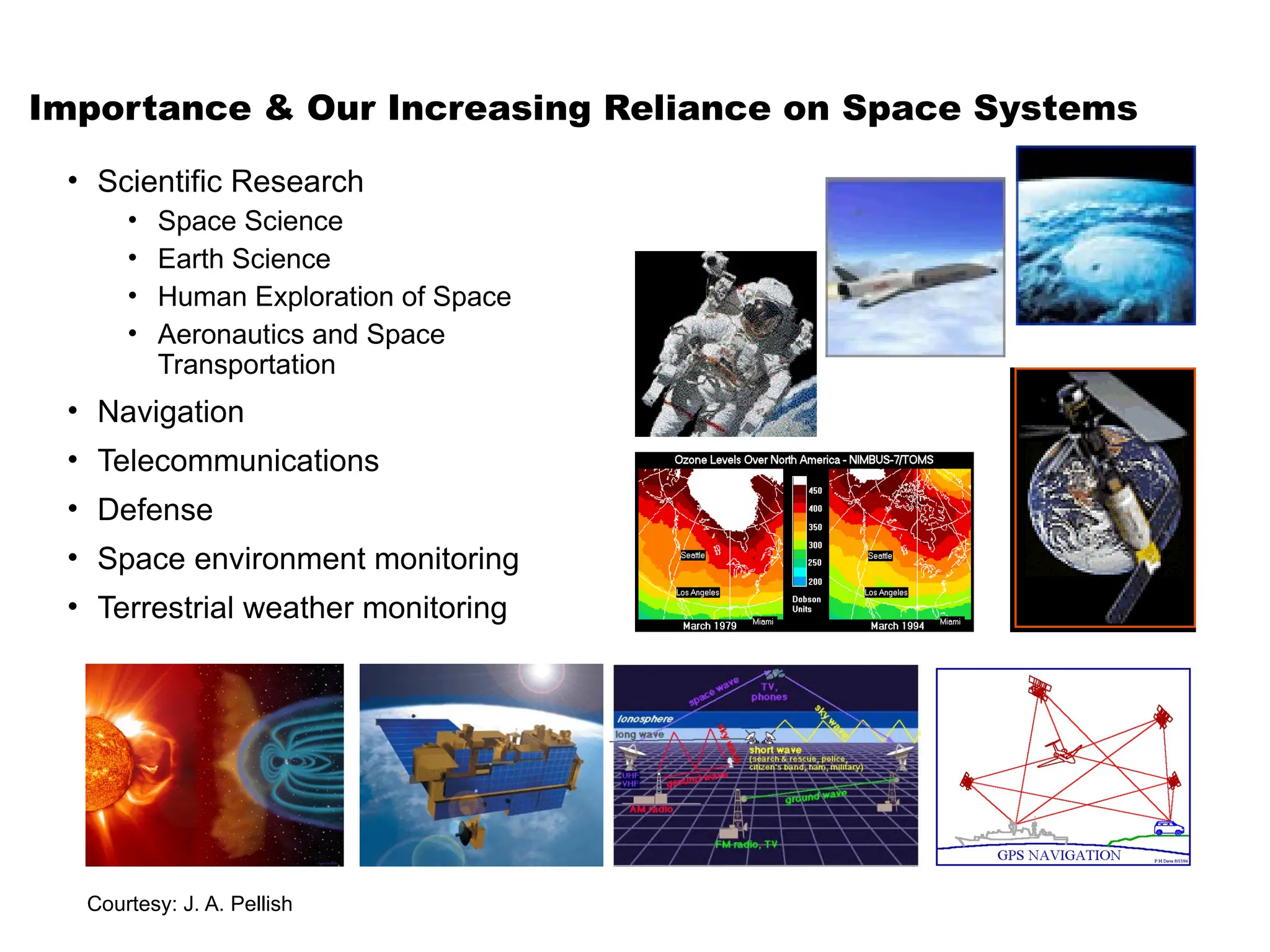
Importance & Our Increasing Reliance on Space Systems
• Scientific Research
• Space Science
• Earth Science
• Human Exploration of Space
• Aeronautics and Space
Transportation
• Navigation
• Telecommunications
• Defense
• Space environment monitoring
• Terrestrial weather monitoring
Courtesy: J. A. Pellish
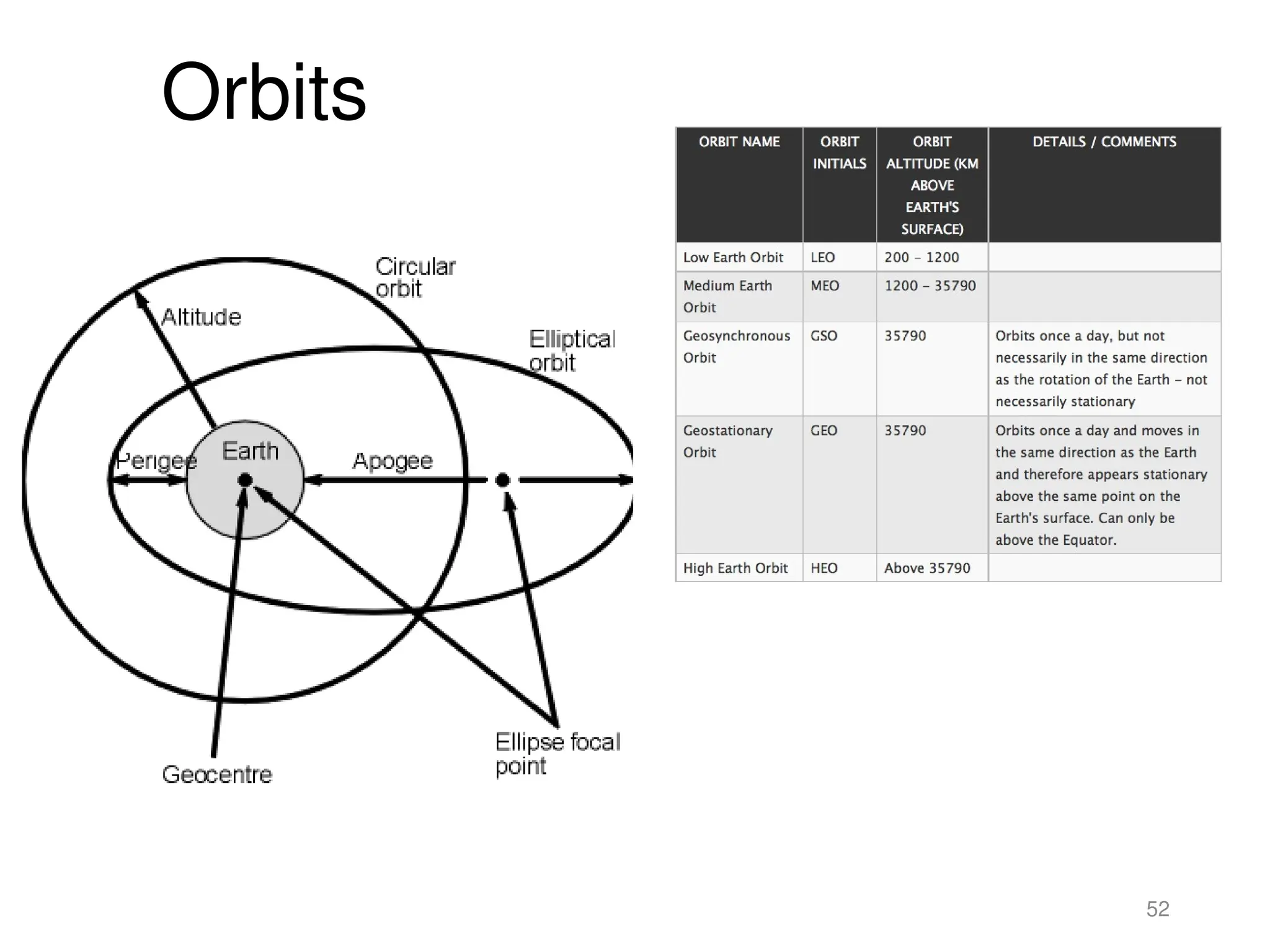
Orbits
52
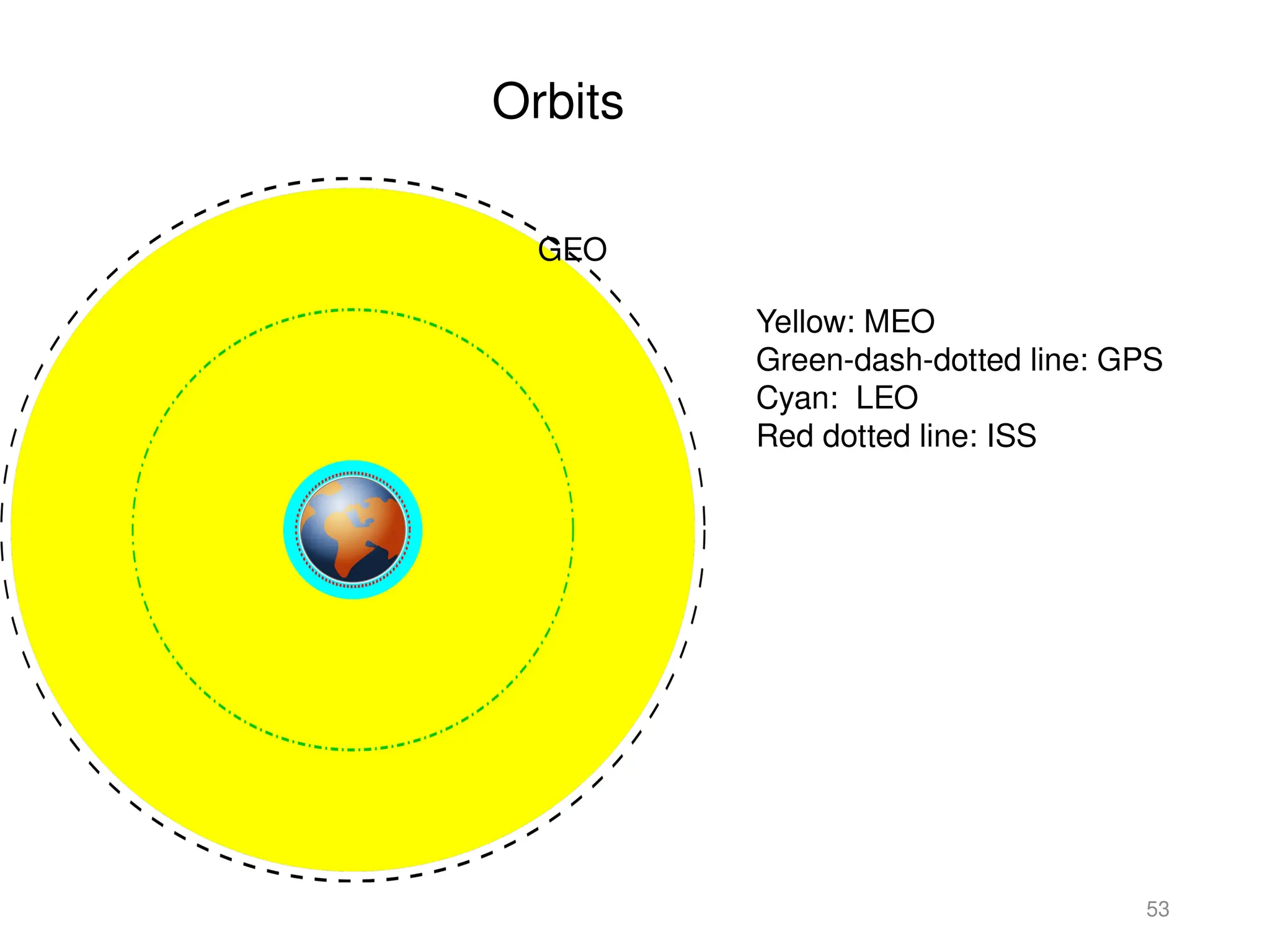
Orbits
53
GEO
Yellow: MEO
Green-dash-dotted line: GPS
Cyan: LEO
Red dotted line: ISS
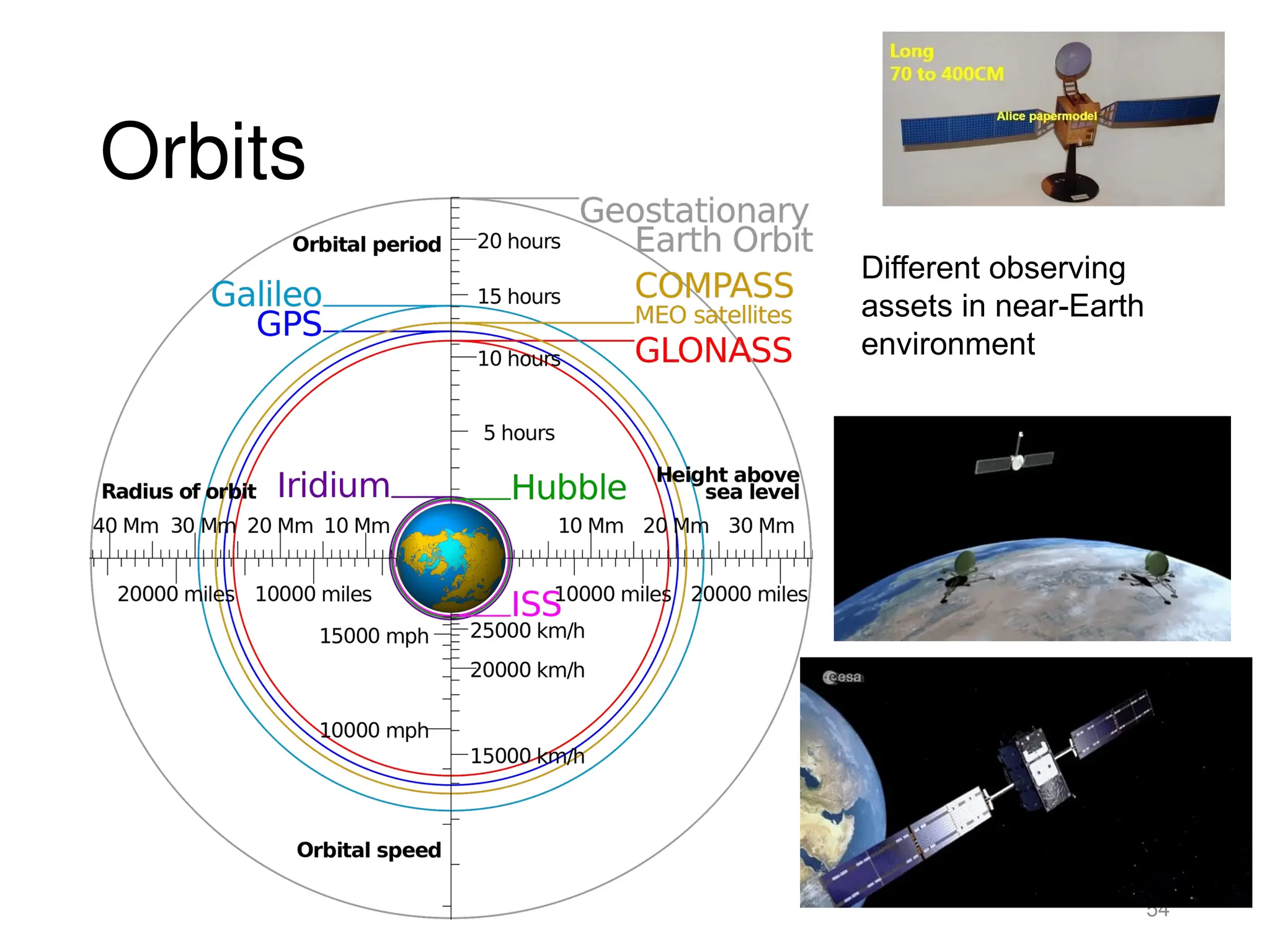
Orbits
54
Different observing
assets in near-Earth
environment
Orbit Classification Based on
Inclination
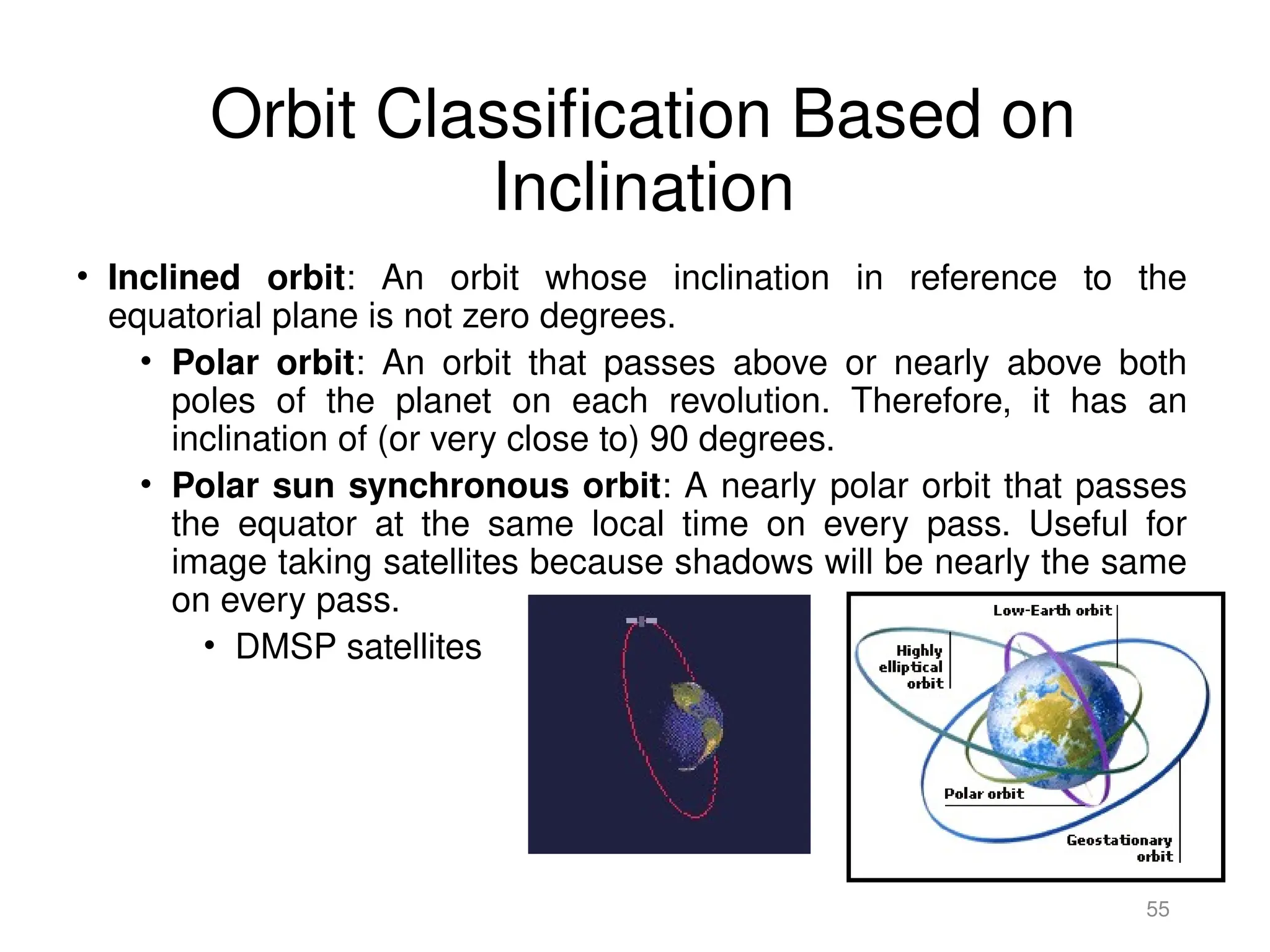
• Inclined orbit: An orbit whose inclination in reference to the
equatorial plane is not zero degrees.
• Polar orbit: An orbit that passes above or nearly above both
poles of the planet on each revolution. Therefore, it has an
inclination of (or very close to) 90 degrees.
• Polar sun synchronous orbit: A nearly polar orbit that passes
the equator at the same local time on every pass. Useful for
image taking satellites because shadows will be nearly the same
on every pass.
• DMSP satellites
55
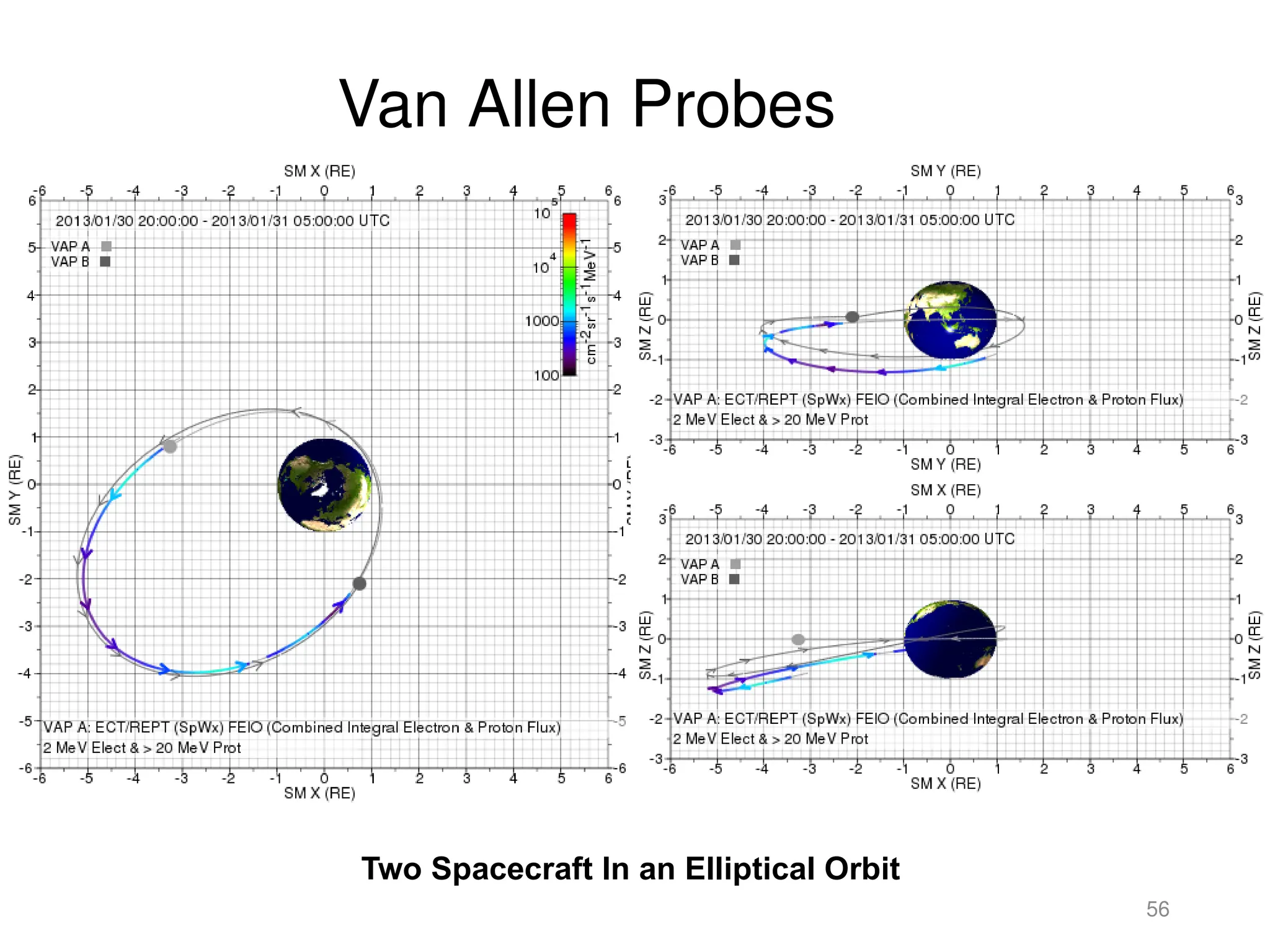
Van Allen Probes
56
Two Spacecraft In an Elliptical Orbit
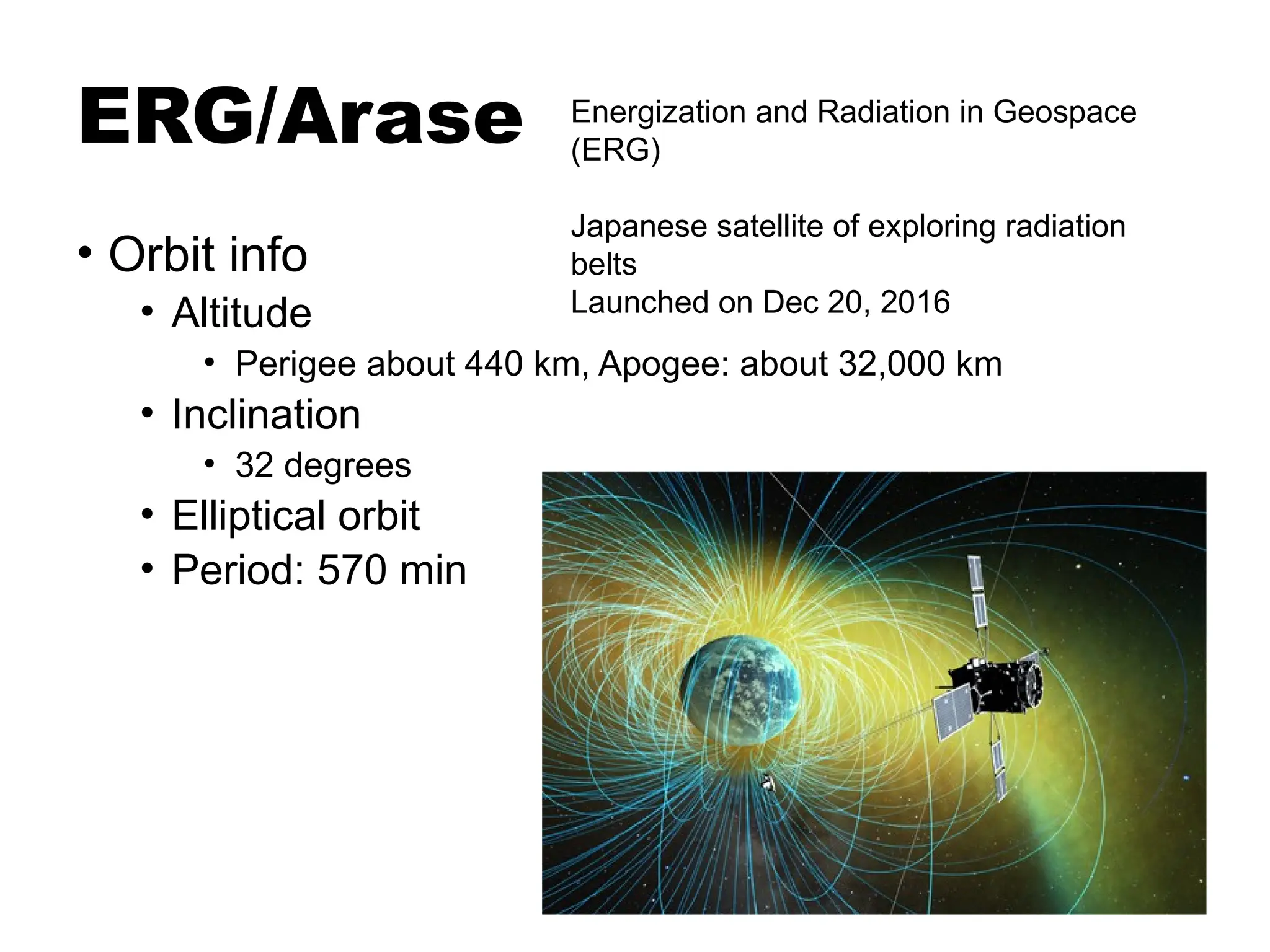
ERG/Arase
• Orbit info
• Altitude
• Perigee about 440 km, Apogee: about 32,000 km
• Inclination
• 32 degrees
• Elliptical orbit
• Period: 570 min
Energization and Radiation in Geospace
(ERG)
Japanese satellite of exploring radiation
belts
Launched on Dec 20, 2016
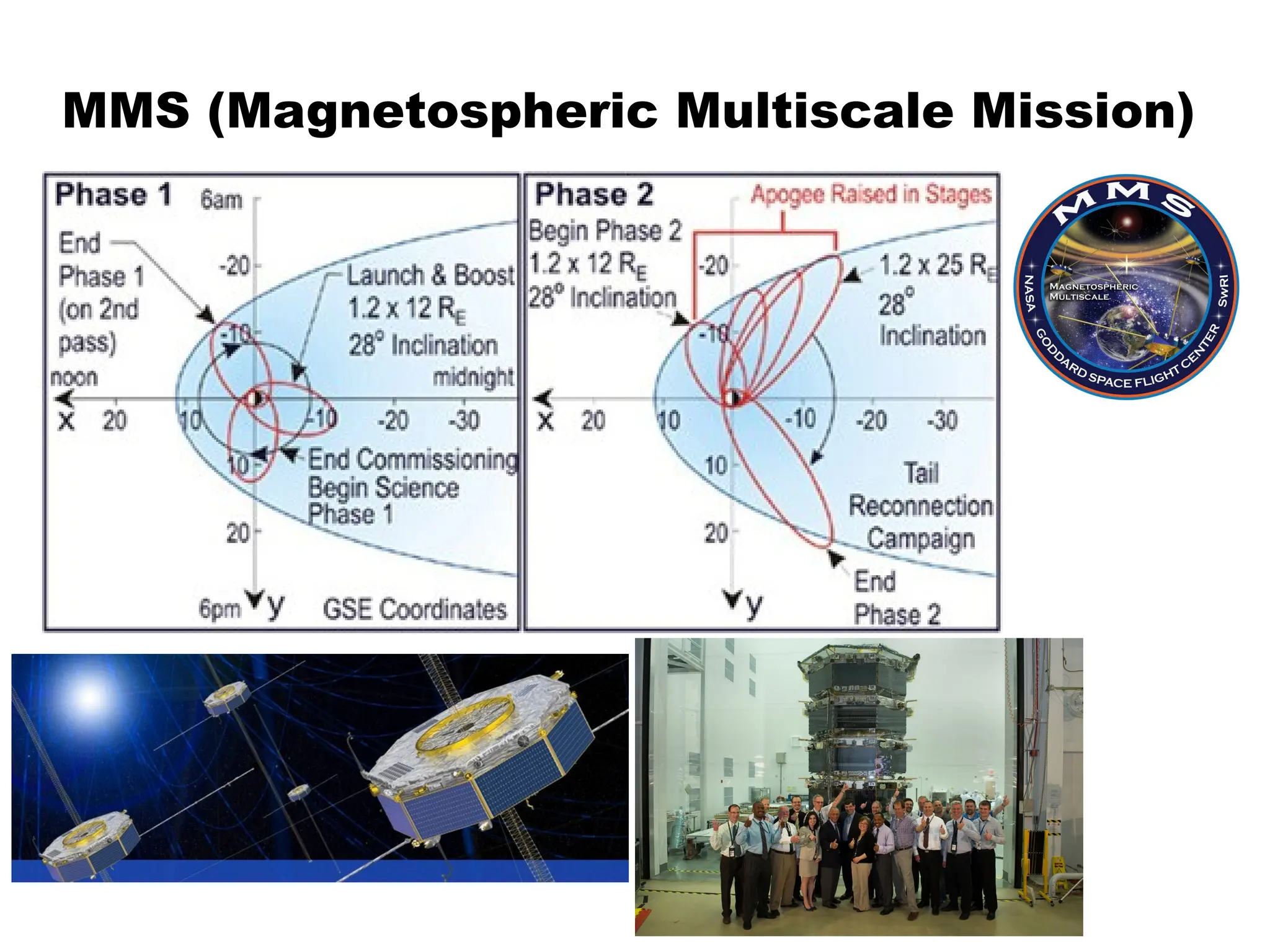
MMS (Magnetospheric Multiscale Mission)
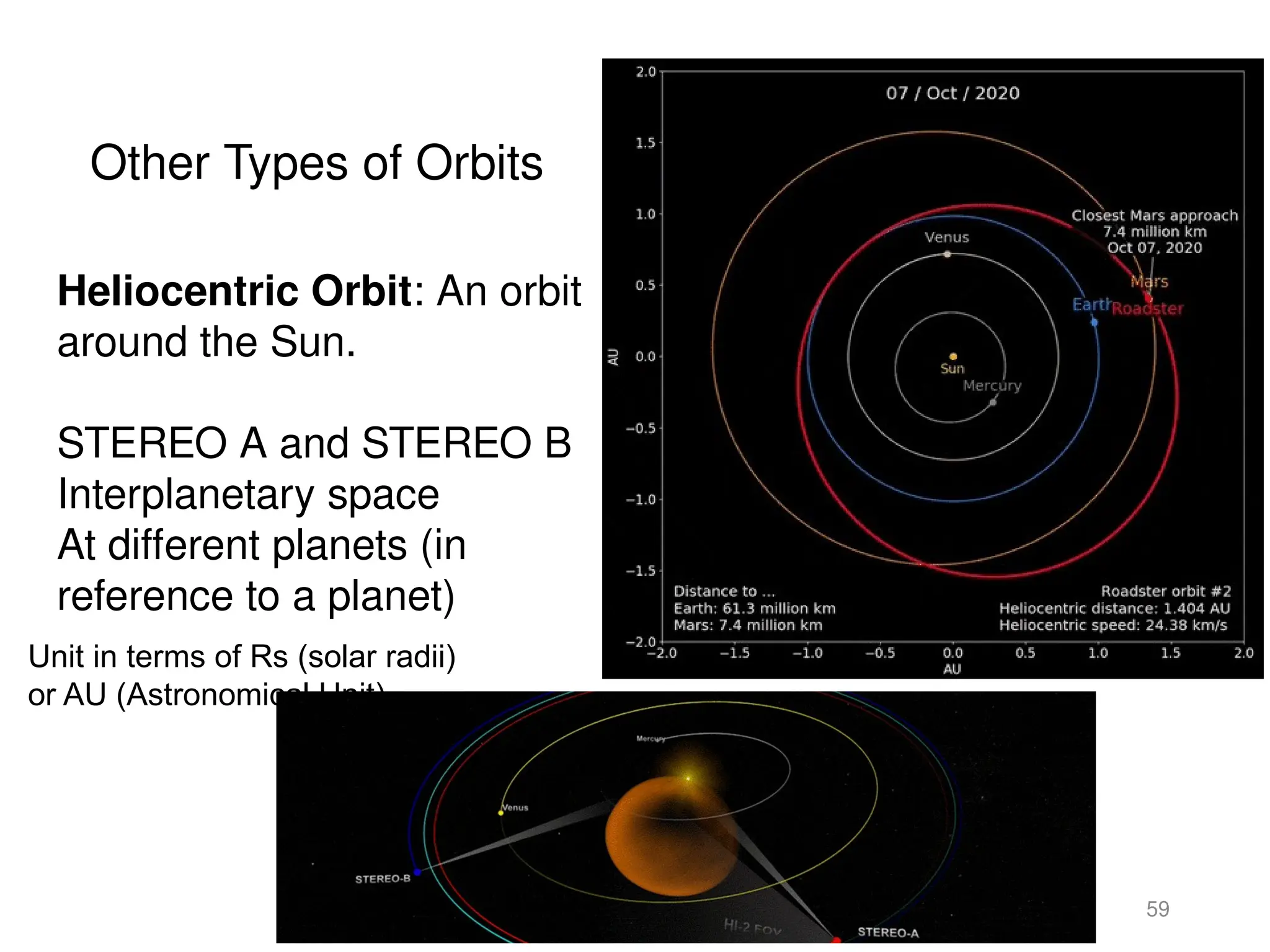
Other Types of Orbits
59
Heliocentric Orbit: An orbit
around the Sun.
STEREO A and STEREO B
Interplanetary space
At different planets (in
reference to a planet)
Unit in terms of Rs (solar radii)
or AU (Astronomical Unit)
Orbit/Mission Design
• New Horizon to Pluto
60
http://www.jhu.edu/jhumag/1105web/pluto.html
Dr. Yanping Guo, a mission design specialist at APL
Reduced the journey by at least three years
Closest approach to Pluto: 7:49:57 a.m.
EDT (11:49:57 UTC) on July 14, 2015
For more information about New Horizon
http://www.nasa.gov/mission_pages/newhorizons/main/index.html
Space Weather and Spacecraft Operations
• The primary approach for the spacecraft industry to mitigate
the effects of space weather is to design satellites to
operate under extreme environmental conditions to the
maximum extent possible within cost and resource
constraints
“Severe Space Weather Events--Understanding Societal and Economic Impacts Workshop Report,”
National Academies Press, Washington, DC, 2008 http://www.nap.edu/catalog/12507.html
• This technique is rarely 100% successful and space
weather will typically end up impacting some aspect of
a space mission
• Some space weather issues are common to all spacecraft, e.g.,
space situational awareness is one example
• Specific details of space weather interactions with a spacecraft are
often unique because spacecraft systems are unique, there is no
“standard” space weather support to mission operations
• Miniaturization of space assets makes them more vulnerable
Space Weather impacts on
spacecraft operation
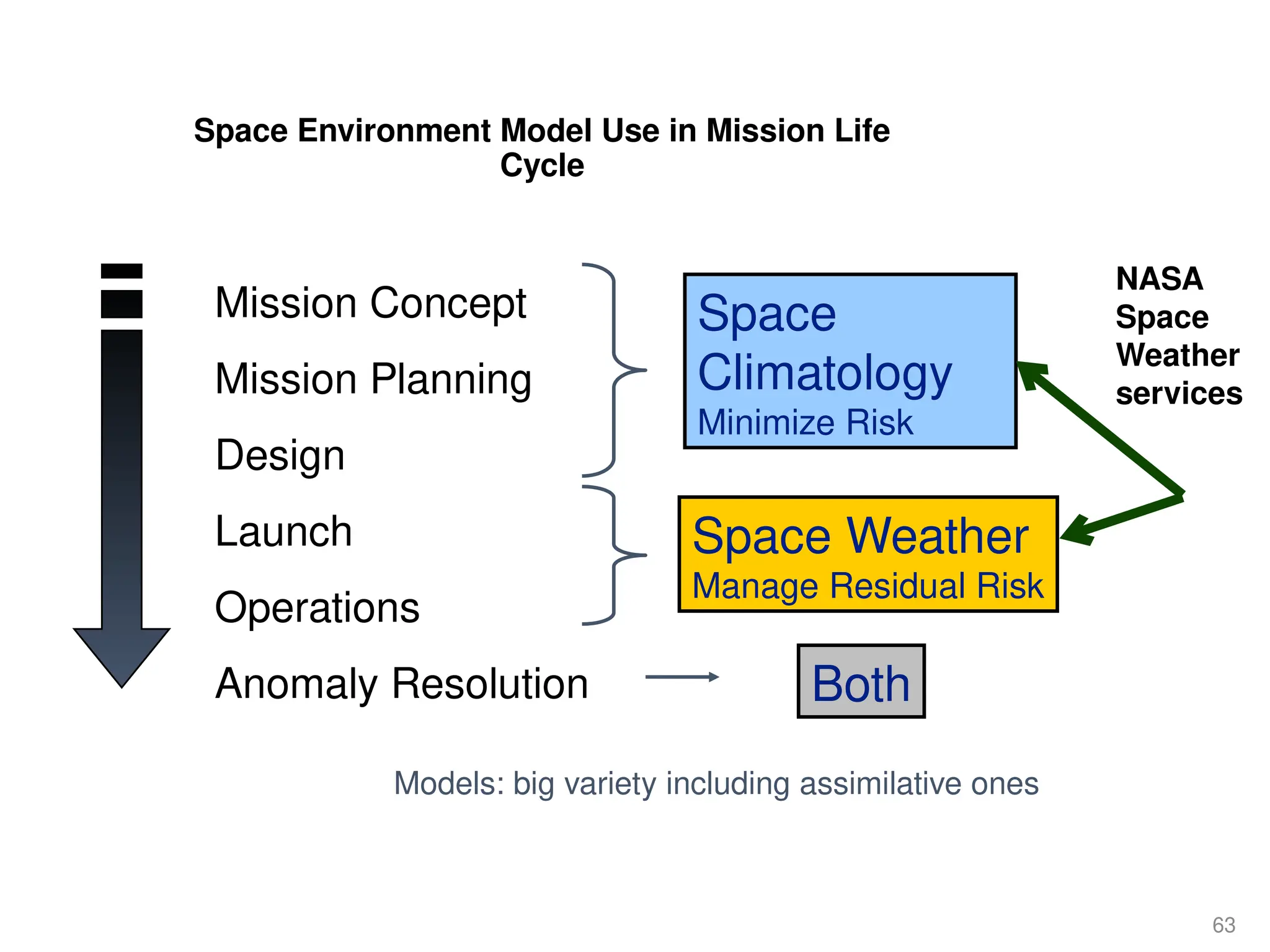
Space Environment Model Use in Mission Life
Cycle
Mission Concept
Mission Planning
Design
Launch
Operations
Anomaly Resolution
Space
Climatology
Minimize Risk
Space Weather
Manage Residual Risk
Both
Models: big variety including assimilative ones
63
NASA
Space
Weather
services
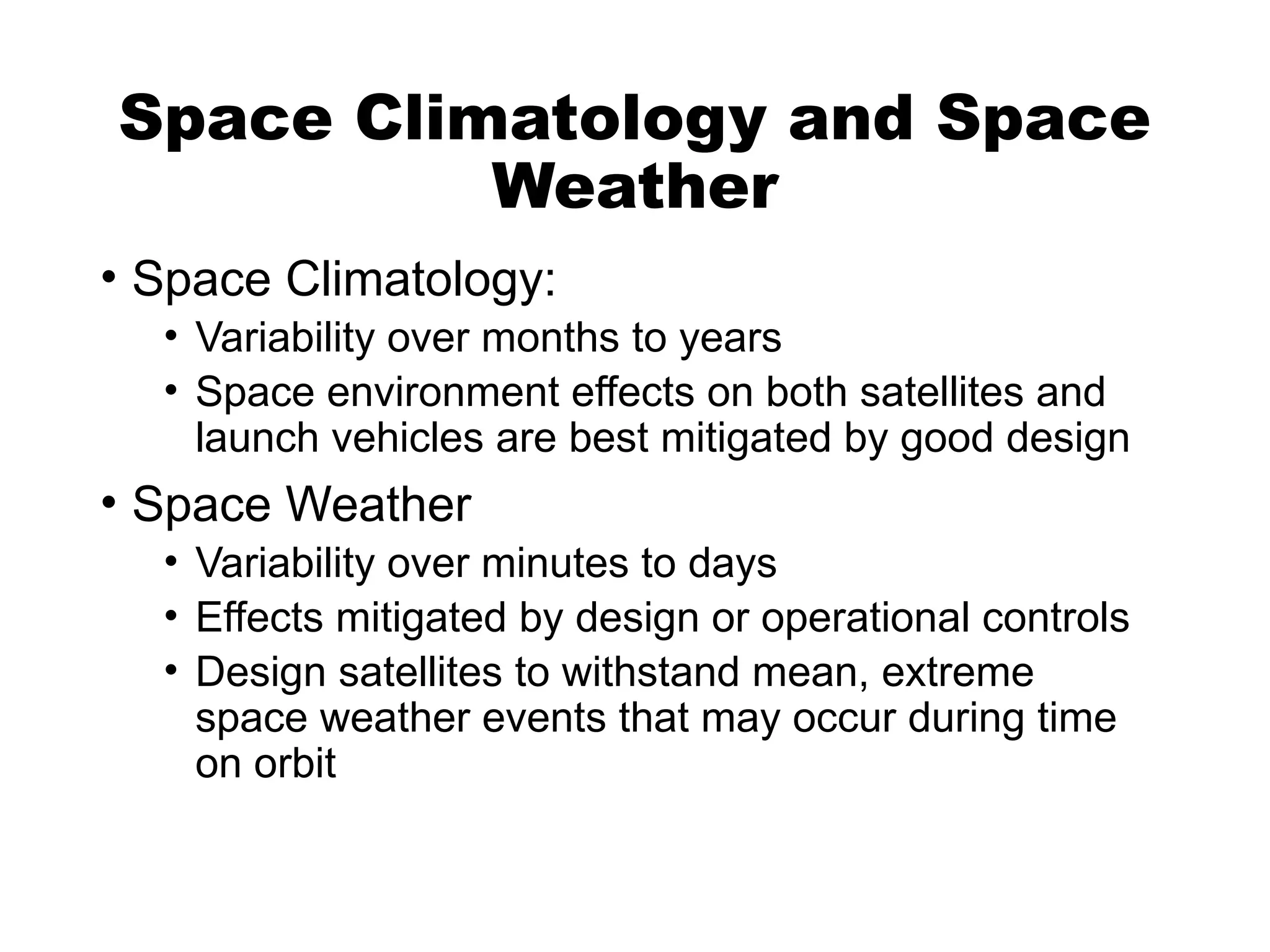
Space Climatology and Space
Weather
• Space Climatology:
• Variability over months to years
• Space environment effects on both satellites and
launch vehicles are best mitigated by good design
• Space Weather
• Variability over minutes to days
• Effects mitigated by design or operational controls
• Design satellites to withstand mean, extreme
space weather events that may occur during time
on orbit
11/20/2024 SIST-AERO 65
SPACE CLIMATOLOGY
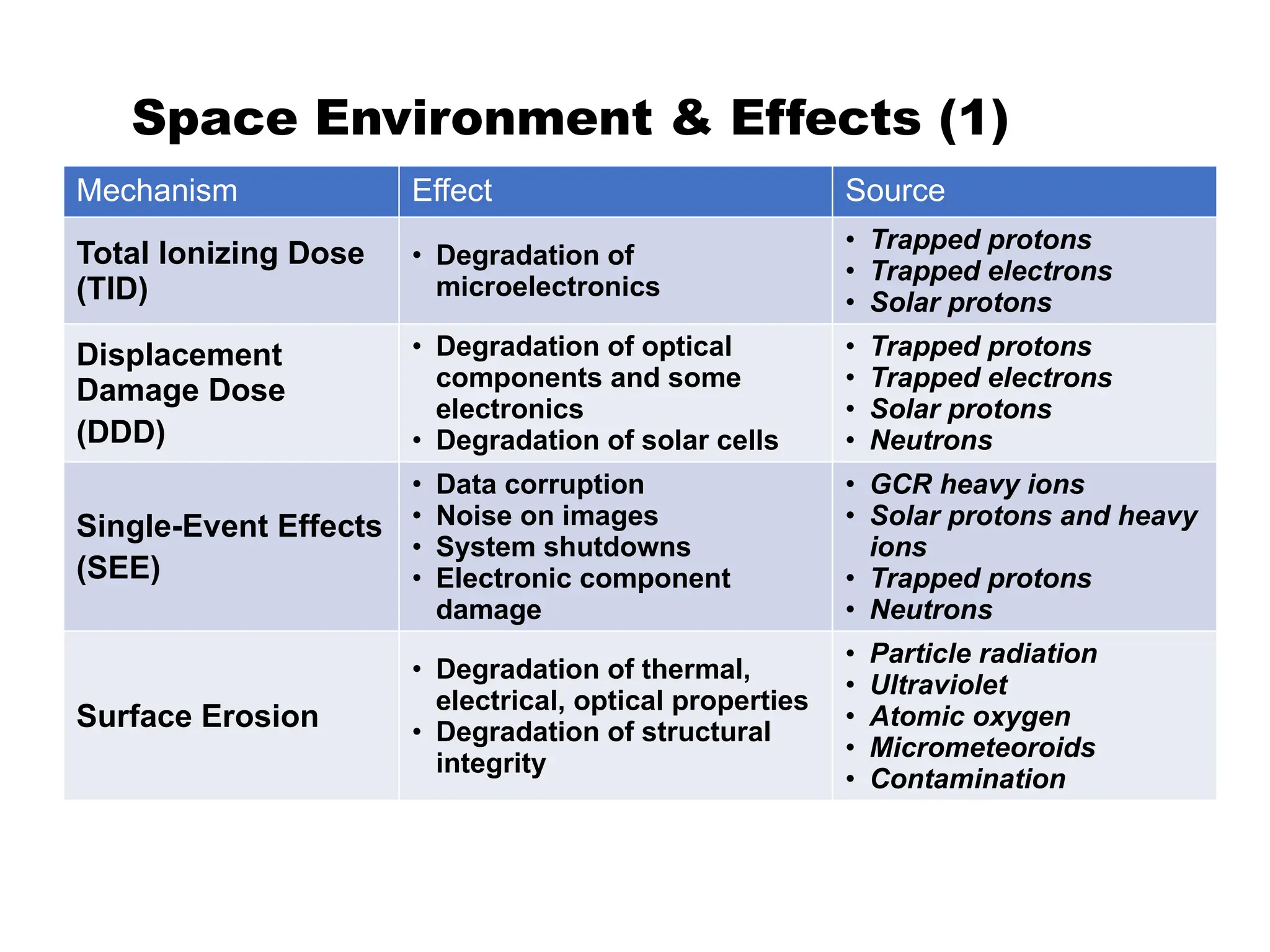
Space Environment & Effects (1)
Mechanism Effect Source
Total Ionizing Dose
(TID)
• Degradation of
microelectronics
• Trapped protons
• Trapped electrons
• Solar protons
Displacement
Damage Dose
(DDD)
• Degradation of optical
components and some
electronics
• Degradation of solar cells
• Trapped protons
• Trapped electrons
• Solar protons
• Neutrons
Single-Event Effects
(SEE)
• Data corruption
• Noise on images
• System shutdowns
• Electronic component
damage
• GCR heavy ions
• Solar protons and heavy
ions
• Trapped protons
• Neutrons
Surface Erosion
• Degradation of thermal,
electrical, optical properties
• Degradation of structural
integrity
• Particle radiation
• Ultraviolet
• Atomic oxygen
• Micrometeoroids
• Contamination
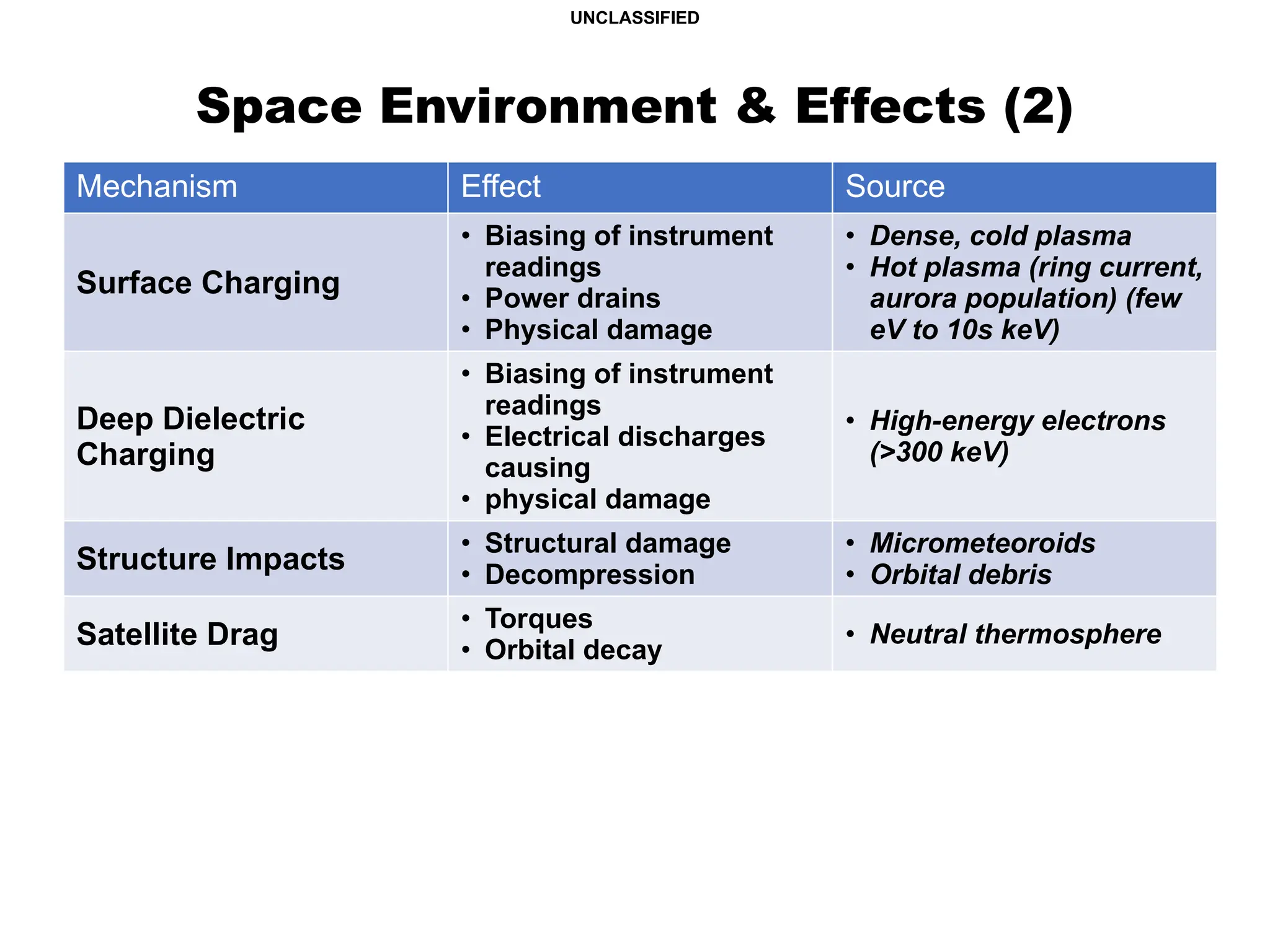
Space Environment & Effects (2)
Mechanism Effect Source
Surface Charging
• Biasing of instrument
readings
• Power drains
• Physical damage
• Dense, cold plasma
• Hot plasma (ring current,
aurora population) (few
eV to 10s keV)
Deep Dielectric
Charging
• Biasing of instrument
readings
• Electrical discharges
causing
• physical damage
• High-energy electrons
(>300 keV)
Structure Impacts
• Structural damage
• Decompression
• Micrometeoroids
• Orbital debris
Satellite Drag
• Torques
• Orbital decay
• Neutral thermosphere
UNCLASSIFIED
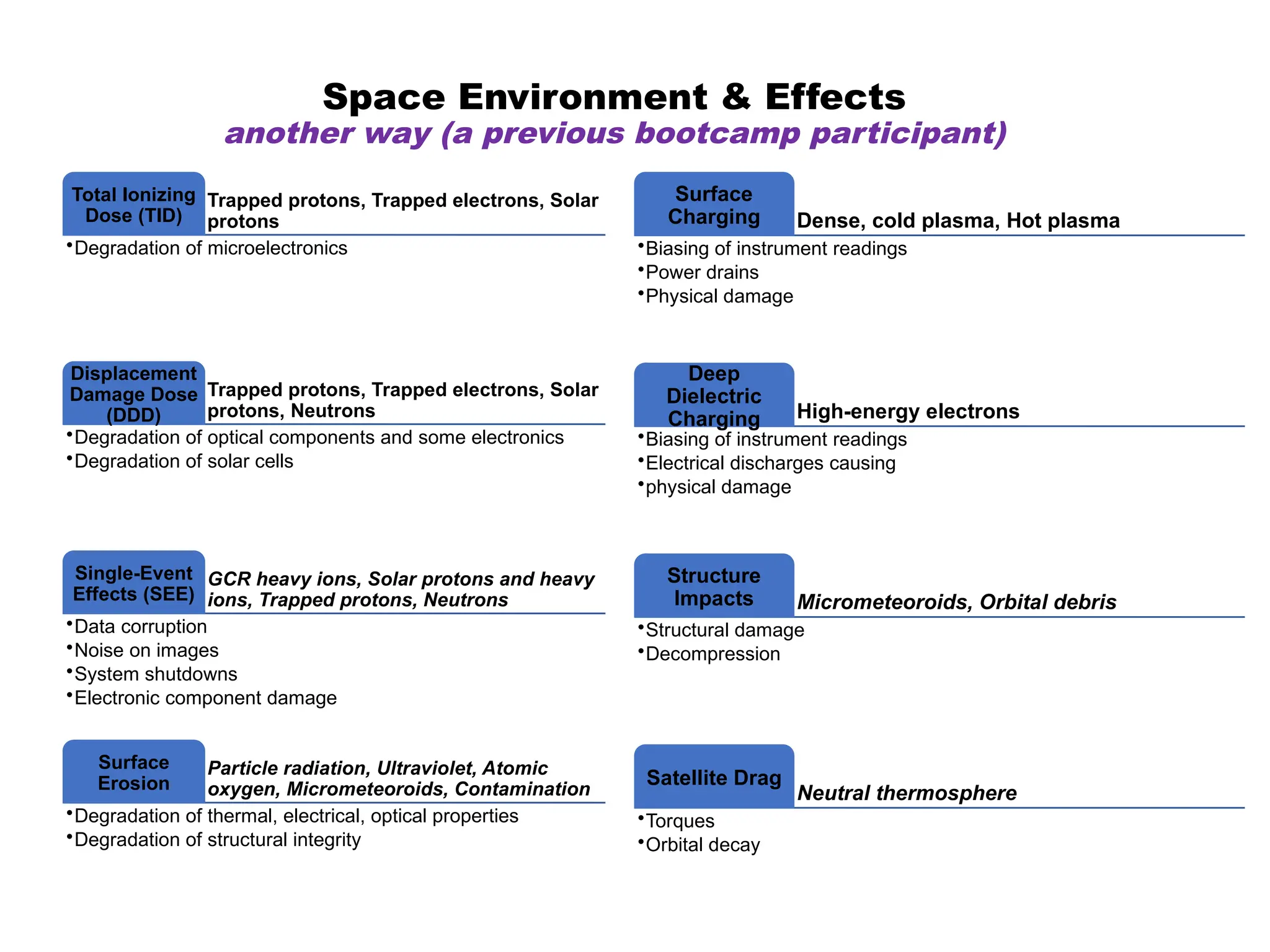
Space Environment & Effects
another way (a previous bootcamp participant)
Trapped protons, Trapped electrons, Solar
protons
Total Ionizing
Dose (TID)
•Degradation of microelectronics
Trapped protons, Trapped electrons, Solar
protons, Neutrons
Displacement
Damage Dose
(DDD)
•Degradation of optical components and some electronics
•Degradation of solar cells
GCR heavy ions, Solar protons and heavy
ions, Trapped protons, Neutrons
Single-Event
Effects (SEE)
•Data corruption
•Noise on images
•System shutdowns
•Electronic component damage
Particle radiation, Ultraviolet, Atomic
oxygen, Micrometeoroids, Contamination
Surface
Erosion
•Degradation of thermal, electrical, optical properties
•Degradation of structural integrity
Dense, cold plasma, Hot plasma
Surface
Charging
•Biasing of instrument readings
•Power drains
•Physical damage
High-energy electrons
Deep
Dielectric
Charging
•Biasing of instrument readings
•Electrical discharges causing
•physical damage
Micrometeoroids, Orbital debris
Structure
Impacts
•Structural damage
•Decompression
Neutral thermosphere
Satellite Drag
•Torques
•Orbital decay
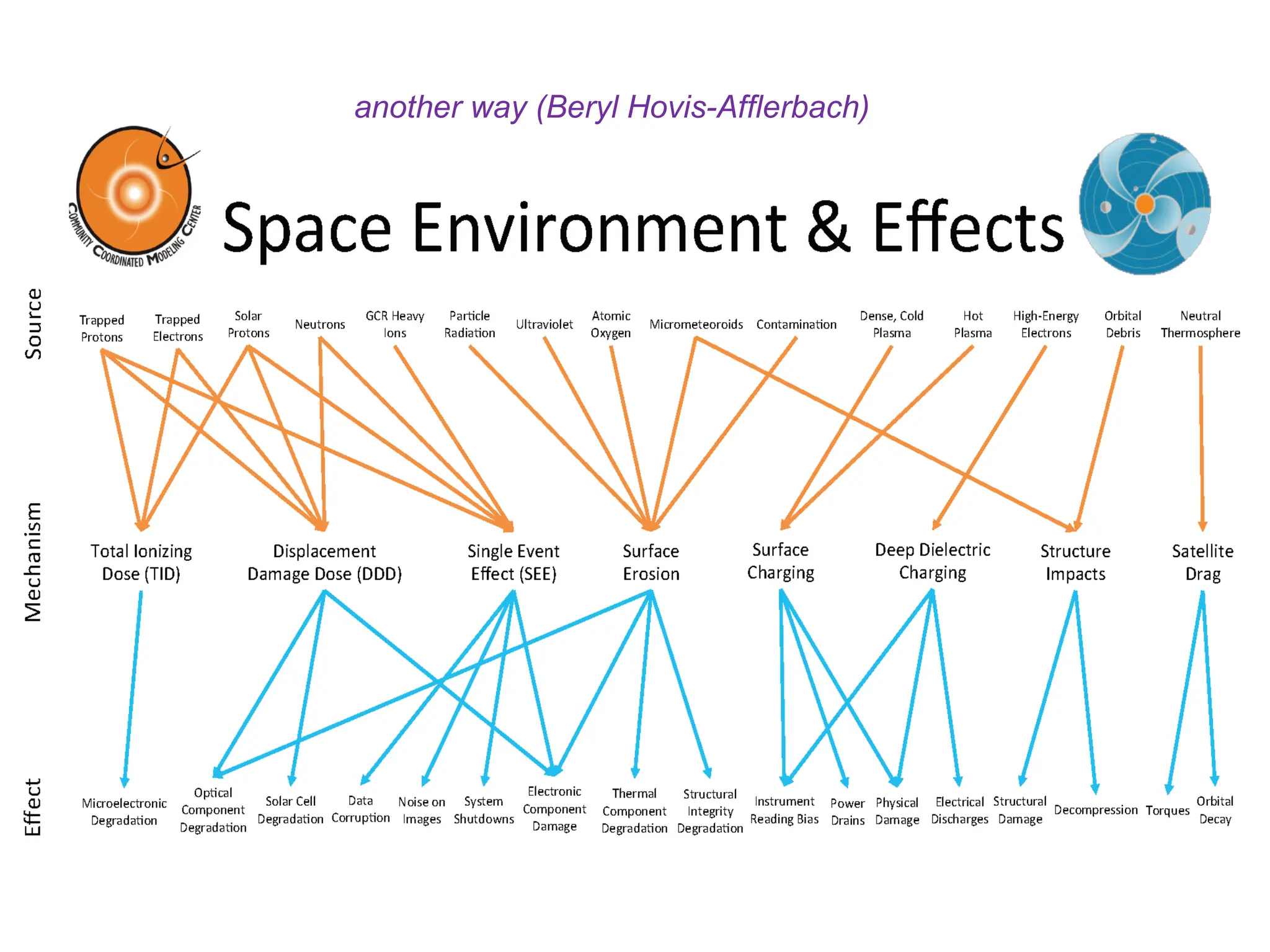
another way (Beryl Hovis-Afflerbach)
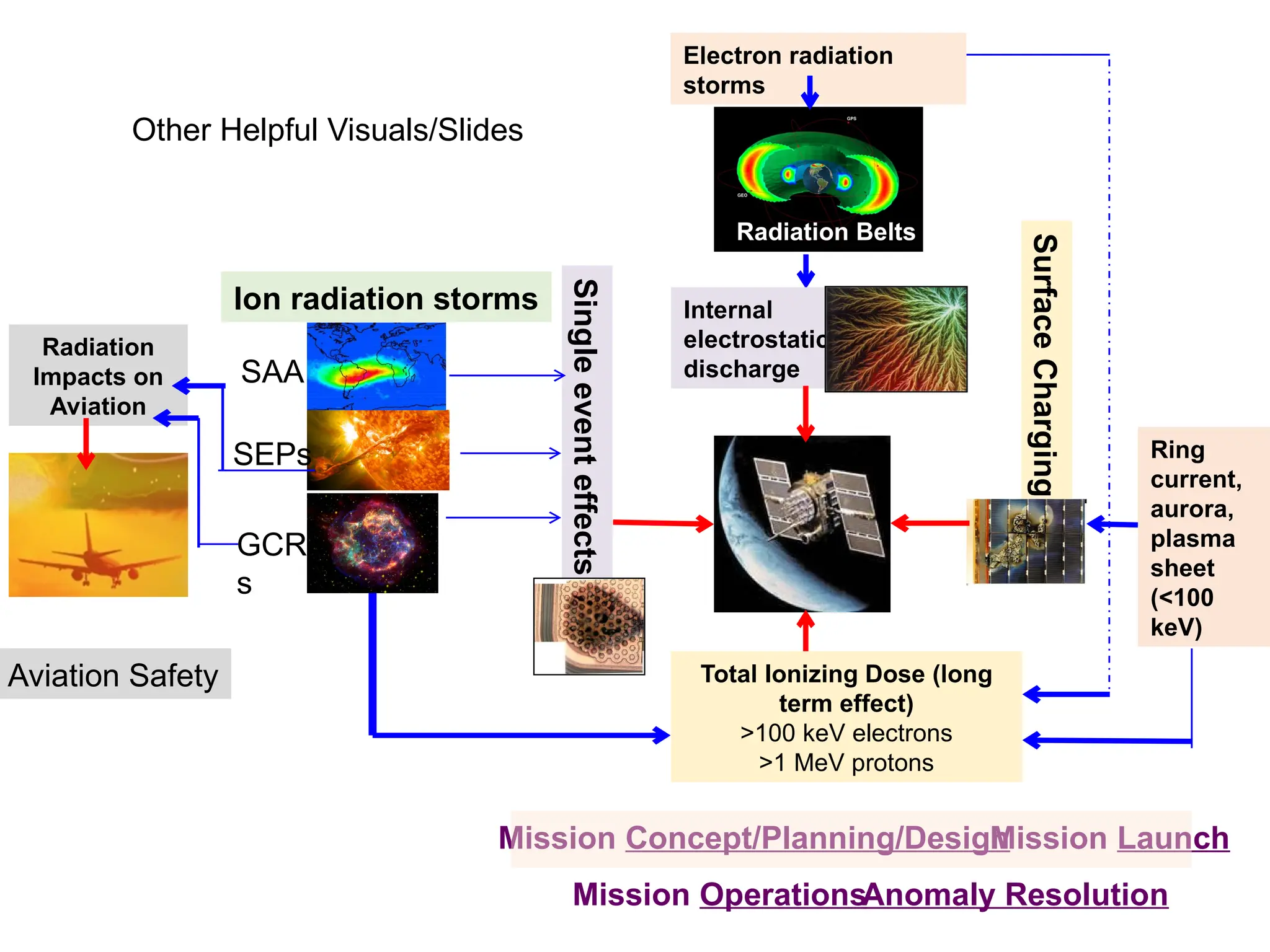
Radiation Belts
SEPs
GCR
s
SAA
Electron radiation
storms
Ion radiation storms Internal
electrostatic
discharge
Single
event
effects
Mission Concept/Planning/Design
Mission Launch
Mission OperationsAnomaly Resolution
Ring
current,
aurora,
plasma
sheet
(<100
keV)
Surface
Charging
Radiation
Impacts on
Aviation
Total Ionizing Dose (long
term effect)
>100 keV electrons
>1 MeV protons
Aviation Safety
Other Helpful Visuals/Slides
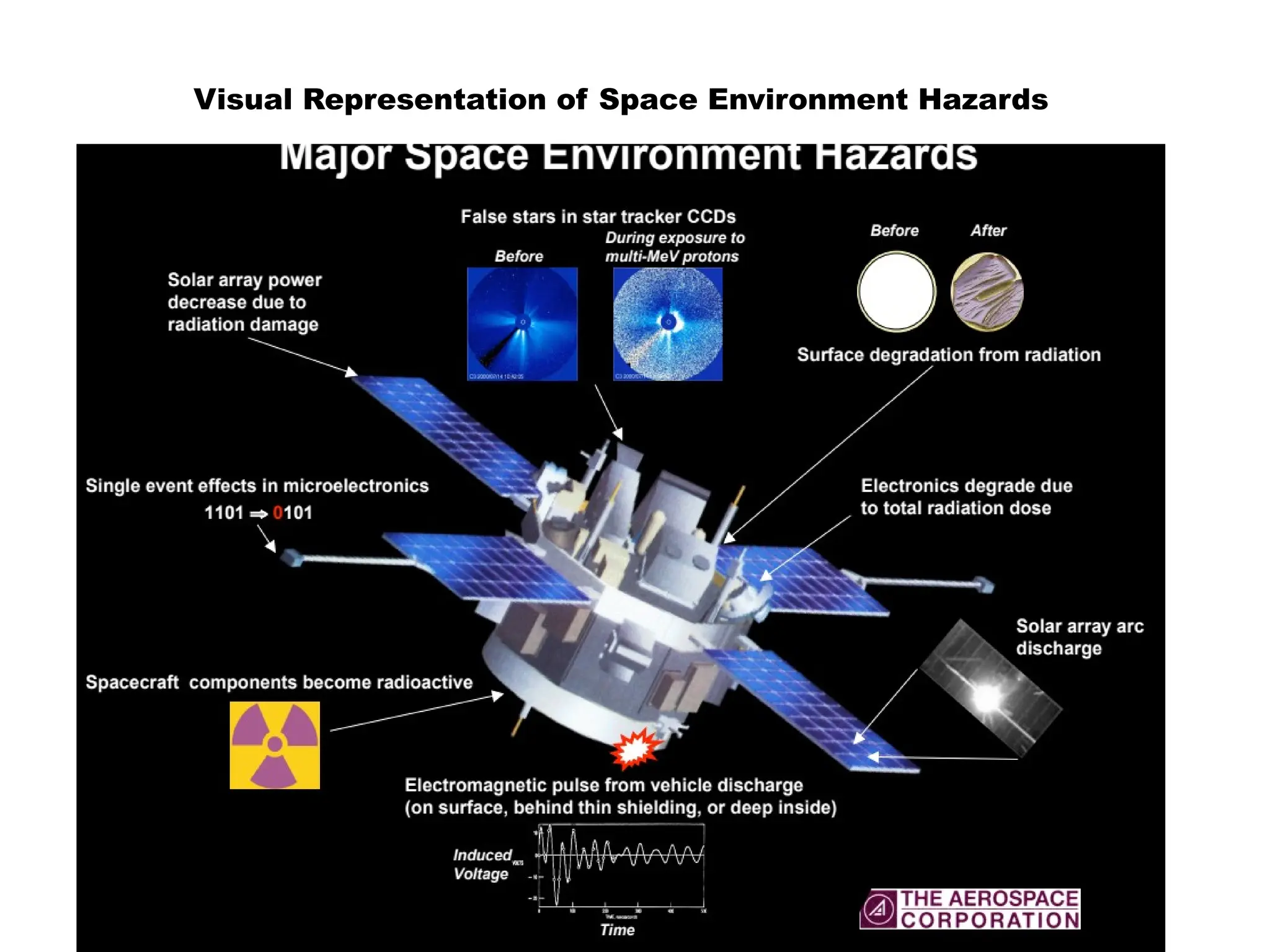
Visual Representation of Space Environment Hazards
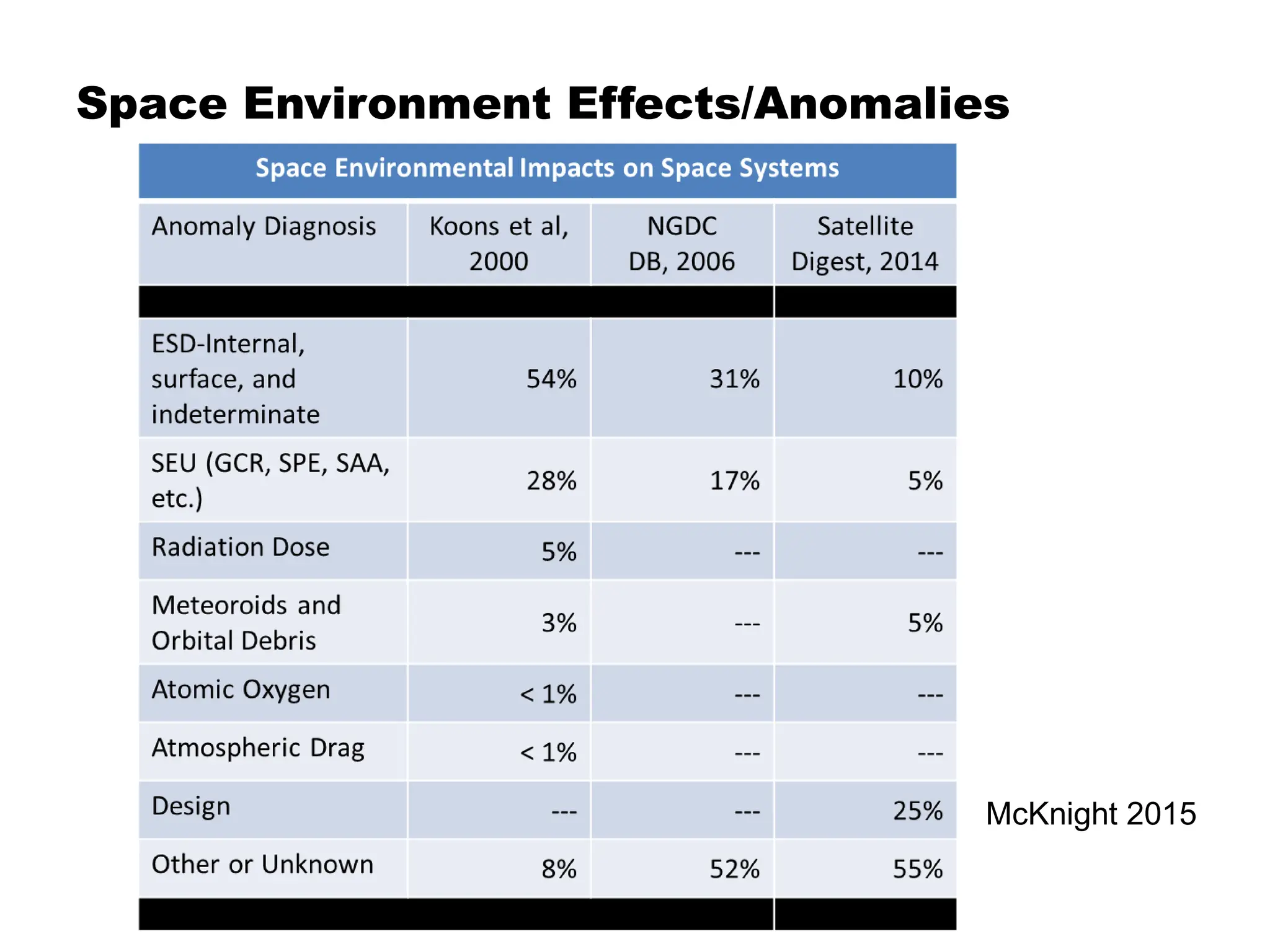
Space Environment Effects/Anomalies
McKnight 2015
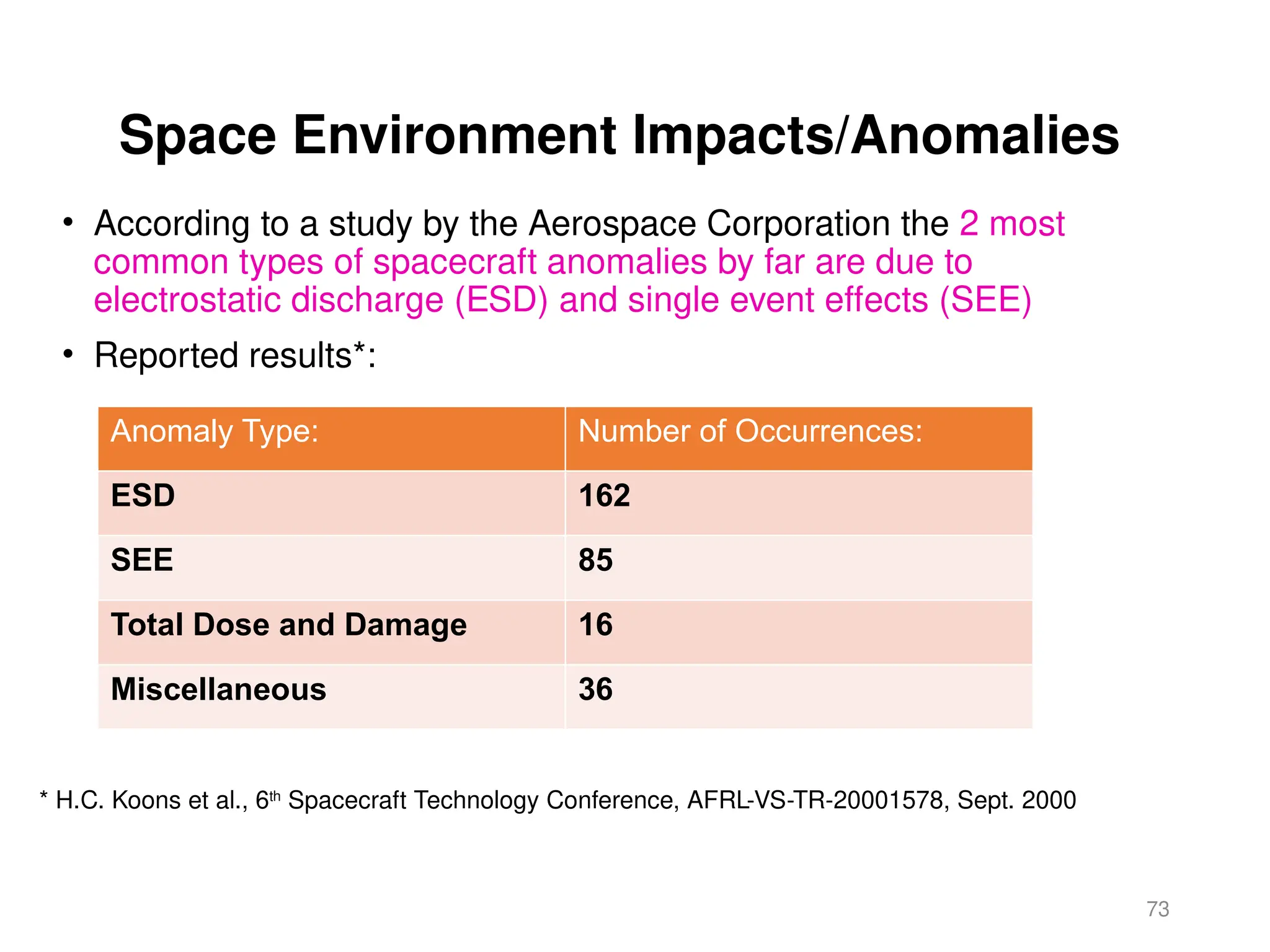
73
Space Environment Impacts/Anomalies
• According to a study by the Aerospace Corporation the 2 most
common types of spacecraft anomalies by far are due to
electrostatic discharge (ESD) and single event effects (SEE)
• Reported results*:
Anomaly Type: Number of Occurrences:
ESD 162
SEE 85
Total Dose and Damage 16
Miscellaneous 36
* H.C. Koons et al., 6th
Spacecraft Technology Conference, AFRL-VS-TR-20001578, Sept. 2000
11/20/2024 SIST-AERO 74
SPACE ENVIRONMENT
ANOMALIES
A few types of space weather impacts on spacecraft
Surface charging: which can lead to electrostatic
discharges (ESD)
ESD: can lead to a variety of problems,
including component failure and phantom commands in
spacecraft electronics [Purvis et al., 1984].
76
Purvis, C. K., H. B. Garrett, A. C. Wittlesey, and N. J. Stevens (1984),
Design guidelines for assessing and controlling spacecraft charging
effects, NASA Tech. Pap. 2361
https://standards.nasa.gov/documents/detail/3314877
Surface Charging (1)
11/20/2024 SIST-AERO 77
Satellites in space
Commercial satellite anomaly
More often in the midnight to morning sector
<100 keV e- distribution: similar behavior as
spacecraft anomalies
=> Surface charging might be the main cause of the
anomalies.
Choi, H. S., J. Lee, K. S. Cho, Y. S. Kwak, I. H. Cho, Y. D. Park, Y. H.
‐ ‐ ‐ ‐ ‐ ‐
Kim, D. N. Baker, G. D. Reeves, and D. K. Lee (2011), Analysis of GEO
‐
spacecraft anomalies: Space weather relationships, Space Weather, 9,
S06001,doi:10.1029/2010SW000597.
78
Surface Charging (2)
Substorm injections ( Aurora)
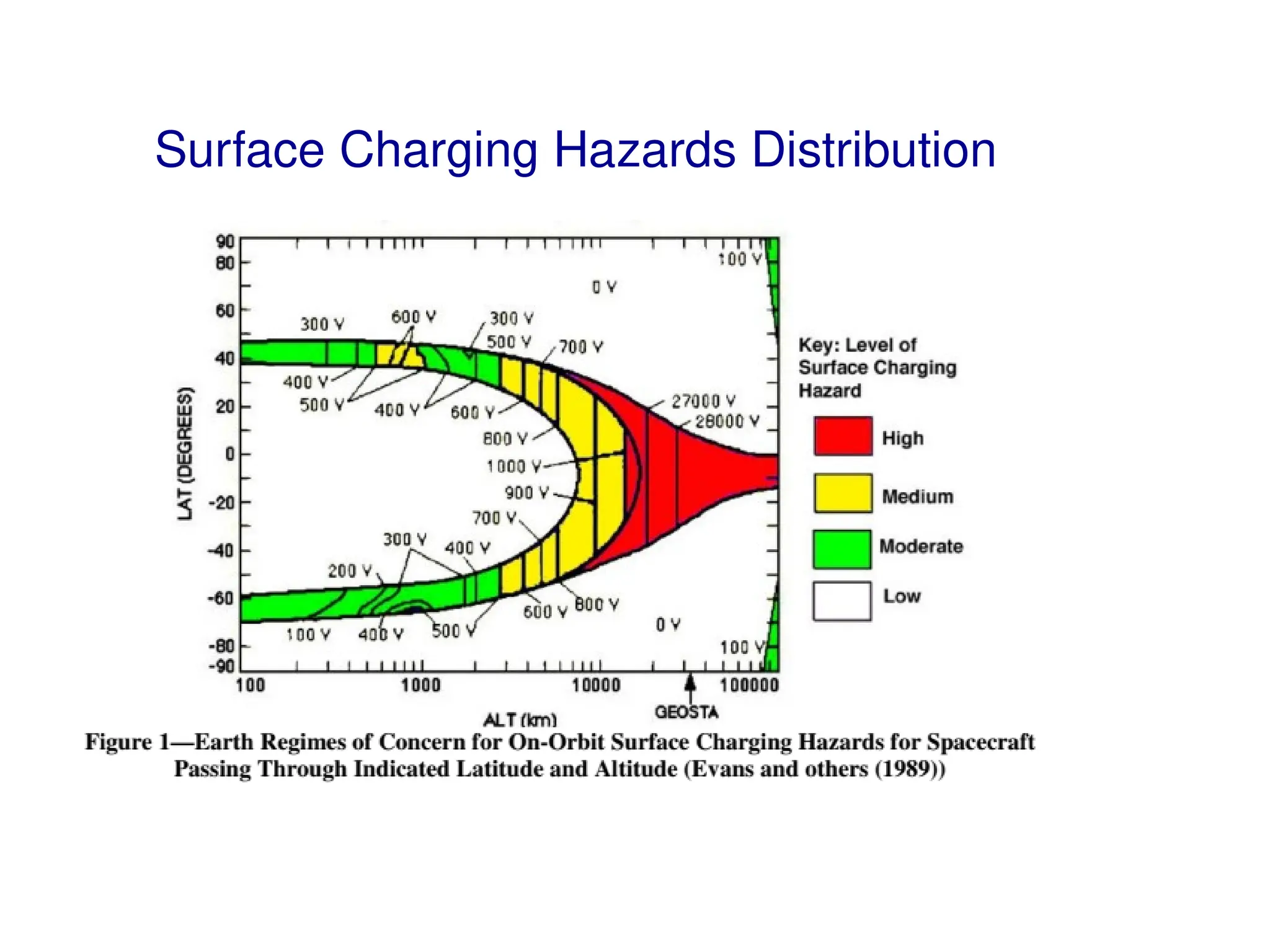
Surface Charging Hazards Distribution
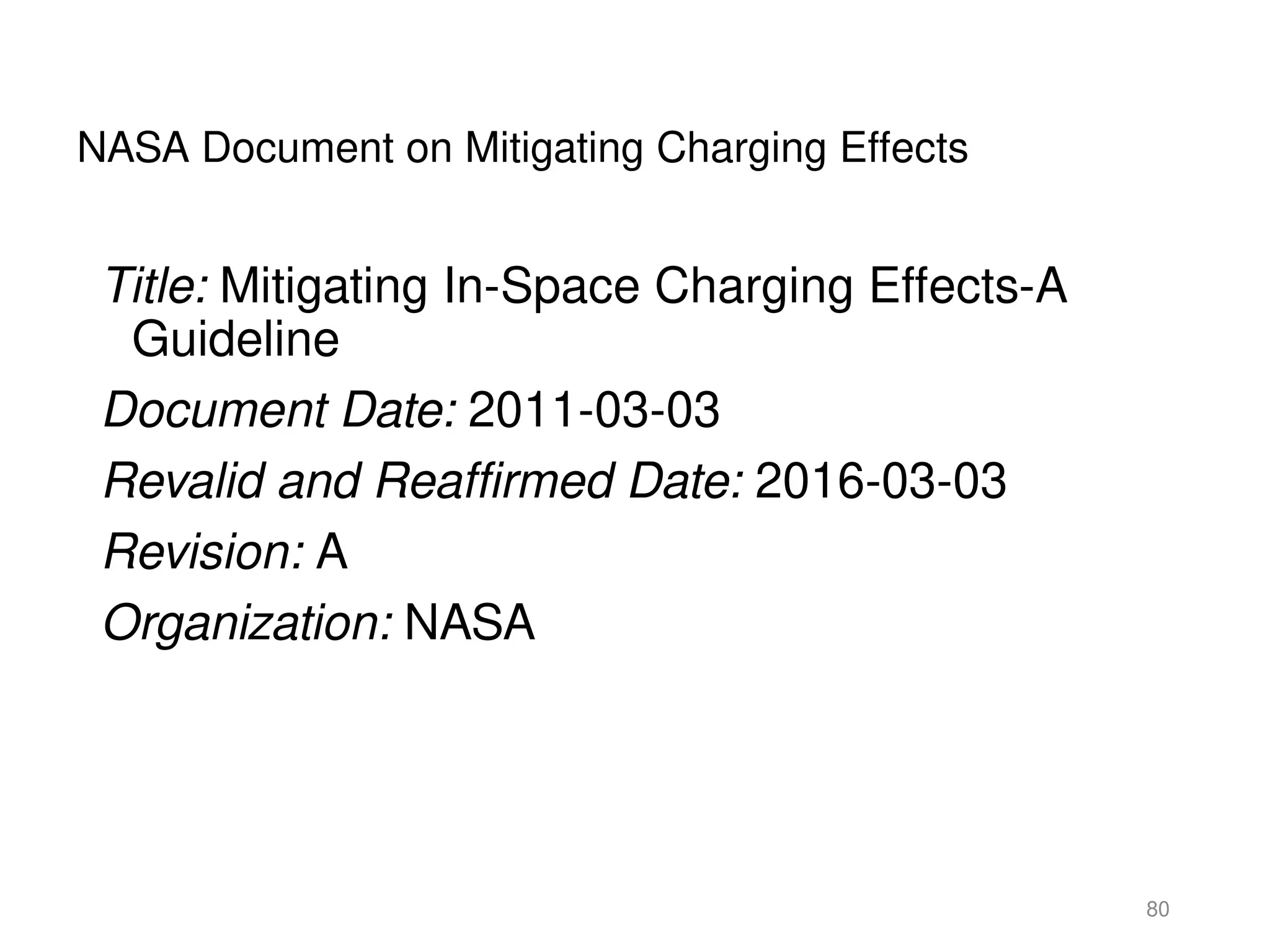
NASA Document on Mitigating Charging Effects
Title: Mitigating In-Space Charging Effects-A
Guideline
Document Date: 2011-03-03
Revalid and Reaffirmed Date: 2016-03-03
Revision: A
Organization: NASA
80
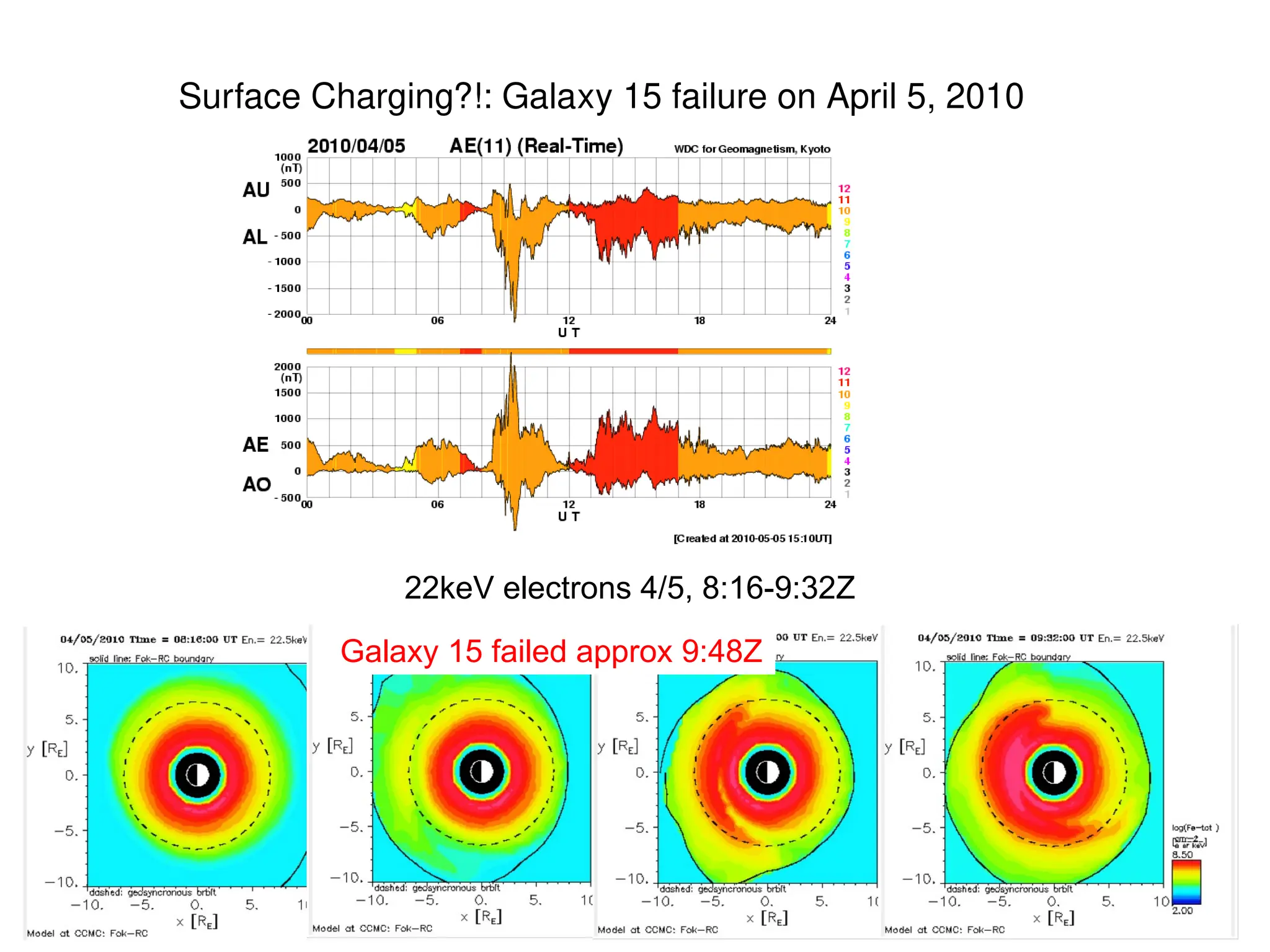
Ring current
model data
show same
Surface Charging?!: Galaxy 15 failure on April 5, 2010
22keV electrons 4/5, 8:16-9:32Z
Galaxy 15 failed approx 9:48Z
82
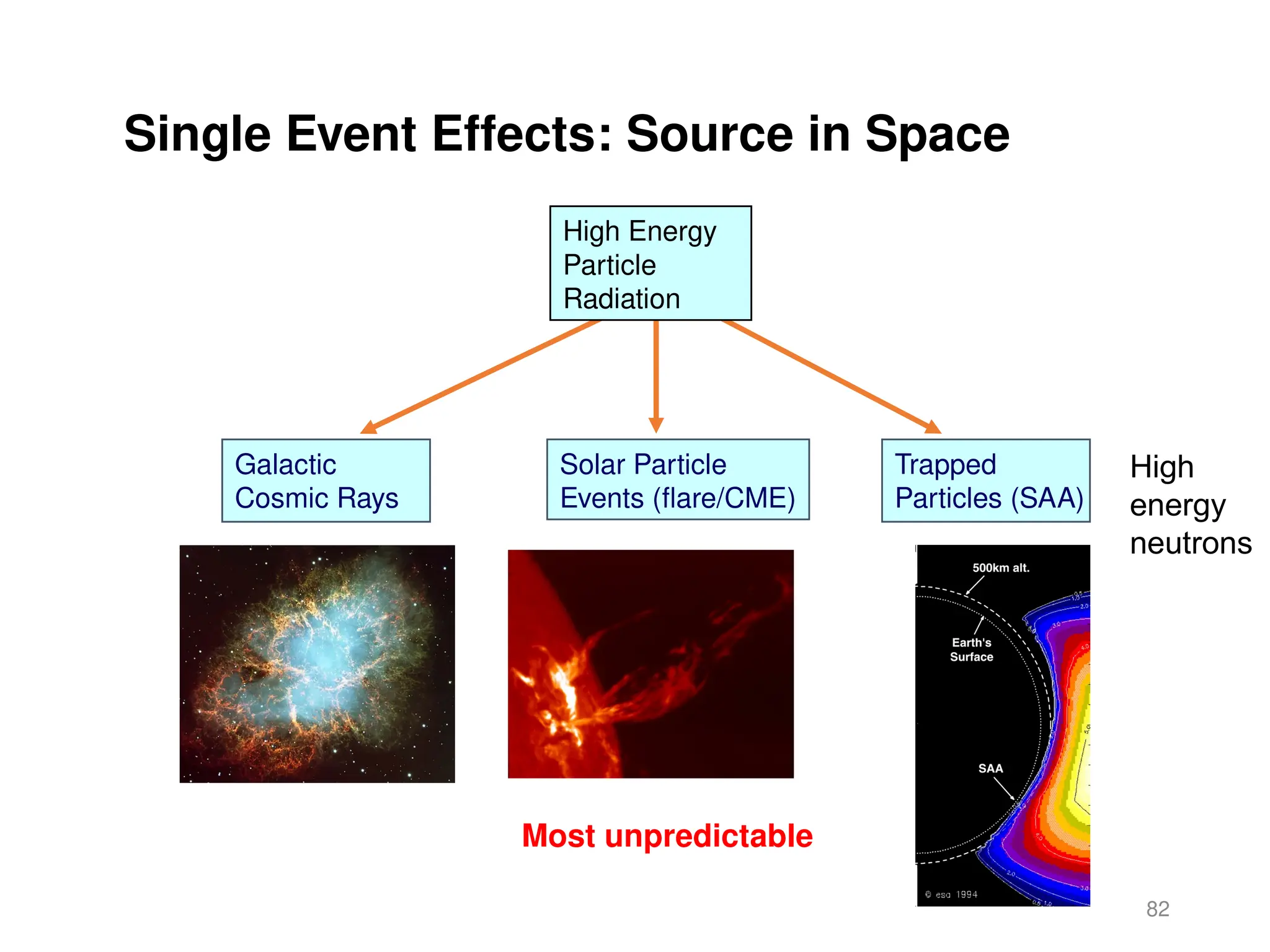
Single Event Effects: Source in Space
Solar Particle
Events (flare/CME)
Trapped
Particles (SAA)
Galactic
Cosmic Rays
High Energy
Particle
Radiation
Most unpredictable
High
energy
neutrons
83
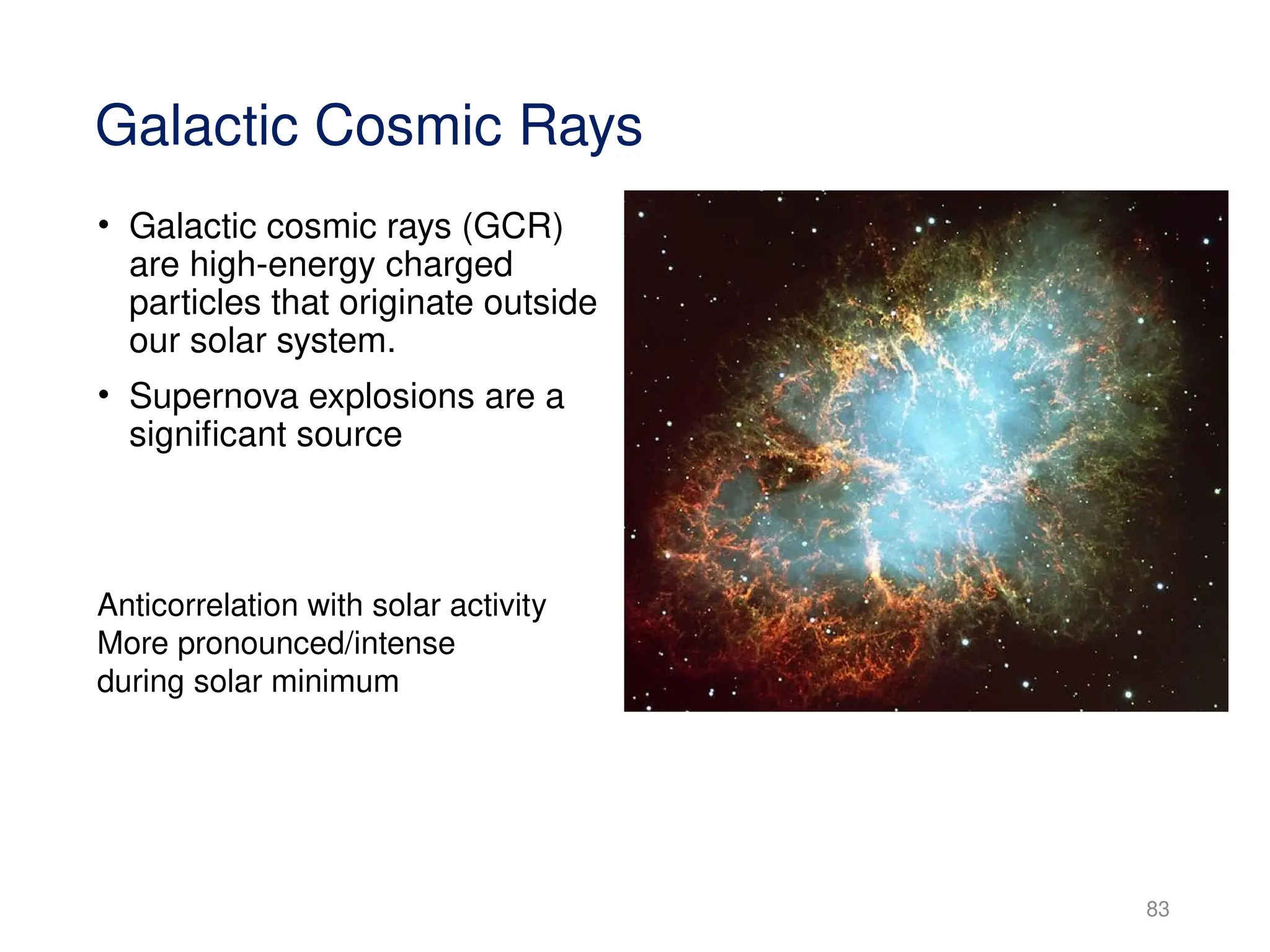
Galactic Cosmic Rays
• Galactic cosmic rays (GCR)
are high-energy charged
particles that originate outside
our solar system.
• Supernova explosions are a
significant source
Anticorrelation with solar activity
More pronounced/intense
during solar minimum
84
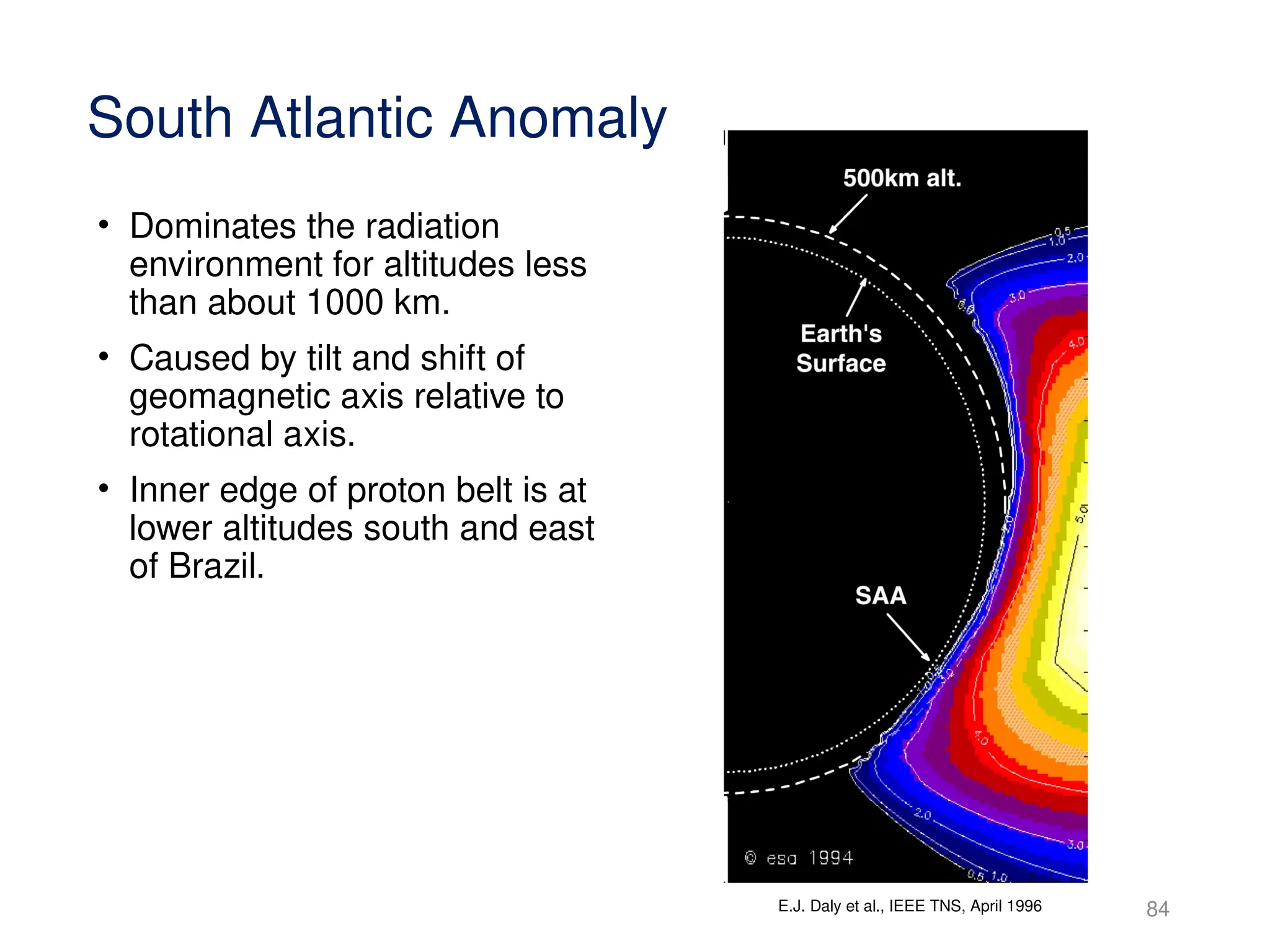
South Atlantic Anomaly
• Dominates the radiation
environment for altitudes less
than about 1000 km.
• Caused by tilt and shift of
geomagnetic axis relative to
rotational axis.
• Inner edge of proton belt is at
lower altitudes south and east
of Brazil.
E.J. Daly et al., IEEE TNS, April 1996
South Atlantic anomaly
85
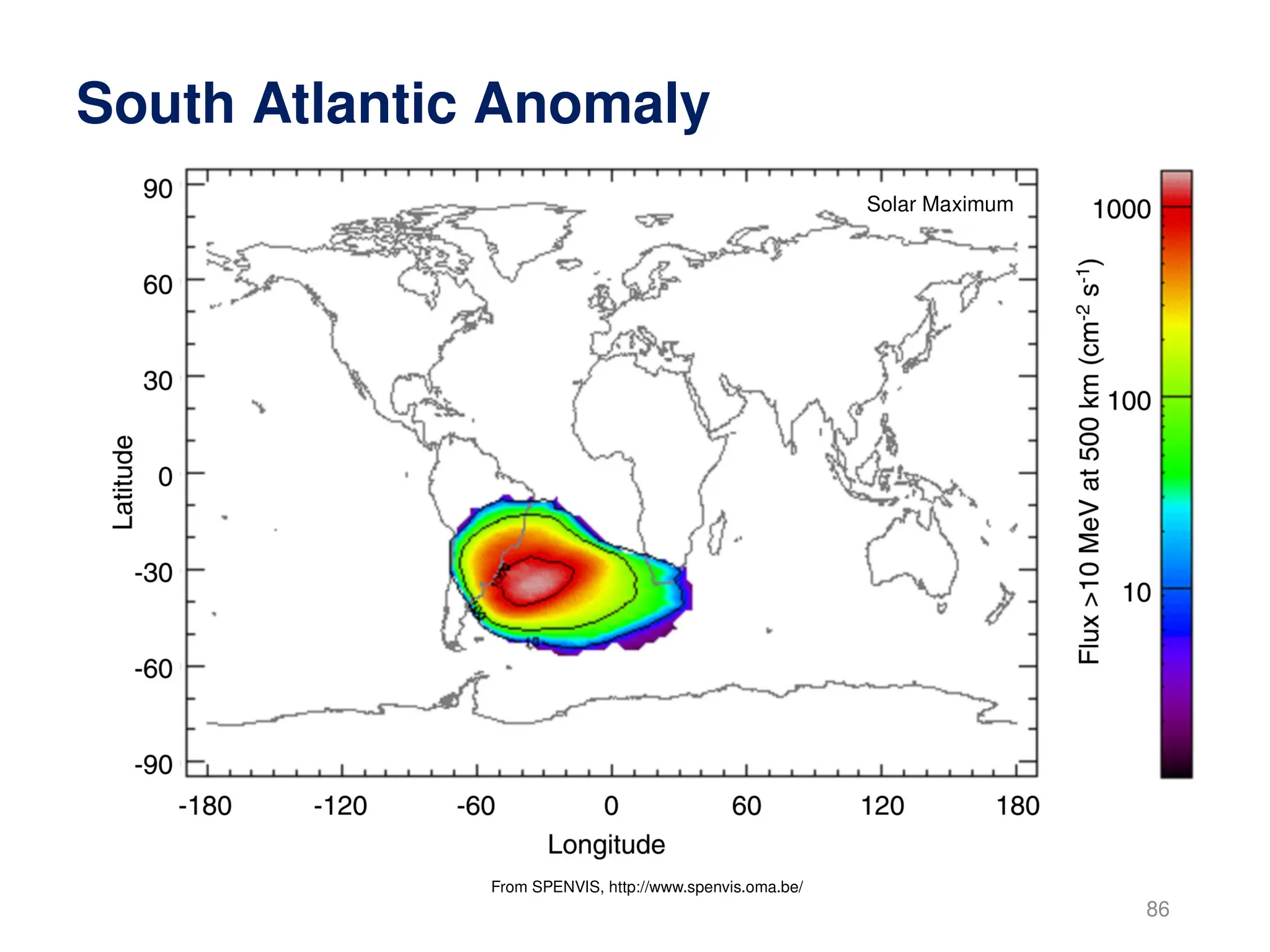
86
South Atlantic Anomaly
From SPENVIS, http://www.spenvis.oma.be/
Solar Maximum
87
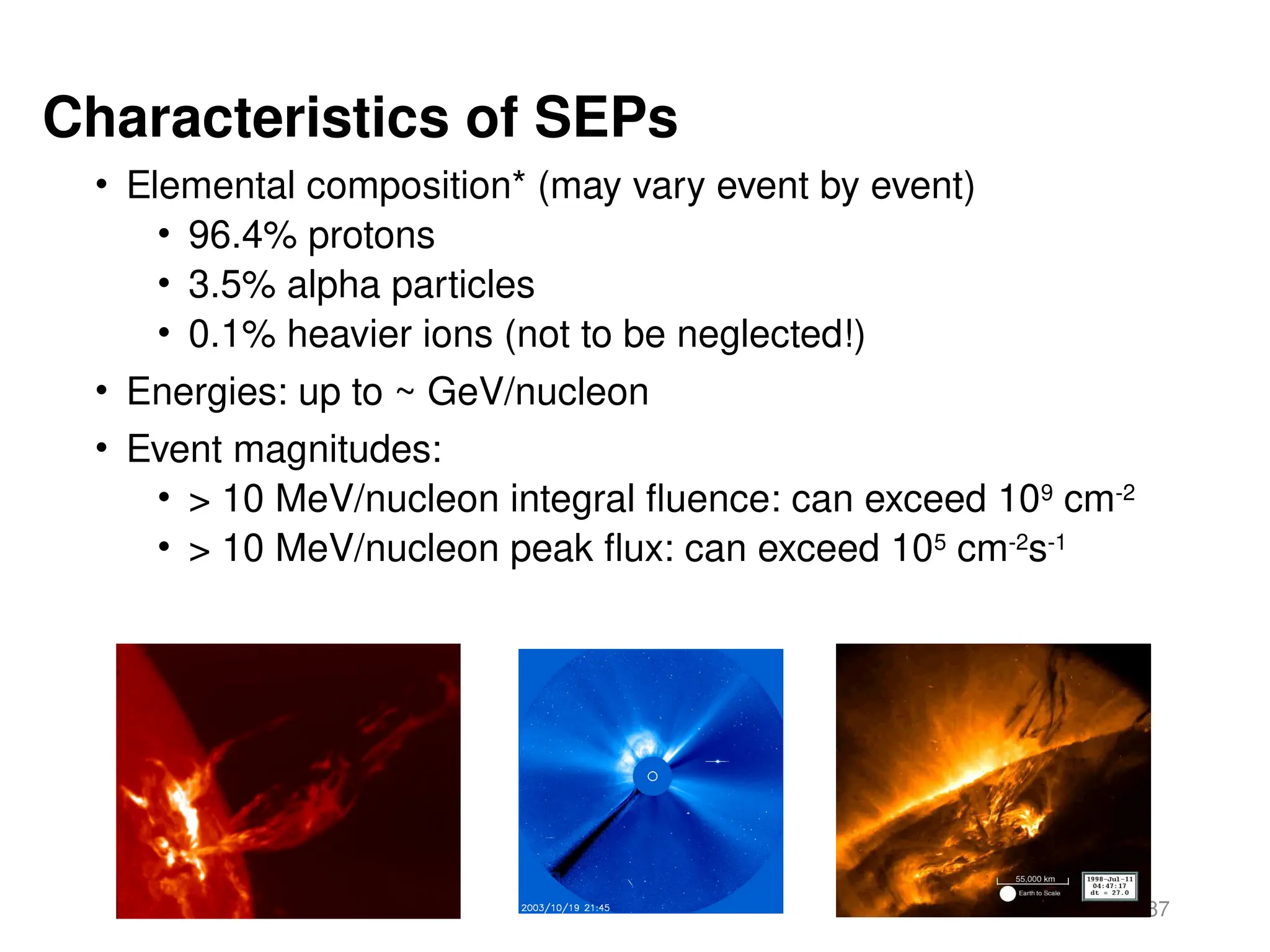
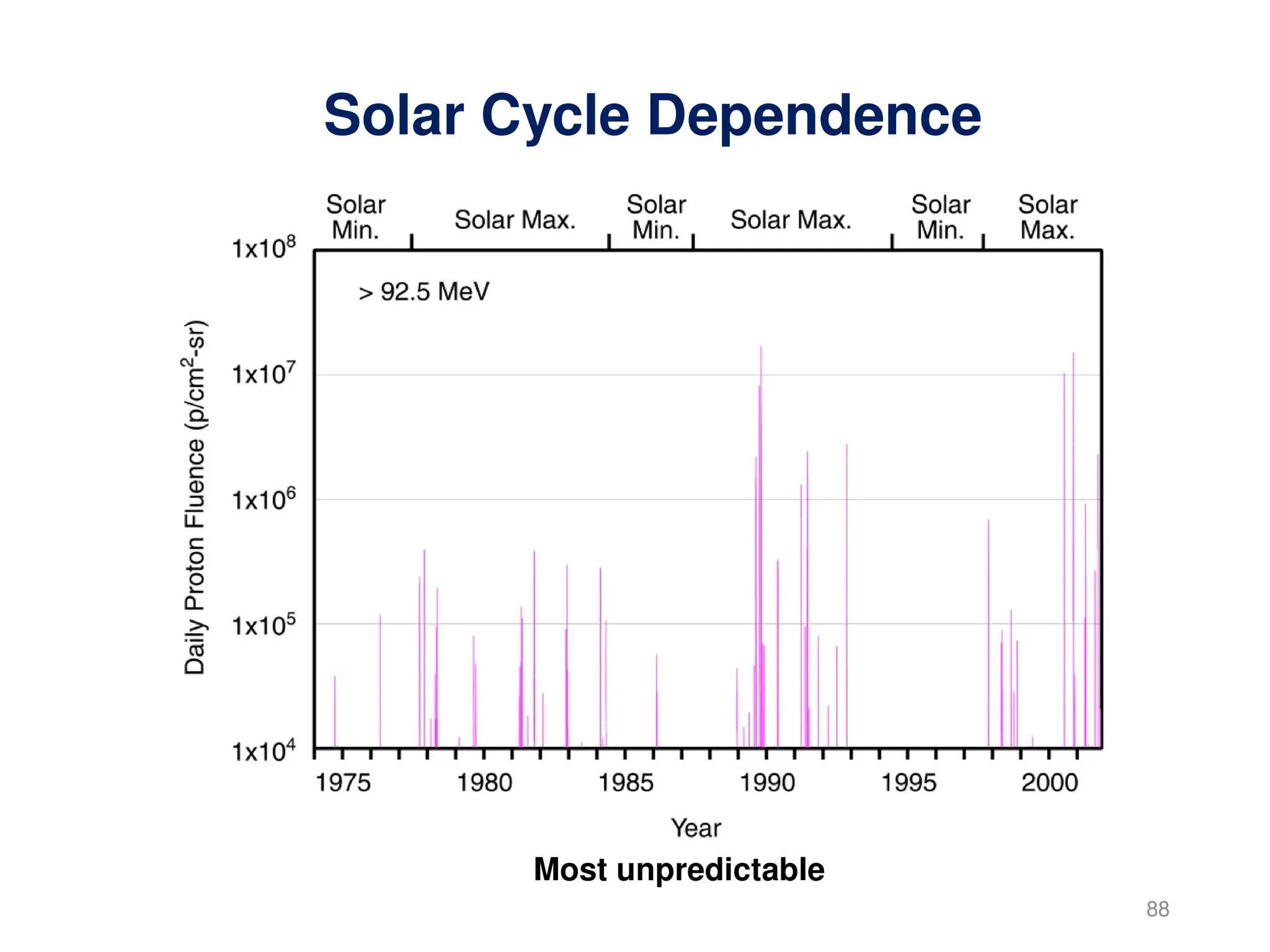
Characteristics of SEPs
• Elemental composition* (may vary event by event)
• 96.4% protons
• 3.5% alpha particles
• 0.1% heavier ions (not to be neglected!)
• Energies: up to ~ GeV/nucleon
• Event magnitudes:
• > 10 MeV/nucleon integral fluence: can exceed 109
cm-2
• > 10 MeV/nucleon peak flux: can exceed 105
cm-2
s-1
88
Solar Cycle Dependence
Most unpredictable
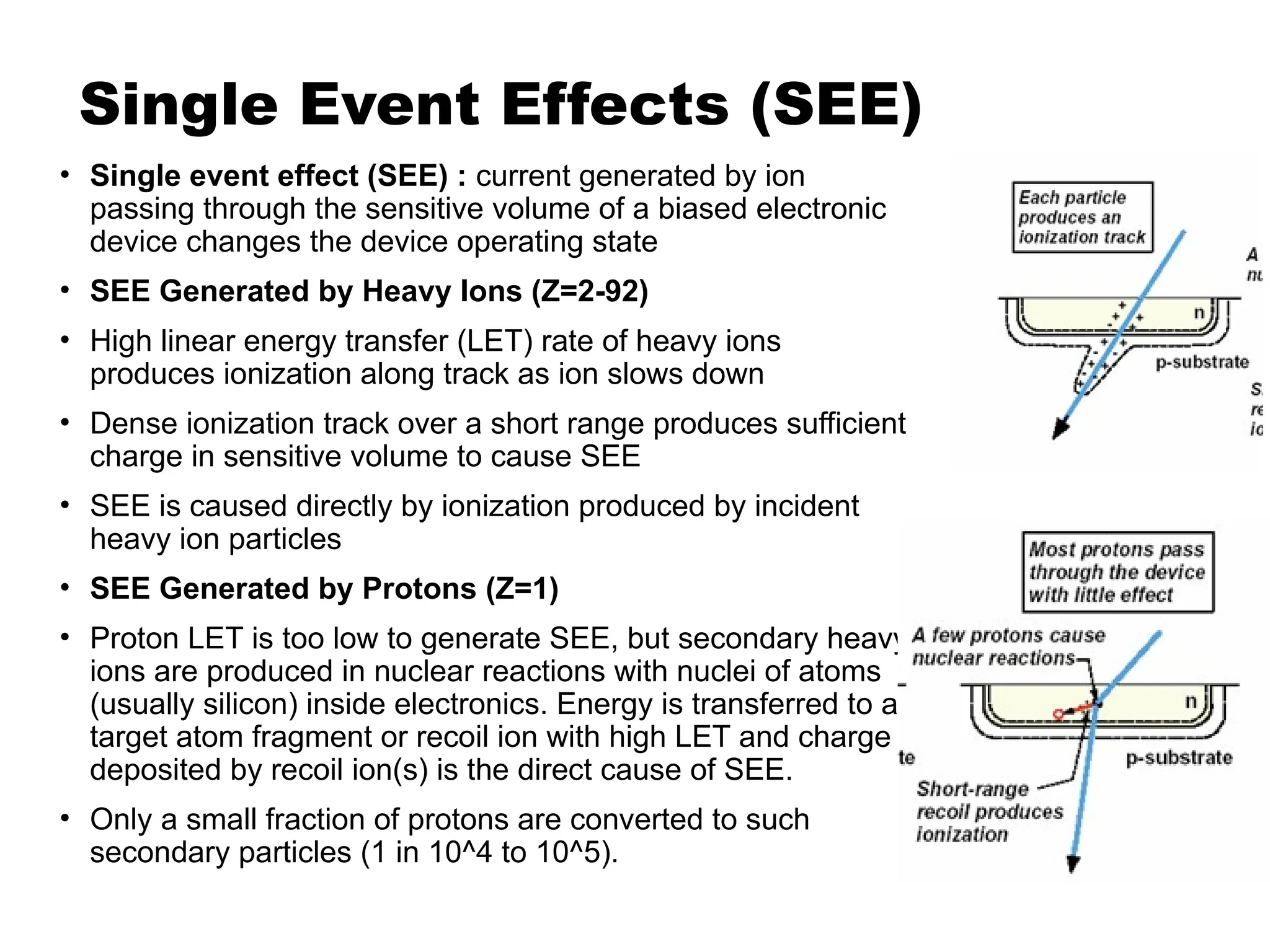
Single Event Effects (SEE)
• Single event effect (SEE) : current generated by ion
passing through the sensitive volume of a biased electronic
device changes the device operating state
• SEE Generated by Heavy Ions (Z=2-92)
• High linear energy transfer (LET) rate of heavy ions
produces ionization along track as ion slows down
• Dense ionization track over a short range produces sufficient
charge in sensitive volume to cause SEE
• SEE is caused directly by ionization produced by incident
heavy ion particles
• SEE Generated by Protons (Z=1)
• Proton LET is too low to generate SEE, but secondary heavy
ions are produced in nuclear reactions with nuclei of atoms
(usually silicon) inside electronics. Energy is transferred to a
target atom fragment or recoil ion with high LET and charge
deposited by recoil ion(s) is the direct cause of SEE.
• Only a small fraction of protons are converted to such
secondary particles (1 in 10^4 to 10^5).
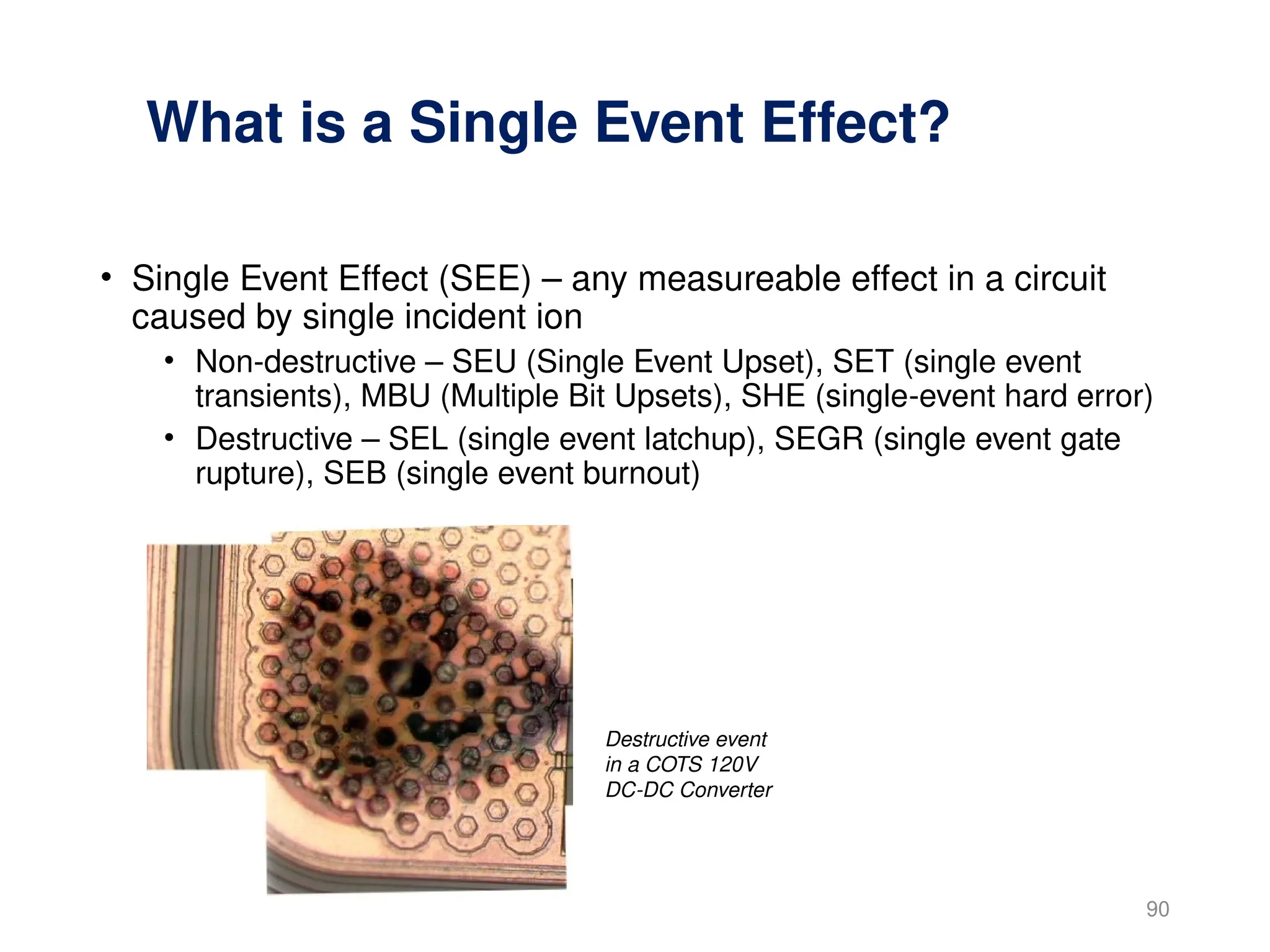
What is a Single Event Effect?
• Single Event Effect (SEE) – any measureable effect in a circuit
caused by single incident ion
• Non-destructive – SEU (Single Event Upset), SET (single event
transients), MBU (Multiple Bit Upsets), SHE (single-event hard error)
• Destructive – SEL (single event latchup), SEGR (single event gate
rupture), SEB (single event burnout)
90
Destructive event
in a COTS 120V
DC-DC Converter
Single Event Upsets
• SEUs: are soft errors, and non-destructive.
They normally appear as transient pulses in
logic or support circuitry, or as bitflips in
memory cells or registers.
91
Destructive SEEs
• Several types of hard errors, potentially
destructive, can appear:
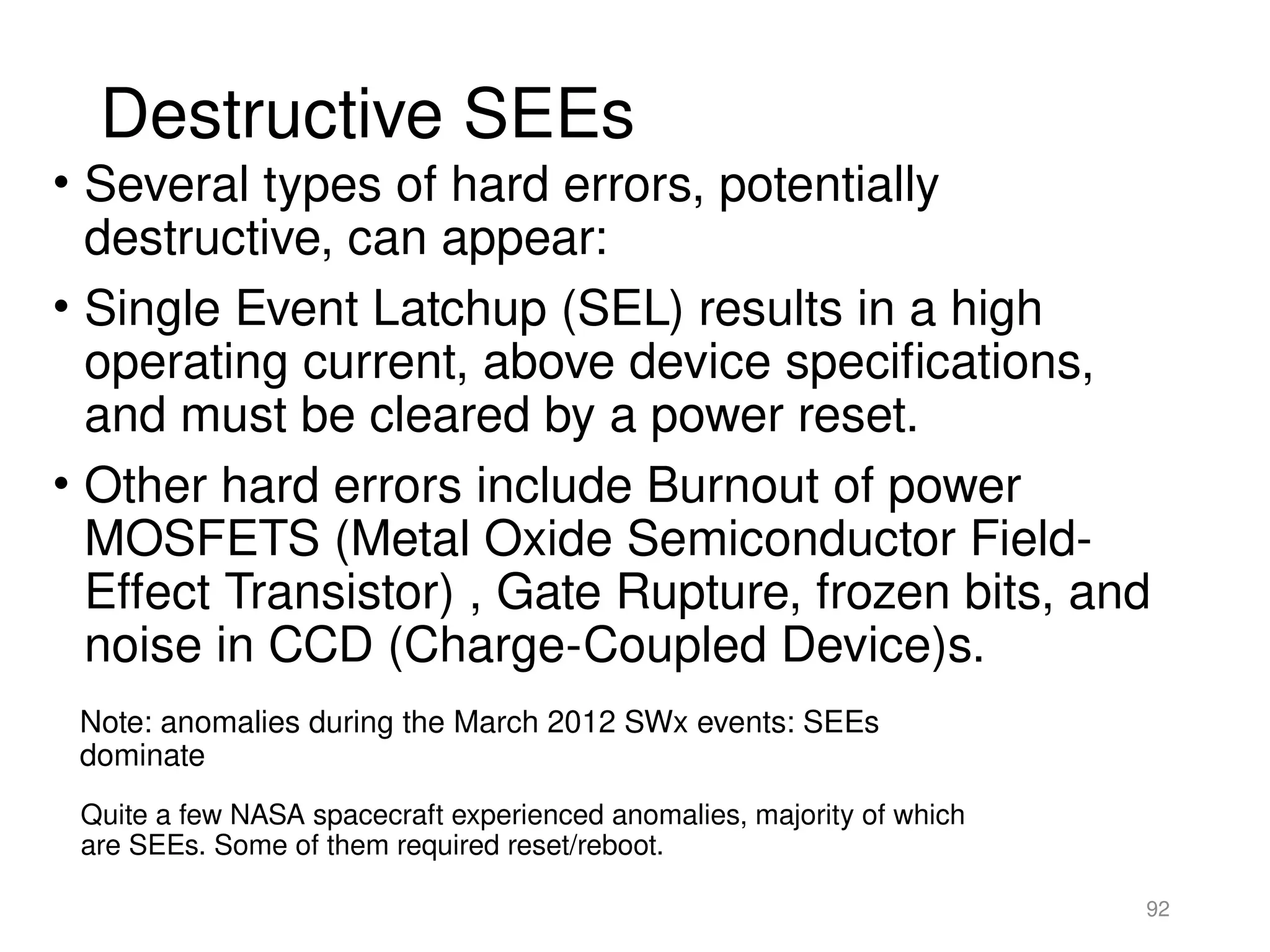
• Single Event Latchup (SEL) results in a high
operating current, above device specifications,
and must be cleared by a power reset.
• Other hard errors include Burnout of power
MOSFETS (Metal Oxide Semiconductor Field-
Effect Transistor) , Gate Rupture, frozen bits, and
noise in CCD (Charge-Coupled Device)s.
92
Note: anomalies during the March 2012 SWx events: SEEs
dominate
Quite a few NASA spacecraft experienced anomalies, majority of which
are SEEs. Some of them required reset/reboot.
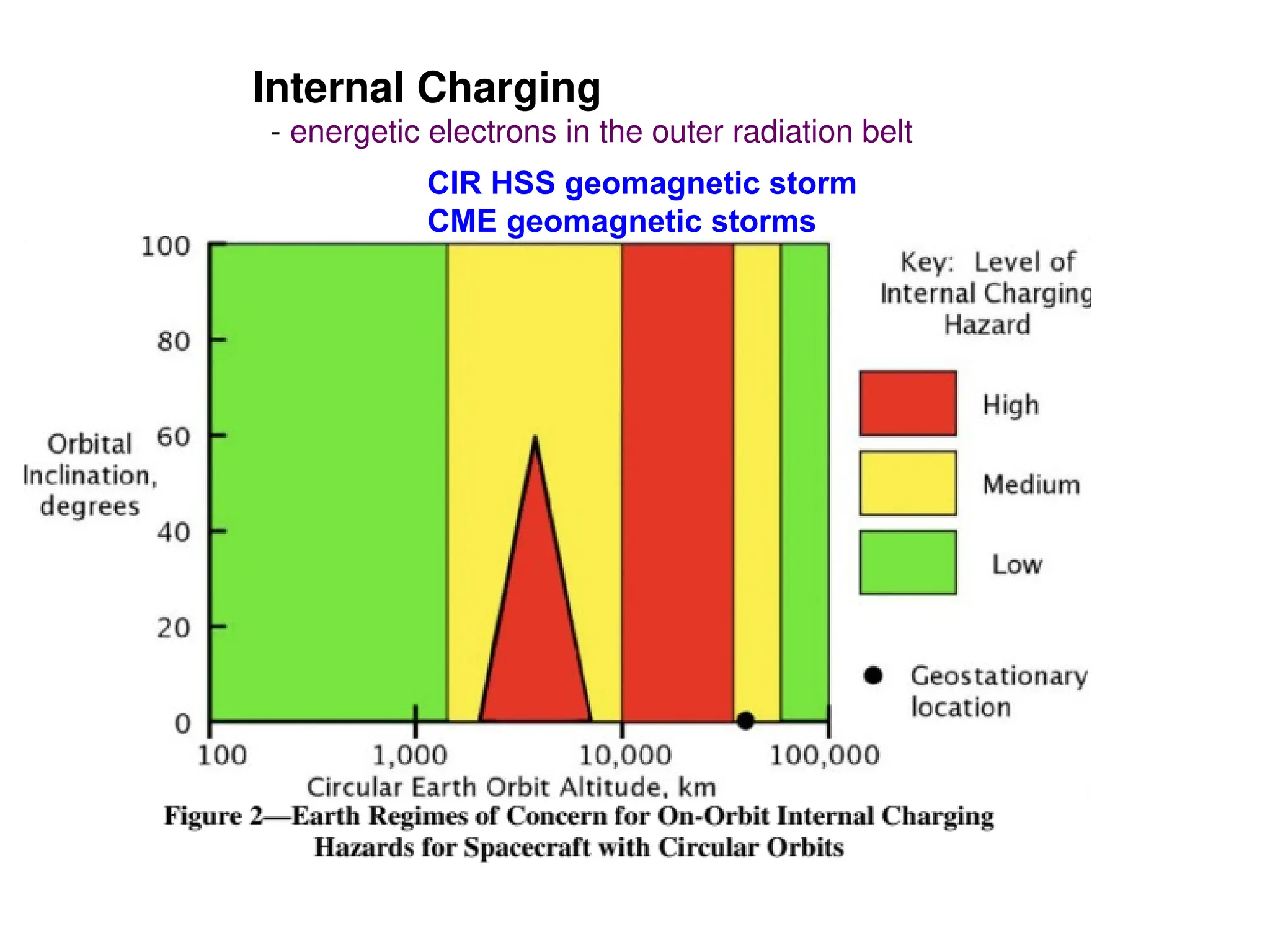
Internal Charging
- energetic electrons in the outer radiation belt
CIR HSS geomagnetic storm
CME geomagnetic storms
Van Allen Probes
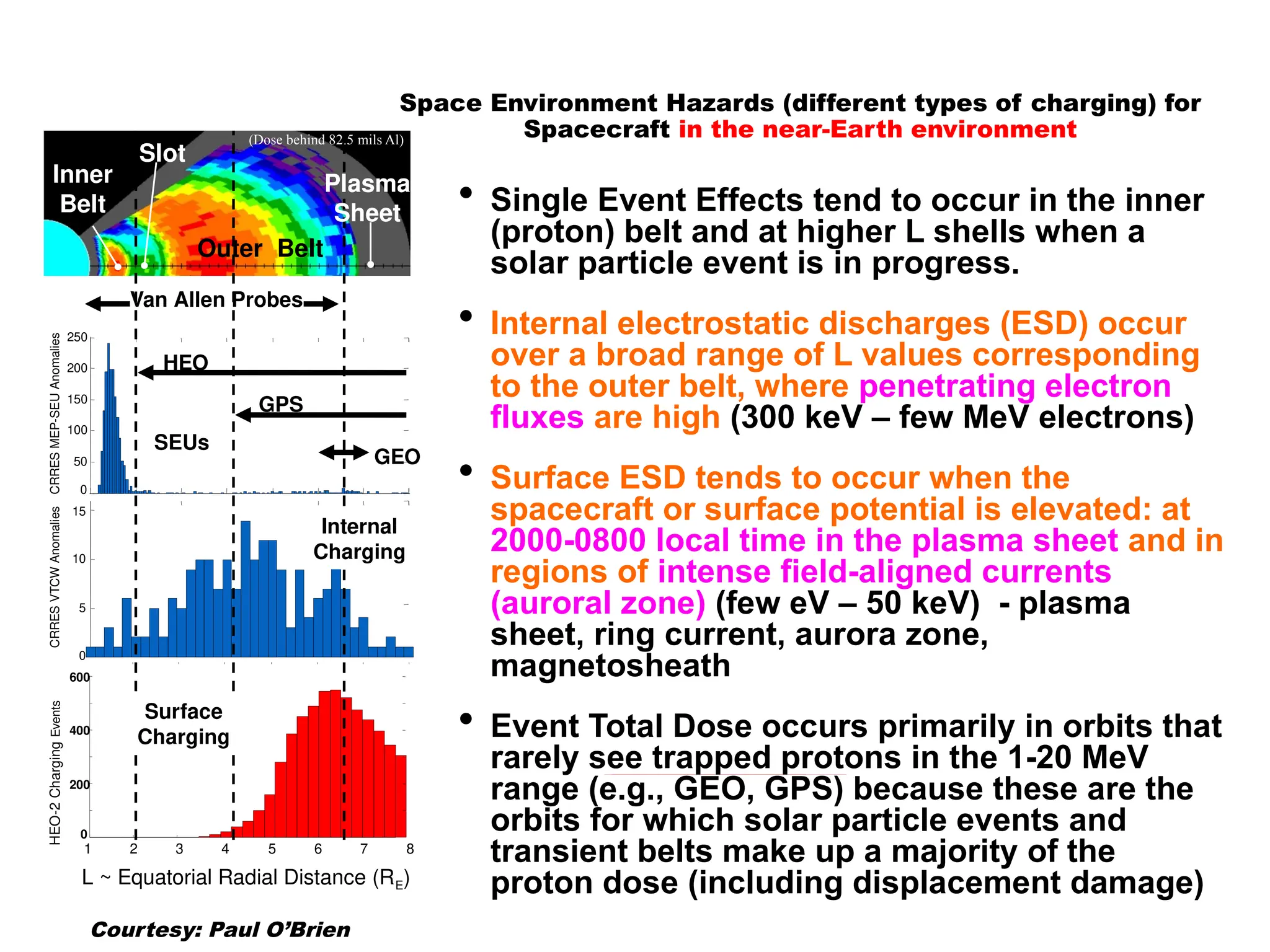
Space Environment Hazards (different types of charging) for
Spacecraft in the near-Earth environment
0
200
400
600
HEO-2
Charging
Events
L ~ Equatorial Radial Distance (RE)
HEO
GPS
GEO
0
50
100
150
200
250
CRRES
MEP-SEU
Anomalies
0
CRRES
VTCW
Anomalies
Inner
Belt
Slot
Outer Belt
5
10
15
1 2 3 4 5 6 7 8
SEUs
Internal
Charging
Surface
Charging
(Dose behind 82.5 mils Al)
• Single Event Effects tend to occur in the inner
(proton) belt and at higher L shells when a
solar particle event is in progress.
• Internal electrostatic discharges (ESD) occur
over a broad range of L values corresponding
to the outer belt, where penetrating electron
fluxes are high (300 keV – few MeV electrons)
• Surface ESD tends to occur when the
spacecraft or surface potential is elevated: at
2000-0800 local time in the plasma sheet and in
regions of intense field-aligned currents
(auroral zone) (few eV – 50 keV) - plasma
sheet, ring current, aurora zone,
magnetosheath
• Event Total Dose occurs primarily in orbits that
rarely see trapped protons in the 1-20 MeV
range (e.g., GEO, GPS) because these are the
orbits for which solar particle events and
transient belts make up a majority of the
proton dose (including displacement damage)
Plasma
Sheet
Courtesy: Paul O’Brien
Total Dose Effects
• Total Ionizing Dose (TID) –
cumulative damage resulting
from ionization (electron-hole
pair formation) causing
• Threshold voltage shifts
• Timing skews
• Leakage currents
• Displacement Damage Dose
(DDD) – cumulative damage
resulting from displacement of
atoms in semiconductor lattice
structure causing:
• Carrier lifetime shortening
• Mobility degradation
0
2
4
6
8
10
12
14
0 2 4 6 8 10
Total Dose [krad(Si)]
Voltage
During
Erase
Function
Failed to erase
Solar Array Degradation
128 Mb Samsung Flash Memory
DDD can also be referred to in the context of
Non-Ionizing Energy Loss (NIEL) CREDIT: NRL & JPL
Messenger, S. R., Summers, G. P., Burke, E. A., Walters, R. J. and
Xapsos, M. A. (2001), Modeling solar cell degradation in space: A
comparison of the NRL displacement damage dose and the JPL
equivalent fluence approaches. Prog. Photovolt: Res. Appl., 9: 103–
121. doi: 10.1002/pip.357
Human Safety in Space
• GCR
• SEP
Johnson Space Center/Space Radiation Analysis
Group (SRAG)
Limit: the > 100 MeV flux exceeding 1pfu
(1 pfu = 1 particle flux unit= 1/cm^2/sec/sr)
• All clear (EVA –extravehicular activity)
96
Space Exploration
What is out there?
Mankind has always looked up at the moon and stars and
wondered about life in the universe.
“The first of these factors is the compelling urge of man to
explore and to discover, the thrust of curiosity that leads
men to try to go where no one has gone before. Most of the
surface of the earth has now been explored and men now
turn on the exploration of outer space as their next
objective.” – Introduction to Outer Space, pamphlet
produced in an effort to garner support for a national space
program in the wake of the Sputnik flight.
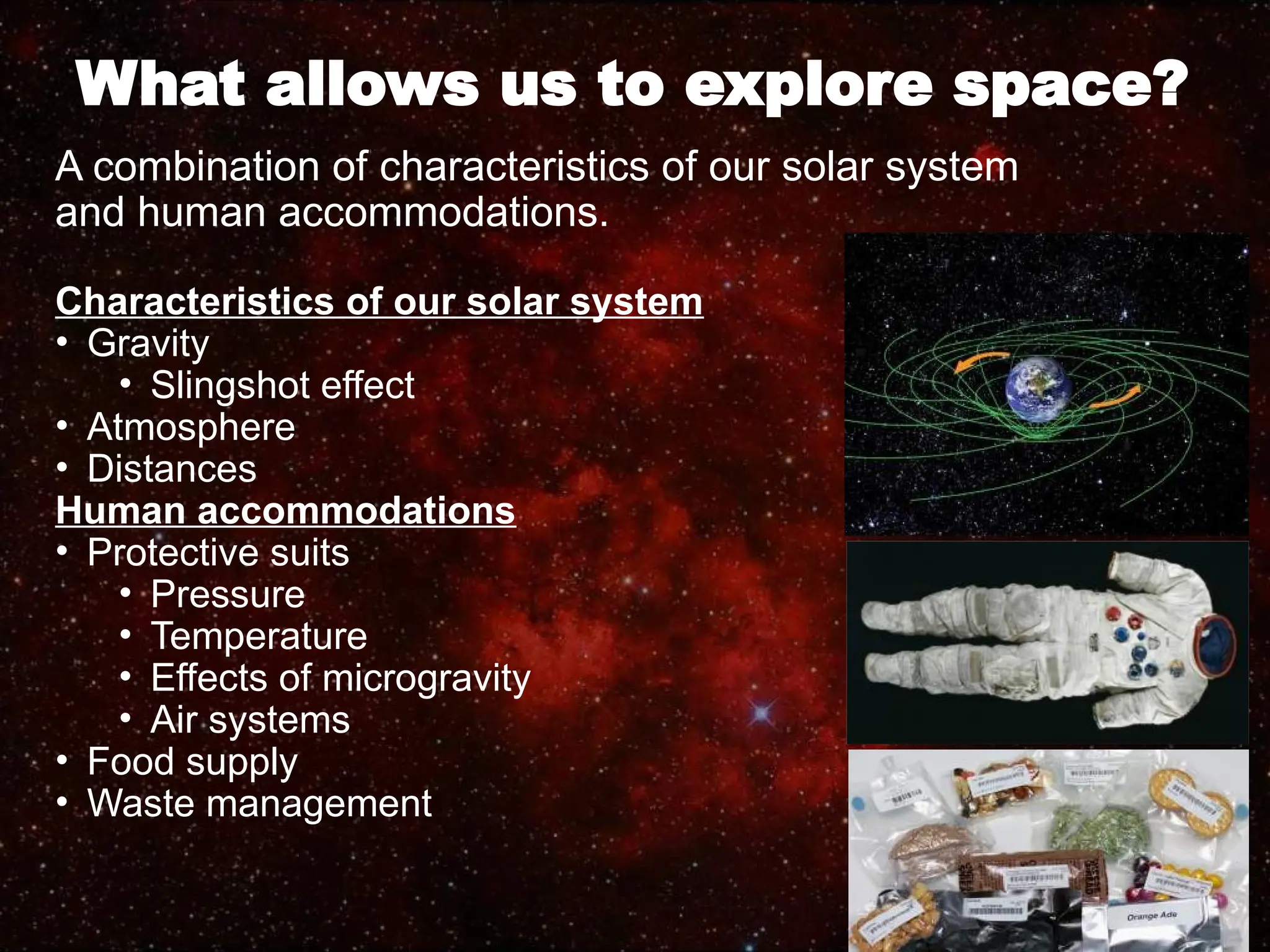
What allows us to explore space?
A combination of characteristics of our solar system
and human accommodations.
Characteristics of our solar system
• Gravity
• Slingshot effect
• Atmosphere
• Distances
Human accommodations
• Protective suits
• Pressure
• Temperature
• Effects of microgravity
• Air systems
• Food supply
• Waste management
11/20/2024 SIST-AERO 101
Space suit
Why can’t we breathe in space?
Earth’s atmosphere has pressure that allows
water to exist in liquid form, protects us
against harmful radiation from the sun, and
allows us to breathe due to nitrogen/oxygen
content.
Since space is essentially a vacuum, there is
no air at all. The density of oxygen in space is
so miniscule that oxygen can be barely
detected even with our most sensitive
detectors. Due to this, astronauts are
equipped with air systems when they leave
their spacecraft.
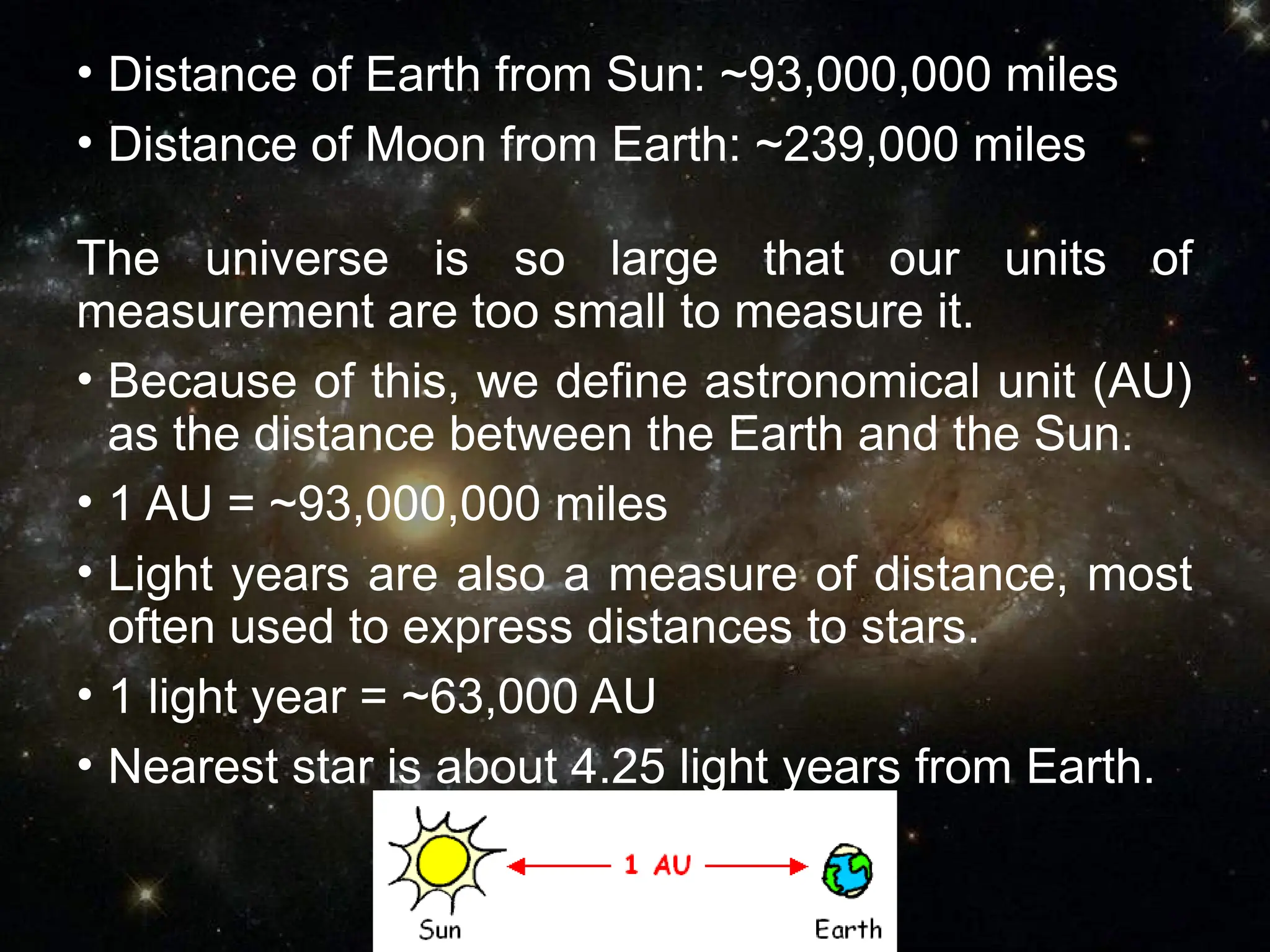
• Distance of Earth from Sun: ~93,000,000 miles
• Distance of Moon from Earth: ~239,000 miles
The universe is so large that our units of
measurement are too small to measure it.
• Because of this, we define astronomical unit (AU)
as the distance between the Earth and the Sun.
• 1 AU = ~93,000,000 miles
• Light years are also a measure of distance, most
often used to express distances to stars.
• 1 light year = ~63,000 AU
• Nearest star is about 4.25 light years from Earth.
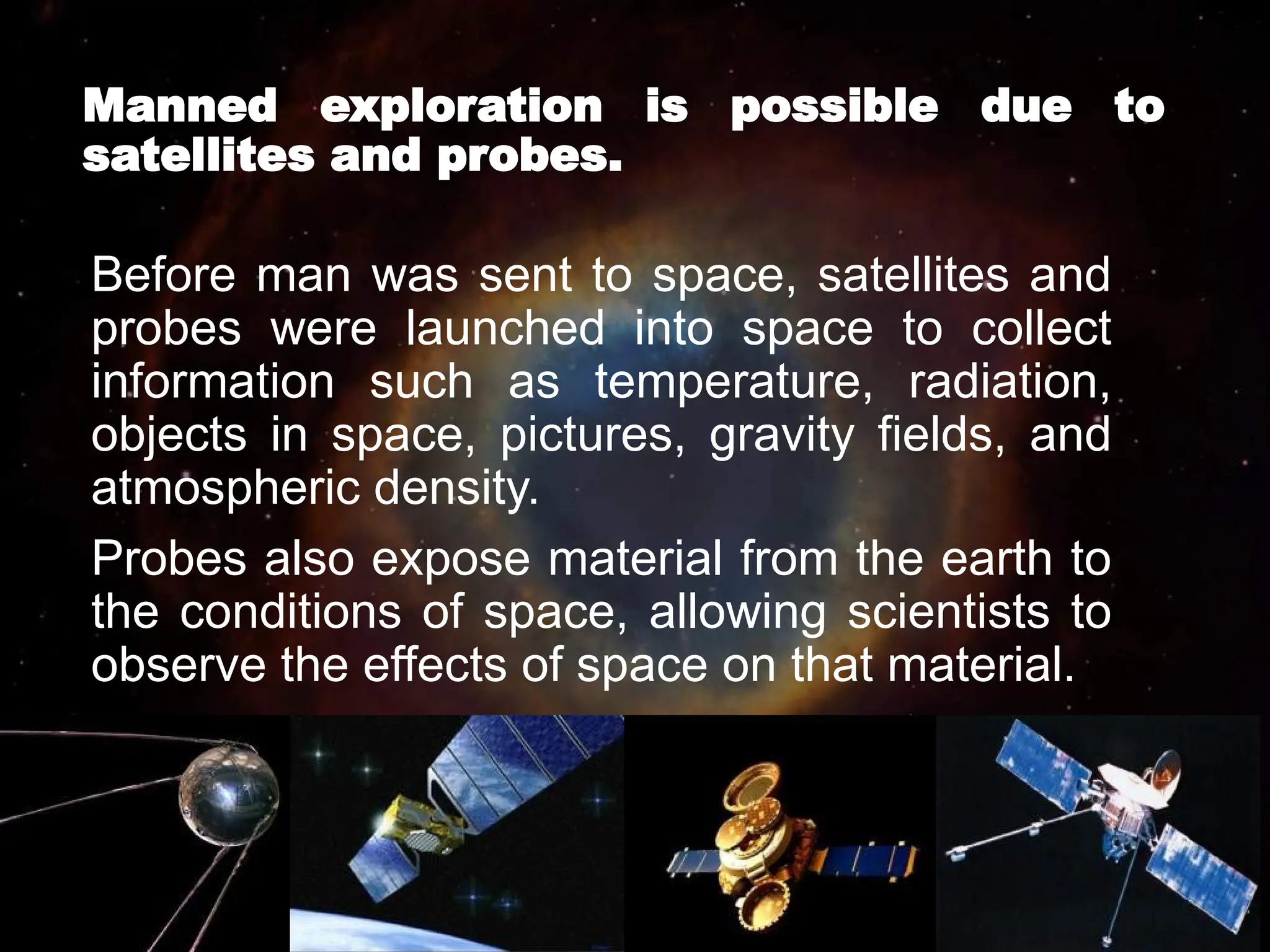
Manned exploration is possible due to
satellites and probes.
Before man was sent to space, satellites and
probes were launched into space to collect
information such as temperature, radiation,
objects in space, pictures, gravity fields, and
atmospheric density.
Probes also expose material from the earth to
the conditions of space, allowing scientists to
observe the effects of space on that material.
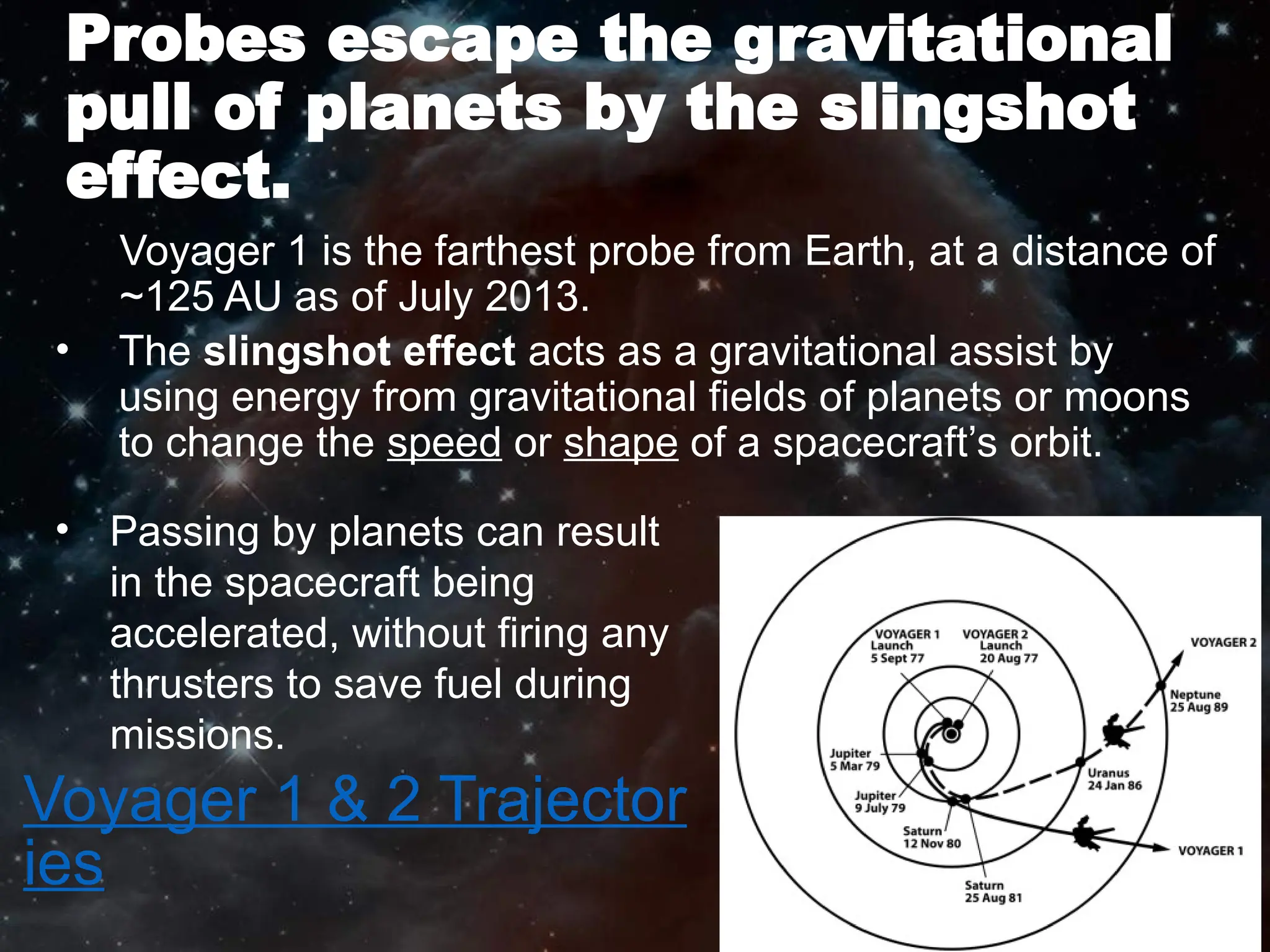
Probes escape the gravitational
pull of planets by the slingshot
effect.
Voyager 1 is the farthest probe from Earth, at a distance of
~125 AU as of July 2013.
• The slingshot effect acts as a gravitational assist by
using energy from gravitational fields of planets or moons
to change the speed or shape of a spacecraft’s orbit.
• Passing by planets can result
in the spacecraft being
accelerated, without firing any
thrusters to save fuel during
missions.
Voyager 1 & 2 Trajector
ies
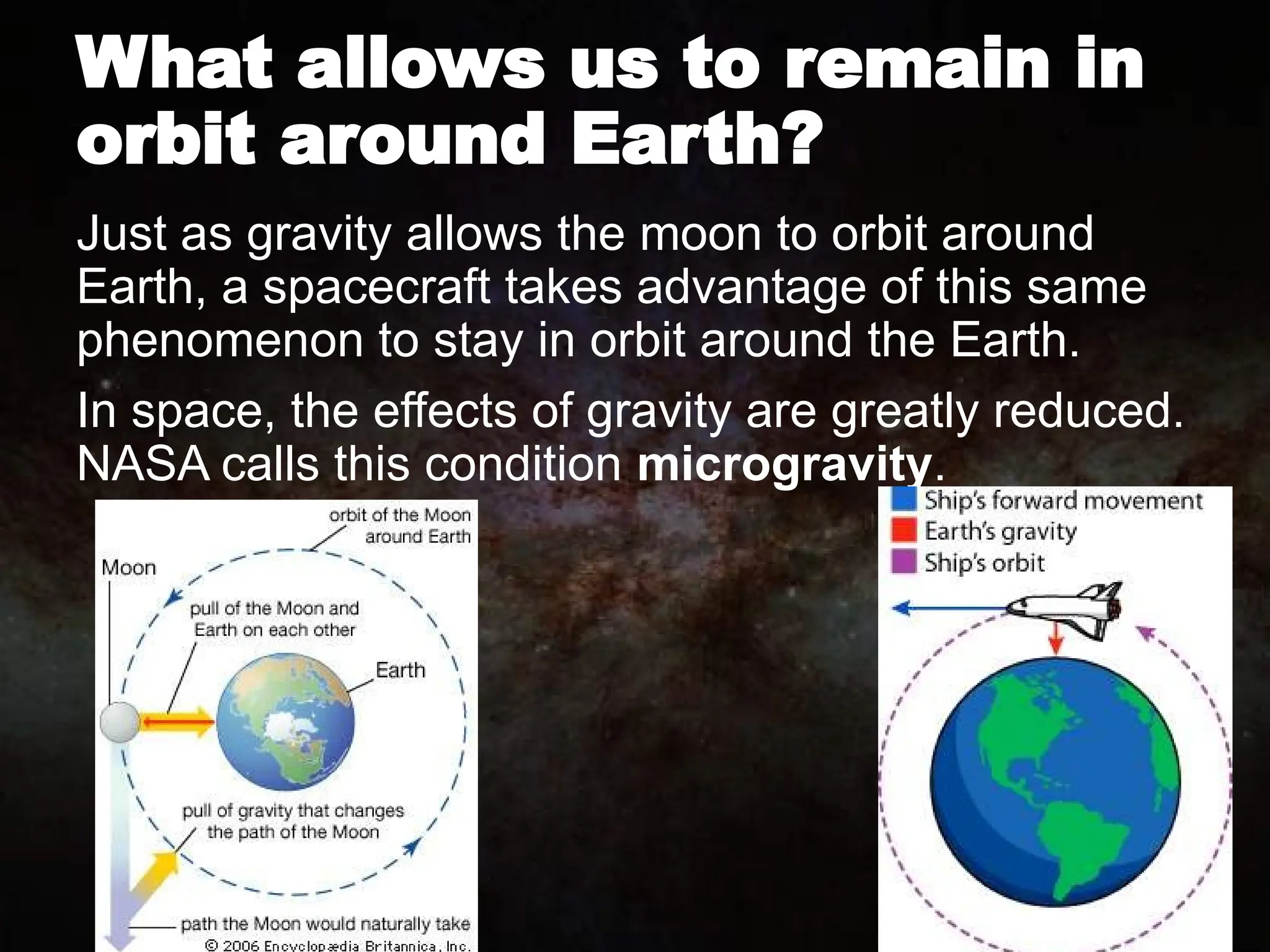
What allows us to remain in
orbit around Earth?
Just as gravity allows the moon to orbit around
Earth, a spacecraft takes advantage of this same
phenomenon to stay in orbit around the Earth.
In space, the effects of gravity are greatly reduced.
NASA calls this condition microgravity.
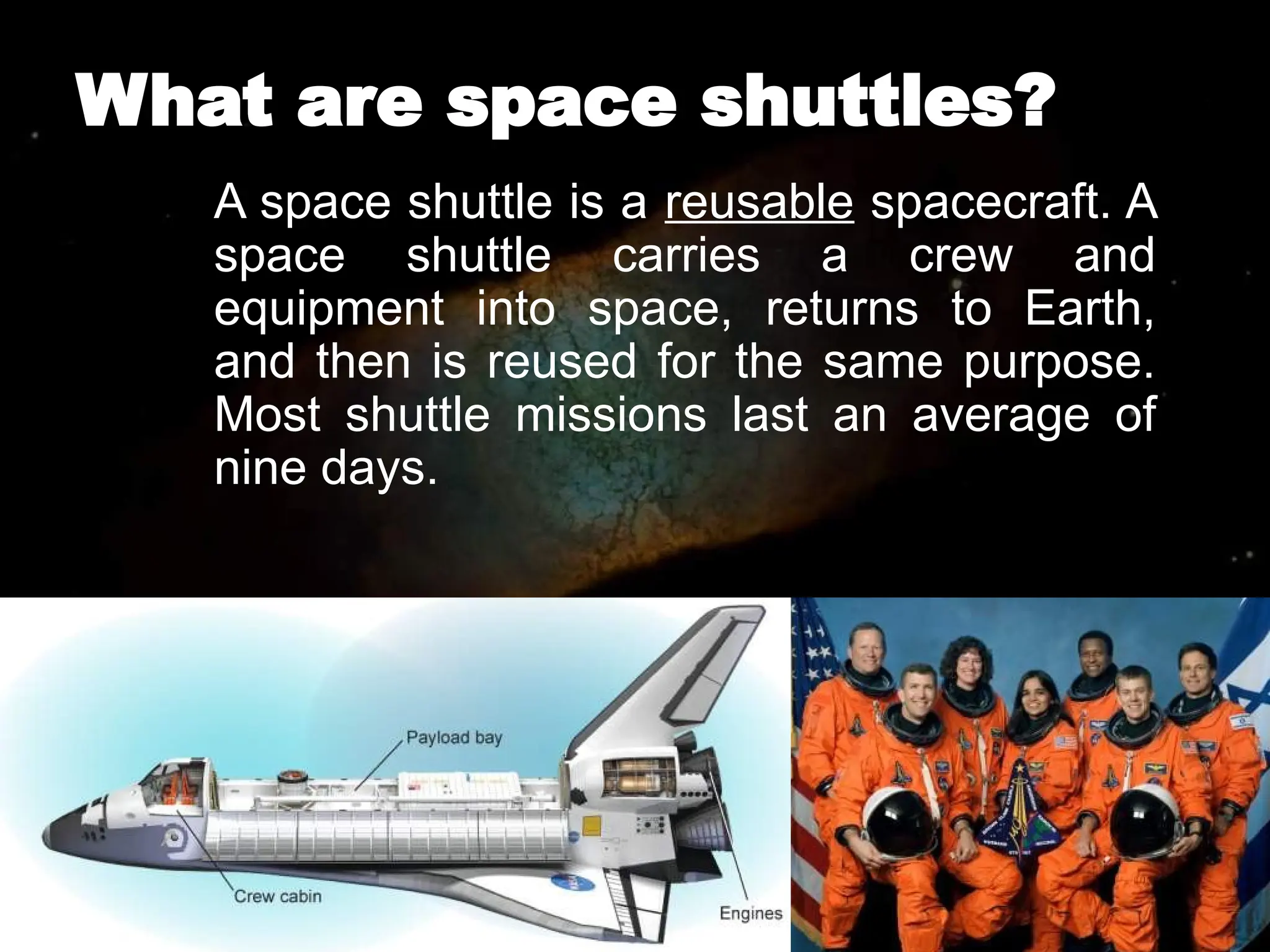
What are space shuttles?
A space shuttle is a reusable spacecraft. A
space shuttle carries a crew and
equipment into space, returns to Earth,
and then is reused for the same purpose.
Most shuttle missions last an average of
nine days.
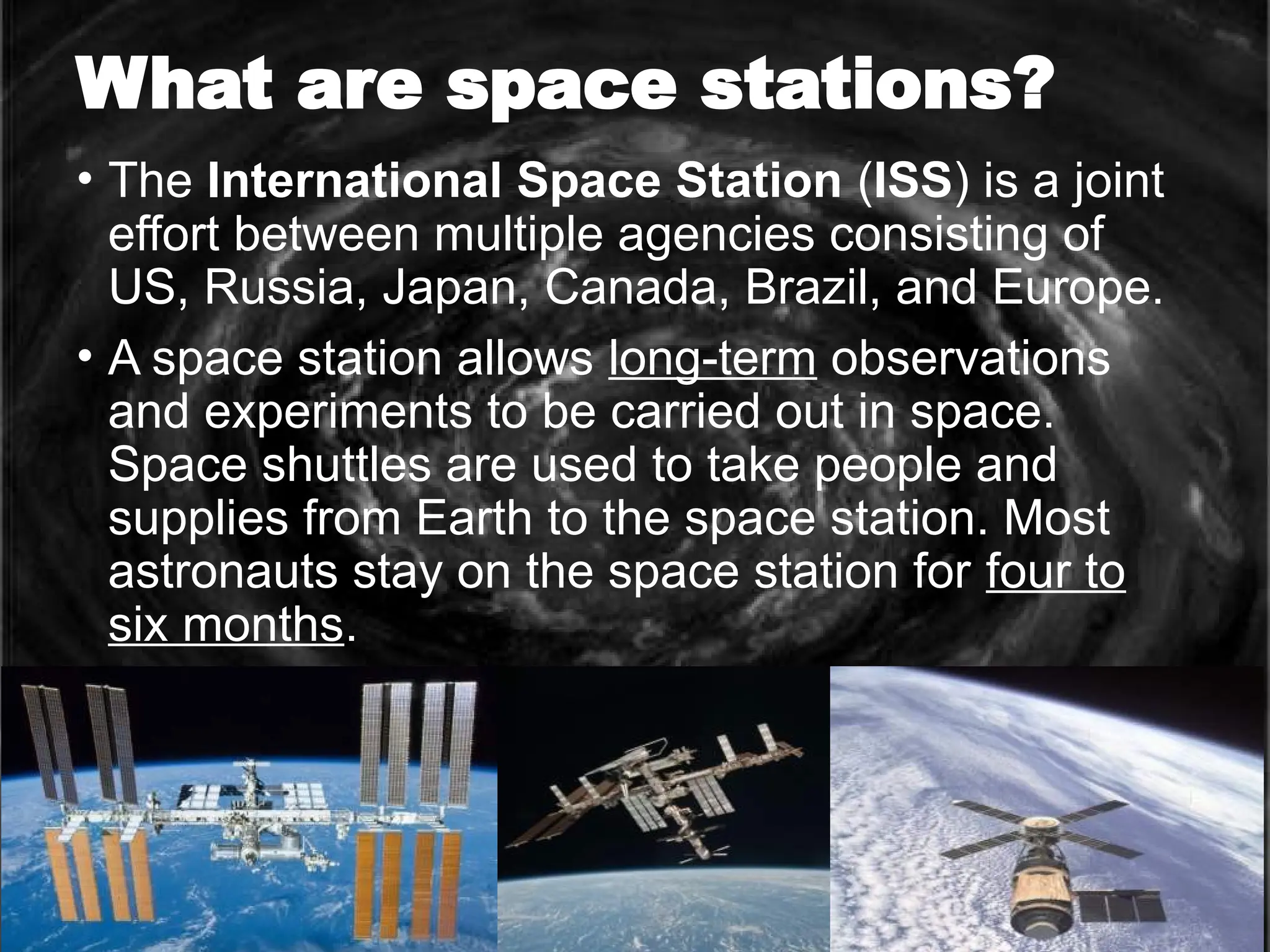
What are space stations?
• The International Space Station (ISS) is a joint
effort between multiple agencies consisting of
US, Russia, Japan, Canada, Brazil, and Europe.
• A space station allows long-term observations
and experiments to be carried out in space.
Space shuttles are used to take people and
supplies from Earth to the space station. Most
astronauts stay on the space station for four to
six months.
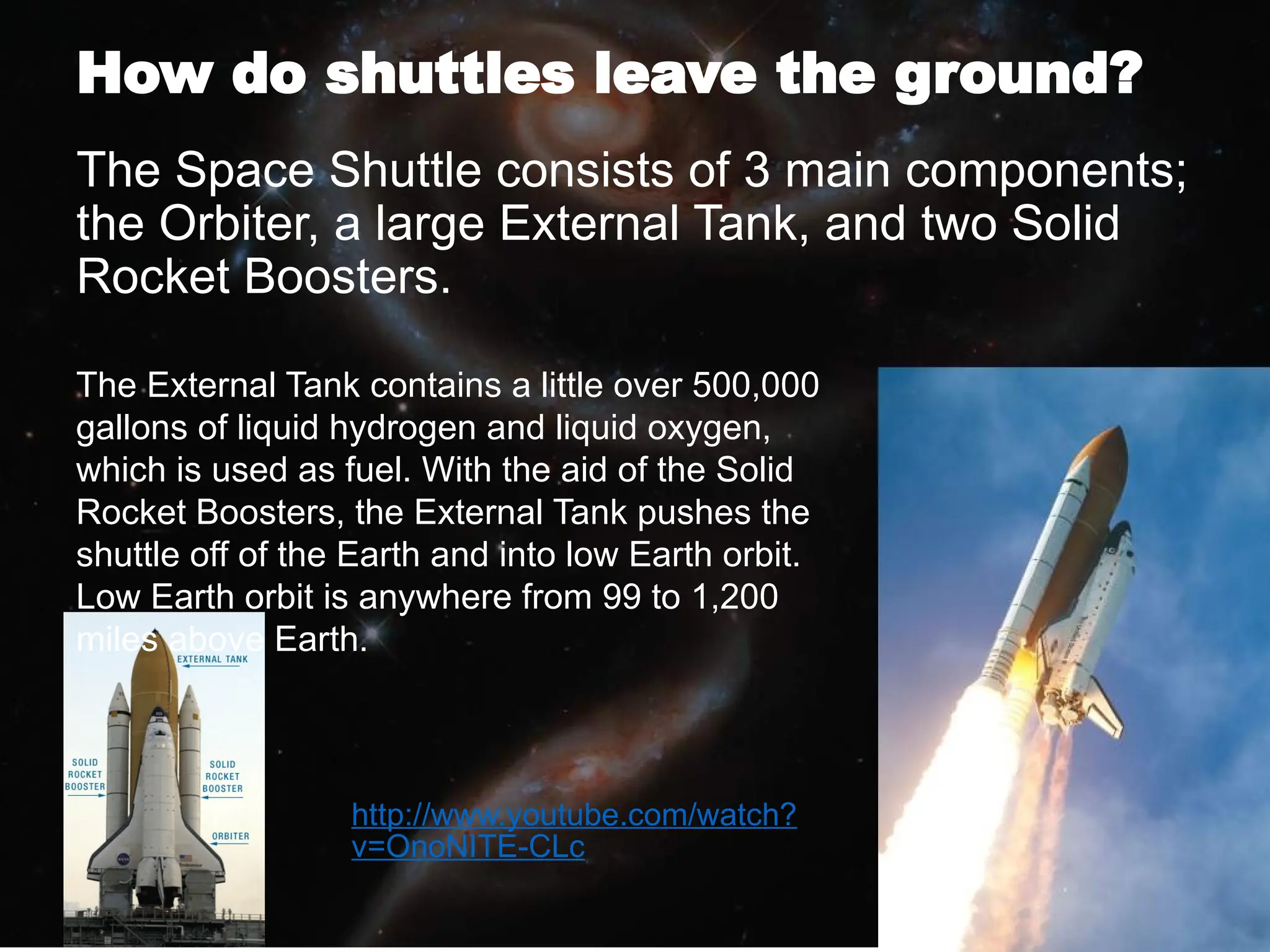
How do shuttles leave the ground?
The Space Shuttle consists of 3 main components;
the Orbiter, a large External Tank, and two Solid
Rocket Boosters.
The External Tank contains a little over 500,000
gallons of liquid hydrogen and liquid oxygen,
which is used as fuel. With the aid of the Solid
Rocket Boosters, the External Tank pushes the
shuttle off of the Earth and into low Earth orbit.
Low Earth orbit is anywhere from 99 to 1,200
miles above Earth.
http://www.youtube.com/watch?
v=OnoNITE-CLc
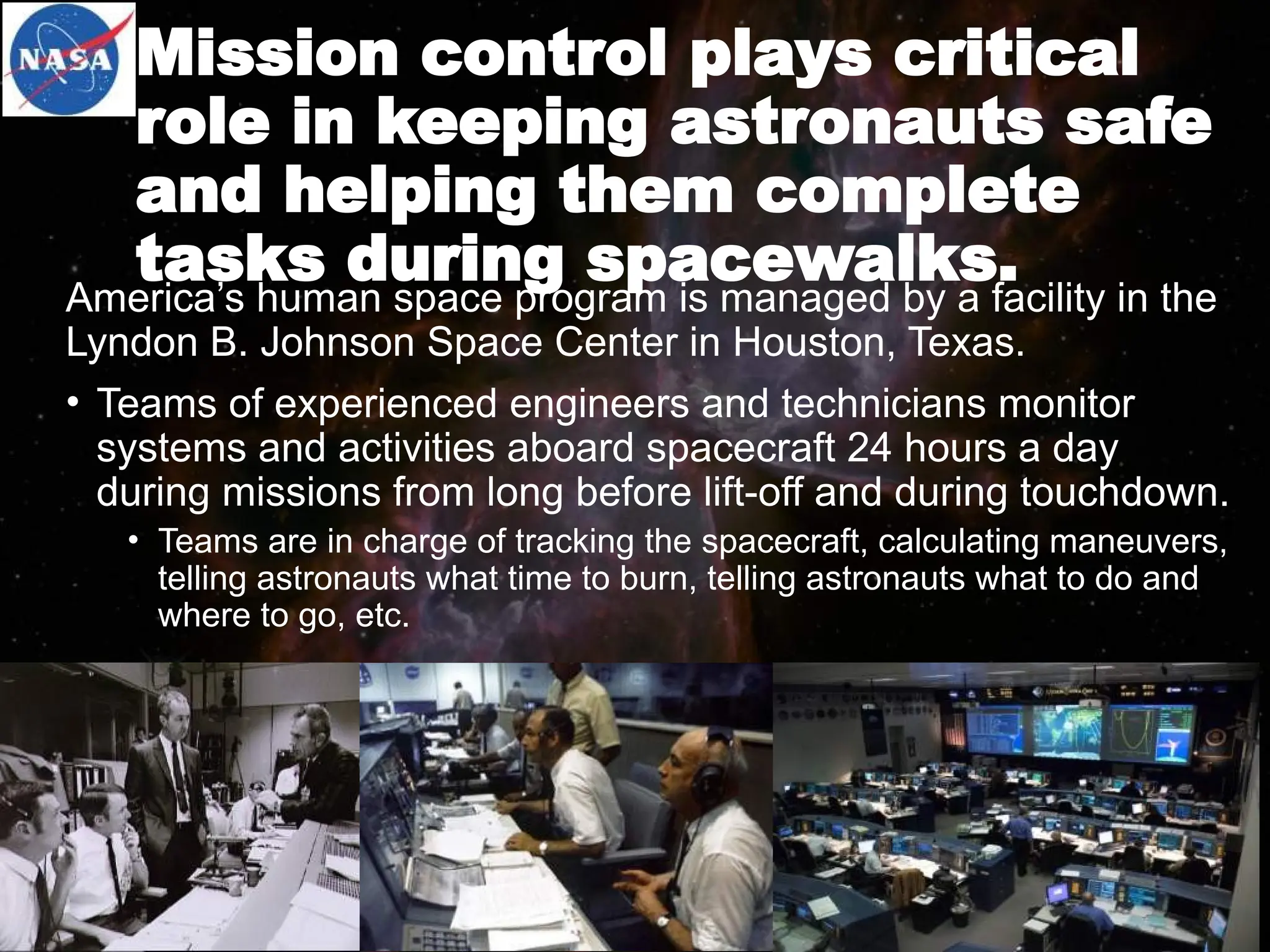
Mission control plays critical
role in keeping astronauts safe
and helping them complete
tasks during spacewalks.
America’s human space program is managed by a facility in the
Lyndon B. Johnson Space Center in Houston, Texas.
• Teams of experienced engineers and technicians monitor
systems and activities aboard spacecraft 24 hours a day
during missions from long before lift-off and during touchdown.
• Teams are in charge of tracking the spacecraft, calculating maneuvers,
telling astronauts what time to burn, telling astronauts what to do and
where to go, etc.
11/20/2024 SIST-AERO 111
Space walks
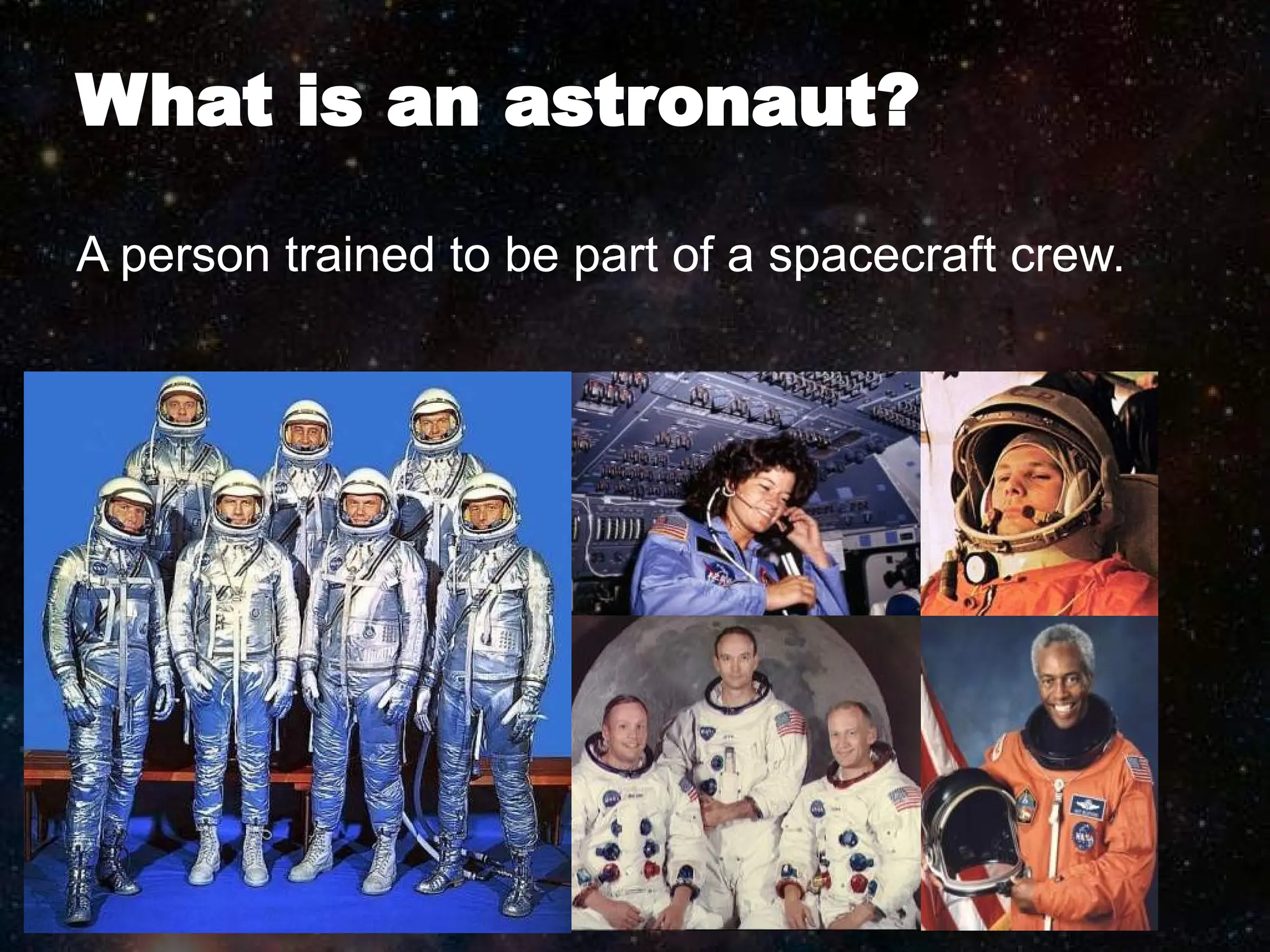
What is an astronaut?
A person trained to be part of a spacecraft crew.
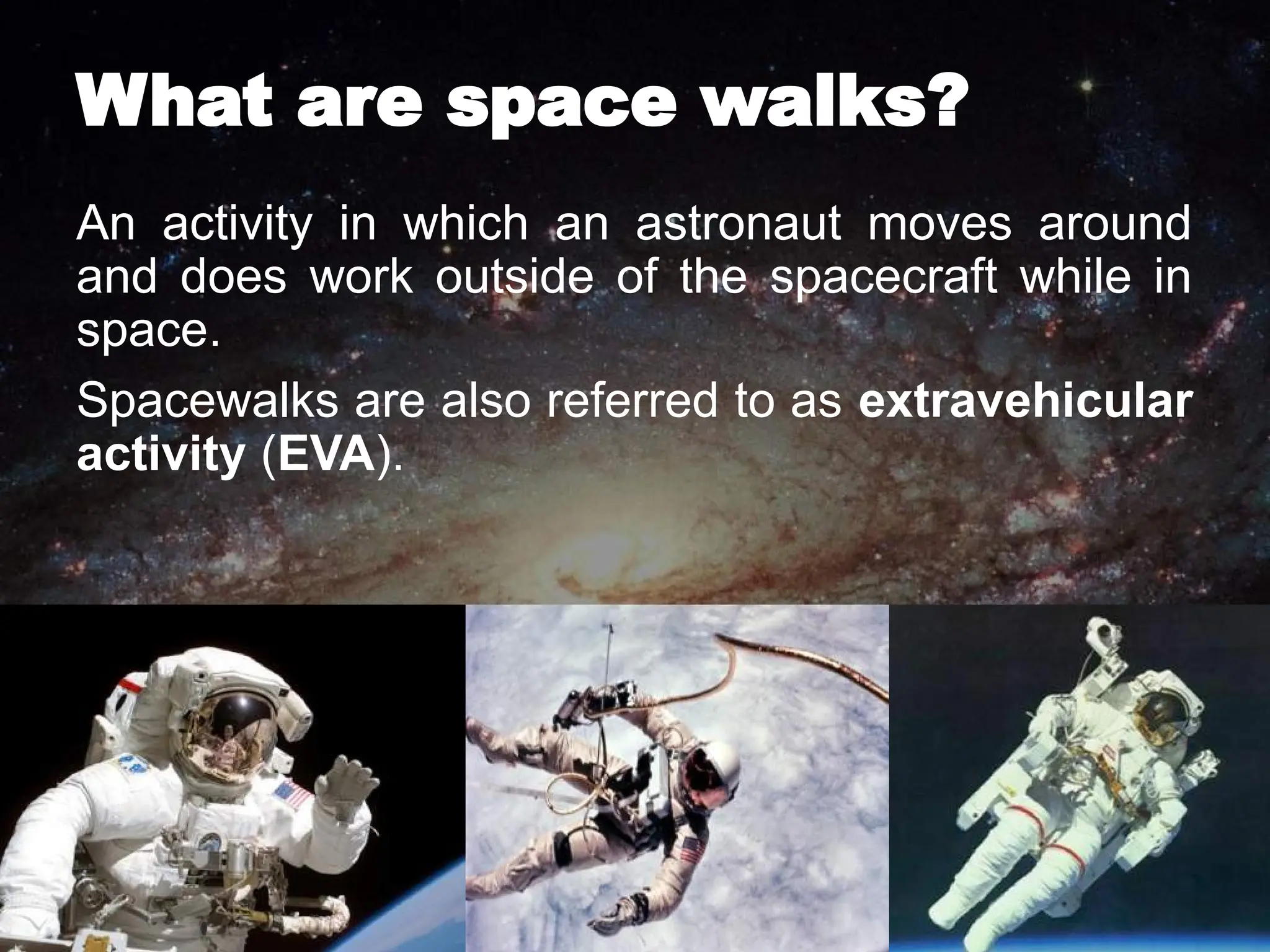
What are space walks?
An activity in which an astronaut moves around
and does work outside of the spacecraft while in
space.
Spacewalks are also referred to as extravehicular
activity (EVA).
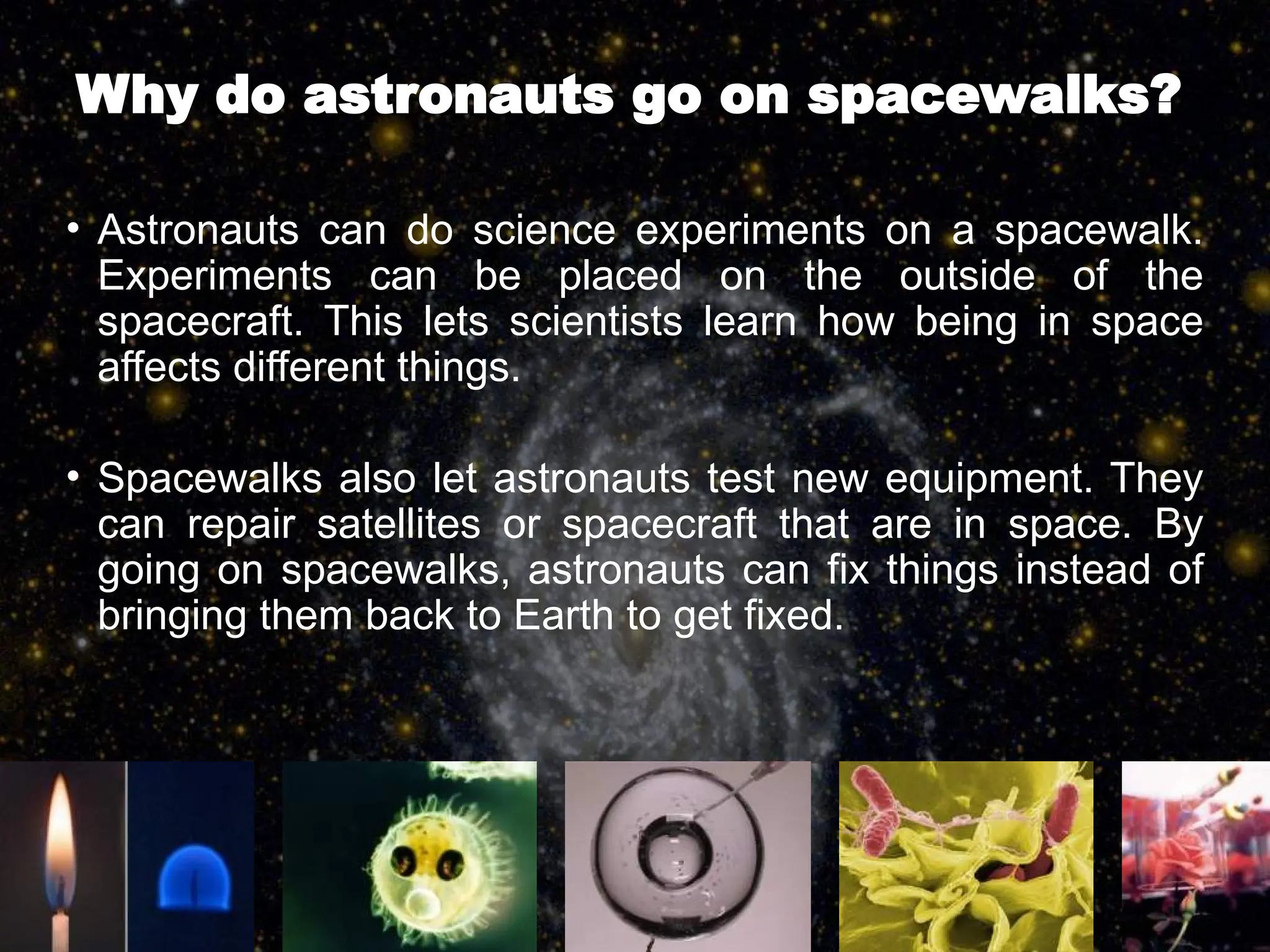
Why do astronauts go on spacewalks?
• Astronauts can do science experiments on a spacewalk.
Experiments can be placed on the outside of the
spacecraft. This lets scientists learn how being in space
affects different things.
• Spacewalks also let astronauts test new equipment. They
can repair satellites or spacecraft that are in space. By
going on spacewalks, astronauts can fix things instead of
bringing them back to Earth to get fixed.
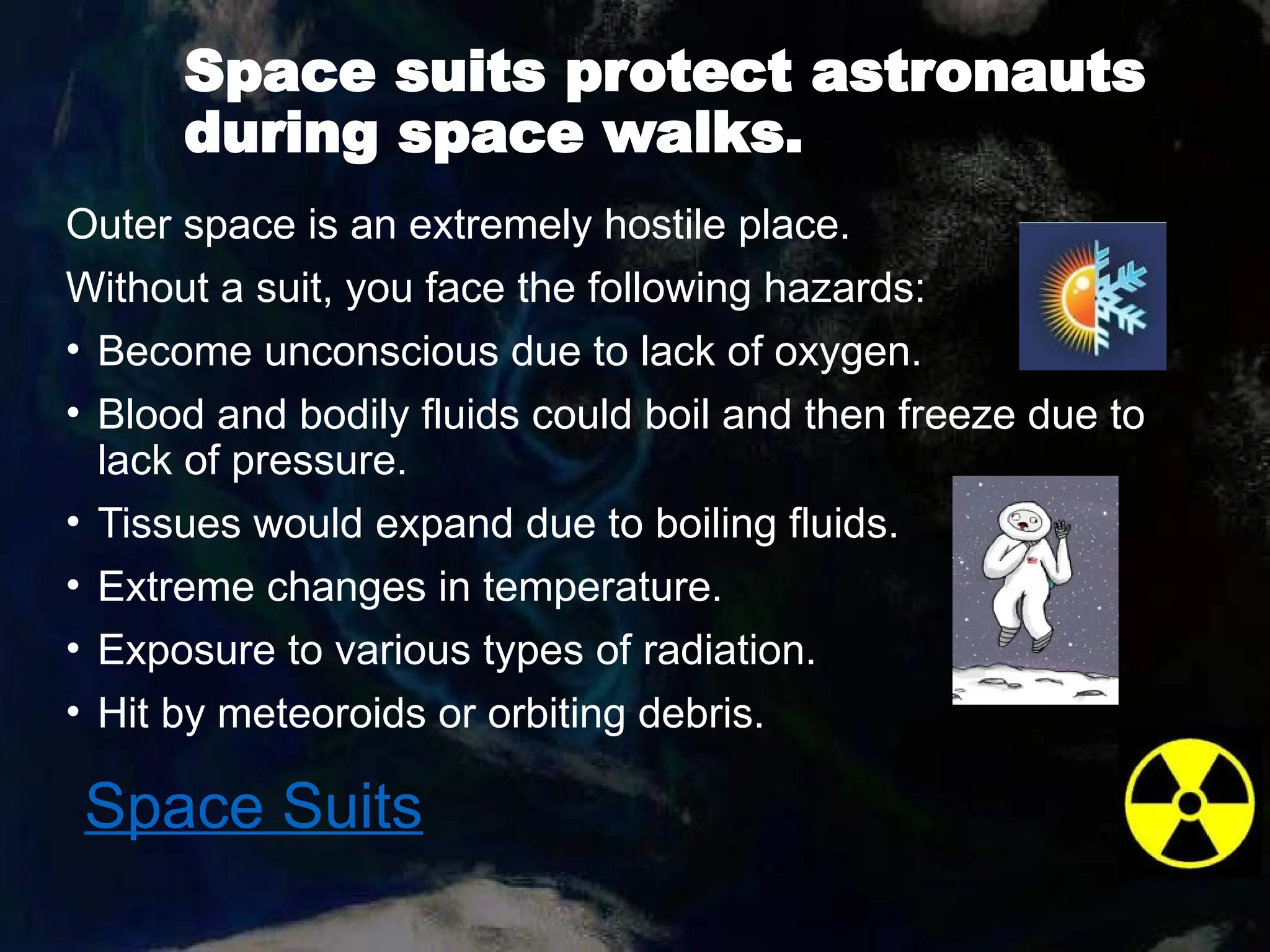
Space suits protect astronauts
during space walks.
Outer space is an extremely hostile place.
Without a suit, you face the following hazards:
• Become unconscious due to lack of oxygen.
• Blood and bodily fluids could boil and then freeze due to
lack of pressure.
• Tissues would expand due to boiling fluids.
• Extreme changes in temperature.
• Exposure to various types of radiation.
• Hit by meteoroids or orbiting debris.
Space Suits
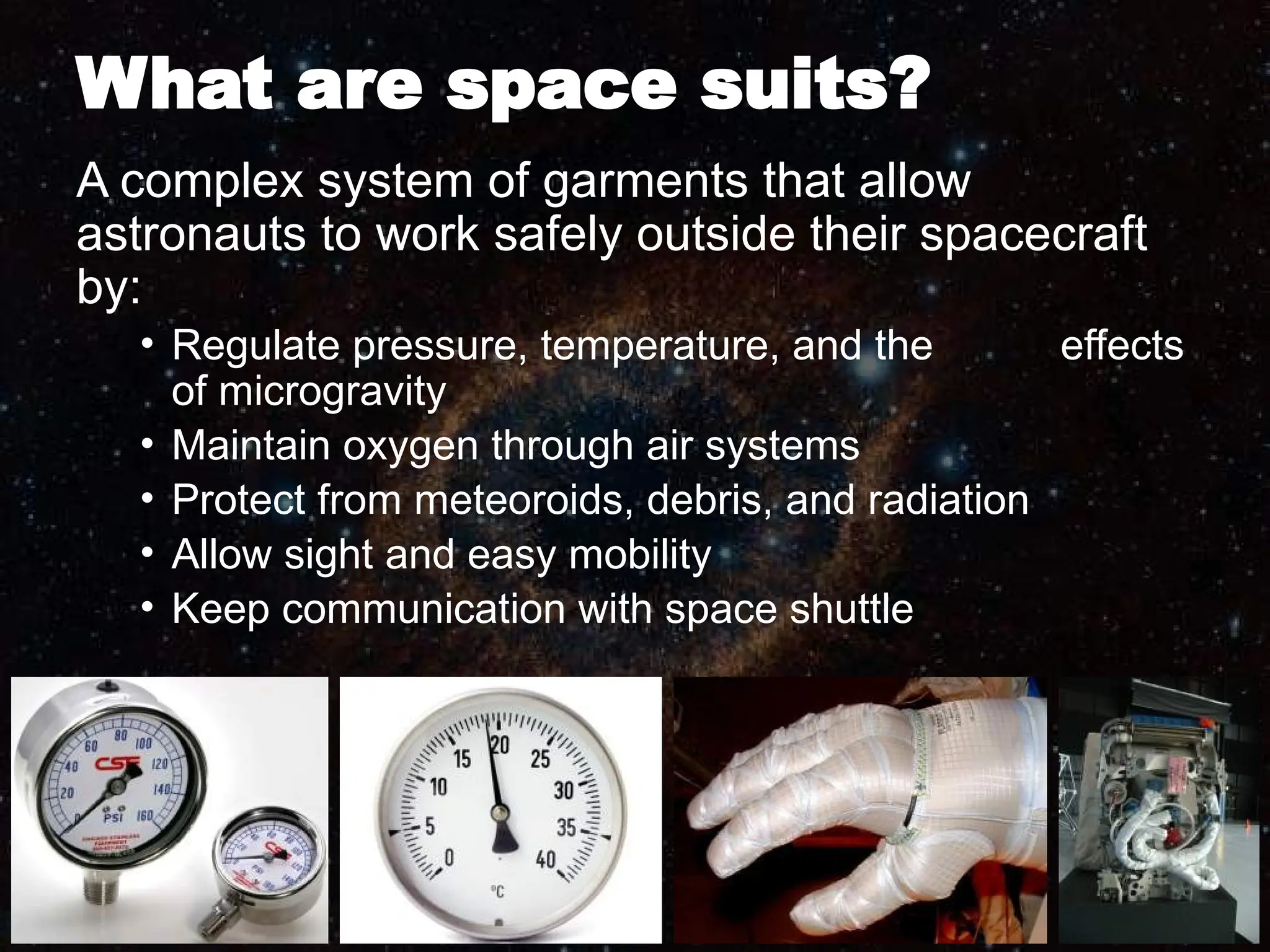
What are space suits?
A complex system of garments that allow
astronauts to work safely outside their spacecraft
by:
• Regulate pressure, temperature, and the effects
of microgravity
• Maintain oxygen through air systems
• Protect from meteoroids, debris, and radiation
• Allow sight and easy mobility
• Keep communication with space shuttle
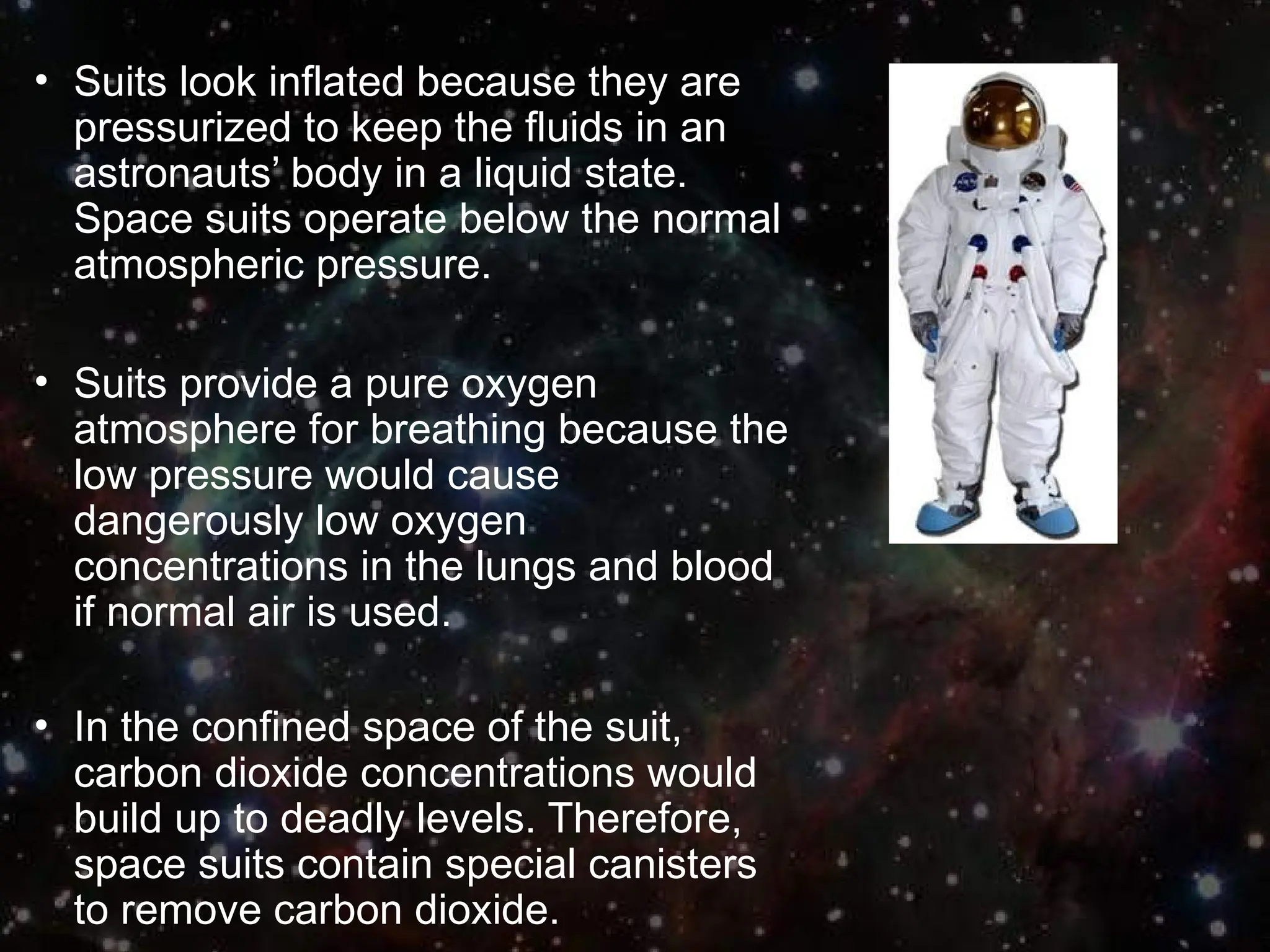
• Suits look inflated because they are
pressurized to keep the fluids in an
astronauts’ body in a liquid state.
Space suits operate below the normal
atmospheric pressure.
• Suits provide a pure oxygen
atmosphere for breathing because the
low pressure would cause
dangerously low oxygen
concentrations in the lungs and blood
if normal air is used.
• In the confined space of the suit,
carbon dioxide concentrations would
build up to deadly levels. Therefore,
space suits contain special canisters
to remove carbon dioxide.
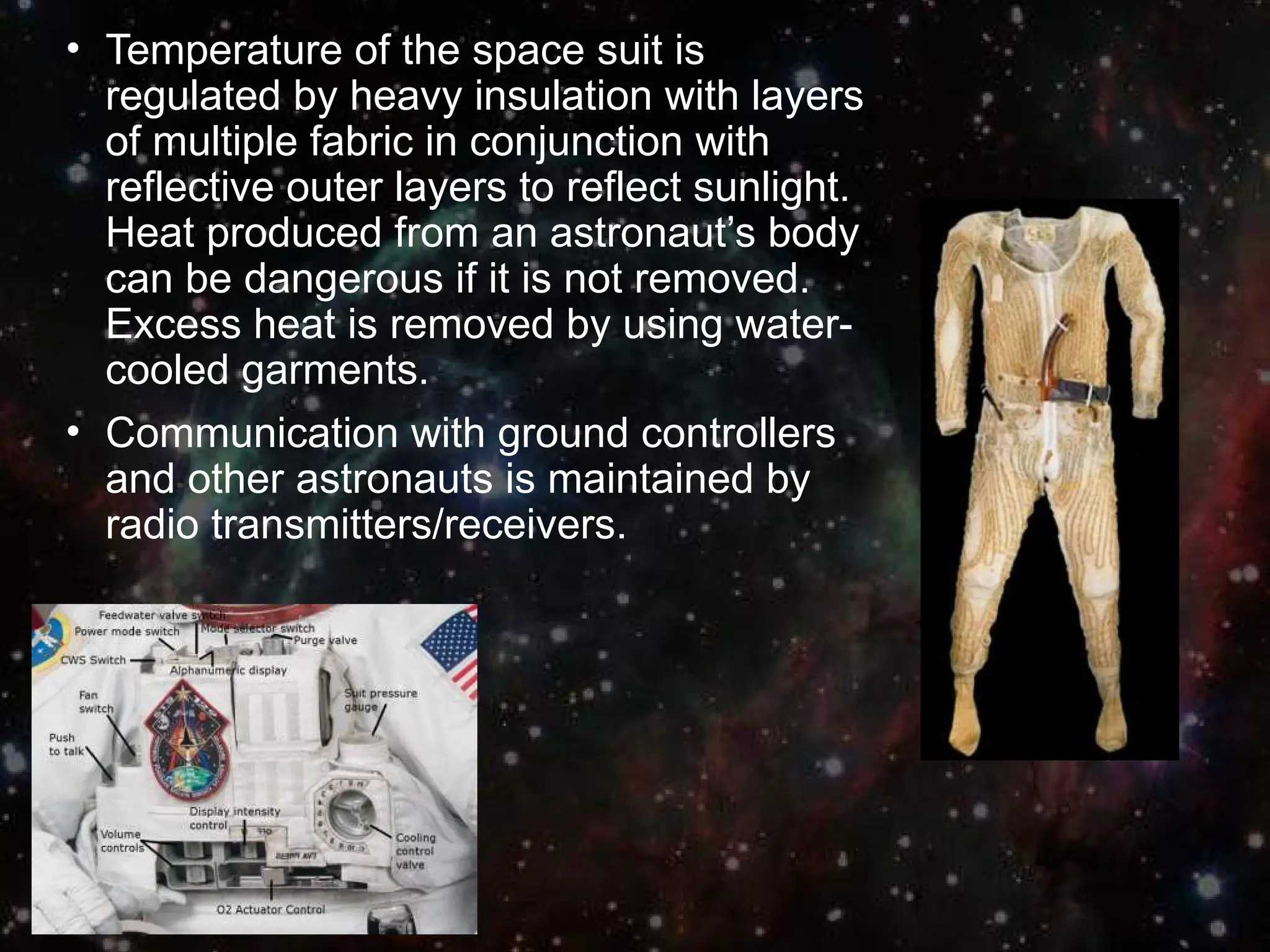
• Temperature of the space suit is
regulated by heavy insulation with layers
of multiple fabric in conjunction with
reflective outer layers to reflect sunlight.
Heat produced from an astronaut’s body
can be dangerous if it is not removed.
Excess heat is removed by using water-
cooled garments.
• Communication with ground controllers
and other astronauts is maintained by
radio transmitters/receivers.
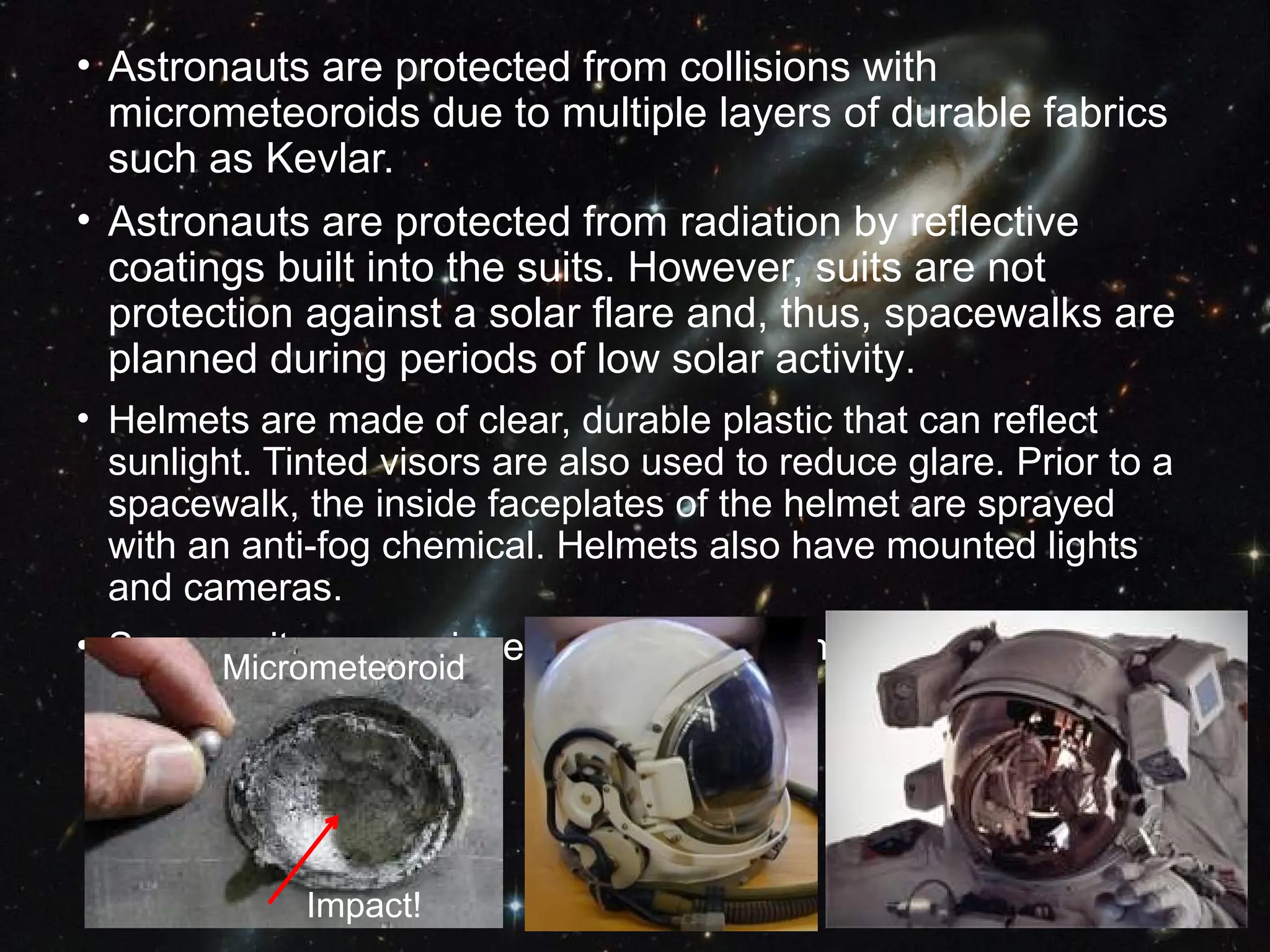
• Astronauts are protected from collisions with
micrometeoroids due to multiple layers of durable fabrics
such as Kevlar.
• Astronauts are protected from radiation by reflective
coatings built into the suits. However, suits are not
protection against a solar flare and, thus, spacewalks are
planned during periods of low solar activity.
• Helmets are made of clear, durable plastic that can reflect
sunlight. Tinted visors are also used to reduce glare. Prior to a
spacewalk, the inside faceplates of the helmet are sprayed
with an anti-fog chemical. Helmets also have mounted lights
and cameras.
• Space suits are equipped with special joints for easy mobility.
Micrometeoroid
Impact!
11/20/2024 SIST-AERO 120
ABOUT ISS
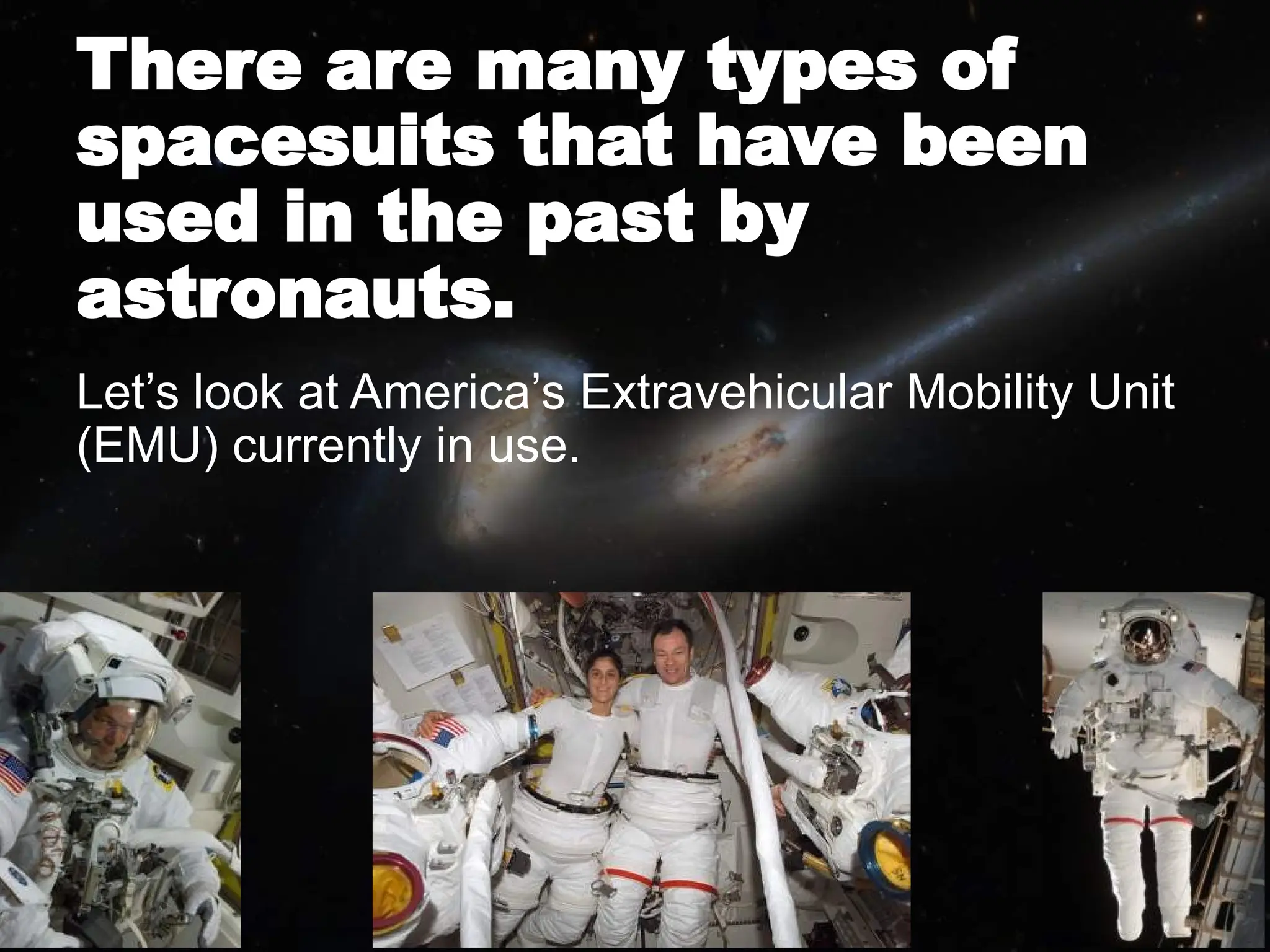
There are many types of
spacesuits that have been
used in the past by
astronauts.
Let’s look at America’s Extravehicular Mobility Unit
(EMU) currently in use.
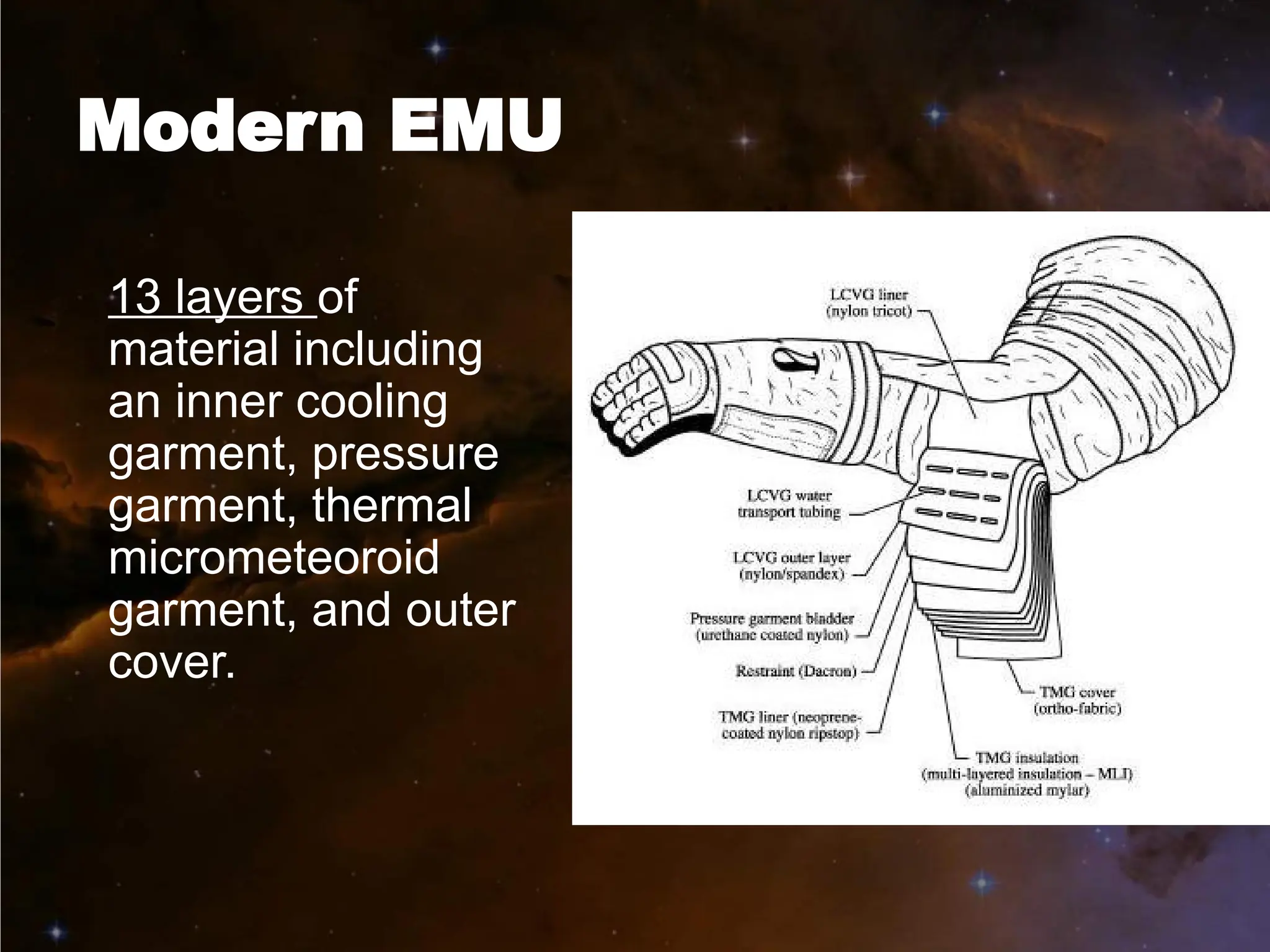
Modern EMU
13 layers of
material including
an inner cooling
garment, pressure
garment, thermal
micrometeoroid
garment, and outer
cover.
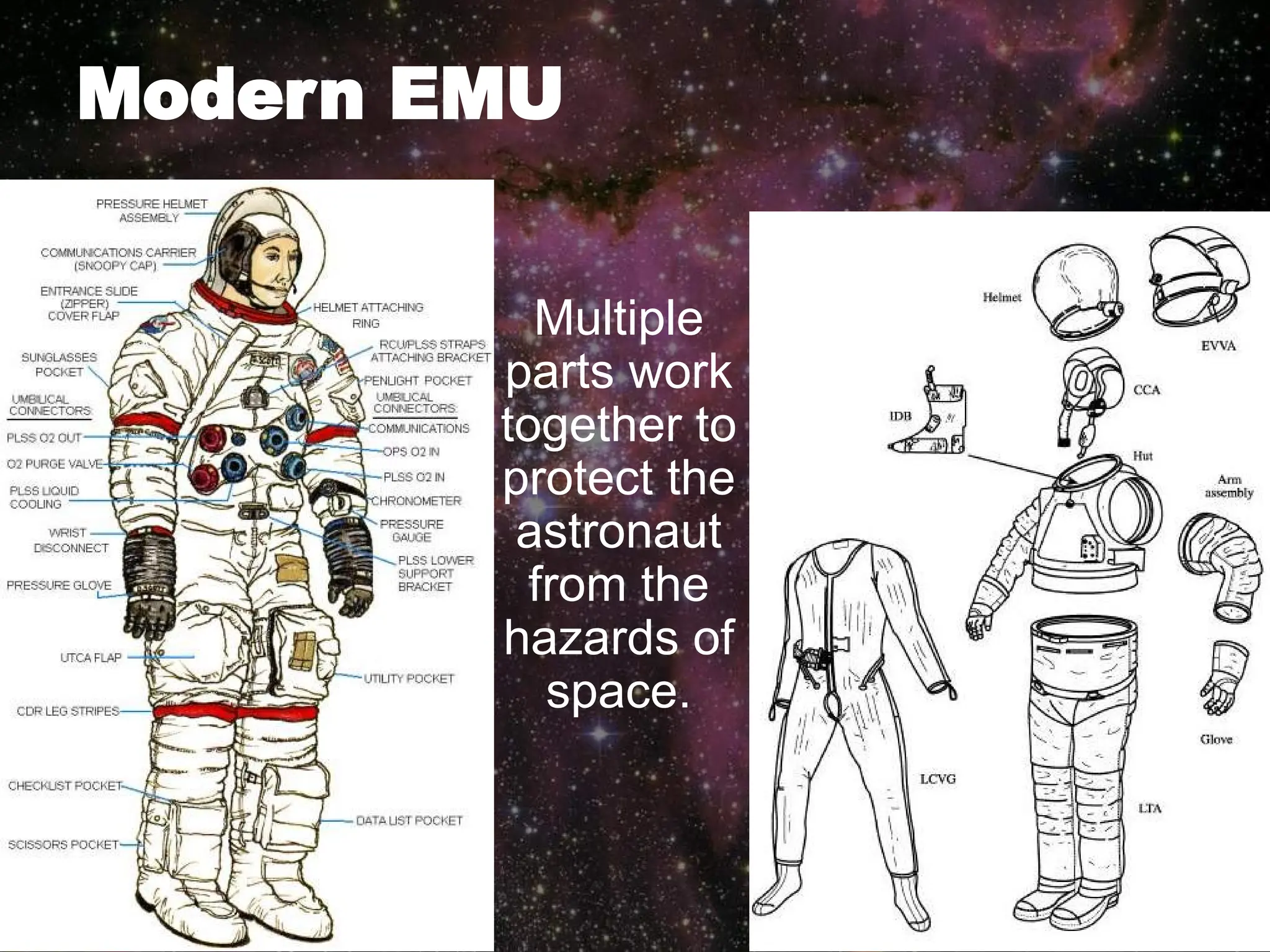
Modern EMU
Multiple
parts work
together to
protect the
astronaut
from the
hazards of
space.
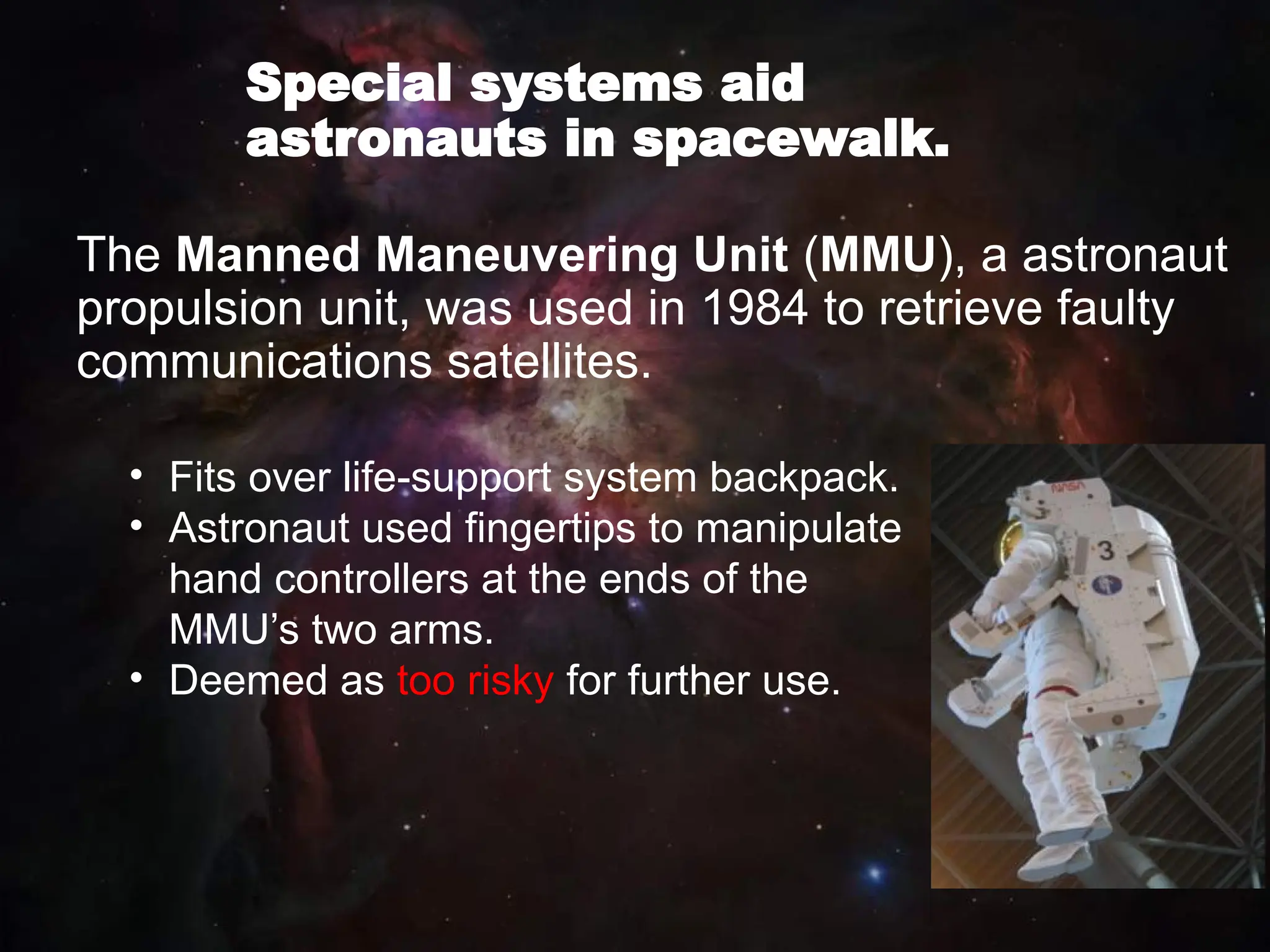
Special systems aid
astronauts in spacewalk.
The Manned Maneuvering Unit (MMU), a astronaut
propulsion unit, was used in 1984 to retrieve faulty
communications satellites.
• Fits over life-support system backpack.
• Astronaut used fingertips to manipulate
hand controllers at the ends of the
MMU’s two arms.
• Deemed as too risky for further use.
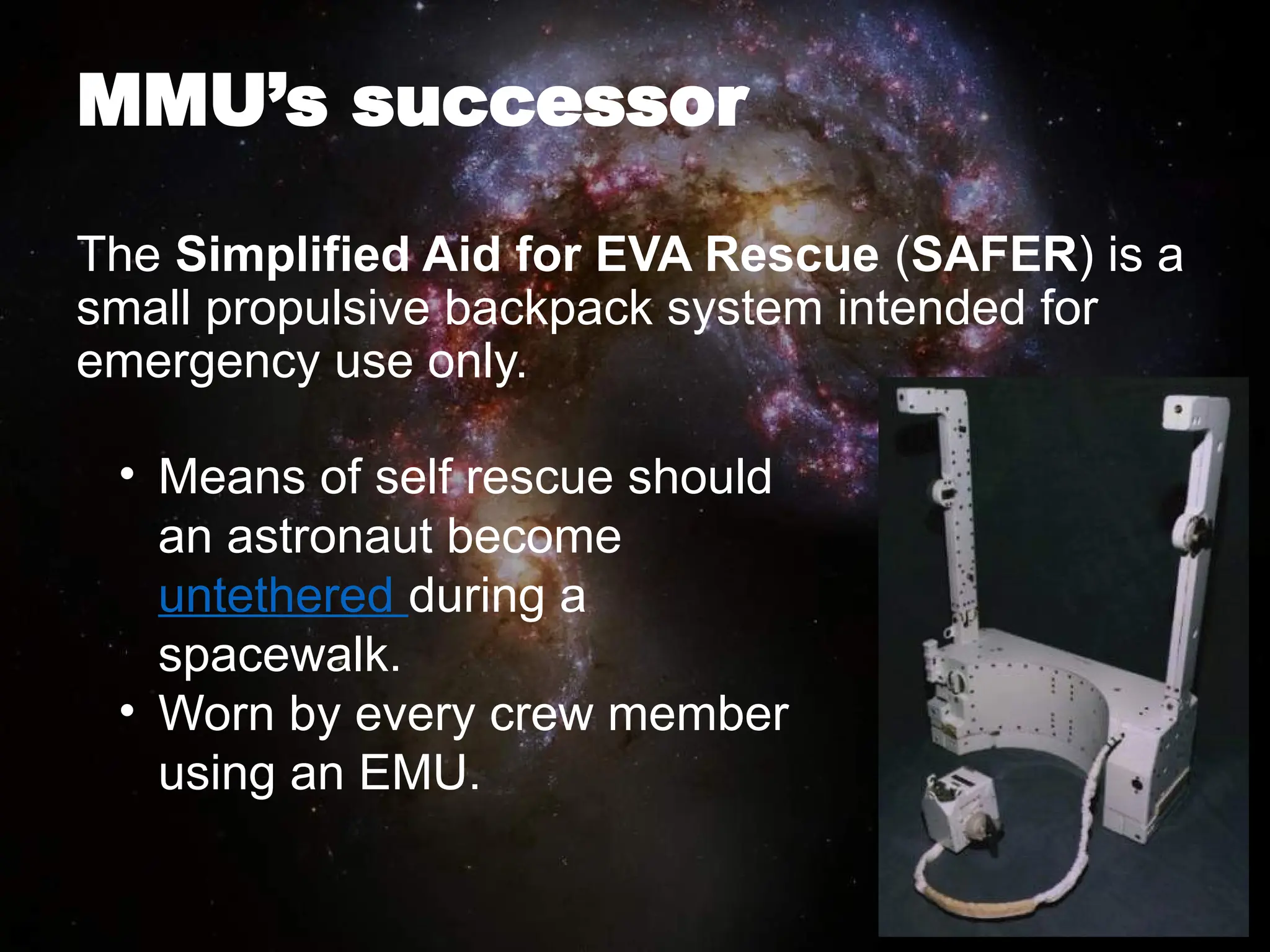
MMU’s successor
The Simplified Aid for EVA Rescue (SAFER) is a
small propulsive backpack system intended for
emergency use only.
• Means of self rescue should
an astronaut become
untethered during a
spacewalk.
• Worn by every crew member
using an EMU.
11/20/2024 SIST-AERO 126
SCIENTISTS IN ISS
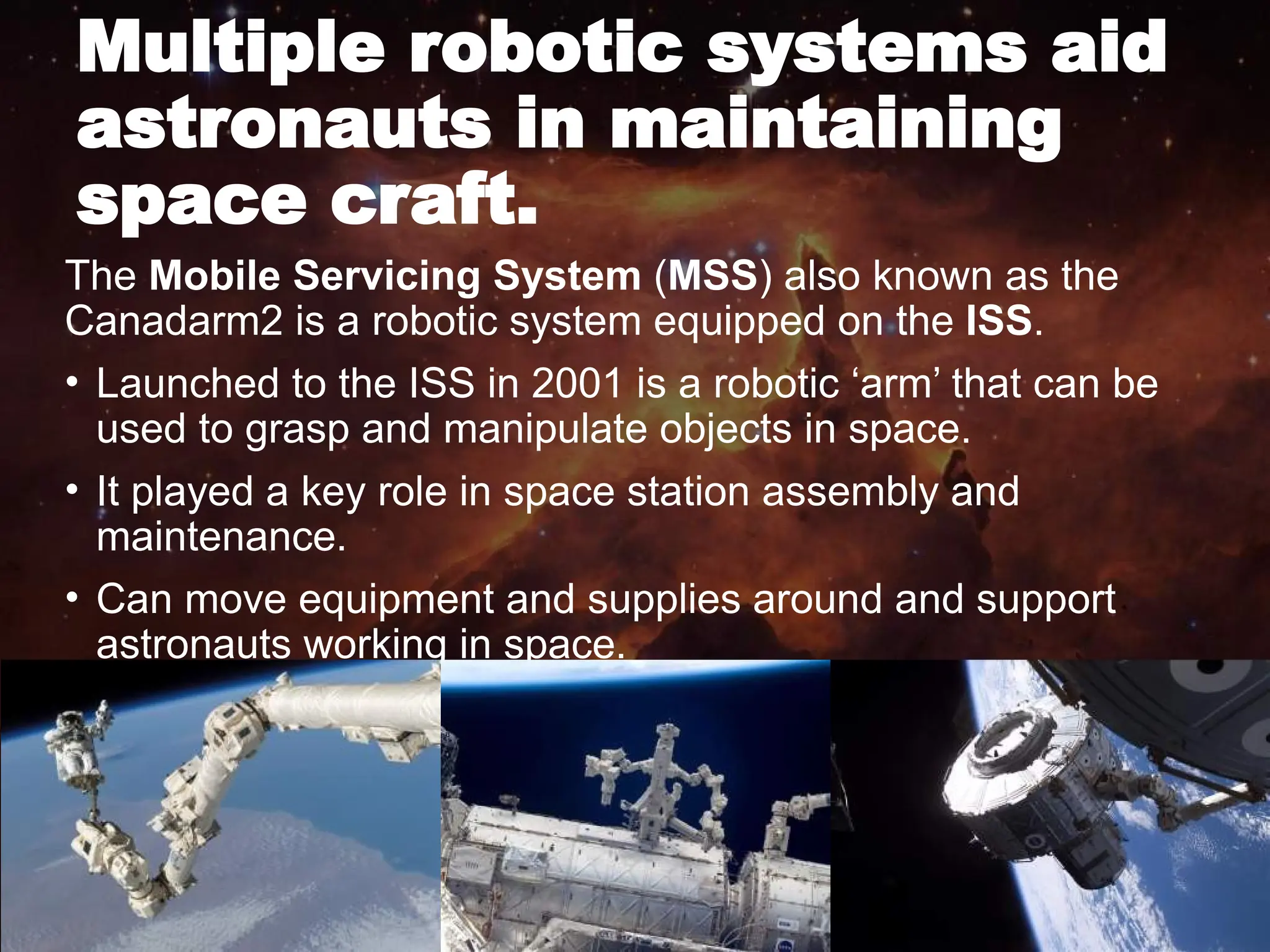
Multiple robotic systems aid
astronauts in maintaining
space craft.
The Mobile Servicing System (MSS) also known as the
Canadarm2 is a robotic system equipped on the ISS.
• Launched to the ISS in 2001 is a robotic ‘arm’ that can be
used to grasp and manipulate objects in space.
• It played a key role in space station assembly and
maintenance.
• Can move equipment and supplies around and support
astronauts working in space.
11/20/2024 SIST-AERO 128
TRAINING
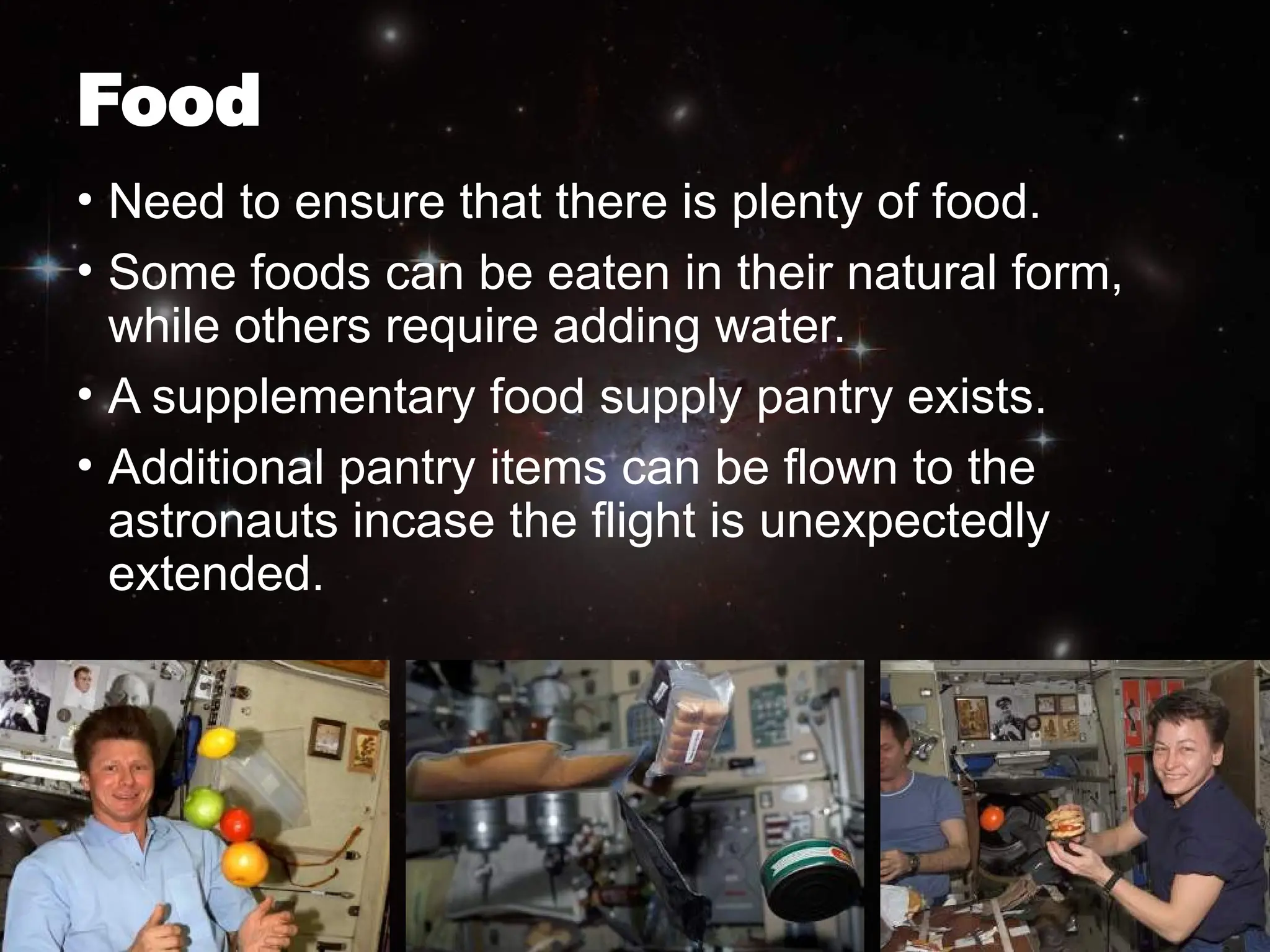
Food
• Need to ensure that there is plenty of food.
• Some foods can be eaten in their natural form,
while others require adding water.
• A supplementary food supply pantry exists.
• Additional pantry items can be flown to the
astronauts incase the flight is unexpectedly
extended.
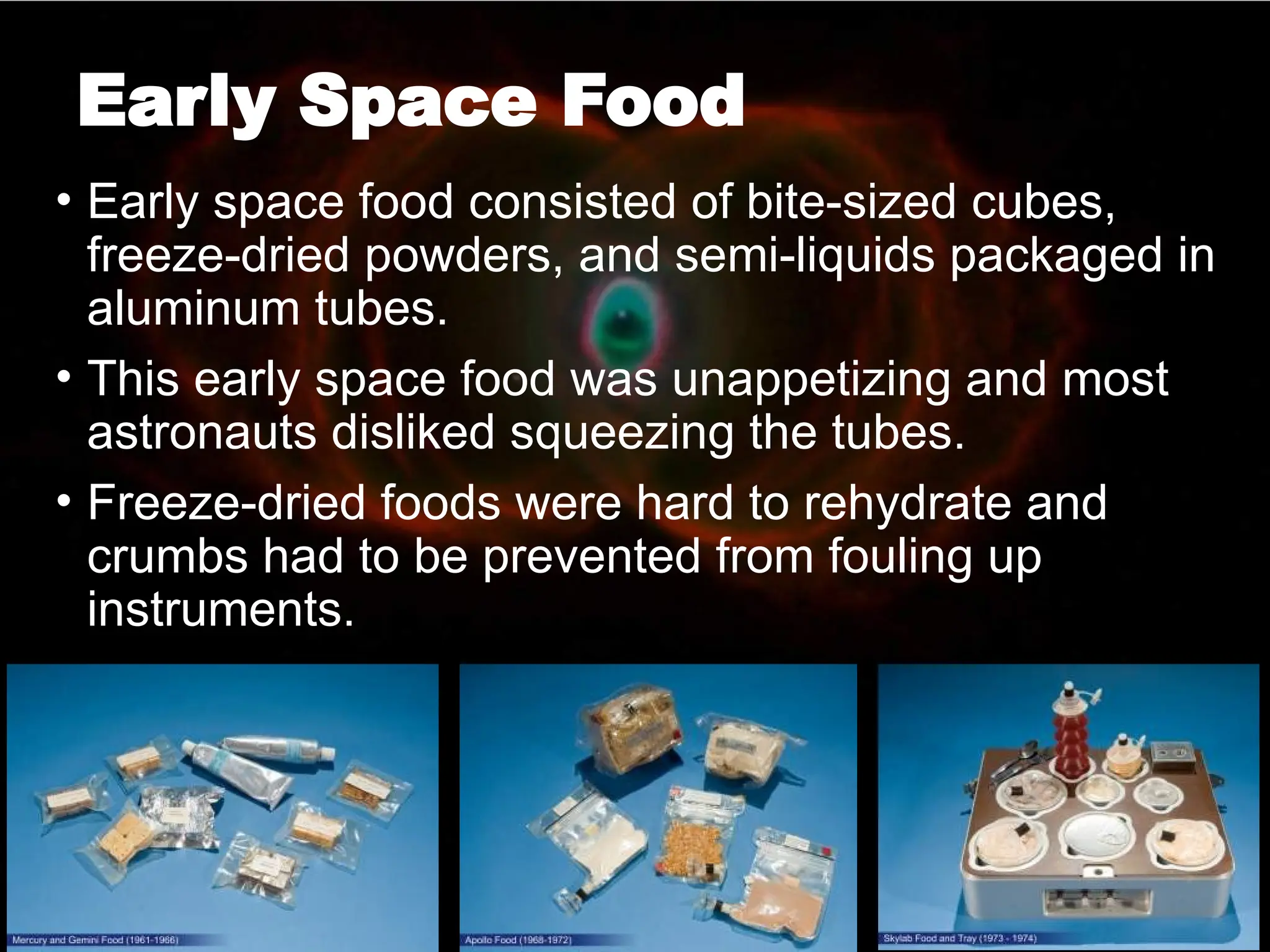
Early Space Food
• Early space food consisted of bite-sized cubes,
freeze-dried powders, and semi-liquids packaged in
aluminum tubes.
• This early space food was unappetizing and most
astronauts disliked squeezing the tubes.
• Freeze-dried foods were hard to rehydrate and
crumbs had to be prevented from fouling up
instruments.
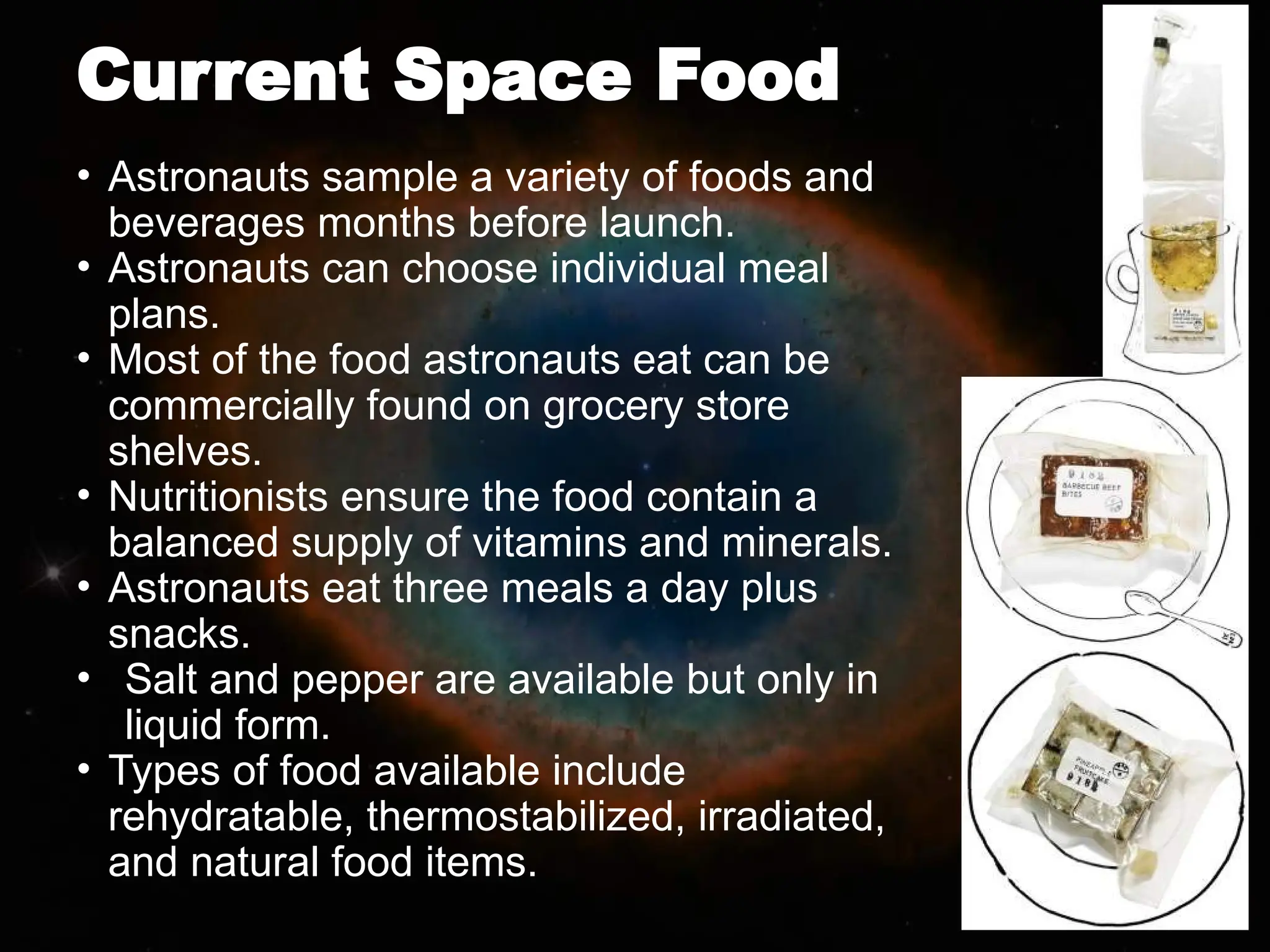
Current Space Food
• Astronauts sample a variety of foods and
beverages months before launch.
• Astronauts can choose individual meal
plans.
• Most of the food astronauts eat can be
commercially found on grocery store
shelves.
• Nutritionists ensure the food contain a
balanced supply of vitamins and minerals.
• Astronauts eat three meals a day plus
snacks.
• Salt and pepper are available but only in
liquid form.
• Types of food available include
rehydratable, thermostabilized, irradiated,
and natural food items.
11/20/2024 SIST-AERO 132
BEFORE LAUNCH
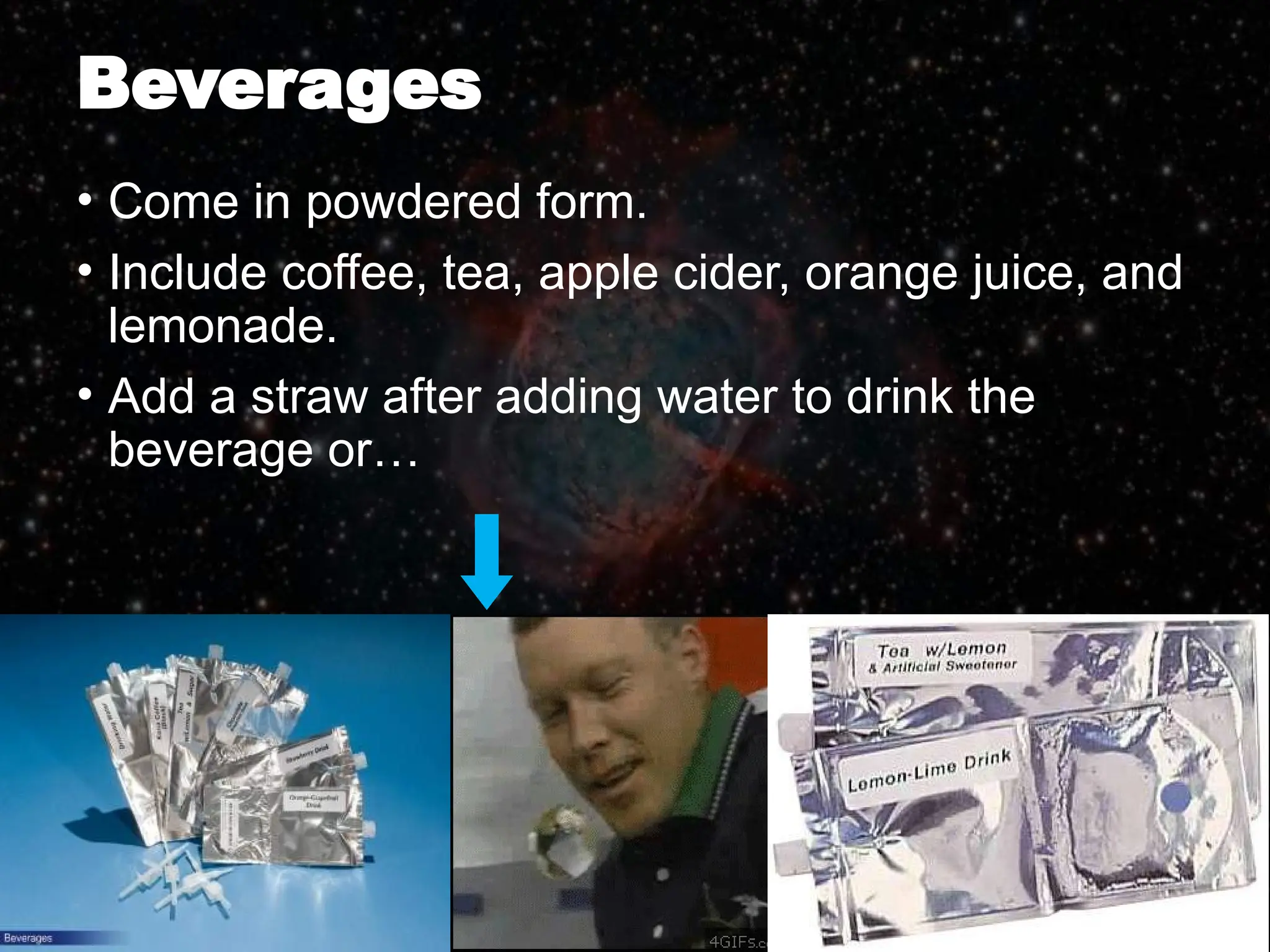
Beverages
• Come in powdered form.
• Include coffee, tea, apple cider, orange juice, and
lemonade.
• Add a straw after adding water to drink the
beverage or…
Food Packaging and Storage
• Space food comes in packages that must be disposed in a
trash compactor after finished eating.
• Food packaging is designed to be flexible and easy to use to
minimize space when storing or disposing.
• Foil is used to a longer product shelf life.
• Velcro on the bottom of food packaging attaches to the meal
tray.
• All food is precooked or processed so it requires no
refrigeration except for any fresh fruit or vegetables.
• Meals are stowed in lockers with food packages arranged in
the order they will be used.
Proper nutrition plays a
critical role in space
exploration.
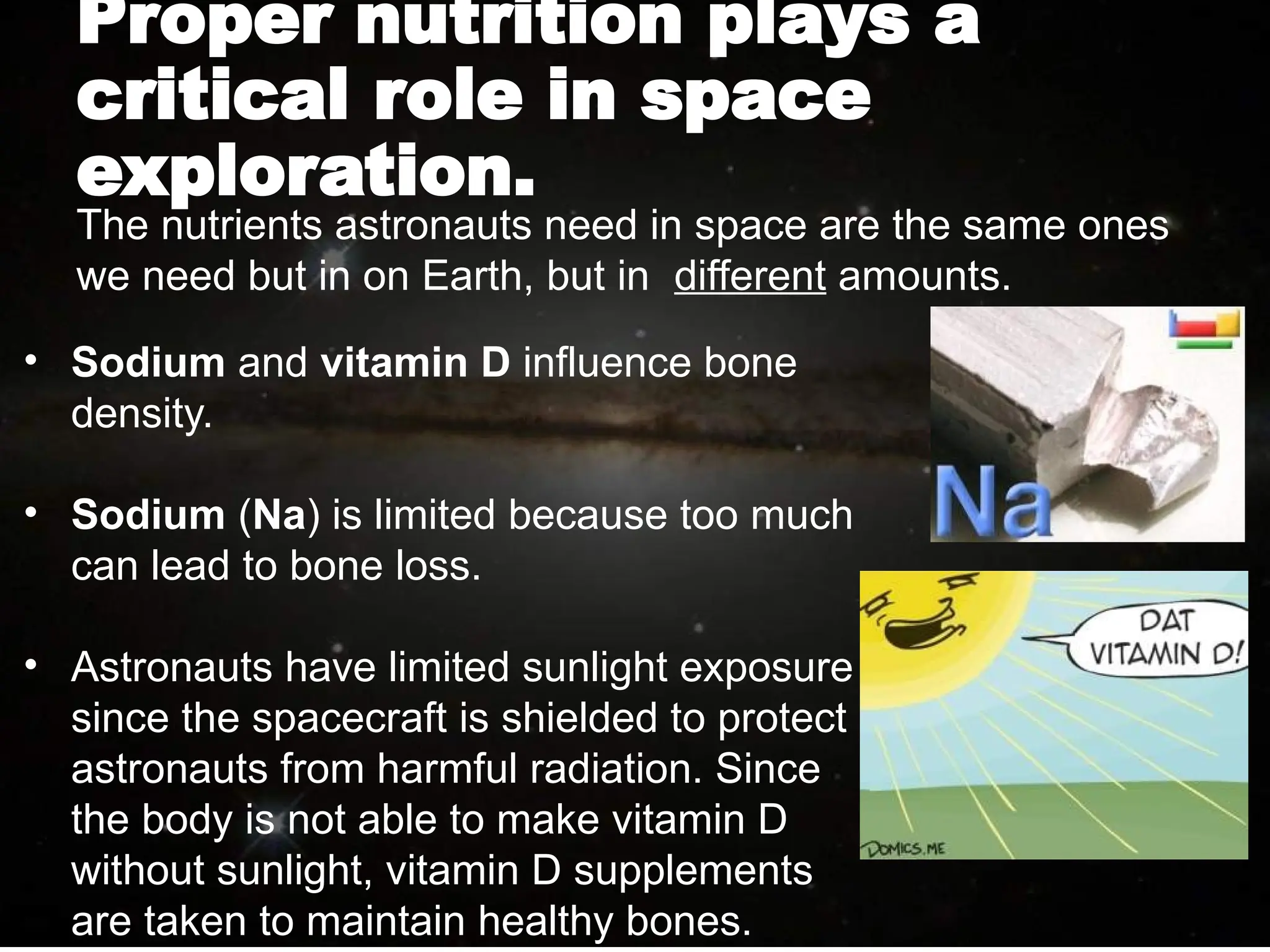
• Sodium and vitamin D influence bone
density.
• Sodium (Na) is limited because too much
can lead to bone loss.
• Astronauts have limited sunlight exposure
since the spacecraft is shielded to protect
astronauts from harmful radiation. Since
the body is not able to make vitamin D
without sunlight, vitamin D supplements
are taken to maintain healthy bones.
The nutrients astronauts need in space are the same ones
we need but in on Earth, but in different amounts.
Proper nutrition plays a
critical role in space
exploration.
The nutrients astronauts need in space are the same ones
we need but in on Earth, but in different amounts.
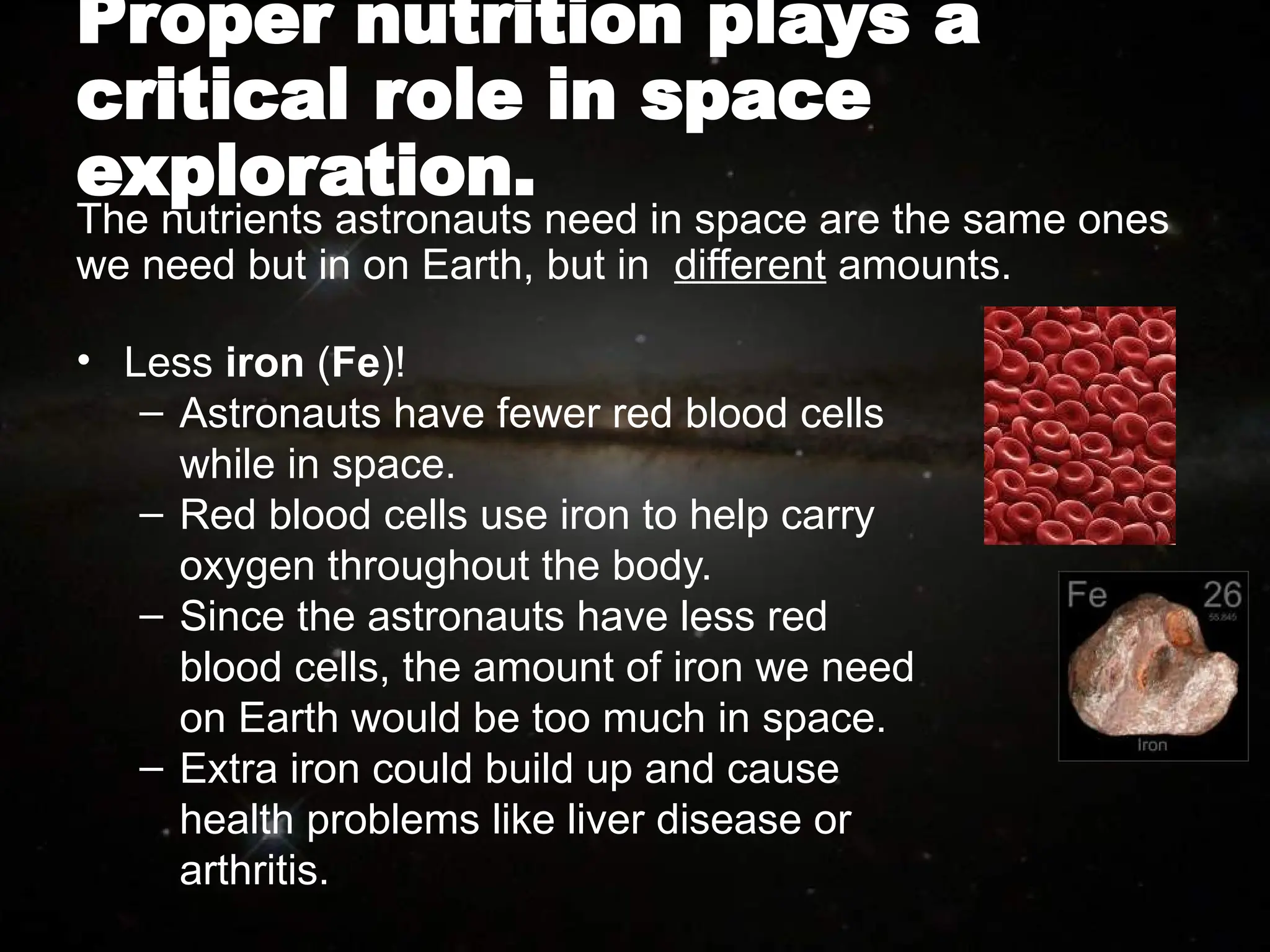
• Less iron (Fe)!
– Astronauts have fewer red blood cells
while in space.
– Red blood cells use iron to help carry
oxygen throughout the body.
– Since the astronauts have less red
blood cells, the amount of iron we need
on Earth would be too much in space.
– Extra iron could build up and cause
health problems like liver disease or
arthritis.
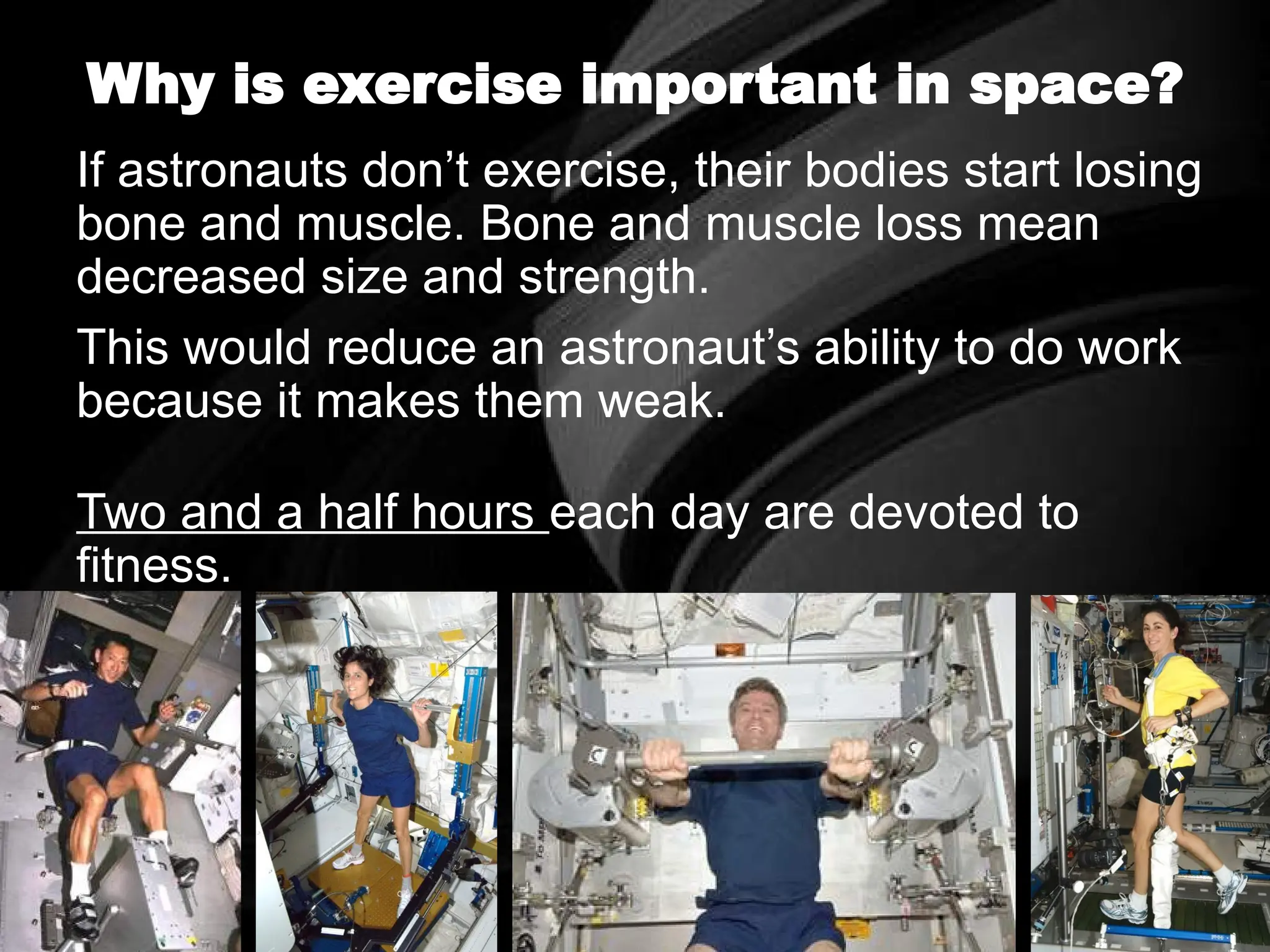
Why is exercise important in space?
If astronauts don’t exercise, their bodies start losing
bone and muscle. Bone and muscle loss mean
decreased size and strength.
This would reduce an astronaut’s ability to do work
because it makes them weak.
Two and a half hours each day are devoted to
fitness.
11/20/2024 SIST-AERO 138
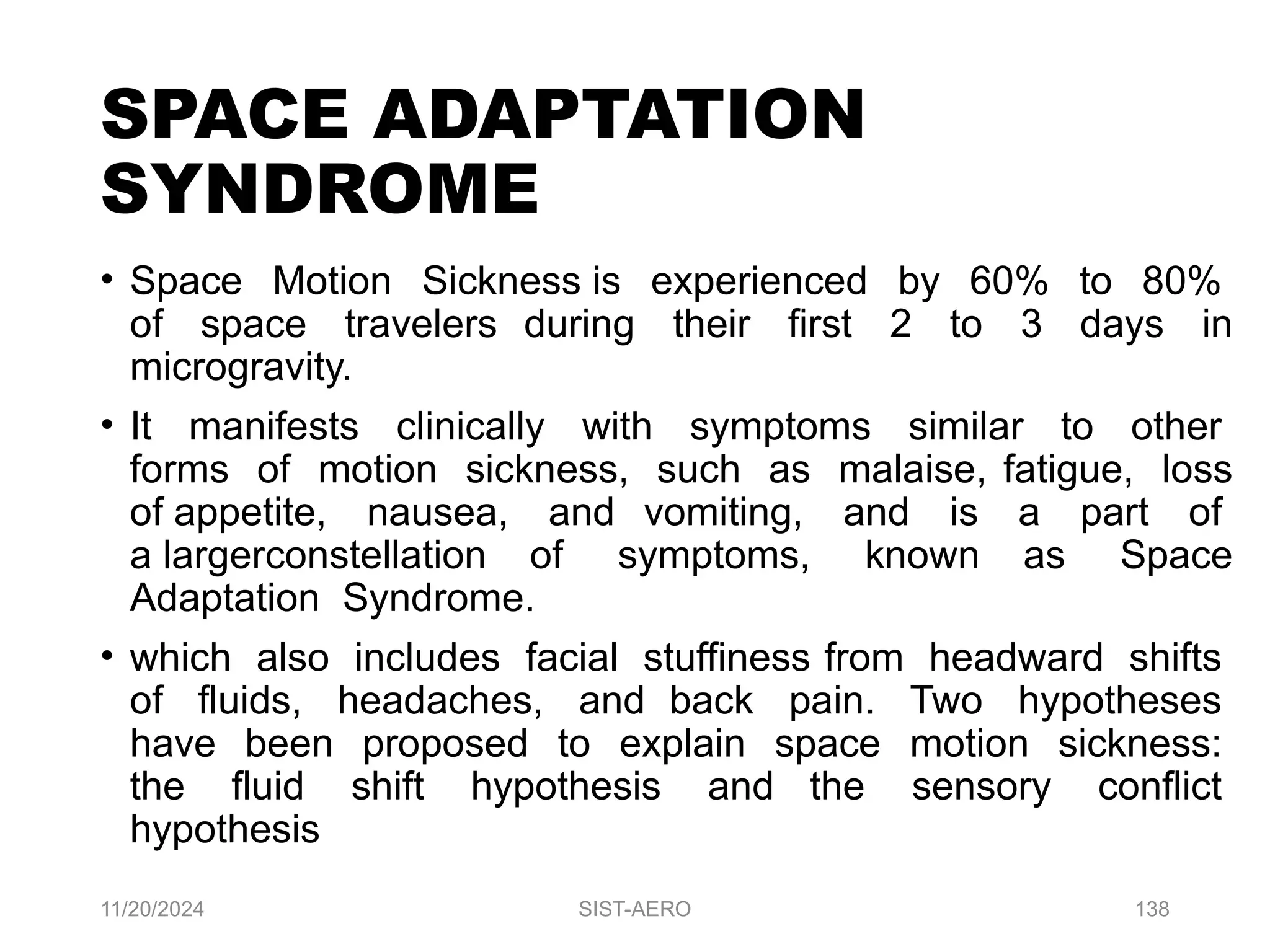
SPACE ADAPTATION
SYNDROME
• Space Motion Sickness is experienced by 60% to 80%
of space travelers during their first 2 to 3 days in
microgravity.
• It manifests clinically with symptoms similar to other
forms of motion sickness, such as malaise, fatigue, loss
of appetite, nausea, and vomiting, and is a part of
a largerconstellation of symptoms, known as Space
Adaptation Syndrome.
• which also includes facial stuffiness from headward shifts
of fluids, headaches, and back pain. Two hypotheses
have been proposed to explain space motion sickness:
the fluid shift hypothesis and the sensory conflict
hypothesis
11/20/2024 SIST-AERO 139
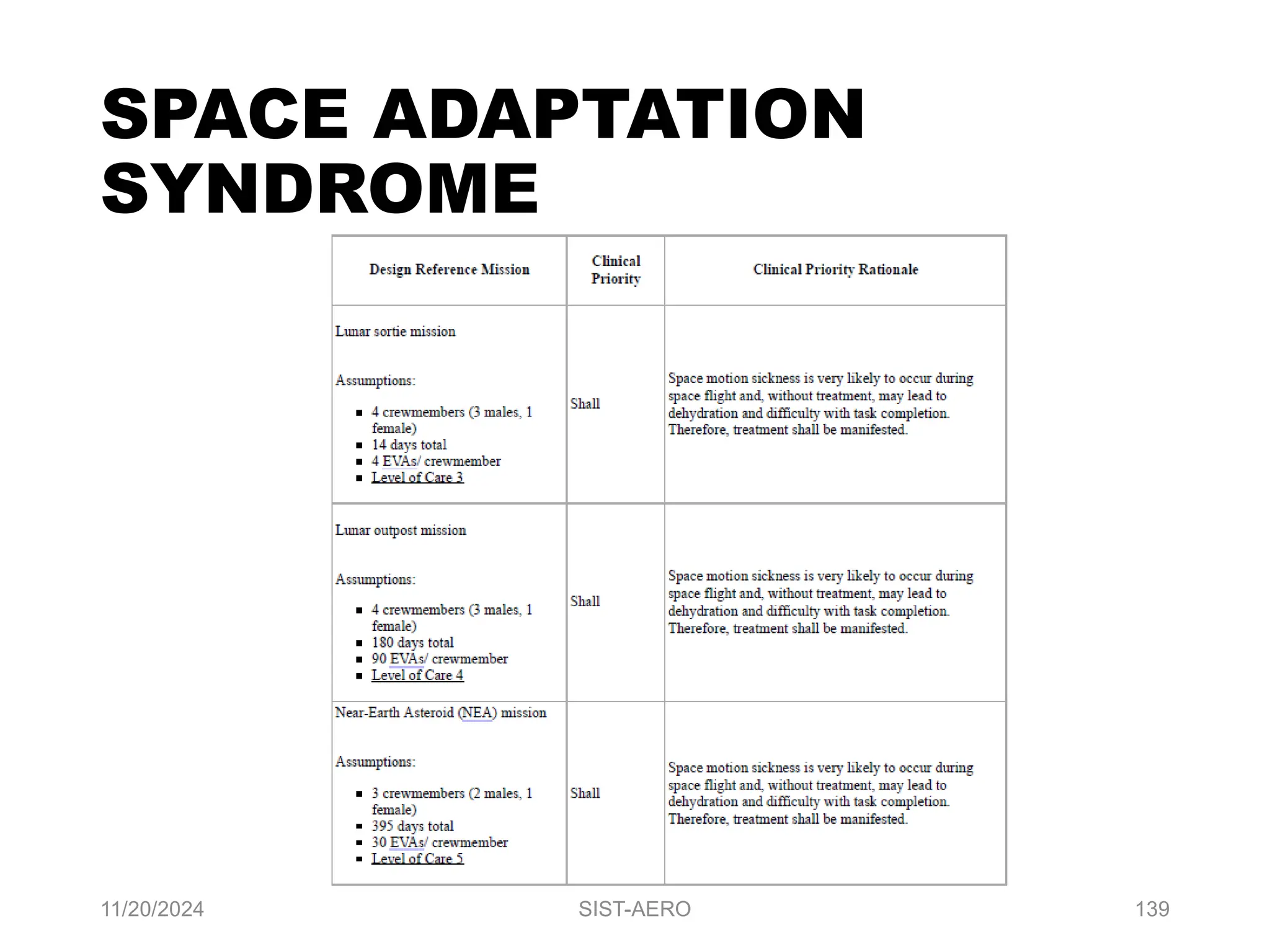
SPACE ADAPTATION
SYNDROME
11/20/2024 SIST-AERO 140
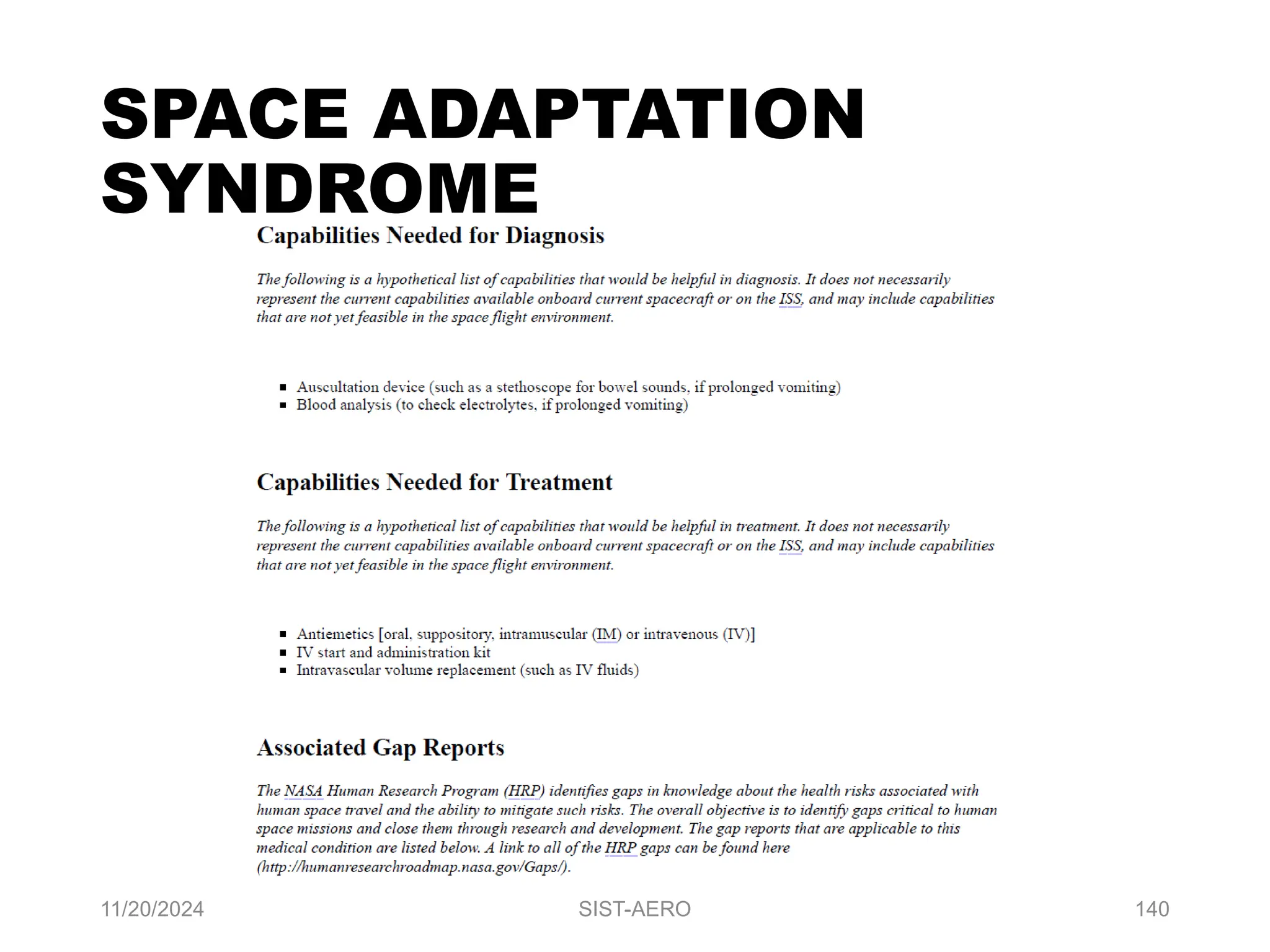
SPACE ADAPTATION
SYNDROME
11/20/2024 SIST-AERO 141
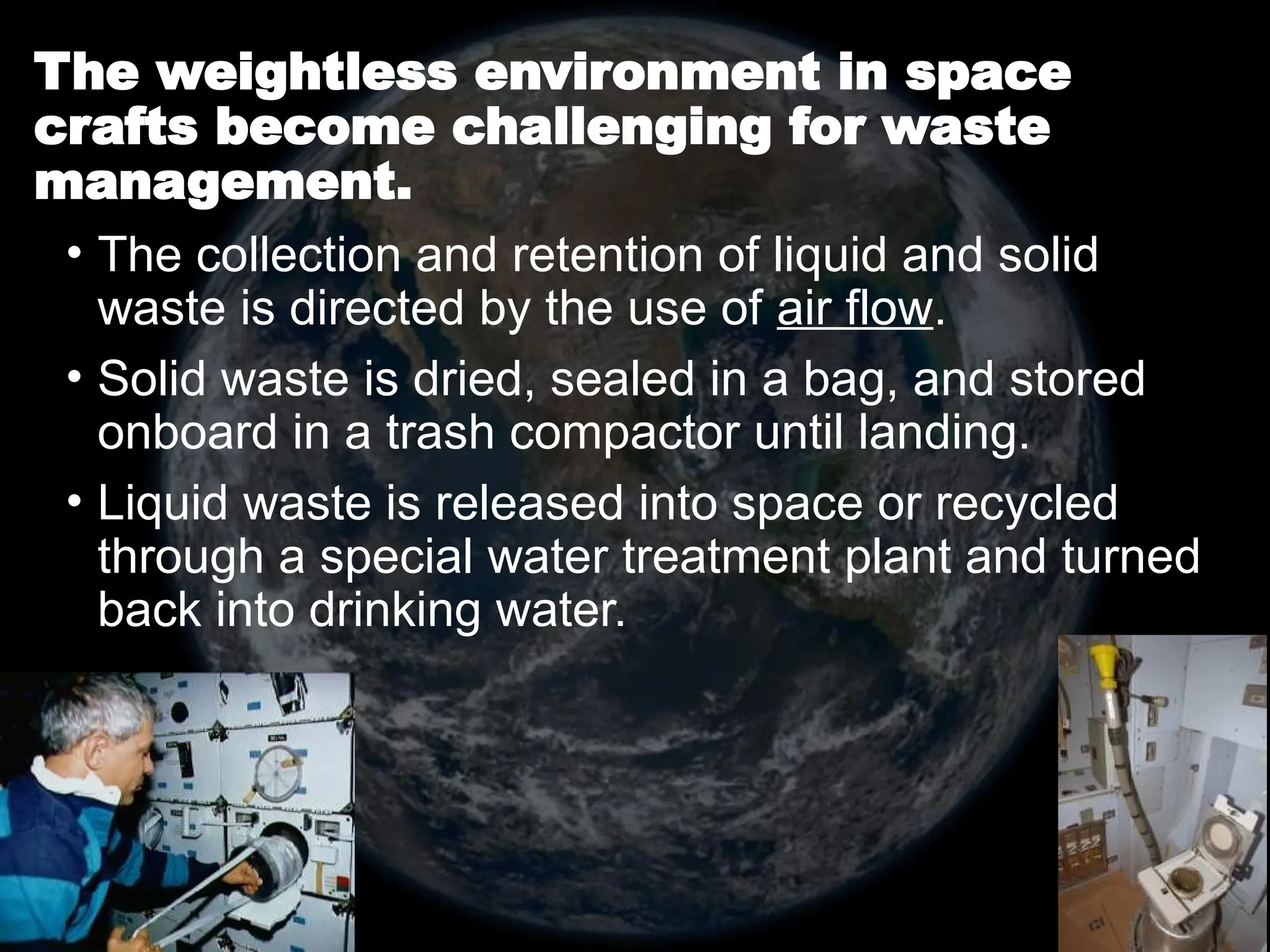
Journey to space
The weightless environment in space
crafts become challenging for waste
management.
• The collection and retention of liquid and solid
waste is directed by the use of air flow.
• Solid waste is dried, sealed in a bag, and stored
onboard in a trash compactor until landing.
• Liquid waste is released into space or recycled
through a special water treatment plant and turned
back into drinking water.
11/20/2024 SIST-AERO 143
Astronauts in space
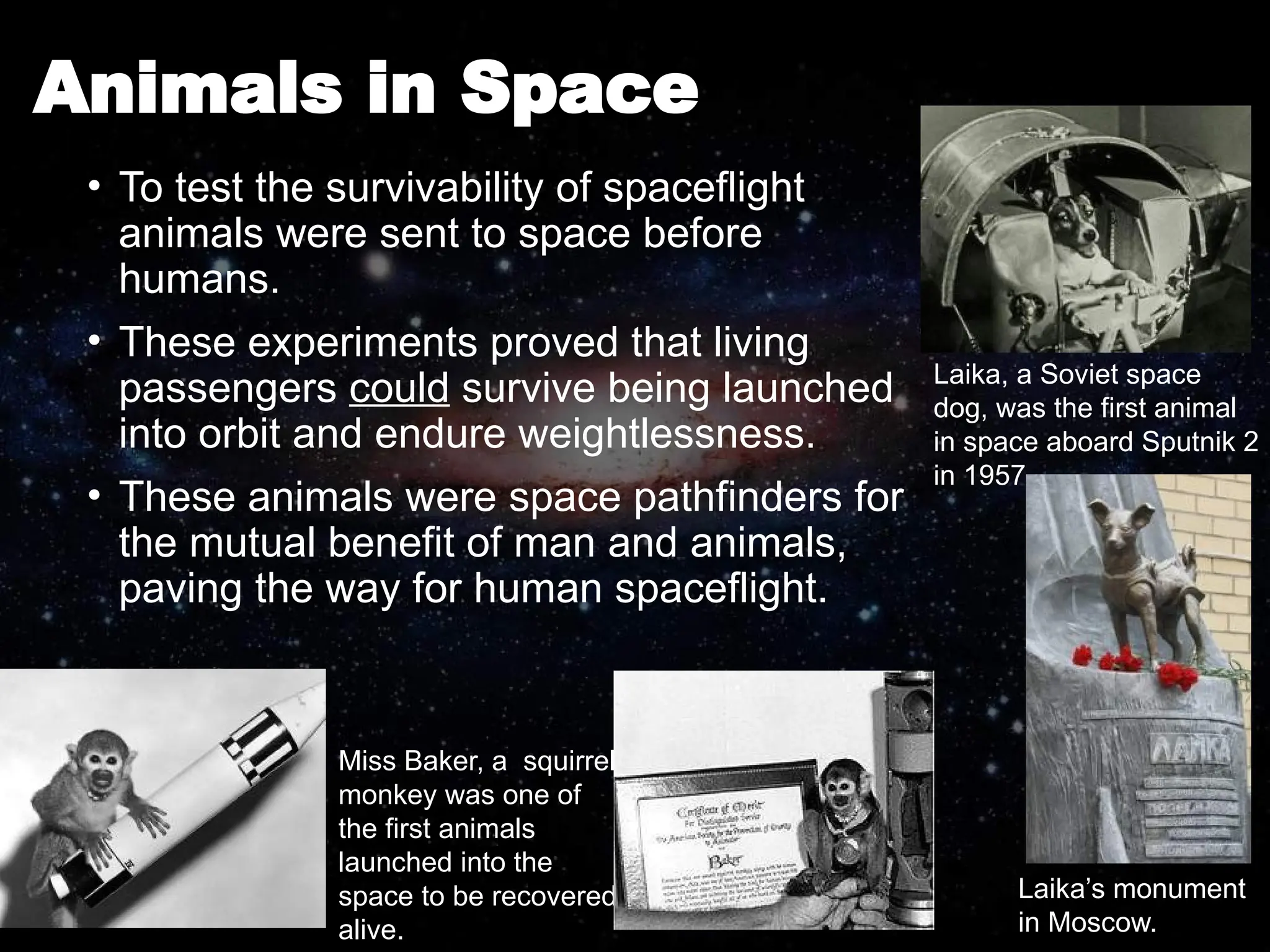
Animals in Space
• To test the survivability of spaceflight
animals were sent to space before
humans.
• These experiments proved that living
passengers could survive being launched
into orbit and endure weightlessness.
• These animals were space pathfinders for
the mutual benefit of man and animals,
paving the way for human spaceflight.
Miss Baker, a squirrel
monkey was one of
the first animals
launched into the
space to be recovered
alive.
Laika, a Soviet space
dog, was the first animal
in space aboard Sputnik 2
in 1957.
Laika’s monument
in Moscow.
11/20/2024 SIST-AERO 146
11/20/2024 SIST-AERO 147
THANK YOU

Unit 2 Online lecture jsad;ofjsdL;FNKSnmdf;lsDM;LF

  • 1.
    Unit - II Spacevs Earth Environment Presented by Mr. G. Madhan Kumar, AP/Aero SATHYABAMA INSTITUTE OF SCIENCE AND TECHNOLOGY SAEA3017 MANNED SPACE MISSION
  • 2.
    Outline  Atmosphere: Structureand Composition,  Atmosphere: Air Pressure, Temperature, and Density,  Atmosphere: Meteoroid,  Orbital Debris & Radiation Protection,  Human Factors of Crewed Spaceflight,  Safety of Crewed Spaceflight,  Magnetosphere,  Radiation Environment: Galactic Cosmic Radiation (GCR),  Solar Particle Events (SPE),  Radiation and the Human Body,  Impact of microgravity and g forces on humans,  space adaptation syndrome.
  • 3.
    Overview of theEarth’s Atmosphere • The atmosphere, when scaled to the size of an apple, is no thicker than the skin on an apple. • The atmosphere is a gas. • The atmosphere is a fluid. • There is a surface but no “top” – the atmosphere gradually thins out with increasing altitude
  • 4.
    Earth's Atmosphere 99% ofatmospheric gases, including water vapor, extend only 30 kilometer (km) above earth's surface. Most of our weather, however, occurs within the first 10 to 15 km. Thin Gaseous envelope
  • 5.
    Composition of the Atmosphere permanentgases variable gases trace gases aerosols • roles of nitrogen, oxygen and argon • role of water vapor • carbon dioxide, methane, ozone, CFCs, et al.
  • 6.
    Composition of the Atmosphere •The “dry atmosphere”: 78% N2, 21% O2, 1% Ar • N2 is primordial – it’s been part of the atmosphere as long as there’s been an atmosphere • O2 has been rising from none at all about 2.2 Gy – comes from photosynthesis • Ar40 /Ar36 tells us that the atmosphere has been outgassed from volcanoes
  • 7.
    Composition of the Atmosphere •Water Vapor: H2O 0-4% • H20 can exist in all three phases at the surface of the Earth – solid, liquid and gas • Liquid or solid H2O can be suspended by atmospheric winds (clouds) or fall to the surface (precipitation) • VERY powerful greenhouse gas (both in vapor form and as clouds)
  • 8.
  • 9.
  • 10.
    Composition of the Atmosphere •Carbon dioxide • 390 ppm (by mass) and counting… • Natural and anthropogenic sources/sinks • Strong greenhouse gas (GHG) CO2 is neither the strongest atmospheric GHG pound-for-pound nor molecule-for-molecule… Why the fuss? CO2 is a product of the reaction that allows modern civilization to exist: combustion.
  • 12.
  • 13.
    Composition of the Atmosphere •Methane • CH4 concentration: 1.8 ppmv • anthropogenic and natural sources/sinks too powerful greenhouse gas • oxidizes rapidly, hence low concentrations • Large concentrations proposed to explain greenhouse warming of early Earth
  • 14.
    Composition of the Atmosphere •Ozone, CFCs and NOx • Ozone (O3) • shields the surface from UV rays • produced by reaction with NOx and sunlight near the surface • CFC’s (Chlorofluorocarbons) • destroy stratospheric ozone • chlorine is a catalyst: it destroys one O3 molecule and then is free to find another • Ozone at high altitudes (stratosphere) is “good”; ozone at low altitudes (troposphere) is “bad.”
  • 15.
    Atmospheric Gases Nitrogen, oxygen, argon,water vapor, carbon dioxide, and most other gases are invisible. Clouds are not gas, but condensed vapor in the form of liquid droplets. Ground based smog, which is visible, contains reactants of nitrogen and ozone. Ozone – is the primary ingredient of smog!
  • 16.
    Aerosols & Pollutants Humanand natural activities displace tiny soil, salt, and ash particles as suspended aerosols, as well as sulfur and nitrogen oxides, and hydrocarbons as pollutants.
  • 17.
    Composition of the Atmosphere Aerosols •Dust • Sea-spray • Microbes Suspended particles in the atmosphere are responsible for cloud formation: water drops nucleate on them Cloud Condensation Nuclei (CCN)
  • 18.
    Other Atmospheres YES NO EarthThe Moon Mars all the other satellites Venus Mercury Jupiter asteroids Saturn Uranus Neptune Pluto Triton (Neptune’s moon) Titan (Saturn’s moon) The Sun
  • 19.
    Other Atmospheres Planet CompositionTemperature Pressure Venus CO2 96.5%, N2 3.5% 750 K 90000 mb Earth N2 78%, O2 21%, Ar 1% 290K 1000 mb Mars CO2 95%, N2 2.7%, Ar 1.6% 220K 10 mb
  • 20.
    History of Meteorology •Meteorology is the study of the atmosphere and its phenomena • Aristotle wrote a book on natural philosophy (340 BC) entitled “Meteorologica” • Sum knowledge of weather/climate at time • Meteors were all things that fell from the sky or were seen in the air • “meteoros” : Greek word meaning “high in air”
  • 21.
    History of Meteorology •Invention of weather instruments • 1500’s Galileo invented water thermometer • 1643 Torricelli invented mercury barometer • 1667 Hooke invented anemometer • 1719 Fahrenheit developed temp scale based on boiling/freezing water • 1735 Hadley explained how the earth’s rotation influences winds in tropics • 1742 Celsius developed the centigrade temp scale 11/20/2024 SIST-AERO
  • 22.
    History of Meteorology •1787 Charles discovered relationship between temp and a volume of air • 1835 Coriolis used math to demonstrate the effect that the earth’s rotation has on atmos. Motions • 1869 first isobars were placed on map • 1920 concepts of air masses and weather fronts were formulated in Norway • 1940’s upper air ballons/3-D view of atmos • 1950’s high speed computers • 1960 Tiros 1 first weather satellite 11/20/2024 SIST-AERO
  • 23.
    Vertical Structure of theEarth’s Atmosphere
  • 24.
    Atmospheric Layers 8 layersare defined by constant trends in average air temperature (which changes with pressure and radiation), where the outer exosphere is not shown. 1. Troposphere 2. Tropopause 3. Stratosphere 4. Stratopause 5. Mesosphere 6. Mesopause 7. Thermosphere 8. Exosphere
  • 25.
    Atmospheric Layers Troposphere –Temp decrease w/ height Most of our weather occurs in this layer Varies in height around the globe, but Averages about 11 km in height. Tropopause separates Troposphere from Stratosphere. Generally higher in summer Lower in winter.
  • 26.
    The troposphere isthe lowest major atmospheric layer, and is located from the Earth's surface up to the bottom of the stratosphere. It has decreasing temperature with height (at an average rate of 3.5° F per thousand feet (6.5° C per kilometer); whereas the stratosphere has either constant or slowly increasing temperature with height. The troposphere is where all of Earth's weather occurs. The boundary that divides the troposphere from the stratosphere is called the "tropopause", located at an altitude of around 5 miles in the winter, to around 8 miles high in the summer, and as high as 11 or 12 miles in the deep tropics. When you see the top of a thunderstorm flatten out into an anvil cloud, like in the illustration above, it is usually because the updrafts in the storm are "bumping up against" the bottom of the stratosphere
  • 27.
    Atmospheric Layers Stratosphere Temperature inversionin stratosphere Ozone plays a major part in heating the air At this altitude
  • 28.
    Atmospheric Layers Mesosphere Middle atmosphere– Air thin, pressure low, Need oxygen to live in this region. Air quite Cold -90°C (-130°F) near the top of mesosphere
  • 29.
    Atmospheric Layers Thermosphere “Hot layer”– oxygen molecules absorb energy from solar Rays warming the air. Very few atoms and molecules in this Region.
  • 30.
    The Stratosphere andOzone Layer Above the troposphere is the stratosphere, where air flow is mostly horizontal. The thin ozone layer in the upper stratosphere has a high concentration of ozone, a particularly reactive form of oxygen. This layer is primarily responsible for absorbing the ultraviolet radiation from the Sun. The formation of this layer is a delicate matter, since only when oxygen is produced in the atmosphere can an ozone layer form and prevent an intense flux of ultraviolet radiation from reaching the surface, where it is quite hazardous to the evolution of life. There is considerable recent concern that manmade flourocarbon compounds may be depleting the ozone layer, with dire future consequences for life on the Earth. The Mesosphere and Ionosphere Above the stratosphere is the mesosphere and above that is the ionosphere (or thermosphere), where many atoms are ionized (have gained or lost electrons so they have a net electrical charge). The ionosphere is very thin, but it is where aurora take place, and is also responsible for absorbing the most energetic photons from the Sun, and for reflecting radio waves, thereby making long-distance radio communication possible.
  • 31.
    A Brief Lookat Air Pressure and Air Density • air density (ρ pronounced “row”) • air pressure (p) • sea-level pressure (ps) • Baseballs travel farther in higher-altitude air (Denver) than they do in lower-altitude air.
  • 32.
    Pressure & DensityGravity pulls gases toward earth's surface, and the whole column of gases weighs 14.7 psi at sea level, a pressure of 1013.25 mb or 29.92 in.Hg. Air Density is The number of air Molecules in a given Space (volume) The amount of force exerted Over an area of surface is called Air pressure!
  • 33.
    Vertical Pressure Profile Atmospheric pressure decreases rapidlywith height. Climbing to an altitude of only 5.5 km where the pressure is 500 mb, would put you above one-half of the atmosphere’s molecules.
  • 34.
    Air Pressure On average,air weighs about 14.7 lb/in2 14.7 lb/in2 =29.92 “inches of mercury” Air Pressure varies over the globe 1” 1” “Top” 11/20/2024 SIST-AERO 34
  • 35.
    Changing Pressure -Winds Take more out than put in – decrease pressure Put more in than take out – increase pressure 11/20/2024 SIST-AERO 35
  • 36.
    Changing Pressure -Temperature Cold Warm Coldest column = highest pressure ** Warmest column = lowest pressure ** 11/20/2024 SIST-AERO 36
  • 37.
    • Lows tendto bring cloudy, wet weather • Highs tend to bring fair, dry weather. Rising Air near ows • Rising air cools; water vapor in the air condenses to form clouds/precipitation Sinking air near ighs • Sinking air warms and dries out. 11/20/2024 SIST-AERO 37
  • 38.
    Some Fundamentals • Earthis heated unevenly: Tropics are warmer than the Polar Regions. • Nature tries to try to even out temperature differences. • Uneven heating sets atmosphere in motion and is the fundamental cause of all weather. 11/20/2024 SIST-AERO 38
  • 39.
    Westerlies - High-Altitudewinds blow generally west-to-east 3-6 miles above mid- latitudes. Jet Stream – River of fastest-moving air within the westerlies. Ridge Trough Upper- Level Features 11/20/2024 SIST-AERO 39
  • 40.
    Reality is messier… Still, highs and Lows move with the westerlies and the jet stream. 11/20/2024 SIST-AERO 40
  • 41.
    Weather vs. Climate Weatheris the dynamical way in which the atmosphere maintains the equilibrium climate.
  • 42.
    Elements of Weather airtemperature air pressure humidity clouds precipitation visibility wind • Certain weather elements, like clouds, visibility and wind, are of particular interest to pilots.
  • 43.
    Climate Average weather • time-average •regional (spatial) average Extremes Trends • Climate represents long-term (e.g. 30 yr) averages of weather.
  • 44.
    A Satellite’s Viewof the Weather • geostationary satellites • Atmospheric observation from satellites was an important technological development in meteorology. Other important developments include computers, internet, and Doppler radar.
  • 45.
    Storms of allSizes midlatitude cyclonic storms hurricanes and tropical storms thunderstorms tornadoes • Storms are very exciting, but they also play an important role in moving heat and moisture around throughout the atmosphere.
  • 46.
    1st Satellite Launched IntoSpace 46 The world's first artificial satellite, the Sputnik 1, was launched by the Soviet Union in 1957. 4 October, 1957 Marking the start of the Space Age International Geophysical Year: 1957
  • 47.
    Space dog -Laika 47 The occupant of the Soviet spacecraft Sputnik 2 that was launched into outer space on November 3, 1957 Paving the way for human missions
  • 48.
    Explorer I –1st U.S. Satellite • was launched into Earth's orbit on a Jupiter C missile from Cape Canaveral, Florida, on January 31, 1958 - Inner belt discovery 48 Explorer 1 and 3: discovery of the inner radiation belt William Pickering (L), James Van Allen (center), Wernher von Braun (right)
  • 49.
  • 50.
    Discovery of theOuter Van Allen Radiation Belt Pioneer 3 (launched 6 December 1958) and Explorer IV (launched July 26, 1958) both carried instruments designed and built by Dr. Van Allen. These spacecraft provided Van Allen additional data that led to discovery of a second radiation belt
  • 51.
    Importance & OurIncreasing Reliance on Space Systems • Scientific Research • Space Science • Earth Science • Human Exploration of Space • Aeronautics and Space Transportation • Navigation • Telecommunications • Defense • Space environment monitoring • Terrestrial weather monitoring Courtesy: J. A. Pellish
  • 52.
  • 53.
    Orbits 53 GEO Yellow: MEO Green-dash-dotted line:GPS Cyan: LEO Red dotted line: ISS
  • 54.
  • 55.
    Orbit Classification Basedon Inclination • Inclined orbit: An orbit whose inclination in reference to the equatorial plane is not zero degrees. • Polar orbit: An orbit that passes above or nearly above both poles of the planet on each revolution. Therefore, it has an inclination of (or very close to) 90 degrees. • Polar sun synchronous orbit: A nearly polar orbit that passes the equator at the same local time on every pass. Useful for image taking satellites because shadows will be nearly the same on every pass. • DMSP satellites 55
  • 56.
    Van Allen Probes 56 TwoSpacecraft In an Elliptical Orbit
  • 57.
    ERG/Arase • Orbit info •Altitude • Perigee about 440 km, Apogee: about 32,000 km • Inclination • 32 degrees • Elliptical orbit • Period: 570 min Energization and Radiation in Geospace (ERG) Japanese satellite of exploring radiation belts Launched on Dec 20, 2016
  • 58.
  • 59.
    Other Types ofOrbits 59 Heliocentric Orbit: An orbit around the Sun. STEREO A and STEREO B Interplanetary space At different planets (in reference to a planet) Unit in terms of Rs (solar radii) or AU (Astronomical Unit)
  • 60.
    Orbit/Mission Design • NewHorizon to Pluto 60 http://www.jhu.edu/jhumag/1105web/pluto.html Dr. Yanping Guo, a mission design specialist at APL Reduced the journey by at least three years Closest approach to Pluto: 7:49:57 a.m. EDT (11:49:57 UTC) on July 14, 2015 For more information about New Horizon http://www.nasa.gov/mission_pages/newhorizons/main/index.html
  • 61.
    Space Weather andSpacecraft Operations • The primary approach for the spacecraft industry to mitigate the effects of space weather is to design satellites to operate under extreme environmental conditions to the maximum extent possible within cost and resource constraints “Severe Space Weather Events--Understanding Societal and Economic Impacts Workshop Report,” National Academies Press, Washington, DC, 2008 http://www.nap.edu/catalog/12507.html • This technique is rarely 100% successful and space weather will typically end up impacting some aspect of a space mission • Some space weather issues are common to all spacecraft, e.g., space situational awareness is one example • Specific details of space weather interactions with a spacecraft are often unique because spacecraft systems are unique, there is no “standard” space weather support to mission operations • Miniaturization of space assets makes them more vulnerable
  • 62.
    Space Weather impactson spacecraft operation
  • 63.
    Space Environment ModelUse in Mission Life Cycle Mission Concept Mission Planning Design Launch Operations Anomaly Resolution Space Climatology Minimize Risk Space Weather Manage Residual Risk Both Models: big variety including assimilative ones 63 NASA Space Weather services
  • 64.
    Space Climatology andSpace Weather • Space Climatology: • Variability over months to years • Space environment effects on both satellites and launch vehicles are best mitigated by good design • Space Weather • Variability over minutes to days • Effects mitigated by design or operational controls • Design satellites to withstand mean, extreme space weather events that may occur during time on orbit
  • 65.
  • 66.
    Space Environment &Effects (1) Mechanism Effect Source Total Ionizing Dose (TID) • Degradation of microelectronics • Trapped protons • Trapped electrons • Solar protons Displacement Damage Dose (DDD) • Degradation of optical components and some electronics • Degradation of solar cells • Trapped protons • Trapped electrons • Solar protons • Neutrons Single-Event Effects (SEE) • Data corruption • Noise on images • System shutdowns • Electronic component damage • GCR heavy ions • Solar protons and heavy ions • Trapped protons • Neutrons Surface Erosion • Degradation of thermal, electrical, optical properties • Degradation of structural integrity • Particle radiation • Ultraviolet • Atomic oxygen • Micrometeoroids • Contamination
  • 67.
    Space Environment &Effects (2) Mechanism Effect Source Surface Charging • Biasing of instrument readings • Power drains • Physical damage • Dense, cold plasma • Hot plasma (ring current, aurora population) (few eV to 10s keV) Deep Dielectric Charging • Biasing of instrument readings • Electrical discharges causing • physical damage • High-energy electrons (>300 keV) Structure Impacts • Structural damage • Decompression • Micrometeoroids • Orbital debris Satellite Drag • Torques • Orbital decay • Neutral thermosphere UNCLASSIFIED
  • 68.
    Space Environment &Effects another way (a previous bootcamp participant) Trapped protons, Trapped electrons, Solar protons Total Ionizing Dose (TID) •Degradation of microelectronics Trapped protons, Trapped electrons, Solar protons, Neutrons Displacement Damage Dose (DDD) •Degradation of optical components and some electronics •Degradation of solar cells GCR heavy ions, Solar protons and heavy ions, Trapped protons, Neutrons Single-Event Effects (SEE) •Data corruption •Noise on images •System shutdowns •Electronic component damage Particle radiation, Ultraviolet, Atomic oxygen, Micrometeoroids, Contamination Surface Erosion •Degradation of thermal, electrical, optical properties •Degradation of structural integrity Dense, cold plasma, Hot plasma Surface Charging •Biasing of instrument readings •Power drains •Physical damage High-energy electrons Deep Dielectric Charging •Biasing of instrument readings •Electrical discharges causing •physical damage Micrometeoroids, Orbital debris Structure Impacts •Structural damage •Decompression Neutral thermosphere Satellite Drag •Torques •Orbital decay
  • 69.
    another way (BerylHovis-Afflerbach)
  • 70.
    Radiation Belts SEPs GCR s SAA Electron radiation storms Ionradiation storms Internal electrostatic discharge Single event effects Mission Concept/Planning/Design Mission Launch Mission OperationsAnomaly Resolution Ring current, aurora, plasma sheet (<100 keV) Surface Charging Radiation Impacts on Aviation Total Ionizing Dose (long term effect) >100 keV electrons >1 MeV protons Aviation Safety Other Helpful Visuals/Slides
  • 71.
    Visual Representation ofSpace Environment Hazards
  • 72.
  • 73.
    73 Space Environment Impacts/Anomalies •According to a study by the Aerospace Corporation the 2 most common types of spacecraft anomalies by far are due to electrostatic discharge (ESD) and single event effects (SEE) • Reported results*: Anomaly Type: Number of Occurrences: ESD 162 SEE 85 Total Dose and Damage 16 Miscellaneous 36 * H.C. Koons et al., 6th Spacecraft Technology Conference, AFRL-VS-TR-20001578, Sept. 2000
  • 74.
    11/20/2024 SIST-AERO 74 SPACEENVIRONMENT ANOMALIES
  • 75.
    A few typesof space weather impacts on spacecraft
  • 76.
    Surface charging: whichcan lead to electrostatic discharges (ESD) ESD: can lead to a variety of problems, including component failure and phantom commands in spacecraft electronics [Purvis et al., 1984]. 76 Purvis, C. K., H. B. Garrett, A. C. Wittlesey, and N. J. Stevens (1984), Design guidelines for assessing and controlling spacecraft charging effects, NASA Tech. Pap. 2361 https://standards.nasa.gov/documents/detail/3314877 Surface Charging (1)
  • 77.
  • 78.
    Commercial satellite anomaly Moreoften in the midnight to morning sector <100 keV e- distribution: similar behavior as spacecraft anomalies => Surface charging might be the main cause of the anomalies. Choi, H. S., J. Lee, K. S. Cho, Y. S. Kwak, I. H. Cho, Y. D. Park, Y. H. ‐ ‐ ‐ ‐ ‐ ‐ Kim, D. N. Baker, G. D. Reeves, and D. K. Lee (2011), Analysis of GEO ‐ spacecraft anomalies: Space weather relationships, Space Weather, 9, S06001,doi:10.1029/2010SW000597. 78 Surface Charging (2) Substorm injections ( Aurora)
  • 79.
  • 80.
    NASA Document onMitigating Charging Effects Title: Mitigating In-Space Charging Effects-A Guideline Document Date: 2011-03-03 Revalid and Reaffirmed Date: 2016-03-03 Revision: A Organization: NASA 80
  • 81.
    Ring current model data showsame Surface Charging?!: Galaxy 15 failure on April 5, 2010 22keV electrons 4/5, 8:16-9:32Z Galaxy 15 failed approx 9:48Z
  • 82.
    82 Single Event Effects:Source in Space Solar Particle Events (flare/CME) Trapped Particles (SAA) Galactic Cosmic Rays High Energy Particle Radiation Most unpredictable High energy neutrons
  • 83.
    83 Galactic Cosmic Rays •Galactic cosmic rays (GCR) are high-energy charged particles that originate outside our solar system. • Supernova explosions are a significant source Anticorrelation with solar activity More pronounced/intense during solar minimum
  • 84.
    84 South Atlantic Anomaly •Dominates the radiation environment for altitudes less than about 1000 km. • Caused by tilt and shift of geomagnetic axis relative to rotational axis. • Inner edge of proton belt is at lower altitudes south and east of Brazil. E.J. Daly et al., IEEE TNS, April 1996
  • 85.
  • 86.
    86 South Atlantic Anomaly FromSPENVIS, http://www.spenvis.oma.be/ Solar Maximum
  • 87.
    87 Characteristics of SEPs •Elemental composition* (may vary event by event) • 96.4% protons • 3.5% alpha particles • 0.1% heavier ions (not to be neglected!) • Energies: up to ~ GeV/nucleon • Event magnitudes: • > 10 MeV/nucleon integral fluence: can exceed 109 cm-2 • > 10 MeV/nucleon peak flux: can exceed 105 cm-2 s-1
  • 88.
  • 89.
    Single Event Effects(SEE) • Single event effect (SEE) : current generated by ion passing through the sensitive volume of a biased electronic device changes the device operating state • SEE Generated by Heavy Ions (Z=2-92) • High linear energy transfer (LET) rate of heavy ions produces ionization along track as ion slows down • Dense ionization track over a short range produces sufficient charge in sensitive volume to cause SEE • SEE is caused directly by ionization produced by incident heavy ion particles • SEE Generated by Protons (Z=1) • Proton LET is too low to generate SEE, but secondary heavy ions are produced in nuclear reactions with nuclei of atoms (usually silicon) inside electronics. Energy is transferred to a target atom fragment or recoil ion with high LET and charge deposited by recoil ion(s) is the direct cause of SEE. • Only a small fraction of protons are converted to such secondary particles (1 in 10^4 to 10^5).
  • 90.
    What is aSingle Event Effect? • Single Event Effect (SEE) – any measureable effect in a circuit caused by single incident ion • Non-destructive – SEU (Single Event Upset), SET (single event transients), MBU (Multiple Bit Upsets), SHE (single-event hard error) • Destructive – SEL (single event latchup), SEGR (single event gate rupture), SEB (single event burnout) 90 Destructive event in a COTS 120V DC-DC Converter
  • 91.
    Single Event Upsets •SEUs: are soft errors, and non-destructive. They normally appear as transient pulses in logic or support circuitry, or as bitflips in memory cells or registers. 91
  • 92.
    Destructive SEEs • Severaltypes of hard errors, potentially destructive, can appear: • Single Event Latchup (SEL) results in a high operating current, above device specifications, and must be cleared by a power reset. • Other hard errors include Burnout of power MOSFETS (Metal Oxide Semiconductor Field- Effect Transistor) , Gate Rupture, frozen bits, and noise in CCD (Charge-Coupled Device)s. 92 Note: anomalies during the March 2012 SWx events: SEEs dominate Quite a few NASA spacecraft experienced anomalies, majority of which are SEEs. Some of them required reset/reboot.
  • 93.
    Internal Charging - energeticelectrons in the outer radiation belt CIR HSS geomagnetic storm CME geomagnetic storms
  • 94.
    Van Allen Probes SpaceEnvironment Hazards (different types of charging) for Spacecraft in the near-Earth environment 0 200 400 600 HEO-2 Charging Events L ~ Equatorial Radial Distance (RE) HEO GPS GEO 0 50 100 150 200 250 CRRES MEP-SEU Anomalies 0 CRRES VTCW Anomalies Inner Belt Slot Outer Belt 5 10 15 1 2 3 4 5 6 7 8 SEUs Internal Charging Surface Charging (Dose behind 82.5 mils Al) • Single Event Effects tend to occur in the inner (proton) belt and at higher L shells when a solar particle event is in progress. • Internal electrostatic discharges (ESD) occur over a broad range of L values corresponding to the outer belt, where penetrating electron fluxes are high (300 keV – few MeV electrons) • Surface ESD tends to occur when the spacecraft or surface potential is elevated: at 2000-0800 local time in the plasma sheet and in regions of intense field-aligned currents (auroral zone) (few eV – 50 keV) - plasma sheet, ring current, aurora zone, magnetosheath • Event Total Dose occurs primarily in orbits that rarely see trapped protons in the 1-20 MeV range (e.g., GEO, GPS) because these are the orbits for which solar particle events and transient belts make up a majority of the proton dose (including displacement damage) Plasma Sheet Courtesy: Paul O’Brien
  • 95.
    Total Dose Effects •Total Ionizing Dose (TID) – cumulative damage resulting from ionization (electron-hole pair formation) causing • Threshold voltage shifts • Timing skews • Leakage currents • Displacement Damage Dose (DDD) – cumulative damage resulting from displacement of atoms in semiconductor lattice structure causing: • Carrier lifetime shortening • Mobility degradation 0 2 4 6 8 10 12 14 0 2 4 6 8 10 Total Dose [krad(Si)] Voltage During Erase Function Failed to erase Solar Array Degradation 128 Mb Samsung Flash Memory DDD can also be referred to in the context of Non-Ionizing Energy Loss (NIEL) CREDIT: NRL & JPL Messenger, S. R., Summers, G. P., Burke, E. A., Walters, R. J. and Xapsos, M. A. (2001), Modeling solar cell degradation in space: A comparison of the NRL displacement damage dose and the JPL equivalent fluence approaches. Prog. Photovolt: Res. Appl., 9: 103– 121. doi: 10.1002/pip.357
  • 96.
    Human Safety inSpace • GCR • SEP Johnson Space Center/Space Radiation Analysis Group (SRAG) Limit: the > 100 MeV flux exceeding 1pfu (1 pfu = 1 particle flux unit= 1/cm^2/sec/sr) • All clear (EVA –extravehicular activity) 96
  • 97.
  • 98.
    What is outthere? Mankind has always looked up at the moon and stars and wondered about life in the universe. “The first of these factors is the compelling urge of man to explore and to discover, the thrust of curiosity that leads men to try to go where no one has gone before. Most of the surface of the earth has now been explored and men now turn on the exploration of outer space as their next objective.” – Introduction to Outer Space, pamphlet produced in an effort to garner support for a national space program in the wake of the Sputnik flight.
  • 100.
    What allows usto explore space? A combination of characteristics of our solar system and human accommodations. Characteristics of our solar system • Gravity • Slingshot effect • Atmosphere • Distances Human accommodations • Protective suits • Pressure • Temperature • Effects of microgravity • Air systems • Food supply • Waste management
  • 101.
  • 102.
    Why can’t webreathe in space? Earth’s atmosphere has pressure that allows water to exist in liquid form, protects us against harmful radiation from the sun, and allows us to breathe due to nitrogen/oxygen content. Since space is essentially a vacuum, there is no air at all. The density of oxygen in space is so miniscule that oxygen can be barely detected even with our most sensitive detectors. Due to this, astronauts are equipped with air systems when they leave their spacecraft.
  • 103.
    • Distance ofEarth from Sun: ~93,000,000 miles • Distance of Moon from Earth: ~239,000 miles The universe is so large that our units of measurement are too small to measure it. • Because of this, we define astronomical unit (AU) as the distance between the Earth and the Sun. • 1 AU = ~93,000,000 miles • Light years are also a measure of distance, most often used to express distances to stars. • 1 light year = ~63,000 AU • Nearest star is about 4.25 light years from Earth.
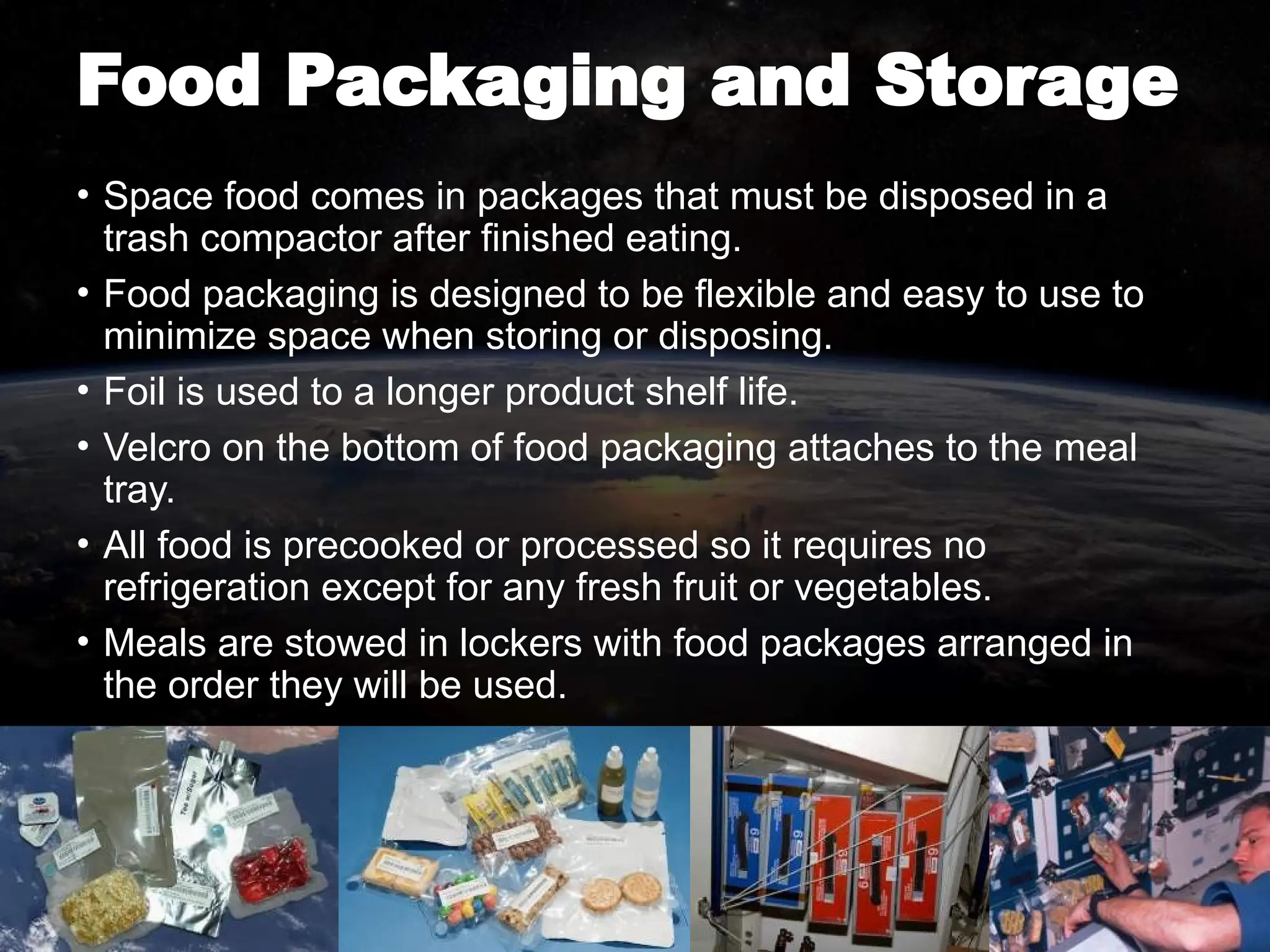
  • 104.
    Manned exploration ispossible due to satellites and probes. Before man was sent to space, satellites and probes were launched into space to collect information such as temperature, radiation, objects in space, pictures, gravity fields, and atmospheric density. Probes also expose material from the earth to the conditions of space, allowing scientists to observe the effects of space on that material.
  • 105.
    Probes escape thegravitational pull of planets by the slingshot effect. Voyager 1 is the farthest probe from Earth, at a distance of ~125 AU as of July 2013. • The slingshot effect acts as a gravitational assist by using energy from gravitational fields of planets or moons to change the speed or shape of a spacecraft’s orbit. • Passing by planets can result in the spacecraft being accelerated, without firing any thrusters to save fuel during missions. Voyager 1 & 2 Trajector ies
  • 106.
    What allows usto remain in orbit around Earth? Just as gravity allows the moon to orbit around Earth, a spacecraft takes advantage of this same phenomenon to stay in orbit around the Earth. In space, the effects of gravity are greatly reduced. NASA calls this condition microgravity.
  • 107.
    What are spaceshuttles? A space shuttle is a reusable spacecraft. A space shuttle carries a crew and equipment into space, returns to Earth, and then is reused for the same purpose. Most shuttle missions last an average of nine days.
  • 108.
    What are spacestations? • The International Space Station (ISS) is a joint effort between multiple agencies consisting of US, Russia, Japan, Canada, Brazil, and Europe. • A space station allows long-term observations and experiments to be carried out in space. Space shuttles are used to take people and supplies from Earth to the space station. Most astronauts stay on the space station for four to six months.
  • 109.
    How do shuttlesleave the ground? The Space Shuttle consists of 3 main components; the Orbiter, a large External Tank, and two Solid Rocket Boosters. The External Tank contains a little over 500,000 gallons of liquid hydrogen and liquid oxygen, which is used as fuel. With the aid of the Solid Rocket Boosters, the External Tank pushes the shuttle off of the Earth and into low Earth orbit. Low Earth orbit is anywhere from 99 to 1,200 miles above Earth. http://www.youtube.com/watch? v=OnoNITE-CLc
  • 110.
    Mission control playscritical role in keeping astronauts safe and helping them complete tasks during spacewalks. America’s human space program is managed by a facility in the Lyndon B. Johnson Space Center in Houston, Texas. • Teams of experienced engineers and technicians monitor systems and activities aboard spacecraft 24 hours a day during missions from long before lift-off and during touchdown. • Teams are in charge of tracking the spacecraft, calculating maneuvers, telling astronauts what time to burn, telling astronauts what to do and where to go, etc.
  • 111.
  • 112.
    What is anastronaut? A person trained to be part of a spacecraft crew.
  • 113.
    What are spacewalks? An activity in which an astronaut moves around and does work outside of the spacecraft while in space. Spacewalks are also referred to as extravehicular activity (EVA).
  • 114.
    Why do astronautsgo on spacewalks? • Astronauts can do science experiments on a spacewalk. Experiments can be placed on the outside of the spacecraft. This lets scientists learn how being in space affects different things. • Spacewalks also let astronauts test new equipment. They can repair satellites or spacecraft that are in space. By going on spacewalks, astronauts can fix things instead of bringing them back to Earth to get fixed.
  • 115.
    Space suits protectastronauts during space walks. Outer space is an extremely hostile place. Without a suit, you face the following hazards: • Become unconscious due to lack of oxygen. • Blood and bodily fluids could boil and then freeze due to lack of pressure. • Tissues would expand due to boiling fluids. • Extreme changes in temperature. • Exposure to various types of radiation. • Hit by meteoroids or orbiting debris. Space Suits
  • 116.
    What are spacesuits? A complex system of garments that allow astronauts to work safely outside their spacecraft by: • Regulate pressure, temperature, and the effects of microgravity • Maintain oxygen through air systems • Protect from meteoroids, debris, and radiation • Allow sight and easy mobility • Keep communication with space shuttle
  • 117.
    • Suits lookinflated because they are pressurized to keep the fluids in an astronauts’ body in a liquid state. Space suits operate below the normal atmospheric pressure. • Suits provide a pure oxygen atmosphere for breathing because the low pressure would cause dangerously low oxygen concentrations in the lungs and blood if normal air is used. • In the confined space of the suit, carbon dioxide concentrations would build up to deadly levels. Therefore, space suits contain special canisters to remove carbon dioxide.
  • 118.
    • Temperature ofthe space suit is regulated by heavy insulation with layers of multiple fabric in conjunction with reflective outer layers to reflect sunlight. Heat produced from an astronaut’s body can be dangerous if it is not removed. Excess heat is removed by using water- cooled garments. • Communication with ground controllers and other astronauts is maintained by radio transmitters/receivers.
  • 119.
    • Astronauts areprotected from collisions with micrometeoroids due to multiple layers of durable fabrics such as Kevlar. • Astronauts are protected from radiation by reflective coatings built into the suits. However, suits are not protection against a solar flare and, thus, spacewalks are planned during periods of low solar activity. • Helmets are made of clear, durable plastic that can reflect sunlight. Tinted visors are also used to reduce glare. Prior to a spacewalk, the inside faceplates of the helmet are sprayed with an anti-fog chemical. Helmets also have mounted lights and cameras. • Space suits are equipped with special joints for easy mobility. Micrometeoroid Impact!
  • 120.
  • 121.
    There are manytypes of spacesuits that have been used in the past by astronauts. Let’s look at America’s Extravehicular Mobility Unit (EMU) currently in use.
  • 122.
    Modern EMU 13 layersof material including an inner cooling garment, pressure garment, thermal micrometeoroid garment, and outer cover.
  • 123.
    Modern EMU Multiple parts work togetherto protect the astronaut from the hazards of space.
  • 124.
    Special systems aid astronautsin spacewalk. The Manned Maneuvering Unit (MMU), a astronaut propulsion unit, was used in 1984 to retrieve faulty communications satellites. • Fits over life-support system backpack. • Astronaut used fingertips to manipulate hand controllers at the ends of the MMU’s two arms. • Deemed as too risky for further use.
  • 125.
    MMU’s successor The SimplifiedAid for EVA Rescue (SAFER) is a small propulsive backpack system intended for emergency use only. • Means of self rescue should an astronaut become untethered during a spacewalk. • Worn by every crew member using an EMU.
  • 126.
  • 127.
    Multiple robotic systemsaid astronauts in maintaining space craft. The Mobile Servicing System (MSS) also known as the Canadarm2 is a robotic system equipped on the ISS. • Launched to the ISS in 2001 is a robotic ‘arm’ that can be used to grasp and manipulate objects in space. • It played a key role in space station assembly and maintenance. • Can move equipment and supplies around and support astronauts working in space.
  • 128.
  • 129.
    Food • Need toensure that there is plenty of food. • Some foods can be eaten in their natural form, while others require adding water. • A supplementary food supply pantry exists. • Additional pantry items can be flown to the astronauts incase the flight is unexpectedly extended.
  • 130.
    Early Space Food •Early space food consisted of bite-sized cubes, freeze-dried powders, and semi-liquids packaged in aluminum tubes. • This early space food was unappetizing and most astronauts disliked squeezing the tubes. • Freeze-dried foods were hard to rehydrate and crumbs had to be prevented from fouling up instruments.
  • 131.
    Current Space Food •Astronauts sample a variety of foods and beverages months before launch. • Astronauts can choose individual meal plans. • Most of the food astronauts eat can be commercially found on grocery store shelves. • Nutritionists ensure the food contain a balanced supply of vitamins and minerals. • Astronauts eat three meals a day plus snacks. • Salt and pepper are available but only in liquid form. • Types of food available include rehydratable, thermostabilized, irradiated, and natural food items.
  • 132.
  • 133.
    Beverages • Come inpowdered form. • Include coffee, tea, apple cider, orange juice, and lemonade. • Add a straw after adding water to drink the beverage or…
  • 134.
    Food Packaging andStorage • Space food comes in packages that must be disposed in a trash compactor after finished eating. • Food packaging is designed to be flexible and easy to use to minimize space when storing or disposing. • Foil is used to a longer product shelf life. • Velcro on the bottom of food packaging attaches to the meal tray. • All food is precooked or processed so it requires no refrigeration except for any fresh fruit or vegetables. • Meals are stowed in lockers with food packages arranged in the order they will be used.
  • 135.
    Proper nutrition playsa critical role in space exploration. • Sodium and vitamin D influence bone density. • Sodium (Na) is limited because too much can lead to bone loss. • Astronauts have limited sunlight exposure since the spacecraft is shielded to protect astronauts from harmful radiation. Since the body is not able to make vitamin D without sunlight, vitamin D supplements are taken to maintain healthy bones. The nutrients astronauts need in space are the same ones we need but in on Earth, but in different amounts.
  • 136.
    Proper nutrition playsa critical role in space exploration. The nutrients astronauts need in space are the same ones we need but in on Earth, but in different amounts. • Less iron (Fe)! – Astronauts have fewer red blood cells while in space. – Red blood cells use iron to help carry oxygen throughout the body. – Since the astronauts have less red blood cells, the amount of iron we need on Earth would be too much in space. – Extra iron could build up and cause health problems like liver disease or arthritis.
  • 137.
    Why is exerciseimportant in space? If astronauts don’t exercise, their bodies start losing bone and muscle. Bone and muscle loss mean decreased size and strength. This would reduce an astronaut’s ability to do work because it makes them weak. Two and a half hours each day are devoted to fitness.
  • 138.
    11/20/2024 SIST-AERO 138 SPACEADAPTATION SYNDROME • Space Motion Sickness is experienced by 60% to 80% of space travelers during their first 2 to 3 days in microgravity. • It manifests clinically with symptoms similar to other forms of motion sickness, such as malaise, fatigue, loss of appetite, nausea, and vomiting, and is a part of a largerconstellation of symptoms, known as Space Adaptation Syndrome. • which also includes facial stuffiness from headward shifts of fluids, headaches, and back pain. Two hypotheses have been proposed to explain space motion sickness: the fluid shift hypothesis and the sensory conflict hypothesis
  • 139.
    11/20/2024 SIST-AERO 139 SPACEADAPTATION SYNDROME
  • 140.
    11/20/2024 SIST-AERO 140 SPACEADAPTATION SYNDROME
  • 141.
  • 142.
    The weightless environmentin space crafts become challenging for waste management. • The collection and retention of liquid and solid waste is directed by the use of air flow. • Solid waste is dried, sealed in a bag, and stored onboard in a trash compactor until landing. • Liquid waste is released into space or recycled through a special water treatment plant and turned back into drinking water.
  • 143.
  • 144.
    Animals in Space •To test the survivability of spaceflight animals were sent to space before humans. • These experiments proved that living passengers could survive being launched into orbit and endure weightlessness. • These animals were space pathfinders for the mutual benefit of man and animals, paving the way for human spaceflight. Miss Baker, a squirrel monkey was one of the first animals launched into the space to be recovered alive. Laika, a Soviet space dog, was the first animal in space aboard Sputnik 2 in 1957. Laika’s monument in Moscow.
  • 146.
  • 147.
  • 148.

Editor's Notes

  • #11 Figure 1.4: Measurements of CO2 in parts per million (ppm) at Mauna Loa Observatory, Hawaii. Higher readings occur in winter when plants die and release CO2 to the atmosphere. Lower readings occur in summer when more abundant vegetation absorbs CO2 from the atmosphere. The solid line is the average yearly value. Notice that the concentration of CO2 has increased by more than 20 percent since 1958.
  • #15 Write “Condensation” on the board: The changing of water vapor to liquid water Write “evaporation” on the board : The process of liquid water becoming a gas Water Vapor is extremely important in our atmosphere. Not only does it form it precip, Also releases large amounts of heat – called latent heat when it changes from vapro to liquid water or ice. Latent hear is an important source of atmospheric energy especially for thunderstorms and hurricanes. Also is one of our greenhouse gases – absorbs a portion of the earth’s outgoing radiant energy thus playing big role in the earth’s energy balance
  • #16 Aerosols are beneficial…act as surfaces on which water vapor condenses to form clouds…hygroscopic nuclei Pollutants are nuisances and health hazards….acid rain results from pollutants and can kill our pines, turn our lakes acidic and can even corrode metal surfaces.
  • #24 So far, we have seen that both air pressure and air density decrease with height above the earth Air temperature has a more complicated vertical profile. Look at this diagram, notice that air temp normally decreases from the surface up to about 11 km (36,000 ft) or 7 mi. This decrease in air temp with increasing height is due mainly to the fact that the sunlight warms the earth’s surface and the surface then warms the air above it. The rate at which air temp decreases with height is called Lapse Rate. The standard lapse rate is about 3.6F per 1000 ft of rise. Note this is only an average and is not always the case. There are times when air temperature actually increases with height. This condition is known as a temperature inversion. We use radiosondes to measure the day to day changes in the lapse rate.
  • #25 So far, we have seen that both air pressure and air density decrease with height above the earth Air temperature has a more complicated vertical profile. Look at this diagram, notice that air temp normally decreases from the surface up to about 11 km (36,000 ft) or 7 mi. This decrease in air temp with increasing height is due mainly to the fact that the sunlight warms the earth’s surface and the surface then warms the air above it. The rate at which air temp decreases with height is called Lapse Rate. The standard lapse rate is about 3.6F per 1000 ft of rise. Note this is only an average and is not always the case. There are times when air temperature actually increases with height. This condition is known as a temperature inversion. We use radiosondes to measure the day to day changes in the lapse rate.
  • #27 So far, we have seen that both air pressure and air density decrease with height above the earth Air temperature has a more complicated vertical profile. Look at this diagram, notice that air temp normally decreases from the surface up to about 11 km (36,000 ft) or 7 mi. This decrease in air temp with increasing height is due mainly to the fact that the sunlight warms the earth’s surface and the surface then warms the air above it. The rate at which air temp decreases with height is called Lapse Rate. The standard lapse rate is about 3.6F per 1000 ft of rise. Note this is only an average and is not always the case. There are times when air temperature actually increases with height. This condition is known as a temperature inversion. We use radiosondes to measure the day to day changes in the lapse rate.
  • #28 So far, we have seen that both air pressure and air density decrease with height above the earth Air temperature has a more complicated vertical profile. Look at this diagram, notice that air temp normally decreases from the surface up to about 11 km (36,000 ft) or 7 mi. This decrease in air temp with increasing height is due mainly to the fact that the sunlight warms the earth’s surface and the surface then warms the air above it. The rate at which air temp decreases with height is called Lapse Rate. The standard lapse rate is about 3.6F per 1000 ft of rise. Note this is only an average and is not always the case. There are times when air temperature actually increases with height. This condition is known as a temperature inversion. We use radiosondes to measure the day to day changes in the lapse rate.
  • #29 So far, we have seen that both air pressure and air density decrease with height above the earth Air temperature has a more complicated vertical profile. Look at this diagram, notice that air temp normally decreases from the surface up to about 11 km (36,000 ft) or 7 mi. This decrease in air temp with increasing height is due mainly to the fact that the sunlight warms the earth’s surface and the surface then warms the air above it. The rate at which air temp decreases with height is called Lapse Rate. The standard lapse rate is about 3.6F per 1000 ft of rise. Note this is only an average and is not always the case. There are times when air temperature actually increases with height. This condition is known as a temperature inversion. We use radiosondes to measure the day to day changes in the lapse rate.
  • #32 Discuss Air density Air density – number of air molecules in a given space Air density greatest at surface and decreases with altitude Air pressure – the amount of force exerted ove an area of suface (atmospheric pressure) As altitude increases, there are fewer molecules above us and thus Atmospheric pressure always decreases with height!!!
  • #33 This igure shows how rapidly air pressure decreases with height. Near sea level, atmospsheric presssure decreases rapidly, whereas at high levels it decreases more slowly. At about 3.5 mi up air pressure is approx. 500 mb or about ½ of sea level pressure This means that if you were at about 18,000 feet above the surface you would be above one half of all the molecules in the atmosphere. The top of Mt Everest (29,000 ft) has a pressure of about 300 mb. The summit of the mountain is above about 70% of all the molecules in the atmosphere. If you go up to about 50 km (about 164,000 ft) the air pressure is about 1 mb which means that 99.9 % of all molecules are below this level.
  • #48 https://explorer1.jpl.nasa.gov/galleries/videos/svs/ https://www.nasa.gov/mission_pages/explorer/index.html
  • #52 https://gisgeography.com/geosynchronous-geostationary-orbits/
  • #57 ERG: exploration of Energization and Radiation in Geospace.
  • #58 http://mms.space.swri.edu/mission-2.html
  • #71 Additional reading material
  • #89 Z=92 Uranium
  • #94 Not the main slide, for further reading and understanding
  • #95 Messenger, S. R., Summers, G. P., Burke, E. A., Walters, R. J. and Xapsos, M. A. (2001), Modeling solar cell degradation in space: A comparison of the NRL displacement damage dose and the JPL equivalent fluence approaches. Prog. Photovolt: Res. Appl., 9: 103–121. doi: 10.1002/pip.357
  • #97 7.9B identifying the accommodations, considering the characteristics of our solar system, that enabled manned space exploration 
  • #105 YouTube clip 1:18 of Voyager 1 and 2’s Trajectories
  • #106 Vacuum - A volume of space mostly empty of matter such as oxygen to breathe
  • #115 Space Suits – YouTube clip 5:16
  • #125 YouTube clip of the trailer for the 2013 film Gravity is hyperlinked to the word “untethered” above. 1:30 minutes The premise of the movie is an astronaut becomes adrift in space.
  • #135 Na is the chemical symbol for sodium on the periodic table of elements. We get sodium when we eat salt!
  • #136 Fe is the chemical symbol for iron on the periodic table of elements.
  • #142 Weightless environment – no force acting on astronauts