1
Facility of IT and Computer Science
By: Dereje Tekaleng
Registration No. 7AQV45311520
DRC No. 3
Supervised by Dr. Priya Swaminarayan
IoT Prospects and
Challenges
24 October
2021
IoT Prospects and Challenges
2
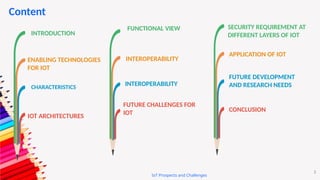
Content
2
INTRODUCTION
ENABLING TECHNOLOGIES
FOR IOT
CHARACTERISTICS
IOT ARCHITECTURES
FUNCTIONAL VIEW
INTEROPERABILITY
INTEROPERABILITY
FUTURE CHALLENGES FOR
IOT
SECURITY REQUIREMENT AT
DIFFERENT LAYERS OF IOT
APPLICATION OF IOT
FUTURE DEVELOPMENT
AND RESEARCH NEEDS
CONCLUSION
3
INTRODUCTION
IoT Prospects and Challenges
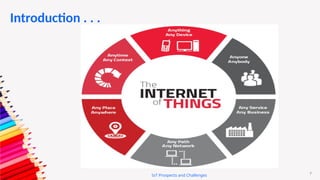
 The Internet of Things (IoT) is a system of interrelated
computing devices, mechanical and digital machines,
objects, animals or people that are provided with unique
identifiers and the ability to transfer data over a network
without requiring human-to-human or human-to-computer
interaction.”
 The Internet of things refers to a type of network to connect
anything with the Internet based on stipulated protocols
through information sensing equipment's to conduct
information exchange and communications in order to achieve
smart recognitions, positioning, tracing, monitoring, and
administration.
Introduction
IoT Prospects and Challenges
5
Introduction . . .
Internet of things is an internet of three things:
People to people,
 People to machine /things,
 Things /machine to things /machine, Interacting
through internet
Vision:- Create pervasive presence in the environment of a
variety of things/objects that through wireless and wired
connections
 unique addressing schemes are able to interact with
each other and cooperate with other things/objects to
create new applications/services and reach common goals.
IoT Prospects and Challenges
6
Introduction . . .
IoT Prospects and Challenges
1999- The term "Internet of Things" was used by Kevin Ashton
during his work at P&G which became widely accepted
2004 - The term was mentioned in famous publications like the
Guardian, Boston Globe, and Scientific American
2005-UN's International Telecommunications Union (ITU)
published its first report on this topic.
2008- The Internet of Things was born
2011- Gartner, the market research company, include
"The Internet of Things" technology in their research it has recently
become more relevant to the practical world largely because of the
growth of mobile devices, embedded and ubiquitous communication,
cloud computing and data analytics
History of IOT
7
Introduction . . .
IoT Prospects and Challenges
8
Introduction . . .
IoT Prospects and Challenges
Internet of things (IOT) is a network of physical objects.
The internet is not only a network of computers, but it has
evolved into a network of device of all type and sizes , vehicles, smart
phones, home appliances, toys, cameras, medical instruments and
industrial systems, animals, people, buildings, all connected ,all
communicating & sharing information based on stipulated protocols
in order to achieve smart reorganizations, positioning, tracing, safe
& control & even personal real time online monitoring , online
upgrade, process control & administration
With the Internet of Things the communication is extended via Internet to
all the things that surround us. The Internet of Things is much more than
machine to machine communication, wireless sensor networks, sensor
networks , 2G/3G/4G,GSM,GPRS,RFID, WI-FI, GPS, microcontroller,
microprocessor etc
9
Introduction . . .
IoT Prospects and Challenges
The goal of the Internet of Things is to enable things to be
connected anytime, anyplace, with anything and anyone ideally
using any path/network and any service.
IOT refer to the general idea of things, especially everyday
objects, that are readable, recognizable, locatable, addressable
through information sensing device and/or controllable via the
Internet, irrespective of the communication means (whether via
RFID, wireless LAN, wide area networks, or other means)
The Internet of Things is not a single technology, but it is a
mixture of different hardware & software technology
Heterogeneous mix of communication technologies,
which need to be adapted in order to address the needs of
IoT applications such as energy efficiency, speed, security,
and reliability
10
Introduction . . .
IoT Prospects and Challenges
Diversity will be scaled to a number a manageable
connectivity technologies that address the needs of the IoT
applications, are adopted by the market, they have already
proved to be serviceable, supported by a strong technology
alliance.
Examples of standards in these categories include
wired and wireless technologies like Ethernet, WI-FI,
Bluetooth, ZigBee, GSM, and GPRS
Enabling
Technologies
11
IoT Prospects and Challenges
12
Enabling Technologies
IoT Prospects and Challenges
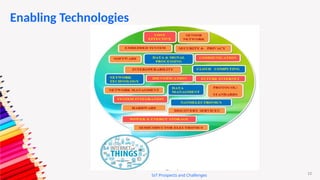
1.Technologies that enable “things” to acquire contextual information
2.Technologies that enable “things” to process contextual information,
3.Technologies to improve security and privacy
The first two categories can be jointly understood as
functional building blocks required building “intelligence”
into “things”, which are indeed the features that differentiate
the IoT from the usual Internet
The third category is not a functional but rather a de facto
requirement, without which the penetration of the IoT would
be severely reduced
13
Enabling Technologies
IoT Prospects and Challenges
CHARACTERISTICS
14
IoT Prospects and Challenges
15
Characteristics
IoT Prospects and Challenges
Interconnectivity: anything can be interconnected with the
global ICT infrastructure.
Things-related services: The IoT is capable of providing
thing-related services
Heterogeneity: The devices in the IoT are heterogeneous as
based on different hardware platforms and networks. They
can interact with other devices or service platforms through
different networks.
Dynamic changes: The state of devices change dynamically, e.g.,
sleeping and waking up, connected and/or disconnected as well as the
context of devices including location and speed. Moreover, the number
of devices can change dynamically.
16
Characteristics
IoT Prospects and Challenges
Connectivity: Connectivity enables network accessibility and
compatibility. Accessibility is getting on a network while
compatibility provides the common ability to consume and
produce data.
Enormous scale: The number of devices is in order of
magnitude larger than the devices connected to the current
Internet. more critical will be the management of the data
generated and their interpretation for application purposes.
Safety: the safety of our personal data and the safety of our
physical well-being. Securing the endpoints, the networks, and
the data moving across all of it means creating a security
paradigm that will scale.
IOT Architectures
17
IoT Prospects and Challenges
18
IOT Architecture
IoT Prospects and Challenges
19
IoT Prospects and Challenges
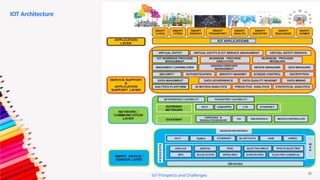
Architecture consists of different layers of technologies
supporting IOT.
Smart Device / Sensor Layer: The lowest layer is made up
of smart objects integrated with sensors. The sensors
enable the interconnection of the physical and digital
worlds allowing real-time information to be collected and
processed.
A sensor can measure the physical property and convert it into signal
that can be understood by an instrument.
 Sensors are grouped according to their unique purpose such as
environmental sensors, body sensors, home appliance sensors and
vehicle telematics sensors, etc.
Most sensors require connectivity to the sensor gateways otherwise
their connectivity to backend servers/applications can be provided using
Wide Area Network (WAN) such as GSM, GPRS and LTE .
IOT Architecture. . .
20
IoT Prospects and Challenges
B. Gateway & networks: massive volume of data will be
produced by these tiny sensors and this requires
A robust High performance wired or wireless network
infrastructure as a transport medium needed to serve a
wider range of IOT services and applications such as high
speed transactional services, context-aware applications,
etc, multiple networks with various technologies
 Access protocols are needed to work with each other in a
heterogeneous configuration
IOT Architecture
21
IoT Prospects and Challenges
B. Management Service Layer: The management service renders
the processing of information possible through analytics, security
controls, process modeling and management of devices.
important features of this layer is the business and process rule
engines
The rule engines support the formulation of decision logics and
trigger interactive and automated processes to enable a more
responsive IOT system.
In the area of analytics, various analytics tools are used to extract relevant
information from massive amount of raw data and to be processed at a much faster
rate.
With data management in the management service layer, information can be
accessed, integrated and controlled. Higher layer applications can be shielded from the
need to process unnecessary data and reduce the risk of privacy disclosure of the data
source. ( Data Filtering)
IOT Architecture. . .
22
IoT Prospects and Challenges
Application Layer: The IoT application covers “smart”
environments/spaces in domains such as: Transportation,
Building, City, Lifestyle, Retail, Agriculture, Factory, Supply chain,
Emergency, Healthcare, User interaction, Culture and tourism,
Environment and Energy.
 Security must be enforced across the whole dimension
IOT Architecture. . .
23
Enabling Technologies
IoT Prospects and Challenges
IoT solutions comprising a number of components such as
 Module for interaction with local IoT devices. This module is
responsible for acquisition of observations and their
forwarding to remote servers for analysis and permanent
storage.
 Module for local analysis and processing of observations
acquired by IoT devices.
 Module for interaction with remote IoT devices, directly over the
Internet
Module for application specific data analysis and processing. This
module is running on an application server serving all clients.
User interface (web or mobile): visual representation of measurements
in a given context (for example on a map)
24
IoT Prospects and Challenges
Gateway & Networks: Massive volume of data will be
produced by these tiny sensors and this requires a robust and high
performance wired or wireless network infrastructure as a transport
medium
needed to serve a wider range of IOT services and applications
such as high speed transactional services, context-aware
applications, etc, multiple networks with various technologies and
access protocols are needed to work with each other in a
heterogeneous configuration
 Module for interaction with remote IoT devices, directly over the
Internet
Module for application specific data analysis and processing. This
module is running on an application server serving all clients.
User interface (web or mobile): visual representation of measurements
in a given context (for example on a map)
IOT Architecture. . .
25
IoT Prospects and Challenges
Gateway The management service renders the processing
of information possible through analytics, security controls,
process modeling and management of devices.
Important features of this layer is the business and process
rule engines
The rule engines support the formulation of decision logics
and trigger interactive and automated processes to enable a
more responsive IOT system.
IOT Architecture. . .
Management Service Layer
26
IoT Prospects and Challenges
In the area of analytics, various analytics tools are used to extract
relevant information from massive amount of raw data and to be
processed at a much faster rate.
With data management in the management service layer, information
can be accessed, integrated and controlled. Higher layer applications can
be shielded from the need to process unnecessary data and reduce the
risk of privacy disclosure of the data source. ( Data Filtering)
IOT Architecture. . .
Management Service Layer . . .
27
IoT Prospects and Challenges
 The IoT application covers “smart” environments/spaces
in domains such as: Transportation, Building, City,
Lifestyle, Retail, Agriculture, Factory, Supply chain,
Emergency, Healthcare, User interaction, Culture and
tourism, Environment and Energy.
 Security must be enforced across the whole dimension
IOT Architecture. . .
Application Layer
Functional View
28
IoT Prospects and Challenges
29
IoT Prospects and Challenges
IoT solutions comprising a number of components (Modules) such as
1. Module for interaction with local IoT devices. This module
is responsible for acquisition of observations and their
forwarding to remote servers for analysis and permanent
storage.
2. Module for local analysis and processing of observations
acquired by IoT devices.
3. Module for interaction with remote IoT devices, directly
over the Internet.
4. Module for application specific data analysis and
processing. This module is running on an application
server serving all clients.
5. User interface (web or mobile): visual representation of
measurements in a given context (for example on a map)
Functional View
Interoperability
30
IoT Prospects and Challenges
31
IoT Prospects and Challenges
IoT solutions comprising a number of components such as
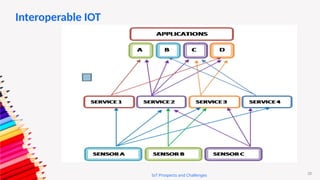
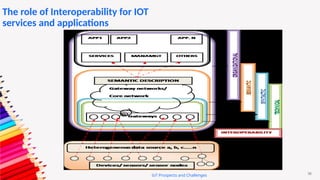
 Interoperability is a key challenge in the realms of the
Internet of Things (IOT).
 Interoperability is: “the ability of two or more systems
or components to exchange data and use
information”.
Interoperability
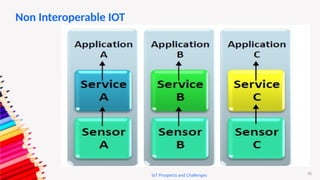
 Heterogeneity of underlying devices and communication technologies
and interoperability in different layers, from communication and
seam-less integration of devices to interoperability of data generated
by the IOT resources, is a challenge for expanding generic IOT
solutions to a global scale.
32
IoT Prospects and Challenges
Non Interoperable IOT
33
IoT Prospects and Challenges
Interoperable IOT
34
IoT Prospects and Challenges
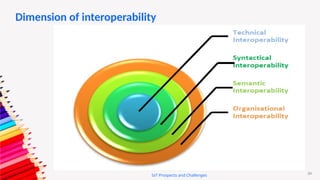
Dimension of interoperability
35
IoT Prospects and Challenges
Dimension of Interoperability
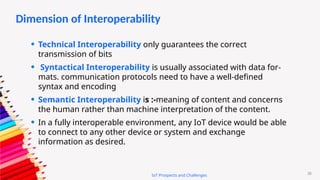
• Technical Interoperability only guarantees the correct
transmission of bits
• Syntactical Interoperability is usually associated with data for-
mats. communication protocols need to have a well-defined
syntax and encoding
• Semantic Interoperability is :-meaning of content and concerns
the human rather than machine interpretation of the content.
• In a fully interoperable environment, any IoT device would be able
to connect to any other device or system and exchange
information as desired.
36
IoT Prospects and Challenges
The role of Interoperability for IOT
services and applications
Future Challenges for IOT
37
IoT Prospects and Challenges
38
IoT Prospects and Challenges
Future Challenges for IOT
Mission-critical systems creates the need to address trust and
security functions adequately
Providing trust and quality-of-information in shared information
models to enable re-use across many applications.
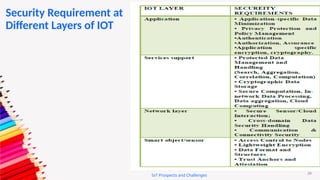
Providing secure exchange of data between iot devices and
consumers of their information.
Providing protection mechanisms for vulnerable devices
key challenges and implications today that need to
be addressed before mass adoption of IOT can occur
A) Privacy & Security
39
IoT Prospects and Challenges
Security Requirement at
Different Layers of IOT
40
IoT Prospects and Challenges
Future Challenges
for IOT
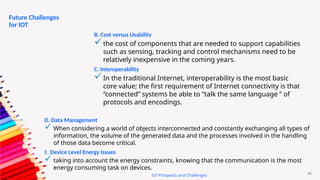
B. Cost versus Usability
the cost of components that are needed to support capabilities
such as sensing, tracking and control mechanisms need to be
relatively inexpensive in the coming years.
C. Interoperability
In the traditional Internet, interoperability is the most basic
core value; the first requirement of Internet connectivity is that
“connected” systems be able to “talk the same language ” of
protocols and encodings.
D. Data Management
 When considering a world of objects interconnected and constantly exchanging all types of
information, the volume of the generated data and the processes involved in the handling
of those data become critical.
E. Device Level Energy Issues
 taking into account the energy constraints, knowing that the communication is the most
energy consuming task on devices.
IOT APPLICATION
41
IoT Prospects and Challenges
42
IoT Prospects and Challenges
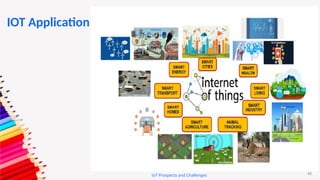
IOT Application
43
IoT Prospects and Challenges
The IoT application covers “smart” environments/spaces in
domains such as: Transportation, Building, City, Lifestyle,
Retail, Agriculture, Factory, Supply chain, Emergency,
Healthcare, User interaction, Culture and tourism,
Environment and Energy.
 IOsL (Internet of smart living):
Remote Control Appliances, Weather Displays, Smart Home
Appliances, Safety Monitoring, Intrusion Detection Systems,
Energy and Water Use (consumption monitoring to obtain advice
on how to save cost and resources )
IOT Application
44
IoT Prospects and Challenges
Application Areas . . .
B. IOsC ( Internet of smart cities):
Structural Health: Monitoring of vibrations and material conditions in
buildings, bridges and historical monuments,
Lightning: intelligent and weather adaptive lighting in street lights,
Safety: Digital video monitoring, fire control management, public
announcement systems,
Transportation: Smart Roads and Intelligent High-ways with warning
messages and diversions according to climate conditions and unexpected
events like accidents or traffic jams
 Smart Parking: Real-time monitoring of parking spaces availability in the city
making residents able to identify and reserve the closest available spaces
 Waste Management: Detection of rubbish levels in containers to optimize
the trash collection routes. Garbage cans and recycle bins with RFID tags
allow the sanitation staff to see when garbage has been put out.
45
IoT Prospects and Challenges
IOsE (Internet of smart environment):
 Air Pollution monitoring, Forest Fire Detection: Weather
monitoring: Earthquake Early Detection,
 Water Quality: Study of water suitability in rivers and the
sea for eligibility in drinkable use,
 River Floods: Monitoring of water level variations in rivers, dams and
reservoirs during rainy days
 Protecting wildlife: Tracking collars utilizing GPS/GSM modules to locate and
track wild animals and communicate their coordinates via SMS.
IOT Application
46
IoT Prospects and Challenges
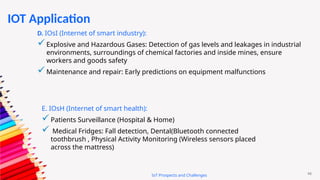
D. IOsI (Internet of smart industry):
Explosive and Hazardous Gases: Detection of gas levels and leakages in industrial
environments, surroundings of chemical factories and inside mines, ensure
workers and goods safety
Maintenance and repair: Early predictions on equipment malfunctions
E. IOsH (Internet of smart health):
Patients Surveillance (Hospital & Home)
 Medical Fridges: Fall detection, Dental(Bluetooth connected
toothbrush , Physical Activity Monitoring (Wireless sensors placed
across the mattress)
IOT Application
47
IoT Prospects and Challenges
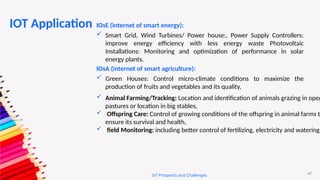
IOsE (internet of smart energy):
 Smart Grid, Wind Turbines/ Power house:, Power Supply Controllers:
improve energy efficiency with less energy waste Photovoltaic
Installations: Monitoring and optimization of performance in solar
energy plants.
IOsA (internet of smart agriculture):
 Green Houses: Control micro-climate conditions to maximize the
production of fruits and vegetables and its quality,
 Animal Farming/Tracking: Location and identification of animals grazing in open
pastures or location in big stables,
 Offspring Care: Control of growing conditions of the offspring in animal farms to
ensure its survival and health,
 field Monitoring: including better control of fertilizing, electricity and watering.
IOT Application
Future Development and
Research Needs
48
IoT Prospects and Challenges
49
IoT Prospects and Challenges
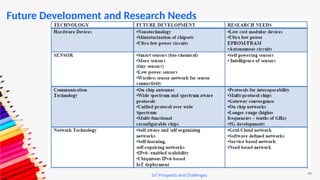
Future Development and Research Needs
50
IoT Prospects and Challenges
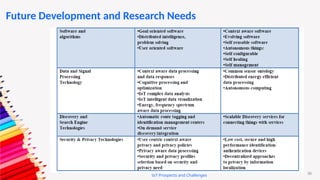
Future Development and Research Needs
CONCLUSION
51
IoT Prospects and Challenges
52
IoT Prospects and Challenges
CONCLUSION
Internet of Things is a new revolution of the Internet & it is a key
research topic for researcher in embedded, computer science &
information technology area due to its very diverse area of application
& heterogeneous mixture of various communications and embedded
technology in its architecture.
53
IoT Prospects and Challenges
References
Keyur K Patel1, Sunil M Patel2 . PG Scholar1 Assistant Professor2
Internet of Things-IOT: Definition, Characteristics, Architecture,
Enabling Technologies, Application & Future Challenges
https://www.oracle.com
Dr. Ovidiu Vermesan SINTEF, Norway, Dr. Peter FriessEU, Belgium,
“Internet of Things: Converging Technologies for Smart Environments
and Integrated Ecosystems”, river publishers’ series in communications,
2013.

जी शुक्रिया
Jee Shukria

Internet of things challenges and prospects

  • 1.
    1 Facility of ITand Computer Science By: Dereje Tekaleng Registration No. 7AQV45311520 DRC No. 3 Supervised by Dr. Priya Swaminarayan IoT Prospects and Challenges 24 October 2021
  • 2.
    IoT Prospects andChallenges 2 Content 2 INTRODUCTION ENABLING TECHNOLOGIES FOR IOT CHARACTERISTICS IOT ARCHITECTURES FUNCTIONAL VIEW INTEROPERABILITY INTEROPERABILITY FUTURE CHALLENGES FOR IOT SECURITY REQUIREMENT AT DIFFERENT LAYERS OF IOT APPLICATION OF IOT FUTURE DEVELOPMENT AND RESEARCH NEEDS CONCLUSION
  • 3.
  • 4.
     The Internetof Things (IoT) is a system of interrelated computing devices, mechanical and digital machines, objects, animals or people that are provided with unique identifiers and the ability to transfer data over a network without requiring human-to-human or human-to-computer interaction.”  The Internet of things refers to a type of network to connect anything with the Internet based on stipulated protocols through information sensing equipment's to conduct information exchange and communications in order to achieve smart recognitions, positioning, tracing, monitoring, and administration. Introduction IoT Prospects and Challenges
  • 5.
    5 Introduction . .. Internet of things is an internet of three things: People to people,  People to machine /things,  Things /machine to things /machine, Interacting through internet Vision:- Create pervasive presence in the environment of a variety of things/objects that through wireless and wired connections  unique addressing schemes are able to interact with each other and cooperate with other things/objects to create new applications/services and reach common goals. IoT Prospects and Challenges
  • 6.
    6 Introduction . .. IoT Prospects and Challenges 1999- The term "Internet of Things" was used by Kevin Ashton during his work at P&G which became widely accepted 2004 - The term was mentioned in famous publications like the Guardian, Boston Globe, and Scientific American 2005-UN's International Telecommunications Union (ITU) published its first report on this topic. 2008- The Internet of Things was born 2011- Gartner, the market research company, include "The Internet of Things" technology in their research it has recently become more relevant to the practical world largely because of the growth of mobile devices, embedded and ubiquitous communication, cloud computing and data analytics History of IOT
  • 7.
    7 Introduction . .. IoT Prospects and Challenges
  • 8.
    8 Introduction . .. IoT Prospects and Challenges Internet of things (IOT) is a network of physical objects. The internet is not only a network of computers, but it has evolved into a network of device of all type and sizes , vehicles, smart phones, home appliances, toys, cameras, medical instruments and industrial systems, animals, people, buildings, all connected ,all communicating & sharing information based on stipulated protocols in order to achieve smart reorganizations, positioning, tracing, safe & control & even personal real time online monitoring , online upgrade, process control & administration With the Internet of Things the communication is extended via Internet to all the things that surround us. The Internet of Things is much more than machine to machine communication, wireless sensor networks, sensor networks , 2G/3G/4G,GSM,GPRS,RFID, WI-FI, GPS, microcontroller, microprocessor etc
  • 9.
    9 Introduction . .. IoT Prospects and Challenges The goal of the Internet of Things is to enable things to be connected anytime, anyplace, with anything and anyone ideally using any path/network and any service. IOT refer to the general idea of things, especially everyday objects, that are readable, recognizable, locatable, addressable through information sensing device and/or controllable via the Internet, irrespective of the communication means (whether via RFID, wireless LAN, wide area networks, or other means) The Internet of Things is not a single technology, but it is a mixture of different hardware & software technology Heterogeneous mix of communication technologies, which need to be adapted in order to address the needs of IoT applications such as energy efficiency, speed, security, and reliability
  • 10.
    10 Introduction . .. IoT Prospects and Challenges Diversity will be scaled to a number a manageable connectivity technologies that address the needs of the IoT applications, are adopted by the market, they have already proved to be serviceable, supported by a strong technology alliance. Examples of standards in these categories include wired and wireless technologies like Ethernet, WI-FI, Bluetooth, ZigBee, GSM, and GPRS
  • 11.
  • 12.
    12 Enabling Technologies IoT Prospectsand Challenges 1.Technologies that enable “things” to acquire contextual information 2.Technologies that enable “things” to process contextual information, 3.Technologies to improve security and privacy The first two categories can be jointly understood as functional building blocks required building “intelligence” into “things”, which are indeed the features that differentiate the IoT from the usual Internet The third category is not a functional but rather a de facto requirement, without which the penetration of the IoT would be severely reduced
  • 13.
  • 14.
  • 15.
    15 Characteristics IoT Prospects andChallenges Interconnectivity: anything can be interconnected with the global ICT infrastructure. Things-related services: The IoT is capable of providing thing-related services Heterogeneity: The devices in the IoT are heterogeneous as based on different hardware platforms and networks. They can interact with other devices or service platforms through different networks. Dynamic changes: The state of devices change dynamically, e.g., sleeping and waking up, connected and/or disconnected as well as the context of devices including location and speed. Moreover, the number of devices can change dynamically.
  • 16.
    16 Characteristics IoT Prospects andChallenges Connectivity: Connectivity enables network accessibility and compatibility. Accessibility is getting on a network while compatibility provides the common ability to consume and produce data. Enormous scale: The number of devices is in order of magnitude larger than the devices connected to the current Internet. more critical will be the management of the data generated and their interpretation for application purposes. Safety: the safety of our personal data and the safety of our physical well-being. Securing the endpoints, the networks, and the data moving across all of it means creating a security paradigm that will scale.
  • 17.
  • 18.
  • 19.
    19 IoT Prospects andChallenges Architecture consists of different layers of technologies supporting IOT. Smart Device / Sensor Layer: The lowest layer is made up of smart objects integrated with sensors. The sensors enable the interconnection of the physical and digital worlds allowing real-time information to be collected and processed. A sensor can measure the physical property and convert it into signal that can be understood by an instrument.  Sensors are grouped according to their unique purpose such as environmental sensors, body sensors, home appliance sensors and vehicle telematics sensors, etc. Most sensors require connectivity to the sensor gateways otherwise their connectivity to backend servers/applications can be provided using Wide Area Network (WAN) such as GSM, GPRS and LTE . IOT Architecture. . .
  • 20.
    20 IoT Prospects andChallenges B. Gateway & networks: massive volume of data will be produced by these tiny sensors and this requires A robust High performance wired or wireless network infrastructure as a transport medium needed to serve a wider range of IOT services and applications such as high speed transactional services, context-aware applications, etc, multiple networks with various technologies  Access protocols are needed to work with each other in a heterogeneous configuration IOT Architecture
  • 21.
    21 IoT Prospects andChallenges B. Management Service Layer: The management service renders the processing of information possible through analytics, security controls, process modeling and management of devices. important features of this layer is the business and process rule engines The rule engines support the formulation of decision logics and trigger interactive and automated processes to enable a more responsive IOT system. In the area of analytics, various analytics tools are used to extract relevant information from massive amount of raw data and to be processed at a much faster rate. With data management in the management service layer, information can be accessed, integrated and controlled. Higher layer applications can be shielded from the need to process unnecessary data and reduce the risk of privacy disclosure of the data source. ( Data Filtering) IOT Architecture. . .
  • 22.
    22 IoT Prospects andChallenges Application Layer: The IoT application covers “smart” environments/spaces in domains such as: Transportation, Building, City, Lifestyle, Retail, Agriculture, Factory, Supply chain, Emergency, Healthcare, User interaction, Culture and tourism, Environment and Energy.  Security must be enforced across the whole dimension IOT Architecture. . .
  • 23.
    23 Enabling Technologies IoT Prospectsand Challenges IoT solutions comprising a number of components such as  Module for interaction with local IoT devices. This module is responsible for acquisition of observations and their forwarding to remote servers for analysis and permanent storage.  Module for local analysis and processing of observations acquired by IoT devices.  Module for interaction with remote IoT devices, directly over the Internet Module for application specific data analysis and processing. This module is running on an application server serving all clients. User interface (web or mobile): visual representation of measurements in a given context (for example on a map)
  • 24.
    24 IoT Prospects andChallenges Gateway & Networks: Massive volume of data will be produced by these tiny sensors and this requires a robust and high performance wired or wireless network infrastructure as a transport medium needed to serve a wider range of IOT services and applications such as high speed transactional services, context-aware applications, etc, multiple networks with various technologies and access protocols are needed to work with each other in a heterogeneous configuration  Module for interaction with remote IoT devices, directly over the Internet Module for application specific data analysis and processing. This module is running on an application server serving all clients. User interface (web or mobile): visual representation of measurements in a given context (for example on a map) IOT Architecture. . .
  • 25.
    25 IoT Prospects andChallenges Gateway The management service renders the processing of information possible through analytics, security controls, process modeling and management of devices. Important features of this layer is the business and process rule engines The rule engines support the formulation of decision logics and trigger interactive and automated processes to enable a more responsive IOT system. IOT Architecture. . . Management Service Layer
  • 26.
    26 IoT Prospects andChallenges In the area of analytics, various analytics tools are used to extract relevant information from massive amount of raw data and to be processed at a much faster rate. With data management in the management service layer, information can be accessed, integrated and controlled. Higher layer applications can be shielded from the need to process unnecessary data and reduce the risk of privacy disclosure of the data source. ( Data Filtering) IOT Architecture. . . Management Service Layer . . .
  • 27.
    27 IoT Prospects andChallenges  The IoT application covers “smart” environments/spaces in domains such as: Transportation, Building, City, Lifestyle, Retail, Agriculture, Factory, Supply chain, Emergency, Healthcare, User interaction, Culture and tourism, Environment and Energy.  Security must be enforced across the whole dimension IOT Architecture. . . Application Layer
  • 28.
  • 29.
    29 IoT Prospects andChallenges IoT solutions comprising a number of components (Modules) such as 1. Module for interaction with local IoT devices. This module is responsible for acquisition of observations and their forwarding to remote servers for analysis and permanent storage. 2. Module for local analysis and processing of observations acquired by IoT devices. 3. Module for interaction with remote IoT devices, directly over the Internet. 4. Module for application specific data analysis and processing. This module is running on an application server serving all clients. 5. User interface (web or mobile): visual representation of measurements in a given context (for example on a map) Functional View
  • 30.
  • 31.
    31 IoT Prospects andChallenges IoT solutions comprising a number of components such as  Interoperability is a key challenge in the realms of the Internet of Things (IOT).  Interoperability is: “the ability of two or more systems or components to exchange data and use information”. Interoperability  Heterogeneity of underlying devices and communication technologies and interoperability in different layers, from communication and seam-less integration of devices to interoperability of data generated by the IOT resources, is a challenge for expanding generic IOT solutions to a global scale.
  • 32.
    32 IoT Prospects andChallenges Non Interoperable IOT
  • 33.
    33 IoT Prospects andChallenges Interoperable IOT
  • 34.
    34 IoT Prospects andChallenges Dimension of interoperability
  • 35.
    35 IoT Prospects andChallenges Dimension of Interoperability • Technical Interoperability only guarantees the correct transmission of bits • Syntactical Interoperability is usually associated with data for- mats. communication protocols need to have a well-defined syntax and encoding • Semantic Interoperability is :-meaning of content and concerns the human rather than machine interpretation of the content. • In a fully interoperable environment, any IoT device would be able to connect to any other device or system and exchange information as desired.
  • 36.
    36 IoT Prospects andChallenges The role of Interoperability for IOT services and applications
  • 37.
    Future Challenges forIOT 37 IoT Prospects and Challenges
  • 38.
    38 IoT Prospects andChallenges Future Challenges for IOT Mission-critical systems creates the need to address trust and security functions adequately Providing trust and quality-of-information in shared information models to enable re-use across many applications. Providing secure exchange of data between iot devices and consumers of their information. Providing protection mechanisms for vulnerable devices key challenges and implications today that need to be addressed before mass adoption of IOT can occur A) Privacy & Security
  • 39.
    39 IoT Prospects andChallenges Security Requirement at Different Layers of IOT
  • 40.
    40 IoT Prospects andChallenges Future Challenges for IOT B. Cost versus Usability the cost of components that are needed to support capabilities such as sensing, tracking and control mechanisms need to be relatively inexpensive in the coming years. C. Interoperability In the traditional Internet, interoperability is the most basic core value; the first requirement of Internet connectivity is that “connected” systems be able to “talk the same language ” of protocols and encodings. D. Data Management  When considering a world of objects interconnected and constantly exchanging all types of information, the volume of the generated data and the processes involved in the handling of those data become critical. E. Device Level Energy Issues  taking into account the energy constraints, knowing that the communication is the most energy consuming task on devices.
  • 41.
  • 42.
    42 IoT Prospects andChallenges IOT Application
  • 43.
    43 IoT Prospects andChallenges The IoT application covers “smart” environments/spaces in domains such as: Transportation, Building, City, Lifestyle, Retail, Agriculture, Factory, Supply chain, Emergency, Healthcare, User interaction, Culture and tourism, Environment and Energy.  IOsL (Internet of smart living): Remote Control Appliances, Weather Displays, Smart Home Appliances, Safety Monitoring, Intrusion Detection Systems, Energy and Water Use (consumption monitoring to obtain advice on how to save cost and resources ) IOT Application
  • 44.
    44 IoT Prospects andChallenges Application Areas . . . B. IOsC ( Internet of smart cities): Structural Health: Monitoring of vibrations and material conditions in buildings, bridges and historical monuments, Lightning: intelligent and weather adaptive lighting in street lights, Safety: Digital video monitoring, fire control management, public announcement systems, Transportation: Smart Roads and Intelligent High-ways with warning messages and diversions according to climate conditions and unexpected events like accidents or traffic jams  Smart Parking: Real-time monitoring of parking spaces availability in the city making residents able to identify and reserve the closest available spaces  Waste Management: Detection of rubbish levels in containers to optimize the trash collection routes. Garbage cans and recycle bins with RFID tags allow the sanitation staff to see when garbage has been put out.
  • 45.
    45 IoT Prospects andChallenges IOsE (Internet of smart environment):  Air Pollution monitoring, Forest Fire Detection: Weather monitoring: Earthquake Early Detection,  Water Quality: Study of water suitability in rivers and the sea for eligibility in drinkable use,  River Floods: Monitoring of water level variations in rivers, dams and reservoirs during rainy days  Protecting wildlife: Tracking collars utilizing GPS/GSM modules to locate and track wild animals and communicate their coordinates via SMS. IOT Application
  • 46.
    46 IoT Prospects andChallenges D. IOsI (Internet of smart industry): Explosive and Hazardous Gases: Detection of gas levels and leakages in industrial environments, surroundings of chemical factories and inside mines, ensure workers and goods safety Maintenance and repair: Early predictions on equipment malfunctions E. IOsH (Internet of smart health): Patients Surveillance (Hospital & Home)  Medical Fridges: Fall detection, Dental(Bluetooth connected toothbrush , Physical Activity Monitoring (Wireless sensors placed across the mattress) IOT Application
  • 47.
    47 IoT Prospects andChallenges IOsE (internet of smart energy):  Smart Grid, Wind Turbines/ Power house:, Power Supply Controllers: improve energy efficiency with less energy waste Photovoltaic Installations: Monitoring and optimization of performance in solar energy plants. IOsA (internet of smart agriculture):  Green Houses: Control micro-climate conditions to maximize the production of fruits and vegetables and its quality,  Animal Farming/Tracking: Location and identification of animals grazing in open pastures or location in big stables,  Offspring Care: Control of growing conditions of the offspring in animal farms to ensure its survival and health,  field Monitoring: including better control of fertilizing, electricity and watering. IOT Application
  • 48.
    Future Development and ResearchNeeds 48 IoT Prospects and Challenges
  • 49.
    49 IoT Prospects andChallenges Future Development and Research Needs
  • 50.
    50 IoT Prospects andChallenges Future Development and Research Needs
  • 51.
  • 52.
    52 IoT Prospects andChallenges CONCLUSION Internet of Things is a new revolution of the Internet & it is a key research topic for researcher in embedded, computer science & information technology area due to its very diverse area of application & heterogeneous mixture of various communications and embedded technology in its architecture.
  • 53.
    53 IoT Prospects andChallenges References Keyur K Patel1, Sunil M Patel2 . PG Scholar1 Assistant Professor2 Internet of Things-IOT: Definition, Characteristics, Architecture, Enabling Technologies, Application & Future Challenges https://www.oracle.com Dr. Ovidiu Vermesan SINTEF, Norway, Dr. Peter FriessEU, Belgium, “Internet of Things: Converging Technologies for Smart Environments and Integrated Ecosystems”, river publishers’ series in communications, 2013. 
  • 54.
Editor's Notes

  • #17 © Copyright Showeet.com – Free PowerPoint Templates. Photo credits: Pixabay (CC0 Public DomainFree for commercial use No attribution required)