ASYNC, AWAIT, OH… WAIT!
YOU’D BETTER WATCH YOUR STEP
December 2016 – Alt.Net Paris
@tpierrain (use case driven)
“USE CASE DRIVEN”, BUT ALSO…
• Reactive Programmer (> 10 years)
• eXtreme Programmer (> 10 years)
• Programmer (> 18 years)
@tpierrain
NFluent Value (DDD)
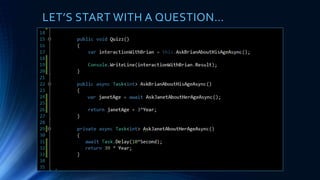
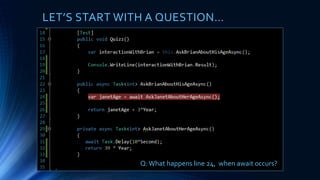
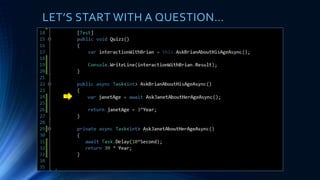
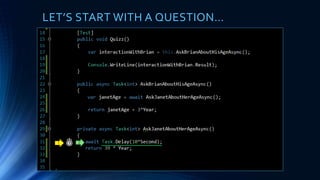
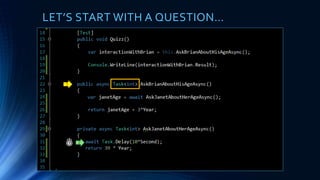
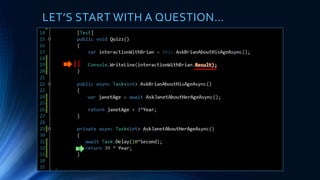
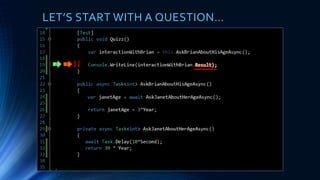
LET’S START WITH A QUESTION…
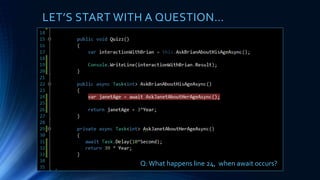
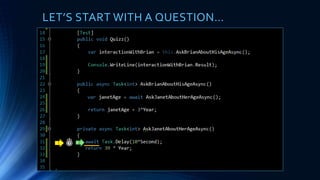
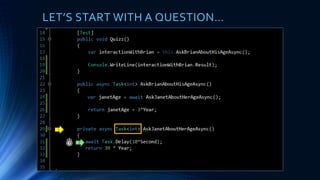
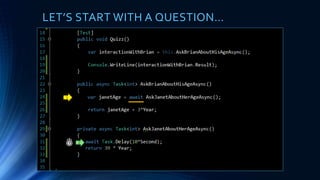
Q:What happens line 24, when await occurs?
OUPS! LET’S ADD SOME CONTEXT
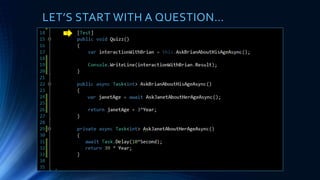
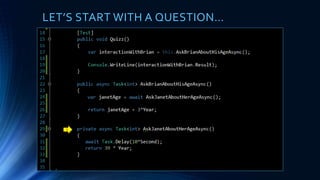
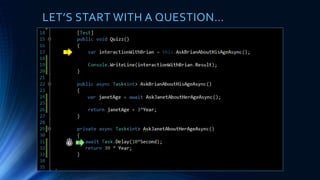
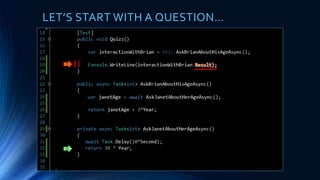
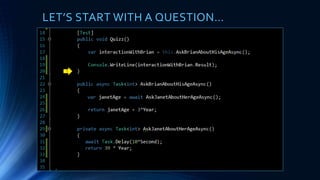
LET’S START WITH A QUESTION…
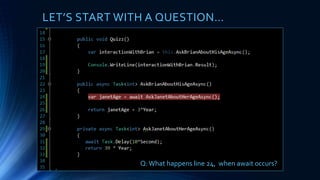
Q:What happens line 24, when await occurs?
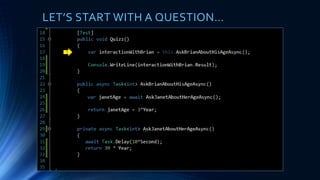
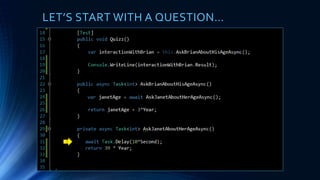
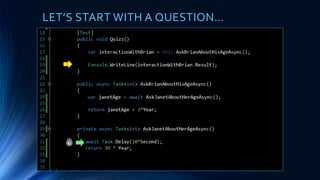
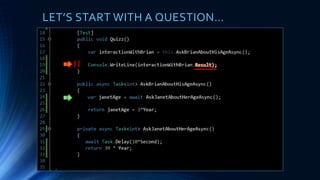
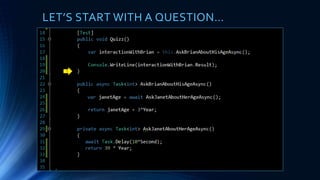
LET’S START WITH A QUESTION…
Q:What happens line 24, when await occurs?
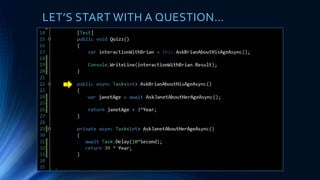
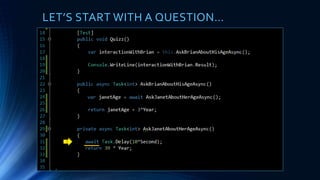
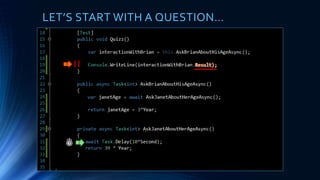
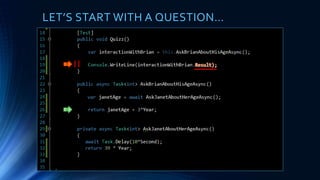
LET’S START WITH A QUESTION…
1
LET’S START WITH A QUESTION…
1
LET’S START WITH A QUESTION…
1
LET’S START WITH A QUESTION…
1
LET’S START WITH A QUESTION…
1
LET’S START WITH A QUESTION…
1
LET’S START WITH A QUESTION…
1
LET’S START WITH A QUESTION…
21
LET’S START WITH A QUESTION…
21
LET’S START WITH A QUESTION…
2
1
LET’S START WITH A QUESTION…
1
2
LET’S START WITH A QUESTION…
1
2
LET’S START WITH A QUESTION…
1
2
LET’S START WITH A QUESTION…
1
LET’S START WITH A QUESTION…
1
2
LET’S START WITH A QUESTION…
2
1
LET’S START WITH A QUESTION…
2
1
LET’S START WITH A QUESTION…
2
1
LET’S START WITH A QUESTION…
2
1
LET’S START WITH A QUESTION…
2 1
LET’S START WITH A QUESTION…
2 11
LET’S START WITH A QUESTION…
1
LET’S START WITH A QUESTION…
1
WAS ITYOUR FIRST ANSWER?
Replay?
GUESS WHAT…
SAME CODE IN ASP.NET OR UI CONTEXT
WILL DEADLOCK!
OH… WAIT! AGENDA
1. Why
2. What
3. How
4. Pitfalls & Recommendations
CHAPTER 1: WHY
LIKE ME, YOU DON’T LIKE WASTE?
A SIMPLE RULE TO AVOID WASTE OF CPU
ASYNC-AWAIT INTENTION IS...
…TO EASILYTRANSFORM
SYNCHRONOUS CODE  ASYNCHRONOUS CODE
(WITHOUT HURTINGYOUR EXISTING CODE STRUCTURE)
WITHOUT HURTINGYOUR EXISTING CODE
STRUCTURE
WAIT A MINUTE… ASYNCHRONOUS,
CONCURRENT, PARALLEL?
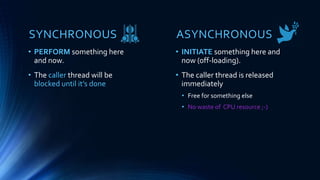
SYNCHRONOUS
• PERFORM something here
and now.
• The caller thread will be
blocked until it’s done
ASYNCHRONOUS
• INITIATE something here and
now (off-loading).
• The caller thread is released
immediately
• Free for something else
• No waste of CPU resource ;-)
SYNCHRONOUS
• PERFORM
THIS IS ABOUT INVOCATION!
(NOT ABOUT HOWTHE GODDAMNTHING IS EXECUTED)
ASYNCHRONOUS
• INITIATE
WHAT ABOUT EXECUTION
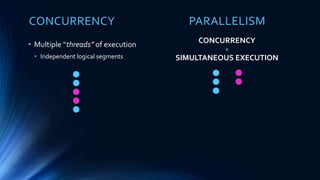
CONCURRENCY
• Multiple “threads” of execution
• Independent logical segments
CONCURRENCY PARALLELISM
CONCURRENCY
+
SIMULTANEOUS EXECUTION
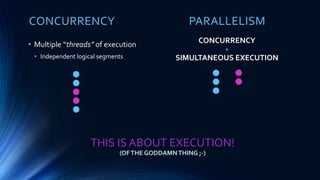
• Multiple “threads” of execution
• Independent logical segments
CONCURRENCY
THIS IS ABOUT EXECUTION!
(OFTHE GODDAMNTHING ;-)
PARALLELISM
CONCURRENCY
+
SIMULTANEOUS EXECUTION
• Multiple “threads” of execution
• Independent logical segments
CHAPTER 2: WHAT
ASYNC-AWAIT IS NOT ABOUT GOING ASYNC
ASYNC-AWAIT IS ABOUT COMPOSINGTHE ASYNC
COMPOSINGTHE ASYNC
WITH TASK CONTINUATIONS
CHAPTER 3: HOW
(PREREQUISITE - TPL)
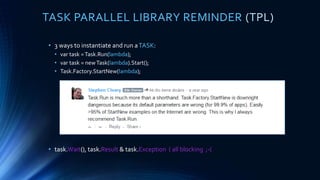
TASK PARALLEL LIBRARY REMINDER (TPL)
• 3 ways to instantiate and run aTASK:
• var task =Task.Run(lambda);
• var task = newTask(lambda).Start();
• Task.Factory.StartNew(lambda);
TASK PARALLEL LIBRARY REMINDER (TPL)
• 3 ways to instantiate and run aTASK:
• var task =Task.Run(lambda);
• var task = newTask(lambda).Start();
• Task.Factory.StartNew(lambda);
TASK PARALLEL LIBRARY REMINDER (TPL)
• 3 ways to instantiate and run aTASK:
• var task =Task.Run(lambda);
• var task = newTask(lambda).Start();
• Task.Factory.StartNew(lambda);
• task.Wait(), task.Result & task.Exception ( all blocking ;-(
TASK PARALLEL LIBRARY REMINDER (TPL)
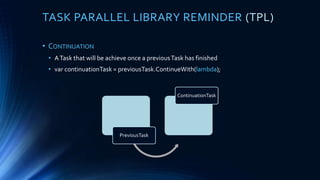
• CONTINUATION
• ATask that will be achieve once a previousTask has finished
• var continuationTask = previousTask.ContinueWith(lambda);
PreviousTask
ContinuationTask
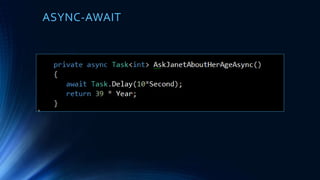
ASYNC-AWAIT
ASYNC-AWAIT
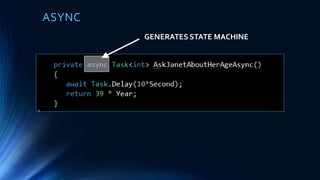
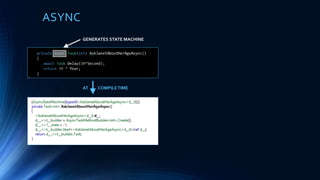
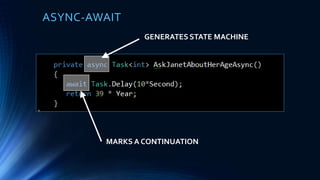
ASYNC
GENERATES STATE MACHINE
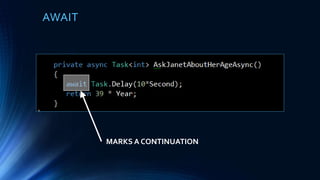
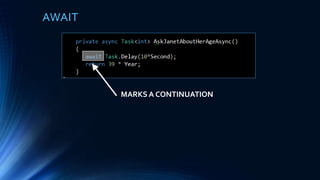
AWAIT
MARKS A CONTINUATION
ASYNC
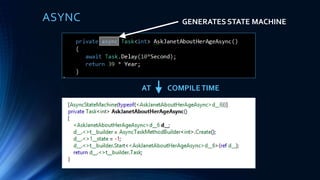
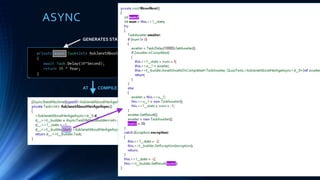
ASYNC GENERATES STATE MACHINE
AT COMPILETIME
ASYNC GENERATES STATE MACHINE
AT COMPILETIME
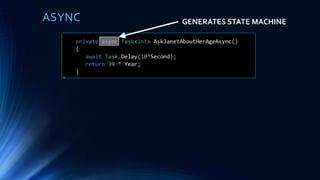
ASYNC
GENERATES STATE MACHINE
AT COMPILETIME
ASYNC
GENERATES STATE MACHINE
AWAIT
AWAIT
MARKS A CONTINUATION
AWAIT
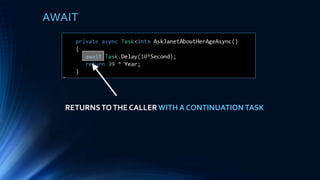
RETURNSTOTHE CALLER WITH A CONTINUATIONTASK
WHO’S DOING THE CONTINUATION?
WELL… IT DEPENDS ;-)
IT DEPENDS ON THE AWAITER CONTEXT
The following code:
IT DEPENDS ON THE AWAITER CONTEXT
The following code:
Is equivalent to:
WinForms,
WPF,
ASP.NET…
ASYNC-AWAIT
GENERATES STATE MACHINE
MARKS A CONTINUATION
THREAD(S) OR NOTHREAD?
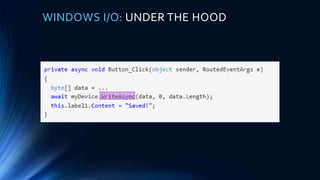
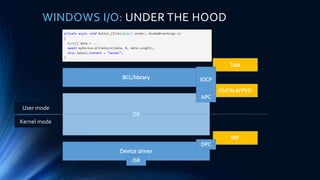
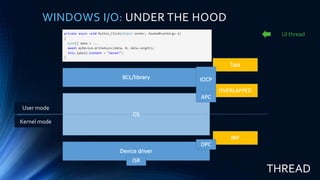
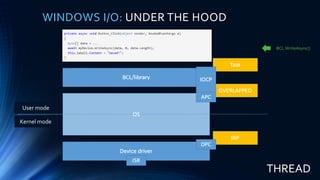
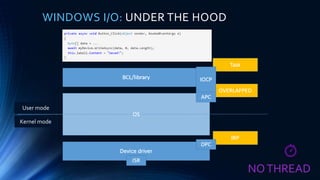
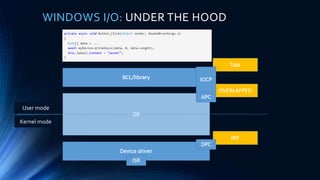
WINDOWS I/O: UNDER THE HOOD
User mode
Kernel mode
WINDOWS I/O: UNDER THE HOOD
User mode
Kernel mode
UI thread
THREAD
WINDOWS I/O: UNDER THE HOOD
User mode
Kernel mode
BCL.WriteAsync()
THREAD
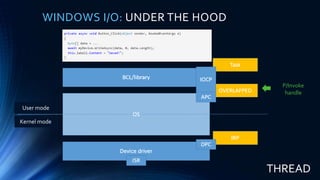
WINDOWS I/O: UNDER THE HOOD
User mode
Kernel mode
P/Invoke
handle
THREAD
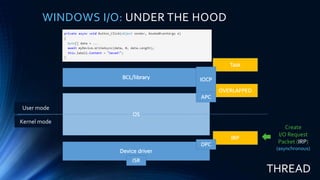
WINDOWS I/O: UNDER THE HOOD
User mode
Kernel mode
Create
I/O Request
Packet (IRP)
(asynchronous)
THREAD
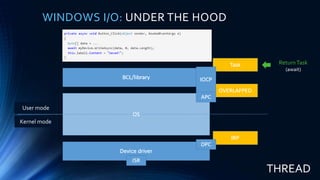
WINDOWS I/O: UNDER THE HOOD
User mode
Kernel mode
ReturnTask
(await)
THREAD
WINDOWS I/O: UNDER THE HOOD
User mode
Kernel mode
Release UI
thread
THREAD
WINDOWS I/O: UNDER THE HOOD
User mode
Kernel mode
NOTHREAD
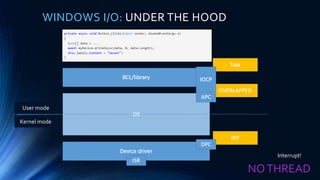
WINDOWS I/O: UNDER THE HOOD
User mode
Kernel mode
Interrupt!
NOTHREAD
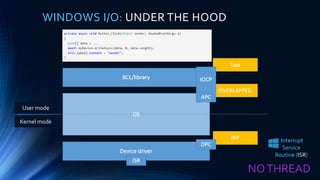
WINDOWS I/O: UNDER THE HOOD
User mode
Kernel mode
Interrupt
Service
Routine (ISR)
NOTHREAD
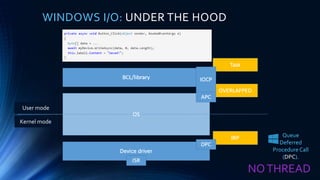
WINDOWS I/O: UNDER THE HOOD
User mode
Kernel mode
Queue
Deferred
Procedure Call
(DPC).
NOTHREAD
WINDOWS I/O: UNDER THE HOOD
User mode
Kernel mode
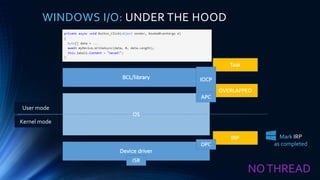
Mark IRP
as completed
NOTHREAD
WINDOWS I/O: UNDER THE HOOD
User mode
Kernel mode
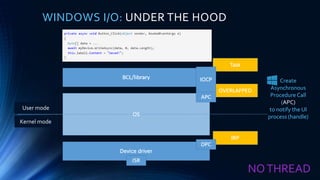
Create
Asynchronous
Procedure Call
(APC)
to notify the UI
process (handle)
NOTHREAD
WINDOWS I/O: UNDER THE HOOD
User mode
Kernel mode
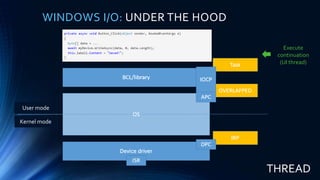
Execute
APC via I/O
Completion port
(IOCP) thread
THREAD
WINDOWS I/O: UNDER THE HOOD
User mode
Kernel mode
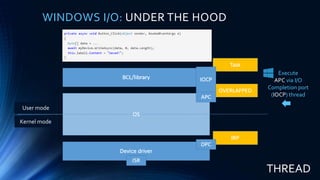
Execute
APC via I/O
Completion port
(IOCP) thread
THREAD
WINDOWS I/O: UNDER THE HOOD
User mode
Kernel mode
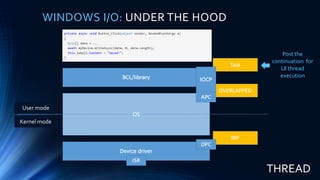
Post the
continuation for
UI thread
execution
THREAD
WINDOWS I/O: UNDER THE HOOD
User mode
Kernel mode
WINDOWS I/O: UNDER THE HOOD
User mode
Kernel mode
Execute
continuation
(UI thread)
THREAD
WINDOWS I/O: UNDER THE HOOD
User mode
Kernel mode
Execute
continuation
(UI thread)
THREAD
WINDOWS I/O: UNDER THE HOOD
User mode
Kernel mode
Replay?
CHAPTER 4: PITFALLS & RECOS
#1: DEADLOCK
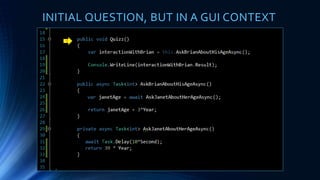
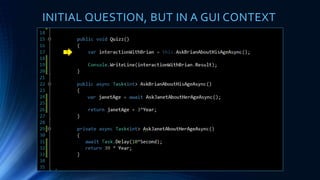
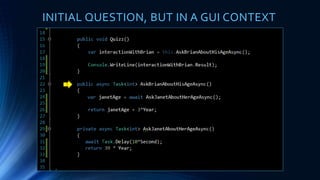
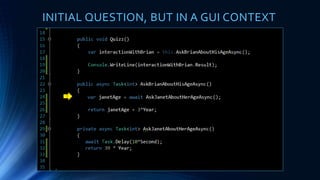
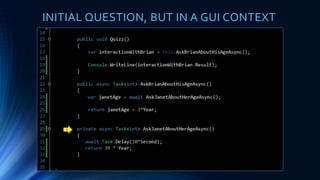
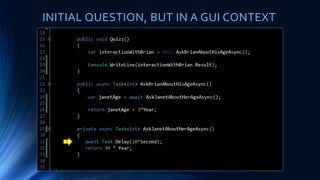
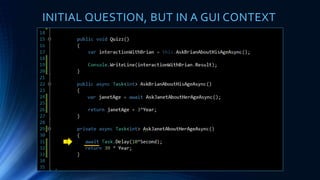
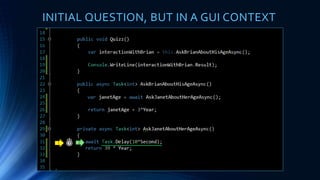
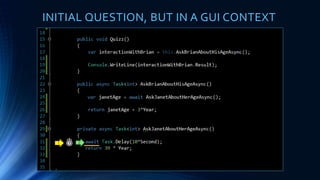
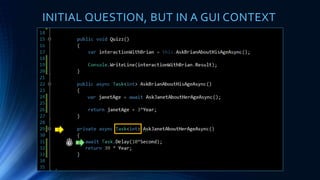
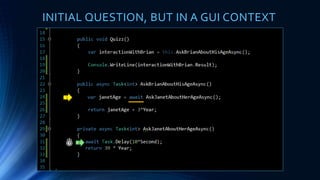
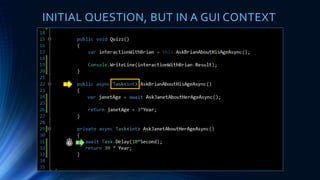
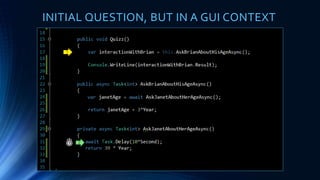
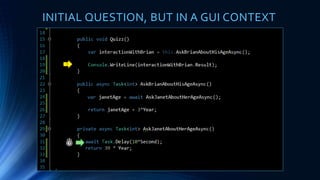
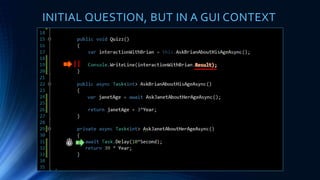
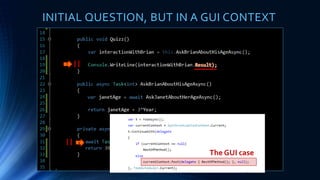
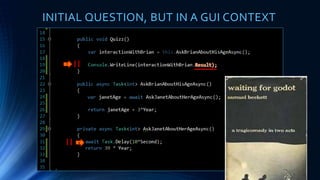
INITIAL QUESTION, BUT IN A GUI CONTEXT
1
1
INITIAL QUESTION, BUT IN A GUI CONTEXT
1
INITIAL QUESTION, BUT IN A GUI CONTEXT
1
INITIAL QUESTION, BUT IN A GUI CONTEXT
1
INITIAL QUESTION, BUT IN A GUI CONTEXT
1
INITIAL QUESTION, BUT IN A GUI CONTEXT
1
INITIAL QUESTION, BUT IN A GUI CONTEXT
21
INITIAL QUESTION, BUT IN A GUI CONTEXT
21
INITIAL QUESTION, BUT IN A GUI CONTEXT
2
1
INITIAL QUESTION, BUT IN A GUI CONTEXT
1
2
INITIAL QUESTION, BUT IN A GUI CONTEXT
1
2
INITIAL QUESTION, BUT IN A GUI CONTEXT
1
2
INITIAL QUESTION, BUT IN A GUI CONTEXT
1
INITIAL QUESTION, BUT IN A GUI CONTEXT
1
2
INITIAL QUESTION, BUT IN A GUI CONTEXT
1
x
INITIAL QUESTION, BUT IN A GUI CONTEXT
The GUI case
1
x
INITIAL QUESTION, BUT IN A GUI CONTEXT
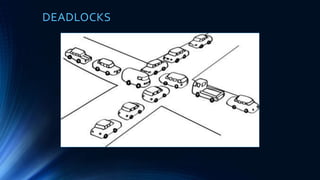
DEADLOCKS
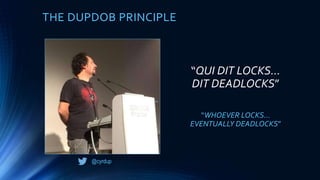
THE DUPDOB PRINCIPLE
“QUI DIT LOCKS…
DIT DEADLOCKS”
“WHOEVER LOCKS…
EVENTUALLY DEADLOCKS”
@cyrdup
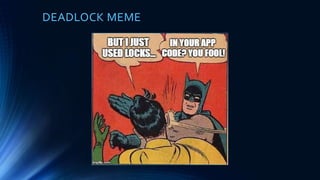
DEADLOCK MEME
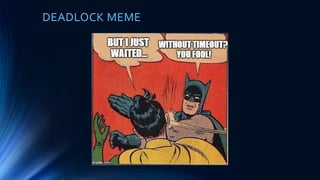
DEADLOCK MEME
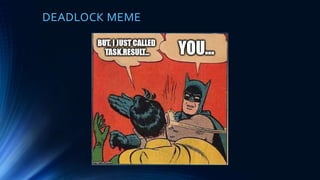
DEADLOCK MEME
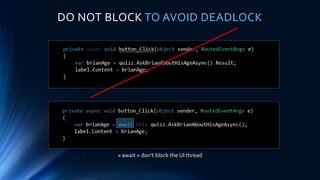
DO NOT BLOCKTO AVOID DEADLOCK
DO NOT BLOCK TO AVOID DEADLOCK
« AWAIT » DON’T BLOCKTHE UITHREAD
YOU CODE A LIBRARY?
SYNCHRONIZATION CONTEXT IS NOTYOUR DECISION!
AVOID DEADLOCKS IMPROVE PERFORMANCE
USE CONFIGUREAWAIT(FALSE) EVERYWHERE!
YOU CODE A LIBRARY?
USE CONFIGUREAWAIT(FALSE) EVERYWHERE!
#2: ENTER THE ASYNC VOID
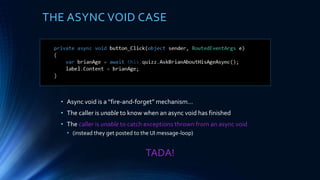
THE ASYNC VOID CASE
• Async void is a “fire-and-forget” mechanism...
• The caller is unable to know when an async void has finished
• The caller is unable to catch exceptions thrown from an async void
• (instead they get posted to the UI message-loop)
THE ASYNC VOID CASE
• Async void is a “fire-and-forget” mechanism...
• The caller is unable to know when an async void has finished
• The caller is unable to catch exceptions thrown from an async void
• (instead they get posted to the UI message-loop)
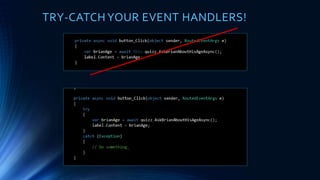
TRY-CATCH YOUR EVENT HANDLERS!
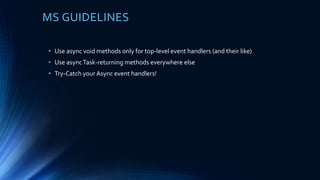
MS GUIDELINES
• Use async void methods only for top-level event handlers (and their like)
• Use asyncTask-returning methods everywhere else
• Try-Catch your Async event handlers!
MS EVEN SAID:
#3: USE IT WISELY
ONLY FOR I/O!
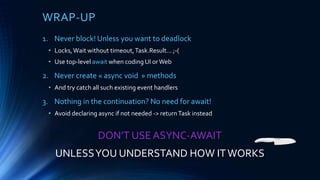
WRAP-UP
WRAP-UP
1. Never block! Unless you want to deadlock
• Locks, Wait without timeout,Task.Result…
• Use top-level await when coding UI or Web
• Use ConfigureAwait(false) everywhere within your libraries
2. Never create « async void » methods
• And try catch all such existing event handlers
3. Only for I/Os
DON’T USE ASYNC-AWAIT
UNLESSYOU UNDERSTAND HOW ITWORKS
THANKS!
APPENDIX
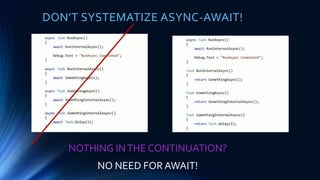
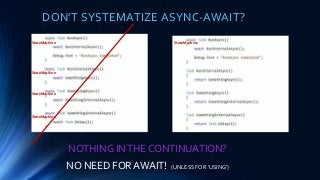
DON’T SYSTEMATIZE ASYNC-AWAIT?
NOTHING INTHE CONTINUATION?
NO NEED FOR AWAIT! (UNLESS FOR ‘USING’)
StateMachine
StateMachine
StateMachine
StateMachine
StateMachine
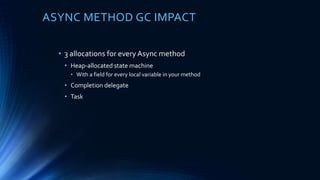
ASYNC METHOD GC IMPACT
• 3 allocations for every Async method
• Heap-allocated state machine
• With a field for every local variable in your method
• Completion delegate
• Task
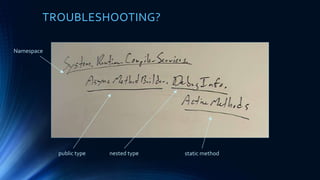
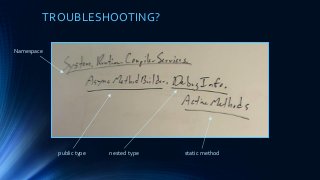
TROUBLESHOOTING?
Namespace
public type nested type static method
FEW REFS
• Bart De Smet deep dive: https://channel9.msdn.com/Events/TechDays/Techdays-2014-the-
Netherlands/Async-programming-deep-dive
• Filip Ekberg at Oredev 2016: https://vimeo.com/191077931
• Async-Await Best practices: https://msdn.microsoft.com/en-us/magazine/jj991977.aspx
• Compiler error: http://stackoverflow.com/questions/12115168/why-does-this-async-await-
code-generate-not-all-code-paths-return-a-value
• Task.Run etiquette: http://blog.stephencleary.com/2013/11/taskrun-etiquette-examples-
dont-use.html
• There is no thread: http://blog.stephencleary.com/2013/11/there-is-no-thread.html
• Does usingTasks (TPL) library make an application multithreaded? :
http://stackoverflow.com/questions/23833255/does-using-tasks-tpl-library-make-an-
application-multithreaded
• Eliding Async-Await : http://blog.stephencleary.com/2016/12/eliding-async-await.html
Async await...oh wait!

Async await...oh wait!

Editor's Notes

  • #4 Ref: http://www.world-of-knives.ch/public/media/filer_thumbnails/2011/11/14/fk-140wh-wh_5_5_3.jpg__663x372_q80_crop-1_upscale-1.jpg
  • #33 Ref: http://images.martechadvisor.com/images/uploads/content_images/cbc928ab5eb5e7f00676992442650b40.jpg
  • #34 Ref:http://i.imgur.com/ZnREN.jpg
  • #37 Ref: http://blog.canacad.ac.jp/wpmu/15matser/files/2013/06/FoodWaste1.jpg
  • #40 Ref : http://www.careofcars.com/wp-content/uploads/2014/01/patchwork-on-cheap-cars.jpg
  • #41 Ref: http://ci.memecdn.com/7869512.jpg
  • #42 Refs : - https://cdn3.iconfinder.com/data/icons/basic-mobile-part-3/512/prisoner-512.png - https://cdn4.iconfinder.com/data/icons/human-values-solid/100/_-62-512.png - https://d30y9cdsu7xlg0.cloudfront.net/png/89995-200.png
  • #43 Refs : - https://cdn3.iconfinder.com/data/icons/basic-mobile-part-3/512/prisoner-512.png - https://cdn4.iconfinder.com/data/icons/human-values-solid/100/_-62-512.png - https://d30y9cdsu7xlg0.cloudfront.net/png/89995-200.png
  • #45 Not OS threads e.g.: JavaScript in a browser Node.js e.g.: Thread-based (e.g. multi-threading) Task-based (e.g. TPL)
  • #46 Not OS threads e.g.: JavaScript in a browser Node.js e.g.: Thread-based (e.g. multi-threading) Task-based (e.g. TPL)
  • #47 Not OS threads e.g.: JavaScript in a browser Node.js e.g.: Thread-based (e.g. multi-threading) Task-based (e.g. TPL)
  • #51 Refs : - https://cdn3.iconfinder.com/data/icons/basic-mobile-part-3/512/prisoner-512.png - https://d30y9cdsu7xlg0.cloudfront.net/png/89995-200.png
  • #72 Ref: https://static1.squarespace.com/static/544d2af6e4b007f43083a5b0/544e719be4b07c493b25c4e4/54625440e4b0f79db69b3b1a/1417724183061/?format=1500w
  • #113 Ref: http://www.designnation.de/Media/Galerie/50cf9c1d197e0,Houston-we-have-a-problem.jpg
  • #115 Ref: https://avatars1.githubusercontent.com/u/3131866?v=3&s=460
  • #116 Ref: http://ci.memecdn.com/7869512.jpg
  • #117 Ref: http://ci.memecdn.com/7869512.jpg
  • #118 Ref: http://ci.memecdn.com/7869512.jpg