@crichardson
A pattern language for
microservices
Chris Richardson
Founder of Eventuate.io
Founder of the original CloudFoundry.com
Author of POJOs in Action
@crichardson
chris@chrisrichardson.net
http://learnmicroservices.io
Copyright © 2017. Chris Richardson Consulting, Inc. All rights reserved
@crichardson
Presentation goal
Overview of the microservice
architecture pattern language
and
how to use it to architect an
application
@crichardson
About Chris
@crichardson
About Chris
Consultant and trainer
focusing on modern
application architectures
including microservices
(http://www.chrisrichardson.net/)
@crichardson
About Chris
Founder of a startup that is creating
an open-source/SaaS platform
that simplifies the development of
transactional microservices
(http://eventuate.io)
@crichardson
About Chris
http://learnmicroservices.io
@crichardson
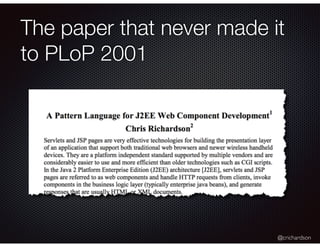
The paper that never made it
to PLoP 2001
@crichardson
Agenda
Why microservices?
Benefits of the microservice architecture
Microservices != silver bullet
The microservice pattern language
Applying the microservice pattern language
@crichardson
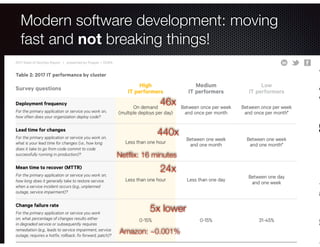
Modern software development: moving
fast and not breaking things!
46x
440x
24x
5x lower
Amazon: ~0.001%
Netflix: 16 minutes
@crichardson
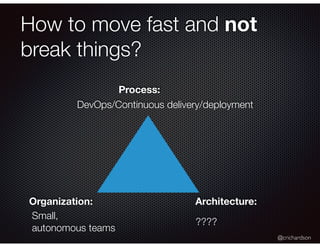
How to move fast and not
break things?
Architecture:
Process:
Small,
autonomous teams
????
DevOps/Continuous delivery/deployment
Organization:
@crichardson
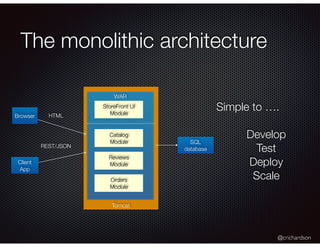
The monolithic architecture
Tomcat
Browser
WAR
SQL
database
HTML
REST/JSON
Client
App
Simple to ….
Develop
Test
Deploy
Scale
Catalog
Module
Reviews
Module
Orders
Module
StoreFront UI
Module
@crichardson
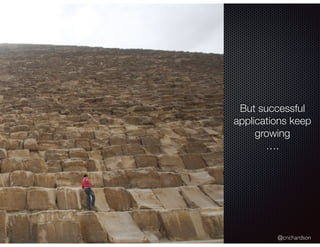
But successful
applications keep
growing
….
@crichardson
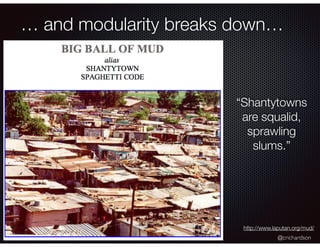
… and modularity breaks down…
http://www.laputan.org/mud/
“Shantytowns
are squalid,
sprawling
slums.”
@crichardson
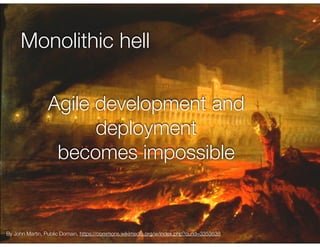
Monolithic hell
Agile development and
deployment
becomes impossible
By John Martin, Public Domain, https://commons.wikimedia.org/w/index.php?curid=3353638
@crichardson
Monolithic hell:
Technology stack becomes
increasingly obsolete
BUT a rewrite is not feasible
The microservice architecture is an
architectural style that
structures an application as a
set of loosely coupled, services
organized around business
capabilities
@crichardson
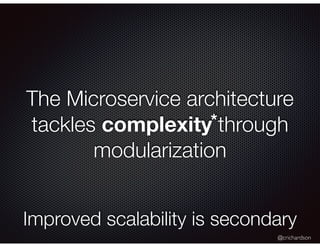
The Microservice architecture
tackles complexity through
modularization
Improved scalability is secondary
*
@crichardson
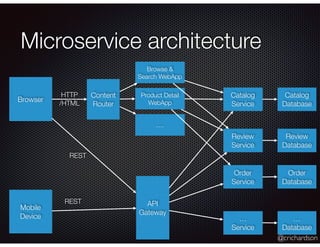
Microservice architecture
Browser
Mobile
Device
Content
Router
API
Gateway
Catalog
Service
Review
Service
Order
Service
…
Service
Catalog
Database
Review
Database
Order
Database
…
Database
HTTP
/HTML
REST
REST
Browse &
Search WebApp
Product Detail
WebApp
….
@crichardson
Agenda
Why microservices?
Benefits of the microservice architecture
Microservices != silver bullet
The microservice pattern language
Applying the microservice pattern language
@crichardson
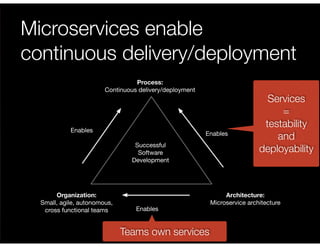
Microservices enable
continuous delivery/deployment
Process:
Continuous delivery/deployment
Organization:
Small, agile, autonomous,
cross functional teams
Architecture:
Microservice architecture
Enables
Enables
Enables
Successful
Software
Development
Services
=
testability
and
deployability
Teams own services
@crichardson
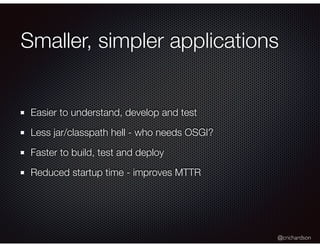
Smaller, simpler applications
Easier to understand, develop and test
Less jar/classpath hell - who needs OSGI?
Faster to build, test and deploy
Reduced startup time - improves MTTR
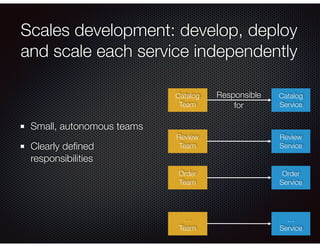
Scales development: develop, deploy
and scale each service independently
Small, autonomous teams
Clearly defined
responsibilities
Catalog
Service
Review
Service
Order
Service
…
Service
Catalog
Team
Review
Team
Order
Team
…
Team
Responsible
for
@crichardson
Easier to scale
@crichardson
Improves fault isolation
@crichardson
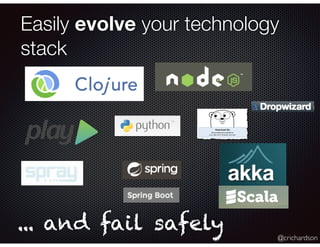
Easily evolve your technology
stack
... and fail safely
@crichardson
Agenda
Why microservices?
Benefits of the microservice architecture
Microservices != silver bullet
The microservice pattern language
Applying the microservice pattern language
@crichardson
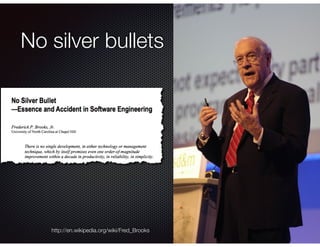
No silver bullets
http://en.wikipedia.org/wiki/Fred_Brooks
@crichardson
Complexity
http://highscalability.com/blog/2014/4/8/microservices-not-a-free-lunch.html
@crichardson
Complexity of developing a
distributed system
@crichardson
Multiple databases
&
Transaction management
Must use event-driven
eventual consistency
@crichardson
Complexity of testing a
distributed system
@crichardson
Complexity of deploying and
operating a distributed system
You need a lot of
automation: VM/container
orchestration or PaaS
@crichardson
Developing and deploying features that
span multiple services requires careful
coordination
@crichardson
Agenda
Why microservices?
Benefits of the microservice architecture
Microservices != silver bullet
The microservice pattern language
Applying the microservice pattern language
@crichardson
Are microservices a good fit
for my application?
@crichardson
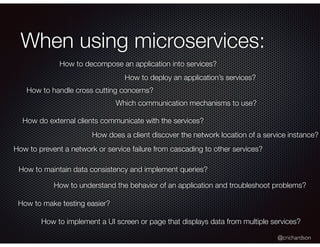
When using microservices:
How to decompose an application into services?
How to deploy an application’s services?
How to handle cross cutting concerns?
Which communication mechanisms to use?
How do external clients communicate with the services?
How does a client discover the network location of a service instance?
How to prevent a network or service failure from cascading to other services?
How to maintain data consistency and implement queries?
How to make testing easier?
How to understand the behavior of an application and troubleshoot problems?
How to implement a UI screen or page that displays data from multiple services?
@crichardson
Microservice pattern language
=
collection of patterns
that solve these
architecture, design, development and
operational problems
@crichardson
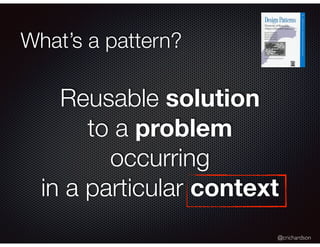
What’s a pattern?
Reusable solution
to a problem
occurring
in a particular context
@crichardson
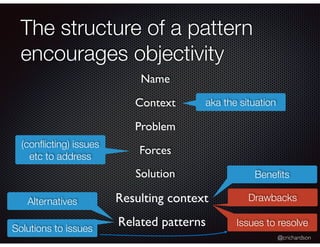
The structure of a pattern
encourages objectivity
Resulting context
aka the situation
Name
Context
Problem
Related patterns
(conflicting) issues
etc to address
Forces
Solution Benefits
Drawbacks
Issues to resolve
Alternatives
Solutions to issues
@crichardson
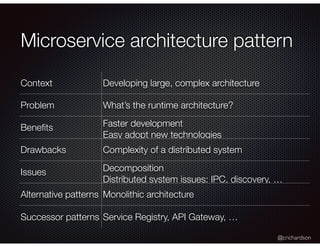
Microservice architecture pattern
Context Developing large, complex architecture
Problem What’s the runtime architecture?
Benefits Faster development
Easy adopt new technologies
Drawbacks Complexity of a distributed system
Issues Decomposition
Distributed system issues: IPC, discovery, …
Alternative patterns Monolithic architecture
Successor patterns Service Registry, API Gateway, …
@crichardson
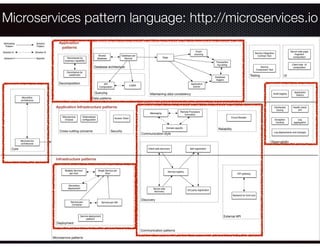
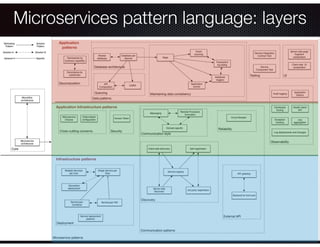
Microservices pattern language: http://microservices.io
@crichardson
Microservices pattern language: layers
@crichardson
Agenda
Why microservices?
Benefits of the microservice architecture
Microservices != silver bullet
The microservice pattern language
Applying the microservice pattern language
@crichardson
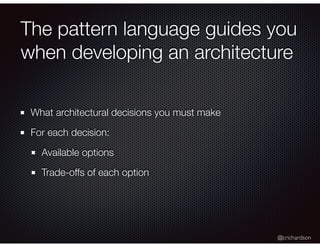
The pattern language guides you
when developing an architecture
What architectural decisions you must make
For each decision:
Available options
Trade-offs of each option
@crichardson
Predecessor - Successor
Sequence?
@crichardson
Key patterns
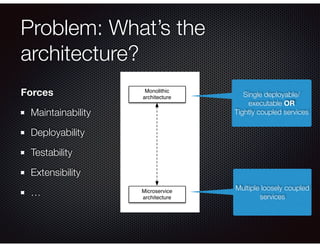
Problem: What’s the
architecture?
Forces
Maintainability
Deployability
Testability
Extensibility
…
Monolithic
architecture
Microservice
architecture
Single deployable/
executable OR
Tightly coupled services
Multiple loosely coupled
services
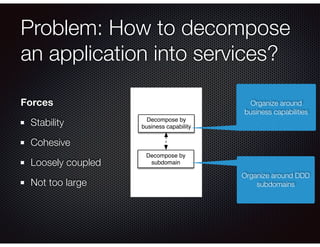
Problem: How to decompose
an application into services?
Forces
Stability
Cohesive
Loosely coupled
Not too large
Decompose by
business capability
Decompose by
subdomain
Organize around
business capabilities
Organize around DDD
subdomains
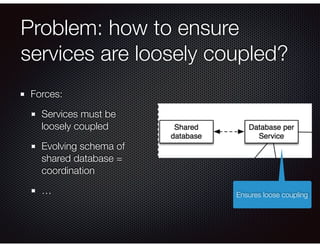
Problem: how to ensure
services are loosely coupled?
Forces:
Services must be
loosely coupled
Evolving schema of
shared database =
coordination
… Ensures loose coupling
@crichardson
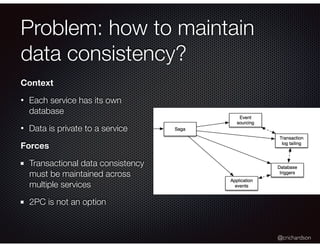
Problem: how to maintain
data consistency?
Context
• Each service has its own
database
• Data is private to a service
Forces
Transactional data consistency
must be maintained across
multiple services
2PC is not an option
@crichardson
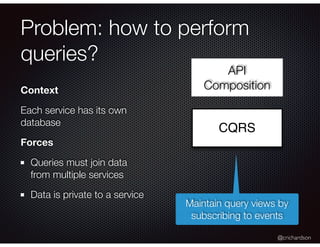
Problem: how to perform
queries?
CQRS
Context
Each service has its own
database
Forces
Queries must join data
from multiple services
Data is private to a service
Maintain query views by
subscribing to events
API
Composition
@crichardson
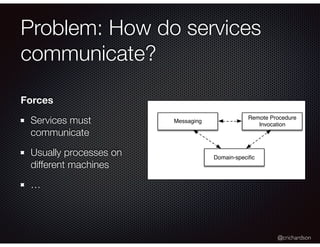
Problem: How do services
communicate?
Messaging
Remote Procedure
Invocation
Domain-specific
Forces
Services must
communicate
Usually processes on
different machines
…
@crichardson
The rest are generic technical
architecture patterns
=
Undifferentiated heavy lifting!
@crichardson
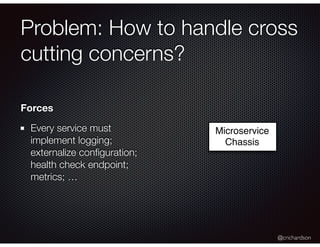
Problem: How to handle cross
cutting concerns?
Microservice
Chassis
Forces
Every service must
implement logging;
externalize configuration;
health check endpoint;
metrics; …
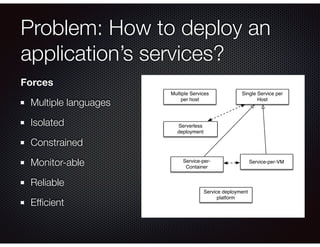
Problem: How to deploy an
application’s services?
Multiple Services
per host
Single Service per
Host
Service-per-
Container
Service-per-VM
Serverless
deployment
Service deployment
platform
Forces
Multiple languages
Isolated
Constrained
Monitor-able
Reliable
Efficient
@crichardson
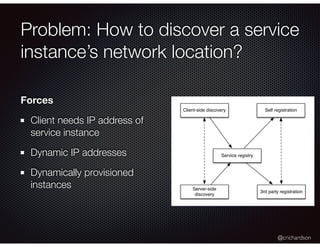
Problem: How to discover a service
instance’s network location?
Client-side discovery
Server-side
discovery
Service registry
Self registration
3rd party registration
Forces
Client needs IP address of
service instance
Dynamic IP addresses
Dynamically provisioned
instances
@crichardson
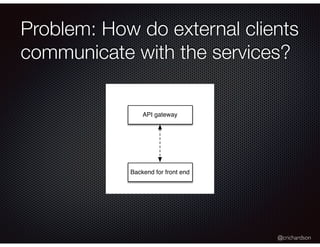
Problem: How do external clients
communicate with the services?
API gateway
Backend for front end
@crichardson
Problem: How to prevent a network
or service failure from cascading?
Circuit Breaker
@crichardson
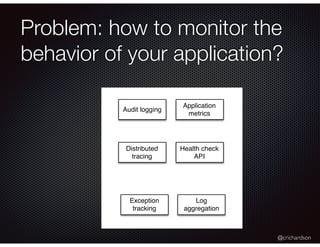
Problem: how to monitor the
behavior of your application?
Exception
tracking
Distributed
tracing
Audit logging
Application
metrics
Log
aggregation
Health check
API
@crichardson
Summary
The monolithic architecture is a good choice for small/simple
applications
Use the microservice architecture for large/complex
applications
Microservice architecture != silver bullet
Use the microservice architecture pattern language to guide
your decision making
@crichardson
@crichardson chris@chrisrichardson.net
http://learnmicroservices.io
Thank you!