© 2013 IBM Corporation
Continuous Delivery of a Cloud
Deployment at a Large
Telecommunications Provider
M Kevin McHugh @mkmchu
Eduardo Patrocinio @patrocinio
1717 – February 25, 2014
1
Agenda
Introduction
Continuous Delivery – what is it, how did we do it
Wrap up
Questions
2
Agenda
Introduction
Continuous Delivery – what is it, how did we do it
Wrap up
Questions
3
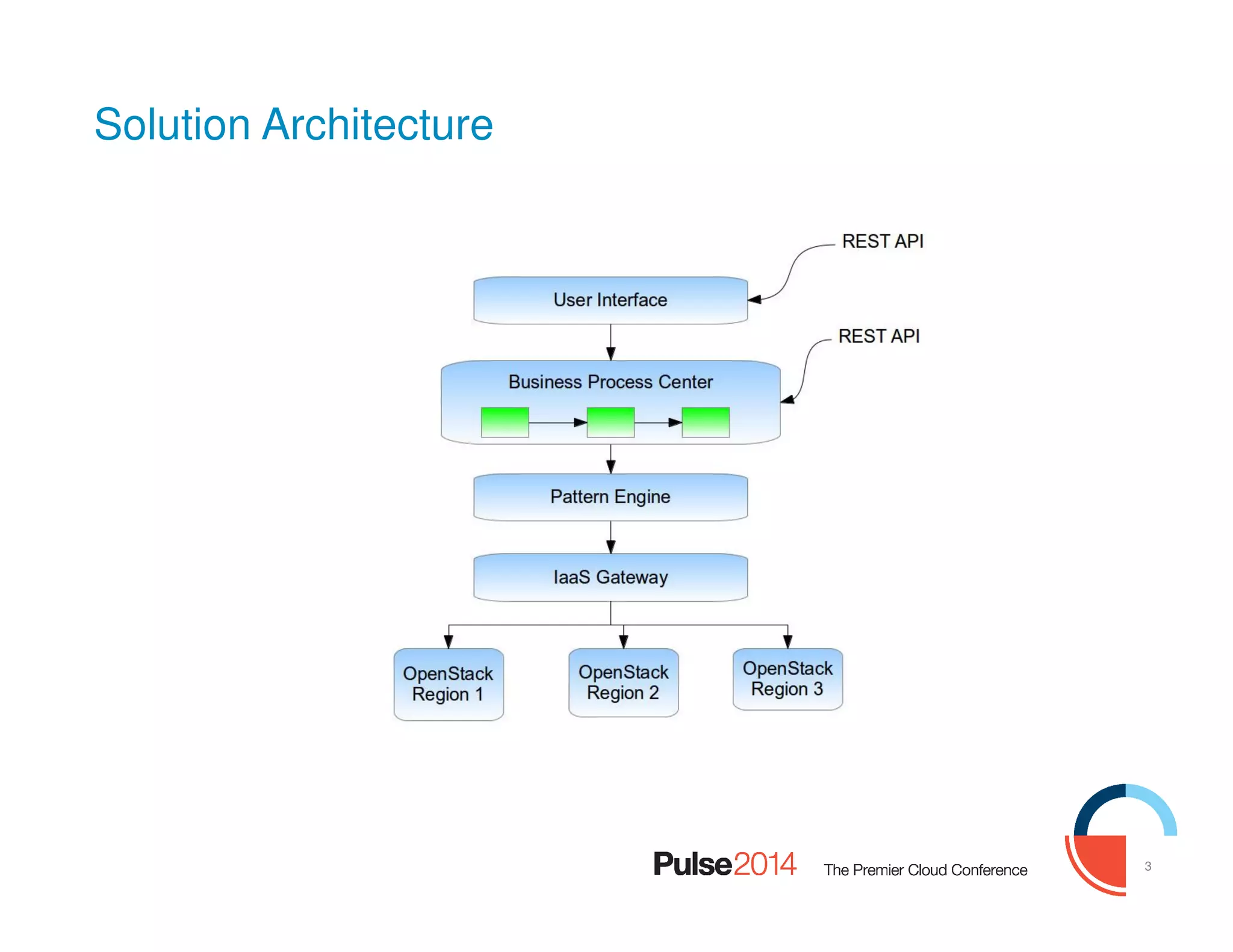
Solution Architecture
4
Agenda
Introduction
Continuous Delivery – what is it, how did we do it
Wrap up
Questions
5
Definition
Continuous Delivery (CD) is a design practice used in software development to
automate and improve the process of software delivery. Techniques such as automated
testing, continuous integration and continuous deployment allow software to be
developed to a high standard and easily packaged and deployed to test environments, resulting in the
ability to rapidly, reliably and repeatedly push out enhancements and bug fixes to customers at low risk
and with minimal manual overhead. The technique was one of the assumptions of extreme
programming but at an enterprise level has developed into a discipline of its own, with job descriptions
for roles such as "buildmaster" calling for CD skills as mandatory.
(Source: Wikipedia 1/2014 - http://en.wikipedia.org/wiki/Continuous_delivery)
The ability to build a releasable asset with nearly trivial effort
What about Continuous Deployment?
6
Components
Method
Continuous Integration
Process
Assets
Automated Test
Automated Build of deployable asset
Tools
7
Method: Agile
7
Team Member
Team Member
Customer
Team Member
Team Lead
Agile
Value-driven lifecycle with regular production of working software
Small, co-located team developing straightforward software
Goal is to develop a high-quality system in an evolutionary, collaborative, and self-organizing manner
Pre-requisite: can build a product backlog
Agile
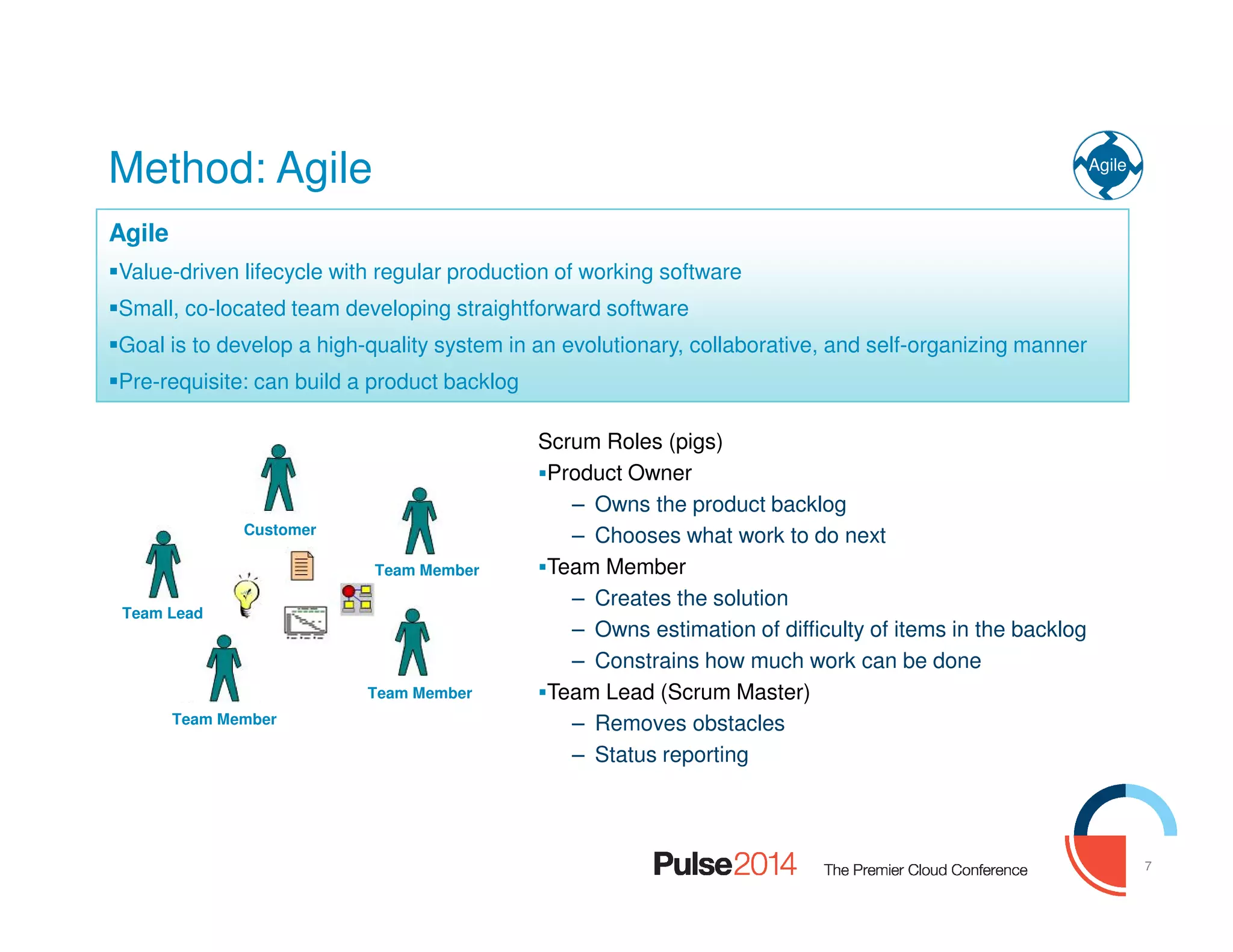
Scrum Roles (pigs)
Product Owner
– Owns the product backlog
– Chooses what work to do next
Team Member
– Creates the solution
– Owns estimation of difficulty of items in the backlog
– Constrains how much work can be done
Team Lead (Scrum Master)
– Removes obstacles
– Status reporting
8
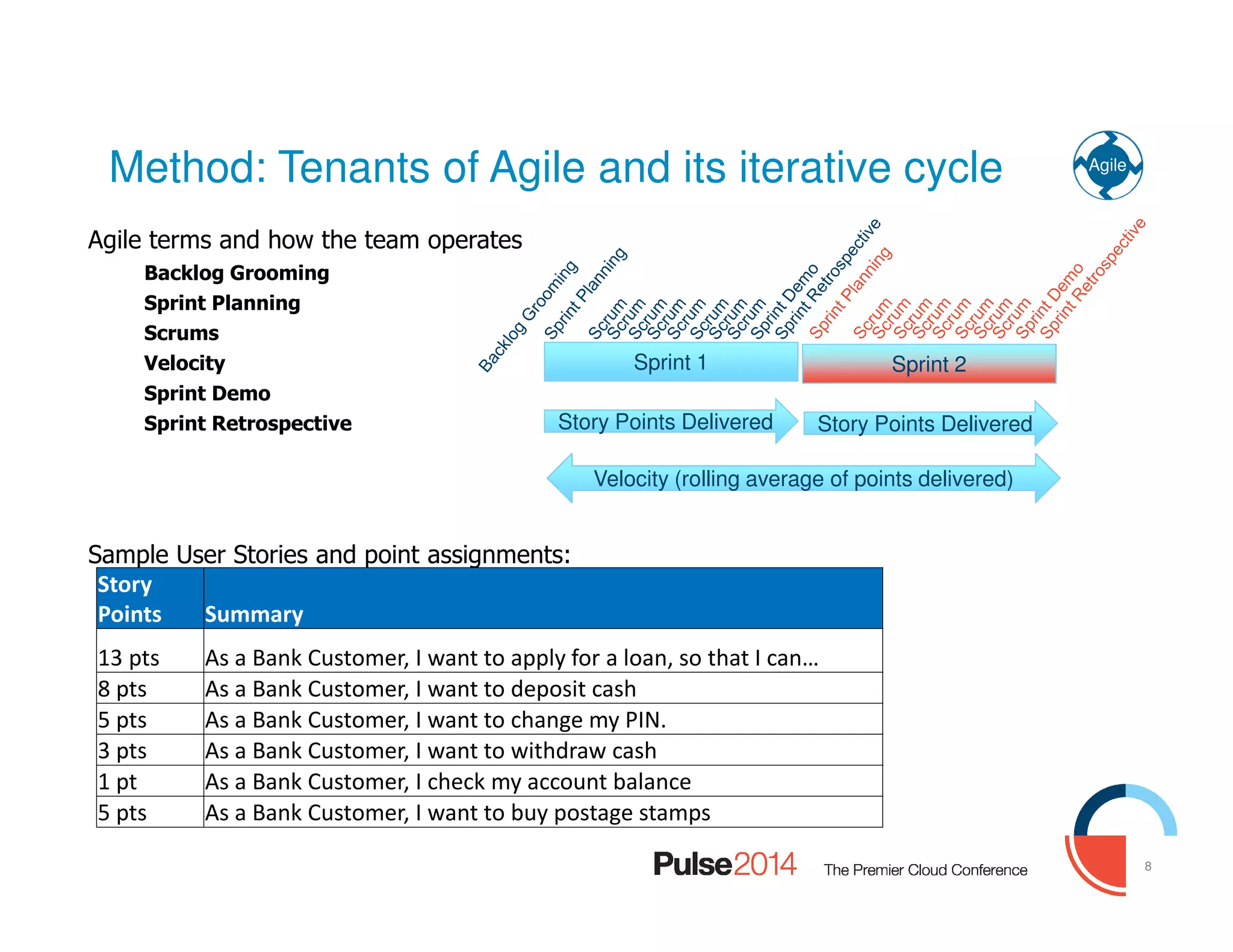
Agile terms and how the team operates
Backlog Grooming
Sprint Planning
Scrums
Velocity
Sprint Demo
Sprint Retrospective
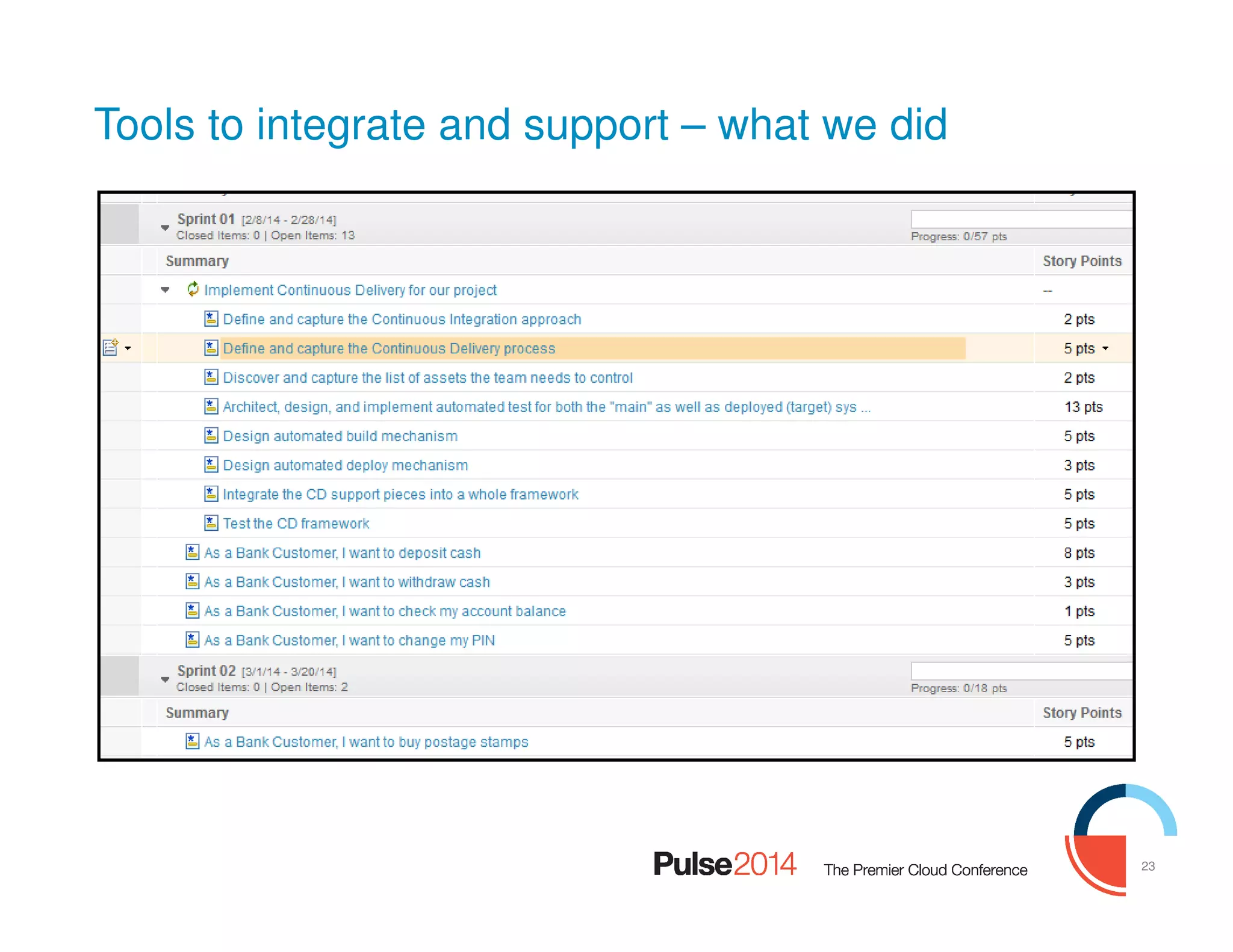
Sample User Stories and point assignments:
8
Story
Points Summary
13 pts As a Bank Customer, I want to apply for a loan, so that I can…
8 pts As a Bank Customer, I want to deposit cash
5 pts As a Bank Customer, I want to change my PIN.
3 pts As a Bank Customer, I want to withdraw cash
1 pt As a Bank Customer, I check my account balance
5 pts As a Bank Customer, I want to buy postage stamps
Agile
Method: Tenants of Agile and its iterative cycle
Sprint 1 Sprint 2
Story Points DeliveredStory Points Delivered Story Points DeliveredStory Points Delivered
Velocity (rolling average of points delivered)Velocity (rolling average of points delivered)
9
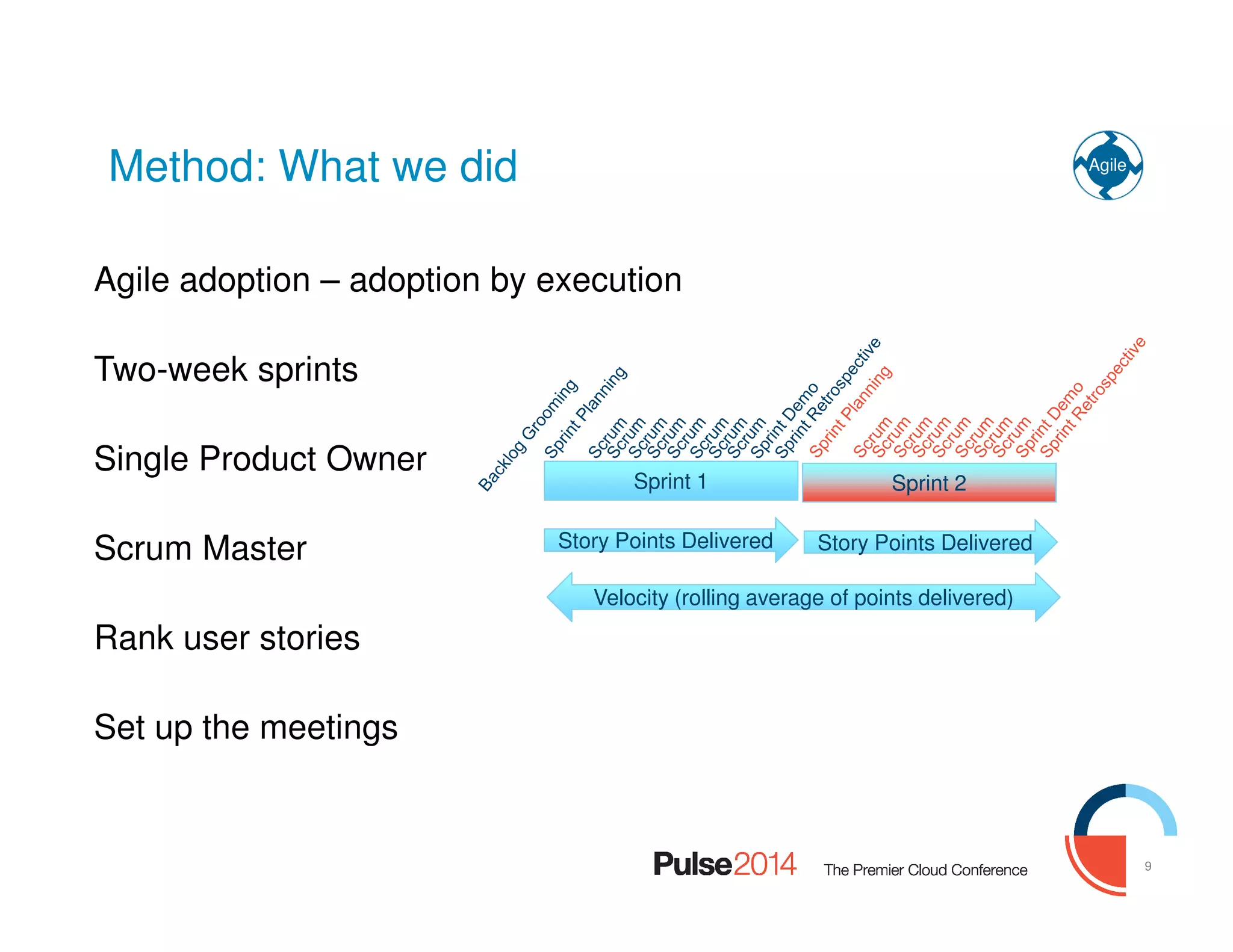
Agile adoption – adoption by execution
Two-week sprints
Single Product Owner
Scrum Master
Rank user stories
Set up the meetings
Method: What we did Agile
Sprint 1 Sprint 2
Story Points DeliveredStory Points Delivered Story Points DeliveredStory Points Delivered
Velocity (rolling average of points delivered)Velocity (rolling average of points delivered)
10
10
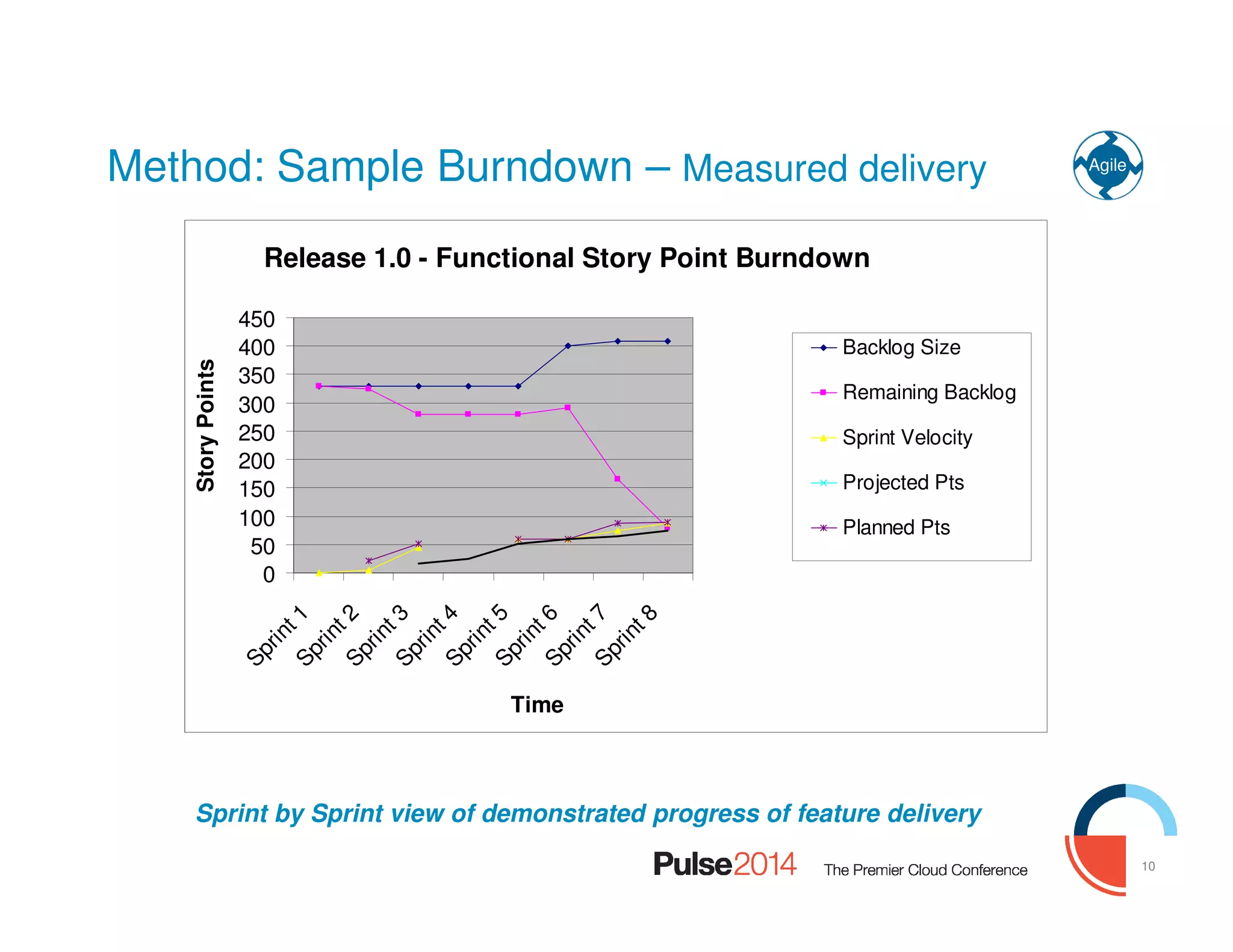
Sprint by Sprint view of demonstrated progress of feature delivery
Agile
Release 1.0 - Functional Story Point Burndown
0
50
100
150
200
250
300
350
400
450
Sprint1Sprint2Sprint3Sprint4Sprint5Sprint6Sprint7Sprint8
Time
StoryPoints
Backlog Size
Remaining Backlog
Sprint Velocity
Projected Pts
Planned Pts
Method: Sample Burndown – Measured delivery
11
Continuous Integration
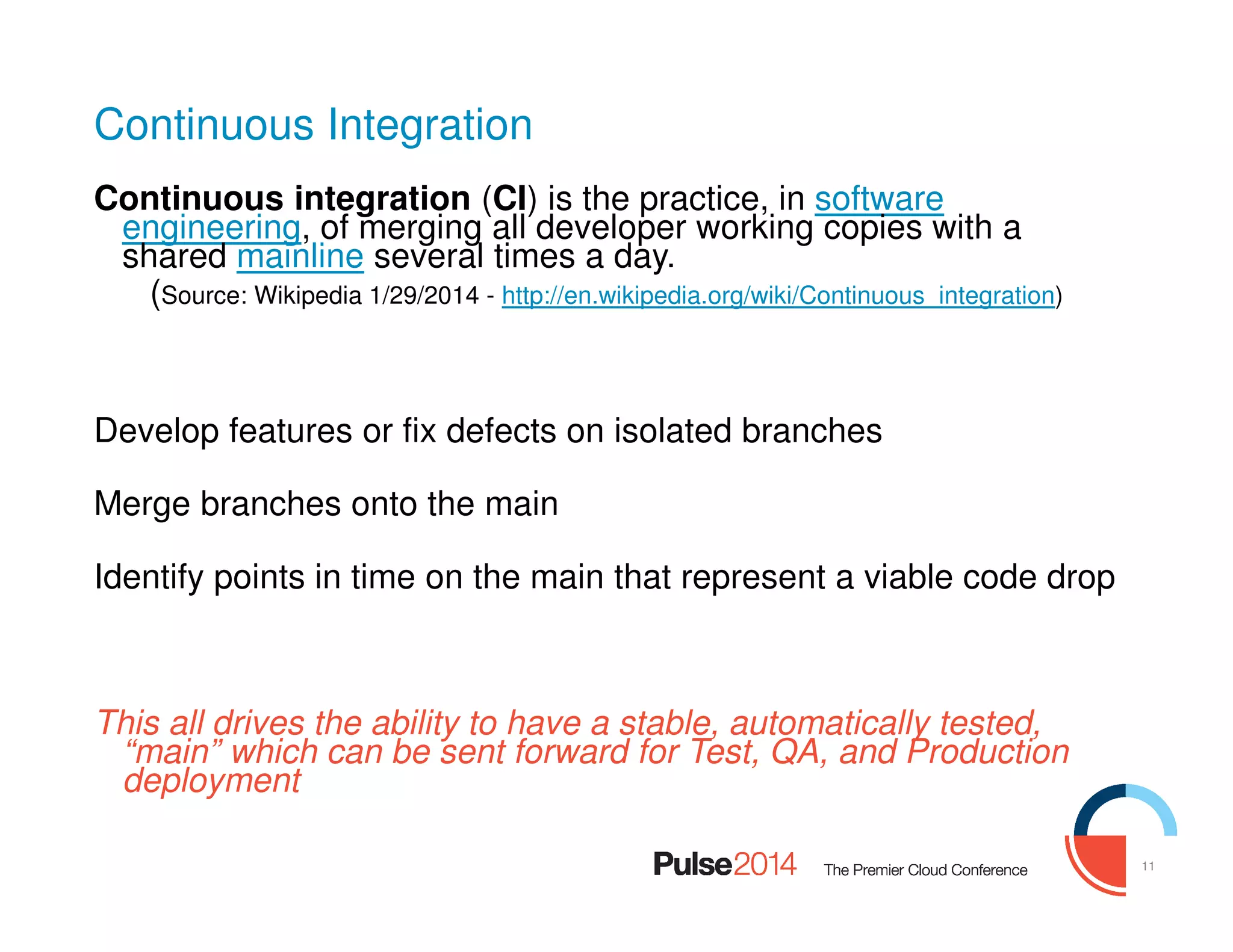
Continuous integration (CI) is the practice, in software
engineering, of merging all developer working copies with a
shared mainline several times a day.
(Source: Wikipedia 1/29/2014 - http://en.wikipedia.org/wiki/Continuous_integration)
Develop features or fix defects on isolated branches
Merge branches onto the main
Identify points in time on the main that represent a viable code drop
This all drives the ability to have a stable, automatically tested,
“main” which can be sent forward for Test, QA, and Production
deployment
12
Continuous Integration – what we did
Initially
Work space isolation obtained via Business Process Manager (BPM)
locking of a business process
The team is working on the main
This limited / prevented concurrent engineering
Led to Sprint-fall
Evolved into
Paired programmers working on separate tool kits, and backend
processes
13
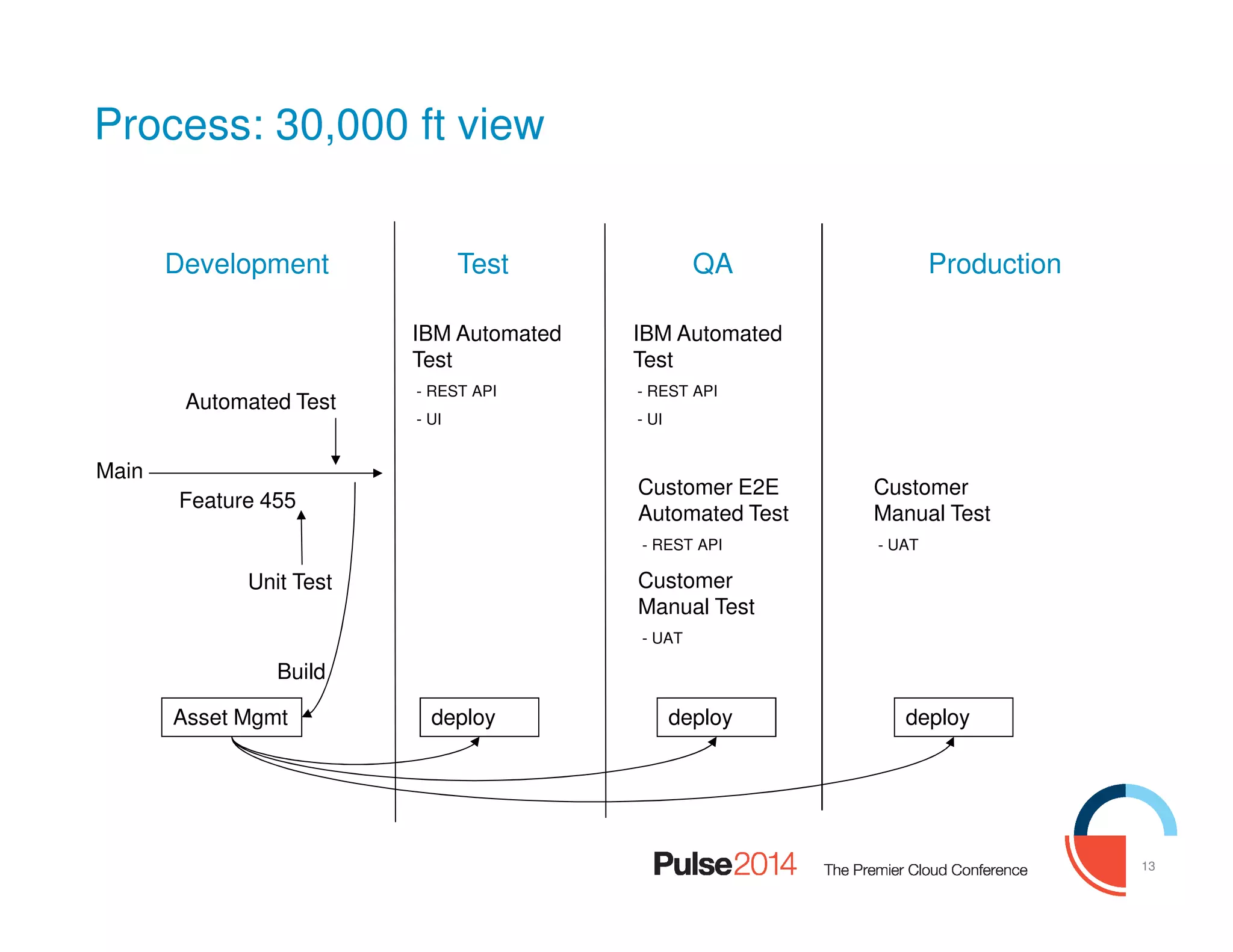
Process: 30,000 ft view
Development Test QA Production
Main
Feature 455
Unit Test
Asset Mgmt deploy deploy deploy
Build
Customer E2E
Automated Test
- REST API
Customer
Manual Test
- UAT
Automated Test
IBM Automated
Test
- REST API
- UI
IBM Automated
Test
- REST API
- UI
Customer
Manual Test
- UAT
14
Assets
Assets include any element that the team can change on any of
the systems supporting the project. For example:
A WAR file
An executable
An environment variable
A database definition
15
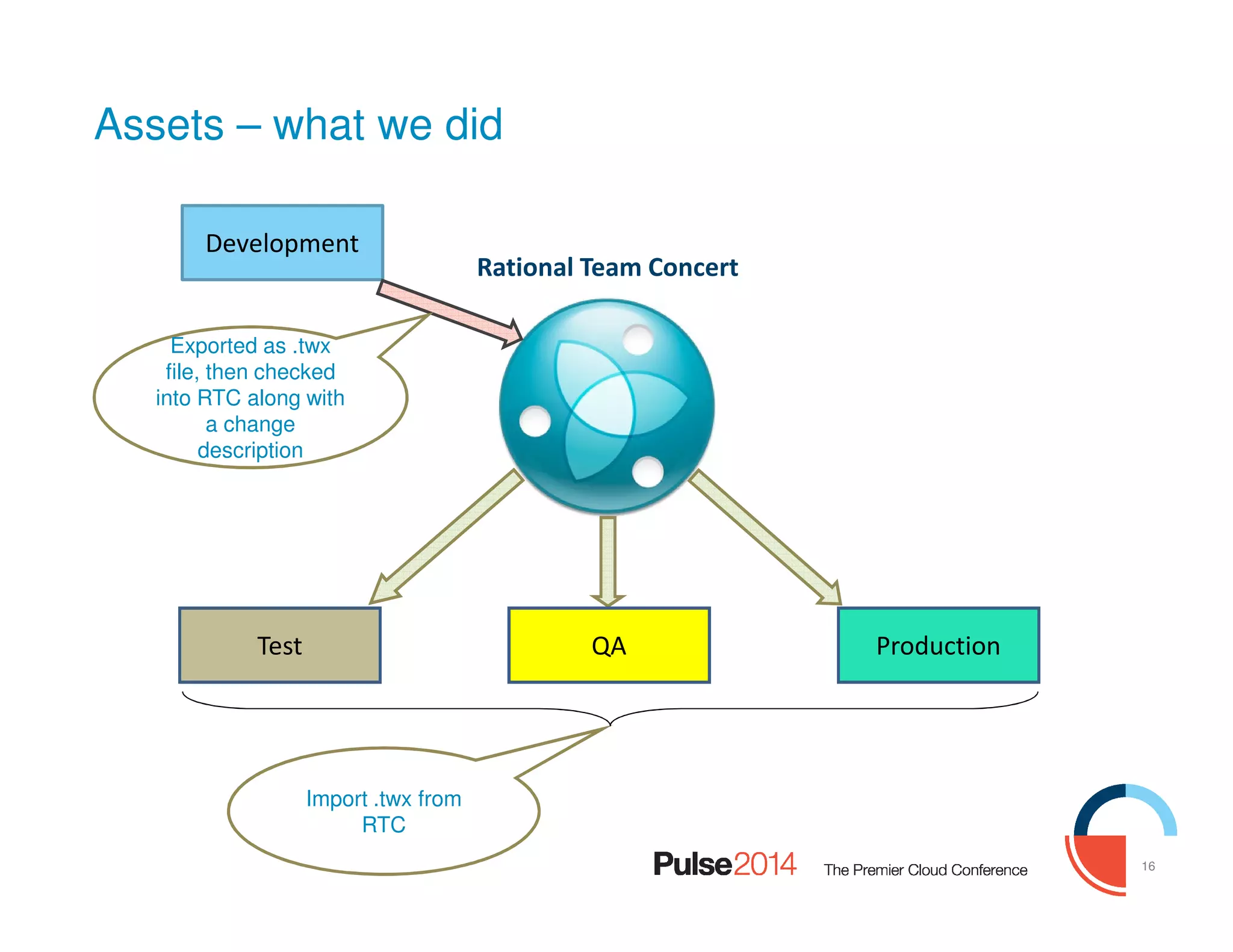
Assets – what we did
BPM process application and tool kit
TWX files
Pattern
The topology of an application
Patch
Those changes to SCO software and/or associated configuration changes
Configuration
Those changes to the systems supporting the SCO product
Configuration of the VMs internally and from a VM mgmt standpoint
Images
The building block for a pattern
16
Rational Team Concert
Assets – what we did
Development
Exported as .twx
file, then checked
into RTC along with
a change
description
Import .twx from
RTC
QATest Production
17
Automated Test
Automated test provides the means to assess the quality of the
main branch or the deployed release
Through the use of Automated Test, the Continuous Delivery
framework can then decide of a particular release candidate is of
sufficient quality to be promoted to the next level
18
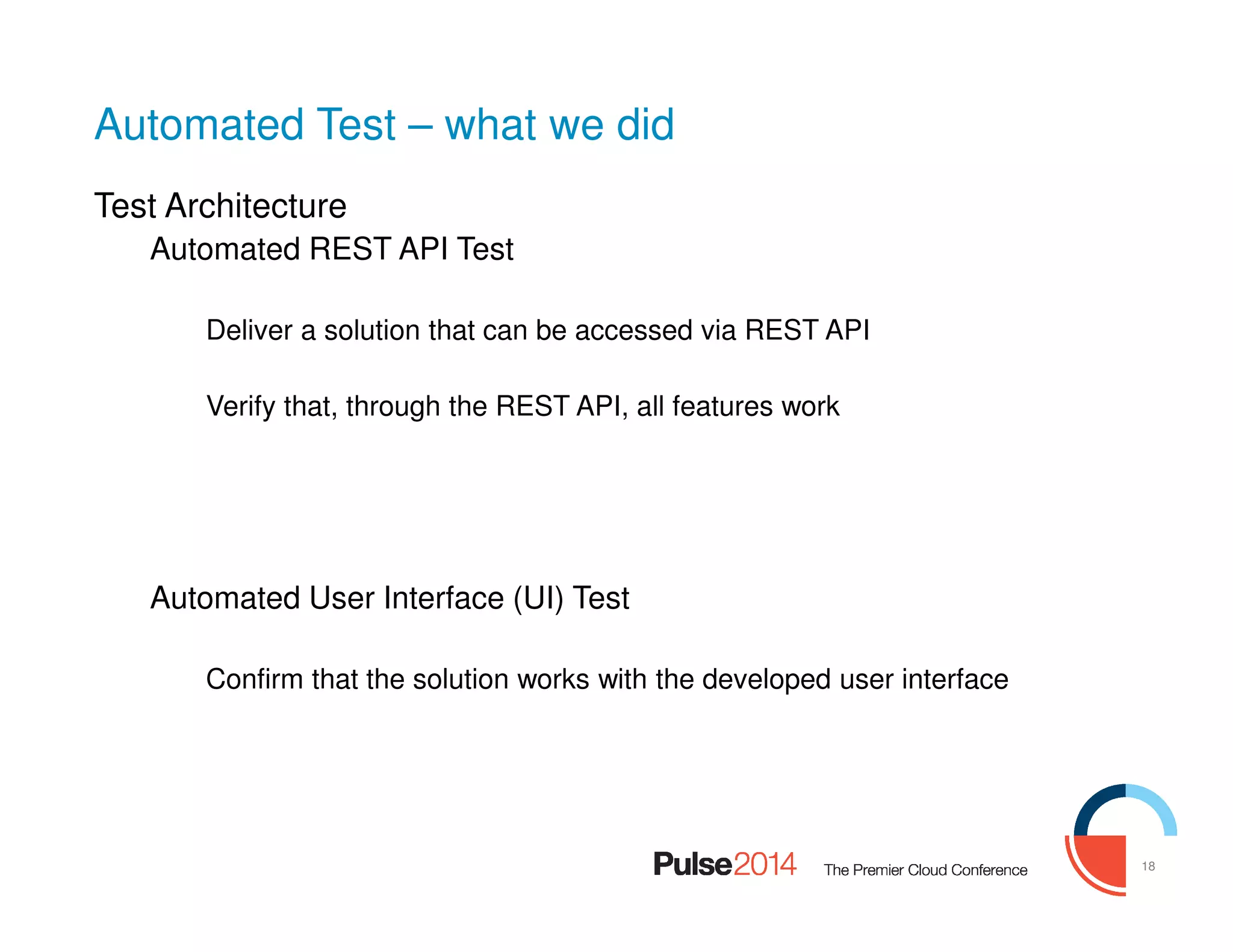
Automated Test – what we did
Test Architecture
Automated REST API Test
Deliver a solution that can be accessed via REST API
Verify that, through the REST API, all features work
Automated User Interface (UI) Test
Confirm that the solution works with the developed user interface
19
Automated Build of Deployable Asset
Automated build provides the means to collect the set of assets
from the development system such that they can later be
deployed to a target system
Automated deploy provides the means to place the assets onto a
target system for test and use
20
Automated Build of Deployable Asset – what we did
Use SmartCloud Orchestrator (SCO), REST based export/import
feature
Implemented a persistence layer to encapsulate differences
between deployment environments
Leverage build and version control tools
Control asset versions
Initiate automated testing
Track test results
21
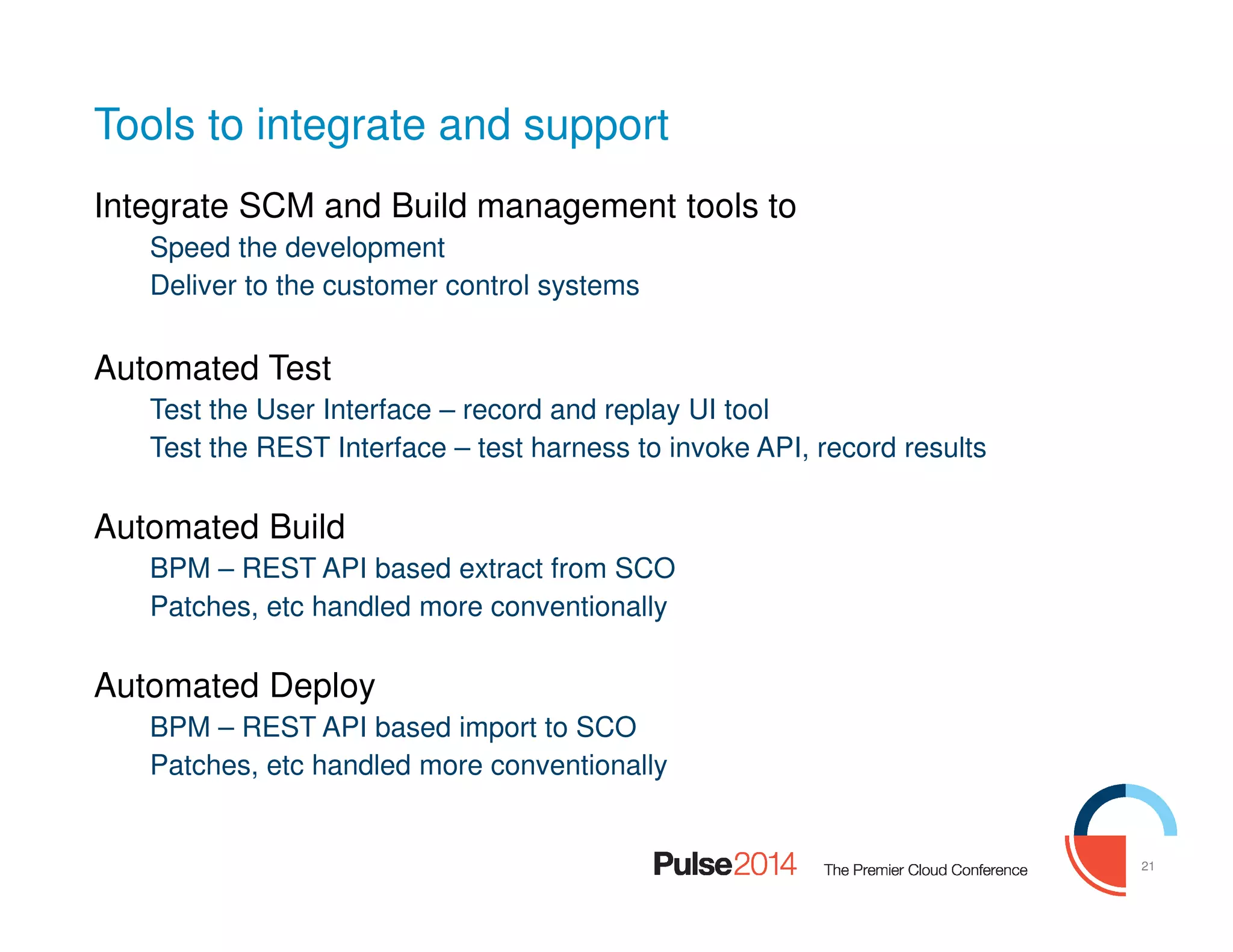
Tools to integrate and support
Integrate SCM and Build management tools to
Speed the development
Deliver to the customer control systems
Automated Test
Test the User Interface – record and replay UI tool
Test the REST Interface – test harness to invoke API, record results
Automated Build
BPM – REST API based extract from SCO
Patches, etc handled more conventionally
Automated Deploy
BPM – REST API based import to SCO
Patches, etc handled more conventionally
22
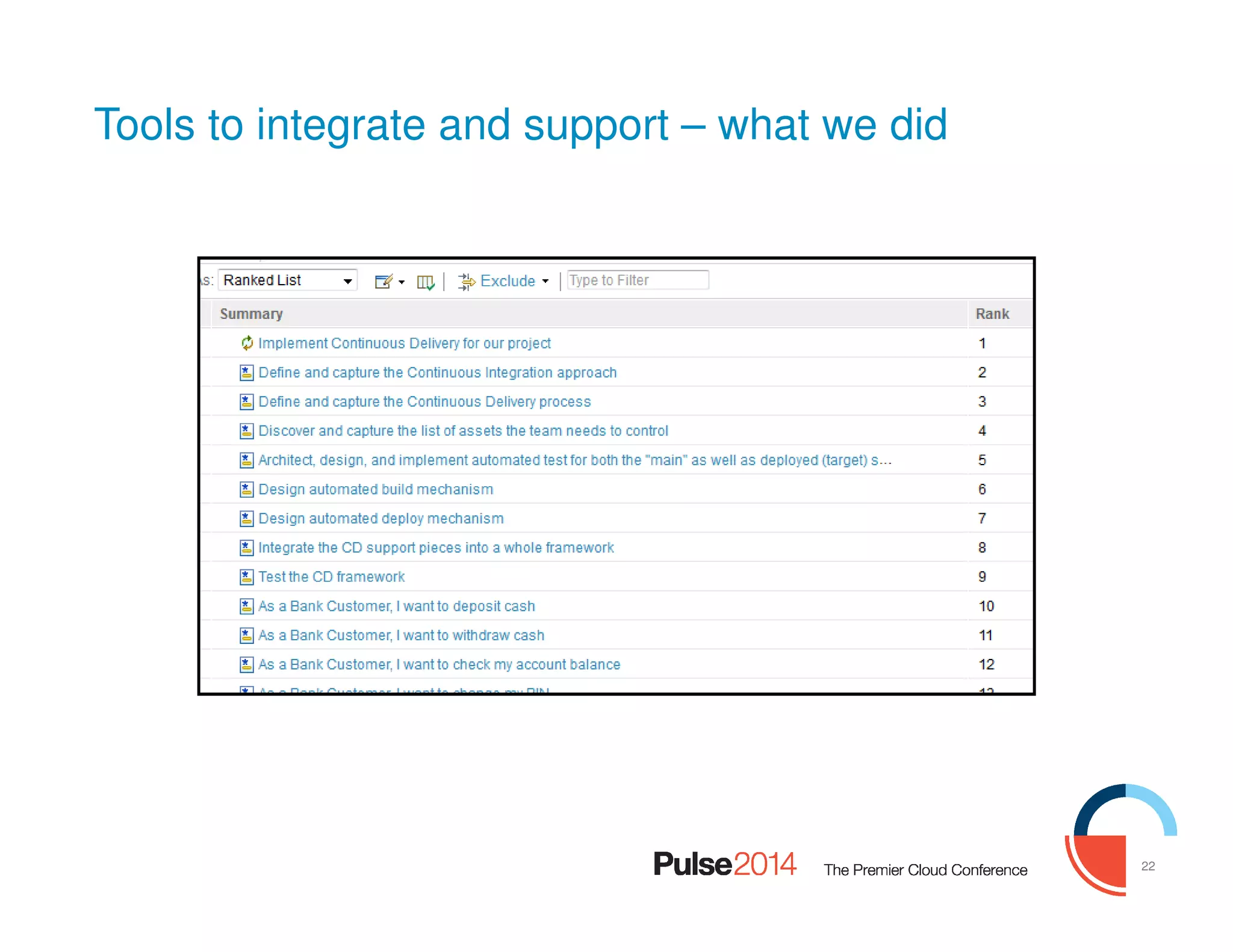
Tools to integrate and support – what we did
23
Tools to integrate and support – what we did
24
Agenda
Introduction
Continuous Delivery – what is it, how did we do it
Wrap up
Questions
25
Components
Method
Continuous Integration
Process
Assets
Automated Test
Automated Build of deployable asset
Tools
26
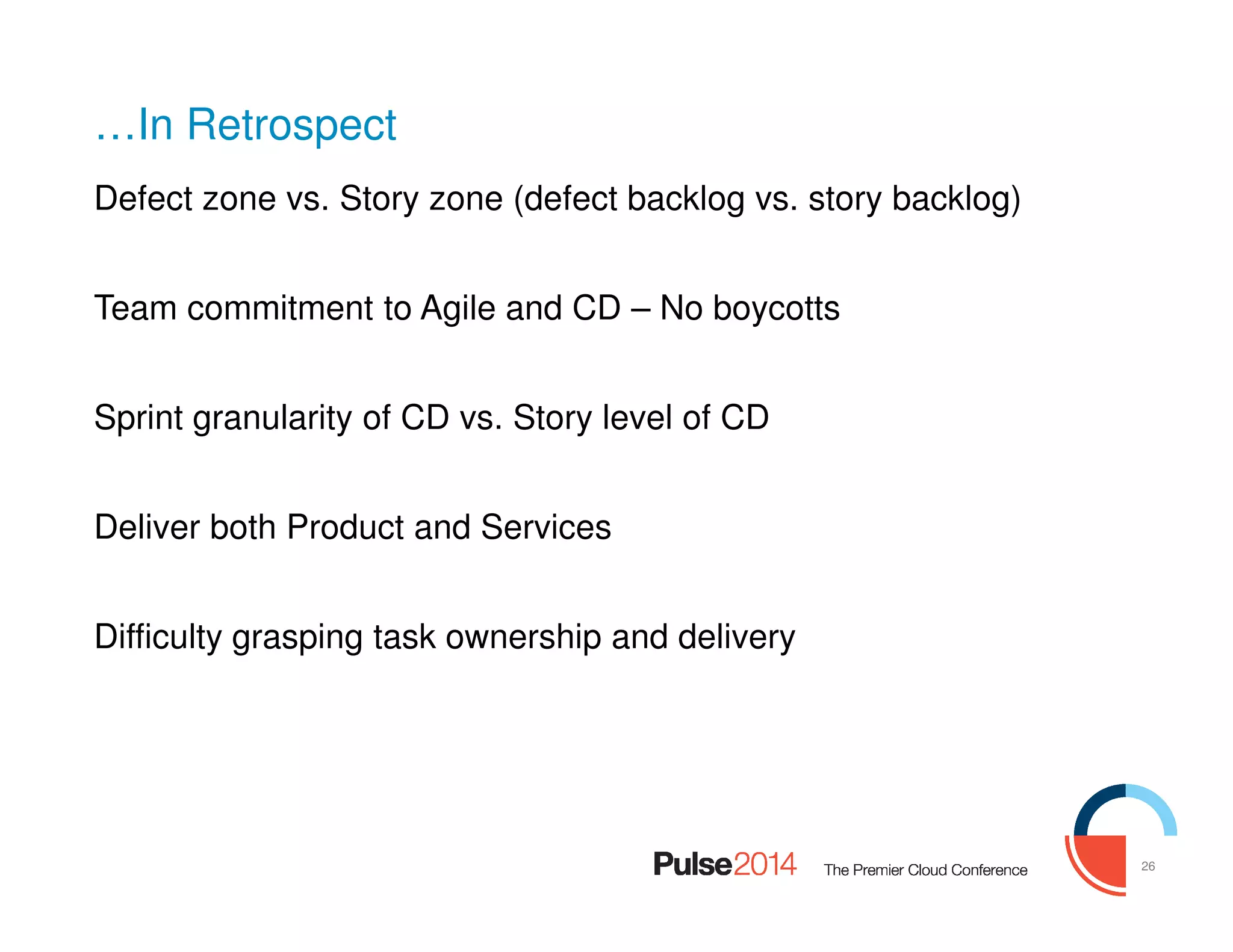
…In Retrospect
Defect zone vs. Story zone (defect backlog vs. story backlog)
Team commitment to Agile and CD – No boycotts
Sprint granularity of CD vs. Story level of CD
Deliver both Product and Services
Difficulty grasping task ownership and delivery
27
Questions
28
Thank you!!

Continuous Delivery of a Cloud Deployment at a Large Telecommunications Provider

  • 1.
    © 2013 IBMCorporation Continuous Delivery of a Cloud Deployment at a Large Telecommunications Provider M Kevin McHugh @mkmchu Eduardo Patrocinio @patrocinio 1717 – February 25, 2014
  • 2.
    1 Agenda Introduction Continuous Delivery –what is it, how did we do it Wrap up Questions
  • 3.
    2 Agenda Introduction Continuous Delivery –what is it, how did we do it Wrap up Questions
  • 4.
  • 5.
    4 Agenda Introduction Continuous Delivery –what is it, how did we do it Wrap up Questions
  • 6.
    5 Definition Continuous Delivery (CD)is a design practice used in software development to automate and improve the process of software delivery. Techniques such as automated testing, continuous integration and continuous deployment allow software to be developed to a high standard and easily packaged and deployed to test environments, resulting in the ability to rapidly, reliably and repeatedly push out enhancements and bug fixes to customers at low risk and with minimal manual overhead. The technique was one of the assumptions of extreme programming but at an enterprise level has developed into a discipline of its own, with job descriptions for roles such as "buildmaster" calling for CD skills as mandatory. (Source: Wikipedia 1/2014 - http://en.wikipedia.org/wiki/Continuous_delivery) The ability to build a releasable asset with nearly trivial effort What about Continuous Deployment?
  • 7.
  • 8.
    7 Method: Agile 7 Team Member TeamMember Customer Team Member Team Lead Agile Value-driven lifecycle with regular production of working software Small, co-located team developing straightforward software Goal is to develop a high-quality system in an evolutionary, collaborative, and self-organizing manner Pre-requisite: can build a product backlog Agile Scrum Roles (pigs) Product Owner – Owns the product backlog – Chooses what work to do next Team Member – Creates the solution – Owns estimation of difficulty of items in the backlog – Constrains how much work can be done Team Lead (Scrum Master) – Removes obstacles – Status reporting
  • 9.
    8 Agile terms andhow the team operates Backlog Grooming Sprint Planning Scrums Velocity Sprint Demo Sprint Retrospective Sample User Stories and point assignments: 8 Story Points Summary 13 pts As a Bank Customer, I want to apply for a loan, so that I can… 8 pts As a Bank Customer, I want to deposit cash 5 pts As a Bank Customer, I want to change my PIN. 3 pts As a Bank Customer, I want to withdraw cash 1 pt As a Bank Customer, I check my account balance 5 pts As a Bank Customer, I want to buy postage stamps Agile Method: Tenants of Agile and its iterative cycle Sprint 1 Sprint 2 Story Points DeliveredStory Points Delivered Story Points DeliveredStory Points Delivered Velocity (rolling average of points delivered)Velocity (rolling average of points delivered)
  • 10.
    9 Agile adoption –adoption by execution Two-week sprints Single Product Owner Scrum Master Rank user stories Set up the meetings Method: What we did Agile Sprint 1 Sprint 2 Story Points DeliveredStory Points Delivered Story Points DeliveredStory Points Delivered Velocity (rolling average of points delivered)Velocity (rolling average of points delivered)
  • 11.
    10 10 Sprint by Sprintview of demonstrated progress of feature delivery Agile Release 1.0 - Functional Story Point Burndown 0 50 100 150 200 250 300 350 400 450 Sprint1Sprint2Sprint3Sprint4Sprint5Sprint6Sprint7Sprint8 Time StoryPoints Backlog Size Remaining Backlog Sprint Velocity Projected Pts Planned Pts Method: Sample Burndown – Measured delivery
  • 12.
    11 Continuous Integration Continuous integration(CI) is the practice, in software engineering, of merging all developer working copies with a shared mainline several times a day. (Source: Wikipedia 1/29/2014 - http://en.wikipedia.org/wiki/Continuous_integration) Develop features or fix defects on isolated branches Merge branches onto the main Identify points in time on the main that represent a viable code drop This all drives the ability to have a stable, automatically tested, “main” which can be sent forward for Test, QA, and Production deployment
  • 13.
    12 Continuous Integration –what we did Initially Work space isolation obtained via Business Process Manager (BPM) locking of a business process The team is working on the main This limited / prevented concurrent engineering Led to Sprint-fall Evolved into Paired programmers working on separate tool kits, and backend processes
  • 14.
    13 Process: 30,000 ftview Development Test QA Production Main Feature 455 Unit Test Asset Mgmt deploy deploy deploy Build Customer E2E Automated Test - REST API Customer Manual Test - UAT Automated Test IBM Automated Test - REST API - UI IBM Automated Test - REST API - UI Customer Manual Test - UAT
  • 15.
    14 Assets Assets include anyelement that the team can change on any of the systems supporting the project. For example: A WAR file An executable An environment variable A database definition
  • 16.
    15 Assets – whatwe did BPM process application and tool kit TWX files Pattern The topology of an application Patch Those changes to SCO software and/or associated configuration changes Configuration Those changes to the systems supporting the SCO product Configuration of the VMs internally and from a VM mgmt standpoint Images The building block for a pattern
  • 17.
    16 Rational Team Concert Assets– what we did Development Exported as .twx file, then checked into RTC along with a change description Import .twx from RTC QATest Production
  • 18.
    17 Automated Test Automated testprovides the means to assess the quality of the main branch or the deployed release Through the use of Automated Test, the Continuous Delivery framework can then decide of a particular release candidate is of sufficient quality to be promoted to the next level
  • 19.
    18 Automated Test –what we did Test Architecture Automated REST API Test Deliver a solution that can be accessed via REST API Verify that, through the REST API, all features work Automated User Interface (UI) Test Confirm that the solution works with the developed user interface
  • 20.
    19 Automated Build ofDeployable Asset Automated build provides the means to collect the set of assets from the development system such that they can later be deployed to a target system Automated deploy provides the means to place the assets onto a target system for test and use
  • 21.
    20 Automated Build ofDeployable Asset – what we did Use SmartCloud Orchestrator (SCO), REST based export/import feature Implemented a persistence layer to encapsulate differences between deployment environments Leverage build and version control tools Control asset versions Initiate automated testing Track test results
  • 22.
    21 Tools to integrateand support Integrate SCM and Build management tools to Speed the development Deliver to the customer control systems Automated Test Test the User Interface – record and replay UI tool Test the REST Interface – test harness to invoke API, record results Automated Build BPM – REST API based extract from SCO Patches, etc handled more conventionally Automated Deploy BPM – REST API based import to SCO Patches, etc handled more conventionally
  • 23.
    22 Tools to integrateand support – what we did
  • 24.
    23 Tools to integrateand support – what we did
  • 25.
    24 Agenda Introduction Continuous Delivery –what is it, how did we do it Wrap up Questions
  • 26.
  • 27.
    26 …In Retrospect Defect zonevs. Story zone (defect backlog vs. story backlog) Team commitment to Agile and CD – No boycotts Sprint granularity of CD vs. Story level of CD Deliver both Product and Services Difficulty grasping task ownership and delivery
  • 28.
  • 29.