Life Changing:
What happens when we
STEMify our schools!
Thomas Meagher, PhD
District STEM Education Coordinator
Owatonna Public Schools
Owatonna, Minnesota
ASTE, 2019
drthomasmeagher.weebly.com
@meagher3dan
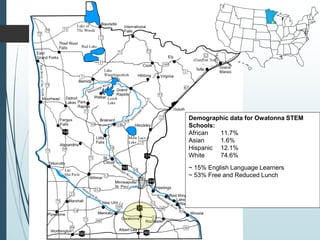
Demographic data for Owatonna STEM
Schools:
African 11.7%
Asian 1.6%
Hispanic 12.1%
White 74.6%
~ 15% English Language Learners
~ 53% Free and Reduced Lunch
Status of STEM according to ACT
• In state & national scores students who expressed
interests in STEM fields outperform their peers in college
readiness scores.
• Almost 50% of all Minnesota students expressed
interests in STEM fields and careers.
• Of the over 61,000 students who took the ACT in
Minnesota only:
135 expressed interest in Math Education
65 expressed interest in Science Education
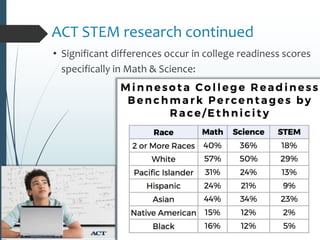
ACT STEM research continued
• Significant differences occur in college readiness scores
specifically in Math & Science:
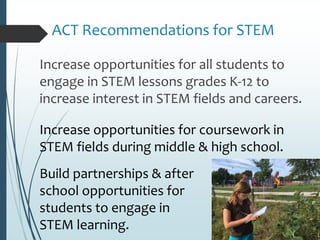
ACT Recommendations for STEM
Increase opportunities for all students to
engage in STEM lessons grades K-12 to
increase interest in STEM fields and careers.
Increase opportunities for coursework in
STEM fields during middle & high school.
Build partnerships & after
school opportunities for
students to engage in
STEM learning.
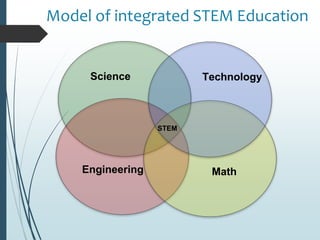
Model of integrated STEM Education
Science
Engineering Math
Technology
STEM
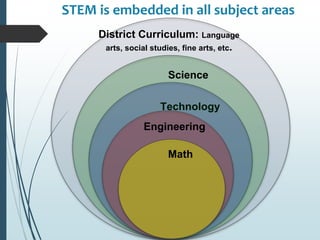
STEM is embedded in all subject areas
District Curriculum: Language
arts, social studies, fine arts, etc.
Technology
Science
Engineering
Math
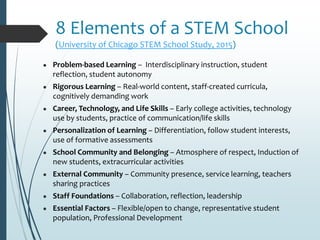
8 Elements of a STEM School
(University of Chicago STEM School Study, 2015)
● Problem-based Learning – Interdisciplinary instruction, student
reflection, student autonomy
● Rigorous Learning – Real-world content, staff-created curricula,
cognitively demanding work
● Career, Technology, and Life Skills – Early college activities, technology
use by students, practice of communication/life skills
● Personalization of Learning – Differentiation, follow student interests,
use of formative assessments
● School Community and Belonging – Atmosphere of respect, Induction of
new students, extracurricular activities
● External Community – Community presence, service learning, teachers
sharing practices
● Staff Foundations – Collaboration, reflection, leadership
● Essential Factors – Flexible/open to change, representative student
population, Professional Development
Key NGSS crosscutting concepts
Patterns analysis
Cause and Effect: Mechanism and
Prediction
Scale, Proportion and Quantity
Systems and System Models
Energy and Matter: Flows, Cycles and
Conservation
Structure and Function
Stability and Change
Interdependence of STEM
Influences of STEM on Society and the
Natural World
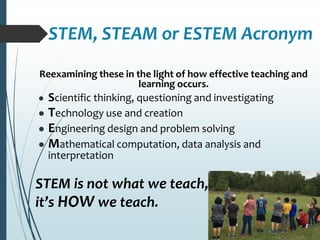
STEM, STEAM or ESTEM Acronym
Reexamining these in the light of how effective teaching and
learning occurs.
● Scientific thinking, questioning and investigating
● Technology use and creation
● Engineering design and problem solving
● Mathematical computation, data analysis and
interpretation
STEM is not what we teach,
it’s HOW we teach.
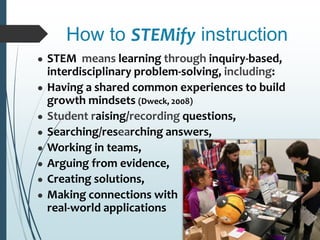
How to STEMify instruction
● STEM means learning through inquiry-based,
interdisciplinary problem-solving, including:
● Having a shared common experiences to build
growth mindsets (Dweck, 2008)
● Student raising/recording questions,
● Searching/researching answers,
● Working in teams,
● Arguing from evidence,
● Creating solutions,
● Making connections with
real-world applications
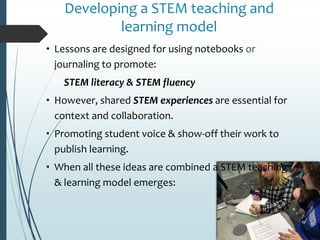
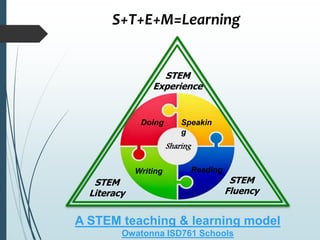
Developing a STEM teaching and
learning model
• Lessons are designed for using notebooks or
journaling to promote:
STEM literacy & STEM fluency
• However, shared STEM experiences are essential for
context and collaboration.
• Promoting student voice & show-off their work to
publish learning.
• When all these ideas are combined a STEM teaching
& learning model emerges:
A STEM teaching & learning model
Owatonna ISD761 Schools
STEM
Experience
STEM
Literacy
STEM
Fluency
Doing Speakin
g
ReadingWriting
Sharing
S+T+E+M=Learning
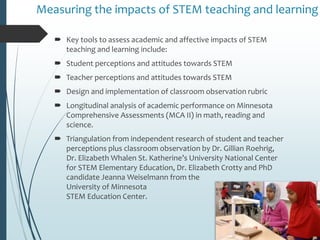
Measuring the impacts of STEM teaching and learning
 Key tools to assess academic and affective impacts of STEM
teaching and learning include:
 Student perceptions and attitudes towards STEM
 Teacher perceptions and attitudes towards STEM
 Design and implementation of classroom observation rubric
 Longitudinal analysis of academic performance on Minnesota
Comprehensive Assessments (MCA II) in math, reading and
science.
 Triangulation from independent research of student and teacher
perceptions plus classroom observation by Dr. Gillian Roehrig,
Dr. Elizabeth Whalen St. Katherine’s University National Center
for STEM Elementary Education, Dr. Elizabeth Crotty and PhD
candidate Jeanna Weiselmann from the
University of Minnesota
STEM Education Center.
Student survey responses
(n=480)
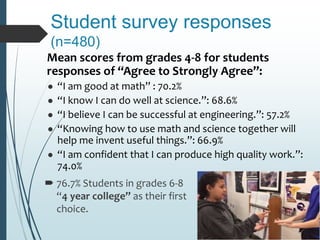
Mean scores from grades 4-8 for students
responses of “Agree to Strongly Agree”:
● “I am good at math” : 70.2%
● “I know I can do well at science.”: 68.6%
● “I believe I can be successful at engineering.”: 57.2%
● “Knowing how to use math and science together will
help me invent useful things.”: 66.9%
● “I am confident that I can produce high quality work.”:
74.0%
 76.7% Students in grades 6-8 selected
“4 year college” as their first
choice.
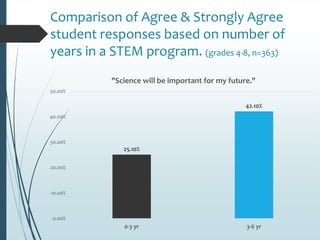
Comparison of Agree & Strongly Agree
student responses based on number of
years in a STEM program. (grades 4-8, n=363)
25.10%
42.10%
0.00%
10.00%
20.00%
30.00%
40.00%
50.00%
0-3 yr 3-6 yr
"Science will be important for my future."
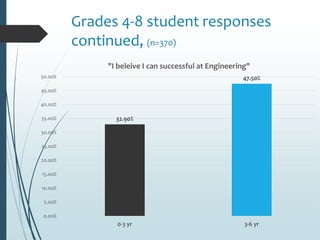
Grades 4-8 student responses
continued, (n=370)
32.90%
47.50%
0.00%
5.00%
10.00%
15.00%
20.00%
25.00%
30.00%
35.00%
40.00%
45.00%
50.00%
0-3 yr 3-6 yr
"I beleive I can successful at Engineering"
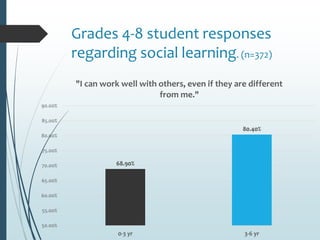
Grades 4-8 student responses
regarding social learning. (n=372)
68.90%
80.40%
50.00%
55.00%
60.00%
65.00%
70.00%
75.00%
80.00%
85.00%
90.00%
0-3 yr 3-6 yr
"I can work well with others, even if they are different
from me."
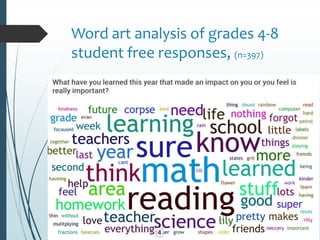
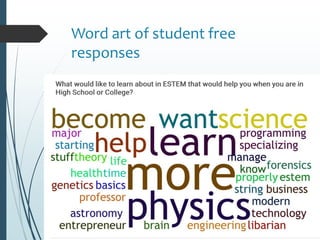
Word art analysis of grades 4-8
student free responses, (n=397)
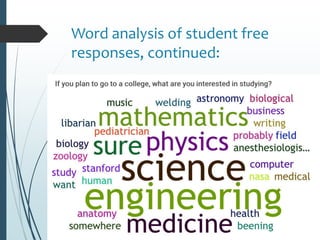
Word analysis of student free
responses, continued:
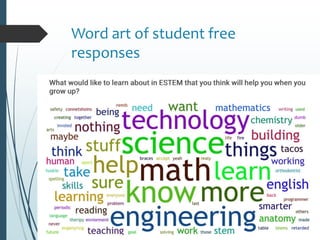
Word art of student free
responses
Word art of student free
responses
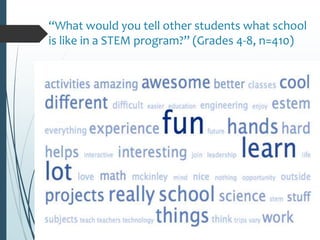
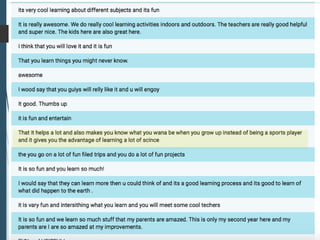
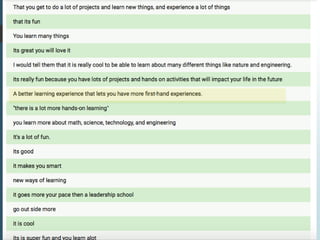
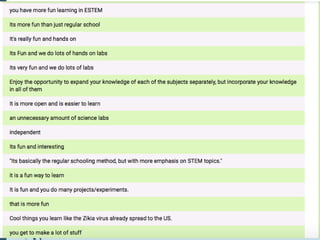
“What would you tell other students what school
is like in a STEM program?” (Grades 4-8, n=410)
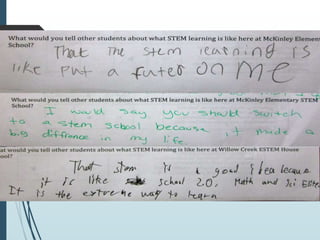
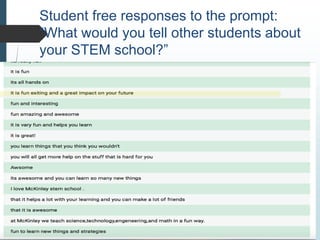
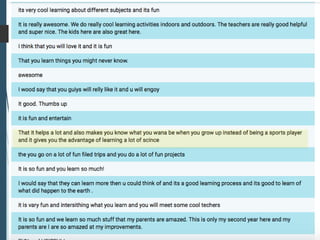
Student free responses to the prompt:
“What would you tell other students about
your STEM school?”
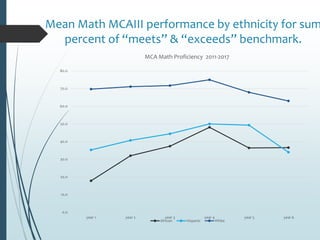
Mean Math MCAIII performance by ethnicity for sum
percent of “meets” & “exceeds” benchmark.
0.0
10.0
20.0
30.0
40.0
50.0
60.0
70.0
80.0
year 1 year 2 year 3 year 4 year 5 year 6
MCA Math Proficiency 2011-2017
African Hispanic White
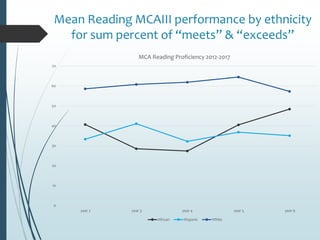
Mean Reading MCAIII performance by ethnicity
for sum percent of “meets” & “exceeds”
0
10
20
30
40
50
60
70
year 2 year 3 year 4 year 5 year 6
MCA Reading Proficiency 2012-2017
African Hispanic White
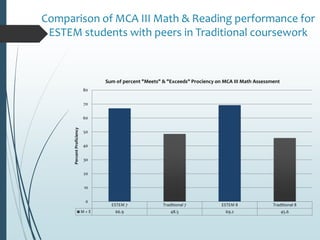
Comparison of MCA III Math & Reading performance for
ESTEM students with peers in Traditional coursework
ESTEM 7 Traditional 7 ESTEM 8 Traditional 8
M + E 66.9 48.5 69.2 45.6
0
10
20
30
40
50
60
70
80
PercentProficiency
Sum of percent "Meets" & "Exceeds" Prociency on MCA III Math Assessment
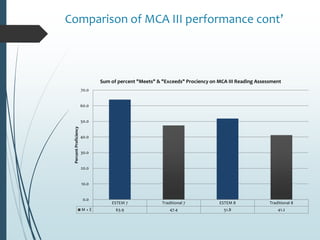
Comparison of MCA III performance cont’
ESTEM 7 Traditional 7 ESTEM 8 Traditional 8
M + E 63.9 47.4 51.8 41.2
0.0
10.0
20.0
30.0
40.0
50.0
60.0
70.0
PercentProficiency
Sum of percent "Meets" & "Exceeds" Prociency on MCA III Reading Assessment
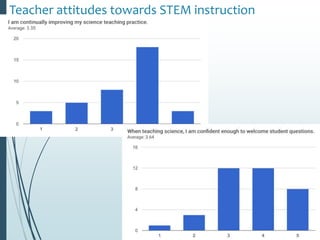
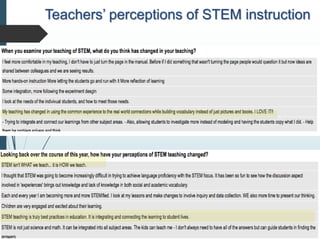
Teacher attitudes towards STEM instruction
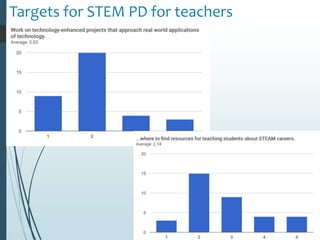
Targets for STEM PD for teachers
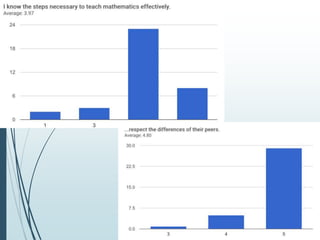
Teachers’ perceptions of STEM instruction
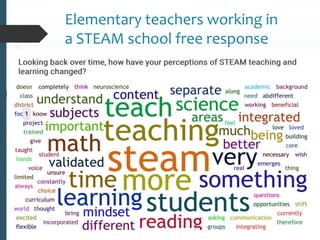
Elementary teachers working in
a STEAM school free response
Preliminary findings and results
 Students show positive attitudes towards classroom learning experiences
that focus on 21st century learning strategies such as cooperative learning
groups, collaboration and using creativity and innovation in STEM
activities.
 There is significant evidence of positive student attitudes towards STEM
learning and its importance in helping them develop understanding and
vision for their academic and professional careers.
 However, creating a positive attitude toward STEM learning is the first step
in a multi-year development of successful student performance.
Continued connections need to be made between academic interests and
STEM career interests.
 Teachers demonstrate positive attitudes towards shifts in instruction and
PCK in STEM teaching and learning.
 Opportunities for professional development needs to focus on supporting
teachers’ needs for providing instruction and resources to enhance
student interests in STEM careers.
Questions?
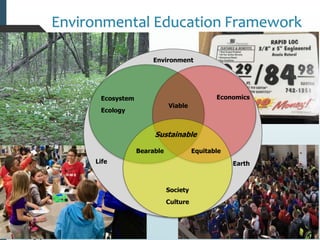
Environmental Education Framework
Environment
Life Earth
Ecosystem
Ecology
Economics
Society
Culture
Viable
Bearable Equitable
Sustainable
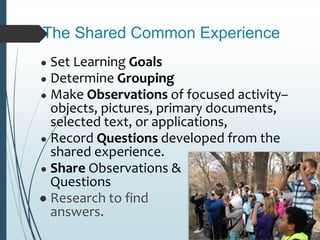
The Shared Common Experience
● Set Learning Goals
● Determine Grouping
● Make Observations of focused activity–
objects, pictures, primary documents,
selected text, or applications,
● Record Questions developed from the
shared experience.
● Share Observations &
Questions
● Research to find
answers.
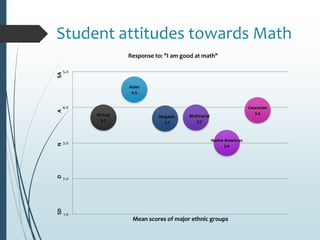
Student attitudes towards Math
African
3.7
Asian
4.5
Hispanic
3.7
Multiracial
3.7
Native American
3.0
Caucasian
3.9
1.0
2.0
3.0
4.0
5.0
SDDNASA
Mean scores of major ethnic groups
Response to: "I am good at math"
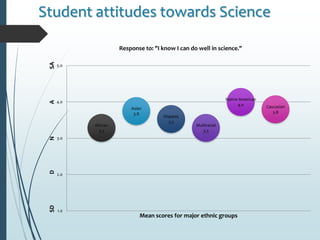
Student attitudes towards Science
African
3.3
Asian
3.8
Hispanic
3.5
Multiracial
3.3
Native American
4.0 Caucasian
3.8
1.0
2.0
3.0
4.0
5.0
SDDNASA
Mean scores for major ethnic groups
Response to: "I know I can do well in science."
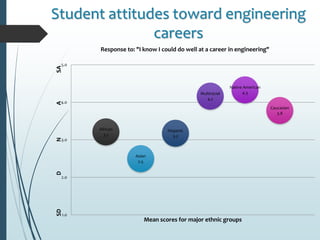
Student attitudes toward engineering
careers
African
3.2
Asian
2.5
Hispanic
3.2
Multiracial
4.2
Native American
4.3
Caucasian
3.8
1.0
2.0
3.0
4.0
5.0
SDDNASA
Mean scores for major ethnic groups
Response to: "I know I could do well at a career in engineering"
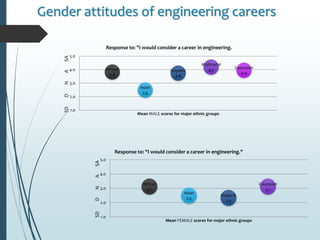
Gender attitudes of engineering careers
African
3.8
Asian
2.5
Hispanic
3.8
Multiracial
4.2
Caucasian
4.0
1.0
2.0
3.0
4.0
5.0
SDDNASA
Mean MALE scores for major ethnic groups
Response to: "I would consider a career in engineering.
African
3.1
Asian
2.5
Hispanic
2.3
Caucasian
3.1
1.0
2.0
3.0
4.0
5.0
SDDNASA
Mean FEMALE scores for major ethnic groups
Response to: "I would consider a career in engineering."
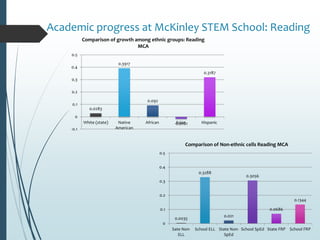
Academic progress at McKinley STEM School: Reading
0.0035
0.3288
0.021
0.3056
0.0686
0.1344
0
0.1
0.2
0.3
0.4
0.5
Sate Non-
ELL
School ELL State Non-
SpEd
School SpEd State FRP School FRP
Comparison of Non-ethnic cells Reading MCA
0.0283
0.3917
0.092
-0.0161
0.3187
-0.1
0
0.1
0.2
0.3
0.4
0.5
White (state) Native
American
African Asian Hispanic
Comparison of growth among ethnic groups: Reading
MCA
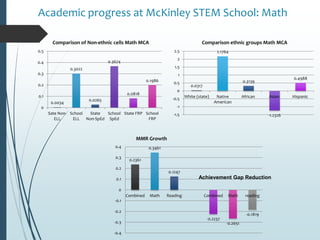
Academic progress at McKinley STEM School: Math
0.0034
0.3022
0.0265
0.3674
0.0818
0.1986
0
0.1
0.2
0.3
0.4
0.5
Sate Non-
ELL
School
ELL
State
Non-SpEd
School
SpEd
State FRP School
FRP
Comparison of Non-ethnic cells Math MCA
0.0317
2.1764
0.3139
-1.2326
0.4988
-1.5
-1
-0.5
0
0.5
1
1.5
2
2.5
White (state) Native
American
African Asian Hispanic
Comparison ethnic groups Math MCA
0.2361
0.3461
0.1247
-0.2237
-0.2651
-0.1819
-0.4
-0.3
-0.2
-0.1
0
0.1
0.2
0.3
0.4
Combined Math Reading Combined Math reading
MMR Growth
Achievement Gap Reduction
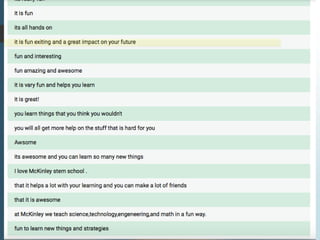
Student free responses to the prompt: “What
would you tell other students about your STEM
school?”
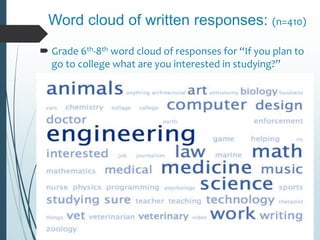
Word cloud of written responses: (n=410)
 Grade 6th-8th word cloud of responses for “If you plan to
go to college what are you interested in studying?”
Today
2011-12 2012-13 2013-14 2014-15 2015-16 2016-17
K-8 Explorations research STEM
Programs in MN
5 days STEM PD with Lee Schmitt
from Hamline University K-7
Outdoor/EE PD from Jeffers
Foundation K-8 1 day summer 13 & 14
2 Days ESTEM PD with Lee Schmitt
for all 7-8 OJHS teachers
2 Days ESTEM PD with Lee Schmitt for all
Willow Creek teachers
Summer 2015
OMS/ESTEM PD for all 6-
8 teachers
8/9-10, 2017
6-8 ESTEM Middle
School Visioning Day
3/28/17
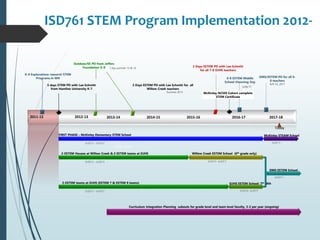
FIRST PHASE – McKinley Elementary STEM School
23.05 mons
Willow Creek ESTEM School (6th grade only)
9/2015- 6/2017
OJHS ESTEM School: 7th /8th
ISD761 STEM Program Implementation 2012-
2017-18
9/2012 – 6/2017
9/2016- 6/2017
2-ESTEM Houses at Willow Creek & 2 ESTEM teams at OJHS
2-ESTEM teams at OJHS (ESTEM 7 & ESTEM 8 teams)
9/2012 – 6/2015
9/2012 – 6/2017
OMS ESTEM School
McKinley STEAM School
9/2017 -
9/2017 -
McKinley NCSEE Cohort complete
STEM Certificate
Curriculum Integration Planning subouts for grade level and team level faculty, 3-2 per year (ongoing)
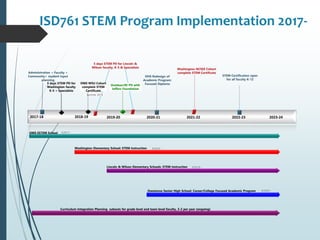
2017-18 2018-19 2019-20 2020-21 2021-22 2022-23
Administration + Faculty +
Community+ student input
planning
5 days STEM PD for
Washington faculty
K-5 + Specialists
5 days STEM PD for Lincoln &
Wilson faculty, K-5 & Specialists
Washington NCSEE Cohort
complete STEM Certificate
OMS WSU Cohort
complete STEM
Certificate
Summer 2019
STEM Certification open
for all faculty K-12
OHS Redesign of
Academic Program:
Focused Diploma
Washington Elementary School: STEM Instruction
ISD761 STEM Program Implementation 2017-
2023-24
9/2017 -
Lincoln & Wilson Elementary Schools: STEM Instruction
Owatonna Senior High School: Career/College Focused Academic Program
9/2019 -
9/2020 -
OMS ESTEM School
Outdoor/EE PD with
Jeffers Foundation
Curriculum Integration Planning subouts for grade level and team level faculty, 3-2 per year (ongoing)
9/2018 -
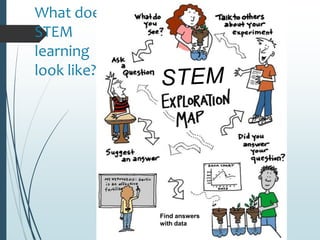
What does
STEM
learning
look like?
Find answers
with data
STEM, ESTEM & STEAM in Owatonna, MN
• Classes focus on students developing growth-mindsets and
making mistakes is real learning.
• Teaching STEM emphasizes integrated lessons students
asking questions, investigate solutions to problems and
engineering challenges.
• STEM is embedded among all subject areas where all
students can learn rigorous academic subject matter.
• Students recognize that lessons relate
to real-world learning.
How we design & build
effective STEM teaching &
learning
 Teachers work in collaborative grade level teams with shared prep
times (usually).
 Bi-weekly PLC meetings that focus on data collected from formative &
summative assessments.
 Sub-out days during the school year provide for common & creative
planning to “STEMify” our curriculum.
 Continual PD and research with resources such as Jeffers Foundation,
Perpich Foundation for Arts Integration, National Center for STEM
Elementary Education, Winona State University STEM professional
cohort & University of MN STEM Education Center.
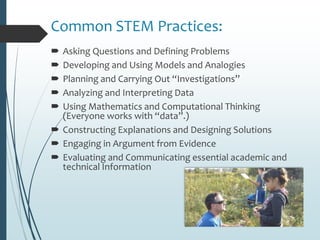
Common STEM Practices:
 Asking Questions and Defining Problems
 Developing and Using Models and Analogies
 Planning and Carrying Out “Investigations”
 Analyzing and Interpreting Data
 Using Mathematics and Computational Thinking
(Everyone works with “data”.)
 Constructing Explanations and Designing Solutions
 Engaging in Argument from Evidence
 Evaluating and Communicating essential academic and
technical Information
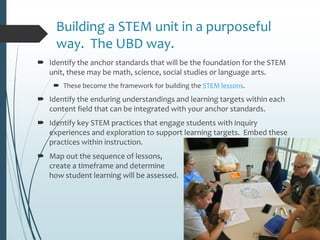
Building a STEM unit in a purposeful
way. The UBD way.
 Identify the anchor standards that will be the foundation for the STEM
unit, these may be math, science, social studies or language arts.
 These become the framework for building the STEM lessons.
 Identify the enduring understandings and learning targets within each
content field that can be integrated with your anchor standards.
 Identify key STEM practices that engage students with inquiry
experiences and exploration to support learning targets. Embed these
practices within instruction.
 Map out the sequence of lessons,
create a timeframe and determine
how student learning will be assessed.

Aste2019

  • 1.
    Life Changing: What happenswhen we STEMify our schools! Thomas Meagher, PhD District STEM Education Coordinator Owatonna Public Schools Owatonna, Minnesota ASTE, 2019 drthomasmeagher.weebly.com @meagher3dan
  • 2.
    Demographic data forOwatonna STEM Schools: African 11.7% Asian 1.6% Hispanic 12.1% White 74.6% ~ 15% English Language Learners ~ 53% Free and Reduced Lunch
  • 3.
    Status of STEMaccording to ACT • In state & national scores students who expressed interests in STEM fields outperform their peers in college readiness scores. • Almost 50% of all Minnesota students expressed interests in STEM fields and careers. • Of the over 61,000 students who took the ACT in Minnesota only: 135 expressed interest in Math Education 65 expressed interest in Science Education
  • 4.
    ACT STEM researchcontinued • Significant differences occur in college readiness scores specifically in Math & Science:
  • 5.
    ACT Recommendations forSTEM Increase opportunities for all students to engage in STEM lessons grades K-12 to increase interest in STEM fields and careers. Increase opportunities for coursework in STEM fields during middle & high school. Build partnerships & after school opportunities for students to engage in STEM learning.
  • 6.
    Model of integratedSTEM Education Science Engineering Math Technology STEM
  • 7.
    STEM is embeddedin all subject areas District Curriculum: Language arts, social studies, fine arts, etc. Technology Science Engineering Math

  • 8.
    8 Elements ofa STEM School (University of Chicago STEM School Study, 2015) ● Problem-based Learning – Interdisciplinary instruction, student reflection, student autonomy ● Rigorous Learning – Real-world content, staff-created curricula, cognitively demanding work ● Career, Technology, and Life Skills – Early college activities, technology use by students, practice of communication/life skills ● Personalization of Learning – Differentiation, follow student interests, use of formative assessments ● School Community and Belonging – Atmosphere of respect, Induction of new students, extracurricular activities ● External Community – Community presence, service learning, teachers sharing practices ● Staff Foundations – Collaboration, reflection, leadership ● Essential Factors – Flexible/open to change, representative student population, Professional Development
  • 9.
    Key NGSS crosscuttingconcepts Patterns analysis Cause and Effect: Mechanism and Prediction Scale, Proportion and Quantity Systems and System Models Energy and Matter: Flows, Cycles and Conservation Structure and Function Stability and Change Interdependence of STEM Influences of STEM on Society and the Natural World
  • 10.
    STEM, STEAM orESTEM Acronym Reexamining these in the light of how effective teaching and learning occurs. ● Scientific thinking, questioning and investigating ● Technology use and creation ● Engineering design and problem solving ● Mathematical computation, data analysis and interpretation STEM is not what we teach, it’s HOW we teach.
  • 11.
    How to STEMifyinstruction ● STEM means learning through inquiry-based, interdisciplinary problem-solving, including: ● Having a shared common experiences to build growth mindsets (Dweck, 2008) ● Student raising/recording questions, ● Searching/researching answers, ● Working in teams, ● Arguing from evidence, ● Creating solutions, ● Making connections with real-world applications
  • 12.
    Developing a STEMteaching and learning model • Lessons are designed for using notebooks or journaling to promote: STEM literacy & STEM fluency • However, shared STEM experiences are essential for context and collaboration. • Promoting student voice & show-off their work to publish learning. • When all these ideas are combined a STEM teaching & learning model emerges:
  • 13.
    A STEM teaching& learning model Owatonna ISD761 Schools STEM Experience STEM Literacy STEM Fluency Doing Speakin g ReadingWriting Sharing S+T+E+M=Learning
  • 14.
    Measuring the impactsof STEM teaching and learning  Key tools to assess academic and affective impacts of STEM teaching and learning include:  Student perceptions and attitudes towards STEM  Teacher perceptions and attitudes towards STEM  Design and implementation of classroom observation rubric  Longitudinal analysis of academic performance on Minnesota Comprehensive Assessments (MCA II) in math, reading and science.  Triangulation from independent research of student and teacher perceptions plus classroom observation by Dr. Gillian Roehrig, Dr. Elizabeth Whalen St. Katherine’s University National Center for STEM Elementary Education, Dr. Elizabeth Crotty and PhD candidate Jeanna Weiselmann from the University of Minnesota STEM Education Center.
  • 15.
    Student survey responses (n=480) Meanscores from grades 4-8 for students responses of “Agree to Strongly Agree”: ● “I am good at math” : 70.2% ● “I know I can do well at science.”: 68.6% ● “I believe I can be successful at engineering.”: 57.2% ● “Knowing how to use math and science together will help me invent useful things.”: 66.9% ● “I am confident that I can produce high quality work.”: 74.0%  76.7% Students in grades 6-8 selected “4 year college” as their first choice.
  • 16.
    Comparison of Agree& Strongly Agree student responses based on number of years in a STEM program. (grades 4-8, n=363) 25.10% 42.10% 0.00% 10.00% 20.00% 30.00% 40.00% 50.00% 0-3 yr 3-6 yr "Science will be important for my future."
  • 17.
    Grades 4-8 studentresponses continued, (n=370) 32.90% 47.50% 0.00% 5.00% 10.00% 15.00% 20.00% 25.00% 30.00% 35.00% 40.00% 45.00% 50.00% 0-3 yr 3-6 yr "I beleive I can successful at Engineering"
  • 18.
    Grades 4-8 studentresponses regarding social learning. (n=372) 68.90% 80.40% 50.00% 55.00% 60.00% 65.00% 70.00% 75.00% 80.00% 85.00% 90.00% 0-3 yr 3-6 yr "I can work well with others, even if they are different from me."
  • 19.
    Word art analysisof grades 4-8 student free responses, (n=397)
  • 20.
    Word analysis ofstudent free responses, continued:
  • 21.
    Word art ofstudent free responses
  • 22.
    Word art ofstudent free responses
  • 23.
    “What would youtell other students what school is like in a STEM program?” (Grades 4-8, n=410)
  • 25.
    Student free responsesto the prompt: “What would you tell other students about your STEM school?”
  • 27.
    Mean Math MCAIIIperformance by ethnicity for sum percent of “meets” & “exceeds” benchmark. 0.0 10.0 20.0 30.0 40.0 50.0 60.0 70.0 80.0 year 1 year 2 year 3 year 4 year 5 year 6 MCA Math Proficiency 2011-2017 African Hispanic White
  • 28.
    Mean Reading MCAIIIperformance by ethnicity for sum percent of “meets” & “exceeds” 0 10 20 30 40 50 60 70 year 2 year 3 year 4 year 5 year 6 MCA Reading Proficiency 2012-2017 African Hispanic White
  • 29.
    Comparison of MCAIII Math & Reading performance for ESTEM students with peers in Traditional coursework ESTEM 7 Traditional 7 ESTEM 8 Traditional 8 M + E 66.9 48.5 69.2 45.6 0 10 20 30 40 50 60 70 80 PercentProficiency Sum of percent "Meets" & "Exceeds" Prociency on MCA III Math Assessment
  • 30.
    Comparison of MCAIII performance cont’ ESTEM 7 Traditional 7 ESTEM 8 Traditional 8 M + E 63.9 47.4 51.8 41.2 0.0 10.0 20.0 30.0 40.0 50.0 60.0 70.0 PercentProficiency Sum of percent "Meets" & "Exceeds" Prociency on MCA III Reading Assessment
  • 31.
    Teacher attitudes towardsSTEM instruction
  • 33.
    Targets for STEMPD for teachers
  • 34.
  • 35.
    Elementary teachers workingin a STEAM school free response
  • 37.
    Preliminary findings andresults  Students show positive attitudes towards classroom learning experiences that focus on 21st century learning strategies such as cooperative learning groups, collaboration and using creativity and innovation in STEM activities.  There is significant evidence of positive student attitudes towards STEM learning and its importance in helping them develop understanding and vision for their academic and professional careers.  However, creating a positive attitude toward STEM learning is the first step in a multi-year development of successful student performance. Continued connections need to be made between academic interests and STEM career interests.  Teachers demonstrate positive attitudes towards shifts in instruction and PCK in STEM teaching and learning.  Opportunities for professional development needs to focus on supporting teachers’ needs for providing instruction and resources to enhance student interests in STEM careers.
  • 38.
  • 39.
    Environmental Education Framework Environment LifeEarth Ecosystem Ecology Economics Society Culture Viable Bearable Equitable Sustainable
  • 40.
    The Shared CommonExperience ● Set Learning Goals ● Determine Grouping ● Make Observations of focused activity– objects, pictures, primary documents, selected text, or applications, ● Record Questions developed from the shared experience. ● Share Observations & Questions ● Research to find answers.
  • 41.
    Student attitudes towardsMath African 3.7 Asian 4.5 Hispanic 3.7 Multiracial 3.7 Native American 3.0 Caucasian 3.9 1.0 2.0 3.0 4.0 5.0 SDDNASA Mean scores of major ethnic groups Response to: "I am good at math"
  • 42.
    Student attitudes towardsScience African 3.3 Asian 3.8 Hispanic 3.5 Multiracial 3.3 Native American 4.0 Caucasian 3.8 1.0 2.0 3.0 4.0 5.0 SDDNASA Mean scores for major ethnic groups Response to: "I know I can do well in science."
  • 43.
    Student attitudes towardengineering careers African 3.2 Asian 2.5 Hispanic 3.2 Multiracial 4.2 Native American 4.3 Caucasian 3.8 1.0 2.0 3.0 4.0 5.0 SDDNASA Mean scores for major ethnic groups Response to: "I know I could do well at a career in engineering"
  • 44.
    Gender attitudes ofengineering careers African 3.8 Asian 2.5 Hispanic 3.8 Multiracial 4.2 Caucasian 4.0 1.0 2.0 3.0 4.0 5.0 SDDNASA Mean MALE scores for major ethnic groups Response to: "I would consider a career in engineering. African 3.1 Asian 2.5 Hispanic 2.3 Caucasian 3.1 1.0 2.0 3.0 4.0 5.0 SDDNASA Mean FEMALE scores for major ethnic groups Response to: "I would consider a career in engineering."
  • 45.
    Academic progress atMcKinley STEM School: Reading 0.0035 0.3288 0.021 0.3056 0.0686 0.1344 0 0.1 0.2 0.3 0.4 0.5 Sate Non- ELL School ELL State Non- SpEd School SpEd State FRP School FRP Comparison of Non-ethnic cells Reading MCA 0.0283 0.3917 0.092 -0.0161 0.3187 -0.1 0 0.1 0.2 0.3 0.4 0.5 White (state) Native American African Asian Hispanic Comparison of growth among ethnic groups: Reading MCA
  • 46.
    Academic progress atMcKinley STEM School: Math 0.0034 0.3022 0.0265 0.3674 0.0818 0.1986 0 0.1 0.2 0.3 0.4 0.5 Sate Non- ELL School ELL State Non-SpEd School SpEd State FRP School FRP Comparison of Non-ethnic cells Math MCA 0.0317 2.1764 0.3139 -1.2326 0.4988 -1.5 -1 -0.5 0 0.5 1 1.5 2 2.5 White (state) Native American African Asian Hispanic Comparison ethnic groups Math MCA 0.2361 0.3461 0.1247 -0.2237 -0.2651 -0.1819 -0.4 -0.3 -0.2 -0.1 0 0.1 0.2 0.3 0.4 Combined Math Reading Combined Math reading MMR Growth Achievement Gap Reduction
  • 47.
    Student free responsesto the prompt: “What would you tell other students about your STEM school?”
  • 51.
    Word cloud ofwritten responses: (n=410)  Grade 6th-8th word cloud of responses for “If you plan to go to college what are you interested in studying?”
  • 52.
    Today 2011-12 2012-13 2013-142014-15 2015-16 2016-17 K-8 Explorations research STEM Programs in MN 5 days STEM PD with Lee Schmitt from Hamline University K-7 Outdoor/EE PD from Jeffers Foundation K-8 1 day summer 13 & 14 2 Days ESTEM PD with Lee Schmitt for all 7-8 OJHS teachers 2 Days ESTEM PD with Lee Schmitt for all Willow Creek teachers Summer 2015 OMS/ESTEM PD for all 6- 8 teachers 8/9-10, 2017 6-8 ESTEM Middle School Visioning Day 3/28/17 FIRST PHASE – McKinley Elementary STEM School 23.05 mons Willow Creek ESTEM School (6th grade only) 9/2015- 6/2017 OJHS ESTEM School: 7th /8th ISD761 STEM Program Implementation 2012- 2017-18 9/2012 – 6/2017 9/2016- 6/2017 2-ESTEM Houses at Willow Creek & 2 ESTEM teams at OJHS 2-ESTEM teams at OJHS (ESTEM 7 & ESTEM 8 teams) 9/2012 – 6/2015 9/2012 – 6/2017 OMS ESTEM School McKinley STEAM School 9/2017 - 9/2017 - McKinley NCSEE Cohort complete STEM Certificate Curriculum Integration Planning subouts for grade level and team level faculty, 3-2 per year (ongoing)
  • 53.
    2017-18 2018-19 2019-202020-21 2021-22 2022-23 Administration + Faculty + Community+ student input planning 5 days STEM PD for Washington faculty K-5 + Specialists 5 days STEM PD for Lincoln & Wilson faculty, K-5 & Specialists Washington NCSEE Cohort complete STEM Certificate OMS WSU Cohort complete STEM Certificate Summer 2019 STEM Certification open for all faculty K-12 OHS Redesign of Academic Program: Focused Diploma Washington Elementary School: STEM Instruction ISD761 STEM Program Implementation 2017- 2023-24 9/2017 - Lincoln & Wilson Elementary Schools: STEM Instruction Owatonna Senior High School: Career/College Focused Academic Program 9/2019 - 9/2020 - OMS ESTEM School Outdoor/EE PD with Jeffers Foundation Curriculum Integration Planning subouts for grade level and team level faculty, 3-2 per year (ongoing) 9/2018 -
  • 54.
  • 55.
    STEM, ESTEM &STEAM in Owatonna, MN • Classes focus on students developing growth-mindsets and making mistakes is real learning. • Teaching STEM emphasizes integrated lessons students asking questions, investigate solutions to problems and engineering challenges. • STEM is embedded among all subject areas where all students can learn rigorous academic subject matter. • Students recognize that lessons relate to real-world learning.
  • 56.
    How we design& build effective STEM teaching & learning  Teachers work in collaborative grade level teams with shared prep times (usually).  Bi-weekly PLC meetings that focus on data collected from formative & summative assessments.  Sub-out days during the school year provide for common & creative planning to “STEMify” our curriculum.  Continual PD and research with resources such as Jeffers Foundation, Perpich Foundation for Arts Integration, National Center for STEM Elementary Education, Winona State University STEM professional cohort & University of MN STEM Education Center.
  • 57.
    Common STEM Practices: Asking Questions and Defining Problems  Developing and Using Models and Analogies  Planning and Carrying Out “Investigations”  Analyzing and Interpreting Data  Using Mathematics and Computational Thinking (Everyone works with “data”.)  Constructing Explanations and Designing Solutions  Engaging in Argument from Evidence  Evaluating and Communicating essential academic and technical Information
  • 58.
    Building a STEMunit in a purposeful way. The UBD way.  Identify the anchor standards that will be the foundation for the STEM unit, these may be math, science, social studies or language arts.  These become the framework for building the STEM lessons.  Identify the enduring understandings and learning targets within each content field that can be integrated with your anchor standards.  Identify key STEM practices that engage students with inquiry experiences and exploration to support learning targets. Embed these practices within instruction.  Map out the sequence of lessons, create a timeframe and determine how student learning will be assessed.