What Happens When We
“STEMify” Our Schools?
Mapping the direction of Owatonna’s STEM initiative.
Tom Meagher, PhD
District STEM Coordinator
Owatonna Public Schools
Owatonna, MN
MnCOSE 2015
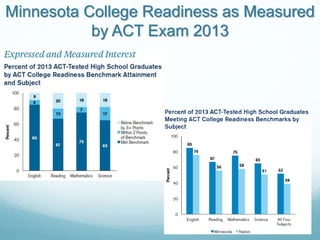
The status of STEM Education in MN
 Results of how students taking the ACT fared based on
interest and performance in STEM fields on 2013 ACT
exams.
 Differences in student interest and academic
performance shows more divergence when examined by
ethnicity.
 Results of this study did not explore if students had
previous schooling in STEM.
Minnesota College Readiness as Measured
by ACT Exam 2013
MN ACT Data by ethnicity & gender
“Essentially, stronger and earlier support structures and interventions
related to career and educational planning and academic preparedness
are needed to see real differences in these still troubling numbers.”
[College Board]
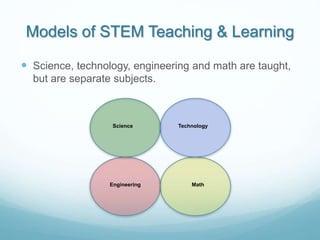
Models of STEM Teaching & Learning
 Science, technology, engineering and math are taught,
but are separate subjects.
Science
Engineering Math
Technology
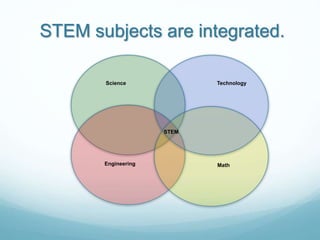
STEM subjects are integrated.
Science
Engineering Math
Technology
STEM
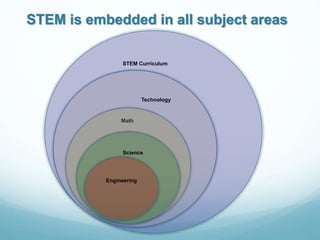
STEM is embedded in all subject areas
Math
Technology
STEM Curriculum
Science
Engineering
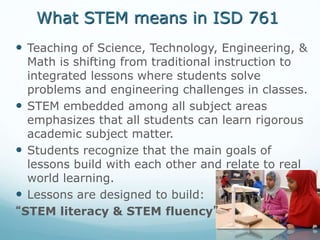
What STEM means in ISD 761
 Teaching of Science, Technology, Engineering, &
Math is shifting from traditional instruction to
integrated lessons where students solve
problems and engineering challenges in classes.
 STEM embedded among all subject areas
emphasizes that all students can learn rigorous
academic subject matter.
 Students recognize that the main goals of
lessons build with each other and relate to real
world learning.
 Lessons are designed to build:
“STEM literacy & STEM fluency”
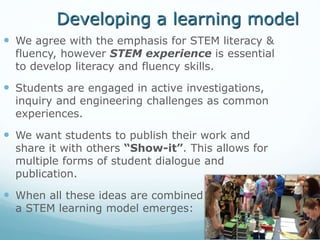
Developing a learning model
 We agree with the emphasis for STEM literacy &
fluency, however STEM experience is essential
to develop literacy and fluency skills.
 Students are engaged in active investigations,
inquiry and engineering challenges as common
experiences.
 We want students to publish their work and
share it with others “Show-it”. This allows for
multiple forms of student dialogue and
publication.
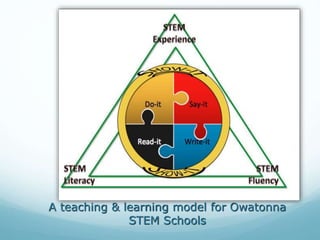
 When all these ideas are combined
a STEM learning model emerges:
A teaching & learning model for Owatonna
STEM Schools
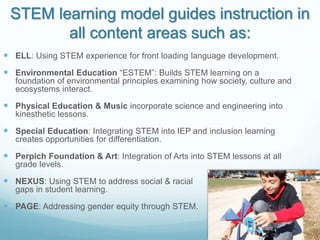
STEM learning model guides instruction in
all content areas such as:
 ELL: Using STEM experience for front loading language development.
 Environmental Education “ESTEM”: Builds STEM learning on a
foundation of environmental principles examining how society, culture and
ecosystems interact.
 Physical Education & Music incorporate science and engineering into
kinesthetic lessons.
 Special Education: Integrating STEM into IEP and inclusion learning
creates opportunities for differentiation.
 Perpich Foundation & Art: Integration of Arts into STEM lessons at all
grade levels.
 NEXUS: Using STEM to address social & racial achievement
gaps in student learning.
 PAGE: Addressing gender equity through STEM.
Measuring the Impacts of the Owatonna STEM
Education Initiative
 Student Attitudes Towards STEM interest survey using tool
developed by North Carolina University (NCU).
 STEM teaching efficacy survey also created by NCU School
of Education with a National Science Foundation Grant.
 NWEA and Dibels student academic growth data.
 MCA III proficiency scores, delineated by ethnicity and
gender for each grade level and STEM site.
 Community engagement and involvement
with STEM schools & ESTEM Teams
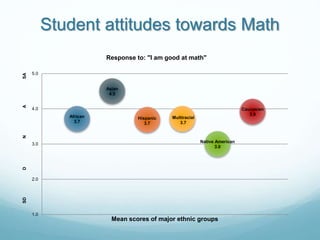
Student attitudes towards Math
African
3.7
Asian
4.5
Hispanic
3.7
Multiracial
3.7
Native American
3.0
Caucasian
3.9
1.0
2.0
3.0
4.0
5.0
SDDNASA
Mean scores of major ethnic groups
Response to: "I am good at math"
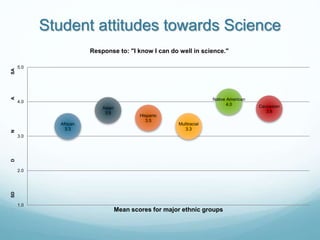
Student attitudes towards Science
African
3.3
Asian
3.8
Hispanic
3.5
Multiracial
3.3
Native American
4.0 Caucasian
3.8
1.0
2.0
3.0
4.0
5.0
SDDNASA
Mean scores for major ethnic groups
Response to: "I know I can do well in science."
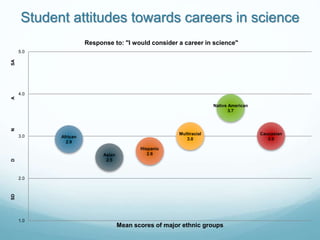
Student attitudes towards careers in science
African
2.9
Asian
2.5
Hispanic
2.6
Multiracial
3.0
Native American
3.7
Caucasian
3.0
1.0
2.0
3.0
4.0
5.0
SDDNASA
Mean scores of major ethnic groups
Response to: "I would consider a career in science"
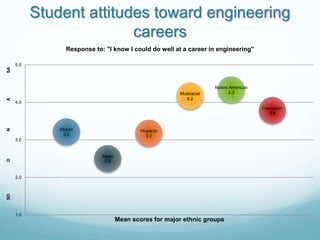
Student attitudes toward engineering
careers
African
3.2
Asian
2.5
Hispanic
3.2
Multiracial
4.2
Native American
4.3
Caucasian
3.8
1.0
2.0
3.0
4.0
5.0
SDDNASA
Mean scores for major ethnic groups
Response to: "I know I could do well at a career in engineering"
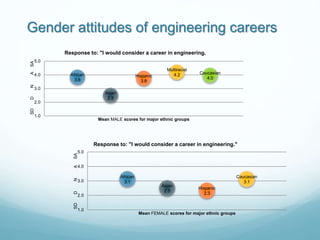
Gender attitudes of engineering careers
African
3.8
Asian
2.5
Hispanic
3.8
Multiracial
4.2 Caucasian
4.0
1.0
2.0
3.0
4.0
5.0
SDDNASA
Mean MALE scores for major ethnic groups
Response to: "I would consider a career in engineering.
African
3.1
Asian
2.5
Hispanic
2.3
Caucasian
3.1
1.0
2.0
3.0
4.0
5.0
SDDNASA
Mean FEMALE scores for major ethnic groups
Response to: "I would consider a career in engineering."
Responses from students on “Student
Attitudes Towards STEM Learning Survey
Prompt: “What did you learn this year that had an
impact on you?” & “What would you tell other students
about STEM?”
 4th Grade students at McKinley WORDLE of
response data:
Responses from students on “Student
Attitudes Towards STEM Learning Survey
Prompt: “What did you learn this year that had an
impact on you?” & “What would you tell other students
about STEM?”
 5th Grade students at McKinley WORDLE of
response data:
Responses from students on “Student
Attitudes Towards STEM Learning Survey
Prompt: “What did you learn this year that had an
impact on you?”
 6th Grade students at Willow Creek WORDLE of
response data:
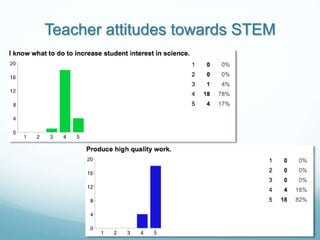
Teacher attitudes towards STEM
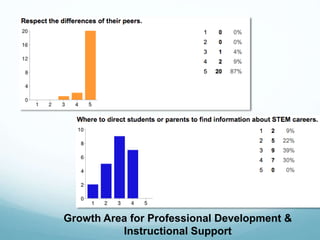
Growth Area for Professional Development &
Instructional Support
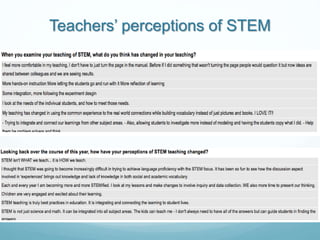
Teachers’ perceptions of STEM
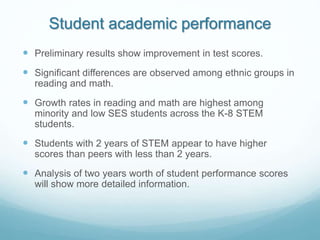
Student academic performance
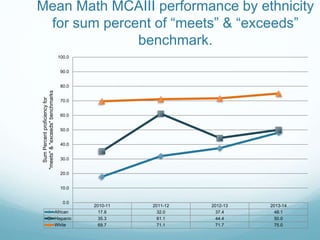
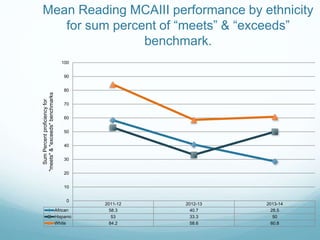
 Preliminary results show improvement in test scores.
 Significant differences are observed among ethnic groups in
reading and math.
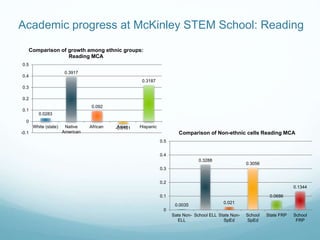
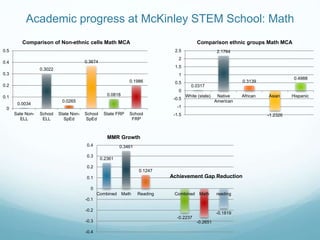
 Growth rates in reading and math are highest among
minority and low SES students across the K-8 STEM
students.
 Students with 2 years of STEM appear to have higher
scores than peers with less than 2 years.
 Analysis of two years worth of student performance scores
will show more detailed information.
Mean Math MCAIII performance by ethnicity
for sum percent of “meets” & “exceeds”
benchmark.
2010-11 2011-12 2012-13 2013-14
African 17.8 32.0 37.4 48.1
Hispanic 35.3 61.1 44.4 50.0
White 69.7 71.1 71.7 75.0
0.0
10.0
20.0
30.0
40.0
50.0
60.0
70.0
80.0
90.0
100.0
SumPercentproficiencyfor
"meets"&"exceeds"benchmarks
Mean Reading MCAIII performance by ethnicity
for sum percent of “meets” & “exceeds”
benchmark.
2011-12 2012-13 2013-14
African 58.3 40.7 28.5
Hispanic 53 33.3 50
White 84.2 58.6 60.8
0
10
20
30
40
50
60
70
80
90
100
SumPercentproficiencyfor
"meets"&"exceeds"benchmarks
Academic progress at McKinley STEM School: Reading
0.0035
0.3288
0.021
0.3056
0.0686
0.1344
0
0.1
0.2
0.3
0.4
0.5
Sate Non-
ELL
School ELL State Non-
SpEd
School
SpEd
State FRP School
FRP
Comparison of Non-ethnic cells Reading MCA
0.0283
0.3917
0.092
-0.0161
0.3187
-0.1
0
0.1
0.2
0.3
0.4
0.5
White (state) Native
American
African Asian Hispanic
Comparison of growth among ethnic groups:
Reading MCA
Academic progress at McKinley STEM School: Math
0.0034
0.3022
0.0265
0.3674
0.0818
0.1986
0
0.1
0.2
0.3
0.4
0.5
Sate Non-
ELL
School
ELL
State Non-
SpEd
School
SpEd
State FRP School
FRP
Comparison of Non-ethnic cells Math MCA
0.0317
2.1764
0.3139
-1.2326
0.4988
-1.5
-1
-0.5
0
0.5
1
1.5
2
2.5
White (state) Native
American
African Asian Hispanic
Comparison ethnic groups Math MCA
0.2361
0.3461
0.1247
-0.2237
-0.2651
-0.1819
-0.4
-0.3
-0.2
-0.1
0
0.1
0.2
0.3
0.4
Combined Math Reading Combined Math reading
MMR Growth
Achievement Gap Reduction
Questions?

Msta 2015

  • 1.
    What Happens WhenWe “STEMify” Our Schools? Mapping the direction of Owatonna’s STEM initiative. Tom Meagher, PhD District STEM Coordinator Owatonna Public Schools Owatonna, MN MnCOSE 2015
  • 2.
    The status ofSTEM Education in MN  Results of how students taking the ACT fared based on interest and performance in STEM fields on 2013 ACT exams.  Differences in student interest and academic performance shows more divergence when examined by ethnicity.  Results of this study did not explore if students had previous schooling in STEM.
  • 3.
    Minnesota College Readinessas Measured by ACT Exam 2013
  • 4.
    MN ACT Databy ethnicity & gender “Essentially, stronger and earlier support structures and interventions related to career and educational planning and academic preparedness are needed to see real differences in these still troubling numbers.” [College Board]
  • 5.
    Models of STEMTeaching & Learning  Science, technology, engineering and math are taught, but are separate subjects. Science Engineering Math Technology
  • 6.
    STEM subjects areintegrated. Science Engineering Math Technology STEM
  • 7.
    STEM is embeddedin all subject areas Math Technology STEM Curriculum Science Engineering
  • 8.
    What STEM meansin ISD 761  Teaching of Science, Technology, Engineering, & Math is shifting from traditional instruction to integrated lessons where students solve problems and engineering challenges in classes.  STEM embedded among all subject areas emphasizes that all students can learn rigorous academic subject matter.  Students recognize that the main goals of lessons build with each other and relate to real world learning.  Lessons are designed to build: “STEM literacy & STEM fluency”
  • 9.
    Developing a learningmodel  We agree with the emphasis for STEM literacy & fluency, however STEM experience is essential to develop literacy and fluency skills.  Students are engaged in active investigations, inquiry and engineering challenges as common experiences.  We want students to publish their work and share it with others “Show-it”. This allows for multiple forms of student dialogue and publication.  When all these ideas are combined a STEM learning model emerges:
  • 10.
    A teaching &learning model for Owatonna STEM Schools
  • 11.
    STEM learning modelguides instruction in all content areas such as:  ELL: Using STEM experience for front loading language development.  Environmental Education “ESTEM”: Builds STEM learning on a foundation of environmental principles examining how society, culture and ecosystems interact.  Physical Education & Music incorporate science and engineering into kinesthetic lessons.  Special Education: Integrating STEM into IEP and inclusion learning creates opportunities for differentiation.  Perpich Foundation & Art: Integration of Arts into STEM lessons at all grade levels.  NEXUS: Using STEM to address social & racial achievement gaps in student learning.  PAGE: Addressing gender equity through STEM.
  • 12.
    Measuring the Impactsof the Owatonna STEM Education Initiative  Student Attitudes Towards STEM interest survey using tool developed by North Carolina University (NCU).  STEM teaching efficacy survey also created by NCU School of Education with a National Science Foundation Grant.  NWEA and Dibels student academic growth data.  MCA III proficiency scores, delineated by ethnicity and gender for each grade level and STEM site.  Community engagement and involvement with STEM schools & ESTEM Teams
  • 13.
    Student attitudes towardsMath African 3.7 Asian 4.5 Hispanic 3.7 Multiracial 3.7 Native American 3.0 Caucasian 3.9 1.0 2.0 3.0 4.0 5.0 SDDNASA Mean scores of major ethnic groups Response to: "I am good at math"
  • 14.
    Student attitudes towardsScience African 3.3 Asian 3.8 Hispanic 3.5 Multiracial 3.3 Native American 4.0 Caucasian 3.8 1.0 2.0 3.0 4.0 5.0 SDDNASA Mean scores for major ethnic groups Response to: "I know I can do well in science."
  • 15.
    Student attitudes towardscareers in science African 2.9 Asian 2.5 Hispanic 2.6 Multiracial 3.0 Native American 3.7 Caucasian 3.0 1.0 2.0 3.0 4.0 5.0 SDDNASA Mean scores of major ethnic groups Response to: "I would consider a career in science"
  • 16.
    Student attitudes towardengineering careers African 3.2 Asian 2.5 Hispanic 3.2 Multiracial 4.2 Native American 4.3 Caucasian 3.8 1.0 2.0 3.0 4.0 5.0 SDDNASA Mean scores for major ethnic groups Response to: "I know I could do well at a career in engineering"
  • 17.
    Gender attitudes ofengineering careers African 3.8 Asian 2.5 Hispanic 3.8 Multiracial 4.2 Caucasian 4.0 1.0 2.0 3.0 4.0 5.0 SDDNASA Mean MALE scores for major ethnic groups Response to: "I would consider a career in engineering. African 3.1 Asian 2.5 Hispanic 2.3 Caucasian 3.1 1.0 2.0 3.0 4.0 5.0 SDDNASA Mean FEMALE scores for major ethnic groups Response to: "I would consider a career in engineering."
  • 18.
    Responses from studentson “Student Attitudes Towards STEM Learning Survey Prompt: “What did you learn this year that had an impact on you?” & “What would you tell other students about STEM?”  4th Grade students at McKinley WORDLE of response data:
  • 19.
    Responses from studentson “Student Attitudes Towards STEM Learning Survey Prompt: “What did you learn this year that had an impact on you?” & “What would you tell other students about STEM?”  5th Grade students at McKinley WORDLE of response data:
  • 20.
    Responses from studentson “Student Attitudes Towards STEM Learning Survey Prompt: “What did you learn this year that had an impact on you?”  6th Grade students at Willow Creek WORDLE of response data:
  • 21.
  • 22.
    Growth Area forProfessional Development & Instructional Support
  • 23.
  • 24.
    Student academic performance Preliminary results show improvement in test scores.  Significant differences are observed among ethnic groups in reading and math.  Growth rates in reading and math are highest among minority and low SES students across the K-8 STEM students.  Students with 2 years of STEM appear to have higher scores than peers with less than 2 years.  Analysis of two years worth of student performance scores will show more detailed information.
  • 25.
    Mean Math MCAIIIperformance by ethnicity for sum percent of “meets” & “exceeds” benchmark. 2010-11 2011-12 2012-13 2013-14 African 17.8 32.0 37.4 48.1 Hispanic 35.3 61.1 44.4 50.0 White 69.7 71.1 71.7 75.0 0.0 10.0 20.0 30.0 40.0 50.0 60.0 70.0 80.0 90.0 100.0 SumPercentproficiencyfor "meets"&"exceeds"benchmarks
  • 26.
    Mean Reading MCAIIIperformance by ethnicity for sum percent of “meets” & “exceeds” benchmark. 2011-12 2012-13 2013-14 African 58.3 40.7 28.5 Hispanic 53 33.3 50 White 84.2 58.6 60.8 0 10 20 30 40 50 60 70 80 90 100 SumPercentproficiencyfor "meets"&"exceeds"benchmarks
  • 27.
    Academic progress atMcKinley STEM School: Reading 0.0035 0.3288 0.021 0.3056 0.0686 0.1344 0 0.1 0.2 0.3 0.4 0.5 Sate Non- ELL School ELL State Non- SpEd School SpEd State FRP School FRP Comparison of Non-ethnic cells Reading MCA 0.0283 0.3917 0.092 -0.0161 0.3187 -0.1 0 0.1 0.2 0.3 0.4 0.5 White (state) Native American African Asian Hispanic Comparison of growth among ethnic groups: Reading MCA
  • 28.
    Academic progress atMcKinley STEM School: Math 0.0034 0.3022 0.0265 0.3674 0.0818 0.1986 0 0.1 0.2 0.3 0.4 0.5 Sate Non- ELL School ELL State Non- SpEd School SpEd State FRP School FRP Comparison of Non-ethnic cells Math MCA 0.0317 2.1764 0.3139 -1.2326 0.4988 -1.5 -1 -0.5 0 0.5 1 1.5 2 2.5 White (state) Native American African Asian Hispanic Comparison ethnic groups Math MCA 0.2361 0.3461 0.1247 -0.2237 -0.2651 -0.1819 -0.4 -0.3 -0.2 -0.1 0 0.1 0.2 0.3 0.4 Combined Math Reading Combined Math reading MMR Growth Achievement Gap Reduction
  • 29.