What is PISA ?
➢ PISA is the OECD’s (Organization for Economic Co-
operation and Development) Programme for International
Student Assessment.
➢ Every three years , 15-year-old students are tested
globally in reading, mathematics and science.
➢ Designed to gauge how well the students master the
key subjects in order to be prepared for real-life situations
➢ KVS,NVS & schools in the UT of Chandigarh will
participate.
➢After 2009, India will participate in 2021 for the
second time
❑Unlike content-based assessment, it measures acquired key
competencies essential for full participation in modern societies.
❑Lead to prepare Indian students for the global economy.
❑ To help move away from rote learning.
❑ CBSE and NCERT will be part of the process and activities
leading to the actual test.
What does PISA assess?
PISA assesses three key areas of knowledge and skills –
Reading, Mathematical and Scientific Literacy.
The term ‘literacy’ captures the “capacity of students to apply
knowledge and skills in key subject areas and to analyze, reason and
communicate.
In the year 2000, the focus was on reading which allowed us to get
more in-depth information on the students' reading skills.
Collaborative problem solving in 2015 and
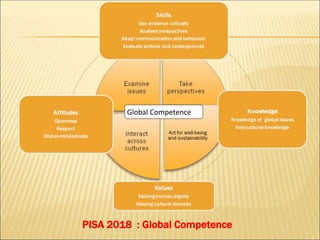
Global competence in 2018.
Global Competence
PISA 2018 : Global Competence
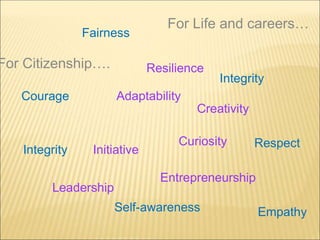
For Life and careers…
For Citizenship….
Fairness
Integrity
Respect
Integrity
Self-awareness
Courage
Empathy
Resilience
Adaptability
Curiosity
Initiative
Leadership
Creativity
Entrepreneurship
master
With guidelines for corporate presentations
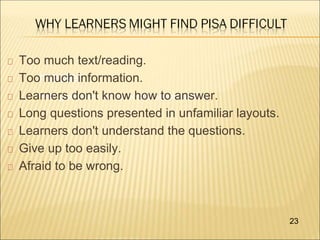
Too much text/reading.
Too much information.
Learners don't know how to answer.
Long questions presented in unfamiliar layouts.
Learners don't understand the questions.
Give up too easily.
Afraid to be wrong.
23
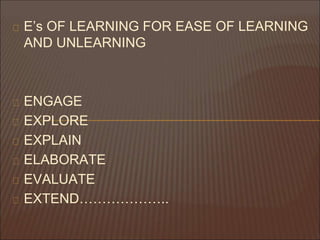
E’s OF LEARNING FOR EASE OF LEARNING
AND UNLEARNING
ENGAGE
EXPLORE
EXPLAIN
ELABORATE
EVALUATE
EXTEND………………..
Identify the main idea, explain the purpose of the text, etc.
Retrieving RELEVANT information
Developing an interpretation
Reflecting on the content of text
Reflecting on the form of a text (15%) — Evaluate its quality and
appropriateness.
The learner will be able to:
i) Locate Information: In questions testing this process, students
need to find and extract a specific piece of information explicitly
stated in the text.
ii) Grasp ideas and interpret – In these items, the students need
to demonstrate that they have understood an idea being conveyed
in the text and have interpreted it correctly.
iii) Infer and evaluate – In these items, the students need to
demonstrate understanding beyond the information and/or ideas
stated explicitly in the text.
iv) Summarize main and supporting ideas and make connections
between them.
Learning Competencies to be Enhanced i) Reading text graphics
ii) Creative thinking iii) Critical thinking iv) Managing and retrieving
information
Learning Dimensions Explored i) Environmental ii) Mathematical
iii) Art
PISA distinguishes four types of reading situations:
For personal/private use (28%) — includes personal letters, fiction,
reading for pleasure.
Public use (28%) — includes official documents, information
about public events.
Work/occupational (16%) — reading related to the work world.
Education (28%) — includes school assignments, reading to learn.
It is measured on three scales:
Retrieving information
Interpreting text
Reflection and evaluation
Capacity of an individual to effectively engage in a process
whereby two or more agents attempt to solve a problem by
sharing the understanding and effort required to come to a
solution and pooling their knowledge, skills and efforts to
reach that solution.
Focus Skills: Creativity, Thinking, Analysis , Decision
,Problem Solving
Collaborative Problem Solving
1. QUESTIONS ARE OFTEN LENGTHY
That tend to distract the aspirant from extracting the main point out of the text.
2. INTEGRATED QUESTIONS
The questions of reading assessment may also have aspects of mathematics as well as that of science, so as to
test the aspirant holistically.
3. INCLUSION OF DATA INTERPRETATION
Stress/emphasis is laid on assessing the ability to read such map, chart or table and draw inferences on their
basis. Beyond that the aspirant would also be required to analyze the input data and interpret it in order
to attempt the questions successfully.
4. OPEN ENDED QUESTIONS
The main objective of organizing this test/Assessment is to prepare the students to apply their acquired
knowledge in real life situations.
5. SURPRISE ELEMENT
As described by educational psychologists, we read a text and understand its meaning/interpret its information
under a determined mental setup. The text of the question would be so devised that till the end one would
not be able to realize which part of the question text would be required to formulate the correct response.
6. USE OF DISTRACTING LANGUAGE
The unusual language and sentence form may sometimes distract the aspirants
and hamper their understanding as well as enhance the difficulty level but as a
result develops their ability to filter the actual information required out of the
lot.
7. OUT OF BOX THINKING
The questions in all the three sections have this feature that an aspirant is bound
to find solutions by thinking on a deviated line rather than the ordinary way of
thinking.
The solution of the questions could be very simple but the twisted/tricky
language may obscure the solution unless a different approach is taken to arrive
at the appropriate solution.
SUGGESTIONS TO THE STUDENTS:
Ø Always read the information for each task carefully.
Ø Reread each task question and any accompanying text before attempting an answer.
Ø Give each question a try, even when you’re not sure.
Ø Remember, partial value is given for partially correct answers.
Ø Interpretive, reflective, and evaluative questions are those that begin with Why?
Why do you think ...?
How do you know ...?
One– or two–word answers are insufficient. Reasons, usually with reference to
the task, are required.
Often the word “because” is used in the response.
Ø Develop a methodical process of elimination of the alternatives in multiple-
choice questions. When the list is narrowed to the best possible answers, choose
one.
Ø There is no penalty for wrong choices.
INSTRUCTIONS TO BE GIVEN TO THE STUDENTS:
· Students will be expected to select, read, and view with understanding a
range of literature, information, media, and visual texts.
· Seek meaning in reading, using a variety of strategies such as cueing
systems, utilizing prior knowledge, analyzing, inferring, predicting,
synthesizing and evaluating.
· Students will be expected to interpret, select, and combine information,
using a variety of strategies, resources, and technologies.
· Select appropriate information to meet the requirements of a learning
task.
· Students will be expected to respond personally to a range of texts.
· Respond to the texts they are reading and viewing by questioning
connecting, evaluating, and extending.
· Students will be expected to respond critically to a range of texts,
applying their understanding of language, form, and genre.
· Make inferences, draw conclusions, and make supported responses to
content, form, and structure.
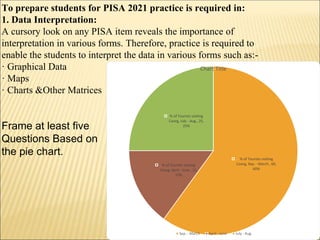
To prepare students for PISA 2021 practice is required in:
1. Data Interpretation:
A cursory look on any PISA item reveals the importance of
interpretation in various forms. Therefore, practice is required to
enable the students to interpret the data in various forms such as:-
· Graphical Data
· Maps
· Charts &Other Matrices
Frame at least five
Questions Based on
the pie chart. % of Tourists visiting
Coorg, Sep. - March , 60,
60%
% of Tourists visiting
Coorg, April - June , 15,
15%
% of Tourists visiting
Coorg, July - Aug., 25,
25%
Chart Title
Sep. - March April - June July - Aug.
2. Reading and Comprehension:
PISA items are quite lengthy in nature. Hence, students should have the ability
to read fast and comprehend the subject content quickly.
3. Activities based on silent reading:
There are many forms of reading such as abstracting, scanning, skimming,
reading between lines, distinguishing between relevance and irrelevance.
Hence, students should be exposed to all the possible aspects of silent reading.
4. Note Making:
Making notes while reading a large passage requires identifying the topic
sentence, keywords, subtitles reference points etc.
5. Puzzle and Riddles:
Puzzles require thinking out of the box and improving lateral thinking. Crossword
puzzles enhance word power. Activities like Sudoku enhance the mathematical acumen
of the child.
6. Surveying:
Activities on surveying will enhance experiential learning of a child and help in
attempting PISA.
7. Report Writing:
Mastery on report writing will help the children in tackling questions requiring various
forms of expressions.
8. Reference Skills:
Ability to refer a dictionary, atlas, bibliographies and encyclopedias, indices etc will
make their task accomplishment faster and more accurate.
9. Hands on activities: Hands on activities may include experiments , practicals,
projects, outdoor activities, visual and performing arts, use of geometry box, BALA
etc. These may enhance child’s ability to express and use his or her intelligence
both in emotional & cognitive domains.
INTEGRATION OF GRAMMAR : Role Play ; (A family planning to visit
Coorg/Hotel reception Inquiry)
10. Question Making: Rubrics of PISA items are quite different from questions
generally encountered by our students. Hence, they should be asked to design
question papers on specific learning outcomes and context.
MIDWAY between Mysore and the coastal town of Mangalore sits
a piece of heaven that must have drifted from the kingdom of god.
This land of rolling hills is inhabited by a proud race of martial
men, beautiful women and wild creatures. Coorg, or Kodagu, the
smallest district of Karnataka, is home to evergreen rainforests,
spices and coffee plantations. Evergreen rainforests cover thirty
per cent of this district. During the monsoons, it pours enough to
keep many visitors away. The season of joy commences from
September and continues till March. The weather is perfect, with
some showers thrown in for good measure. The air breathes of
invigorating coffee. Coffee estates and colonial bungalows stand
tucked under tree canopies in prime corners. The fiercely
independent people of Coorg are possibly of Greek or Arabic
descent. As one story goes, a part of Alexander’s army moved
south along the coast and settled here when return became
impractical. These people married amongst the locals and their
culture is apparent in the martial traditions, marriage and religious
rites, which are distinct from the Hindu mainstream. The theory of
Arab origin draws support from the long, black coat with an
embroidered waist-belt worn by the Kodavus.
http://www.ncert.nic.in/ncerts/l/jeff107.pdf
Known as kuppia, it resembles the kuffia worn by the Arabs and the
Kurds. Coorgi homes have a tradition of hospitality, and they are more
than willing to recount numerous tales of valour related to their sons and
fathers. The Coorg Regiment is one of the most decorated in the Indian
Army, and the first Chief of the Indian Army, General Cariappa, was a
Coorgi. Even now, Kodavus are the only people in India permitted to
carry firearms without a licence. The river, Kaveri, obtains its water from
the hills and forests of Coorg. Mahaseer — a large freshwater fish —
abound in these waters. Kingfishers dive for their catch, while squirrels
and langurs drop partially eaten fruit for the mischief of enjoying the
splash and the ripple effect in the clear water. Elephants enjoy being
bathed and scrubbed in the river by their mahouts. The most laidback
individuals become converts to the life of high-energy adventure with
river rafting, canoeing, rappelling, rock climbing and mountain biking.
Numerous walking trails in this region are a favourite with trekkers. Birds,
bees and butterflies are there to give you company. Macaques, Malabar
squirrels, langurs and slender loris keep a watchful eye from the tree
canopy. I do, however, prefer to step aside for wild elephants. The climb
to the Brahmagiri hills brings you into a panoramic view of the entire
misty landscape of Coorg. A walk across the rope bridge leads to the
sixty-four-acre island of Nisargadhama. Running into Buddhist monks
from India’s largest Tibetan settlement, at nearby Bylakuppe, is a bonus.
The monks, in red, ochre and yellow robes, are amongst the many
surprises that wait to be discovered by visitors searching for the heart
and soul of India, right here in Coorg.
MCQs are prepared on.
CONVENTIONAL APPROACH
1. Where is Coorg?
2. What is the story about the Kodavu people’s
descent?
PISA APPROACH
Locate Coorg on Map with the help of a scale.
APPROACHES
Activities based on silent reading:
abstracting,
scanning,
skimming,
distinguishing between relevance and irrelevance. (You are travelling to Coorg with your
father in a car. You witness a landslide that has blocked the road. What will you do?)
Decision Making : You learn that your mother has fallen sick but the hotel bookings and
tickets are already confirmed after a heavy investment.What will you do now?
Problem Solving : Your brother has lost his way while on a trip.Your mother is too
worried.What will you do?
Creative thinking : What measures should be initiated to keep the tourist places clean?
Reading between lines (Example :MIDWAY between
Mysore and the coastal town of Mangalore sits a piece of
heaven that must have drifted from the kingdom of god.
Frame a sentence using ‘BETWEEN’.
Find the conjunctions given in the sentence.)
SILENT READING
Google
NCERT
CBSE
REFERENCE(S) :
COMPILED BY :
Rajesh Vashisth kvsguru
KENDRIYA VIDYALAYA SANGATHAN

Programme for International Student Assessment

  • 1.
    What is PISA? ➢ PISA is the OECD’s (Organization for Economic Co- operation and Development) Programme for International Student Assessment. ➢ Every three years , 15-year-old students are tested globally in reading, mathematics and science. ➢ Designed to gauge how well the students master the key subjects in order to be prepared for real-life situations ➢ KVS,NVS & schools in the UT of Chandigarh will participate. ➢After 2009, India will participate in 2021 for the second time
  • 2.
    ❑Unlike content-based assessment,it measures acquired key competencies essential for full participation in modern societies. ❑Lead to prepare Indian students for the global economy. ❑ To help move away from rote learning. ❑ CBSE and NCERT will be part of the process and activities leading to the actual test.
  • 3.
    What does PISAassess? PISA assesses three key areas of knowledge and skills – Reading, Mathematical and Scientific Literacy. The term ‘literacy’ captures the “capacity of students to apply knowledge and skills in key subject areas and to analyze, reason and communicate. In the year 2000, the focus was on reading which allowed us to get more in-depth information on the students' reading skills. Collaborative problem solving in 2015 and Global competence in 2018.
  • 4.
    Global Competence PISA 2018: Global Competence
  • 5.
    For Life andcareers… For Citizenship…. Fairness Integrity Respect Integrity Self-awareness Courage Empathy Resilience Adaptability Curiosity Initiative Leadership Creativity Entrepreneurship
  • 6.
    master With guidelines forcorporate presentations Too much text/reading. Too much information. Learners don't know how to answer. Long questions presented in unfamiliar layouts. Learners don't understand the questions. Give up too easily. Afraid to be wrong. 23
  • 7.
    E’s OF LEARNINGFOR EASE OF LEARNING AND UNLEARNING ENGAGE EXPLORE EXPLAIN ELABORATE EVALUATE EXTEND………………..
  • 8.
    Identify the mainidea, explain the purpose of the text, etc. Retrieving RELEVANT information Developing an interpretation Reflecting on the content of text Reflecting on the form of a text (15%) — Evaluate its quality and appropriateness.
  • 9.
    The learner willbe able to: i) Locate Information: In questions testing this process, students need to find and extract a specific piece of information explicitly stated in the text. ii) Grasp ideas and interpret – In these items, the students need to demonstrate that they have understood an idea being conveyed in the text and have interpreted it correctly. iii) Infer and evaluate – In these items, the students need to demonstrate understanding beyond the information and/or ideas stated explicitly in the text. iv) Summarize main and supporting ideas and make connections between them. Learning Competencies to be Enhanced i) Reading text graphics ii) Creative thinking iii) Critical thinking iv) Managing and retrieving information Learning Dimensions Explored i) Environmental ii) Mathematical iii) Art
  • 10.
    PISA distinguishes fourtypes of reading situations: For personal/private use (28%) — includes personal letters, fiction, reading for pleasure. Public use (28%) — includes official documents, information about public events. Work/occupational (16%) — reading related to the work world. Education (28%) — includes school assignments, reading to learn.
  • 11.
    It is measuredon three scales: Retrieving information Interpreting text Reflection and evaluation
  • 12.
    Capacity of anindividual to effectively engage in a process whereby two or more agents attempt to solve a problem by sharing the understanding and effort required to come to a solution and pooling their knowledge, skills and efforts to reach that solution. Focus Skills: Creativity, Thinking, Analysis , Decision ,Problem Solving Collaborative Problem Solving
  • 13.
    1. QUESTIONS AREOFTEN LENGTHY That tend to distract the aspirant from extracting the main point out of the text. 2. INTEGRATED QUESTIONS The questions of reading assessment may also have aspects of mathematics as well as that of science, so as to test the aspirant holistically. 3. INCLUSION OF DATA INTERPRETATION Stress/emphasis is laid on assessing the ability to read such map, chart or table and draw inferences on their basis. Beyond that the aspirant would also be required to analyze the input data and interpret it in order to attempt the questions successfully. 4. OPEN ENDED QUESTIONS The main objective of organizing this test/Assessment is to prepare the students to apply their acquired knowledge in real life situations. 5. SURPRISE ELEMENT As described by educational psychologists, we read a text and understand its meaning/interpret its information under a determined mental setup. The text of the question would be so devised that till the end one would not be able to realize which part of the question text would be required to formulate the correct response.
  • 14.
    6. USE OFDISTRACTING LANGUAGE The unusual language and sentence form may sometimes distract the aspirants and hamper their understanding as well as enhance the difficulty level but as a result develops their ability to filter the actual information required out of the lot. 7. OUT OF BOX THINKING The questions in all the three sections have this feature that an aspirant is bound to find solutions by thinking on a deviated line rather than the ordinary way of thinking. The solution of the questions could be very simple but the twisted/tricky language may obscure the solution unless a different approach is taken to arrive at the appropriate solution.
  • 15.
    SUGGESTIONS TO THESTUDENTS: Ø Always read the information for each task carefully. Ø Reread each task question and any accompanying text before attempting an answer. Ø Give each question a try, even when you’re not sure. Ø Remember, partial value is given for partially correct answers. Ø Interpretive, reflective, and evaluative questions are those that begin with Why? Why do you think ...? How do you know ...? One– or two–word answers are insufficient. Reasons, usually with reference to the task, are required. Often the word “because” is used in the response. Ø Develop a methodical process of elimination of the alternatives in multiple- choice questions. When the list is narrowed to the best possible answers, choose one. Ø There is no penalty for wrong choices.
  • 16.
    INSTRUCTIONS TO BEGIVEN TO THE STUDENTS: · Students will be expected to select, read, and view with understanding a range of literature, information, media, and visual texts. · Seek meaning in reading, using a variety of strategies such as cueing systems, utilizing prior knowledge, analyzing, inferring, predicting, synthesizing and evaluating. · Students will be expected to interpret, select, and combine information, using a variety of strategies, resources, and technologies. · Select appropriate information to meet the requirements of a learning task. · Students will be expected to respond personally to a range of texts. · Respond to the texts they are reading and viewing by questioning connecting, evaluating, and extending. · Students will be expected to respond critically to a range of texts, applying their understanding of language, form, and genre. · Make inferences, draw conclusions, and make supported responses to content, form, and structure.
  • 17.
    To prepare studentsfor PISA 2021 practice is required in: 1. Data Interpretation: A cursory look on any PISA item reveals the importance of interpretation in various forms. Therefore, practice is required to enable the students to interpret the data in various forms such as:- · Graphical Data · Maps · Charts &Other Matrices Frame at least five Questions Based on the pie chart. % of Tourists visiting Coorg, Sep. - March , 60, 60% % of Tourists visiting Coorg, April - June , 15, 15% % of Tourists visiting Coorg, July - Aug., 25, 25% Chart Title Sep. - March April - June July - Aug.
  • 18.
    2. Reading andComprehension: PISA items are quite lengthy in nature. Hence, students should have the ability to read fast and comprehend the subject content quickly. 3. Activities based on silent reading: There are many forms of reading such as abstracting, scanning, skimming, reading between lines, distinguishing between relevance and irrelevance. Hence, students should be exposed to all the possible aspects of silent reading. 4. Note Making: Making notes while reading a large passage requires identifying the topic sentence, keywords, subtitles reference points etc.
  • 19.
    5. Puzzle andRiddles: Puzzles require thinking out of the box and improving lateral thinking. Crossword puzzles enhance word power. Activities like Sudoku enhance the mathematical acumen of the child. 6. Surveying: Activities on surveying will enhance experiential learning of a child and help in attempting PISA. 7. Report Writing: Mastery on report writing will help the children in tackling questions requiring various forms of expressions. 8. Reference Skills: Ability to refer a dictionary, atlas, bibliographies and encyclopedias, indices etc will make their task accomplishment faster and more accurate. 9. Hands on activities: Hands on activities may include experiments , practicals, projects, outdoor activities, visual and performing arts, use of geometry box, BALA etc. These may enhance child’s ability to express and use his or her intelligence both in emotional & cognitive domains. INTEGRATION OF GRAMMAR : Role Play ; (A family planning to visit Coorg/Hotel reception Inquiry) 10. Question Making: Rubrics of PISA items are quite different from questions generally encountered by our students. Hence, they should be asked to design question papers on specific learning outcomes and context.
  • 20.
    MIDWAY between Mysoreand the coastal town of Mangalore sits a piece of heaven that must have drifted from the kingdom of god. This land of rolling hills is inhabited by a proud race of martial men, beautiful women and wild creatures. Coorg, or Kodagu, the smallest district of Karnataka, is home to evergreen rainforests, spices and coffee plantations. Evergreen rainforests cover thirty per cent of this district. During the monsoons, it pours enough to keep many visitors away. The season of joy commences from September and continues till March. The weather is perfect, with some showers thrown in for good measure. The air breathes of invigorating coffee. Coffee estates and colonial bungalows stand tucked under tree canopies in prime corners. The fiercely independent people of Coorg are possibly of Greek or Arabic descent. As one story goes, a part of Alexander’s army moved south along the coast and settled here when return became impractical. These people married amongst the locals and their culture is apparent in the martial traditions, marriage and religious rites, which are distinct from the Hindu mainstream. The theory of Arab origin draws support from the long, black coat with an embroidered waist-belt worn by the Kodavus. http://www.ncert.nic.in/ncerts/l/jeff107.pdf
  • 21.
    Known as kuppia,it resembles the kuffia worn by the Arabs and the Kurds. Coorgi homes have a tradition of hospitality, and they are more than willing to recount numerous tales of valour related to their sons and fathers. The Coorg Regiment is one of the most decorated in the Indian Army, and the first Chief of the Indian Army, General Cariappa, was a Coorgi. Even now, Kodavus are the only people in India permitted to carry firearms without a licence. The river, Kaveri, obtains its water from the hills and forests of Coorg. Mahaseer — a large freshwater fish — abound in these waters. Kingfishers dive for their catch, while squirrels and langurs drop partially eaten fruit for the mischief of enjoying the splash and the ripple effect in the clear water. Elephants enjoy being bathed and scrubbed in the river by their mahouts. The most laidback individuals become converts to the life of high-energy adventure with river rafting, canoeing, rappelling, rock climbing and mountain biking. Numerous walking trails in this region are a favourite with trekkers. Birds, bees and butterflies are there to give you company. Macaques, Malabar squirrels, langurs and slender loris keep a watchful eye from the tree canopy. I do, however, prefer to step aside for wild elephants. The climb to the Brahmagiri hills brings you into a panoramic view of the entire misty landscape of Coorg. A walk across the rope bridge leads to the sixty-four-acre island of Nisargadhama. Running into Buddhist monks from India’s largest Tibetan settlement, at nearby Bylakuppe, is a bonus. The monks, in red, ochre and yellow robes, are amongst the many surprises that wait to be discovered by visitors searching for the heart and soul of India, right here in Coorg. MCQs are prepared on.
  • 22.
    CONVENTIONAL APPROACH 1. Whereis Coorg? 2. What is the story about the Kodavu people’s descent? PISA APPROACH Locate Coorg on Map with the help of a scale. APPROACHES
  • 23.
    Activities based onsilent reading: abstracting, scanning, skimming, distinguishing between relevance and irrelevance. (You are travelling to Coorg with your father in a car. You witness a landslide that has blocked the road. What will you do?) Decision Making : You learn that your mother has fallen sick but the hotel bookings and tickets are already confirmed after a heavy investment.What will you do now? Problem Solving : Your brother has lost his way while on a trip.Your mother is too worried.What will you do? Creative thinking : What measures should be initiated to keep the tourist places clean? Reading between lines (Example :MIDWAY between Mysore and the coastal town of Mangalore sits a piece of heaven that must have drifted from the kingdom of god. Frame a sentence using ‘BETWEEN’. Find the conjunctions given in the sentence.) SILENT READING
  • 24.
    Google NCERT CBSE REFERENCE(S) : COMPILED BY: Rajesh Vashisth kvsguru KENDRIYA VIDYALAYA SANGATHAN