1
Profile
English 1013 Last Updated: 18 August 2014
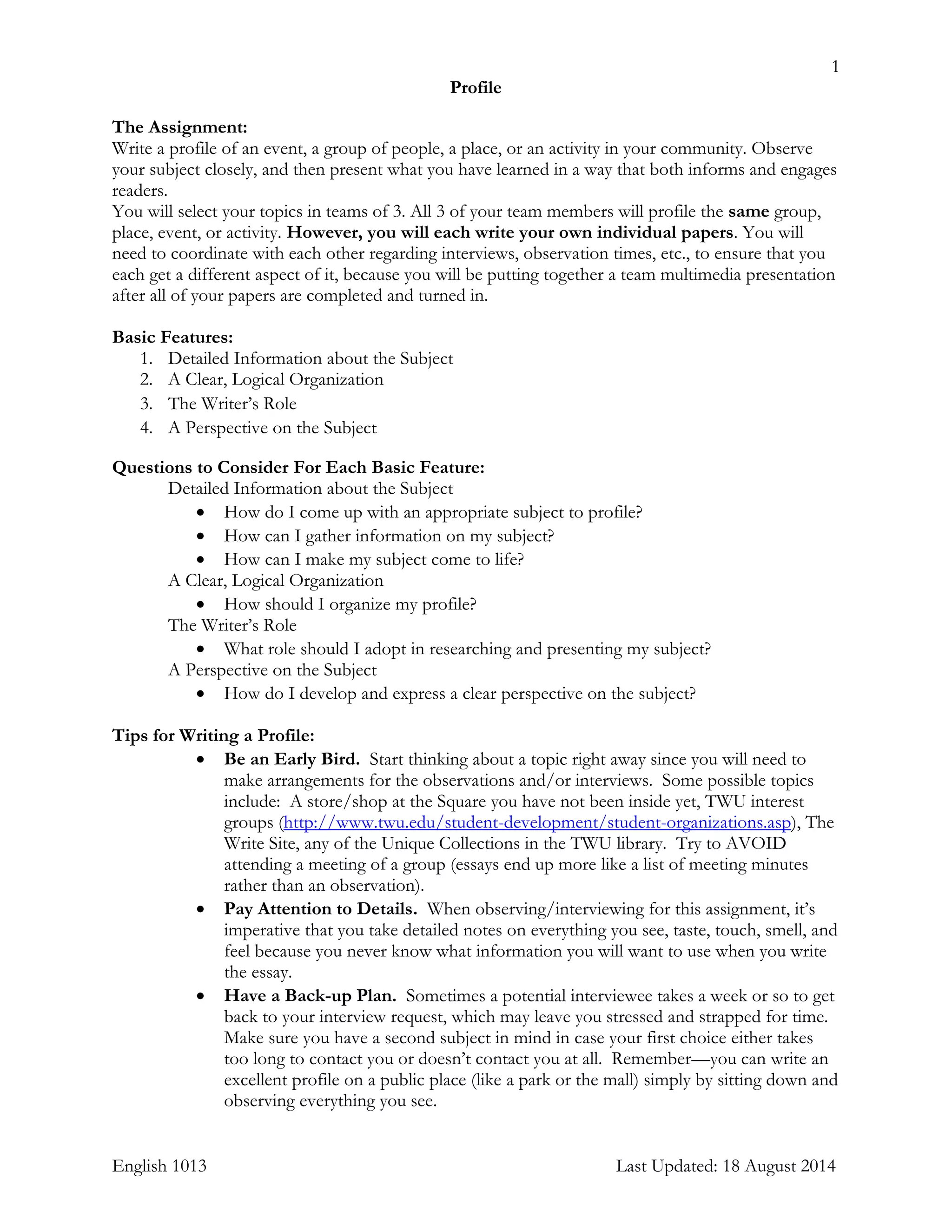
The Assignment:
Write a profile of an event, a group of people, a place, or an activity in your community. Observe
your subject closely, and then present what you have learned in a way that both informs and engages
readers.
You will select your topics in teams of 3. All 3 of your team members will profile the same group,
place, event, or activity. However, you will each write your own individual papers. You will
need to coordinate with each other regarding interviews, observation times, etc., to ensure that you
each get a different aspect of it, because you will be putting together a team multimedia presentation
after all of your papers are completed and turned in.
Basic Features:
1. Detailed Information about the Subject
2. A Clear, Logical Organization
3. The Writer’s Role
4. A Perspective on the Subject
Questions to Consider For Each Basic Feature:
Detailed Information about the Subject
 How do I come up with an appropriate subject to profile?
 How can I gather information on my subject?
 How can I make my subject come to life?
A Clear, Logical Organization
 How should I organize my profile?
The Writer’s Role
 What role should I adopt in researching and presenting my subject?
A Perspective on the Subject
 How do I develop and express a clear perspective on the subject?
Tips for Writing a Profile:
 Be an Early Bird. Start thinking about a topic right away since you will need to
make arrangements for the observations and/or interviews. Some possible topics
include: A store/shop at the Square you have not been inside yet, TWU interest
groups (http://www.twu.edu/student-development/student-organizations.asp), The
Write Site, any of the Unique Collections in the TWU library. Try to AVOID
attending a meeting of a group (essays end up more like a list of meeting minutes
rather than an observation).
 Pay Attention to Details. When observing/interviewing for this assignment, it’s
imperative that you take detailed notes on everything you see, taste, touch, smell, and
feel because you never know what information you will want to use when you write
the essay.
 Have a Back-up Plan. Sometimes a potential interviewee takes a week or so to get
back to your interview request, which may leave you stressed and strapped for time.
Make sure you have a second subject in mind in case your first choice either takes
too long to contact you or doesn’t contact you at all. Remember—you can write an
excellent profile on a public place (like a park or the mall) simply by sitting down and
observing everything you see.
2
Profile
English 1013 Last Updated: 18 August 2014
 Stay Local. Due to time constraints, try to pick a topic that is locally-based and is
easily accessible. Sure, we would all love to interview our favorite movie stars, but
there isn’t much time to make this happen. Just because something or someone is
well known doesn’t mean that they are more interesting than everyone else.
Sometimes the most interesting places/people are the ones right outside your door.
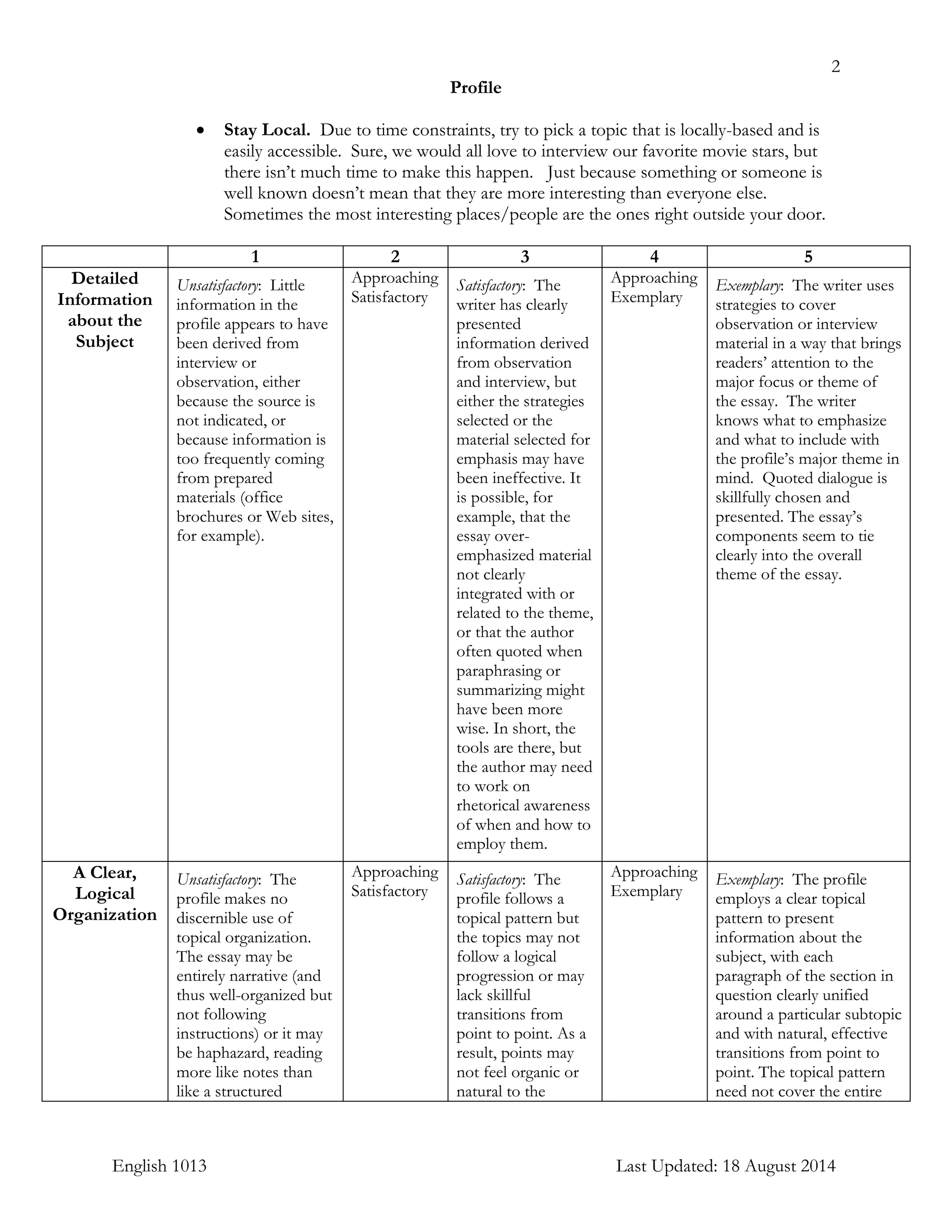
1 2 3 4 5
Detailed
Information
about the
Subject
Unsatisfactory: Little
information in the
profile appears to have
been derived from
interview or
observation, either
because the source is
not indicated, or
because information is
too frequently coming
from prepared
materials (office
brochures or Web sites,
for example).
Approaching
Satisfactory
Satisfactory: The
writer has clearly
presented
information derived
from observation
and interview, but
either the strategies
selected or the
material selected for
emphasis may have
been ineffective. It
is possible, for
example, that the
essay over-
emphasized material
not clearly
integrated with or
related to the theme,
or that the author
often quoted when
paraphrasing or
summarizing might
have been more
wise. In short, the
tools are there, but
the author may need
to work on
rhetorical awareness
of when and how to
employ them.
Approaching
Exemplary
Exemplary: The writer uses
strategies to cover
observation or interview
material in a way that brings
readers’ attention to the
major focus or theme of
the essay. The writer
knows what to emphasize
and what to include with
the profile’s major theme in
mind. Quoted dialogue is
skillfully chosen and
presented. The essay’s
components seem to tie
clearly into the overall
theme of the essay.
A Clear,
Logical
Organization
Unsatisfactory: The
profile makes no
discernible use of
topical organization.
The essay may be
entirely narrative (and
thus well-organized but
not following
instructions) or it may
be haphazard, reading
more like notes than
like a structured
Approaching
Satisfactory
Satisfactory: The
profile follows a
topical pattern but
the topics may not
follow a logical
progression or may
lack skillful
transitions from
point to point. As a
result, points may
not feel organic or
natural to the
Approaching
Exemplary
Exemplary: The profile
employs a clear topical
pattern to present
information about the
subject, with each
paragraph of the section in
question clearly unified
around a particular subtopic
and with natural, effective
transitions from point to
point. The topical pattern
need not cover the entire
3
Profile
English 1013 Last Updated: 18 August 2014
presentation. argument, and may
instead feel “forced
in” or formulaically
presented.
paper—a paper can still do
an exemplary job even if it
opens and closes with
narrative or uses anecdotes
as examples, for instance.
However, the transitions
from chronological to
topical organization and
back are gracefully handled
at this level.
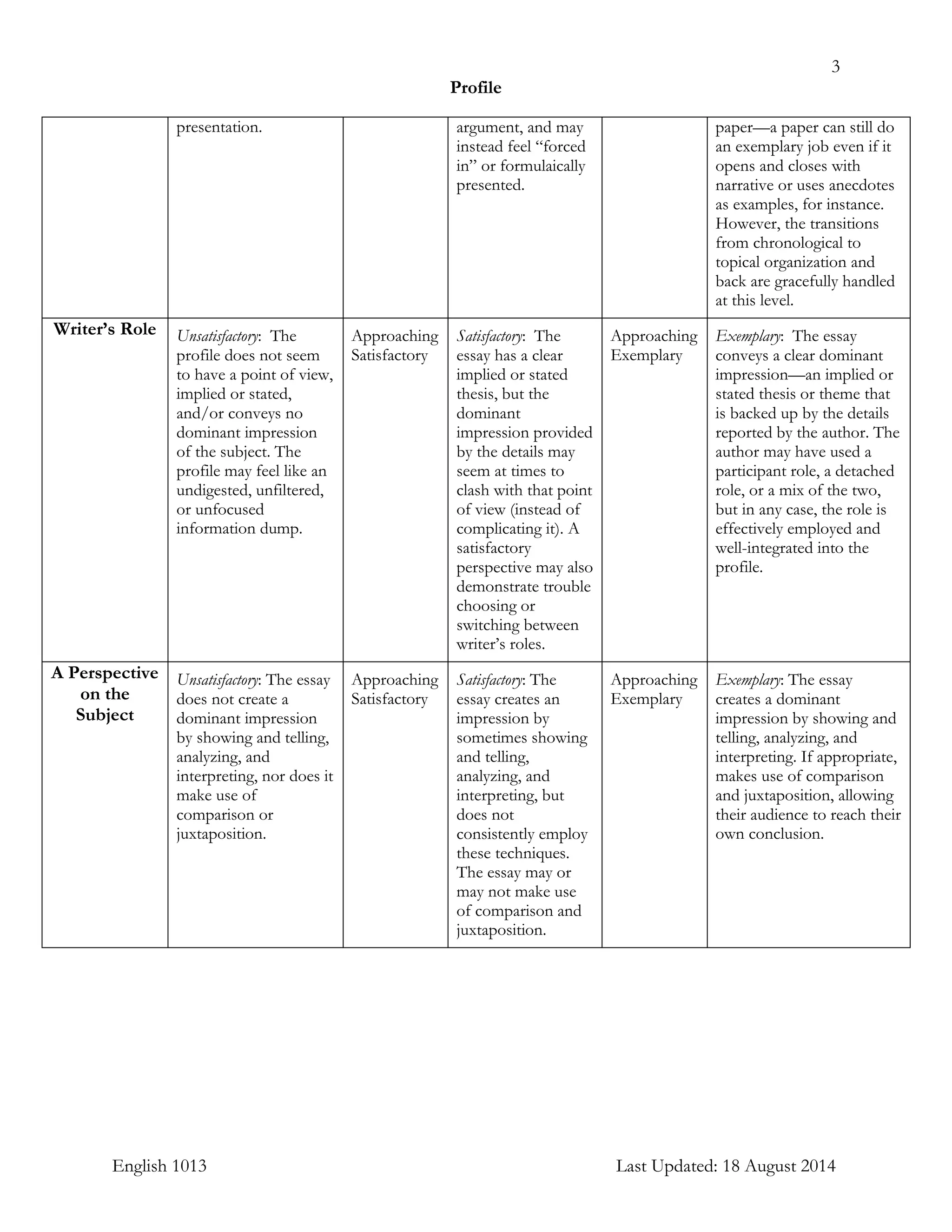
Writer’s Role Unsatisfactory: The
profile does not seem
to have a point of view,
implied or stated,
and/or conveys no
dominant impression
of the subject. The
profile may feel like an
undigested, unfiltered,
or unfocused
information dump.
Approaching
Satisfactory
Satisfactory: The
essay has a clear
implied or stated
thesis, but the
dominant
impression provided
by the details may
seem at times to
clash with that point
of view (instead of
complicating it). A
satisfactory
perspective may also
demonstrate trouble
choosing or
switching between
writer’s roles.
Approaching
Exemplary
Exemplary: The essay
conveys a clear dominant
impression—an implied or
stated thesis or theme that
is backed up by the details
reported by the author. The
author may have used a
participant role, a detached
role, or a mix of the two,
but in any case, the role is
effectively employed and
well-integrated into the
profile.
A Perspective
on the
Subject
Unsatisfactory: The essay
does not create a
dominant impression
by showing and telling,
analyzing, and
interpreting, nor does it
make use of
comparison or
juxtaposition.
Approaching
Satisfactory
Satisfactory: The
essay creates an
impression by
sometimes showing
and telling,
analyzing, and
interpreting, but
does not
consistently employ
these techniques.
The essay may or
may not make use
of comparison and
juxtaposition.
Approaching
Exemplary
Exemplary: The essay
creates a dominant
impression by showing and
telling, analyzing, and
interpreting. If appropriate,
makes use of comparison
and juxtaposition, allowing
their audience to reach their
own conclusion.

Profile Assignment prompt

  • 1.
    1 Profile English 1013 LastUpdated: 18 August 2014 The Assignment: Write a profile of an event, a group of people, a place, or an activity in your community. Observe your subject closely, and then present what you have learned in a way that both informs and engages readers. You will select your topics in teams of 3. All 3 of your team members will profile the same group, place, event, or activity. However, you will each write your own individual papers. You will need to coordinate with each other regarding interviews, observation times, etc., to ensure that you each get a different aspect of it, because you will be putting together a team multimedia presentation after all of your papers are completed and turned in. Basic Features: 1. Detailed Information about the Subject 2. A Clear, Logical Organization 3. The Writer’s Role 4. A Perspective on the Subject Questions to Consider For Each Basic Feature: Detailed Information about the Subject  How do I come up with an appropriate subject to profile?  How can I gather information on my subject?  How can I make my subject come to life? A Clear, Logical Organization  How should I organize my profile? The Writer’s Role  What role should I adopt in researching and presenting my subject? A Perspective on the Subject  How do I develop and express a clear perspective on the subject? Tips for Writing a Profile:  Be an Early Bird. Start thinking about a topic right away since you will need to make arrangements for the observations and/or interviews. Some possible topics include: A store/shop at the Square you have not been inside yet, TWU interest groups (http://www.twu.edu/student-development/student-organizations.asp), The Write Site, any of the Unique Collections in the TWU library. Try to AVOID attending a meeting of a group (essays end up more like a list of meeting minutes rather than an observation).  Pay Attention to Details. When observing/interviewing for this assignment, it’s imperative that you take detailed notes on everything you see, taste, touch, smell, and feel because you never know what information you will want to use when you write the essay.  Have a Back-up Plan. Sometimes a potential interviewee takes a week or so to get back to your interview request, which may leave you stressed and strapped for time. Make sure you have a second subject in mind in case your first choice either takes too long to contact you or doesn’t contact you at all. Remember—you can write an excellent profile on a public place (like a park or the mall) simply by sitting down and observing everything you see.
  • 2.
    2 Profile English 1013 LastUpdated: 18 August 2014  Stay Local. Due to time constraints, try to pick a topic that is locally-based and is easily accessible. Sure, we would all love to interview our favorite movie stars, but there isn’t much time to make this happen. Just because something or someone is well known doesn’t mean that they are more interesting than everyone else. Sometimes the most interesting places/people are the ones right outside your door. 1 2 3 4 5 Detailed Information about the Subject Unsatisfactory: Little information in the profile appears to have been derived from interview or observation, either because the source is not indicated, or because information is too frequently coming from prepared materials (office brochures or Web sites, for example). Approaching Satisfactory Satisfactory: The writer has clearly presented information derived from observation and interview, but either the strategies selected or the material selected for emphasis may have been ineffective. It is possible, for example, that the essay over- emphasized material not clearly integrated with or related to the theme, or that the author often quoted when paraphrasing or summarizing might have been more wise. In short, the tools are there, but the author may need to work on rhetorical awareness of when and how to employ them. Approaching Exemplary Exemplary: The writer uses strategies to cover observation or interview material in a way that brings readers’ attention to the major focus or theme of the essay. The writer knows what to emphasize and what to include with the profile’s major theme in mind. Quoted dialogue is skillfully chosen and presented. The essay’s components seem to tie clearly into the overall theme of the essay. A Clear, Logical Organization Unsatisfactory: The profile makes no discernible use of topical organization. The essay may be entirely narrative (and thus well-organized but not following instructions) or it may be haphazard, reading more like notes than like a structured Approaching Satisfactory Satisfactory: The profile follows a topical pattern but the topics may not follow a logical progression or may lack skillful transitions from point to point. As a result, points may not feel organic or natural to the Approaching Exemplary Exemplary: The profile employs a clear topical pattern to present information about the subject, with each paragraph of the section in question clearly unified around a particular subtopic and with natural, effective transitions from point to point. The topical pattern need not cover the entire
  • 3.
    3 Profile English 1013 LastUpdated: 18 August 2014 presentation. argument, and may instead feel “forced in” or formulaically presented. paper—a paper can still do an exemplary job even if it opens and closes with narrative or uses anecdotes as examples, for instance. However, the transitions from chronological to topical organization and back are gracefully handled at this level. Writer’s Role Unsatisfactory: The profile does not seem to have a point of view, implied or stated, and/or conveys no dominant impression of the subject. The profile may feel like an undigested, unfiltered, or unfocused information dump. Approaching Satisfactory Satisfactory: The essay has a clear implied or stated thesis, but the dominant impression provided by the details may seem at times to clash with that point of view (instead of complicating it). A satisfactory perspective may also demonstrate trouble choosing or switching between writer’s roles. Approaching Exemplary Exemplary: The essay conveys a clear dominant impression—an implied or stated thesis or theme that is backed up by the details reported by the author. The author may have used a participant role, a detached role, or a mix of the two, but in any case, the role is effectively employed and well-integrated into the profile. A Perspective on the Subject Unsatisfactory: The essay does not create a dominant impression by showing and telling, analyzing, and interpreting, nor does it make use of comparison or juxtaposition. Approaching Satisfactory Satisfactory: The essay creates an impression by sometimes showing and telling, analyzing, and interpreting, but does not consistently employ these techniques. The essay may or may not make use of comparison and juxtaposition. Approaching Exemplary Exemplary: The essay creates a dominant impression by showing and telling, analyzing, and interpreting. If appropriate, makes use of comparison and juxtaposition, allowing their audience to reach their own conclusion.