ASSIGNMENT 
SUBMITTED BY 
Viji V S 
English Optional 
Roll No:24 
Candidate Code:165/13376024
WAYS OF DEALING WITH LEARNERS 
WITH LD IN INCLUSIVE SETTING
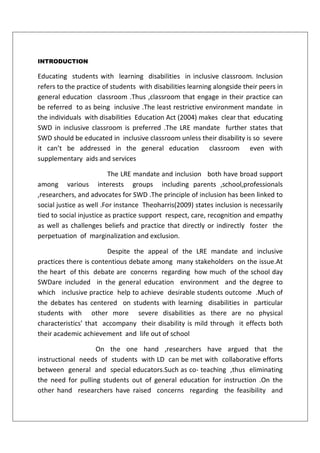
INTRODUCTION 
Educating students with learning disabilities in inclusive classroom. Inclusion 
refers to the practice of students with disabilities learning alongside their peers in 
general education classroom .Thus ,classroom that engage in their practice can 
be referred to as being inclusive .The least restrictive environment mandate in 
the individuals with disabilities Education Act (2004) makes clear that educating 
SWD in inclusive classroom is preferred .The LRE mandate further states that 
SWD should be educated in inclusive classroom unless their disability is so severe 
it can’t be addressed in the general education classroom even with 
supplementary aids and services 
The LRE mandate and inclusion both have broad support 
among various interests groups including parents ,school,professionals 
,researchers, and advocates for SWD .The principle of inclusion has been linked to 
social justice as well .For instance Theoharris(2009) states inclusion is necessarily 
tied to social injustice as practice support respect, care, recognition and empathy 
as well as challenges beliefs and practice that directly or indirectly foster the 
perpetuation of marginalization and exclusion. 
Despite the appeal of the LRE mandate and inclusive 
practices there is contentious debate among many stakeholders on the issue.At 
the heart of this debate are concerns regarding how much of the school day 
SWDare included in the general education environment and the degree to 
which inclusive practice help to achieve desirable students outcome .Much of 
the debates has centered on students with learning disabilities in particular 
students with other more severe disabilities as there are no physical 
characteristics’ that accompany their disability is mild through it effects both 
their academic achievement and life out of school 
On the one hand ,researchers have argued that the 
instructional needs of students with LD can be met with collaborative efforts 
between general and special educators.Such as co- teaching ,thus eliminating 
the need for pulling students out of general education for instruction .On the 
other hand researchers have raised concerns regarding the feasibility and
effectiveness of full inclusion for meeting the academic needs of students with 
LD. 
It is possible to conclude the former group of researchers above 
is” winning” this debate .That is data from the US Department Education show 
that over the past two decades the number of students with LD who are 
educated in the general education environment most of their school day has 
increased considerably .For instance McLesky and Waldron (2011) reported that 
the percentage of students with LD being educated in the general education 
classroom for at least 80 percent of their school day went from 22% during the 
1989-1990 school year to 62% during the 2007-2008 school year .Despite less 
progress being made in their area for students with emotional and behavioral 
disabilities and those with intellectual disabilities. It has been concluded that the 
preferred model of services delivery in most of the United states for students 
with LD is currently “ full inclusion with co- teaching” 
INCLUSIVE STRATEGIES FOR EDUCATING STUDENTS WITH LD 
In their section I will discuss three methods for including 
students with LD in inclusive classroom. Their decision will include co- teaching, 
differentiated ,instruction ,and peer mediated instruction and inventions . First 
various forms of co-teaching will be reviewed with several selected benefits 
provided 
CO-TEACHING 
Though inclusion can occurs with or without involvement from a 
special education teacher ,a co-teaching arrangement in typical .By working 
together the general and special education ,teacher are better able to provide 
support for ,students with LD than the former could independently .As such the 
need to remove students with LD for specialized instruction is eliminated 
.Although the definition of co-teaching is commonly simple ,as suggested here 
,it is often operationalized broadly
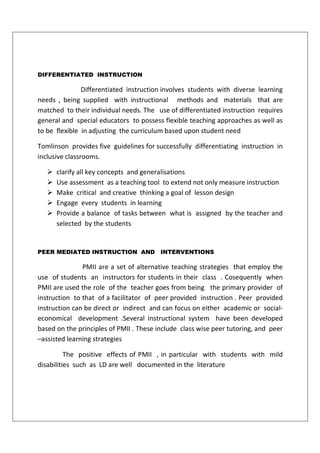
DIFFERENTIATED INSTRUCTION 
Differentiated instruction involves students with diverse learning 
needs , being supplied with instructional methods and materials that are 
matched to their individual needs. The use of differentiated instruction requires 
general and special educators to possess flexible teaching approaches as well as 
to be flexible in adjusting the curriculum based upon student need 
Tomlinson provides five guidelines for successfully differentiating instruction in 
inclusive classrooms. 
 clarify all key concepts and generalisations 
 Use assessment as a teaching tool to extend not only measure instruction 
 Make critical and creative thinking a goal of lesson design 
 Engage every students in learning 
 Provide a balance of tasks between what is assigned by the teacher and 
selected by the students 
PEER MEDIATED INSTRUCTION AND INTERVENTIONS 
PMII are a set of alternative teaching strategies that employ the 
use of students an instructors for students in their class . Cosequently when 
PMII are used the role of the teacher goes from being the primary provider of 
instruction to that of a facilitator of peer provided instruction . Peer provided 
instruction can be direct or indirect and can focus on either academic or social-economical 
development .Several instructional system have been developed 
based on the principles of PMII . These include class wise peer tutoring, and peer 
–assisted learning strategies 
The positive effects of PMII , in particular with students with mild 
disabilities such as LD are well documented in the literature
EFFECTIVENESS OF INCLUSIVE STRATEGIES FOR STUDENTS WITH LD 
An examination of the literature on the inclusion dwbate 
reveals the need for distinguishing between inclusion and full inclusion . 
Kaufman and Hallaham state that full inclusion is a mandate where the 
needs of SWD is ignored in order for all students to be educated together in the 
general education environment. As a result Kaufman and Hallahan argue that 
full inclusion doesn’t always allow individualized education plan teams to 
make the best educational decision regarding placement in the LRE. Unlike in 
full inclusion , an inclusive classroom is one in which the general education 
teacher had the student for the majority of the school day with support 
provided by the special education teacher as needed . Thus IEP teams are given 
flexibility to meet the needs of students in whatever ways that may be while 
considering a continuum of services option consistent with the individuals 
with disabilities education improvement act 2004 
COMPARING FULL INCLUSION TO PULLOUT IN ELEMENTARY SCHOOLS 
McLesky and Waldron summarized the research on whether or not 
inclusive education programs can be effective for elementary students with 
LD. They found that studies have consistently found that some students 
obtain better achievement results in full inclusion classrooms, but other have 
fared better when part –time resource support is provided . McLesky and 
Waldron also found that most studies concluded that variability between 
student outcomes in the two settings is due to the unevenness in the quality 
of instruction. They argue that the intensive instruction provided in a small 
group pullout setting allows students with LD to receive the intensified 
instruction they need on specific concepts and skills.
STRENGTHS AND WEAKNESS OF INCLUSION IN HIGH SCHOOL 
The practice of inclusion in high school has had greater 
success the elementary level compared to the secondary level. For instance, 
when casle- Giannola compared vocational and academic inclusion high 
school classrooms, several strengths and weakness for both were found .Using 
observation, consultation, and surveys, casle- giannola found classrooms to 
have strengths such as positive teacher students raport,real-life connections 
to and interesting discussion of lessons, good use of strategies and 
modifications use of active learning to motivate students, and good teacher 
collaboration 
In rerards to the academic classrooms, casale–giannola 
found that teacher lacked strategies to support SWD and were unaware of 
law pertaining to special education as well as students classifications and 
need.Alack of co-teaching collaboration with most school using the one teach 
,one assist model was also found as was a limited use of students 
assessment to help determines instructional planning weakness for 
vocational classrooms included alack of understanding regarding special 
education laws issues, and individual supports as well as difficulty with 
classroom management 
CONCLUSION 
It is possible to educate students with LD in inclusive Classroom as the 
LRE mandate prefers .However full inclusion doesn’t always produce the 
academic results that IEP team desire . though social justice had been linked 
to inclusion ,it is important that the educators that work with students 
with LD be allowed to make placement decisions they believe best allow for 
the needs to be met .There is no doubt that the needs of students with LD , 
including academic needs, can be met with inclusive practice by talented 
teachers and other educators. In some situations it may be best for students 
with ld to be taught in separate pull out classrooms with a teacher who can 
provide targeted skill instruction in areas where a student is struggling.
REFERENCE 
 Algozzine. BYsseldyke.J (2006)The fundamental of special education 
.Thousand oaks 
 Casale –Giannola .D (2012) coparing inclusion the secoandary 
vocational and accadamic 
 Frattura .EM and Capper .CA (2007). Leading for social justice. 
Transforming schools for all learners .Thousand .Oaks.C A Corwin 
Http://www.dnis.org

Assignment

  • 1.
    ASSIGNMENT SUBMITTED BY Viji V S English Optional Roll No:24 Candidate Code:165/13376024
  • 2.
    WAYS OF DEALINGWITH LEARNERS WITH LD IN INCLUSIVE SETTING
  • 3.
    INTRODUCTION Educating studentswith learning disabilities in inclusive classroom. Inclusion refers to the practice of students with disabilities learning alongside their peers in general education classroom .Thus ,classroom that engage in their practice can be referred to as being inclusive .The least restrictive environment mandate in the individuals with disabilities Education Act (2004) makes clear that educating SWD in inclusive classroom is preferred .The LRE mandate further states that SWD should be educated in inclusive classroom unless their disability is so severe it can’t be addressed in the general education classroom even with supplementary aids and services The LRE mandate and inclusion both have broad support among various interests groups including parents ,school,professionals ,researchers, and advocates for SWD .The principle of inclusion has been linked to social justice as well .For instance Theoharris(2009) states inclusion is necessarily tied to social injustice as practice support respect, care, recognition and empathy as well as challenges beliefs and practice that directly or indirectly foster the perpetuation of marginalization and exclusion. Despite the appeal of the LRE mandate and inclusive practices there is contentious debate among many stakeholders on the issue.At the heart of this debate are concerns regarding how much of the school day SWDare included in the general education environment and the degree to which inclusive practice help to achieve desirable students outcome .Much of the debates has centered on students with learning disabilities in particular students with other more severe disabilities as there are no physical characteristics’ that accompany their disability is mild through it effects both their academic achievement and life out of school On the one hand ,researchers have argued that the instructional needs of students with LD can be met with collaborative efforts between general and special educators.Such as co- teaching ,thus eliminating the need for pulling students out of general education for instruction .On the other hand researchers have raised concerns regarding the feasibility and
  • 4.
    effectiveness of fullinclusion for meeting the academic needs of students with LD. It is possible to conclude the former group of researchers above is” winning” this debate .That is data from the US Department Education show that over the past two decades the number of students with LD who are educated in the general education environment most of their school day has increased considerably .For instance McLesky and Waldron (2011) reported that the percentage of students with LD being educated in the general education classroom for at least 80 percent of their school day went from 22% during the 1989-1990 school year to 62% during the 2007-2008 school year .Despite less progress being made in their area for students with emotional and behavioral disabilities and those with intellectual disabilities. It has been concluded that the preferred model of services delivery in most of the United states for students with LD is currently “ full inclusion with co- teaching” INCLUSIVE STRATEGIES FOR EDUCATING STUDENTS WITH LD In their section I will discuss three methods for including students with LD in inclusive classroom. Their decision will include co- teaching, differentiated ,instruction ,and peer mediated instruction and inventions . First various forms of co-teaching will be reviewed with several selected benefits provided CO-TEACHING Though inclusion can occurs with or without involvement from a special education teacher ,a co-teaching arrangement in typical .By working together the general and special education ,teacher are better able to provide support for ,students with LD than the former could independently .As such the need to remove students with LD for specialized instruction is eliminated .Although the definition of co-teaching is commonly simple ,as suggested here ,it is often operationalized broadly
  • 5.
    DIFFERENTIATED INSTRUCTION Differentiatedinstruction involves students with diverse learning needs , being supplied with instructional methods and materials that are matched to their individual needs. The use of differentiated instruction requires general and special educators to possess flexible teaching approaches as well as to be flexible in adjusting the curriculum based upon student need Tomlinson provides five guidelines for successfully differentiating instruction in inclusive classrooms. clarify all key concepts and generalisations Use assessment as a teaching tool to extend not only measure instruction Make critical and creative thinking a goal of lesson design Engage every students in learning Provide a balance of tasks between what is assigned by the teacher and selected by the students PEER MEDIATED INSTRUCTION AND INTERVENTIONS PMII are a set of alternative teaching strategies that employ the use of students an instructors for students in their class . Cosequently when PMII are used the role of the teacher goes from being the primary provider of instruction to that of a facilitator of peer provided instruction . Peer provided instruction can be direct or indirect and can focus on either academic or social-economical development .Several instructional system have been developed based on the principles of PMII . These include class wise peer tutoring, and peer –assisted learning strategies The positive effects of PMII , in particular with students with mild disabilities such as LD are well documented in the literature
  • 6.
    EFFECTIVENESS OF INCLUSIVESTRATEGIES FOR STUDENTS WITH LD An examination of the literature on the inclusion dwbate reveals the need for distinguishing between inclusion and full inclusion . Kaufman and Hallaham state that full inclusion is a mandate where the needs of SWD is ignored in order for all students to be educated together in the general education environment. As a result Kaufman and Hallahan argue that full inclusion doesn’t always allow individualized education plan teams to make the best educational decision regarding placement in the LRE. Unlike in full inclusion , an inclusive classroom is one in which the general education teacher had the student for the majority of the school day with support provided by the special education teacher as needed . Thus IEP teams are given flexibility to meet the needs of students in whatever ways that may be while considering a continuum of services option consistent with the individuals with disabilities education improvement act 2004 COMPARING FULL INCLUSION TO PULLOUT IN ELEMENTARY SCHOOLS McLesky and Waldron summarized the research on whether or not inclusive education programs can be effective for elementary students with LD. They found that studies have consistently found that some students obtain better achievement results in full inclusion classrooms, but other have fared better when part –time resource support is provided . McLesky and Waldron also found that most studies concluded that variability between student outcomes in the two settings is due to the unevenness in the quality of instruction. They argue that the intensive instruction provided in a small group pullout setting allows students with LD to receive the intensified instruction they need on specific concepts and skills.
  • 7.
    STRENGTHS AND WEAKNESSOF INCLUSION IN HIGH SCHOOL The practice of inclusion in high school has had greater success the elementary level compared to the secondary level. For instance, when casle- Giannola compared vocational and academic inclusion high school classrooms, several strengths and weakness for both were found .Using observation, consultation, and surveys, casle- giannola found classrooms to have strengths such as positive teacher students raport,real-life connections to and interesting discussion of lessons, good use of strategies and modifications use of active learning to motivate students, and good teacher collaboration In rerards to the academic classrooms, casale–giannola found that teacher lacked strategies to support SWD and were unaware of law pertaining to special education as well as students classifications and need.Alack of co-teaching collaboration with most school using the one teach ,one assist model was also found as was a limited use of students assessment to help determines instructional planning weakness for vocational classrooms included alack of understanding regarding special education laws issues, and individual supports as well as difficulty with classroom management CONCLUSION It is possible to educate students with LD in inclusive Classroom as the LRE mandate prefers .However full inclusion doesn’t always produce the academic results that IEP team desire . though social justice had been linked to inclusion ,it is important that the educators that work with students with LD be allowed to make placement decisions they believe best allow for the needs to be met .There is no doubt that the needs of students with LD , including academic needs, can be met with inclusive practice by talented teachers and other educators. In some situations it may be best for students with ld to be taught in separate pull out classrooms with a teacher who can provide targeted skill instruction in areas where a student is struggling.
  • 8.
    REFERENCE Algozzine.BYsseldyke.J (2006)The fundamental of special education .Thousand oaks Casale –Giannola .D (2012) coparing inclusion the secoandary vocational and accadamic Frattura .EM and Capper .CA (2007). Leading for social justice. Transforming schools for all learners .Thousand .Oaks.C A Corwin Http://www.dnis.org