Special Education Laws and Strategies in the general education classroom

                    Patricia Blankenship

           ESE 631 Survey of the Exceptional Child

                  Instructor: Analisa Smith

                         10/14/12
Overview of IDEA, Least Restrictive Environment (LRE), and Free and Appropriate Public
                                         Education (FAPE)
    "The Individuals with Disabilities Education Act (IDEA) requires public schools to locate and

identify children with disabilities who may be in need of specialized education"(Wrightslaw).

This is an educational law to provide federal financial assistance to State and local education agencies

to provide special education and services to children who are eligible for the program.. Idea also

requires an IEP in place for student when enrolled in Special Education program.

     FAPE is short for "Provide A Free, Appropriate Public Education"providing special education and

services for all children,at no cost to the parents for children with disabilities.

Least Restrictive Environment (LRE)"LRE means that a student who has a disability should have the

opportunity to be educated with their peers, to the greatest extent possible,and should have access to the

general education curriculum, extracurricular activities, or any other program that their peers would be

able to access"(Law & Legal).The laws are constantly changing and teachers and faculty need to stay

up to date on the changes made with the laws to provide the best assistance for the students.
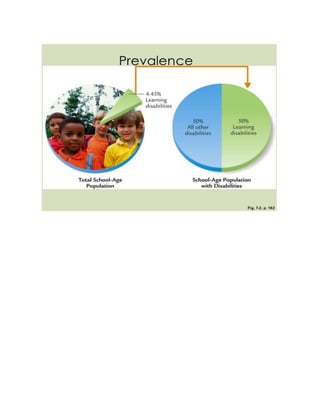
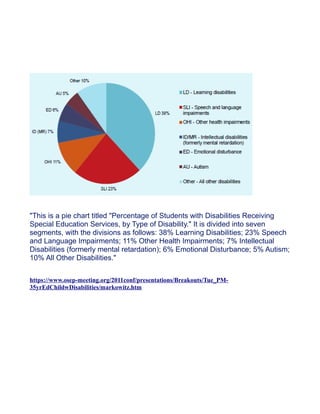
"This is a pie chart titled "Percentage of Students with Disabilities Receiving
Special Education Services, by Type of Disability." It is divided into seven
segments, with the divisions as follows: 38% Learning Disabilities; 23% Speech
and Language Impairments; 11% Other Health Impairments; 7% Intellectual
Disabilities (formerly mental retardation); 6% Emotional Disturbance; 5% Autism;
10% All Other Disabilities."

https://www.osep-meeting.org/2011conf/presentations/Breakouts/Tue_PM-
35yrEdChildwDisabilities/markowitz.htm
The purpose and main components of an Individualized Education Program (IEP)


   "The IEP has two general purposes: (1) to establish measurable annual goals for the child; and (2)

to state the special education and related services and supplementary aids and services that the public

agency will provide to, or on behalf of, the child, the IEP team broadly considers the child’s

involvement and participation in three main areas of school life:the general education

curriculum,extracurricular activities, and nonacademic activities"(Contents of the IEP 2010)

              The main components of an IEP should include the following:

Academic Performance,goals and objectives,how will school meet the goals,services and supports for

the student,what type of assessments will be used for the student,and finally location of services and

duration of services.
Accommodations and modifications that could support students with disabilities in the classroom

   The Individuals with Disabilities Education Act (IDEA) requires that an Individualized Education

Program (IEP) be developed for each child with a disability,each student has a different learning style

,strengths and weaknesses that must be addressed in the classroom.

    Accommodations and modifications that could support students ,extended time for completion of

assignments or tests ,Visual demonstrations ,Assistance with organization,change the learning

environment,notes for lessons learned that day,one step directions from teacher,graphic organizers

special communication systems .
Compare/Contrast Learning Disabilities (LD) and Emotional/Behavioral Disabilities (EBD)

   "A learning disability is a neurological disorder that affects the brain’s ability to receive, process,

store, and respond to information" (Turnbull, Turnbull, & Wehmeyer,2010).Students who have been

diagnosed with a learning disability will have unique learning abilities and can vary from student to

student, most often skills that are affected by the student are reading, writing and math.

    Students who have been diagnosed with Emotional/Behavioral Disability have an inability to learn

that cannot be explained by intellectual, sensory, or health factors ,they can not build relationships with

peers or faculty,and also have inappropriate types of behavior. Students with emotional or behavioral

disabilities have both learning problems and behavioral problems as students with learning disabilities

may have an inability to learn.
Compare/Contrast LD and Intellectual Disabilities (ID)


    People who have a learning disability is a neurological disorder that affects the brain's

communication to receive, process,and respond to information,students with this disorder may have to

retrain their brain to learn new ways of storing information,such as index cards ,graphic

organizers,notes. This will help the students with learning disabilities to retrieve the information they

need to remind them to stay on tasks. People who have an intellectual disability may have mild to

severe limitations in intellectual functioning such as reasoning, learning, problem solving
Compare/Contrast EBD and ID

   EBD commonly is diagnosed when the student exhibits emotional, behavioral, and social

behavioral psychopathology that impairs the student’s ability to participate and benefit from the regular

education program. EBD may or may not be a lifelong problem though some students who have a

severity of EBD may not be able to handle a regular classroom setting, requiring instead a specialized

classroom.

    ID students have problems with mental functioning communication skills, taking care of him or

herself, and daily life skills,Students with ID will special education and related services.

ID students Lack ability to understand the cause and effect relationship between a behavior and a

negative outcome.
Inclusion tips for each of the disability areas above (LD, EBD, ID)


Provide written or picture schedules so students will adjust to transitions. Build collaboration time

between special education and regular education personnel into the IEP. Write directions on the

board,use one step at a time verbal directions,Provide accommodations and supports for students.

Use graphic organizers,.You may need to use tape recorders for students who need to hear the lesson

for the day. "Teachers may need to make adaptations to the curriculum and learning activities in order

to fully include all students,use differentiate instruction and include learning objectives, adapting

materials and resources, varying teaching strategies, and using technology "(Kate MacLean,(2001)) .
References:

 Crain Danielle,Thirty five years of Educating Students with Disabilities
https://www.osep-meeting.org/2011conf/presentations/Breakouts/Tue_PM-
35yrEdChildwDisabilities/markowitz.htm

Developmental Disabilities Increasing in US (2011)
http://www.cdc.gov/

ERIC Clearinghouse on Disabilities and Gifted Education. (1992). Legal foundations 1: Section 504 of
the Rehabilitation Act and the Americans with Disabilities Act. Reston, VA

Henderson,Kelly ,(2010) Overview of ADA, IDEA, and Section 504

Least Restrictive Environment [LRE] Law & Legal Definition
http://definitions.uslegal.com/l/least-restrictive-environment-lre/

MacLean, Kate ,(2001). Inclusive Teaching Guide

Overview of the Individuals with Disabilities Education Act OF 1997
(http://www.wrightslaw.com/bks/lawbk/ch4.idea.overview.pdf)

Overview of ADA, IDEA, and Section 504 Contents of the IEP (2010)
http://nichcy.org/schoolage/iep/iepcontents

Turnbull, Turnbull, & Wehmeyer, (2010), Exceptional Lives: Special Education in Today’s Schools, 6th
edition, Upper Saddle River, New Jersey

Final project ese 631

  • 1.
    Special Education Lawsand Strategies in the general education classroom Patricia Blankenship ESE 631 Survey of the Exceptional Child Instructor: Analisa Smith 10/14/12
  • 4.
    Overview of IDEA,Least Restrictive Environment (LRE), and Free and Appropriate Public Education (FAPE) "The Individuals with Disabilities Education Act (IDEA) requires public schools to locate and identify children with disabilities who may be in need of specialized education"(Wrightslaw). This is an educational law to provide federal financial assistance to State and local education agencies to provide special education and services to children who are eligible for the program.. Idea also requires an IEP in place for student when enrolled in Special Education program. FAPE is short for "Provide A Free, Appropriate Public Education"providing special education and services for all children,at no cost to the parents for children with disabilities. Least Restrictive Environment (LRE)"LRE means that a student who has a disability should have the opportunity to be educated with their peers, to the greatest extent possible,and should have access to the general education curriculum, extracurricular activities, or any other program that their peers would be able to access"(Law & Legal).The laws are constantly changing and teachers and faculty need to stay up to date on the changes made with the laws to provide the best assistance for the students.
  • 5.
    "This is apie chart titled "Percentage of Students with Disabilities Receiving Special Education Services, by Type of Disability." It is divided into seven segments, with the divisions as follows: 38% Learning Disabilities; 23% Speech and Language Impairments; 11% Other Health Impairments; 7% Intellectual Disabilities (formerly mental retardation); 6% Emotional Disturbance; 5% Autism; 10% All Other Disabilities." https://www.osep-meeting.org/2011conf/presentations/Breakouts/Tue_PM- 35yrEdChildwDisabilities/markowitz.htm
  • 6.
    The purpose andmain components of an Individualized Education Program (IEP) "The IEP has two general purposes: (1) to establish measurable annual goals for the child; and (2) to state the special education and related services and supplementary aids and services that the public agency will provide to, or on behalf of, the child, the IEP team broadly considers the child’s involvement and participation in three main areas of school life:the general education curriculum,extracurricular activities, and nonacademic activities"(Contents of the IEP 2010) The main components of an IEP should include the following: Academic Performance,goals and objectives,how will school meet the goals,services and supports for the student,what type of assessments will be used for the student,and finally location of services and duration of services.
  • 7.
    Accommodations and modificationsthat could support students with disabilities in the classroom The Individuals with Disabilities Education Act (IDEA) requires that an Individualized Education Program (IEP) be developed for each child with a disability,each student has a different learning style ,strengths and weaknesses that must be addressed in the classroom. Accommodations and modifications that could support students ,extended time for completion of assignments or tests ,Visual demonstrations ,Assistance with organization,change the learning environment,notes for lessons learned that day,one step directions from teacher,graphic organizers special communication systems .
  • 8.
    Compare/Contrast Learning Disabilities(LD) and Emotional/Behavioral Disabilities (EBD) "A learning disability is a neurological disorder that affects the brain’s ability to receive, process, store, and respond to information" (Turnbull, Turnbull, & Wehmeyer,2010).Students who have been diagnosed with a learning disability will have unique learning abilities and can vary from student to student, most often skills that are affected by the student are reading, writing and math. Students who have been diagnosed with Emotional/Behavioral Disability have an inability to learn that cannot be explained by intellectual, sensory, or health factors ,they can not build relationships with peers or faculty,and also have inappropriate types of behavior. Students with emotional or behavioral disabilities have both learning problems and behavioral problems as students with learning disabilities may have an inability to learn.
  • 9.
    Compare/Contrast LD andIntellectual Disabilities (ID) People who have a learning disability is a neurological disorder that affects the brain's communication to receive, process,and respond to information,students with this disorder may have to retrain their brain to learn new ways of storing information,such as index cards ,graphic organizers,notes. This will help the students with learning disabilities to retrieve the information they need to remind them to stay on tasks. People who have an intellectual disability may have mild to severe limitations in intellectual functioning such as reasoning, learning, problem solving
  • 10.
    Compare/Contrast EBD andID EBD commonly is diagnosed when the student exhibits emotional, behavioral, and social behavioral psychopathology that impairs the student’s ability to participate and benefit from the regular education program. EBD may or may not be a lifelong problem though some students who have a severity of EBD may not be able to handle a regular classroom setting, requiring instead a specialized classroom. ID students have problems with mental functioning communication skills, taking care of him or herself, and daily life skills,Students with ID will special education and related services. ID students Lack ability to understand the cause and effect relationship between a behavior and a negative outcome.
  • 11.
    Inclusion tips foreach of the disability areas above (LD, EBD, ID) Provide written or picture schedules so students will adjust to transitions. Build collaboration time between special education and regular education personnel into the IEP. Write directions on the board,use one step at a time verbal directions,Provide accommodations and supports for students. Use graphic organizers,.You may need to use tape recorders for students who need to hear the lesson for the day. "Teachers may need to make adaptations to the curriculum and learning activities in order to fully include all students,use differentiate instruction and include learning objectives, adapting materials and resources, varying teaching strategies, and using technology "(Kate MacLean,(2001)) .
  • 12.
    References: Crain Danielle,Thirtyfive years of Educating Students with Disabilities https://www.osep-meeting.org/2011conf/presentations/Breakouts/Tue_PM- 35yrEdChildwDisabilities/markowitz.htm Developmental Disabilities Increasing in US (2011) http://www.cdc.gov/ ERIC Clearinghouse on Disabilities and Gifted Education. (1992). Legal foundations 1: Section 504 of the Rehabilitation Act and the Americans with Disabilities Act. Reston, VA Henderson,Kelly ,(2010) Overview of ADA, IDEA, and Section 504 Least Restrictive Environment [LRE] Law & Legal Definition http://definitions.uslegal.com/l/least-restrictive-environment-lre/ MacLean, Kate ,(2001). Inclusive Teaching Guide Overview of the Individuals with Disabilities Education Act OF 1997 (http://www.wrightslaw.com/bks/lawbk/ch4.idea.overview.pdf) Overview of ADA, IDEA, and Section 504 Contents of the IEP (2010) http://nichcy.org/schoolage/iep/iepcontents Turnbull, Turnbull, & Wehmeyer, (2010), Exceptional Lives: Special Education in Today’s Schools, 6th edition, Upper Saddle River, New Jersey