Abigail

          Joanne

                   Gledis

                            Vera
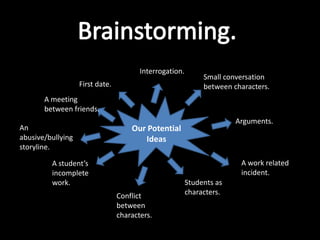
Interrogation.
                                                              Small conversation
                   First date.                                between characters.
       A meeting
       between friends.
                                                                       Arguments.
An                                   Our Potential
abusive/bullying                        Ideas
storyline.

         A student’s                                                    A work related
         incomplete                                                     incident.
         work.                                           Students as
                                 Conflict                characters.
                                 between
                                 characters.
• We came up with a medley of rough ideas to
  work with, and decided on using a few
  merged ideas.

• We decided upon a small conversation
  between characters, about a student’s
  incomplete work, which leads to conflict
  between the characters.
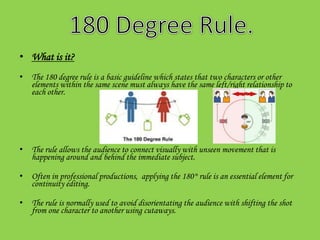
• What is it?
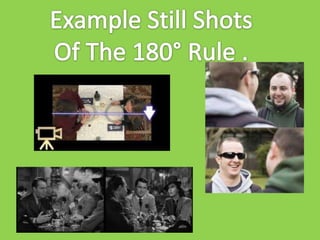
• The 180 degree rule is a basic guideline which states that two characters or other
  elements within the same scene must always have the same left/right relationship to
  each other.


• The rule allows the audience to connect visually with unseen movement that is
  happening around and behind the immediate subject.

• Often in professional productions, applying the 180° rule is an essential element for
  continuity editing.

• The rule is normally used to avoid disorientating the audience with shifting the shot
  from one character to another using cutaways.
• We considered using the 180° rule whilst filming the characters in
  our scene are having a conversation at a desk.

• During the conversation in our scene we considered filming from
  behind the shoulder of one character capturing the other character
  who would be talking at this point.

• We would then film from the same position but from the other
  character at exactly 180 degrees away from the last shot.

• This would place the camera directly opposite the previous shot.
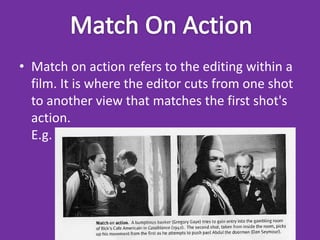
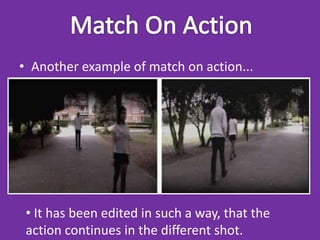
• Match on action refers to the editing within a
  film. It is where the editor cuts from one shot
  to another view that matches the first shot's
  action.
  E.g.
• We have considered using match on action in
  our opening sequence on numerous occasions
  within the opening sequence.

• It will be used to show the continuation of
  different parts of the scene from different
  angles.
• Another example of match on action...


 • It has been edited in such a way, that the
 action continues in the different shot.
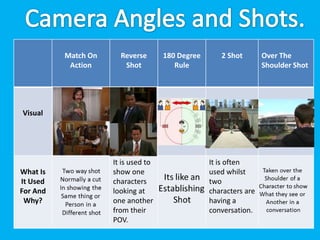
Match On     Reverse       180 Degree      2 Shot        Over The
           Action       Shot            Rule                       Shoulder Shot


Visual


                     It is used to                It is often
What Is              show one                     used whilst
It Used              characters                   two
For And              looking at                   characters are
 Why?                one another                  having a
                     from their                   conversation.
                     POV.
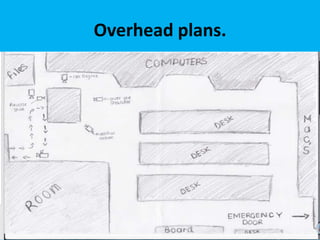
Overhead plans.
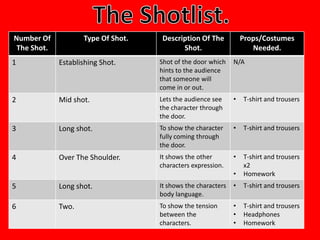
Number Of           Type Of Shot.   Description Of The            Props/Costumes
 The Shot.                                Shot.                      Needed.
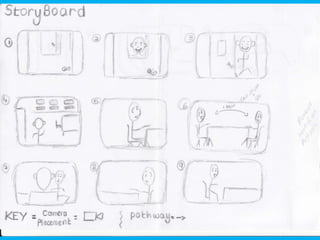
1            Establishing Shot.     Shot of the door which    N/A
                                    hints to the audience
                                    that someone will
                                    come in or out.
2            Mid shot.              Lets the audience see     •   T-shirt and trousers
                                    the character through
                                    the door.
3            Long shot.             To show the character     •   T-shirt and trousers
                                    fully coming through
                                    the door.
4            Over The Shoulder.     It shows the other        •   T-shirt and trousers
                                    characters expression.        x2
                                                              •   Homework
5            Long shot.             It shows the characters   •   T-shirt and trousers
                                    body language.
6            Two.                   To show the tension       •   T-shirt and trousers
                                    between the               •   Headphones
                                    characters.               •   Homework
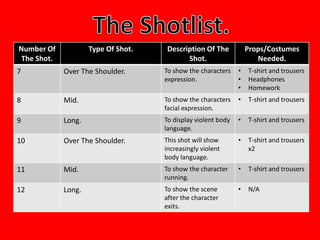
Number Of            Type Of Shot.    Description Of The           Props/Costumes
 The Shot.                                  Shot.                     Needed.
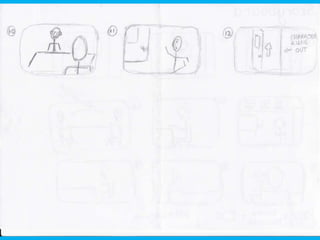
7            Over The Shoulder.      To show the characters    •   T-shirt and trousers
                                     expression.               •   Headphones
                                                               •   Homework
8            Mid.                    To show the characters    •   T-shirt and trousers
                                     facial expression.
9            Long.                   To display violent body   •   T-shirt and trousers
                                     language.
10           Over The Shoulder.      This shot will show       •   T-shirt and trousers
                                     increasingly violent          x2
                                     body language.
11           Mid.                    To show the character     •   T-shirt and trousers
                                     running.
12           Long.                   To show the scene         •   N/A
                                     after the character
                                     exits.

Assignment #14 preliminary task

  • 1.
    Abigail Joanne Gledis Vera
  • 2.
    Interrogation. Small conversation First date. between characters. A meeting between friends. Arguments. An Our Potential abusive/bullying Ideas storyline. A student’s A work related incomplete incident. work. Students as Conflict characters. between characters.
  • 3.
    • We cameup with a medley of rough ideas to work with, and decided on using a few merged ideas. • We decided upon a small conversation between characters, about a student’s incomplete work, which leads to conflict between the characters.
  • 4.
    • What isit? • The 180 degree rule is a basic guideline which states that two characters or other elements within the same scene must always have the same left/right relationship to each other. • The rule allows the audience to connect visually with unseen movement that is happening around and behind the immediate subject. • Often in professional productions, applying the 180° rule is an essential element for continuity editing. • The rule is normally used to avoid disorientating the audience with shifting the shot from one character to another using cutaways.
  • 5.
    • We consideredusing the 180° rule whilst filming the characters in our scene are having a conversation at a desk. • During the conversation in our scene we considered filming from behind the shoulder of one character capturing the other character who would be talking at this point. • We would then film from the same position but from the other character at exactly 180 degrees away from the last shot. • This would place the camera directly opposite the previous shot.
  • 7.
    • Match onaction refers to the editing within a film. It is where the editor cuts from one shot to another view that matches the first shot's action. E.g.
  • 8.
    • We haveconsidered using match on action in our opening sequence on numerous occasions within the opening sequence. • It will be used to show the continuation of different parts of the scene from different angles.
  • 9.
    • Another exampleof match on action... • It has been edited in such a way, that the action continues in the different shot.
  • 10.
    Match On Reverse 180 Degree 2 Shot Over The Action Shot Rule Shoulder Shot Visual It is used to It is often What Is show one used whilst It Used characters two For And looking at characters are Why? one another having a from their conversation. POV.
  • 11.
  • 17.
    Number Of Type Of Shot. Description Of The Props/Costumes The Shot. Shot. Needed. 1 Establishing Shot. Shot of the door which N/A hints to the audience that someone will come in or out. 2 Mid shot. Lets the audience see • T-shirt and trousers the character through the door. 3 Long shot. To show the character • T-shirt and trousers fully coming through the door. 4 Over The Shoulder. It shows the other • T-shirt and trousers characters expression. x2 • Homework 5 Long shot. It shows the characters • T-shirt and trousers body language. 6 Two. To show the tension • T-shirt and trousers between the • Headphones characters. • Homework
  • 18.
    Number Of Type Of Shot. Description Of The Props/Costumes The Shot. Shot. Needed. 7 Over The Shoulder. To show the characters • T-shirt and trousers expression. • Headphones • Homework 8 Mid. To show the characters • T-shirt and trousers facial expression. 9 Long. To display violent body • T-shirt and trousers language. 10 Over The Shoulder. This shot will show • T-shirt and trousers increasingly violent x2 body language. 11 Mid. To show the character • T-shirt and trousers running. 12 Long. To show the scene • N/A after the character exits.