Abigail

          Joanne

                   Gledis

                            Vera
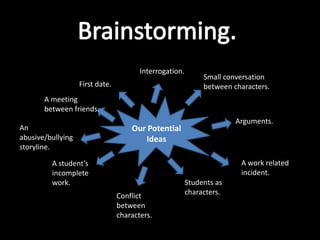
Interrogation.
                                                              Small conversation
                   First date.                                between characters.
       A meeting
       between friends.
                                                                       Arguments.
An                                   Our Potential
abusive/bullying                        Ideas
storyline.

         A student’s                                                    A work related
         incomplete                                                     incident.
         work.                                           Students as
                                 Conflict                characters.
                                 between
                                 characters.
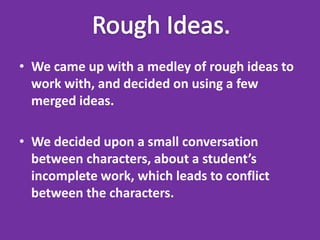
• We came up with a medley of rough ideas to
  work with, and decided on using a few
  merged ideas.

• We decided upon a small conversation
  between characters, about a student’s
  incomplete work, which leads to conflict
  between the characters.
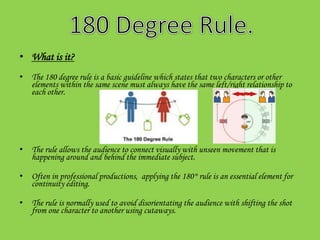
• What is it?
• The 180 degree rule is a basic guideline which states that two characters or other
  elements within the same scene must always have the same left/right relationship to
  each other.


• The rule allows the audience to connect visually with unseen movement that is
  happening around and behind the immediate subject.

• Often in professional productions, applying the 180° rule is an essential element for
  continuity editing.

• The rule is normally used to avoid disorientating the audience with shifting the shot
  from one character to another using cutaways.
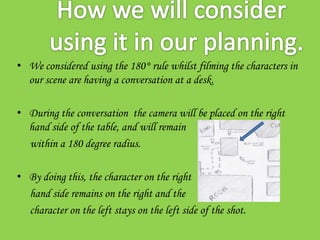
• We considered using the 180° rule whilst filming the characters in
  our scene are having a conversation at a desk.

• During the conversation the camera will be placed on the right
  hand side of the table, and will remain
  within a 180 degree radius.

• By doing this, the character on the right
  hand side remains on the right and the
  character on the left stays on the left side of the shot.
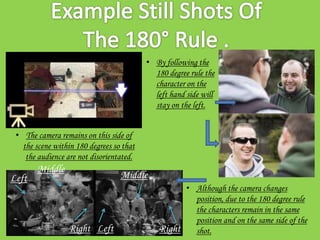
• By following the
                                            180 degree rule the
                                            character on the
                                            left hand side will
                                            stay on the left.


 • The camera remains on this side of
   the scene within 180 degrees so that
    the audience are not disorientated.
        Middle
Left.                             Middle
                                                  • Although the camera changes
                                                    position, due to the 180 degree rule
                                                    the characters remain in the same
                                                    position and on the same side of the
                 Right Left.                 Right shot.
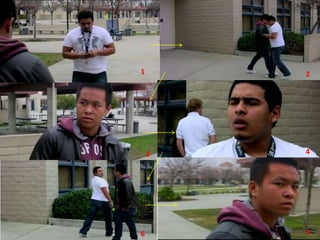
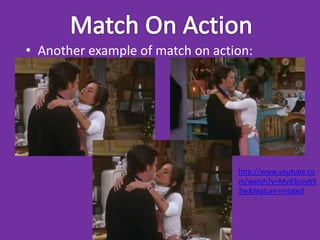
• Match on action is editing, where it cuts from
  one shot to another shot that matches the
  first shot's action.
• It is used to show the continuation of actions.
  E.g.:
• http://www.youtube.com/watch?v=_RjfGD1R
  TW8&feature=related
1       2


    3   4


6       7
We will be using match on action in our opening
  sequence throughout.
We’ll use it to show:
• Joanne as she walks into the media room.
• Joanne as she sits opposite Abigail.
• When Joanne pushes Abigail’s work from the
  table.
• Another example of match on action:


                                  http://www.youtube.co
                                  m/watch?v=Mv93covb5
                                  3w&feature=related
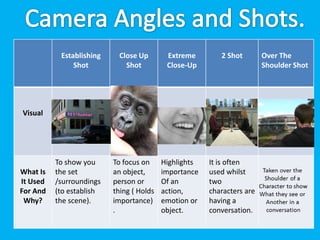
Establishing     Close Up       Extreme        2 Shot        Over The
               Shot           Shot         Close-Up                     Shoulder Shot


Visual


          To show you     To focus on     Highlights   It is often
What Is   the set         an object,      importance   used whilst
It Used   /surroundings   person or       Of an        two
For And   (to establish   thing ( Holds   action,      characters are
 Why?     the scene).     importance)     emotion or   having a
                          .               object.      conversation.
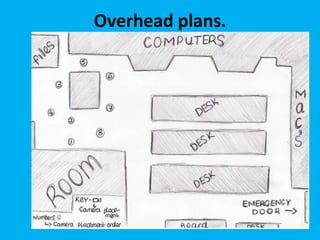
Overhead plans.
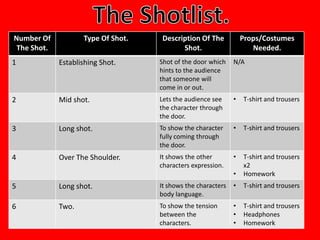
Number Of           Type Of Shot.   Description Of The            Props/Costumes
 The Shot.                                Shot.                      Needed.
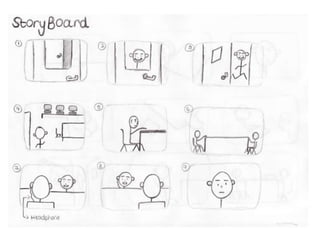
1            Establishing Shot.     Shot of the door which    N/A
                                    hints to the audience
                                    that someone will
                                    come in or out.
2            Mid shot.              Lets the audience see     •   T-shirt and trousers
                                    the character through
                                    the door.
3            Long shot.             To show the character     •   T-shirt and trousers
                                    fully coming through
                                    the door.
4            Over The Shoulder.     It shows the other        •   T-shirt and trousers
                                    characters expression.        x2
                                                              •   Homework
5            Long shot.             It shows the characters   •   T-shirt and trousers
                                    body language.
6            Two.                   To show the tension       •   T-shirt and trousers
                                    between the               •   Headphones
                                    characters.               •   Homework
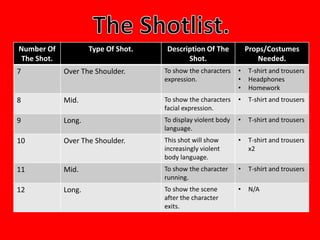
Number Of            Type Of Shot.    Description Of The           Props/Costumes
 The Shot.                                  Shot.                     Needed.
7            Over The Shoulder.      To show the characters    •   T-shirt and trousers
                                     expression.               •   Headphones
                                                               •   Homework
8            Mid.                    To show the characters    •   T-shirt and trousers
                                     facial expression.
9            Long.                   To display violent body   •   T-shirt and trousers
                                     language.
10           Over The Shoulder.      This shot will show       •   T-shirt and trousers
                                     increasingly violent          x2
                                     body language.
11           Mid.                    To show the character     •   T-shirt and trousers
                                     running.
12           Long.                   To show the scene         •   N/A
                                     after the character
                                     exits.

Assignment 14, draft 2. completed.

  • 1.
    Abigail Joanne Gledis Vera
  • 2.
    Interrogation. Small conversation First date. between characters. A meeting between friends. Arguments. An Our Potential abusive/bullying Ideas storyline. A student’s A work related incomplete incident. work. Students as Conflict characters. between characters.
  • 3.
    • We cameup with a medley of rough ideas to work with, and decided on using a few merged ideas. • We decided upon a small conversation between characters, about a student’s incomplete work, which leads to conflict between the characters.
  • 4.
    • What isit? • The 180 degree rule is a basic guideline which states that two characters or other elements within the same scene must always have the same left/right relationship to each other. • The rule allows the audience to connect visually with unseen movement that is happening around and behind the immediate subject. • Often in professional productions, applying the 180° rule is an essential element for continuity editing. • The rule is normally used to avoid disorientating the audience with shifting the shot from one character to another using cutaways.
  • 5.
    • We consideredusing the 180° rule whilst filming the characters in our scene are having a conversation at a desk. • During the conversation the camera will be placed on the right hand side of the table, and will remain within a 180 degree radius. • By doing this, the character on the right hand side remains on the right and the character on the left stays on the left side of the shot.
  • 6.
    • By followingthe 180 degree rule the character on the left hand side will stay on the left. • The camera remains on this side of the scene within 180 degrees so that the audience are not disorientated. Middle Left. Middle • Although the camera changes position, due to the 180 degree rule the characters remain in the same position and on the same side of the Right Left. Right shot.
  • 7.
    • Match onaction is editing, where it cuts from one shot to another shot that matches the first shot's action. • It is used to show the continuation of actions. E.g.: • http://www.youtube.com/watch?v=_RjfGD1R TW8&feature=related
  • 8.
    1 2 3 4 6 7
  • 9.
    We will beusing match on action in our opening sequence throughout. We’ll use it to show: • Joanne as she walks into the media room. • Joanne as she sits opposite Abigail. • When Joanne pushes Abigail’s work from the table.
  • 10.
    • Another exampleof match on action: http://www.youtube.co m/watch?v=Mv93covb5 3w&feature=related
  • 11.
    Establishing Close Up Extreme 2 Shot Over The Shot Shot Close-Up Shoulder Shot Visual To show you To focus on Highlights It is often What Is the set an object, importance used whilst It Used /surroundings person or Of an two For And (to establish thing ( Holds action, characters are Why? the scene). importance) emotion or having a . object. conversation.
  • 12.
  • 18.
    Number Of Type Of Shot. Description Of The Props/Costumes The Shot. Shot. Needed. 1 Establishing Shot. Shot of the door which N/A hints to the audience that someone will come in or out. 2 Mid shot. Lets the audience see • T-shirt and trousers the character through the door. 3 Long shot. To show the character • T-shirt and trousers fully coming through the door. 4 Over The Shoulder. It shows the other • T-shirt and trousers characters expression. x2 • Homework 5 Long shot. It shows the characters • T-shirt and trousers body language. 6 Two. To show the tension • T-shirt and trousers between the • Headphones characters. • Homework
  • 19.
    Number Of Type Of Shot. Description Of The Props/Costumes The Shot. Shot. Needed. 7 Over The Shoulder. To show the characters • T-shirt and trousers expression. • Headphones • Homework 8 Mid. To show the characters • T-shirt and trousers facial expression. 9 Long. To display violent body • T-shirt and trousers language. 10 Over The Shoulder. This shot will show • T-shirt and trousers increasingly violent x2 body language. 11 Mid. To show the character • T-shirt and trousers running. 12 Long. To show the scene • N/A after the character exits.