Assignment 1 
ENGLISH LANGUAGE SYSTEM STUDY 
Name: Matías Rodríguez Sanhueza 
Date: August 28th 
Teacher: Iris Roa
Arizona decrees pregnancy starts before 
conception 
Taken from: Newscientist Magazine 
20 April 2012 
http://www.newscientist.com/article/dn21721-arizona-decrees-pregnancy- 
starts-before-conception.html 
By: James F. Smith 
Class: GIP2232 Section ??
Arizona decrees pregnancy starts before conception 
 10:21 20 April 2012 by Lisa Grossman 
On 12 April, the governor of Arizona approved a bill banning most abortions after 20 weeks of 
pregnancy. However, the bill marks pregnancy as beginning two weeks before a child has 
been conceived. On the face of it, this sounds like nonsense, but what does the science say? 
New Scientist takes a closer look. 
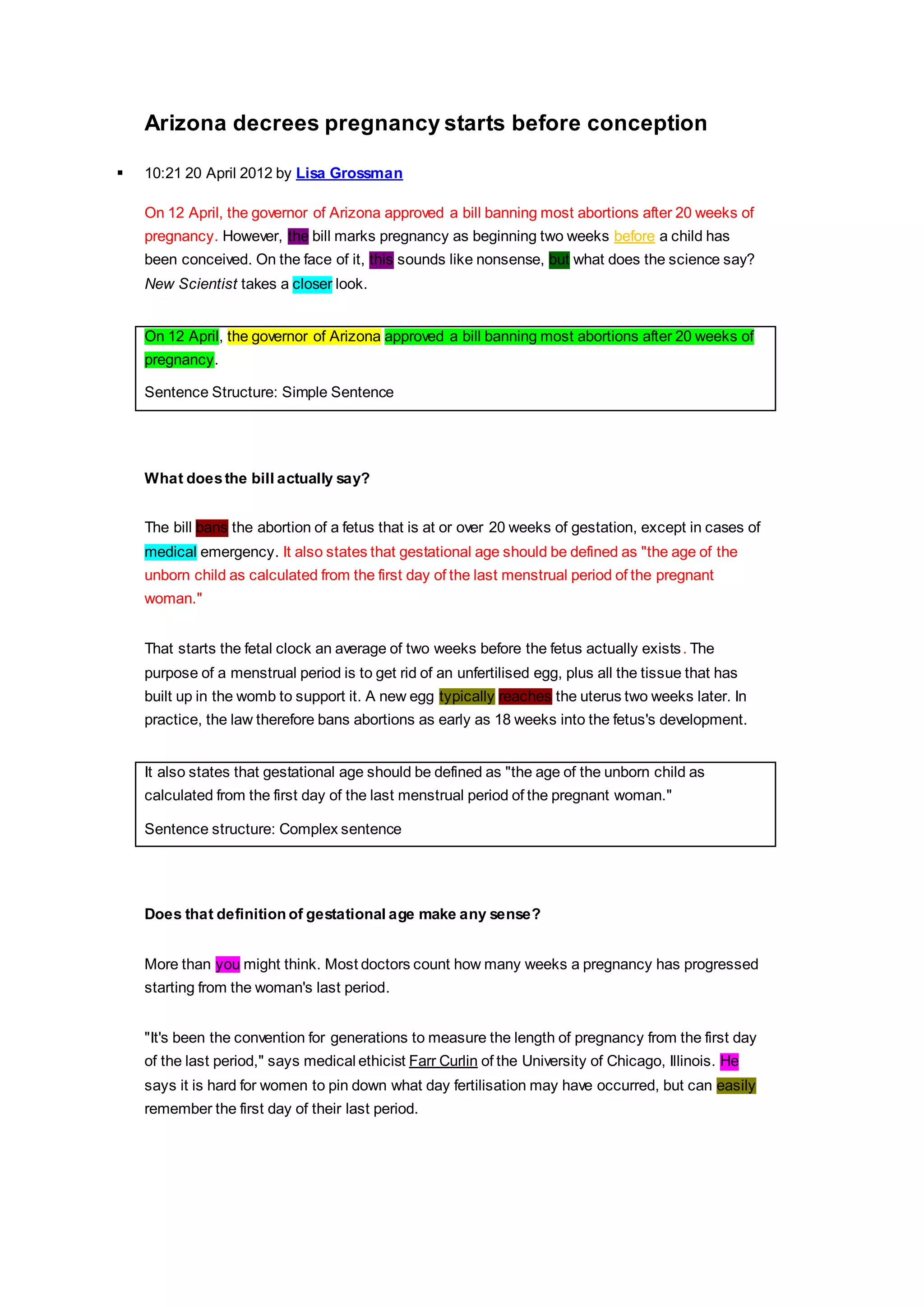
On 12 April, the governor of Arizona approved a bill banning most abortions after 20 weeks of 
pregnancy. 
Sentence Structure: Simple Sentence 
What does the bill actually say? 
The bill bans the abortion of a fetus that is at or over 20 weeks of gestation, except in cases of 
medical emergency. It also states that gestational age should be defined as "the age of the 
unborn child as calculated from the first day of the last menstrual period of the pregnant 
woman." 
That starts the fetal clock an average of two weeks before the fetus actually exists. The 
purpose of a menstrual period is to get rid of an unfertilised egg, plus all the tissue that has 
built up in the womb to support it. A new egg typically reaches the uterus two weeks later. In 
practice, the law therefore bans abortions as early as 18 weeks into the fetus's development. 
It also states that gestational age should be defined as "the age of the unborn child as 
calculated from the first day of the last menstrual period of the pregnant woman." 
Sentence structure: Complex sentence 
Does that definition of gestational age make any sense? 
More than you might think. Most doctors count how many weeks a pregnancy has progressed 
starting from the woman's last period. 
"It's been the convention for generations to measure the length of pregnancy from the first day 
of the last period," says medical ethicist Farr Curlin of the University of Chicago, Illinois. He 
says it is hard for women to pin down what day fertilisation may have occurred, but can easily 
remember the first day of their last period.
When does a pregnancy actually begin? 
"It would be absurd to say a woman is pregnant who is having her period," Curlin says. 
However, there is surprisingly little consensus in the medical community about whether a 
pregnancy begins at the moment the egg is fertilised by the sperm, or when it is implanted in 
the uterus. 
The American College of Obstetricians and Gynecologists opts for implantation, in light of the 
high percentage of fertilised eggs that never successfully implant. 
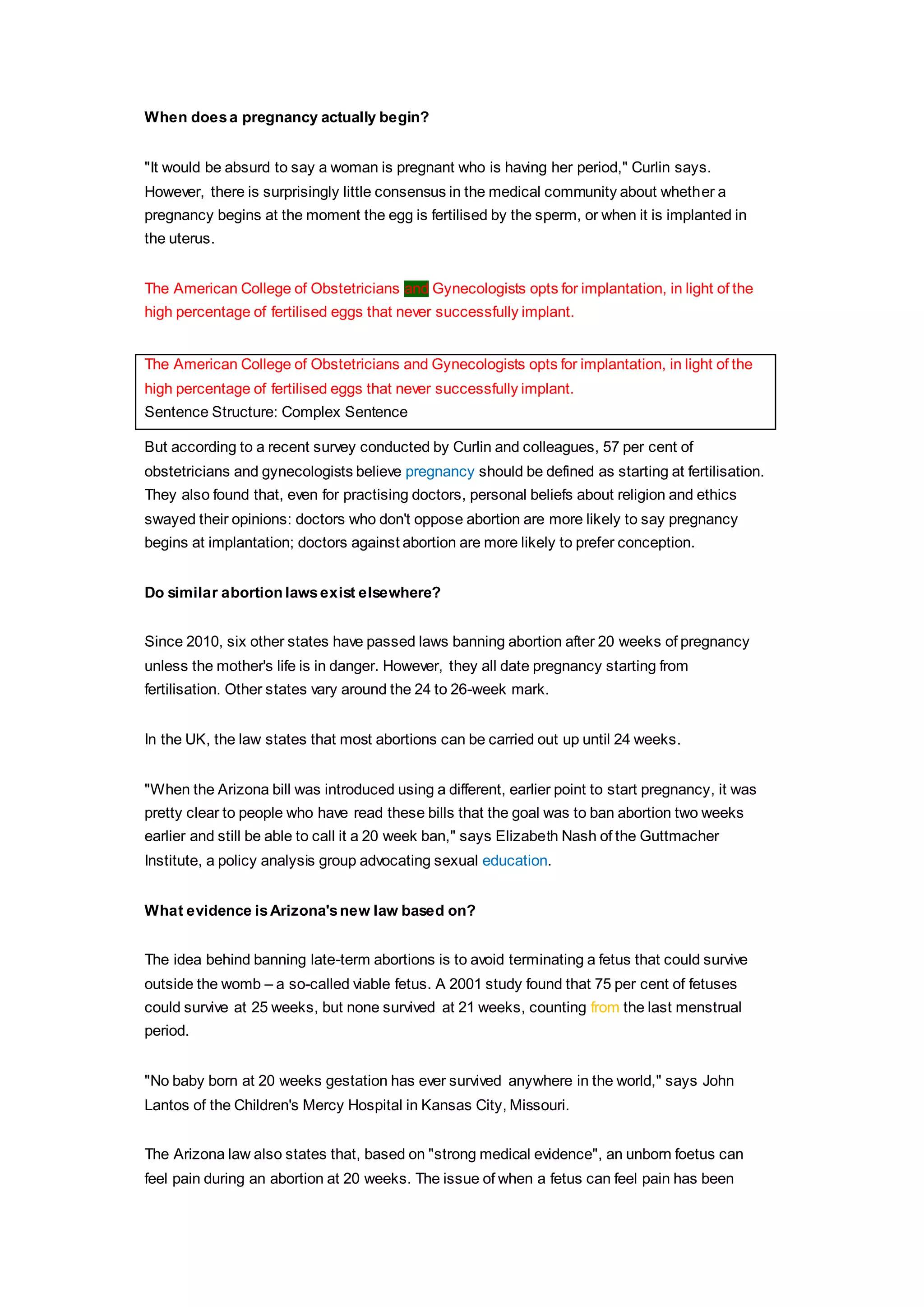
The American College of Obstetricians and Gynecologists opts for implantation, in light of the 
high percentage of fertilised eggs that never successfully implant. 
Sentence Structure: Complex Sentence 
But according to a recent survey conducted by Curlin and colleagues, 57 per cent of 
obstetricians and gynecologists believe pregnancy should be defined as starting at fertilisation. 
They also found that, even for practising doctors, personal beliefs about religion and ethics 
swayed their opinions: doctors who don't oppose abortion are more likely to say pregnancy 
begins at implantation; doctors against abortion are more likely to prefer conception. 
Do similar abortion laws exist elsewhere? 
Since 2010, six other states have passed laws banning abortion after 20 weeks of pregnancy 
unless the mother's life is in danger. However, they all date pregnancy starting from 
fertilisation. Other states vary around the 24 to 26-week mark. 
In the UK, the law states that most abortions can be carried out up until 24 weeks. 
"When the Arizona bill was introduced using a different, earlier point to start pregnancy, it was 
pretty clear to people who have read these bills that the goal was to ban abortion two weeks 
earlier and still be able to call it a 20 week ban," says Elizabeth Nash of the Guttmacher 
Institute, a policy analysis group advocating sexual education. 
What evidence is Arizona's new law based on? 
The idea behind banning late-term abortions is to avoid terminating a fetus that could survive 
outside the womb – a so-called viable fetus. A 2001 study found that 75 per cent of fetuses 
could survive at 25 weeks, but none survived at 21 weeks, counting from the last menstrual 
period. 
"No baby born at 20 weeks gestation has ever survived anywhere in the world," says John 
Lantos of the Children's Mercy Hospital in Kansas City, Missouri. 
The Arizona law also states that, based on "strong medical evidence", an unborn foetus can 
feel pain during an abortion at 20 weeks. The issue of when a fetus can feel pain has been
hotly contested. However, it is widely considered that brain pathways responsible for the 
perception of pain are not thought to be complete until 26 to 29 weeks. 
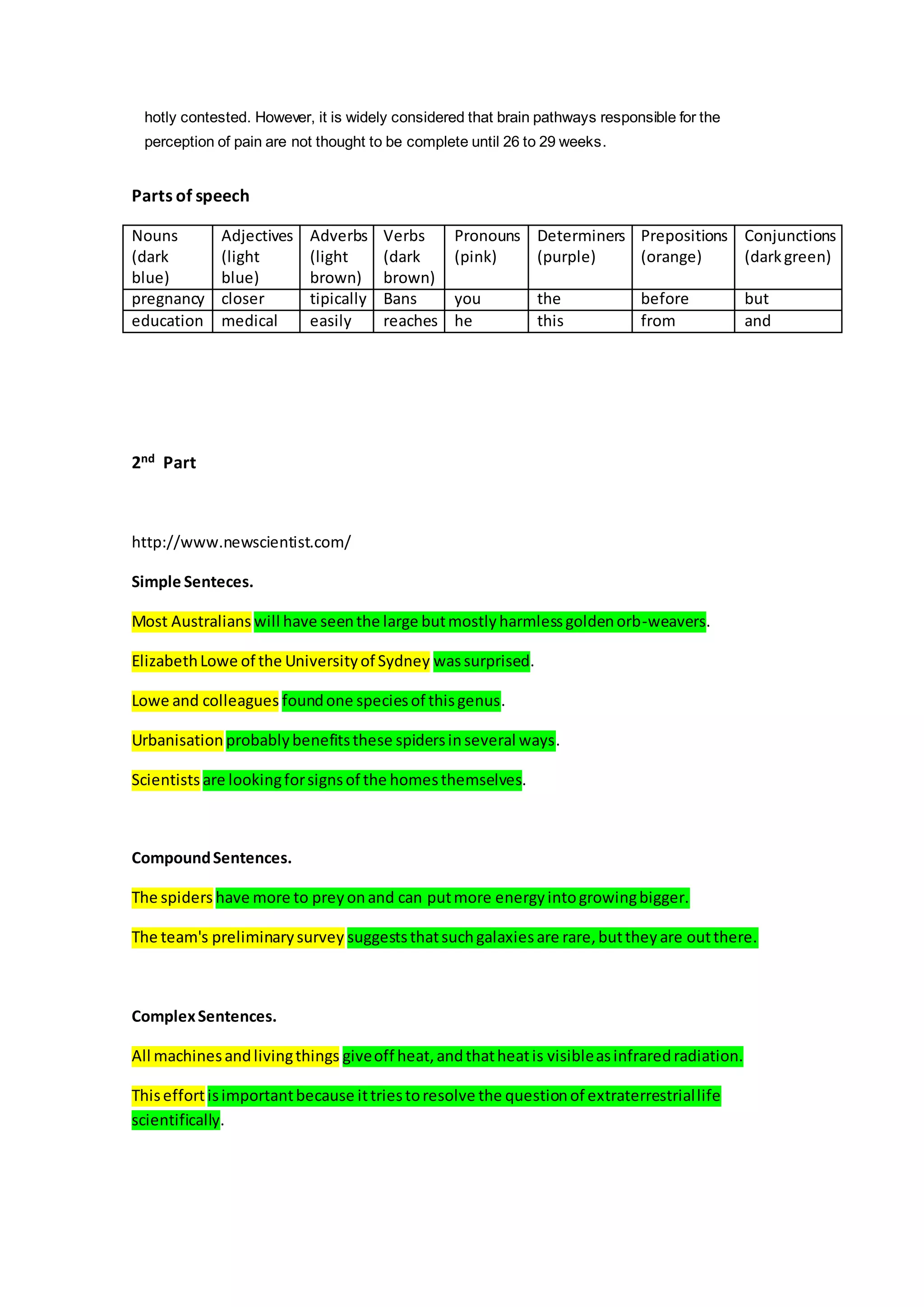
Parts of speech 
Nouns 
(dark 
blue) 
Adjectives 
(light 
blue) 
Adverbs 
(light 
brown) 
Verbs 
(dark 
brown) 
Pronouns 
(pink) 
Determiners 
(purple) 
Prepositions 
(orange) 
Conjunctions 
(dark green) 
pregnancy closer tipically Bans you the before but 
education medical easily reaches he this from and 
2nd Part 
http://www.newscientist.com/ 
Simple Senteces. 
Most Australians will have seen the large but mostly harmless golden orb-weavers. 
Elizabeth Lowe of the University of Sydney was surprised. 
Lowe and colleagues found one species of this genus. 
Urbanisation probably benefits these spiders in several ways. 
Scientists are looking for signs of the homes themselves. 
Compound Sentences. 
The spiders have more to prey on and can put more energy into growing bigger. 
The team's preliminary survey suggests that such galaxies are rare, but they are out there. 
Complex Sentences. 
All machines and living things give off heat, and that heat is visible as infrared radiation. 
This effort is important because it tries to resolve the question of extraterrestrial life 
scientifically.

Assignment 1 -template (1)

  • 1.
    Assignment 1 ENGLISHLANGUAGE SYSTEM STUDY Name: Matías Rodríguez Sanhueza Date: August 28th Teacher: Iris Roa
  • 2.
    Arizona decrees pregnancystarts before conception Taken from: Newscientist Magazine 20 April 2012 http://www.newscientist.com/article/dn21721-arizona-decrees-pregnancy- starts-before-conception.html By: James F. Smith Class: GIP2232 Section ??
  • 3.
    Arizona decrees pregnancystarts before conception  10:21 20 April 2012 by Lisa Grossman On 12 April, the governor of Arizona approved a bill banning most abortions after 20 weeks of pregnancy. However, the bill marks pregnancy as beginning two weeks before a child has been conceived. On the face of it, this sounds like nonsense, but what does the science say? New Scientist takes a closer look. On 12 April, the governor of Arizona approved a bill banning most abortions after 20 weeks of pregnancy. Sentence Structure: Simple Sentence What does the bill actually say? The bill bans the abortion of a fetus that is at or over 20 weeks of gestation, except in cases of medical emergency. It also states that gestational age should be defined as "the age of the unborn child as calculated from the first day of the last menstrual period of the pregnant woman." That starts the fetal clock an average of two weeks before the fetus actually exists. The purpose of a menstrual period is to get rid of an unfertilised egg, plus all the tissue that has built up in the womb to support it. A new egg typically reaches the uterus two weeks later. In practice, the law therefore bans abortions as early as 18 weeks into the fetus's development. It also states that gestational age should be defined as "the age of the unborn child as calculated from the first day of the last menstrual period of the pregnant woman." Sentence structure: Complex sentence Does that definition of gestational age make any sense? More than you might think. Most doctors count how many weeks a pregnancy has progressed starting from the woman's last period. "It's been the convention for generations to measure the length of pregnancy from the first day of the last period," says medical ethicist Farr Curlin of the University of Chicago, Illinois. He says it is hard for women to pin down what day fertilisation may have occurred, but can easily remember the first day of their last period.
  • 4.
    When does apregnancy actually begin? "It would be absurd to say a woman is pregnant who is having her period," Curlin says. However, there is surprisingly little consensus in the medical community about whether a pregnancy begins at the moment the egg is fertilised by the sperm, or when it is implanted in the uterus. The American College of Obstetricians and Gynecologists opts for implantation, in light of the high percentage of fertilised eggs that never successfully implant. The American College of Obstetricians and Gynecologists opts for implantation, in light of the high percentage of fertilised eggs that never successfully implant. Sentence Structure: Complex Sentence But according to a recent survey conducted by Curlin and colleagues, 57 per cent of obstetricians and gynecologists believe pregnancy should be defined as starting at fertilisation. They also found that, even for practising doctors, personal beliefs about religion and ethics swayed their opinions: doctors who don't oppose abortion are more likely to say pregnancy begins at implantation; doctors against abortion are more likely to prefer conception. Do similar abortion laws exist elsewhere? Since 2010, six other states have passed laws banning abortion after 20 weeks of pregnancy unless the mother's life is in danger. However, they all date pregnancy starting from fertilisation. Other states vary around the 24 to 26-week mark. In the UK, the law states that most abortions can be carried out up until 24 weeks. "When the Arizona bill was introduced using a different, earlier point to start pregnancy, it was pretty clear to people who have read these bills that the goal was to ban abortion two weeks earlier and still be able to call it a 20 week ban," says Elizabeth Nash of the Guttmacher Institute, a policy analysis group advocating sexual education. What evidence is Arizona's new law based on? The idea behind banning late-term abortions is to avoid terminating a fetus that could survive outside the womb – a so-called viable fetus. A 2001 study found that 75 per cent of fetuses could survive at 25 weeks, but none survived at 21 weeks, counting from the last menstrual period. "No baby born at 20 weeks gestation has ever survived anywhere in the world," says John Lantos of the Children's Mercy Hospital in Kansas City, Missouri. The Arizona law also states that, based on "strong medical evidence", an unborn foetus can feel pain during an abortion at 20 weeks. The issue of when a fetus can feel pain has been
  • 5.
    hotly contested. However,it is widely considered that brain pathways responsible for the perception of pain are not thought to be complete until 26 to 29 weeks. Parts of speech Nouns (dark blue) Adjectives (light blue) Adverbs (light brown) Verbs (dark brown) Pronouns (pink) Determiners (purple) Prepositions (orange) Conjunctions (dark green) pregnancy closer tipically Bans you the before but education medical easily reaches he this from and 2nd Part http://www.newscientist.com/ Simple Senteces. Most Australians will have seen the large but mostly harmless golden orb-weavers. Elizabeth Lowe of the University of Sydney was surprised. Lowe and colleagues found one species of this genus. Urbanisation probably benefits these spiders in several ways. Scientists are looking for signs of the homes themselves. Compound Sentences. The spiders have more to prey on and can put more energy into growing bigger. The team's preliminary survey suggests that such galaxies are rare, but they are out there. Complex Sentences. All machines and living things give off heat, and that heat is visible as infrared radiation. This effort is important because it tries to resolve the question of extraterrestrial life scientifically.