Abortion 
A brief overview
Abortion: some terminology 
(procured) abortion 
spontaneous abortion 
human foetus 
human embryo 
abortion on demand 
Intentional ending of unborn human 
life 
A miscarriage 
Commonly used to refer to unborn 
human life after first weeks 
Commonly used to refer to unborn 
human life during first weeks 
Abortion available without the need 
for reasons
Abortion: some statistics 
 Worldwide estimates between 
45 to 55 million annually 
 Typically 175 000 to 180 000 
annually in England and Wales 
 Of these… 
 Around 3.5% are for females 
under 16 
 Around 80% for females 
aged 16-24 
 About 85% of abortions are in 
the first trimester 
 About 80% of abortions are NHS 
funded 
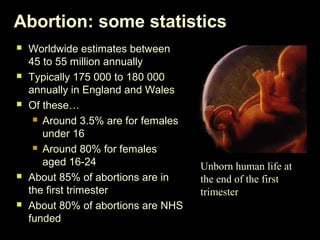
Unborn human life at 
the end of the first 
trimester
Development of human life 
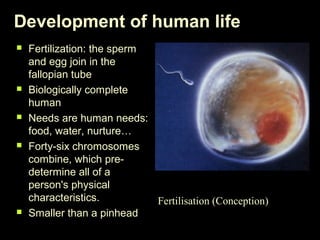
 Fertilization: the sperm 
and egg join in the 
fallopian tube 
 Biologically complete 
human 
 Needs are human needs: 
food, water, nurture… 
 Forty-six chromosomes 
combine, which pre-determine 
all of a 
person's physical 
characteristics. 
 Smaller than a pinhead 
Fertilisation (Conception)
Development of human life 
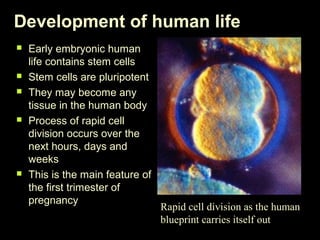
 Early embryonic human 
life contains stem cells 
 Stem cells are pluripotent 
 They may become any 
tissue in the human body 
 Process of rapid cell 
division occurs over the 
next hours, days and 
weeks 
 This is the main feature of 
the first trimester of 
pregnancy Rapid cell division as the human 
blueprint carries itself out
Development of human life 
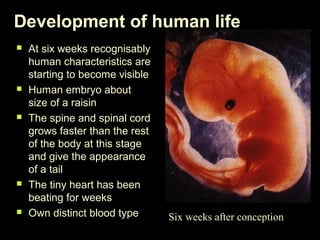
 At six weeks recognisably 
human characteristics are 
starting to become visible 
 Human embryo about 
size of a raisin 
 The spine and spinal cord 
grows faster than the rest 
of the body at this stage 
and give the appearance 
of a tail 
 The tiny heart has been 
beating for weeks 
 Own distinct blood type Six weeks after conception
Development of human life 
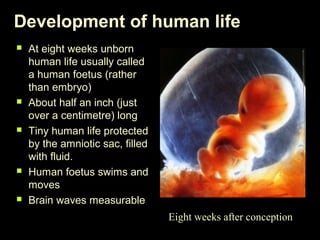
 At eight weeks unborn 
human life usually called 
a human foetus (rather 
than embryo) 
 About half an inch (just 
over a centimetre) long 
 Tiny human life protected 
by the amniotic sac, filled 
with fluid. 
 Human foetus swims and 
moves 
 Brain waves measurable 
Eight weeks after conception
Development of human life 
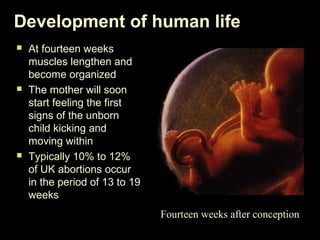
 At fourteen weeks 
muscles lengthen and 
become organized 
 The mother will soon 
start feeling the first 
signs of the unborn 
child kicking and 
moving within 
 Typically 10% to 12% 
of UK abortions occur 
in the period of 13 to 19 
weeks 
Fourteen weeks after conception
Development of human life 
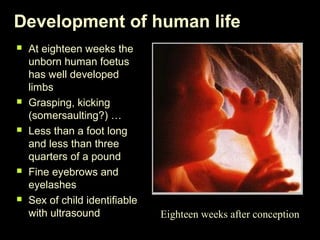
 At eighteen weeks the 
unborn human foetus 
has well developed 
limbs 
 Grasping, kicking 
(somersaulting?) … 
 Less than a foot long 
and less than three 
quarters of a pound 
 Fine eyebrows and 
eyelashes 
 Sex of child identifiable 
with ultrasound Eighteen weeks after conception
Development of human life 
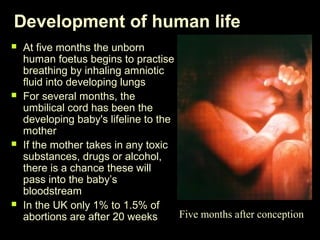
 At five months the unborn 
human foetus begins to practise 
breathing by inhaling amniotic 
fluid into developing lungs 
 For several months, the 
umbilical cord has been the 
developing baby's lifeline to the 
mother 
 If the mother takes in any toxic 
substances, drugs or alcohol, 
there is a chance these will 
pass into the baby’s 
bloodstream 
 In the UK only 1% to 1.5% of 
abortions are after 20 weeks Five months after conception
Development of human life 
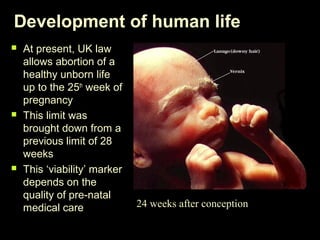
 At present, UK law 
allows abortion of a 
healthy unborn life 
up to the 25th week of 
pregnancy 
 This limit was 
brought down from a 
previous limit of 28 
weeks 
 This ‘viability’ marker 
depends on the 
quality of pre-natal 
medical care 24 weeks after conception
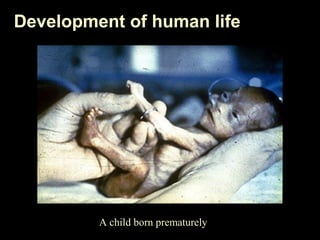
Development of human life 
A child born prematurely
Abortion: the crux of the debate 
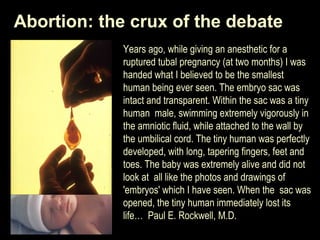
Years ago, while giving an anesthetic for a 
ruptured tubal pregnancy (at two months) I was 
handed what I believed to be the smallest 
human being ever seen. The embryo sac was 
intact and transparent. Within the sac was a tiny 
human male, swimming extremely vigorously in 
the amniotic fluid, while attached to the wall by 
the umbilical cord. The tiny human was perfectly 
developed, with long, tapering fingers, feet and 
toes. The baby was extremely alive and did not 
look at all like the photos and drawings of 
'embryos' which I have seen. When the sac was 
opened, the tiny human immediately lost its 
life… Paul E. Rockwell, M.D.
Abortion: some methods 
Vacuum 
aspiration 
Curettage 
Late-term 
surgical 
methods 
Abortifacients 
Under anaesthetic the cervix is gradually 
widened by probes, suction tubes rupture the 
amniotic sac and suck the unborn human life 
out a piece at a time. 
Instead of a suction tube, a curette (scraping 
tool) removes the unborn human foetus 
piecemeal 
For late-second trimester abortions onward, 
D&E (Dilation and Evacuation) and, for very 
late abortions, D&X (Dilation and Extraction) 
methods are sometimes used 
Various chemical methods that prevent the 
pregnancy continuing e.g. the morning 
after pill or chemically induced miscarriage
Abortion: the hard cases 
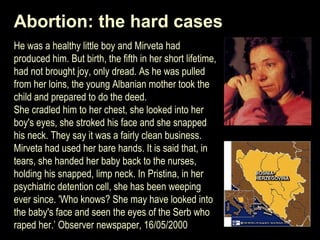
He was a healthy little boy and Mirveta had 
produced him. But birth, the fifth in her short lifetime, 
had not brought joy, only dread. As he was pulled 
from her loins, the young Albanian mother took the 
child and prepared to do the deed. 
She cradled him to her chest, she looked into her 
boy's eyes, she stroked his face and she snapped 
his neck. They say it was a fairly clean business. 
Mirveta had used her bare hands. It is said that, in 
tears, she handed her baby back to the nurses, 
holding his snapped, limp neck. In Pristina, in her 
psychiatric detention cell, she has been weeping 
ever since. 'Who knows? She may have looked into 
the baby's face and seen the eyes of the Serb who 
raped her.’ Observer newspaper, 16/05/2000
Different reactions… 
"When I gave birth to her, I didn't 
want to see her...but on the second 
day, when I took her to my breast, I 
realised that she was the only 
beauty remaining in this world and 
so I kept her." 
With these words Esma, a Bosnian 
waitress, explains what made her 
keep her daughter Sara, 13. 
Esma, former medical student, 
became pregnant in war-torn 
Sarajevo in 1992 after being raped 
by Serb soldiers in her Grbavica 
home. 
Victims of mass rapes are being 
shunned by family and friends. 
Most of them are stigmatised and 
excluded from society if people 
around them come to know the 
truth. 
The children conceived in rapes 
were mostly pushed into 
orphanages in Bosnia or 
neighbouring Croatia, and in rare 
cases given for adoption. They 
grow up knowing nothing about 
their parents. 
Source: http://ipsnews.net/news.asp?idnews=32406
Some issues and responses 
Backstreet Abortions? 
• Numbers admitted to 
hospital after botched 
abortions was on the way 
down years before 1967. 
• Many so-called ‘backstreet’ 
abortions before 1967 were 
done in ‘front’ streets by 
private practice doctors. 
• Backstreet abortions were 
almost always performed 
early in pregnancy. 
• Those who think abortion is 
wrong reject backstreet 
abortions along with all other 
abortions. 
• Wherever or however they 
are performed, at least one 
life is ended, sometimes 
two. 
• They would argue that If 
people are being beaten up 
in the back streets should 
we establish clinics where 
they can be attacked in 
hygienic conditions?
Some issues and responses 
Pregnant after rape/abuse? 
• Because of the severe 
body trauma, pregnancy 
after rape is extremely rare. 
• However, it does happen. 
Mass rape was part of the 
Serbian terror tactics in the 
Balkan war over a decade 
ago. This produced a 
number of rape children. 
• Proponents argue that the 
continuing pregnancy can 
only be an terrible reminder 
of a terrible ordeal. 
• Those who think abortion is 
wrong would argue that the 
violence of abortion will 
only add to the trauma of 
rape. 
• As it is, post-abortion 
trauma/depression is a 
common occurrence. It 
could get far worse. 
• They would also argue that 
the developing child should 
not be punished for the 
crime of his or her father.
Some issues and responses 
Health risk or disability? 
• Proponents argue that a 
woman should have access 
to abortion when her health 
is threatened by the 
pregnancy. 
• They also argue that 
severely disabled unborn 
human lives should be 
terminated. 
• In 2004, 1% of abortions 
were because of risk of 
handicap; 1% because of a 
health threat to the woman. 
• Those who think abortion is 
wrong would say that for 
health threats, inducing a 
birth is safer than abortion. 
• They would also argue that 
we are showing a vicious 
prejudice against disabled 
people. 
• It makes the womb by far 
the most dangerous place 
for disabled people in the 
western world.
Christian views 
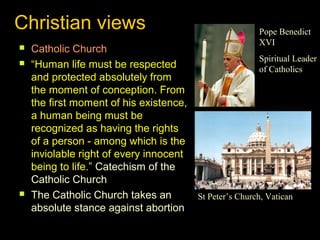
 Catholic Church 
 “Human life must be respected 
and protected absolutely from 
the moment of conception. From 
the first moment of his existence, 
a human being must be 
recognized as having the rights 
of a person - among which is the 
inviolable right of every innocent 
being to life.” Catechism of the 
Catholic Church 
 The Catholic Church takes an 
absolute stance against abortion 
Pope Benedict 
XVI 
Spiritual Leader 
of Catholics 
St Peter’s Church, Vatican
Christian views 
 Anglican Church 
 "All human life, including life 
developing in the womb, is 
created by God in his own image 
and is therefore to be nurtured, 
supported and protected” 
 However, the Anglican Church 
sometimes sees abortion as a 
less evil alternative in certain 
grave circumstances 
 Other Christians, for example, 
Methodists, have similar views 
on this issue 
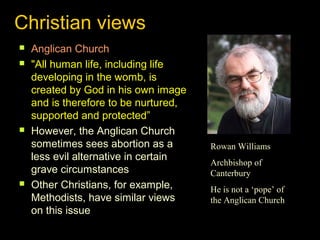
Rowan Williams 
Archbishop of 
Canterbury 
He is not a ‘pope’ of 
the Anglican Church
The Bible 
 The Bible 
 No passage 
which says: 
“Though shall 
not commit 
abortion”… 
 However, there 
are references 
that get across 
the belief that 
human life exists 
from the earliest 
moment of a 
pregnancy… 
 "You created my inmost being, 
you knit me together in my 
mother's womb" Psalm 139 
 The word of the LORD came to 
me, saying, “Before I formed 
you in the womb I knew you, 
before you were born I set you 
apart; I appointed you as a 
prophet to the nations”. 
Jeremiah 1:4,5 
 Now as soon as Elizabeth heard 
Mary's greeting, the child leaped 
in her womb and Elizabeth was 
filled with the Holy Spirit. Luke 
1:41

Abortion

  • 1.
  • 2.
    Abortion: some terminology (procured) abortion spontaneous abortion human foetus human embryo abortion on demand Intentional ending of unborn human life A miscarriage Commonly used to refer to unborn human life after first weeks Commonly used to refer to unborn human life during first weeks Abortion available without the need for reasons
  • 3.
    Abortion: some statistics  Worldwide estimates between 45 to 55 million annually  Typically 175 000 to 180 000 annually in England and Wales  Of these…  Around 3.5% are for females under 16  Around 80% for females aged 16-24  About 85% of abortions are in the first trimester  About 80% of abortions are NHS funded Unborn human life at the end of the first trimester
  • 4.
    Development of humanlife  Fertilization: the sperm and egg join in the fallopian tube  Biologically complete human  Needs are human needs: food, water, nurture…  Forty-six chromosomes combine, which pre-determine all of a person's physical characteristics.  Smaller than a pinhead Fertilisation (Conception)
  • 5.
    Development of humanlife  Early embryonic human life contains stem cells  Stem cells are pluripotent  They may become any tissue in the human body  Process of rapid cell division occurs over the next hours, days and weeks  This is the main feature of the first trimester of pregnancy Rapid cell division as the human blueprint carries itself out
  • 6.
    Development of humanlife  At six weeks recognisably human characteristics are starting to become visible  Human embryo about size of a raisin  The spine and spinal cord grows faster than the rest of the body at this stage and give the appearance of a tail  The tiny heart has been beating for weeks  Own distinct blood type Six weeks after conception
  • 7.
    Development of humanlife  At eight weeks unborn human life usually called a human foetus (rather than embryo)  About half an inch (just over a centimetre) long  Tiny human life protected by the amniotic sac, filled with fluid.  Human foetus swims and moves  Brain waves measurable Eight weeks after conception
  • 8.
    Development of humanlife  At fourteen weeks muscles lengthen and become organized  The mother will soon start feeling the first signs of the unborn child kicking and moving within  Typically 10% to 12% of UK abortions occur in the period of 13 to 19 weeks Fourteen weeks after conception
  • 9.
    Development of humanlife  At eighteen weeks the unborn human foetus has well developed limbs  Grasping, kicking (somersaulting?) …  Less than a foot long and less than three quarters of a pound  Fine eyebrows and eyelashes  Sex of child identifiable with ultrasound Eighteen weeks after conception
  • 10.
    Development of humanlife  At five months the unborn human foetus begins to practise breathing by inhaling amniotic fluid into developing lungs  For several months, the umbilical cord has been the developing baby's lifeline to the mother  If the mother takes in any toxic substances, drugs or alcohol, there is a chance these will pass into the baby’s bloodstream  In the UK only 1% to 1.5% of abortions are after 20 weeks Five months after conception
  • 11.
    Development of humanlife  At present, UK law allows abortion of a healthy unborn life up to the 25th week of pregnancy  This limit was brought down from a previous limit of 28 weeks  This ‘viability’ marker depends on the quality of pre-natal medical care 24 weeks after conception
  • 12.
    Development of humanlife A child born prematurely
  • 13.
    Abortion: the cruxof the debate Years ago, while giving an anesthetic for a ruptured tubal pregnancy (at two months) I was handed what I believed to be the smallest human being ever seen. The embryo sac was intact and transparent. Within the sac was a tiny human male, swimming extremely vigorously in the amniotic fluid, while attached to the wall by the umbilical cord. The tiny human was perfectly developed, with long, tapering fingers, feet and toes. The baby was extremely alive and did not look at all like the photos and drawings of 'embryos' which I have seen. When the sac was opened, the tiny human immediately lost its life… Paul E. Rockwell, M.D.
  • 14.
    Abortion: some methods Vacuum aspiration Curettage Late-term surgical methods Abortifacients Under anaesthetic the cervix is gradually widened by probes, suction tubes rupture the amniotic sac and suck the unborn human life out a piece at a time. Instead of a suction tube, a curette (scraping tool) removes the unborn human foetus piecemeal For late-second trimester abortions onward, D&E (Dilation and Evacuation) and, for very late abortions, D&X (Dilation and Extraction) methods are sometimes used Various chemical methods that prevent the pregnancy continuing e.g. the morning after pill or chemically induced miscarriage
  • 15.
    Abortion: the hardcases He was a healthy little boy and Mirveta had produced him. But birth, the fifth in her short lifetime, had not brought joy, only dread. As he was pulled from her loins, the young Albanian mother took the child and prepared to do the deed. She cradled him to her chest, she looked into her boy's eyes, she stroked his face and she snapped his neck. They say it was a fairly clean business. Mirveta had used her bare hands. It is said that, in tears, she handed her baby back to the nurses, holding his snapped, limp neck. In Pristina, in her psychiatric detention cell, she has been weeping ever since. 'Who knows? She may have looked into the baby's face and seen the eyes of the Serb who raped her.’ Observer newspaper, 16/05/2000
  • 16.
    Different reactions… "WhenI gave birth to her, I didn't want to see her...but on the second day, when I took her to my breast, I realised that she was the only beauty remaining in this world and so I kept her." With these words Esma, a Bosnian waitress, explains what made her keep her daughter Sara, 13. Esma, former medical student, became pregnant in war-torn Sarajevo in 1992 after being raped by Serb soldiers in her Grbavica home. Victims of mass rapes are being shunned by family and friends. Most of them are stigmatised and excluded from society if people around them come to know the truth. The children conceived in rapes were mostly pushed into orphanages in Bosnia or neighbouring Croatia, and in rare cases given for adoption. They grow up knowing nothing about their parents. Source: http://ipsnews.net/news.asp?idnews=32406
  • 17.
    Some issues andresponses Backstreet Abortions? • Numbers admitted to hospital after botched abortions was on the way down years before 1967. • Many so-called ‘backstreet’ abortions before 1967 were done in ‘front’ streets by private practice doctors. • Backstreet abortions were almost always performed early in pregnancy. • Those who think abortion is wrong reject backstreet abortions along with all other abortions. • Wherever or however they are performed, at least one life is ended, sometimes two. • They would argue that If people are being beaten up in the back streets should we establish clinics where they can be attacked in hygienic conditions?
  • 18.
    Some issues andresponses Pregnant after rape/abuse? • Because of the severe body trauma, pregnancy after rape is extremely rare. • However, it does happen. Mass rape was part of the Serbian terror tactics in the Balkan war over a decade ago. This produced a number of rape children. • Proponents argue that the continuing pregnancy can only be an terrible reminder of a terrible ordeal. • Those who think abortion is wrong would argue that the violence of abortion will only add to the trauma of rape. • As it is, post-abortion trauma/depression is a common occurrence. It could get far worse. • They would also argue that the developing child should not be punished for the crime of his or her father.
  • 19.
    Some issues andresponses Health risk or disability? • Proponents argue that a woman should have access to abortion when her health is threatened by the pregnancy. • They also argue that severely disabled unborn human lives should be terminated. • In 2004, 1% of abortions were because of risk of handicap; 1% because of a health threat to the woman. • Those who think abortion is wrong would say that for health threats, inducing a birth is safer than abortion. • They would also argue that we are showing a vicious prejudice against disabled people. • It makes the womb by far the most dangerous place for disabled people in the western world.
  • 20.
    Christian views Catholic Church  “Human life must be respected and protected absolutely from the moment of conception. From the first moment of his existence, a human being must be recognized as having the rights of a person - among which is the inviolable right of every innocent being to life.” Catechism of the Catholic Church  The Catholic Church takes an absolute stance against abortion Pope Benedict XVI Spiritual Leader of Catholics St Peter’s Church, Vatican
  • 21.
    Christian views Anglican Church  "All human life, including life developing in the womb, is created by God in his own image and is therefore to be nurtured, supported and protected”  However, the Anglican Church sometimes sees abortion as a less evil alternative in certain grave circumstances  Other Christians, for example, Methodists, have similar views on this issue Rowan Williams Archbishop of Canterbury He is not a ‘pope’ of the Anglican Church
  • 22.
    The Bible The Bible  No passage which says: “Though shall not commit abortion”…  However, there are references that get across the belief that human life exists from the earliest moment of a pregnancy…  "You created my inmost being, you knit me together in my mother's womb" Psalm 139  The word of the LORD came to me, saying, “Before I formed you in the womb I knew you, before you were born I set you apart; I appointed you as a prophet to the nations”. Jeremiah 1:4,5  Now as soon as Elizabeth heard Mary's greeting, the child leaped in her womb and Elizabeth was filled with the Holy Spirit. Luke 1:41