GOODBYE KPUP
MeluJean A. Mayores
SST III
DEPED ORDER NO. 8 S.2015
 Policy Guidelines on Classroom Assessment
for the K to 12 Basic Education Program
 Classroom Assessment is an integral part of
curriculum implementation
 Allows the teachers to track and measure
learners progress
 Adjust instruction accordingly
 Informs the learners, as well as their parents
and guardians, of their progress
THEORETICAL BASIS
 Integral part of teaching and learning
 Diversity of learners, need for multiple
ways of measuring their varying abilities
and learning potentials
 Appropriate assessment is committed to
ensure learners’ success in moving from
guided to independent display of
knowledge, understanding and skills
 Acknowledges the unity of instruction and
assessment
CLASSROOM ASSESSMENT
 Ongoing process of identifying, gathering,
organizing and interpreting quantitative
and qualitative information about what
learners know and can do
 Employ methods that are consistent with
curriculum standards
 Always inform learners about the
objectives of the lesson
 Provides immediate feedback about their
progress
TYPES OF CLASSROOM ASSESSMENT
Formative
 For learning so teachers can make
adjustments in their instruction
 As learning wherein students reflect on their
own progress
 Characteristically informal and intended to
help students identify strengths and
weaknesses in order to learn from the
experience
TYPES OF CLASSROOM ASSESSMENT
Formative
 Maybe given at any time to check the
effectiveness of the instruction
 Observe and guide learners in their tasks
through interaction and dialogue , thus
gaining deeper insights into the learner
 Result will help teachers make good
instructional decisions
TYPES OF CLASSROOM ASSESSMENT
Formative
 Record results by documenting and
tracking learners’ progress
 Help understand their students and thus
teach them better
 Not included in the computation of
summative assessment
TYPES OF CLASSROOM ASSESSMENT
Before the Lesson
 Agree/Disagree activities
 Games
 Interviews
 Inventories/Checklist of skills
 KWL
 Open-ended questions
 Practice exercises
TYPES OF CLASSROOM ASSESSMENT
Lesson Proper
 Multimedia Presentations
 Observations
 Formative performance task
 Quizzes (recorded but not graded)
 Recitations
 Simulation activities
TYPES OF CLASSROOM ASSESSMENT
After the Lesson
 Checklists
 Discussion
 Games
 Performance tasks
 Practice exercises
 Short quizzes
 Written work
TYPES OF CLASSROOM ASSESSMENT
Summative
 Of learning which occurs at the end of a
particular unit in order to describe the
standard reached by the learner
 Measure whether learners have met the
content and performance standards
 Results are recorded and used to report on
the learners achievement
WHAT IS ASSESSED IN THE CLASSROOM?
A. Content Standards
What should the learners know?
 Essential knowledge and understanding that
should be learned
 Specified scope of sequential topics within
each learning strand, domain, theme or
component
WHAT IS ASSESSED IN THE CLASSROOM?
B. Performance Standards
What can learners do with what they know?
 Abilities and skills that learners are
expected to demonstrate in relation to the
content standards and integration of 21st
century skills
 expressed through creation, innovation and
adding value to the products, independent
or collaborative
WHAT IS ASSESSED IN THE CLASSROOM?
C. Learning Competencies
Knowledge, understanding, skills and attitudes
that students need to demonstrate in every
lesson and/or learning activity
WHAT IS ASSESSED IN THE CLASSROOM?
D. Concept Development
Cognitive process from basic to complex
 Remembering
 Understanding
 Applying
 Analyzing
 Evaluating
 Creating
HOW ARE LEARNERS ASSESSED?
A. Individually
Enables the learner to demonstrate independently
what has been learned or mastered
 Check up quizzes
 Written exercises
 Performances
 Models
 Electronic presentations
HOW ARE LEARNERS ASSESSED?
B. Collaboratively (Peer Assessment)
Allows students to support each other’s
learning
 Discussions
 Role playing
 Games
 Group activities
HOW ARE LEARNERS ASSESSED?
Components of Summative Assessment
1. Written Work Component
Long quizzes and tests
2. Performance task
Skills demonstration, group presentation,
ora work, multimedia presentation and
research projects
3. Quarterly Assessment
WHAT IS THE GRADING SYSTEM?
 Grades will be based on the weighted raw
score of the learners’ summative
assessment
 Minimum grade needed to pass a specific
learning area is 60, which is transmuted to
75 in the report card
 The lowest mark that can appear on the
report card is 60 for quarterly grades and
Final Grades
HOW THE LEARNER PROGRESS RECORDED AND
COMPUTED?
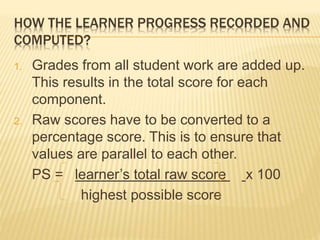
1. Grades from all student work are added up.
This results in the total score for each
component.
2. Raw scores have to be converted to a
percentage score. This is to ensure that
values are parallel to each other.
PS = learner’s total raw score x 100
highest possible score
HOW THE LEARNER PROGRESS RECORDED AND
COMPUTED?
3. Percentage scores are then converted to
Weighted Scores to show the importance of
each component
Weighted score (WS)= Percentage score x
Weight of component
4. The sum of the weighted scores in each
component is the initial Grade. This initial
grade will be transmuted using the given
transmutation table to get the quarterly
grade
HOW ARE THE GRADES COMPUTED AT THE END
OF THE SCHOOL YEAR?
 The average of the Quarterly Grades (QG)
produces the Final Grade
 The general average is computed by
dividing the sum of all final grades by the
total number of learning areas. Each
learning area has equal weight
 The FG and Gave are reported as whole
numbers
HOW IS THE LEARNER”S PROGRESS
REPORTED?
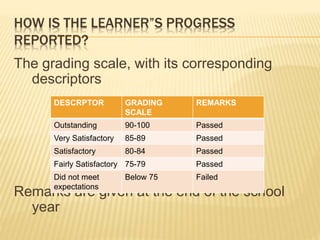
The grading scale, with its corresponding
descriptors
Remarks are given at the end of the school
year
DESCRPTOR GRADING
SCALE
REMARKS
Outstanding 90-100 Passed
Very Satisfactory 85-89 Passed
Satisfactory 80-84 Passed
Fairly Satisfactory 75-79 Passed
Did not meet
expectations
Below 75 Failed
HOW IS THE LEARNER’S PROMOTED OR
RETAINED?
 Final grades of at least 75 in all learning
areas-promoted to the next grade level
 Did not meet expectations in not more than
two learning areas-must pass remedial
classes to be promoted
 Did not meet expectations in three or more-
retained in the same level

Goodbye kpup

  • 1.
    GOODBYE KPUP MeluJean A.Mayores SST III
  • 2.
    DEPED ORDER NO.8 S.2015  Policy Guidelines on Classroom Assessment for the K to 12 Basic Education Program  Classroom Assessment is an integral part of curriculum implementation  Allows the teachers to track and measure learners progress  Adjust instruction accordingly  Informs the learners, as well as their parents and guardians, of their progress
  • 3.
    THEORETICAL BASIS  Integralpart of teaching and learning  Diversity of learners, need for multiple ways of measuring their varying abilities and learning potentials  Appropriate assessment is committed to ensure learners’ success in moving from guided to independent display of knowledge, understanding and skills  Acknowledges the unity of instruction and assessment
  • 4.
    CLASSROOM ASSESSMENT  Ongoingprocess of identifying, gathering, organizing and interpreting quantitative and qualitative information about what learners know and can do  Employ methods that are consistent with curriculum standards  Always inform learners about the objectives of the lesson  Provides immediate feedback about their progress
  • 5.
    TYPES OF CLASSROOMASSESSMENT Formative  For learning so teachers can make adjustments in their instruction  As learning wherein students reflect on their own progress  Characteristically informal and intended to help students identify strengths and weaknesses in order to learn from the experience
  • 6.
    TYPES OF CLASSROOMASSESSMENT Formative  Maybe given at any time to check the effectiveness of the instruction  Observe and guide learners in their tasks through interaction and dialogue , thus gaining deeper insights into the learner  Result will help teachers make good instructional decisions
  • 7.
    TYPES OF CLASSROOMASSESSMENT Formative  Record results by documenting and tracking learners’ progress  Help understand their students and thus teach them better  Not included in the computation of summative assessment
  • 8.
    TYPES OF CLASSROOMASSESSMENT Before the Lesson  Agree/Disagree activities  Games  Interviews  Inventories/Checklist of skills  KWL  Open-ended questions  Practice exercises
  • 9.
    TYPES OF CLASSROOMASSESSMENT Lesson Proper  Multimedia Presentations  Observations  Formative performance task  Quizzes (recorded but not graded)  Recitations  Simulation activities
  • 10.
    TYPES OF CLASSROOMASSESSMENT After the Lesson  Checklists  Discussion  Games  Performance tasks  Practice exercises  Short quizzes  Written work
  • 11.
    TYPES OF CLASSROOMASSESSMENT Summative  Of learning which occurs at the end of a particular unit in order to describe the standard reached by the learner  Measure whether learners have met the content and performance standards  Results are recorded and used to report on the learners achievement
  • 12.
    WHAT IS ASSESSEDIN THE CLASSROOM? A. Content Standards What should the learners know?  Essential knowledge and understanding that should be learned  Specified scope of sequential topics within each learning strand, domain, theme or component
  • 13.
    WHAT IS ASSESSEDIN THE CLASSROOM? B. Performance Standards What can learners do with what they know?  Abilities and skills that learners are expected to demonstrate in relation to the content standards and integration of 21st century skills  expressed through creation, innovation and adding value to the products, independent or collaborative
  • 14.
    WHAT IS ASSESSEDIN THE CLASSROOM? C. Learning Competencies Knowledge, understanding, skills and attitudes that students need to demonstrate in every lesson and/or learning activity
  • 15.
    WHAT IS ASSESSEDIN THE CLASSROOM? D. Concept Development Cognitive process from basic to complex  Remembering  Understanding  Applying  Analyzing  Evaluating  Creating
  • 16.
    HOW ARE LEARNERSASSESSED? A. Individually Enables the learner to demonstrate independently what has been learned or mastered  Check up quizzes  Written exercises  Performances  Models  Electronic presentations
  • 17.
    HOW ARE LEARNERSASSESSED? B. Collaboratively (Peer Assessment) Allows students to support each other’s learning  Discussions  Role playing  Games  Group activities
  • 18.
    HOW ARE LEARNERSASSESSED? Components of Summative Assessment 1. Written Work Component Long quizzes and tests 2. Performance task Skills demonstration, group presentation, ora work, multimedia presentation and research projects 3. Quarterly Assessment
  • 19.
    WHAT IS THEGRADING SYSTEM?  Grades will be based on the weighted raw score of the learners’ summative assessment  Minimum grade needed to pass a specific learning area is 60, which is transmuted to 75 in the report card  The lowest mark that can appear on the report card is 60 for quarterly grades and Final Grades
  • 20.
    HOW THE LEARNERPROGRESS RECORDED AND COMPUTED? 1. Grades from all student work are added up. This results in the total score for each component. 2. Raw scores have to be converted to a percentage score. This is to ensure that values are parallel to each other. PS = learner’s total raw score x 100 highest possible score
  • 21.
    HOW THE LEARNERPROGRESS RECORDED AND COMPUTED? 3. Percentage scores are then converted to Weighted Scores to show the importance of each component Weighted score (WS)= Percentage score x Weight of component 4. The sum of the weighted scores in each component is the initial Grade. This initial grade will be transmuted using the given transmutation table to get the quarterly grade
  • 22.
    HOW ARE THEGRADES COMPUTED AT THE END OF THE SCHOOL YEAR?  The average of the Quarterly Grades (QG) produces the Final Grade  The general average is computed by dividing the sum of all final grades by the total number of learning areas. Each learning area has equal weight  The FG and Gave are reported as whole numbers
  • 23.
    HOW IS THELEARNER”S PROGRESS REPORTED? The grading scale, with its corresponding descriptors Remarks are given at the end of the school year DESCRPTOR GRADING SCALE REMARKS Outstanding 90-100 Passed Very Satisfactory 85-89 Passed Satisfactory 80-84 Passed Fairly Satisfactory 75-79 Passed Did not meet expectations Below 75 Failed
  • 24.
    HOW IS THELEARNER’S PROMOTED OR RETAINED?  Final grades of at least 75 in all learning areas-promoted to the next grade level  Did not meet expectations in not more than two learning areas-must pass remedial classes to be promoted  Did not meet expectations in three or more- retained in the same level