

Workshop on

THE LINKAGES OF LEARNING OUTCOMES, 
LEARNING ACTIVITIES AND ASSESSMENTS IN 
HIGHER EDUCATION
Australian and Thai Perspectives

THAILAND  19  28 June 2012
THAILAND 19 – 28 June 2012


Thailand Qualification Framework
Learning Outcomes, Assessment and Feedback


                                   Nattavud Pimpa
                                       Tim Moore


                                                    1
Sessions 3 & 4: Learning Objective
 By the end of these two sessions the 
 participants will be able to link learning 
 participants will be able to link learning
 outcomes with assessment, and strengthen
 teaching practice through effective feedback.


                       TQF


What are the purposes of assessment?


                                                 2
There is
nothing to fear
from changes in
assessment practices


 What are the purposes of assessment?
• to measure students’ preparedness for further study or 
  professional accreditation
                  ,                        ,
• to rank students, relative to one another, for the 
  purposes of competitive scholarships or other 
  opportunities
• to provide feedback on student learning for both 
  students and staff


                                                            3
What are the purposes of assessment?


                    • to provide feedback 
                      to provide feedback
                      on teaching for staff
                    • to define and protect 
                      academic standards
                    • to direct students’ 
                      learning


     What are your experiences 
          in assessment?


                                               4
Steps in Designing Learning Outcomes
Step 5: Determining Assessment 

•Fair, equitable and transparent.
• Must reflect the learning outcomes
•Incorporate a range of types or modes of 
 assessment appropriate to the nature of the 
 unit, method of delivery and the students 
 involved
•Design appropriate assessment strategies 
 that ideally engage the learners in activities 
 they can relate to real‐life or workplace 
 situations

                                 TQF


 Steps in Designing Learning Outcomes
Example 
Thinking critically and making judgments  (Developing arguments, 
 reflecting, evaluating, assessing, judging)  
•Essay  
•Report  
•Journal  
•Letter of advice to … (about policy, public health matters … )  
•Present a case for an interest group  
•Prepare a committee briefing paper for a specific meeting  
•Book review (or article) for a particular journal  
•Write a newspaper article for a foreign newspaper 
                                 TQF


                                                                    5
Steps in Designing Learning Outcomes
Example 
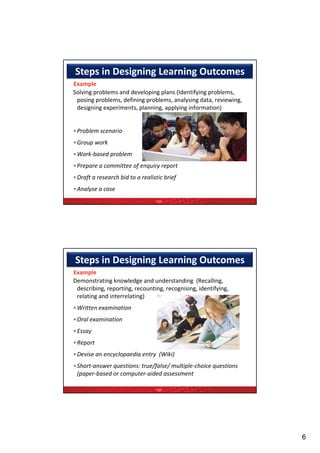
Solving problems and developing plans (Identifying problems, 
 posing problems, defining problems, analysing data, reviewing, 
 designing experiments, planning, applying information) 
 designing experiments planning applying information)


•Problem scenario  
•Group work  
•Work‐based problem  
            p
•Prepare a committee of enquiry report  
•Draft a research bid to a realistic brief  
•Analyse a case 
                                  TQF


Steps in Designing Learning Outcomes
Example 
Demonstrating knowledge and understanding  (Recalling, 
 describing, reporting, recounting, recognising, identifying, 
 relating and interrelating)  
 relating and interrelating)
•Written examination  
•Oral examination  
•Essay  
   p
•Report  
•Devise an encyclopaedia entry  (Wiki)
•Short‐answer questions: true/false/ multiple‐choice questions 
 (paper‐based or computer‐aided assessment

                                  TQF


                                                                   6
Steps in Designing Learning Outcomes
Example 
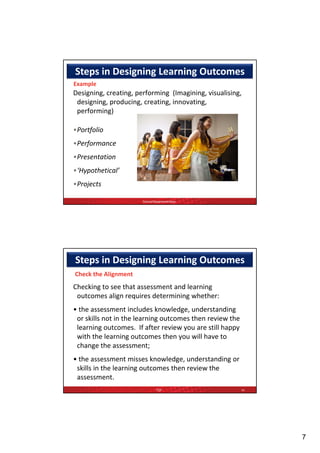
Designing, creating, performing  (Imagining, visualising, 
 designing, producing, creating, innovating, 
 performing)  

•Portfolio  
•Performance  
•Presentation  
•Presentation
•‘Hypothetical’  
•Projects 

                       School/Department/Area


Steps in Designing Learning Outcomes
Check the Alignment
Checking to see that assessment and learning 
 outcomes align requires determining whether:  
 outcomes align requires determining whether:
• the assessment includes knowledge, understanding 
 or skills not in the learning outcomes then review the 
 learning outcomes.  If after review you are still happy 
 with the learning outcomes then you will have to 
 change the assessment; 
 change the assessment;
• the assessment misses knowledge, understanding or 
 skills in the learning outcomes then review the 
 assessment.
                               TQF                       14


                                                              7
Core Principles of Effective Assessment 
Objectives for higher education assessment

1. Assessment that guides and encourages effective 
   approaches to learning
2. Assessment that validly and reliably measures 
   expected learning outcomes, in particular the higher‐
   order learning that characterises higher education
3. Assessment and grading that define and protect 
   academic standards


                          Adapted from the Centre for the Study of Higher Education, University of Melbourne


Core Principles of Effective Assessment 
Well designed assessment should …
1. set clear expectations
2. establish a reasonable 
   workload (one that does not 
   push students into rote 
   reproductive approaches to 
   study)
3. provide opportunities for 
3       id        t iti f
   students to self‐monitor, 
   rehearse, practise and 
   receive feedback.

                               TQF


                                                                                                               8
Core Principles of Effective Assessment 


Core Principles of Effective Assessment 


                                           9
Core Principles of Effective Assessment 
  16 INDICATORS OF EFFECTIVE ASSESSMENT IN HIGHER 
                        EDUCATION
       A checklist for quality in student assessment
       A h kli f          li i       d

  1. Assessment is treated by staff and students as an integral component 
      of the entire teaching and learning process.
  2. The multiple roles of assessment are recognised. The powerful 
      motivating effect of assessment requirements on students is 
      understood and assessment tasks are designed to foster valued 
      understood and assessment tasks are designed to foster valued
      study habits.
  3. There is a faculty/departmental policy that guides assessment 
      practices. Subject assessment is integrated into an overall plan for 
      course assessment.


Core Principles of Effective Assessment 


 4. There is a clear alignment between expected learning outcomes, what is 
     taught and learnt, and the knowledge, skills (and attitudes) assessed.
 5. Assessment tasks assess the capacity to analyse and synthesis new 
     information and concepts rather than simply recall information which 
     has been presented.
     h b               d
 6. A variety of assessment methods is employed so that the limitations of 
     particular methods are minimised.
 7. Assessment tasks are designed to assess relevant generic skills as well 
     as subject‐specific knowledge and skills.


                                                                               10
Core Principles of Effective Assessment 
8. There is a steady progression in the complexity and demands of assessment 
    requirements in the later years of courses.
9. There is provision for student choice in assessment tasks and weighting at 
    certain times.
    certain times
10. Student and staff workloads are considered in the scheduling and design of 
    assessment tasks.
11. Excessive assessment is avoided. Assessment tasks are designed to sample 
    student learning.
12. Assessment tasks are weighted to balance the developmental (‘formative’) 
    and judgemental (‘summative’) roles of assessment. Early low‐stakes, low‐
    and judgemental (‘summative’) roles of assessment Early low stakes low
    weight assessment is used to provide students with feedback.


Core Principles of Effective Assessment 
 13. Grades are calculated and reported on the basis of clearly articulated 
     learning outcomes and criteria for levels of achievement.
                        p       y        g                           g
 14. Students receive explanatory and diagnostic feedback as well as grades.
 15. Assessment tasks are checked to ensure there are no inherent biases 
     that may disadvantage particular student groups.
 16. Plagiarism is minimised through careful task design, explicit education 
     and appropriate monitoring of academic honesty.


                                                                                  11
Core Principles of Effective Assessment 
What students value in assessment


  • Unambiguous expectations
  • ‘Authentic’ tasks 
  • Choice and flexibility  


                      Feedback
Why Feedback?


•Without feedback, mistakes go uncorrected  and good 
 performance is not reinforced.

•Without feedback, our learners may not know how 
 they are doing, if they are doing well, or if there are 
 elements of their performance that need to be 
  l     t f th i       f         th t      dt b
 improved so that they can be competent.  


                                                            12
Feedback


 •Minimal Feedback/Reinforcement
  Mi i l F db k/R i f          t
 •Evaluation
 •Feedback

                                     How do They Differ?


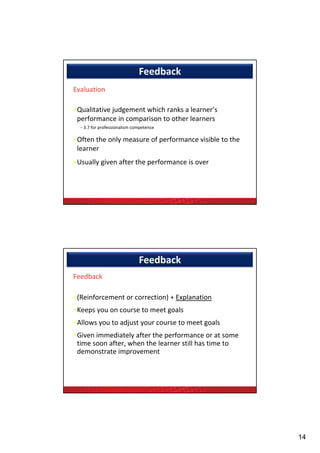
                             Feedback
   Reinforcement/
   Minimal Feedback
•Statements expressing positive (or 
•Statements expressing positive (or
 negative) reaction to a behaviour
 which aims to increase (or 
 decrease) the likelihood of that 
 behaviour happening again 
  –“That was a great presentation”
  –“You need to work on your 
   presentation skills”
            i    kill ”
•Often mistaken for feedback
  –Timing is similar ‐ immediate


                                                           13
Feedback
Evaluation

•Qualitative judgement which ranks a learner’s 
 Q lit ti j d        t hi h     k l         ’
 performance in comparison to other learners
  – 3.7 for professionalism competence

•Often the only measure of performance visible to the 
 learner
•Usually given after the performance is over 


                              Feedback
Feedback

•(Reinforcement or correction) + Explanation
•(Reinforcement or correction) + Explanation
•Keeps you on course to meet goals
•Allows you to adjust your course to meet goals
•Given immediately after the performance or at some 
 time soon after, when the learner still has time to 
 time soon after, when the learner still has time to
 demonstrate improvement


                                                         14
Barriers to Feedback
…as it is part of other training cultures


          Barriers to Feedback
   Barriers


 •It is uncomfortable
 •It is uncomfortable
   –Avoid confrontation 
   –Learner will not be 
    receptive
   –No one ever gave me 
    feedback
   –Not quite sure how to do it
   –I hated getting feedback


                                            15
Barriers to Feedback


                      •I’m not sure of the goals or the 
                                           g
                       expected behaviour
                      •Not sure that the observed 
                       behaviour is really a problem
                        –Need to see it twice
                      •It’s not my job
                      •It’s not that important
                      •There’s not enough time


   Essential Components of Feedback
What are they?


   •What was done well
   •What could be done better
                            p
   •What could be done to improve next time


                                                           16
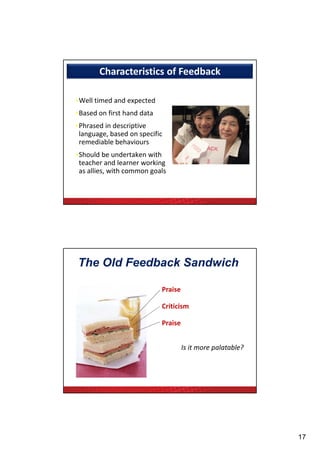
Characteristics of Feedback

 •Well timed and expected
 •Based on first hand data
 •Phrased in descriptive 
  language, based on specific 
  remediable behaviours
 •Should be undertaken with
  Should be undertaken with 
  teacher and learner working 
  as allies, with common goals


Ende J. Feedback in Clinical Medical Education. JAMA 1983;250:777-781.


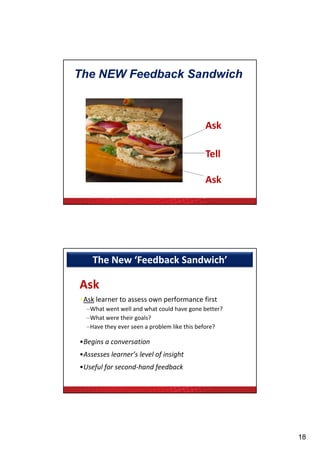
  The Old Feedback Sandwich

                                    Praise

                                    Criticism

                                    Praise


                                             Is it more palatable?
                                                          l bl ?


                                                                         17
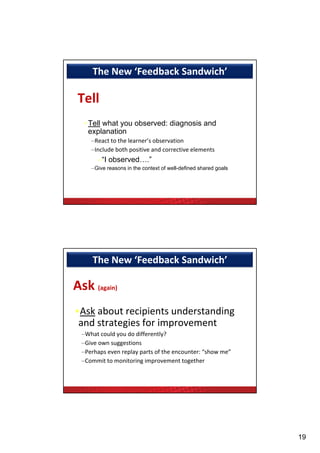
The NEW Feedback Sandwich


                                                                  Ask

                                                                  Tell

                                                                  Ask
Adaptation of “The New Feedback Sandwich,’ common in patient-physician communication
literature; adapted by Lyuba Konopasek, MD, for use in feedback settings.


           The New ‘Feedback Sandwich’ 

     Ask
     •Ask learner to assess own performance first
        –What went well and what could have gone better?
        –What were their goals?
        –Have they ever seen a problem like this before?

     •Begins a conversation
        g
     •Assesses learner’s level of insight 
     •Useful for second‐hand feedback


                                                                                       18
The New ‘Feedback Sandwich’ 

 Tell
   • Tell what you observed: diagnosis and
     explanation
     –React to the learner’s observation
     –Include both positive and corrective elements
       –“I observed….”
     –Give reasons in the context of well-defined shared goals


      The New ‘Feedback Sandwich’ 

Ask (again)
•Ask about recipients understanding 
 and strategies for improvement
  –What could you do differently?
   Give own suggestions
  –Give own suggestions
  –Perhaps even replay parts of the encounter: “show me”
  –Commit to monitoring improvement together


                                                                 19
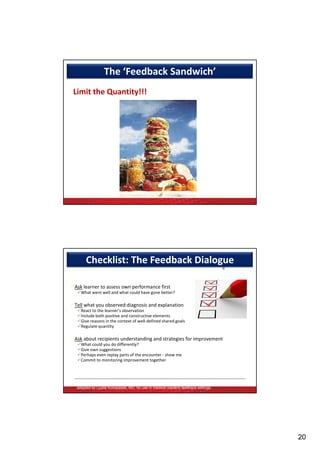
The ‘Feedback Sandwich’
 Limit the Quantity!!!


       Checklist: The Feedback Dialogue

Ask learner to assess own performance first
   What went well and what could have gone better?

Tell what you observed:diagnosis and explanation
   React to the learner’s observation
   Include both positive and constructive elements
   Give reasons in the context of well‐defined shared goals
   Regulate quantity

Ask about recipients understanding and strategies for improvement
   What could you do differently?
   What could you do differently?
   Give own suggestions
   Perhaps even replay parts of the encounter ‐ show me
   Commit to monitoring improvement together


  Adaptation of “The New Feedback Sandwich,’ common in patient-physician communication literature;
  adapted by Lyuba Konopasek, MD, for use in medical resident feedback settings.


                                                                                                     20
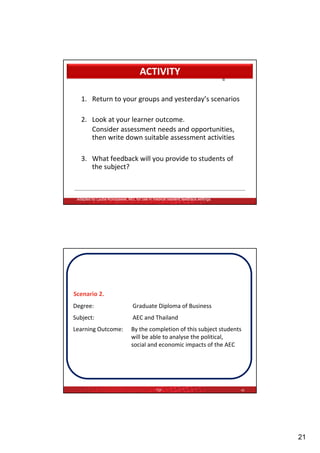
ACTIVITY

   1. Return to your groups and yesterday’s scenarios

   2. Look at your learner outcome.
      Consider assessment needs and opportunities, 
      then write down suitable assessment activities 

   3. What feedback will you provide to students of 
   3 Wh f db k ill               id        d      f
      the subject?


 Adaptation of “The New Feedback Sandwich,’ common in patient-physician communication literature;
 adapted by Lyuba Konopasek, MD, for use in medical resident feedback settings.


Scenario 2.
Degree:                         Graduate Diploma of Business
Subject:                        AEC and Thailand
Learning Outcome:               By the completion of this subject students 
                                will be able to analyse the political, 
                                social and economic impacts of the AEC
                                social and economic impacts of the AEC


                                              TQF                                              42


                                                                                                    21
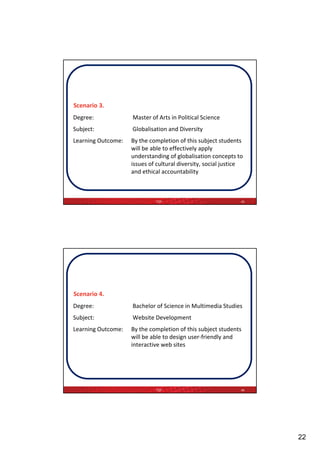
Scenario 3.
Degree:              Master of Arts in Political Science
Subject:             Globalisation and Diversity
Learning Outcome:    By the completion of this subject students 
                     will be able to effectively apply 
                     understanding of globalisation concepts to 
                     understanding of globalisation concepts to
                     issues of cultural diversity, social justice 
                     and ethical accountability


                              TQF                               43


Scenario 4.
Degree:              Bachelor of Science in Multimedia Studies
Subject:             Website Development
Learning Outcome:    By the completion of this subject students 
                     will be able to design user‐friendly and 
                     interactive web sites
                     interactive web sites


                              TQF                               44


                                                                     22
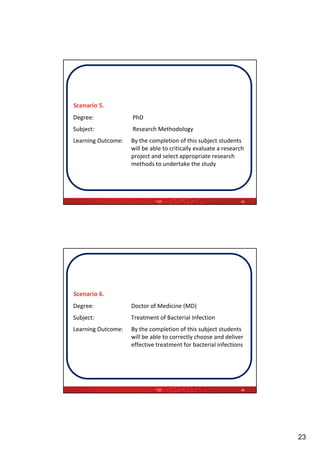
Scenario 5.
Degree:              PhD
Subject:             Research Methodology
Learning Outcome:    By the completion of this subject students 
                     will be able to critically evaluate a research 
                     project and select appropriate research 
                     project and select appropriate research
                     methods to undertake the study


                               TQF                                45


Scenario 6.
Degree:              Doctor of Medicine (MD)
Subject:             Treatment of Bacterial Infection
Learning Outcome:    By the completion of this subject students 
                     will be able to correctly choose and deliver 
                     effective treatment for bacterial infections
                     effective treatment for bacterial infections


                               TQF                                46


                                                                       23
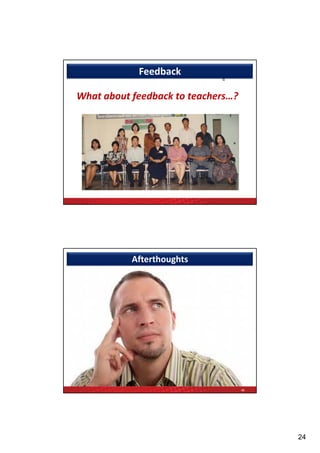
Feedback

What about feedback to teachers…?


           Afterthoughts


                                    48


                                         24
Evaluations


THANK YOU
                49


                     25

Tqf day 2 - assessment and feedback

  • 1.
  • 2.
    Sessions 3 & 4: Learning Objective By the end of these two sessions the  participants will be able to link learning  participants will be able to link learning outcomes with assessment, and strengthen teaching practice through effective feedback. TQF What are the purposes of assessment? 2
  • 3.
    There is nothing tofear from changes in assessment practices What are the purposes of assessment? • to measure students’ preparedness for further study or  professional accreditation , , • to rank students, relative to one another, for the  purposes of competitive scholarships or other  opportunities • to provide feedback on student learning for both  students and staff 3
  • 4.
    What are the purposes of assessment? • to provide feedback  to provide feedback on teaching for staff • to define and protect  academic standards • to direct students’  learning What are your experiences  in assessment? 4
  • 5.
    Steps in Designing Learning Outcomes Step 5: Determining Assessment  •Fair, equitable and transparent. • Must reflect the learning outcomes •Incorporate a range of types or modes of  assessment appropriate to the nature of the  unit, method of delivery and the students  involved •Design appropriate assessment strategies  that ideally engage the learners in activities  they can relate to real‐life or workplace  situations TQF Steps in Designing Learning Outcomes Example  Thinking critically and making judgments  (Developing arguments,  reflecting, evaluating, assessing, judging)   •Essay   •Report   •Journal   •Letter of advice to … (about policy, public health matters … )   •Present a case for an interest group   •Prepare a committee briefing paper for a specific meeting   •Book review (or article) for a particular journal   •Write a newspaper article for a foreign newspaper  TQF 5
  • 6.
    Steps in Designing Learning Outcomes Example  Solving problems and developing plans (Identifying problems,  posing problems, defining problems, analysing data, reviewing,  designing experiments, planning, applying information)  designing experiments planning applying information) •Problem scenario   •Group work   •Work‐based problem   p •Prepare a committee of enquiry report   •Draft a research bid to a realistic brief   •Analyse a case  TQF Steps in Designing Learning Outcomes Example  Demonstrating knowledge and understanding  (Recalling,  describing, reporting, recounting, recognising, identifying,  relating and interrelating)   relating and interrelating) •Written examination   •Oral examination   •Essay   p •Report   •Devise an encyclopaedia entry  (Wiki) •Short‐answer questions: true/false/ multiple‐choice questions  (paper‐based or computer‐aided assessment TQF 6
  • 7.
    Steps in Designing Learning Outcomes Example  Designing, creating, performing  (Imagining, visualising,  designing, producing, creating, innovating,  performing)   •Portfolio   •Performance   •Presentation   •Presentation •‘Hypothetical’   •Projects  School/Department/Area Steps in Designing Learning Outcomes Check the Alignment Checking to see that assessment and learning  outcomes align requires determining whether:   outcomes align requires determining whether: • the assessment includes knowledge, understanding  or skills not in the learning outcomes then review the  learning outcomes.  If after review you are still happy  with the learning outcomes then you will have to  change the assessment;  change the assessment; • the assessment misses knowledge, understanding or  skills in the learning outcomes then review the  assessment. TQF 14 7
  • 8.
    Core Principles of Effective Assessment  Objectives for higher education assessment 1. Assessment that guides and encourages effective  approaches to learning 2. Assessment that validly and reliably measures  expected learning outcomes, in particular the higher‐ order learning that characterises higher education 3. Assessment and grading that define and protect  academic standards Adapted from the Centre for the Study of Higher Education, University of Melbourne Core Principles of Effective Assessment  Well designed assessment should … 1. set clear expectations 2. establish a reasonable  workload (one that does not  push students into rote  reproductive approaches to  study) 3. provide opportunities for  3 id t iti f students to self‐monitor,  rehearse, practise and  receive feedback. TQF 8
  • 9.
  • 10.
    Core Principles of Effective Assessment  16 INDICATORS OF EFFECTIVE ASSESSMENT IN HIGHER  EDUCATION A checklist for quality in student assessment A h kli f li i d 1. Assessment is treated by staff and students as an integral component  of the entire teaching and learning process. 2. The multiple roles of assessment are recognised. The powerful  motivating effect of assessment requirements on students is  understood and assessment tasks are designed to foster valued  understood and assessment tasks are designed to foster valued study habits. 3. There is a faculty/departmental policy that guides assessment  practices. Subject assessment is integrated into an overall plan for  course assessment. Core Principles of Effective Assessment  4. There is a clear alignment between expected learning outcomes, what is  taught and learnt, and the knowledge, skills (and attitudes) assessed. 5. Assessment tasks assess the capacity to analyse and synthesis new  information and concepts rather than simply recall information which  has been presented. h b d 6. A variety of assessment methods is employed so that the limitations of  particular methods are minimised. 7. Assessment tasks are designed to assess relevant generic skills as well  as subject‐specific knowledge and skills. 10
  • 11.
    Core Principles of Effective Assessment  8. There is a steady progression in the complexity and demands of assessment  requirements in the later years of courses. 9. There is provision for student choice in assessment tasks and weighting at  certain times. certain times 10. Student and staff workloads are considered in the scheduling and design of  assessment tasks. 11. Excessive assessment is avoided. Assessment tasks are designed to sample  student learning. 12. Assessment tasks are weighted to balance the developmental (‘formative’)  and judgemental (‘summative’) roles of assessment. Early low‐stakes, low‐ and judgemental (‘summative’) roles of assessment Early low stakes low weight assessment is used to provide students with feedback. Core Principles of Effective Assessment  13. Grades are calculated and reported on the basis of clearly articulated  learning outcomes and criteria for levels of achievement. p y g g 14. Students receive explanatory and diagnostic feedback as well as grades. 15. Assessment tasks are checked to ensure there are no inherent biases  that may disadvantage particular student groups. 16. Plagiarism is minimised through careful task design, explicit education  and appropriate monitoring of academic honesty. 11
  • 12.
    Core Principles of Effective Assessment  What students value in assessment •Unambiguous expectations • ‘Authentic’ tasks  • Choice and flexibility   Feedback Why Feedback? •Without feedback, mistakes go uncorrected  and good  performance is not reinforced. •Without feedback, our learners may not know how  they are doing, if they are doing well, or if there are  elements of their performance that need to be  l t f th i f th t dt b improved so that they can be competent.   12
  • 13.
    Feedback •Minimal Feedback/Reinforcement Mi i l F db k/R i f t •Evaluation •Feedback How do They Differ? Feedback Reinforcement/ Minimal Feedback •Statements expressing positive (or  •Statements expressing positive (or negative) reaction to a behaviour which aims to increase (or  decrease) the likelihood of that  behaviour happening again  –“That was a great presentation” –“You need to work on your  presentation skills” i kill ” •Often mistaken for feedback –Timing is similar ‐ immediate 13
  • 14.
    Feedback Evaluation •Qualitative judgement which ranks a learner’s  Qlit ti j d t hi h k l ’ performance in comparison to other learners – 3.7 for professionalism competence •Often the only measure of performance visible to the  learner •Usually given after the performance is over  Feedback Feedback •(Reinforcement or correction) + Explanation •(Reinforcement or correction) + Explanation •Keeps you on course to meet goals •Allows you to adjust your course to meet goals •Given immediately after the performance or at some  time soon after, when the learner still has time to  time soon after, when the learner still has time to demonstrate improvement 14
  • 15.
    Barriers to Feedback …as it ispart of other training cultures Barriers to Feedback Barriers •It is uncomfortable •It is uncomfortable –Avoid confrontation  –Learner will not be  receptive –No one ever gave me  feedback –Not quite sure how to do it –I hated getting feedback 15
  • 16.
    Barriers to Feedback •I’m not sure of the goals or the  g expected behaviour •Not sure that the observed  behaviour is really a problem –Need to see it twice •It’s not my job •It’s not that important •There’s not enough time Essential Components of Feedback What are they? •What was done well •What could be done better p •What could be done to improve next time 16
  • 17.
    Characteristics of Feedback •Well timed and expected •Based on first hand data •Phrased in descriptive  language, based on specific  remediable behaviours •Should be undertaken with Should be undertaken with  teacher and learner working  as allies, with common goals Ende J. Feedback in Clinical Medical Education. JAMA 1983;250:777-781. The Old Feedback Sandwich Praise Criticism Praise Is it more palatable? l bl ? 17
  • 18.
    The NEW FeedbackSandwich Ask Tell Ask Adaptation of “The New Feedback Sandwich,’ common in patient-physician communication literature; adapted by Lyuba Konopasek, MD, for use in feedback settings. The New ‘Feedback Sandwich’  Ask •Ask learner to assess own performance first –What went well and what could have gone better? –What were their goals? –Have they ever seen a problem like this before? •Begins a conversation g •Assesses learner’s level of insight  •Useful for second‐hand feedback 18
  • 19.
    The New ‘Feedback Sandwich’  Tell • Tell what you observed: diagnosis and explanation –React to the learner’s observation –Include both positive and corrective elements –“I observed….” –Give reasons in the context of well-defined shared goals The New ‘Feedback Sandwich’  Ask (again) •Ask about recipients understanding  and strategies for improvement –What could you do differently? Give own suggestions –Give own suggestions –Perhaps even replay parts of the encounter: “show me” –Commit to monitoring improvement together 19
  • 20.
    The ‘Feedback Sandwich’ Limit the Quantity!!! Checklist: The Feedback Dialogue Ask learner to assess own performance first What went well and what could have gone better? Tell what you observed:diagnosis and explanation React to the learner’s observation Include both positive and constructive elements Give reasons in the context of well‐defined shared goals Regulate quantity Ask about recipients understanding and strategies for improvement What could you do differently? What could you do differently? Give own suggestions Perhaps even replay parts of the encounter ‐ show me Commit to monitoring improvement together Adaptation of “The New Feedback Sandwich,’ common in patient-physician communication literature; adapted by Lyuba Konopasek, MD, for use in medical resident feedback settings. 20
  • 21.
    ACTIVITY 1. Return to your groups and yesterday’s scenarios 2. Look at your learner outcome. Consider assessment needs and opportunities,  then write down suitable assessment activities  3. What feedback will you provide to students of  3 Wh f db k ill id d f the subject? Adaptation of “The New Feedback Sandwich,’ common in patient-physician communication literature; adapted by Lyuba Konopasek, MD, for use in medical resident feedback settings. Scenario 2. Degree: Graduate Diploma of Business Subject: AEC and Thailand Learning Outcome:  By the completion of this subject students  will be able to analyse the political,  social and economic impacts of the AEC social and economic impacts of the AEC TQF 42 21
  • 22.
    Scenario 3. Degree: Master of Arts in Political Science Subject: Globalisation and Diversity Learning Outcome:  By the completion of this subject students  will be able to effectively apply  understanding of globalisation concepts to  understanding of globalisation concepts to issues of cultural diversity, social justice  and ethical accountability TQF 43 Scenario 4. Degree: Bachelor of Science in Multimedia Studies Subject: Website Development Learning Outcome:  By the completion of this subject students  will be able to design user‐friendly and  interactive web sites interactive web sites TQF 44 22
  • 23.
    Scenario 5. Degree: PhD Subject: Research Methodology Learning Outcome:  By the completion of this subject students  will be able to critically evaluate a research  project and select appropriate research  project and select appropriate research methods to undertake the study TQF 45 Scenario 6. Degree: Doctor of Medicine (MD) Subject: Treatment of Bacterial Infection Learning Outcome:  By the completion of this subject students  will be able to correctly choose and deliver  effective treatment for bacterial infections effective treatment for bacterial infections TQF 46 23
  • 24.
  • 25.