TEXT STRUCTURE
Discourse analysis
Teacher: HectorVega
Student:Valentina Espinosa
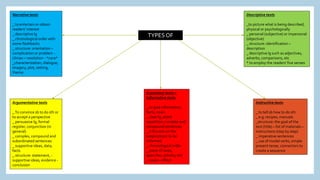
TYPES OF
TEXTS
Argumentative texts
_To convince sb to do sth or
to accept a perspective
_ persuasive lg, formal
register, conjunction (in
general)
_ complex, compound and
subordinated sentences
_ supportive ideas, data,
facts
_ structure: statement, -
supportive ideas, evidence -
conclusion
Narrative texts
_ to entertain or obtain
readers’ interest
_ descriptive lg
_ chronological order with
some flashbacks
_ structure: orientation –
complication or problem -
climax – resolution - *cora*
_characterization, dialogue,
imagery, plot, setting,
theme.
Descriptive texts
_to picture what is being described,
physical or psychologically
_ personal (subjective) or impersonal
(objective)
_ structure: identification –
description
_ descriptive lg such as adjectives,
adverbs, comparisons, etc
* to employ the readers’ five senses
Instructive texts
_ to tell sb how to do sth
_ e.g: recipes, manuals
_structure: the goal of the
text (title) – list of materials –
instructions (step by step)
_ imperative sentences
_ use of modal verbs, simple
present tense, connectors to
create a sequence
Expository texts =
Informative texts
_ to give information,
facts, news
_ clear lg, avoid
repetition, complex and
compound sentences
_ it focuses on the
subject/topic to be
informed
_ chronological order
_ piece of news,
speeches, articles, etc
_ cause - effect

D.a types of texts

  • 1.
    TEXT STRUCTURE Discourse analysis Teacher:HectorVega Student:Valentina Espinosa
  • 2.
    TYPES OF TEXTS Argumentative texts _Toconvince sb to do sth or to accept a perspective _ persuasive lg, formal register, conjunction (in general) _ complex, compound and subordinated sentences _ supportive ideas, data, facts _ structure: statement, - supportive ideas, evidence - conclusion Narrative texts _ to entertain or obtain readers’ interest _ descriptive lg _ chronological order with some flashbacks _ structure: orientation – complication or problem - climax – resolution - *cora* _characterization, dialogue, imagery, plot, setting, theme. Descriptive texts _to picture what is being described, physical or psychologically _ personal (subjective) or impersonal (objective) _ structure: identification – description _ descriptive lg such as adjectives, adverbs, comparisons, etc * to employ the readers’ five senses Instructive texts _ to tell sb how to do sth _ e.g: recipes, manuals _structure: the goal of the text (title) – list of materials – instructions (step by step) _ imperative sentences _ use of modal verbs, simple present tense, connectors to create a sequence Expository texts = Informative texts _ to give information, facts, news _ clear lg, avoid repetition, complex and compound sentences _ it focuses on the subject/topic to be informed _ chronological order _ piece of news, speeches, articles, etc _ cause - effect