





How to Get the Best Out of
Your Students in a Rigorous
 Mathematics Classroom
              M Dor
               onica cz
                      Sources:
       Lead4Ward STAAR 3D and Bloom’s Taxonomy
Know Your Curriculum
Make sure that you fully understand your curriculum, the vertical

          alignment and how to intervene when necessary.

  Once you do, it is time to bring the rigor up like you never have

     before. We will be discussing how to incorporate Bloom’s

Taxonomy and rigorous strategies to ensure you are teaching to a

 higher level where students are actively and consistently proving

their deep conceptual understanding of core academic concepts.
Source: Lead4Ward STAAR 3D                              Sept. 19, 2012   2
7 Ways to RENEW
                   Instruction
    O Talk with Students

    O Ask great questions

    O Check for understanding

    O Learn from mistakes

    O Wait time

    O Pace instruction

    O Teach for transfer
Source: Lead4Ward STAAR 3D      Sept. 19, 2012   3
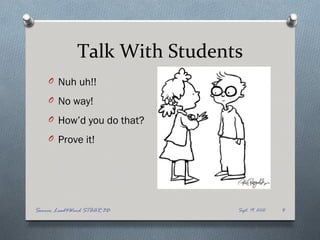
Talk With Students
    O Nuh uh!!

    O No way!

    O How’d you do that?

    O Prove it!


Source: Lead4Ward STAAR 3D     Sept. 19, 2012   4
Ask Great Questions
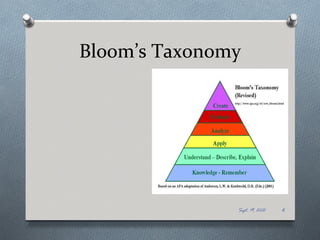
    O Bloom’s Taxonomy

    O That student’s themselves can answer

    O Try to intrigue them

    O Expand the answer from correct to

       “complete”
    O “Why” or “How”


Source: Lead4Ward STAAR 3D                   Sept. 19, 2012   5
Bloom’s Taxonomy


               Sept. 19, 2012   6
Knowledge Levels
   Learn terms

   Facts

   Methods

   Procedures

   Concepts
http://montemath.com/bloomstaxonomyformath.pdf   Sept. 19, 2012   7
Knowledge Verbs
   Draw, Recognize
   Count, Group
   Reproduce
   Memorize
   State
   Tabulate
   Identify
   Point
   Follow Directions
http://montemath.com/bloomstaxonomyformath.pdf   Sept. 19, 2012   8
Knowledge Tasks
    Identify different place

       values
    State the mode, mean,

       median, and range
       from your set of data.
    Reproduce a circle

       using a compass?
http://montemath.com/bloomstaxonomyformath.pdf   Sept. 19, 2012   9
Understand Levels
   Terms

   Facts

   Methods

   Procedures

   Concepts

http://montemath.com/bloomstaxonomyformath.pdf   Sept. 19, 2012   10
Understand Verbs
  Change
  Classify
  Convert, Estimate,
  Interpret, Measure,
  Put in Order, Show,
  Suggest,
  Express in other terms
http://montemath.com/bloomstaxonomyformath.pdf   Sept. 19, 2012   11
Understand Tasks
  Classify polygons by
   regularity, concavity and
   line symmetry.
  Explain how to convert
   between fractions,
   decimals, and percents.
  What is your
   interpretation of the data
   expressed on the graph?


http://montemath.com/bloomstaxonomyformath.pdf   Sept. 19, 2012   12
Apply Levels
   O Practice theory,
     solve problems,
     use
   O Information in the
     new situations


http://montemath.com/bloomstaxonomyformath.pdf   Sept. 19, 2012   13
Apply Verbs
    Calculate, Compute,
    Construct,
    Demonstrate,
    Derive, Graph,
    Manipulate,
    Operate,
    Practice, Prove,
    Solve
http://montemath.com/bloomstaxonomyformath.pdf   Sept. 19, 2012   14
Apply Tasks
   Calculate the percent
    of a given whole?
   Solve for the area of a
    rectangle by using
    A= l x w.
   What information do
    you consider when
    graphing data derived
    from a survey?
http://montemath.com/bloomstaxonomyformath.pdf   Sept. 19, 2012   15
Analyze Levels
       Analyze structure,
       recognize
       assumptions,
       breaking down
       material into parts


http://montemath.com/bloomstaxonomyformath.pdf   Sept. 19, 2012   16
Analyze Verbs
       Break down,
       Deduce, Diagram,
       Distinguish,
       Formulate, Group,
       Order, Separate,
       Simplify,
       Sort

http://montemath.com/bloomstaxonomyformath.pdf   Sept. 19, 2012   17
Analyze Tasks
    What methods can be
     used to compare and
     order fractions?
    Analyze the relationship
     between variables on a
     graph.
    What factors do you
     consider when
     formulating a plan for
     problem solving?
http://montemath.com/bloomstaxonomyformath.pdf   Sept. 19, 2012   18
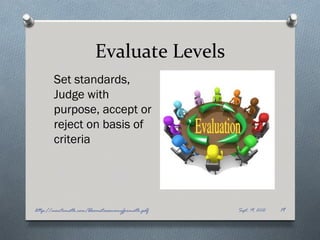
Evaluate Levels
       Set standards,
       Judge with
       purpose, accept or
       reject on basis of
       criteria


http://montemath.com/bloomstaxonomyformath.pdf   Sept. 19, 2012   19
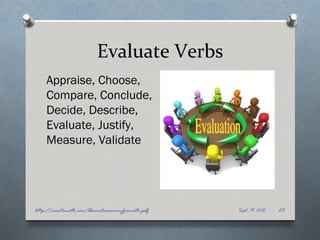
Evaluate Verbs
    Appraise, Choose,
    Compare, Conclude,
    Decide, Describe,
    Evaluate, Justify,
    Measure, Validate


http://montemath.com/bloomstaxonomyformath.pdf   Sept. 19, 2012   20
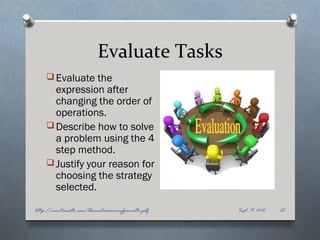
Evaluate Tasks
     Evaluate the
      expression after
      changing the order of
      operations.
     Describe how to solve
      a problem using the 4
      step method.
     Justify your reason for
      choosing the strategy
      selected.

http://montemath.com/bloomstaxonomyformath.pdf   Sept. 19, 2012   21
Create Levels
       Putting information
       together into a new
       and creative way.


http://montemath.com/bloomstaxonomyformath.pdf   Sept. 19, 2012   22
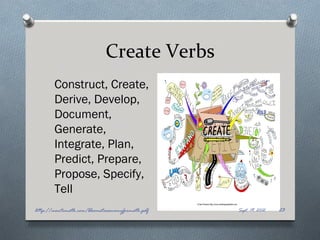
Create Verbs
       Construct, Create,
       Derive, Develop,
       Document,
       Generate,
       Integrate, Plan,
       Predict, Prepare,
       Propose, Specify,
       Tell
http://montemath.com/bloomstaxonomyformath.pdf   Sept. 19, 2012   23
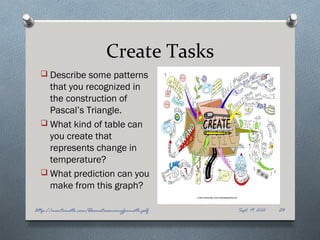
Create Tasks
   Describe some patterns
    that you recognized in
    the construction of
    Pascal’s Triangle.
   What kind of table can
    you create that
    represents change in
    temperature?
   What prediction can you
    make from this graph?

http://montemath.com/bloomstaxonomyformath.pdf   Sept. 19, 2012   24
Bloom’s Activity Discussion
 Give examples of how a perimeter lesson
   might look at each level of Bloom’s
   Taxonomy.

 O   Knowledge
 O   Understand
 O   Apply
 O   Analyze
 O   Evaluate
 O   Create
                                    Sept. 19, 2012   25
Check for Understanding
    O Focus should be more on the extended
       response of the student, rather than the
       question itself
    O Tickets out the door

    O Think-pair-share

    O CBAs


Source: Lead4Ward STAAR 3D                    Sept. 19, 2012   26
Allow Students to Learn
         from Their Mistakes
  “Great teachers allow students to fail just enough so
   they can discuss and learn from it.” ~ Ervin Knezek

       Procedural Errors
       Application Errors
       Conceptual Errors

Source: Lead4Ward STAAR 3D                   Sept. 19, 2012   27
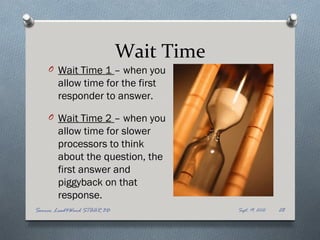
Wait Time
    O Wait Time 1 – when you
       allow time for the first
       responder to answer.
    O Wait Time 2 – when you
       allow time for slower
       processors to think
       about the question, the
       first answer and
       piggyback on that
       response.
Source: Lead4Ward STAAR 3D               Sept. 19, 2012   28
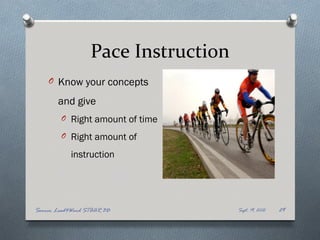
Pace Instruction
    O Know your concepts

       and give
         O Right amount of time

         O Right amount of

            instruction


Source: Lead4Ward STAAR 3D            Sept. 19, 2012   29
Teach for Transfer
     “Are we giving tricycle problems to students who
     are responsible for taking a motorcycle test?” ~
                     Ervin Knezek – Lead4Ward


Source: Lead4Ward STAAR 3D                      Sept. 19, 2012   30
Rigor in the classroom
       O Develop a set of best management
           practices

       O Develop strategies for establishing
           instructional goals

       O Document progress toward these goals


       O Assess rigor in the classroom

http://edge.ascd.org/_Seven-Myths-About-Rigor/blog/3235457/127586.html   Sept. 19, 2012   31
Components of Rigor
O Content acquisition

O Critical thinking

O Relevance

O Integration

O Application of concepts

O Long term retention

O Responsibility

                            Sept. 19, 2012   32
Rigor Is…                                 Rigor Is Not…
  More effort
  For every student
  Quality
  Messy and Free Ranging
  All levels of Bloom’s
  Intentional
  Builds Self Regulation
  Risky (Uncertainty)
  Challenging
  Relevant
  Relative
http://edge.ascd.org/_Seven-Myths-About-Rigor/blog/3235457/127586.html   Sept. 19, 2012   33
Strategies
O Interactive Journals

O Multiple Representations

O Problem-solving

O Collaboration

O Wait Time

O Vocabulary
                             Sept. 19, 2012   34
Authentic Problem Solving
O Students actively explore, research and solve complex

  problems to develop a deep understanding of core
  academic concepts.
O Increasing rigor means time and opportunity for students

  to consistently think critically about their content.
O Students analyze, collaborate, connect, identify patterns,

  evaluate outcomes, speculate on possibilities and
  assess value.
                                                    Sept. 19, 2012   35
AfterMATHs

O Clear expectations


O Higher test scores


O Improved math skills


O Higher ordered thinking skills


                                   Sept. 19, 2012   36

Rigor2

  • 1.
    How to Getthe Best Out of Your Students in a Rigorous Mathematics Classroom M Dor onica cz Sources: Lead4Ward STAAR 3D and Bloom’s Taxonomy
  • 2.
    Know Your Curriculum Makesure that you fully understand your curriculum, the vertical alignment and how to intervene when necessary. Once you do, it is time to bring the rigor up like you never have before. We will be discussing how to incorporate Bloom’s Taxonomy and rigorous strategies to ensure you are teaching to a higher level where students are actively and consistently proving their deep conceptual understanding of core academic concepts. Source: Lead4Ward STAAR 3D Sept. 19, 2012 2
  • 3.
    7 Ways toRENEW Instruction O Talk with Students O Ask great questions O Check for understanding O Learn from mistakes O Wait time O Pace instruction O Teach for transfer Source: Lead4Ward STAAR 3D Sept. 19, 2012 3
  • 4.
    Talk With Students O Nuh uh!! O No way! O How’d you do that? O Prove it! Source: Lead4Ward STAAR 3D Sept. 19, 2012 4
  • 5.
    Ask Great Questions O Bloom’s Taxonomy O That student’s themselves can answer O Try to intrigue them O Expand the answer from correct to “complete” O “Why” or “How” Source: Lead4Ward STAAR 3D Sept. 19, 2012 5
  • 6.
    Bloom’s Taxonomy Sept. 19, 2012 6
  • 7.
    Knowledge Levels Learn terms Facts Methods Procedures Concepts http://montemath.com/bloomstaxonomyformath.pdf Sept. 19, 2012 7
  • 8.
    Knowledge Verbs Draw, Recognize Count, Group Reproduce Memorize State Tabulate Identify Point Follow Directions http://montemath.com/bloomstaxonomyformath.pdf Sept. 19, 2012 8
  • 9.
    Knowledge Tasks  Identify different place values  State the mode, mean, median, and range from your set of data.  Reproduce a circle using a compass? http://montemath.com/bloomstaxonomyformath.pdf Sept. 19, 2012 9
  • 10.
    Understand Levels Terms Facts Methods Procedures Concepts http://montemath.com/bloomstaxonomyformath.pdf Sept. 19, 2012 10
  • 11.
    Understand Verbs Change Classify Convert, Estimate, Interpret, Measure, Put in Order, Show, Suggest, Express in other terms http://montemath.com/bloomstaxonomyformath.pdf Sept. 19, 2012 11
  • 12.
    Understand Tasks Classify polygons by regularity, concavity and line symmetry.  Explain how to convert between fractions, decimals, and percents.  What is your interpretation of the data expressed on the graph? http://montemath.com/bloomstaxonomyformath.pdf Sept. 19, 2012 12
  • 13.
    Apply Levels O Practice theory, solve problems, use O Information in the new situations http://montemath.com/bloomstaxonomyformath.pdf Sept. 19, 2012 13
  • 14.
    Apply Verbs Calculate, Compute, Construct, Demonstrate, Derive, Graph, Manipulate, Operate, Practice, Prove, Solve http://montemath.com/bloomstaxonomyformath.pdf Sept. 19, 2012 14
  • 15.
    Apply Tasks  Calculate the percent of a given whole?  Solve for the area of a rectangle by using A= l x w.  What information do you consider when graphing data derived from a survey? http://montemath.com/bloomstaxonomyformath.pdf Sept. 19, 2012 15
  • 16.
    Analyze Levels Analyze structure, recognize assumptions, breaking down material into parts http://montemath.com/bloomstaxonomyformath.pdf Sept. 19, 2012 16
  • 17.
    Analyze Verbs Break down, Deduce, Diagram, Distinguish, Formulate, Group, Order, Separate, Simplify, Sort http://montemath.com/bloomstaxonomyformath.pdf Sept. 19, 2012 17
  • 18.
    Analyze Tasks  What methods can be used to compare and order fractions?  Analyze the relationship between variables on a graph.  What factors do you consider when formulating a plan for problem solving? http://montemath.com/bloomstaxonomyformath.pdf Sept. 19, 2012 18
  • 19.
    Evaluate Levels Set standards, Judge with purpose, accept or reject on basis of criteria http://montemath.com/bloomstaxonomyformath.pdf Sept. 19, 2012 19
  • 20.
    Evaluate Verbs Appraise, Choose, Compare, Conclude, Decide, Describe, Evaluate, Justify, Measure, Validate http://montemath.com/bloomstaxonomyformath.pdf Sept. 19, 2012 20
  • 21.
    Evaluate Tasks  Evaluate the expression after changing the order of operations.  Describe how to solve a problem using the 4 step method.  Justify your reason for choosing the strategy selected. http://montemath.com/bloomstaxonomyformath.pdf Sept. 19, 2012 21
  • 22.
    Create Levels Putting information together into a new and creative way. http://montemath.com/bloomstaxonomyformath.pdf Sept. 19, 2012 22
  • 23.
    Create Verbs Construct, Create, Derive, Develop, Document, Generate, Integrate, Plan, Predict, Prepare, Propose, Specify, Tell http://montemath.com/bloomstaxonomyformath.pdf Sept. 19, 2012 23
  • 24.
    Create Tasks  Describe some patterns that you recognized in the construction of Pascal’s Triangle.  What kind of table can you create that represents change in temperature?  What prediction can you make from this graph? http://montemath.com/bloomstaxonomyformath.pdf Sept. 19, 2012 24
  • 25.
    Bloom’s Activity Discussion Give examples of how a perimeter lesson might look at each level of Bloom’s Taxonomy. O Knowledge O Understand O Apply O Analyze O Evaluate O Create Sept. 19, 2012 25
  • 26.
    Check for Understanding O Focus should be more on the extended response of the student, rather than the question itself O Tickets out the door O Think-pair-share O CBAs Source: Lead4Ward STAAR 3D Sept. 19, 2012 26
  • 27.
    Allow Students toLearn from Their Mistakes “Great teachers allow students to fail just enough so they can discuss and learn from it.” ~ Ervin Knezek Procedural Errors Application Errors Conceptual Errors Source: Lead4Ward STAAR 3D Sept. 19, 2012 27
  • 28.
    Wait Time O Wait Time 1 – when you allow time for the first responder to answer. O Wait Time 2 – when you allow time for slower processors to think about the question, the first answer and piggyback on that response. Source: Lead4Ward STAAR 3D Sept. 19, 2012 28
  • 29.
    Pace Instruction O Know your concepts and give O Right amount of time O Right amount of instruction Source: Lead4Ward STAAR 3D Sept. 19, 2012 29
  • 30.
    Teach for Transfer “Are we giving tricycle problems to students who are responsible for taking a motorcycle test?” ~ Ervin Knezek – Lead4Ward Source: Lead4Ward STAAR 3D Sept. 19, 2012 30
  • 31.
    Rigor in theclassroom O Develop a set of best management practices O Develop strategies for establishing instructional goals O Document progress toward these goals O Assess rigor in the classroom http://edge.ascd.org/_Seven-Myths-About-Rigor/blog/3235457/127586.html Sept. 19, 2012 31
  • 32.
    Components of Rigor OContent acquisition O Critical thinking O Relevance O Integration O Application of concepts O Long term retention O Responsibility Sept. 19, 2012 32
  • 33.
    Rigor Is… Rigor Is Not…  More effort  For every student  Quality  Messy and Free Ranging  All levels of Bloom’s  Intentional  Builds Self Regulation  Risky (Uncertainty)  Challenging  Relevant  Relative http://edge.ascd.org/_Seven-Myths-About-Rigor/blog/3235457/127586.html Sept. 19, 2012 33
  • 34.
    Strategies O Interactive Journals OMultiple Representations O Problem-solving O Collaboration O Wait Time O Vocabulary Sept. 19, 2012 34
  • 35.
    Authentic Problem Solving OStudents actively explore, research and solve complex problems to develop a deep understanding of core academic concepts. O Increasing rigor means time and opportunity for students to consistently think critically about their content. O Students analyze, collaborate, connect, identify patterns, evaluate outcomes, speculate on possibilities and assess value. Sept. 19, 2012 35
  • 36.
    AfterMATHs O Clear expectations OHigher test scores O Improved math skills O Higher ordered thinking skills Sept. 19, 2012 36