Assessing and Expanding Soil Health
for Productivity, Economic, and Environmental Benefits
A project funded in part by the Foundation for Food and Agriculture
leveraging matching funds and the missions and capacities of
Photo credit: erieconserves.org
Safeguard and enhance
the vitality and
productivity of soil
through scientific
research and
advancement.
Conserve the lands and
waters on which all life
depends.
Measure and
communicate the
economic and
environmental
benefits of different
soil management
strategies.
2018 Soil and Water Conservation Society 2018 Annual Meeting, Albuquerque, New Mexico
Paul W. Tracy – SHI Project Manager
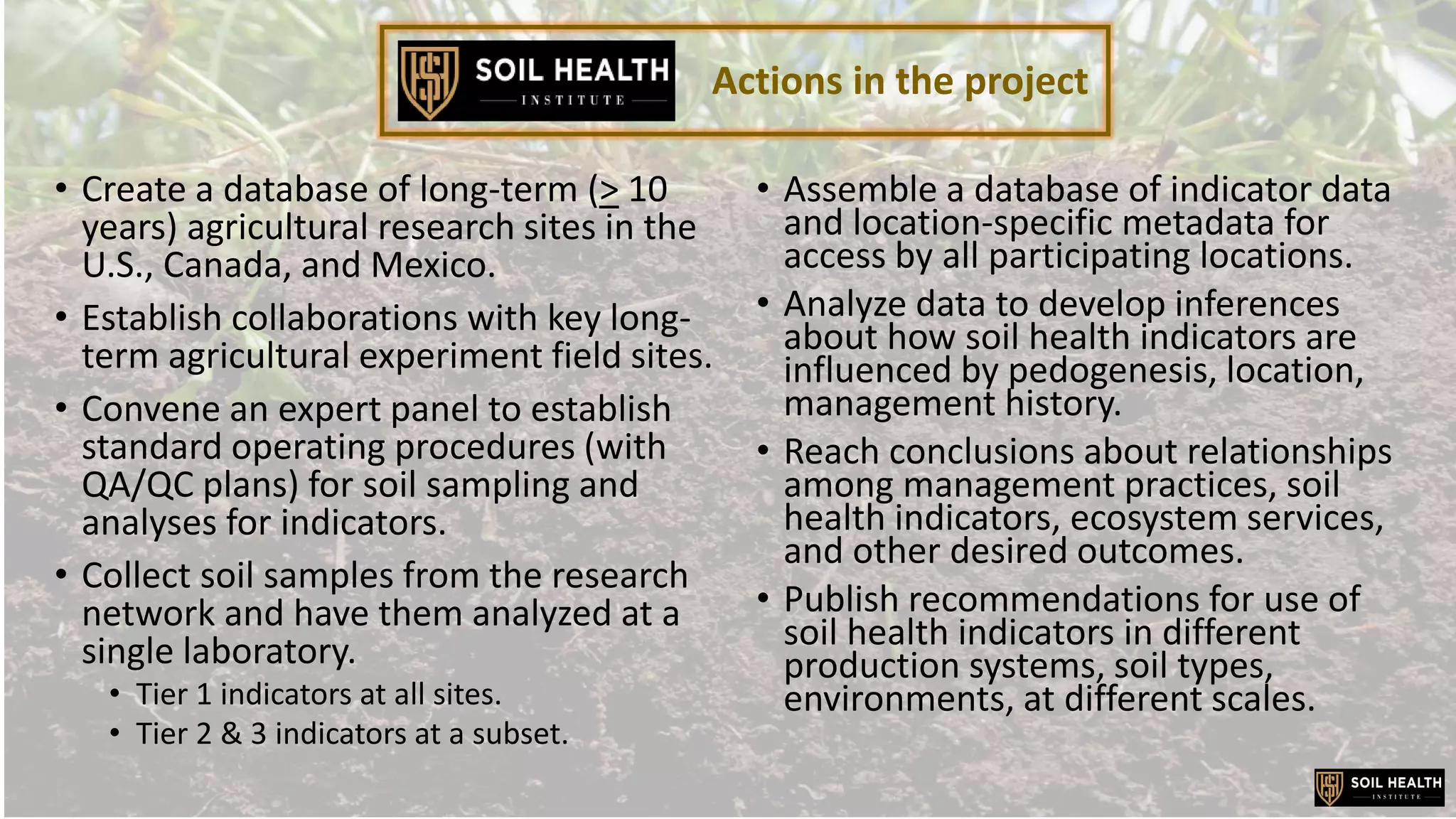
Actions in the project
• Create a database of long-term (> 10
years) agricultural research sites in the
U.S., Canada, and Mexico.
• Establish collaborations with key long-
term agricultural experiment field sites.
• Convene an expert panel to establish
standard operating procedures (with
QA/QC plans) for soil sampling and
analyses for indicators.
• Collect soil samples from the research
network and have them analyzed at a
single laboratory.
• Tier 1 indicators at all sites.
• Tier 2 & 3 indicators at a subset.
• Assemble a database of indicator data
and location-specific metadata for
access by all participating locations.
• Analyze data to develop inferences
about how soil health indicators are
influenced by pedogenesis, location,
management history.
• Reach conclusions about relationships
among management practices, soil
health indicators, ecosystem services,
and other desired outcomes.
• Publish recommendations for use of
soil health indicators in different
production systems, soil types,
environments, at different scales.
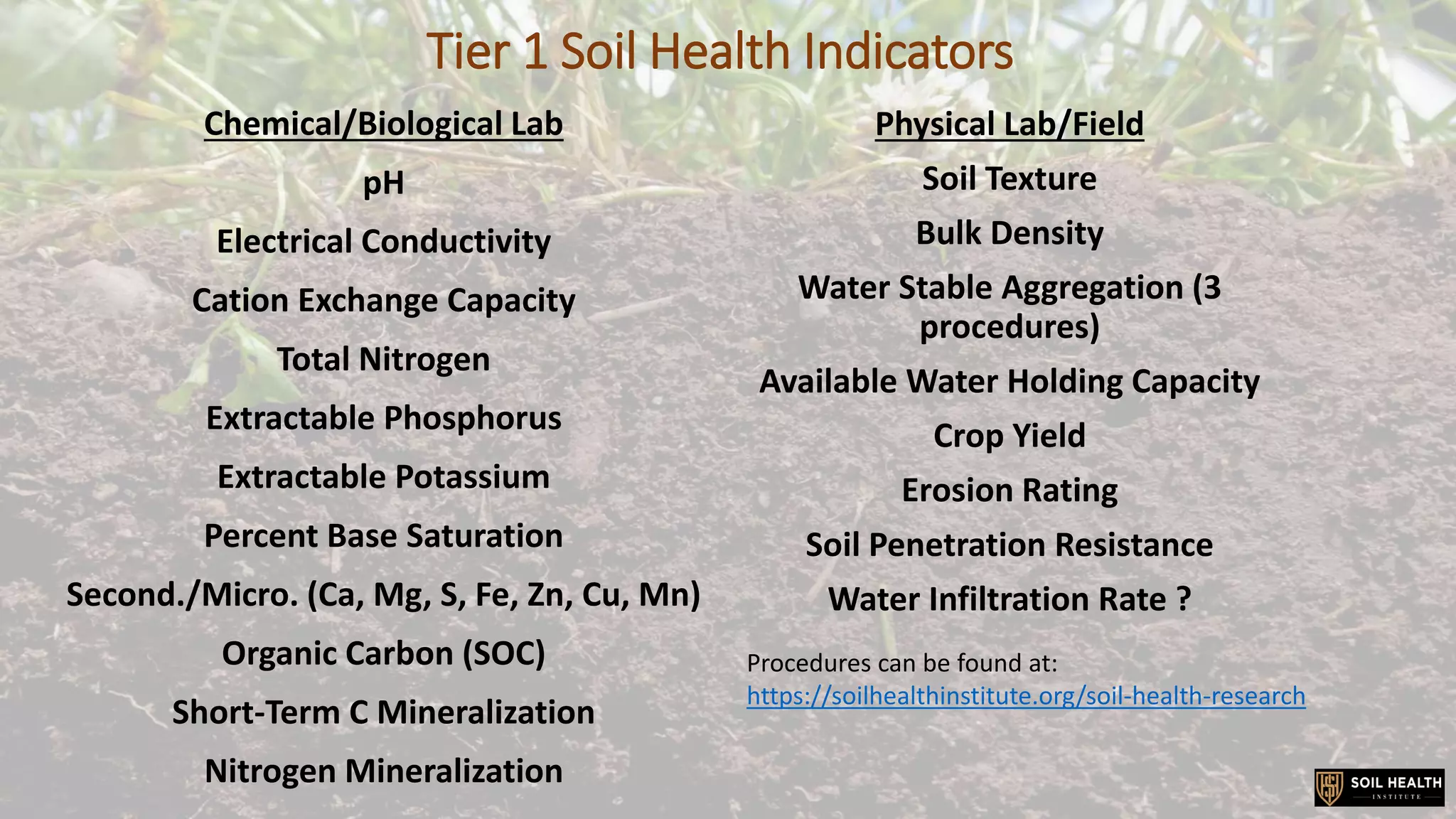
Tier 1 Soil Health Indicators
Chemical/Biological Lab
pH
Electrical Conductivity
Cation Exchange Capacity
Total Nitrogen
Extractable Phosphorus
Extractable Potassium
Percent Base Saturation
Second./Micro. (Ca, Mg, S, Fe, Zn, Cu, Mn)
Organic Carbon (SOC)
Short-Term C Mineralization
Nitrogen Mineralization
Physical Lab/Field
Soil Texture
Bulk Density
Water Stable Aggregation (3
procedures)
Available Water Holding Capacity
Crop Yield
Erosion Rating
Soil Penetration Resistance
Water Infiltration Rate ?
Procedures can be found at:
https://soilhealthinstitute.org/soil-health-research
Tier 2 & 3 Soil Health Indicators
Sodium Adsorption Ratio (SAR)
EA’s: B-Glucosidase, B-Glucosaminidase
Phosphatase, Arylsulfatase
Soil Protein Index – Autoclave Citrate Extractable
Active Carbon – Permanganate Oxidizable C (POXC)
Phospholipid Fatty Acid (PLFA) (small subset?)
Ester-Linked Fatty Acid Methyl Ester (EL-FAME) (small subset?)
Genomics (all samples or large subset)
Reflectance
Others (indicators from frameworks/index programs)
Procedures can be found at: https://soilhealthinstitute.org/soil-health-research
Soil Health Index programs
Soil Management Assessment Framework (SMAF)
Cornell Comprehensive Assessment of Soil Health
(CASH)
Haney Soil Test
Long-term agricultural research sites entered into the Web-GIS
program to date (July 20, 2018)
• 121 sites total
• 34 U.S. States (92 sites)
• 4 Canadian Provinces (19 sites)
• 9 Mexican States (10 sites)
• AB, AGU, AL, AR, CA, CO, DE, FL, GA, HID, IA, ID, IL, IN, KS, KY, MB,
MEX, MI, MIC, MN, MO, MOR, MT, NC, ND, NE, NY, OAX, OH, OK,
ON, OR, PA, QTO, SC, SD, SK, SLP, SON,TN, TX, VA, WA, WI, WV
• USDA LTAR/GRACEnet/CEAP (currently being added)
SHI Web-GIS: 121 sites entered (July 20, 2018)
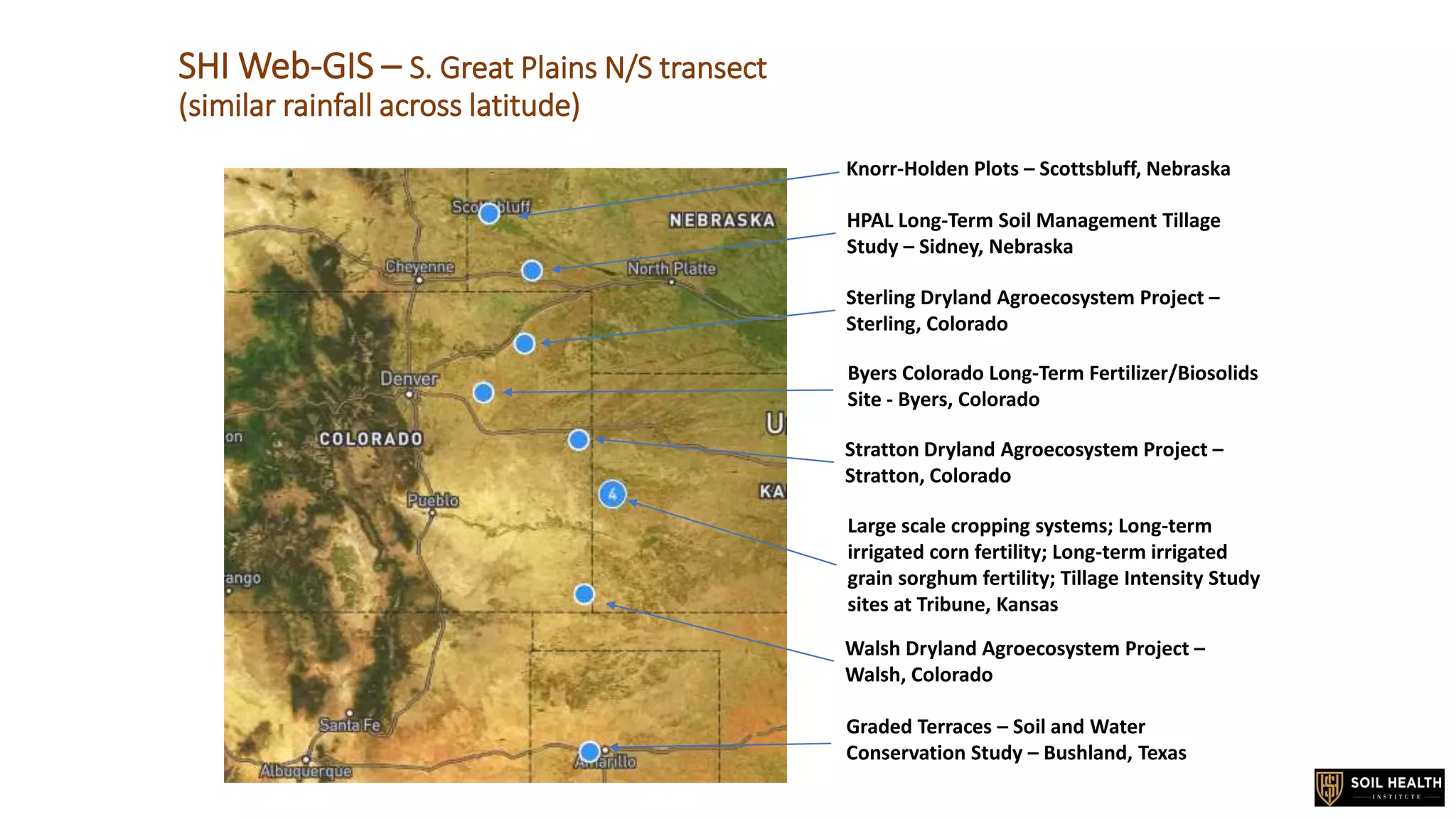
SHI Web-GIS – S. Great Plains N/S transect
(similar rainfall across latitude)
Knorr-Holden Plots – Scottsbluff, Nebraska
HPAL Long-Term Soil Management Tillage
Study – Sidney, Nebraska
Sterling Dryland Agroecosystem Project –
Sterling, Colorado
Byers Colorado Long-Term Fertilizer/Biosolids
Site - Byers, Colorado
Stratton Dryland Agroecosystem Project –
Stratton, Colorado
Large scale cropping systems; Long-term
irrigated corn fertility; Long-term irrigated
grain sorghum fertility; Tillage Intensity Study
sites at Tribune, Kansas
Walsh Dryland Agroecosystem Project –
Walsh, Colorado
Graded Terraces – Soil and Water
Conservation Study – Bushland, Texas
Using the SHI WEB-GIS program to evaluate individual sites
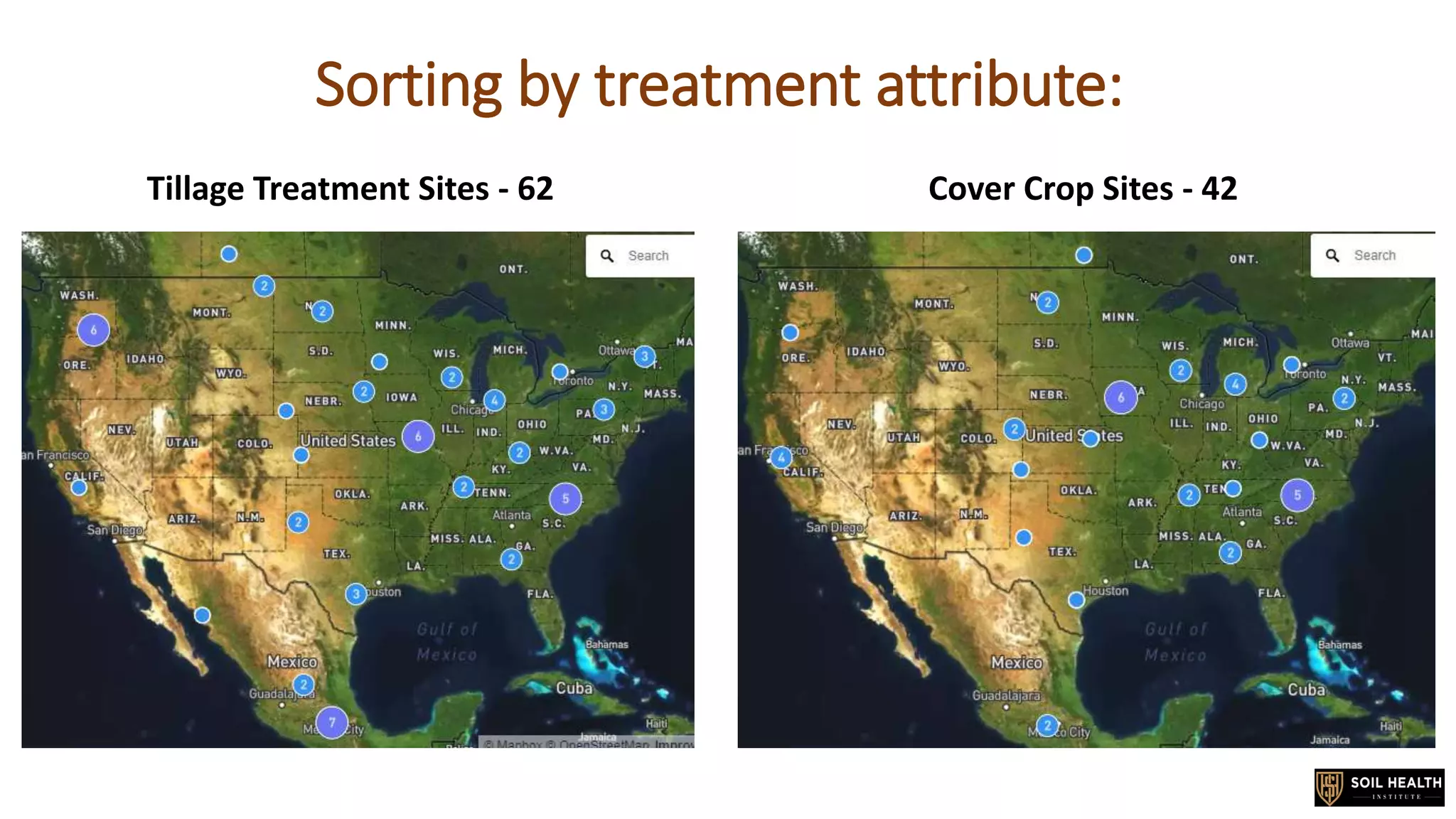
Sorting by treatment attribute:
Tillage Treatment Sites - 62 Cover Crop Sites - 42
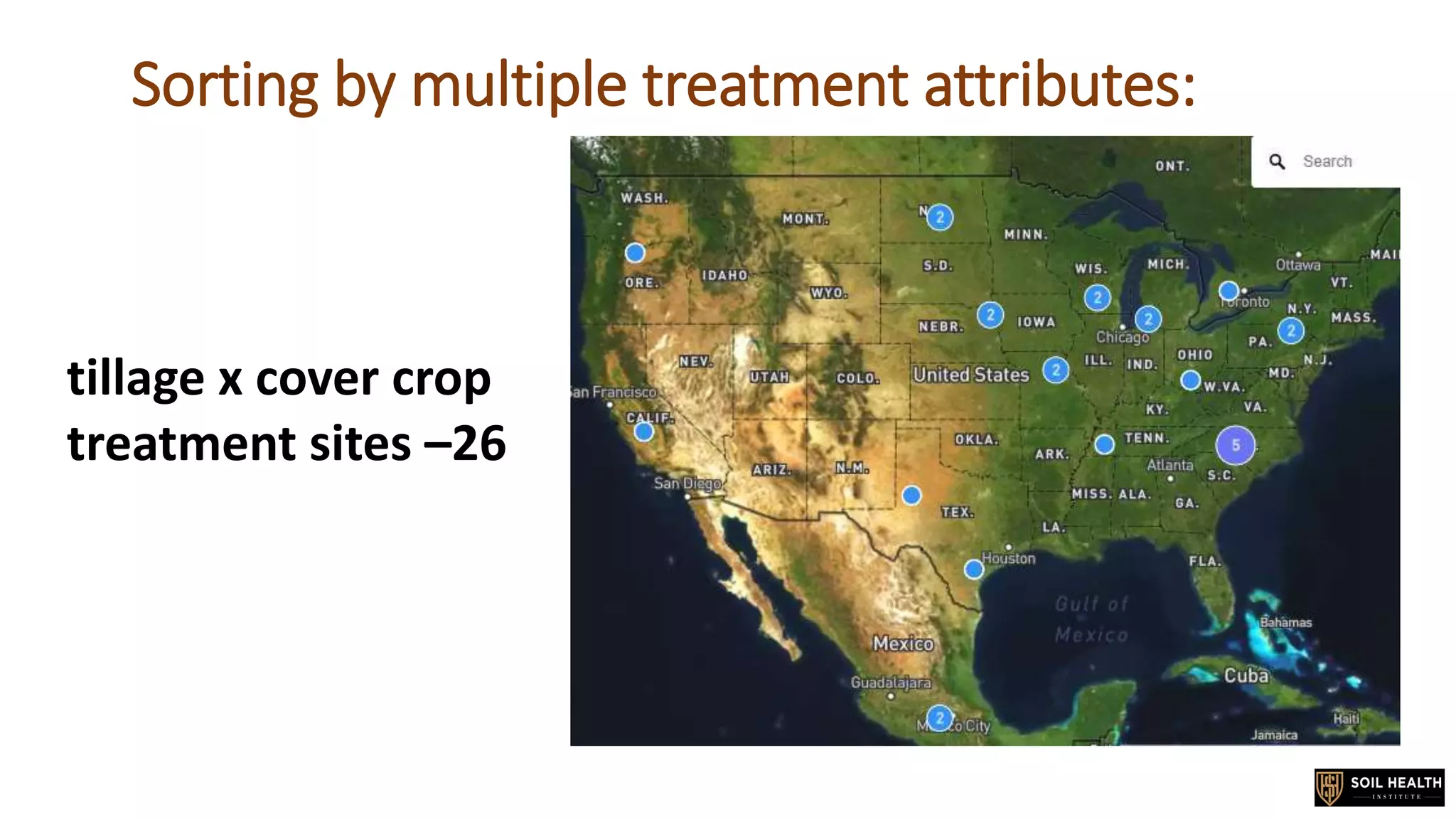
Sorting by multiple treatment attributes:
tillage x cover crop
treatment sites –26
Soil health influencing prioritizations for intensive
sampling sites or treatments within sites
1) Soil disturbance
2) Soil cover (amount, active)
3) Species diversity
4) Soil nutrition
5) Others (irrigation, drainage, etc.)
Targeted timelines
• Make final site selections Sept., 2018
• Laboratory selections Sept., 2018
• Principle Investigator workshops Oct. 2018 – Jan. 2019
• Sample all selected sites Feb. 2019 – June 2019
• Finish laboratory analysis Fall of 2019
• Data interpretation Fall of 2019 – Dec. 2020
Thank You

Assessing and expanding soil health

  • 1.
    Assessing and ExpandingSoil Health for Productivity, Economic, and Environmental Benefits A project funded in part by the Foundation for Food and Agriculture leveraging matching funds and the missions and capacities of Photo credit: erieconserves.org Safeguard and enhance the vitality and productivity of soil through scientific research and advancement. Conserve the lands and waters on which all life depends. Measure and communicate the economic and environmental benefits of different soil management strategies. 2018 Soil and Water Conservation Society 2018 Annual Meeting, Albuquerque, New Mexico Paul W. Tracy – SHI Project Manager
  • 2.
    Actions in theproject • Create a database of long-term (> 10 years) agricultural research sites in the U.S., Canada, and Mexico. • Establish collaborations with key long- term agricultural experiment field sites. • Convene an expert panel to establish standard operating procedures (with QA/QC plans) for soil sampling and analyses for indicators. • Collect soil samples from the research network and have them analyzed at a single laboratory. • Tier 1 indicators at all sites. • Tier 2 & 3 indicators at a subset. • Assemble a database of indicator data and location-specific metadata for access by all participating locations. • Analyze data to develop inferences about how soil health indicators are influenced by pedogenesis, location, management history. • Reach conclusions about relationships among management practices, soil health indicators, ecosystem services, and other desired outcomes. • Publish recommendations for use of soil health indicators in different production systems, soil types, environments, at different scales.
  • 3.
    Tier 1 SoilHealth Indicators Chemical/Biological Lab pH Electrical Conductivity Cation Exchange Capacity Total Nitrogen Extractable Phosphorus Extractable Potassium Percent Base Saturation Second./Micro. (Ca, Mg, S, Fe, Zn, Cu, Mn) Organic Carbon (SOC) Short-Term C Mineralization Nitrogen Mineralization Physical Lab/Field Soil Texture Bulk Density Water Stable Aggregation (3 procedures) Available Water Holding Capacity Crop Yield Erosion Rating Soil Penetration Resistance Water Infiltration Rate ? Procedures can be found at: https://soilhealthinstitute.org/soil-health-research
  • 4.
    Tier 2 &3 Soil Health Indicators Sodium Adsorption Ratio (SAR) EA’s: B-Glucosidase, B-Glucosaminidase Phosphatase, Arylsulfatase Soil Protein Index – Autoclave Citrate Extractable Active Carbon – Permanganate Oxidizable C (POXC) Phospholipid Fatty Acid (PLFA) (small subset?) Ester-Linked Fatty Acid Methyl Ester (EL-FAME) (small subset?) Genomics (all samples or large subset) Reflectance Others (indicators from frameworks/index programs) Procedures can be found at: https://soilhealthinstitute.org/soil-health-research
  • 5.
    Soil Health Indexprograms Soil Management Assessment Framework (SMAF) Cornell Comprehensive Assessment of Soil Health (CASH) Haney Soil Test
  • 6.
    Long-term agricultural researchsites entered into the Web-GIS program to date (July 20, 2018) • 121 sites total • 34 U.S. States (92 sites) • 4 Canadian Provinces (19 sites) • 9 Mexican States (10 sites) • AB, AGU, AL, AR, CA, CO, DE, FL, GA, HID, IA, ID, IL, IN, KS, KY, MB, MEX, MI, MIC, MN, MO, MOR, MT, NC, ND, NE, NY, OAX, OH, OK, ON, OR, PA, QTO, SC, SD, SK, SLP, SON,TN, TX, VA, WA, WI, WV • USDA LTAR/GRACEnet/CEAP (currently being added)
  • 7.
    SHI Web-GIS: 121sites entered (July 20, 2018)
  • 8.
    SHI Web-GIS –S. Great Plains N/S transect (similar rainfall across latitude) Knorr-Holden Plots – Scottsbluff, Nebraska HPAL Long-Term Soil Management Tillage Study – Sidney, Nebraska Sterling Dryland Agroecosystem Project – Sterling, Colorado Byers Colorado Long-Term Fertilizer/Biosolids Site - Byers, Colorado Stratton Dryland Agroecosystem Project – Stratton, Colorado Large scale cropping systems; Long-term irrigated corn fertility; Long-term irrigated grain sorghum fertility; Tillage Intensity Study sites at Tribune, Kansas Walsh Dryland Agroecosystem Project – Walsh, Colorado Graded Terraces – Soil and Water Conservation Study – Bushland, Texas
  • 9.
    Using the SHIWEB-GIS program to evaluate individual sites
  • 10.
    Sorting by treatmentattribute: Tillage Treatment Sites - 62 Cover Crop Sites - 42
  • 11.
    Sorting by multipletreatment attributes: tillage x cover crop treatment sites –26
  • 12.
    Soil health influencingprioritizations for intensive sampling sites or treatments within sites 1) Soil disturbance 2) Soil cover (amount, active) 3) Species diversity 4) Soil nutrition 5) Others (irrigation, drainage, etc.)
  • 13.
    Targeted timelines • Makefinal site selections Sept., 2018 • Laboratory selections Sept., 2018 • Principle Investigator workshops Oct. 2018 – Jan. 2019 • Sample all selected sites Feb. 2019 – June 2019 • Finish laboratory analysis Fall of 2019 • Data interpretation Fall of 2019 – Dec. 2020
  • 14.